
MET377 Surface Engineering Tribology What is


Description: MET377 Surface Engineering Tribology What is tribology? Tribology is defined as the science and technology of interacting surfaces in relative motion, having its origin in the Greek word tribos meaning rubbing. It is a study of the
Related Topics
Download Presentation
"MET377 Surface Engineering Tribology What is" is the property of its rightful owner. Permission is granted to download and print the materials on this website for personal, non-commercial use only, and to display it on your personal computer provided you do not modify the materials and that you retain all copyright notices contained in the materials. By downloading content from our website, you accept the terms of this agreement.
Presentation Transcript
slide1. MET377
Surface Engineering Tribology<br>
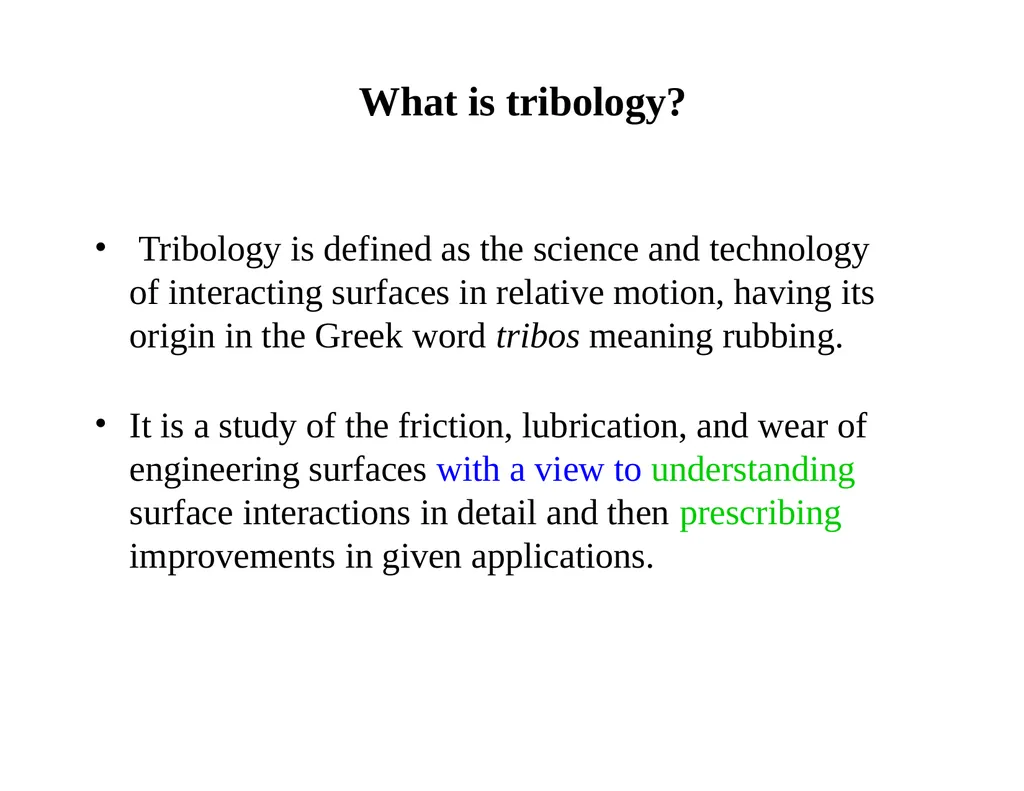
slide2. What is tribology? Tribology is defined as the science and technology of interacting surfaces in relative motion, having its origin in the Greek word tribos meaning rubbing.
It is a study of the friction, lubrication, and wear of engineering surfaces with a view to understanding surface interactions in detail and then prescribing improvements in given applications.<br>
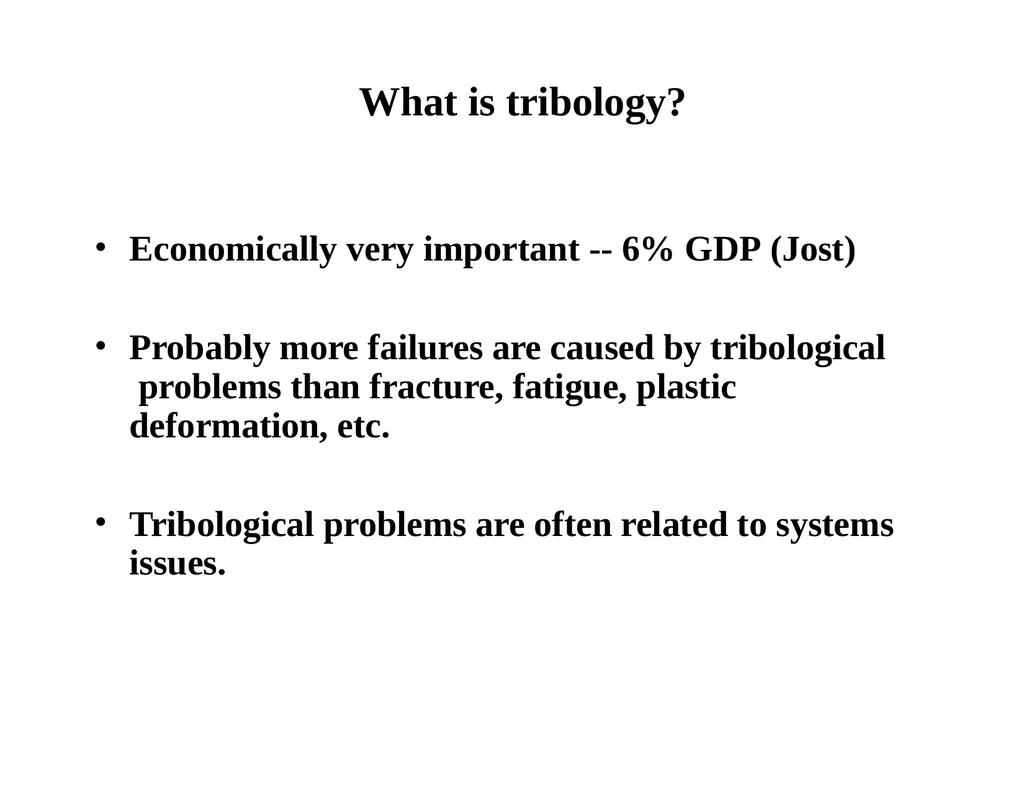
slide3. What is tribology? Economically very important -- 6% GDP (Jost)
Probably more failures are caused by tribological problems than fracture, fatigue, plastic deformation, etc.
Tribological problems are often related to systems issues.<br>
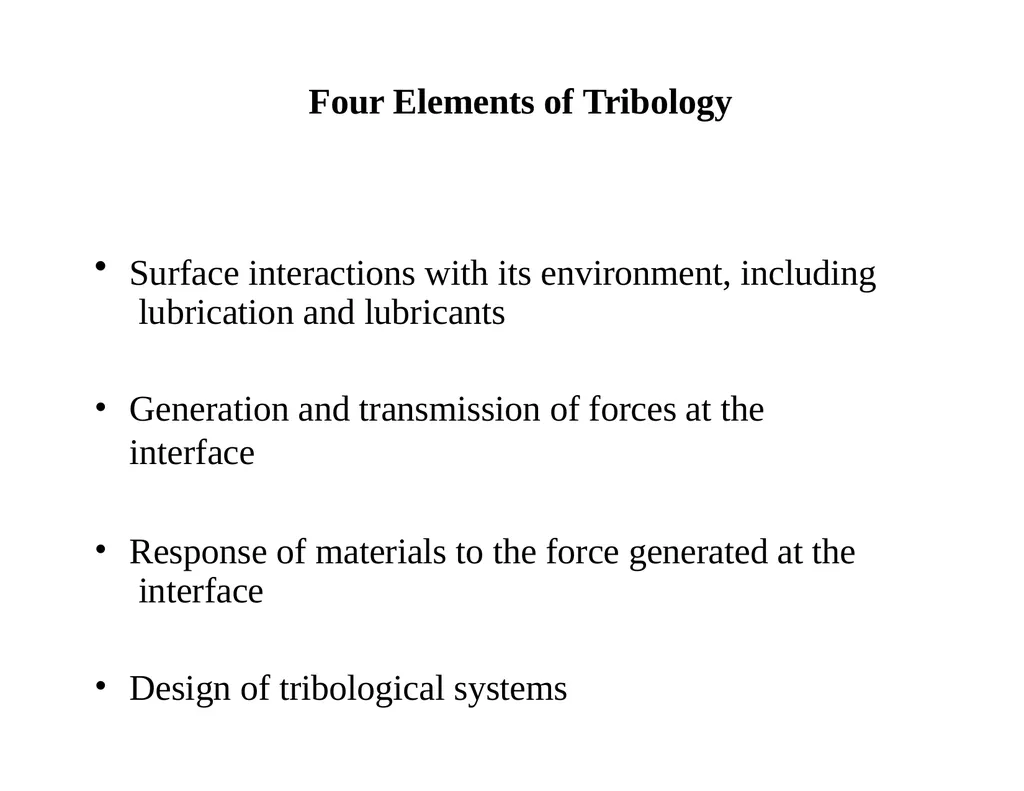
slide4. Four Elements of Tribology Surface interactions with its environment, including lubrication and lubricants
Generation and transmission of forces at the interface
Response of materials to the force generated at the interface
Design of tribological systems<br>
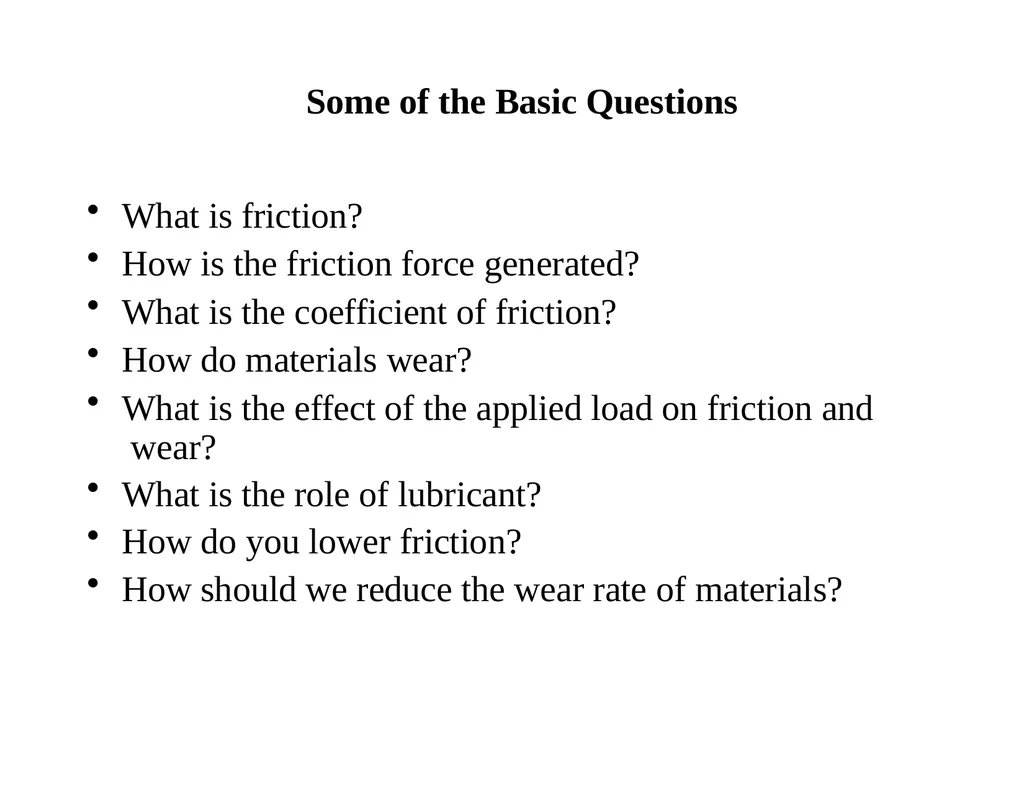
slide5. Some of the Basic Questions
What is friction?
How is the friction force generated?
What is the coefficient of friction?
How do materials wear?
What is the effect of the applied load on friction and wear?
What is the role of lubricant?
How do you lower friction?
How should we reduce the wear rate of materials?<br>
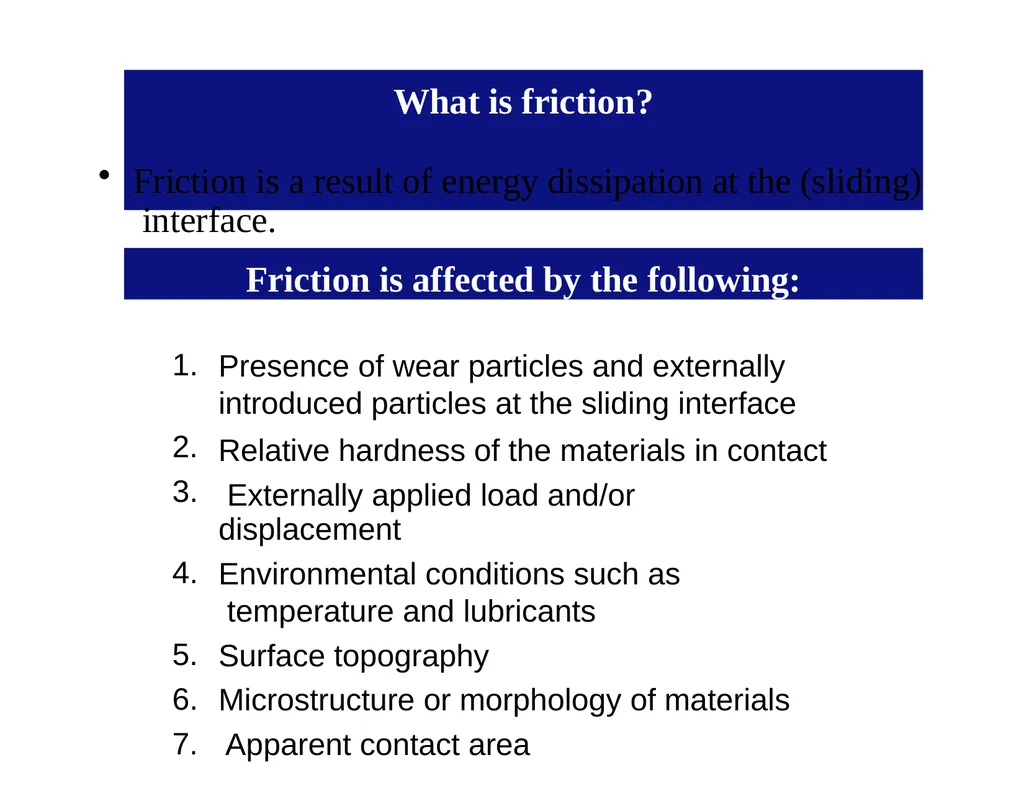
slide6. What is friction? Friction is a result of energy dissipation at the (sliding) interface. Friction is affected by the following: 1. 2.
3. 4. 5.
6.
7. Presence of wear particles and externally introduced particles at the sliding interface
Relative hardness of the materials in contact Externally applied load and/or
displacement
Environmental conditions such as temperature and lubricants
Surface topography
Microstructure or morphology of materials Apparent contact area<br>
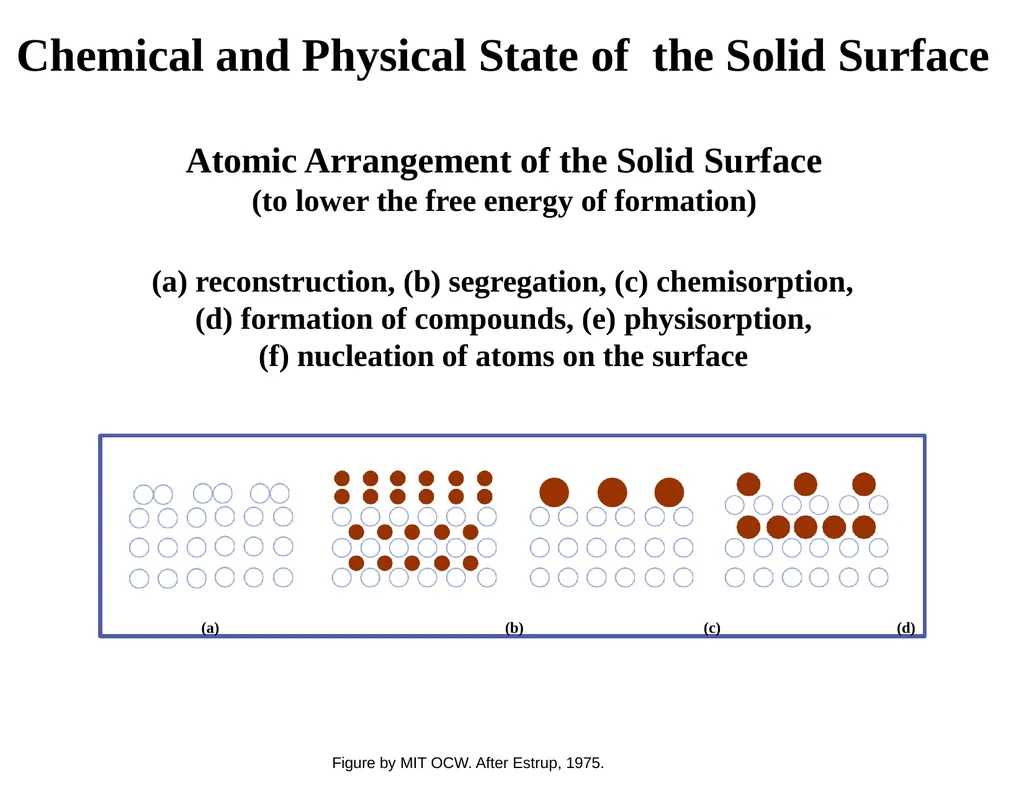
slide8. Atomic Arrangement of the Solid Surface
(to lower the free energy of formation) (a) reconstruction, (b) segregation, (c) chemisorption,
(d) formation of compounds, (e) physisorption,
(f) nucleation of atoms on the surface Figure by MIT OCW. After Estrup, 1975. (a) (b) (c) (d) Chemical and Physical State of the Solid Surface<br>
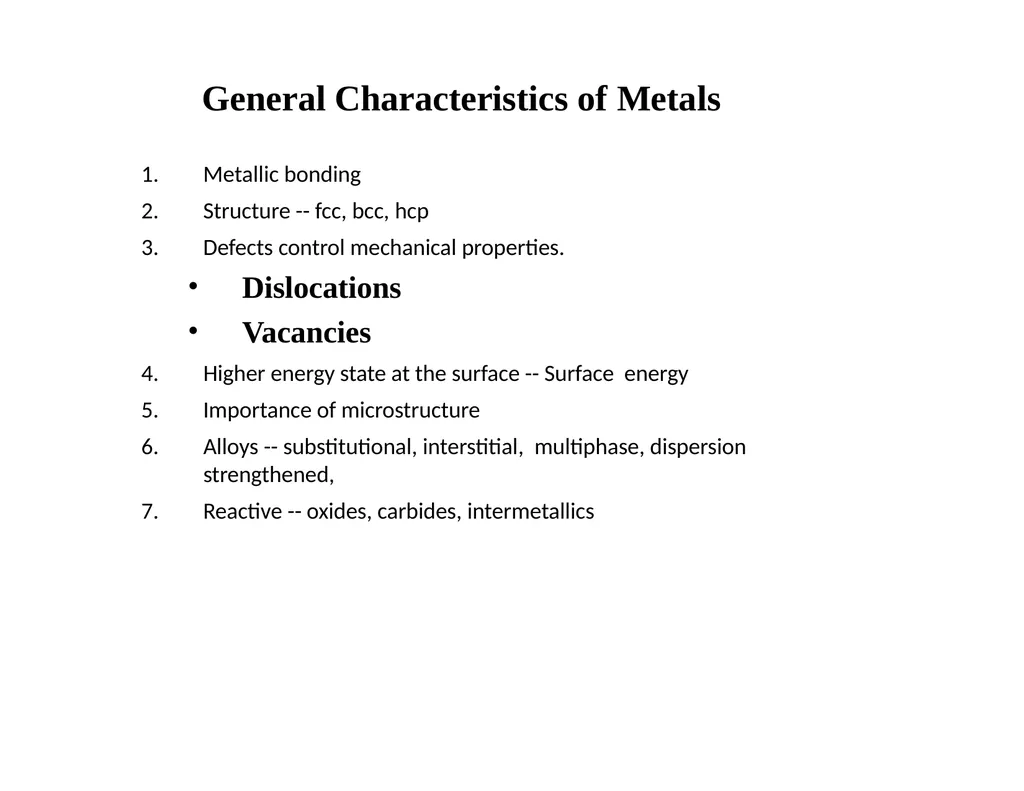
slide9. General Characteristics of Metals Metallic bonding
Structure -- fcc, bcc, hcp
Defects control mechanical properties.
Dislocations
Vacancies
Higher energy state at the surface -- Surface energy
Importance of microstructure
Alloys -- substitutional, interstitial, multiphase, dispersion strengthened,
Reactive -- oxides, carbides, intermetallics<br>
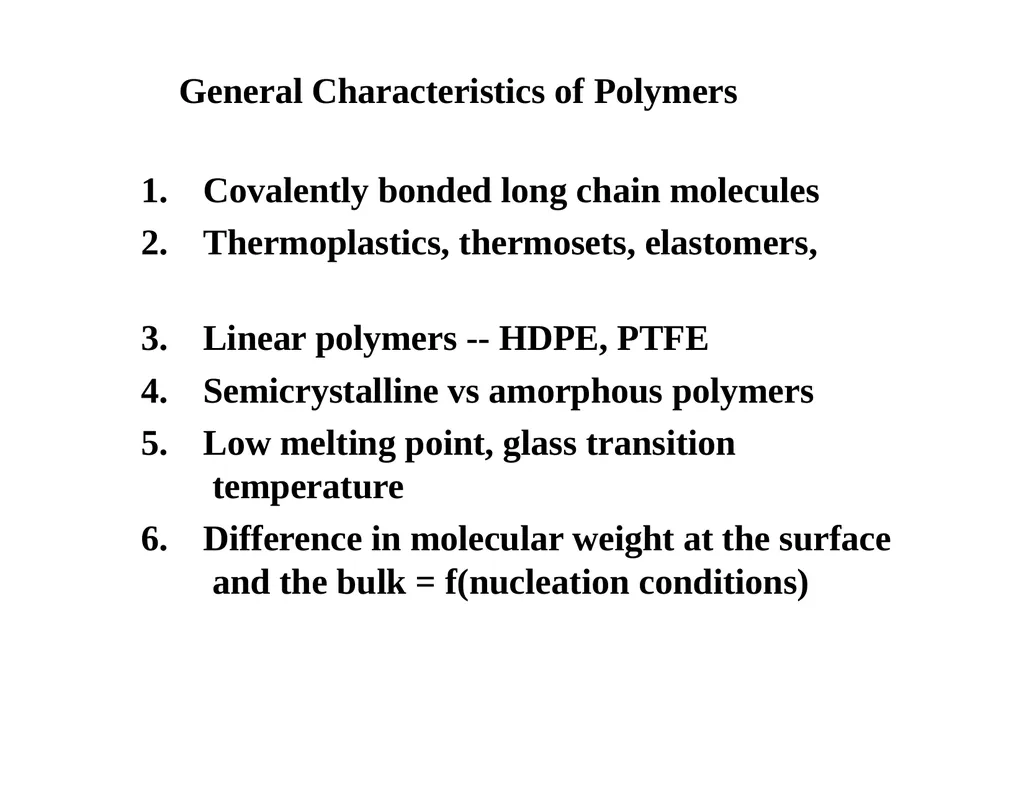
slide10. General Characteristics of Polymers Covalently bonded long chain molecules
Thermoplastics, thermosets, elastomers,
Linear polymers -- HDPE, PTFE
Semicrystalline vs amorphous polymers
Low melting point, glass transition temperature
Difference in molecular weight at the surface and the bulk = f(nucleation conditions)<br>
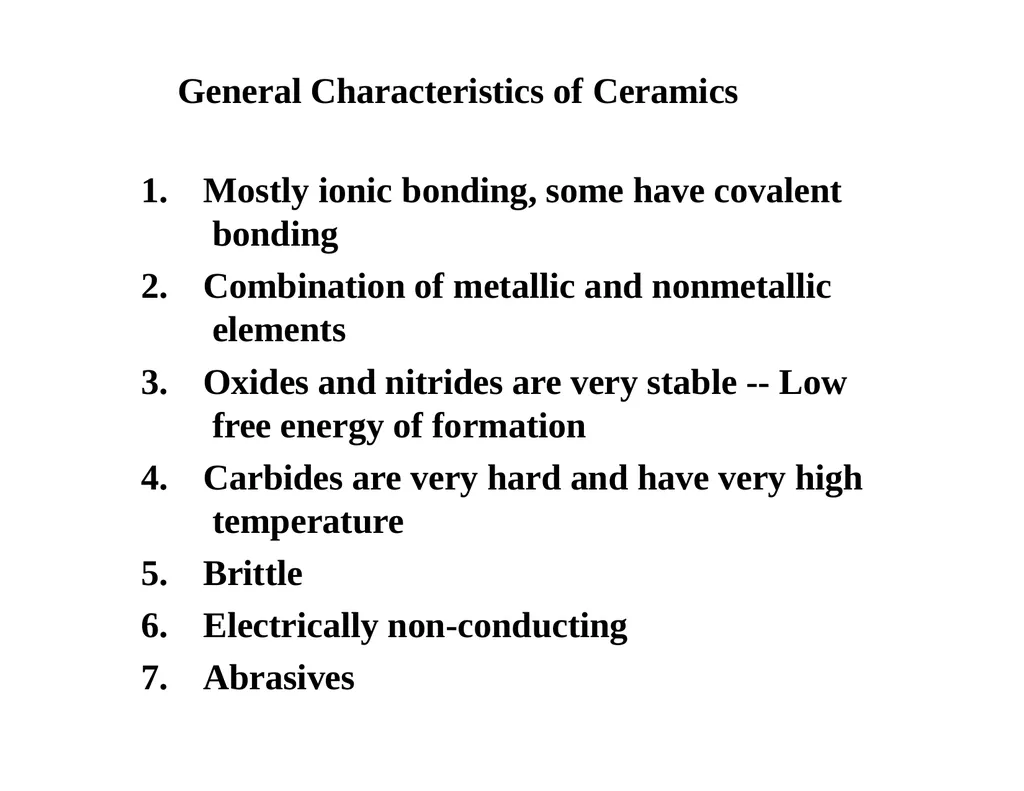
slide11. General Characteristics of Ceramics Mostly ionic bonding, some have covalent bonding
Combination of metallic and nonmetallic elements
Oxides and nitrides are very stable -- Low free energy of formation
Carbides are very hard and have very high temperature
Brittle
Electrically non-conducting
Abrasives<br>
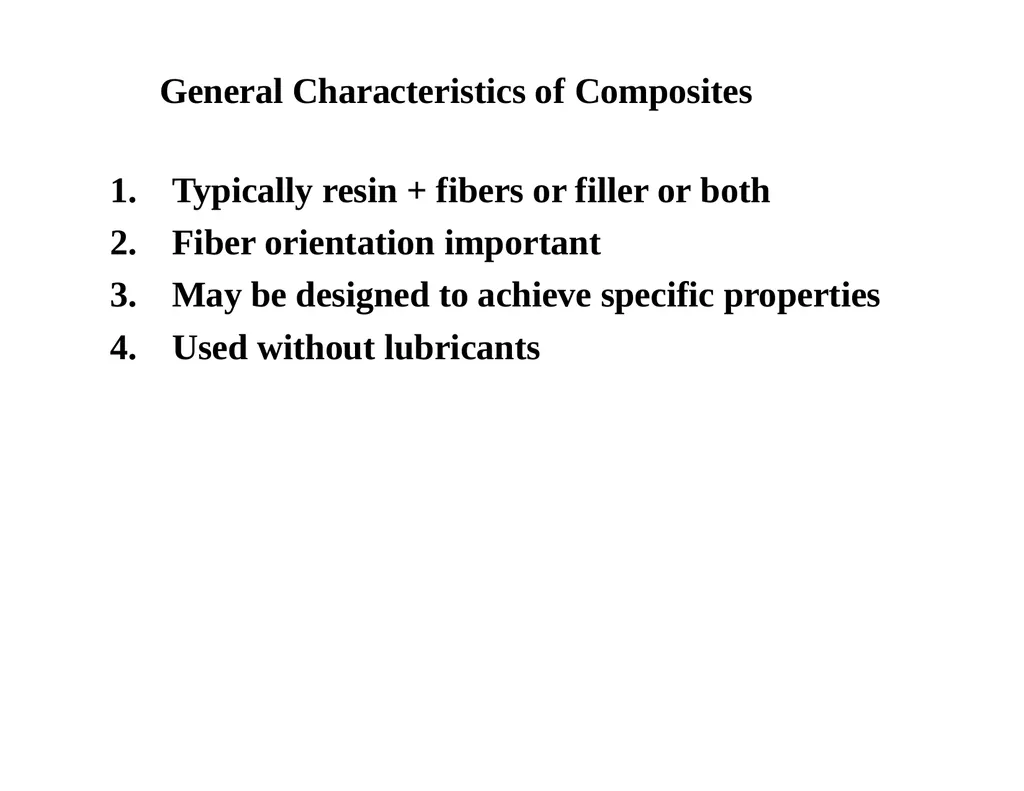
slide12. General Characteristics of Composites Typically resin + fibers or filler or both
Fiber orientation important
May be designed to achieve specific properties
Used without lubricants<br>
slide13. General Characteristics of a Solid Surface Surface energy
Surface may be different from the bulk in atomic structure, mechanical properties, chemical state
Wear resistance
Corrosion resistance
Hardness<br>
slide14. Role of lubricants Change surface energy
(monolayer)
Reduce metal to metal contact
through wetting
Prevent particle agglomeration
through wetting Lubrication Lubrication is the process or technique employed to reduce wear of one or both surfaces in close proximity, and moving relative to each another, by interposing a substance called lubricant between the surfaces to carry or to help carry the load (pressure generated) between the opposing surfaces.<br>
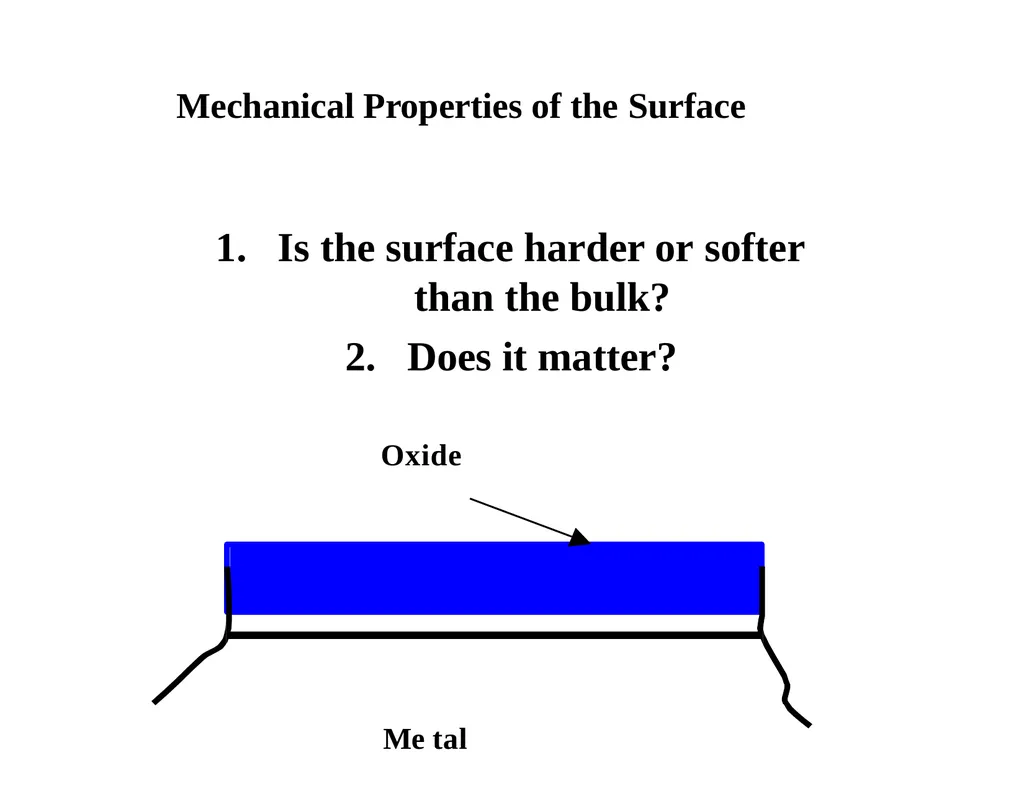
slide15. Mechanical Properties of the Surface Is the surface harder or softer
than the bulk?
Does it matter? Oxide
Me tal<br>
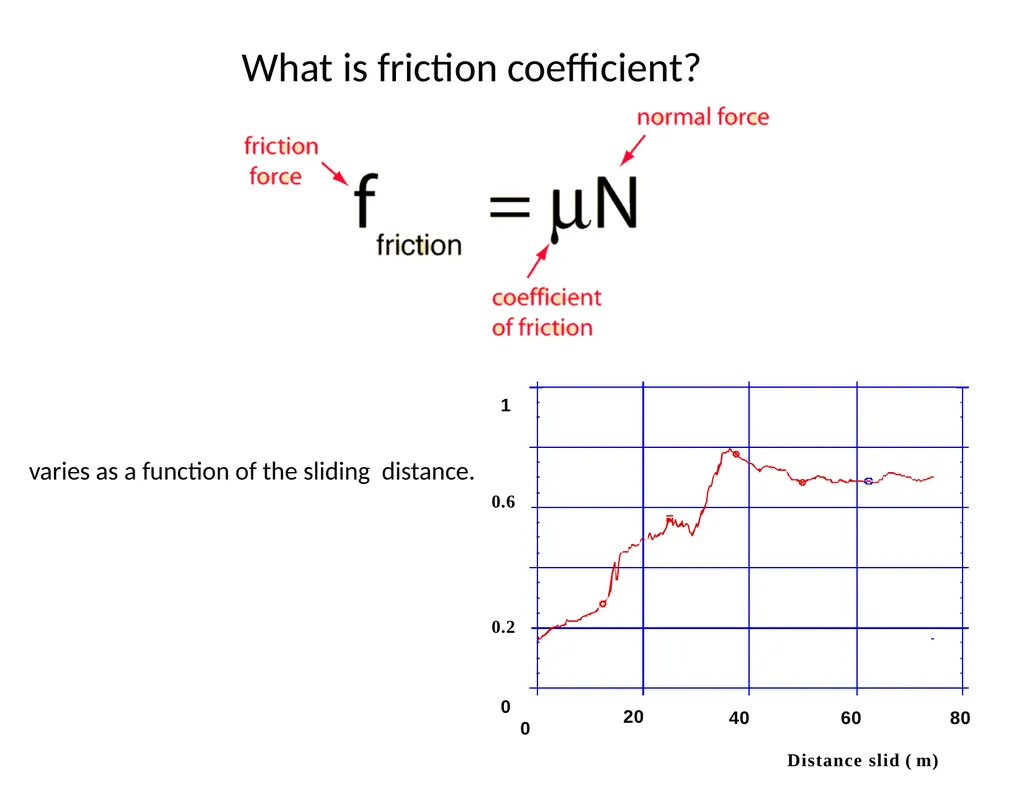
slide16. What is friction coefficient? varies as a function of the sliding distance.<br>
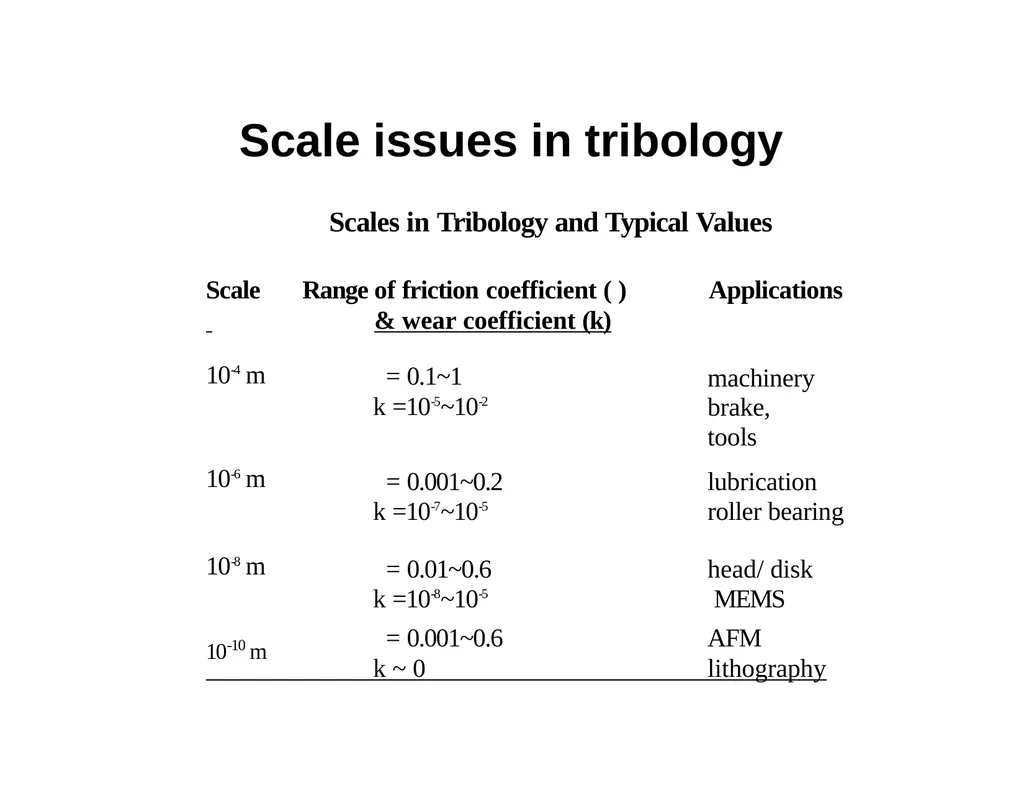
slide17. Scale issues in tribology Scales in Tribology and Typical Values
Scale Range of friction coefficient () Applications
& wear coefficient (k) 10-10 m = 0.001~0.6
k ~ 0 AFM
lithography<br>
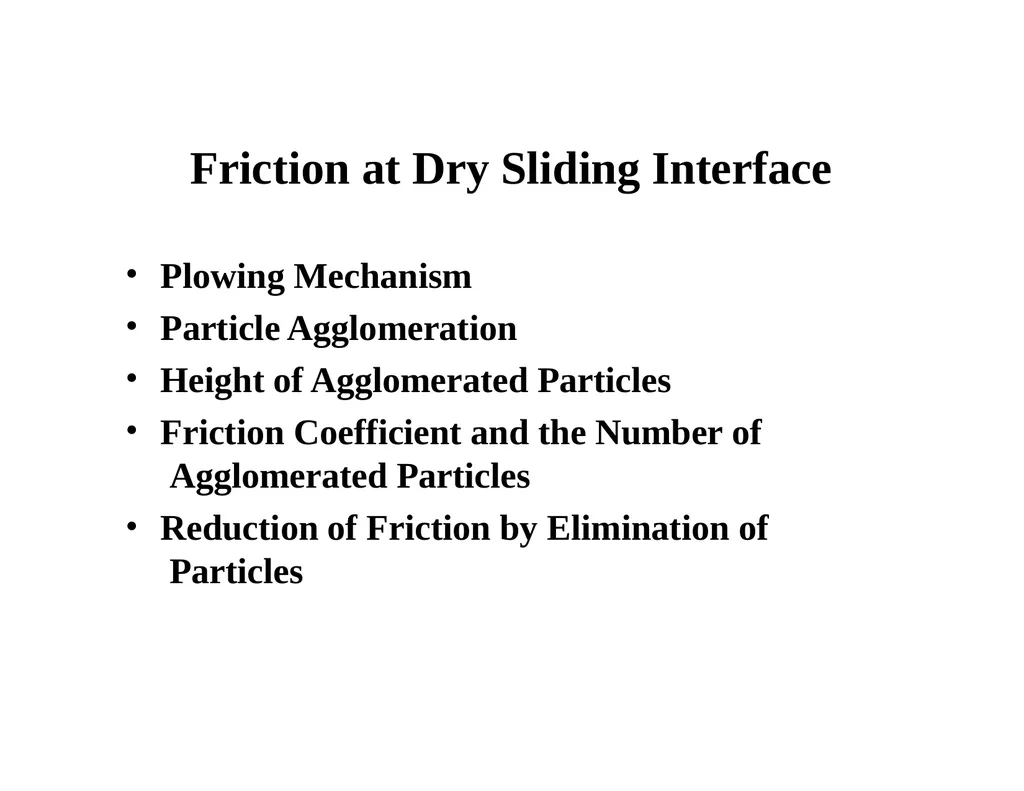
slide18. Friction at Dry Sliding Interface Plowing Mechanism
Particle Agglomeration
Height of Agglomerated Particles
Friction Coefficient and the Number of Agglomerated Particles
Reduction of Friction by Elimination of Particles<br>
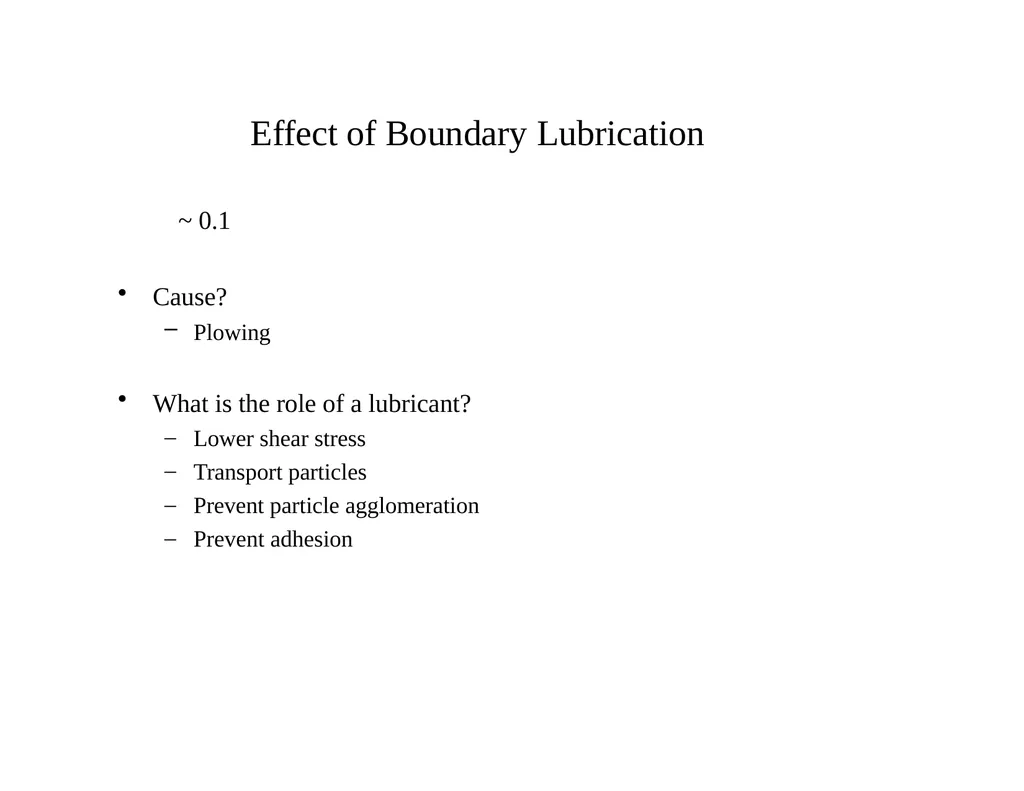
slide19. Effect of Boundary Lubrication ~ 0.1
Cause?
Plowing
What is the role of a lubricant?
Lower shear stress
Transport particles
Prevent particle agglomeration
Prevent adhesion<br>
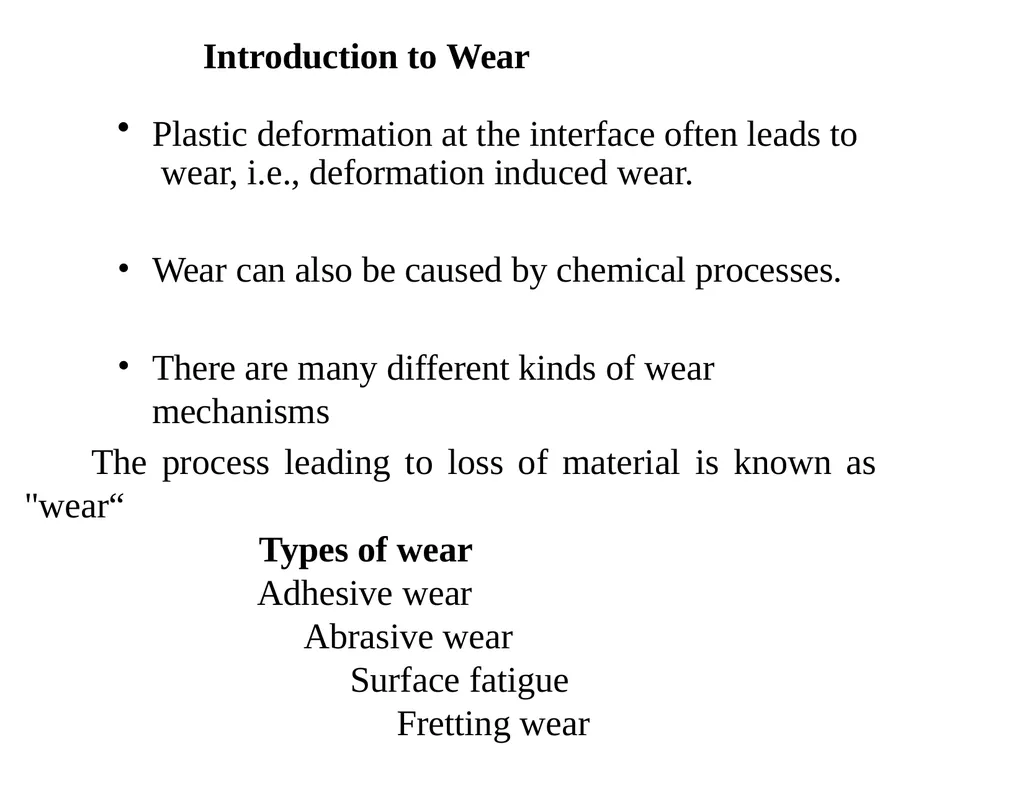
slide20. Introduction to Wear Plastic deformation at the interface often leads to wear, i.e., deformation induced wear.
Wear can also be caused by chemical processes.
There are many different kinds of wear mechanisms The process leading to loss of material is known as "wear“
Types of wear
Adhesive wear
Abrasive wear
Surface fatigue
Fretting wear<br>
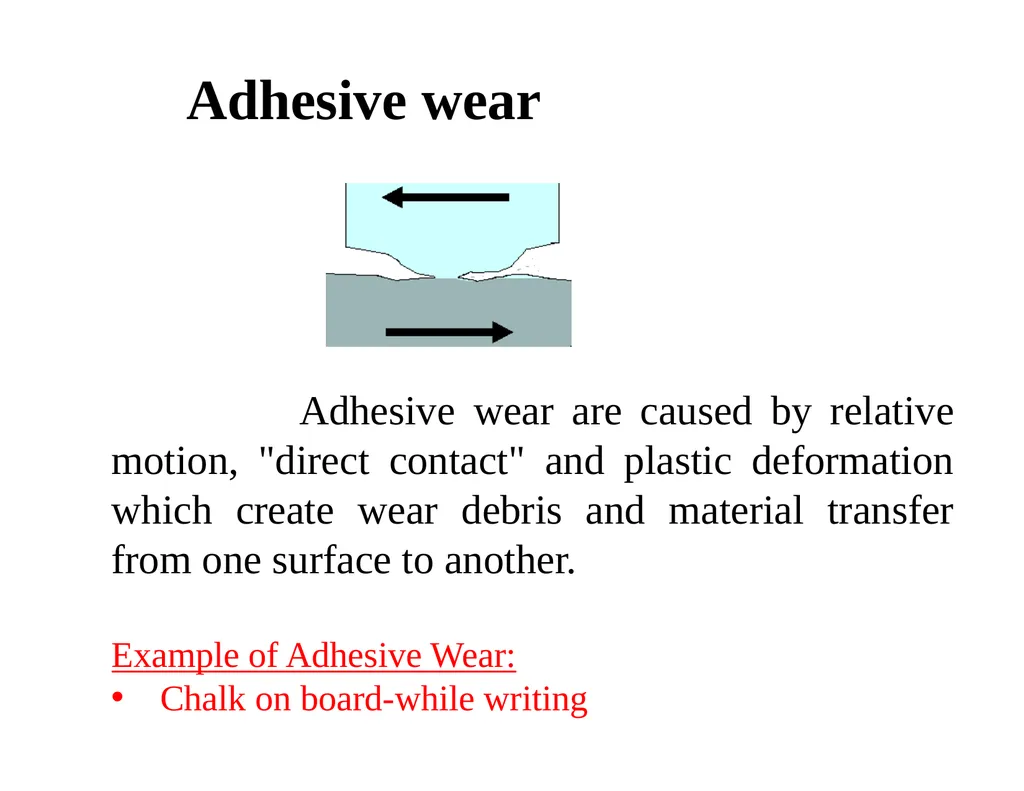
slide21. Adhesive wear Adhesive wear are caused by relative motion, "direct contact" and plastic deformation which create wear debris and material transfer from one surface to another.
Example of Adhesive Wear:
Chalk on board-while writing<br>
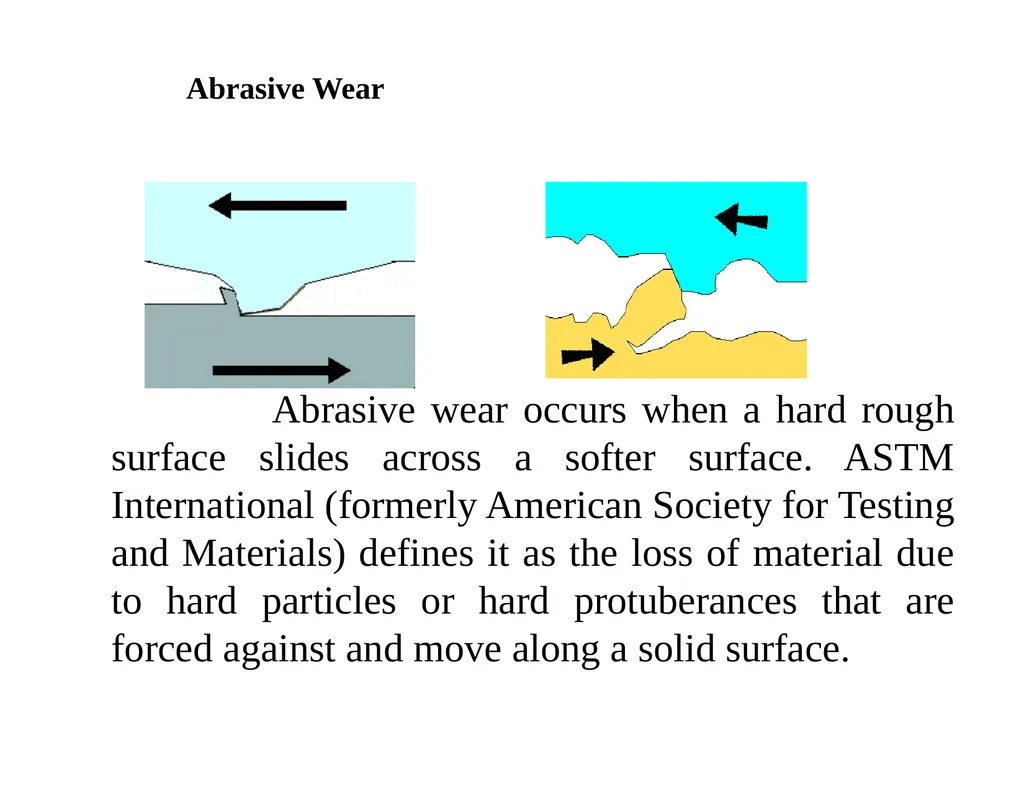
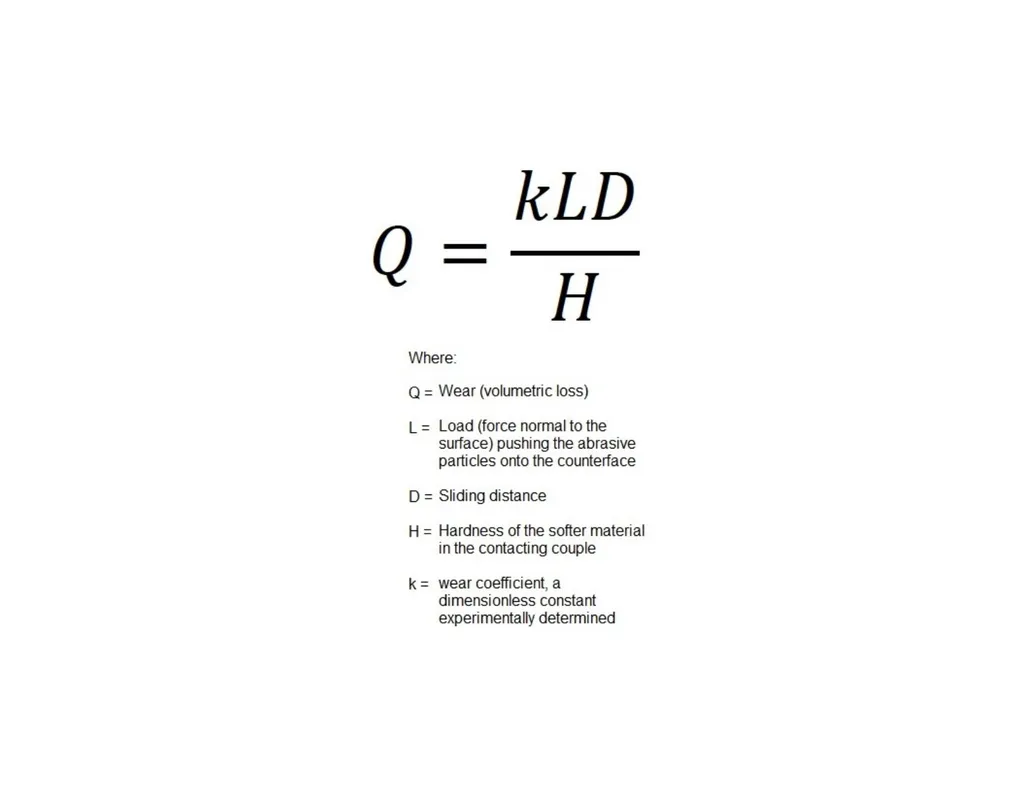
slide22. Abrasive Wear Abrasive wear occurs when a hard rough surface slides across a softer surface. ASTM International (formerly American Society for Testing and Materials) defines it as the loss of material due to hard particles or hard protuberances that are forced against and move along a solid surface.<br>
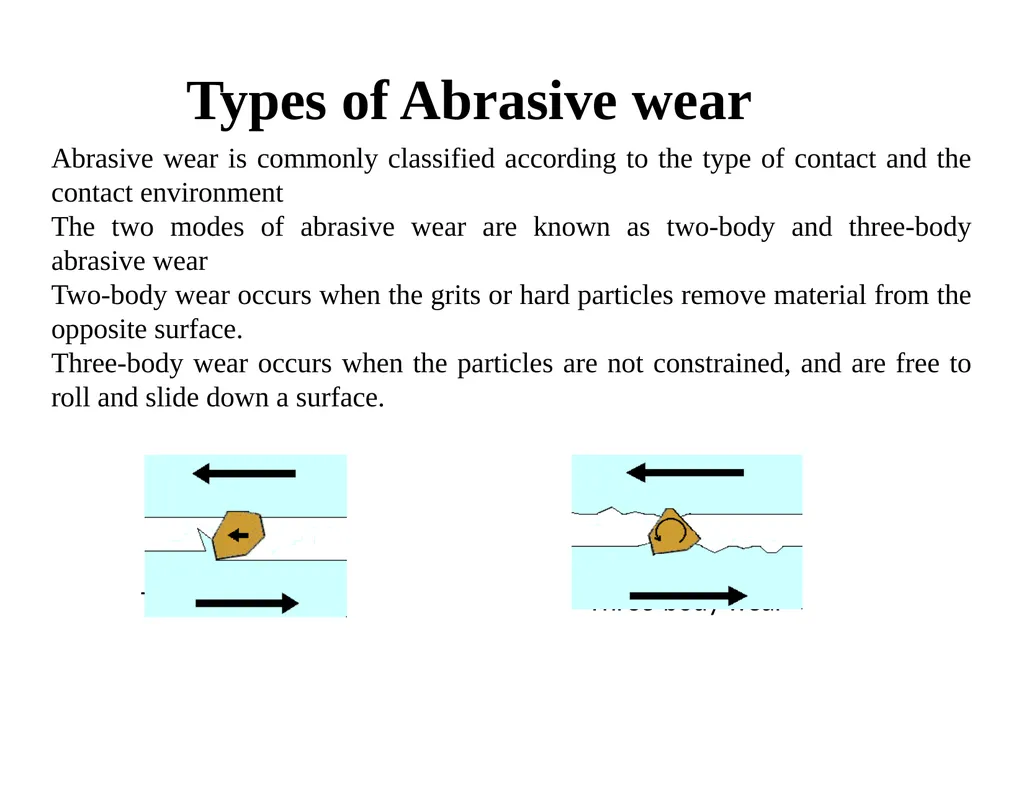
slide23. Types of Abrasive wear Abrasive wear is commonly classified according to the type of contact and the contact environment
The two modes of abrasive wear are known as two-body and three-body abrasive wear
Two-body wear occurs when the grits or hard particles remove material from the opposite surface.
Three-body wear occurs when the particles are not constrained, and are free to roll and slide down a surface.
Two-body wear Three-body wear<br>
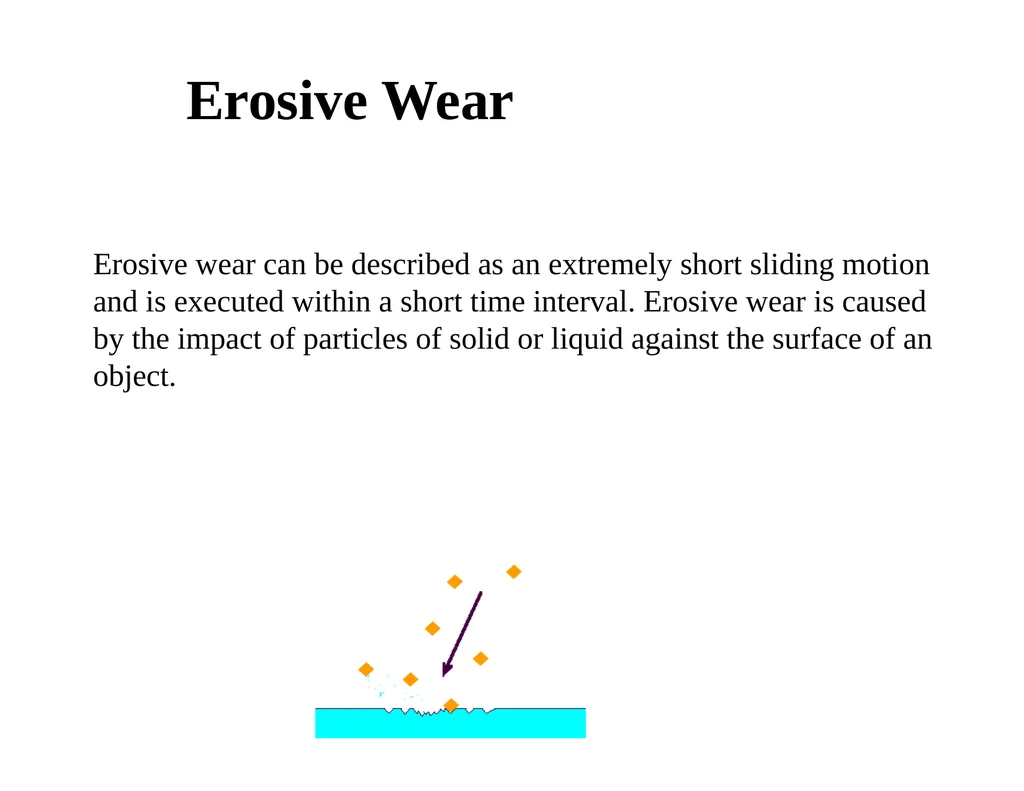
slide24. Erosive Wear Erosive wear can be described as an extremely short sliding motion and is executed within a short time interval. Erosive wear is caused by the impact of particles of solid or liquid against the surface of an object.<br>
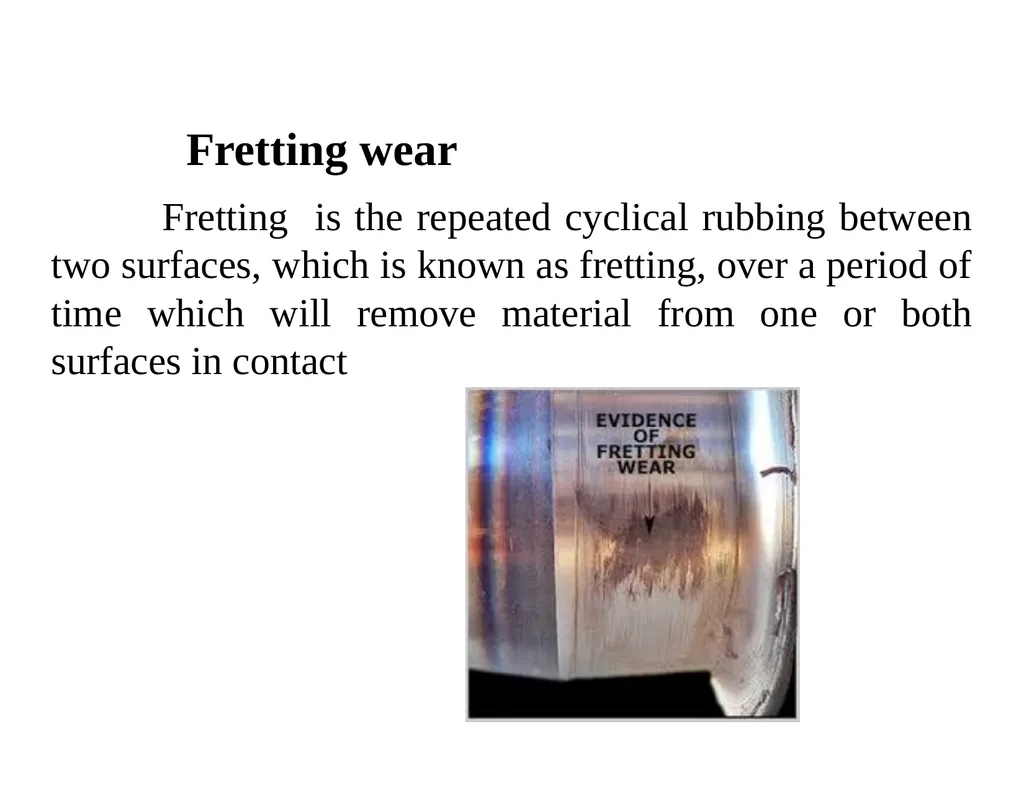
slide25. Fretting wear Fretting is the repeated cyclical rubbing between two surfaces, which is known as fretting, over a period of time which will remove material from one or both surfaces in contact<br>
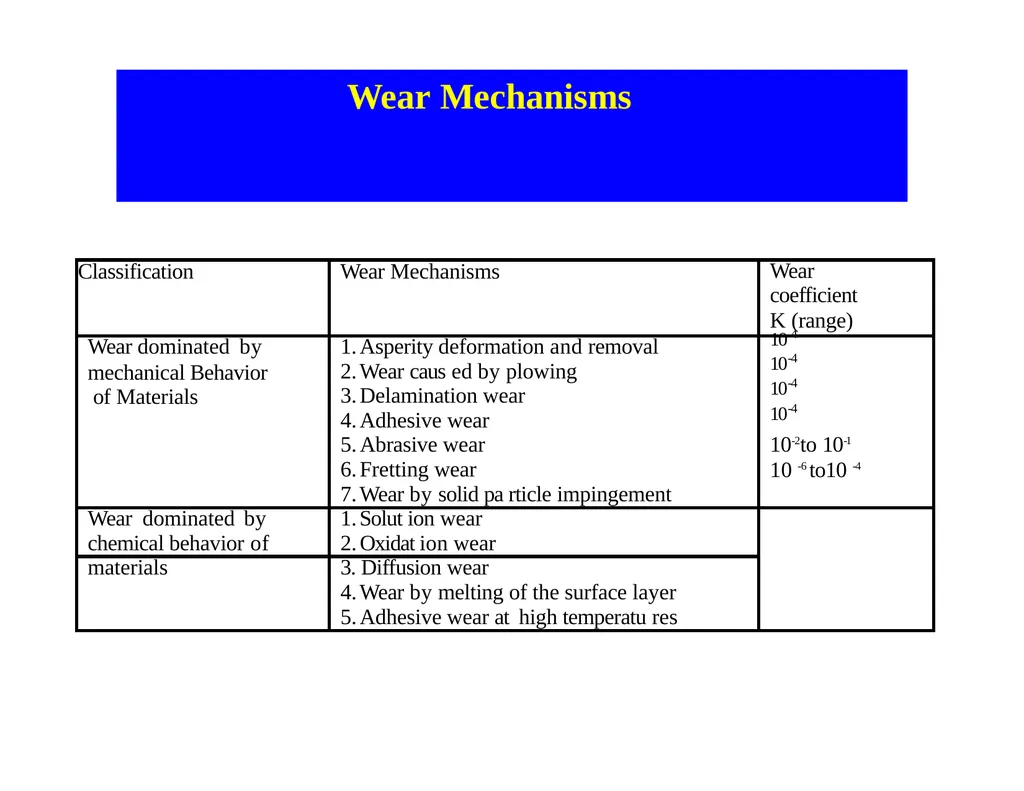
slide26. Wear Mechanisms<br>
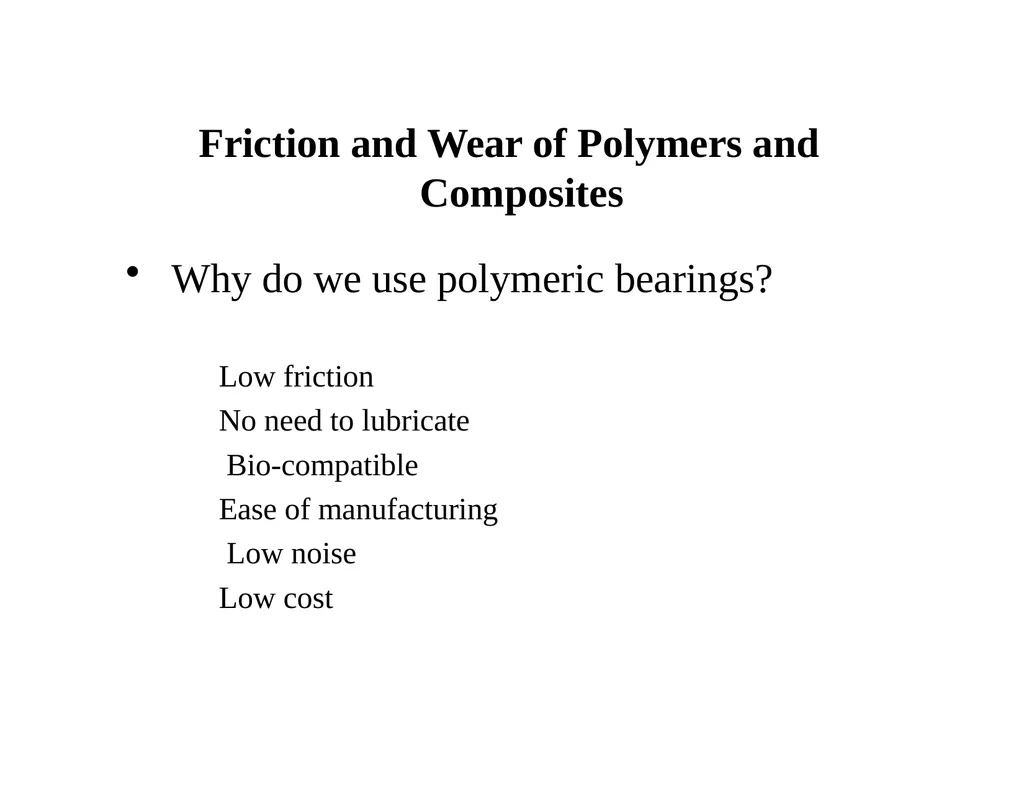
slide27. Friction and Wear of Polymers and Composites Why do we use polymeric bearings?
Low friction
No need to lubricate Bio-compatible
Ease of manufacturing Low noise
Low cost<br>
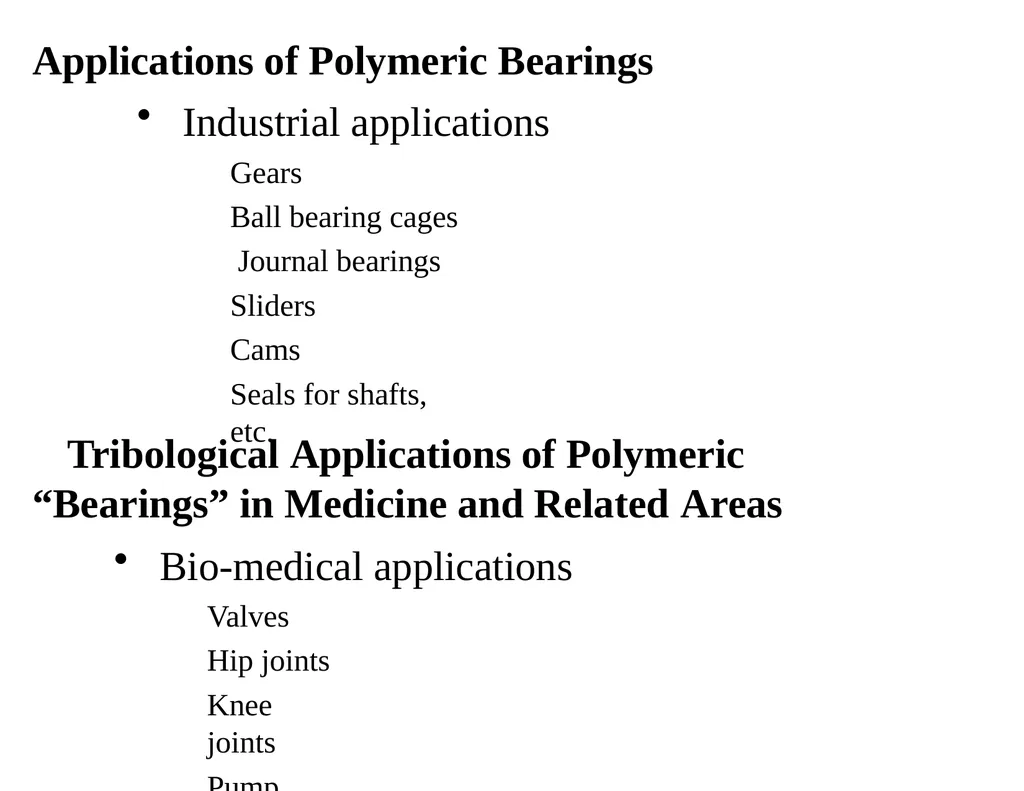
slide28. Applications of Polymeric Bearings Industrial applications
Gears
Ball bearing cages Journal bearings Sliders
Cams
Seals for shafts, etc. Tribological Applications of Polymeric “Bearings” in Medicine and Related Areas Bio-medical applications
Valves Hip joints
Knee joints
Pump components<br>
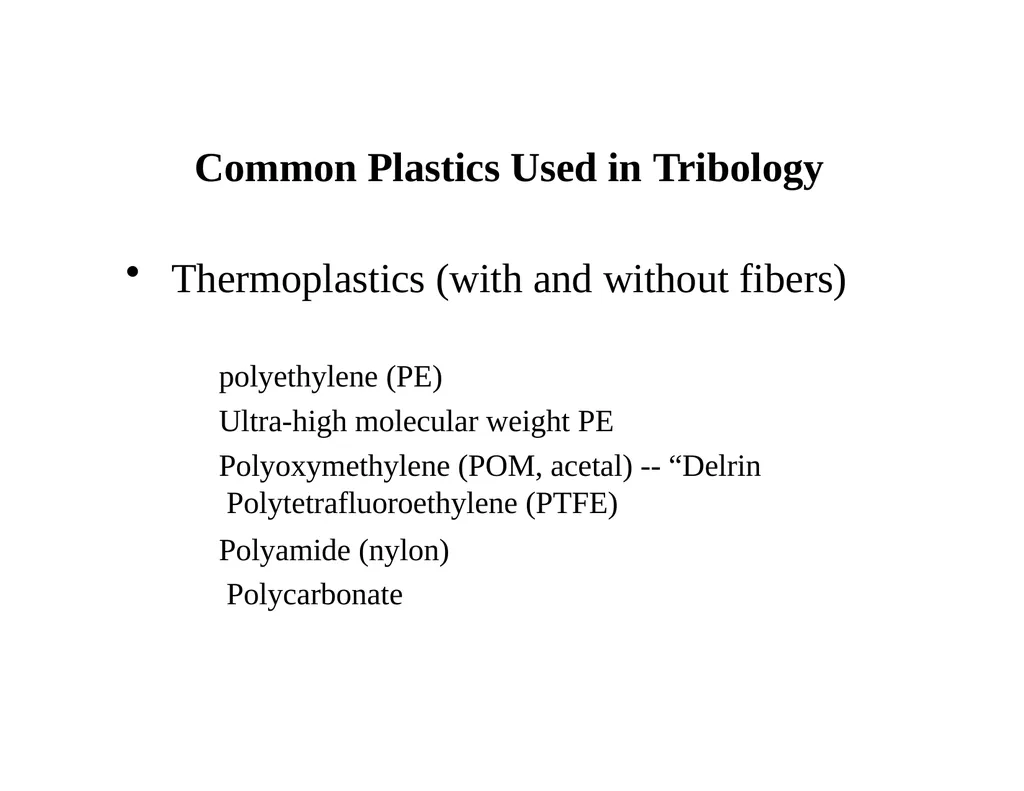
slide29. Common Plastics Used in Tribology Thermoplastics (with and without fibers)
polyethylene (PE)
Ultra-high molecular weight PE
Polyoxymethylene (POM, acetal) -- “Delrin Polytetrafluoroethylene (PTFE)
Polyamide (nylon) Polycarbonate<br>
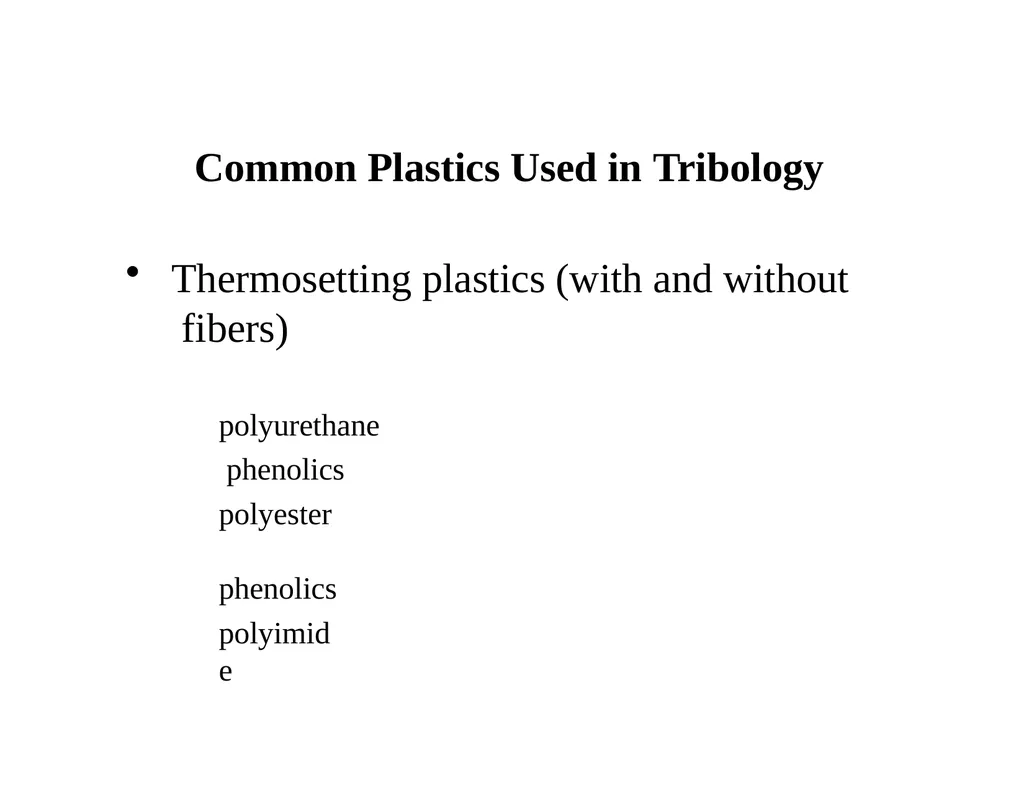
slide30. Common Plastics Used in Tribology Thermosetting plastics (with and without fibers)
polyurethane phenolics
polyester phenolics
polyimide<br>
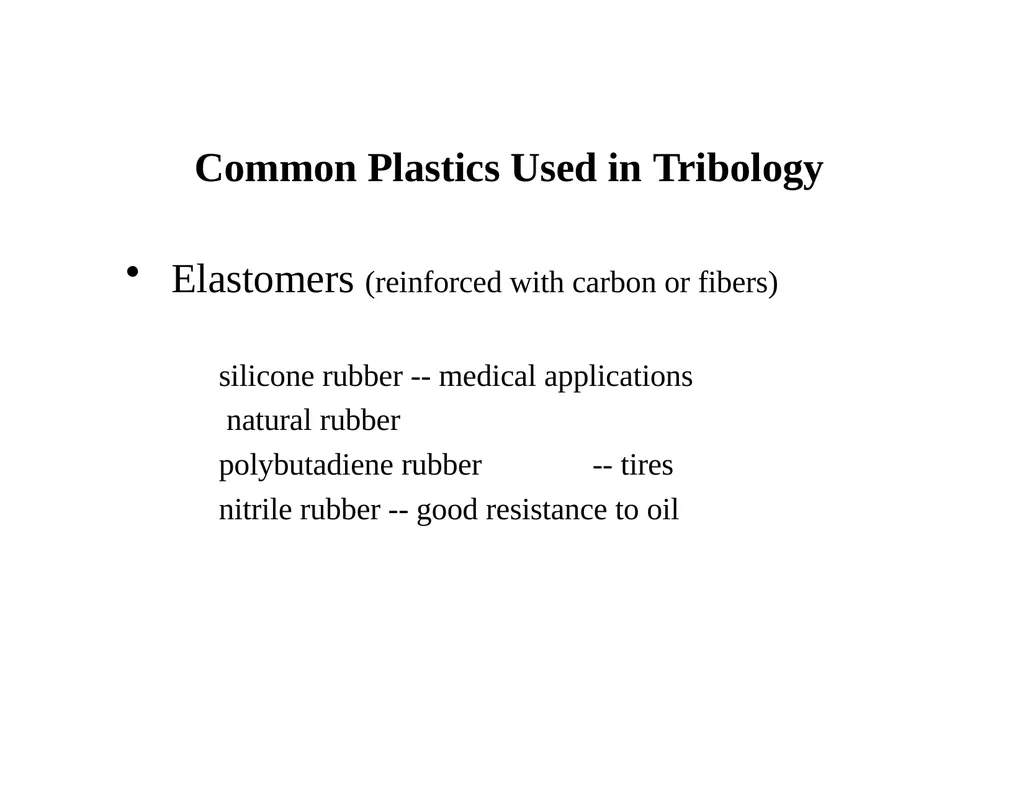
slide31. Common Plastics Used in Tribology Elastomers (reinforced with carbon or fibers)
silicone rubber -- medical applications natural rubber
polybutadiene rubber -- tires
nitrile rubber -- good resistance to oil<br>
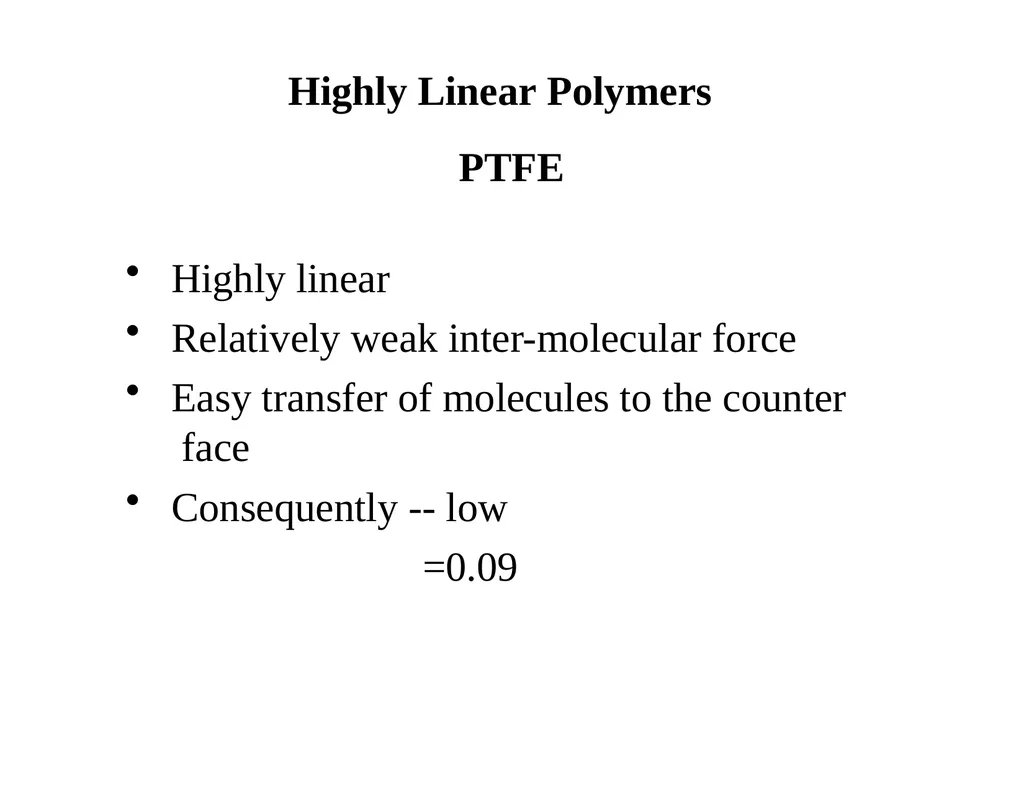
slide32. PTFE Highly linear
Relatively weak inter-molecular force
Easy transfer of molecules to the counter face
Consequently -- low
=0.09 Highly Linear Polymers<br>
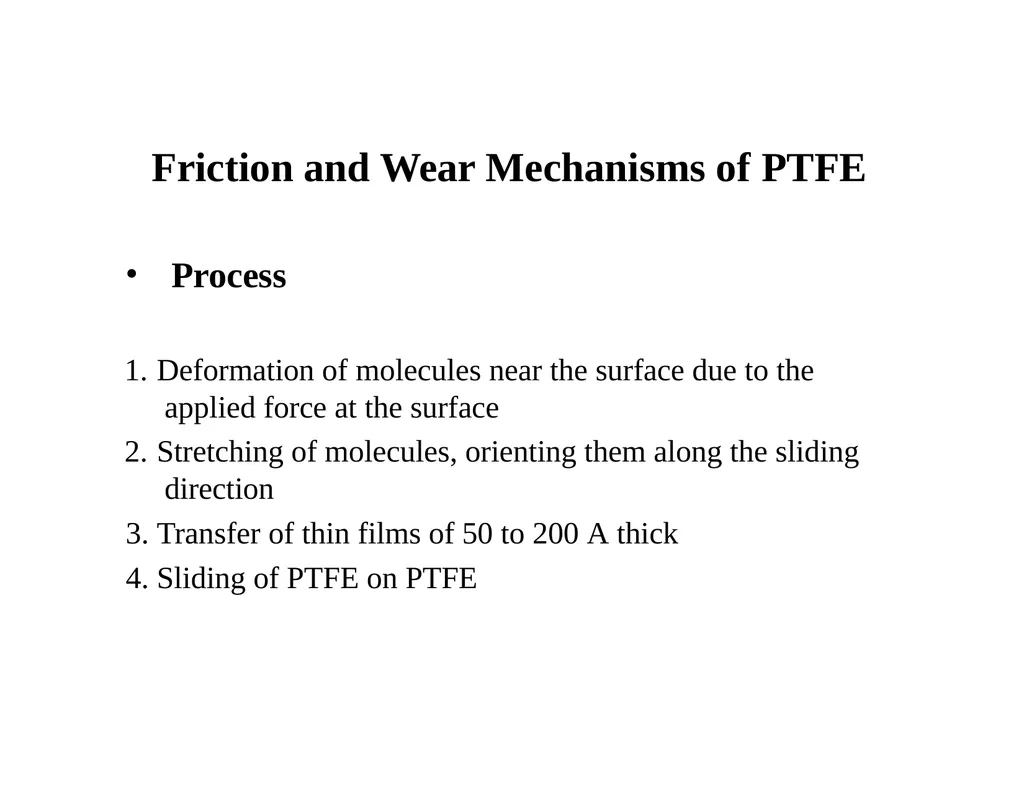
slide33. Friction and Wear Mechanisms of PTFE Process
Deformation of molecules near the surface due to the applied force at the surface
Stretching of molecules, orienting them along the sliding direction
Transfer of thin films of 50 to 200 A thick
Sliding of PTFE on PTFE<br>
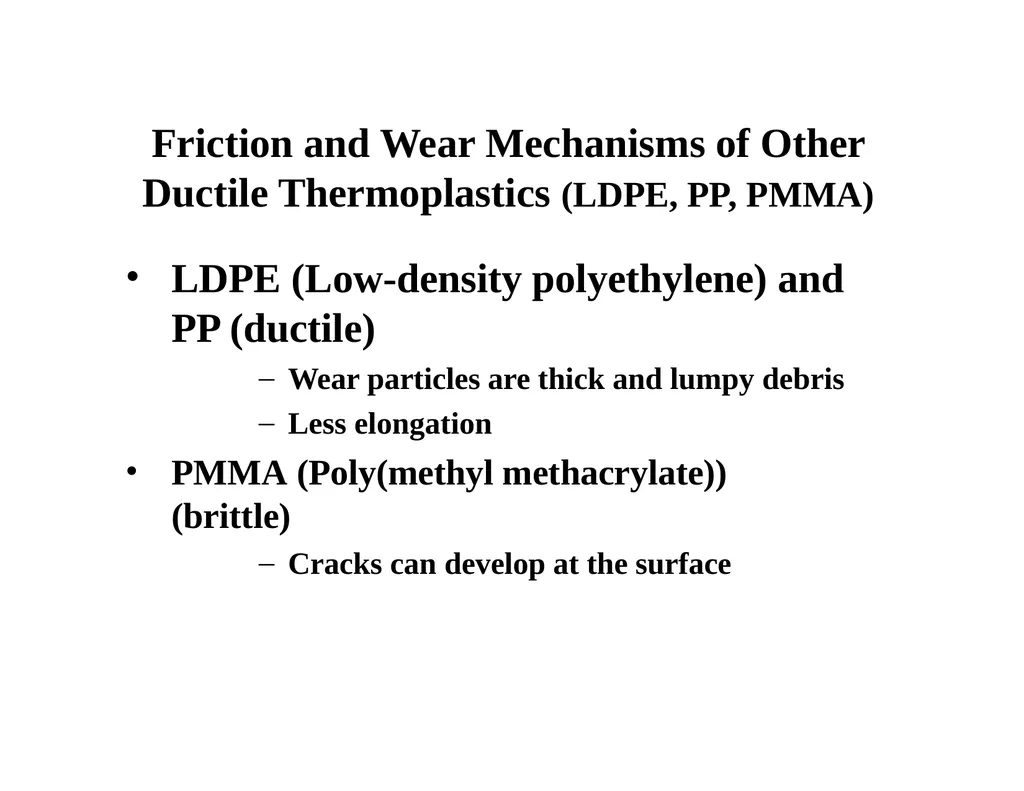
slide34. Friction and Wear Mechanisms of Other Ductile Thermoplastics (LDPE, PP, PMMA) LDPE (Low-density polyethylene) and PP (ductile)
Wear particles are thick and lumpy debris
Less elongation
PMMA (Poly(methyl methacrylate)) (brittle)
Cracks can develop at the surface<br>
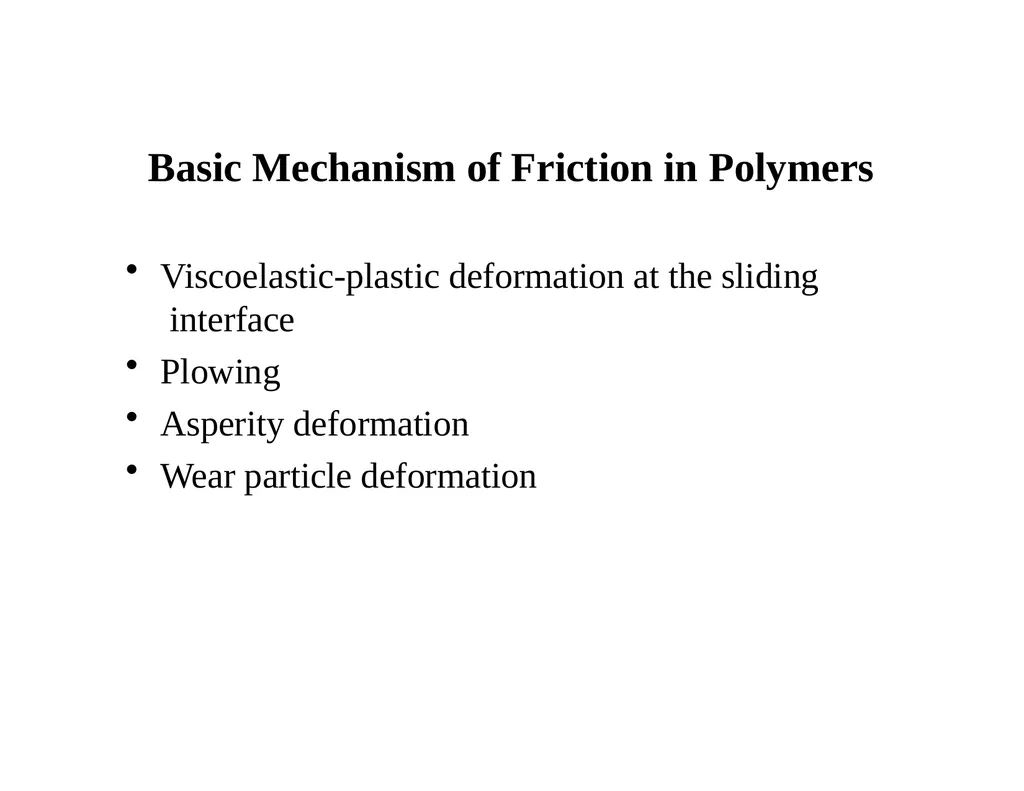
slide35. Basic Mechanism of Friction in Polymers Viscoelastic-plastic deformation at the sliding interface
Plowing
Asperity deformation
Wear particle deformation<br>
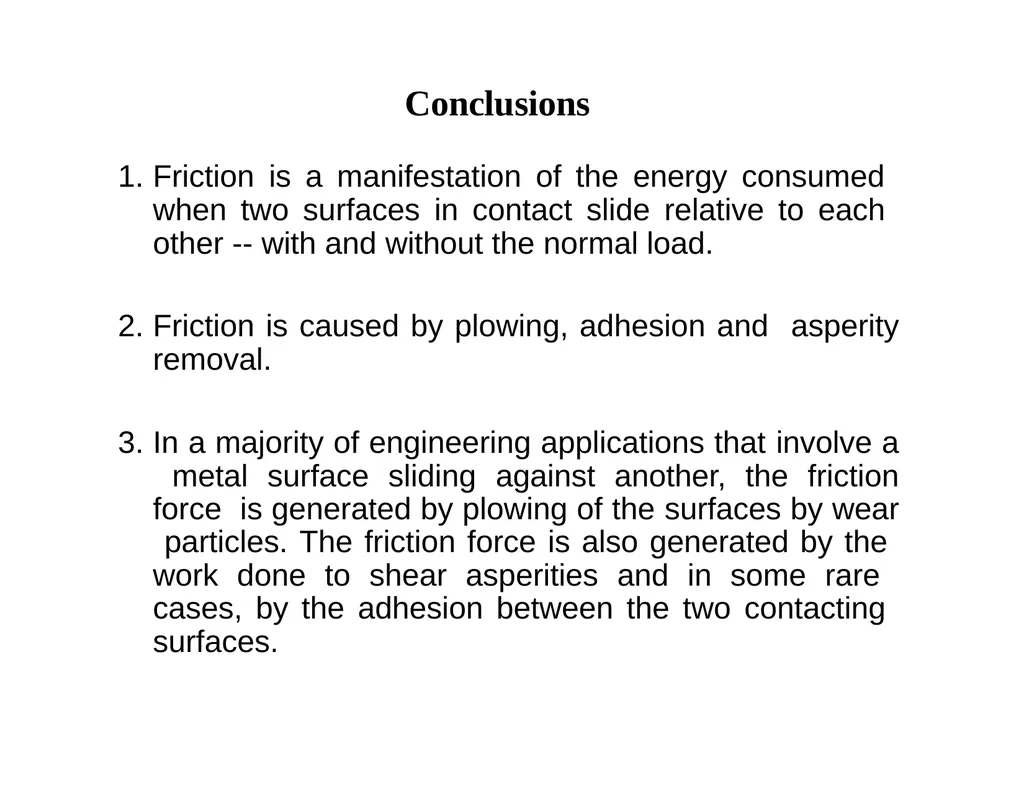
slide36. Conclusions Friction is a manifestation of the energy consumed when two surfaces in contact slide relative to each other -- with and without the normal load.
Friction is caused by plowing, adhesion and asperity removal.
In a majority of engineering applications that involve a metal surface sliding against another, the friction force is generated by plowing of the surfaces by wear particles. The friction force is also generated by the work done to shear asperities and in some rare cases, by the adhesion between the two contacting surfaces.<br>
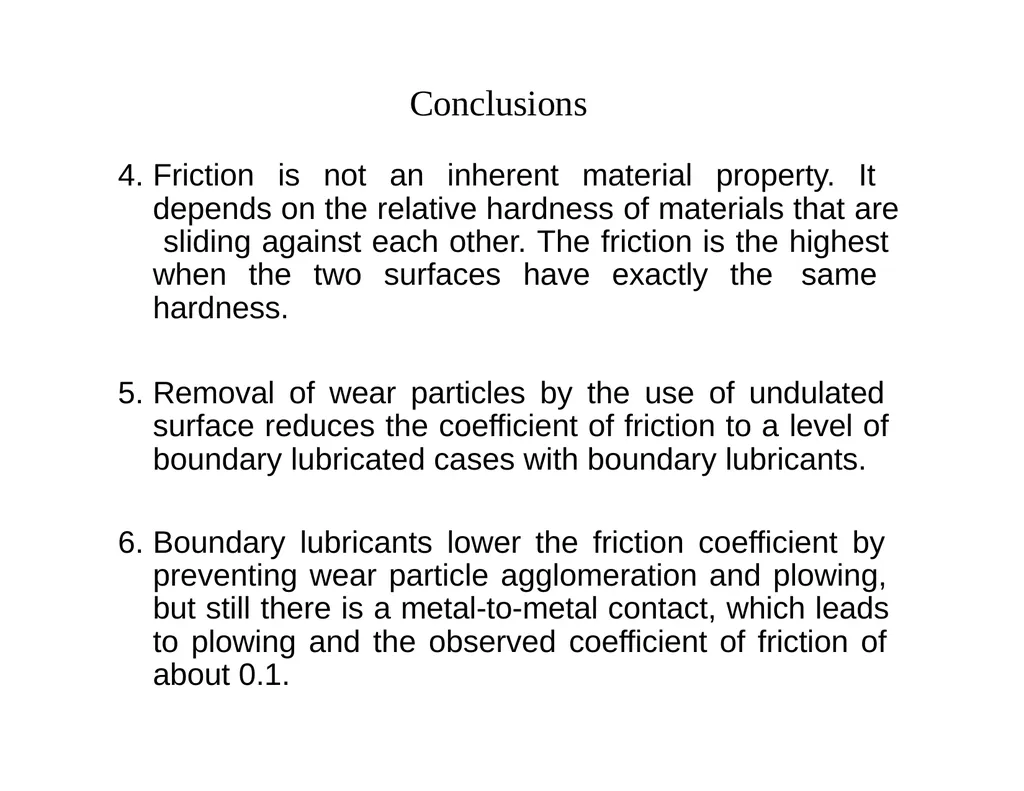
slide37. Conclusions Friction is not an inherent material property. It depends on the relative hardness of materials that are sliding against each other. The friction is the highest when the two surfaces have exactly the same hardness.
Removal of wear particles by the use of undulated surface reduces the coefficient of friction to a level of boundary lubricated cases with boundary lubricants.
Boundary lubricants lower the friction coefficient by preventing wear particle agglomeration and plowing, but still there is a metal-to-metal contact, which leads to plowing and the observed coefficient of friction of about 0.1.<br>
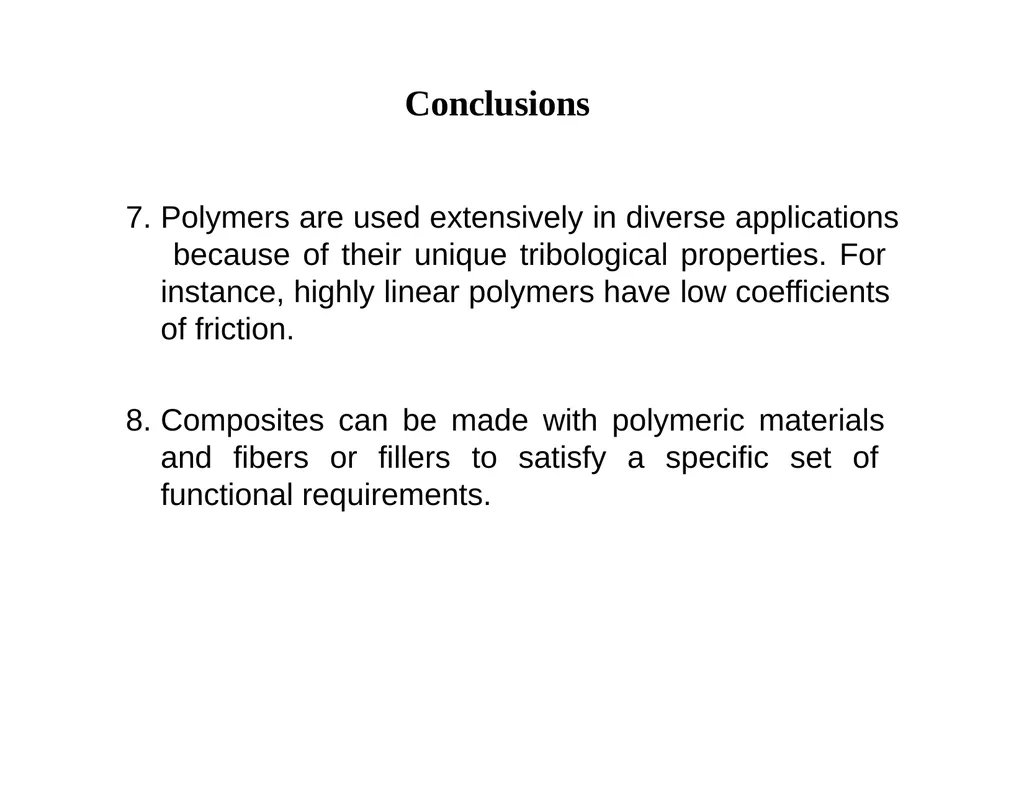
slide38. Conclusions Polymers are used extensively in diverse applications because of their unique tribological properties. For instance, highly linear polymers have low coefficients of friction.
Composites can be made with polymeric materials and fibers or fillers to satisfy a specific set of functional requirements.<br>
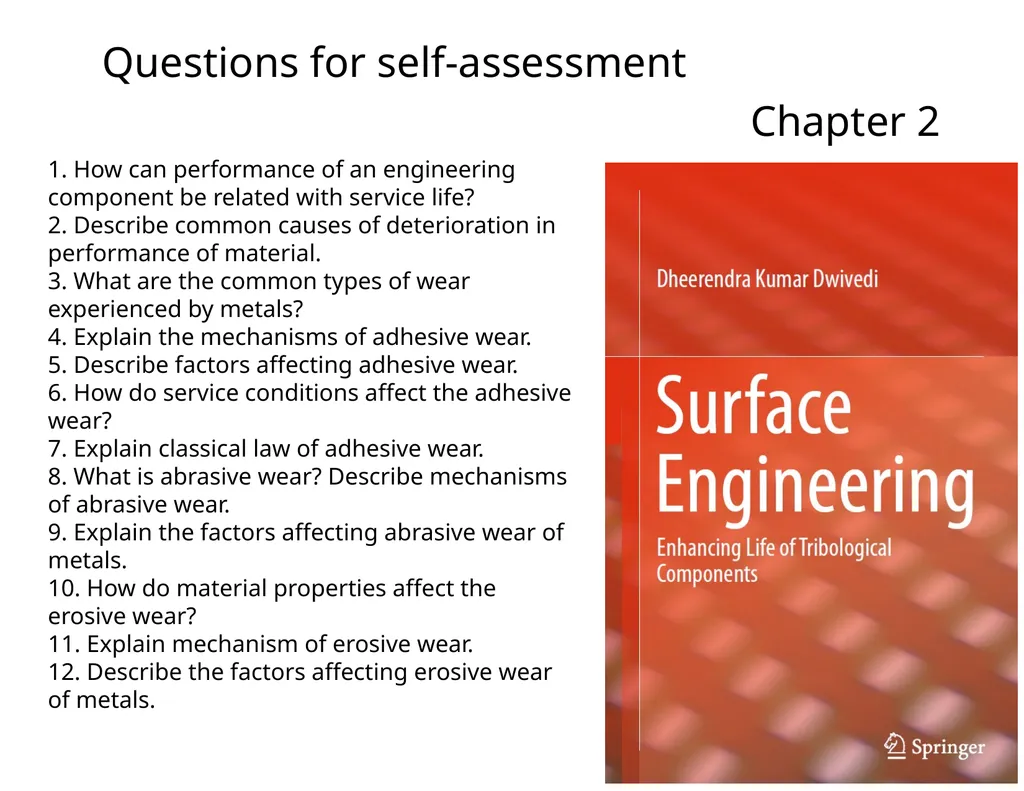
slide39. Questions for self-assessment 1. How can performance of an engineering component be related with service life?
2. Describe common causes of deterioration in performance of material.
3. What are the common types of wear experienced by metals?
4. Explain the mechanisms of adhesive wear.
5. Describe factors affecting adhesive wear.
6. How do service conditions affect the adhesive wear?
7. Explain classical law of adhesive wear.
8. What is abrasive wear? Describe mechanisms of abrasive wear.
9. Explain the factors affecting abrasive wear of metals.
10. How do material properties affect the erosive wear?
11. Explain mechanism of erosive wear.
12. Describe the factors affecting erosive wear of metals. Chapter 2<br>
Surface Engineering Tribology<br>
slide2. What is tribology? Tribology is defined as the science and technology of interacting surfaces in relative motion, having its origin in the Greek word tribos meaning rubbing.
It is a study of the friction, lubrication, and wear of engineering surfaces with a view to understanding surface interactions in detail and then prescribing improvements in given applications.<br>
slide3. What is tribology? Economically very important -- 6% GDP (Jost)
Probably more failures are caused by tribological problems than fracture, fatigue, plastic deformation, etc.
Tribological problems are often related to systems issues.<br>
slide4. Four Elements of Tribology Surface interactions with its environment, including lubrication and lubricants
Generation and transmission of forces at the interface
Response of materials to the force generated at the interface
Design of tribological systems<br>
slide5. Some of the Basic Questions
What is friction?
How is the friction force generated?
What is the coefficient of friction?
How do materials wear?
What is the effect of the applied load on friction and wear?
What is the role of lubricant?
How do you lower friction?
How should we reduce the wear rate of materials?<br>
slide6. What is friction? Friction is a result of energy dissipation at the (sliding) interface. Friction is affected by the following: 1. 2.
3. 4. 5.
6.
7. Presence of wear particles and externally introduced particles at the sliding interface
Relative hardness of the materials in contact Externally applied load and/or
displacement
Environmental conditions such as temperature and lubricants
Surface topography
Microstructure or morphology of materials Apparent contact area<br>
slide8. Atomic Arrangement of the Solid Surface
(to lower the free energy of formation) (a) reconstruction, (b) segregation, (c) chemisorption,
(d) formation of compounds, (e) physisorption,
(f) nucleation of atoms on the surface Figure by MIT OCW. After Estrup, 1975. (a) (b) (c) (d) Chemical and Physical State of the Solid Surface<br>
slide9. General Characteristics of Metals Metallic bonding
Structure -- fcc, bcc, hcp
Defects control mechanical properties.
Dislocations
Vacancies
Higher energy state at the surface -- Surface energy
Importance of microstructure
Alloys -- substitutional, interstitial, multiphase, dispersion strengthened,
Reactive -- oxides, carbides, intermetallics<br>
slide10. General Characteristics of Polymers Covalently bonded long chain molecules
Thermoplastics, thermosets, elastomers,
Linear polymers -- HDPE, PTFE
Semicrystalline vs amorphous polymers
Low melting point, glass transition temperature
Difference in molecular weight at the surface and the bulk = f(nucleation conditions)<br>
slide11. General Characteristics of Ceramics Mostly ionic bonding, some have covalent bonding
Combination of metallic and nonmetallic elements
Oxides and nitrides are very stable -- Low free energy of formation
Carbides are very hard and have very high temperature
Brittle
Electrically non-conducting
Abrasives<br>
slide12. General Characteristics of Composites Typically resin + fibers or filler or both
Fiber orientation important
May be designed to achieve specific properties
Used without lubricants<br>
slide13. General Characteristics of a Solid Surface Surface energy
Surface may be different from the bulk in atomic structure, mechanical properties, chemical state
Wear resistance
Corrosion resistance
Hardness<br>
slide14. Role of lubricants Change surface energy
(monolayer)
Reduce metal to metal contact
through wetting
Prevent particle agglomeration
through wetting Lubrication Lubrication is the process or technique employed to reduce wear of one or both surfaces in close proximity, and moving relative to each another, by interposing a substance called lubricant between the surfaces to carry or to help carry the load (pressure generated) between the opposing surfaces.<br>
slide15. Mechanical Properties of the Surface Is the surface harder or softer
than the bulk?
Does it matter? Oxide
Me tal<br>
slide16. What is friction coefficient? varies as a function of the sliding distance.<br>
slide17. Scale issues in tribology Scales in Tribology and Typical Values
Scale Range of friction coefficient () Applications
& wear coefficient (k) 10-10 m = 0.001~0.6
k ~ 0 AFM
lithography<br>
slide18. Friction at Dry Sliding Interface Plowing Mechanism
Particle Agglomeration
Height of Agglomerated Particles
Friction Coefficient and the Number of Agglomerated Particles
Reduction of Friction by Elimination of Particles<br>
slide19. Effect of Boundary Lubrication ~ 0.1
Cause?
Plowing
What is the role of a lubricant?
Lower shear stress
Transport particles
Prevent particle agglomeration
Prevent adhesion<br>
slide20. Introduction to Wear Plastic deformation at the interface often leads to wear, i.e., deformation induced wear.
Wear can also be caused by chemical processes.
There are many different kinds of wear mechanisms The process leading to loss of material is known as "wear“
Types of wear
Adhesive wear
Abrasive wear
Surface fatigue
Fretting wear<br>
slide21. Adhesive wear Adhesive wear are caused by relative motion, "direct contact" and plastic deformation which create wear debris and material transfer from one surface to another.
Example of Adhesive Wear:
Chalk on board-while writing<br>
slide22. Abrasive Wear Abrasive wear occurs when a hard rough surface slides across a softer surface. ASTM International (formerly American Society for Testing and Materials) defines it as the loss of material due to hard particles or hard protuberances that are forced against and move along a solid surface.<br>
slide23. Types of Abrasive wear Abrasive wear is commonly classified according to the type of contact and the contact environment
The two modes of abrasive wear are known as two-body and three-body abrasive wear
Two-body wear occurs when the grits or hard particles remove material from the opposite surface.
Three-body wear occurs when the particles are not constrained, and are free to roll and slide down a surface.
Two-body wear Three-body wear<br>
slide24. Erosive Wear Erosive wear can be described as an extremely short sliding motion and is executed within a short time interval. Erosive wear is caused by the impact of particles of solid or liquid against the surface of an object.<br>
slide25. Fretting wear Fretting is the repeated cyclical rubbing between two surfaces, which is known as fretting, over a period of time which will remove material from one or both surfaces in contact<br>
slide26. Wear Mechanisms<br>
slide27. Friction and Wear of Polymers and Composites Why do we use polymeric bearings?
Low friction
No need to lubricate Bio-compatible
Ease of manufacturing Low noise
Low cost<br>
slide28. Applications of Polymeric Bearings Industrial applications
Gears
Ball bearing cages Journal bearings Sliders
Cams
Seals for shafts, etc. Tribological Applications of Polymeric “Bearings” in Medicine and Related Areas Bio-medical applications
Valves Hip joints
Knee joints
Pump components<br>
slide29. Common Plastics Used in Tribology Thermoplastics (with and without fibers)
polyethylene (PE)
Ultra-high molecular weight PE
Polyoxymethylene (POM, acetal) -- “Delrin Polytetrafluoroethylene (PTFE)
Polyamide (nylon) Polycarbonate<br>
slide30. Common Plastics Used in Tribology Thermosetting plastics (with and without fibers)
polyurethane phenolics
polyester phenolics
polyimide<br>
slide31. Common Plastics Used in Tribology Elastomers (reinforced with carbon or fibers)
silicone rubber -- medical applications natural rubber
polybutadiene rubber -- tires
nitrile rubber -- good resistance to oil<br>
slide32. PTFE Highly linear
Relatively weak inter-molecular force
Easy transfer of molecules to the counter face
Consequently -- low
=0.09 Highly Linear Polymers<br>
slide33. Friction and Wear Mechanisms of PTFE Process
Deformation of molecules near the surface due to the applied force at the surface
Stretching of molecules, orienting them along the sliding direction
Transfer of thin films of 50 to 200 A thick
Sliding of PTFE on PTFE<br>
slide34. Friction and Wear Mechanisms of Other Ductile Thermoplastics (LDPE, PP, PMMA) LDPE (Low-density polyethylene) and PP (ductile)
Wear particles are thick and lumpy debris
Less elongation
PMMA (Poly(methyl methacrylate)) (brittle)
Cracks can develop at the surface<br>
slide35. Basic Mechanism of Friction in Polymers Viscoelastic-plastic deformation at the sliding interface
Plowing
Asperity deformation
Wear particle deformation<br>
slide36. Conclusions Friction is a manifestation of the energy consumed when two surfaces in contact slide relative to each other -- with and without the normal load.
Friction is caused by plowing, adhesion and asperity removal.
In a majority of engineering applications that involve a metal surface sliding against another, the friction force is generated by plowing of the surfaces by wear particles. The friction force is also generated by the work done to shear asperities and in some rare cases, by the adhesion between the two contacting surfaces.<br>
slide37. Conclusions Friction is not an inherent material property. It depends on the relative hardness of materials that are sliding against each other. The friction is the highest when the two surfaces have exactly the same hardness.
Removal of wear particles by the use of undulated surface reduces the coefficient of friction to a level of boundary lubricated cases with boundary lubricants.
Boundary lubricants lower the friction coefficient by preventing wear particle agglomeration and plowing, but still there is a metal-to-metal contact, which leads to plowing and the observed coefficient of friction of about 0.1.<br>
slide38. Conclusions Polymers are used extensively in diverse applications because of their unique tribological properties. For instance, highly linear polymers have low coefficients of friction.
Composites can be made with polymeric materials and fibers or fillers to satisfy a specific set of functional requirements.<br>
slide39. Questions for self-assessment 1. How can performance of an engineering component be related with service life?
2. Describe common causes of deterioration in performance of material.
3. What are the common types of wear experienced by metals?
4. Explain the mechanisms of adhesive wear.
5. Describe factors affecting adhesive wear.
6. How do service conditions affect the adhesive wear?
7. Explain classical law of adhesive wear.
8. What is abrasive wear? Describe mechanisms of abrasive wear.
9. Explain the factors affecting abrasive wear of metals.
10. How do material properties affect the erosive wear?
11. Explain mechanism of erosive wear.
12. Describe the factors affecting erosive wear of metals. Chapter 2<br>