
Meta–synthesis and narrative synthesis Victoria
JO
Published · 24 slides · 0 views

1 / 1


Description
Metasynthesis and narrative synthesis Victoria Bird Unit for Social and Community Psychiatry, WHO collaborating Centre, QMUL 26052021 Overview What is meta-synthesis? Background and definitions. Overview of different types of
Related Topics
Share
Embed code
Download this presentation From Below
"Meta–synthesis and narrative synthesis Victoria" is the property of its rightful owner. Permission is granted to download and print the materials on this website for personal, non-commercial use only, and to display it on your personal computer provided you do not modify the materials and that you retain all copyright notices contained in the materials. By downloading content from our website, you accept the terms of this agreement.
Presentation Transcript
01
Meta–synthesis and narrative synthesis Victoria Bird
Unit for Social and Community Psychiatry, WHO collaborating Centre, QMUL
26/05/2021<br>
Unit for Social and Community Psychiatry, WHO collaborating Centre, QMUL
26/05/2021<br>
02
Overview What is meta-synthesis? – Background and definitions.
Overview of different types of meta-synthesis, including similarities and differences.
In-depth look at narrative synthesis as a example.<br>
Overview of different types of meta-synthesis, including similarities and differences.
In-depth look at narrative synthesis as a example.<br>
03
The rise of qualitative syntheses… Between 1988 – 2004 only 42 published qualitative reviews in healthcare. This has increased exponentially since then.
Increased recognition of the importance of qualitative research by policy makers and practitioners.
Qualitative synthesis seen by some as analogous to systematic reviews and meta-analyses.
Qualitative reviews can be conducted:
In parallel to quantitative reviews
Integrated with quantitative studies
As stand-alone reviews<br>
Increased recognition of the importance of qualitative research by policy makers and practitioners.
Qualitative synthesis seen by some as analogous to systematic reviews and meta-analyses.
Qualitative reviews can be conducted:
In parallel to quantitative reviews
Integrated with quantitative studies
As stand-alone reviews<br>
04
The 4 contributions of qualitative synthesis Informing – used to help develop and refine research questions
Enhancing – used to explore issues around implementation and acceptability of an intervention, particularly qualitative studies linked to RCTs.
Extending – specifically searching for qualitative studies to extend the questions of effectiveness.
Supplementing – research used to assess other questions in addition to effectiveness.<br>
Enhancing – used to explore issues around implementation and acceptability of an intervention, particularly qualitative studies linked to RCTs.
Extending – specifically searching for qualitative studies to extend the questions of effectiveness.
Supplementing – research used to assess other questions in addition to effectiveness.<br>
05
Meta-synthesis Meta-synthesis has become an “umbrella term”.
Definition of synthesis – “summarising and combining the evidence from available studies”.
Dixon-Woods (2005) suggests meta-synthesis and qualitative reviews vary from integrative (or aggregated) to interpretative.
Continuum of Integrative – Interpretative.<br>
Definition of synthesis – “summarising and combining the evidence from available studies”.
Dixon-Woods (2005) suggests meta-synthesis and qualitative reviews vary from integrative (or aggregated) to interpretative.
Continuum of Integrative – Interpretative.<br>
06
Research questions How is the illness or intervention experienced?
Why did an intervention work / not work?
What are the barriers and facilitators of successful implementation?
Why do some people access healthcare and others not?
In what circumstances do people access healthcare?
What is the experience of care?
How is an intervention experienced by those implementing and delivering it?<br>
Why did an intervention work / not work?
What are the barriers and facilitators of successful implementation?
Why do some people access healthcare and others not?
In what circumstances do people access healthcare?
What is the experience of care?
How is an intervention experienced by those implementing and delivering it?<br>
07
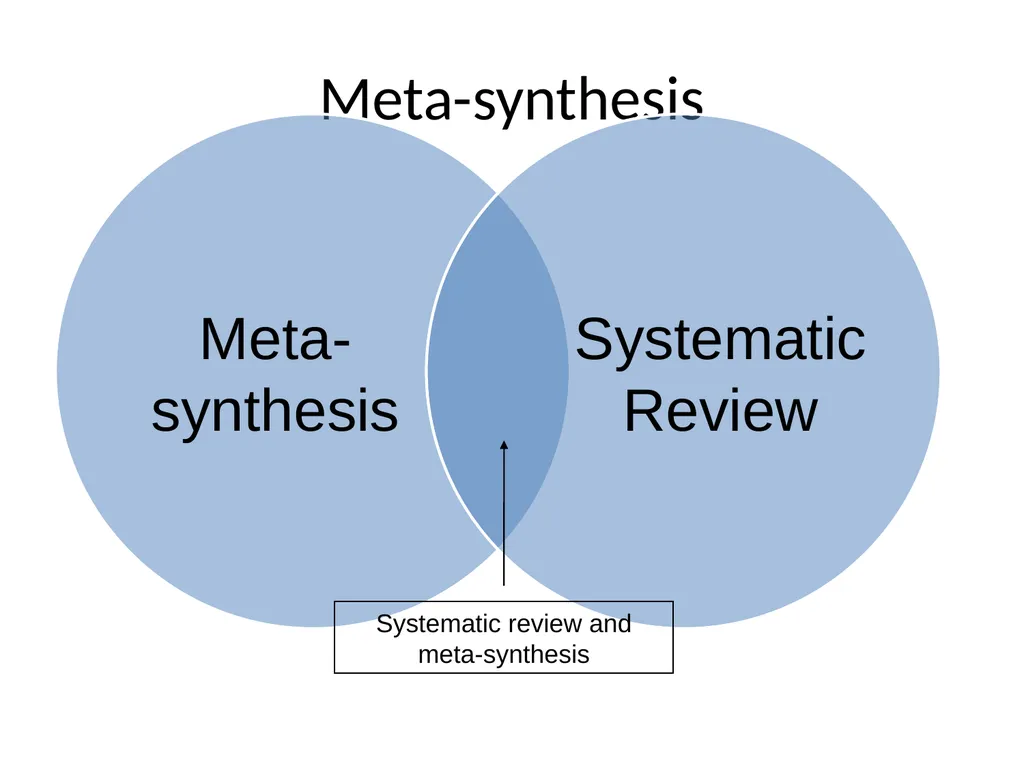
Meta-synthesis Systematic review and meta-synthesis<br>
08
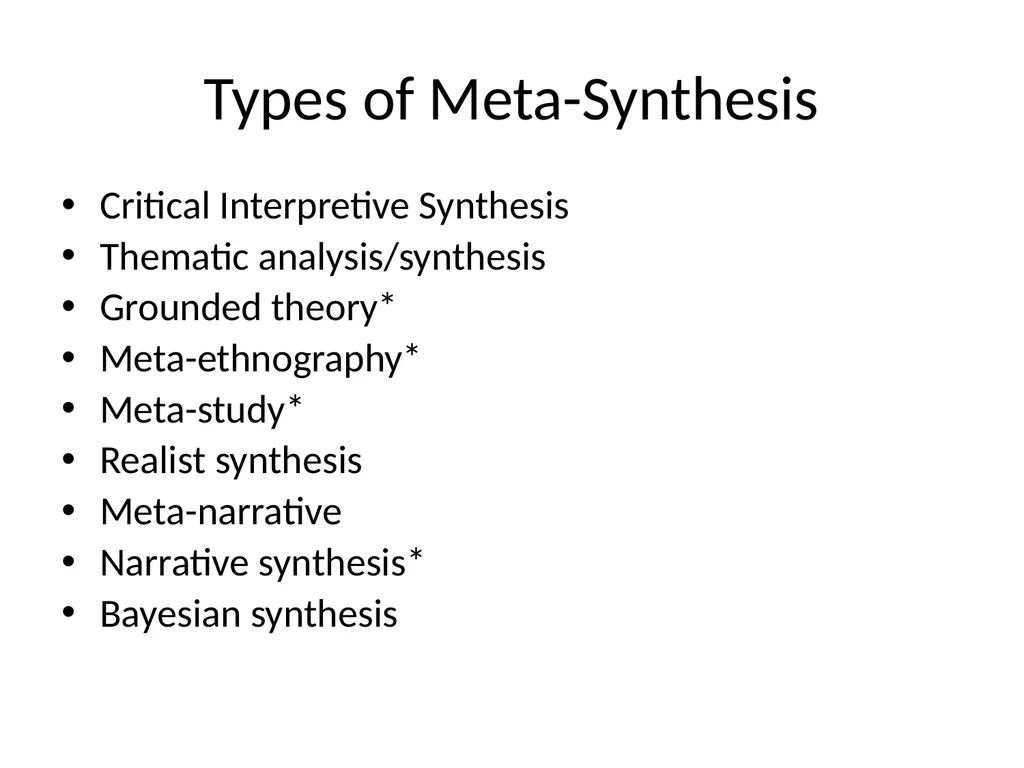
Types of Meta-Synthesis Critical Interpretive Synthesis
Thematic analysis/synthesis
Grounded theory*
Meta-ethnography*
Meta-study*
Realist synthesis
Meta-narrative
Narrative synthesis*
Bayesian synthesis<br>
Thematic analysis/synthesis
Grounded theory*
Meta-ethnography*
Meta-study*
Realist synthesis
Meta-narrative
Narrative synthesis*
Bayesian synthesis<br>
09
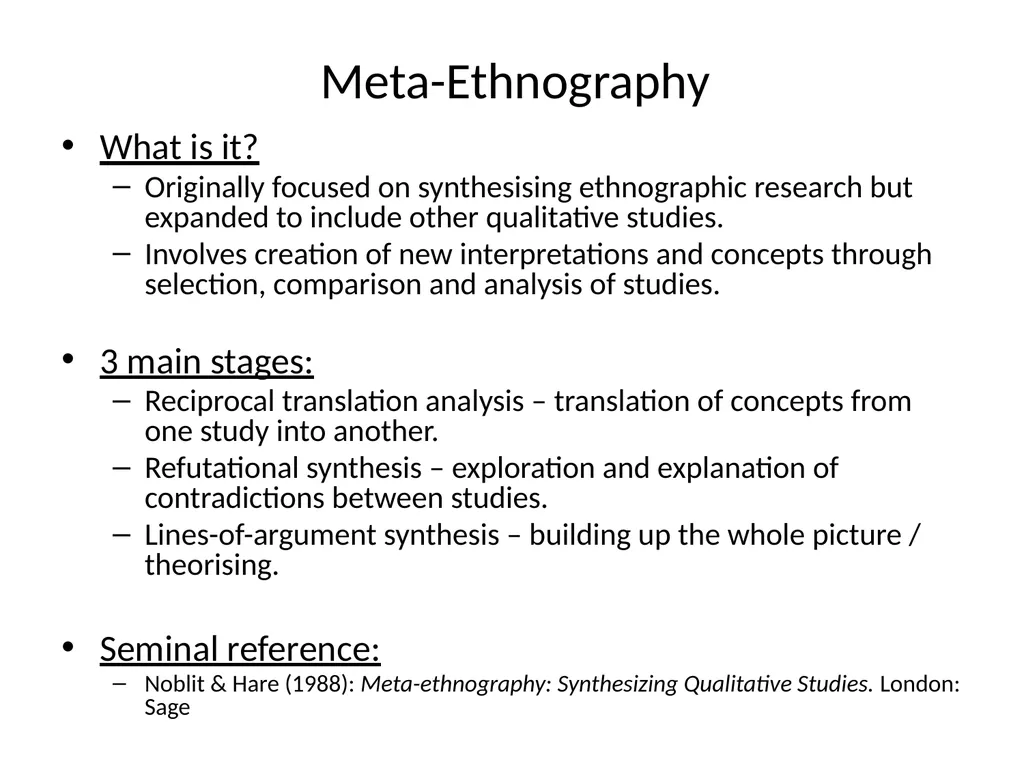
Meta-Ethnography What is it?
Originally focused on synthesising ethnographic research but expanded to include other qualitative studies.
Involves creation of new interpretations and concepts through selection, comparison and analysis of studies.
3 main stages:
Reciprocal translation analysis – translation of concepts from one study into another.
Refutational synthesis – exploration and explanation of contradictions between studies.
Lines-of-argument synthesis – building up the whole picture / theorising.
Seminal reference:
Noblit & Hare (1988): Meta-ethnography: Synthesizing Qualitative Studies. London: Sage<br>
Originally focused on synthesising ethnographic research but expanded to include other qualitative studies.
Involves creation of new interpretations and concepts through selection, comparison and analysis of studies.
3 main stages:
Reciprocal translation analysis – translation of concepts from one study into another.
Refutational synthesis – exploration and explanation of contradictions between studies.
Lines-of-argument synthesis – building up the whole picture / theorising.
Seminal reference:
Noblit & Hare (1988): Meta-ethnography: Synthesizing Qualitative Studies. London: Sage<br>
10
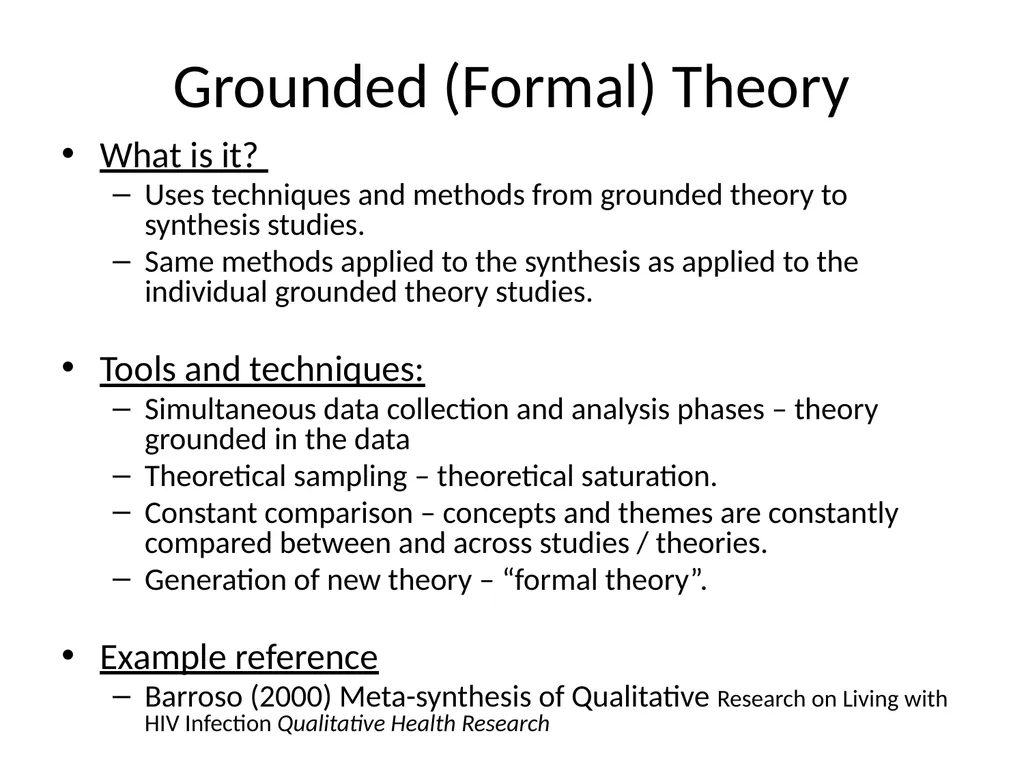
Grounded (Formal) Theory What is it?
Uses techniques and methods from grounded theory to synthesis studies.
Same methods applied to the synthesis as applied to the individual grounded theory studies.
Tools and techniques:
Simultaneous data collection and analysis phases – theory grounded in the data
Theoretical sampling – theoretical saturation.
Constant comparison – concepts and themes are constantly compared between and across studies / theories.
Generation of new theory – “formal theory”.
Example reference
Barroso (2000) Meta-synthesis of Qualitative Research on Living with HIV Infection Qualitative Health Research<br>
Uses techniques and methods from grounded theory to synthesis studies.
Same methods applied to the synthesis as applied to the individual grounded theory studies.
Tools and techniques:
Simultaneous data collection and analysis phases – theory grounded in the data
Theoretical sampling – theoretical saturation.
Constant comparison – concepts and themes are constantly compared between and across studies / theories.
Generation of new theory – “formal theory”.
Example reference
Barroso (2000) Meta-synthesis of Qualitative Research on Living with HIV Infection Qualitative Health Research<br>
11
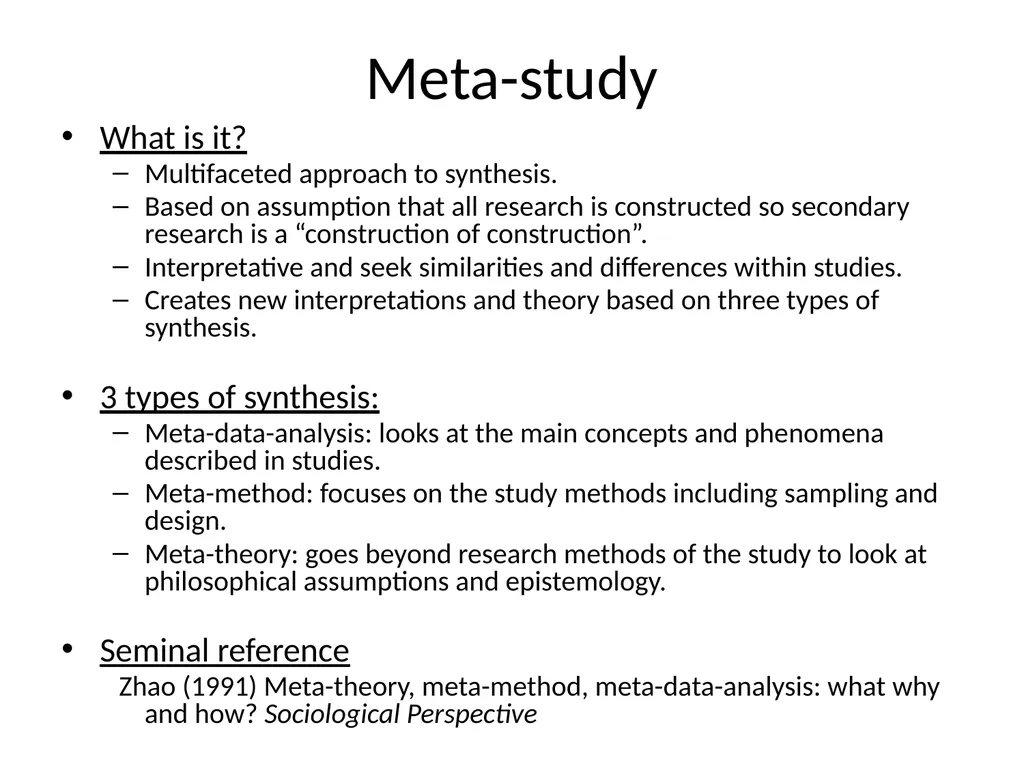
Meta-study What is it?
Multifaceted approach to synthesis.
Based on assumption that all research is constructed so secondary research is a “construction of construction”.
Interpretative and seek similarities and differences within studies.
Creates new interpretations and theory based on three types of synthesis.
3 types of synthesis:
Meta-data-analysis: looks at the main concepts and phenomena described in studies.
Meta-method: focuses on the study methods including sampling and design.
Meta-theory: goes beyond research methods of the study to look at philosophical assumptions and epistemology.
Seminal reference
Zhao (1991) Meta-theory, meta-method, meta-data-analysis: what why and how? Sociological Perspective<br>
Multifaceted approach to synthesis.
Based on assumption that all research is constructed so secondary research is a “construction of construction”.
Interpretative and seek similarities and differences within studies.
Creates new interpretations and theory based on three types of synthesis.
3 types of synthesis:
Meta-data-analysis: looks at the main concepts and phenomena described in studies.
Meta-method: focuses on the study methods including sampling and design.
Meta-theory: goes beyond research methods of the study to look at philosophical assumptions and epistemology.
Seminal reference
Zhao (1991) Meta-theory, meta-method, meta-data-analysis: what why and how? Sociological Perspective<br>
12
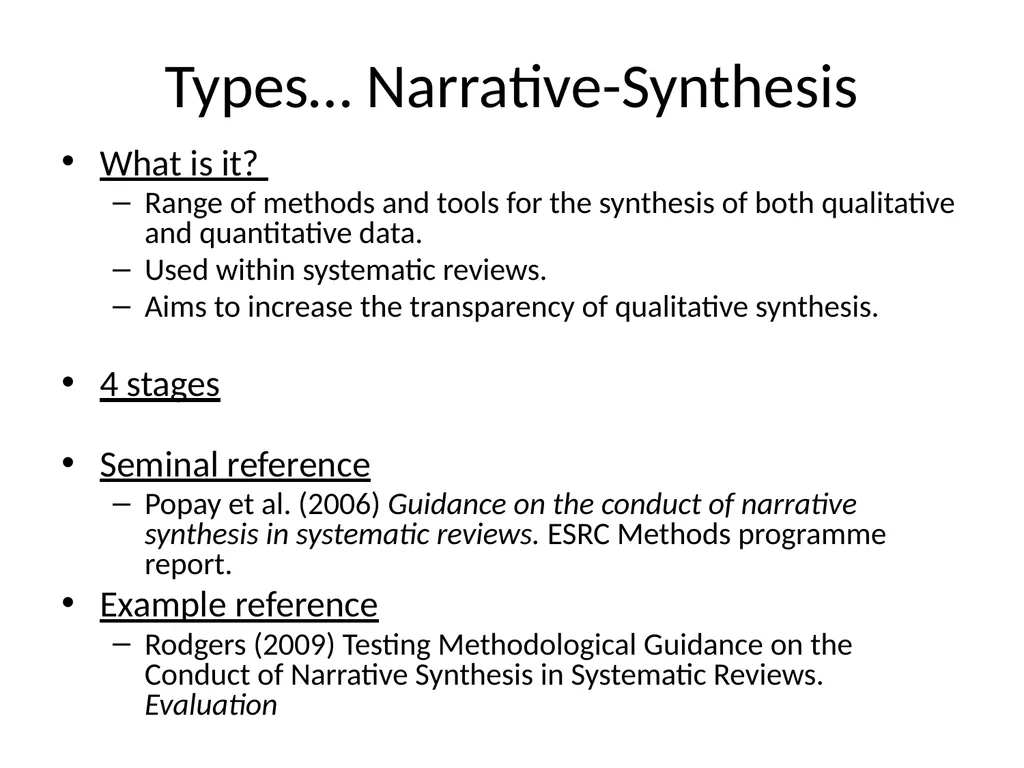
Types… Narrative-Synthesis What is it?
Range of methods and tools for the synthesis of both qualitative and quantitative data.
Used within systematic reviews.
Aims to increase the transparency of qualitative synthesis.
4 stages
Seminal reference
Popay et al. (2006) Guidance on the conduct of narrative synthesis in systematic reviews. ESRC Methods programme report.
Example reference
Rodgers (2009) Testing Methodological Guidance on the Conduct of Narrative Synthesis in Systematic Reviews. Evaluation<br>
Range of methods and tools for the synthesis of both qualitative and quantitative data.
Used within systematic reviews.
Aims to increase the transparency of qualitative synthesis.
4 stages
Seminal reference
Popay et al. (2006) Guidance on the conduct of narrative synthesis in systematic reviews. ESRC Methods programme report.
Example reference
Rodgers (2009) Testing Methodological Guidance on the Conduct of Narrative Synthesis in Systematic Reviews. Evaluation<br>
13
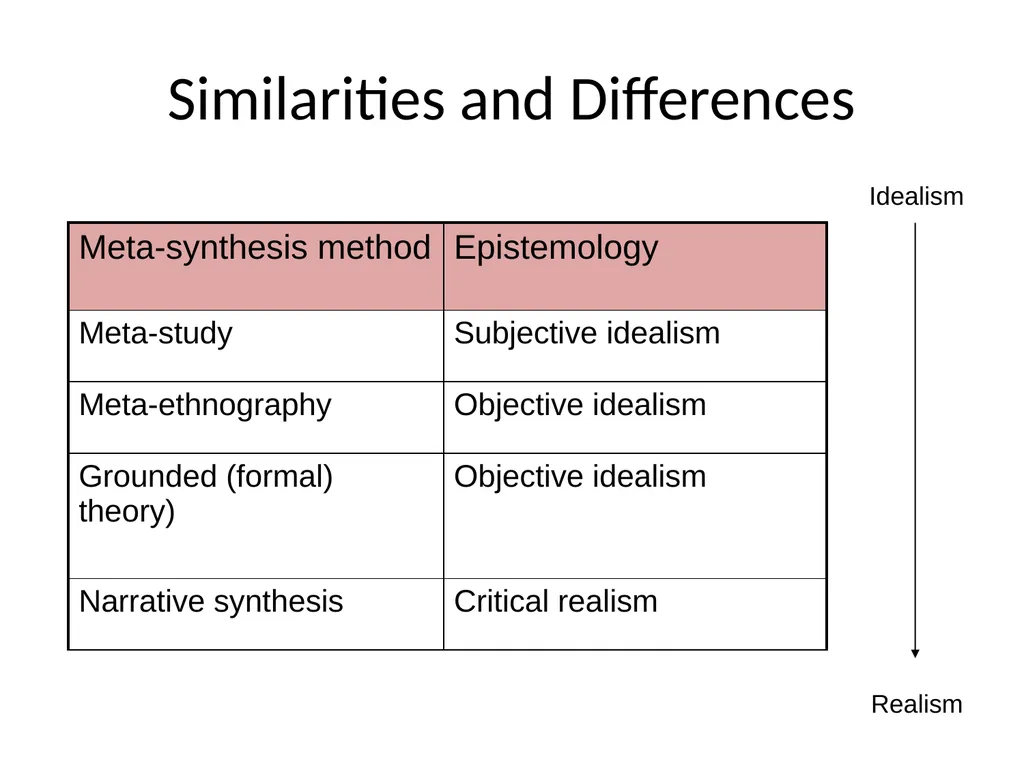
Similarities and Differences Idealism Realism<br>
14
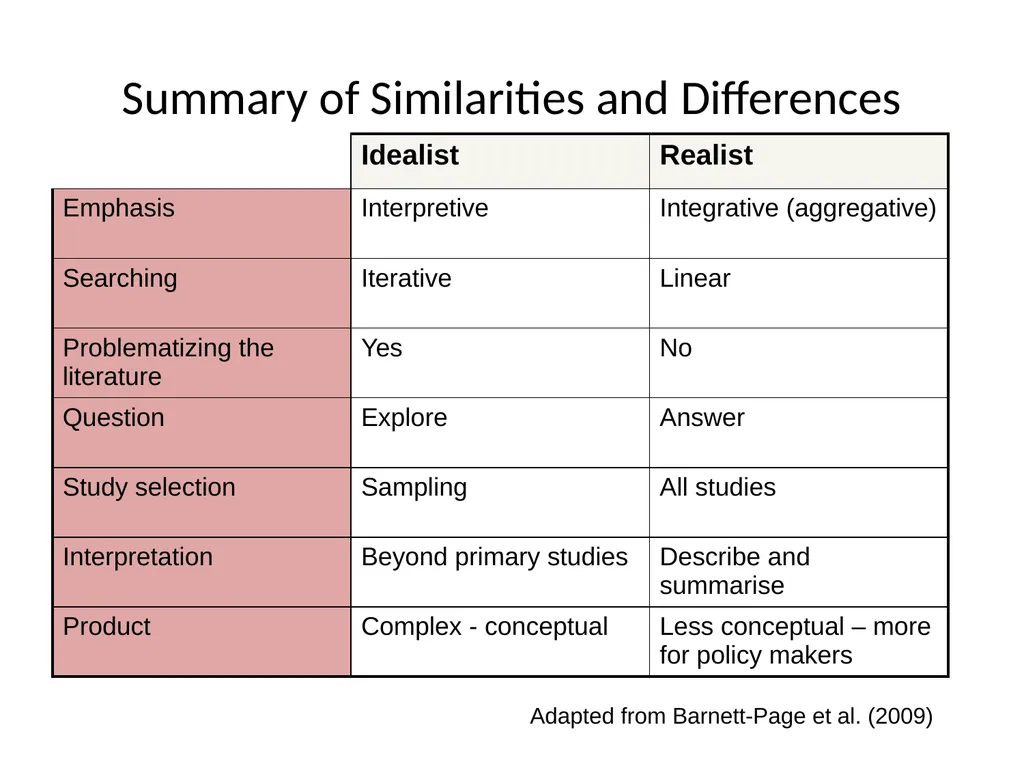
Summary of Similarities and Differences Adapted from Barnett-Page et al. (2009)<br>
15
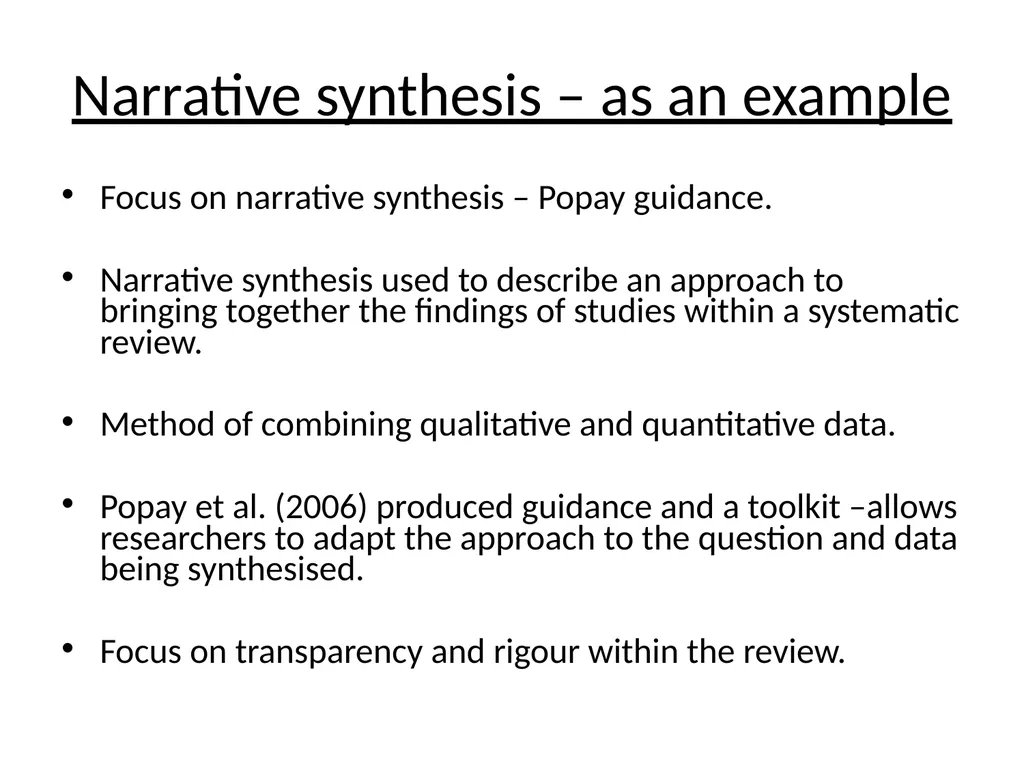
Narrative synthesis – as an example Focus on narrative synthesis – Popay guidance.
Narrative synthesis used to describe an approach to bringing together the findings of studies within a systematic review.
Method of combining qualitative and quantitative data.
Popay et al. (2006) produced guidance and a toolkit –allows researchers to adapt the approach to the question and data being synthesised.
Focus on transparency and rigour within the review.<br>
Narrative synthesis used to describe an approach to bringing together the findings of studies within a systematic review.
Method of combining qualitative and quantitative data.
Popay et al. (2006) produced guidance and a toolkit –allows researchers to adapt the approach to the question and data being synthesised.
Focus on transparency and rigour within the review.<br>
16
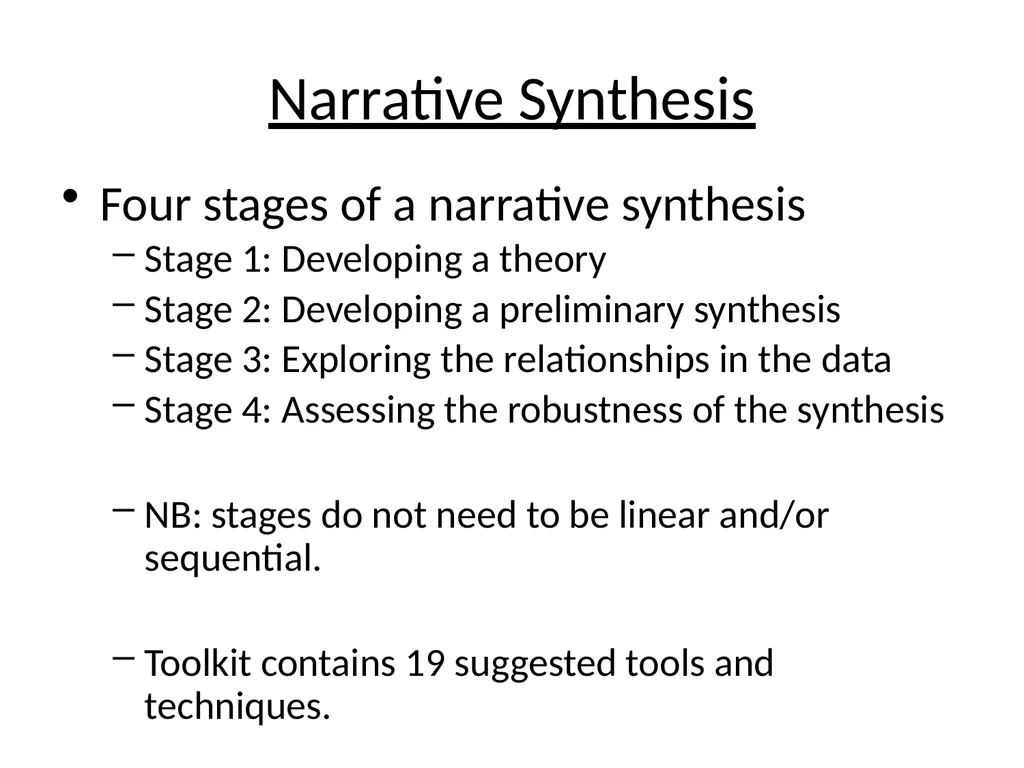
Narrative Synthesis Four stages of a narrative synthesis
Stage 1: Developing a theory
Stage 2: Developing a preliminary synthesis
Stage 3: Exploring the relationships in the data
Stage 4: Assessing the robustness of the synthesis
NB: stages do not need to be linear and/or sequential.
Toolkit contains 19 suggested tools and techniques.<br>
Stage 1: Developing a theory
Stage 2: Developing a preliminary synthesis
Stage 3: Exploring the relationships in the data
Stage 4: Assessing the robustness of the synthesis
NB: stages do not need to be linear and/or sequential.
Toolkit contains 19 suggested tools and techniques.<br>
17
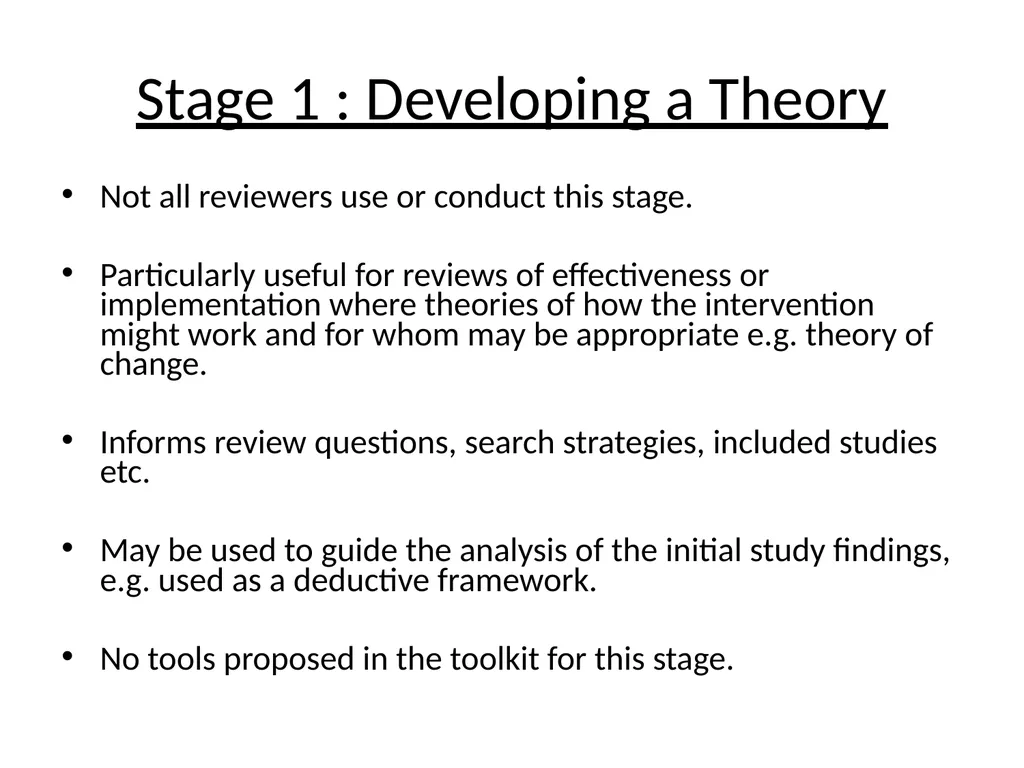
Stage 1 : Developing a Theory Not all reviewers use or conduct this stage.
Particularly useful for reviews of effectiveness or implementation where theories of how the intervention might work and for whom may be appropriate e.g. theory of change.
Informs review questions, search strategies, included studies etc.
May be used to guide the analysis of the initial study findings, e.g. used as a deductive framework.
No tools proposed in the toolkit for this stage.<br>
Particularly useful for reviews of effectiveness or implementation where theories of how the intervention might work and for whom may be appropriate e.g. theory of change.
Informs review questions, search strategies, included studies etc.
May be used to guide the analysis of the initial study findings, e.g. used as a deductive framework.
No tools proposed in the toolkit for this stage.<br>
18
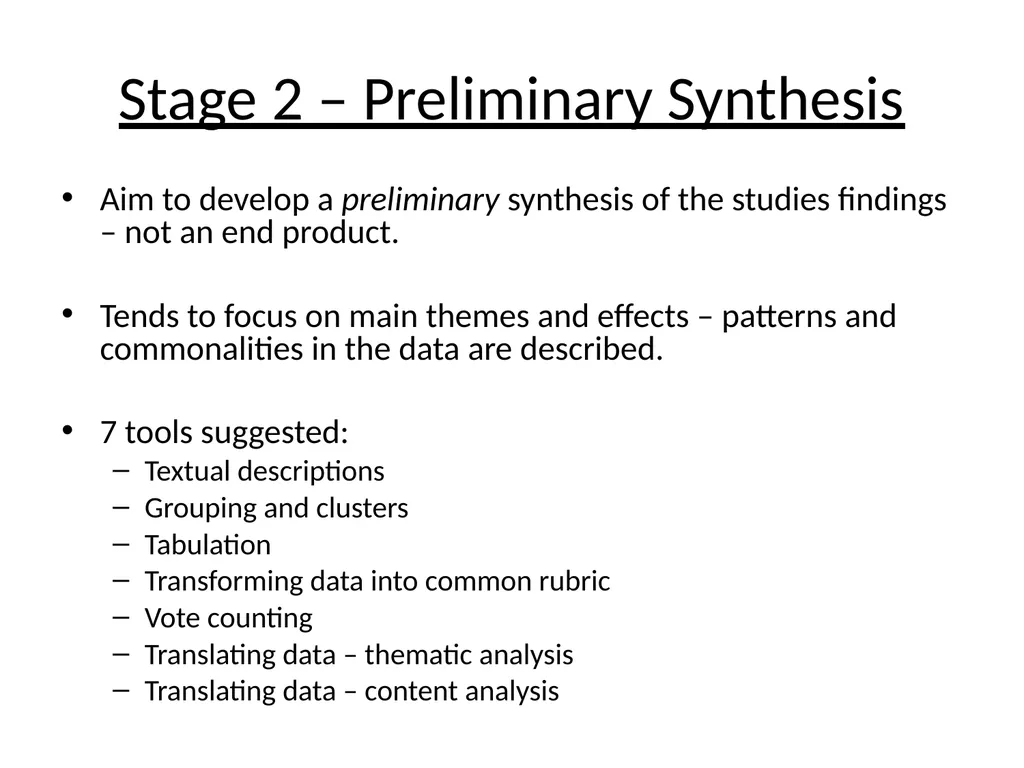
Stage 2 – Preliminary Synthesis Aim to develop a preliminary synthesis of the studies findings – not an end product.
Tends to focus on main themes and effects – patterns and commonalities in the data are described.
7 tools suggested:
Textual descriptions
Grouping and clusters
Tabulation
Transforming data into common rubric
Vote counting
Translating data – thematic analysis
Translating data – content analysis<br>
Tends to focus on main themes and effects – patterns and commonalities in the data are described.
7 tools suggested:
Textual descriptions
Grouping and clusters
Tabulation
Transforming data into common rubric
Vote counting
Translating data – thematic analysis
Translating data – content analysis<br>
19
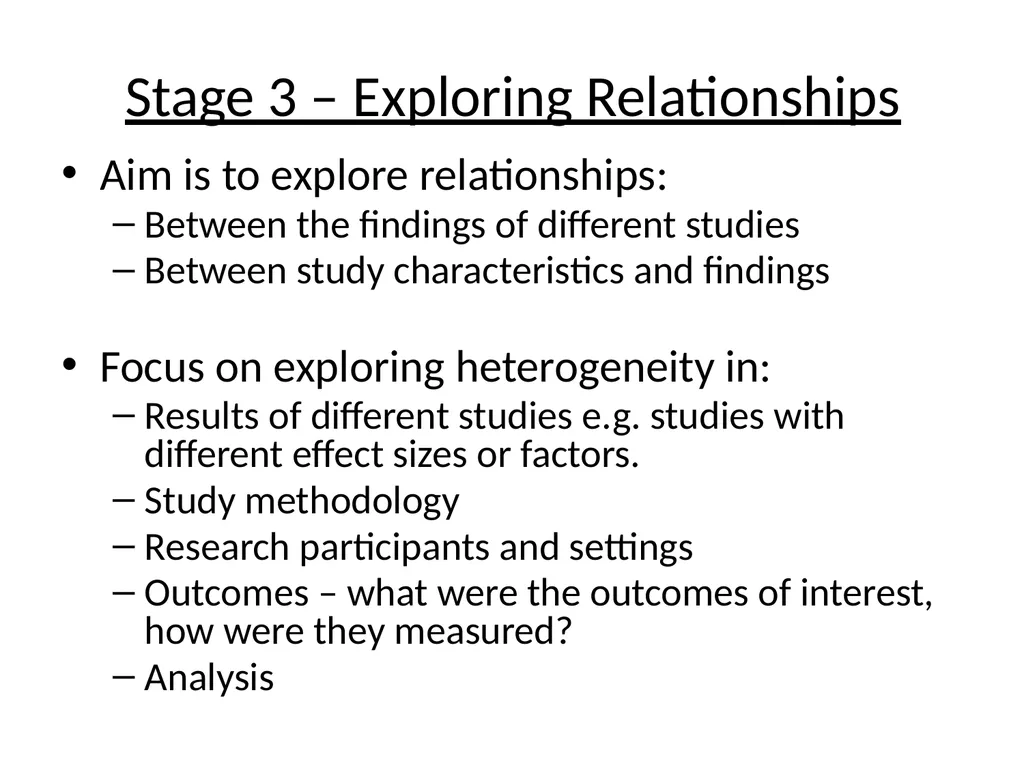
Stage 3 – Exploring Relationships Aim is to explore relationships:
Between the findings of different studies
Between study characteristics and findings
Focus on exploring heterogeneity in:
Results of different studies e.g. studies with different effect sizes or factors.
Study methodology
Research participants and settings
Outcomes – what were the outcomes of interest, how were they measured?
Analysis<br>
Between the findings of different studies
Between study characteristics and findings
Focus on exploring heterogeneity in:
Results of different studies e.g. studies with different effect sizes or factors.
Study methodology
Research participants and settings
Outcomes – what were the outcomes of interest, how were they measured?
Analysis<br>
20
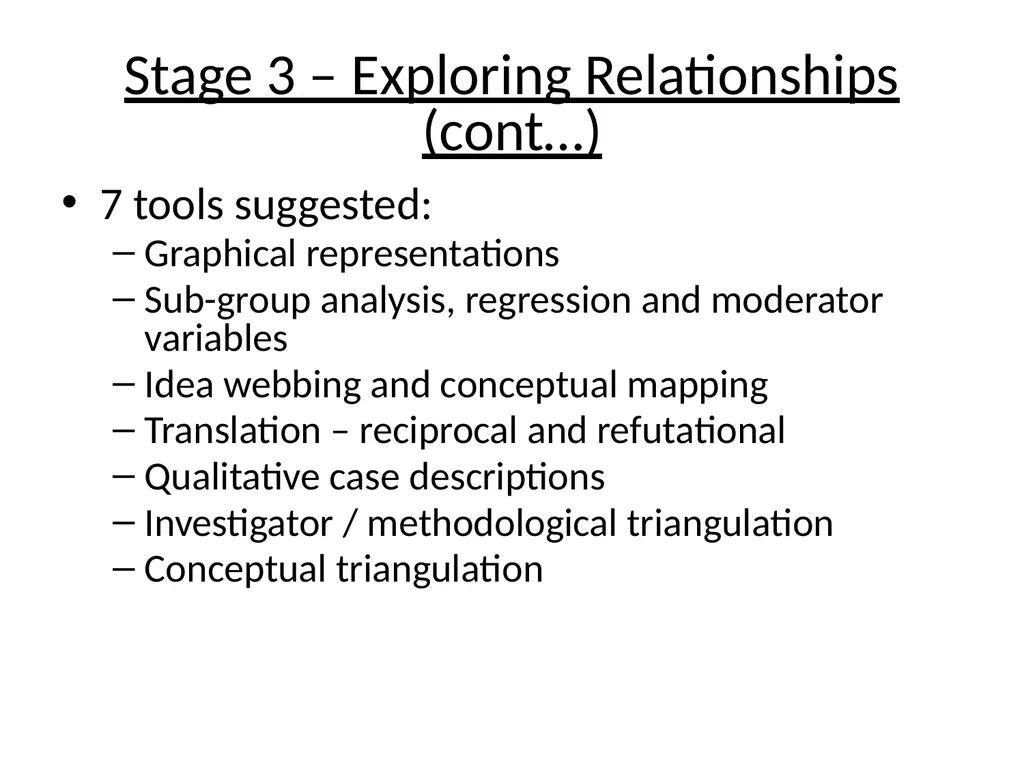
Stage 3 – Exploring Relationships (cont…) 7 tools suggested:
Graphical representations
Sub-group analysis, regression and moderator variables
Idea webbing and conceptual mapping
Translation – reciprocal and refutational
Qualitative case descriptions
Investigator / methodological triangulation
Conceptual triangulation<br>
Graphical representations
Sub-group analysis, regression and moderator variables
Idea webbing and conceptual mapping
Translation – reciprocal and refutational
Qualitative case descriptions
Investigator / methodological triangulation
Conceptual triangulation<br>
21
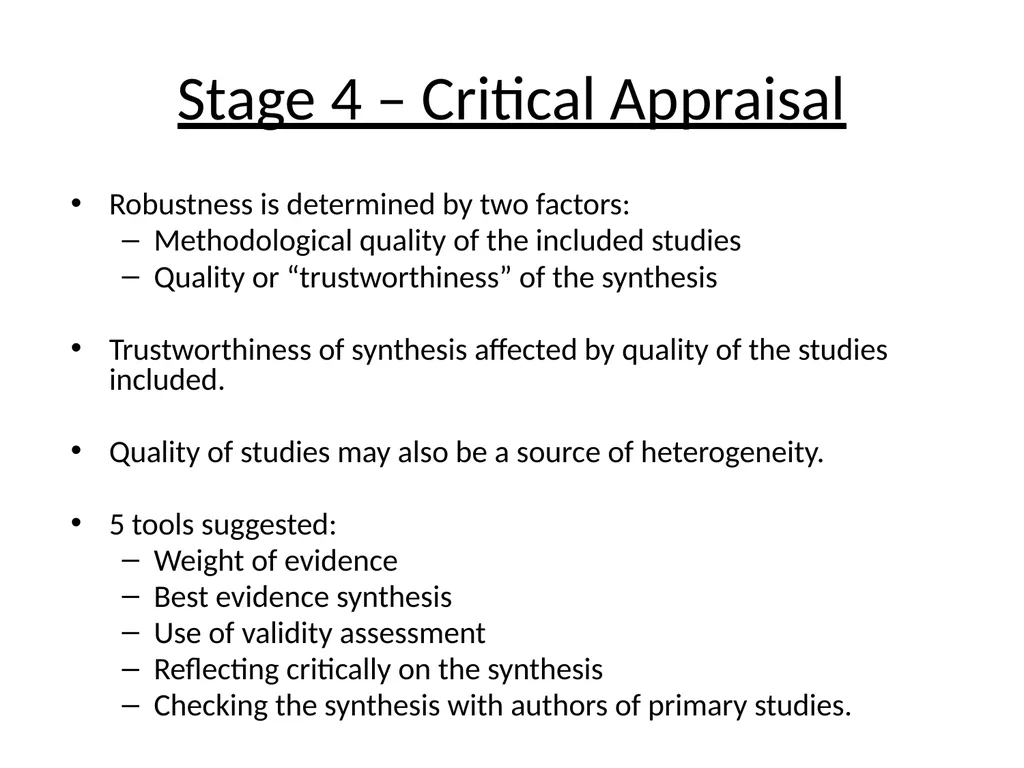
Stage 4 – Critical Appraisal Robustness is determined by two factors:
Methodological quality of the included studies
Quality or “trustworthiness” of the synthesis
Trustworthiness of synthesis affected by quality of the studies included.
Quality of studies may also be a source of heterogeneity.
5 tools suggested:
Weight of evidence
Best evidence synthesis
Use of validity assessment
Reflecting critically on the synthesis
Checking the synthesis with authors of primary studies.<br>
Methodological quality of the included studies
Quality or “trustworthiness” of the synthesis
Trustworthiness of synthesis affected by quality of the studies included.
Quality of studies may also be a source of heterogeneity.
5 tools suggested:
Weight of evidence
Best evidence synthesis
Use of validity assessment
Reflecting critically on the synthesis
Checking the synthesis with authors of primary studies.<br>
22
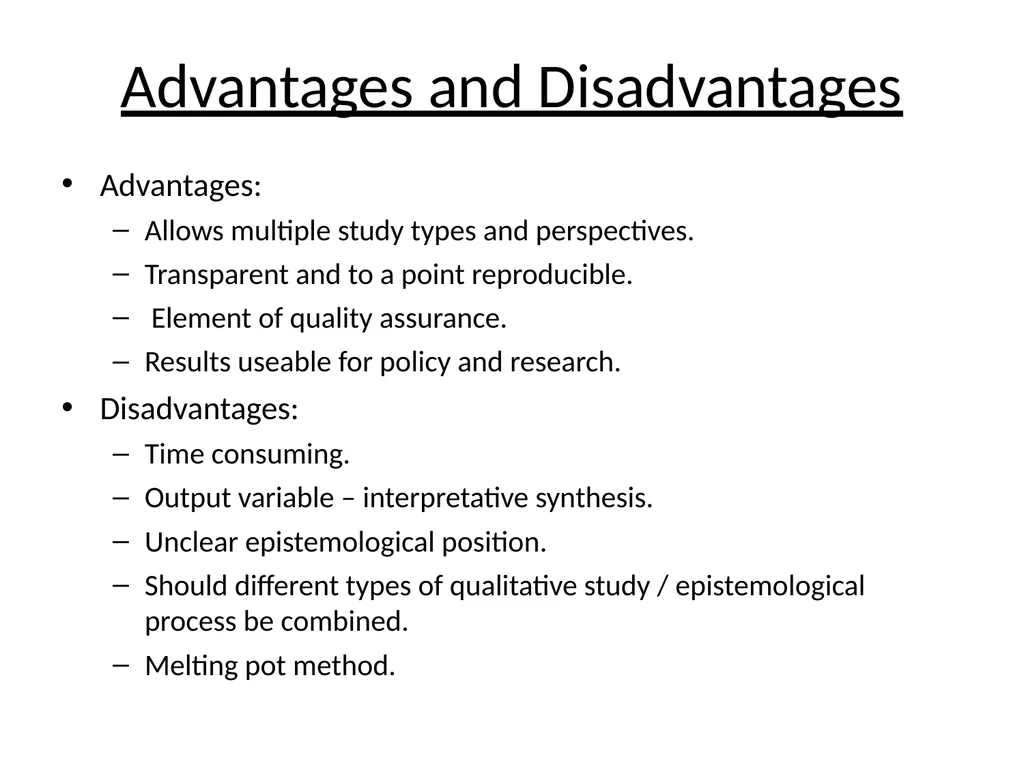
Advantages and Disadvantages Advantages:
Allows multiple study types and perspectives.
Transparent and to a point reproducible.
Element of quality assurance.
Results useable for policy and research.
Disadvantages:
Time consuming.
Output variable – interpretative synthesis.
Unclear epistemological position.
Should different types of qualitative study / epistemological process be combined.
Melting pot method.<br>
Allows multiple study types and perspectives.
Transparent and to a point reproducible.
Element of quality assurance.
Results useable for policy and research.
Disadvantages:
Time consuming.
Output variable – interpretative synthesis.
Unclear epistemological position.
Should different types of qualitative study / epistemological process be combined.
Melting pot method.<br>
23
General Issues with Meta-Synthesis What synthesis method is most appropriate?
Searching for the literature – design and conduct
Quality appraisal – Should and can study quality be appraised?<br>
Searching for the literature – design and conduct
Quality appraisal – Should and can study quality be appraised?<br>
24
Choosing a Meta-Synthesis Method Choice of method depends on a number of factors:
Expertise
Available evidence
Resources – particularly time
End product
Epistemological stand point / world view<br>
Expertise
Available evidence
Resources – particularly time
End product
Epistemological stand point / world view<br>