METODOLOGY OF DEVELOPING SUSTAINABLE DEVELOPMENT STRATEGIES OF THE EUROPEAN UNION CAPITAL CITIES, THEIR COMPERATIVE ANALYSIS AND SOURCES OF FINANCING SUSTAINABLE DEVELOPMENT GOALS BY LOCAL GOVERMENTS Ewelina Pałucka associate professor
"METODOLOGY OF DEVELOPING SUSTAINABLE DEVELOPMENT" is the property of its rightful owner. Permission is granted to
download and print the materials on this website for personal, non-commercial use only, and to display it
on your personal computer provided you do not modify the materials and that you retain all copyright
notices contained in the materials. By downloading content from our website, you accept the terms of this
agreement.
Presentation Transcript
01
METODOLOGY OF DEVELOPING SUSTAINABLE DEVELOPMENT STRATEGIES OF THE EUROPEAN UNION CAPITAL CITIES, THEIR COMPERATIVE ANALYSIS AND SOURCES OF FINANCING SUSTAINABLE DEVELOPMENT GOALS BY LOCAL GOVERMENTS Ewelina Pałucka
associate professor
Univeristy of Ecology and Management in Warsaw
Faculty of Engineering and Management<br>
02
Content Introduction
Theoretical background
Study
Materials and Methods
Analysis and results
Summary<br>
03
Content Introduction
Theoretical background
Study
Materials and Methods
Analysis and results
Summary<br>
04
Introduction overview of the origin of the concept of sustainable development
determines core elements and framework of developing SDS tailored for EU capital cities
explores the degree of cohesion between uniquely designed SDS with the SDSs of all the EU capital cities
presents the sources of financing the sustainable goals of the surveyed cities<br>
05
Content Introduction
Theoretical background
Study
Materials and Methods
Analysis and results
Summary<br>
06
Theoretical background Concept of SD known already in ancient Roman, Greek, Egyptian
and Mesopotamian civilizations
Firstly described by Hans Carl von Carlowitz
in 1713 in Sylvicultura Oeconomica
Raised significance only in the second half of the 20th century<br>
07
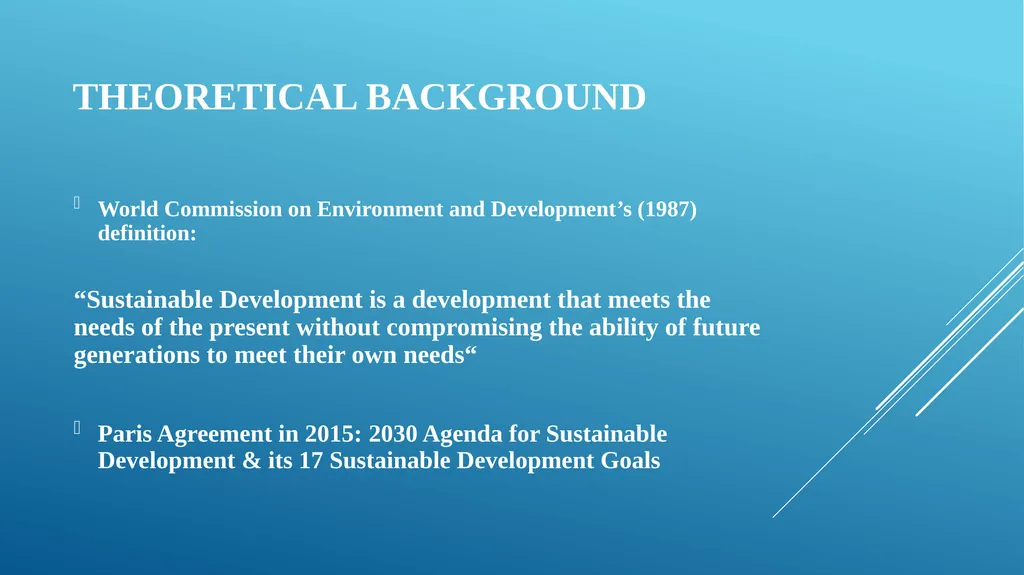
Theoretical background World Commission on Environment and Development’s (1987) definition:
“Sustainable Development is a development that meets the needs of the present without compromising the ability of future generations to meet their own needs“
Paris Agreement in 2015: 2030 Agenda for Sustainable Development & its 17 Sustainable Development Goals<br>
08
Content Introduction
Theoretical background
Study
Materials and Methods
Analysis and results
Summary<br>
09
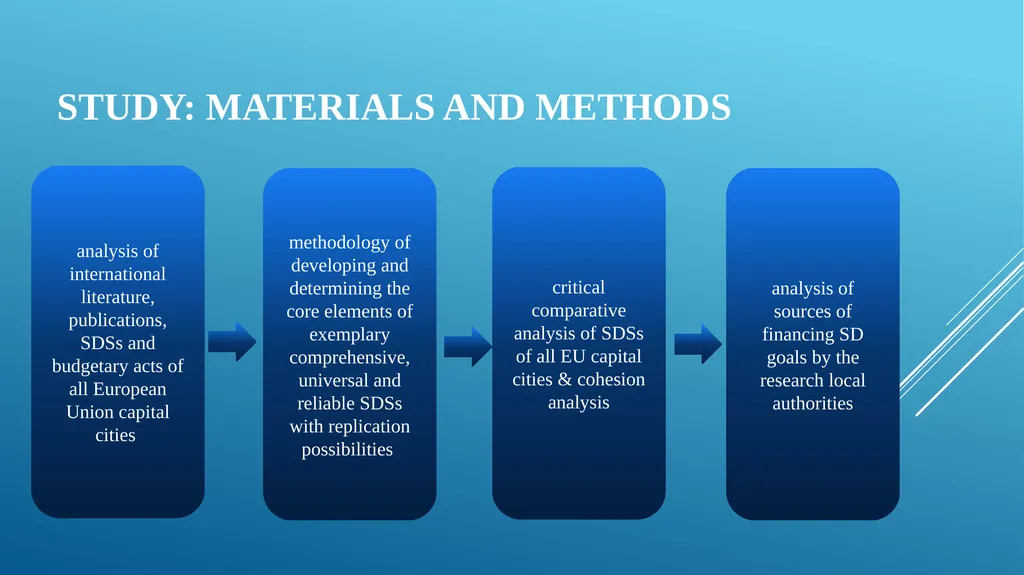
Study: Materials and Methods analysis of international literature, publications, SDSs and budgetary acts of all European Union capital cities methodology of developing and determining the core elements of exemplary comprehensive, universal and reliable SDSs with replication possibilities analysis of sources of financing SD goals by the research local authorities critical comparative analysis of SDSs of all EU capital cities & cohesion analysis<br>
10
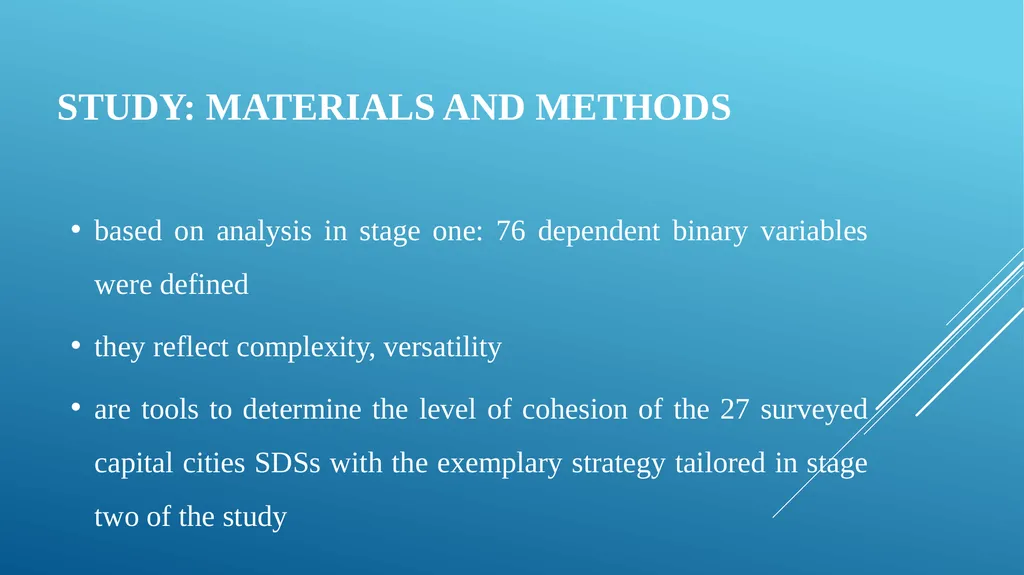
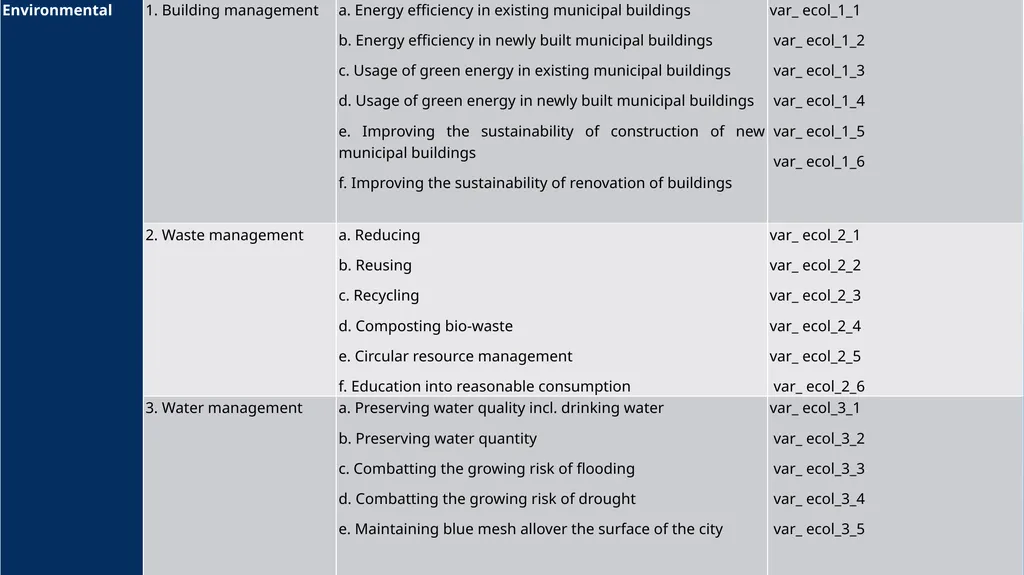
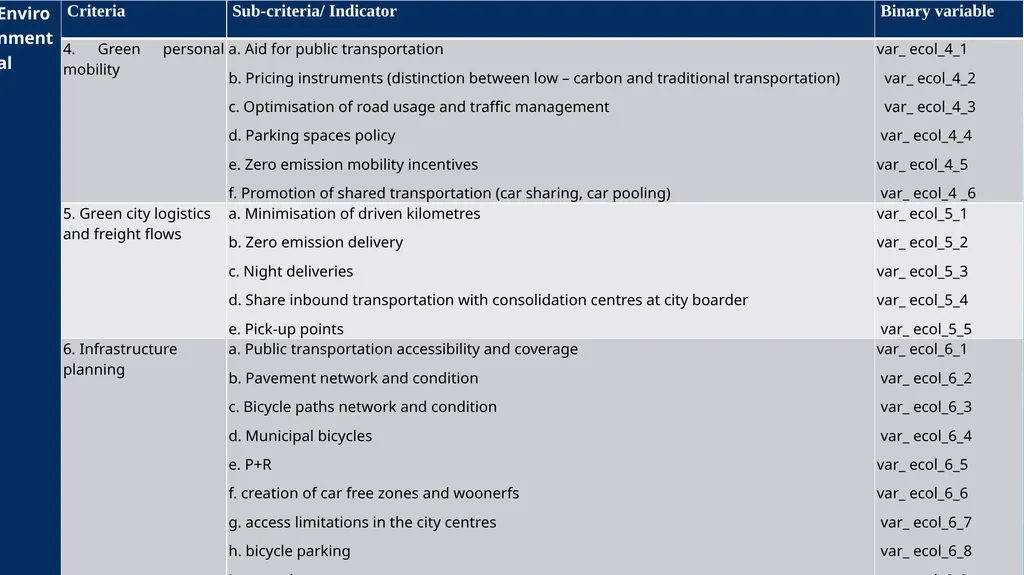
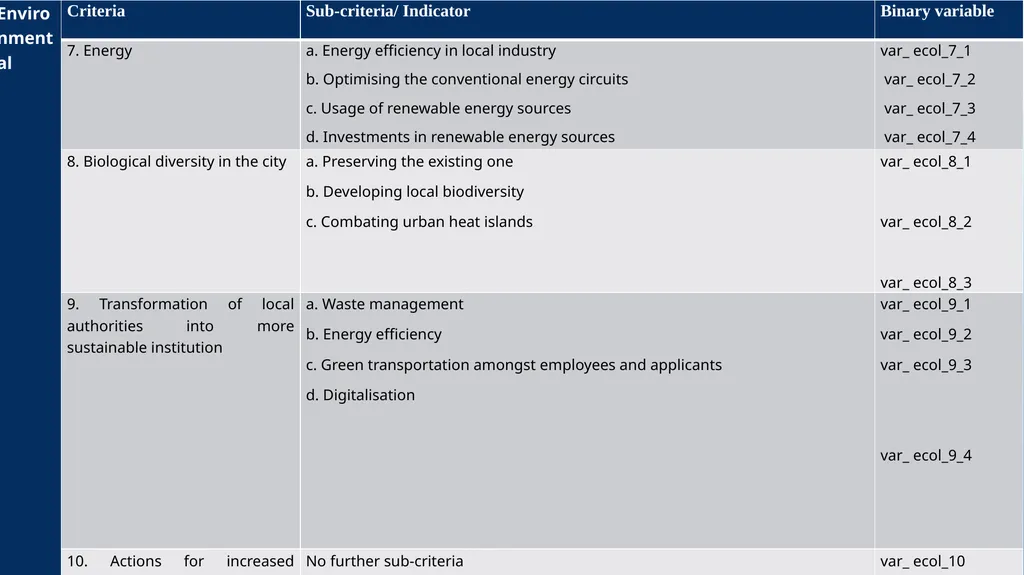
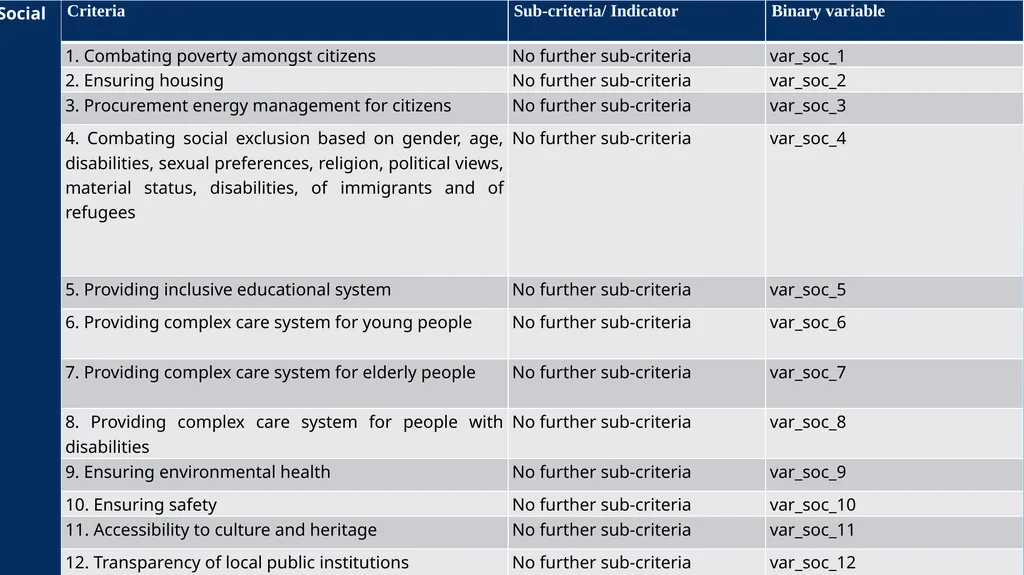
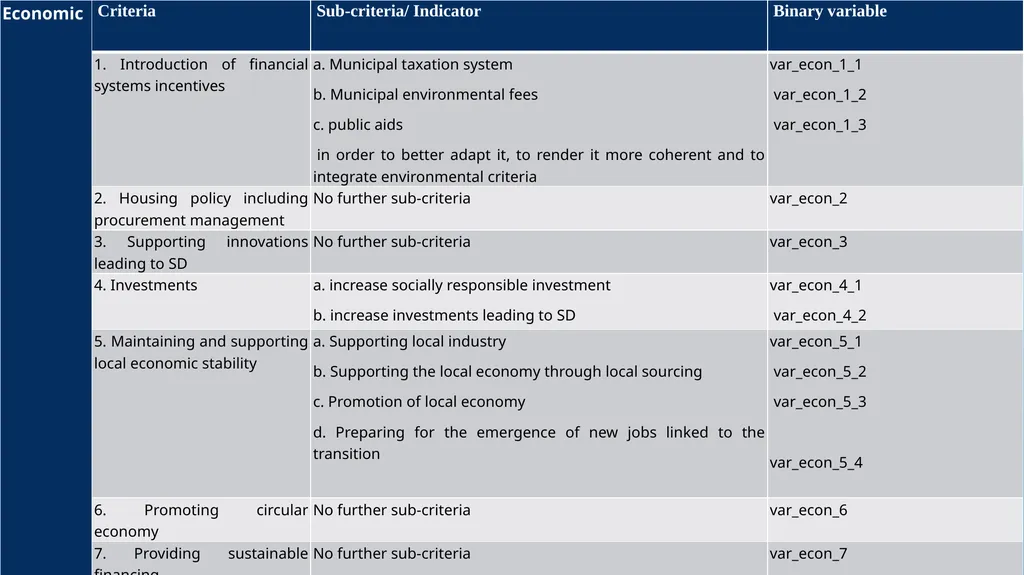
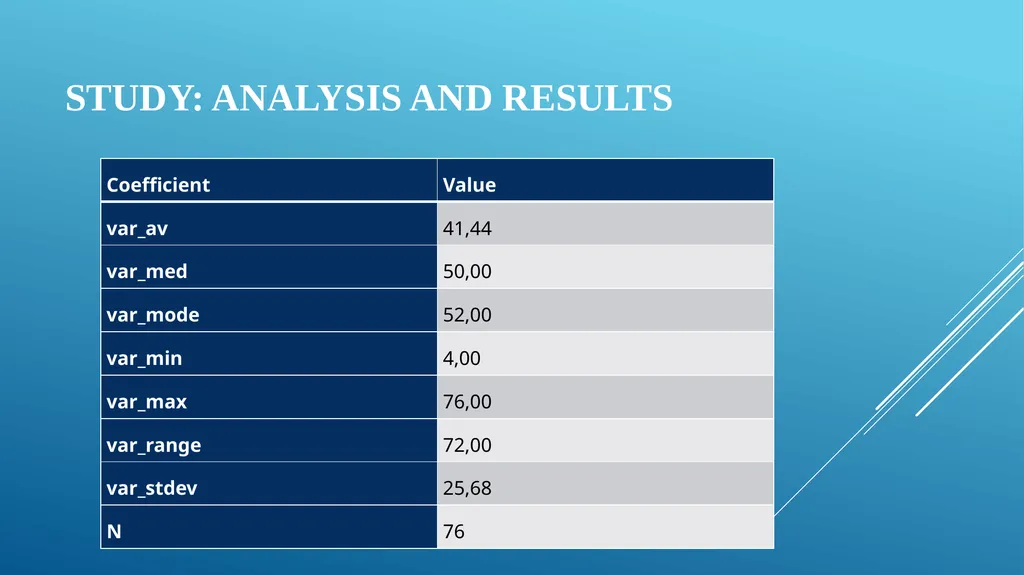
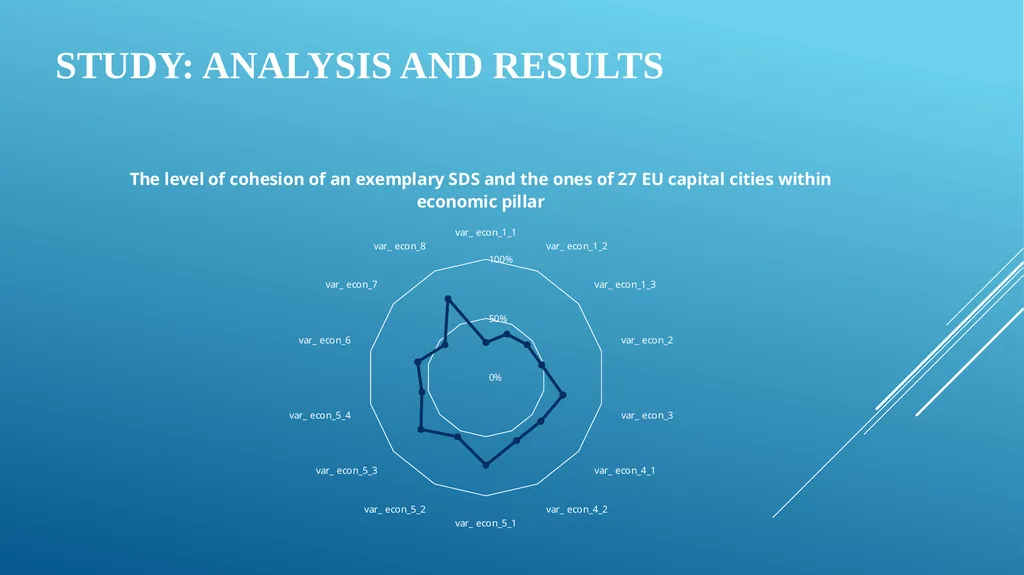
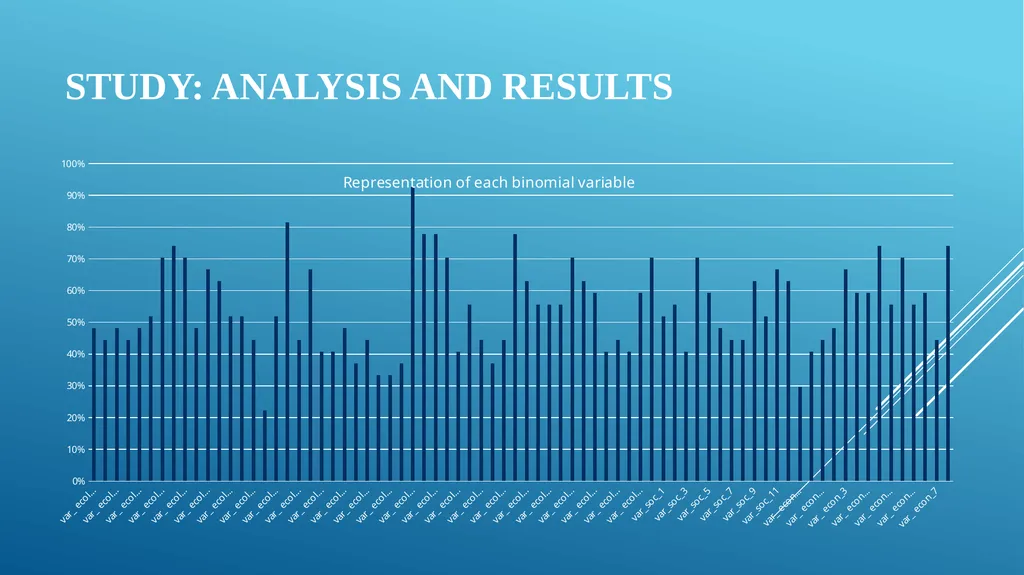
Study: Materials and Methods based on analysis in stage one: 76 dependent binary variables were defined
they reflect complexity, versatility
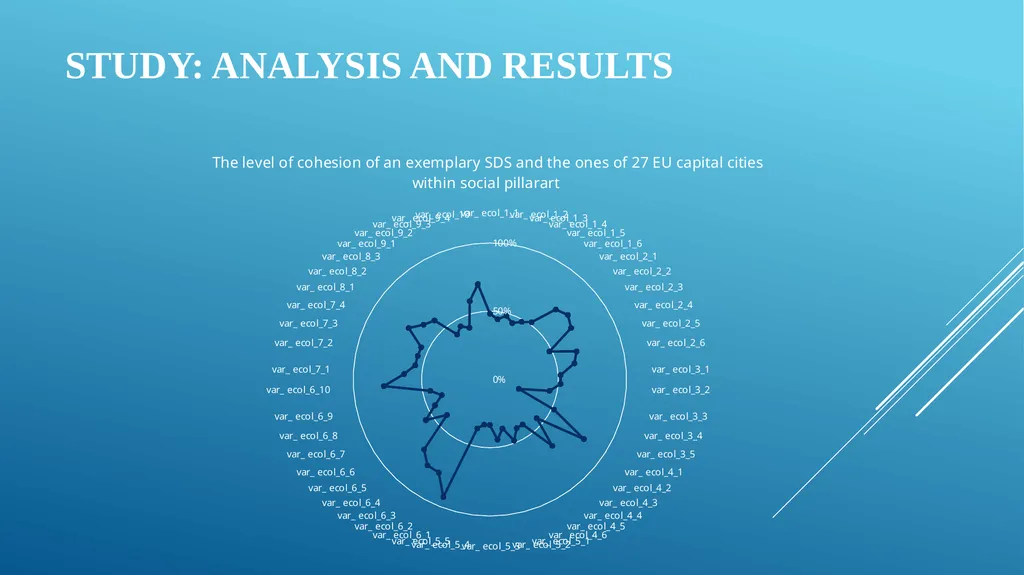
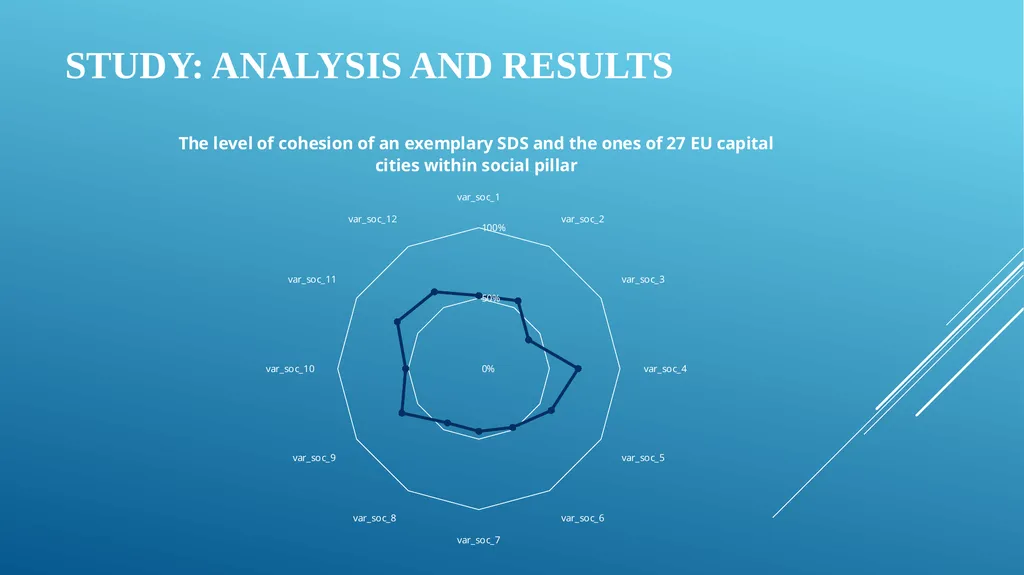
are tools to determine the level of cohesion of the 27 surveyed capital cities SDSs with the exemplary strategy tailored in stage two of the study<br>
11
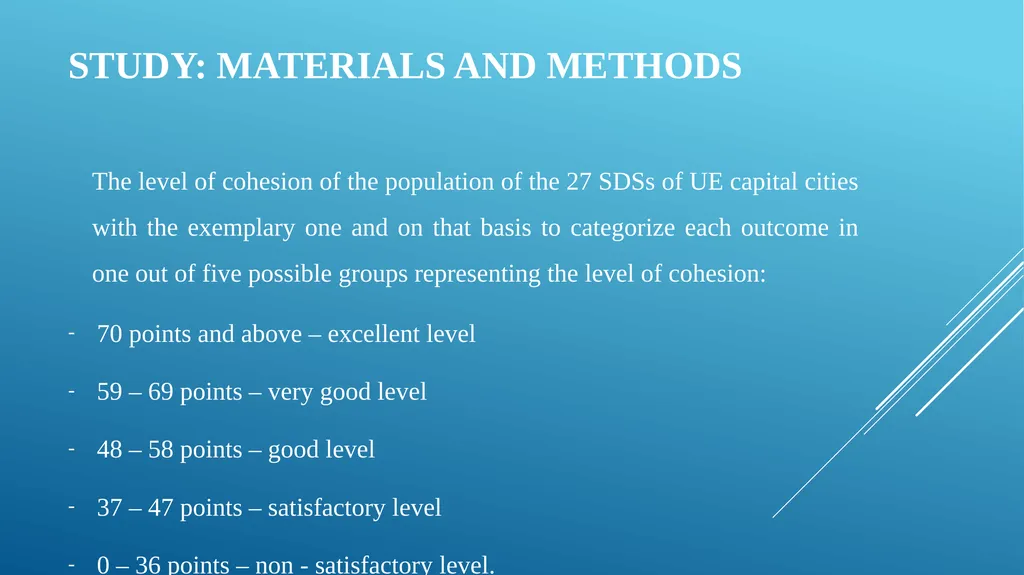
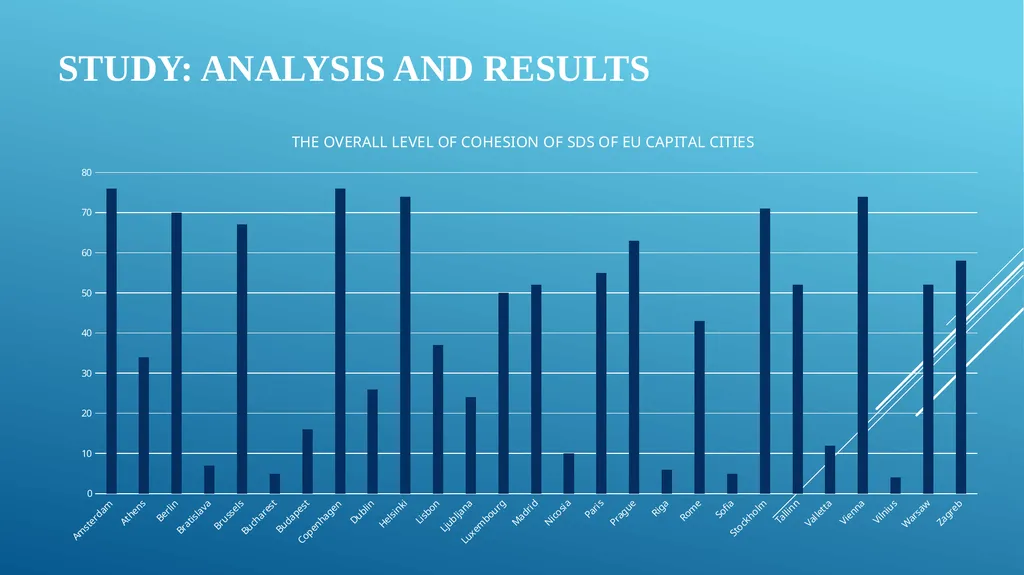
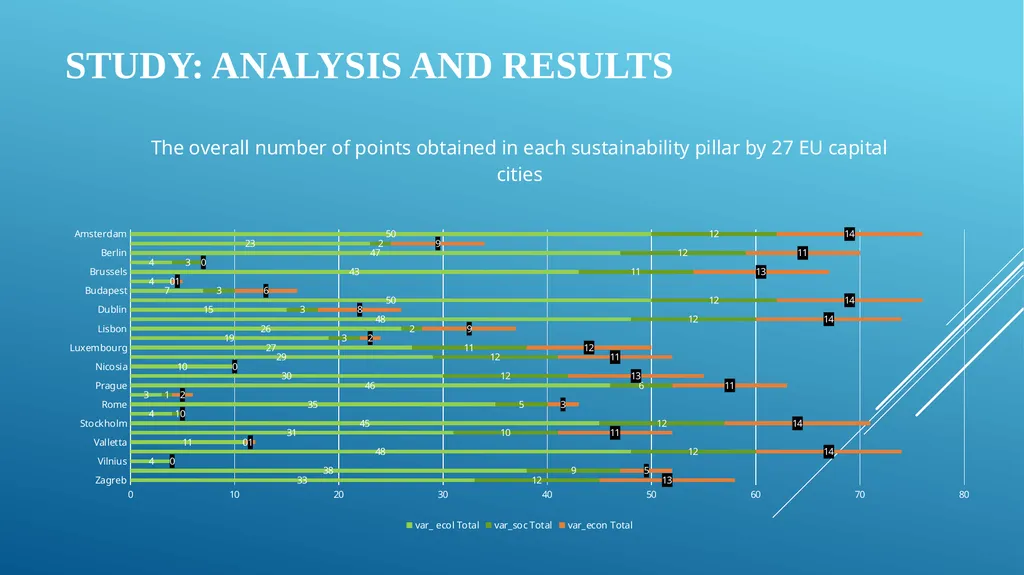
Study: Materials and Methods The level of cohesion of the population of the 27 SDSs of UE capital cities with the exemplary one and on that basis to categorize each outcome in one out of five possible groups representing the level of cohesion:
70 points and above – excellent level
59 – 69 points – very good level
48 – 58 points – good level
37 – 47 points – satisfactory level
0 – 36 points – non - satisfactory level.<br>
12
Content Introduction
Theoretical background
Study
Materials and Methods
Analysis and results
Summary<br>
13
Study: Analysis and results<br>
14
Study: Analysis and results<br>
15
Study: Analysis and results<br>
16
Study: Analysis and results<br>
17
Study: Analysis and results<br>
18
Study: Analysis and results<br>
19
Study: Analysis and results<br>
20
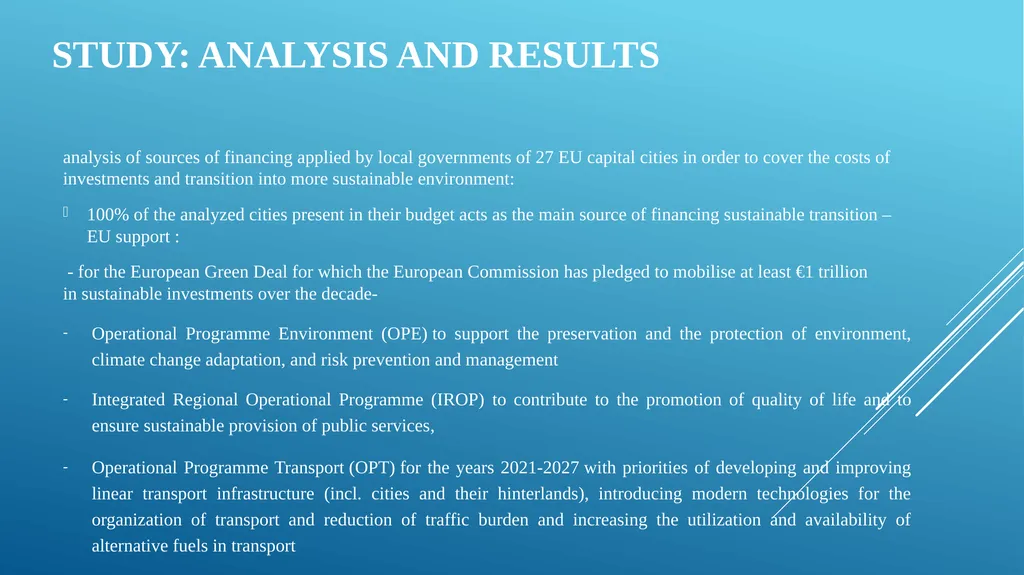
Study: Analysis and results analysis of sources of financing applied by local governments of 27 EU capital cities in order to cover the costs of investments and transition into more sustainable environment:
100% of the analyzed cities present in their budget acts as the main source of financing sustainable transition – EU support :
- for the European Green Deal for which the European Commission has pledged to mobilise at least €1 trillion in sustainable investments over the decade-
Operational Programme Environment (OPE) to support the preservation and the protection of environment, climate change adaptation, and risk prevention and management
Integrated Regional Operational Programme (IROP) to contribute to the promotion of quality of life and to ensure sustainable provision of public services,
Operational Programme Transport (OPT) for the years 2021-2027 with priorities of developing and improving linear transport infrastructure (incl. cities and their hinterlands), introducing modern technologies for the organization of transport and reduction of traffic burden and increasing the utilization and availability of alternative fuels in transport<br>
21
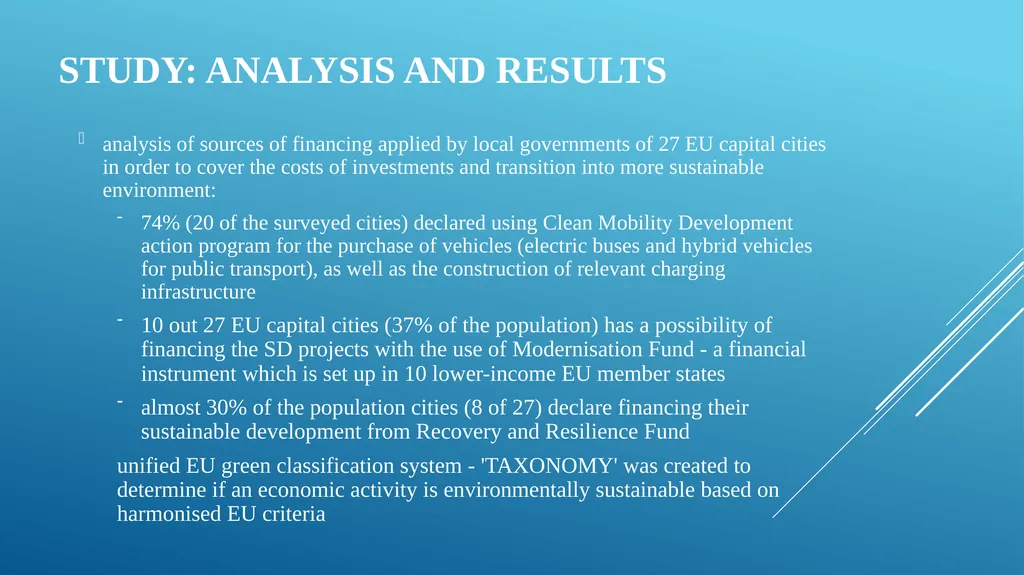
Study: Analysis and results analysis of sources of financing applied by local governments of 27 EU capital cities in order to cover the costs of investments and transition into more sustainable environment:
74% (20 of the surveyed cities) declared using Clean Mobility Development action program for the purchase of vehicles (electric buses and hybrid vehicles for public transport), as well as the construction of relevant charging infrastructure
10 out 27 EU capital cities (37% of the population) has a possibility of financing the SD projects with the use of Modernisation Fund - a financial instrument which is set up in 10 lower-income EU member states
almost 30% of the population cities (8 of 27) declare financing their sustainable development from Recovery and Resilience Fund
unified EU green classification system - 'TAXONOMY' was created to determine if an economic activity is environmentally sustainable based on harmonised EU criteria<br>
22
Study: Analysis and results cooperation of private and public investments to:
- scale up sustainable finance to plug the current investment gap,
- ensure compatible markets for sustainable financial assets across borders and avoid fragmentation,
- achieve economies of scale by exploring synergies,
- maximise the impact of EU investment to support our industry and help us deliver on our core priorities.
-orienting private capital to more sustainable investments require a comprehensive rethinking of how our financial system works.<br>
23
Study: Analysis and results Examples of private and public cooperation in SD finance:
European Union's Capital Markets Union (CMU) project
International Platform on Sustainable Finance Platform
Warsaw Sustainable Segment on Warsaw Stock<br>
24
Content Introduction
Theoretical background
Study
Materials and Methods
Analysis and results
Summary<br>
25
Summary The survey allowed to create methodology of developing and propose core elements of universal, exemplary, comprehensive and replicable SDS for EU cities
diversity in the field of constructing the SD strategies within the population of EU capital cities is very high
the main sources of finance concentrates around EU programs within the whole population of the survey<br>