
MHO/ CHO Guide For Training, Deployment and

Description: MHO CHO Guide For Training, Deployment and Mobilization of Community Health Teams (CHTs) Preparing for CHT Mobilization at the MunicipalCity Level The Municipal Health OfficerCity Health Officer will play a vital role in the Training,
Related Topics
Download Presentation
"MHO/ CHO Guide For Training, Deployment and" is the property of its rightful owner. Permission is granted to download and print the materials on this website for personal, non-commercial use only, and to display it on your personal computer provided you do not modify the materials and that you retain all copyright notices contained in the materials. By downloading content from our website, you accept the terms of this agreement.
Presentation Transcript
slide1. MHO/ CHO Guide For Training, Deployment and Mobilization of Community Health Teams (CHTs)<br>
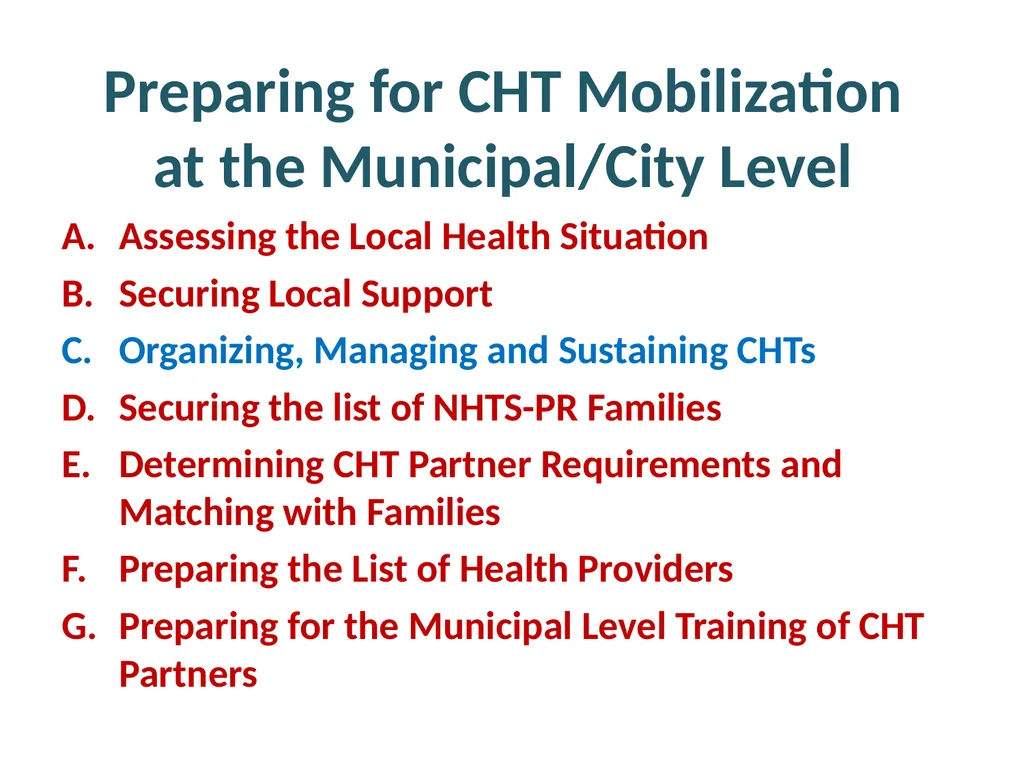
slide2. Preparing for CHT Mobilization at the Municipal/City Level The Municipal Health Officer/City Health Officer will play a vital role in the Training, Deployment and Mobilization of Community Health Teams (CHTs) in his/her Local Government Unit (LGU). All of the following activities will have to be immediately initiated and implemented by the MHO/CHO prior to the undertaking of the training of the CHT Management Group and Partners at the municipal level.<br>
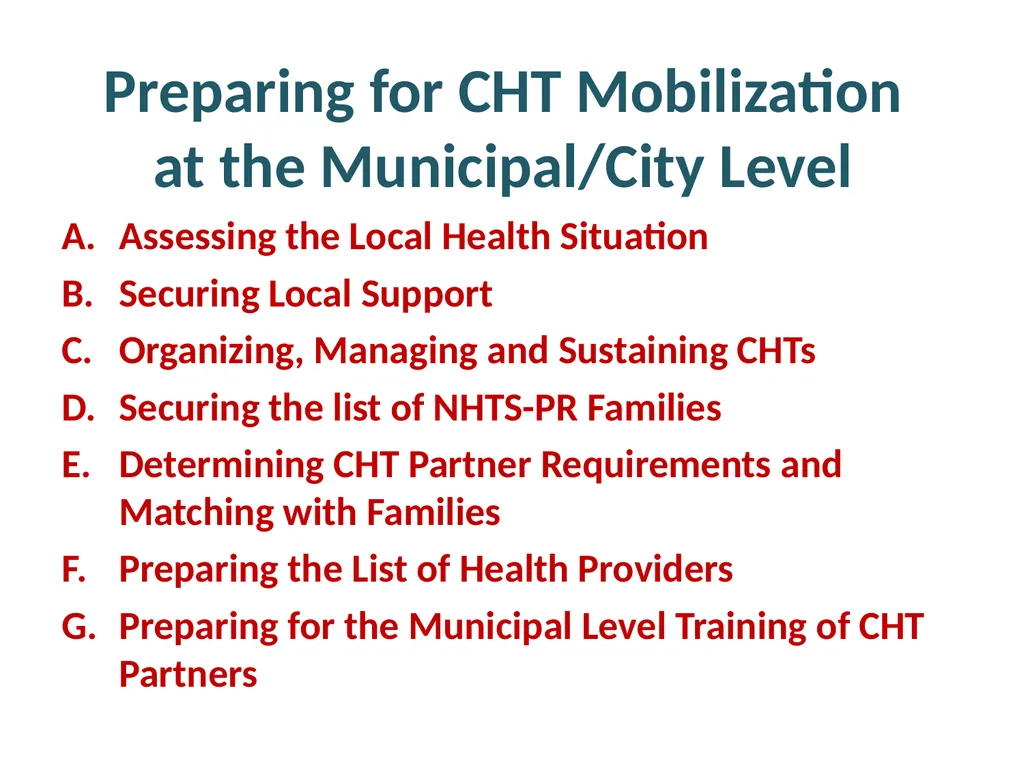
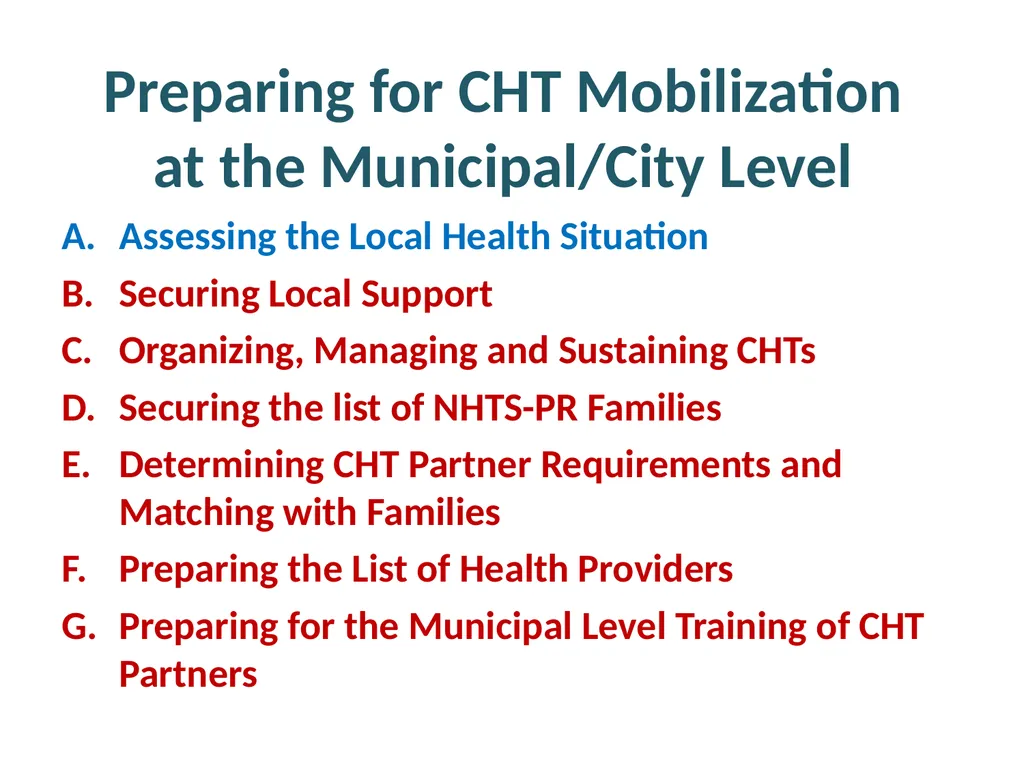
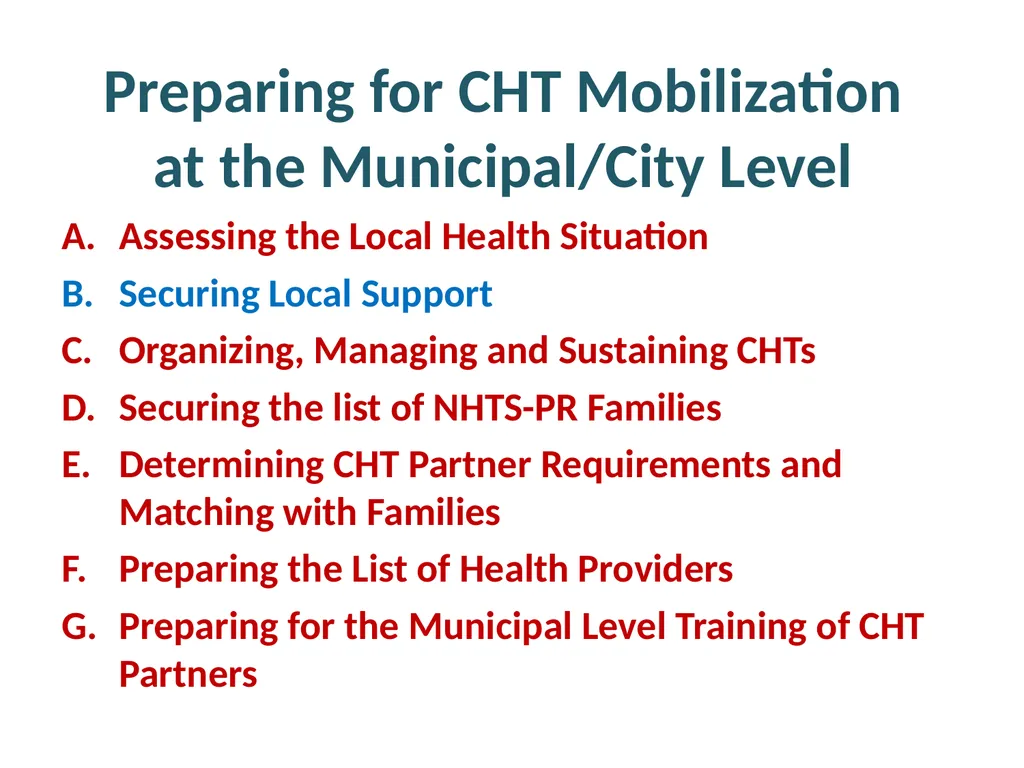
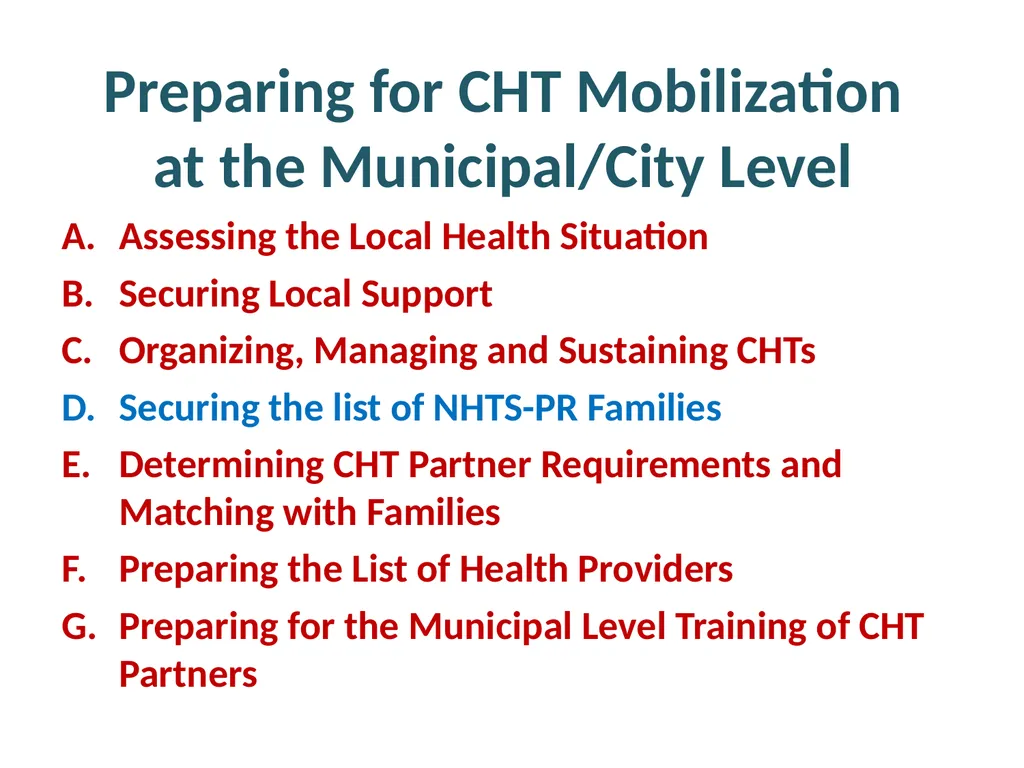
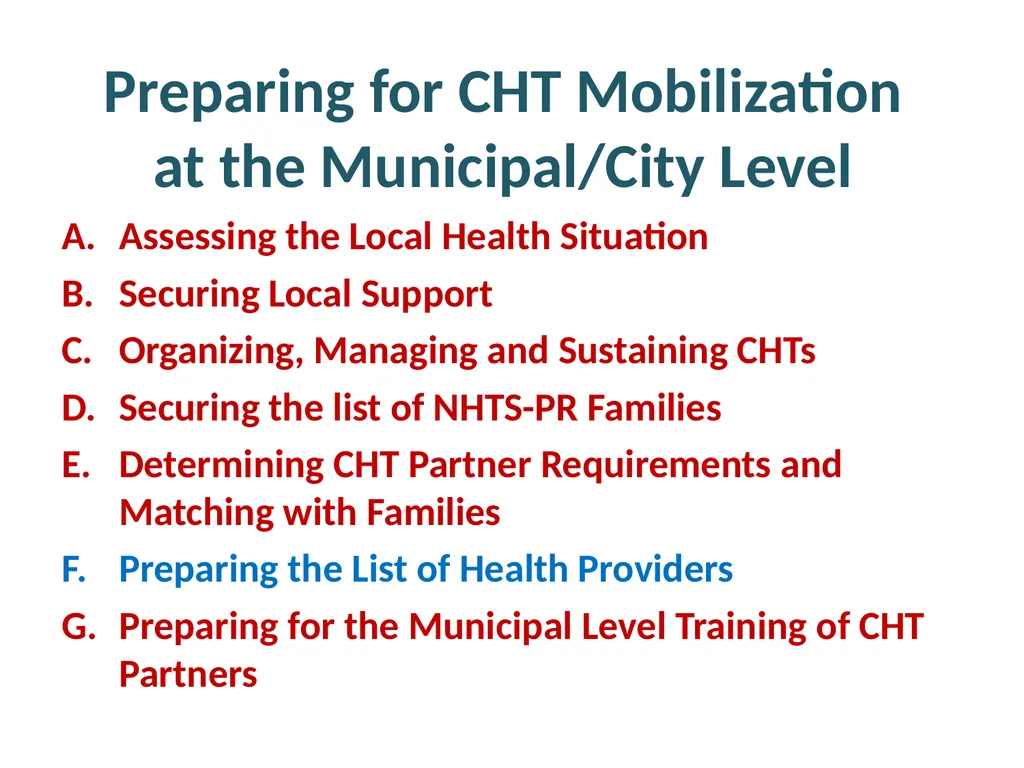
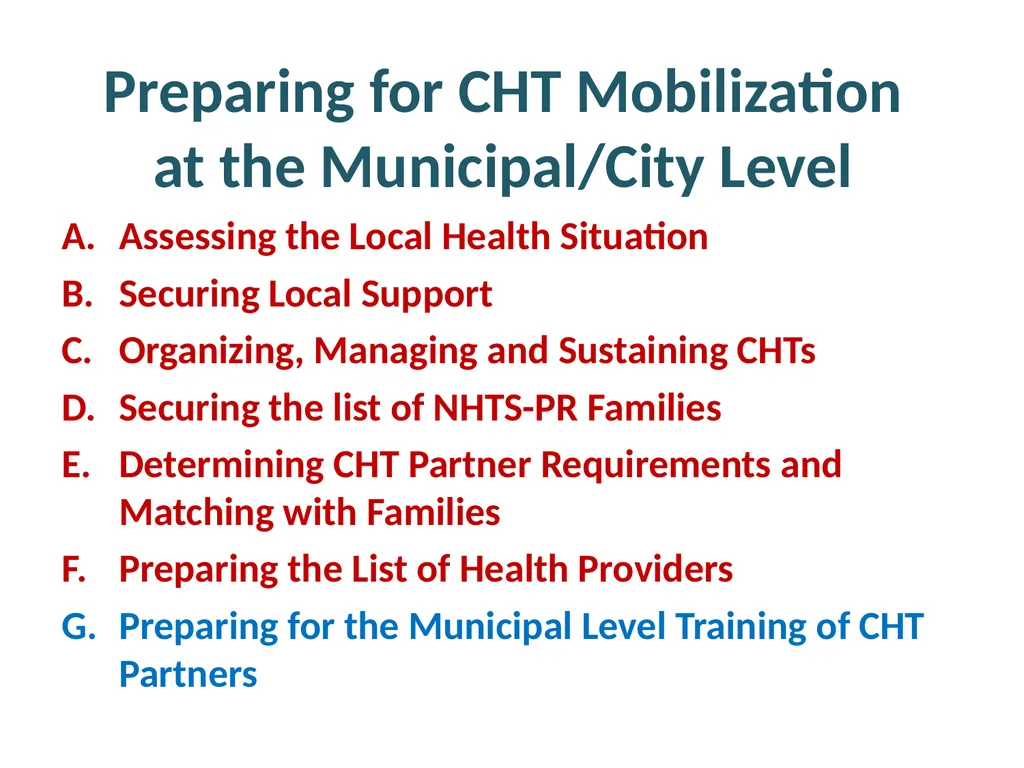
slide3. Preparing for CHT Mobilization at the Municipal/City Level Assessing the Local Health Situation
Securing Local Support
Organizing, Managing and Sustaining CHTs
Securing the list of NHTS-PR Families
Determining CHT Partner Requirements and Matching with Families
Preparing the List of Health Providers
Preparing for the Municipal Level Training of CHT Partners<br>
slide4. Preparing for CHT Mobilization at the Municipal/City Level Assessing the Local Health Situation
Securing Local Support
Organizing, Managing and Sustaining CHTs
Securing the list of NHTS-PR Families
Determining CHT Partner Requirements and Matching with Families
Preparing the List of Health Providers
Preparing for the Municipal Level Training of CHT Partners<br>
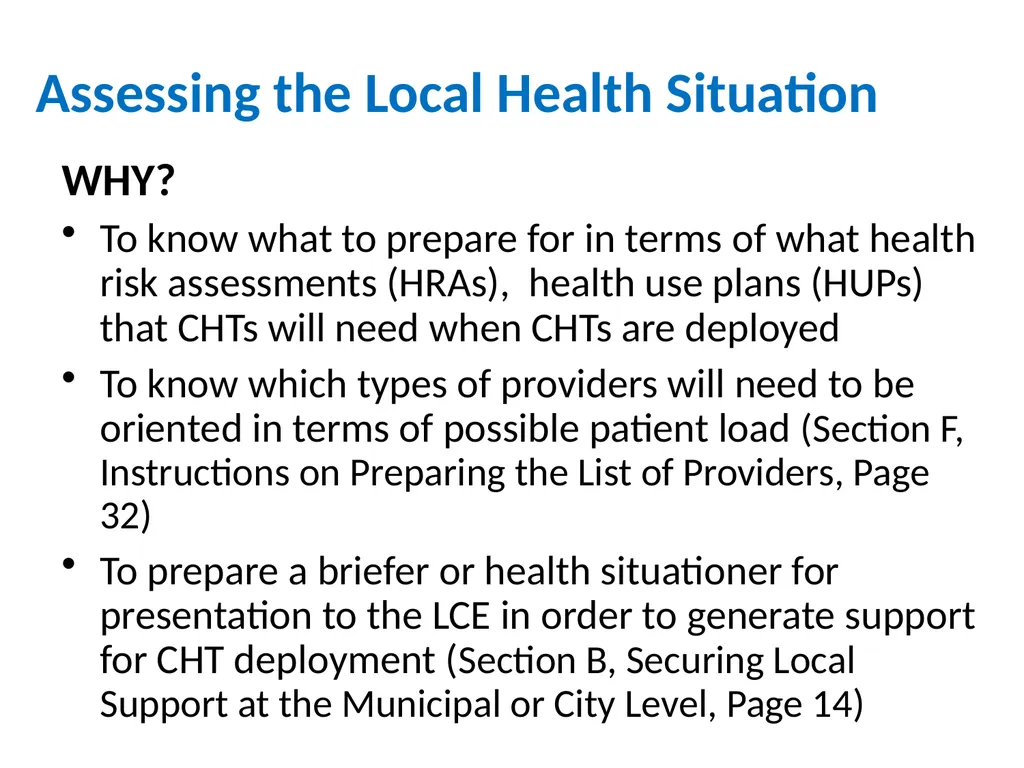
slide5. Assessing the Local Health Situation WHY?
To know what to prepare for in terms of what health risk assessments (HRAs), health use plans (HUPs) that CHTs will need when CHTs are deployed
To know which types of providers will need to be oriented in terms of possible patient load (Section F, Instructions on Preparing the List of Providers, Page 32)
To prepare a briefer or health situationer for presentation to the LCE in order to generate support for CHT deployment (Section B, Securing Local Support at the Municipal or City Level, Page 14)<br>
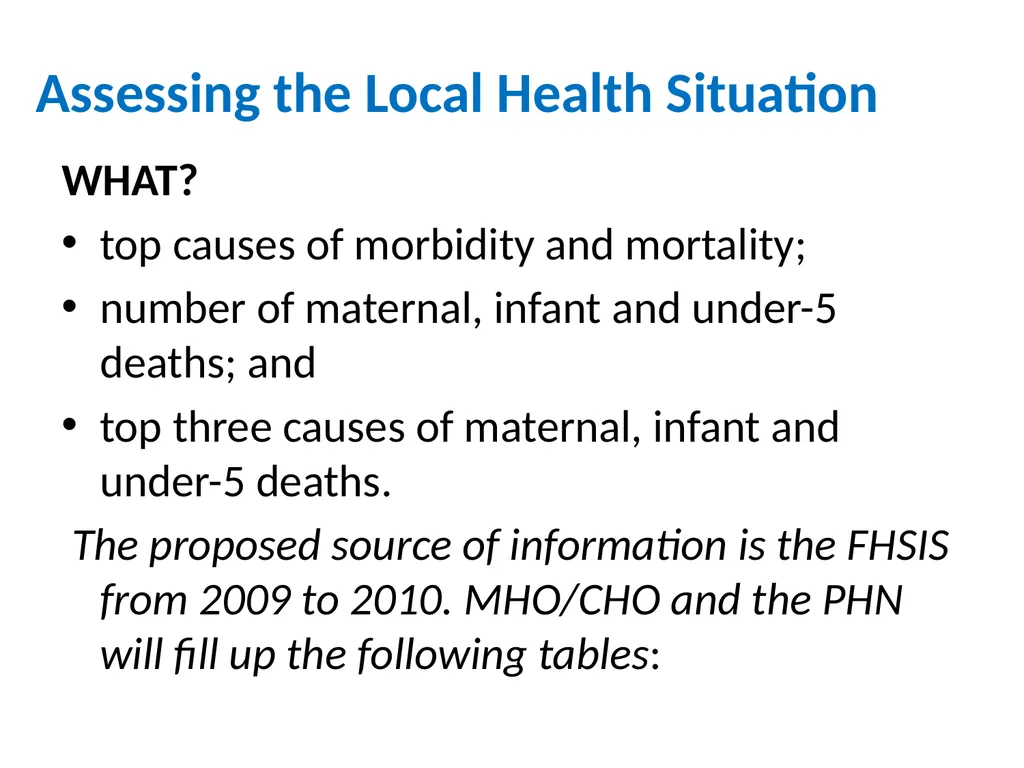
slide6. WHAT?
top causes of morbidity and mortality;
number of maternal, infant and under-5 deaths; and
top three causes of maternal, infant and under-5 deaths.
The proposed source of information is the FHSIS from 2009 to 2010. MHO/CHO and the PHN will fill up the following tables: Assessing the Local Health Situation<br>
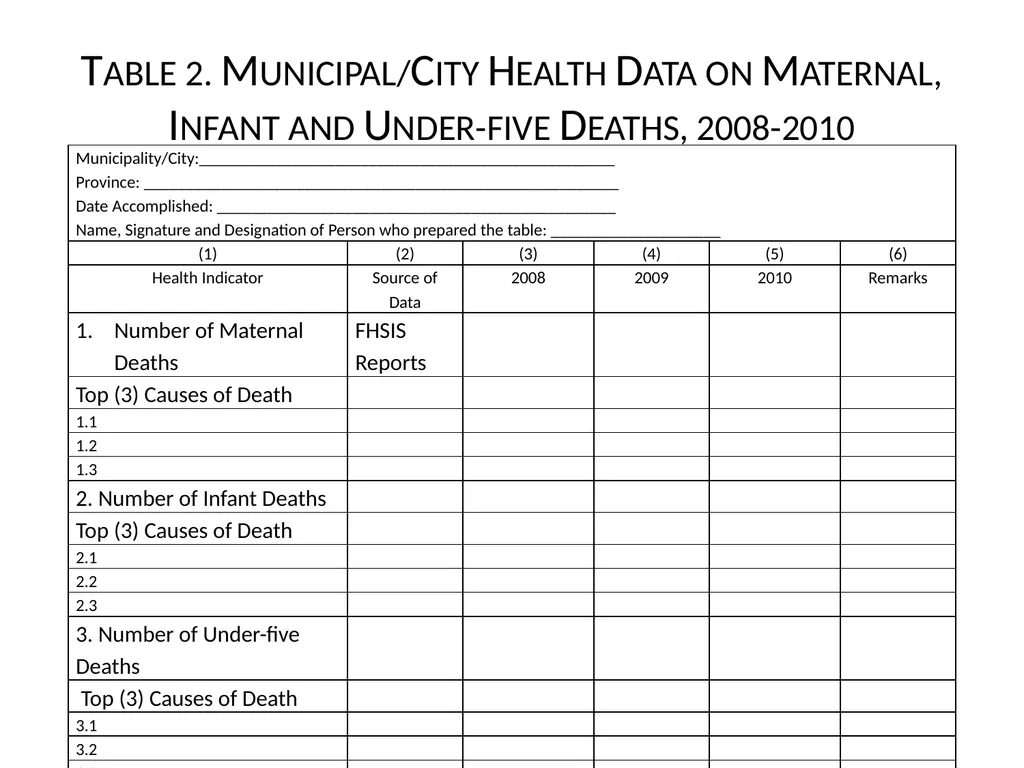
slide7. Table 2. Municipal/City Health Data on Maternal, Infant and Under-five Deaths, 2008-2010<br>
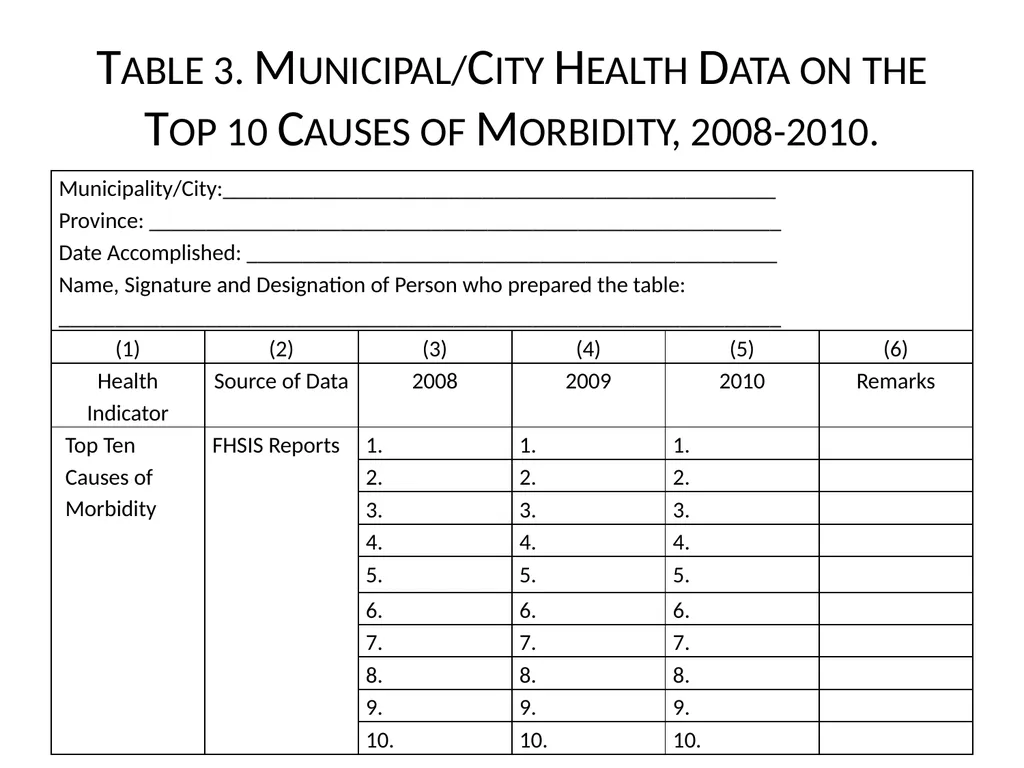
slide8. Table 3. Municipal/City Health Data on the Top 10 Causes of Morbidity, 2008-2010.<br>
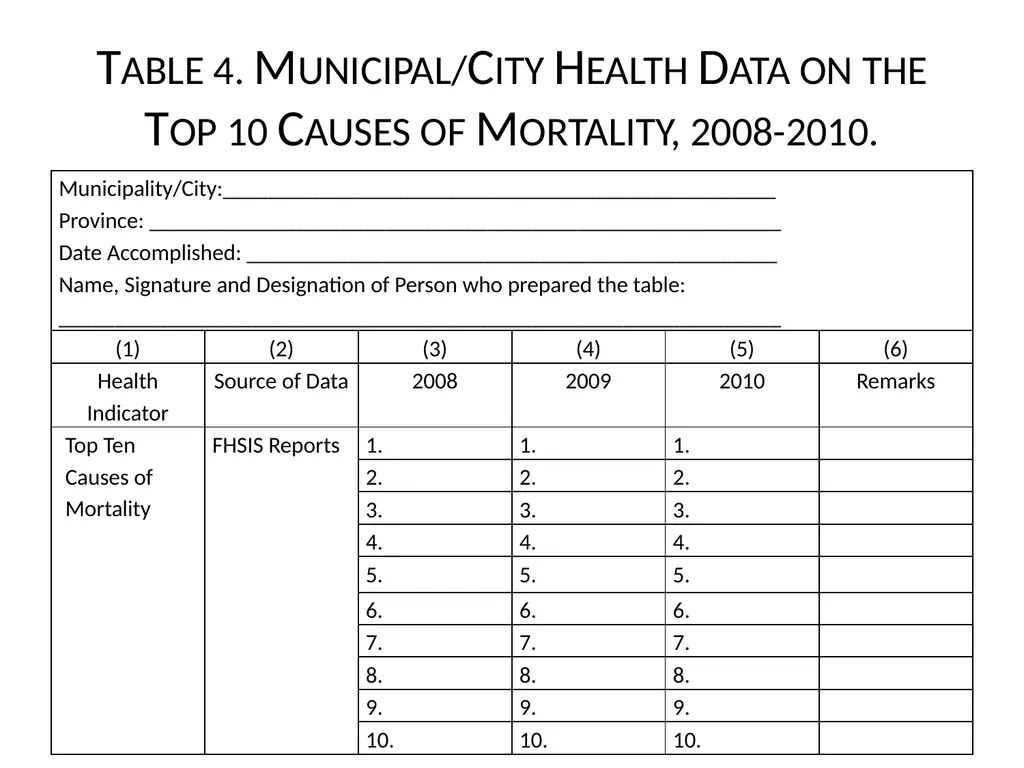
slide9. Table 4. Municipal/City Health Data on the Top 10 Causes of Mortality, 2008-2010.<br>
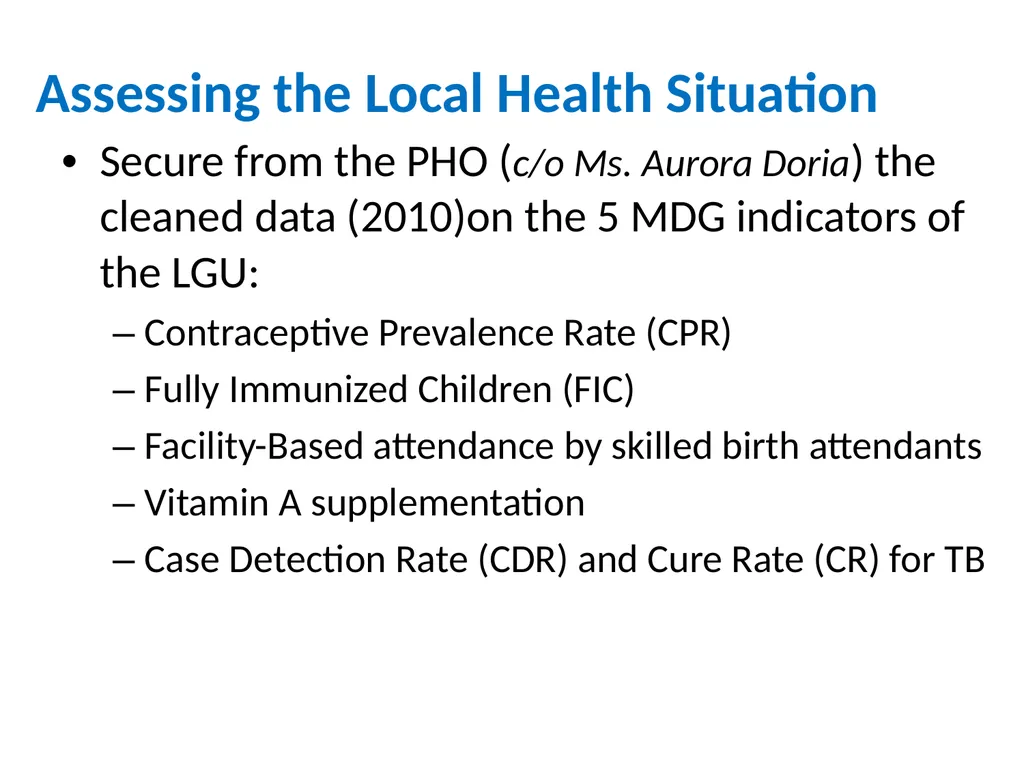
slide10. Secure from the PHO (c/o Ms. Aurora Doria) the cleaned data (2010)on the 5 MDG indicators of the LGU:
Contraceptive Prevalence Rate (CPR)
Fully Immunized Children (FIC)
Facility-Based attendance by skilled birth attendants
Vitamin A supplementation
Case Detection Rate (CDR) and Cure Rate (CR) for TB Assessing the Local Health Situation<br>
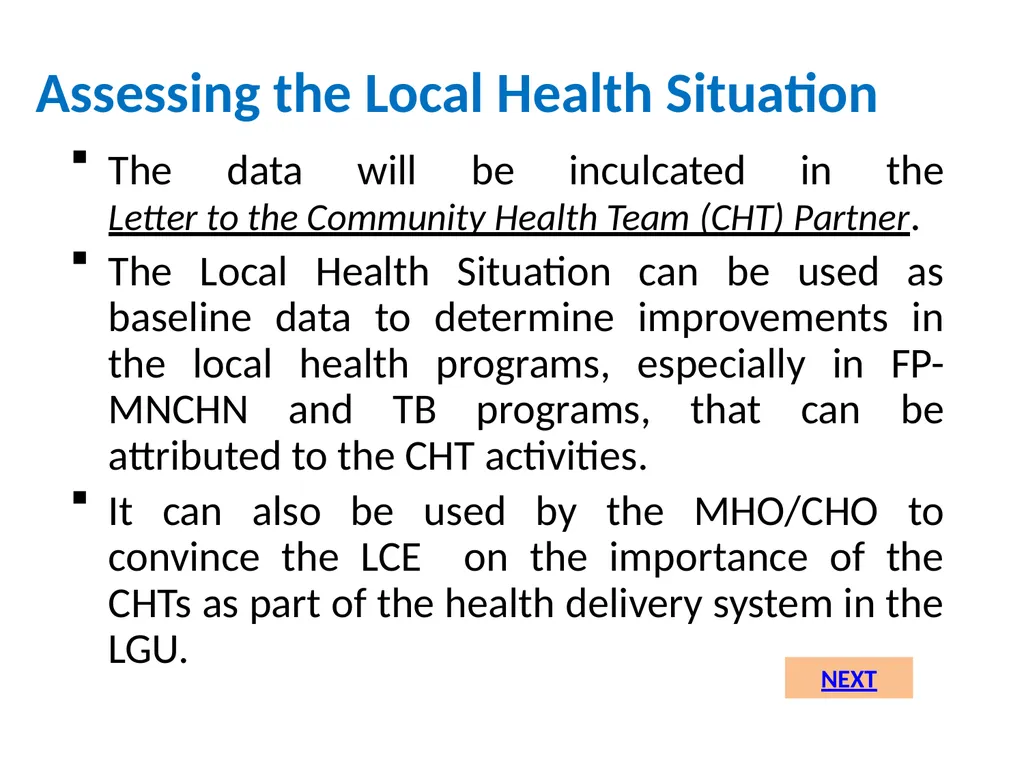
slide11. The data will be inculcated in the Letter to the Community Health Team (CHT) Partner.
The Local Health Situation can be used as baseline data to determine improvements in the local health programs, especially in FP-MNCHN and TB programs, that can be attributed to the CHT activities.
It can also be used by the MHO/CHO to convince the LCE on the importance of the CHTs as part of the health delivery system in the LGU. Assessing the Local Health Situation NEXT<br>
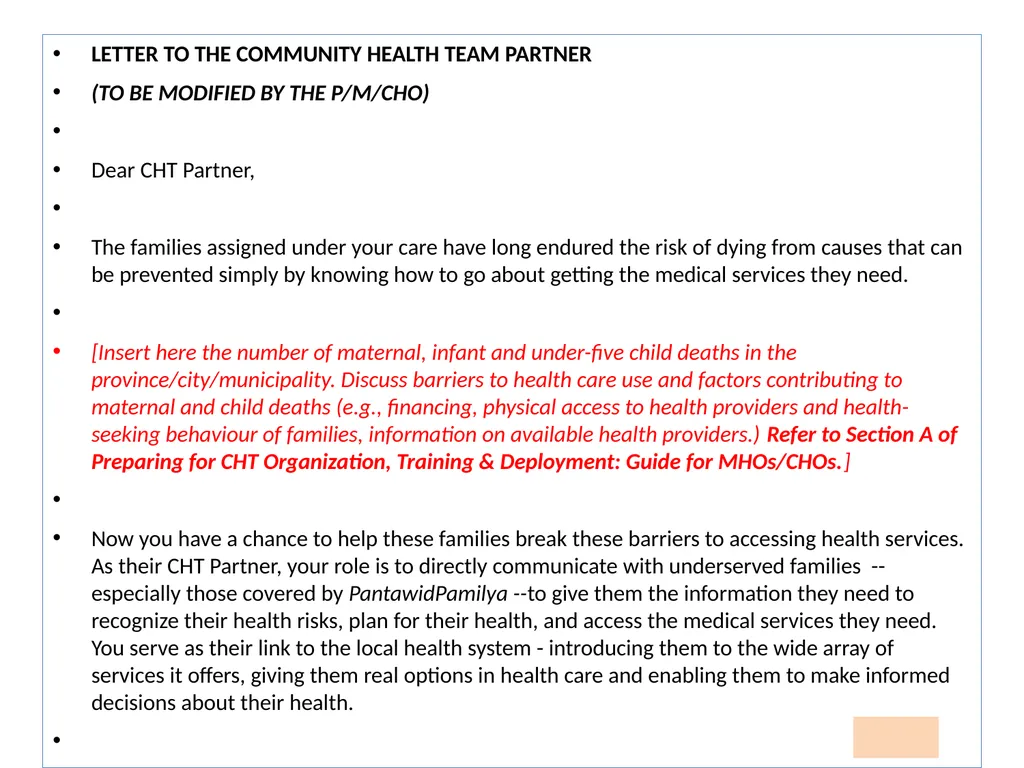
slide12. Letter to the Community Health Team Partner
(to be modified by the P/M/CHO)
Dear CHT Partner,
The families assigned under your care have long endured the risk of dying from causes that can be prevented simply by knowing how to go about getting the medical services they need.
[Insert here the number of maternal, infant and under-five child deaths in the province/city/municipality. Discuss barriers to health care use and factors contributing to maternal and child deaths (e.g., financing, physical access to health providers and health-seeking behaviour of families, information on available health providers.) Refer to Section A of Preparing for CHT Organization, Training & Deployment: Guide for MHOs/CHOs.]
Now you have a chance to help these families break these barriers to accessing health services. As their CHT Partner, your role is to directly communicate with underserved families --especially those covered by PantawidPamilya --to give them the information they need to recognize their health risks, plan for their health, and access the medical services they need. You serve as their link to the local health system - introducing them to the wide array of services it offers, giving them real options in health care and enabling them to make informed decisions about their health.<br>
slide13. Preparing for CHT Mobilization at the Municipal/City Level Assessing the Local Health Situation
Securing Local Support
Organizing, Managing and Sustaining CHTs
Securing the list of NHTS-PR Families
Determining CHT Partner Requirements and Matching with Families
Preparing the List of Health Providers
Preparing for the Municipal Level Training of CHT Partners<br>
slide14. Securing Local Support MHO/ CHO will convey to the LCE and other concerned local agencies on the importance of the CHT, specifically its navigation function, in improving the health status of poor families; and what the LGU can do to support their mobilization or deployment.
a. The MHO/CHO can cite the enabling statutes/policies on CHT mobilization:
- DILG Memo Circular 2011-145
- Joint Memorandum Circular No. 2011-0073
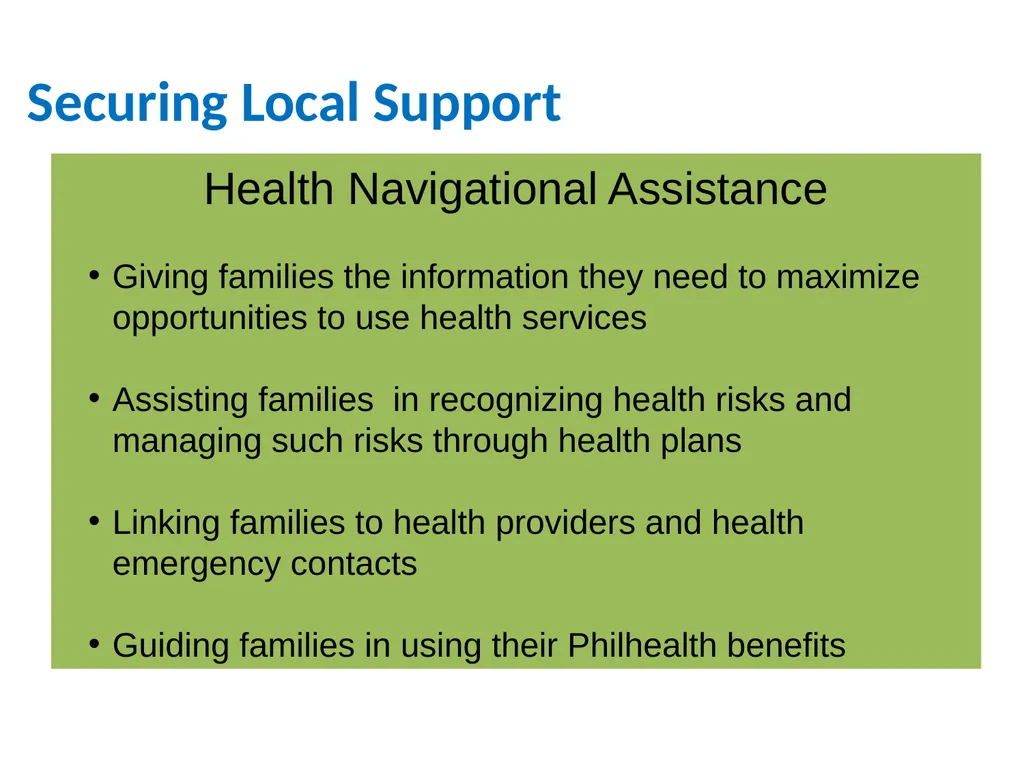
(DOH, DSWD, DILG, DepED) Health Navigational Assistance
Giving families the information they need to maximize opportunities to use health services
Assisting families in recognizing health risks and managing such risks through health plans
Linking families to health providers and health emergency contacts
Guiding families in using their Philhealth benefits<br>
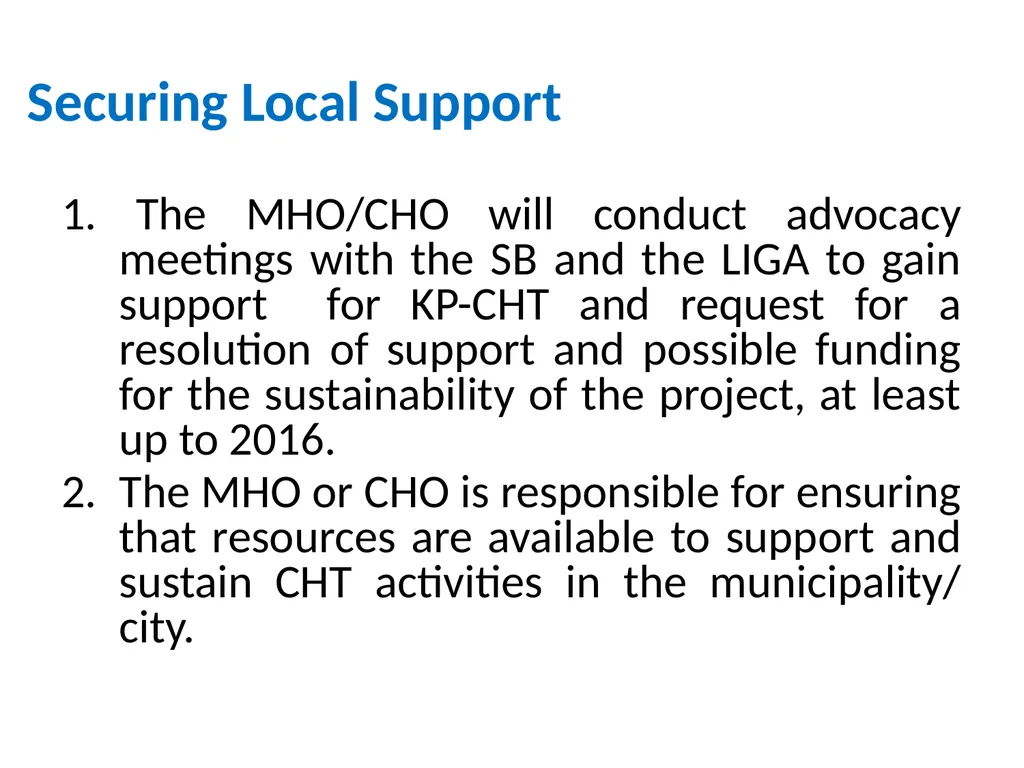
slide15. 1. The MHO/CHO will conduct advocacy meetings with the SB and the LIGA to gain support for KP-CHT and request for a resolution of support and possible funding for the sustainability of the project, at least up to 2016.
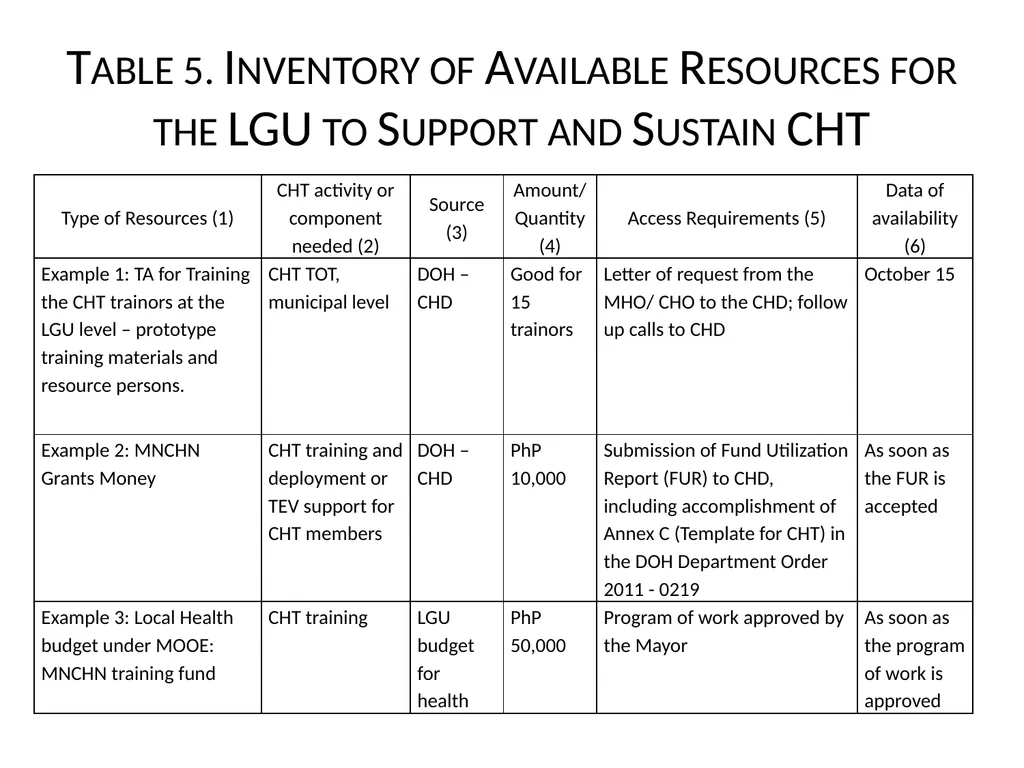
2. The MHO or CHO is responsible for ensuring that resources are available to support and sustain CHT activities in the municipality/ city. Securing Local Support<br>
slide16. Table 5. Inventory of Available Resources for the LGU to Support and Sustain CHT<br>
slide17. Preparing for CHT Mobilization at the Municipal/City Level Assessing the Local Health Situation
Securing Local Support
Organizing, Managing and Sustaining CHTs
Securing the list of NHTS-PR Families
Determining CHT Partner Requirements and Matching with Families
Preparing the List of Health Providers
Preparing for the Municipal Level Training of CHT Partners<br>
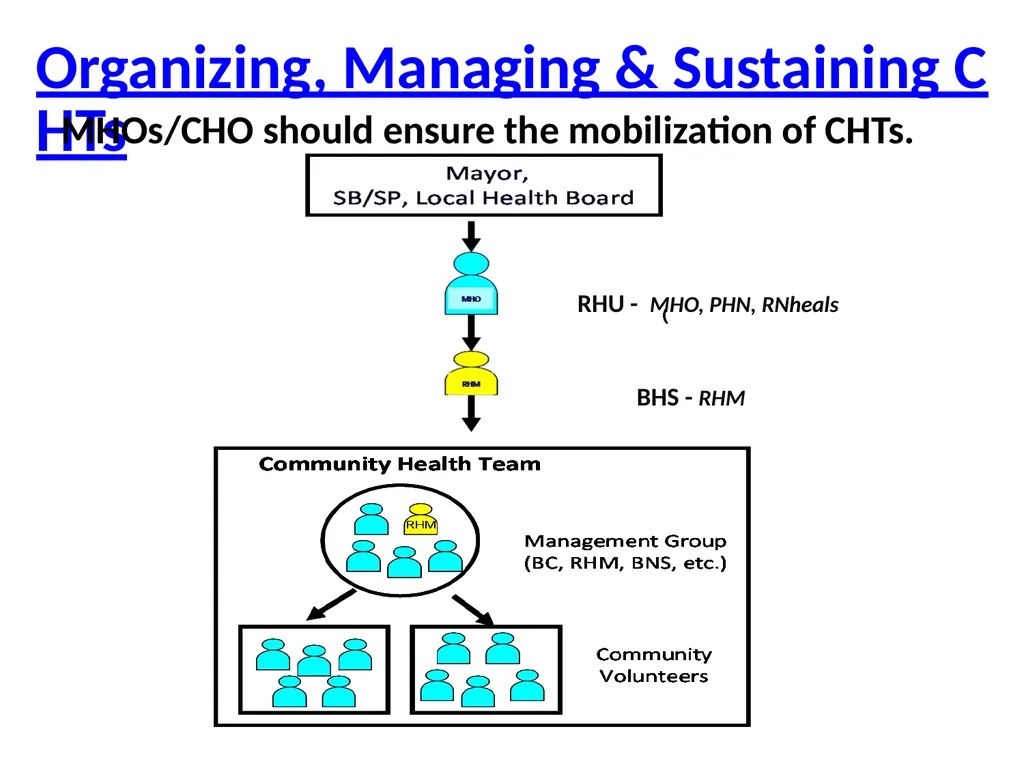
slide18. Organizing, Managing & Sustaining CHTs MHOs/CHO should ensure the mobilization of CHTs. RHU - MHO, PHN, RNheals BHS - RHM<br>
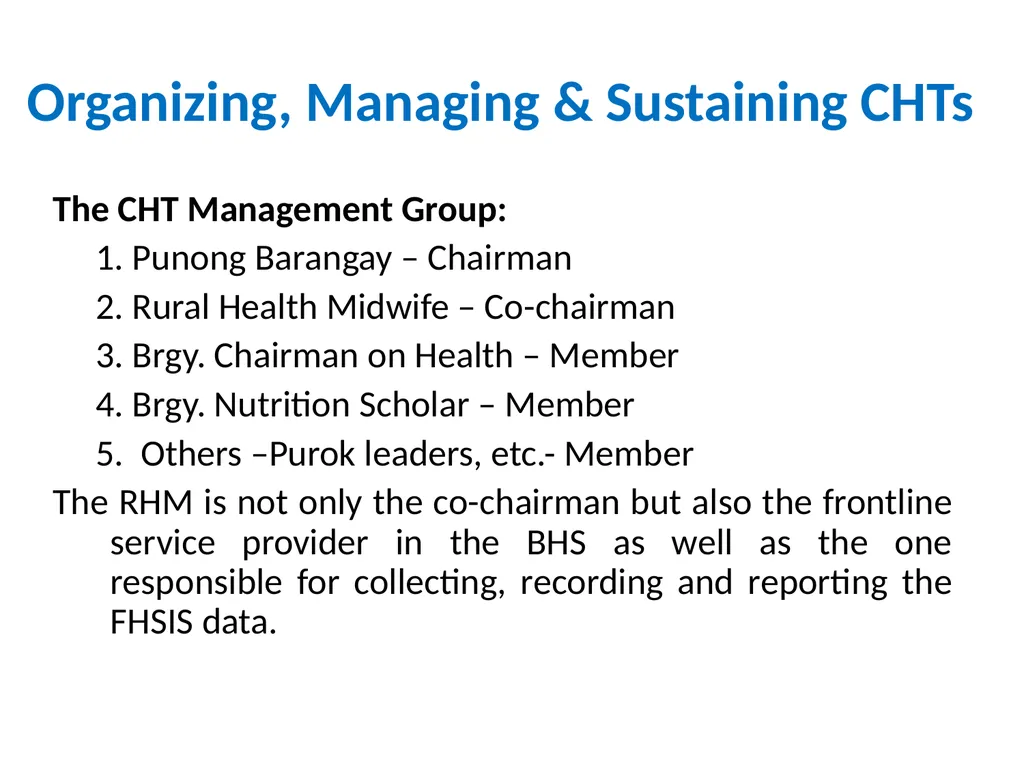
slide19. Organizing, Managing & Sustaining CHTs The CHT Management Group:
1. Punong Barangay – Chairman
2. Rural Health Midwife – Co-chairman
3. Brgy. Chairman on Health – Member
4. Brgy. Nutrition Scholar – Member
5. Others –Purok leaders, etc.- Member
The RHM is not only the co-chairman but also the frontline service provider in the BHS as well as the one responsible for collecting, recording and reporting the FHSIS data.<br>
slide20. Preparing for CHT Mobilization at the Municipal/City Level Assessing the Local Health Situation
Securing Local Support
Organizing, Managing and Sustaining CHTs
Securing the list of NHTS-PR Families
Determining CHT Partner Requirements and Matching with Families
Preparing the List of Health Providers
Preparing for the Municipal Level Training of CHT Partners<br>
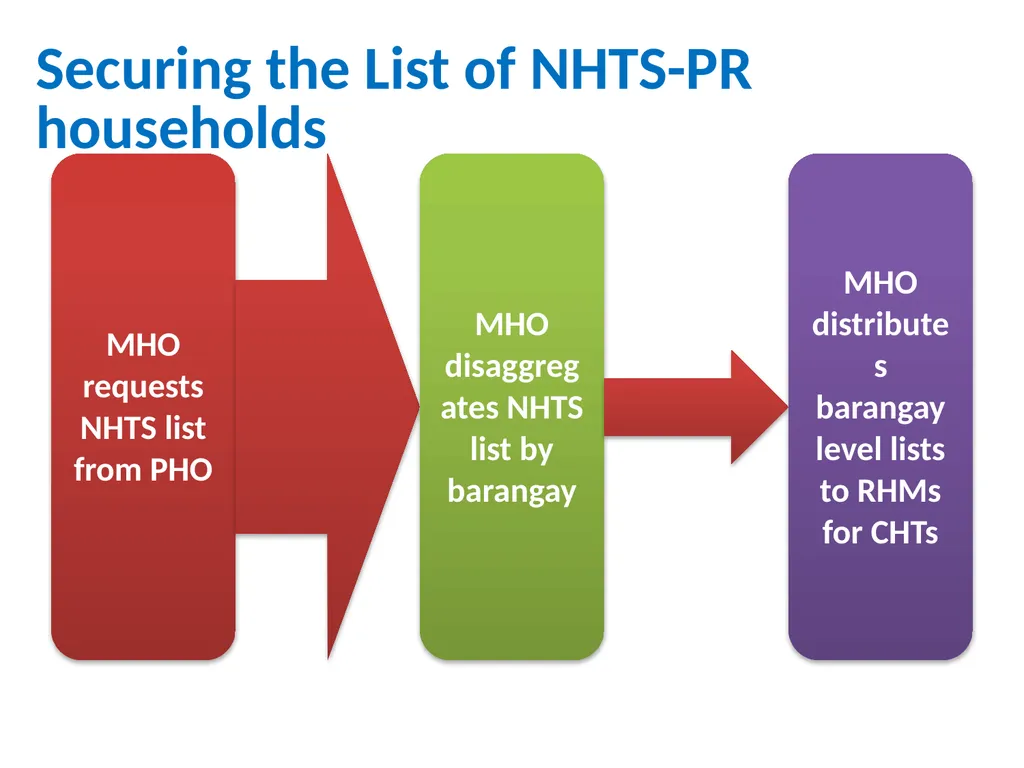
slide21. Securing the List of NHTS-PR households<br>
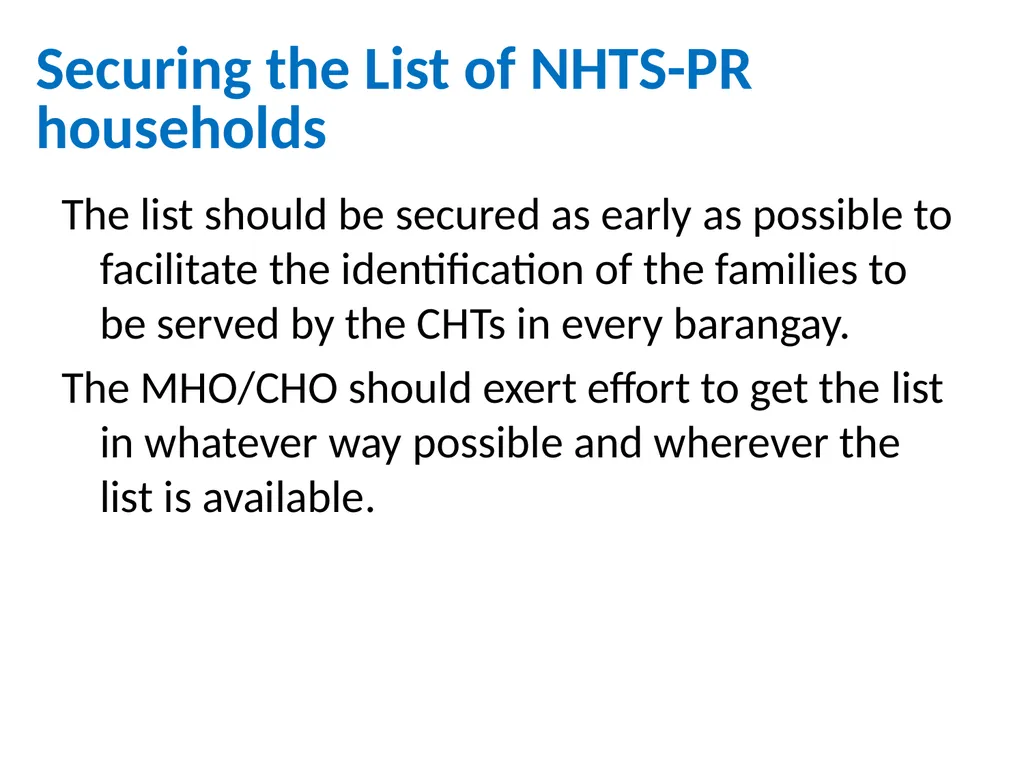
slide22. Securing the List of NHTS-PR households The list should be secured as early as possible to facilitate the identification of the families to be served by the CHTs in every barangay.
The MHO/CHO should exert effort to get the list in whatever way possible and wherever the list is available.<br>
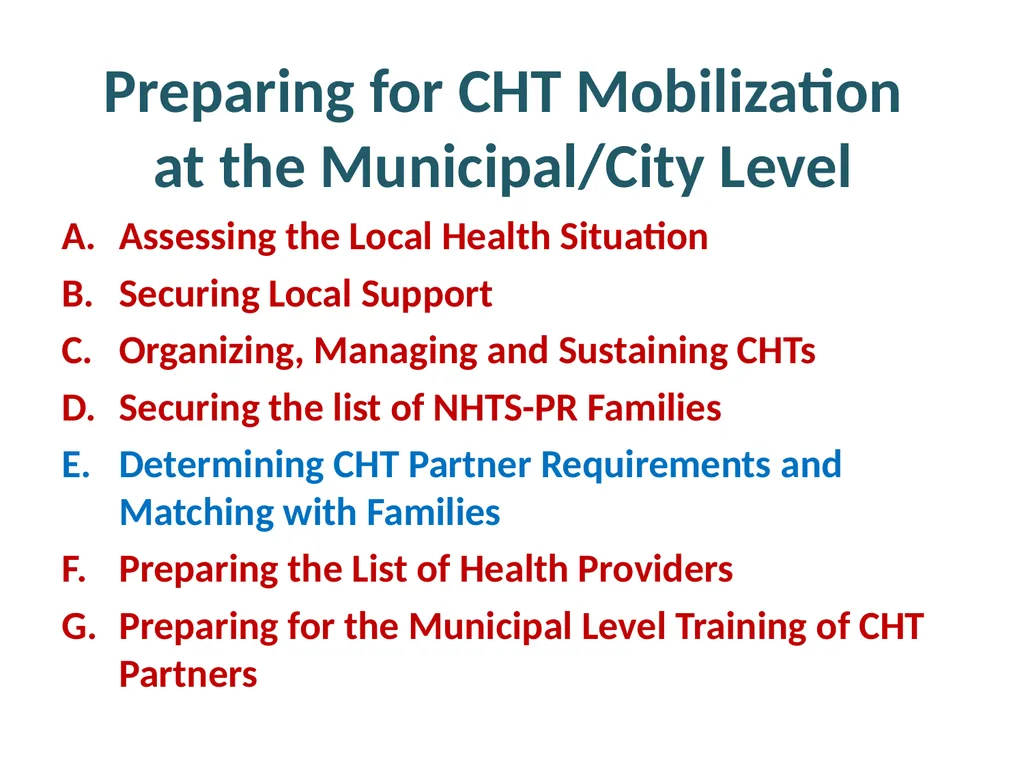
slide23. Preparing for CHT Mobilization at the Municipal/City Level Assessing the Local Health Situation
Securing Local Support
Organizing, Managing and Sustaining CHTs
Securing the list of NHTS-PR Families
Determining CHT Partner Requirements and Matching with Families
Preparing the List of Health Providers
Preparing for the Municipal Level Training of CHT Partners<br>
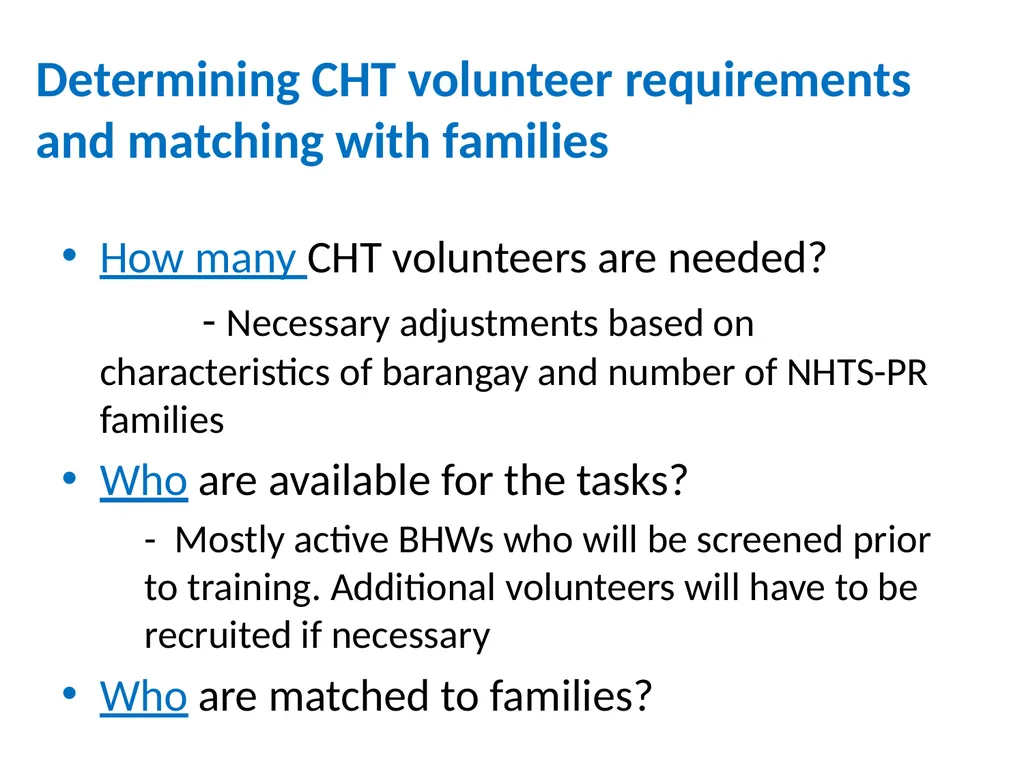
slide24. Determining CHT volunteer requirements and matching with families How many CHT volunteers are needed?
- Necessary adjustments based on characteristics of barangay and number of NHTS-PR families
Who are available for the tasks?
- Mostly active BHWs who will be screened prior to training. Additional volunteers will have to be recruited if necessary
Who are matched to families?<br>
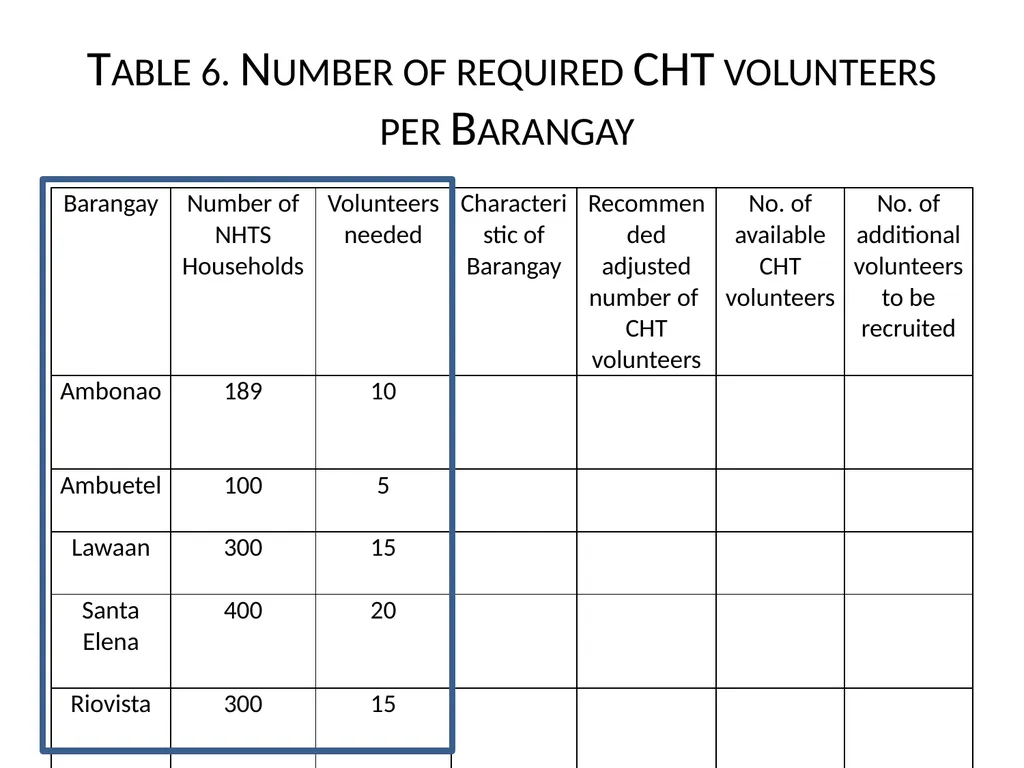
slide25. Table 6. Number of required CHT volunteers per Barangay<br>
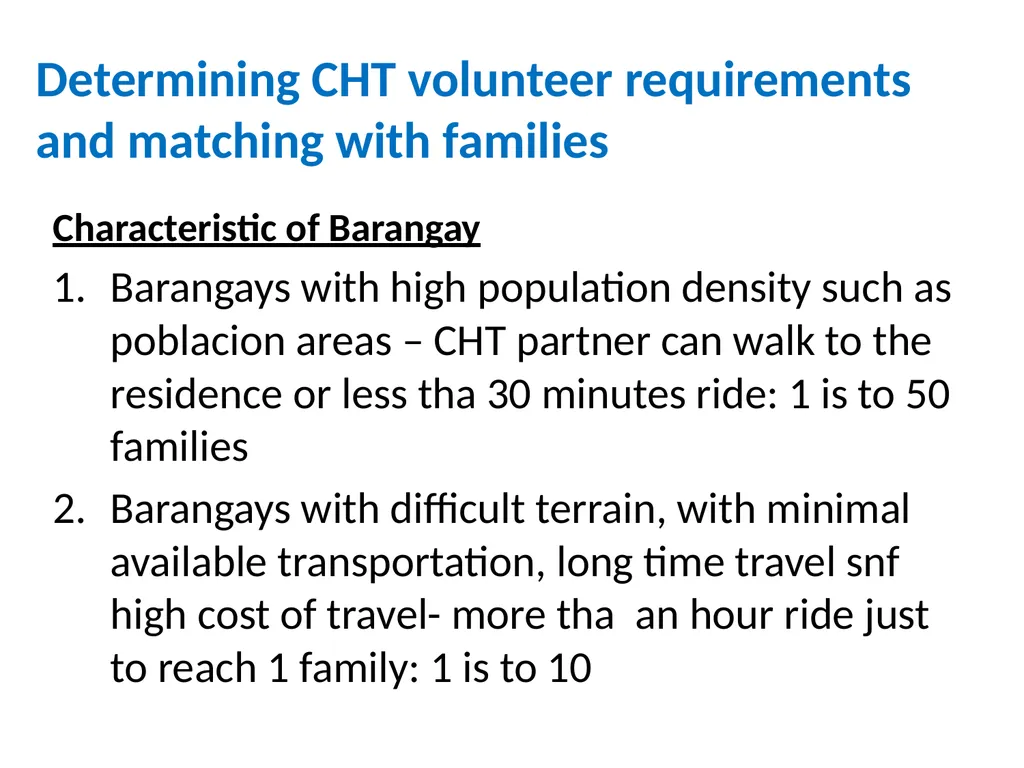
slide26. Determining CHT volunteer requirements and matching with families Characteristic of Barangay
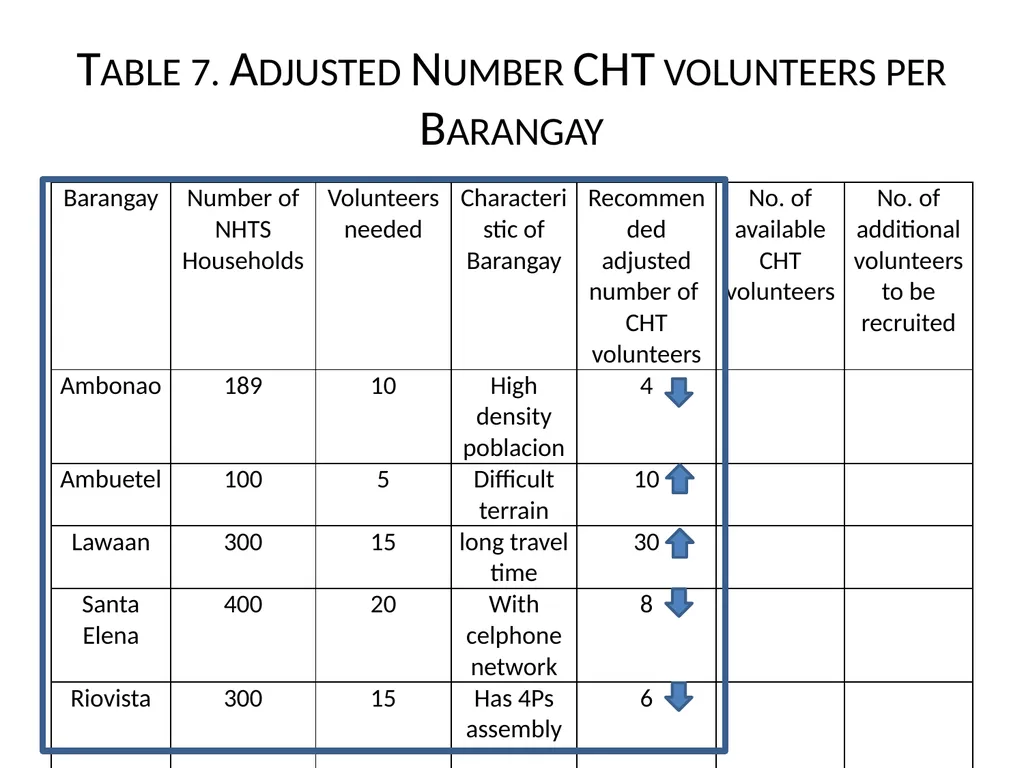
Barangays with high population density such as poblacion areas – CHT partner can walk to the residence or less tha 30 minutes ride: 1 is to 50 families
Barangays with difficult terrain, with minimal available transportation, long time travel snf high cost of travel- more tha an hour ride just to reach 1 family: 1 is to 10<br>
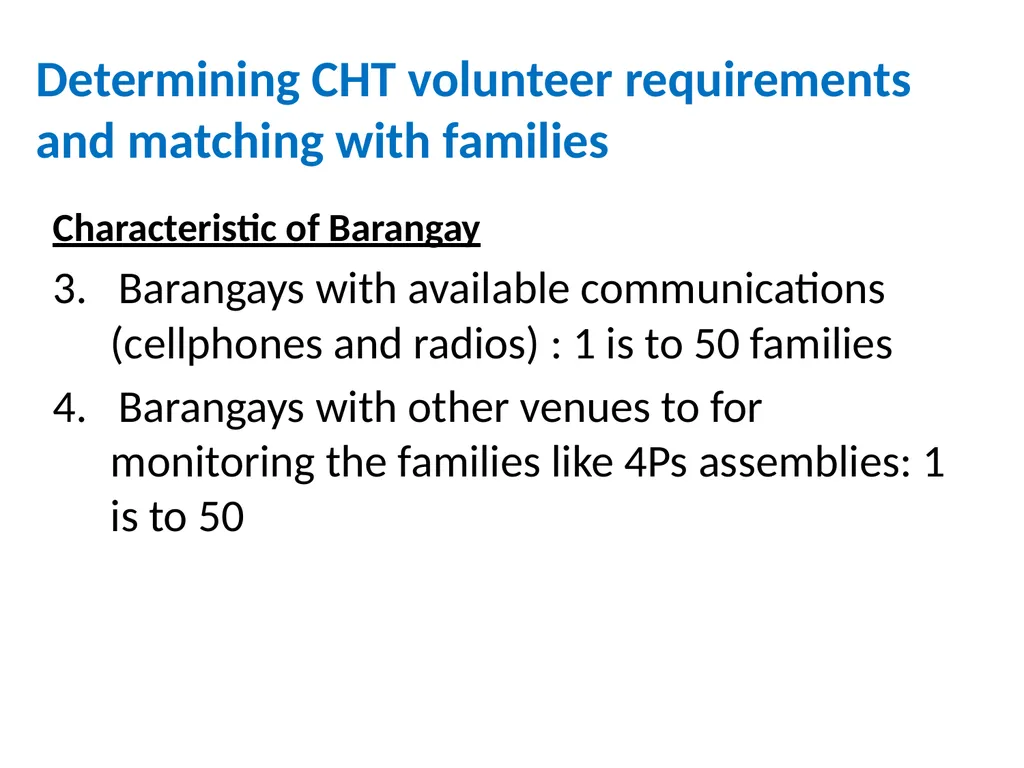
slide27. Determining CHT volunteer requirements and matching with families Characteristic of Barangay
3. Barangays with available communications (cellphones and radios) : 1 is to 50 families
4. Barangays with other venues to for monitoring the families like 4Ps assemblies: 1 is to 50<br>
slide28. Table 7. Adjusted Number CHT volunteers per Barangay<br>
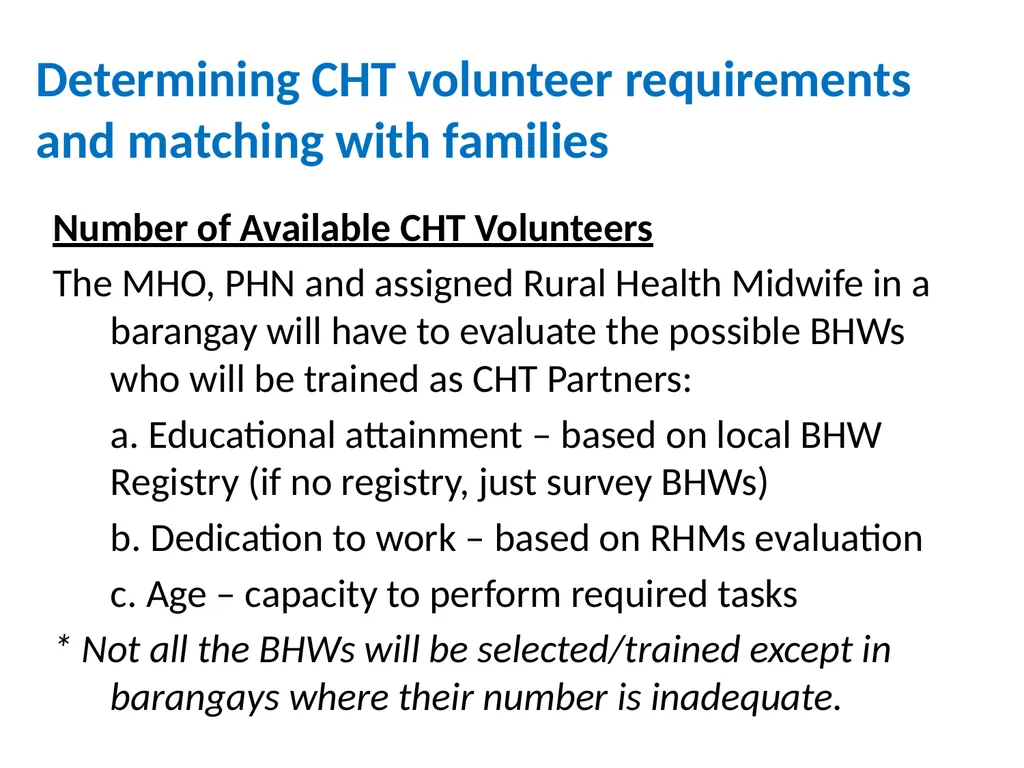
slide29. Determining CHT volunteer requirements and matching with families Number of Available CHT Volunteers
The MHO, PHN and assigned Rural Health Midwife in a barangay will have to evaluate the possible BHWs who will be trained as CHT Partners:
a. Educational attainment – based on local BHW Registry (if no registry, just survey BHWs)
b. Dedication to work – based on RHMs evaluation
c. Age – capacity to perform required tasks
* Not all the BHWs will be selected/trained except in barangays where their number is inadequate.<br>
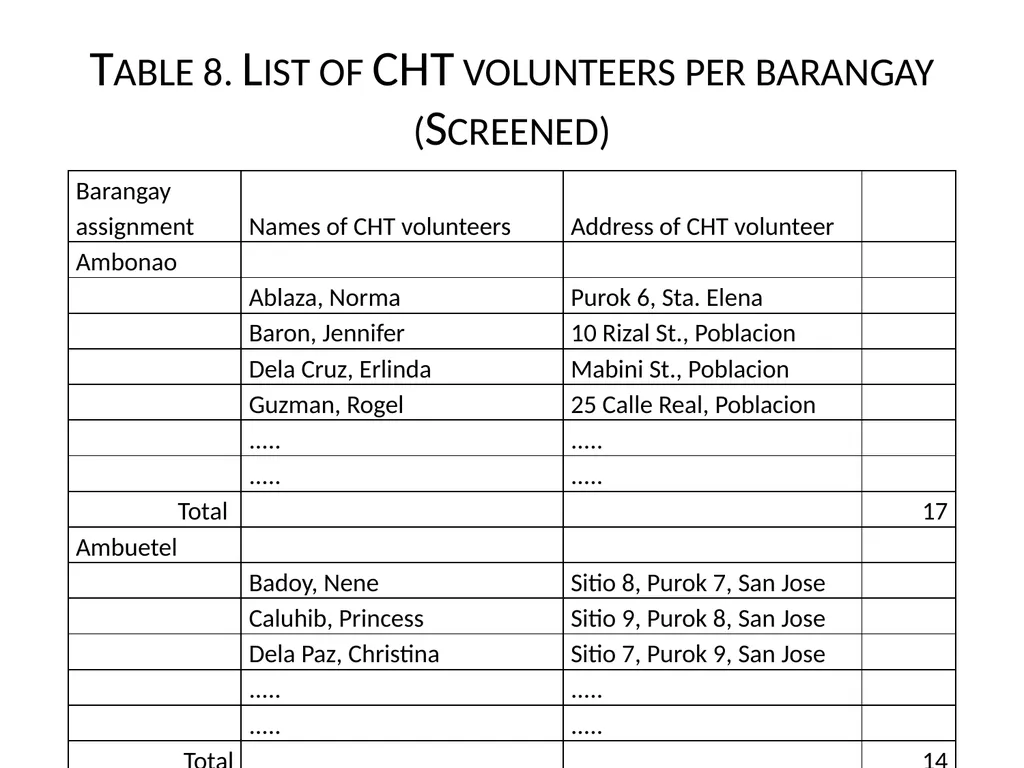
slide30. Table 8. List of CHT volunteers per barangay (Screened)<br>
slide31. Determining CHT volunteer requirements and matching with families Number of Available CHT Volunteers
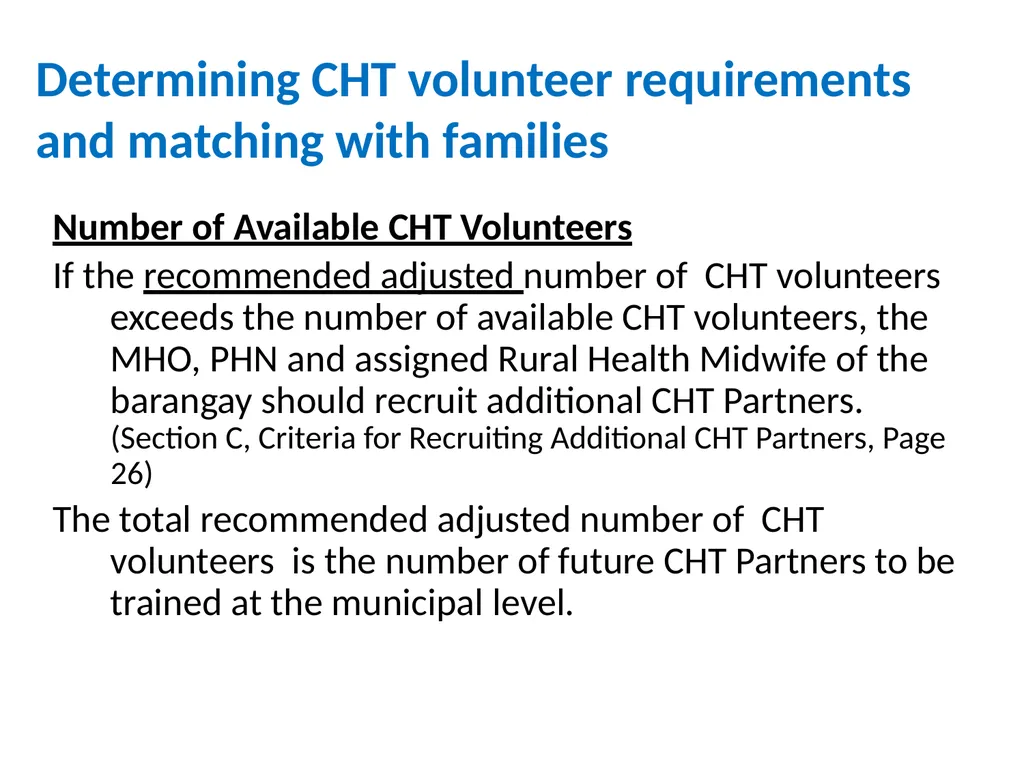
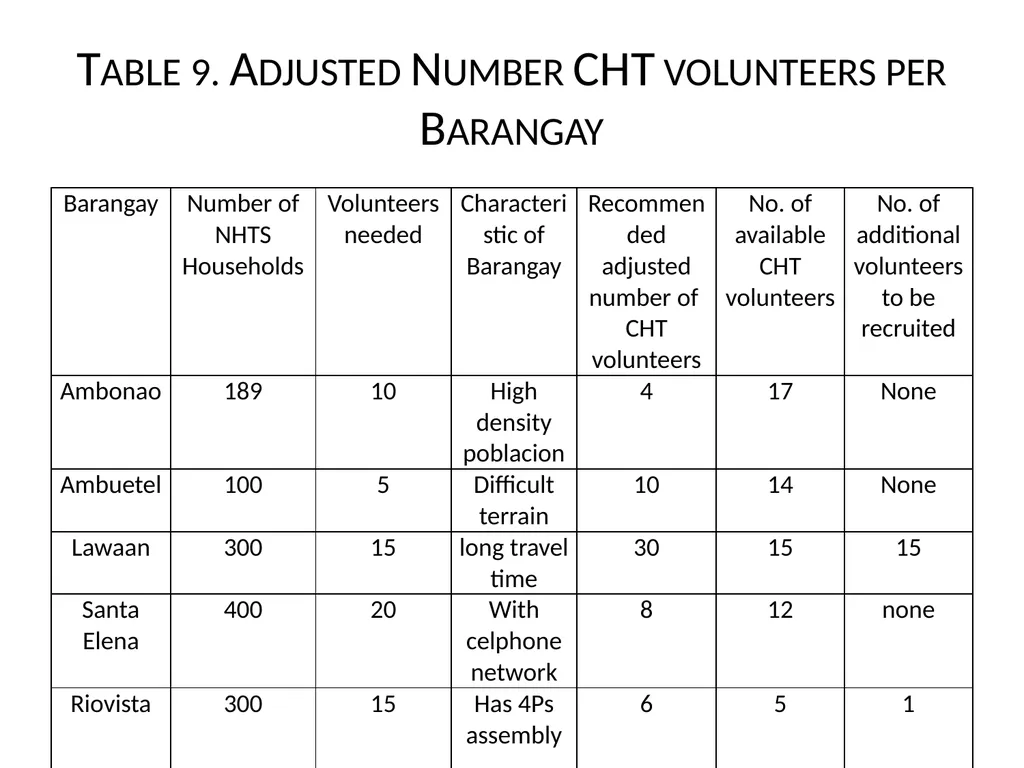
If the recommended adjusted number of CHT volunteers exceeds the number of available CHT volunteers, the MHO, PHN and assigned Rural Health Midwife of the barangay should recruit additional CHT Partners. (Section C, Criteria for Recruiting Additional CHT Partners, Page 26)
The total recommended adjusted number of CHT volunteers is the number of future CHT Partners to be trained at the municipal level.<br>
slide32. Table 9. Adjusted Number CHT volunteers per Barangay<br>
slide33. Determining CHT volunteer requirements and matching with families Matching CHT Partners to NHTS families
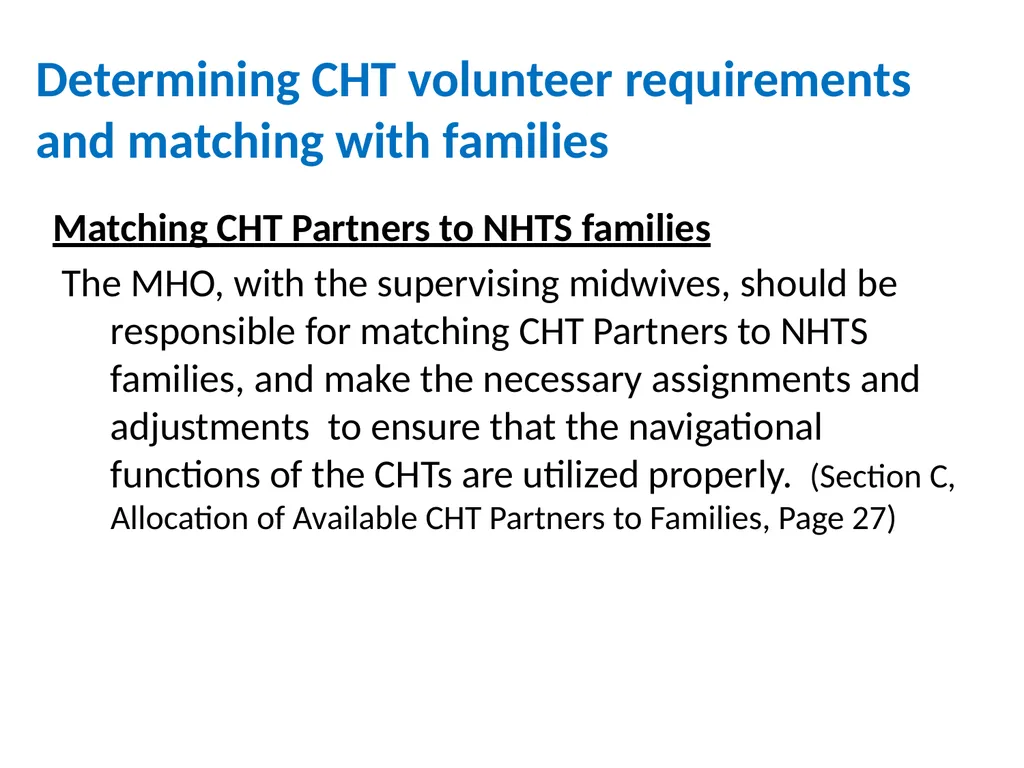
The MHO, with the supervising midwives, should be responsible for matching CHT Partners to NHTS families, and make the necessary assignments and adjustments to ensure that the navigational functions of the CHTs are utilized properly. (Section C, Allocation of Available CHT Partners to Families, Page 27)<br>
slide34. Preparing for CHT Mobilization at the Municipal/City Level Assessing the Local Health Situation
Securing Local Support
Organizing, Managing and Sustaining CHTs
Securing the list of NHTS-PR Families
Determining CHT Partner Requirements and Matching with Families
Preparing the List of Health Providers
Preparing for the Municipal Level Training of CHT Partners<br>
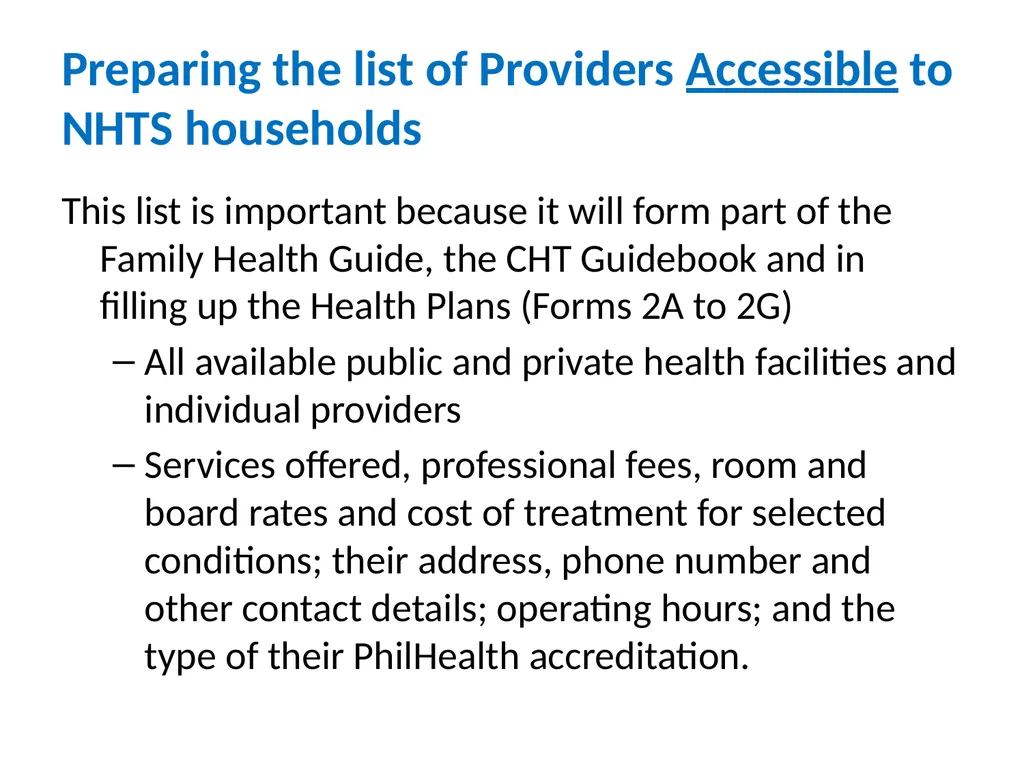
slide35. Preparing the list of Providers Accessible to NHTS households This list is important because it will form part of the Family Health Guide, the CHT Guidebook and in filling up the Health Plans (Forms 2A to 2G)
All available public and private health facilities and individual providers
Services offered, professional fees, room and board rates and cost of treatment for selected conditions; their address, phone number and other contact details; operating hours; and the type of their PhilHealth accreditation.<br>
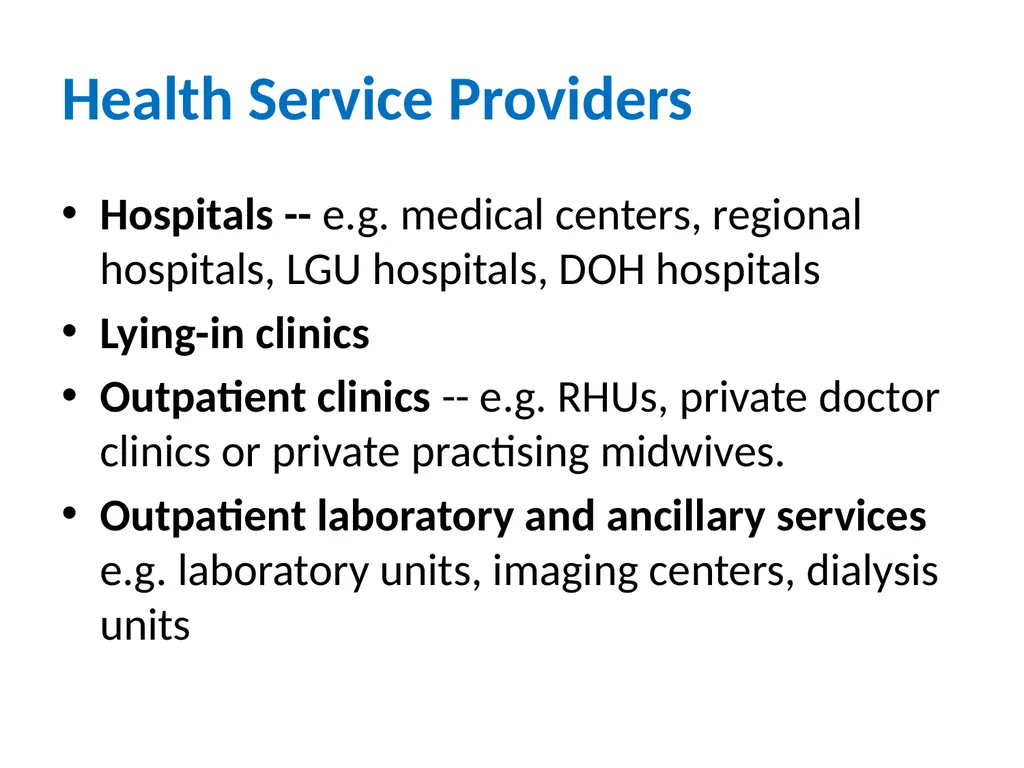
slide36. Health Service Providers Hospitals -- e.g. medical centers, regional hospitals, LGU hospitals, DOH hospitals
Lying-in clinics
Outpatient clinics -- e.g. RHUs, private doctor clinics or private practising midwives.
Outpatient laboratory and ancillary services e.g. laboratory units, imaging centers, dialysis units<br>
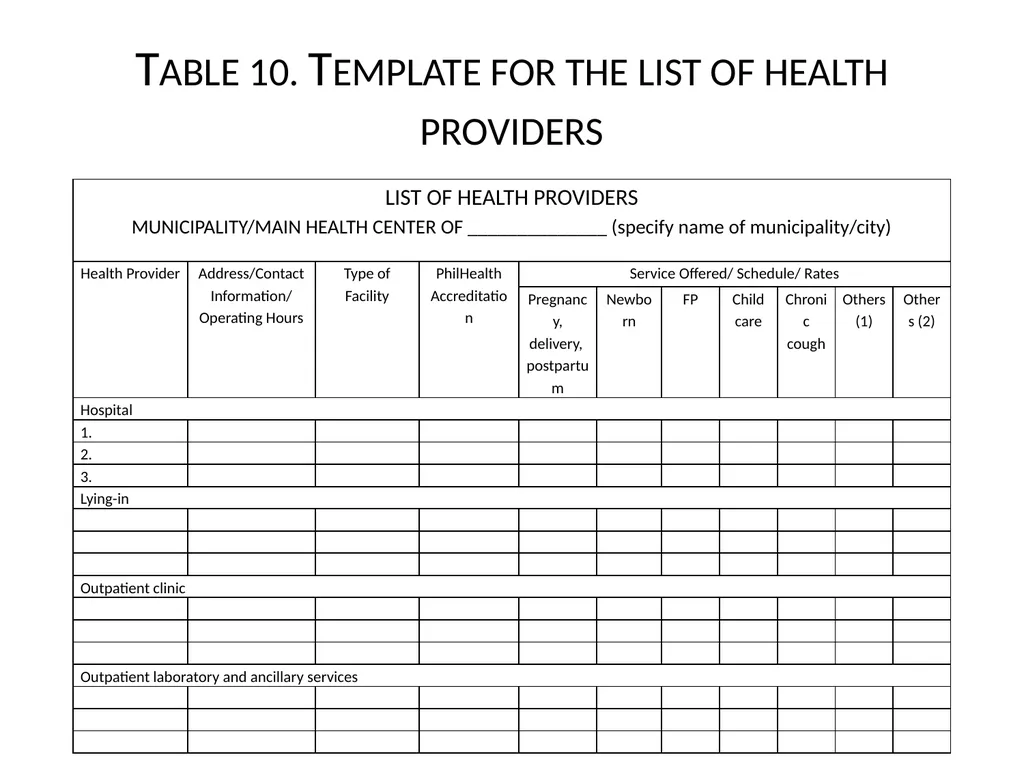
slide37. Table 10. Template for the list of health providers<br>
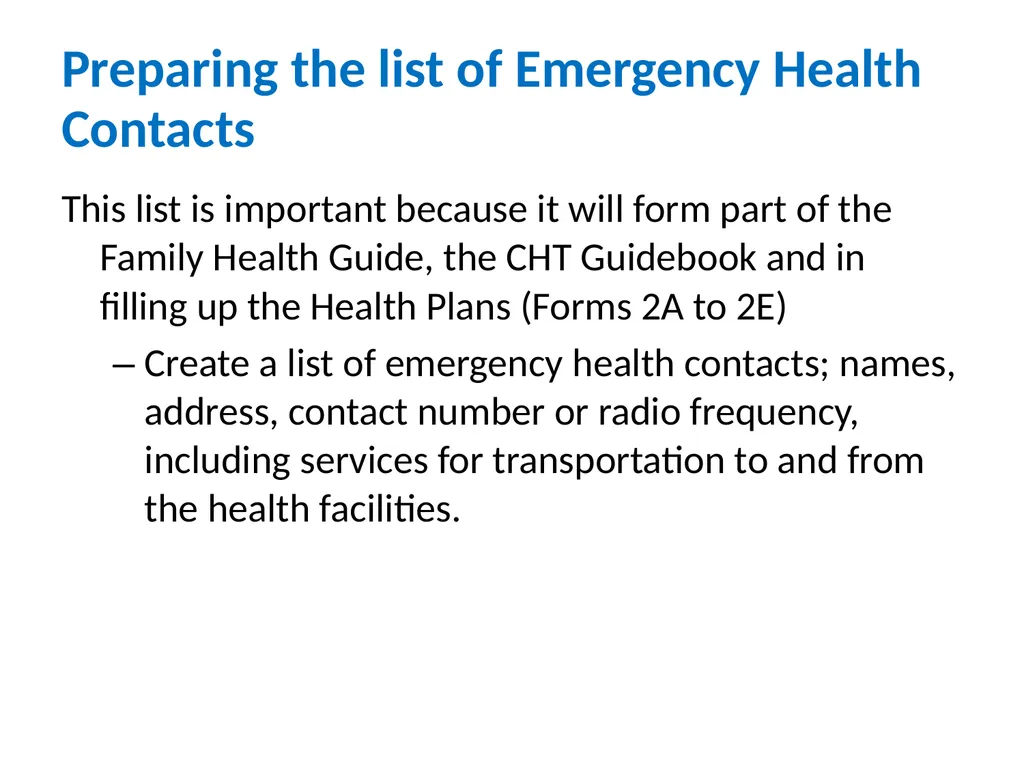
slide38. Preparing the list of Emergency Health Contacts This list is important because it will form part of the Family Health Guide, the CHT Guidebook and in filling up the Health Plans (Forms 2A to 2E)
Create a list of emergency health contacts; names, address, contact number or radio frequency, including services for transportation to and from the health facilities.<br>
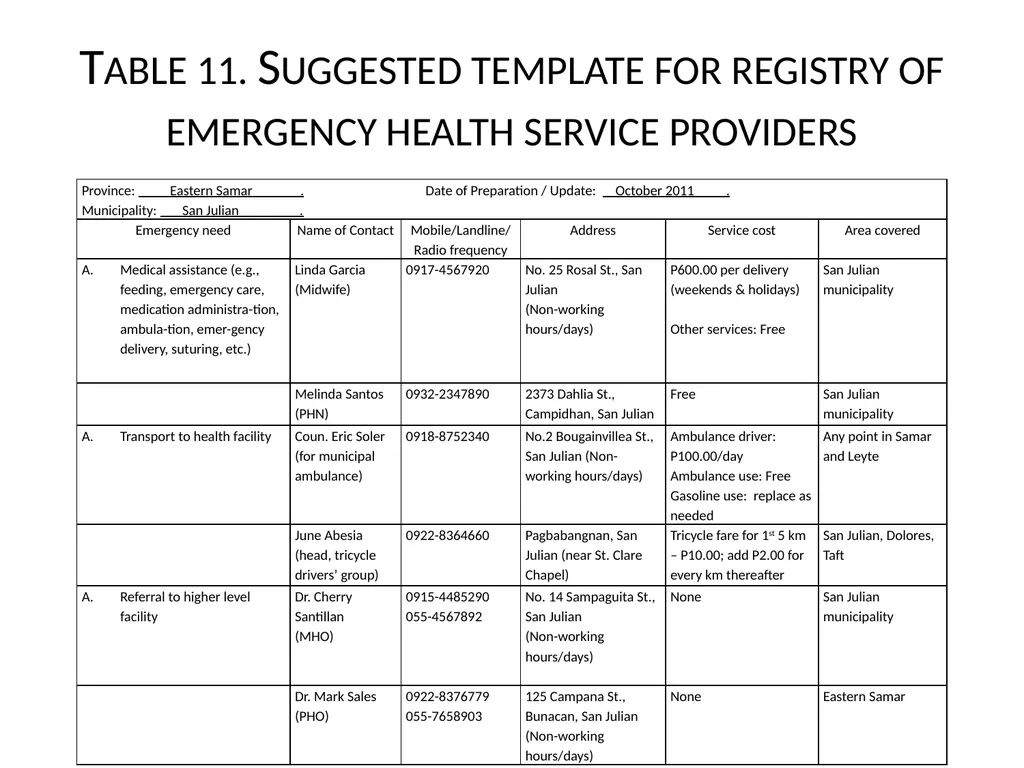
slide39. Table 11. Suggested template for registry of emergency health service providers<br>
slide40. Preparing for CHT Mobilization at the Municipal/City Level Assessing the Local Health Situation
Securing Local Support
Organizing, Managing and Sustaining CHTs
Securing the list of NHTS-PR Families
Determining CHT Partner Requirements and Matching with Families
Preparing the List of Health Providers
Preparing for the Municipal Level Training of CHT Partners<br>
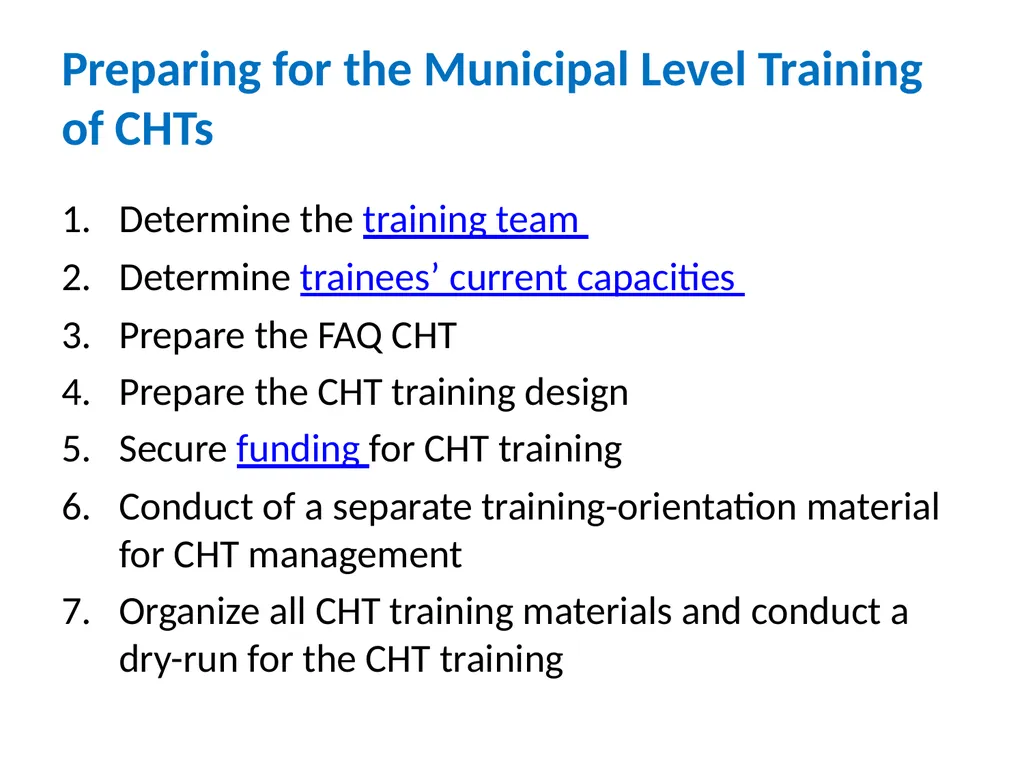
slide41. Preparing for the Municipal Level Training of CHTs Determine the training team
Determine trainees’ current capacities
Prepare the FAQ CHT
Prepare the CHT training design
Secure funding for CHT training
Conduct of a separate training-orientation material for CHT management
Organize all CHT training materials and conduct a dry-run for the CHT training<br>
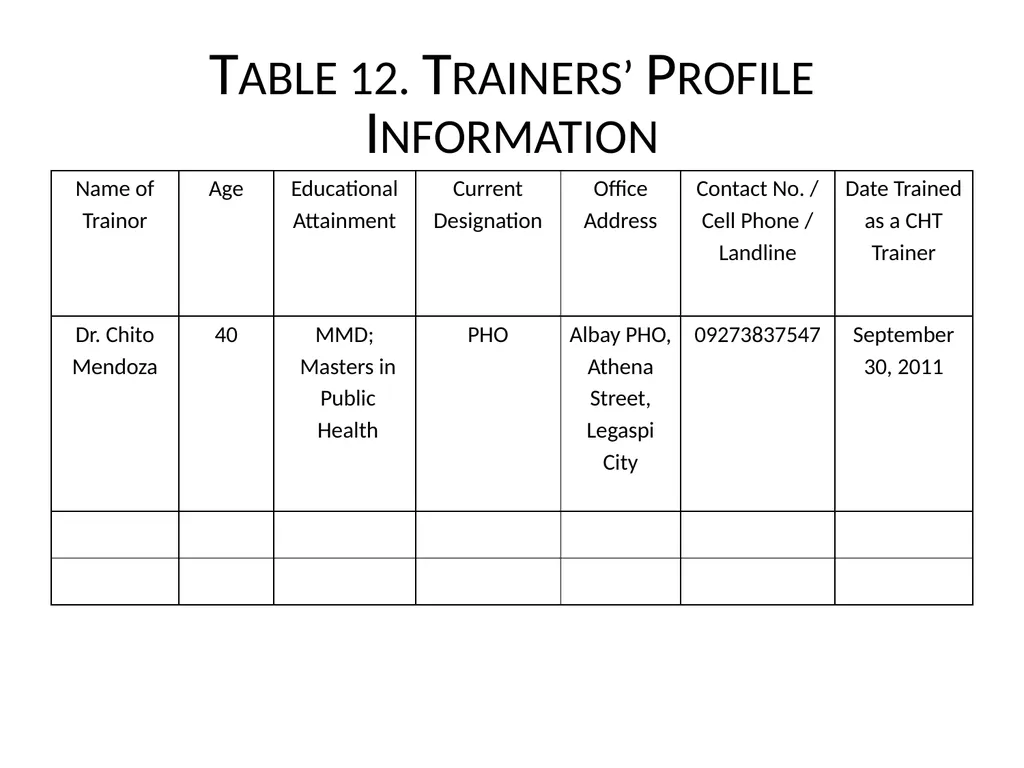
slide42. Table 12. Trainers’ Profile Information<br>
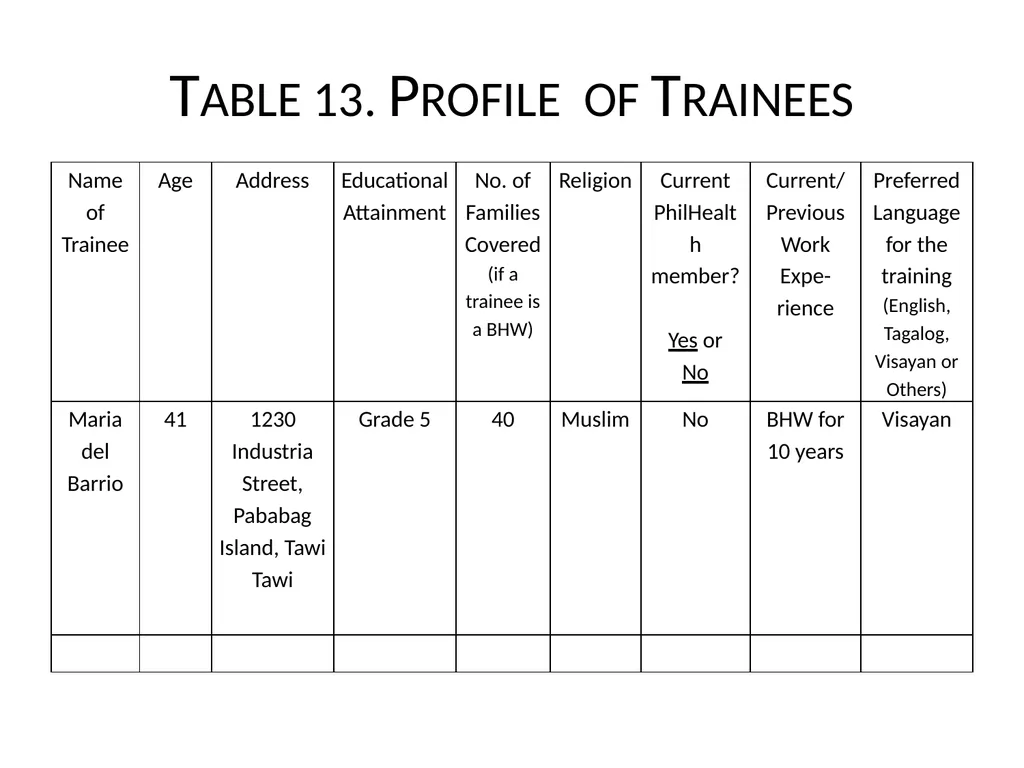
slide43. Table 13. Profile of Trainees<br>
slide44. THANKS!!!<br>
slide2. Preparing for CHT Mobilization at the Municipal/City Level The Municipal Health Officer/City Health Officer will play a vital role in the Training, Deployment and Mobilization of Community Health Teams (CHTs) in his/her Local Government Unit (LGU). All of the following activities will have to be immediately initiated and implemented by the MHO/CHO prior to the undertaking of the training of the CHT Management Group and Partners at the municipal level.<br>
slide3. Preparing for CHT Mobilization at the Municipal/City Level Assessing the Local Health Situation
Securing Local Support
Organizing, Managing and Sustaining CHTs
Securing the list of NHTS-PR Families
Determining CHT Partner Requirements and Matching with Families
Preparing the List of Health Providers
Preparing for the Municipal Level Training of CHT Partners<br>
slide4. Preparing for CHT Mobilization at the Municipal/City Level Assessing the Local Health Situation
Securing Local Support
Organizing, Managing and Sustaining CHTs
Securing the list of NHTS-PR Families
Determining CHT Partner Requirements and Matching with Families
Preparing the List of Health Providers
Preparing for the Municipal Level Training of CHT Partners<br>
slide5. Assessing the Local Health Situation WHY?
To know what to prepare for in terms of what health risk assessments (HRAs), health use plans (HUPs) that CHTs will need when CHTs are deployed
To know which types of providers will need to be oriented in terms of possible patient load (Section F, Instructions on Preparing the List of Providers, Page 32)
To prepare a briefer or health situationer for presentation to the LCE in order to generate support for CHT deployment (Section B, Securing Local Support at the Municipal or City Level, Page 14)<br>
slide6. WHAT?
top causes of morbidity and mortality;
number of maternal, infant and under-5 deaths; and
top three causes of maternal, infant and under-5 deaths.
The proposed source of information is the FHSIS from 2009 to 2010. MHO/CHO and the PHN will fill up the following tables: Assessing the Local Health Situation<br>
slide7. Table 2. Municipal/City Health Data on Maternal, Infant and Under-five Deaths, 2008-2010<br>
slide8. Table 3. Municipal/City Health Data on the Top 10 Causes of Morbidity, 2008-2010.<br>
slide9. Table 4. Municipal/City Health Data on the Top 10 Causes of Mortality, 2008-2010.<br>
slide10. Secure from the PHO (c/o Ms. Aurora Doria) the cleaned data (2010)on the 5 MDG indicators of the LGU:
Contraceptive Prevalence Rate (CPR)
Fully Immunized Children (FIC)
Facility-Based attendance by skilled birth attendants
Vitamin A supplementation
Case Detection Rate (CDR) and Cure Rate (CR) for TB Assessing the Local Health Situation<br>
slide11. The data will be inculcated in the Letter to the Community Health Team (CHT) Partner.
The Local Health Situation can be used as baseline data to determine improvements in the local health programs, especially in FP-MNCHN and TB programs, that can be attributed to the CHT activities.
It can also be used by the MHO/CHO to convince the LCE on the importance of the CHTs as part of the health delivery system in the LGU. Assessing the Local Health Situation NEXT<br>
slide12. Letter to the Community Health Team Partner
(to be modified by the P/M/CHO)
Dear CHT Partner,
The families assigned under your care have long endured the risk of dying from causes that can be prevented simply by knowing how to go about getting the medical services they need.
[Insert here the number of maternal, infant and under-five child deaths in the province/city/municipality. Discuss barriers to health care use and factors contributing to maternal and child deaths (e.g., financing, physical access to health providers and health-seeking behaviour of families, information on available health providers.) Refer to Section A of Preparing for CHT Organization, Training & Deployment: Guide for MHOs/CHOs.]
Now you have a chance to help these families break these barriers to accessing health services. As their CHT Partner, your role is to directly communicate with underserved families --especially those covered by PantawidPamilya --to give them the information they need to recognize their health risks, plan for their health, and access the medical services they need. You serve as their link to the local health system - introducing them to the wide array of services it offers, giving them real options in health care and enabling them to make informed decisions about their health.<br>
slide13. Preparing for CHT Mobilization at the Municipal/City Level Assessing the Local Health Situation
Securing Local Support
Organizing, Managing and Sustaining CHTs
Securing the list of NHTS-PR Families
Determining CHT Partner Requirements and Matching with Families
Preparing the List of Health Providers
Preparing for the Municipal Level Training of CHT Partners<br>
slide14. Securing Local Support MHO/ CHO will convey to the LCE and other concerned local agencies on the importance of the CHT, specifically its navigation function, in improving the health status of poor families; and what the LGU can do to support their mobilization or deployment.
a. The MHO/CHO can cite the enabling statutes/policies on CHT mobilization:
- DILG Memo Circular 2011-145
- Joint Memorandum Circular No. 2011-0073
(DOH, DSWD, DILG, DepED) Health Navigational Assistance
Giving families the information they need to maximize opportunities to use health services
Assisting families in recognizing health risks and managing such risks through health plans
Linking families to health providers and health emergency contacts
Guiding families in using their Philhealth benefits<br>
slide15. 1. The MHO/CHO will conduct advocacy meetings with the SB and the LIGA to gain support for KP-CHT and request for a resolution of support and possible funding for the sustainability of the project, at least up to 2016.
2. The MHO or CHO is responsible for ensuring that resources are available to support and sustain CHT activities in the municipality/ city. Securing Local Support<br>
slide16. Table 5. Inventory of Available Resources for the LGU to Support and Sustain CHT<br>
slide17. Preparing for CHT Mobilization at the Municipal/City Level Assessing the Local Health Situation
Securing Local Support
Organizing, Managing and Sustaining CHTs
Securing the list of NHTS-PR Families
Determining CHT Partner Requirements and Matching with Families
Preparing the List of Health Providers
Preparing for the Municipal Level Training of CHT Partners<br>
slide18. Organizing, Managing & Sustaining CHTs MHOs/CHO should ensure the mobilization of CHTs. RHU - MHO, PHN, RNheals BHS - RHM<br>
slide19. Organizing, Managing & Sustaining CHTs The CHT Management Group:
1. Punong Barangay – Chairman
2. Rural Health Midwife – Co-chairman
3. Brgy. Chairman on Health – Member
4. Brgy. Nutrition Scholar – Member
5. Others –Purok leaders, etc.- Member
The RHM is not only the co-chairman but also the frontline service provider in the BHS as well as the one responsible for collecting, recording and reporting the FHSIS data.<br>
slide20. Preparing for CHT Mobilization at the Municipal/City Level Assessing the Local Health Situation
Securing Local Support
Organizing, Managing and Sustaining CHTs
Securing the list of NHTS-PR Families
Determining CHT Partner Requirements and Matching with Families
Preparing the List of Health Providers
Preparing for the Municipal Level Training of CHT Partners<br>
slide21. Securing the List of NHTS-PR households<br>
slide22. Securing the List of NHTS-PR households The list should be secured as early as possible to facilitate the identification of the families to be served by the CHTs in every barangay.
The MHO/CHO should exert effort to get the list in whatever way possible and wherever the list is available.<br>
slide23. Preparing for CHT Mobilization at the Municipal/City Level Assessing the Local Health Situation
Securing Local Support
Organizing, Managing and Sustaining CHTs
Securing the list of NHTS-PR Families
Determining CHT Partner Requirements and Matching with Families
Preparing the List of Health Providers
Preparing for the Municipal Level Training of CHT Partners<br>
slide24. Determining CHT volunteer requirements and matching with families How many CHT volunteers are needed?
- Necessary adjustments based on characteristics of barangay and number of NHTS-PR families
Who are available for the tasks?
- Mostly active BHWs who will be screened prior to training. Additional volunteers will have to be recruited if necessary
Who are matched to families?<br>
slide25. Table 6. Number of required CHT volunteers per Barangay<br>
slide26. Determining CHT volunteer requirements and matching with families Characteristic of Barangay
Barangays with high population density such as poblacion areas – CHT partner can walk to the residence or less tha 30 minutes ride: 1 is to 50 families
Barangays with difficult terrain, with minimal available transportation, long time travel snf high cost of travel- more tha an hour ride just to reach 1 family: 1 is to 10<br>
slide27. Determining CHT volunteer requirements and matching with families Characteristic of Barangay
3. Barangays with available communications (cellphones and radios) : 1 is to 50 families
4. Barangays with other venues to for monitoring the families like 4Ps assemblies: 1 is to 50<br>
slide28. Table 7. Adjusted Number CHT volunteers per Barangay<br>
slide29. Determining CHT volunteer requirements and matching with families Number of Available CHT Volunteers
The MHO, PHN and assigned Rural Health Midwife in a barangay will have to evaluate the possible BHWs who will be trained as CHT Partners:
a. Educational attainment – based on local BHW Registry (if no registry, just survey BHWs)
b. Dedication to work – based on RHMs evaluation
c. Age – capacity to perform required tasks
* Not all the BHWs will be selected/trained except in barangays where their number is inadequate.<br>
slide30. Table 8. List of CHT volunteers per barangay (Screened)<br>
slide31. Determining CHT volunteer requirements and matching with families Number of Available CHT Volunteers
If the recommended adjusted number of CHT volunteers exceeds the number of available CHT volunteers, the MHO, PHN and assigned Rural Health Midwife of the barangay should recruit additional CHT Partners. (Section C, Criteria for Recruiting Additional CHT Partners, Page 26)
The total recommended adjusted number of CHT volunteers is the number of future CHT Partners to be trained at the municipal level.<br>
slide32. Table 9. Adjusted Number CHT volunteers per Barangay<br>
slide33. Determining CHT volunteer requirements and matching with families Matching CHT Partners to NHTS families
The MHO, with the supervising midwives, should be responsible for matching CHT Partners to NHTS families, and make the necessary assignments and adjustments to ensure that the navigational functions of the CHTs are utilized properly. (Section C, Allocation of Available CHT Partners to Families, Page 27)<br>
slide34. Preparing for CHT Mobilization at the Municipal/City Level Assessing the Local Health Situation
Securing Local Support
Organizing, Managing and Sustaining CHTs
Securing the list of NHTS-PR Families
Determining CHT Partner Requirements and Matching with Families
Preparing the List of Health Providers
Preparing for the Municipal Level Training of CHT Partners<br>
slide35. Preparing the list of Providers Accessible to NHTS households This list is important because it will form part of the Family Health Guide, the CHT Guidebook and in filling up the Health Plans (Forms 2A to 2G)
All available public and private health facilities and individual providers
Services offered, professional fees, room and board rates and cost of treatment for selected conditions; their address, phone number and other contact details; operating hours; and the type of their PhilHealth accreditation.<br>
slide36. Health Service Providers Hospitals -- e.g. medical centers, regional hospitals, LGU hospitals, DOH hospitals
Lying-in clinics
Outpatient clinics -- e.g. RHUs, private doctor clinics or private practising midwives.
Outpatient laboratory and ancillary services e.g. laboratory units, imaging centers, dialysis units<br>
slide37. Table 10. Template for the list of health providers<br>
slide38. Preparing the list of Emergency Health Contacts This list is important because it will form part of the Family Health Guide, the CHT Guidebook and in filling up the Health Plans (Forms 2A to 2E)
Create a list of emergency health contacts; names, address, contact number or radio frequency, including services for transportation to and from the health facilities.<br>
slide39. Table 11. Suggested template for registry of emergency health service providers<br>
slide40. Preparing for CHT Mobilization at the Municipal/City Level Assessing the Local Health Situation
Securing Local Support
Organizing, Managing and Sustaining CHTs
Securing the list of NHTS-PR Families
Determining CHT Partner Requirements and Matching with Families
Preparing the List of Health Providers
Preparing for the Municipal Level Training of CHT Partners<br>
slide41. Preparing for the Municipal Level Training of CHTs Determine the training team
Determine trainees’ current capacities
Prepare the FAQ CHT
Prepare the CHT training design
Secure funding for CHT training
Conduct of a separate training-orientation material for CHT management
Organize all CHT training materials and conduct a dry-run for the CHT training<br>
slide42. Table 12. Trainers’ Profile Information<br>
slide43. Table 13. Profile of Trainees<br>
slide44. THANKS!!!<br>