Migratory Insertion Elimination Rxns A migratory insertion reaction is when a cisoidal anionic and neutral ligand on a metal complex couple together to generate a new coordinated anionic ligand. This new anionic ligand is composed of the
"Migratory Insertion & Elimination Rxns A migratory" is the property of its rightful owner. Permission is granted to
download and print the materials on this website for personal, non-commercial use only, and to display it
on your personal computer provided you do not modify the materials and that you retain all copyright
notices contained in the materials. By downloading content from our website, you accept the terms of this
agreement.
Presentation Transcript
01
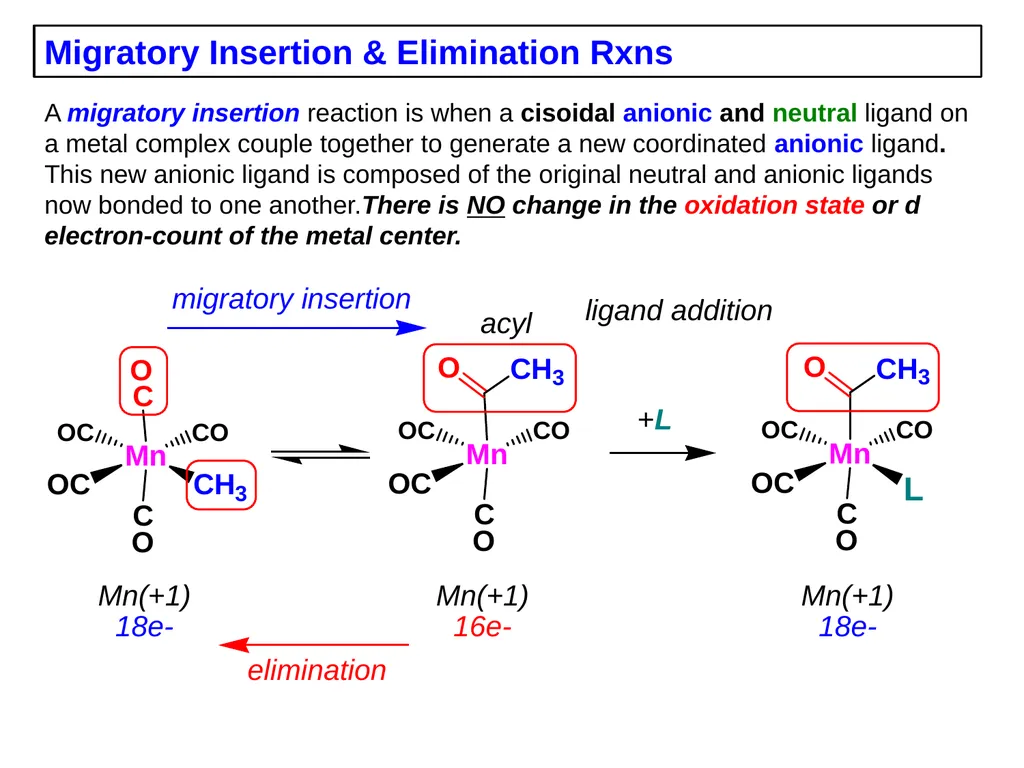
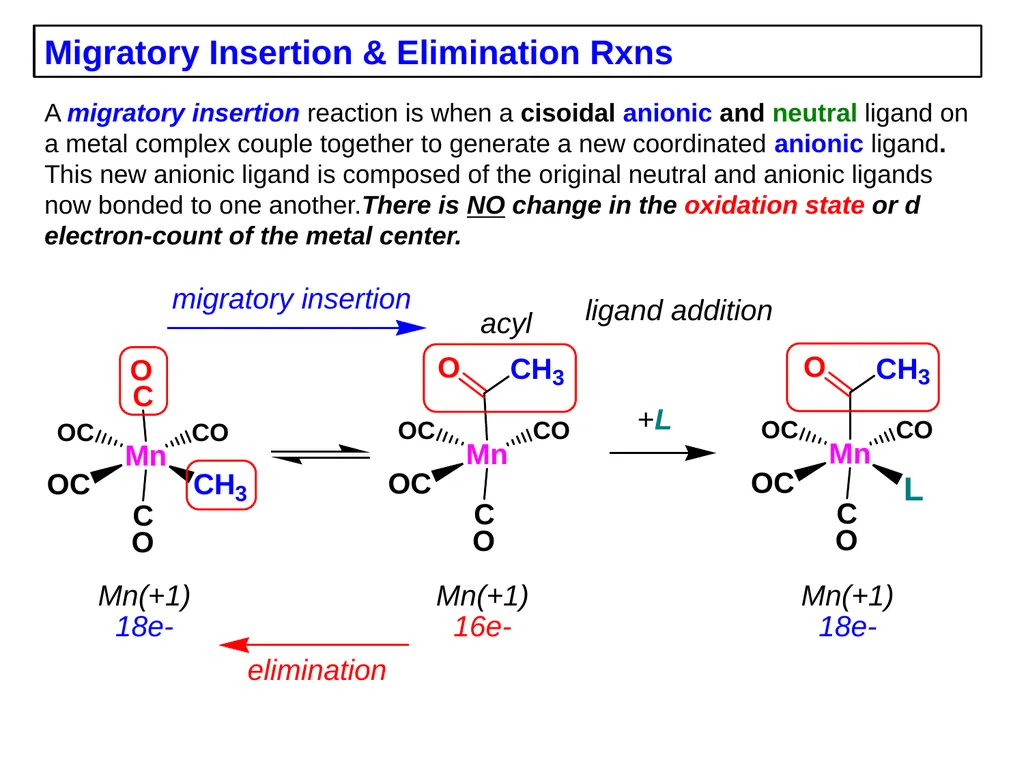
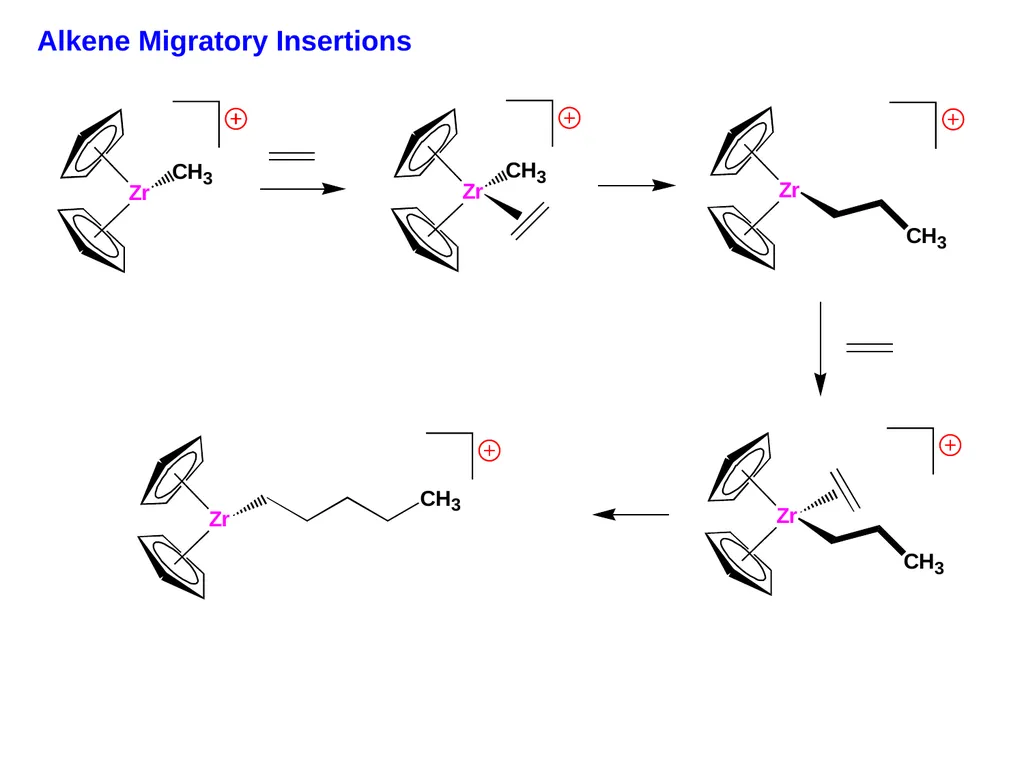
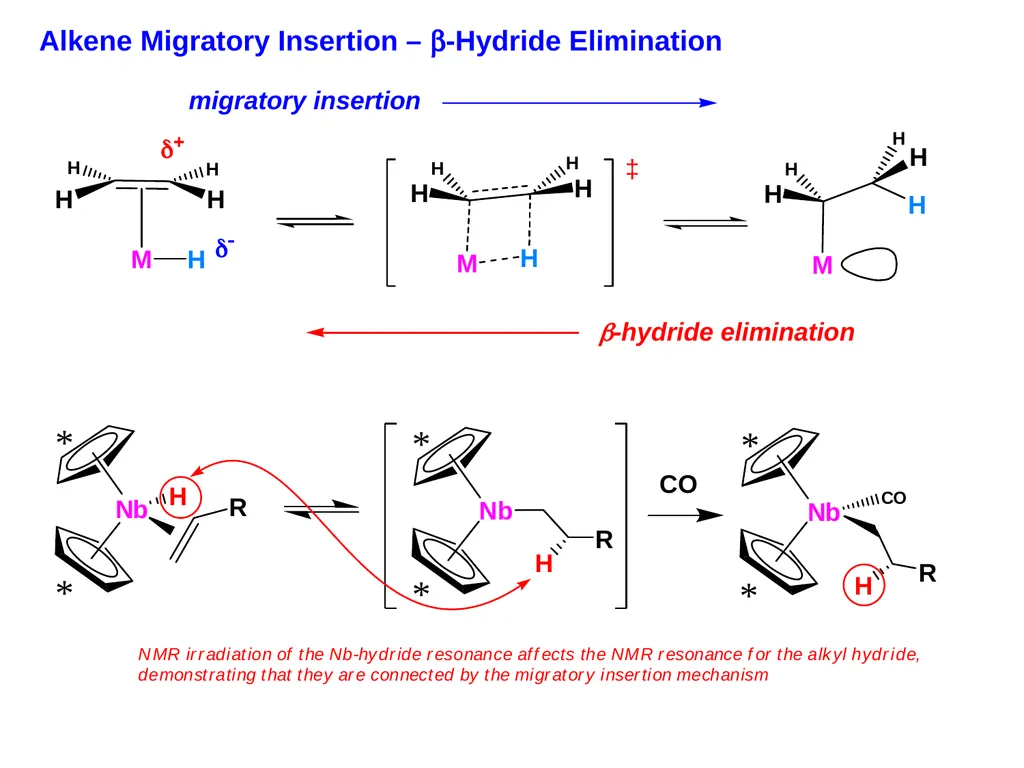
Migratory Insertion & Elimination Rxns A migratory insertion reaction is when a cisoidal anionic and neutral ligand on a metal complex couple together to generate a new coordinated anionic ligand. This new anionic ligand is composed of the original neutral and anionic ligands now bonded to one another.There is NO change in the oxidation state or d electron-count of the metal center.<br>
02
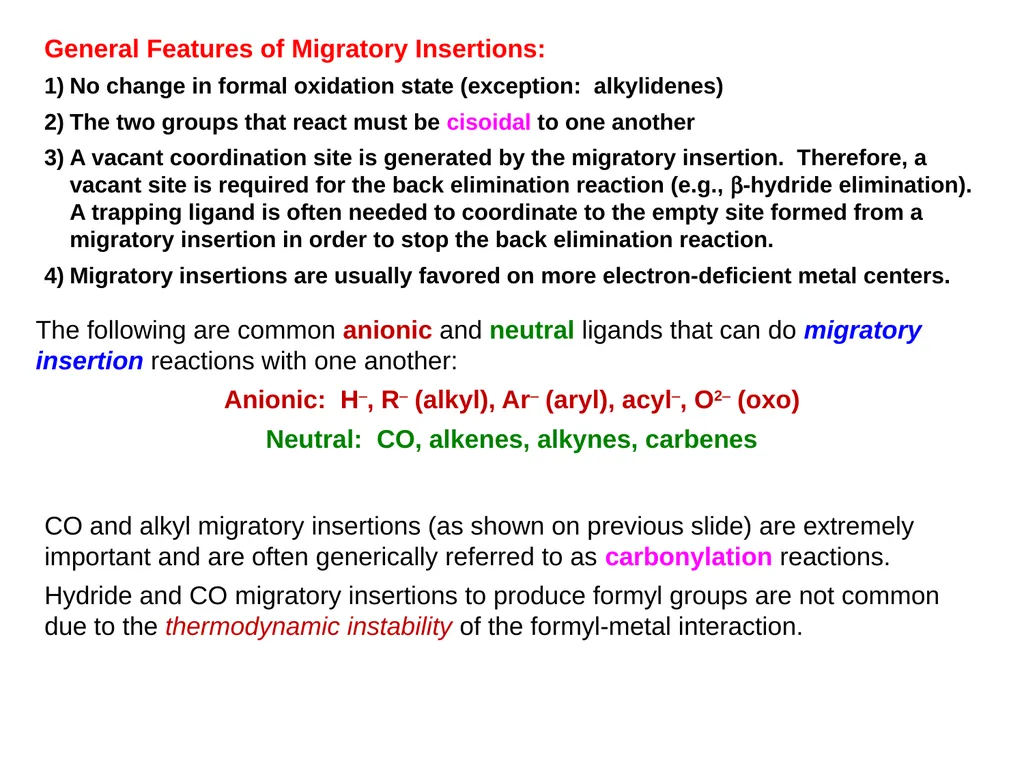
General Features of Migratory Insertions:
1) No change in formal oxidation state (exception: alkylidenes)
2) The two groups that react must be cisoidal to one another
3) A vacant coordination site is generated by the migratory insertion. Therefore, a vacant site is required for the back elimination reaction (e.g., b-hydride elimination). A trapping ligand is often needed to coordinate to the empty site formed from a migratory insertion in order to stop the back elimination reaction.
4) Migratory insertions are usually favored on more electron-deficient metal centers. The following are common anionic and neutral ligands that can do migratory insertion reactions with one another:
Anionic: H-, R- (alkyl), Ar- (aryl), acyl-, O2- (oxo)
Neutral: CO, alkenes, alkynes, carbenes CO and alkyl migratory insertions (as shown on previous slide) are extremely important and are often generically referred to as carbonylation reactions.
Hydride and CO migratory insertions to produce formyl groups are not common due to the thermodynamic instability of the formyl-metal interaction.<br>
03
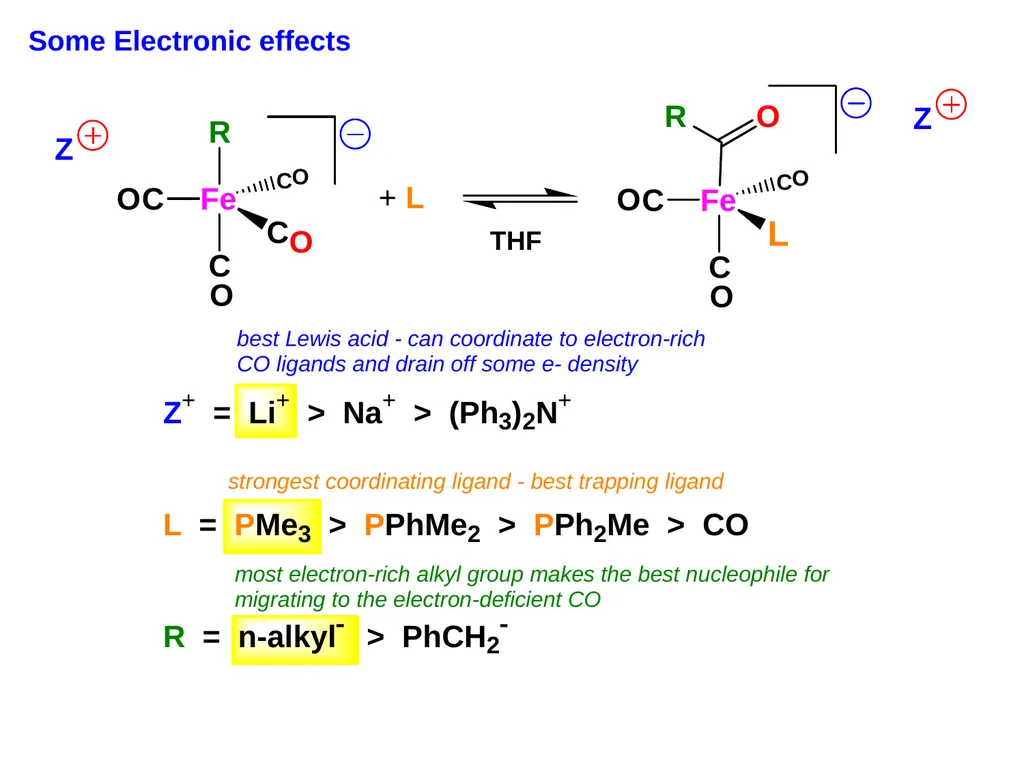
Some Electronic effects<br>
04
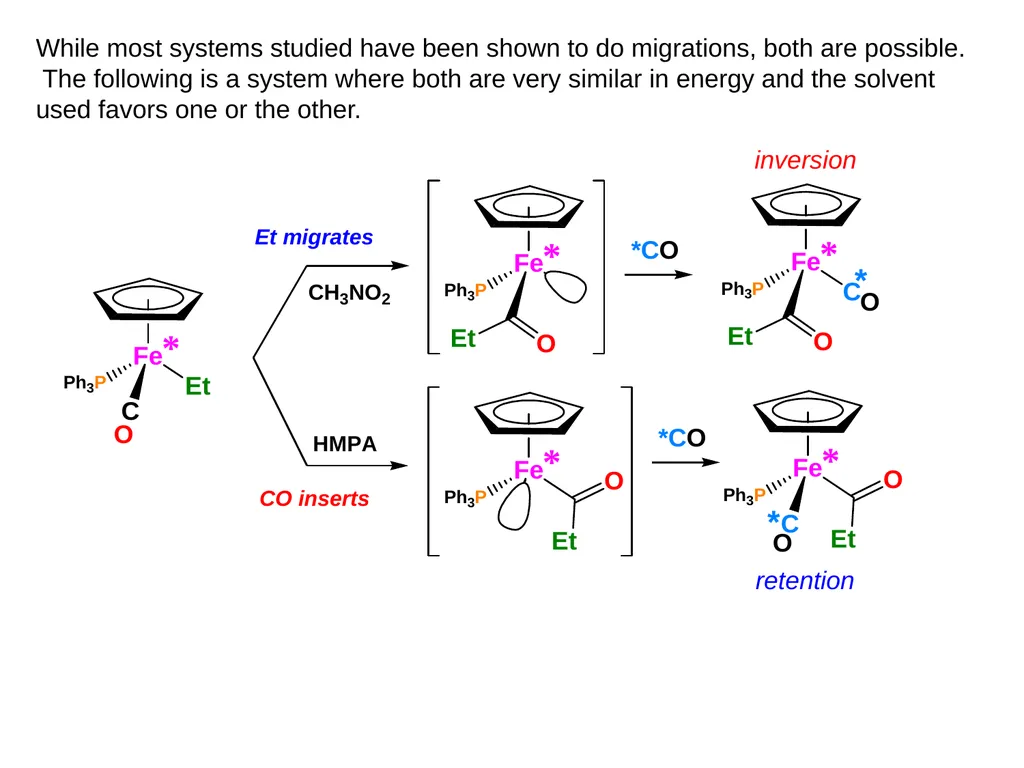
Migration vs. Insertion<br>
05
While most systems studied have been shown to do migrations, both are possible. The following is a system where both are very similar in energy and the solvent used favors one or the other.<br>
Problem: Why don’t either of the complexes shown below do alkene-hydride migratory insertions at room temperature? Problem: Sketch out and label the two mechanistic steps (in the correct order) that are occurring for the following reaction.<br>
09
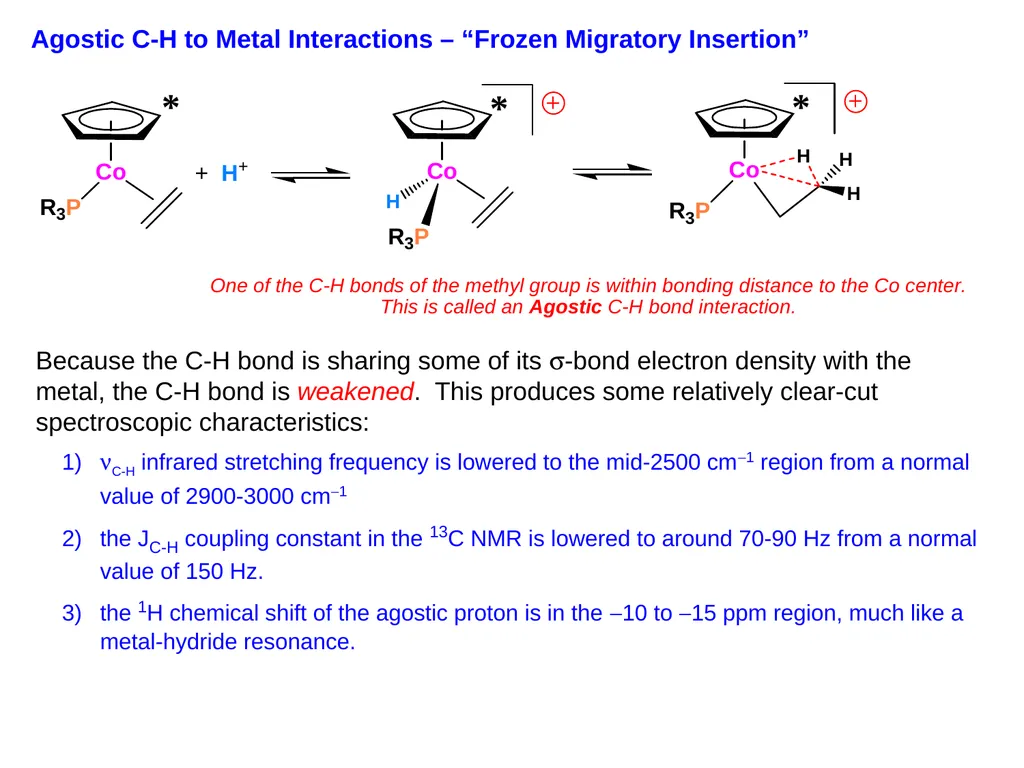
Agostic C-H to Metal Interactions – “Frozen Migratory Insertion” Because the C-H bond is sharing some of its s-bond electron density with the metal, the C-H bond is weakened. This produces some relatively clear-cut spectroscopic characteristics:
1) nC-H infrared stretching frequency is lowered to the mid-2500 cm-1 region from a normal value of 2900-3000 cm-1
2) the JC-H coupling constant in the 13C NMR is lowered to around 70-90 Hz from a normal value of 150 Hz.
3) the 1H chemical shift of the agostic proton is in the -10 to -15 ppm region, much like a metal-hydride resonance.<br>
10
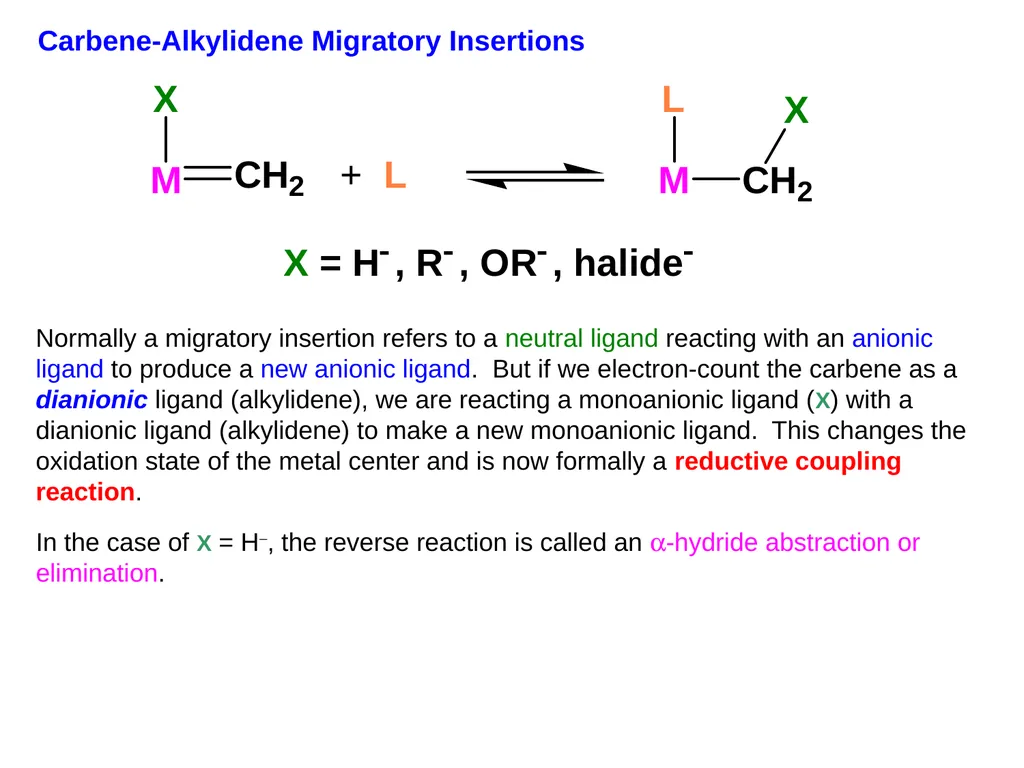
Carbene-Alkylidene Migratory Insertions Normally a migratory insertion refers to a neutral ligand reacting with an anionic ligand to produce a new anionic ligand. But if we electron-count the carbene as a dianionic ligand (alkylidene), we are reacting a monoanionic ligand (X) with a dianionic ligand (alkylidene) to make a new monoanionic ligand. This changes the oxidation state of the metal center and is now formally a reductive coupling reaction. In the case of X = H-, the reverse reaction is called an a-hydride abstraction or elimination.<br>
11
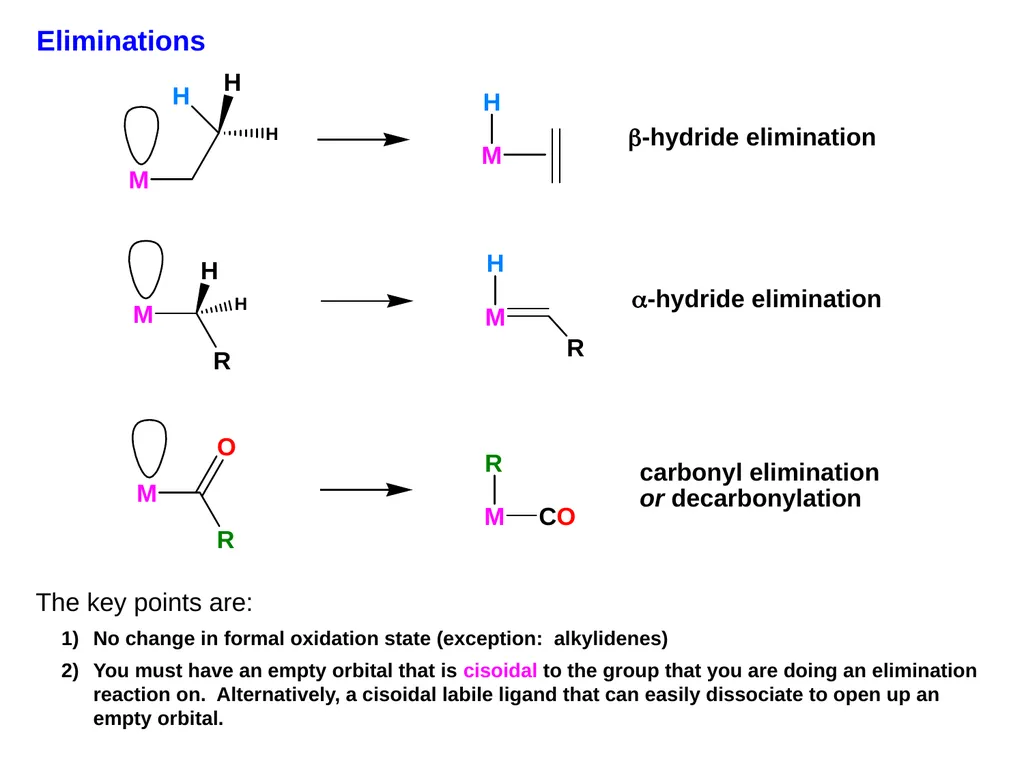
Eliminations The key points are:
1) No change in formal oxidation state (exception: alkylidenes)
2) You must have an empty orbital that is cisoidal to the group that you are doing an elimination reaction on. Alternatively, a cisoidal labile ligand that can easily dissociate to open up an empty orbital.<br>
12
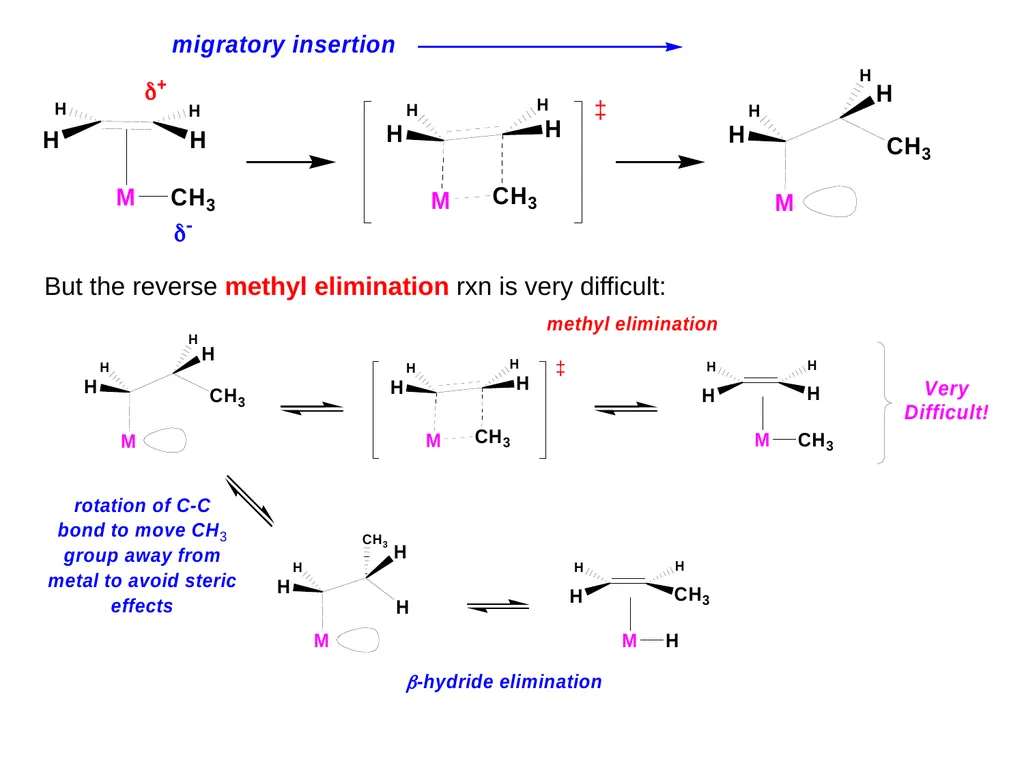
But the reverse methyl elimination rxn is very difficult:<br>
13
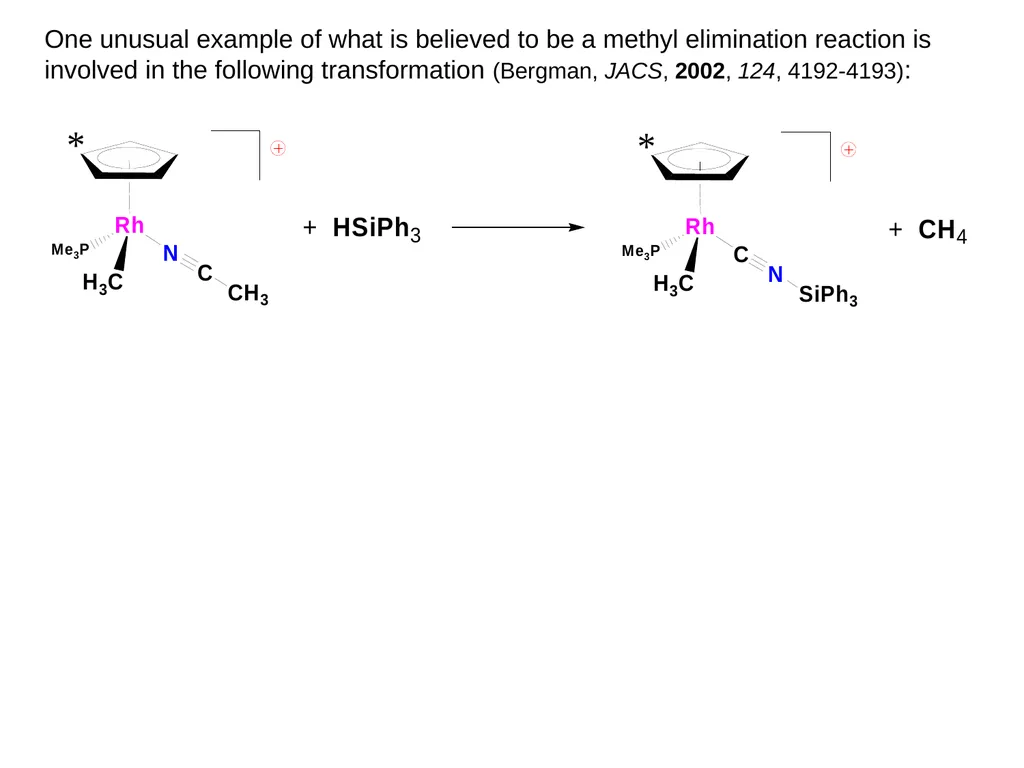
One unusual example of what is believed to be a methyl elimination reaction is involved in the following transformation (Bergman, JACS, 2002, 124, 4192-4193):<br>
14
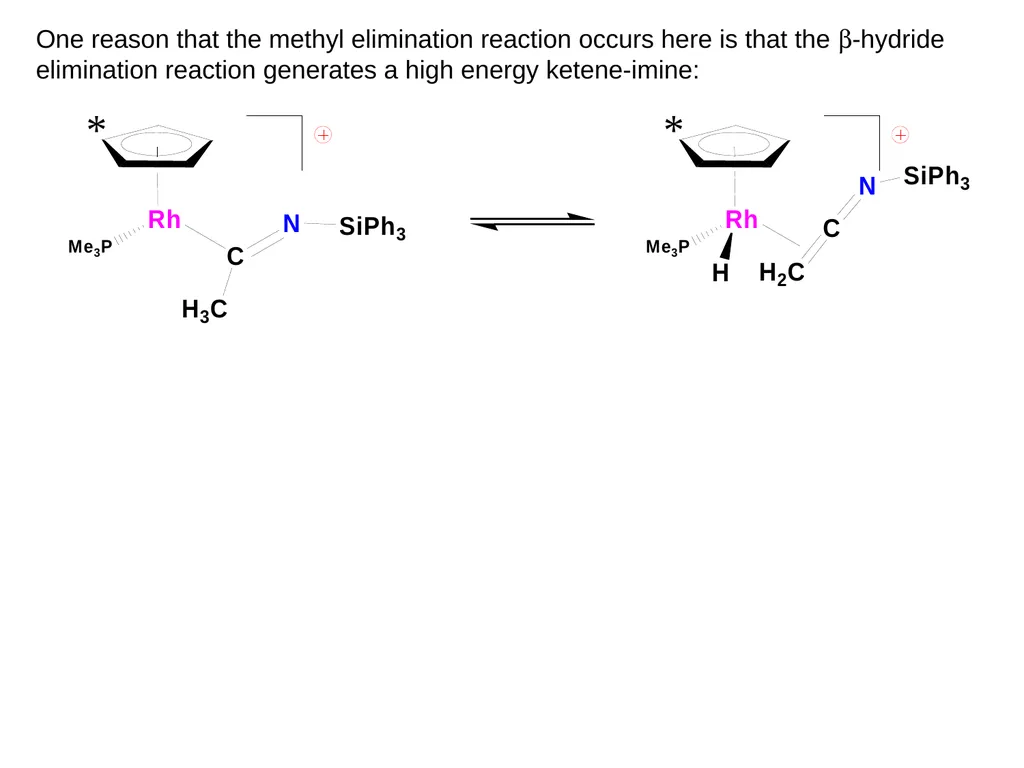
One reason that the methyl elimination reaction occurs here is that the b-hydride elimination reaction generates a high energy ketene-imine:<br>
15
Problem: Identify each step in the following mechanism. Some steps may have several things occurring.<br>
16
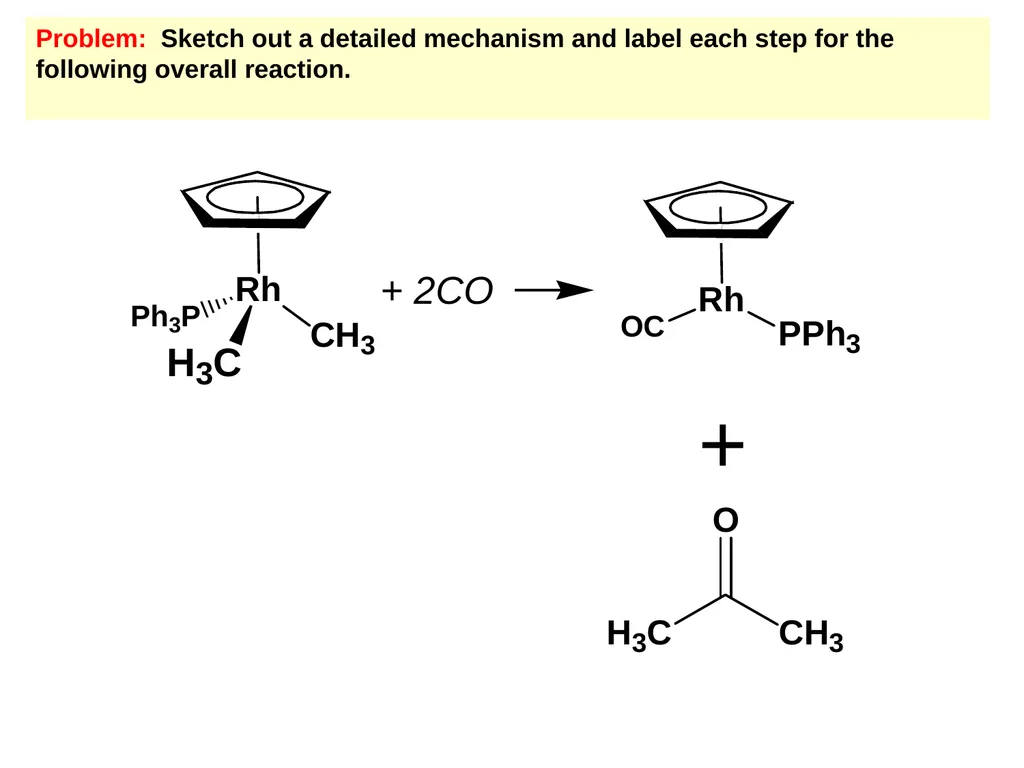
Problem: Sketch out a detailed mechanism and label each step for the following overall reaction.<br>