MILESTONE 2 USER RESEARCH AND PROBLEM FRAMING SHUBHAM DIGHIKAR USER SEGMENTATION User Segments Student Learner Demographics: High school, undergraduate and Postgraduate students Primary Needs: Instant home work help and assignment
"MILESTONE 2 USER RESEARCH AND PROBLEM FRAMING" is the property of its rightful owner. Permission is granted to
download and print the materials on this website for personal, non-commercial use only, and to display it
on your personal computer provided you do not modify the materials and that you retain all copyright
notices contained in the materials. By downloading content from our website, you accept the terms of this
agreement.
Presentation Transcript
01
MILESTONE 2
USER RESEARCH AND PROBLEM FRAMING
SHUBHAM DIGHIKAR<br>
02
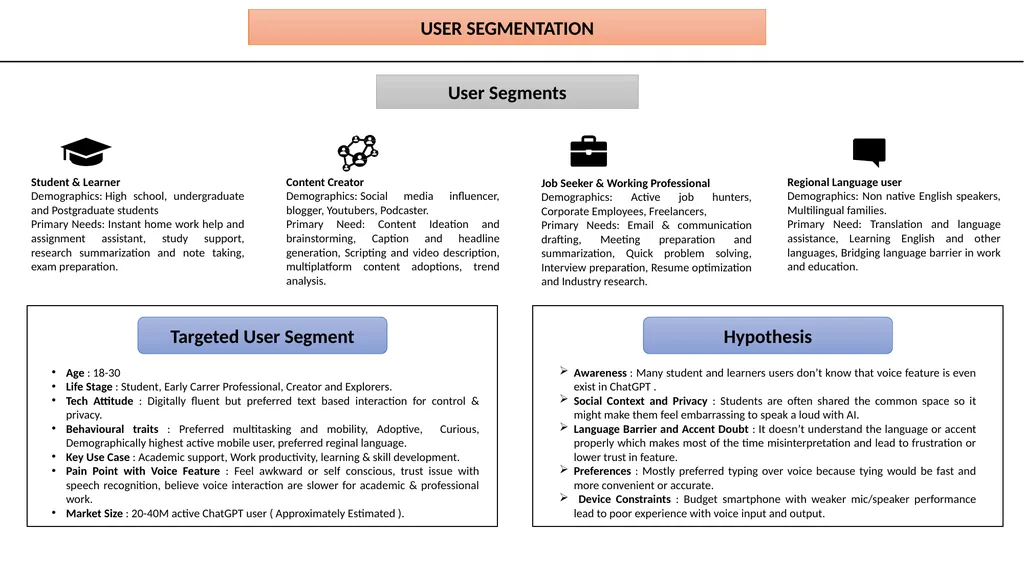
USER SEGMENTATION User Segments Student & Learner
Demographics: High school, undergraduate and Postgraduate students
Primary Needs: Instant home work help and assignment assistant, study support, research summarization and note taking, exam preparation. Job Seeker & Working Professional
Demographics: Active job hunters, Corporate Employees, Freelancers,
Primary Needs: Email & communication drafting, Meeting preparation and summarization, Quick problem solving, Interview preparation, Resume optimization and Industry research. Regional Language user
Demographics: Non native English speakers, Multilingual families.
Primary Need: Translation and language assistance, Learning English and other languages, Bridging language barrier in work and education. Content Creator
Demographics: Social media influencer, blogger, Youtubers, Podcaster.
Primary Need: Content Ideation and brainstorming, Caption and headline generation, Scripting and video description, multiplatform content adoptions, trend analysis. Targeted User Segment Hypothesis Awareness : Many student and learners users don’t know that voice feature is even exist in ChatGPT .
Social Context and Privacy : Students are often shared the common space so it might make them feel embarrassing to speak a loud with AI.
Language Barrier and Accent Doubt : It doesn’t understand the language or accent properly which makes most of the time misinterpretation and lead to frustration or lower trust in feature.
Preferences : Mostly preferred typing over voice because tying would be fast and more convenient or accurate.
Device Constraints : Budget smartphone with weaker mic/speaker performance lead to poor experience with voice input and output. Age : 18-30
Life Stage : Student, Early Carrer Professional, Creator and Explorers.
Tech Attitude : Digitally fluent but preferred text based interaction for control & privacy.
Behavioural traits : Preferred multitasking and mobility, Adoptive, Curious, Demographically highest active mobile user, preferred reginal language.
Key Use Case : Academic support, Work productivity, learning & skill development.
Pain Point with Voice Feature : Feel awkward or self conscious, trust issue with speech recognition, believe voice interaction are slower for academic & professional work.
Market Size : 20-40M active ChatGPT user ( Approximately Estimated ).<br>
03
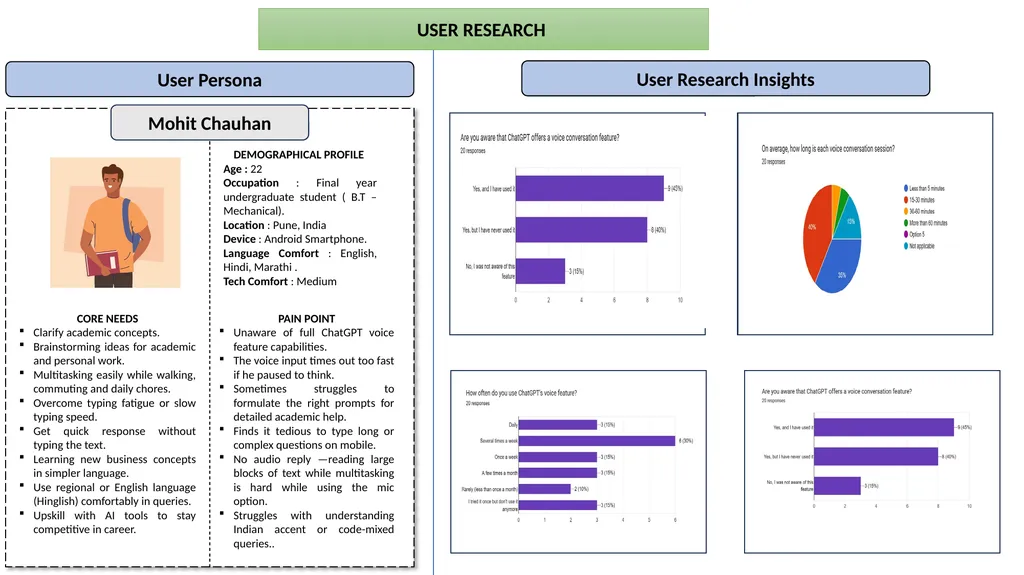
USER RESEARCH User Persona Mohit Chauhan DEMOGRAPHICAL PROFILE
Age : 22
Occupation : Final year undergraduate student ( B.T – Mechanical).
Location : Pune, India
Device : Android Smartphone.
Language Comfort : English, Hindi, Marathi .
Tech Comfort : Medium PAIN POINT
Unaware of full ChatGPT voice feature capabilities.
The voice input times out too fast if he paused to think.
Sometimes struggles to formulate the right prompts for detailed academic help.
Finds it tedious to type long or complex questions on mobile.
No audio reply —reading large blocks of text while multitasking is hard while using the mic option.
Struggles with understanding Indian accent or code-mixed queries.. CORE NEEDS
Clarify academic concepts.
Brainstorming ideas for academic and personal work.
Multitasking easily while walking, commuting and daily chores.
Overcome typing fatigue or slow typing speed.
Get quick response without typing the text.
Learning new business concepts in simpler language.
Use regional or English language (Hinglish) comfortably in queries.
Upskill with AI tools to stay competitive in career. User Research Insights<br>
04
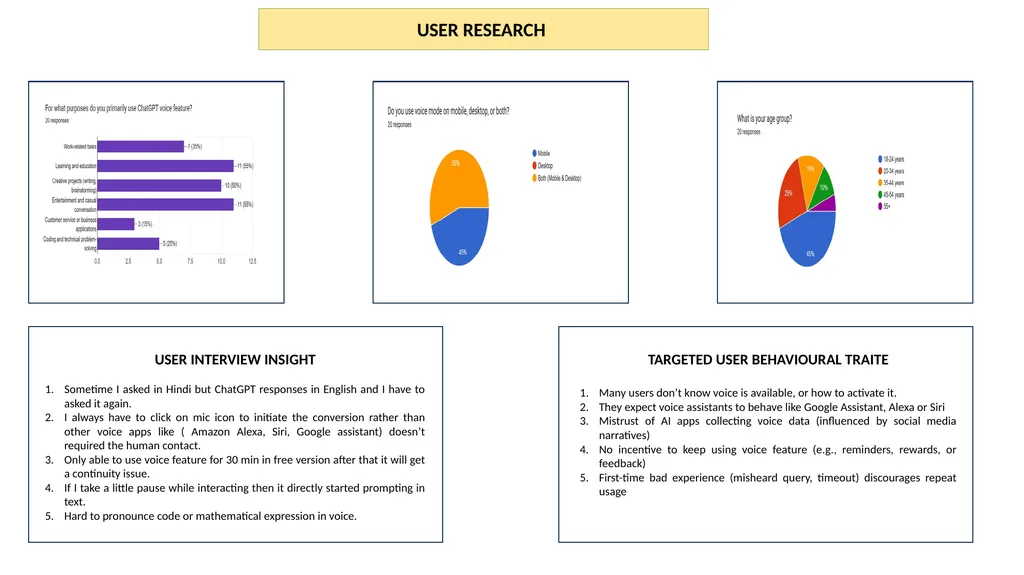
USER RESEARCH USER INTERVIEW INSIGHT
Sometime I asked in Hindi but ChatGPT responses in English and I have to asked it again.
I always have to click on mic icon to initiate the conversion rather than other voice apps like ( Amazon Alexa, Siri, Google assistant) doesn’t required the human contact.
Only able to use voice feature for 30 min in free version after that it will get a continuity issue.
If I take a little pause while interacting then it directly started prompting in text.
Hard to pronounce code or mathematical expression in voice. TARGETED USER BEHAVIOURAL TRAITE
Many users don’t know voice is available, or how to activate it.
They expect voice assistants to behave like Google Assistant, Alexa or Siri
Mistrust of AI apps collecting voice data (influenced by social media narratives)
No incentive to keep using voice feature (e.g., reminders, rewards, or feedback)
First-time bad experience (misheard query, timeout) discourages repeat usage<br>
05
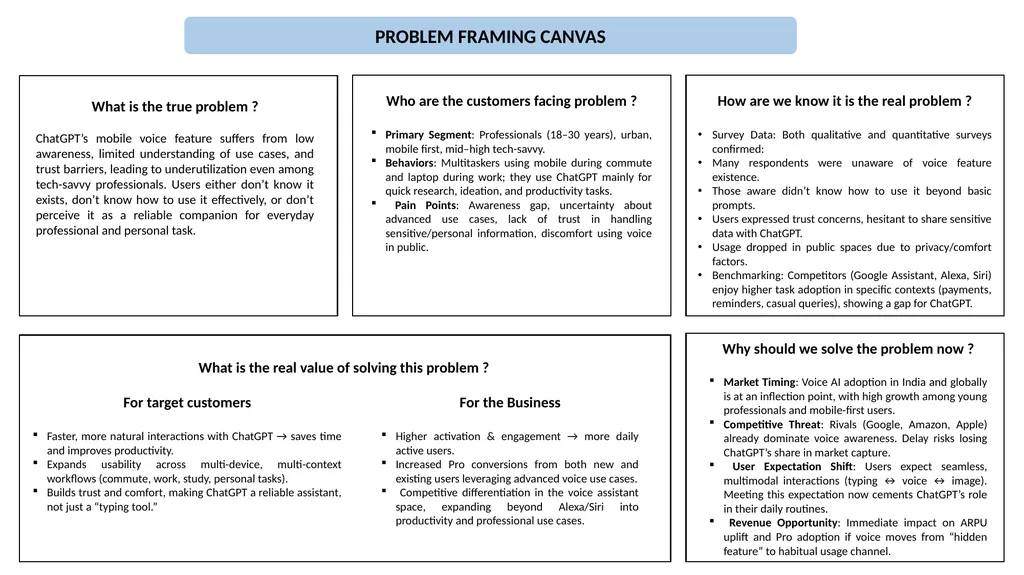
PROBLEM FRAMING CANVAS What is the true problem ?
ChatGPT’s mobile voice feature suffers from low awareness, limited understanding of use cases, and trust barriers, leading to underutilization even among tech-savvy professionals. Users either don’t know it exists, don’t know how to use it effectively, or don’t perceive it as a reliable companion for everyday professional and personal task. Who are the customers facing problem ?
Primary Segment: Professionals (18–30 years), urban, mobile first, mid–high tech-savvy.
Behaviors: Multitaskers using mobile during commute and laptop during work; they use ChatGPT mainly for quick research, ideation, and productivity tasks.
Pain Points: Awareness gap, uncertainty about advanced use cases, lack of trust in handling sensitive/personal information, discomfort using voice in public. How are we know it is the real problem ?
Survey Data: Both qualitative and quantitative surveys confirmed:
Many respondents were unaware of voice feature existence.
Those aware didn’t know how to use it beyond basic prompts.
Users expressed trust concerns, hesitant to share sensitive data with ChatGPT.
Usage dropped in public spaces due to privacy/comfort factors.
Benchmarking: Competitors (Google Assistant, Alexa, Siri) enjoy higher task adoption in specific contexts (payments, reminders, casual queries), showing a gap for ChatGPT. What is the real value of solving this problem ? For target customers
Faster, more natural interactions with ChatGPT → saves time and improves productivity.
Expands usability across multi-device, multi-context workflows (commute, work, study, personal tasks).
Builds trust and comfort, making ChatGPT a reliable assistant, not just a “typing tool.” For the Business
Higher activation & engagement → more daily active users.
Increased Pro conversions from both new and existing users leveraging advanced voice use cases.
Competitive differentiation in the voice assistant space, expanding beyond Alexa/Siri into productivity and professional use cases. Why should we solve the problem now ?
Market Timing: Voice AI adoption in India and globally is at an inflection point, with high growth among young professionals and mobile-first users.
Competitive Threat: Rivals (Google, Amazon, Apple) already dominate voice awareness. Delay risks losing ChatGPT’s share in market capture.
User Expectation Shift: Users expect seamless, multimodal interactions (typing ↔ voice ↔ image). Meeting this expectation now cements ChatGPT’s role in their daily routines.
Revenue Opportunity: Immediate impact on ARPU uplift and Pro adoption if voice moves from “hidden feature” to habitual usage channel.<br>