
MinBD: Minimally-Buffered Deflection Routing for
GB
Published · 49 slides · 0 views
1 / 1

Description
MinBD: Minimally-Buffered Deflection Routing for Energy-Efficient Interconnect Chris Fallin, Greg Nazario, Xiangyao Yu, Kevin Chang, Rachata Ausavarungnirun, Onur Mutlu Carnegie Mellon University CMU and Tsinghua University Motivation In
Related Topics
Share
Embed code
Download this presentation From Below
"MinBD: Minimally-Buffered Deflection Routing for" is the property of its rightful owner. Permission is granted to download and print the materials on this website for personal, non-commercial use only, and to display it on your personal computer provided you do not modify the materials and that you retain all copyright notices contained in the materials. By downloading content from our website, you accept the terms of this agreement.
Presentation Transcript
01
MinBD:
Minimally-Buffered Deflection Routing
for Energy-Efficient Interconnect Chris Fallin, Greg Nazario, Xiangyao Yu*,
Kevin Chang, Rachata Ausavarungnirun, Onur Mutlu
Carnegie Mellon University
*CMU and Tsinghua University<br>
Carnegie Mellon University
*CMU and Tsinghua University<br>
02
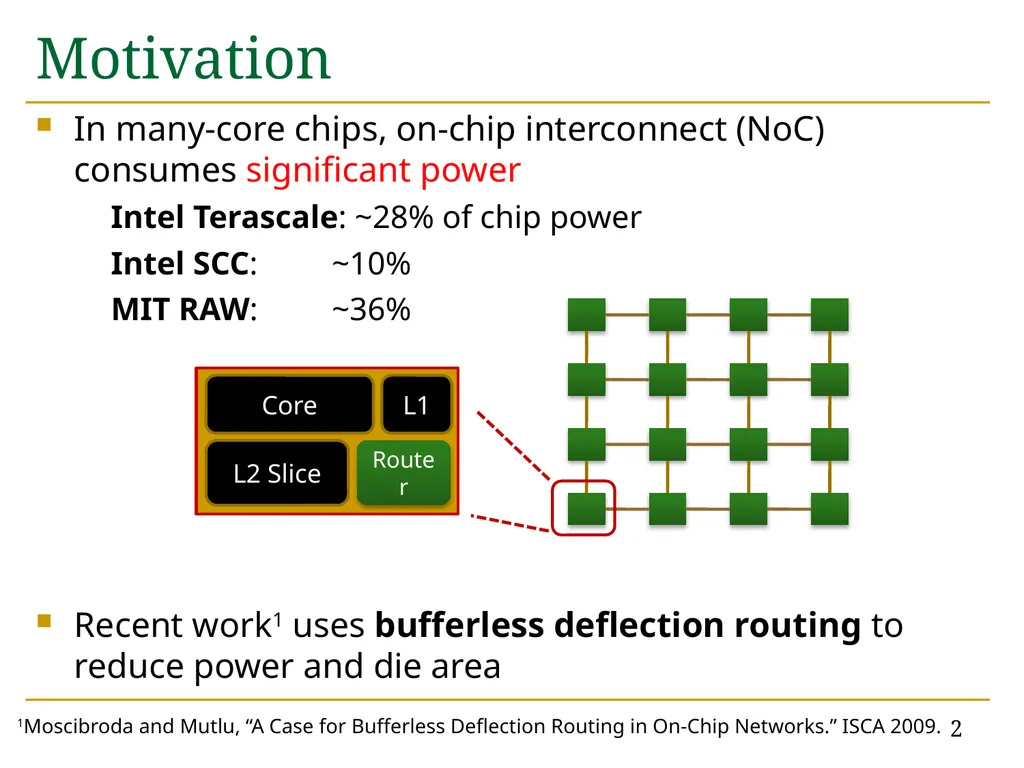
Motivation In many-core chips, on-chip interconnect (NoC) consumes significant power
Intel Terascale: ~28% of chip power
Intel SCC: ~10%
MIT RAW: ~36%
Recent work1 uses bufferless deflection routing to reduce power and die area 2 1Moscibroda and Mutlu, “A Case for Bufferless Deflection Routing in On-Chip Networks.” ISCA 2009.<br>
Intel Terascale: ~28% of chip power
Intel SCC: ~10%
MIT RAW: ~36%
Recent work1 uses bufferless deflection routing to reduce power and die area 2 1Moscibroda and Mutlu, “A Case for Bufferless Deflection Routing in On-Chip Networks.” ISCA 2009.<br>
03
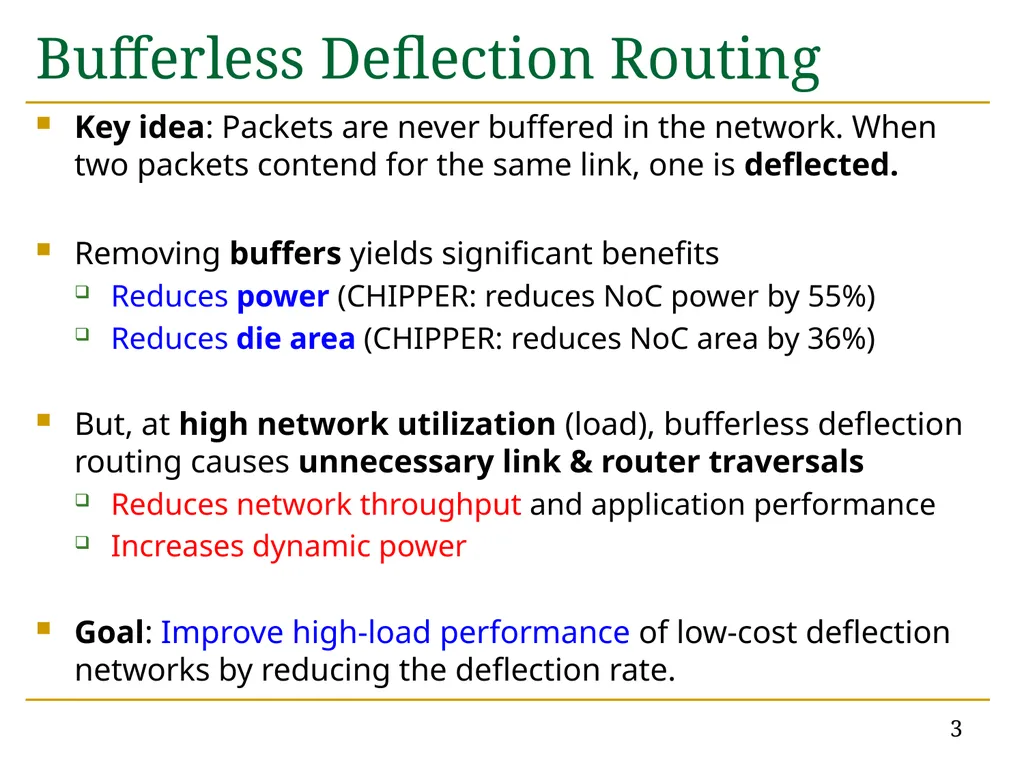
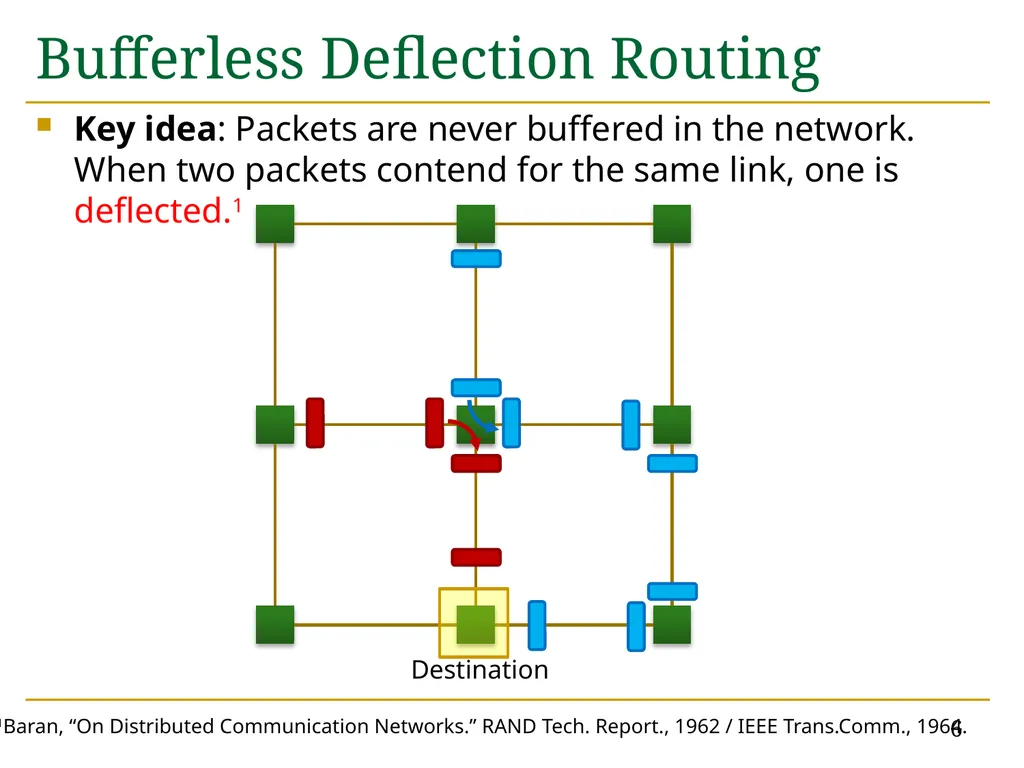
Bufferless Deflection Routing Key idea: Packets are never buffered in the network. When two packets contend for the same link, one is deflected.
Removing buffers yields significant benefits
Reduces power (CHIPPER: reduces NoC power by 55%)
Reduces die area (CHIPPER: reduces NoC area by 36%)
But, at high network utilization (load), bufferless deflection routing causes unnecessary link & router traversals
Reduces network throughput and application performance
Increases dynamic power
Goal: Improve high-load performance of low-cost deflection networks by reducing the deflection rate. 3<br>
Removing buffers yields significant benefits
Reduces power (CHIPPER: reduces NoC power by 55%)
Reduces die area (CHIPPER: reduces NoC area by 36%)
But, at high network utilization (load), bufferless deflection routing causes unnecessary link & router traversals
Reduces network throughput and application performance
Increases dynamic power
Goal: Improve high-load performance of low-cost deflection networks by reducing the deflection rate. 3<br>
04
Outline: This Talk Motivation
Background: Bufferless Deflection Routing
MinBD: Reducing Deflections
Addressing Link Contention
Addressing the Ejection Bottleneck
Improving Deflection Arbitration
Results
Conclusions 4<br>
Background: Bufferless Deflection Routing
MinBD: Reducing Deflections
Addressing Link Contention
Addressing the Ejection Bottleneck
Improving Deflection Arbitration
Results
Conclusions 4<br>
05
Outline: This Talk Motivation
Background: Bufferless Deflection Routing
MinBD: Reducing Deflections
Addressing Link Contention
Addressing the Ejection Bottleneck
Improving Deflection Arbitration
Results
Conclusions 5<br>
Background: Bufferless Deflection Routing
MinBD: Reducing Deflections
Addressing Link Contention
Addressing the Ejection Bottleneck
Improving Deflection Arbitration
Results
Conclusions 5<br>
06
Destination Bufferless Deflection Routing Key idea: Packets are never buffered in the network. When two packets contend for the same link, one is deflected.1 6 1Baran, “On Distributed Communication Networks.” RAND Tech. Report., 1962 / IEEE Trans.Comm., 1964.<br>
07
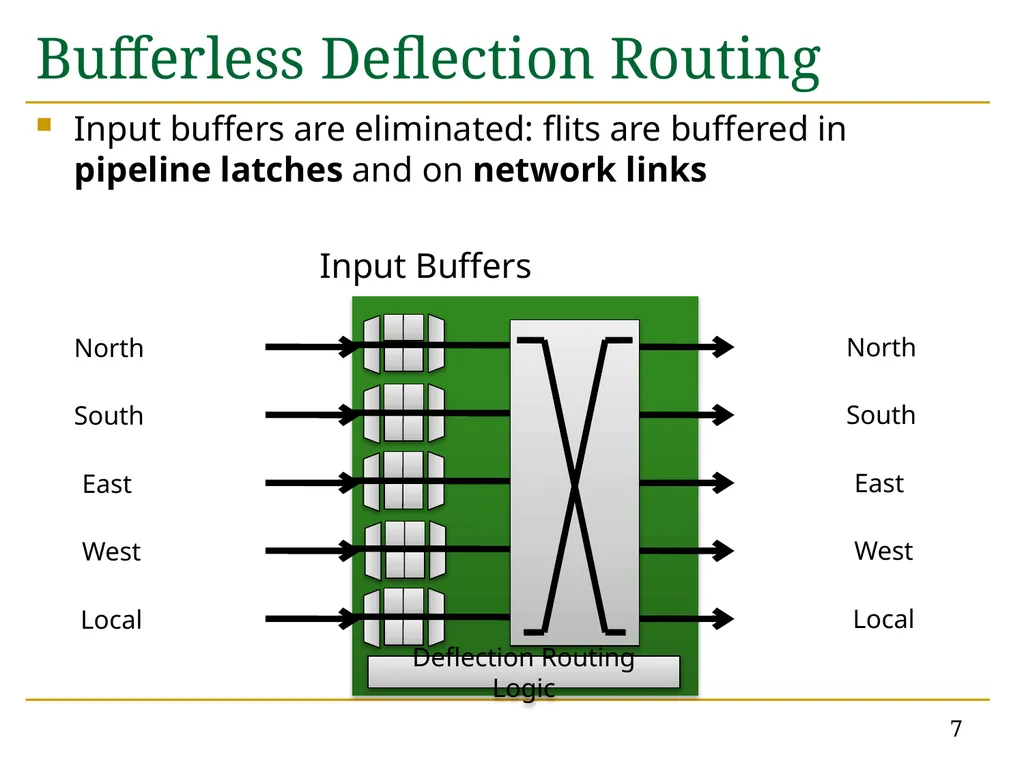
Bufferless Deflection Routing Input buffers are eliminated: flits are buffered in
pipeline latches and on network links 7 North South East West Local Deflection Routing Logic Input Buffers<br>
08
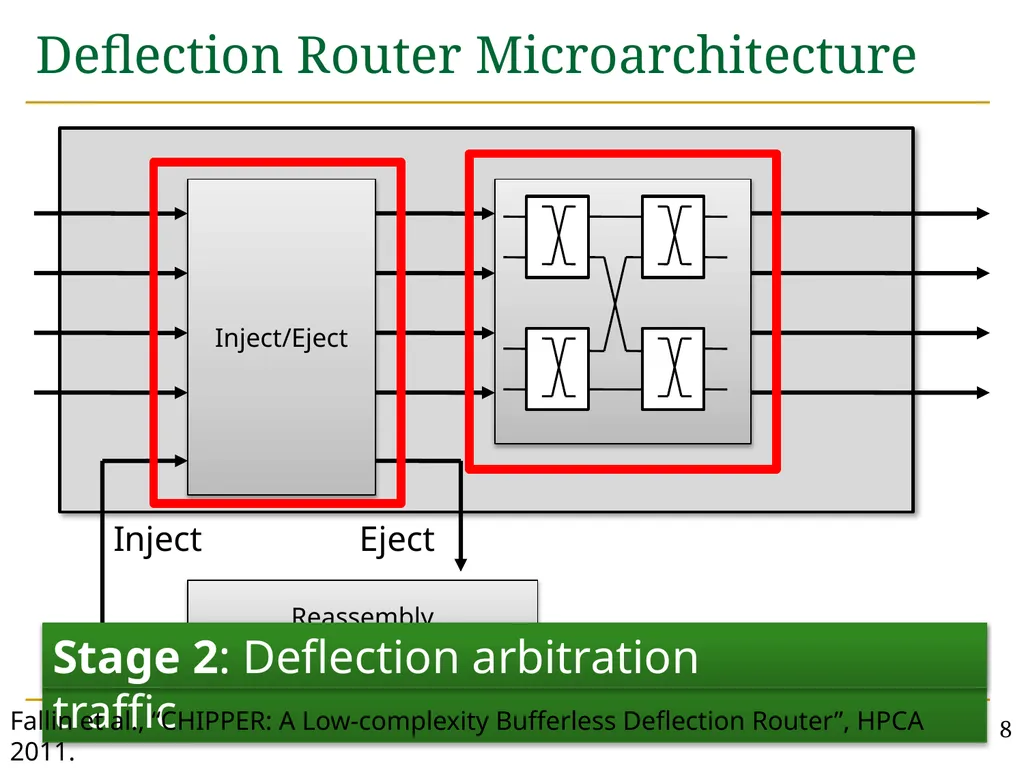
Deflection Router Microarchitecture 8 Inject/Eject Reassembly
Buffers Inject Eject Stage 1: Ejection and injection of local traffic Stage 2: Deflection arbitration Fallin et al., “CHIPPER: A Low-complexity Bufferless Deflection Router”, HPCA 2011.<br>
Buffers Inject Eject Stage 1: Ejection and injection of local traffic Stage 2: Deflection arbitration Fallin et al., “CHIPPER: A Low-complexity Bufferless Deflection Router”, HPCA 2011.<br>
09
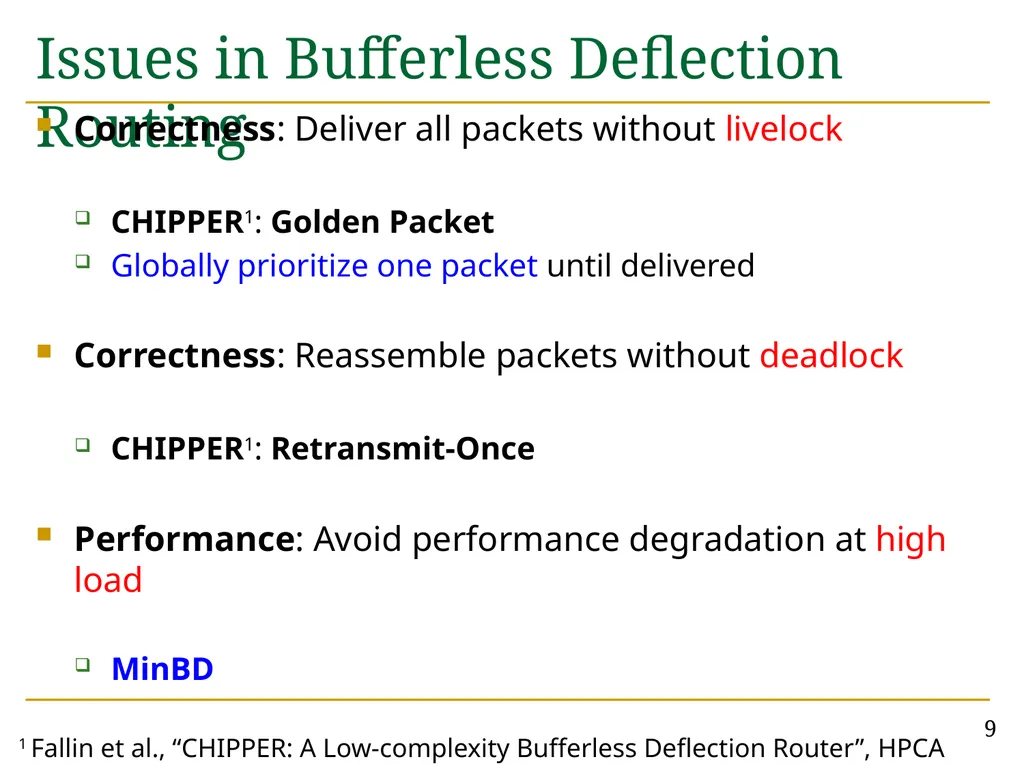
Issues in Bufferless Deflection Routing Correctness: Deliver all packets without livelock
CHIPPER1: Golden Packet
Globally prioritize one packet until delivered
Correctness: Reassemble packets without deadlock
CHIPPER1: Retransmit-Once
Performance: Avoid performance degradation at high load
MinBD 9 1 Fallin et al., “CHIPPER: A Low-complexity Bufferless Deflection Router”, HPCA 2011.<br>
CHIPPER1: Golden Packet
Globally prioritize one packet until delivered
Correctness: Reassemble packets without deadlock
CHIPPER1: Retransmit-Once
Performance: Avoid performance degradation at high load
MinBD 9 1 Fallin et al., “CHIPPER: A Low-complexity Bufferless Deflection Router”, HPCA 2011.<br>
10
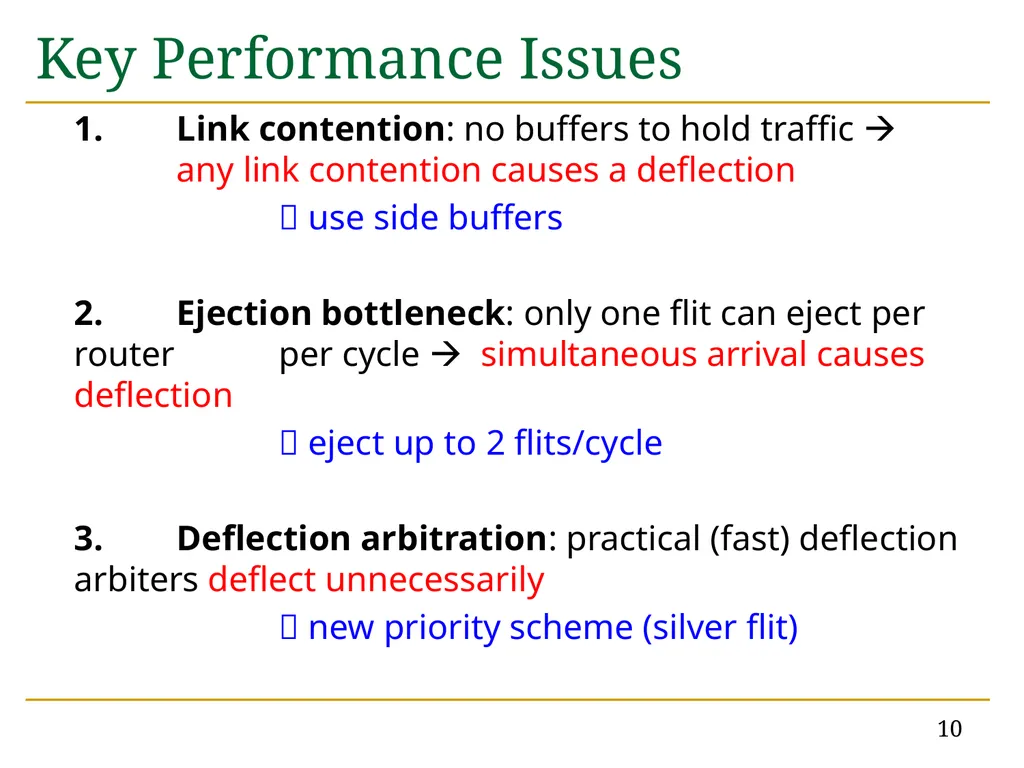
Key Performance Issues 1. Link contention: no buffers to hold traffic
any link contention causes a deflection
use side buffers
2. Ejection bottleneck: only one flit can eject per router per cycle simultaneous arrival causes deflection
eject up to 2 flits/cycle
3. Deflection arbitration: practical (fast) deflection arbiters deflect unnecessarily
new priority scheme (silver flit) 10<br>
use side buffers
2. Ejection bottleneck: only one flit can eject per router per cycle simultaneous arrival causes deflection
eject up to 2 flits/cycle
3. Deflection arbitration: practical (fast) deflection arbiters deflect unnecessarily
new priority scheme (silver flit) 10<br>
11
Outline: This Talk Motivation
Background: Bufferless Deflection Routing
MinBD: Reducing Deflections
Addressing Link Contention
Addressing the Ejection Bottleneck
Improving Deflection Arbitration
Results
Conclusions 11<br>
Background: Bufferless Deflection Routing
MinBD: Reducing Deflections
Addressing Link Contention
Addressing the Ejection Bottleneck
Improving Deflection Arbitration
Results
Conclusions 11<br>
12
Outline: This Talk Motivation
Background: Bufferless Deflection Routing
MinBD: Reducing Deflections
Addressing Link Contention
Addressing the Ejection Bottleneck
Improving Deflection Arbitration
Results
Conclusions 12<br>
Background: Bufferless Deflection Routing
MinBD: Reducing Deflections
Addressing Link Contention
Addressing the Ejection Bottleneck
Improving Deflection Arbitration
Results
Conclusions 12<br>
13
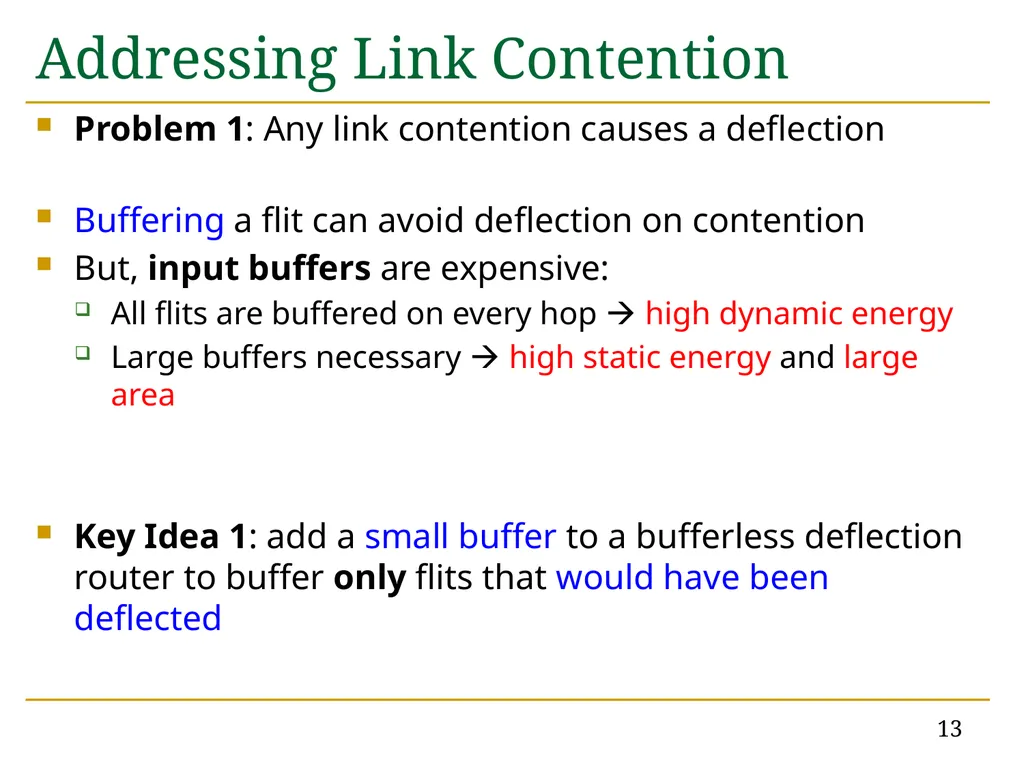
Addressing Link Contention Problem 1: Any link contention causes a deflection
Buffering a flit can avoid deflection on contention
But, input buffers are expensive:
All flits are buffered on every hop high dynamic energy
Large buffers necessary high static energy and large area
Key Idea 1: add a small buffer to a bufferless deflection router to buffer only flits that would have been deflected 13<br>
Buffering a flit can avoid deflection on contention
But, input buffers are expensive:
All flits are buffered on every hop high dynamic energy
Large buffers necessary high static energy and large area
Key Idea 1: add a small buffer to a bufferless deflection router to buffer only flits that would have been deflected 13<br>
14
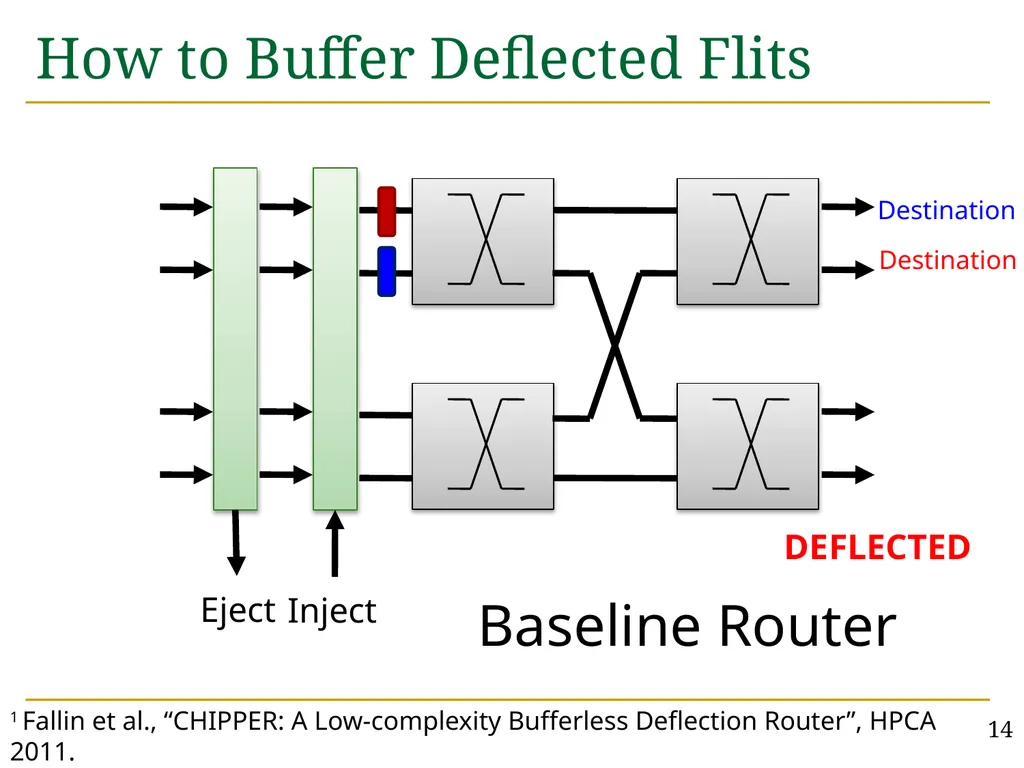
How to Buffer Deflected Flits 14 1 Fallin et al., “CHIPPER: A Low-complexity Bufferless Deflection Router”, HPCA 2011. Destination Destination DEFLECTED<br>
15
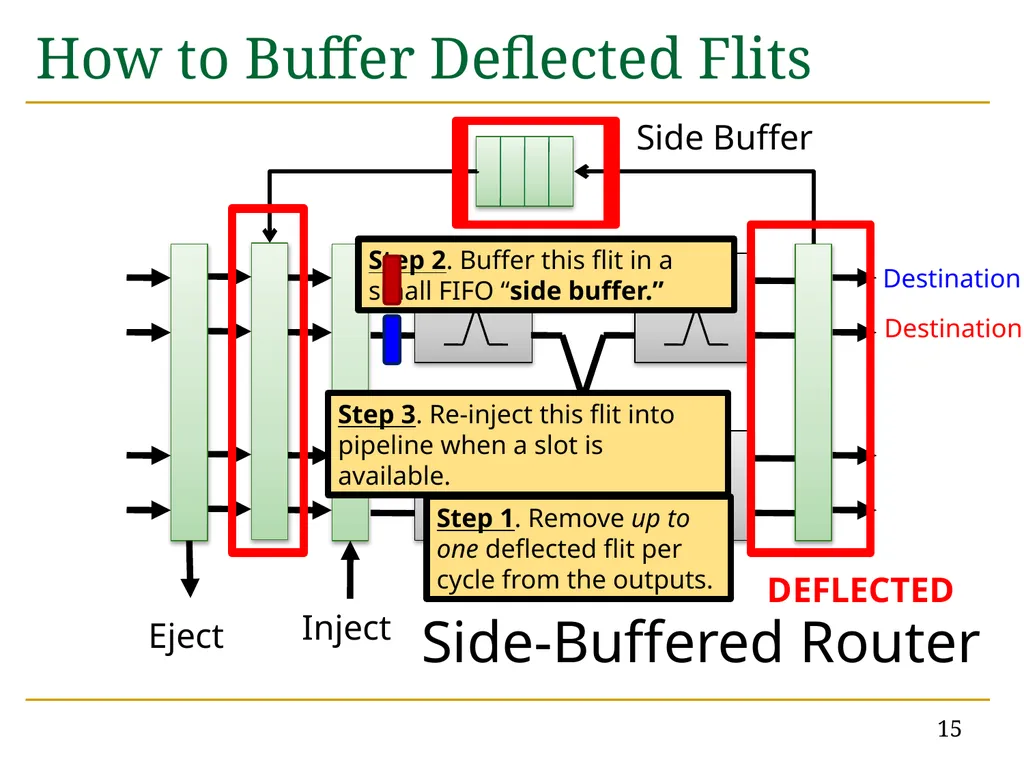
How to Buffer Deflected Flits 15 Step 1. Remove up to one deflected flit per cycle from the outputs. Step 2. Buffer this flit in a small FIFO “side buffer.” Step 3. Re-inject this flit into pipeline when a slot is available. Side Buffer Destination Destination DEFLECTED<br>
16
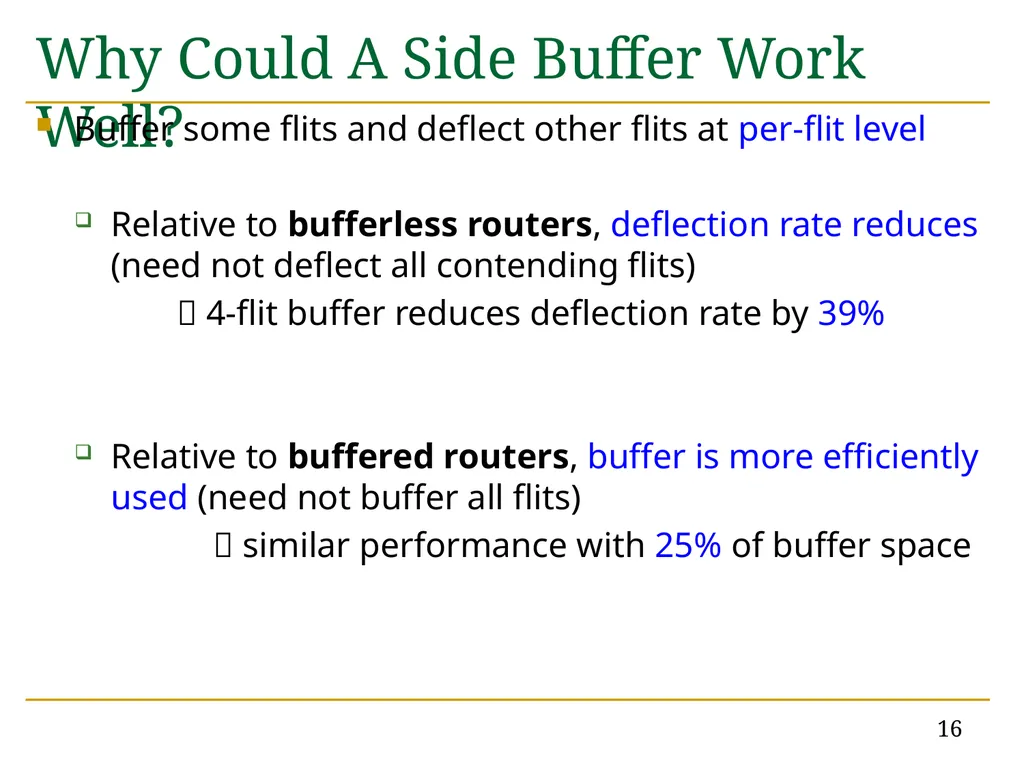
Why Could A Side Buffer Work Well? Buffer some flits and deflect other flits at per-flit level
Relative to bufferless routers, deflection rate reduces (need not deflect all contending flits)
4-flit buffer reduces deflection rate by 39%
Relative to buffered routers, buffer is more efficiently used (need not buffer all flits)
similar performance with 25% of buffer space 16<br>
Relative to bufferless routers, deflection rate reduces (need not deflect all contending flits)
4-flit buffer reduces deflection rate by 39%
Relative to buffered routers, buffer is more efficiently used (need not buffer all flits)
similar performance with 25% of buffer space 16<br>
17
Outline: This Talk Motivation
Background: Bufferless Deflection Routing
MinBD: Reducing Deflections
Addressing Link Contention
Addressing the Ejection Bottleneck
Improving Deflection Arbitration
Results
Conclusions 17<br>
Background: Bufferless Deflection Routing
MinBD: Reducing Deflections
Addressing Link Contention
Addressing the Ejection Bottleneck
Improving Deflection Arbitration
Results
Conclusions 17<br>
18
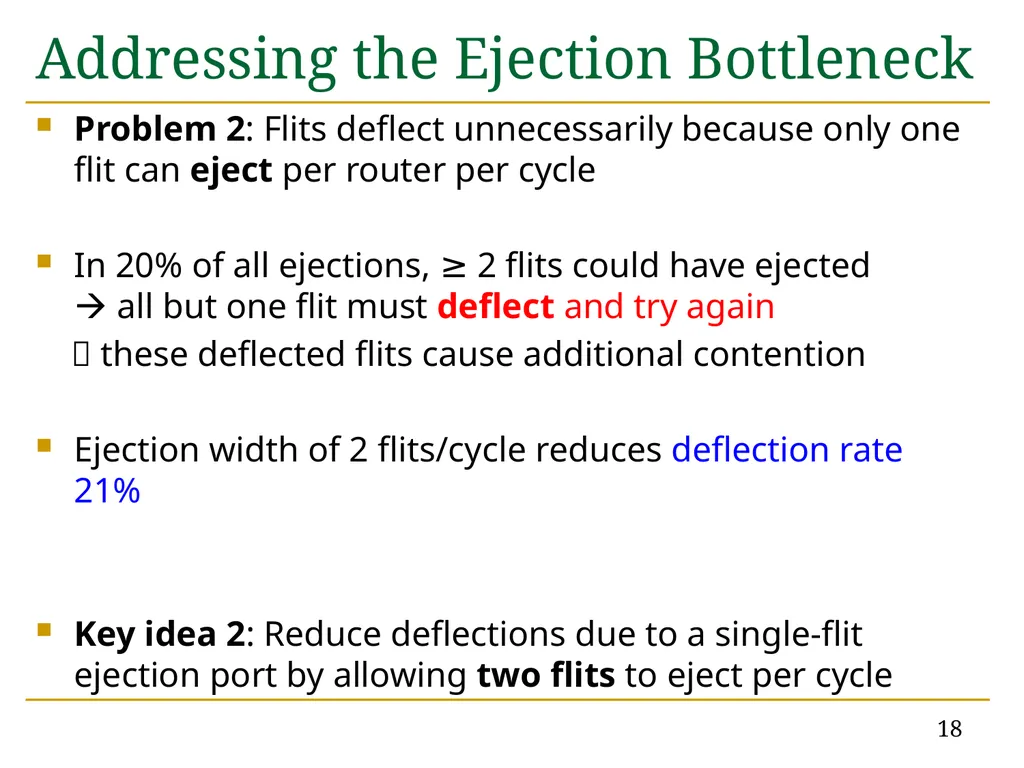
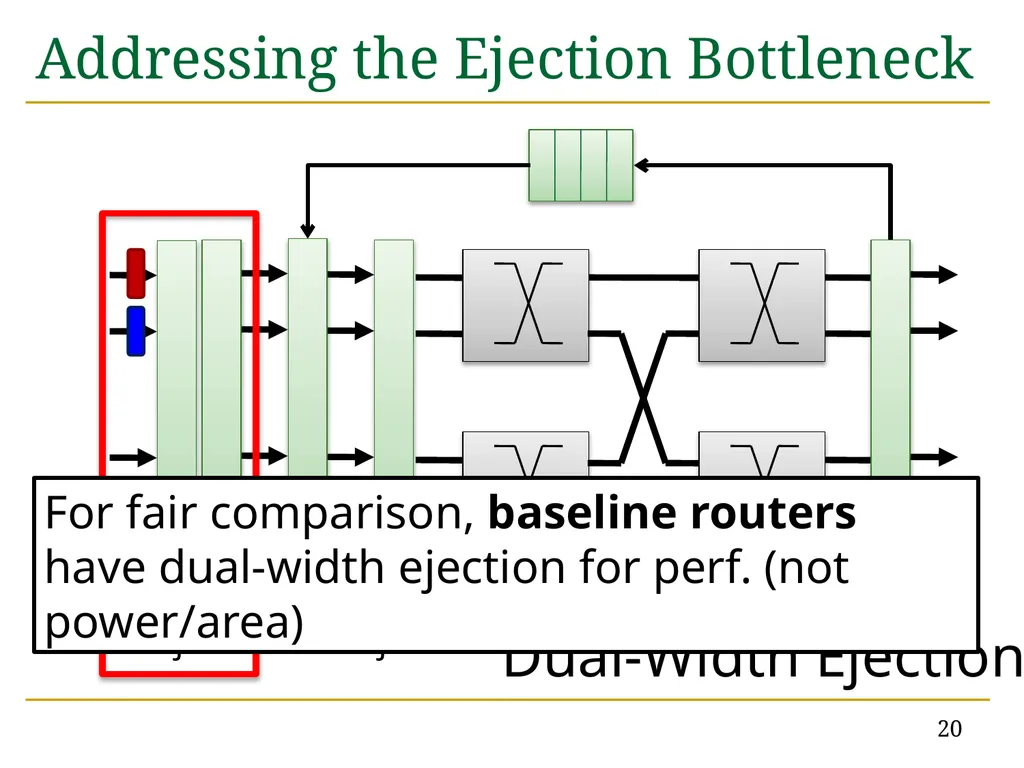
Addressing the Ejection Bottleneck Problem 2: Flits deflect unnecessarily because only one flit can eject per router per cycle
In 20% of all ejections, ≥ 2 flits could have ejected all but one flit must deflect and try again
these deflected flits cause additional contention
Ejection width of 2 flits/cycle reduces deflection rate 21%
Key idea 2: Reduce deflections due to a single-flit ejection port by allowing two flits to eject per cycle 18<br>
In 20% of all ejections, ≥ 2 flits could have ejected all but one flit must deflect and try again
these deflected flits cause additional contention
Ejection width of 2 flits/cycle reduces deflection rate 21%
Key idea 2: Reduce deflections due to a single-flit ejection port by allowing two flits to eject per cycle 18<br>
19
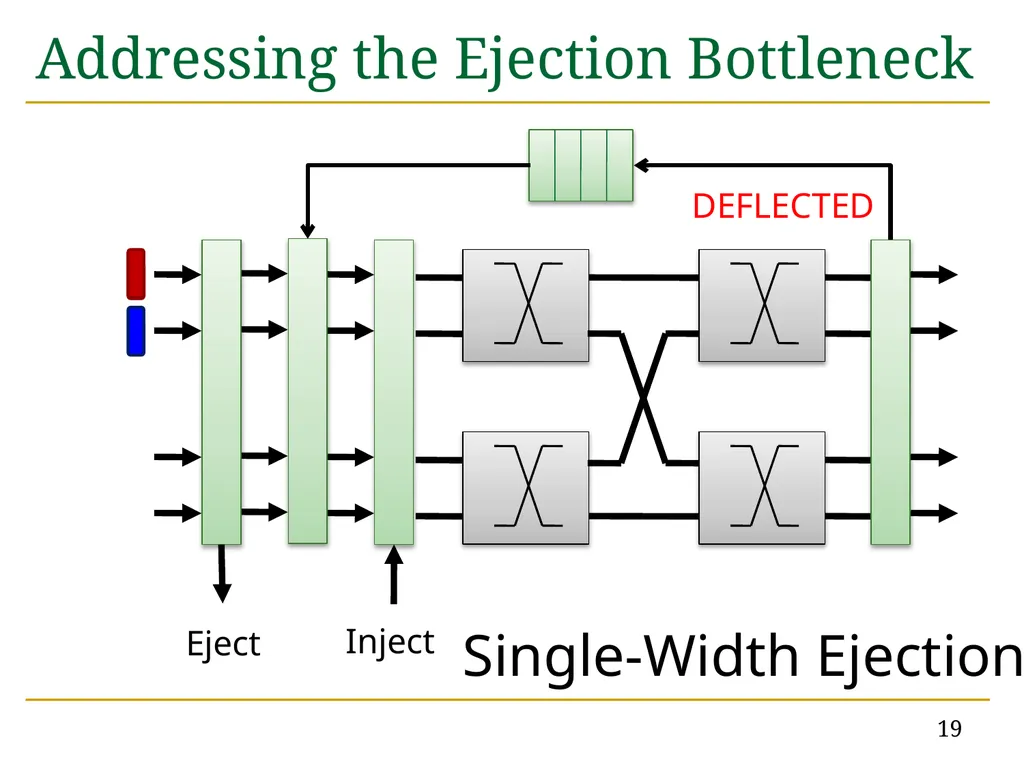
Addressing the Ejection Bottleneck 19 DEFLECTED<br>
20
Addressing the Ejection Bottleneck 20 For fair comparison, baseline routers have dual-width ejection for perf. (not power/area)<br>
21
Outline: This Talk Motivation
Background: Bufferless Deflection Routing
MinBD: Reducing Deflections
Addressing Link Contention
Addressing the Ejection Bottleneck
Improving Deflection Arbitration
Results
Conclusions 21<br>
Background: Bufferless Deflection Routing
MinBD: Reducing Deflections
Addressing Link Contention
Addressing the Ejection Bottleneck
Improving Deflection Arbitration
Results
Conclusions 21<br>
22
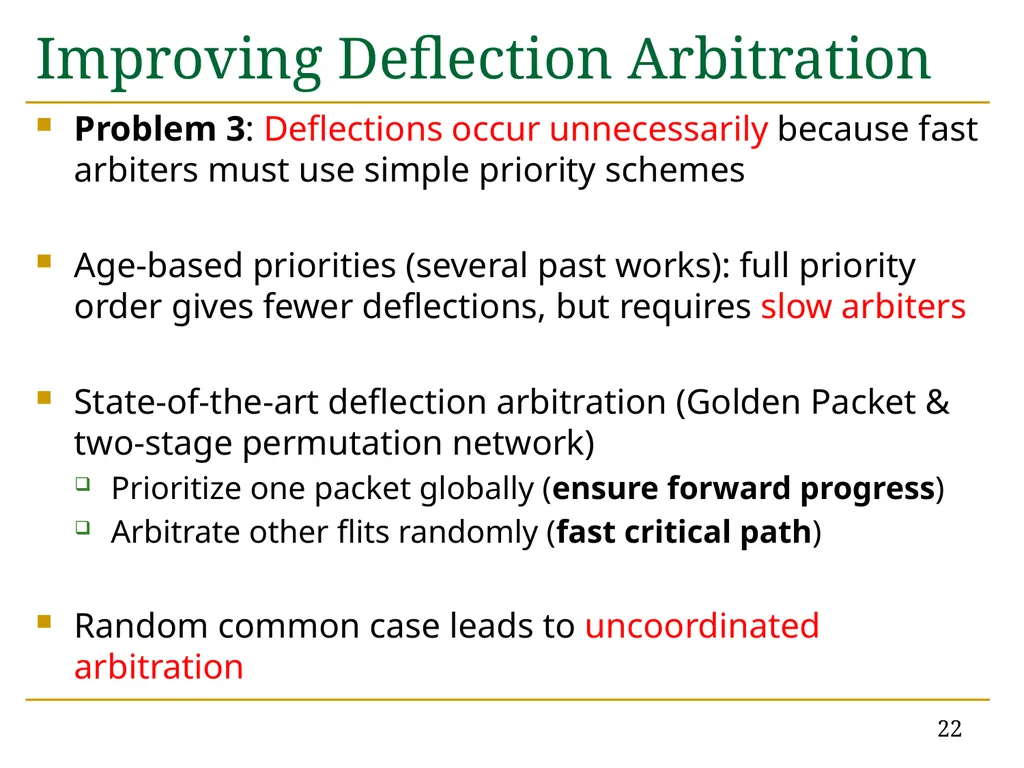
Improving Deflection Arbitration Problem 3: Deflections occur unnecessarily because fast arbiters must use simple priority schemes
Age-based priorities (several past works): full priority order gives fewer deflections, but requires slow arbiters
State-of-the-art deflection arbitration (Golden Packet & two-stage permutation network)
Prioritize one packet globally (ensure forward progress)
Arbitrate other flits randomly (fast critical path)
Random common case leads to uncoordinated arbitration 22<br>
Age-based priorities (several past works): full priority order gives fewer deflections, but requires slow arbiters
State-of-the-art deflection arbitration (Golden Packet & two-stage permutation network)
Prioritize one packet globally (ensure forward progress)
Arbitrate other flits randomly (fast critical path)
Random common case leads to uncoordinated arbitration 22<br>
23
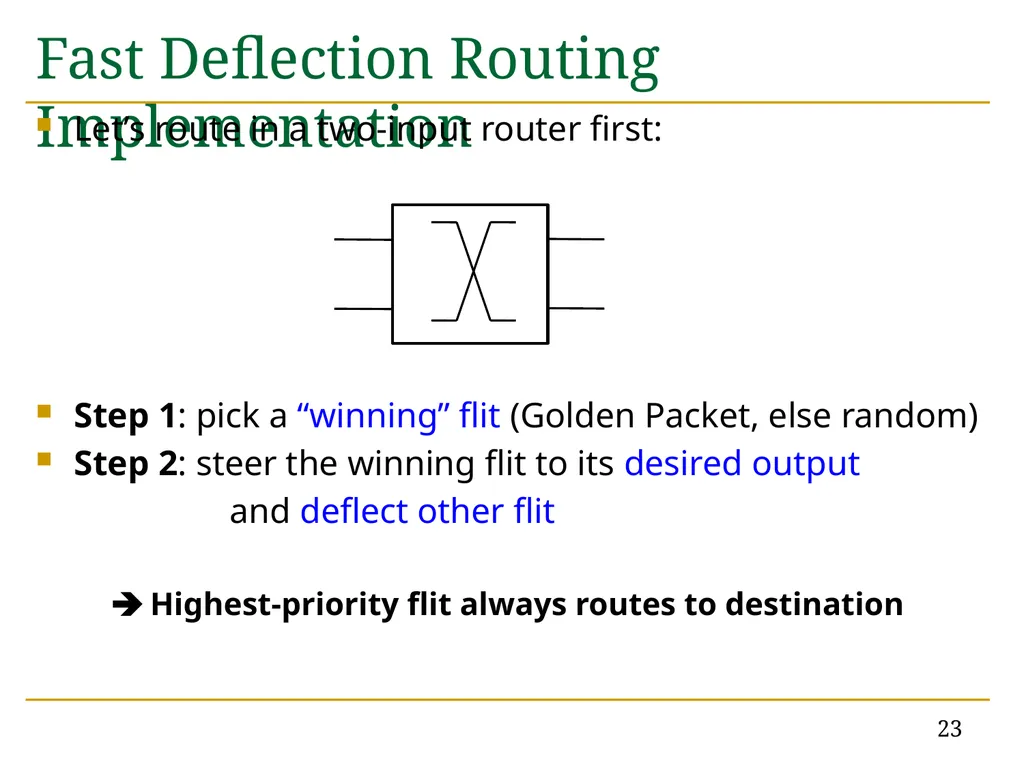
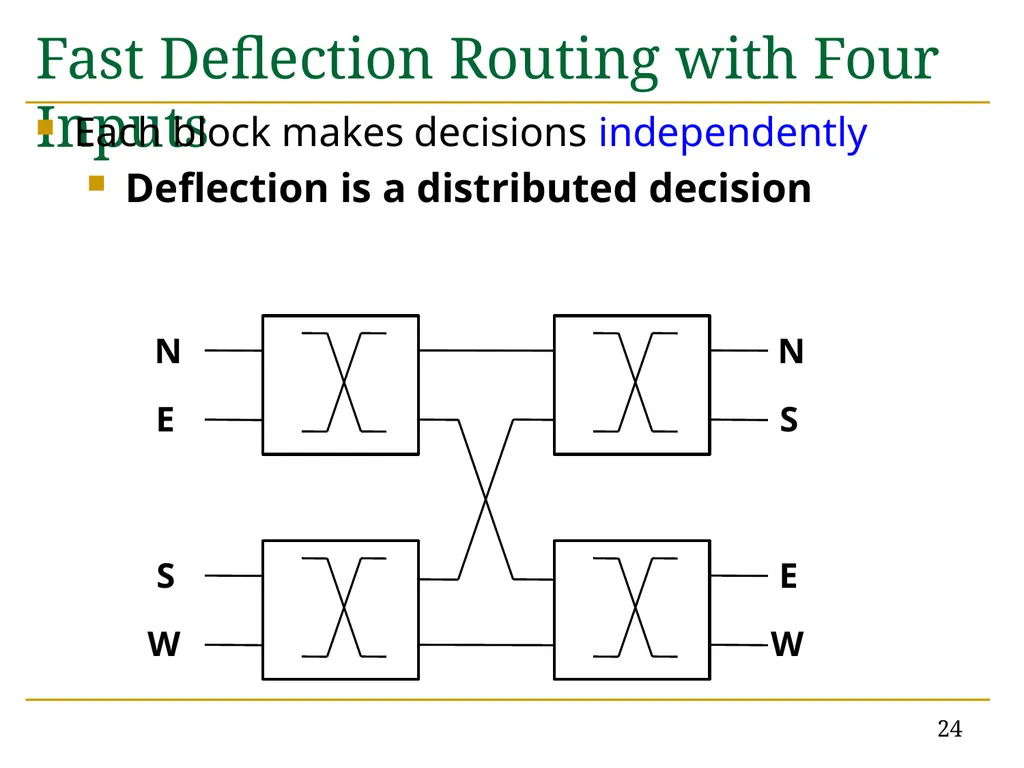
Fast Deflection Routing Implementation Let’s route in a two-input router first:
Step 1: pick a “winning” flit (Golden Packet, else random)
Step 2: steer the winning flit to its desired output
and deflect other flit
Highest-priority flit always routes to destination 23<br>
Step 1: pick a “winning” flit (Golden Packet, else random)
Step 2: steer the winning flit to its desired output
and deflect other flit
Highest-priority flit always routes to destination 23<br>
24
Fast Deflection Routing with Four Inputs 24 Each block makes decisions independently
Deflection is a distributed decision N E S W N S E W<br>
Deflection is a distributed decision N E S W N S E W<br>
25
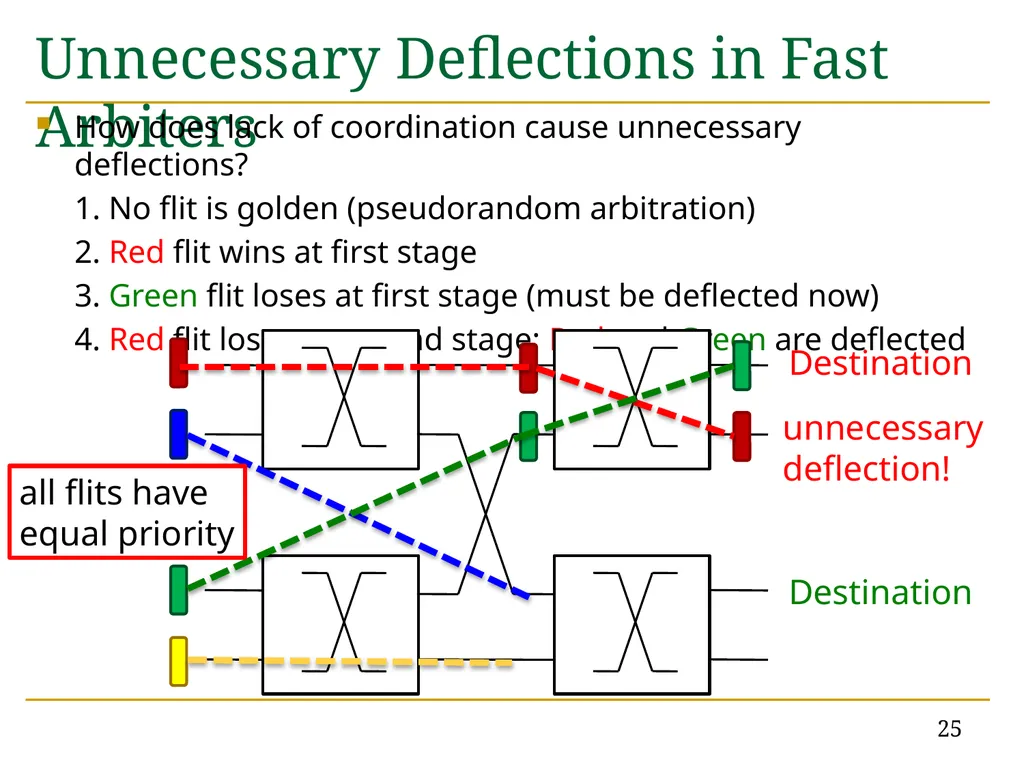
Unnecessary Deflections in Fast Arbiters How does lack of coordination cause unnecessary deflections?
1. No flit is golden (pseudorandom arbitration)
2. Red flit wins at first stage
3. Green flit loses at first stage (must be deflected now)
4. Red flit loses at second stage; Red and Green are deflected 25 Destination Destination all flits have
equal priority unnecessary
deflection!<br>
1. No flit is golden (pseudorandom arbitration)
2. Red flit wins at first stage
3. Green flit loses at first stage (must be deflected now)
4. Red flit loses at second stage; Red and Green are deflected 25 Destination Destination all flits have
equal priority unnecessary
deflection!<br>
26
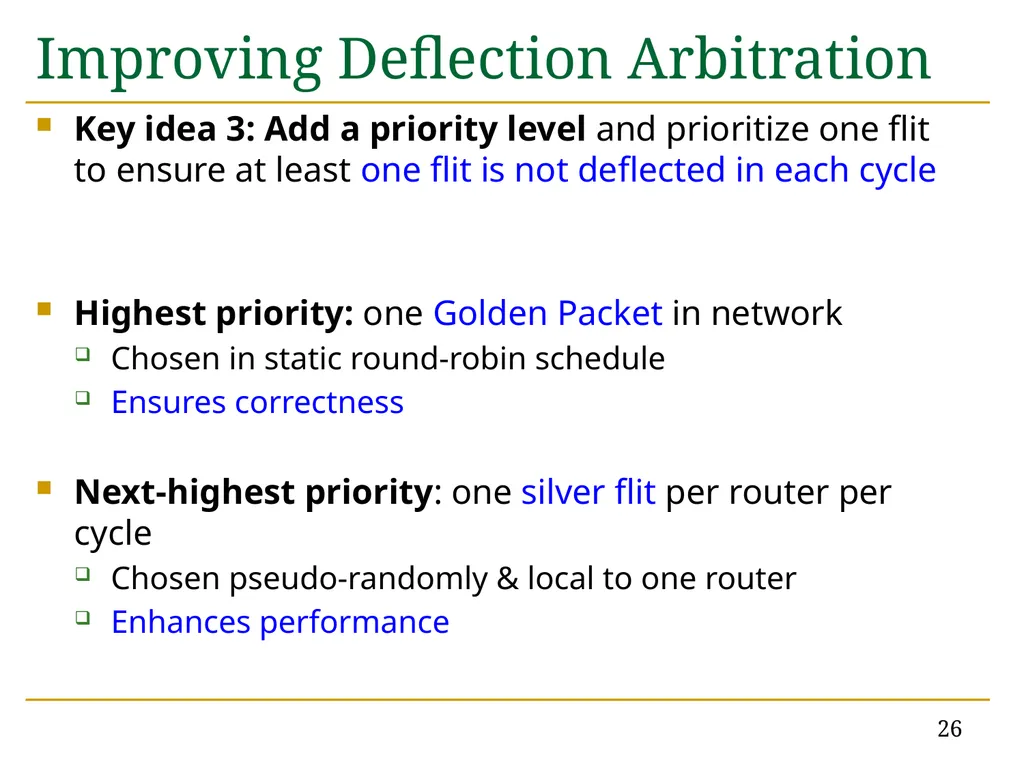
Improving Deflection Arbitration Key idea 3: Add a priority level and prioritize one flit
to ensure at least one flit is not deflected in each cycle
Highest priority: one Golden Packet in network
Chosen in static round-robin schedule
Ensures correctness
Next-highest priority: one silver flit per router per cycle
Chosen pseudo-randomly & local to one router
Enhances performance 26<br>
Highest priority: one Golden Packet in network
Chosen in static round-robin schedule
Ensures correctness
Next-highest priority: one silver flit per router per cycle
Chosen pseudo-randomly & local to one router
Enhances performance 26<br>
27
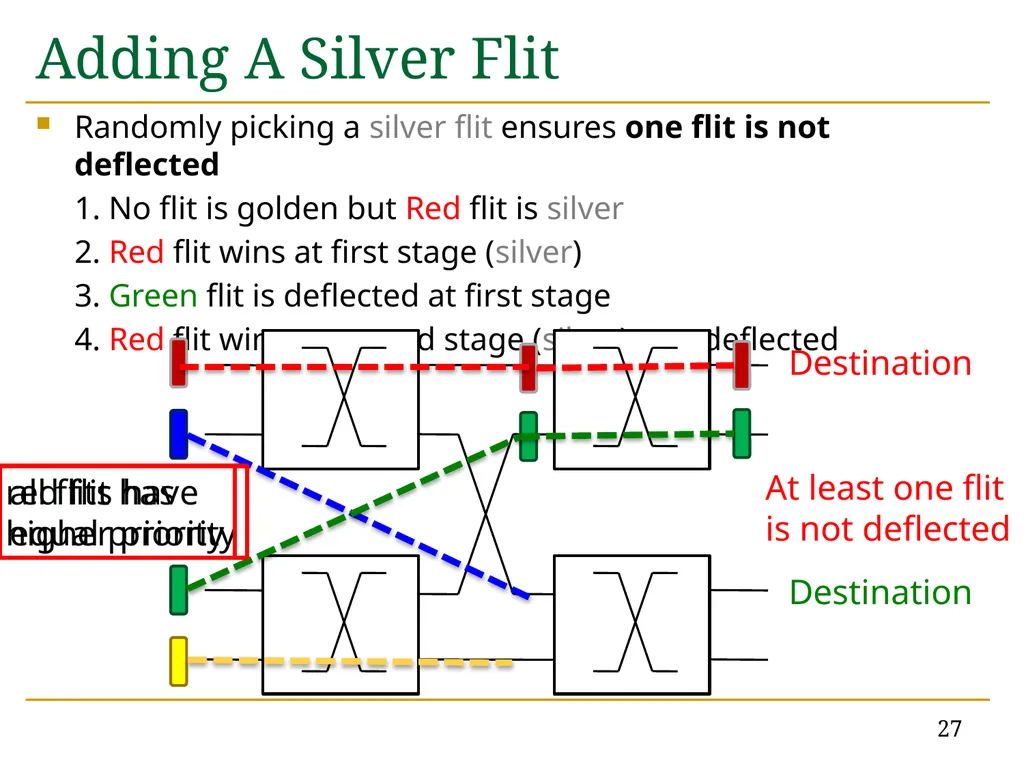
Adding A Silver Flit Randomly picking a silver flit ensures one flit is not deflected
1. No flit is golden but Red flit is silver
2. Red flit wins at first stage (silver)
3. Green flit is deflected at first stage
4. Red flit wins at second stage (silver); not deflected 27 Destination Destination At least one flit
is not deflected red flit has
higher priority all flits have
equal priority<br>
1. No flit is golden but Red flit is silver
2. Red flit wins at first stage (silver)
3. Green flit is deflected at first stage
4. Red flit wins at second stage (silver); not deflected 27 Destination Destination At least one flit
is not deflected red flit has
higher priority all flits have
equal priority<br>
28
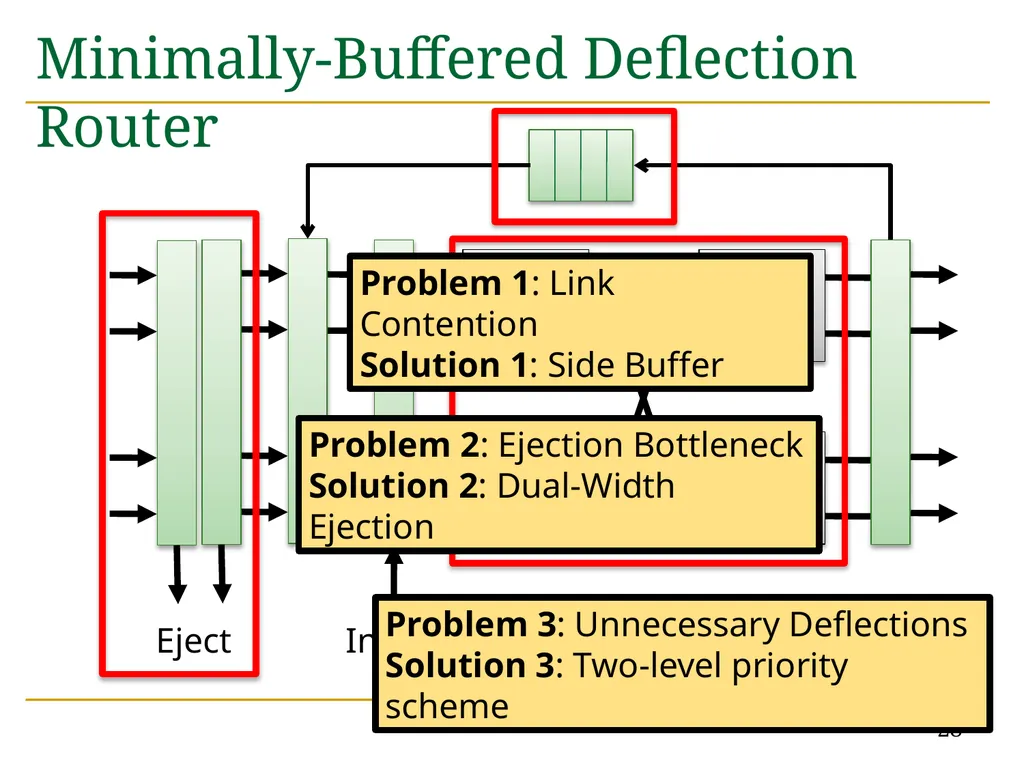
Minimally-Buffered Deflection Router 28 Problem 1: Link Contention
Solution 1: Side Buffer Problem 2: Ejection Bottleneck
Solution 2: Dual-Width Ejection Problem 3: Unnecessary Deflections
Solution 3: Two-level priority scheme<br>
Solution 1: Side Buffer Problem 2: Ejection Bottleneck
Solution 2: Dual-Width Ejection Problem 3: Unnecessary Deflections
Solution 3: Two-level priority scheme<br>
29
Outline: This Talk Motivation
Background: Bufferless Deflection Routing
MinBD: Reducing Deflections
Addressing Link Contention
Addressing the Ejection Bottleneck
Improving Deflection Arbitration 29<br>
Background: Bufferless Deflection Routing
MinBD: Reducing Deflections
Addressing Link Contention
Addressing the Ejection Bottleneck
Improving Deflection Arbitration 29<br>
30
Outline: This Talk Motivation
Background: Bufferless Deflection Routing
MinBD: Reducing Deflections
Addressing Link Contention
Addressing the Ejection Bottleneck
Improving Deflection Arbitration
Results
Conclusions 30<br>
Background: Bufferless Deflection Routing
MinBD: Reducing Deflections
Addressing Link Contention
Addressing the Ejection Bottleneck
Improving Deflection Arbitration
Results
Conclusions 30<br>
31
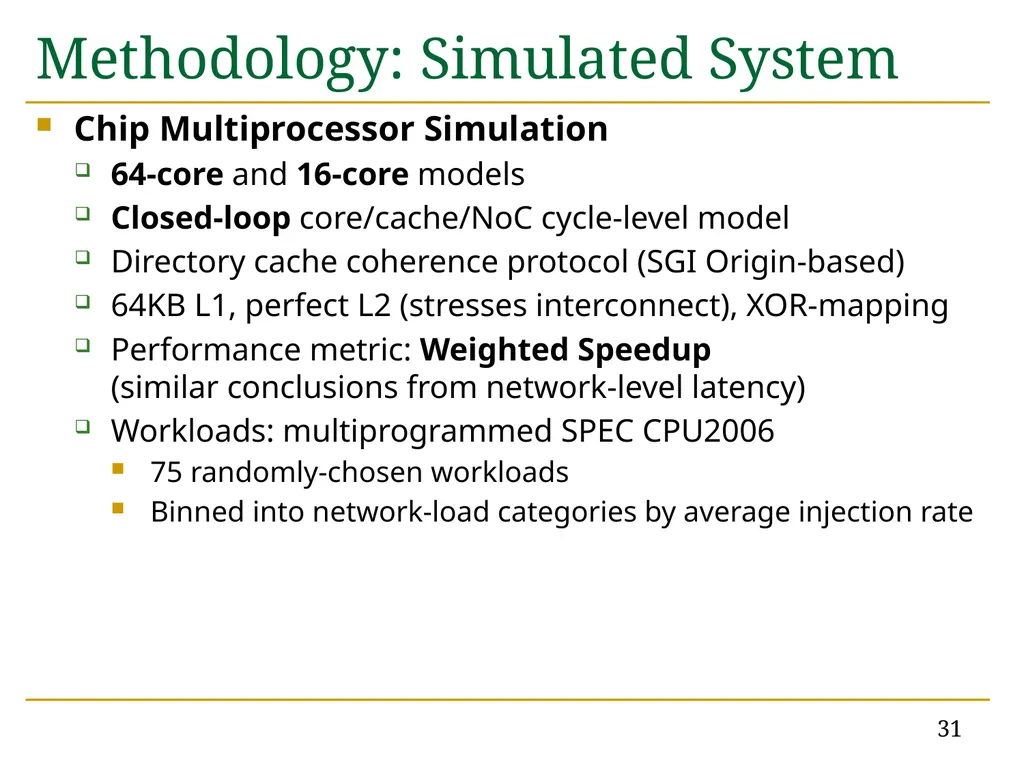
Methodology: Simulated System Chip Multiprocessor Simulation
64-core and 16-core models
Closed-loop core/cache/NoC cycle-level model
Directory cache coherence protocol (SGI Origin-based)
64KB L1, perfect L2 (stresses interconnect), XOR-mapping
Performance metric: Weighted Speedup (similar conclusions from network-level latency)
Workloads: multiprogrammed SPEC CPU2006
75 randomly-chosen workloads
Binned into network-load categories by average injection rate 31<br>
64-core and 16-core models
Closed-loop core/cache/NoC cycle-level model
Directory cache coherence protocol (SGI Origin-based)
64KB L1, perfect L2 (stresses interconnect), XOR-mapping
Performance metric: Weighted Speedup (similar conclusions from network-level latency)
Workloads: multiprogrammed SPEC CPU2006
75 randomly-chosen workloads
Binned into network-load categories by average injection rate 31<br>
32
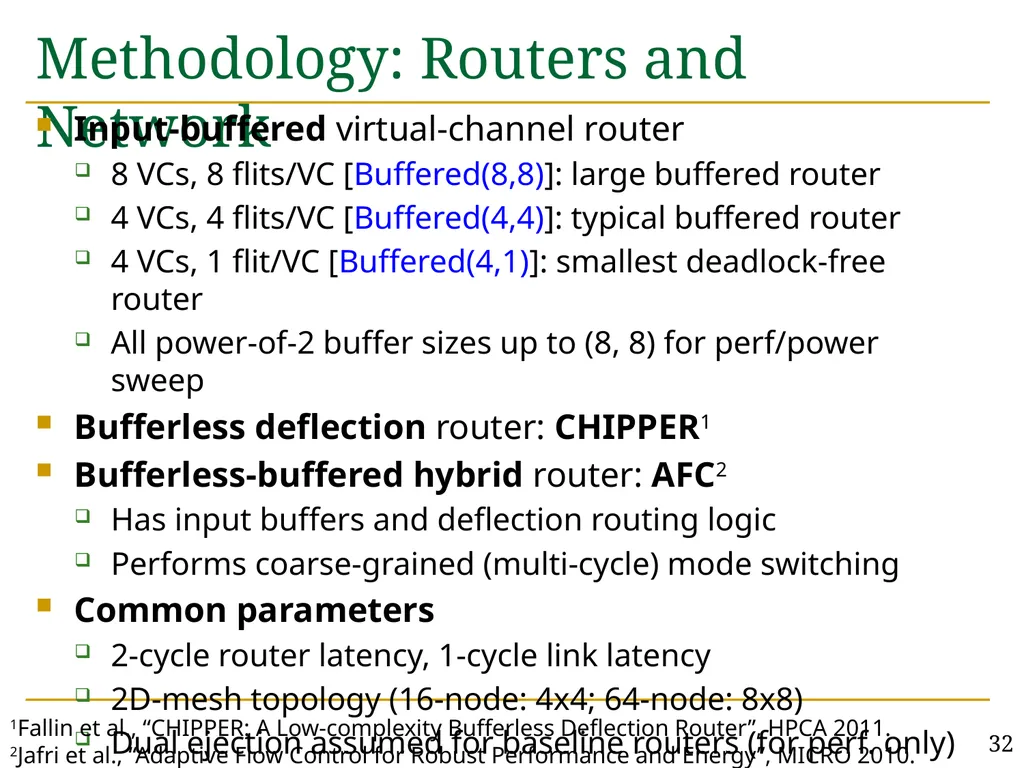
Methodology: Routers and Network Input-buffered virtual-channel router
8 VCs, 8 flits/VC [Buffered(8,8)]: large buffered router
4 VCs, 4 flits/VC [Buffered(4,4)]: typical buffered router
4 VCs, 1 flit/VC [Buffered(4,1)]: smallest deadlock-free router
All power-of-2 buffer sizes up to (8, 8) for perf/power sweep
Bufferless deflection router: CHIPPER1
Bufferless-buffered hybrid router: AFC2
Has input buffers and deflection routing logic
Performs coarse-grained (multi-cycle) mode switching
Common parameters
2-cycle router latency, 1-cycle link latency
2D-mesh topology (16-node: 4x4; 64-node: 8x8)
Dual ejection assumed for baseline routers (for perf. only) 32 1Fallin et al., “CHIPPER: A Low-complexity Bufferless Deflection Router”, HPCA 2011.
2Jafri et al., “Adaptive Flow Control for Robust Performance and Energy”, MICRO 2010.<br>
8 VCs, 8 flits/VC [Buffered(8,8)]: large buffered router
4 VCs, 4 flits/VC [Buffered(4,4)]: typical buffered router
4 VCs, 1 flit/VC [Buffered(4,1)]: smallest deadlock-free router
All power-of-2 buffer sizes up to (8, 8) for perf/power sweep
Bufferless deflection router: CHIPPER1
Bufferless-buffered hybrid router: AFC2
Has input buffers and deflection routing logic
Performs coarse-grained (multi-cycle) mode switching
Common parameters
2-cycle router latency, 1-cycle link latency
2D-mesh topology (16-node: 4x4; 64-node: 8x8)
Dual ejection assumed for baseline routers (for perf. only) 32 1Fallin et al., “CHIPPER: A Low-complexity Bufferless Deflection Router”, HPCA 2011.
2Jafri et al., “Adaptive Flow Control for Robust Performance and Energy”, MICRO 2010.<br>
33
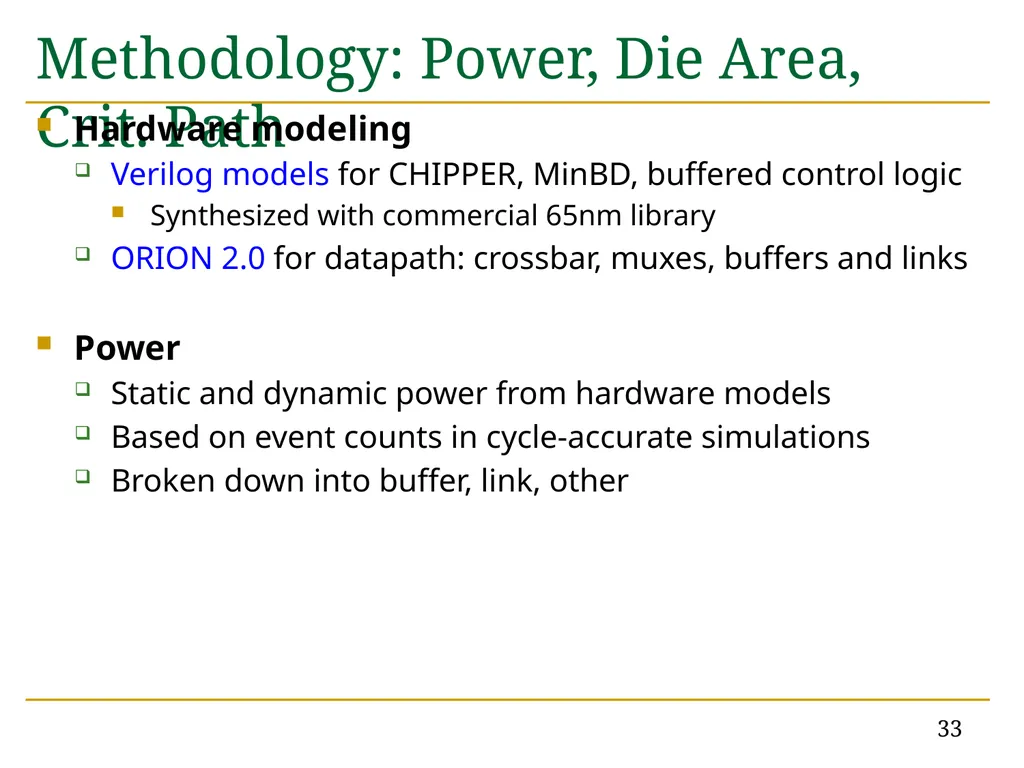
Methodology: Power, Die Area, Crit. Path Hardware modeling
Verilog models for CHIPPER, MinBD, buffered control logic
Synthesized with commercial 65nm library
ORION 2.0 for datapath: crossbar, muxes, buffers and links
Power
Static and dynamic power from hardware models
Based on event counts in cycle-accurate simulations
Broken down into buffer, link, other 33<br>
Verilog models for CHIPPER, MinBD, buffered control logic
Synthesized with commercial 65nm library
ORION 2.0 for datapath: crossbar, muxes, buffers and links
Power
Static and dynamic power from hardware models
Based on event counts in cycle-accurate simulations
Broken down into buffer, link, other 33<br>
34
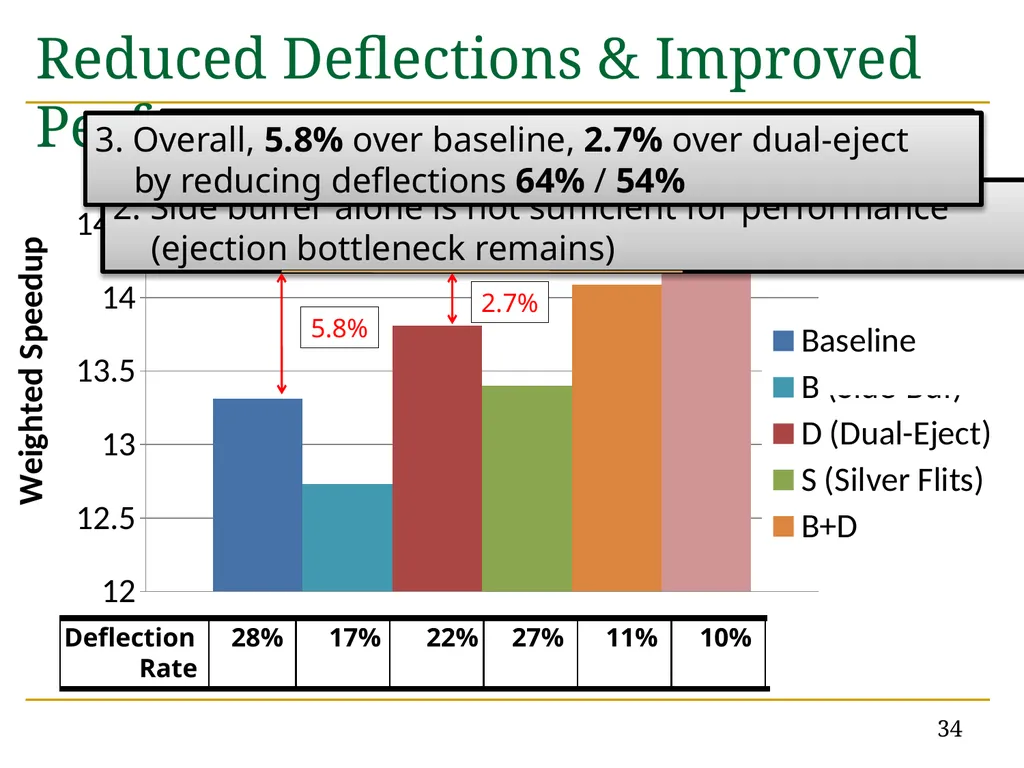
Deflection Reduced Deflections & Improved Perf. 34 Rate 28% 17% 22% 27% 11% 10% All mechanisms individually reduce deflections 2. Side buffer alone is not sufficient for performance
(ejection bottleneck remains) 3. Overall, 5.8% over baseline, 2.7% over dual-eject
by reducing deflections 64% / 54% 2.7%<br>
35
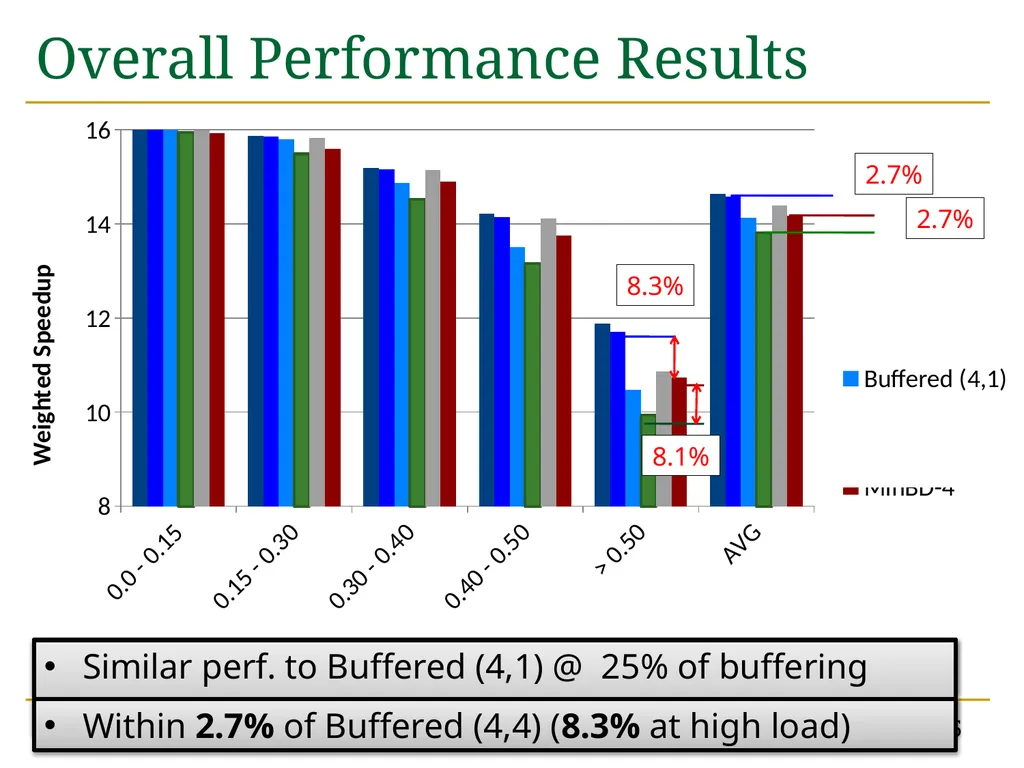
Overall Performance Results 35 Improves 2.7% over CHIPPER (8.1% at high load) Similar perf. to Buffered (4,1) @ 25% of buffering space Within 2.7% of Buffered (4,4) (8.3% at high load)<br>
36
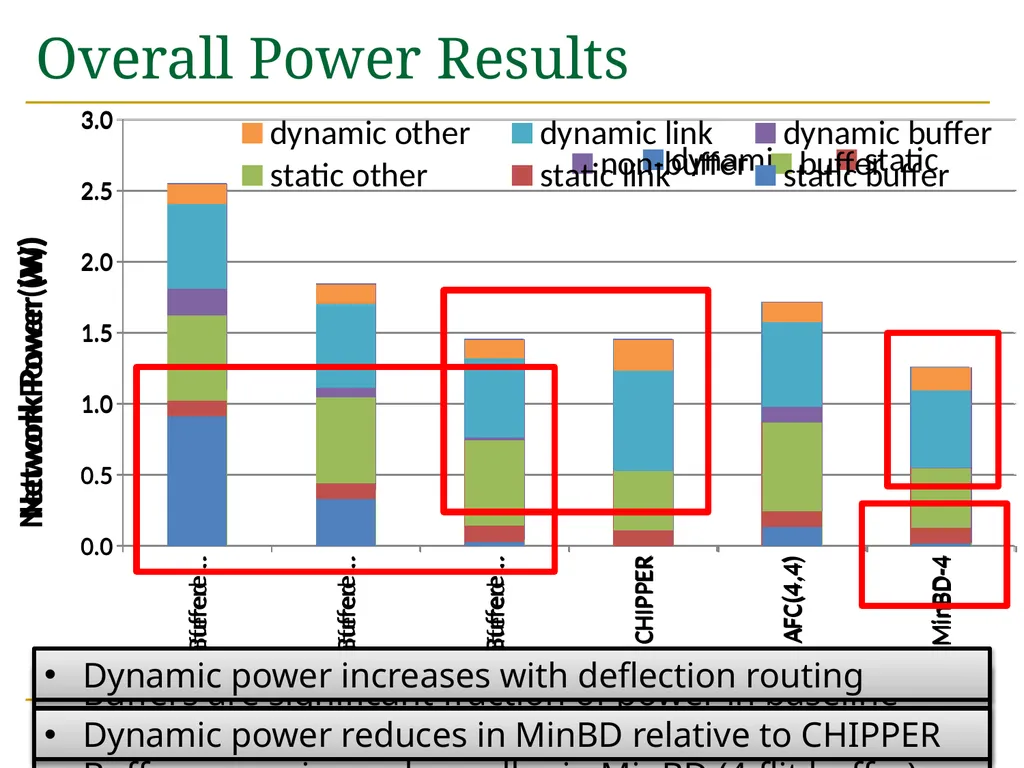
Overall Power Results 36 Buffers are significant fraction of power in baseline routers
Buffer power is much smaller in MinBD (4-flit buffer) Dynamic power increases with deflection routing Dynamic power reduces in MinBD relative to CHIPPER<br>
Buffer power is much smaller in MinBD (4-flit buffer) Dynamic power increases with deflection routing Dynamic power reduces in MinBD relative to CHIPPER<br>
37
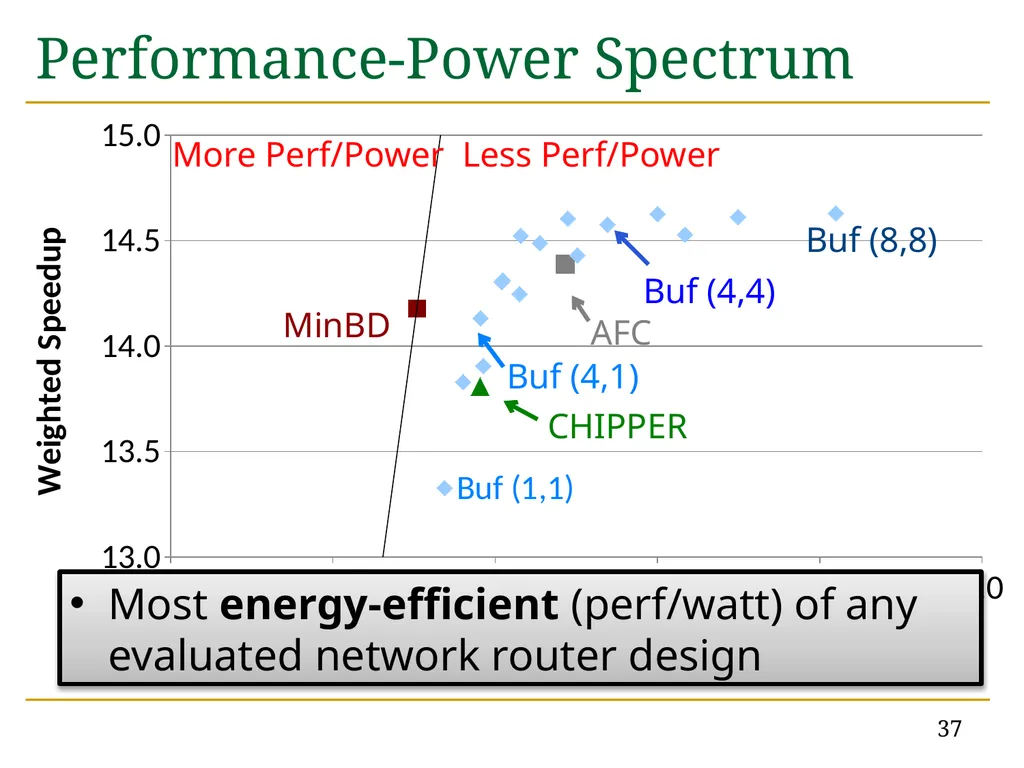
Performance-Power Spectrum 37 Most energy-efficient (perf/watt) of any evaluated network router design Buf (4,4) Buf (4,1) More Perf/Power Less Perf/Power Buf (8,8) AFC CHIPPER MinBD<br>
38
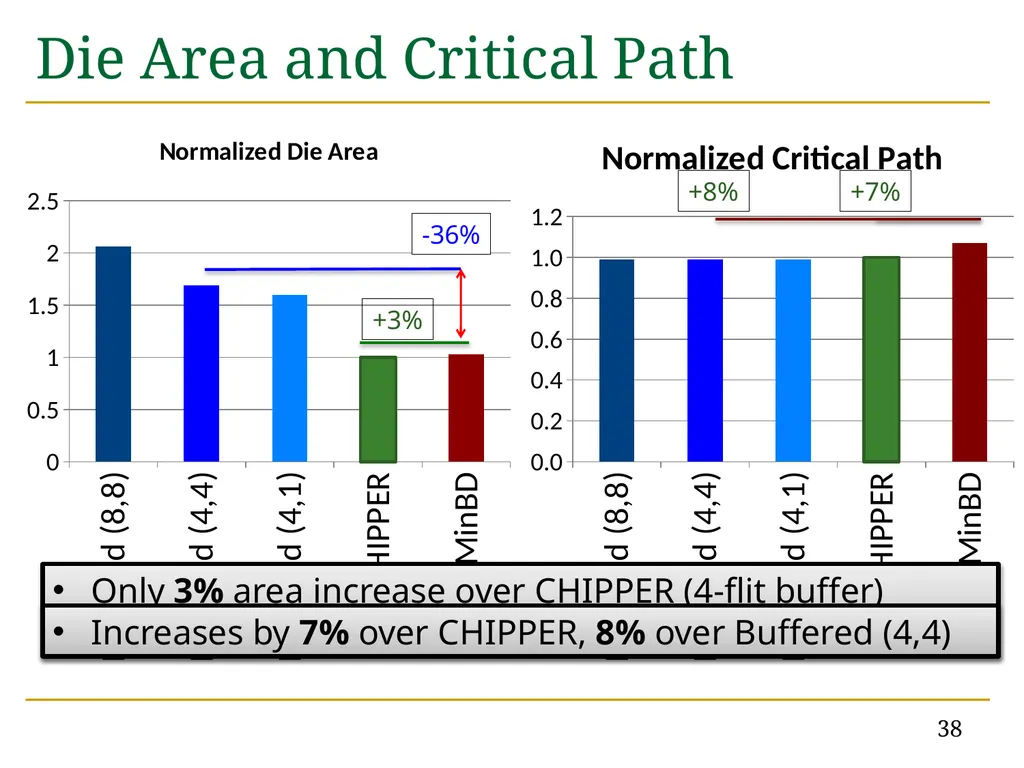
Die Area and Critical Path 38 Only 3% area increase over CHIPPER (4-flit buffer)
Reduces area by 36% from Buffered (4,4) Increases by 7% over CHIPPER, 8% over Buffered (4,4) +3% -36% +7% +8%<br>
Reduces area by 36% from Buffered (4,4) Increases by 7% over CHIPPER, 8% over Buffered (4,4) +3% -36% +7% +8%<br>
39
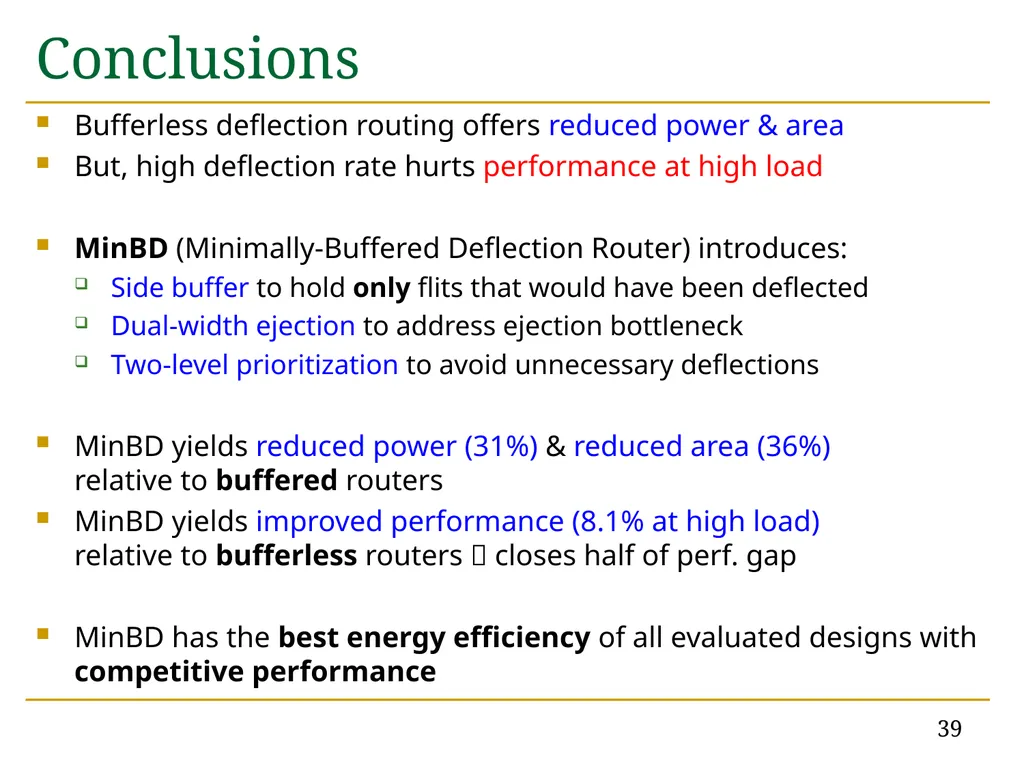
Conclusions Bufferless deflection routing offers reduced power & area
But, high deflection rate hurts performance at high load
MinBD (Minimally-Buffered Deflection Router) introduces:
Side buffer to hold only flits that would have been deflected
Dual-width ejection to address ejection bottleneck
Two-level prioritization to avoid unnecessary deflections
MinBD yields reduced power (31%) & reduced area (36%) relative to buffered routers
MinBD yields improved performance (8.1% at high load) relative to bufferless routers closes half of perf. gap
MinBD has the best energy efficiency of all evaluated designs with competitive performance 39<br>
But, high deflection rate hurts performance at high load
MinBD (Minimally-Buffered Deflection Router) introduces:
Side buffer to hold only flits that would have been deflected
Dual-width ejection to address ejection bottleneck
Two-level prioritization to avoid unnecessary deflections
MinBD yields reduced power (31%) & reduced area (36%) relative to buffered routers
MinBD yields improved performance (8.1% at high load) relative to bufferless routers closes half of perf. gap
MinBD has the best energy efficiency of all evaluated designs with competitive performance 39<br>
40
Thank You! 40<br>
41
MinBD: Minimally-Buffered Deflection Routing for Energy-Efficient Interconnect Chris Fallin, Greg Nazario, Xiangyao Yu*,
Kevin Chang, Rachata Ausavarungnirun, Onur Mutlu
Carnegie Mellon University
*CMU and Tsinghua University<br>
Carnegie Mellon University
*CMU and Tsinghua University<br>
42
Backup Slides 42<br>
43
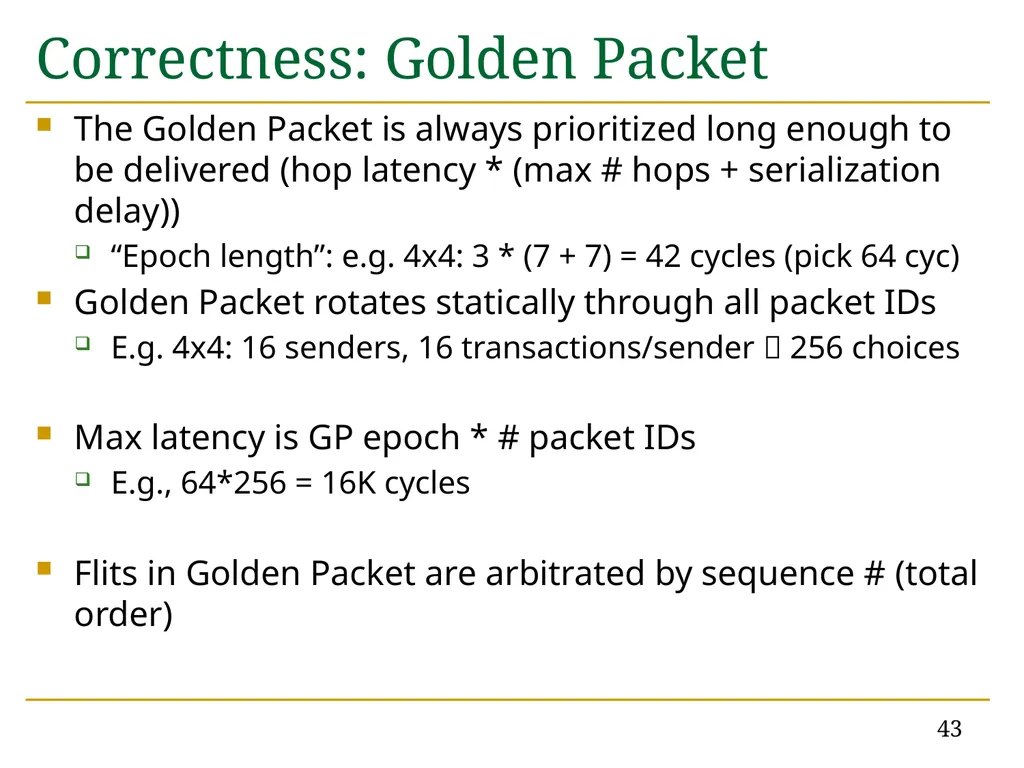
Correctness: Golden Packet The Golden Packet is always prioritized long enough to be delivered (hop latency * (max # hops + serialization delay))
“Epoch length”: e.g. 4x4: 3 * (7 + 7) = 42 cycles (pick 64 cyc)
Golden Packet rotates statically through all packet IDs
E.g. 4x4: 16 senders, 16 transactions/sender 256 choices
Max latency is GP epoch * # packet IDs
E.g., 64*256 = 16K cycles
Flits in Golden Packet are arbitrated by sequence # (total order) 43<br>
“Epoch length”: e.g. 4x4: 3 * (7 + 7) = 42 cycles (pick 64 cyc)
Golden Packet rotates statically through all packet IDs
E.g. 4x4: 16 senders, 16 transactions/sender 256 choices
Max latency is GP epoch * # packet IDs
E.g., 64*256 = 16K cycles
Flits in Golden Packet are arbitrated by sequence # (total order) 43<br>
44
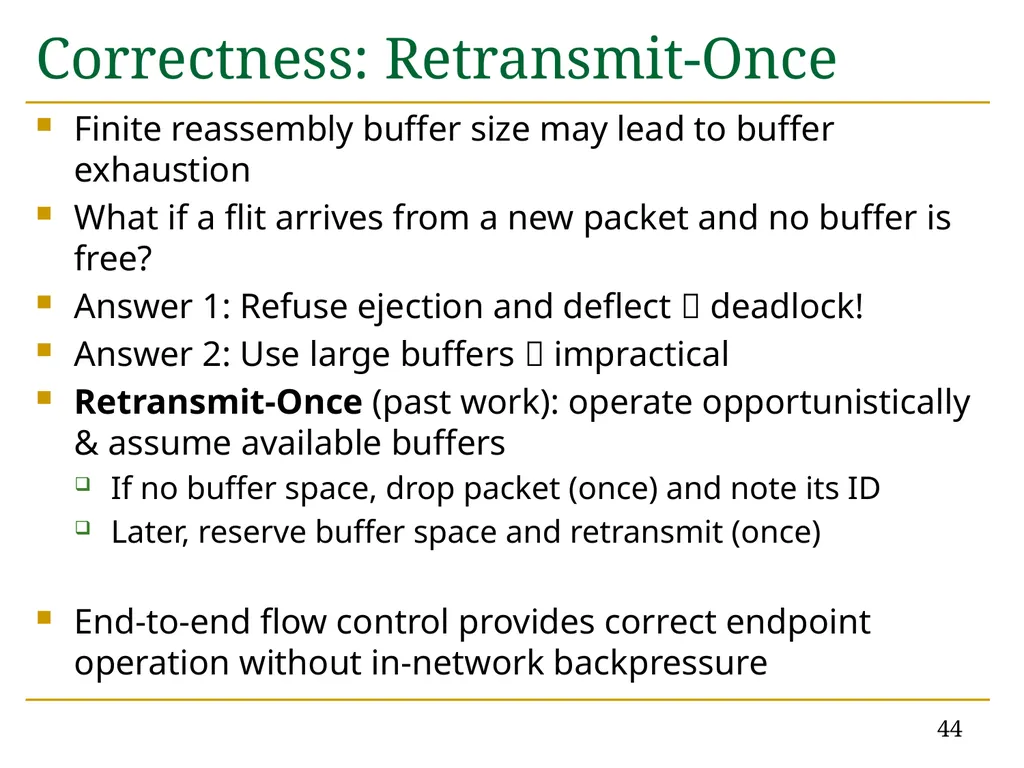
Correctness: Retransmit-Once Finite reassembly buffer size may lead to buffer exhaustion
What if a flit arrives from a new packet and no buffer is free?
Answer 1: Refuse ejection and deflect deadlock!
Answer 2: Use large buffers impractical
Retransmit-Once (past work): operate opportunistically & assume available buffers
If no buffer space, drop packet (once) and note its ID
Later, reserve buffer space and retransmit (once)
End-to-end flow control provides correct endpoint operation without in-network backpressure 44<br>
What if a flit arrives from a new packet and no buffer is free?
Answer 1: Refuse ejection and deflect deadlock!
Answer 2: Use large buffers impractical
Retransmit-Once (past work): operate opportunistically & assume available buffers
If no buffer space, drop packet (once) and note its ID
Later, reserve buffer space and retransmit (once)
End-to-end flow control provides correct endpoint operation without in-network backpressure 44<br>
45
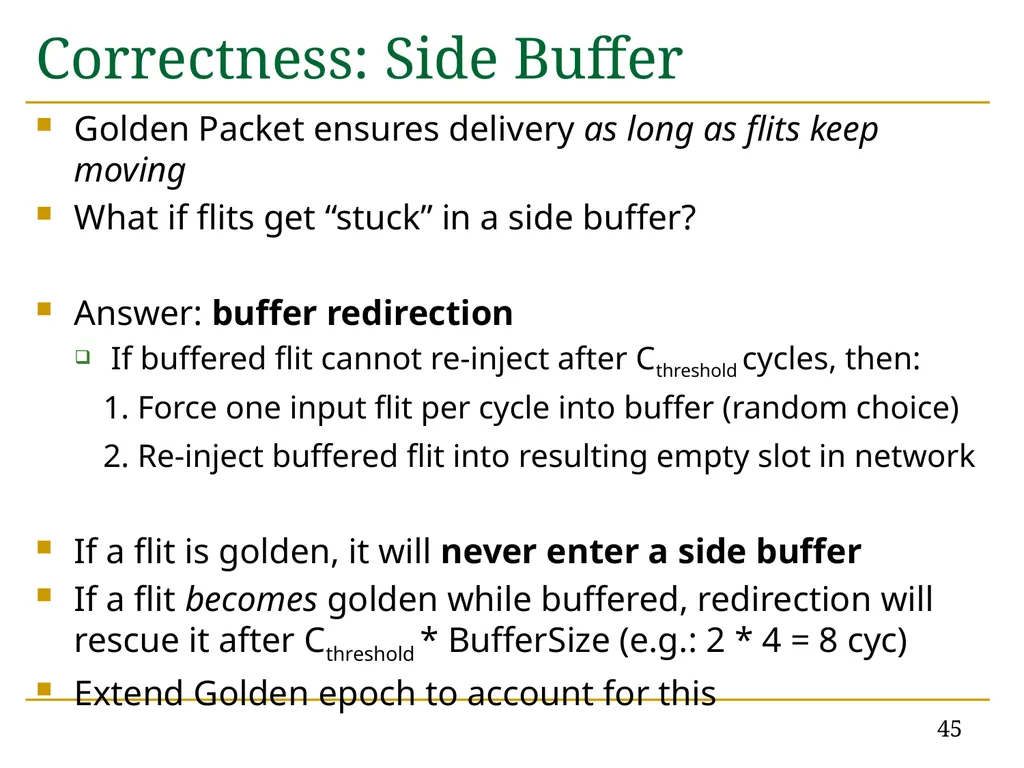
Correctness: Side Buffer Golden Packet ensures delivery as long as flits keep moving
What if flits get “stuck” in a side buffer?
Answer: buffer redirection
If buffered flit cannot re-inject after Cthreshold cycles, then:
1. Force one input flit per cycle into buffer (random choice)
2. Re-inject buffered flit into resulting empty slot in network
If a flit is golden, it will never enter a side buffer
If a flit becomes golden while buffered, redirection will rescue it after Cthreshold * BufferSize (e.g.: 2 * 4 = 8 cyc)
Extend Golden epoch to account for this 45<br>
What if flits get “stuck” in a side buffer?
Answer: buffer redirection
If buffered flit cannot re-inject after Cthreshold cycles, then:
1. Force one input flit per cycle into buffer (random choice)
2. Re-inject buffered flit into resulting empty slot in network
If a flit is golden, it will never enter a side buffer
If a flit becomes golden while buffered, redirection will rescue it after Cthreshold * BufferSize (e.g.: 2 * 4 = 8 cyc)
Extend Golden epoch to account for this 45<br>
46
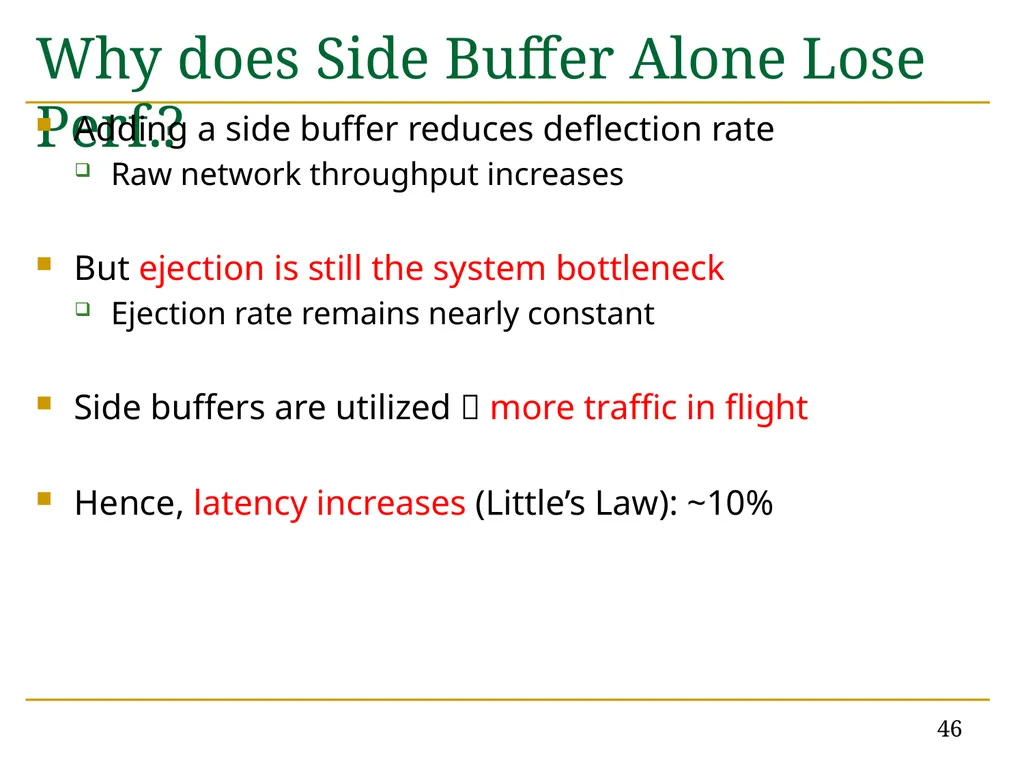
Why does Side Buffer Alone Lose Perf.? Adding a side buffer reduces deflection rate
Raw network throughput increases
But ejection is still the system bottleneck
Ejection rate remains nearly constant
Side buffers are utilized more traffic in flight
Hence, latency increases (Little’s Law): ~10% 46<br>
Raw network throughput increases
But ejection is still the system bottleneck
Ejection rate remains nearly constant
Side buffers are utilized more traffic in flight
Hence, latency increases (Little’s Law): ~10% 46<br>
47
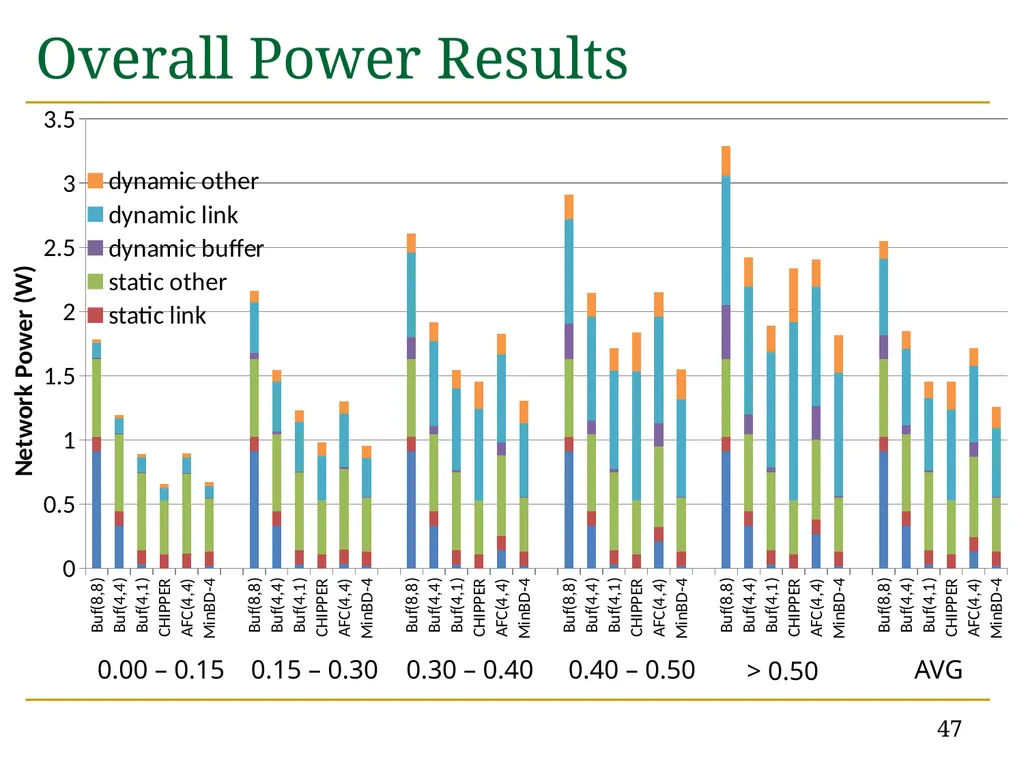
Overall Power Results 47 0.00 – 0.15 0.15 – 0.30 0.30 – 0.40 0.40 – 0.50 > 0.50 AVG<br>
48
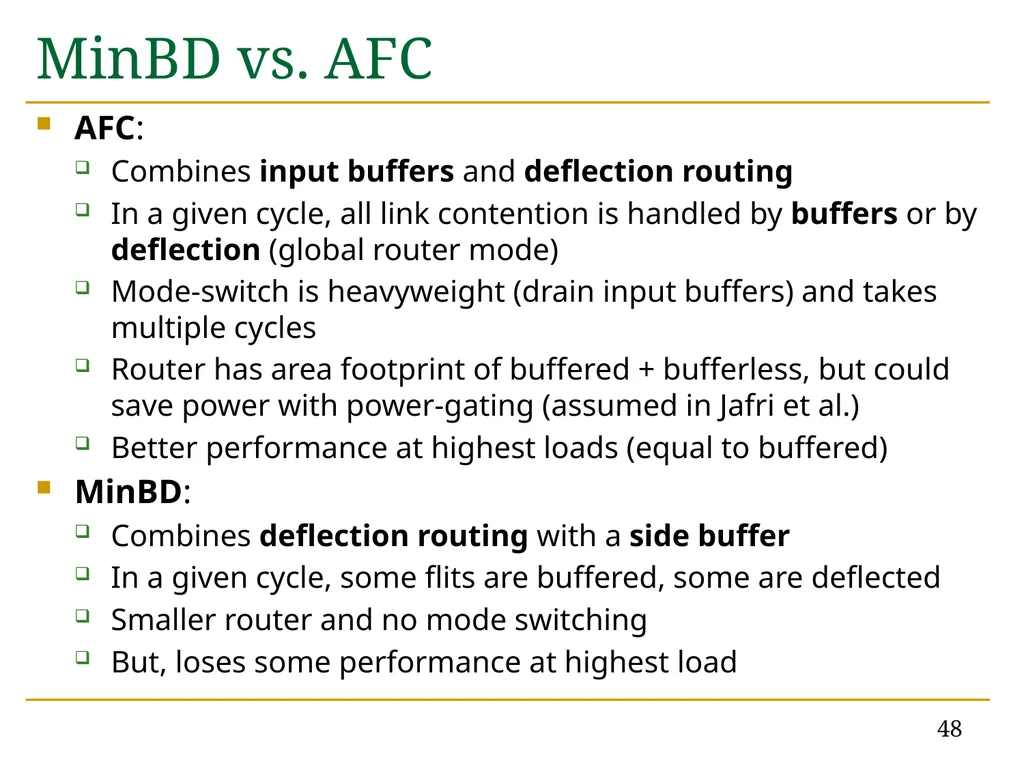
MinBD vs. AFC AFC:
Combines input buffers and deflection routing
In a given cycle, all link contention is handled by buffers or by deflection (global router mode)
Mode-switch is heavyweight (drain input buffers) and takes multiple cycles
Router has area footprint of buffered + bufferless, but could save power with power-gating (assumed in Jafri et al.)
Better performance at highest loads (equal to buffered)
MinBD:
Combines deflection routing with a side buffer
In a given cycle, some flits are buffered, some are deflected
Smaller router and no mode switching
But, loses some performance at highest load 48<br>
Combines input buffers and deflection routing
In a given cycle, all link contention is handled by buffers or by deflection (global router mode)
Mode-switch is heavyweight (drain input buffers) and takes multiple cycles
Router has area footprint of buffered + bufferless, but could save power with power-gating (assumed in Jafri et al.)
Better performance at highest loads (equal to buffered)
MinBD:
Combines deflection routing with a side buffer
In a given cycle, some flits are buffered, some are deflected
Smaller router and no mode switching
But, loses some performance at highest load 48<br>
49
Related Work Baran, 1964
Original “hot potato” (deflection) routing
BLESS (Moscibroda and Mutlu, ISCA 2009)
Earlier bufferless deflection router
Age-based arbitration slow (did not consider critical path)
CHIPPER (Fallin et al., HPCA 2011)
Assumed baseline for this work
AFC (Jafri et al., MICRO 2010)
Coarse-grained bufferless-buffered hybrid
SCARAB (Hayenga et al., MICRO 2009), BPS (Gomez+08)
Drop-based deflection networks
SCARAB: dedicated circuit-switched NACK network 49<br>
Original “hot potato” (deflection) routing
BLESS (Moscibroda and Mutlu, ISCA 2009)
Earlier bufferless deflection router
Age-based arbitration slow (did not consider critical path)
CHIPPER (Fallin et al., HPCA 2011)
Assumed baseline for this work
AFC (Jafri et al., MICRO 2010)
Coarse-grained bufferless-buffered hybrid
SCARAB (Hayenga et al., MICRO 2009), BPS (Gomez+08)
Drop-based deflection networks
SCARAB: dedicated circuit-switched NACK network 49<br>