Modeling with Linear Functions All slides in this presentations are based on the book Functions, Data and Models, S.P. Gordon and F. S Gordon ISBN 978-0-88385-767-0 Example 1 Example 1 The following data relate the snowy tree crickets
"Modeling with Linear Functions All slides in this" is the property of its rightful owner. Permission is granted to
download and print the materials on this website for personal, non-commercial use only, and to display it
on your personal computer provided you do not modify the materials and that you retain all copyright
notices contained in the materials. By downloading content from our website, you accept the terms of this
agreement.
Presentation Transcript
01
Modeling with Linear Functions All slides in this presentations are based on the book Functions, Data and Models, S.P. Gordon and F. S Gordon ISBN 978-0-88385-767-0<br>
02
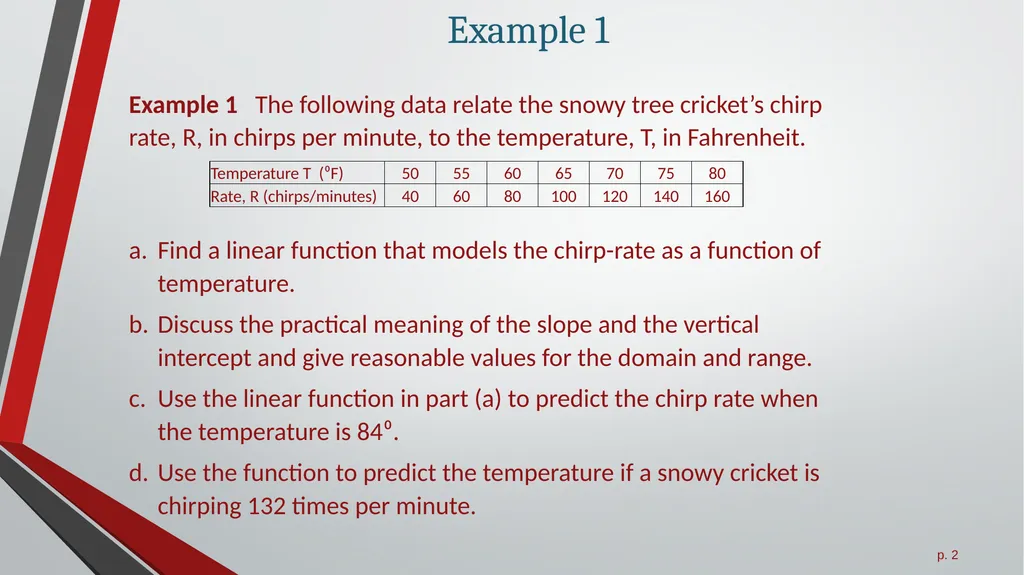
Example 1 Example 1 The following data relate the snowy tree cricket’s chirp rate, R, in chirps per minute, to the temperature, T, in Fahrenheit.
Find a linear function that models the chirp-rate as a function of temperature.
Discuss the practical meaning of the slope and the vertical intercept and give reasonable values for the domain and range.
Use the linear function in part (a) to predict the chirp rate when the temperature is 84⁰.
Use the function to predict the temperature if a snowy cricket is chirping 132 times per minute.<br>
03
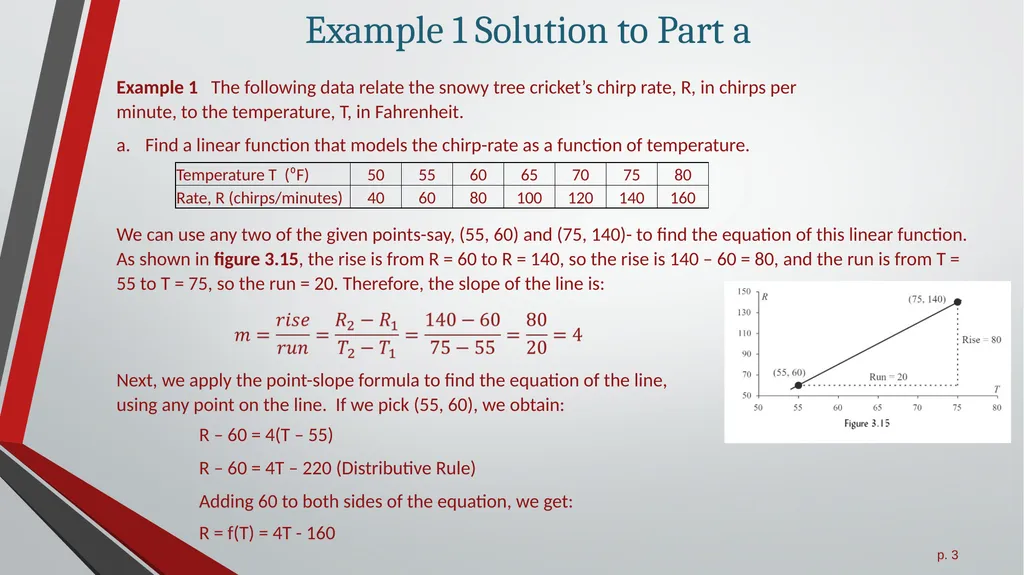
Example 1 Solution to Part a Example 1 The following data relate the snowy tree cricket’s chirp rate, R, in chirps per minute, to the temperature, T, in Fahrenheit.
Find a linear function that models the chirp-rate as a function of temperature. We can use any two of the given points-say, (55, 60) and (75, 140)- to find the equation of this linear function. As shown in figure 3.15, the rise is from R = 60 to R = 140, so the rise is 140 – 60 = 80, and the run is from T = 55 to T = 75, so the run = 20. Therefore, the slope of the line is: Next, we apply the point-slope formula to find the equation of the line, using any point on the line. If we pick (55, 60), we obtain: R – 60 = 4(T – 55)
R – 60 = 4T – 220 (Distributive Rule)
Adding 60 to both sides of the equation, we get:
R = f(T) = 4T - 160<br>
04
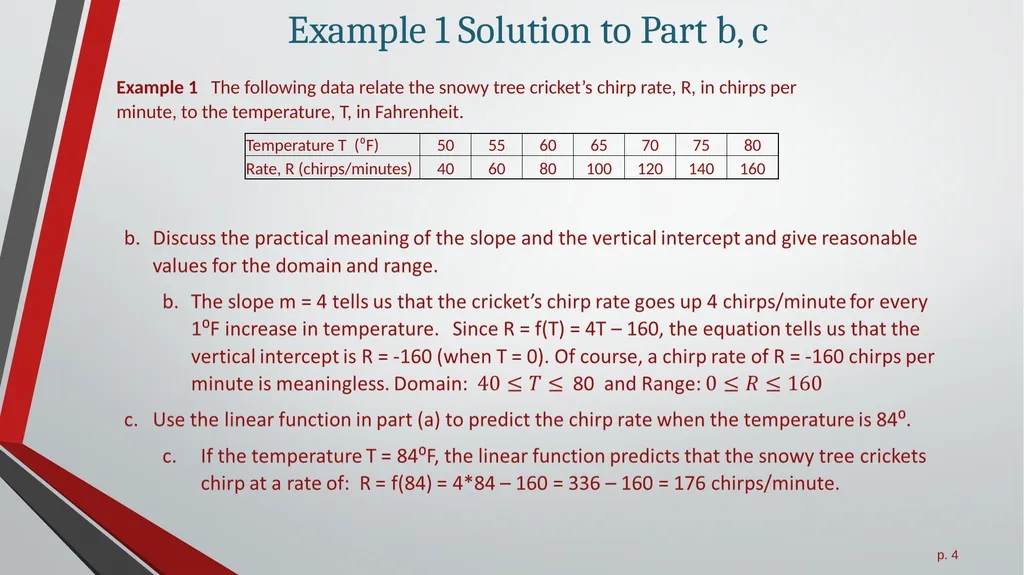
Example 1 Solution to Part b, c Example 1 The following data relate the snowy tree cricket’s chirp rate, R, in chirps per minute, to the temperature, T, in Fahrenheit.<br>
05
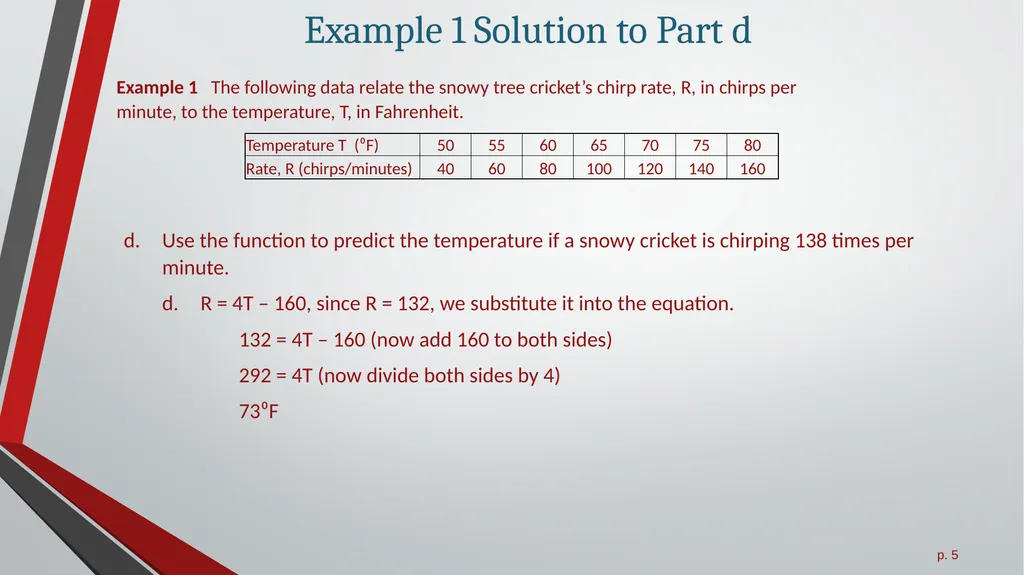
Example 1 Solution to Part d Example 1 The following data relate the snowy tree cricket’s chirp rate, R, in chirps per minute, to the temperature, T, in Fahrenheit. Use the function to predict the temperature if a snowy cricket is chirping 138 times per minute.
R = 4T – 160, since R = 132, we substitute it into the equation.
132 = 4T – 160 (now add 160 to both sides)
292 = 4T (now divide both sides by 4)
73⁰F<br>
06
Example 2 Example 2 In 1980, the annual average number of cigarettes smoked by people in the United States was 2930. By 2000, the annual average number of cigarettes consumed in the United States dropped to 1550.
Assuming the trend in the average number of cigarettes consumed in the United States is linear, find the equation of the linear function.
Assuming the trend continues, predict the average number of cigarettes consumed by the people in the United States in 2012.<br>
07
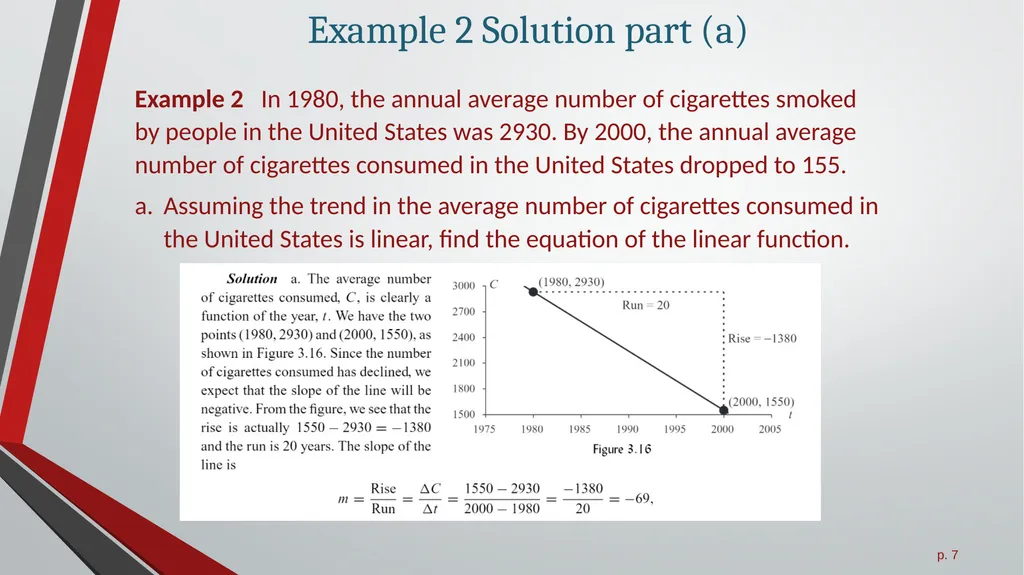
Example 2 Solution part (a) Example 2 In 1980, the annual average number of cigarettes smoked by people in the United States was 2930. By 2000, the annual average number of cigarettes consumed in the United States dropped to 155.
Assuming the trend in the average number of cigarettes consumed in the United States is linear, find the equation of the linear function.<br>
08
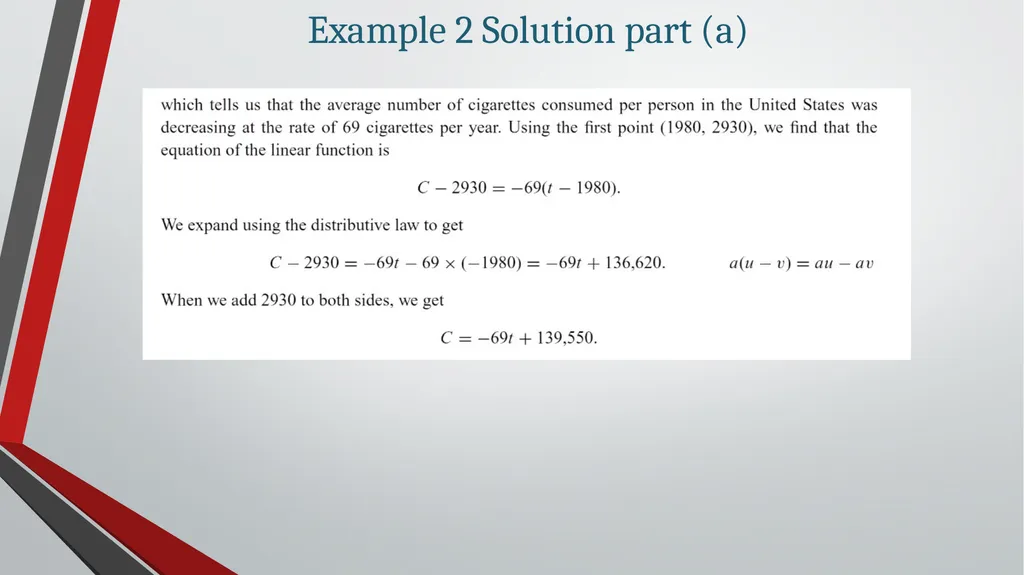
Example 2 Solution part (a)<br>
09
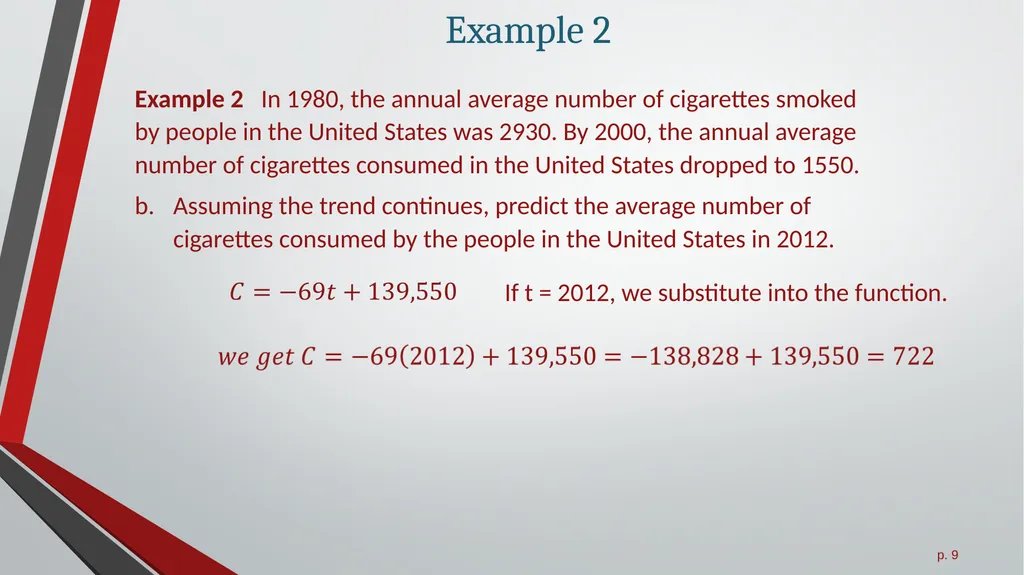
Example 2 Example 2 In 1980, the annual average number of cigarettes smoked by people in the United States was 2930. By 2000, the annual average number of cigarettes consumed in the United States dropped to 1550.
Assuming the trend continues, predict the average number of cigarettes consumed by the people in the United States in 2012. If t = 2012, we substitute into the function.<br>
10
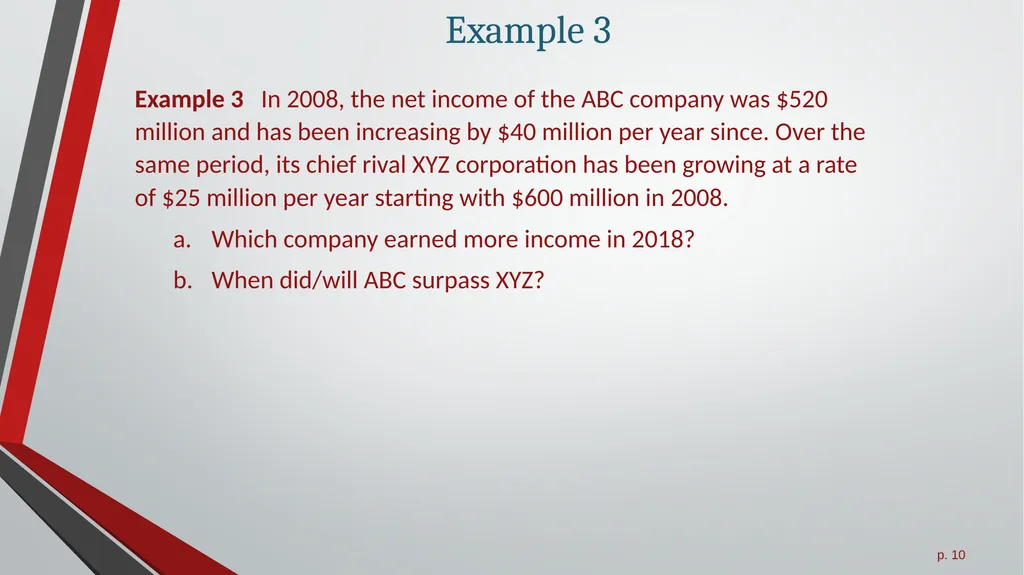
Example 3 Example 3 In 2008, the net income of the ABC company was $520 million and has been increasing by $40 million per year since. Over the same period, its chief rival XYZ corporation has been growing at a rate of $25 million per year starting with $600 million in 2008.
Which company earned more income in 2018?
When did/will ABC surpass XYZ?<br>
11
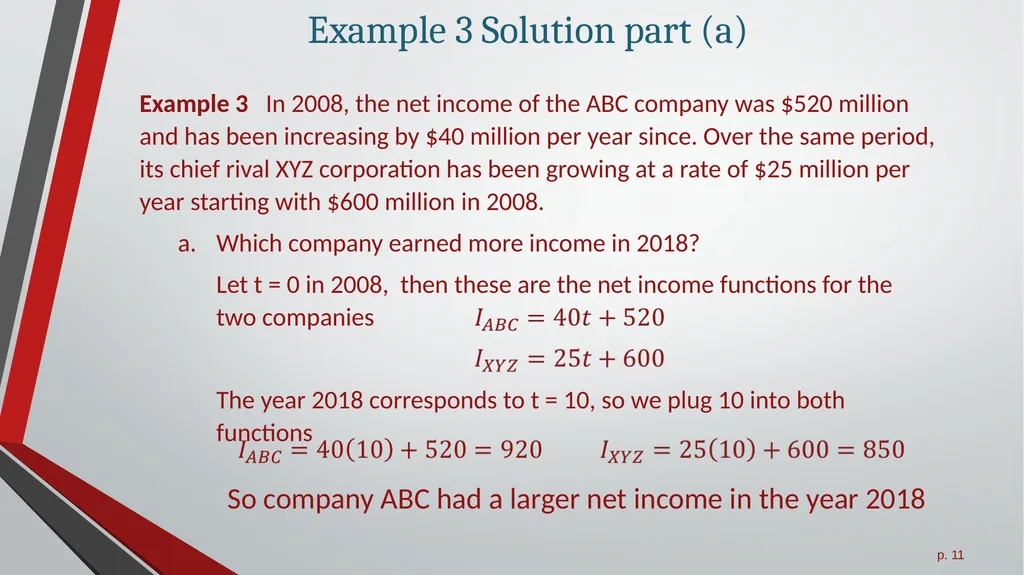
Example 3 Solution part (a) Example 3 In 2008, the net income of the ABC company was $520 million and has been increasing by $40 million per year since. Over the same period, its chief rival XYZ corporation has been growing at a rate of $25 million per year starting with $600 million in 2008.
Which company earned more income in 2018?
Let t = 0 in 2008, then these are the net income functions for the two companies
The year 2018 corresponds to t = 10, so we plug 10 into both functions So company ABC had a larger net income in the year 2018<br>
12
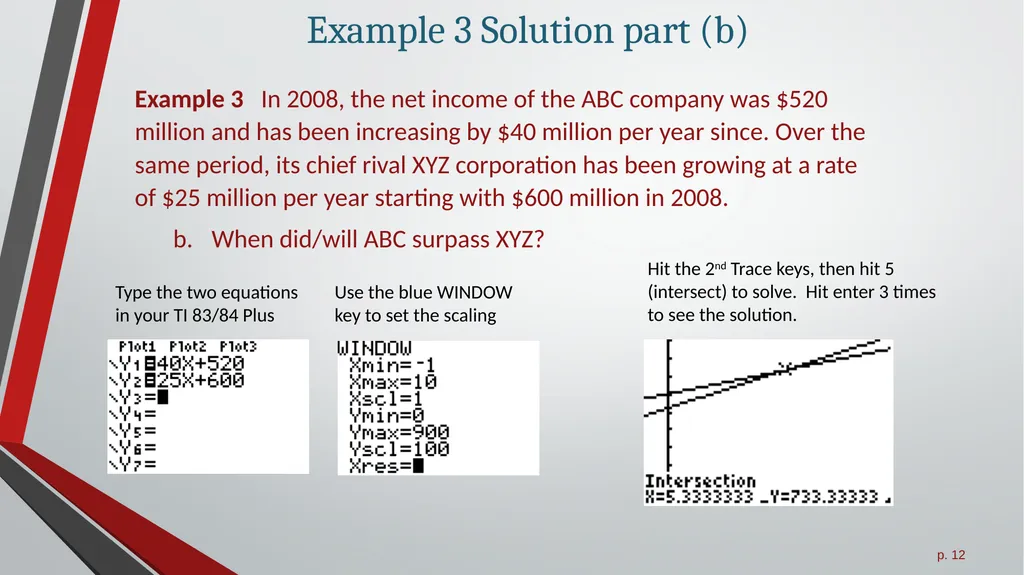
Example 3 Solution part (b) Example 3 In 2008, the net income of the ABC company was $520 million and has been increasing by $40 million per year since. Over the same period, its chief rival XYZ corporation has been growing at a rate of $25 million per year starting with $600 million in 2008.
When did/will ABC surpass XYZ? Type the two equations in your TI 83/84 Plus Use the blue WINDOW key to set the scaling Hit the 2nd Trace keys, then hit 5 (intersect) to solve. Hit enter 3 times to see the solution.<br>
13
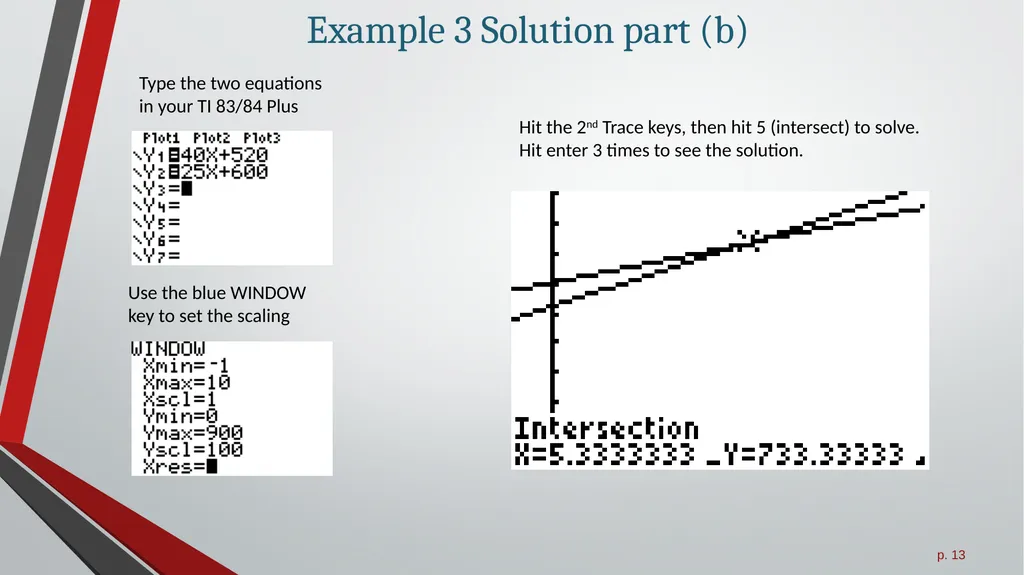
Example 3 Solution part (b) Type the two equations in your TI 83/84 Plus Use the blue WINDOW key to set the scaling Hit the 2nd Trace keys, then hit 5 (intersect) to solve. Hit enter 3 times to see the solution.<br>