
Models of Spring-Mass Systems Formulated as Cauchy
DP
Published · 40 slides · 0 views

1 / 1




Description
Models of Spring-Mass Systems Formulated as Cauchy Problems Ricky Bartels Back to Basics The modeling of more complex spring-mass systems (such as a system of n masses and n1 springs under the influence of friction) builds upon the model
Related Topics
Share
Embed code
Download this presentation From Below
"Models of Spring-Mass Systems Formulated as Cauchy" is the property of its rightful owner. Permission is granted to download and print the materials on this website for personal, non-commercial use only, and to display it on your personal computer provided you do not modify the materials and that you retain all copyright notices contained in the materials. By downloading content from our website, you accept the terms of this agreement.
Presentation Transcript
01
Models of Spring-Mass Systems
Formulated as Cauchy Problems Ricky Bartels<br>
02
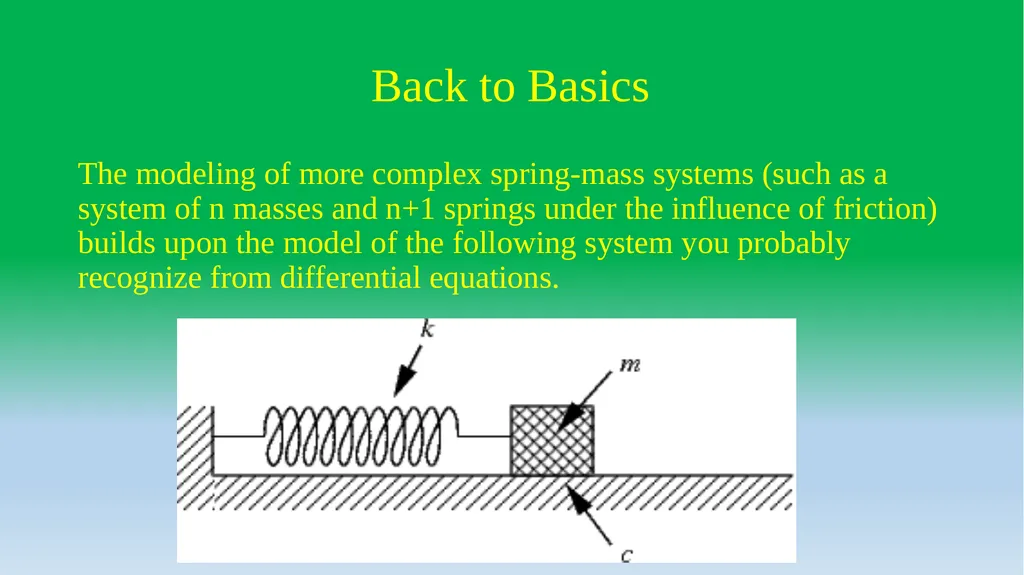
Back to Basics The modeling of more complex spring-mass systems (such as a system of n masses and n+1 springs under the influence of friction) builds upon the model of the following system you probably recognize from differential equations.<br>
03
Hooke’s Law + Newton’s 2nd Law of Motion Homogenous model of a simple oscillating mass. Assume the magnitude of the mass’s displacement is small, and the surface is frictionless.
Hooke’s Law states that the restoring force of the spring, F, is proportional to the distance the mass was extended from its equilibrium position. Particularly, F= -kx
Newton’s Second Law of Motion states that the net-force on a particle equals the mass of a particle times its acceleration. (F=ma).
If x(t) is the mass’s position function, where x=0 when the particle is at its equilibrium position, then x”(t) is its acceleration.
Therefore, mx”(t)= -kx(t)<br>
04
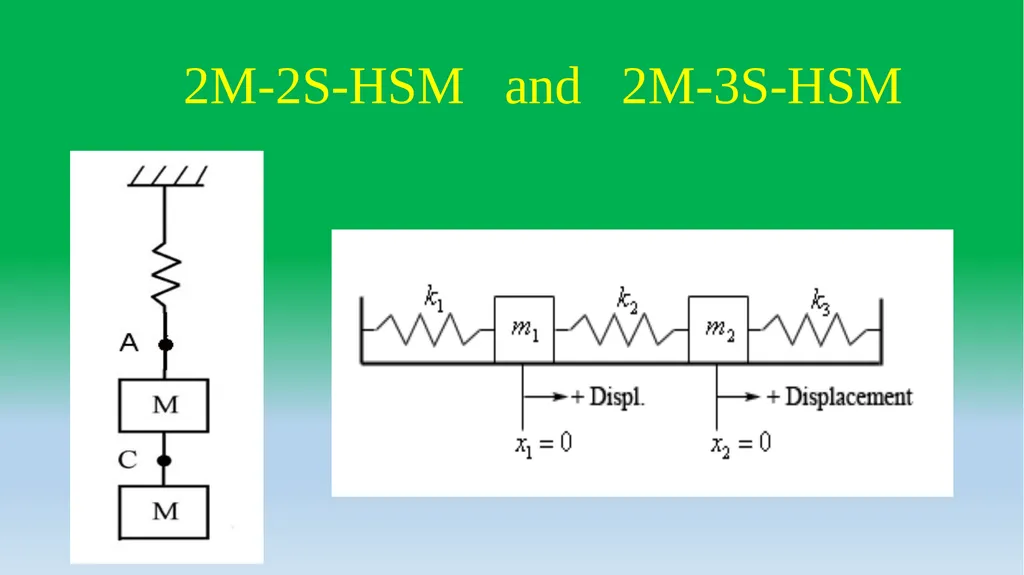
2M-2S-HSM and 2M-3S-HSM<br>
05
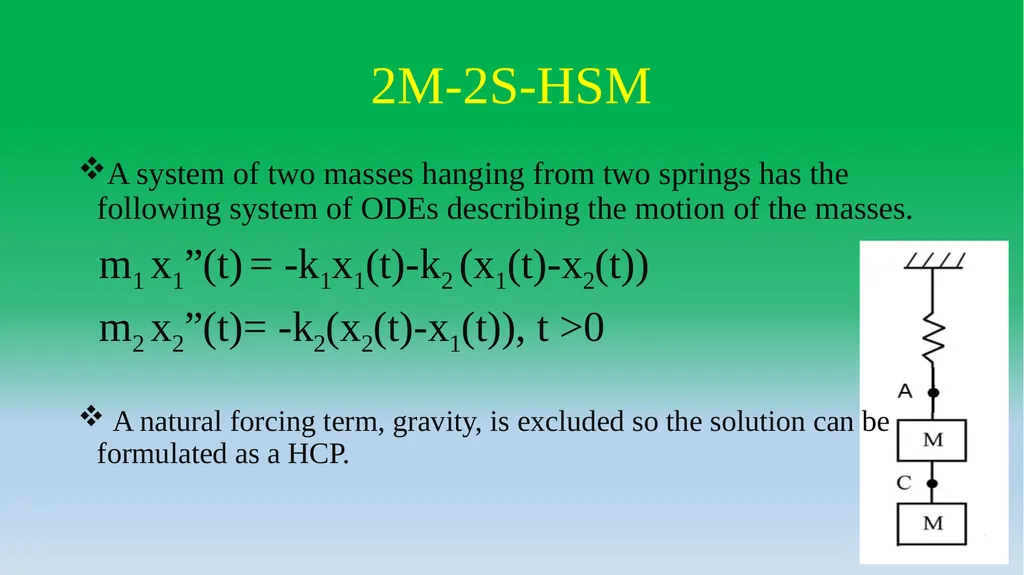
2M-2S-HSM A system of two masses hanging from two springs has the following system of ODEs describing the motion of the masses.
m1 x1”(t) = -k1x1(t)-k2 (x1(t)-x2(t))
m2 x2”(t)= -k2(x2(t)-x1(t)), t >0
A natural forcing term, gravity, is excluded so the solution can be formulated as a HCP.<br>
m1 x1”(t) = -k1x1(t)-k2 (x1(t)-x2(t))
m2 x2”(t)= -k2(x2(t)-x1(t)), t >0
A natural forcing term, gravity, is excluded so the solution can be formulated as a HCP.<br>
06
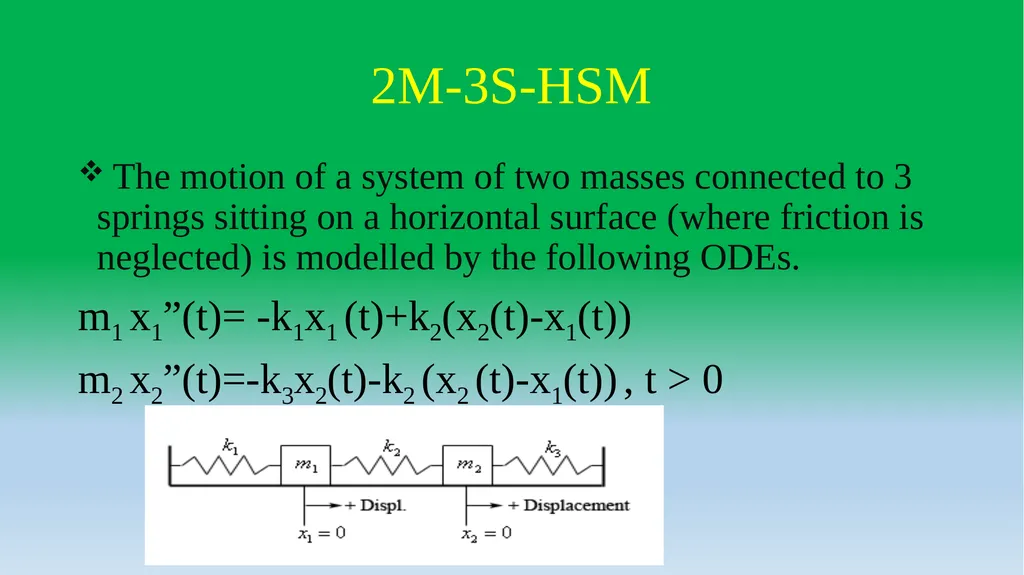
2M-3S-HSM The motion of a system of two masses connected to 3 springs sitting on a horizontal surface (where friction is neglected) is modelled by the following ODEs.
m1 x1”(t)= -k1x1 (t)+k2(x2(t)-x1(t))
m2 x2”(t)=-k3x2(t)-k2 (x2 (t)-x1(t)) , t > 0<br>
m1 x1”(t)= -k1x1 (t)+k2(x2(t)-x1(t))
m2 x2”(t)=-k3x2(t)-k2 (x2 (t)-x1(t)) , t > 0<br>
07
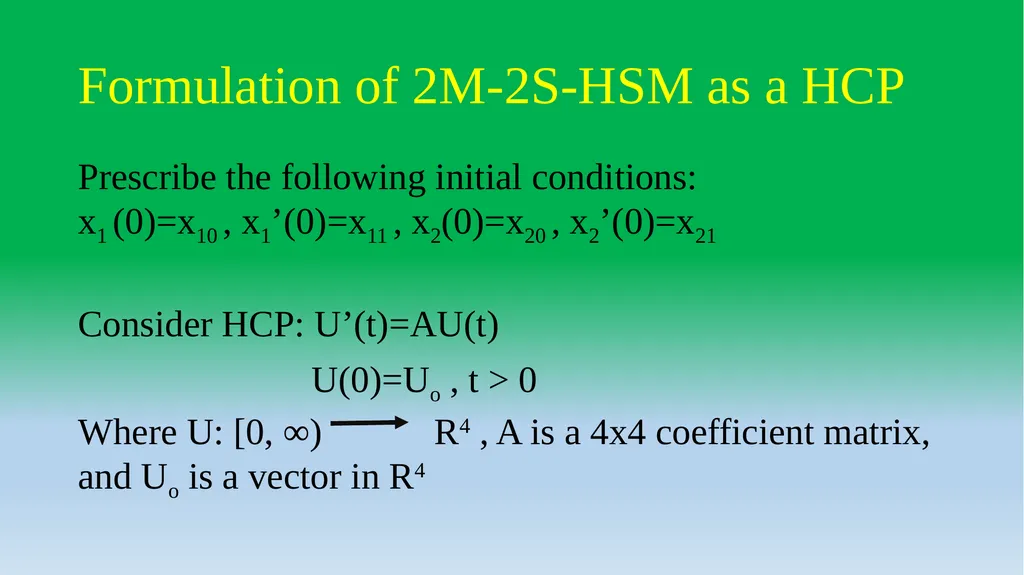
Formulation of 2M-2S-HSM as a HCP Prescribe the following initial conditions: x1 (0)=x10 , x1’(0)=x11 , x2(0)=x20 , x2’(0)=x21
Consider HCP: U’(t)=AU(t)
U(0)=Uo , t > 0
Where U: [0, ∞) R4 , A is a 4x4 coefficient matrix, and Uo is a vector in R4<br>
Consider HCP: U’(t)=AU(t)
U(0)=Uo , t > 0
Where U: [0, ∞) R4 , A is a 4x4 coefficient matrix, and Uo is a vector in R4<br>
08
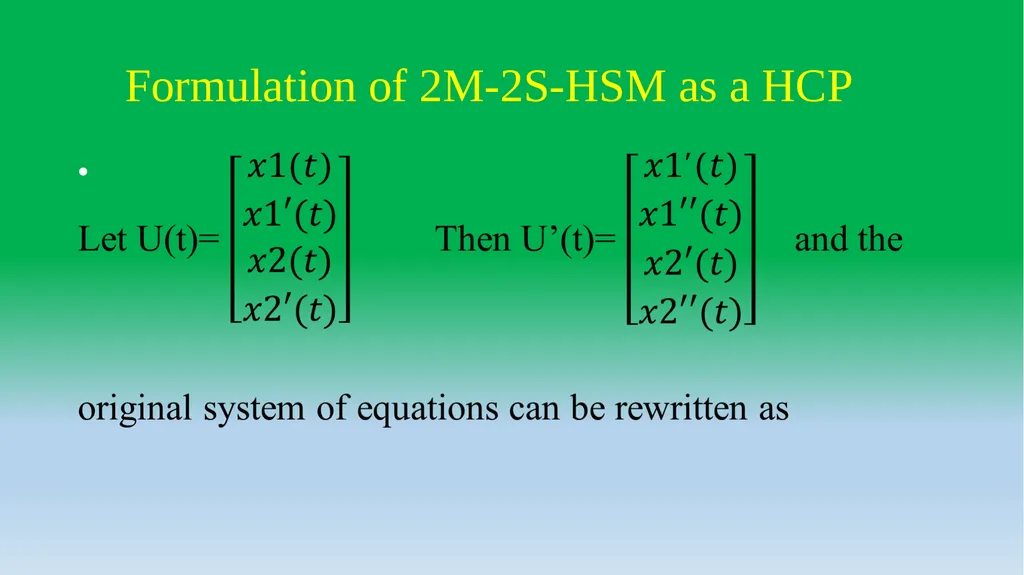
Formulation of 2M-2S-HSM as a HCP<br>
09
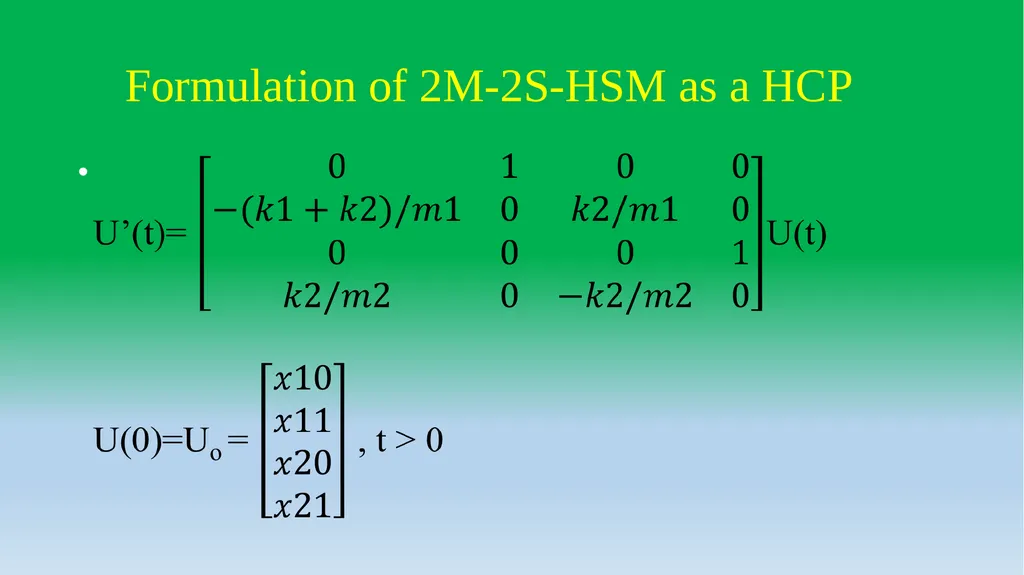
Formulation of 2M-2S-HSM as a HCP<br>
10
Reaping the benefits of HCP What have we proven about any HCP? (And therefore about the generating system of ODEs?)
Homogenous Cauchy Problems have unique classical solutions of the form U(t)= eAtUo
The solutions to 2M-2S-HSM correspond to the first and third components of the solution vector.
Moreover, the solution to the general HCP is continuously dependent on its initial conditions. Therefore, the solutions to 2M-2S-HSM are also continuously dependent on their initial conditions.<br>
11
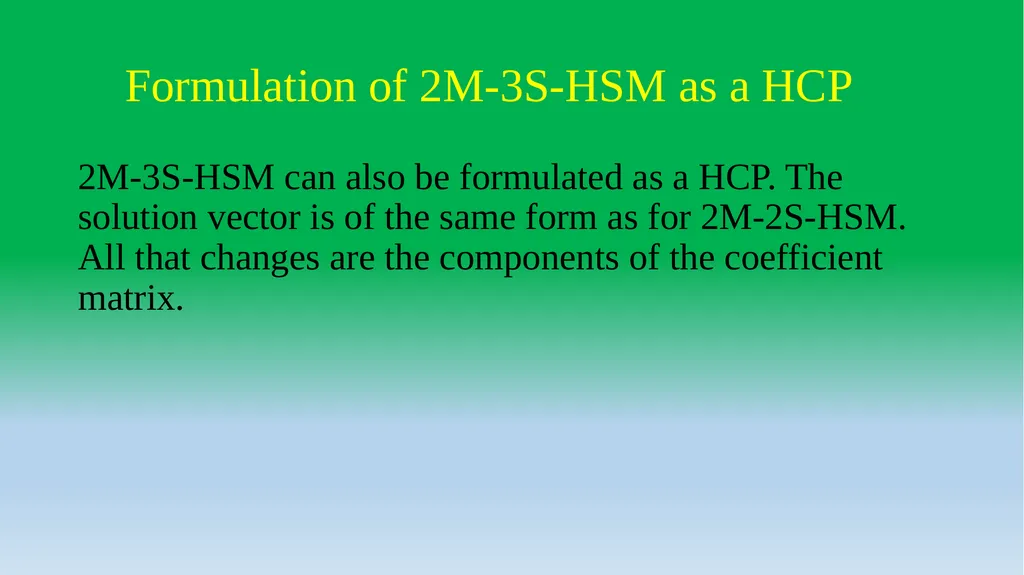
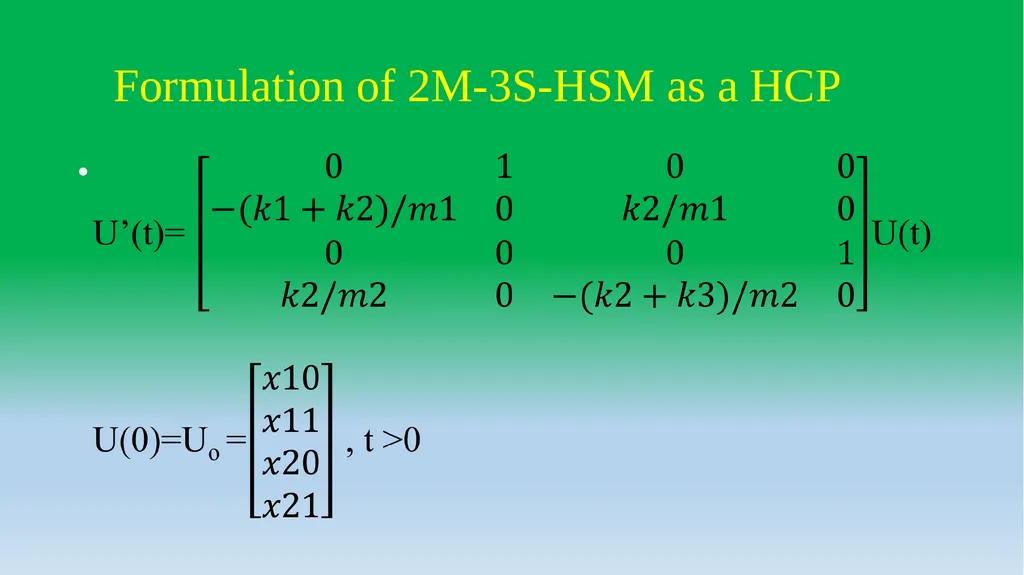
Formulation of 2M-3S-HSM as a HCP 2M-3S-HSM can also be formulated as a HCP. The solution vector is of the same form as for 2M-2S-HSM. All that changes are the components of the coefficient matrix.<br>
12
Formulation of 2M-3S-HSM as a HCP<br>
13
nM-nS-HSM and nM-(n+1)S-HSM What if, for both the horizontal and vertical spring mass systems just encountered, the number of masses (and thus the number of springs) is generalized?
What systems of ODEs model the motion of the masses in these spring-mass systems?
Do these systems of ODEs have solutions?<br>
What systems of ODEs model the motion of the masses in these spring-mass systems?
Do these systems of ODEs have solutions?<br>
14
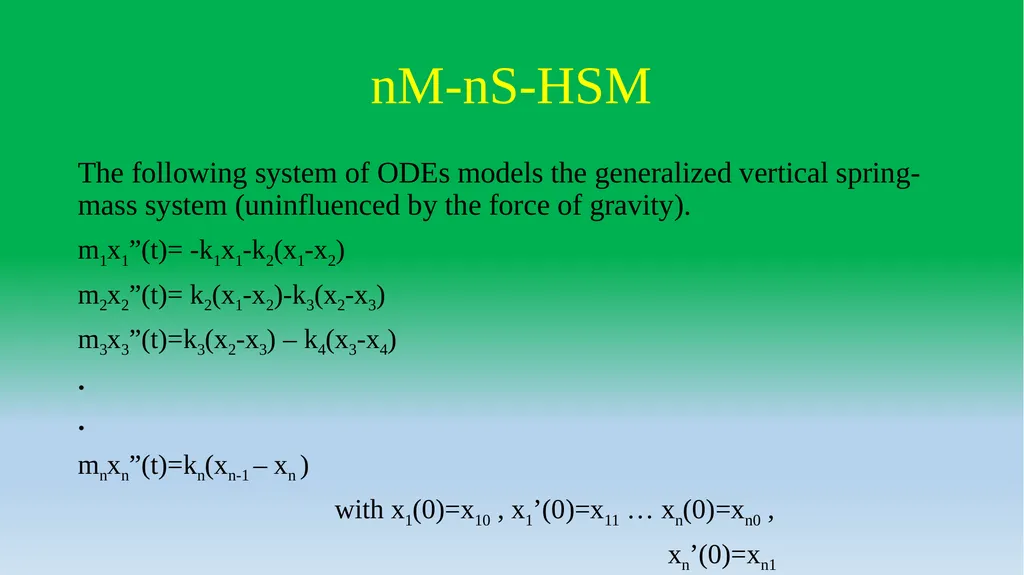
nM-nS-HSM The following system of ODEs models the generalized vertical spring-mass system (uninfluenced by the force of gravity).
m1x1”(t)= -k1x1-k2(x1-x2)
m2x2”(t)= k2(x1-x2)-k3(x2-x3)
m3x3”(t)=k3(x2-x3) – k4(x3-x4)
.
.
mnxn”(t)=kn(xn-1 – xn )
with x1(0)=x10 , x1’(0)=x11 … xn(0)=xn0 ,
xn’(0)=xn1<br>
m1x1”(t)= -k1x1-k2(x1-x2)
m2x2”(t)= k2(x1-x2)-k3(x2-x3)
m3x3”(t)=k3(x2-x3) – k4(x3-x4)
.
.
mnxn”(t)=kn(xn-1 – xn )
with x1(0)=x10 , x1’(0)=x11 … xn(0)=xn0 ,
xn’(0)=xn1<br>
15
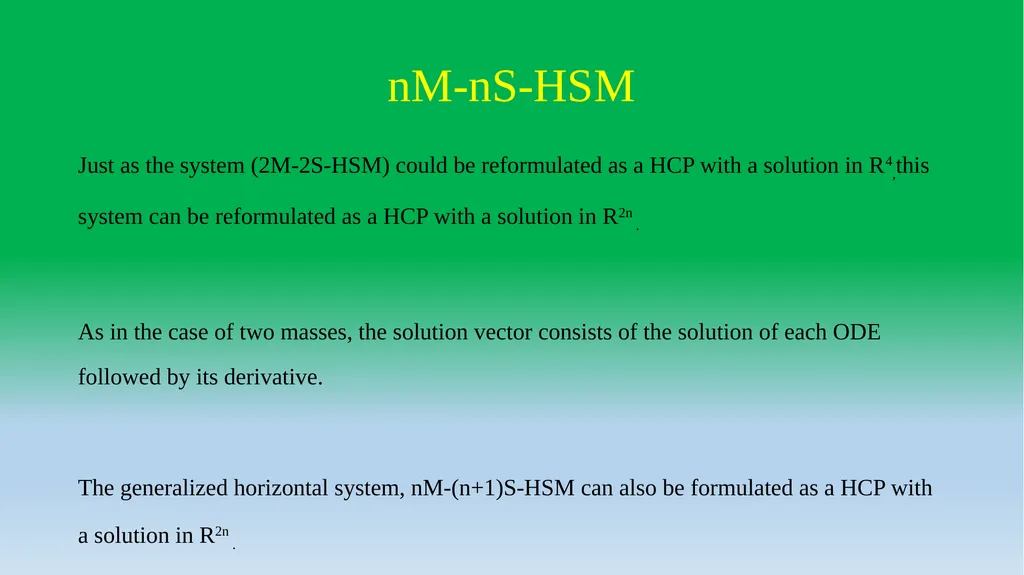
nM-nS-HSM Just as the system (2M-2S-HSM) could be reformulated as a HCP with a solution in R4,this system can be reformulated as a HCP with a solution in R2n .
As in the case of two masses, the solution vector consists of the solution of each ODE followed by its derivative.
The generalized horizontal system, nM-(n+1)S-HSM can also be formulated as a HCP with a solution in R2n .<br>
As in the case of two masses, the solution vector consists of the solution of each ODE followed by its derivative.
The generalized horizontal system, nM-(n+1)S-HSM can also be formulated as a HCP with a solution in R2n .<br>
16
nM-nS-HSM and nM-(n+1)S-HSM<br>
17
Effects of Altering Parameters How does choosing different values for the masses and spring constants in 2M-2S-HSM and 2M-3S-HSM affect the motion of the masses for fixed initial conditions?<br>
18
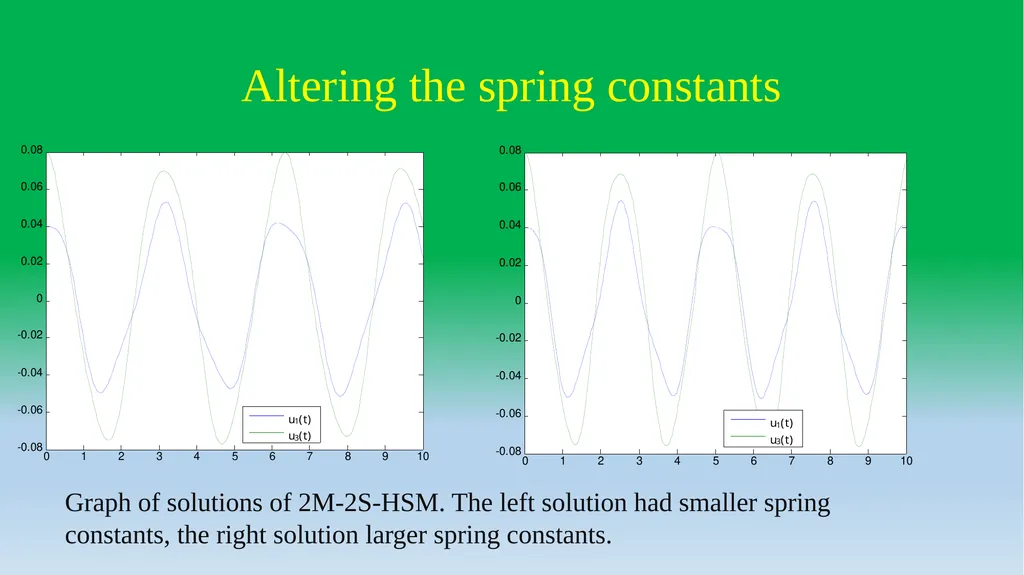
Altering the spring constants Hooke’s Law states F= -kx. The larger the value of k, the greater the force that must be applied to extend the spring a fixed distance. Colloquially, increasing k increases a spring’s “stiffness”. So if two springs with distinct spring constants (one larger than the other) are extended the same distance, we would expect the spring with the larger spring constant to cycle through its oscillations more quickly than that with the smaller constant. Thus, increasing the spring constant should increase the frequency of the oscillations of a spring for fixed masses and initial conditions. These conjectures were corroborated by experiments in MATLAB.<br>
19
Altering the spring constants Graph of solutions of 2M-2S-HSM. The left solution had smaller spring constants, the right solution larger spring constants.<br>
20
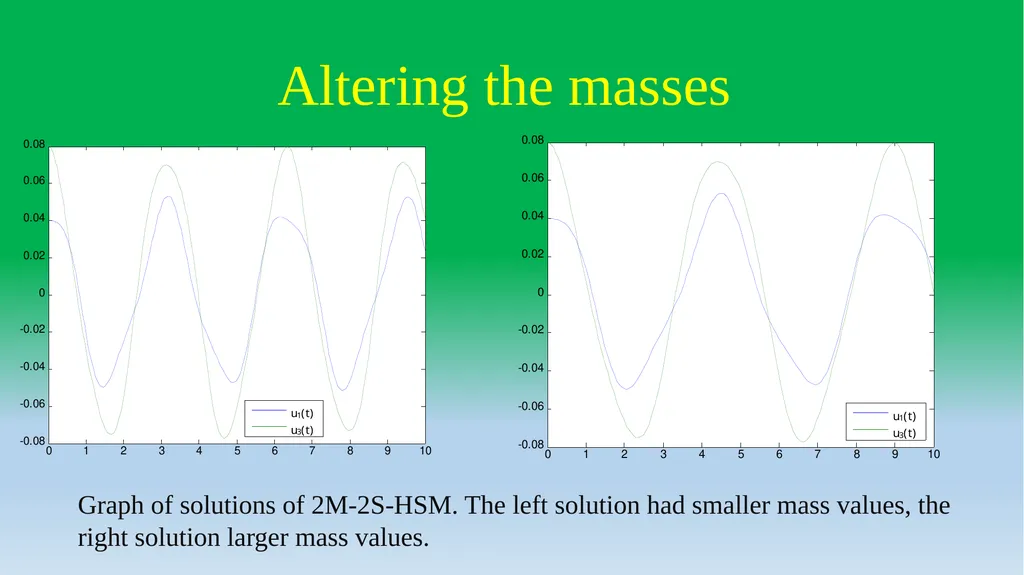
Altering the masses Consider two systems of the form (2M-2S-HSM). Suppose for both systems, the initial conditions and spring constant values are the same, but the values of their masses differ. Considering the situation informally, it’d seem that if two springs (with the same spring constants) and different masses on their ends were displaced the same amount, it would be more “difficult” for the spring with the greater masses to reach the top of its oscillation once they are released. In other words, the greater the mass, the lower the frequency of its oscillations when all other parameters are fixed.<br>
21
Altering the masses Graph of solutions of 2M-2S-HSM. The left solution had smaller mass values, the right solution larger mass values.<br>
22
Dampening terms on HSM (HSMD) Suppose that a dampening term proportional to the velocity of the mass is added to each equation in (2M-2S-HSM) and (2M-3S-HSM).
Will (2M-2S-HSMD) and (2M-3S-HSMD) have solutions?<br>
Will (2M-2S-HSMD) and (2M-3S-HSMD) have solutions?<br>
23
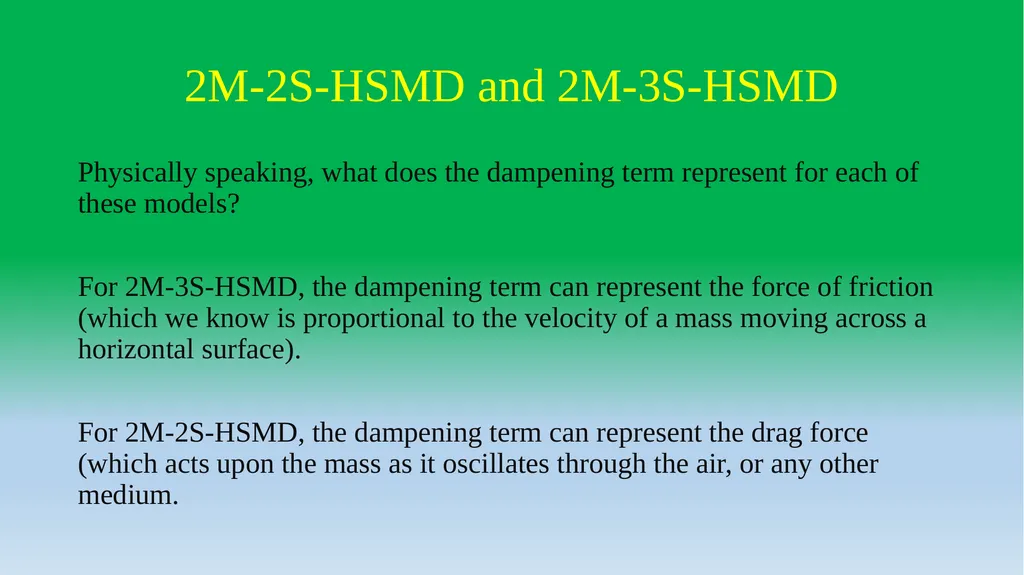
2M-2S-HSMD and 2M-3S-HSMD Physically speaking, what does the dampening term represent for each of these models?
For 2M-3S-HSMD, the dampening term can represent the force of friction (which we know is proportional to the velocity of a mass moving across a horizontal surface).
For 2M-2S-HSMD, the dampening term can represent the drag force (which acts upon the mass as it oscillates through the air, or any other medium.<br>
24
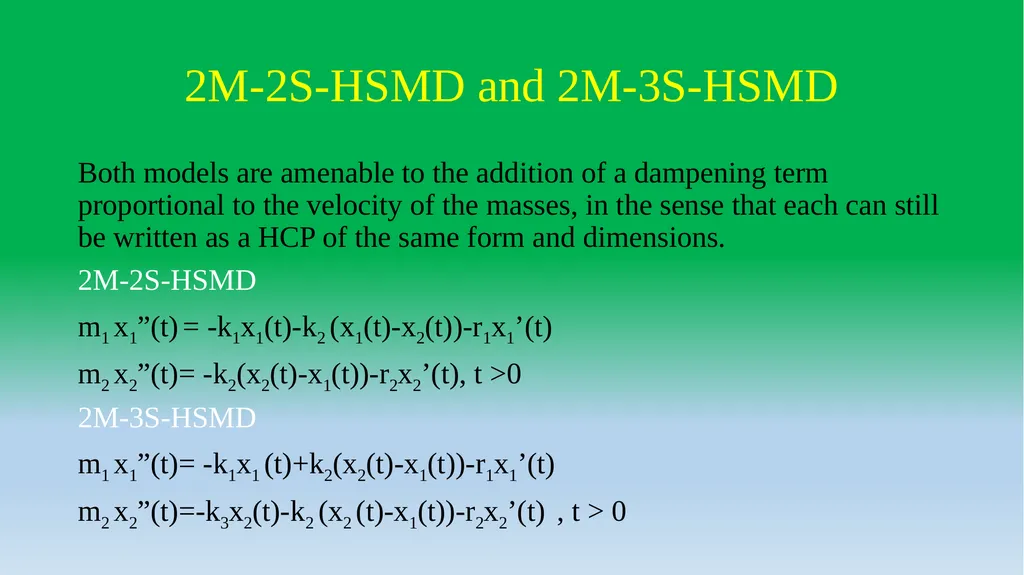
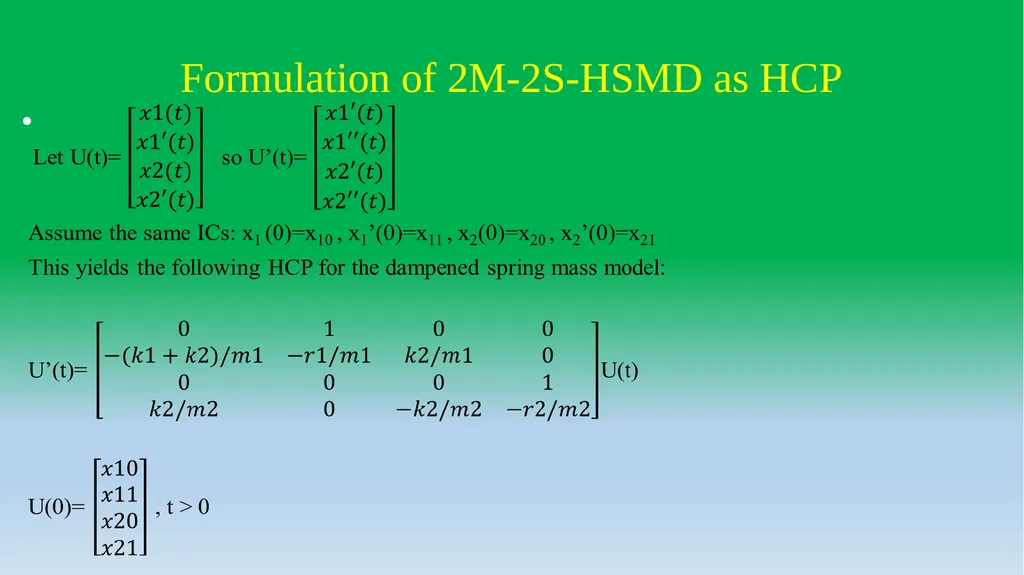
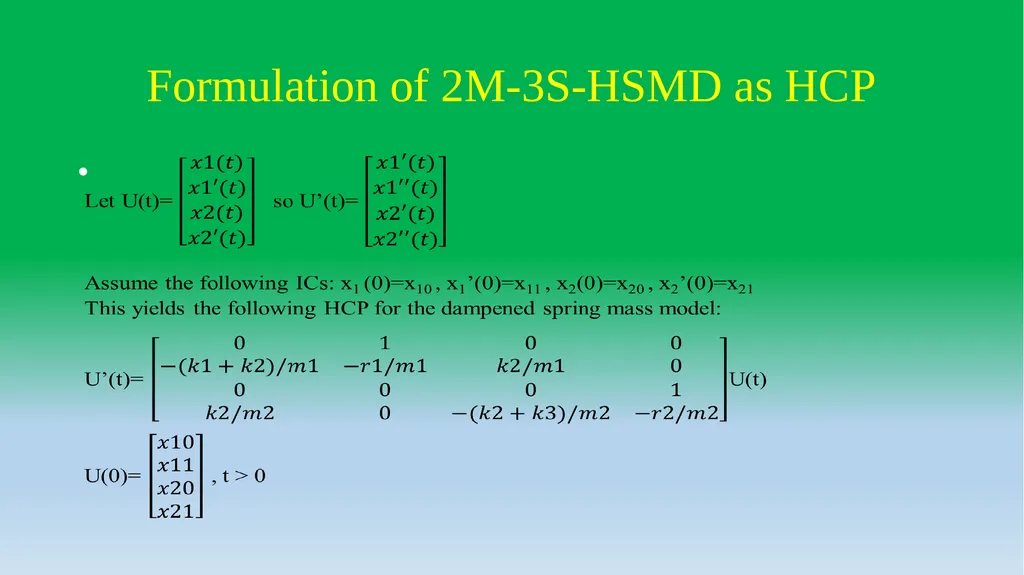
2M-2S-HSMD and 2M-3S-HSMD Both models are amenable to the addition of a dampening term proportional to the velocity of the masses, in the sense that each can still be written as a HCP of the same form and dimensions.
2M-2S-HSMD
m1 x1”(t) = -k1x1(t)-k2 (x1(t)-x2(t))-r1x1’(t)
m2 x2”(t)= -k2(x2(t)-x1(t))-r2x2’(t), t >0
2M-3S-HSMD
m1 x1”(t)= -k1x1 (t)+k2(x2(t)-x1(t))-r1x1’(t)
m2 x2”(t)=-k3x2(t)-k2 (x2 (t)-x1(t))-r2x2’(t) , t > 0<br>
2M-2S-HSMD
m1 x1”(t) = -k1x1(t)-k2 (x1(t)-x2(t))-r1x1’(t)
m2 x2”(t)= -k2(x2(t)-x1(t))-r2x2’(t), t >0
2M-3S-HSMD
m1 x1”(t)= -k1x1 (t)+k2(x2(t)-x1(t))-r1x1’(t)
m2 x2”(t)=-k3x2(t)-k2 (x2 (t)-x1(t))-r2x2’(t) , t > 0<br>
25
Formulation of 2M-2S-HSMD as HCP<br>
26
Formulation of 2M-3S-HSMD as HCP<br>
27
2M-2S-HSMD and 2M-3S-HSMD Both of these models can be formulated as HCP, and therefore have solutions, and depend continuously on their initial data.<br>
28
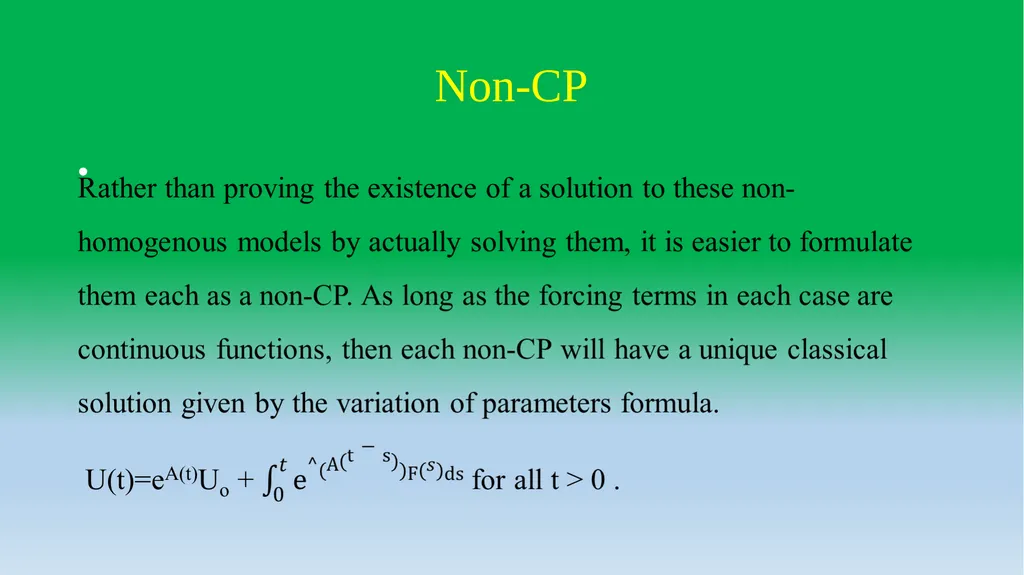
Non-Homogenous Case The models of vertical spring-mass systems encountered so far have limited power in accurately describing the motion of the masses in those systems. Particularly, the force of gravity was omitted from both 2M-2S-HSM and 2M-2S-HSMD. In the case of 2M-3S-HSM and 2M-3S-HSMD, the issue is not so much the inaccuracy of the models’ descriptions of the masses’ motions, but the highly idealized nature of the systems they described. The addition of physically significant forcing terms to each model addresses these issues.<br>
29
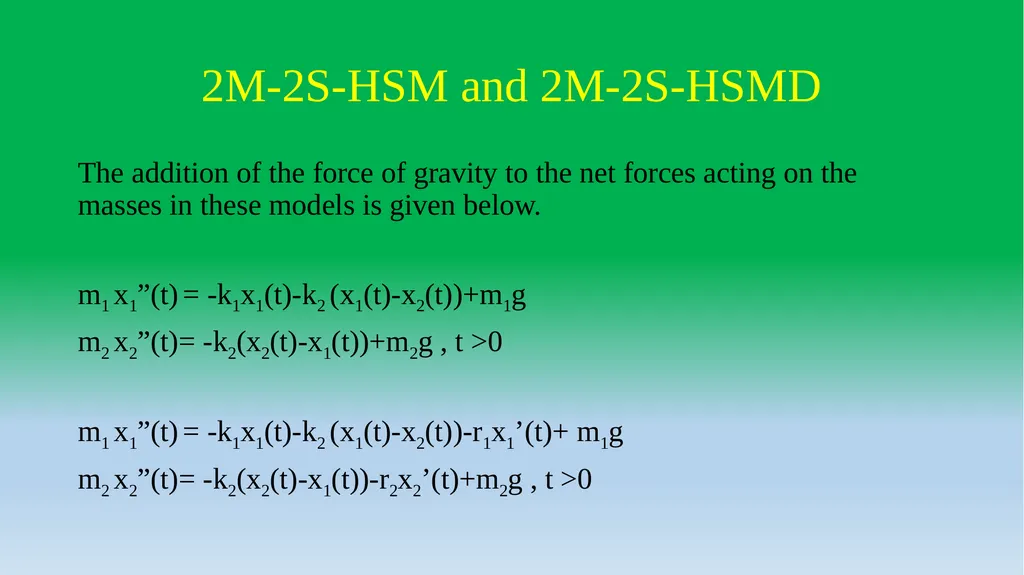
2M-2S-HSM and 2M-2S-HSMD The addition of the force of gravity to the net forces acting on the masses in these models is given below.
m1 x1”(t) = -k1x1(t)-k2 (x1(t)-x2(t))+m1g
m2 x2”(t)= -k2(x2(t)-x1(t))+m2g , t >0
m1 x1”(t) = -k1x1(t)-k2 (x1(t)-x2(t))-r1x1’(t)+ m1g
m2 x2”(t)= -k2(x2(t)-x1(t))-r2x2’(t)+m2g , t >0<br>
m1 x1”(t) = -k1x1(t)-k2 (x1(t)-x2(t))+m1g
m2 x2”(t)= -k2(x2(t)-x1(t))+m2g , t >0
m1 x1”(t) = -k1x1(t)-k2 (x1(t)-x2(t))-r1x1’(t)+ m1g
m2 x2”(t)= -k2(x2(t)-x1(t))-r2x2’(t)+m2g , t >0<br>
30
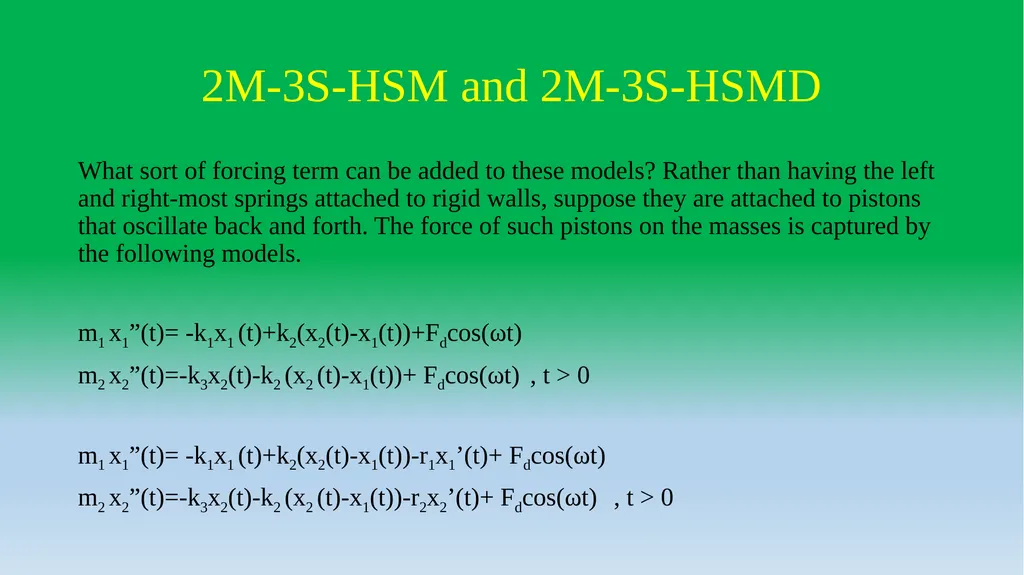
2M-3S-HSM and 2M-3S-HSMD What sort of forcing term can be added to these models? Rather than having the left and right-most springs attached to rigid walls, suppose they are attached to pistons that oscillate back and forth. The force of such pistons on the masses is captured by the following models.
m1 x1”(t)= -k1x1 (t)+k2(x2(t)-x1(t))+Fdcos(ωt)
m2 x2”(t)=-k3x2(t)-k2 (x2 (t)-x1(t))+ Fdcos(ωt) , t > 0
m1 x1”(t)= -k1x1 (t)+k2(x2(t)-x1(t))-r1x1’(t)+ Fdcos(ωt)
m2 x2”(t)=-k3x2(t)-k2 (x2 (t)-x1(t))-r2x2’(t)+ Fdcos(ωt) , t > 0<br>
m1 x1”(t)= -k1x1 (t)+k2(x2(t)-x1(t))+Fdcos(ωt)
m2 x2”(t)=-k3x2(t)-k2 (x2 (t)-x1(t))+ Fdcos(ωt) , t > 0
m1 x1”(t)= -k1x1 (t)+k2(x2(t)-x1(t))-r1x1’(t)+ Fdcos(ωt)
m2 x2”(t)=-k3x2(t)-k2 (x2 (t)-x1(t))-r2x2’(t)+ Fdcos(ωt) , t > 0<br>
31
Non-CP<br>
32
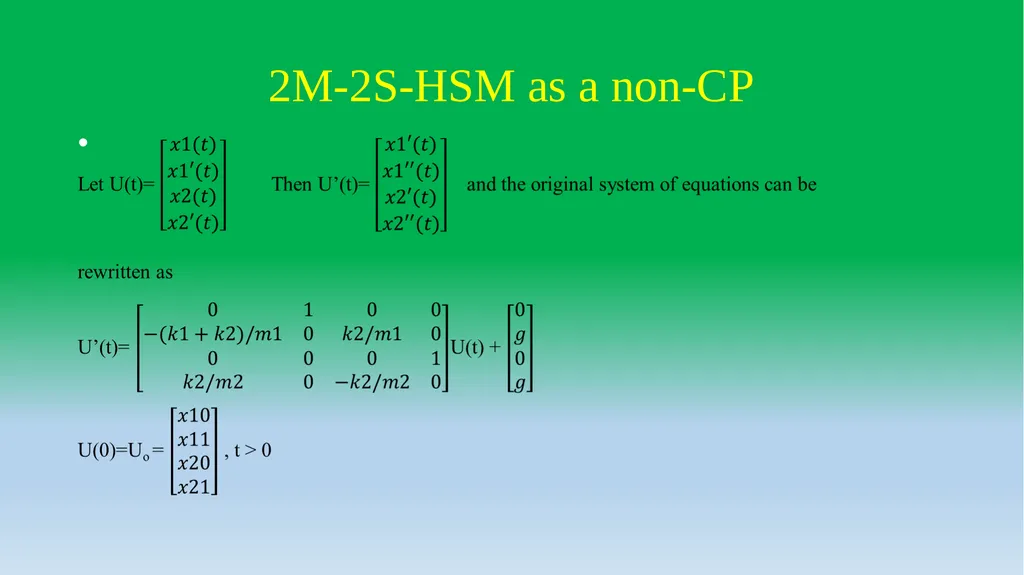
2M-2S-HSM as a non-CP<br>
33
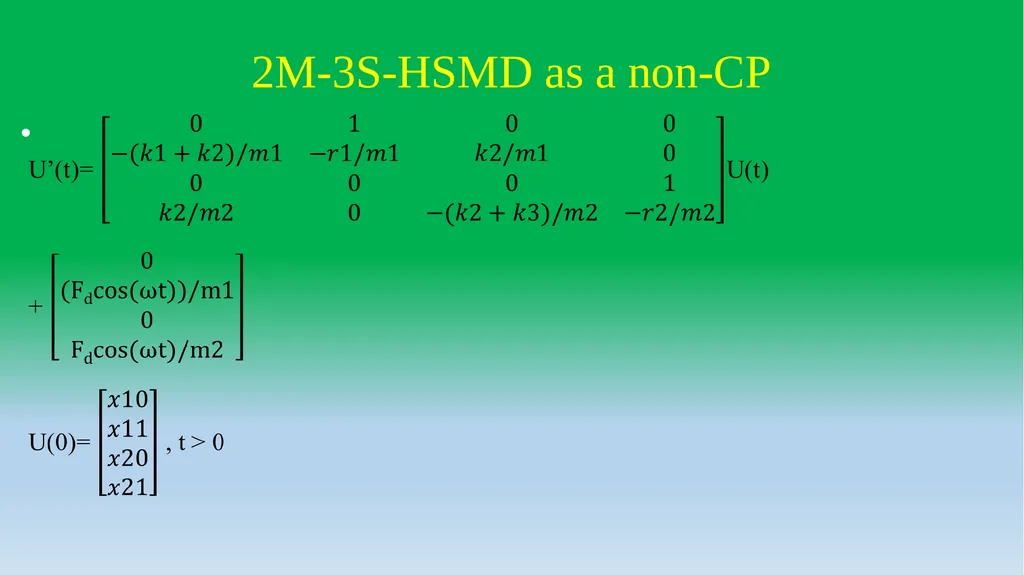
2M-3S-HSMD as a non-CP<br>
34
Solutions to non-CP models The fact that each non-homogenous model can be reformulated as a non-CP does not guarantee the existence of their solutions. The continuity of the forcing term (vector) is necessary by Theorem 5.3.1.
A function from R to Rn is continuous if and only if each component of the vector valued function is continuous. As the components of each forcing term are either scalar multiples of cosine or constants (which are both clearly continuous) each forcing term is continuous, so each formulated non-CP has a unique solution. Therefore, each of the original non-homogenous models has a solution.<br>
A function from R to Rn is continuous if and only if each component of the vector valued function is continuous. As the components of each forcing term are either scalar multiples of cosine or constants (which are both clearly continuous) each forcing term is continuous, so each formulated non-CP has a unique solution. Therefore, each of the original non-homogenous models has a solution.<br>
35
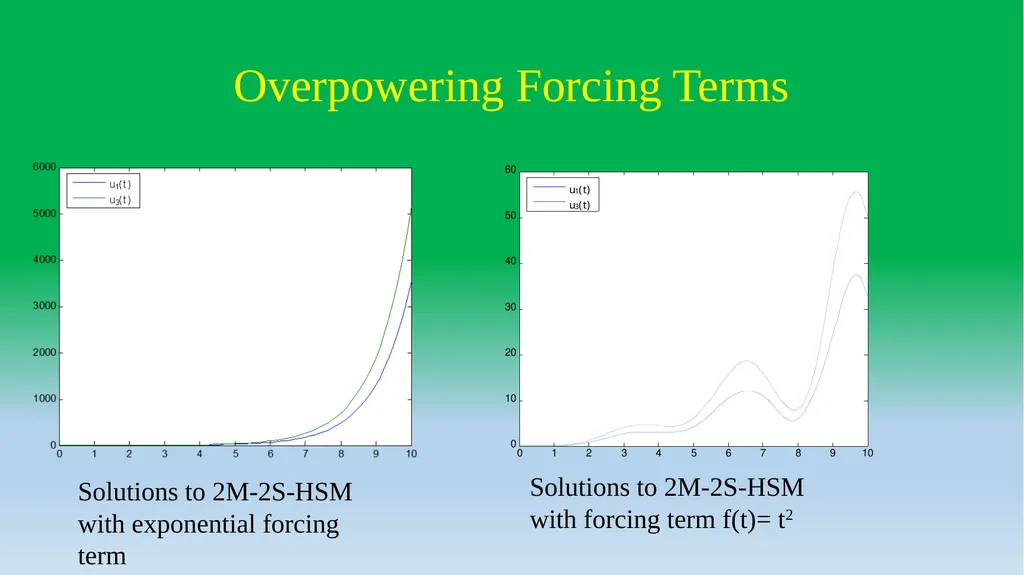
Overpowering Forcing Terms For the non-homogenous models, are there forcing terms that can be prescribed to cause the displacement of the masses to grow in time (at least for finite time)? The answer is yes, and two examples of such forcing functions are f(t)=et and f(t)=tn where n is a natural number greater than or equal to 2. On the next slide are the graphs of solutions to 2M-2S-HSM with each of these forcing functions.<br>
36
Overpowering Forcing Terms Solutions to 2M-2S-HSM with exponential forcing term Solutions to 2M-2S-HSM with forcing term f(t)= t2<br>
37
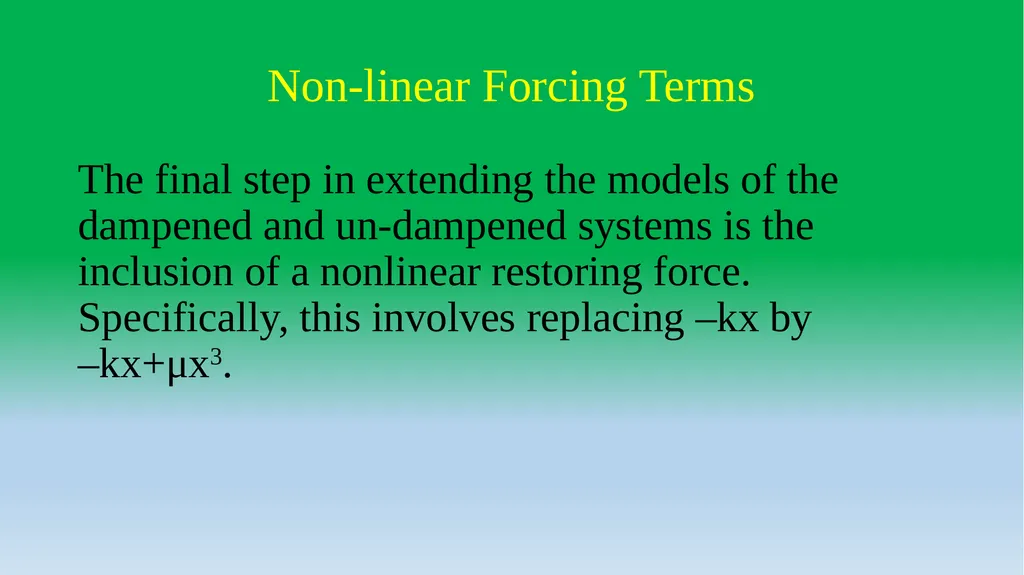
Non-linear Forcing Terms The final step in extending the models of the dampened and un-dampened systems is the inclusion of a nonlinear restoring force. Specifically, this involves replacing –kx by –kx+μx3.<br>
38
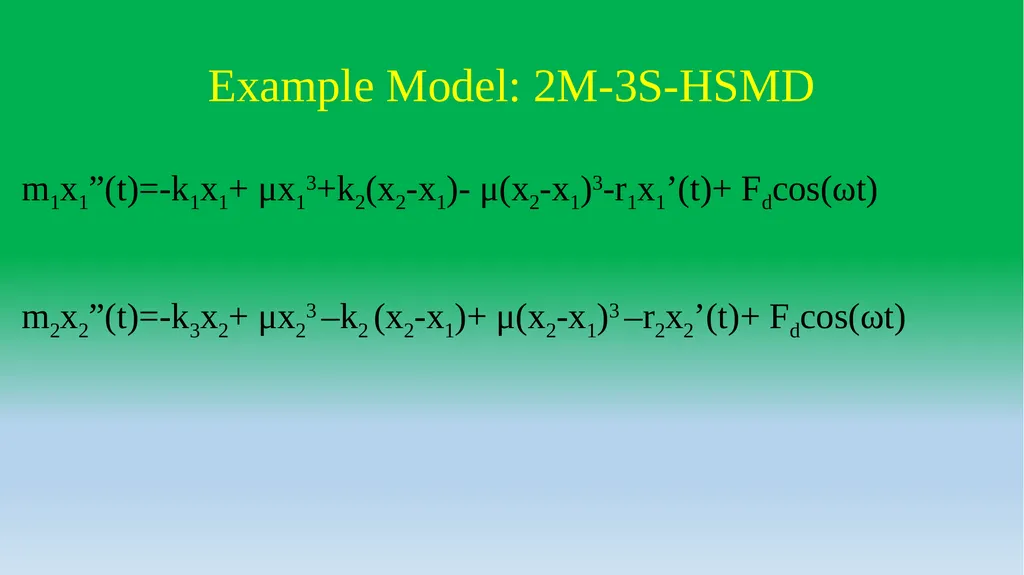
Example Model: 2M-3S-HSMD m1x1”(t)=-k1x1+ μx13+k2(x2-x1)- μ(x2-x1)3-r1x1’(t)+ Fdcos(ωt)
m2x2”(t)=-k3x2+ μx23 –k2 (x2-x1)+ μ(x2-x1)3 –r2x2’(t)+ Fdcos(ωt)<br>
m2x2”(t)=-k3x2+ μx23 –k2 (x2-x1)+ μ(x2-x1)3 –r2x2’(t)+ Fdcos(ωt)<br>
39
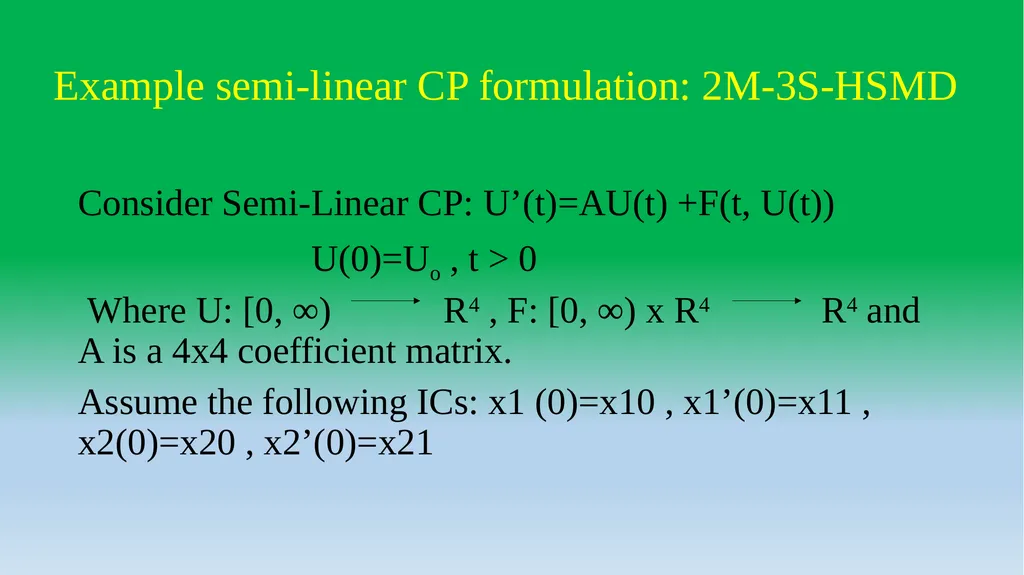
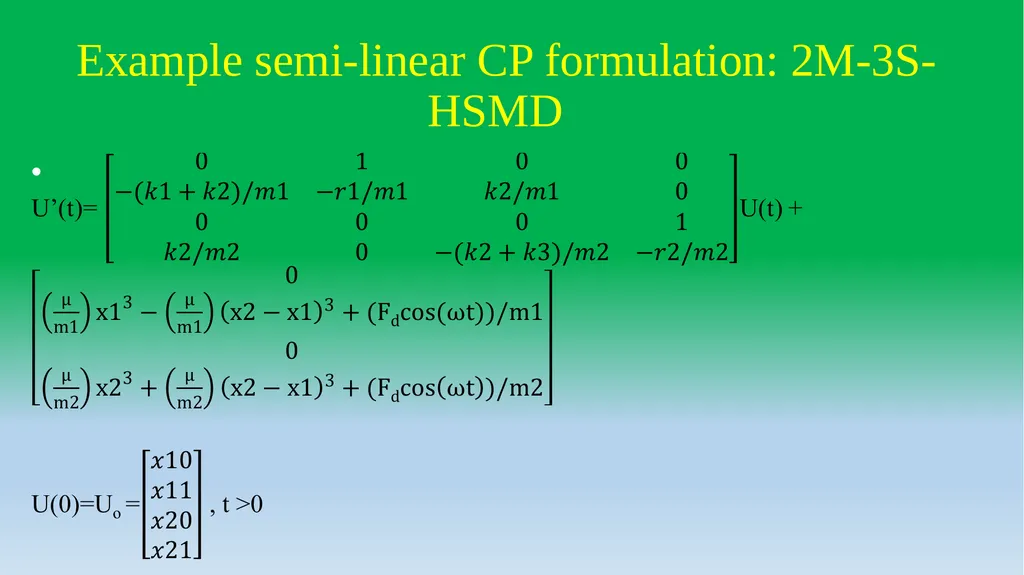
Example semi-linear CP formulation: 2M-3S-HSMD Consider Semi-Linear CP: U’(t)=AU(t) +F(t, U(t))
U(0)=Uo , t > 0
Where U: [0, ∞) R4 , F: [0, ∞) x R4 R4 and A is a 4x4 coefficient matrix.
Assume the following ICs: x1 (0)=x10 , x1’(0)=x11 , x2(0)=x20 , x2’(0)=x21<br>
U(0)=Uo , t > 0
Where U: [0, ∞) R4 , F: [0, ∞) x R4 R4 and A is a 4x4 coefficient matrix.
Assume the following ICs: x1 (0)=x10 , x1’(0)=x11 , x2(0)=x20 , x2’(0)=x21<br>
40
Example semi-linear CP formulation: 2M-3S-HSMD<br>