Modernisation theories The linear view of democracy as end point of modernisation Democracy could only be possible after passing some threshold of development The trade-off view The sacrifices view Blood sweat and tears or the BLAST
"Modernisation theories The linear view of" is the property of its rightful owner. Permission is granted to
download and print the materials on this website for personal, non-commercial use only, and to display it
on your personal computer provided you do not modify the materials and that you retain all copyright
notices contained in the materials. By downloading content from our website, you accept the terms of this
agreement.
Presentation Transcript
01
Modernisation theories The linear view of democracy as end point of modernisation
Democracy could only be possible after passing some threshold of development
The trade-off view
The "sacrifices" view
"Blood sweat and tears" or the BLAST model - Amartya Sen
Fully Belly Thesis “People can’t eat democracy” Thandika Mkandawire, LSE London<br>
02
11/25/2015 Development versus Democracy Authoritarian advantage
Efficiency
Political Stability – national unity argument
Long-time perspective due to freedom from populist and myopic demands
Higher revenue collection capacity
Historical evidence of Developmental authoritarian regimes –
the India China comparison
The East Asian Miracle economies
The Soviet Exoerience<br>
03
11/25/2015<br>
04
Domestic Politics The nation-building quest for unity
Conflation of unity with uniformity
Overthrow of nationalist movements by military rulers
Authoritarian developmentalism:
“Silent: Development in Progress” Thandika Mkandawire, LSE London<br>
05
The Authoritarian advantage once again Interpretation of the role of developmental state as inherently authoritarian
The Pinochet and Chicago Boys link-up and the view that only authoritarian regimes could implement SAP
The developmental state literature was used to suggest that East Asia was following the correct path - development then democracy. Africans were seen as sequencing the process wrongly
Initial suspicion that democracy would undermine adjustment Thandika Mkandawire, LSE London<br>
06
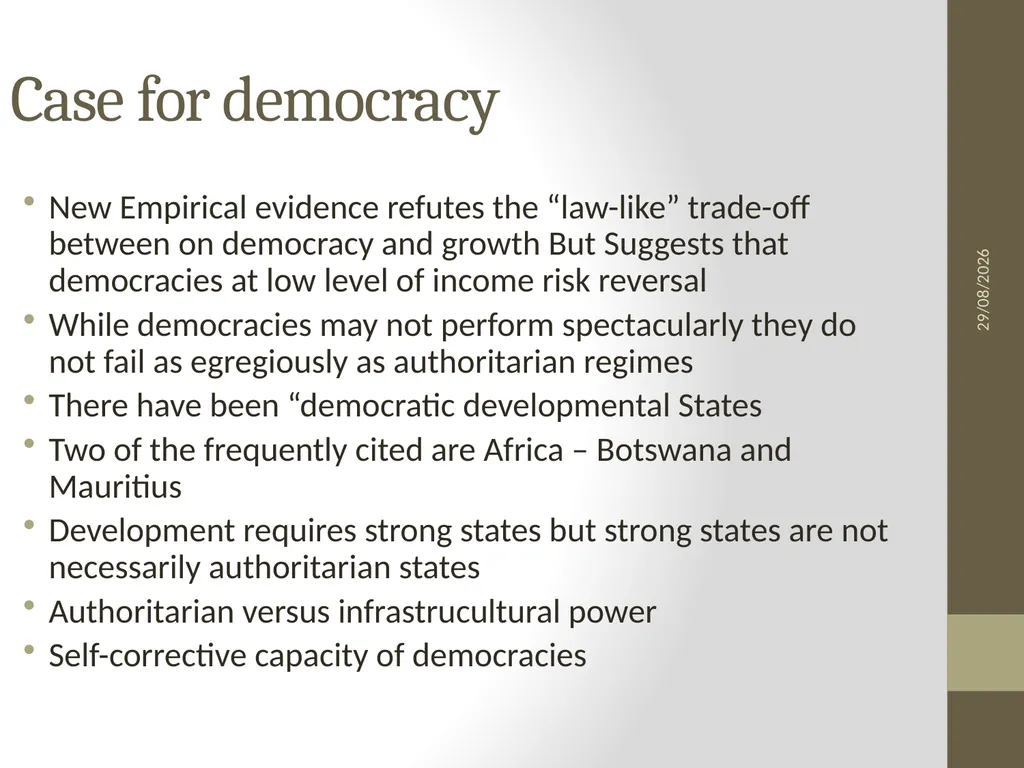
11/25/2015 Case for democracy New Empirical evidence refutes the “law-like” trade-off between on democracy and growth But Suggests that democracies at low level of income risk reversal
While democracies may not perform spectacularly they do not fail as egregiously as authoritarian regimes
There have been “democratic developmental States
Two of the frequently cited are Africa – Botswana and Mauritius
Development requires strong states but strong states are not necessarily authoritarian states
Authoritarian versus infrastrucultural power
Self-corrective capacity of democracies<br>
07
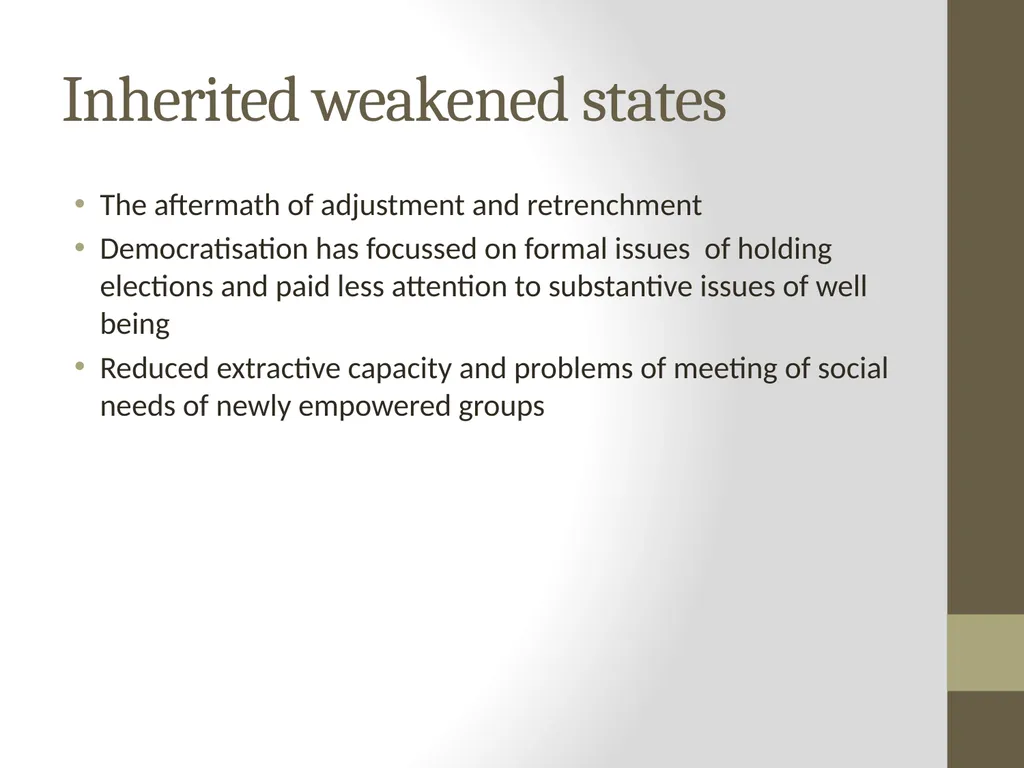
Inherited weakened states The aftermath of adjustment and retrenchment
Democratisation has focussed on formal issues of holding elections and paid less attention to substantive issues of well being
Reduced extractive capacity and problems of meeting of social needs of newly empowered groups<br>
08
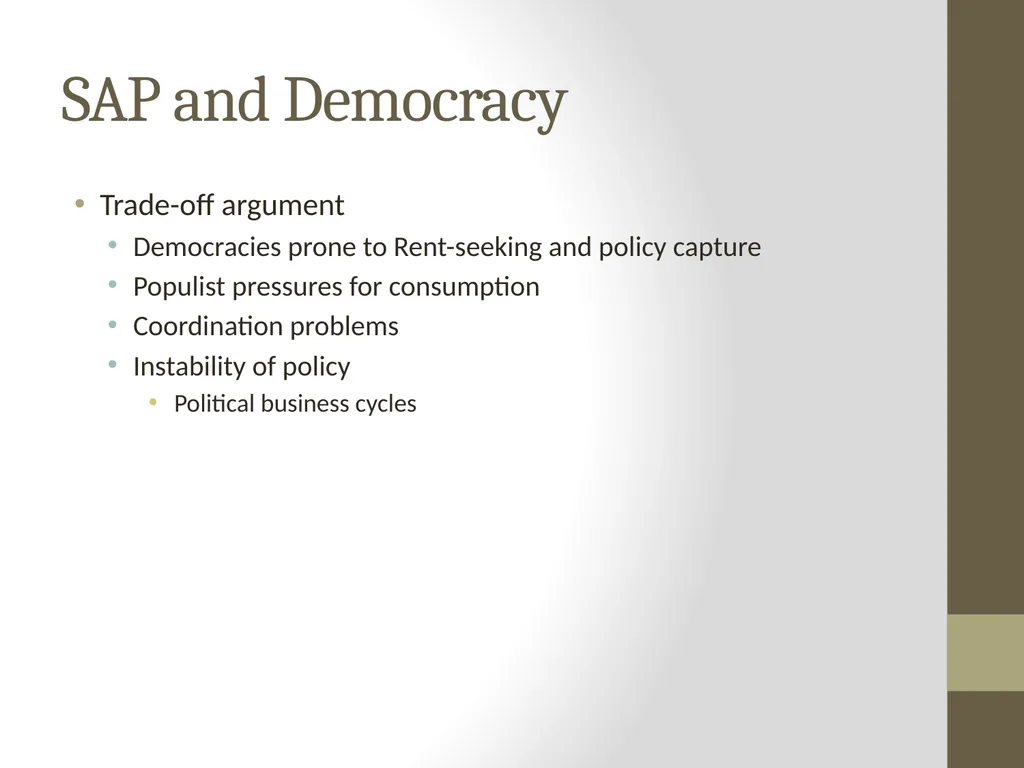
SAP and Democracy Trade-off argument
Democracies prone to Rent-seeking and policy capture
Populist pressures for consumption
Coordination problems
Instability of policy
Political business cycles<br>
09
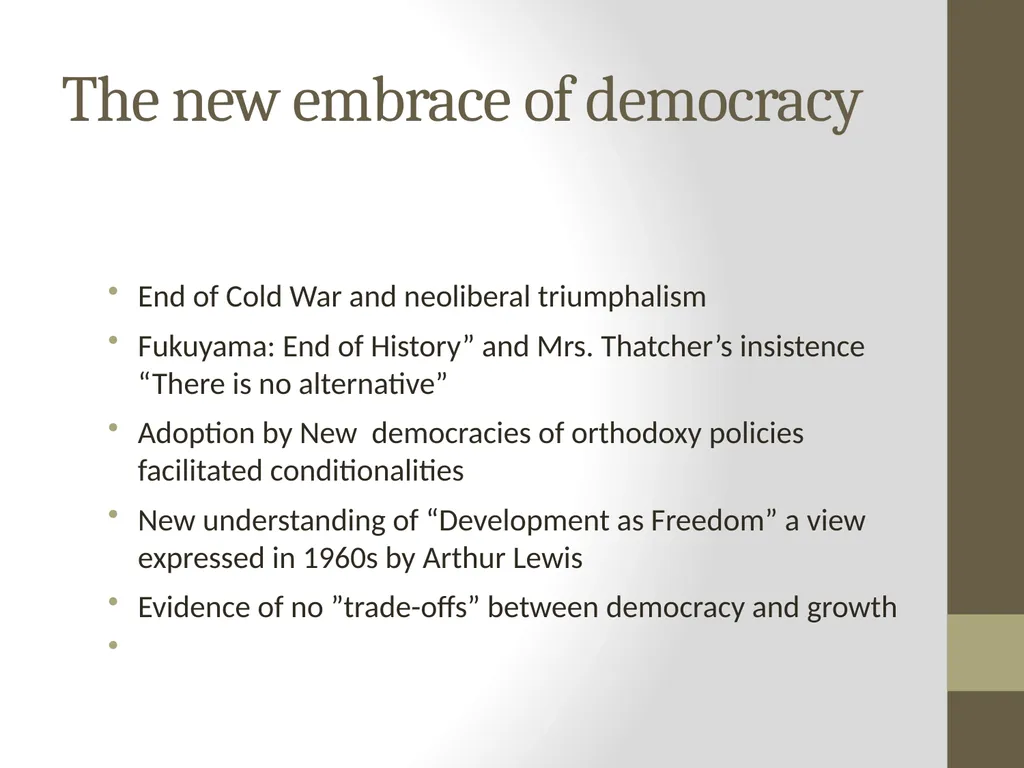
The new embrace of democracy End of Cold War and neoliberal triumphalism
Fukuyama: End of History” and Mrs. Thatcher’s insistence “There is no alternative”
Adoption by New democracies of orthodoxy policies facilitated conditionalities
New understanding of “Development as Freedom” a view expressed in 1960s by Arthur Lewis
Evidence of no ”trade-offs” between democracy and growth Thandika Mkandawire, LSE London<br>
10
Ideological stance of new democracies Many were orthodox in reaction to the interventionism of their authoritarian predecessors
Some equated free markets with democracy
Although oppositions to orthodox policies played a major role, the political leadership that emerged were middle class in favour of markets
Some of these were former bureaucrats or politicians turned businessmen and women<br>
11
How are African democracies doing? They are generally doing better than their authoritarian predecessor
But are they doing better than their contemporaries?<br>
12
Many democracies are moving away from orthodox policies Over time democratic politics works against formulaic orthodox and tend to move context specific policies
Some of the new democracies are benefitting from the recent resource boom which renders the traction of conditionalities less effective
The shift from the more formalistic aspects of democracy towards substantive issues of social justice Thandika Mkandawire, LSE London<br>
13
The accumulation challenge In a capitalist economy high growth calls for high profitability
The challenge is to ensure that profits accruing to capitalists are productively and not consumes of repatriated
No clear “developmental pacts” have emerged<br>
14
Democracy and Growth Through the analysis of the latest economic and political data, which include up to 43 countries in sub-Saharan Africa for the period of 1982-2012, they find strong evidence that democracy is positively associated with economic growth
And that this ‘democratic advantage’ is more pronounced for those African countries that haveremained democratic for longer periods of time
.<br>
15
New challenges Over time democratic politics works against formulaic orthodox and tend to move context specific policies
Some of the new democracies are benefitting from the recent resource boom which renders the traction of conditionalities less effective
The shift from the more formalistic aspects of democracy towards substantive issues of social justice Thandika Mkandawire, LSE London<br>
16
Democracy is superior to autocracy only when structural factors, such as external threats or natural resource intensity, are not favorable to growth.
Conversely, where structural factors are conducive to growth, autocracies are likely to perform better or equally well as democracies.<br>