Modes of Collaboration Between BANKS NBFCs Services offered by banks and nbfcs Both Banks and NBFCs are important financial intermediaries which offer almost similar services to their respective customers such as loans and advances and
"Modes of Collaboration Between BANKS NBFC’s" is the property of its rightful owner. Permission is granted to
download and print the materials on this website for personal, non-commercial use only, and to display it
on your personal computer provided you do not modify the materials and that you retain all copyright
notices contained in the materials. By downloading content from our website, you accept the terms of this
agreement.
Presentation Transcript
01
Modes of Collaboration Between BANKS NBFC’s<br>
02
Services offered by banks and nbfc’s Both Banks and NBFC’s are important financial intermediaries which offer almost similar services to their respective customers such as loans and advances and other credit facilities.
However the key differences between a Banks and an NBFC is as follows:
NBFC’s cannot accept demand deposits
NBFC’s do not form part of the payment and settlement system and cannot issue cheques drawn on itself
Deposit insurance facility of DICGC is not available to depositors of NBFC’s, unlike in case of Banks.<br>
03
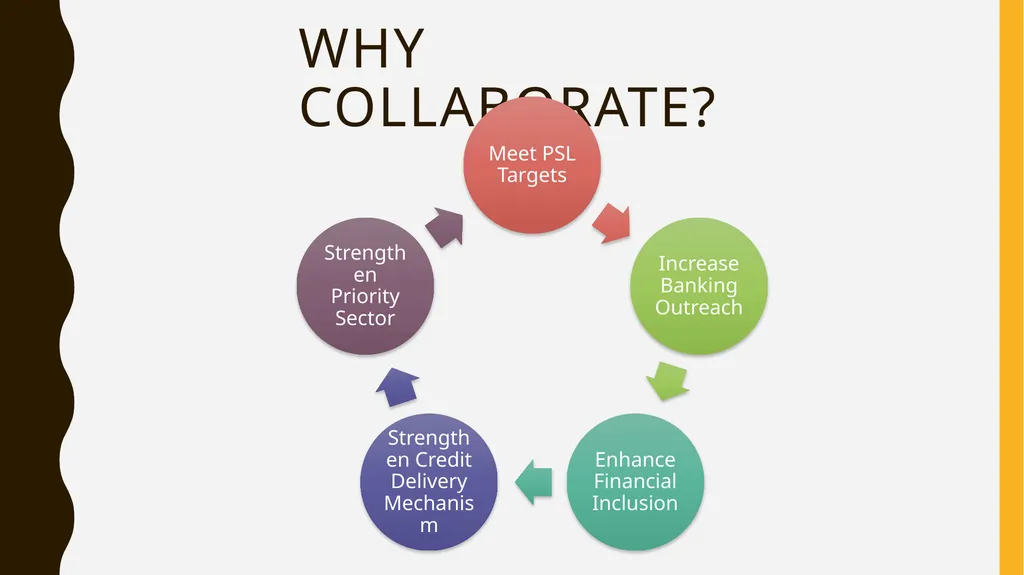
Why collaborate?<br>
04
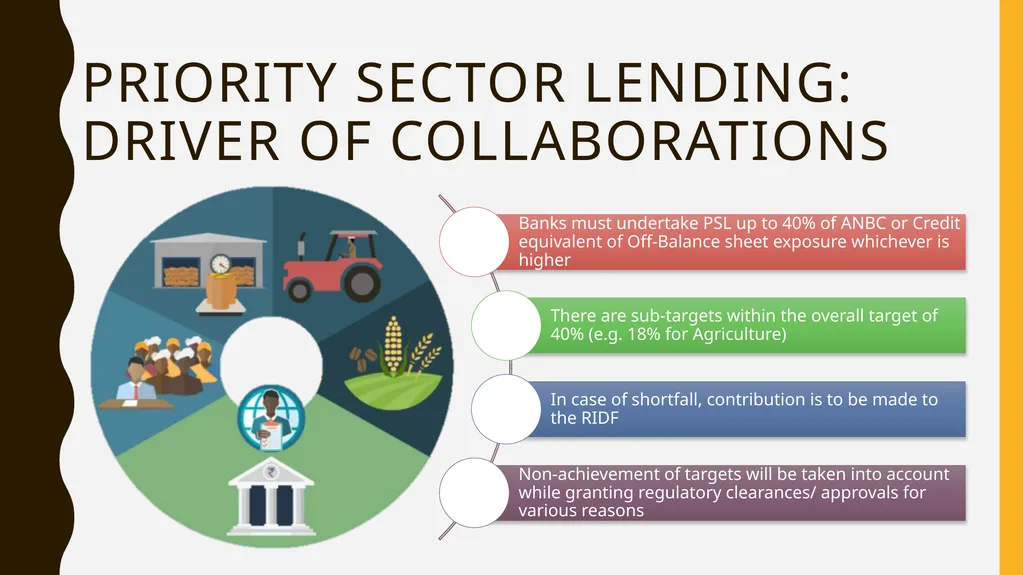
Priority sector lending: driver of collaborations<br>
05
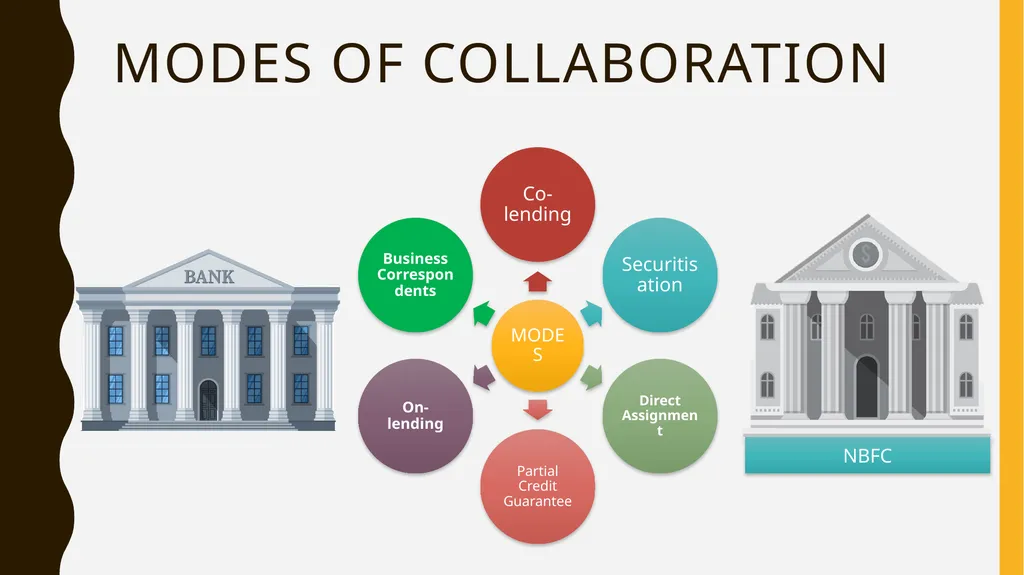
Modes of Collaboration NBFC<br>
06
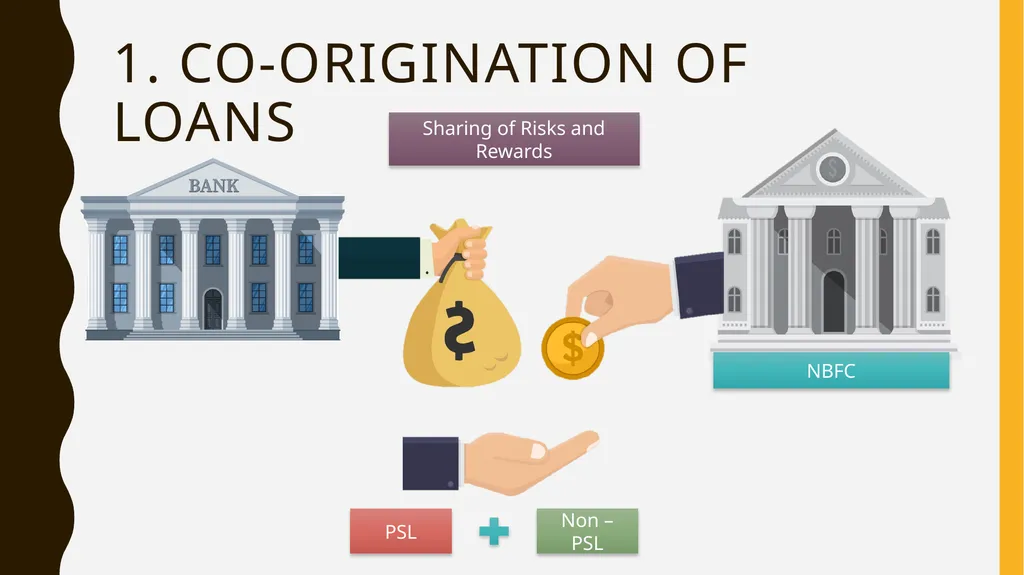
1. Co-origination of Loans Sharing of Risks and Rewards<br>
07
Non-Psl co-origination Done on the Basis of Mutually decided terms and conditions.
Must be a Tripartite Agreement between Bank, NBFC and Customer.
Agreement must include essential items such as interest rate.
Bank and NBFC may decide ratio of exposure.
Will be on books of the Bank and NBFC in their respective share of exposure.
Facilitates participation by both Bank and NBFC.
The whole idea is to have a rational and acceptable sharing of risk and rewards between the Bank and the NBFC.<br>
08
Co-origination guidelines for lending to the priority sector All SCB’s (excluding RRB’s and SFB) may co-originate loans with NBFC-ND-SI for PSL
Essential features of co-origination model:
Sharing of Risks and Rewards
Blended Interest Rate
KYC guidelines
Loan Sanction
Common Account
Monitoring & Recovery
Security and Charge Creation
Provisioning/Reporting requirement
Assignment/ Change in Loan Limits
Grievance Redressal
Business Continuity Planning<br>
09
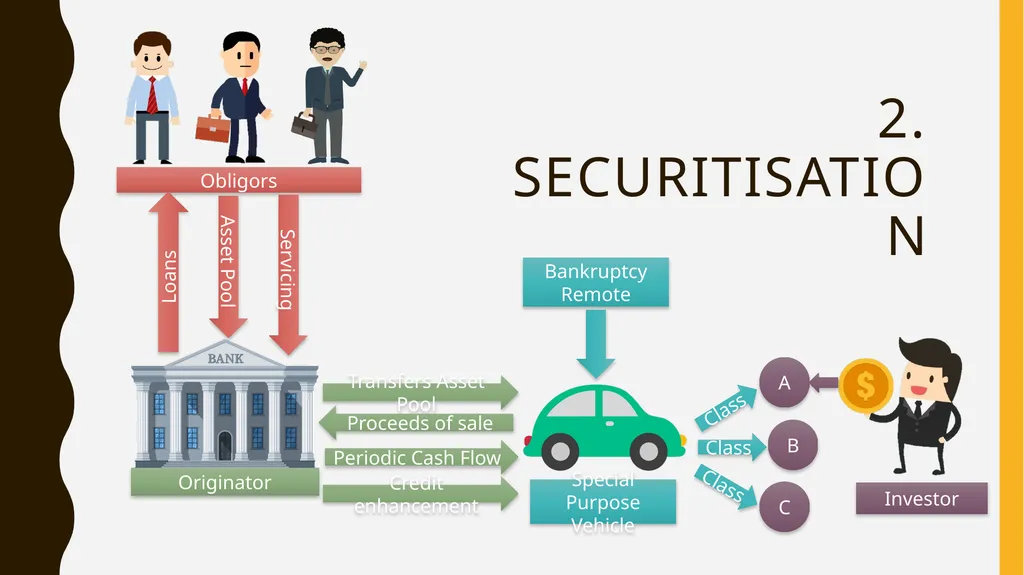
2. Securitisation Obligors Originator Special Purpose Vehicle Investor Loans Transfers Asset Pool Class Class Class A B C Servicing Proceeds of sale Periodic Cash Flow Credit enhancement Asset Pool Bankruptcy Remote<br>
10
Special purpose vehicle May either be a Company or Trust set up for a specific purpose:
(a) activities of which are limited to those for accomplishing the purpose of the company, trust or other entity as the case may be; and
(b) which is structured in a manner intended to isolate the corporation, trust or entity as the case may be, from the credit risk of an originator to make it bankruptcy remote;
SPV is thus ‘Bankruptcy Remote’
Any transaction between the originator and the SPV should be strictly on arm’s length basis.<br>
11
True sale True Sale = Essential Pre-requisite, in order to remove transferred assets from B/S of the originator.
If True Sale, Originator need not maintain capital against the value of assets transferred.
Sale should result in immediate legal separation of the originator from the assets.
Effective transfer of all risks/rewards and rights/obligations pertaining to the assets.
Should meet other criteria for true sale of assets.<br>
12
Credit enhancement facility Credit enhancement facilities include all arrangements provided to the SPV that could result in an originator absorbing losses of the SPV or its investors.
May be provided by the originator or third parties.
The facility is provided on an 'arm's length basis' on market terms and conditions, and subjected to the facility provider’s normal credit approval and review process.
The facility is limited to a specified amount and duration.<br>
13
Minimum holding period and minimum risk retention With a view to develop an orderly and healthy securitisation market and to align the interests of the originators and the investors, MHP and MRR were introduced.
Guidelines have been formulated for MHP and MRR.
Originators can securitise loans only after they have been held for a minimum period in their books.
The MRR is primarily designed to ensure that the originating banks have a continuing stake in the performance of securitised assets so as to ensure that they carry out proper due diligence of loans to be securitised.<br>
14
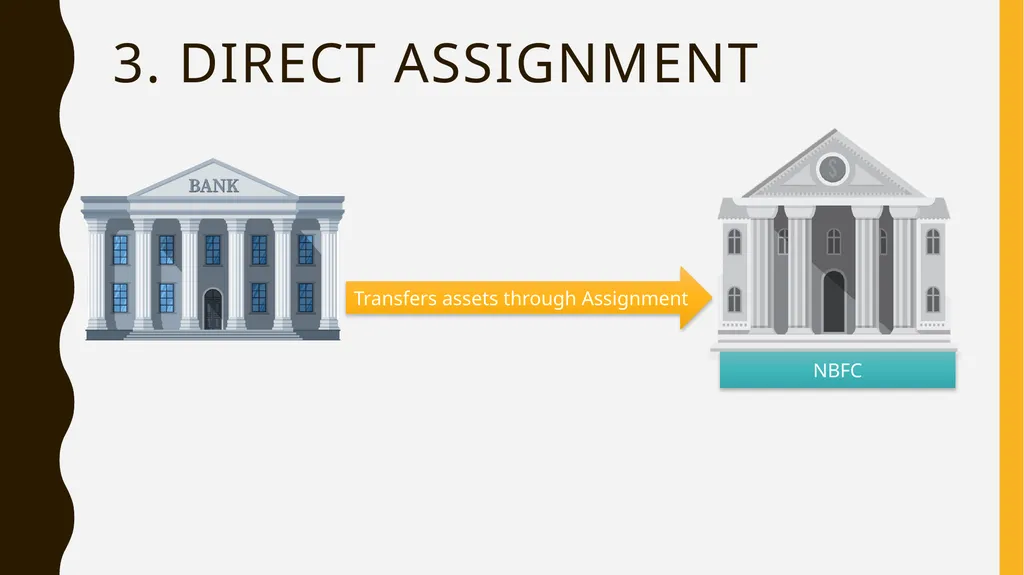
3. Direct assignment Transfers assets through Assignment NBFC<br>
15
Direct assignment guidelines Banks or NBFC’s can transfer a single standard asset or a part of such asset or a portfolio of such assets to financial entities through an assignment deed with the exception of the following:
(i) Revolving credit facilities (e.g. Cash Credit accounts, Credit Card receivables etc.)
(ii) Assets purchased from other entities
(iii) Assets with bullet repayment of both principal and interest
MHP is same as Securitisation, however MRR differs.<br>
16
4. Partial credit guarantee scheme This scheme is offered by the Government of India to Public Sector Banks for the purchase of high-rated (typically ‘AA’ or higher Rated) pool of assets from financially sound NBFC’s/ HFC’s.
The guarantee is provided by the Government of India and can be invoked by Banks in case of a default.
The Guarantee is given only for the assets that are standard assets in the books of the NBFCs as on the date of sale.
Also, the Scheme comes with a first loss credit guarantee of up to 10% of the amount guaranteed.<br>
17
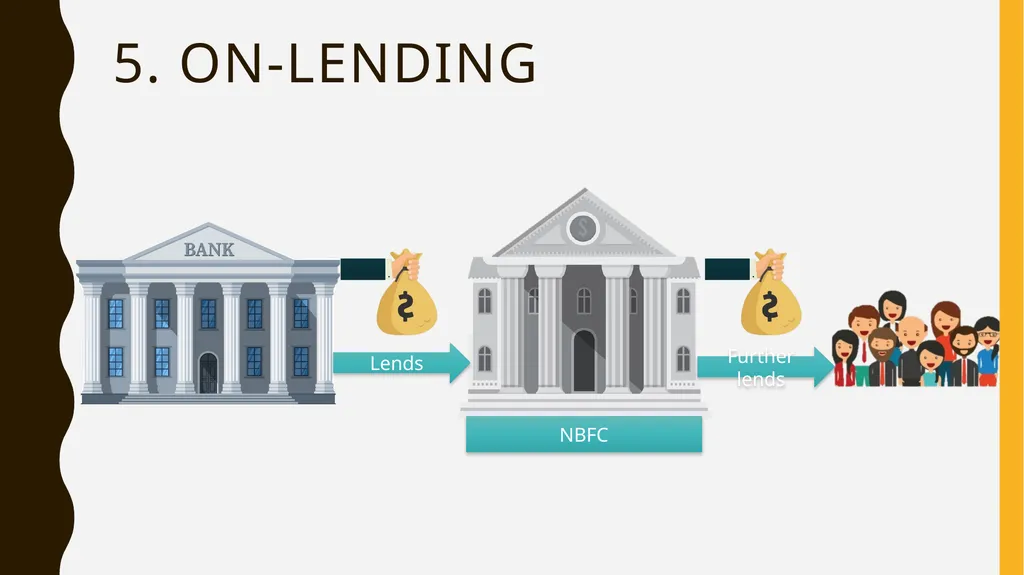
5. On-lending Lends Further lends NBFC<br>
18
On-lending to priority sector (Additional guidelines) In order to boost credit to the needy segment of borrowers, it has been decided that bank credit to registered NBFCs (other than MFIs) for on-lending will be eligible for classification as priority sector under respective categories subject to the following conditions:
Agriculture: On-lending by NBFCs for ‘Term lending’ component under Agriculture will be allowed up to ₹ 10 lakh per borrower.
Micro & Small enterprises: On-lending by NBFC will be allowed up to ₹ 20 lakh per borrower.
Housing: Enhancement of the existing limits for on-lending by HFCs vide para 10.5 of our Master Direction on Priority Sector lending, from ₹ 10 lakh per borrower to ₹ 20 lakh per borrower.<br>
19
6. Business correspondents Business Correspondents are retail agents engaged by banks for providing banking services at locations other than a bank branch/ATM.
Banks are required to take full responsibility for the acts of omission and commission of the BCs that they engage and have, therefore, to ensure thorough due diligence and additional safeguards for minimizing the agency risk.
Basically, BCs enable a bank to expand its outreach and offer limited range of banking services at low cost, as setting up a brick and mortar branch may not be viable in all cases.
BCs, thus, are an integral part of a business strategy for achieving greater financial inclusion.<br>
20
Guidelines for banks and nbfc’s All Domestic Commercial Banks (excluding RRB’s) may engage non-deposit taking NBFC’s (NBFCs-ND) as Business Correspondents subject to the following:
a) It should be ensured that there is no comingling of bank funds and those of the NBFC-ND appointed as BC.
b) There should be a specific contractual arrangement between the bank and the NBFC-ND to ensure that all possible conflicts of interest are adequately taken care of.
c) Banks should ensure that the NBFC-ND does not adopt any restrictive practice such as offering savings or remittance functions only to its own customers and forced bundling of services offered by the NBFC-ND and the bank does not take place.<br>