
Module 1 Preparatory Process in Wet Processing Ms.
MJ
Published · 46 slides · 0 views

1 / 1








Description
Module 1 Preparatory Process in Wet Processing Ms. Jissa Francis Department of Vocational Studies Wet Processing Wet processing is one of the most important part of textile processing. This process is applied on textile in form of liquid
Related Topics
Share
Embed code
Download this presentation From Below
"Module 1 Preparatory Process in Wet Processing Ms." is the property of its rightful owner. Permission is granted to download and print the materials on this website for personal, non-commercial use only, and to display it on your personal computer provided you do not modify the materials and that you retain all copyright notices contained in the materials. By downloading content from our website, you accept the terms of this agreement.
Presentation Transcript
01
Module 1 Preparatory Process in Wet Processing Ms. Jissa Francis
Department of Vocational Studies<br>
Department of Vocational Studies<br>
02
Wet Processing Wet processing is one of the most important part of textile processing.
This process is applied on textile in form of liquid with involves some for chemical action on the textile.
Bleaching, dyeing, printing etc. are the parts of wet processing.<br>
This process is applied on textile in form of liquid with involves some for chemical action on the textile.
Bleaching, dyeing, printing etc. are the parts of wet processing.<br>
03
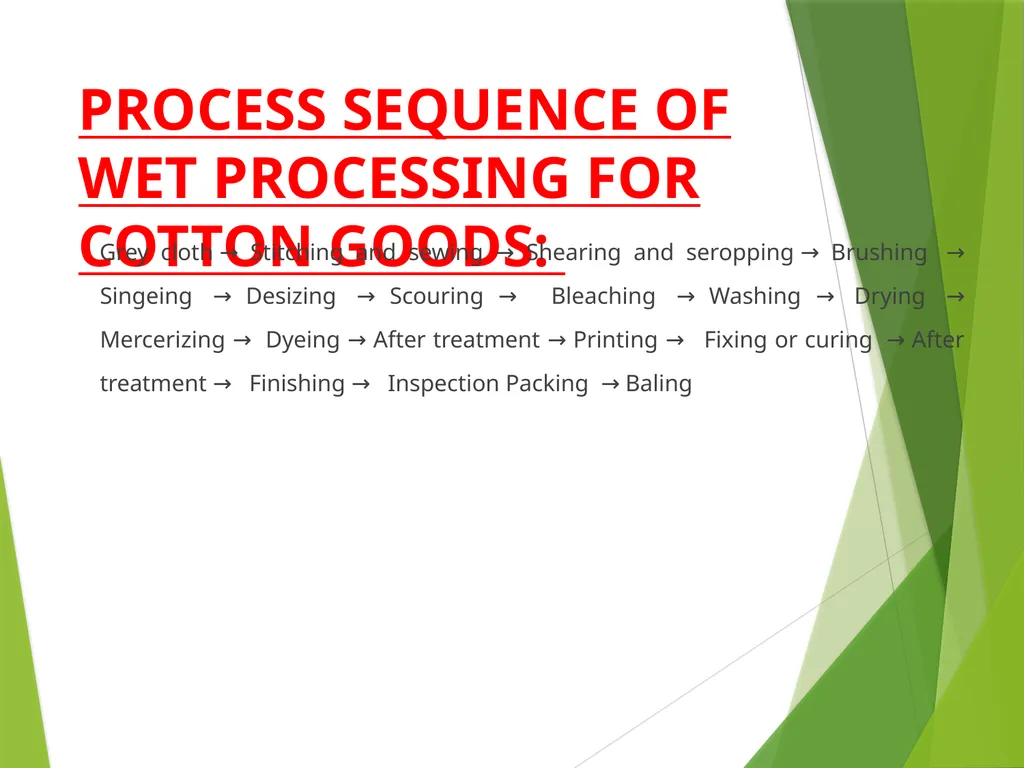
PROCESS SEQUENCE OF WET PROCESSING FOR COTTON GOODS: Grey cloth → Stitching and sewing → Shearing and seropping → Brushing → Singeing → Desizing → Scouring → Bleaching → Washing → Drying → Mercerizing → Dyeing → After treatment → Printing → Fixing or curing → After treatment → Finishing → Inspection Packing → Baling<br>
04
Grey cloth
The undyed and unfinished cloth is called grey cloth.
Stitching and sewing
It is the process to join up several grey cloths on to wrappers beam to produce a continuous fabric stand for quick wet processing action. Sewing is a process to attach two or more parts of fabric by needle and threads.
Shearing and seropping
The process to cut out extra warp or weft end from the surface of fabric is known as shearing or seropping.<br>
The undyed and unfinished cloth is called grey cloth.
Stitching and sewing
It is the process to join up several grey cloths on to wrappers beam to produce a continuous fabric stand for quick wet processing action. Sewing is a process to attach two or more parts of fabric by needle and threads.
Shearing and seropping
The process to cut out extra warp or weft end from the surface of fabric is known as shearing or seropping.<br>
05
Brushing
It is a process to remove dirt and dust, small fibres and other additional substances by brush before singeing.
Singeing
The process by which the projecting of floating fibres stand out on the fabric surfaces are burnt off is known as singeing.
Desizing
The process to remove the sizing material from the fabric is known as desizing.<br>
It is a process to remove dirt and dust, small fibres and other additional substances by brush before singeing.
Singeing
The process by which the projecting of floating fibres stand out on the fabric surfaces are burnt off is known as singeing.
Desizing
The process to remove the sizing material from the fabric is known as desizing.<br>
06
Scouring
The process to remove the fats, oil and waxy substances and added other impurities by certain percent of alkali and which increases the absorbency power of the textile goods is known as scouring.
Bleaching
The process by which the natural color of a fibre can be removed and make the textile materials pure white and bright is known as bleaching.
Washing
To wash the textile materials.
Drying
After washing the textile material is then dried.<br>
The process to remove the fats, oil and waxy substances and added other impurities by certain percent of alkali and which increases the absorbency power of the textile goods is known as scouring.
Bleaching
The process by which the natural color of a fibre can be removed and make the textile materials pure white and bright is known as bleaching.
Washing
To wash the textile materials.
Drying
After washing the textile material is then dried.<br>
07
Mercerizing
It is the process in which the cotton materials are passed with 20-22% NaOH or 55-60% Tw (Towdel) concentrated of NaOH for 2-3 minutes at room temperature.
To increase the lustre of fabric.
Dyeing
The process by which a textile material is changed physically or chemically so that it looks mono uniform coloured is called dyeing.<br>
It is the process in which the cotton materials are passed with 20-22% NaOH or 55-60% Tw (Towdel) concentrated of NaOH for 2-3 minutes at room temperature.
To increase the lustre of fabric.
Dyeing
The process by which a textile material is changed physically or chemically so that it looks mono uniform coloured is called dyeing.<br>
08
Printing
Printing is one kind of dyeing though there are some basic difference between dyeing and printing. When different types of color used to make a particular design on the textile goods is called printing. Normally printing is performed on the textile goods in dry condition.
Fixing or curing
To fix up the dyestuff into the textile materials is known as fixing.
After treatment
The process which is used for proper and perfect dyeing action. As for example, in case of direct dye, after treatment is performed for increasing light fastness of dyed materials.<br>
Printing is one kind of dyeing though there are some basic difference between dyeing and printing. When different types of color used to make a particular design on the textile goods is called printing. Normally printing is performed on the textile goods in dry condition.
Fixing or curing
To fix up the dyestuff into the textile materials is known as fixing.
After treatment
The process which is used for proper and perfect dyeing action. As for example, in case of direct dye, after treatment is performed for increasing light fastness of dyed materials.<br>
09
Finishing
Finishing is a process to give the proper quality of textile materials at the end of the wet processing depending of the customers.
Inspection
Measuring, testing characteristics of a product or service and comparing those with specified requirement to determine comfortably is called inspection.
Packing
To pack the textile materials treated by polyethylene bag.
Baling
To bail the textile materials.<br>
Finishing is a process to give the proper quality of textile materials at the end of the wet processing depending of the customers.
Inspection
Measuring, testing characteristics of a product or service and comparing those with specified requirement to determine comfortably is called inspection.
Packing
To pack the textile materials treated by polyethylene bag.
Baling
To bail the textile materials.<br>
10
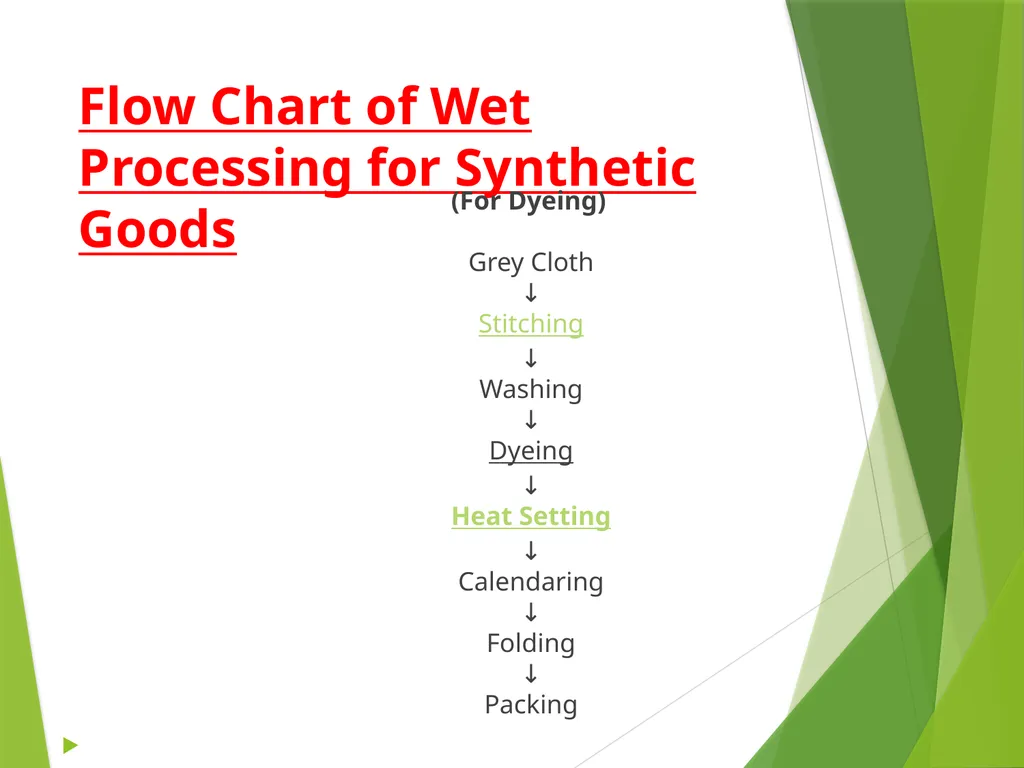
Flow Chart of Wet Processing for Synthetic Goods (For Dyeing)
Grey Cloth
↓
Stitching
↓
Washing
↓
Dyeing
↓
Heat Setting
↓
Calendaring
↓
Folding
↓
Packing<br>
11
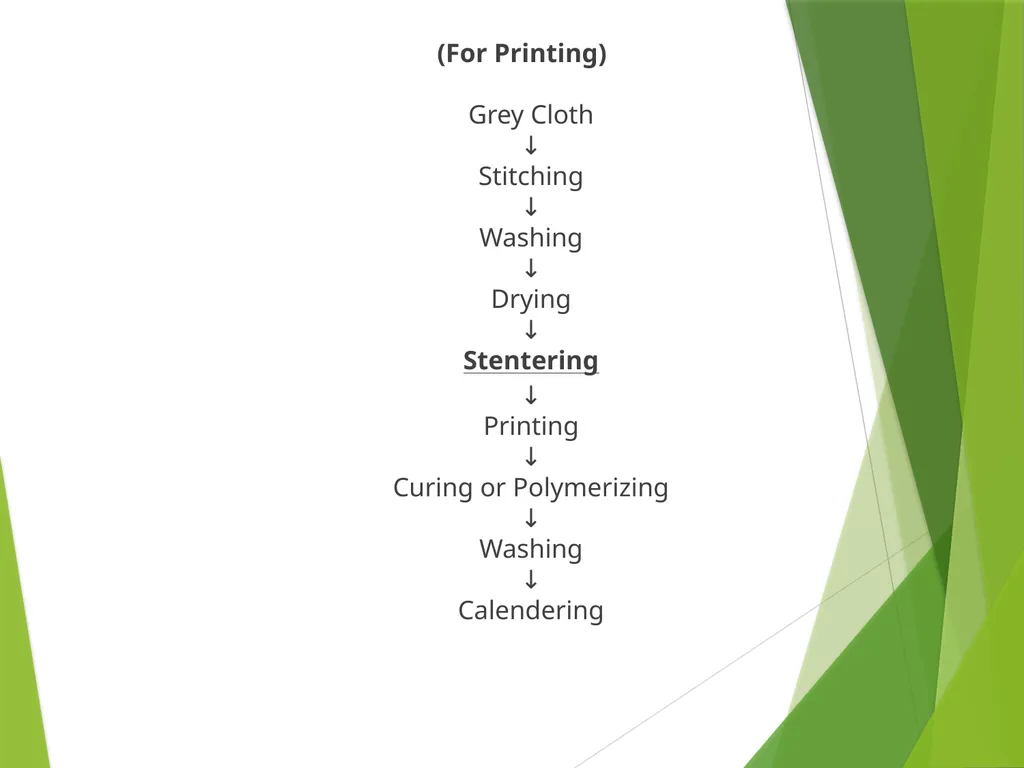
(For Printing)
Grey Cloth
↓
Stitching
↓
Washing
↓
Drying
↓
Stentering
↓
Printing
↓
Curing or Polymerizing
↓
Washing
↓
Calendering<br>
12
Grey cloth/fabric: The fabric which not yet dyed or finished is called grey fabric.
Stitching: It is the first working process of wet processing. Several number of fabric rolls are stitched to produce continuous fabric for preparing next process.
Washing: After stitching fabric are washed for preparing next process.
Heat setting: Heat-setting or thermosetting is a heat treatment applied to fabrics made of thermoplastic fibers such as polyester or Nylon to impart dimensional stability.<br>
Stitching: It is the first working process of wet processing. Several number of fabric rolls are stitched to produce continuous fabric for preparing next process.
Washing: After stitching fabric are washed for preparing next process.
Heat setting: Heat-setting or thermosetting is a heat treatment applied to fabrics made of thermoplastic fibers such as polyester or Nylon to impart dimensional stability.<br>
13
Dyeing: The process by which a textile material is changed physically or chemically so that it looks colorful is called dyeing.
Calendering: Calendering is a temporary finishing process used on fabric to give a smooth surface of cloth.
Stentering: Stentering is a mechanical finishing process of textile. It is widely used for stretching, drying, heat-setting and finishing of Fabrics.
Printing: It is one type of dyeing. Basic difference between dyeing and printing are dyeing is done by one color and printing is done by different color to produce specific design.
Curing: A process following application of a finish to textile fabrics in which appropriate conditions are used to effect a chemical reaction is called curing.<br>
Calendering: Calendering is a temporary finishing process used on fabric to give a smooth surface of cloth.
Stentering: Stentering is a mechanical finishing process of textile. It is widely used for stretching, drying, heat-setting and finishing of Fabrics.
Printing: It is one type of dyeing. Basic difference between dyeing and printing are dyeing is done by one color and printing is done by different color to produce specific design.
Curing: A process following application of a finish to textile fabrics in which appropriate conditions are used to effect a chemical reaction is called curing.<br>
14
Brushing The purpose of brushing/sue ding is to remove the short and loose fibres from the surface of the cloth.
It also removes husk particles clinging to the cloth. Brushing is mainly done to fabrics of staple fibre content, as filament yams usually do not have loose fibre ends.
Cylinders covered with fine bristles rotate over the fabric, pick up loose fibres, and pull them away by either gravity or vacuum.
The raised fibre ends are cut off during shearing operation. Brushing before cropping minimise pilling.<br>
It also removes husk particles clinging to the cloth. Brushing is mainly done to fabrics of staple fibre content, as filament yams usually do not have loose fibre ends.
Cylinders covered with fine bristles rotate over the fabric, pick up loose fibres, and pull them away by either gravity or vacuum.
The raised fibre ends are cut off during shearing operation. Brushing before cropping minimise pilling.<br>
15
Cropping and Shearing Shearing is an operation consists of cutting the loose strands of fibres from either surface of a fabric with a sharp edged razor or scissors.
By manipulating the shearing it is also possible to cut designs into pile fabrics.
Good cropping is perhaps, the simplest way of reducing the tendency of blended fabrics to 'pill'.
In the case of cotton fabrics, in particular, care should be taken to see that the shearing blades do not scratch the surface of the fabric, which otherwise can cause dyeing defects during subsequent dyeing.<br>
By manipulating the shearing it is also possible to cut designs into pile fabrics.
Good cropping is perhaps, the simplest way of reducing the tendency of blended fabrics to 'pill'.
In the case of cotton fabrics, in particular, care should be taken to see that the shearing blades do not scratch the surface of the fabric, which otherwise can cause dyeing defects during subsequent dyeing.<br>
16
Singeing The verb ‘singe’ literally means ‘to burn superficially’.
Singeing is a process, where loose hairy fibers are protruded from the surface of the cloth, fabric, and the yarn is removed by burning.
This is accomplished by passing the fibre or yarn over a gas flame or heated copper plates at a speed sufficient to burn away the protruding material without scorching or burning the yarn or fabric.<br>
Singeing is a process, where loose hairy fibers are protruded from the surface of the cloth, fabric, and the yarn is removed by burning.
This is accomplished by passing the fibre or yarn over a gas flame or heated copper plates at a speed sufficient to burn away the protruding material without scorching or burning the yarn or fabric.<br>
17
Enzymatic Desizing Enzymatic desizing is the classical desizing process of degrading starch size on cotton fabrics using enzymes.
Enzymes are complex organic, soluble bio-catalysts, formed by living organisms, that catalyze chemical reaction in biological processes.
Enzymes are quite specific in their action on a particular substance.
A small quantity of enzyme is able to decompose a large quantity of the substance it acts upon.
Enzymes are usually named by the kind of substance degraded in the reaction it catalyzes.<br>
Enzymes are complex organic, soluble bio-catalysts, formed by living organisms, that catalyze chemical reaction in biological processes.
Enzymes are quite specific in their action on a particular substance.
A small quantity of enzyme is able to decompose a large quantity of the substance it acts upon.
Enzymes are usually named by the kind of substance degraded in the reaction it catalyzes.<br>
18
Scouring The process to remove fats, oil, waxy substances and added other impurities by certain percentage of alkali treatment and which increases the absorbency power of textile material is called scouring.<br>
19
Objectives of Scouring To remove the oily, waxy and other additional impurities
To increase the absorbency of textile goods
To clean the fabric by alkali, soap, or detergent
To make the fabric suitable fro achieving good effect in dyeing and printing process.
To remove natural colour
To remove non- cellulosic substances in case of cotton.<br>
To increase the absorbency of textile goods
To clean the fabric by alkali, soap, or detergent
To make the fabric suitable fro achieving good effect in dyeing and printing process.
To remove natural colour
To remove non- cellulosic substances in case of cotton.<br>
20
Scouring Process Generally, there are 2 principal methods of scouring
Discontinuous method (kier boiling )
Continuous method ( Scouring in J box )<br>
Discontinuous method (kier boiling )
Continuous method ( Scouring in J box )<br>
21
Kier Boiling Process Kier boiling is a scouring process for cotton and linen in which the fibers are treated for removal of impurities by boiling with a 1% solution of caustic soda.
Its main purpose is to remove most of the natural impurities such as wax, wood fragments and oil stains.
Kier boiling process of cotton is performed in a kier boiler and the fabric is scoured in rope form by alkali liquor.
Kier is a large cylindrical iron vessel.
The kier may be open one as closed one and horizontal or vertical.<br>
Its main purpose is to remove most of the natural impurities such as wax, wood fragments and oil stains.
Kier boiling process of cotton is performed in a kier boiler and the fabric is scoured in rope form by alkali liquor.
Kier is a large cylindrical iron vessel.
The kier may be open one as closed one and horizontal or vertical.<br>
22
Open kier: Open kier is not an air tight kier and scouring temperature is 100°C for 24 hrs.
Closed kier: Closed kier is air tight. Scouring temperature is 120-130°C for 6 hrs.
Kier capacity: 200 kg – 5000 kg but industrially 2000 kg kiering is very popular.<br>
23
Standard recipe: The amount of different chemicals used in a kier boiling may vary according to Hardness of water
Quality / Quantity of cotton
Fabric construction / texture, yarn twist etc.<br>
Quality / Quantity of cotton
Fabric construction / texture, yarn twist etc.<br>
24
But in generally the following amounts of the chemicals are used: Caustic soda (Strong) → 2- 5% owf
Soda ash (mild) → 0.5 – 1.0%
Sequestering agent → 0.2-0.5%
Wetting agent + Detergent → 0.5-1.0%
M : L → 1:5 to 1:7
Temp → 100°C – 120°C
Time → 8 hr (100°C) – 2 hr (120°C)<br>
Soda ash (mild) → 0.5 – 1.0%
Sequestering agent → 0.2-0.5%
Wetting agent + Detergent → 0.5-1.0%
M : L → 1:5 to 1:7
Temp → 100°C – 120°C
Time → 8 hr (100°C) – 2 hr (120°C)<br>
25
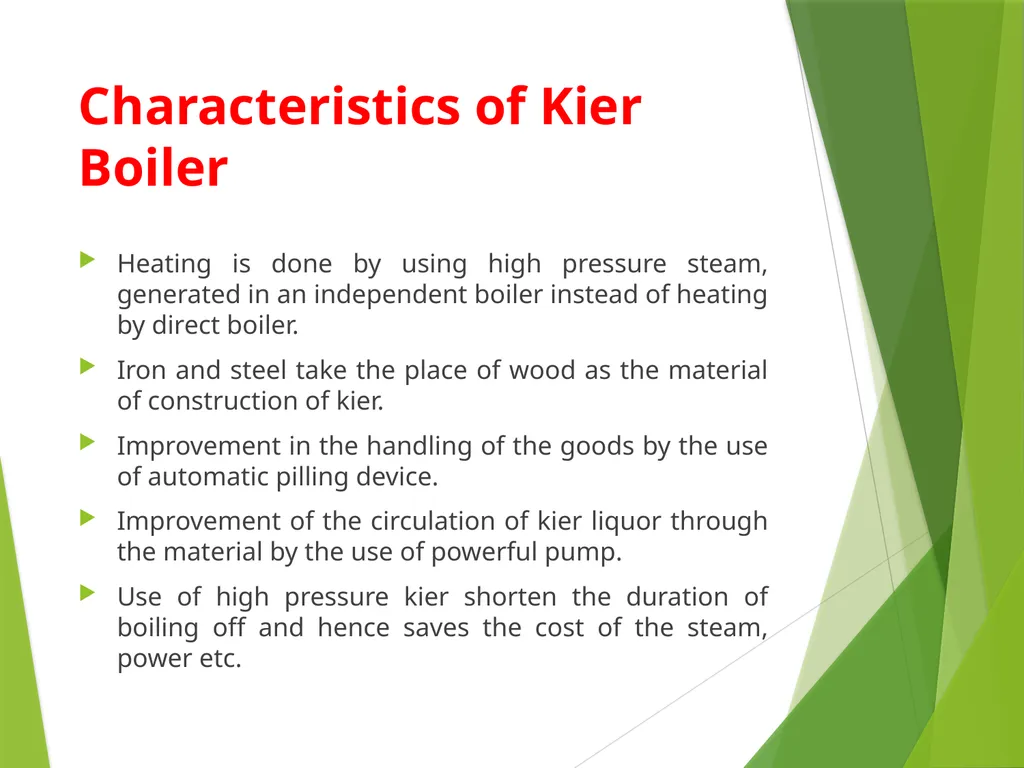
Characteristics of Kier Boiler Heating is done by using high pressure steam, generated in an independent boiler instead of heating by direct boiler.
Iron and steel take the place of wood as the material of construction of kier.
Improvement in the handling of the goods by the use of automatic pilling device.
Improvement of the circulation of kier liquor through the material by the use of powerful pump.
Use of high pressure kier shorten the duration of boiling off and hence saves the cost of the steam, power etc.<br>
Iron and steel take the place of wood as the material of construction of kier.
Improvement in the handling of the goods by the use of automatic pilling device.
Improvement of the circulation of kier liquor through the material by the use of powerful pump.
Use of high pressure kier shorten the duration of boiling off and hence saves the cost of the steam, power etc.<br>
26
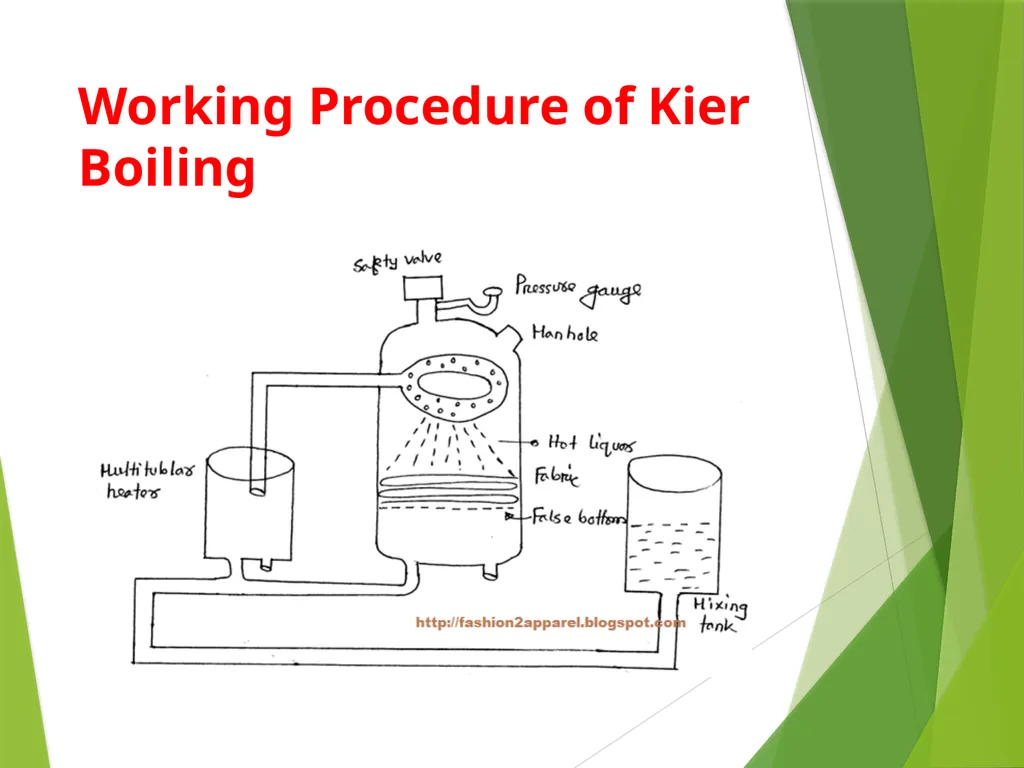
Working Procedure of Kier Boiling<br>
27
Kier boiler is provided two tubes. One is at the bottom and another is top.
There is one manhole for loading and unloading of sample.
Preheater is also provided at the middle of these two tubes.
The liquor is prepared into the mixing tank by above chemicals then it brought into the preheater and heated by the steam.
The fabric is loaded in the machine by man hole and kept in rope form.<br>
There is one manhole for loading and unloading of sample.
Preheater is also provided at the middle of these two tubes.
The liquor is prepared into the mixing tank by above chemicals then it brought into the preheater and heated by the steam.
The fabric is loaded in the machine by man hole and kept in rope form.<br>
28
Then the hot liquor is pumped and sprayed by spader plate onto the fabric which is packed into the kier.
The temperature of the liquor is about 100 oC and boiling for 8 hrs. the excess liquor passes slowly over the packed cloth and percolates through the false bottom of the kier.
Then this excess liquor is collect at the bottom of the kier and pumped into the auxiliary heater by a centrifugal pump and this cycle is repeat.
Below the false bottom the liquor is free from the oxygen of air.
After scouring, the fabric is washed with 80 oC water otherwise impurities on the fabric would not be removed.
Then the fabric is neutralizing with 0.1%-0.055 acetic acid. And then cold wash.<br>
The temperature of the liquor is about 100 oC and boiling for 8 hrs. the excess liquor passes slowly over the packed cloth and percolates through the false bottom of the kier.
Then this excess liquor is collect at the bottom of the kier and pumped into the auxiliary heater by a centrifugal pump and this cycle is repeat.
Below the false bottom the liquor is free from the oxygen of air.
After scouring, the fabric is washed with 80 oC water otherwise impurities on the fabric would not be removed.
Then the fabric is neutralizing with 0.1%-0.055 acetic acid. And then cold wash.<br>
29
Precaution Kier should be clean.
Material should be packed evenly.
No air pocket should be formed.
The fabric should be immersed in liquor completely.
After boiling the liquor should be removed in absence of water.
Before starting, all the joining parts should be checked.
The joint parts should be leak proof.
Before scouring, the fabric should be starch free.<br>
Material should be packed evenly.
No air pocket should be formed.
The fabric should be immersed in liquor completely.
After boiling the liquor should be removed in absence of water.
Before starting, all the joining parts should be checked.
The joint parts should be leak proof.
Before scouring, the fabric should be starch free.<br>
30
Advantages of kier boiling process:
Material scoured well.
Remove most of the natural color and another adventitious.
Disadvantages of kier boiling process:
Failure of pressure gauge, boiler may brust.<br>
Material scoured well.
Remove most of the natural color and another adventitious.
Disadvantages of kier boiling process:
Failure of pressure gauge, boiler may brust.<br>
31
J Box/ Continuous Process Scouring in J box
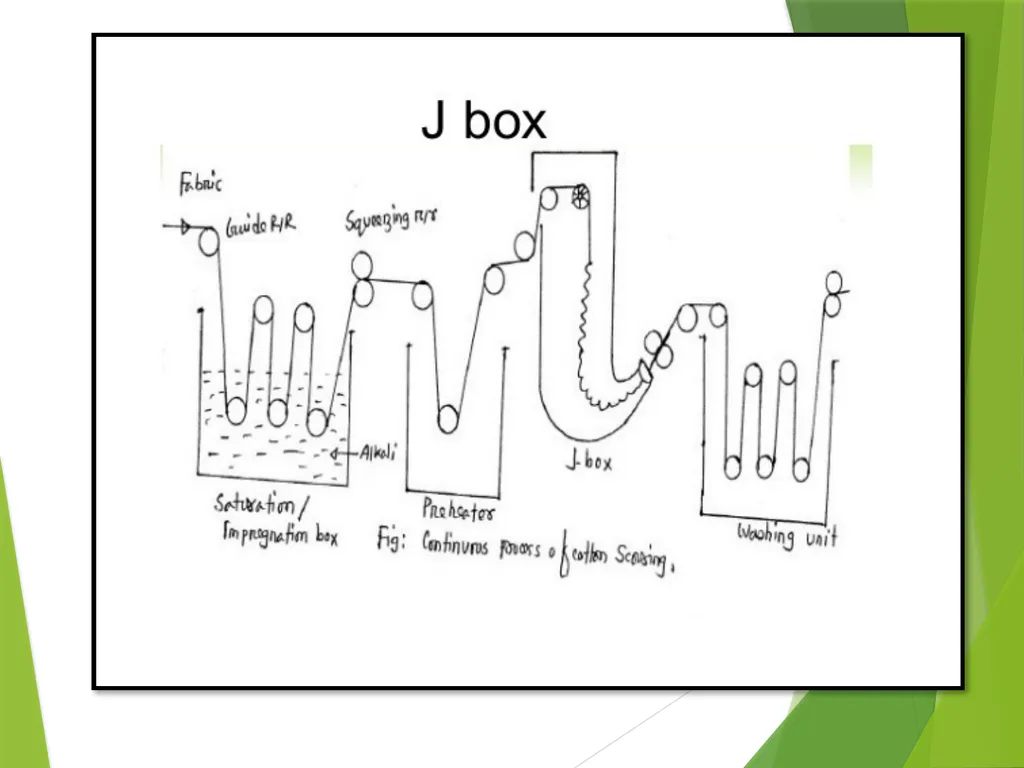
in continuous process J box is used for cotton scouring. It looks like English letter J so it is called J box. In J box cotton is scoured open width and rope form.
General recipe of scouring in J Box
Alkali – 4 to 6 g/l
Wetting agent – 4 to 5 g/l
Sequestering agent – 3 to 4 g/l
Detergent – 1 to 2 g/l<br>
in continuous process J box is used for cotton scouring. It looks like English letter J so it is called J box. In J box cotton is scoured open width and rope form.
General recipe of scouring in J Box
Alkali – 4 to 6 g/l
Wetting agent – 4 to 5 g/l
Sequestering agent – 3 to 4 g/l
Detergent – 1 to 2 g/l<br>
32
M:L – 1:3
Impregnation temperature – 70 to 800°C
Impregnation time : 40 to 90 second
Pick up : 90 to 100%
Storing time in J box : 1 to 2 hours
Temperature in J box : 98 to 102°C<br>
Impregnation temperature – 70 to 800°C
Impregnation time : 40 to 90 second
Pick up : 90 to 100%
Storing time in J box : 1 to 2 hours
Temperature in J box : 98 to 102°C<br>
33
Description and Working Principle The scouring process in J Box can be divided into four units. They are
Impregnation box
Pre – heater
J box
Washing unit<br>
Impregnation box
Pre – heater
J box
Washing unit<br>
34
Impregnation box
fabric is passed into impregnation box in open width form and through the guide rollers and padded by caustic soda and wetting agent.
Temperature fro impregnation should e maintained at 70 to 800°C for about 40 to 90 seconds.
Then the fabric is squeezed and passed onto the next unit.<br>
fabric is passed into impregnation box in open width form and through the guide rollers and padded by caustic soda and wetting agent.
Temperature fro impregnation should e maintained at 70 to 800°C for about 40 to 90 seconds.
Then the fabric is squeezed and passed onto the next unit.<br>
35
b) Pre-heater
In this unit the material is passed to the thermostatic controlling system at temperature of about 90 to 100°C fro about 30 seconds.
Then the material is passed to the J Box
c) J box
In J box, fabric is stored in this solution of NaOH for about 30 minutes at a temperature of 100°C.
The capacity of normal J box is about 12000 to 15000 pounds.
The material from the J box is passed to the washing unit passing through squeeze roller<br>
In this unit the material is passed to the thermostatic controlling system at temperature of about 90 to 100°C fro about 30 seconds.
Then the material is passed to the J Box
c) J box
In J box, fabric is stored in this solution of NaOH for about 30 minutes at a temperature of 100°C.
The capacity of normal J box is about 12000 to 15000 pounds.
The material from the J box is passed to the washing unit passing through squeeze roller<br>
36
d) Washing unit
The water soluble impurities or products that were left on the material are removed by washing.
First of all the material are washed in hot water at temperature above 800°C, then it is cold washed and finally dried.
Advantage
The process is a continuous process. So consumes less time.
The process is economical
Scouring, desizing and bleaching are performed at same time.
Disadvantage
The result of scouring is not good as compared with kier boiler.
The process is not hydrophilic as kier boiler.
Huge damage may occur due to power failure<br>
The water soluble impurities or products that were left on the material are removed by washing.
First of all the material are washed in hot water at temperature above 800°C, then it is cold washed and finally dried.
Advantage
The process is a continuous process. So consumes less time.
The process is economical
Scouring, desizing and bleaching are performed at same time.
Disadvantage
The result of scouring is not good as compared with kier boiler.
The process is not hydrophilic as kier boiler.
Huge damage may occur due to power failure<br>
37
Bleaching Bleaching is an important and essential step in pretreatment of Textiles.
It helps 'whiten' the textile material by removing undesired inherent coloring components.
Bleaching process can be defined as the destruction of natural colouring matter from the textile materials in order to achieve a clean white end product.<br>
It helps 'whiten' the textile material by removing undesired inherent coloring components.
Bleaching process can be defined as the destruction of natural colouring matter from the textile materials in order to achieve a clean white end product.<br>
38
Aim of Bleaching Removal of coloured impurities.
Removal of the seed coats.
Minimum tendering of fibre.
Increasing the degree of whiteness.
To increase dye affinity.
To make the fabric suitable for the next subsequent process.<br>
Removal of the seed coats.
Minimum tendering of fibre.
Increasing the degree of whiteness.
To increase dye affinity.
To make the fabric suitable for the next subsequent process.<br>
39
Bleaching Agent A bleaching agent is a substance that can whiten or decolorize other substances.
Bleaching agents essentially destroy chromophores (thereby removing the color), via the oxidation or reduction of these absorbing groups.
Types Of Textile Bleaching Agent
They are in two types as follows –
Oxidizing and
Reducing<br>
Bleaching agents essentially destroy chromophores (thereby removing the color), via the oxidation or reduction of these absorbing groups.
Types Of Textile Bleaching Agent
They are in two types as follows –
Oxidizing and
Reducing<br>
40
Oxidizing Bleaching Agent
The chemical agents which remove coloring material from textile materials by oxidizing reaction and make the material pure white and bright and to increase absorbency power is called oxidizing bleaching agent.
Eg. : Hydrogen peroxide, sodium hypochlorite
Generally natural vegetable fibres are bleached by these bleaching agents.
Reducing Bleaching Agent
The chemicals which removes coloring materials from textile materials by reduction reaction and make the material pure white and bright and increase absorbency power is called reducing bleaching agent. Eg. : hydrogen sulphide, sodium sulphide
Generally protein fibre i.e. silk, wool, etc. are bleached by these agents.<br>
The chemical agents which remove coloring material from textile materials by oxidizing reaction and make the material pure white and bright and to increase absorbency power is called oxidizing bleaching agent.
Eg. : Hydrogen peroxide, sodium hypochlorite
Generally natural vegetable fibres are bleached by these bleaching agents.
Reducing Bleaching Agent
The chemicals which removes coloring materials from textile materials by reduction reaction and make the material pure white and bright and increase absorbency power is called reducing bleaching agent. Eg. : hydrogen sulphide, sodium sulphide
Generally protein fibre i.e. silk, wool, etc. are bleached by these agents.<br>
41
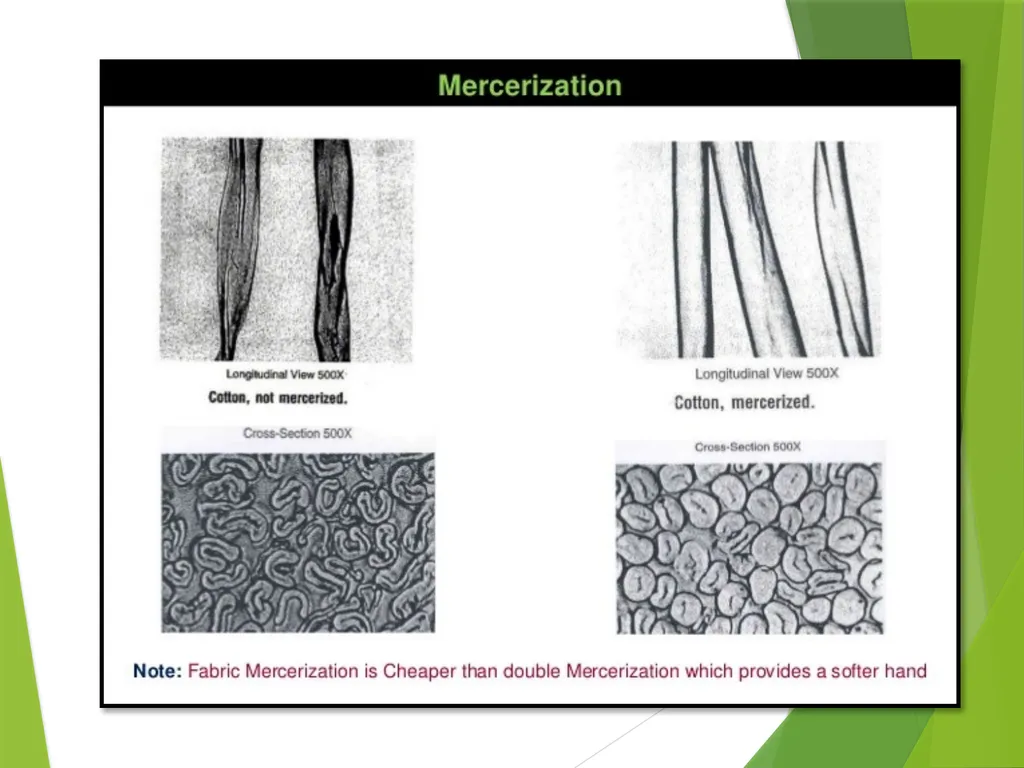
Mercerization Mercerization, the treatment of cotton with a strong caustic alkaline solution in order to improve the luster, hand and other properties, was named after its discoverer, John Mercer, and has been in use for some time.<br>
42
Mercerization Processing If cotton is dipped into a strong alkaline solution such as lithium hydroxide, caustic soda, or potassium hydroxide, the fibers will swell and shrink.
If the fibers are placed under tension while in this swollen state and then rinsed with water, the alkali will be removed and a permanent silk-like luster will result.
Alternatively, after swelling, if the alkali is rinsed off when the fiber is in its shrunk state, an increase in luster may not be discernable, but the fibers will fix in that shrunk state, thus giving good elasticity to external stress.<br>
If the fibers are placed under tension while in this swollen state and then rinsed with water, the alkali will be removed and a permanent silk-like luster will result.
Alternatively, after swelling, if the alkali is rinsed off when the fiber is in its shrunk state, an increase in luster may not be discernable, but the fibers will fix in that shrunk state, thus giving good elasticity to external stress.<br>
43
The former is known as tension mercerization and is often simply called mercerization, while the latter is referred to as slack mercerization. Due to considerations of cost and efficacy, only caustic soda is used as the alkali in industry.
The effects of mercerization
Improved luster
Increased ability to absorb dye
Improved reactions with a variety of chemicals
Improved stability of form
Improved strength/elongation
Improved smoothness<br>
The effects of mercerization
Improved luster
Increased ability to absorb dye
Improved reactions with a variety of chemicals
Improved stability of form
Improved strength/elongation
Improved smoothness<br>
44
Thank you<br>