Wet Granulation Wet Granulation The wet
Description: Wet Granulation Wet Granulation The wet granulation technique uses the same preparatory and finishing steps of direct compression and dry granulation (dry screening and mixing); it also involve additional steps of wet massing, wet screening
Related Topics
Download Presentation
"Wet Granulation Wet Granulation The wet" is the property of its rightful owner. Permission is granted to download and print the materials on this website for personal, non-commercial use only, and to display it on your personal computer provided you do not modify the materials and that you retain all copyright notices contained in the materials. By downloading content from our website, you accept the terms of this agreement.
Presentation Transcript
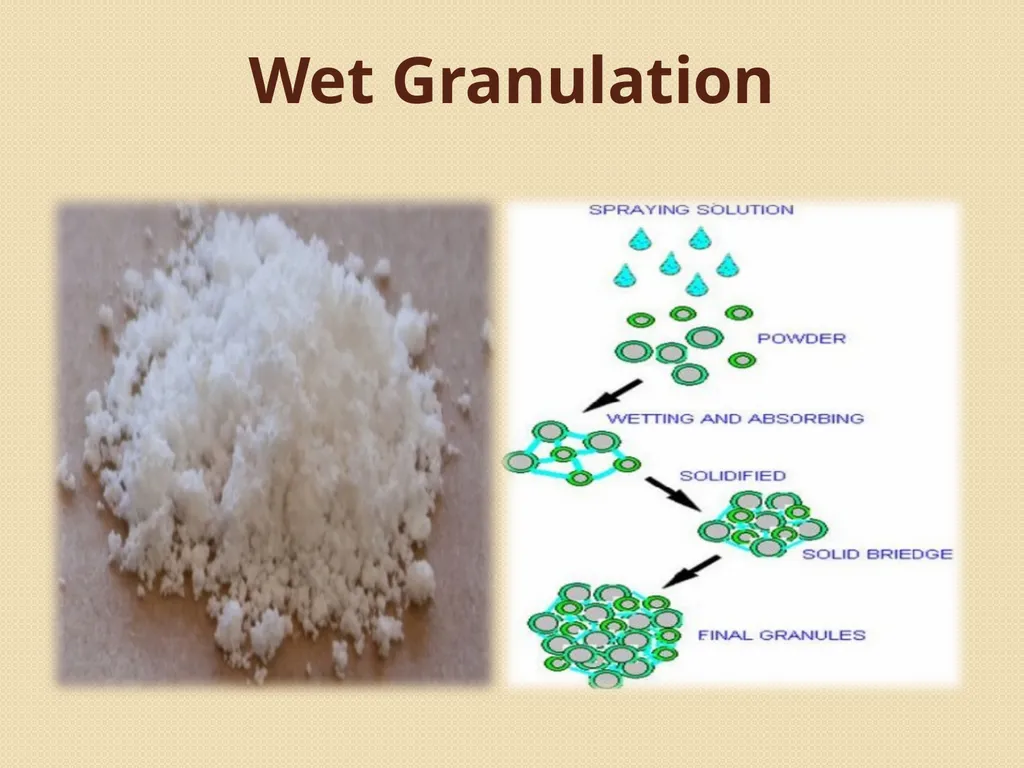
slide1. Wet Granulation<br>
slide2. Wet Granulation The wet granulation technique uses the same preparatory and finishing steps of direct compression and dry granulation (dry screening and mixing); it also involve additional steps of wet massing, wet screening and drying.<br>
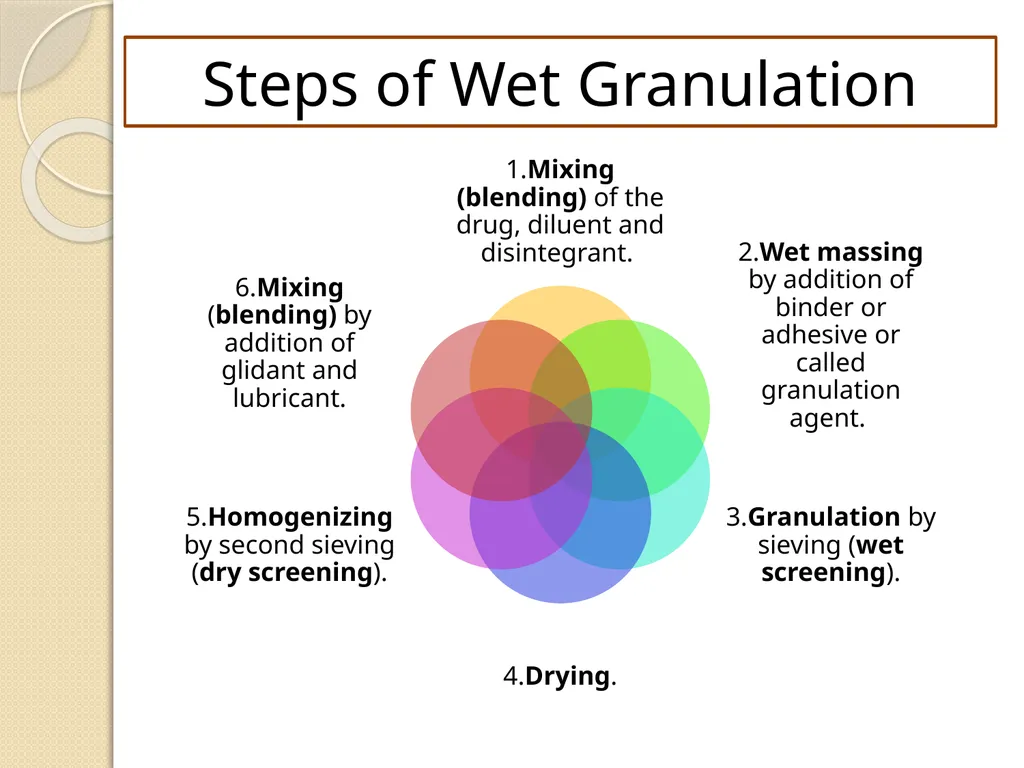
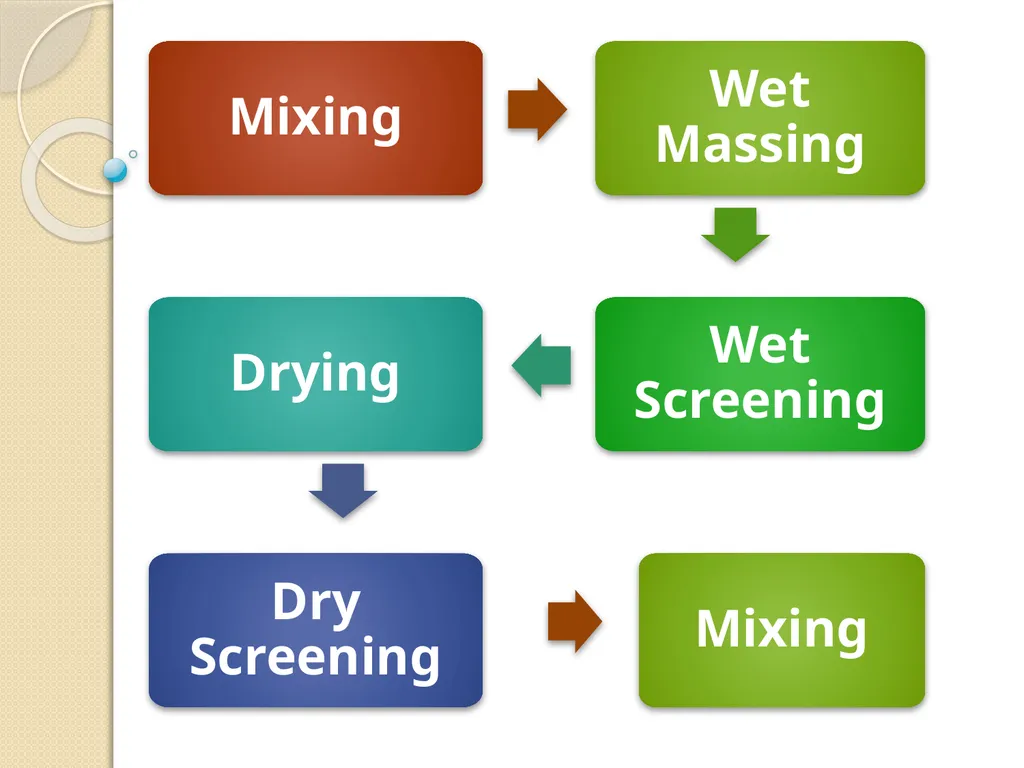
slide3. Steps of Wet Granulation<br>
slide4. Mixing<br>
slide5. 1- Mixing
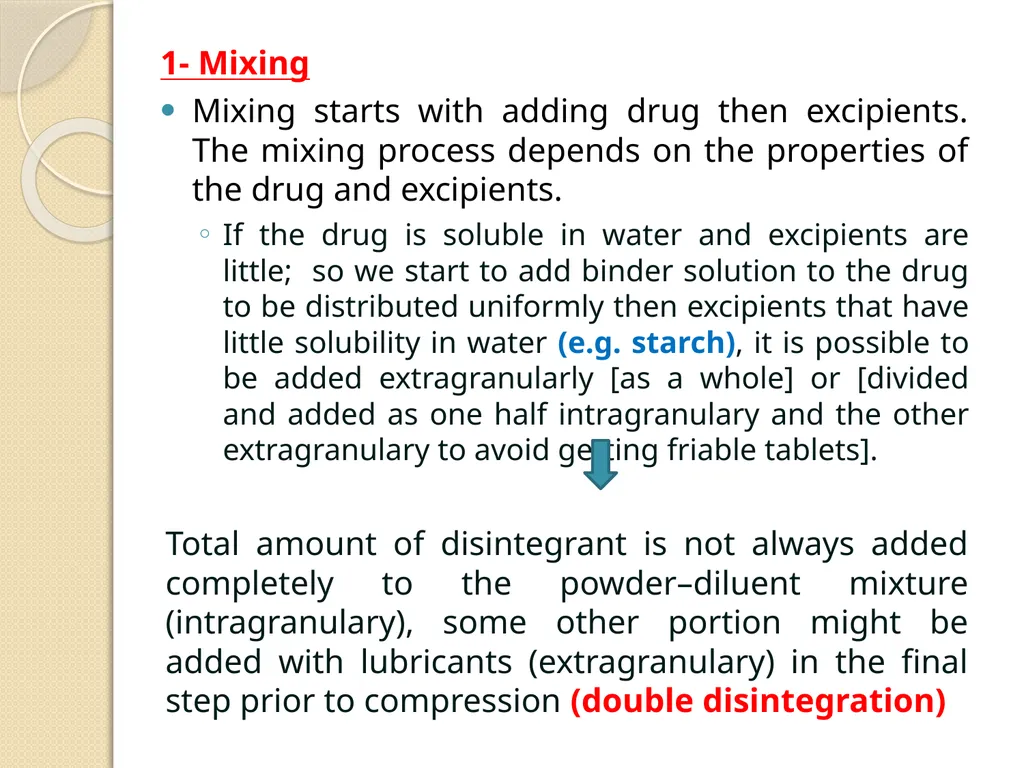
Mixing starts with adding drug then excipients. The mixing process depends on the properties of the drug and excipients.
If the drug is soluble in water and excipients are little; so we start to add binder solution to the drug to be distributed uniformly then excipients that have little solubility in water (e.g. starch), it is possible to be added extragranularly [as a whole] or [divided and added as one half intragranulary and the other extragranulary to avoid getting friable tablets].
Total amount of disintegrant is not always added completely to the powder–diluent mixture (intragranulary), some other portion might be added with lubricants (extragranulary) in the final step prior to compression (double disintegration)<br>
slide6. 2- Wet Massing
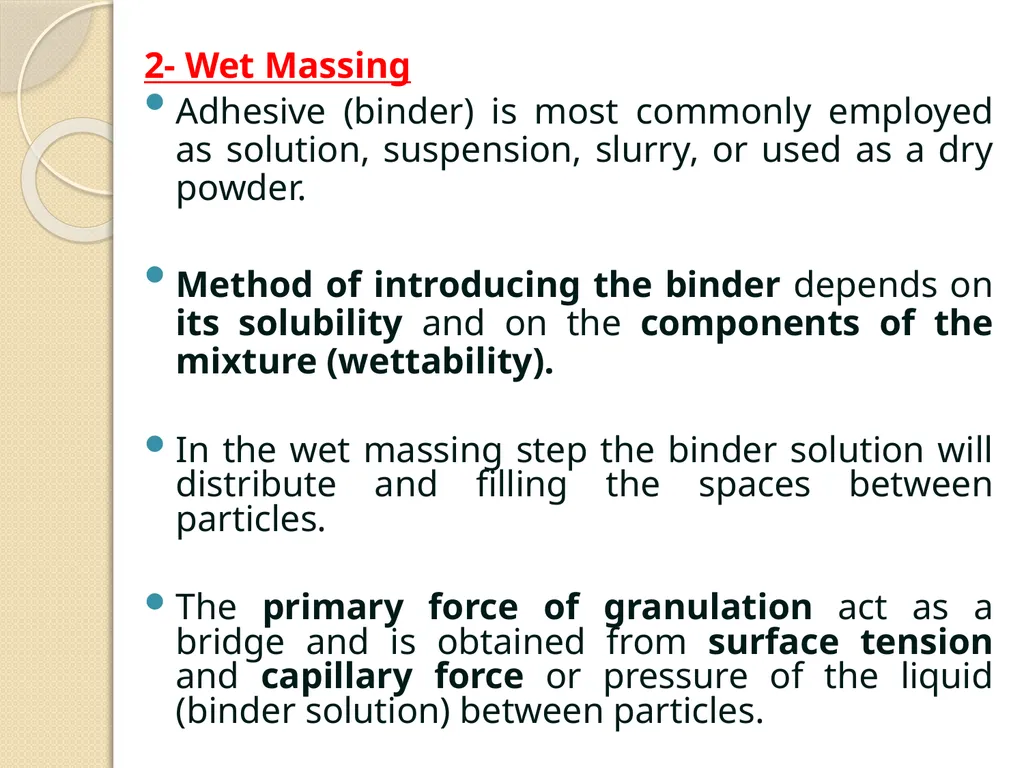
Adhesive (binder) is most commonly employed as solution, suspension, slurry, or used as a dry powder.
Method of introducing the binder depends on its solubility and on the components of the mixture (wettability).
In the wet massing step the binder solution will distribute and filling the spaces between particles.
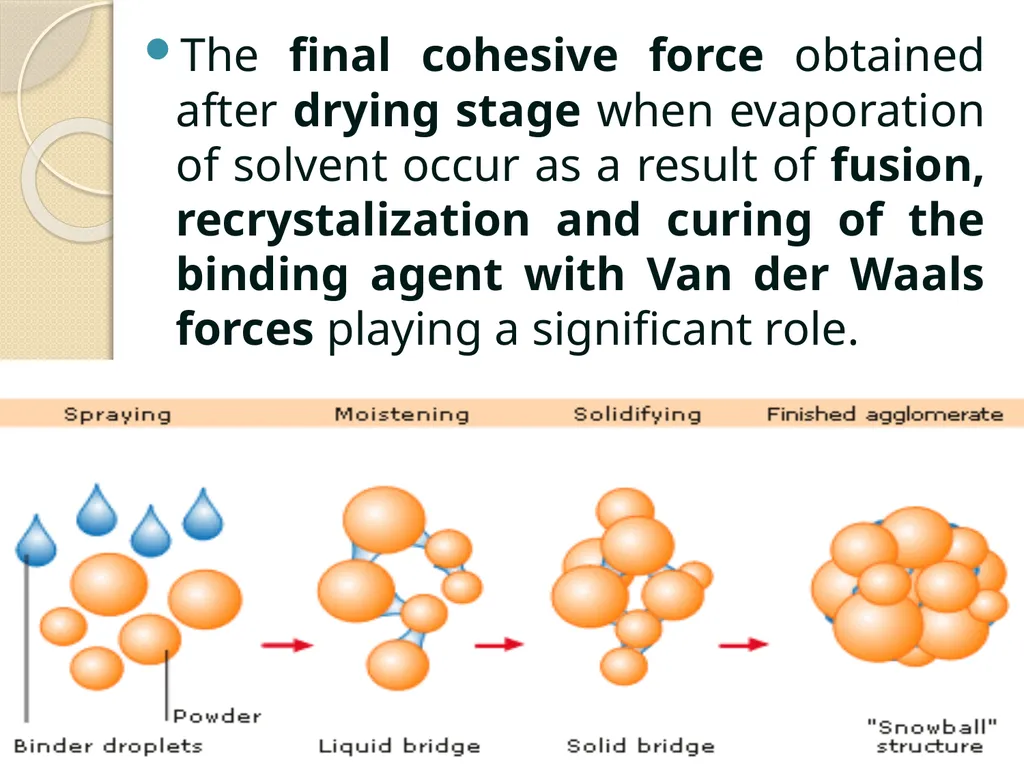
The primary force of granulation act as a bridge and is obtained from surface tension and capillary force or pressure of the liquid (binder solution) between particles.<br>
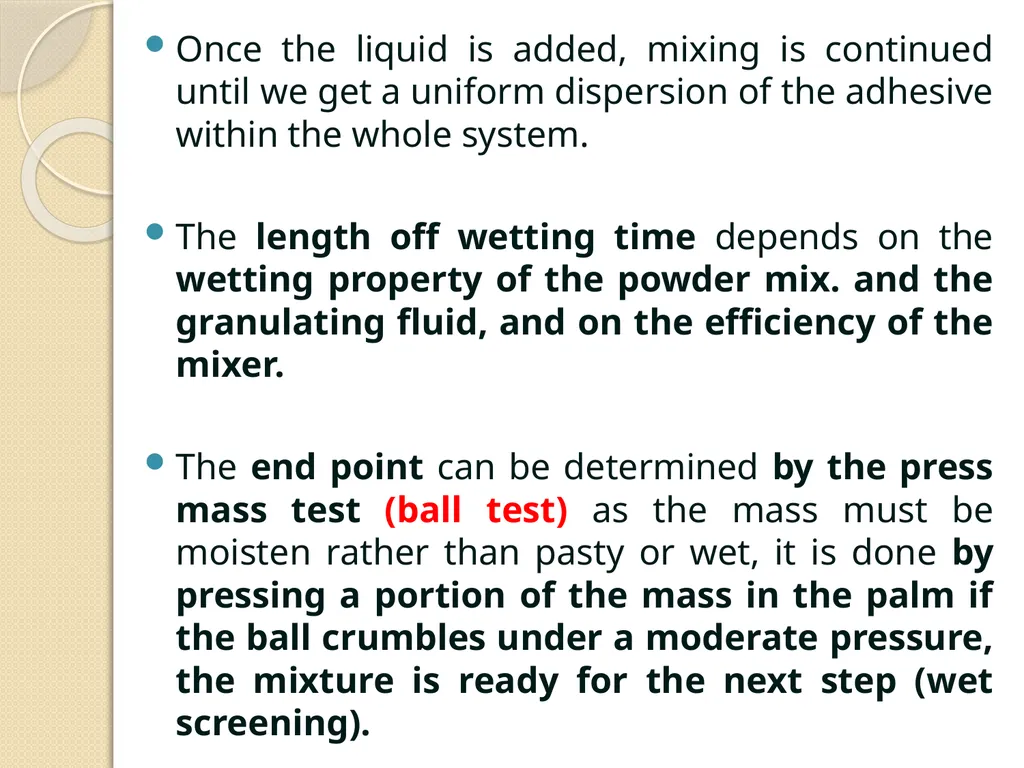
slide7. Once the liquid is added, mixing is continued until we get a uniform dispersion of the adhesive within the whole system.
The length off wetting time depends on the wetting property of the powder mix. and the granulating fluid, and on the efficiency of the mixer.
The end point can be determined by the press mass test (ball test) as the mass must be moisten rather than pasty or wet, it is done by pressing a portion of the mass in the palm if the ball crumbles under a moderate pressure, the mixture is ready for the next step (wet screening).<br>
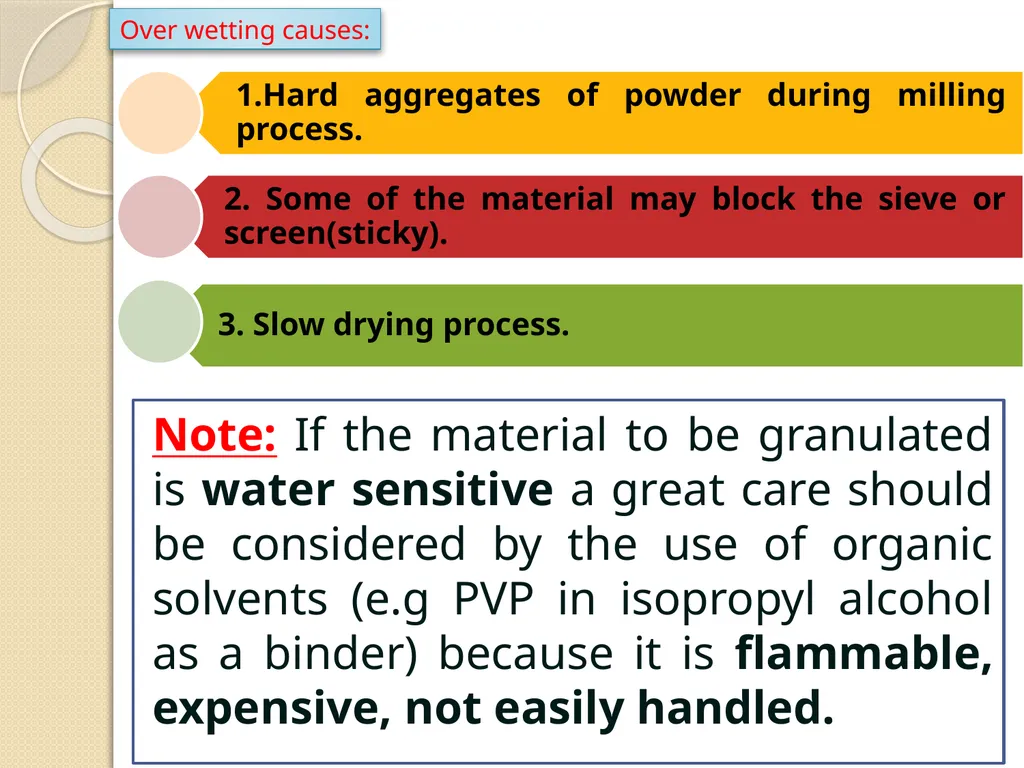
slide8. Note: If the material to be granulated is water sensitive a great care should be considered by the use of organic solvents (e.g PVP in isopropyl alcohol as a binder) because it is flammable, expensive, not easily handled. Over wetting causes:<br>
slide9. 3- Wet Screening (granulation)
Granulation is performed to obtain a discrete granules and further consolidate the granules by increasing the particles contact points, and also to increase surface area to facilitate the drying process.
4- Drying
After drying step the granules should contain some degree of humidity to act as a binder (not be 100% free of humidity) as over drying may leads to weak force and friable granules.<br>
slide10. The final cohesive force obtained after drying stage when evaporation of solvent occur as a result of fusion, recrystalization and curing of the binding agent with Van der Waals forces playing a significant role.<br>
slide11. 5- Dry screening
After drying; then dry screening is performed to get a homogenized granules with uniform size and shape.
6- Mixing
By addition of lubricants and glidants.
Therefore, the granules will posses good compressibility (good cohesive forces once applying punch forming solid impact tab.), good flowability (spherical shape that is the ideal physical form in providing smoothness and size uniformity to the particles which is easily flow).<br>
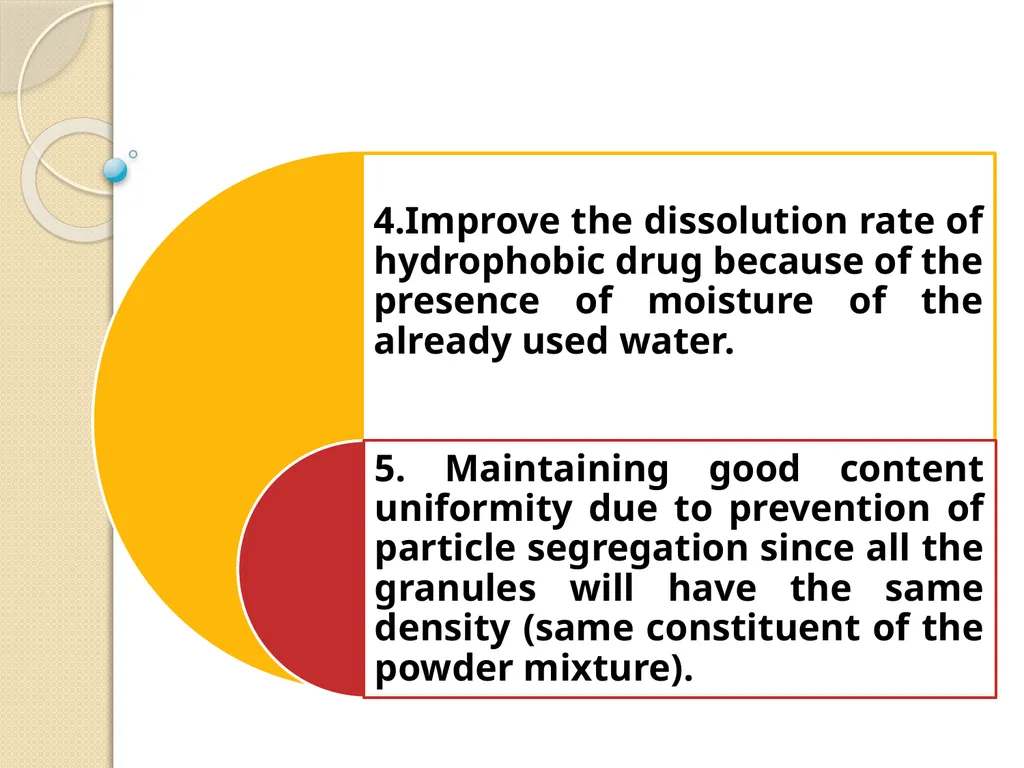
slide12. Advantages of wet granulation method:<br>
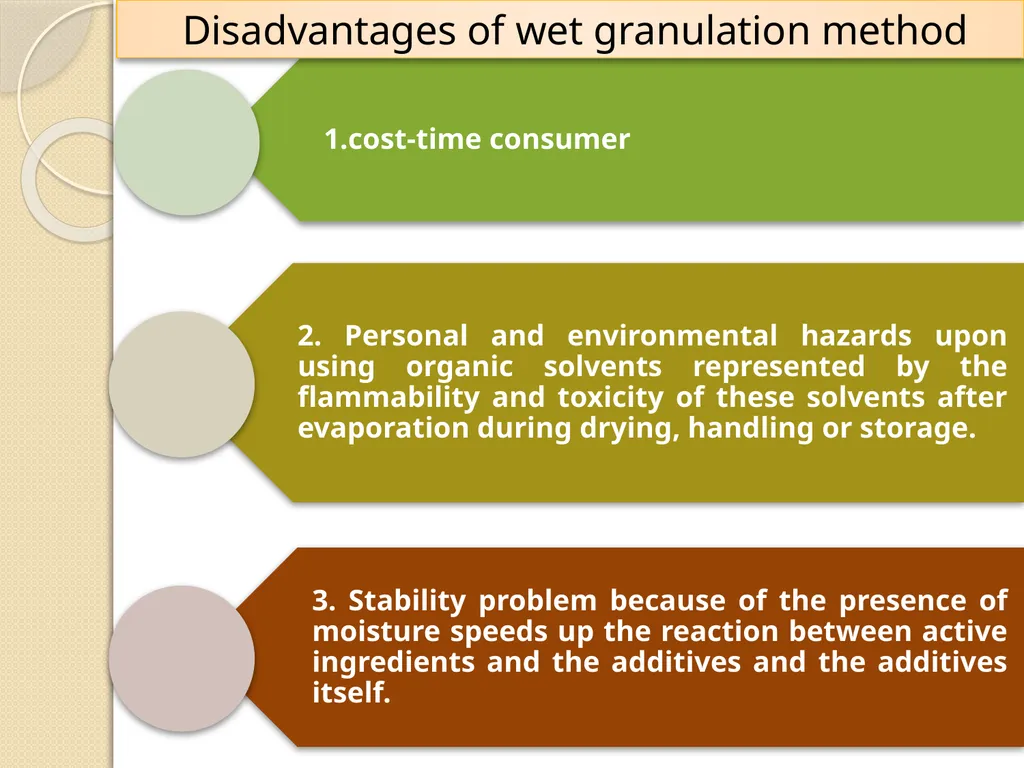
slide14. Disadvantages of wet granulation method<br>
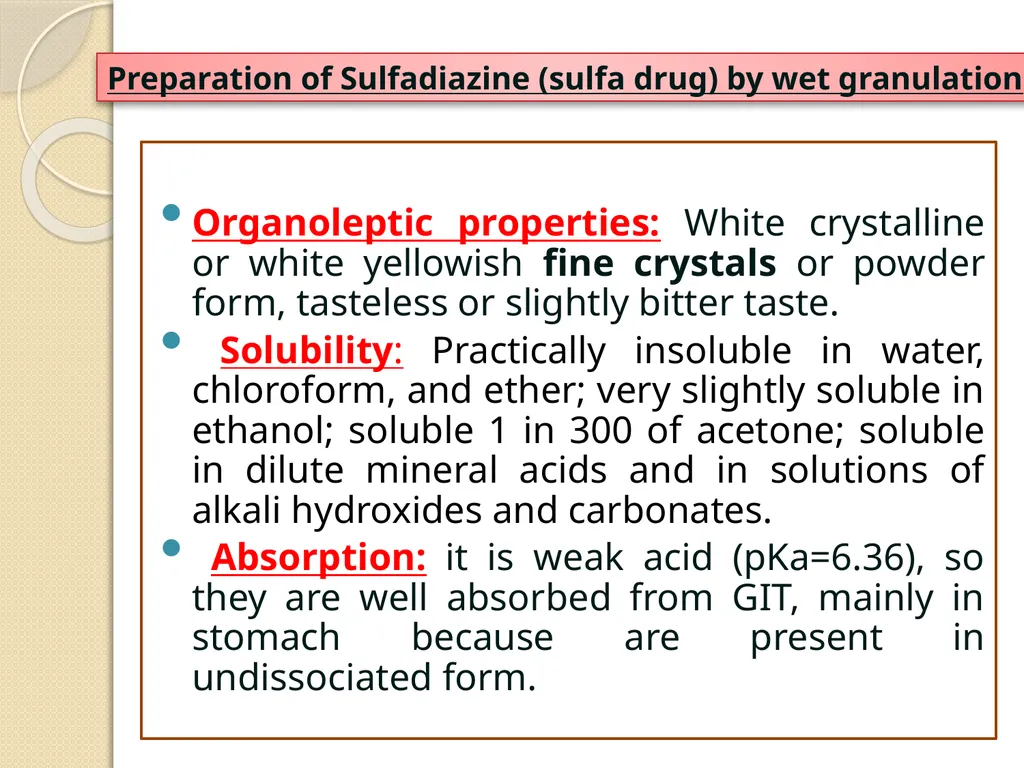
slide15. Organoleptic properties: White crystalline or white yellowish fine crystals or powder form, tasteless or slightly bitter taste.
Solubility: Practically insoluble in water, chloroform, and ether; very slightly soluble in ethanol; soluble 1 in 300 of acetone; soluble in dilute mineral acids and in solutions of alkali hydroxides and carbonates.
Absorption: it is weak acid (pKa=6.36), so they are well absorbed from GIT, mainly in stomach because are present in undissociated form. Preparation of Sulfadiazine (sulfa drug) by wet granulation<br>
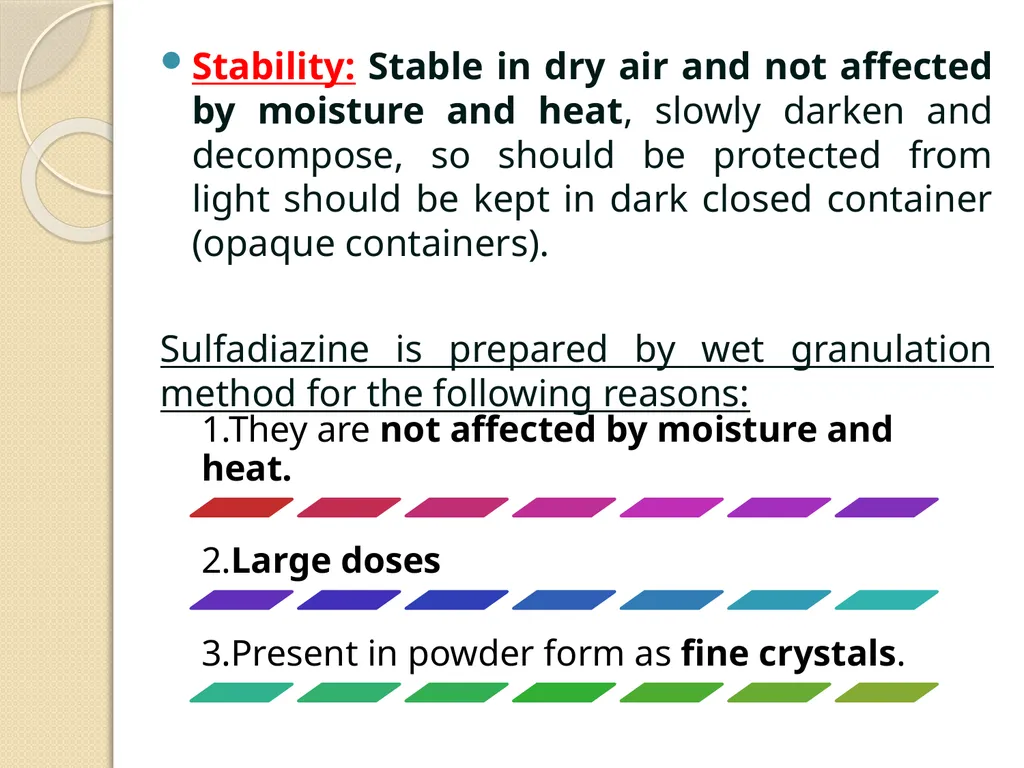
slide16. Stability: Stable in dry air and not affected by moisture and heat, slowly darken and decompose, so should be protected from light should be kept in dark closed container (opaque containers).
Sulfadiazine is prepared by wet granulation method for the following reasons:<br>
slide17. Sulfa drug are not prepared by direct compression because:<br>
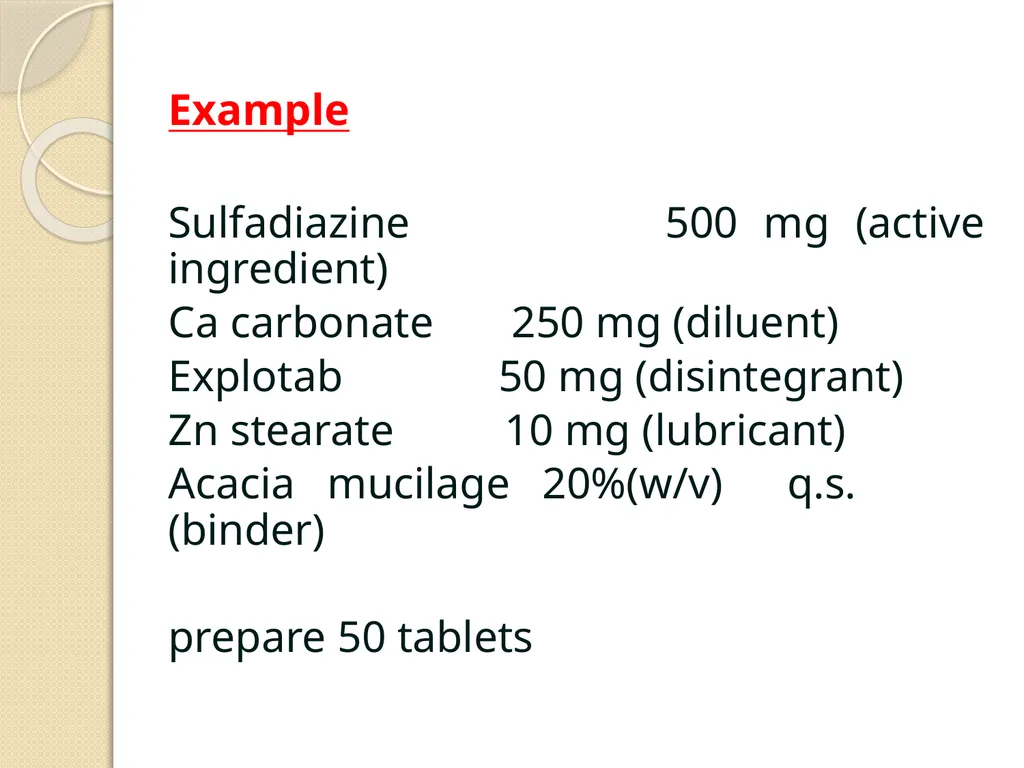
slide18. Example
Sulfadiazine 500 mg (active ingredient)
Ca carbonate 250 mg (diluent)
Explotab 50 mg (disintegrant)
Zn stearate 10 mg (lubricant)
Acacia mucilage 20%(w/v) q.s. (binder)
prepare 50 tablets<br>
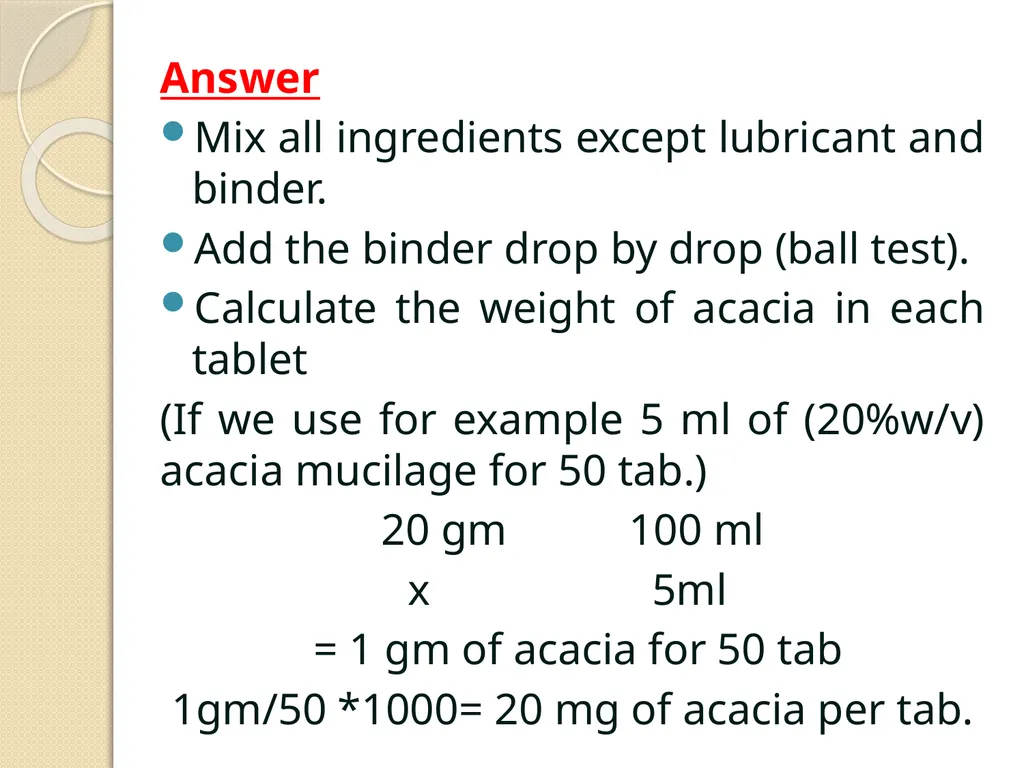
slide19. Answer
Mix all ingredients except lubricant and binder.
Add the binder drop by drop (ball test).
Calculate the weight of acacia in each tablet
(If we use for example 5 ml of (20%w/v) acacia mucilage for 50 tab.)
20 gm 100 ml
x 5ml
= 1 gm of acacia for 50 tab
1gm/50 *1000= 20 mg of acacia per tab.<br>
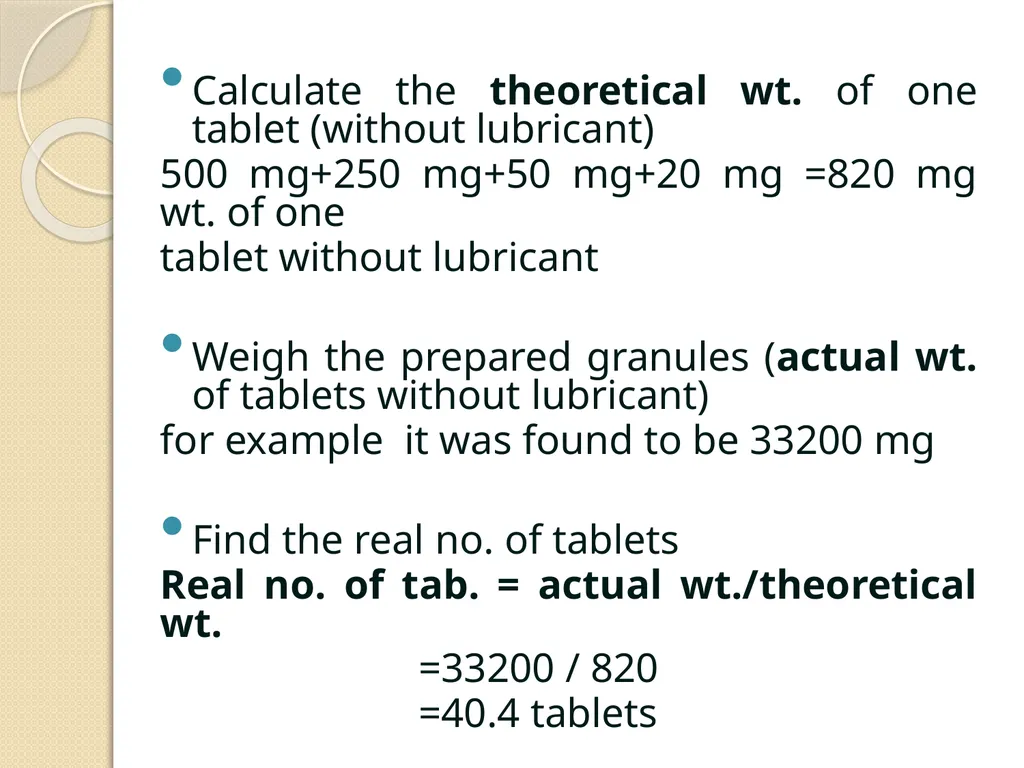
slide20. Calculate the theoretical wt. of one tablet (without lubricant)
500 mg+250 mg+50 mg+20 mg =820 mg wt. of one
tablet without lubricant
Weigh the prepared granules (actual wt. of tablets without lubricant)
for example it was found to be 33200 mg
Find the real no. of tablets
Real no. of tab. = actual wt./theoretical wt.
=33200 / 820
=40.4 tablets<br>
slide21. Calculate the actual amount of lubricant to be added:
amount of lubricant =10 mg * Real no. of tab.
=10 * 40
=400mg of lubricant added<br>

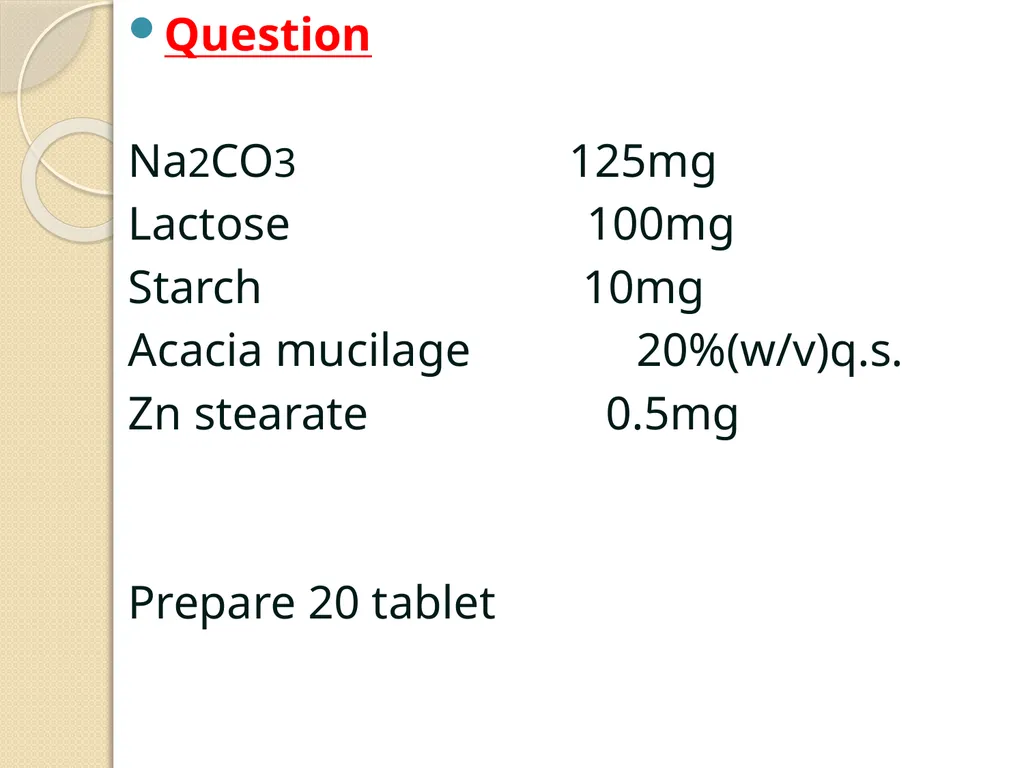
slide22. Question
Na2CO3 125mg
Lactose 100mg
Starch 10mg
Acacia mucilage 20%(w/v)q.s.
Zn stearate 0.5mg
Prepare 20 tablet<br>
slide2. Wet Granulation The wet granulation technique uses the same preparatory and finishing steps of direct compression and dry granulation (dry screening and mixing); it also involve additional steps of wet massing, wet screening and drying.<br>
slide3. Steps of Wet Granulation<br>
slide4. Mixing<br>
slide5. 1- Mixing
Mixing starts with adding drug then excipients. The mixing process depends on the properties of the drug and excipients.
If the drug is soluble in water and excipients are little; so we start to add binder solution to the drug to be distributed uniformly then excipients that have little solubility in water (e.g. starch), it is possible to be added extragranularly [as a whole] or [divided and added as one half intragranulary and the other extragranulary to avoid getting friable tablets].
Total amount of disintegrant is not always added completely to the powder–diluent mixture (intragranulary), some other portion might be added with lubricants (extragranulary) in the final step prior to compression (double disintegration)<br>
slide6. 2- Wet Massing
Adhesive (binder) is most commonly employed as solution, suspension, slurry, or used as a dry powder.
Method of introducing the binder depends on its solubility and on the components of the mixture (wettability).
In the wet massing step the binder solution will distribute and filling the spaces between particles.
The primary force of granulation act as a bridge and is obtained from surface tension and capillary force or pressure of the liquid (binder solution) between particles.<br>
slide7. Once the liquid is added, mixing is continued until we get a uniform dispersion of the adhesive within the whole system.
The length off wetting time depends on the wetting property of the powder mix. and the granulating fluid, and on the efficiency of the mixer.
The end point can be determined by the press mass test (ball test) as the mass must be moisten rather than pasty or wet, it is done by pressing a portion of the mass in the palm if the ball crumbles under a moderate pressure, the mixture is ready for the next step (wet screening).<br>
slide8. Note: If the material to be granulated is water sensitive a great care should be considered by the use of organic solvents (e.g PVP in isopropyl alcohol as a binder) because it is flammable, expensive, not easily handled. Over wetting causes:<br>
slide9. 3- Wet Screening (granulation)
Granulation is performed to obtain a discrete granules and further consolidate the granules by increasing the particles contact points, and also to increase surface area to facilitate the drying process.
4- Drying
After drying step the granules should contain some degree of humidity to act as a binder (not be 100% free of humidity) as over drying may leads to weak force and friable granules.<br>
slide10. The final cohesive force obtained after drying stage when evaporation of solvent occur as a result of fusion, recrystalization and curing of the binding agent with Van der Waals forces playing a significant role.<br>
slide11. 5- Dry screening
After drying; then dry screening is performed to get a homogenized granules with uniform size and shape.
6- Mixing
By addition of lubricants and glidants.
Therefore, the granules will posses good compressibility (good cohesive forces once applying punch forming solid impact tab.), good flowability (spherical shape that is the ideal physical form in providing smoothness and size uniformity to the particles which is easily flow).<br>
slide12. Advantages of wet granulation method:<br>
slide14. Disadvantages of wet granulation method<br>
slide15. Organoleptic properties: White crystalline or white yellowish fine crystals or powder form, tasteless or slightly bitter taste.
Solubility: Practically insoluble in water, chloroform, and ether; very slightly soluble in ethanol; soluble 1 in 300 of acetone; soluble in dilute mineral acids and in solutions of alkali hydroxides and carbonates.
Absorption: it is weak acid (pKa=6.36), so they are well absorbed from GIT, mainly in stomach because are present in undissociated form. Preparation of Sulfadiazine (sulfa drug) by wet granulation<br>
slide16. Stability: Stable in dry air and not affected by moisture and heat, slowly darken and decompose, so should be protected from light should be kept in dark closed container (opaque containers).
Sulfadiazine is prepared by wet granulation method for the following reasons:<br>
slide17. Sulfa drug are not prepared by direct compression because:<br>
slide18. Example
Sulfadiazine 500 mg (active ingredient)
Ca carbonate 250 mg (diluent)
Explotab 50 mg (disintegrant)
Zn stearate 10 mg (lubricant)
Acacia mucilage 20%(w/v) q.s. (binder)
prepare 50 tablets<br>
slide19. Answer
Mix all ingredients except lubricant and binder.
Add the binder drop by drop (ball test).
Calculate the weight of acacia in each tablet
(If we use for example 5 ml of (20%w/v) acacia mucilage for 50 tab.)
20 gm 100 ml
x 5ml
= 1 gm of acacia for 50 tab
1gm/50 *1000= 20 mg of acacia per tab.<br>
slide20. Calculate the theoretical wt. of one tablet (without lubricant)
500 mg+250 mg+50 mg+20 mg =820 mg wt. of one
tablet without lubricant
Weigh the prepared granules (actual wt. of tablets without lubricant)
for example it was found to be 33200 mg
Find the real no. of tablets
Real no. of tab. = actual wt./theoretical wt.
=33200 / 820
=40.4 tablets<br>
slide21. Calculate the actual amount of lubricant to be added:
amount of lubricant =10 mg * Real no. of tab.
=10 * 40
=400mg of lubricant added<br>
slide22. Question
Na2CO3 125mg
Lactose 100mg
Starch 10mg
Acacia mucilage 20%(w/v)q.s.
Zn stearate 0.5mg
Prepare 20 tablet<br>