
Module 3: Conducting Threat Assessments Through
Description: Module 3: Conducting Threat Assessments Through the Atrocity Prevention Lens GLOBAL CENTRE FOR THE RESPONSIBILITY TO PROTECT Phase 1 Risk Identification GLOBAL CENTRE FOR THE RESPONSIBILITY TO PROTECT 1 Module 3: Conducting Threat
Related Topics
Download Presentation
"Module 3: Conducting Threat Assessments Through" is the property of its rightful owner. Permission is granted to download and print the materials on this website for personal, non-commercial use only, and to display it on your personal computer provided you do not modify the materials and that you retain all copyright notices contained in the materials. By downloading content from our website, you accept the terms of this agreement.
Presentation Transcript
slide1. Module 3: Conducting Threat Assessments
Through the Atrocity Prevention Lens GLOBAL CENTRE FOR THE RESPONSIBILITY TO PROTECT<br>
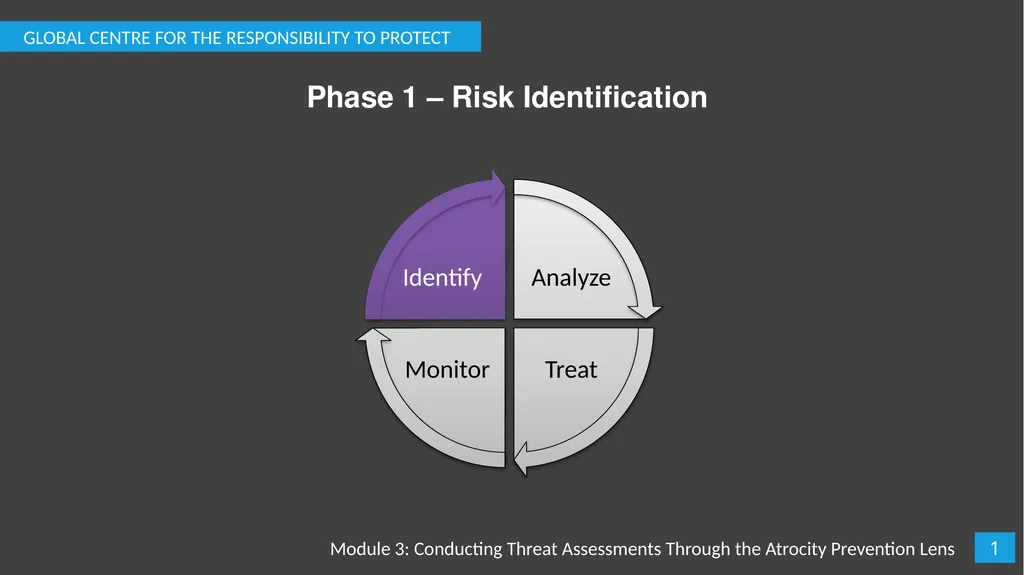
slide2. Phase 1 – Risk Identification GLOBAL CENTRE FOR THE RESPONSIBILITY TO PROTECT 1 Module 3: Conducting Threat Assessments Through the Atrocity Prevention Lens<br>
slide3. Discussion Question:
For those participants that have prior experience in a field setting, how do you carry out situational awareness when on the ground? GLOBAL CENTRE FOR THE RESPONSIBILITY TO PROTECT 2 Module 3: Conducting Threat Assessments Through the Atrocity Prevention Lens<br>
slide4. Information Collection in Daily Activities Patrols
Establishment of observation posts and checkpoints
Monitoring and reporting on human rights violations
Outreach and Engagement within area of responsibility GLOBAL CENTRE FOR THE RESPONSIBILITY TO PROTECT 3 Module 3: Conducting Threat Assessments Through the Atrocity Prevention Lens<br>
slide5. Addressing the Specific Vulnerabilities of Women and Children Monitoring and Assessment Tasks:
Special attention to women and children’s protection risks in joint investigations and analysis
Liaise with Women Protection Advisers and Children Protection Advisers
Specialized Reporting on Conflict-Related Sexual Violence, women and child abductions, recruitment into armed groups, sex trafficking, arbitrary killings that target women/children
Ensure female peacekeepers are involved in community engagement activities and establish relationships with women’s groups. Ensure women are consulted in threat assessments and use women as resources in monitoring and information gathering activities
Establish dial-in radio programs for women to report threats
Host radio programs raising awareness of child protection issues GLOBAL CENTRE FOR THE RESPONSIBILITY TO PROTECT 4 Module 3: Conducting Threat Assessments Through the Atrocity Prevention Lens<br>
slide6. Designated Situational Awareness Units Joint Operations Centres and Joint Mission Analysis Centres
Military Intelligence Units
Criminal Intelligence Units
Geo-spacial Information Systems GLOBAL CENTRE FOR THE RESPONSIBILITY TO PROTECT 5 Module 3: Conducting Threat Assessments Through the Atrocity Prevention Lens<br>
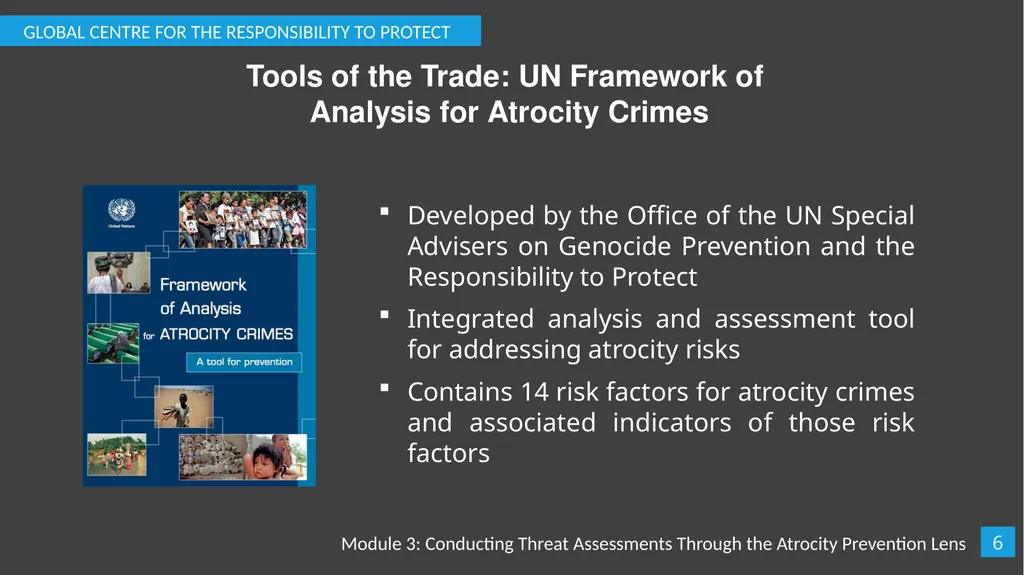
slide7. Tools of the Trade: UN Framework of Analysis for Atrocity Crimes Developed by the Office of the UN Special Advisers on Genocide Prevention and the Responsibility to Protect
Integrated analysis and assessment tool for addressing atrocity risks
Contains 14 risk factors for atrocity crimes and associated indicators of those risk factors GLOBAL CENTRE FOR THE RESPONSIBILITY TO PROTECT<br>
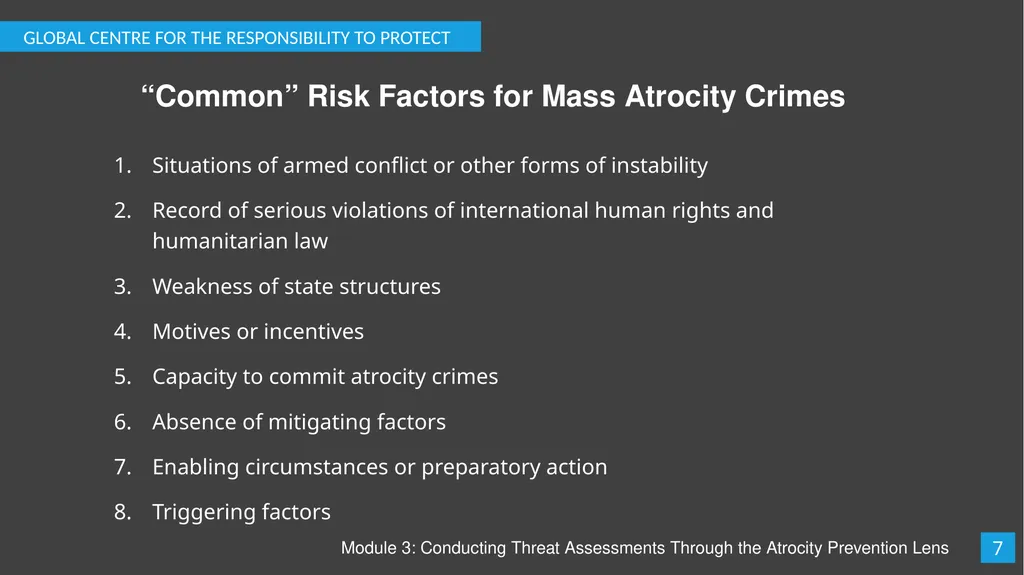
slide8. “Common” Risk Factors for Mass Atrocity Crimes Situations of armed conflict or other forms of instability
Record of serious violations of international human rights and humanitarian law
Weakness of state structures
Motives or incentives
Capacity to commit atrocity crimes
Absence of mitigating factors
Enabling circumstances or preparatory action
Triggering factors GLOBAL CENTRE FOR THE RESPONSIBILITY TO PROTECT<br>
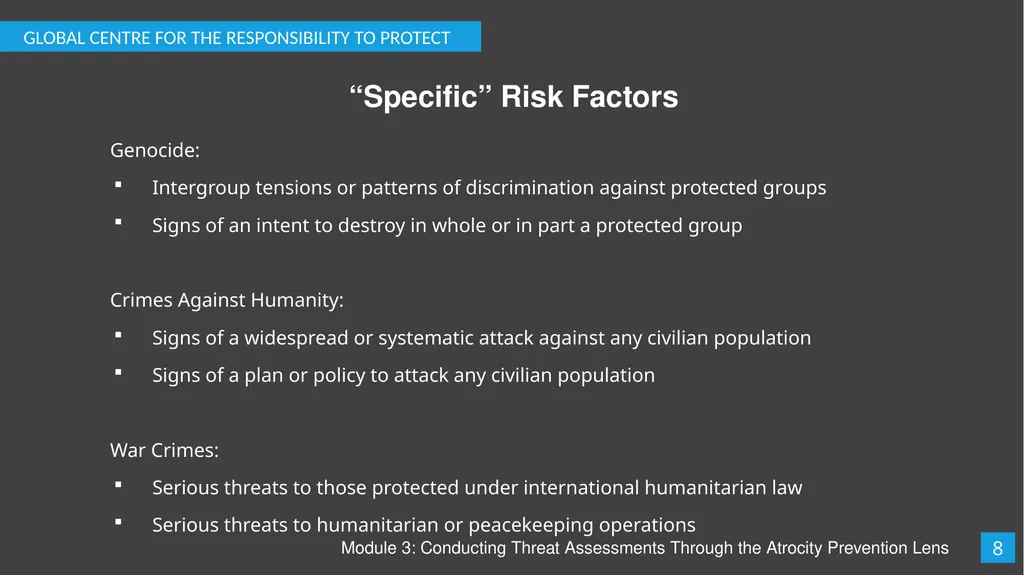
slide9. “Specific” Risk Factors Genocide:
Intergroup tensions or patterns of discrimination against protected groups
Signs of an intent to destroy in whole or in part a protected group
Crimes Against Humanity:
Signs of a widespread or systematic attack against any civilian population
Signs of a plan or policy to attack any civilian population
War Crimes:
Serious threats to those protected under international humanitarian law
Serious threats to humanitarian or peacekeeping operations GLOBAL CENTRE FOR THE RESPONSIBILITY TO PROTECT<br>
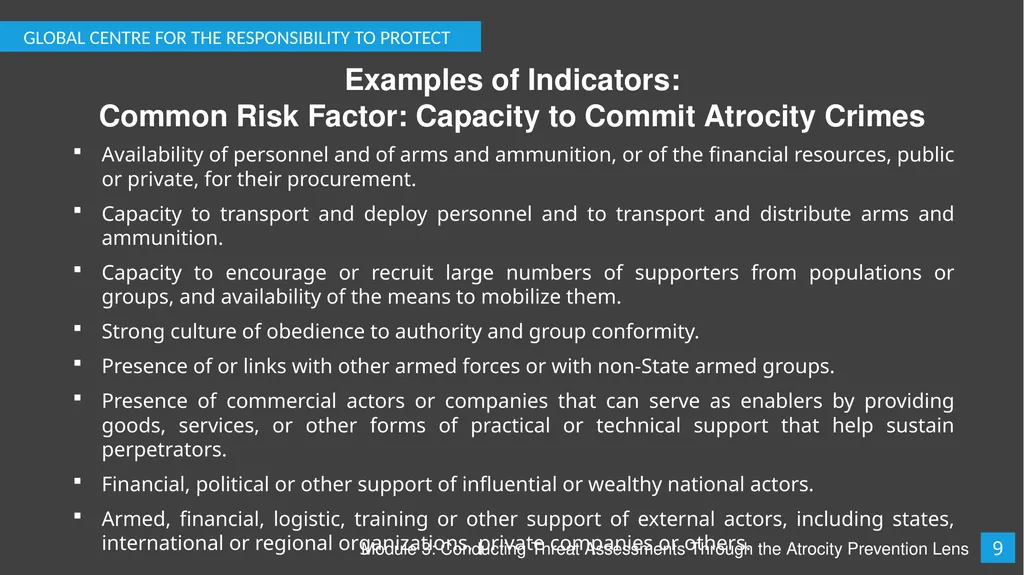
slide10. Examples of Indicators: Common Risk Factor: Capacity to Commit Atrocity Crimes Availability of personnel and of arms and ammunition, or of the financial resources, public or private, for their procurement.
Capacity to transport and deploy personnel and to transport and distribute arms and ammunition.
Capacity to encourage or recruit large numbers of supporters from populations or groups, and availability of the means to mobilize them.
Strong culture of obedience to authority and group conformity.
Presence of or links with other armed forces or with non-State armed groups.
Presence of commercial actors or companies that can serve as enablers by providing goods, services, or other forms of practical or technical support that help sustain perpetrators.
Financial, political or other support of influential or wealthy national actors.
Armed, financial, logistic, training or other support of external actors, including states, international or regional organizations, private companies or others. GLOBAL CENTRE FOR THE RESPONSIBILITY TO PROTECT<br>
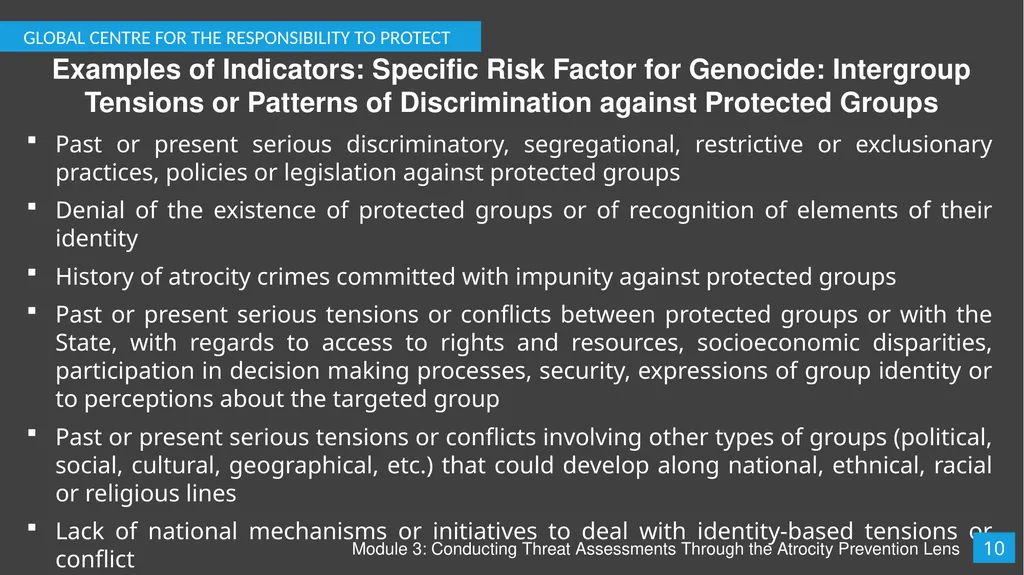
slide11. Examples of Indicators: Specific Risk Factor for Genocide: Intergroup Tensions or Patterns of Discrimination against Protected Groups Past or present serious discriminatory, segregational, restrictive or exclusionary practices, policies or legislation against protected groups
Denial of the existence of protected groups or of recognition of elements of their identity
History of atrocity crimes committed with impunity against protected groups
Past or present serious tensions or conflicts between protected groups or with the State, with regards to access to rights and resources, socioeconomic disparities, participation in decision making processes, security, expressions of group identity or to perceptions about the targeted group
Past or present serious tensions or conflicts involving other types of groups (political, social, cultural, geographical, etc.) that could develop along national, ethnical, racial or religious lines
Lack of national mechanisms or initiatives to deal with identity-based tensions or conflict GLOBAL CENTRE FOR THE RESPONSIBILITY TO PROTECT<br>
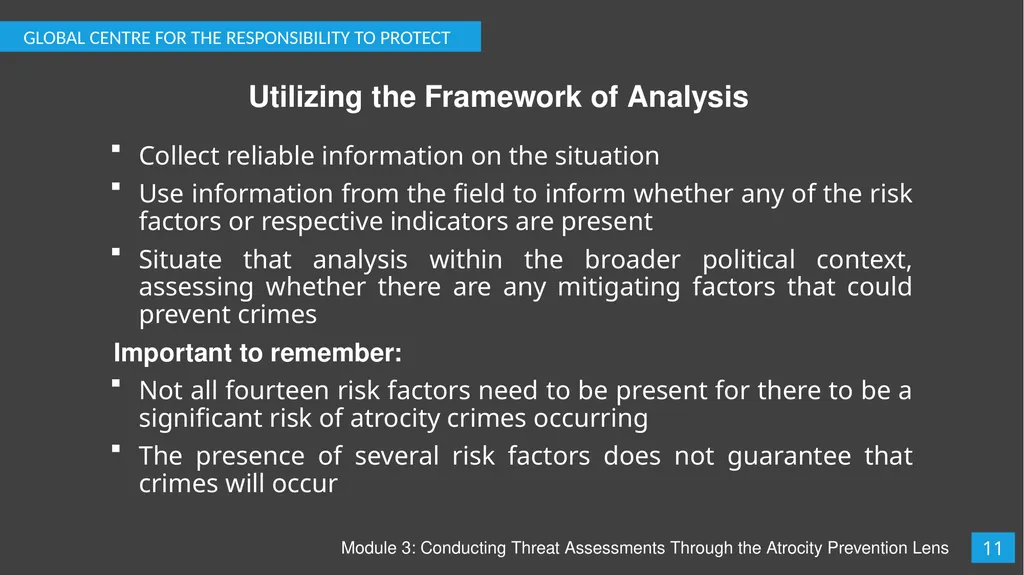
slide12. Utilizing the Framework of Analysis Collect reliable information on the situation
Use information from the field to inform whether any of the risk factors or respective indicators are present
Situate that analysis within the broader political context, assessing whether there are any mitigating factors that could prevent crimes
Important to remember:
Not all fourteen risk factors need to be present for there to be a significant risk of atrocity crimes occurring
The presence of several risk factors does not guarantee that crimes will occur GLOBAL CENTRE FOR THE RESPONSIBILITY TO PROTECT<br>
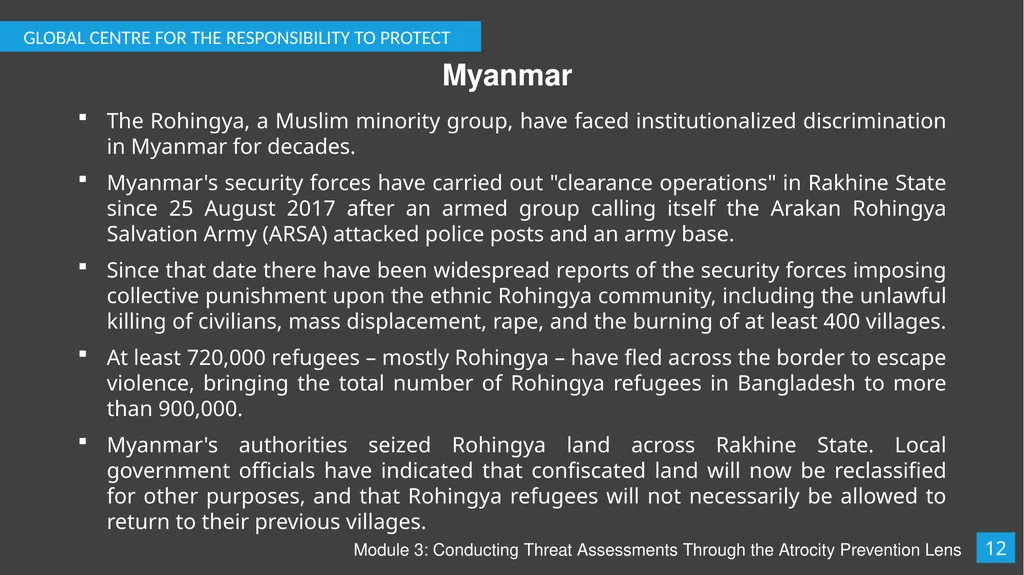
slide13. Myanmar The Rohingya, a Muslim minority group, have faced institutionalized discrimination in Myanmar for decades.
Myanmar's security forces have carried out "clearance operations" in Rakhine State since 25 August 2017 after an armed group calling itself the Arakan Rohingya Salvation Army (ARSA) attacked police posts and an army base.
Since that date there have been widespread reports of the security forces imposing collective punishment upon the ethnic Rohingya community, including the unlawful killing of civilians, mass displacement, rape, and the burning of at least 400 villages.
At least 720,000 refugees – mostly Rohingya – have fled across the border to escape violence, bringing the total number of Rohingya refugees in Bangladesh to more than 900,000.
Myanmar's authorities seized Rohingya land across Rakhine State. Local government officials have indicated that confiscated land will now be reclassified for other purposes, and that Rohingya refugees will not necessarily be allowed to return to their previous villages. GLOBAL CENTRE FOR THE RESPONSIBILITY TO PROTECT<br>
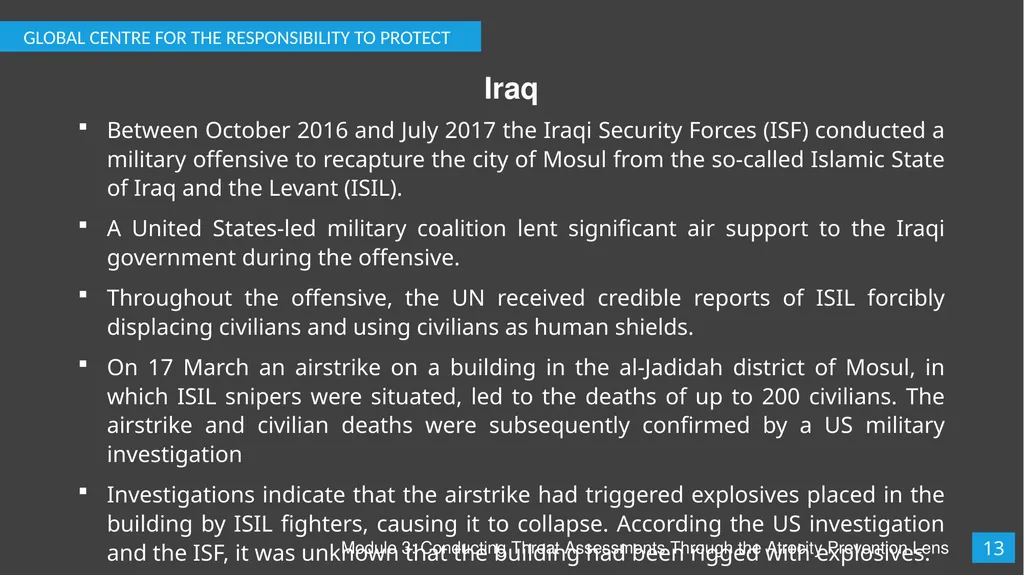
slide14. Iraq Between October 2016 and July 2017 the Iraqi Security Forces (ISF) conducted a military offensive to recapture the city of Mosul from the so-called Islamic State of Iraq and the Levant (ISIL).
A United States-led military coalition lent significant air support to the Iraqi government during the offensive.
Throughout the offensive, the UN received credible reports of ISIL forcibly displacing civilians and using civilians as human shields.
On 17 March an airstrike on a building in the al-Jadidah district of Mosul, in which ISIL snipers were situated, led to the deaths of up to 200 civilians. The airstrike and civilian deaths were subsequently confirmed by a US military investigation
Investigations indicate that the airstrike had triggered explosives placed in the building by ISIL fighters, causing it to collapse. According the US investigation and the ISF, it was unknown that the building had been rigged with explosives. GLOBAL CENTRE FOR THE RESPONSIBILITY TO PROTECT<br>
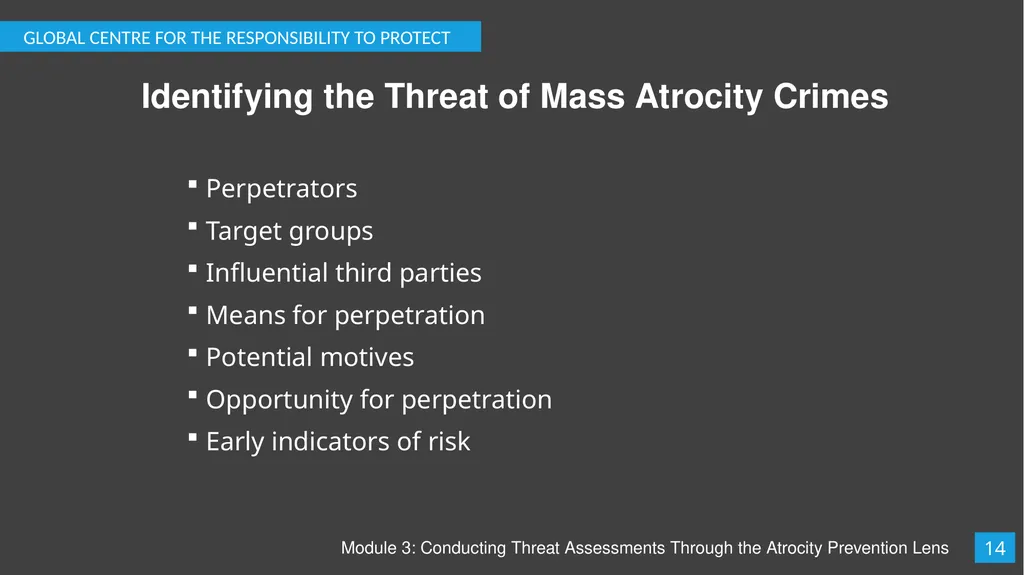
slide15. Identifying the Threat of Mass Atrocity Crimes Perpetrators
Target groups
Influential third parties
Means for perpetration
Potential motives
Opportunity for perpetration
Early indicators of risk GLOBAL CENTRE FOR THE RESPONSIBILITY TO PROTECT<br>
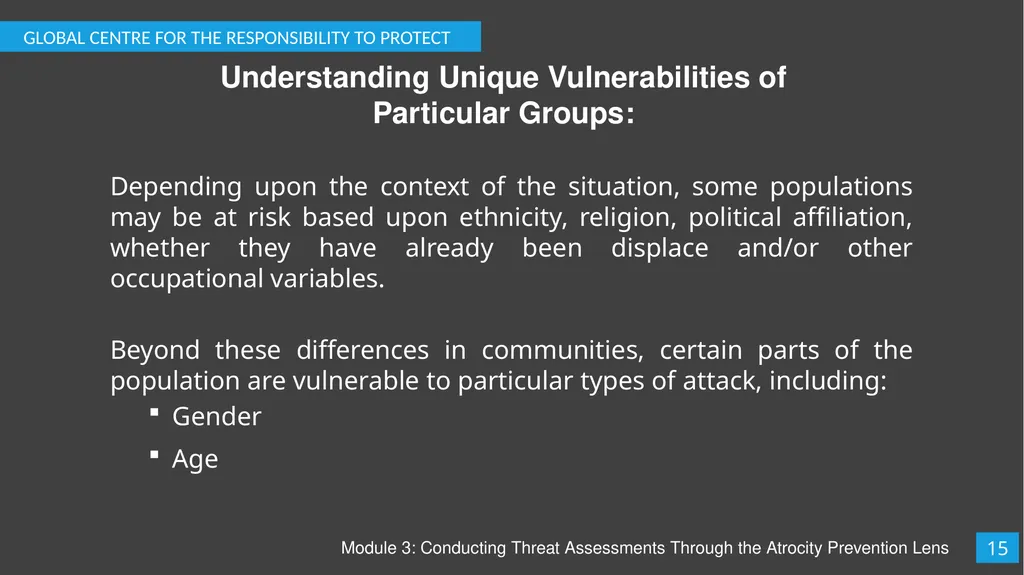
slide16. Understanding Unique Vulnerabilities of Particular Groups: Depending upon the context of the situation, some populations may be at risk based upon ethnicity, religion, political affiliation, whether they have already been displace and/or other occupational variables.
Beyond these differences in communities, certain parts of the population are vulnerable to particular types of attack, including:
Gender
Age GLOBAL CENTRE FOR THE RESPONSIBILITY TO PROTECT<br>
slide17. Module 3 Activity: Threat Assessment GLOBAL CENTRE FOR THE RESPONSIBILITY TO PROTECT<br>
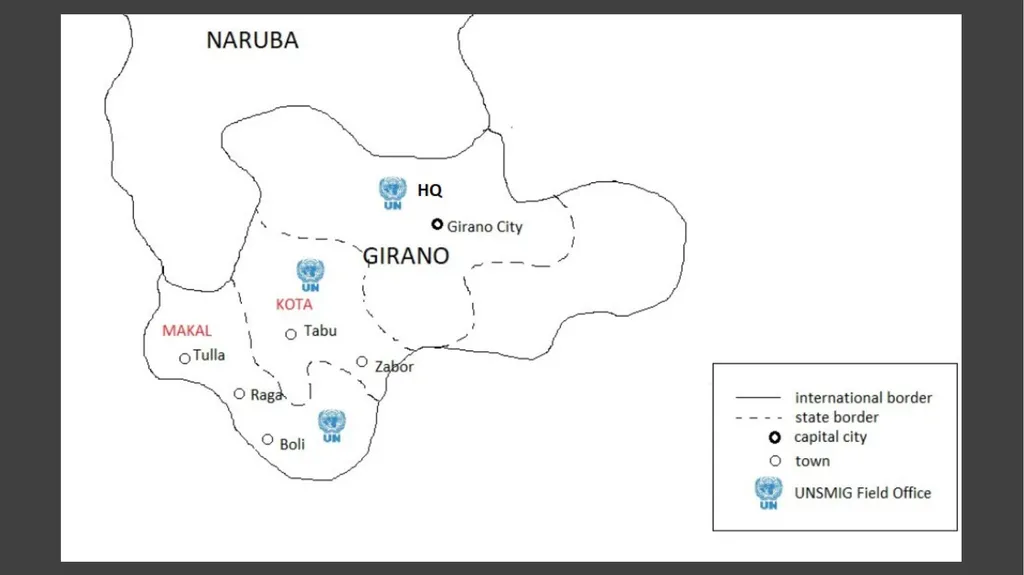
slide18. Module 3 Activity: SYsTEMIC ANALYSIS AND Threat Assessment GLOBAL CENTRE FOR THE RESPONSIBILITY TO PROTECT<br>
slide20. Module 3 Learning Outcomes - Review By the end of Module 3, learners will:
Understand the ways in which information on risks can be collected and communicated
Identify the actors, motives and means that may be present when assessing the threat of mass atrocity crimes
Explain how the Atrocity Prevention Lens enhances the ability to assess the potential risks faced by populations
Define warning signs and risk factors for mass atrocity crimes GLOBAL CENTRE FOR THE RESPONSIBILITY TO PROTECT<br>
slide2. Phase 1 – Risk Identification GLOBAL CENTRE FOR THE RESPONSIBILITY TO PROTECT 1 Module 3: Conducting Threat Assessments Through the Atrocity Prevention Lens<br>
slide3. Discussion Question:
For those participants that have prior experience in a field setting, how do you carry out situational awareness when on the ground? GLOBAL CENTRE FOR THE RESPONSIBILITY TO PROTECT 2 Module 3: Conducting Threat Assessments Through the Atrocity Prevention Lens<br>
slide4. Information Collection in Daily Activities Patrols
Establishment of observation posts and checkpoints
Monitoring and reporting on human rights violations
Outreach and Engagement within area of responsibility GLOBAL CENTRE FOR THE RESPONSIBILITY TO PROTECT 3 Module 3: Conducting Threat Assessments Through the Atrocity Prevention Lens<br>
slide5. Addressing the Specific Vulnerabilities of Women and Children Monitoring and Assessment Tasks:
Special attention to women and children’s protection risks in joint investigations and analysis
Liaise with Women Protection Advisers and Children Protection Advisers
Specialized Reporting on Conflict-Related Sexual Violence, women and child abductions, recruitment into armed groups, sex trafficking, arbitrary killings that target women/children
Ensure female peacekeepers are involved in community engagement activities and establish relationships with women’s groups. Ensure women are consulted in threat assessments and use women as resources in monitoring and information gathering activities
Establish dial-in radio programs for women to report threats
Host radio programs raising awareness of child protection issues GLOBAL CENTRE FOR THE RESPONSIBILITY TO PROTECT 4 Module 3: Conducting Threat Assessments Through the Atrocity Prevention Lens<br>
slide6. Designated Situational Awareness Units Joint Operations Centres and Joint Mission Analysis Centres
Military Intelligence Units
Criminal Intelligence Units
Geo-spacial Information Systems GLOBAL CENTRE FOR THE RESPONSIBILITY TO PROTECT 5 Module 3: Conducting Threat Assessments Through the Atrocity Prevention Lens<br>
slide7. Tools of the Trade: UN Framework of Analysis for Atrocity Crimes Developed by the Office of the UN Special Advisers on Genocide Prevention and the Responsibility to Protect
Integrated analysis and assessment tool for addressing atrocity risks
Contains 14 risk factors for atrocity crimes and associated indicators of those risk factors GLOBAL CENTRE FOR THE RESPONSIBILITY TO PROTECT<br>
slide8. “Common” Risk Factors for Mass Atrocity Crimes Situations of armed conflict or other forms of instability
Record of serious violations of international human rights and humanitarian law
Weakness of state structures
Motives or incentives
Capacity to commit atrocity crimes
Absence of mitigating factors
Enabling circumstances or preparatory action
Triggering factors GLOBAL CENTRE FOR THE RESPONSIBILITY TO PROTECT<br>
slide9. “Specific” Risk Factors Genocide:
Intergroup tensions or patterns of discrimination against protected groups
Signs of an intent to destroy in whole or in part a protected group
Crimes Against Humanity:
Signs of a widespread or systematic attack against any civilian population
Signs of a plan or policy to attack any civilian population
War Crimes:
Serious threats to those protected under international humanitarian law
Serious threats to humanitarian or peacekeeping operations GLOBAL CENTRE FOR THE RESPONSIBILITY TO PROTECT<br>
slide10. Examples of Indicators: Common Risk Factor: Capacity to Commit Atrocity Crimes Availability of personnel and of arms and ammunition, or of the financial resources, public or private, for their procurement.
Capacity to transport and deploy personnel and to transport and distribute arms and ammunition.
Capacity to encourage or recruit large numbers of supporters from populations or groups, and availability of the means to mobilize them.
Strong culture of obedience to authority and group conformity.
Presence of or links with other armed forces or with non-State armed groups.
Presence of commercial actors or companies that can serve as enablers by providing goods, services, or other forms of practical or technical support that help sustain perpetrators.
Financial, political or other support of influential or wealthy national actors.
Armed, financial, logistic, training or other support of external actors, including states, international or regional organizations, private companies or others. GLOBAL CENTRE FOR THE RESPONSIBILITY TO PROTECT<br>
slide11. Examples of Indicators: Specific Risk Factor for Genocide: Intergroup Tensions or Patterns of Discrimination against Protected Groups Past or present serious discriminatory, segregational, restrictive or exclusionary practices, policies or legislation against protected groups
Denial of the existence of protected groups or of recognition of elements of their identity
History of atrocity crimes committed with impunity against protected groups
Past or present serious tensions or conflicts between protected groups or with the State, with regards to access to rights and resources, socioeconomic disparities, participation in decision making processes, security, expressions of group identity or to perceptions about the targeted group
Past or present serious tensions or conflicts involving other types of groups (political, social, cultural, geographical, etc.) that could develop along national, ethnical, racial or religious lines
Lack of national mechanisms or initiatives to deal with identity-based tensions or conflict GLOBAL CENTRE FOR THE RESPONSIBILITY TO PROTECT<br>
slide12. Utilizing the Framework of Analysis Collect reliable information on the situation
Use information from the field to inform whether any of the risk factors or respective indicators are present
Situate that analysis within the broader political context, assessing whether there are any mitigating factors that could prevent crimes
Important to remember:
Not all fourteen risk factors need to be present for there to be a significant risk of atrocity crimes occurring
The presence of several risk factors does not guarantee that crimes will occur GLOBAL CENTRE FOR THE RESPONSIBILITY TO PROTECT<br>
slide13. Myanmar The Rohingya, a Muslim minority group, have faced institutionalized discrimination in Myanmar for decades.
Myanmar's security forces have carried out "clearance operations" in Rakhine State since 25 August 2017 after an armed group calling itself the Arakan Rohingya Salvation Army (ARSA) attacked police posts and an army base.
Since that date there have been widespread reports of the security forces imposing collective punishment upon the ethnic Rohingya community, including the unlawful killing of civilians, mass displacement, rape, and the burning of at least 400 villages.
At least 720,000 refugees – mostly Rohingya – have fled across the border to escape violence, bringing the total number of Rohingya refugees in Bangladesh to more than 900,000.
Myanmar's authorities seized Rohingya land across Rakhine State. Local government officials have indicated that confiscated land will now be reclassified for other purposes, and that Rohingya refugees will not necessarily be allowed to return to their previous villages. GLOBAL CENTRE FOR THE RESPONSIBILITY TO PROTECT<br>
slide14. Iraq Between October 2016 and July 2017 the Iraqi Security Forces (ISF) conducted a military offensive to recapture the city of Mosul from the so-called Islamic State of Iraq and the Levant (ISIL).
A United States-led military coalition lent significant air support to the Iraqi government during the offensive.
Throughout the offensive, the UN received credible reports of ISIL forcibly displacing civilians and using civilians as human shields.
On 17 March an airstrike on a building in the al-Jadidah district of Mosul, in which ISIL snipers were situated, led to the deaths of up to 200 civilians. The airstrike and civilian deaths were subsequently confirmed by a US military investigation
Investigations indicate that the airstrike had triggered explosives placed in the building by ISIL fighters, causing it to collapse. According the US investigation and the ISF, it was unknown that the building had been rigged with explosives. GLOBAL CENTRE FOR THE RESPONSIBILITY TO PROTECT<br>
slide15. Identifying the Threat of Mass Atrocity Crimes Perpetrators
Target groups
Influential third parties
Means for perpetration
Potential motives
Opportunity for perpetration
Early indicators of risk GLOBAL CENTRE FOR THE RESPONSIBILITY TO PROTECT<br>
slide16. Understanding Unique Vulnerabilities of Particular Groups: Depending upon the context of the situation, some populations may be at risk based upon ethnicity, religion, political affiliation, whether they have already been displace and/or other occupational variables.
Beyond these differences in communities, certain parts of the population are vulnerable to particular types of attack, including:
Gender
Age GLOBAL CENTRE FOR THE RESPONSIBILITY TO PROTECT<br>
slide17. Module 3 Activity: Threat Assessment GLOBAL CENTRE FOR THE RESPONSIBILITY TO PROTECT<br>
slide18. Module 3 Activity: SYsTEMIC ANALYSIS AND Threat Assessment GLOBAL CENTRE FOR THE RESPONSIBILITY TO PROTECT<br>
slide20. Module 3 Learning Outcomes - Review By the end of Module 3, learners will:
Understand the ways in which information on risks can be collected and communicated
Identify the actors, motives and means that may be present when assessing the threat of mass atrocity crimes
Explain how the Atrocity Prevention Lens enhances the ability to assess the potential risks faced by populations
Define warning signs and risk factors for mass atrocity crimes GLOBAL CENTRE FOR THE RESPONSIBILITY TO PROTECT<br>