
MODULE 5: FACILITY BASED HIVST DISTRIBUTION
DP
Published · 13 slides · 0 views
1 / 1

Description
MODULE 5: FACILITY BASED HIVST DISTRIBUTION APPROACHES Learning Objectives By the end of this module, participants will be able to: Understand facility-based HIVST Distribution Models Explain the difference between primary and secondary
Related Topics
Share
Embed code
Download this presentation From Below
"MODULE 5: FACILITY BASED HIVST DISTRIBUTION" is the property of its rightful owner. Permission is granted to download and print the materials on this website for personal, non-commercial use only, and to display it on your personal computer provided you do not modify the materials and that you retain all copyright notices contained in the materials. By downloading content from our website, you accept the terms of this agreement.
Presentation Transcript
01
MODULE 5:
FACILITY BASED HIVST DISTRIBUTION APPROACHES<br>
02
Learning Objectives By the end of this module, participants will be able to:
Understand facility-based HIVST Distribution Models
Explain the difference between primary and secondary HIVST distribution
Describe the operational considerations for each distribution model
Know about the challenges and solutions related to HIVST Distribution 5<br>
Understand facility-based HIVST Distribution Models
Explain the difference between primary and secondary HIVST distribution
Describe the operational considerations for each distribution model
Know about the challenges and solutions related to HIVST Distribution 5<br>
03
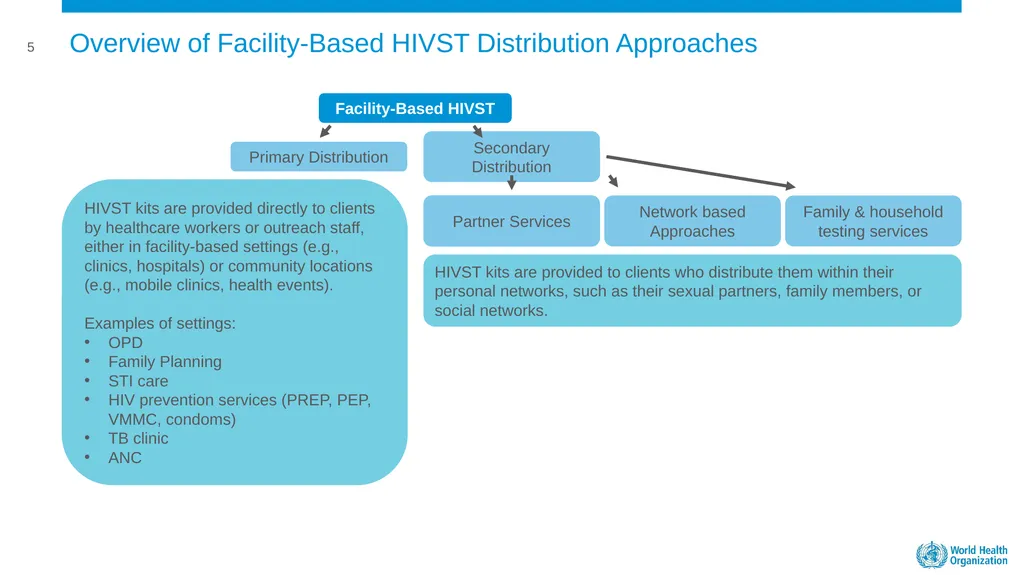
Overview of Facility-Based HIVST Distribution Approaches 5 Facility-Based HIVST HIVST kits are provided directly to clients by healthcare workers or outreach staff, either in facility-based settings (e.g., clinics, hospitals) or community locations (e.g., mobile clinics, health events).
Examples of settings:
OPD
Family Planning
STI care
HIV prevention services (PREP, PEP, VMMC, condoms)
TB clinic
ANC Partner Services Secondary Distribution Primary Distribution Network based Approaches Family & household testing services HIVST kits are provided to clients who distribute them within their personal networks, such as their sexual partners, family members, or social networks.<br>
Examples of settings:
OPD
Family Planning
STI care
HIV prevention services (PREP, PEP, VMMC, condoms)
TB clinic
ANC Partner Services Secondary Distribution Primary Distribution Network based Approaches Family & household testing services HIVST kits are provided to clients who distribute them within their personal networks, such as their sexual partners, family members, or social networks.<br>
04
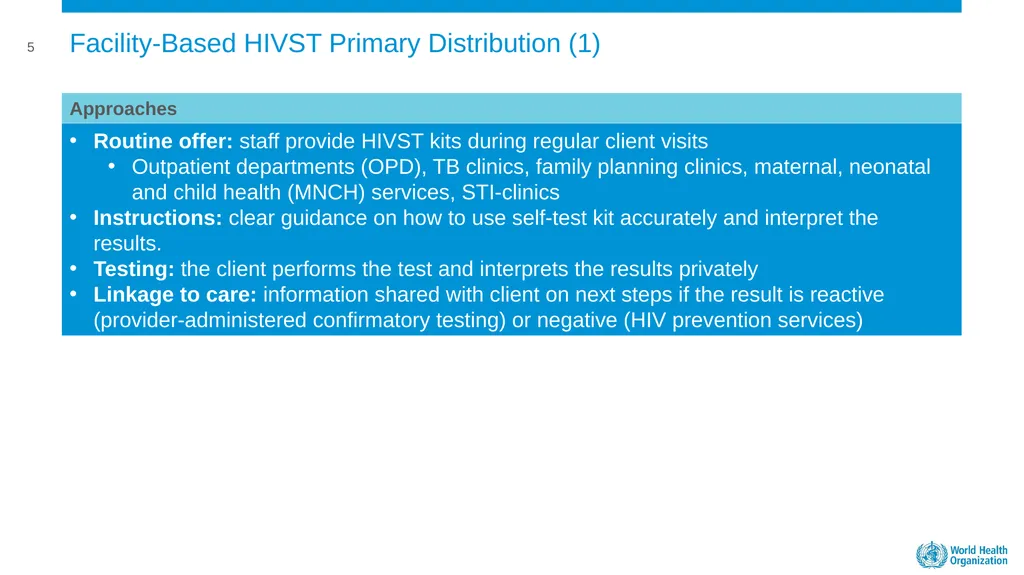
Facility-Based HIVST Primary Distribution (1) Routine offer: staff provide HIVST kits during regular client visits
Outpatient departments (OPD), TB clinics, family planning clinics, maternal, neonatal and child health (MNCH) services, STI-clinics
Instructions: clear guidance on how to use self-test kit accurately and interpret the results.
Testing: the client performs the test and interprets the results privately
Linkage to care: information shared with client on next steps if the result is reactive (provider-administered confirmatory testing) or negative (HIV prevention services) Approaches 5<br>
Outpatient departments (OPD), TB clinics, family planning clinics, maternal, neonatal and child health (MNCH) services, STI-clinics
Instructions: clear guidance on how to use self-test kit accurately and interpret the results.
Testing: the client performs the test and interprets the results privately
Linkage to care: information shared with client on next steps if the result is reactive (provider-administered confirmatory testing) or negative (HIV prevention services) Approaches 5<br>
05
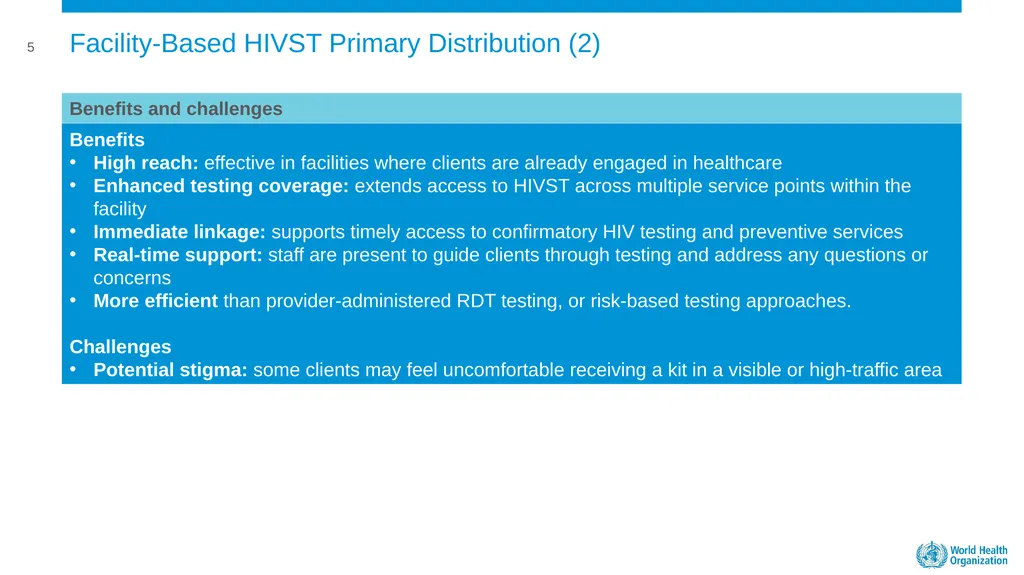
Facility-Based HIVST Primary Distribution (2) Benefits
High reach: effective in facilities where clients are already engaged in healthcare
Enhanced testing coverage: extends access to HIVST across multiple service points within the facility
Immediate linkage: supports timely access to confirmatory HIV testing and preventive services
Real-time support: staff are present to guide clients through testing and address any questions or concerns
More efficient than provider-administered RDT testing, or risk-based testing approaches.
Challenges
Potential stigma: some clients may feel uncomfortable receiving a kit in a visible or high-traffic area Benefits and challenges 5<br>
High reach: effective in facilities where clients are already engaged in healthcare
Enhanced testing coverage: extends access to HIVST across multiple service points within the facility
Immediate linkage: supports timely access to confirmatory HIV testing and preventive services
Real-time support: staff are present to guide clients through testing and address any questions or concerns
More efficient than provider-administered RDT testing, or risk-based testing approaches.
Challenges
Potential stigma: some clients may feel uncomfortable receiving a kit in a visible or high-traffic area Benefits and challenges 5<br>
06
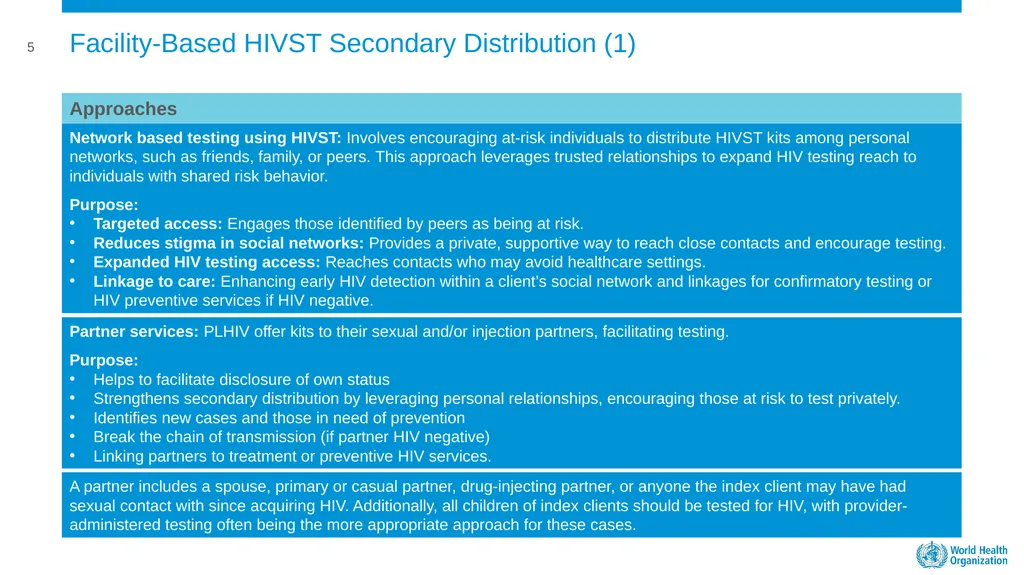
Facility-Based HIVST Secondary Distribution (1) Network based testing using HIVST: Involves encouraging at-risk individuals to distribute HIVST kits among personal networks, such as friends, family, or peers. This approach leverages trusted relationships to expand HIV testing reach to individuals with shared risk behavior.
Purpose:
Targeted access: Engages those identified by peers as being at risk.
Reduces stigma in social networks: Provides a private, supportive way to reach close contacts and encourage testing.
Expanded HIV testing access: Reaches contacts who may avoid healthcare settings.
Linkage to care: Enhancing early HIV detection within a client’s social network and linkages for confirmatory testing or HIV preventive services if HIV negative. 5 Partner services: PLHIV offer kits to their sexual and/or injection partners, facilitating testing.
Purpose:
Helps to facilitate disclosure of own status
Strengthens secondary distribution by leveraging personal relationships, encouraging those at risk to test privately.
Identifies new cases and those in need of prevention
Break the chain of transmission (if partner HIV negative)
Linking partners to treatment or preventive HIV services. A partner includes a spouse, primary or casual partner, drug-injecting partner, or anyone the index client may have had sexual contact with since acquiring HIV. Additionally, all children of index clients should be tested for HIV, with provider-administered testing often being the more appropriate approach for these cases. Approaches<br>
Purpose:
Targeted access: Engages those identified by peers as being at risk.
Reduces stigma in social networks: Provides a private, supportive way to reach close contacts and encourage testing.
Expanded HIV testing access: Reaches contacts who may avoid healthcare settings.
Linkage to care: Enhancing early HIV detection within a client’s social network and linkages for confirmatory testing or HIV preventive services if HIV negative. 5 Partner services: PLHIV offer kits to their sexual and/or injection partners, facilitating testing.
Purpose:
Helps to facilitate disclosure of own status
Strengthens secondary distribution by leveraging personal relationships, encouraging those at risk to test privately.
Identifies new cases and those in need of prevention
Break the chain of transmission (if partner HIV negative)
Linking partners to treatment or preventive HIV services. A partner includes a spouse, primary or casual partner, drug-injecting partner, or anyone the index client may have had sexual contact with since acquiring HIV. Additionally, all children of index clients should be tested for HIV, with provider-administered testing often being the more appropriate approach for these cases. Approaches<br>
07
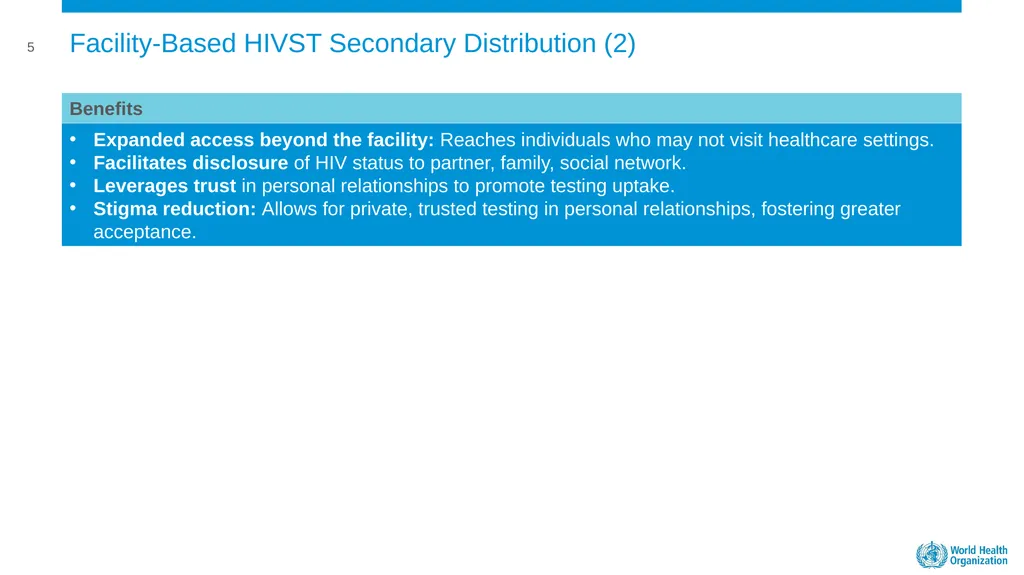
Facility-Based HIVST Secondary Distribution (2) 5 Expanded access beyond the facility: Reaches individuals who may not visit healthcare settings.
Facilitates disclosure of HIV status to partner, family, social network.
Leverages trust in personal relationships to promote testing uptake.
Stigma reduction: Allows for private, trusted testing in personal relationships, fostering greater acceptance. Benefits<br>
Facilitates disclosure of HIV status to partner, family, social network.
Leverages trust in personal relationships to promote testing uptake.
Stigma reduction: Allows for private, trusted testing in personal relationships, fostering greater acceptance. Benefits<br>
08
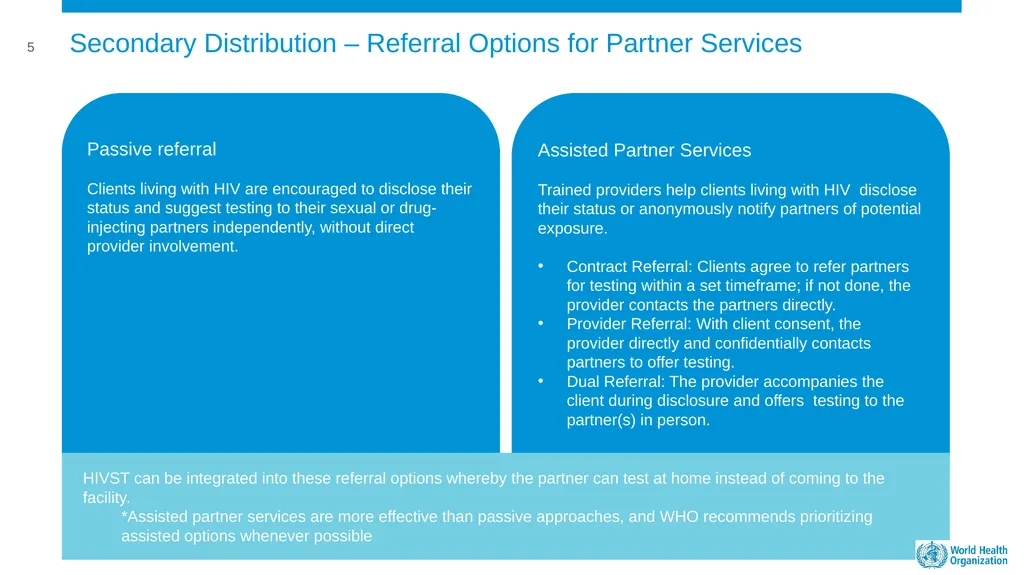
Secondary Distribution – Referral Options for Partner Services Assisted Partner Services
Trained providers help clients living with HIV disclose their status or anonymously notify partners of potential exposure.
Contract Referral: Clients agree to refer partners for testing within a set timeframe; if not done, the provider contacts the partners directly.
Provider Referral: With client consent, the provider directly and confidentially contacts partners to offer testing.
Dual Referral: The provider accompanies the client during disclosure and offers testing to the partner(s) in person. Passive referral
Clients living with HIV are encouraged to disclose their status and suggest testing to their sexual or drug-injecting partners independently, without direct provider involvement. HIVST can be integrated into these referral options whereby the partner can test at home instead of coming to the facility.
*Assisted partner services are more effective than passive approaches, and WHO recommends prioritizing assisted options whenever possible 5<br>
Trained providers help clients living with HIV disclose their status or anonymously notify partners of potential exposure.
Contract Referral: Clients agree to refer partners for testing within a set timeframe; if not done, the provider contacts the partners directly.
Provider Referral: With client consent, the provider directly and confidentially contacts partners to offer testing.
Dual Referral: The provider accompanies the client during disclosure and offers testing to the partner(s) in person. Passive referral
Clients living with HIV are encouraged to disclose their status and suggest testing to their sexual or drug-injecting partners independently, without direct provider involvement. HIVST can be integrated into these referral options whereby the partner can test at home instead of coming to the facility.
*Assisted partner services are more effective than passive approaches, and WHO recommends prioritizing assisted options whenever possible 5<br>
09
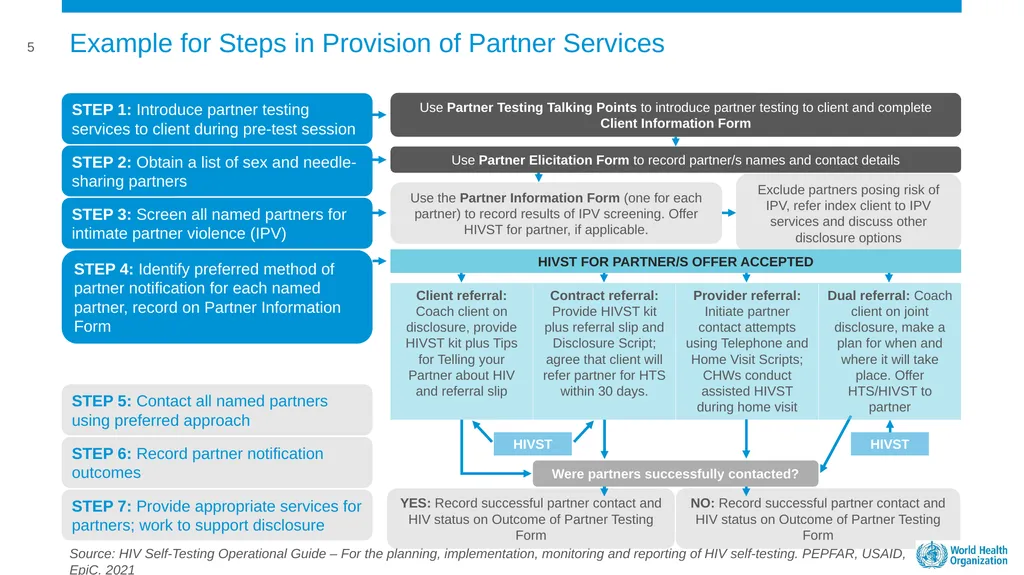
STEP 1: Introduce partner testing services to client during pre-test session STEP 2: Obtain a list of sex and needle-sharing partners STEP 3: Screen all named partners for intimate partner violence (IPV) STEP 4: Identify preferred method of partner notification for each named partner, record on Partner Information Form STEP 5: Contact all named partners using preferred approach STEP 6: Record partner notification outcomes STEP 7: Provide appropriate services for partners; work to support disclosure Use Partner Testing Talking Points to introduce partner testing to client and complete Client Information Form Use Partner Elicitation Form to record partner/s names and contact details Use the Partner Information Form (one for each partner) to record results of IPV screening. Offer HIVST for partner, if applicable. Exclude partners posing risk of IPV, refer index client to IPV services and discuss other disclosure options HIVST FOR PARTNER/S OFFER ACCEPTED HIVST Were partners successfully contacted? YES: Record successful partner contact and HIV status on Outcome of Partner Testing Form NO: Record successful partner contact and HIV status on Outcome of Partner Testing Form Example for Steps in Provision of Partner Services 5 Source: HIV Self-Testing Operational Guide – For the planning, implementation, monitoring and reporting of HIV self-testing. PEPFAR, USAID, EpiC. 2021 Client referral: Coach client on disclosure, provide HIVST kit plus Tips for Telling your Partner about HIV and referral slip Contract referral: Provide HIVST kit plus referral slip and Disclosure Script; agree that client will refer partner for HTS within 30 days. Provider referral: Initiate partner contact attempts using Telephone and Home Visit Scripts; CHWs conduct assisted HIVST during home visit Dual referral: Coach client on joint disclosure, make a plan for when and where it will take place. Offer HTS/HIVST to partner HIVST<br>
10
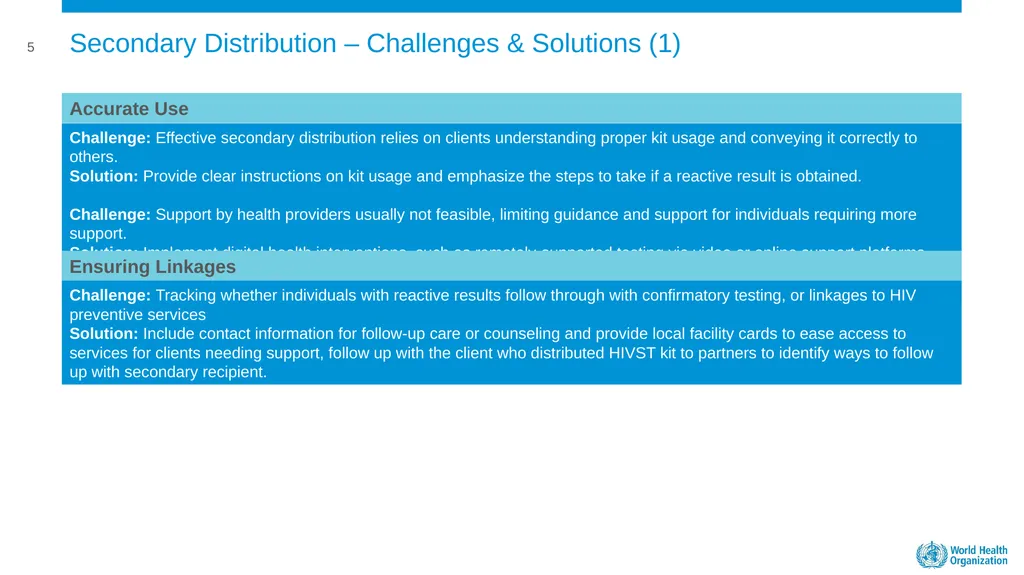
Secondary Distribution – Challenges & Solutions (1) 5 Challenge: Effective secondary distribution relies on clients understanding proper kit usage and conveying it correctly to others.
Solution: Provide clear instructions on kit usage and emphasize the steps to take if a reactive result is obtained.
Challenge: Support by health providers usually not feasible, limiting guidance and support for individuals requiring more support.
Solution: Implement digital health interventions, such as remotely-supported testing via video or online support platforms. These tools provide step-by-step guidance, ensuring clients have the support needed for accurate test use and linkage to care. Accurate Use Challenge: Tracking whether individuals with reactive results follow through with confirmatory testing, or linkages to HIV preventive services Solution: Include contact information for follow-up care or counseling and provide local facility cards to ease access to services for clients needing support, follow up with the client who distributed HIVST kit to partners to identify ways to follow up with secondary recipient. Ensuring Linkages<br>
Solution: Provide clear instructions on kit usage and emphasize the steps to take if a reactive result is obtained.
Challenge: Support by health providers usually not feasible, limiting guidance and support for individuals requiring more support.
Solution: Implement digital health interventions, such as remotely-supported testing via video or online support platforms. These tools provide step-by-step guidance, ensuring clients have the support needed for accurate test use and linkage to care. Accurate Use Challenge: Tracking whether individuals with reactive results follow through with confirmatory testing, or linkages to HIV preventive services Solution: Include contact information for follow-up care or counseling and provide local facility cards to ease access to services for clients needing support, follow up with the client who distributed HIVST kit to partners to identify ways to follow up with secondary recipient. Ensuring Linkages<br>
11
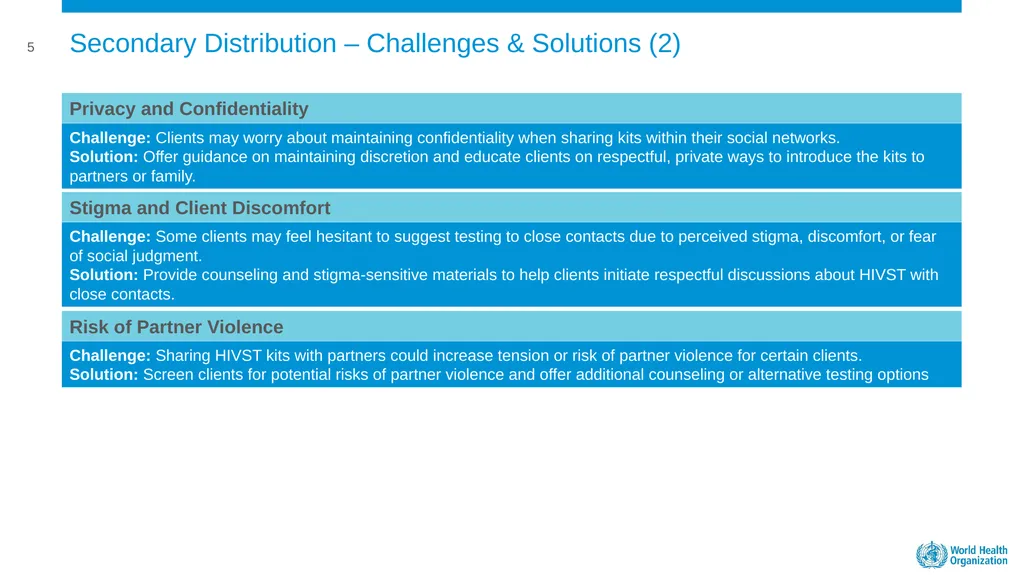
Secondary Distribution – Challenges & Solutions (2) 5 Challenge: Clients may worry about maintaining confidentiality when sharing kits within their social networks.
Solution: Offer guidance on maintaining discretion and educate clients on respectful, private ways to introduce the kits to partners or family. Privacy and Confidentiality Challenge: Some clients may feel hesitant to suggest testing to close contacts due to perceived stigma, discomfort, or fear of social judgment.
Solution: Provide counseling and stigma-sensitive materials to help clients initiate respectful discussions about HIVST with close contacts. Stigma and Client Discomfort Challenge: Sharing HIVST kits with partners could increase tension or risk of partner violence for certain clients.
Solution: Screen clients for potential risks of partner violence and offer additional counseling or alternative testing options Risk of Partner Violence<br>
12
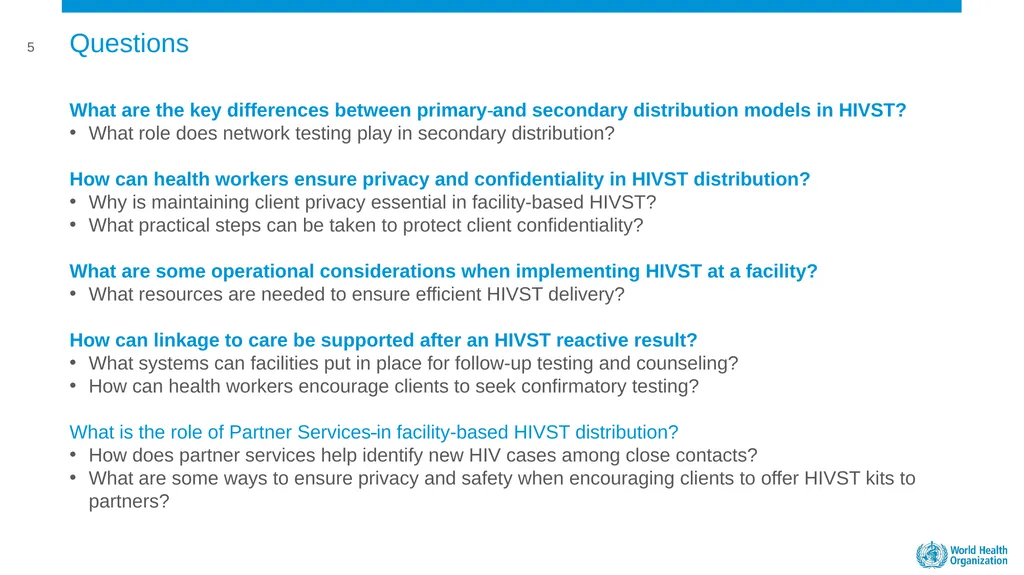
What are the key differences between primary and secondary distribution models in HIVST?
What role does network testing play in secondary distribution?
How can health workers ensure privacy and confidentiality in HIVST distribution?
Why is maintaining client privacy essential in facility-based HIVST?
What practical steps can be taken to protect client confidentiality?
What are some operational considerations when implementing HIVST at a facility?
What resources are needed to ensure efficient HIVST delivery?
How can linkage to care be supported after an HIVST reactive result?
What systems can facilities put in place for follow-up testing and counseling?
How can health workers encourage clients to seek confirmatory testing?
What is the role of Partner Services in facility-based HIVST distribution?
How does partner services help identify new HIV cases among close contacts?
What are some ways to ensure privacy and safety when encouraging clients to offer HIVST kits to partners? 5 Questions<br>
What role does network testing play in secondary distribution?
How can health workers ensure privacy and confidentiality in HIVST distribution?
Why is maintaining client privacy essential in facility-based HIVST?
What practical steps can be taken to protect client confidentiality?
What are some operational considerations when implementing HIVST at a facility?
What resources are needed to ensure efficient HIVST delivery?
How can linkage to care be supported after an HIVST reactive result?
What systems can facilities put in place for follow-up testing and counseling?
How can health workers encourage clients to seek confirmatory testing?
What is the role of Partner Services in facility-based HIVST distribution?
How does partner services help identify new HIV cases among close contacts?
What are some ways to ensure privacy and safety when encouraging clients to offer HIVST kits to partners? 5 Questions<br>
13
Exercise 5<br>