
Module 6: Recognize, Provide, Mobilize Community
MY
Published · 37 slides · 0 views
1 / 1
Description
Module 6: Recognize, Provide, Mobilize Community First Aid Response Course Module 6: Learning Objectives On completing this module, you should be able to: Describe higher level of care Recognize key considerations in choosing where to send
Related Topics
Share
Embed code
Download this presentation From Below
"Module 6: Recognize, Provide, Mobilize Community" is the property of its rightful owner. Permission is granted to download and print the materials on this website for personal, non-commercial use only, and to display it on your personal computer provided you do not modify the materials and that you retain all copyright notices contained in the materials. By downloading content from our website, you accept the terms of this agreement.
Presentation Transcript
01
Module 6: Recognize, Provide, Mobilize Community First Aid Response Course<br>
02
Module 6: Learning Objectives On completing this module, you should be able to:
Describe higher level of care
Recognize key considerations in choosing where to send people for higher care
Assess key considerations in how to mobilize people to health facilities
Perform basic patient mobilization and transport.
Explain how CFARs can integrate within broader emergency care systems<br>
Describe higher level of care
Recognize key considerations in choosing where to send people for higher care
Assess key considerations in how to mobilize people to health facilities
Perform basic patient mobilization and transport.
Explain how CFARs can integrate within broader emergency care systems<br>
03
Essential Skills By the end of this module, the CFAR will be able to demonstrate the following skills:
One-Person Carry Techniques
Multi-Person Carry Techniques<br>
One-Person Carry Techniques
Multi-Person Carry Techniques<br>
04
Module 6: Key Terms On completing this module, you should be able to define the following terms:
Higher level of care
Patient Transport
System Integration<br>
Higher level of care
Patient Transport
System Integration<br>
05
Overview To be successful, a Community First Aid Responder must know:
How to recognize critically ill patients,
How to respond with interventions and call for help,
Where to send patients needing higher level of care, and
How to safely aid in transporting them to that care.
They must be integrated with existing emergency care systems to improve timely access to care for their patients.<br>
How to recognize critically ill patients,
How to respond with interventions and call for help,
Where to send patients needing higher level of care, and
How to safely aid in transporting them to that care.
They must be integrated with existing emergency care systems to improve timely access to care for their patients.<br>
06
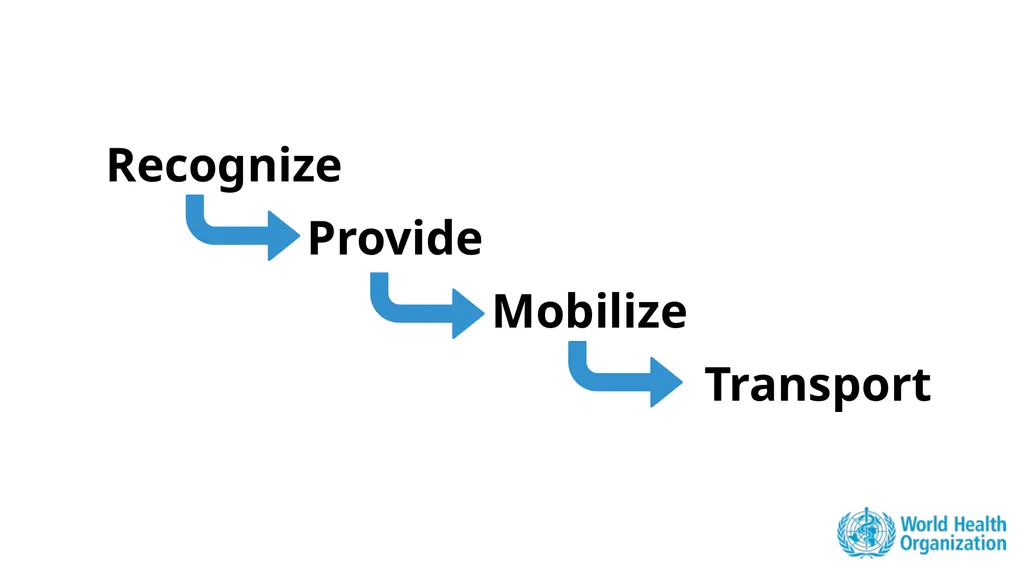
Transport Recognize Provide Mobilize<br>
07
Recognize an Emergency Condition You have learned how to recognize an emergency condition doing CABCDE assessment.
Patients with emergency conditions will often need additional care beyond the first aid that you can provide.<br>
Patients with emergency conditions will often need additional care beyond the first aid that you can provide.<br>
08
Recognize when a Patient Needs More Higher level of care = a healthcare facility that can provide advanced emergency care beyond what you can provide
You may need to decide whether a patient should go to one healthcare facility or another. For example:
Traumatic injury (head or abdomen) → facility with surgical capability.
Pregnant woman with bleeding emergency → facility with emergency obstetric services.<br>
You may need to decide whether a patient should go to one healthcare facility or another. For example:
Traumatic injury (head or abdomen) → facility with surgical capability.
Pregnant woman with bleeding emergency → facility with emergency obstetric services.<br>
09
Remember Sending a patient to a location that cannot provide the needed care may delay life-saving care.
If possible, send directly to a hospital with advanced services.
Know your local facilities and what care they offer to help get patients where they need to go.<br>
If possible, send directly to a hospital with advanced services.
Know your local facilities and what care they offer to help get patients where they need to go.<br>
10
Provide care for a person with an emergency condition Once you identify an emergency using the CABCDE steps, use your skills to give first aid and help prevent the condition from getting worse.<br>
11
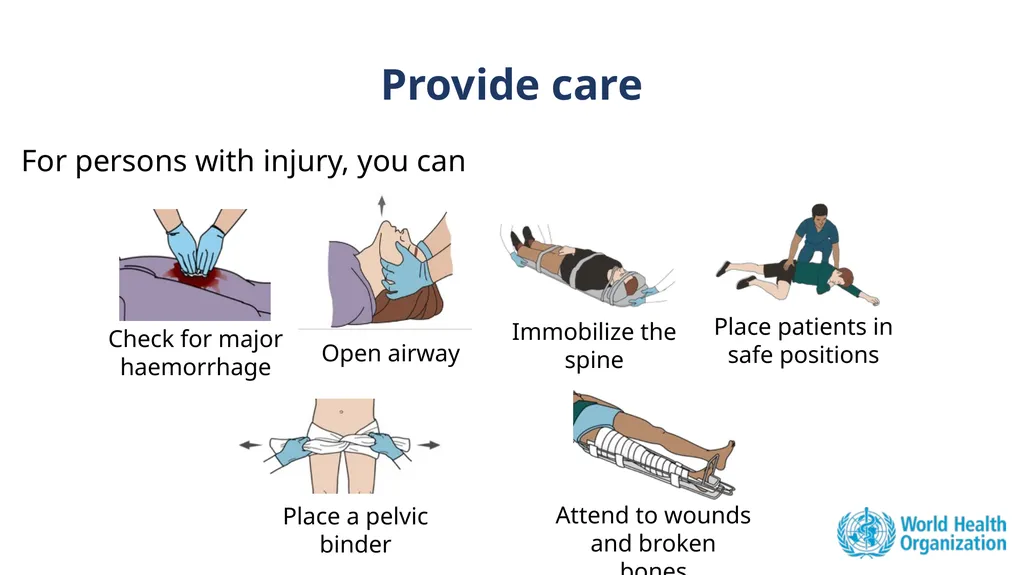
Provide care For persons with injury, you can Check for major haemorrhage Open airway Immobilize the spine Place patients in safe positions Place a pelvic binder Attend to wounds and broken bones<br>
12
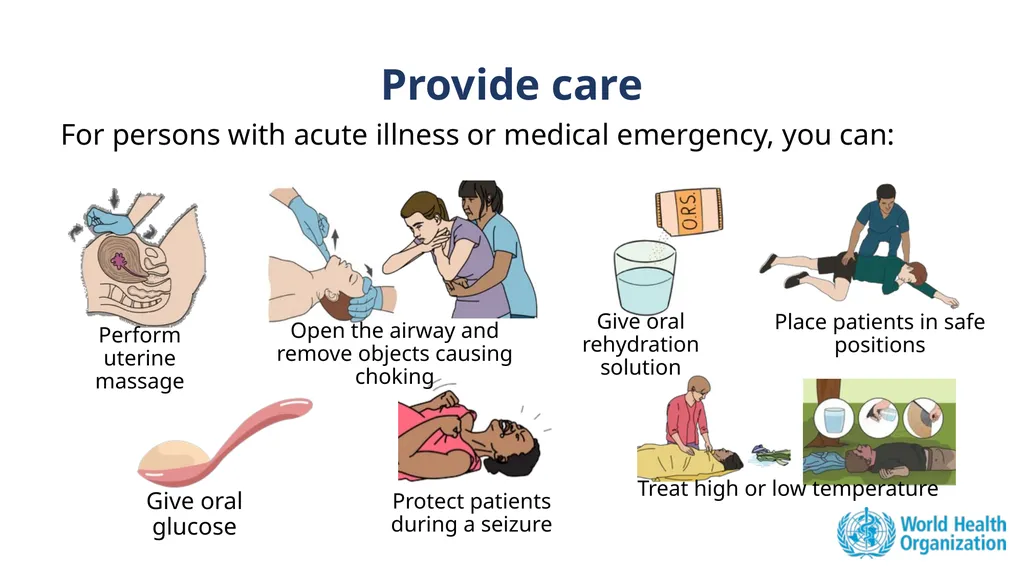
Provide care For persons with acute illness or medical emergency, you can: Treat high or low temperature Perform uterine massage Open the airway and remove objects causing choking Place patients in safe positions Give oral rehydration solution Give oral glucose Protect patients during a seizure<br>
13
Provide care Immediate interventions will help save lives until people can get to a higher level of care.<br>
14
Mobilize person with an emergency condition Arrange mobilization as soon as possible to ensure that they reach the right healthcare facility quickly if needed.<br>
15
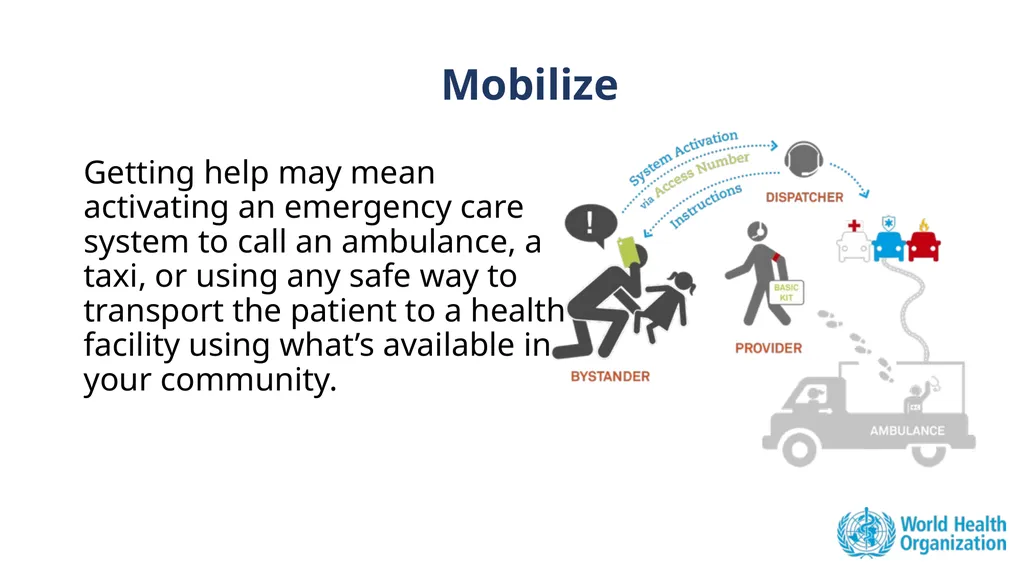
Mobilize Getting help may mean activating an emergency care system to call an ambulance, a taxi, or using any safe way to transport the patient to a health facility using what’s available in your community.<br>
16
Mobilize Call for guidance from nearest health facility. Accompany the patient during transport if they are very sick.<br>
17
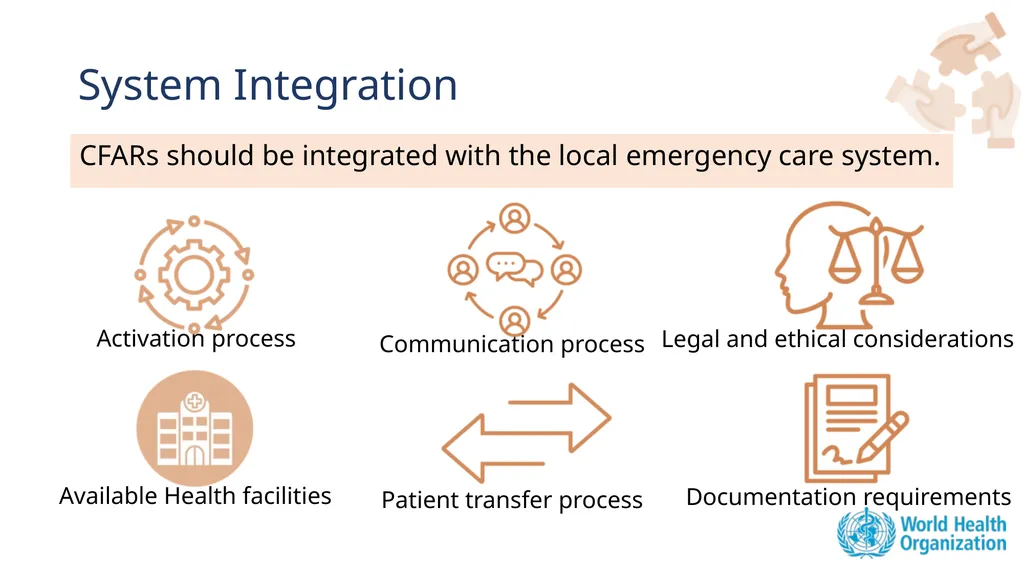
System Integration Activation process Communication process Documentation requirements Legal and ethical considerations Patient transfer process Available Health facilities CFARs should be integrated with the local emergency care system.<br>
18
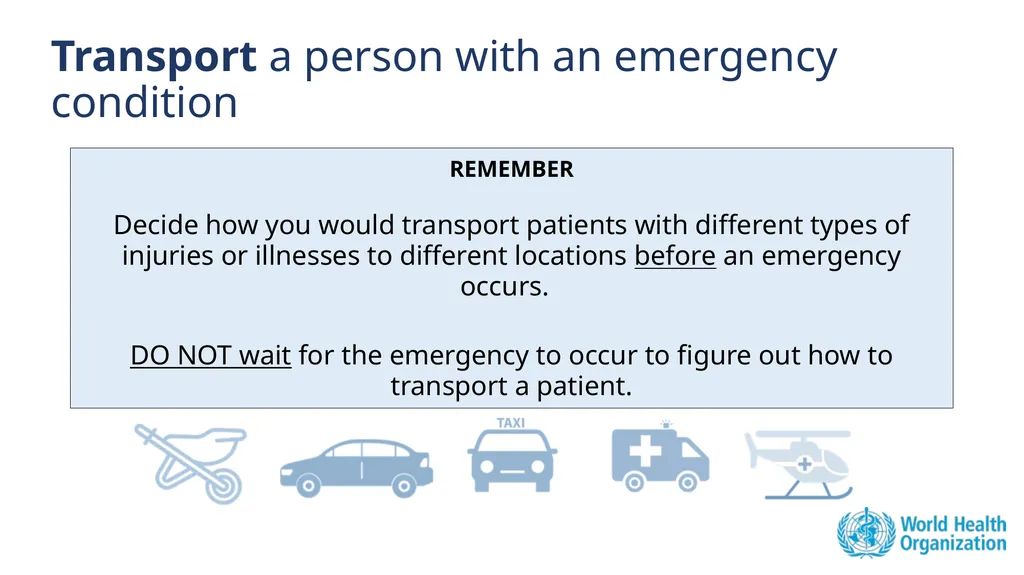
Transport a person with an emergency condition REMEMBER
Decide how you would transport patients with different types of injuries or illnesses to different locations before an emergency occurs.
DO NOT wait for the emergency to occur to figure out how to transport a patient.<br>
Decide how you would transport patients with different types of injuries or illnesses to different locations before an emergency occurs.
DO NOT wait for the emergency to occur to figure out how to transport a patient.<br>
19
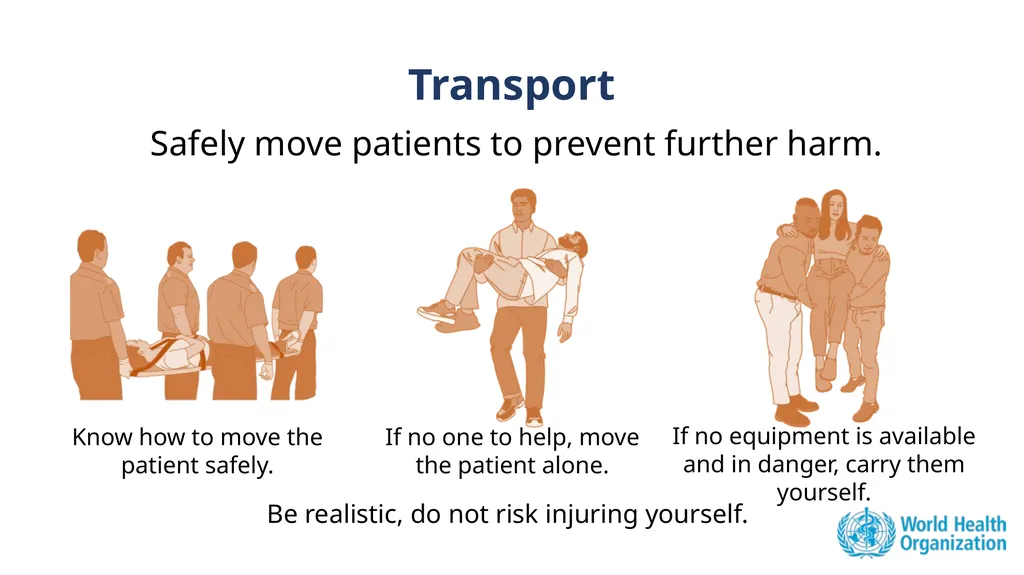
Transport Know how to move the patient safely. Be realistic, do not risk injuring yourself. If no equipment is available and in danger, carry them yourself. If no one to help, move the patient alone. Safely move patients to prevent further harm.<br>
20
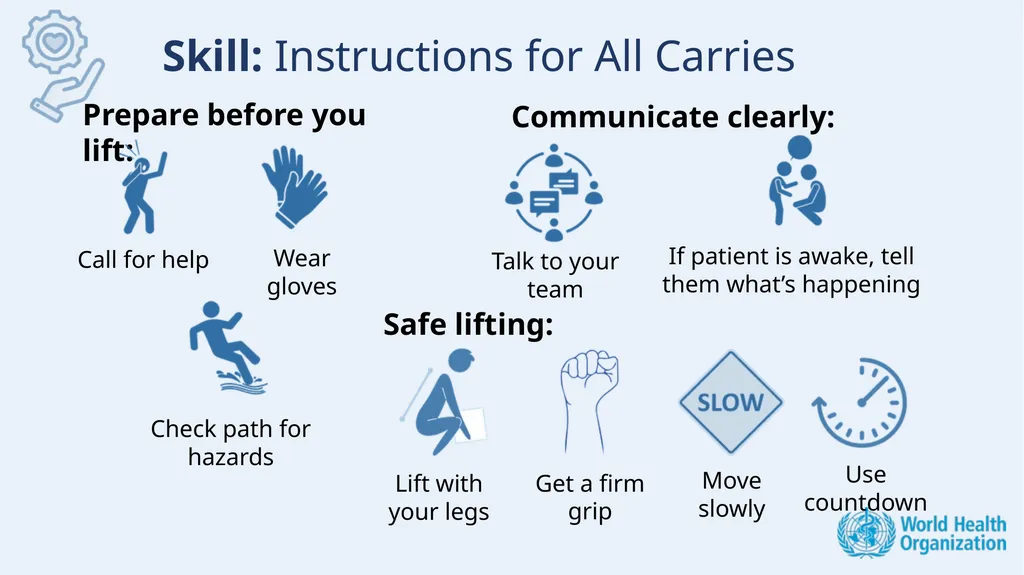
Skill: Instructions for All Carries Prepare before you lift: Wear gloves Call for help Communicate clearly: Check path for hazards If patient is awake, tell them what’s happening Talk to your team Safe lifting: Lift with your legs Get a firm grip Move slowly Use countdown<br>
21
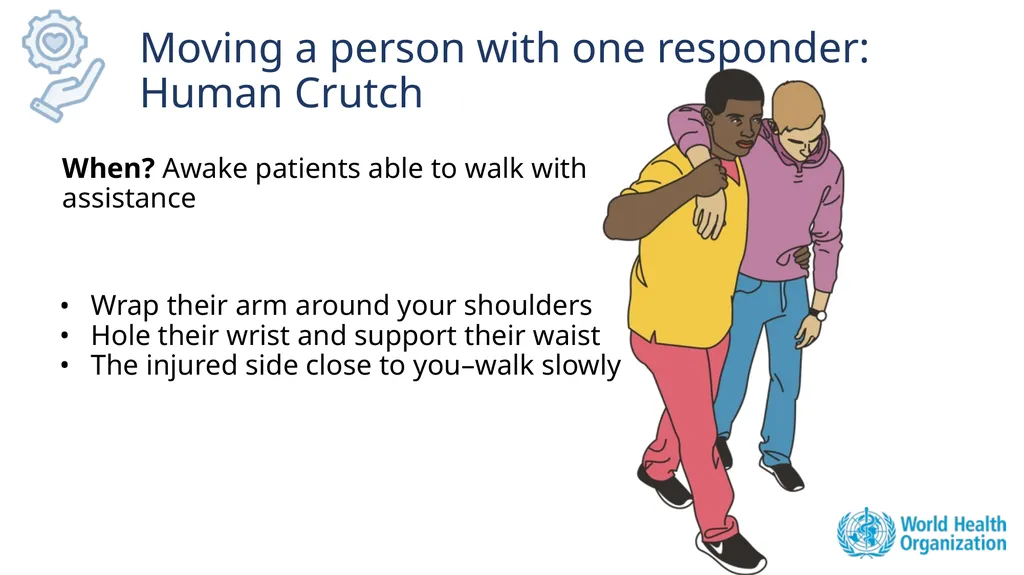
Moving a person with one responder:
Human Crutch When? Awake patients able to walk with assistance Wrap their arm around your shoulders
Hole their wrist and support their waist
The injured side close to you–walk slowly<br>
Hole their wrist and support their waist
The injured side close to you–walk slowly<br>
22
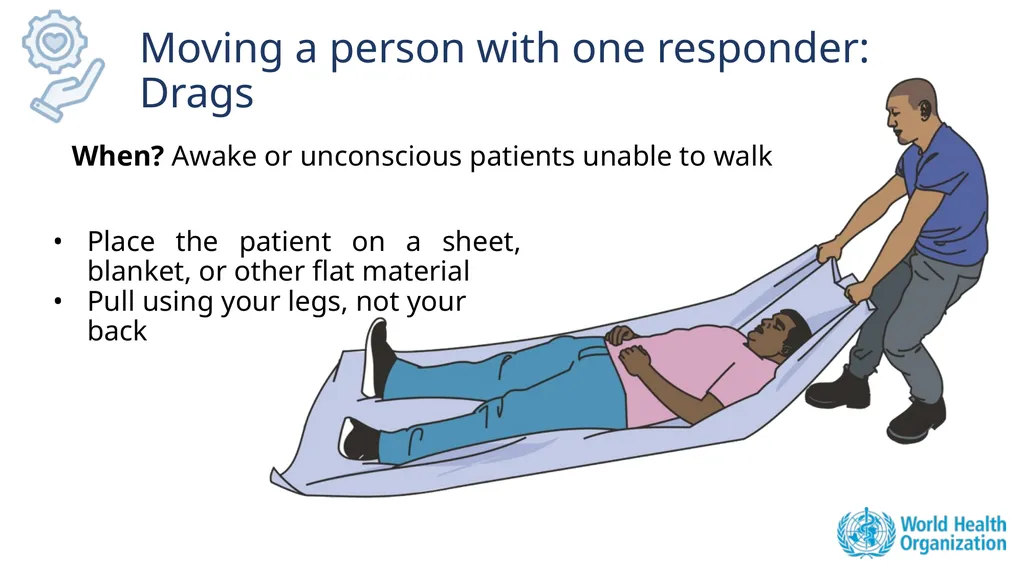
Moving a person with one responder:
Drags When? Awake or unconscious patients unable to walk Place the patient on a sheet, blanket, or other flat material
Pull using your legs, not your back<br>
Pull using your legs, not your back<br>
23
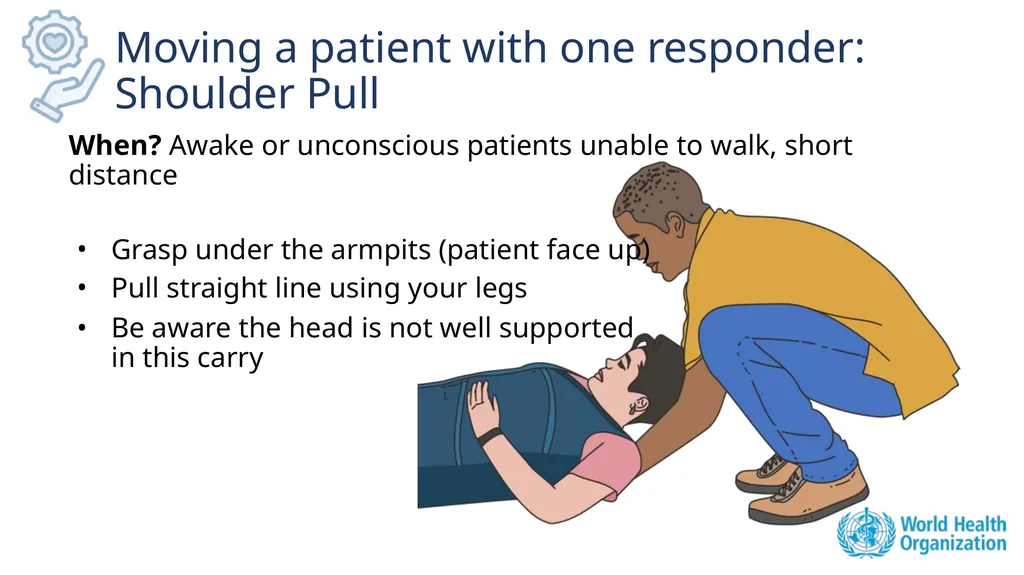
Moving a patient with one responder:
Shoulder Pull When? Awake or unconscious patients unable to walk, short distance Grasp under the armpits (patient face up)
Pull straight line using your legs
Be aware the head is not well supported in this carry<br>
Pull straight line using your legs
Be aware the head is not well supported in this carry<br>
24
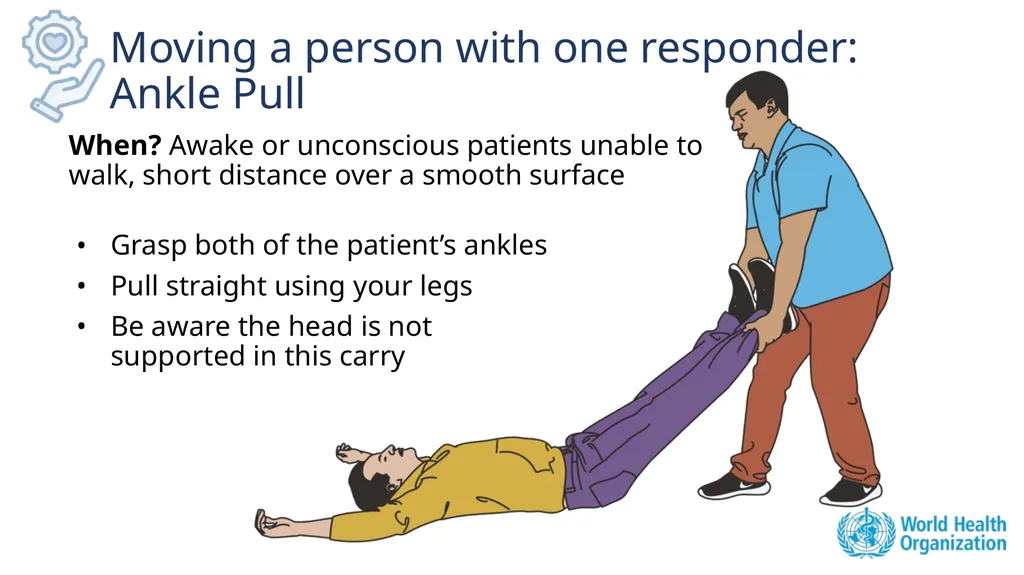
Moving a person with one responder:
Ankle Pull When? Awake or unconscious patients unable to walk, short distance over a smooth surface Grasp both of the patient’s ankles
Pull straight using your legs
Be aware the head is not supported in this carry<br>
Pull straight using your legs
Be aware the head is not supported in this carry<br>
25
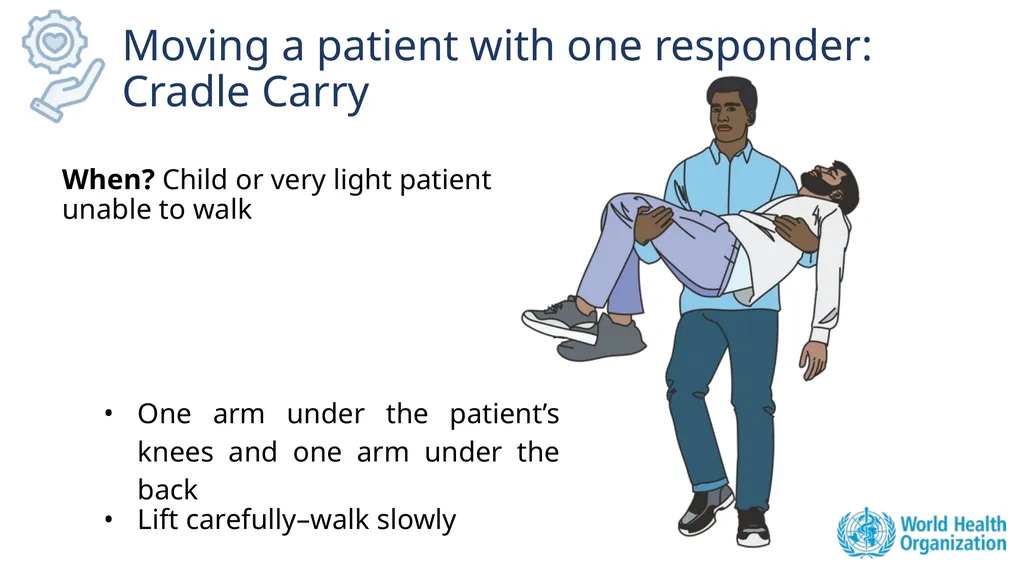
Moving a patient with one responder:
Cradle Carry When? Child or very light patient unable to walk One arm under the patient’s knees and one arm under the back
Lift carefully–walk slowly<br>
Lift carefully–walk slowly<br>
26
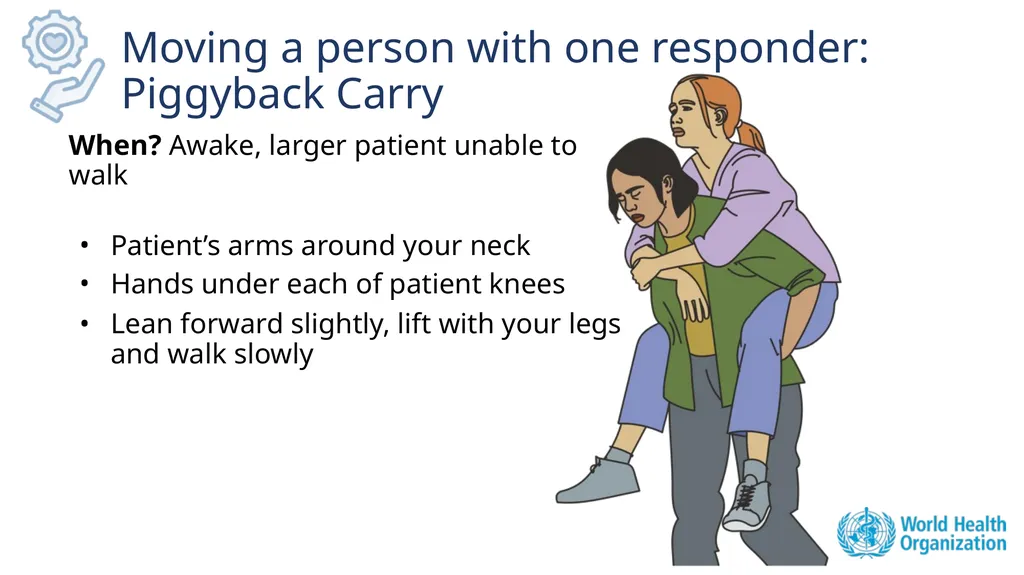
Moving a person with one responder:
Piggyback Carry When? Awake, larger patient unable to walk Patient’s arms around your neck
Hands under each of patient knees
Lean forward slightly, lift with your legs and walk slowly<br>
Hands under each of patient knees
Lean forward slightly, lift with your legs and walk slowly<br>
27
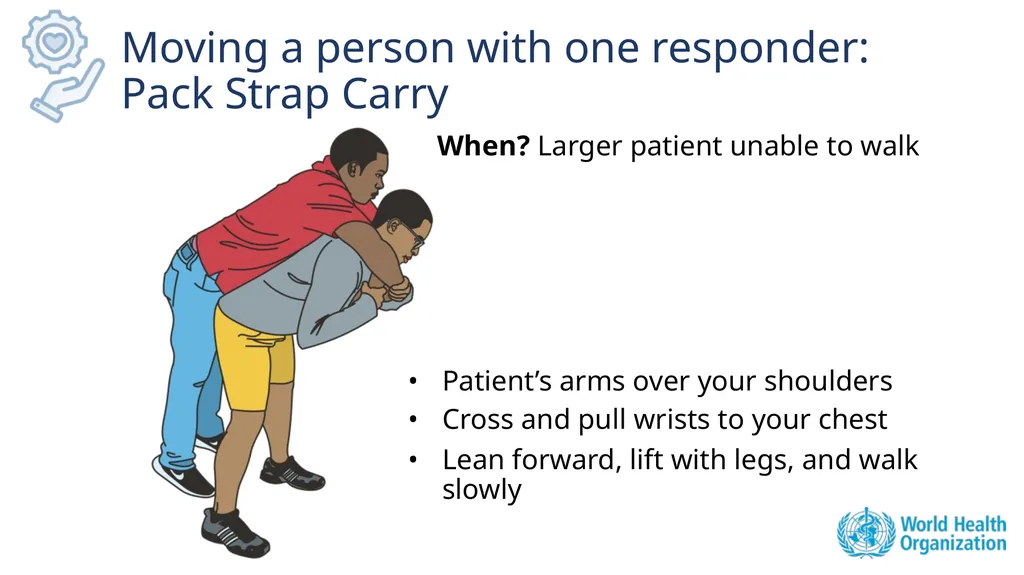
Moving a person with one responder:
Pack Strap Carry When? Larger patient unable to walk Patient’s arms over your shoulders
Cross and pull wrists to your chest
Lean forward, lift with legs, and walk slowly<br>
Cross and pull wrists to your chest
Lean forward, lift with legs, and walk slowly<br>
28
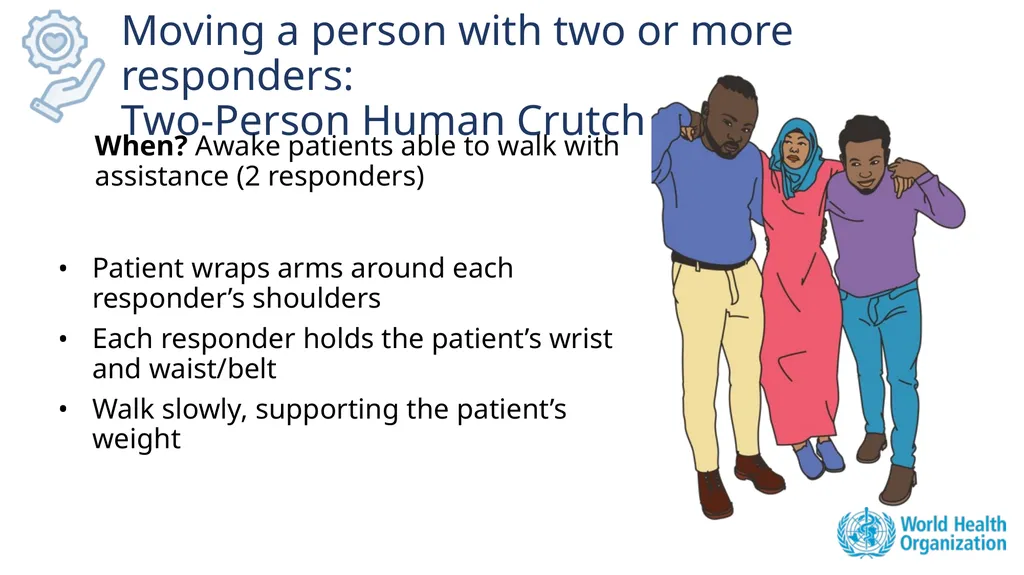
Moving a person with two or more responders:
Two-Person Human Crutch Patient wraps arms around each responder’s shoulders
Each responder holds the patient’s wrist and waist/belt
Walk slowly, supporting the patient’s weight When? Awake patients able to walk with assistance (2 responders)<br>
Each responder holds the patient’s wrist and waist/belt
Walk slowly, supporting the patient’s weight When? Awake patients able to walk with assistance (2 responders)<br>
29
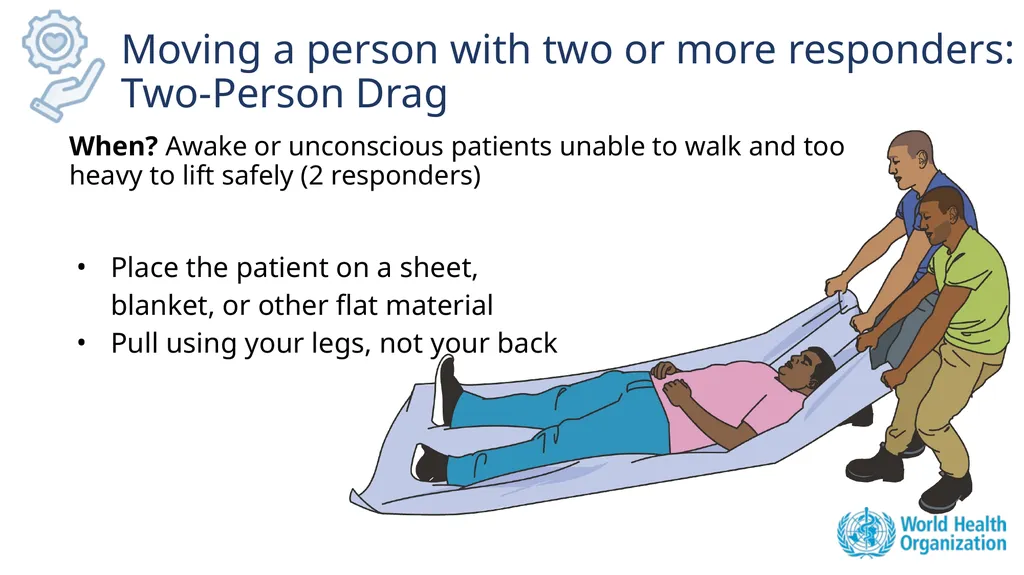
Moving a person with two or more responders:
Two-Person Drag When? Awake or unconscious patients unable to walk and too heavy to lift safely (2 responders) Place the patient on a sheet, blanket, or other flat material
Pull using your legs, not your back<br>
Pull using your legs, not your back<br>
30
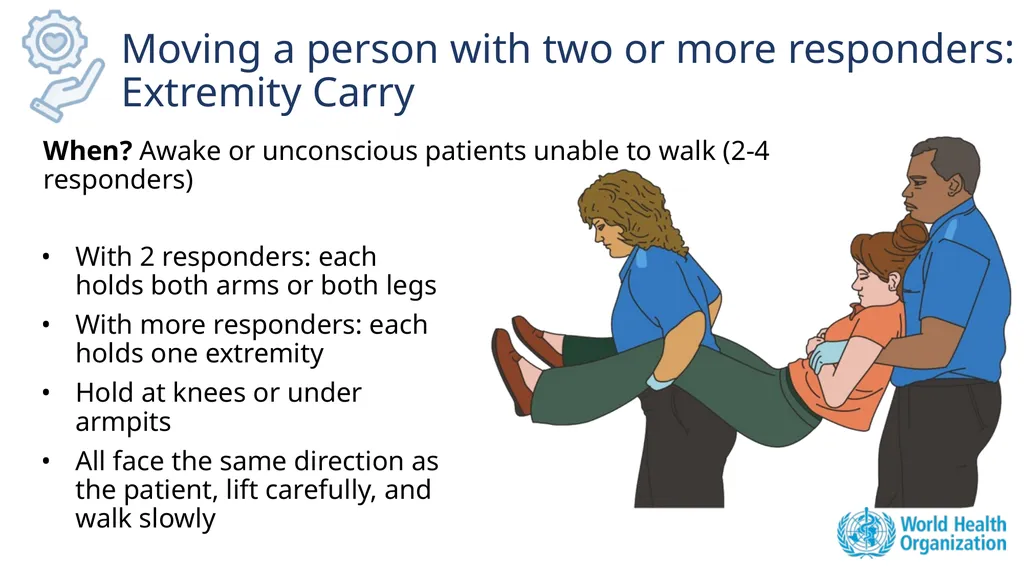
Moving a person with two or more responders:
Extremity Carry When? Awake or unconscious patients unable to walk (2-4 responders) With 2 responders: each holds both arms or both legs
With more responders: each holds one extremity
Hold at knees or under armpits
All face the same direction as the patient, lift carefully, and walk slowly<br>
With more responders: each holds one extremity
Hold at knees or under armpits
All face the same direction as the patient, lift carefully, and walk slowly<br>
31
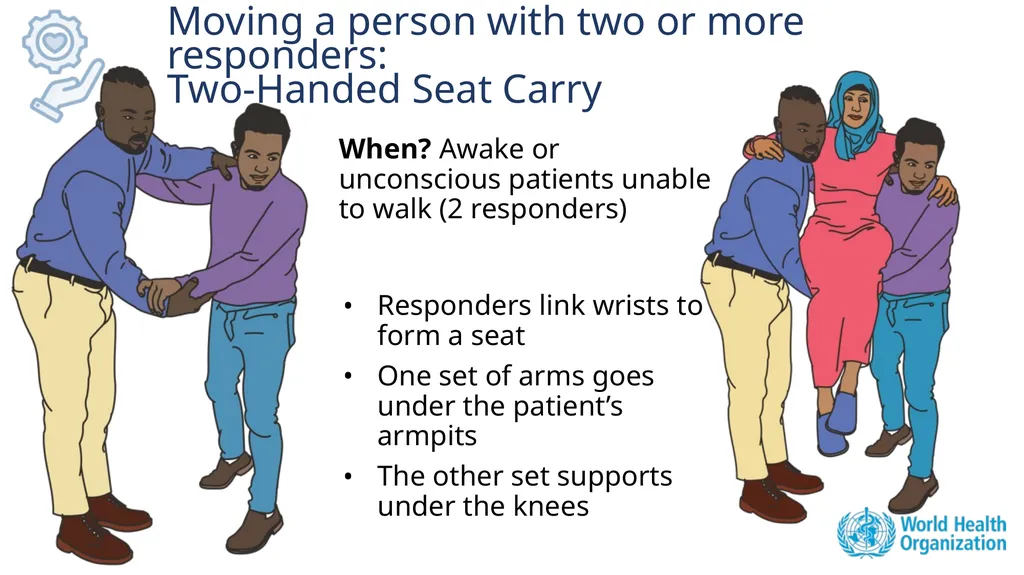
Moving a person with two or more responders:
Two-Handed Seat Carry When? Awake or unconscious patients unable to walk (2 responders) Responders link wrists to form a seat
One set of arms goes under the patient’s armpits
The other set supports under the knees<br>
One set of arms goes under the patient’s armpits
The other set supports under the knees<br>
32
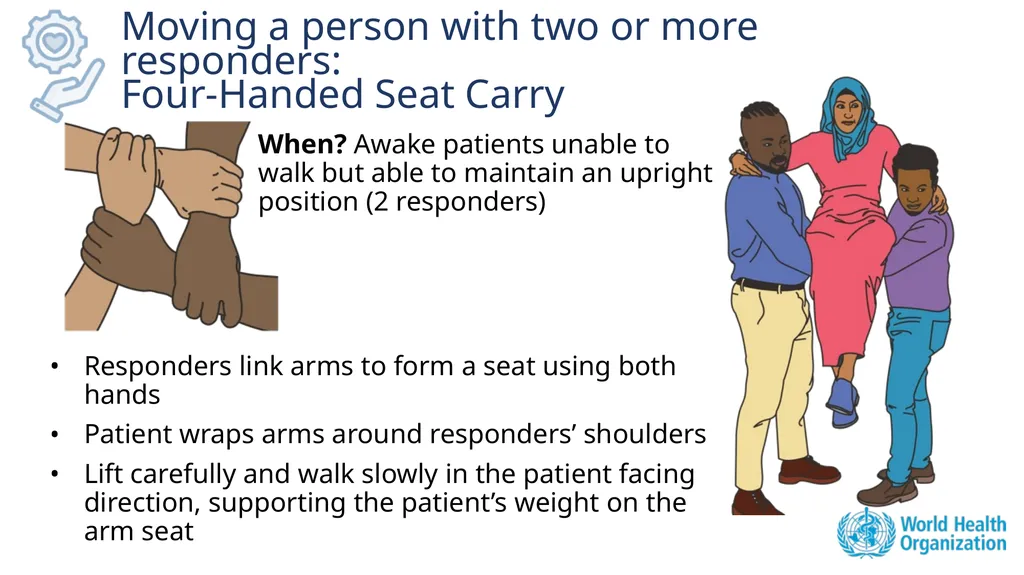
When? Awake patients unable to walk but able to maintain an upright position (2 responders) Moving a person with two or more responders:
Four-Handed Seat Carry Responders link arms to form a seat using both hands
Patient wraps arms around responders’ shoulders
Lift carefully and walk slowly in the patient facing direction, supporting the patient’s weight on the arm seat<br>
Patient wraps arms around responders’ shoulders
Lift carefully and walk slowly in the patient facing direction, supporting the patient’s weight on the arm seat<br>
33
Moving a patient with three or more responders:
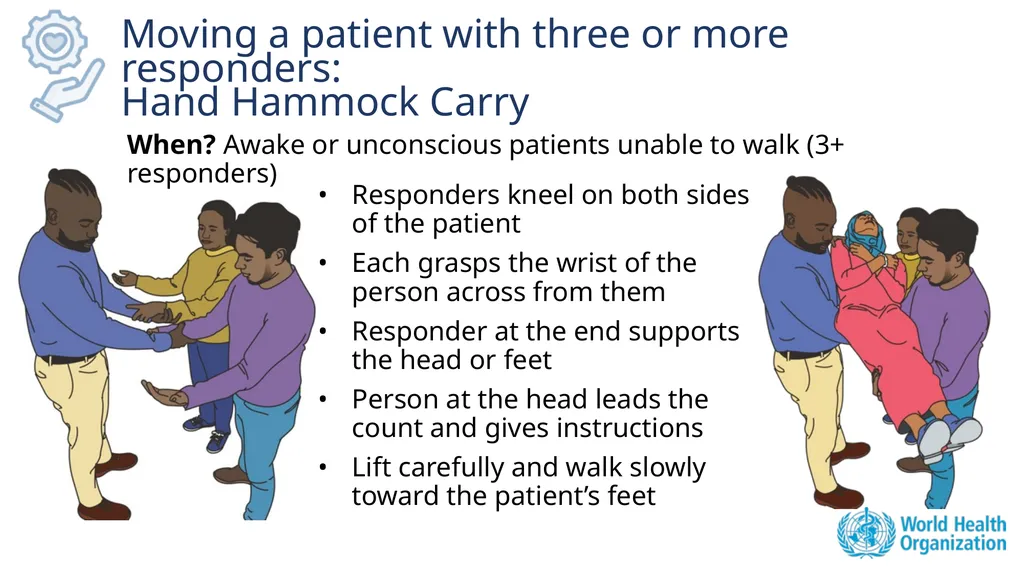
Hand Hammock Carry When? Awake or unconscious patients unable to walk (3+ responders) Responders kneel on both sides of the patient
Each grasps the wrist of the person across from them
Responder at the end supports the head or feet
Person at the head leads the count and gives instructions
Lift carefully and walk slowly toward the patient’s feet<br>
Each grasps the wrist of the person across from them
Responder at the end supports the head or feet
Person at the head leads the count and gives instructions
Lift carefully and walk slowly toward the patient’s feet<br>
34
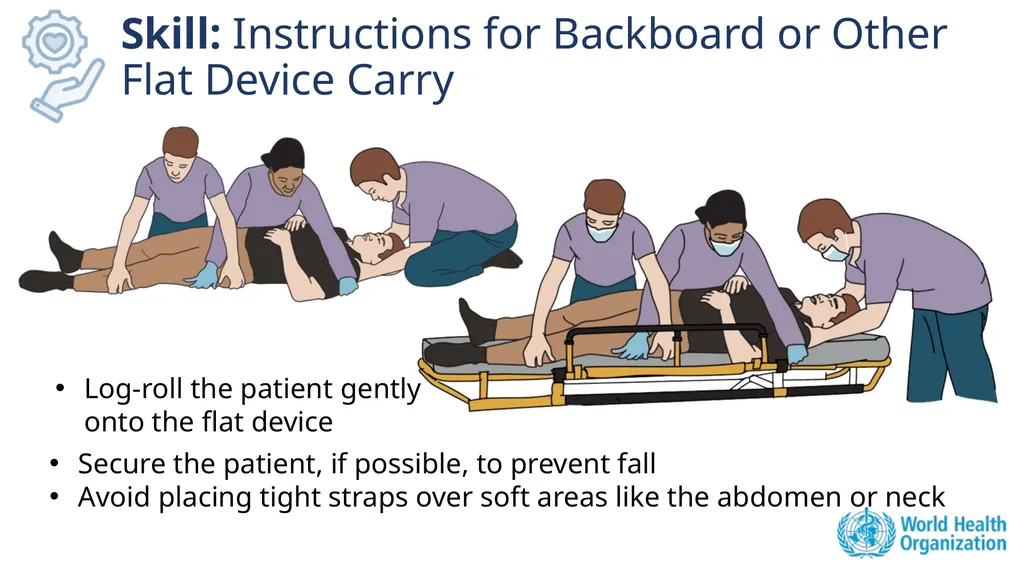
Skill: Instructions for Backboard or Other Flat Device Carry Secure the patient, if possible, to prevent fall
Avoid placing tight straps over soft areas like the abdomen or neck Log-roll the patient gently onto the flat device<br>
Avoid placing tight straps over soft areas like the abdomen or neck Log-roll the patient gently onto the flat device<br>
35
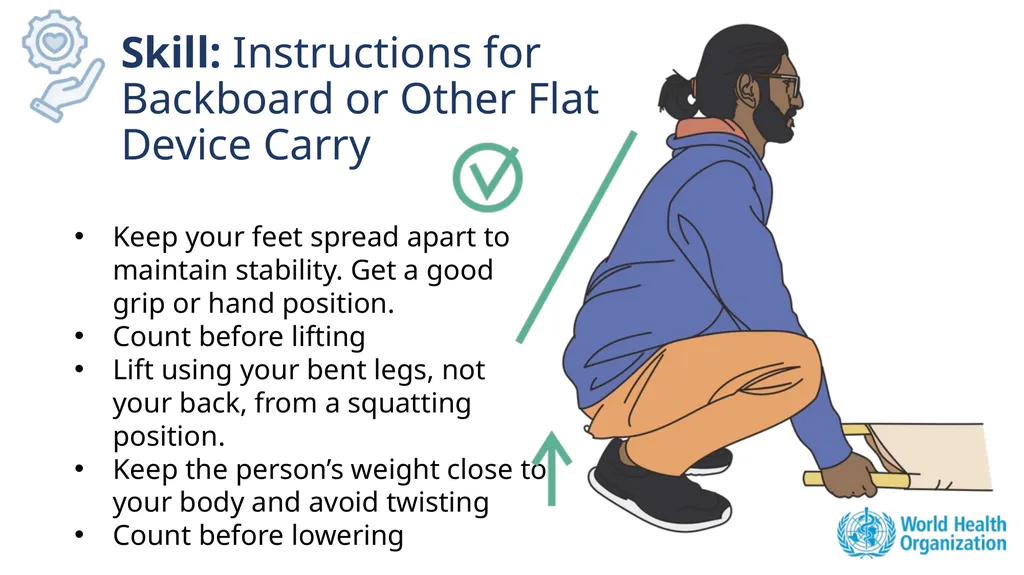
Skill: Instructions for Backboard or Other Flat Device Carry Keep your feet spread apart to maintain stability. Get a good grip or hand position.
Count before lifting
Lift using your bent legs, not your back, from a squatting position.
Keep the person’s weight close to your body and avoid twisting
Count before lowering<br>
Count before lifting
Lift using your bent legs, not your back, from a squatting position.
Keep the person’s weight close to your body and avoid twisting
Count before lowering<br>
36
Questions?<br>
37
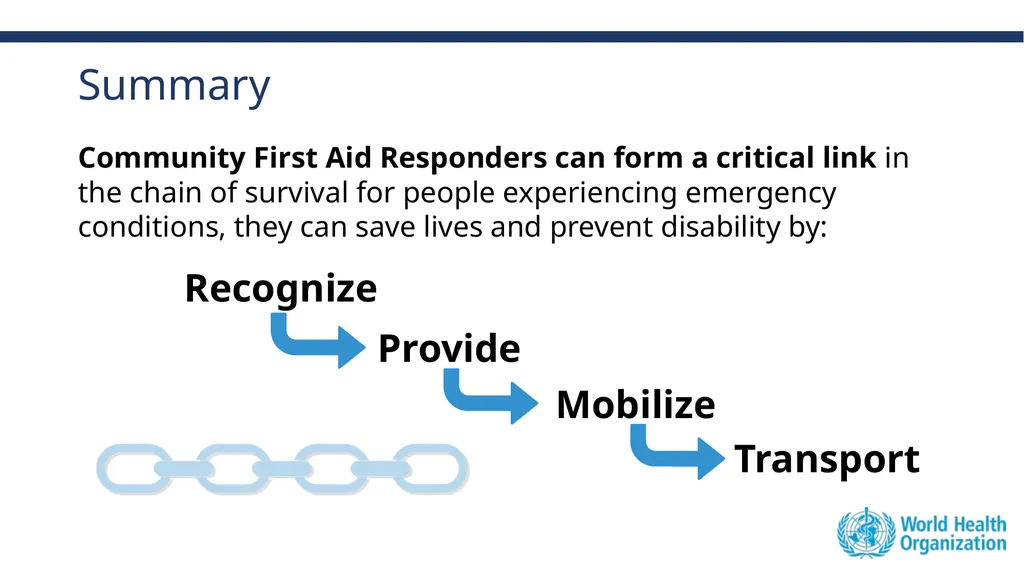
Summary Community First Aid Responders can form a critical link in the chain of survival for people experiencing emergency conditions, they can save lives and prevent disability by: Transport Recognize Provide Mobilize<br>