
Module #8 Hawaiian Wind Names and Emergency
SB
Published · 22 slides · 0 views

1 / 1


Description
Module 8 Hawaiian Wind Names and Emergency Management Add image here 1 Learning Objectives Participate in an activity that is inclusive and collaborative. Show how each member of your group is contributing to the team and community.
Related Topics
Share
Embed code
Download this presentation From Below
"Module #8 Hawaiian Wind Names and Emergency" is the property of its rightful owner. Permission is granted to download and print the materials on this website for personal, non-commercial use only, and to display it on your personal computer provided you do not modify the materials and that you retain all copyright notices contained in the materials. By downloading content from our website, you accept the terms of this agreement.
Presentation Transcript
01
Module #8
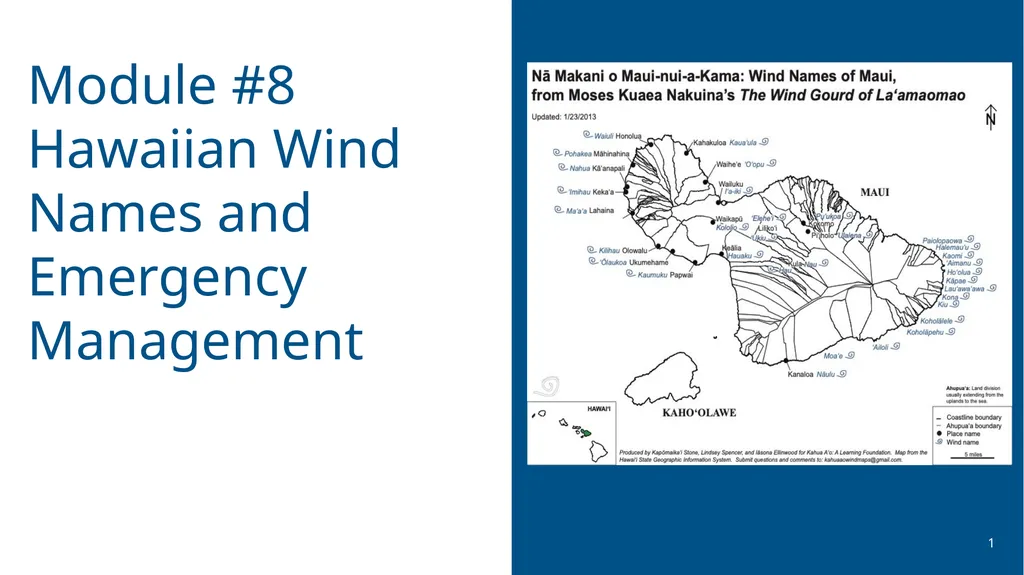
Hawaiian Wind Names and Emergency Management Add image here 1<br>
02
Learning Objectives Participate in an activity that is inclusive and collaborative.
Show how each member of your group is contributing to the team and community.
Reclaim Hawaiian identity through understanding winds & directional points through ʻike kuʻuna (Hawaiian knowledge, belief system, philosophy, and practices).
Perpetuate ʻike kuʻuna in order to form a Hawaiian foundation for the lāhui (Nation).
Understanding how winds can contribute to Emergency Management Plans. 2<br>
Show how each member of your group is contributing to the team and community.
Reclaim Hawaiian identity through understanding winds & directional points through ʻike kuʻuna (Hawaiian knowledge, belief system, philosophy, and practices).
Perpetuate ʻike kuʻuna in order to form a Hawaiian foundation for the lāhui (Nation).
Understanding how winds can contribute to Emergency Management Plans. 2<br>
03
Needs to Know Where does the sun rise and set?
Where is the East and West?
What are the names to the winds in that area and/or family Ahupuaʻa?
What is the ʻike kuʻuna and ʻike kūpuna about the significance of the winds?
How is the wind connected to Emergency Management?
How did my kupuna show appreciation to this ʻike?
How is the wind important in the bigger picture of Climate Change? 3<br>
Where is the East and West?
What are the names to the winds in that area and/or family Ahupuaʻa?
What is the ʻike kuʻuna and ʻike kūpuna about the significance of the winds?
How is the wind connected to Emergency Management?
How did my kupuna show appreciation to this ʻike?
How is the wind important in the bigger picture of Climate Change? 3<br>
04
Module Sections Cultural protocol
Introductions Activity
Moʻolelo of Laʻamaomao
Information on Laʻamaomao & the Wind Gourd
Re-tell the moʻolelo
Moʻolelo and Critical Dialogue
Group Activity: Winds of Maui
Station 1: Wind Descriptions
Station 2: Wind Characteristics
Station 3: Wind Names
Benefits of knowing the wind
Group Activity: Gather to Share
Case Study
Additional references
Oli Mahalo 4<br>
Introductions Activity
Moʻolelo of Laʻamaomao
Information on Laʻamaomao & the Wind Gourd
Re-tell the moʻolelo
Moʻolelo and Critical Dialogue
Group Activity: Winds of Maui
Station 1: Wind Descriptions
Station 2: Wind Characteristics
Station 3: Wind Names
Benefits of knowing the wind
Group Activity: Gather to Share
Case Study
Additional references
Oli Mahalo 4<br>
05
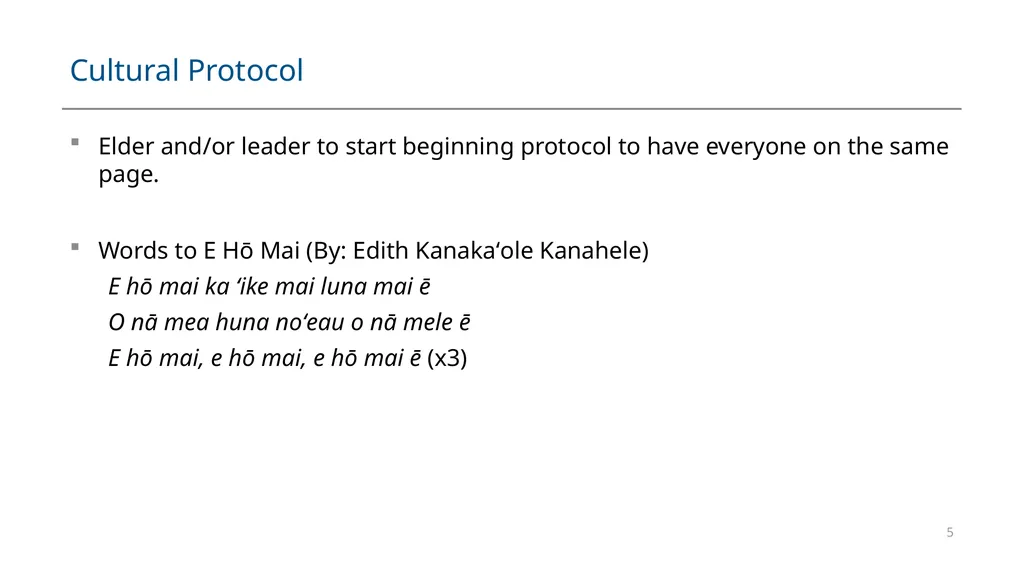
Cultural Protocol Elder and/or leader to start beginning protocol to have everyone on the same page.
Words to E Hō Mai (By: Edith Kanakaʻole Kanahele)
E hō mai ka ʻike mai luna mai ē
O nā mea huna noʻeau o nā mele ē
E hō mai, e hō mai, e hō mai ē (x3) 5<br>
Words to E Hō Mai (By: Edith Kanakaʻole Kanahele)
E hō mai ka ʻike mai luna mai ē
O nā mea huna noʻeau o nā mele ē
E hō mai, e hō mai, e hō mai ē (x3) 5<br>
06
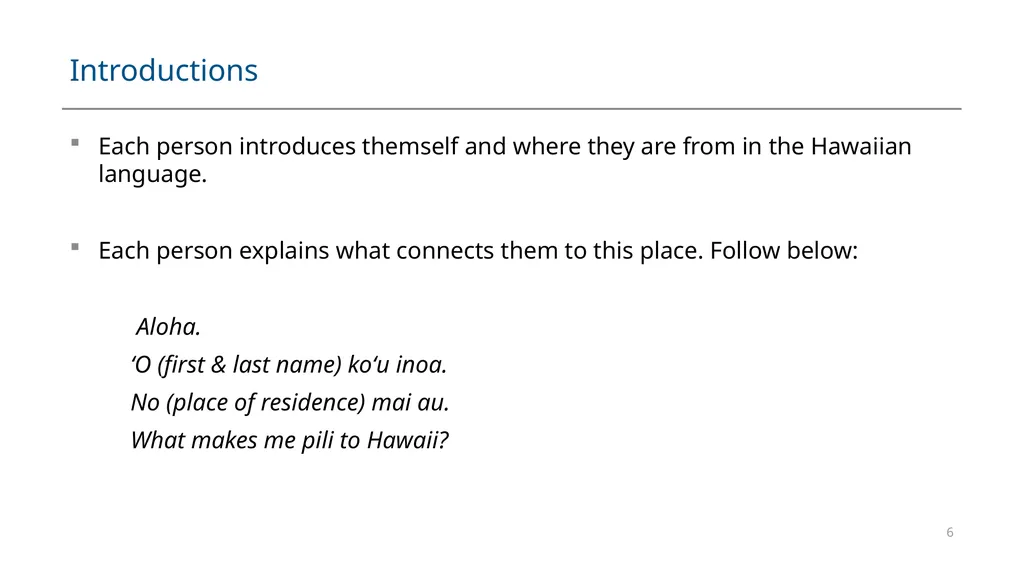
Introductions Each person introduces themself and where they are from in the Hawaiian language.
Each person explains what connects them to this place. Follow below:
Aloha.
ʻO (first & last name) koʻu inoa.
No (place of residence) mai au.
What makes me pili to Hawaii? 6<br>
Each person explains what connects them to this place. Follow below:
Aloha.
ʻO (first & last name) koʻu inoa.
No (place of residence) mai au.
What makes me pili to Hawaii? 6<br>
07
Moʻolelo of Laʻamaomao In legends, it is believed that there was a wind gourd that could summon these winds upon chanting for them. The gourd represents the God Lono and the guardian of the gourd is called Laʻamaomao. Laʻamaomao was the name of Moʻikeha’s crewmember that sailed back and forth with Moʻikeha as the person that called out to the winds. This gourd today can be found at the Bishop Museum collection and has an inscription [that] reads....
The wind gourd of Laʻamaomao that was in the keeping of Hauna, personal attendant of Lonoikamakahiki I [Keawenuiaʻumi’s youngest son]. It was passed on to Pakaʻa, a personal attendant of Keawenuiaumi. It was placed in the royal burial cave of Hoaiku on the sacred cliffs of keoua, at kaawaloa, island of Hawaii, and received by King Kalakaua I on January 1, 1883, from Kaʻapana, caretaker of Hoaiku. (Kawaharada 2) 7<br>
The wind gourd of Laʻamaomao that was in the keeping of Hauna, personal attendant of Lonoikamakahiki I [Keawenuiaʻumi’s youngest son]. It was passed on to Pakaʻa, a personal attendant of Keawenuiaumi. It was placed in the royal burial cave of Hoaiku on the sacred cliffs of keoua, at kaawaloa, island of Hawaii, and received by King Kalakaua I on January 1, 1883, from Kaʻapana, caretaker of Hoaiku. (Kawaharada 2) 7<br>
08
Information on Laʻamaomao and the Wind Gourd This wind gourd was donated to the Bishop Museum by Princess Kalanianaʻole in 1923 where it sits in the basement in a cold room.
It is another testament that traditional sites hold pieces of knowledge that can explain the phenamena of the world.
The wind can also be seen on the ocean pathways as the water is disturbed by the wind interacting with the ocean. What can be felt by using your face to feel the wind can also seen on top of the ocean pathways.
One of many examples is the wind channel that can be seen from an advantage point on Kahoʻolawe at Kealaikahiki as the Kealaikahiki(same name) ocean channel follows in the same direction. The wind path can be seen on the water when the wind is blowing over 10mph. 8<br>
It is another testament that traditional sites hold pieces of knowledge that can explain the phenamena of the world.
The wind can also be seen on the ocean pathways as the water is disturbed by the wind interacting with the ocean. What can be felt by using your face to feel the wind can also seen on top of the ocean pathways.
One of many examples is the wind channel that can be seen from an advantage point on Kahoʻolawe at Kealaikahiki as the Kealaikahiki(same name) ocean channel follows in the same direction. The wind path can be seen on the water when the wind is blowing over 10mph. 8<br>
09
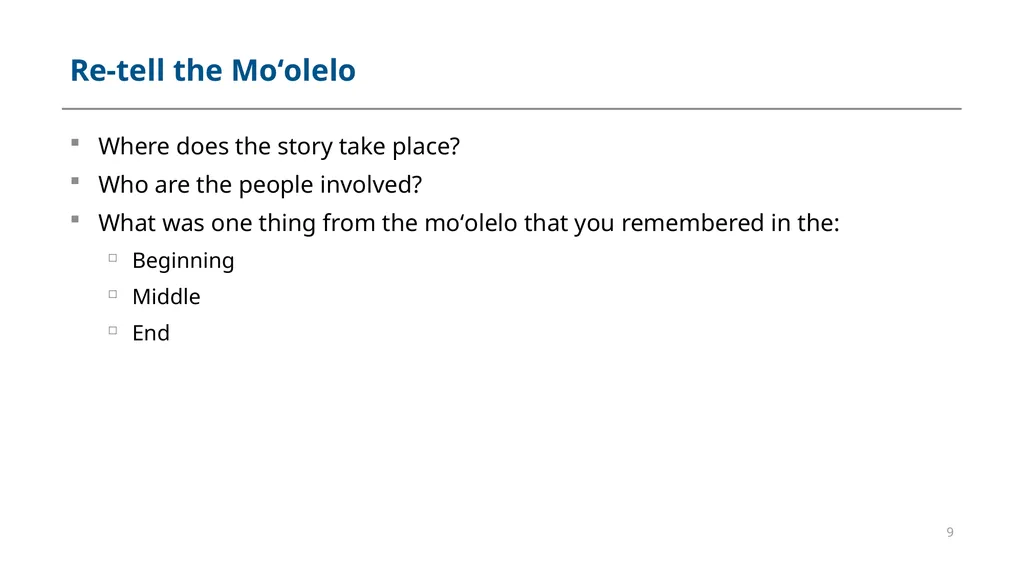
Re-tell the Moʻolelo Where does the story take place?
Who are the people involved?
What was one thing from the moʻolelo that you remembered in the:
Beginning
Middle
End 9<br>
Who are the people involved?
What was one thing from the moʻolelo that you remembered in the:
Beginning
Middle
End 9<br>
10
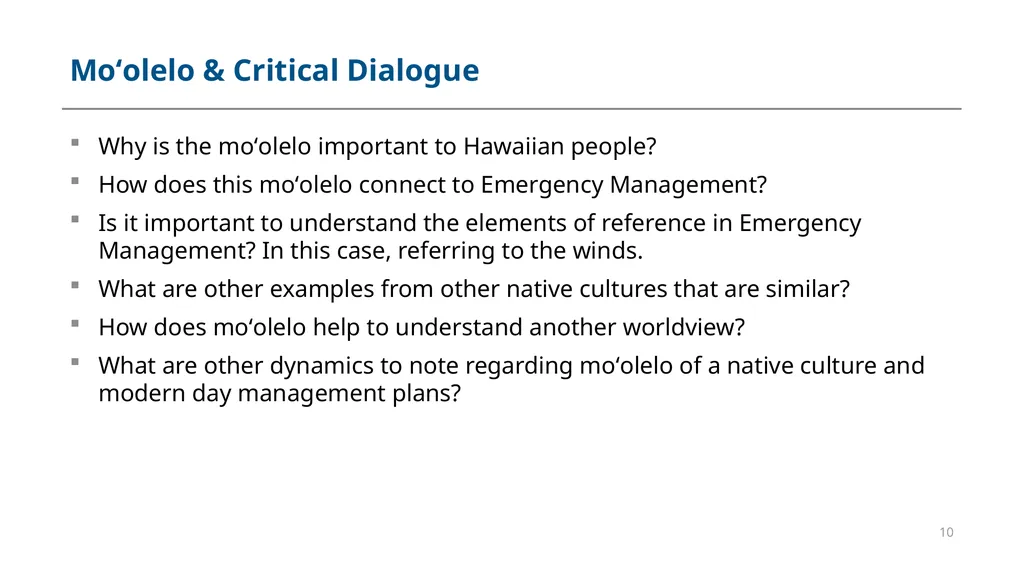
Moʻolelo & Critical Dialogue Why is the moʻolelo important to Hawaiian people?
How does this moʻolelo connect to Emergency Management?
Is it important to understand the elements of reference in Emergency Management? In this case, referring to the winds.
What are other examples from other native cultures that are similar?
How does moʻolelo help to understand another worldview?
What are other dynamics to note regarding moʻolelo of a native culture and modern day management plans? 10<br>
How does this moʻolelo connect to Emergency Management?
Is it important to understand the elements of reference in Emergency Management? In this case, referring to the winds.
What are other examples from other native cultures that are similar?
How does moʻolelo help to understand another worldview?
What are other dynamics to note regarding moʻolelo of a native culture and modern day management plans? 10<br>
11
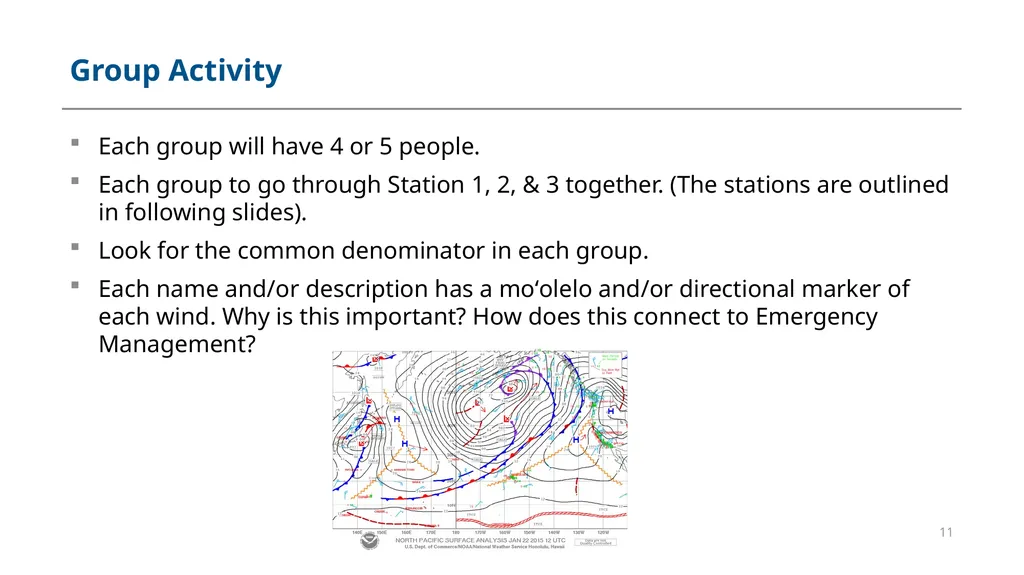
Group Activity Each group will have 4 or 5 people.
Each group to go through Station 1, 2, & 3 together. (The stations are outlined in following slides).
Look for the common denominator in each group.
Each name and/or description has a moʻolelo and/or directional marker of each wind. Why is this important? How does this connect to Emergency Management? 11<br>
Each group to go through Station 1, 2, & 3 together. (The stations are outlined in following slides).
Look for the common denominator in each group.
Each name and/or description has a moʻolelo and/or directional marker of each wind. Why is this important? How does this connect to Emergency Management? 11<br>
12
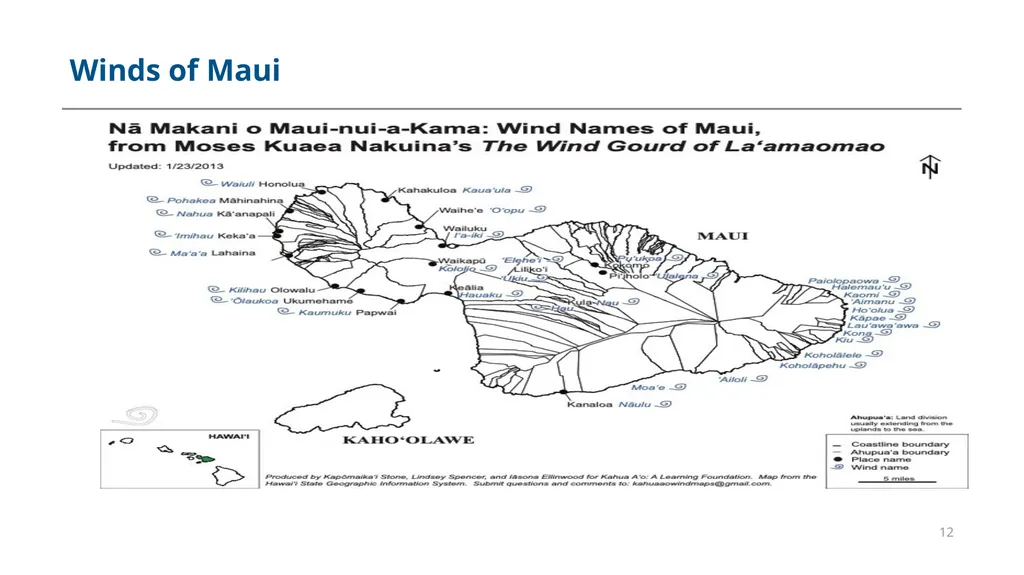
Winds of Maui 12<br>
13
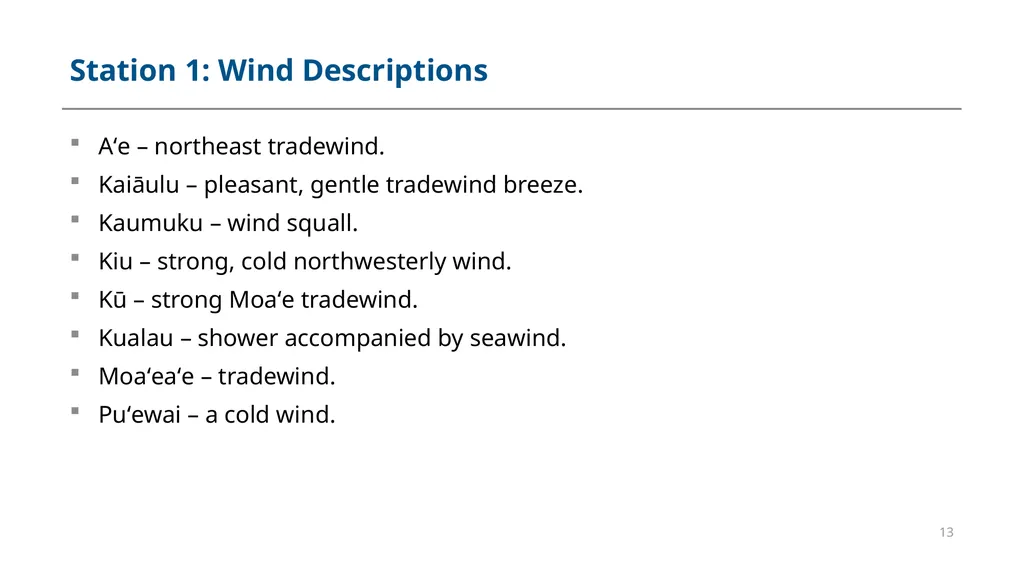
Station 1: Wind Descriptions Aʻe – northeast tradewind.
Kaiāulu – pleasant, gentle tradewind breeze.
Kaumuku – wind squall.
Kiu – strong, cold northwesterly wind.
Kū – strong Moaʻe tradewind.
Kualau – shower accompanied by seawind.
Moaʻeaʻe – tradewind.
Puʻewai – a cold wind. 13<br>
Kaiāulu – pleasant, gentle tradewind breeze.
Kaumuku – wind squall.
Kiu – strong, cold northwesterly wind.
Kū – strong Moaʻe tradewind.
Kualau – shower accompanied by seawind.
Moaʻeaʻe – tradewind.
Puʻewai – a cold wind. 13<br>
14
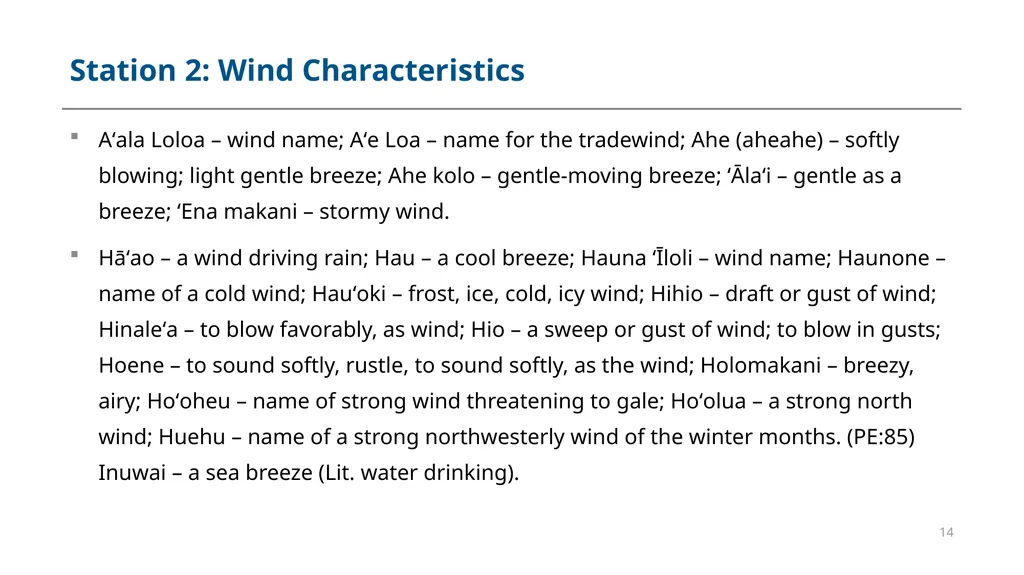
Station 2: Wind Characteristics Aʻala Loloa – wind name; Aʻe Loa – name for the tradewind; Ahe (aheahe) – softly blowing; light gentle breeze; Ahe kolo – gentle-moving breeze; ʻĀlaʻi – gentle as a breeze; ʻEna makani – stormy wind.
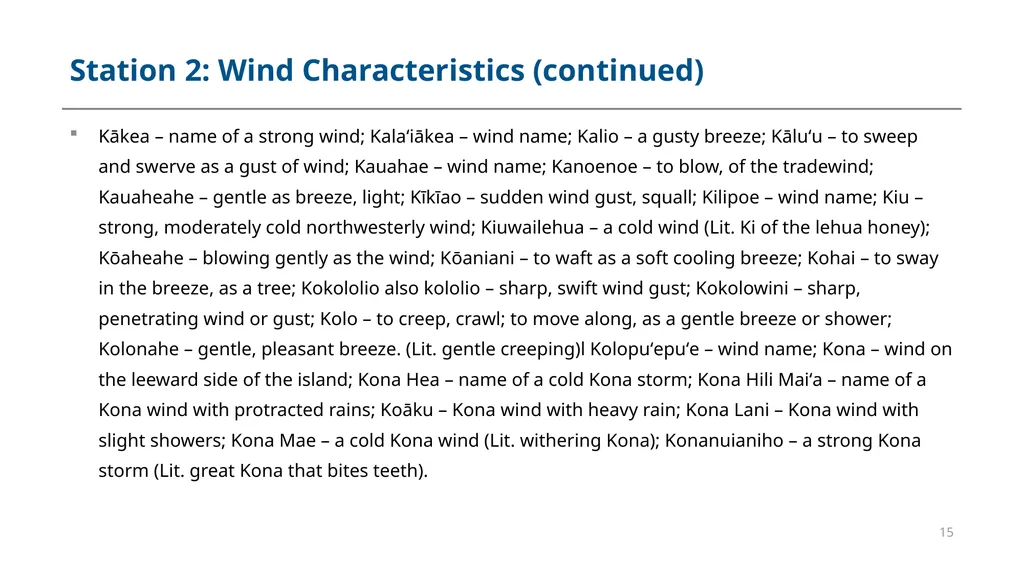
Hāʻao – a wind driving rain; Hau – a cool breeze; Hauna ʻĪloli – wind name; Haunone – name of a cold wind; Hauʻoki – frost, ice, cold, icy wind; Hihio – draft or gust of wind; Hinaleʻa – to blow favorably, as wind; Hio – a sweep or gust of wind; to blow in gusts; Hoene – to sound softly, rustle, to sound softly, as the wind; Holomakani – breezy, airy; Hoʻoheu – name of strong wind threatening to gale; Hoʻolua – a strong north wind; Huehu – name of a strong northwesterly wind of the winter months. (PE:85) Inuwai – a sea breeze (Lit. water drinking). 14<br>
Hāʻao – a wind driving rain; Hau – a cool breeze; Hauna ʻĪloli – wind name; Haunone – name of a cold wind; Hauʻoki – frost, ice, cold, icy wind; Hihio – draft or gust of wind; Hinaleʻa – to blow favorably, as wind; Hio – a sweep or gust of wind; to blow in gusts; Hoene – to sound softly, rustle, to sound softly, as the wind; Holomakani – breezy, airy; Hoʻoheu – name of strong wind threatening to gale; Hoʻolua – a strong north wind; Huehu – name of a strong northwesterly wind of the winter months. (PE:85) Inuwai – a sea breeze (Lit. water drinking). 14<br>
15
Station 2: Wind Characteristics (continued) Kākea – name of a strong wind; Kalaʻiākea – wind name; Kalio – a gusty breeze; Kāluʻu – to sweep and swerve as a gust of wind; Kauahae – wind name; Kanoenoe – to blow, of the tradewind; Kauaheahe – gentle as breeze, light; Kīkīao – sudden wind gust, squall; Kilipoe – wind name; Kiu – strong, moderately cold northwesterly wind; Kiuwailehua – a cold wind (Lit. Ki of the lehua honey); Kōaheahe – blowing gently as the wind; Kōaniani – to waft as a soft cooling breeze; Kohai – to sway in the breeze, as a tree; Kokololio also kololio – sharp, swift wind gust; Kokolowini – sharp, penetrating wind or gust; Kolo – to creep, crawl; to move along, as a gentle breeze or shower; Kolonahe – gentle, pleasant breeze. (Lit. gentle creeping)l Kolopuʻepuʻe – wind name; Kona – wind on the leeward side of the island; Kona Hea – name of a cold Kona storm; Kona Hili Maiʻa – name of a Kona wind with protracted rains; Koāku – Kona wind with heavy rain; Kona Lani – Kona wind with slight showers; Kona Mae – a cold Kona wind (Lit. withering Kona); Konanuianiho – a strong Kona storm (Lit. great Kona that bites teeth). 15<br>
16
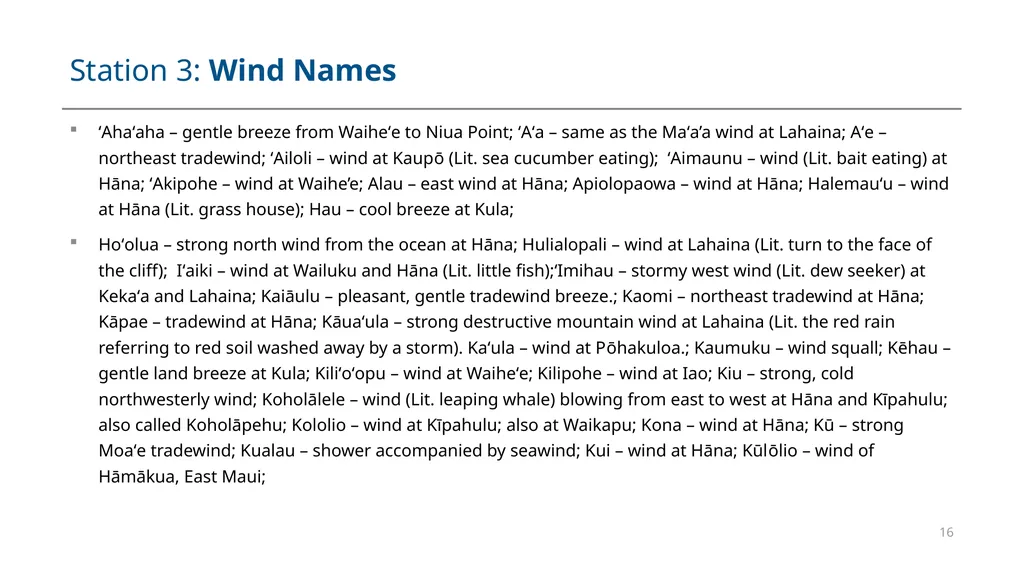
Station 3: Wind Names ʻAhaʻaha – gentle breeze from Waiheʻe to Niua Point; ʻAʻa – same as the Maʻa’a wind at Lahaina; Aʻe – northeast tradewind; ʻAiloli – wind at Kaupō (Lit. sea cucumber eating); ʻAimaunu – wind (Lit. bait eating) at Hāna; ʻAkipohe – wind at Waihe’e; Alau – east wind at Hāna; Apiolopaowa – wind at Hāna; Halemauʻu – wind at Hāna (Lit. grass house); Hau – cool breeze at Kula;
Hoʻolua – strong north wind from the ocean at Hāna; Hulialopali – wind at Lahaina (Lit. turn to the face of the cliff); Iʻaiki – wind at Wailuku and Hāna (Lit. little fish);ʻImihau – stormy west wind (Lit. dew seeker) at Kekaʻa and Lahaina; Kaiāulu – pleasant, gentle tradewind breeze.; Kaomi – northeast tradewind at Hāna; Kāpae – tradewind at Hāna; Kāuaʻula – strong destructive mountain wind at Lahaina (Lit. the red rain referring to red soil washed away by a storm). Kaʻula – wind at Pōhakuloa.; Kaumuku – wind squall; Kēhau – gentle land breeze at Kula; Kiliʻoʻopu – wind at Waiheʻe; Kilipohe – wind at Iao; Kiu – strong, cold northwesterly wind; Koholālele – wind (Lit. leaping whale) blowing from east to west at Hāna and Kīpahulu; also called Koholāpehu; Kololio – wind at Kīpahulu; also at Waikapu; Kona – wind at Hāna; Kū – strong Moaʻe tradewind; Kualau – shower accompanied by seawind; Kui – wind at Hāna; Kūlōlio – wind of Hāmākua, East Maui; 16<br>
Hoʻolua – strong north wind from the ocean at Hāna; Hulialopali – wind at Lahaina (Lit. turn to the face of the cliff); Iʻaiki – wind at Wailuku and Hāna (Lit. little fish);ʻImihau – stormy west wind (Lit. dew seeker) at Kekaʻa and Lahaina; Kaiāulu – pleasant, gentle tradewind breeze.; Kaomi – northeast tradewind at Hāna; Kāpae – tradewind at Hāna; Kāuaʻula – strong destructive mountain wind at Lahaina (Lit. the red rain referring to red soil washed away by a storm). Kaʻula – wind at Pōhakuloa.; Kaumuku – wind squall; Kēhau – gentle land breeze at Kula; Kiliʻoʻopu – wind at Waiheʻe; Kilipohe – wind at Iao; Kiu – strong, cold northwesterly wind; Koholālele – wind (Lit. leaping whale) blowing from east to west at Hāna and Kīpahulu; also called Koholāpehu; Kololio – wind at Kīpahulu; also at Waikapu; Kona – wind at Hāna; Kū – strong Moaʻe tradewind; Kualau – shower accompanied by seawind; Kui – wind at Hāna; Kūlōlio – wind of Hāmākua, East Maui; 16<br>
17
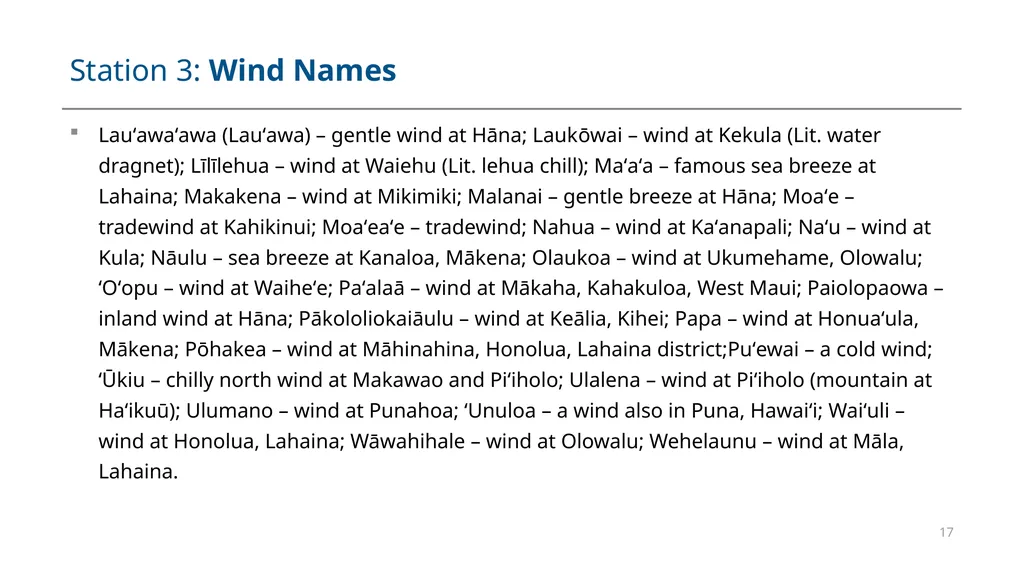
Station 3: Wind Names Lauʻawaʻawa (Lauʻawa) – gentle wind at Hāna; Laukōwai – wind at Kekula (Lit. water dragnet); Līlīlehua – wind at Waiehu (Lit. lehua chill); Maʻaʻa – famous sea breeze at Lahaina; Makakena – wind at Mikimiki; Malanai – gentle breeze at Hāna; Moaʻe – tradewind at Kahikinui; Moaʻeaʻe – tradewind; Nahua – wind at Kaʻanapali; Naʻu – wind at Kula; Nāulu – sea breeze at Kanaloa, Mākena; Olaukoa – wind at Ukumehame, Olowalu; ʻOʻopu – wind at Waiheʻe; Paʻalaā – wind at Mākaha, Kahakuloa, West Maui; Paiolopaowa – inland wind at Hāna; Pākololiokaiāulu – wind at Keālia, Kihei; Papa – wind at Honuaʻula, Mākena; Pōhakea – wind at Māhinahina, Honolua, Lahaina district;Puʻewai – a cold wind; ʻŪkiu – chilly north wind at Makawao and Piʻiholo; Ulalena – wind at Piʻiholo (mountain at Haʻikuū); Ulumano – wind at Punahoa; ʻUnuloa – a wind also in Puna, Hawaiʻi; Waiʻuli – wind at Honolua, Lahaina; Wāwahihale – wind at Olowalu; Wehelaunu – wind at Māla, Lahaina. 17<br>
18
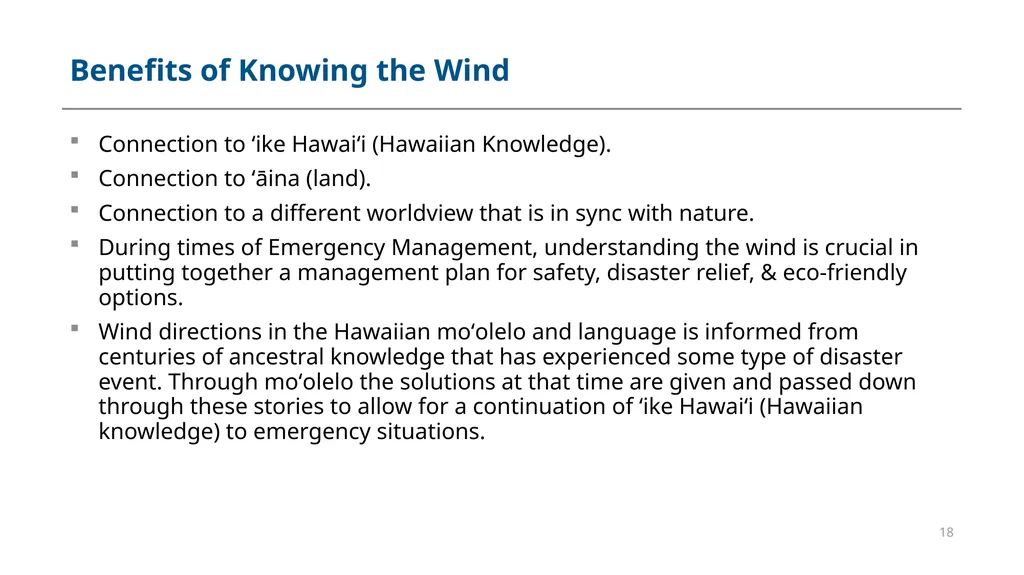
Benefits of Knowing the Wind Connection to ʻike Hawaiʻi (Hawaiian Knowledge).
Connection to ʻāina (land).
Connection to a different worldview that is in sync with nature.
During times of Emergency Management, understanding the wind is crucial in putting together a management plan for safety, disaster relief, & eco-friendly options.
Wind directions in the Hawaiian moʻolelo and language is informed from centuries of ancestral knowledge that has experienced some type of disaster event. Through moʻolelo the solutions at that time are given and passed down through these stories to allow for a continuation of ʻike Hawaiʻi (Hawaiian knowledge) to emergency situations. 18<br>
Connection to ʻāina (land).
Connection to a different worldview that is in sync with nature.
During times of Emergency Management, understanding the wind is crucial in putting together a management plan for safety, disaster relief, & eco-friendly options.
Wind directions in the Hawaiian moʻolelo and language is informed from centuries of ancestral knowledge that has experienced some type of disaster event. Through moʻolelo the solutions at that time are given and passed down through these stories to allow for a continuation of ʻike Hawaiʻi (Hawaiian knowledge) to emergency situations. 18<br>
19
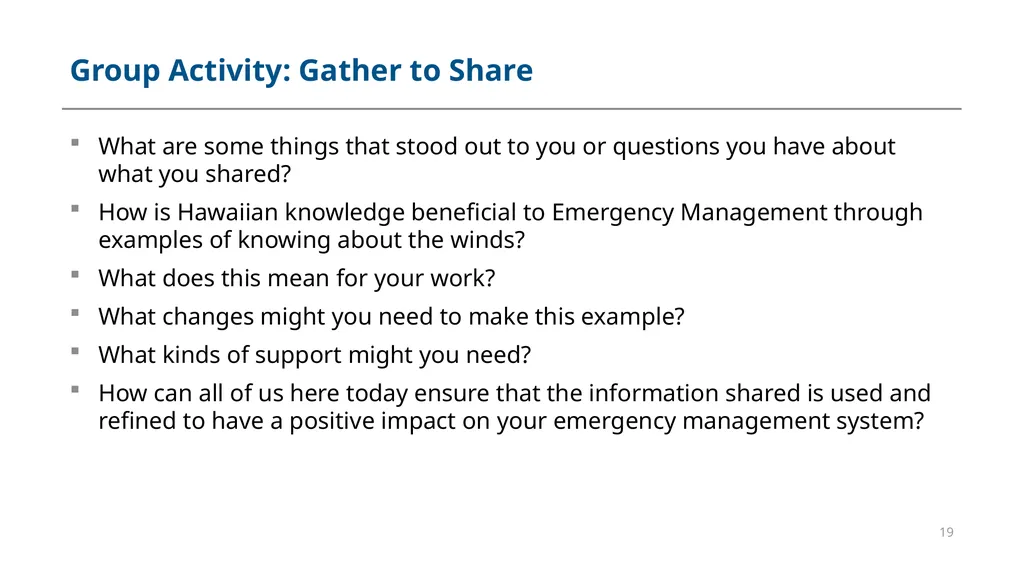
Group Activity: Gather to Share What are some things that stood out to you or questions you have about what you shared?
How is Hawaiian knowledge beneficial to Emergency Management through examples of knowing about the winds?
What does this mean for your work?
What changes might you need to make this example?
What kinds of support might you need?
How can all of us here today ensure that the information shared is used and refined to have a positive impact on your emergency management system? 19<br>
How is Hawaiian knowledge beneficial to Emergency Management through examples of knowing about the winds?
What does this mean for your work?
What changes might you need to make this example?
What kinds of support might you need?
How can all of us here today ensure that the information shared is used and refined to have a positive impact on your emergency management system? 19<br>
20
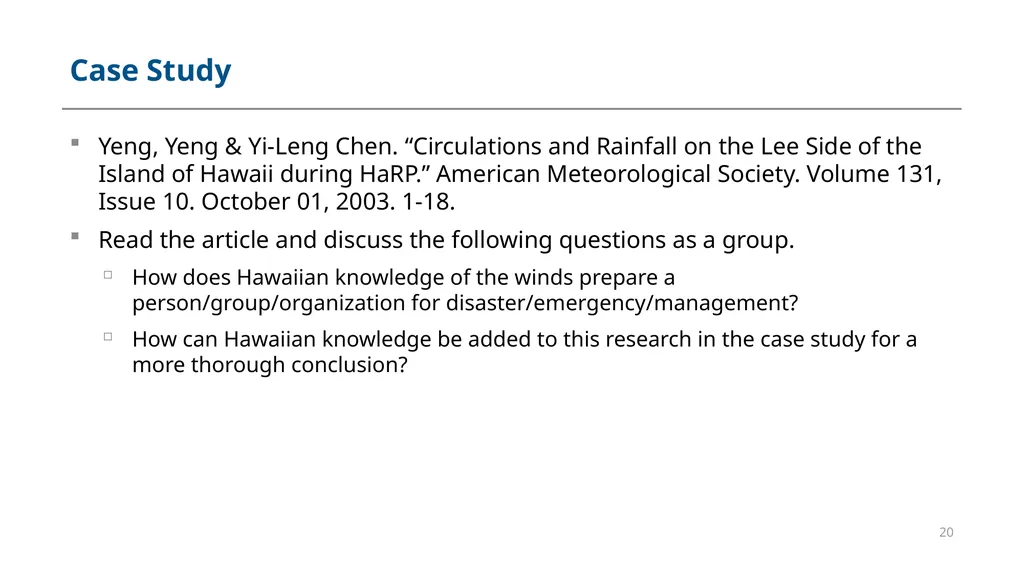
Case Study Yeng, Yeng & Yi-Leng Chen. “Circulations and Rainfall on the Lee Side of the Island of Hawaii during HaRP.” American Meteorological Society. Volume 131, Issue 10. October 01, 2003. 1-18.
Read the article and discuss the following questions as a group.
How does Hawaiian knowledge of the winds prepare a person/group/organization for disaster/emergency/management?
How can Hawaiian knowledge be added to this research in the case study for a more thorough conclusion? 20<br>
Read the article and discuss the following questions as a group.
How does Hawaiian knowledge of the winds prepare a person/group/organization for disaster/emergency/management?
How can Hawaiian knowledge be added to this research in the case study for a more thorough conclusion? 20<br>
21
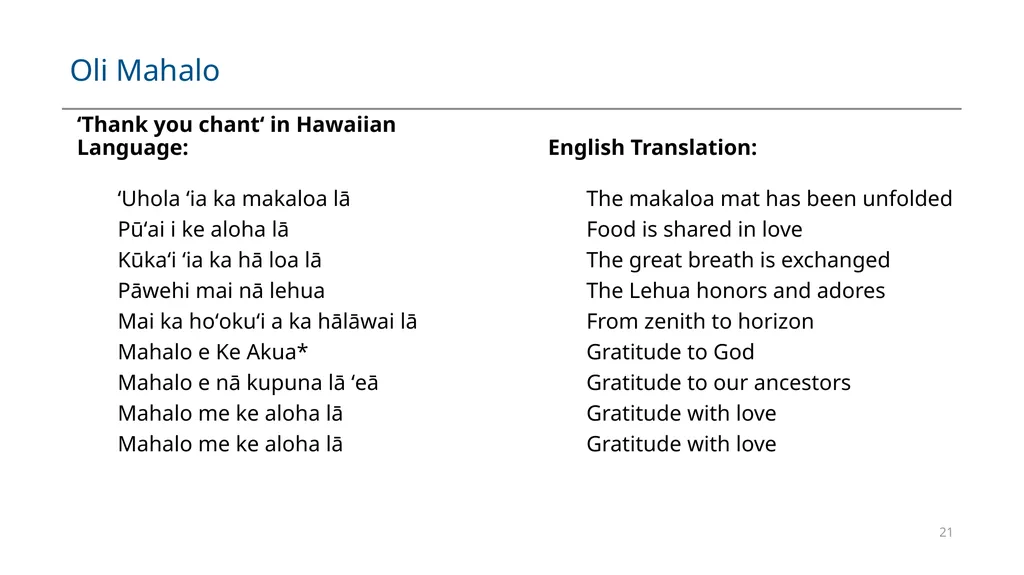
Oli Mahalo ʻThank you chantʻ in Hawaiian Language: ʻUhola ʻia ka makaloa lā
Pūʻai i ke aloha lā
Kūkaʻi ʻia ka hā loa lā
Pāwehi mai nā lehua
Mai ka hoʻokuʻi a ka hālāwai lā
Mahalo e Ke Akua*
Mahalo e nā kupuna lā ʻeā
Mahalo me ke aloha lā
Mahalo me ke aloha lā English Translation: The makaloa mat has been unfolded
Food is shared in love
The great breath is exchanged
The Lehua honors and adores
From zenith to horizon
Gratitude to God
Gratitude to our ancestors
Gratitude with love
Gratitude with love 21<br>
22
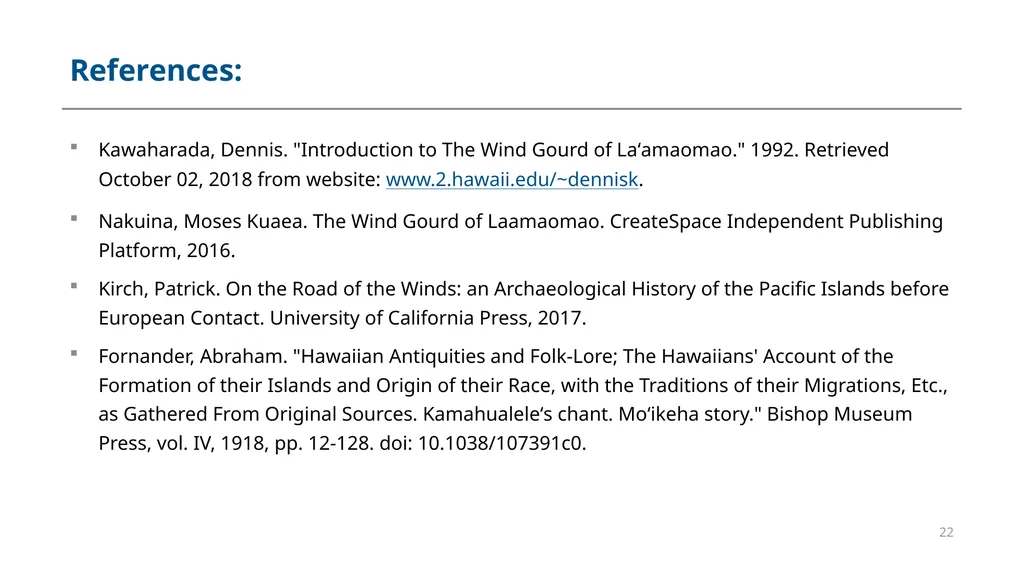
References: Kawaharada, Dennis. "Introduction to The Wind Gourd of Laʻamaomao." 1992. Retrieved October 02, 2018 from website: www.2.hawaii.edu/~dennisk.
Nakuina, Moses Kuaea. The Wind Gourd of Laamaomao. CreateSpace Independent Publishing Platform, 2016.
Kirch, Patrick. On the Road of the Winds: an Archaeological History of the Pacific Islands before European Contact. University of California Press, 2017.
Fornander, Abraham. "Hawaiian Antiquities and Folk-Lore; The Hawaiians' Account of the Formation of their Islands and Origin of their Race, with the Traditions of their Migrations, Etc., as Gathered From Original Sources. Kamahualeleʻs chant. Moʻikeha story." Bishop Museum Press, vol. IV, 1918, pp. 12-128. doi: 10.1038/107391c0. 22<br>
Nakuina, Moses Kuaea. The Wind Gourd of Laamaomao. CreateSpace Independent Publishing Platform, 2016.
Kirch, Patrick. On the Road of the Winds: an Archaeological History of the Pacific Islands before European Contact. University of California Press, 2017.
Fornander, Abraham. "Hawaiian Antiquities and Folk-Lore; The Hawaiians' Account of the Formation of their Islands and Origin of their Race, with the Traditions of their Migrations, Etc., as Gathered From Original Sources. Kamahualeleʻs chant. Moʻikeha story." Bishop Museum Press, vol. IV, 1918, pp. 12-128. doi: 10.1038/107391c0. 22<br>