
Module 8 Intensifying Behavioral Support Jennifer
KB
Published · 66 slides · 0 views
1 / 1

Description
Module 8 Intensifying Behavioral Support Jennifer Freeman, PhD Don Briere, PhD Brandi Simonsen, PhD Acknowledgements Much of the content shared in this module was developed by members of the OSEP-funded National Technical Assistance Center
Related Topics
Share
Embed code
Download this presentation From Below
"Module 8 Intensifying Behavioral Support Jennifer" is the property of its rightful owner. Permission is granted to download and print the materials on this website for personal, non-commercial use only, and to display it on your personal computer provided you do not modify the materials and that you retain all copyright notices contained in the materials. By downloading content from our website, you accept the terms of this agreement.
Presentation Transcript
01
Module 8
Intensifying Behavioral Support Jennifer Freeman, PhD
Don Briere, PhD
Brandi Simonsen, PhD<br>
Intensifying Behavioral Support Jennifer Freeman, PhD
Don Briere, PhD
Brandi Simonsen, PhD<br>
02
Acknowledgements Much of the content shared in this module was developed by members of the OSEP-funded National Technical Assistance Center for Positive Behavioral Interventions and Supports.
Thank you to:
Members of classroom workgroup:
Brandi Simonsen, Jennifer Freeman, Jessica Swain-Bradway, Robert Putnam, Heather George, Steve Goodman, Barb Mitchell, Kimberly Yanek, Kathleen Lane & Jeffrey Sprague
Members of the Northeast PBIS Network:
Susannah Everett, Adam Feinberg, George Sugai, Brandi Simonsen & Jennifer Freeman<br>
Thank you to:
Members of classroom workgroup:
Brandi Simonsen, Jennifer Freeman, Jessica Swain-Bradway, Robert Putnam, Heather George, Steve Goodman, Barb Mitchell, Kimberly Yanek, Kathleen Lane & Jeffrey Sprague
Members of the Northeast PBIS Network:
Susannah Everett, Adam Feinberg, George Sugai, Brandi Simonsen & Jennifer Freeman<br>
03
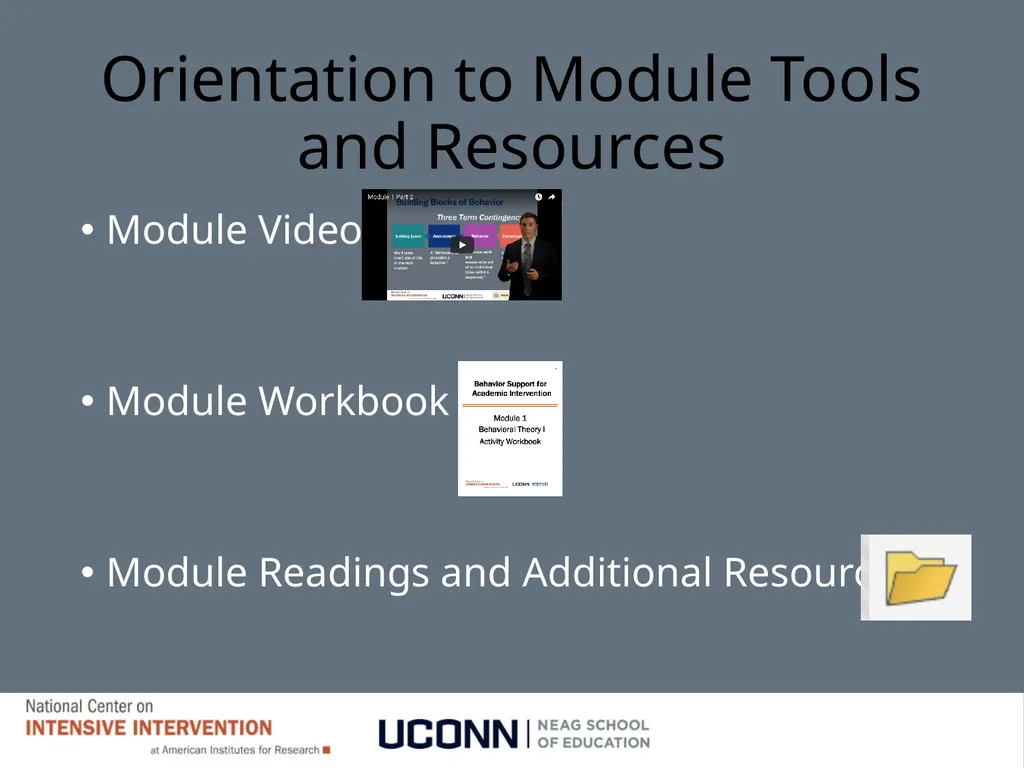
Orientation to Module Tools and Resources Module Videos
Module Workbook
Module Readings and Additional Resources<br>
Module Workbook
Module Readings and Additional Resources<br>
04
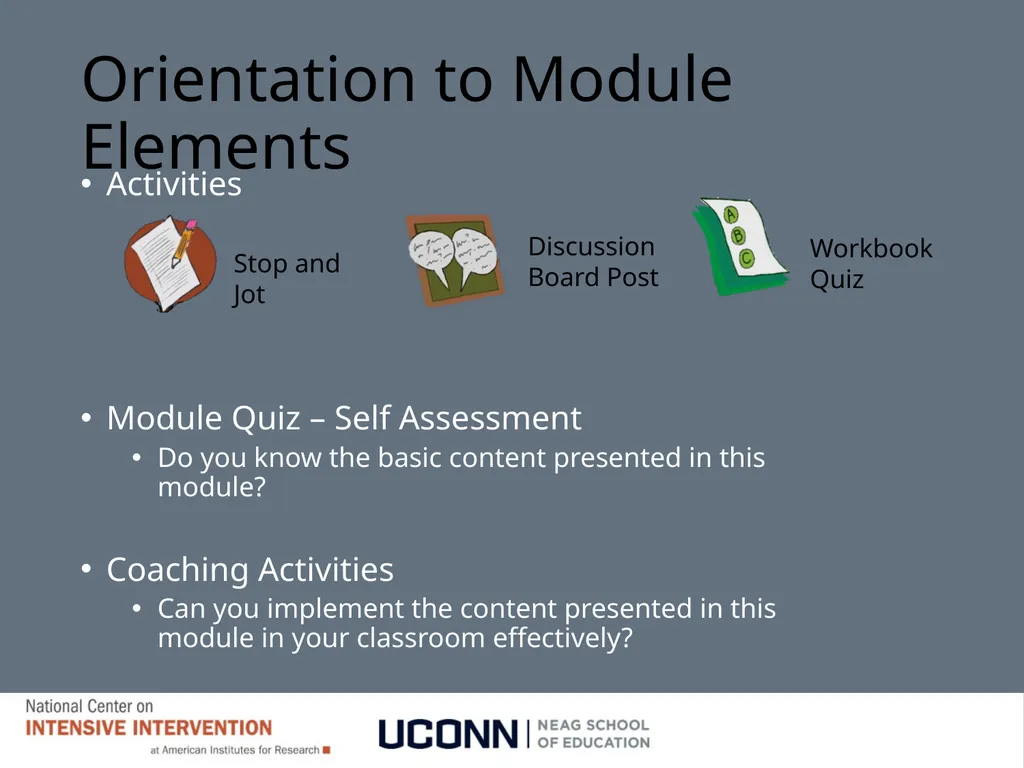
Orientation to Module Elements Activities
Module Quiz – Self Assessment
Do you know the basic content presented in this module?
Coaching Activities
Can you implement the content presented in this module in your classroom effectively? Stop and Jot Discussion Board Post Workbook Quiz<br>
Module Quiz – Self Assessment
Do you know the basic content presented in this module?
Coaching Activities
Can you implement the content presented in this module in your classroom effectively? Stop and Jot Discussion Board Post Workbook Quiz<br>
05
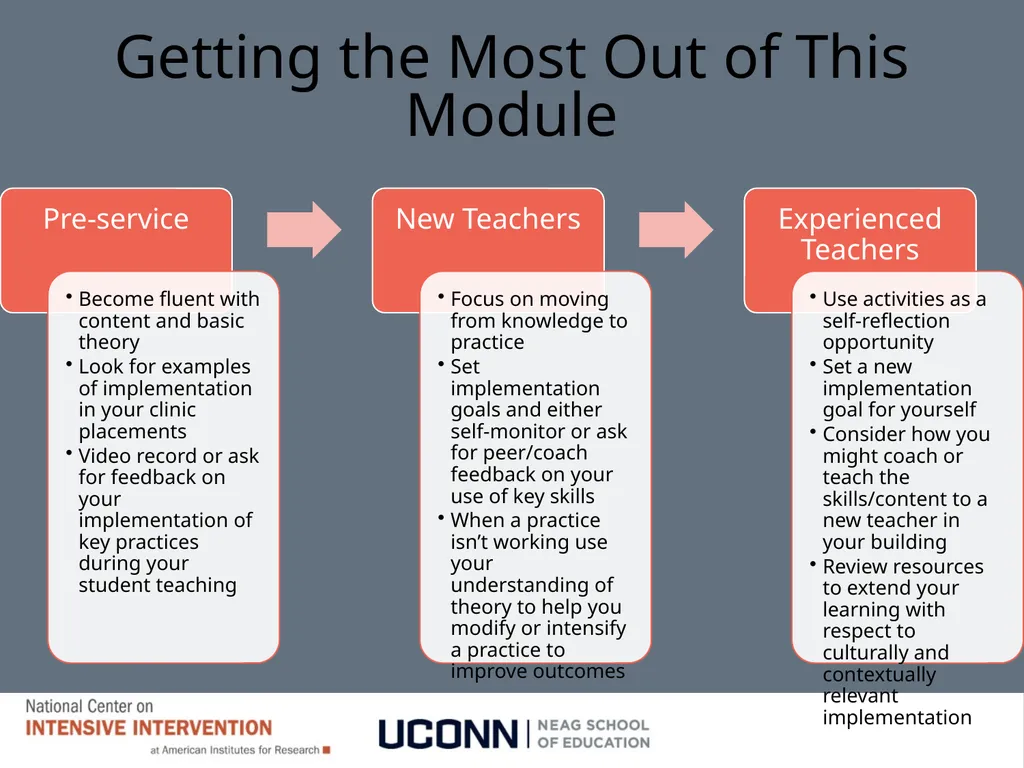
Getting the Most Out of This Module<br>
06
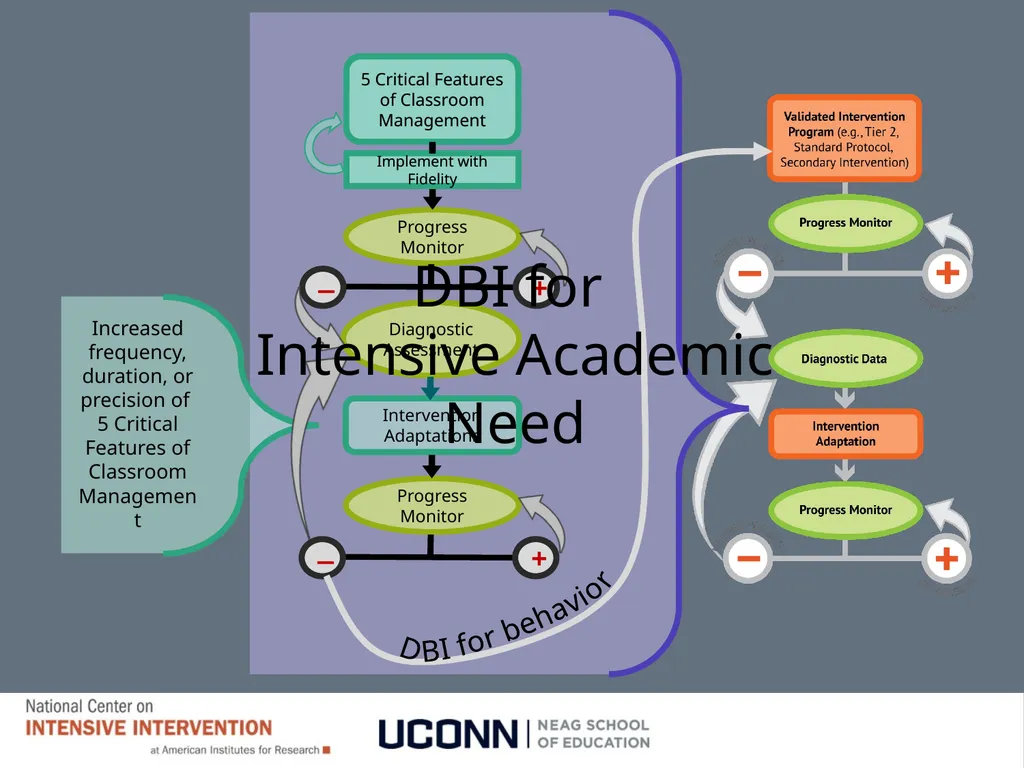
5 Critical Features of Classroom Management Implement with Fidelity Progress Monitor + _ Diagnostic Assessment Intervention Adaptations Progress Monitor + _ Increased frequency, duration, or precision of
5 Critical Features of Classroom Management DBI for behavior DBI for
Intensive Academic Need 5 Critical Features of Classroom Management Implement with Fidelity<br>
5 Critical Features of Classroom Management DBI for behavior DBI for
Intensive Academic Need 5 Critical Features of Classroom Management Implement with Fidelity<br>
07
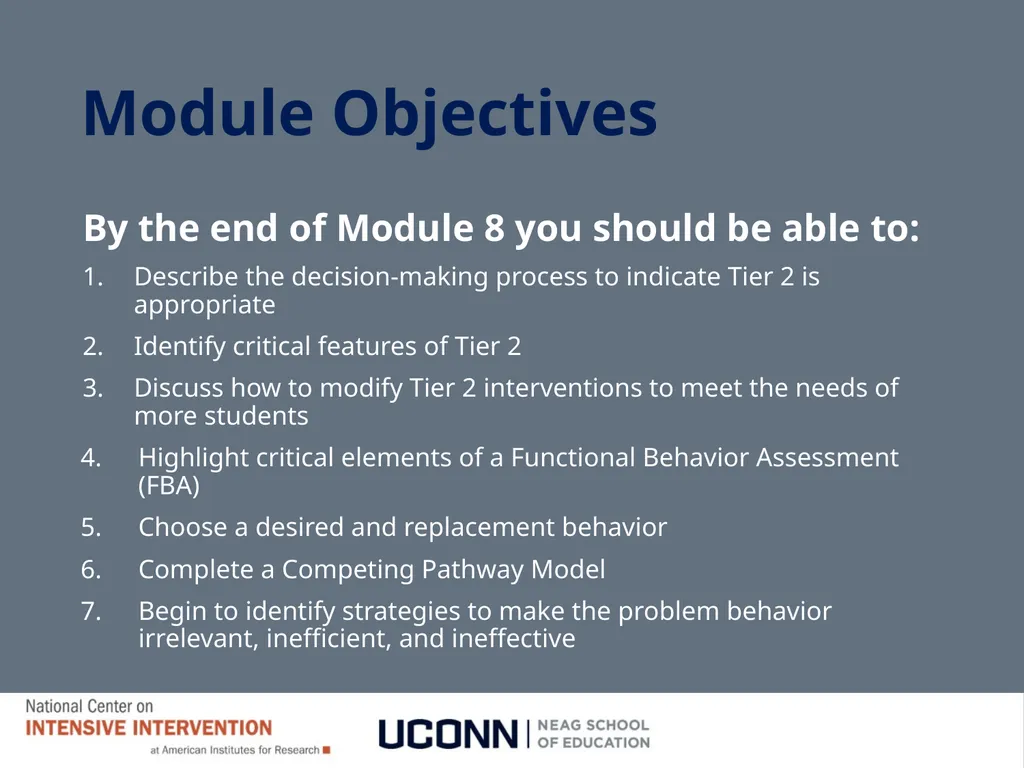
Module Objectives By the end of Module 8 you should be able to:
Describe the decision-making process to indicate Tier 2 is appropriate
Identify critical features of Tier 2
Discuss how to modify Tier 2 interventions to meet the needs of more students
Highlight critical elements of a Functional Behavior Assessment (FBA)
Choose a desired and replacement behavior
Complete a Competing Pathway Model
Begin to identify strategies to make the problem behavior irrelevant, inefficient, and ineffective<br>
Describe the decision-making process to indicate Tier 2 is appropriate
Identify critical features of Tier 2
Discuss how to modify Tier 2 interventions to meet the needs of more students
Highlight critical elements of a Functional Behavior Assessment (FBA)
Choose a desired and replacement behavior
Complete a Competing Pathway Model
Begin to identify strategies to make the problem behavior irrelevant, inefficient, and ineffective<br>
08
Intensifying Behavioral Interventions Part 1
How do we intensify supports for small groups of students?<br>
How do we intensify supports for small groups of students?<br>
09
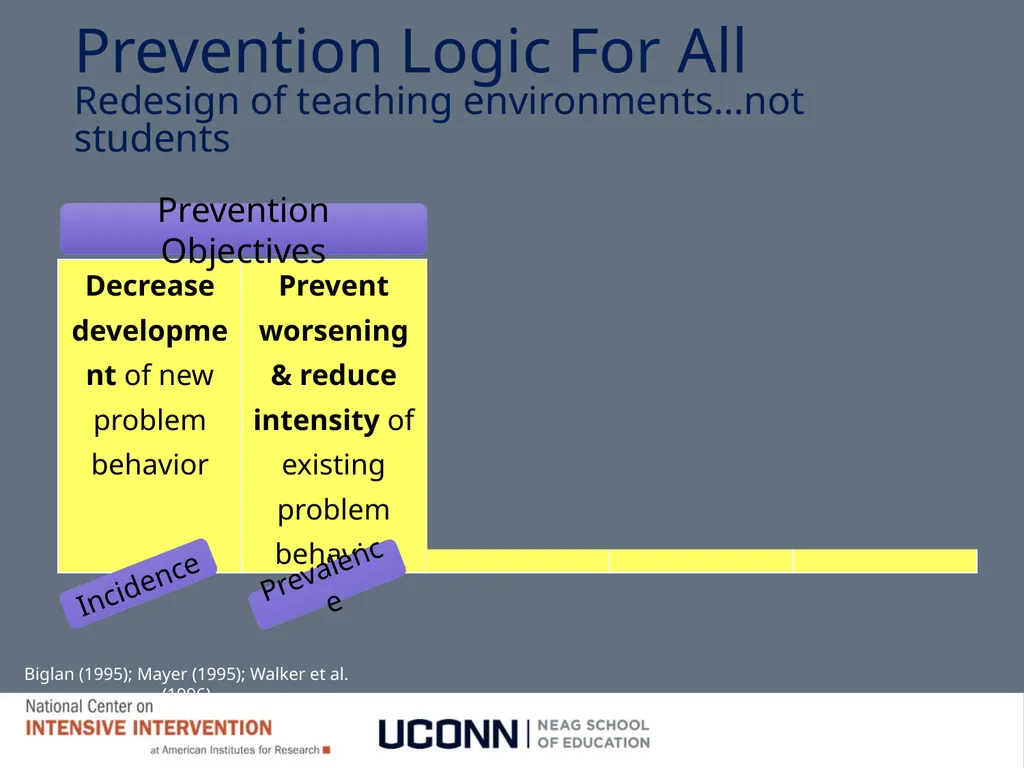
Prevention Logic For All
Redesign of teaching environments…not students Prevention Objectives Prevention Actions Incidence Prevalence Biglan (1995); Mayer (1995); Walker et al. (1996)<br>
10
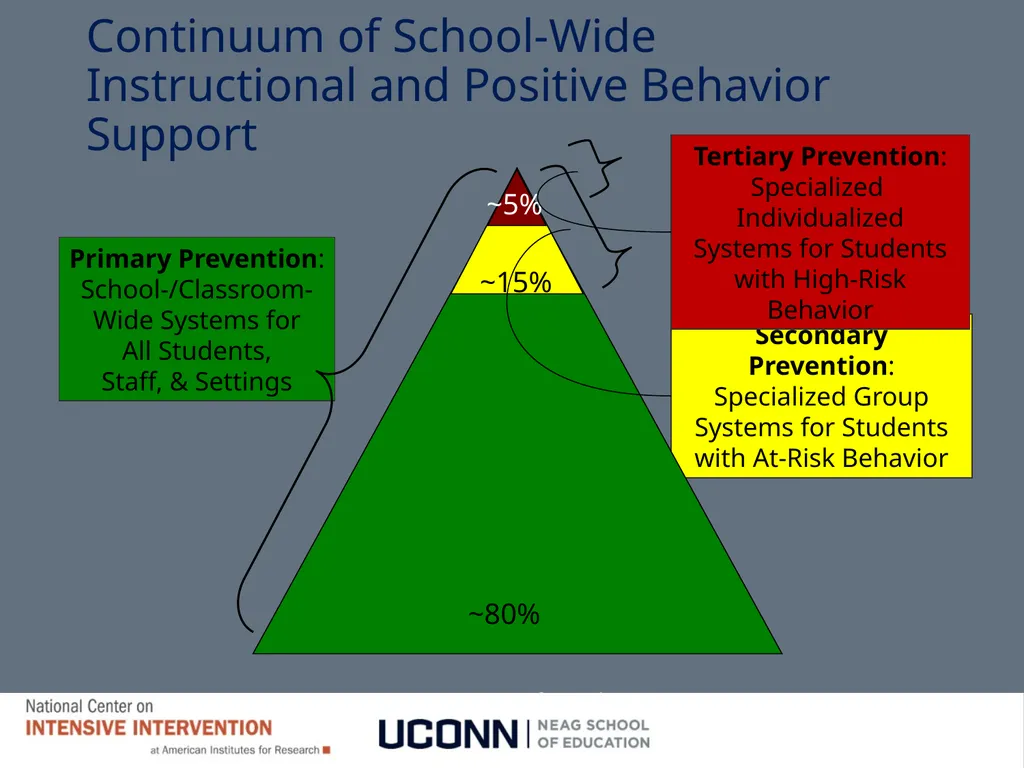
Continuum of School-Wide
Instructional and Positive Behavior Support Primary Prevention:
School-/Classroom-
Wide Systems for
All Students,
Staff, & Settings Secondary Prevention:
Specialized Group
Systems for Students with At-Risk Behavior Tertiary Prevention:
Specialized
Individualized
Systems for Students with High-Risk Behavior ~80% of Students ~15% ~5% ~80%<br>
School-/Classroom-
Wide Systems for
All Students,
Staff, & Settings Secondary Prevention:
Specialized Group
Systems for Students with At-Risk Behavior Tertiary Prevention:
Specialized
Individualized
Systems for Students with High-Risk Behavior ~80% of Students ~15% ~5% ~80%<br>
11
Secondary Supports: Who Benefits? Students who continue to demonstrate challenging behavior despite school and classroom supports
being in place Approximately 10 to 15% of the student population Likely to be students with both
academic and behavioral difficulties Without effective school-wide prevention, we cannot reliably identify students who benefit from secondary supports<br>
being in place Approximately 10 to 15% of the student population Likely to be students with both
academic and behavioral difficulties Without effective school-wide prevention, we cannot reliably identify students who benefit from secondary supports<br>
12
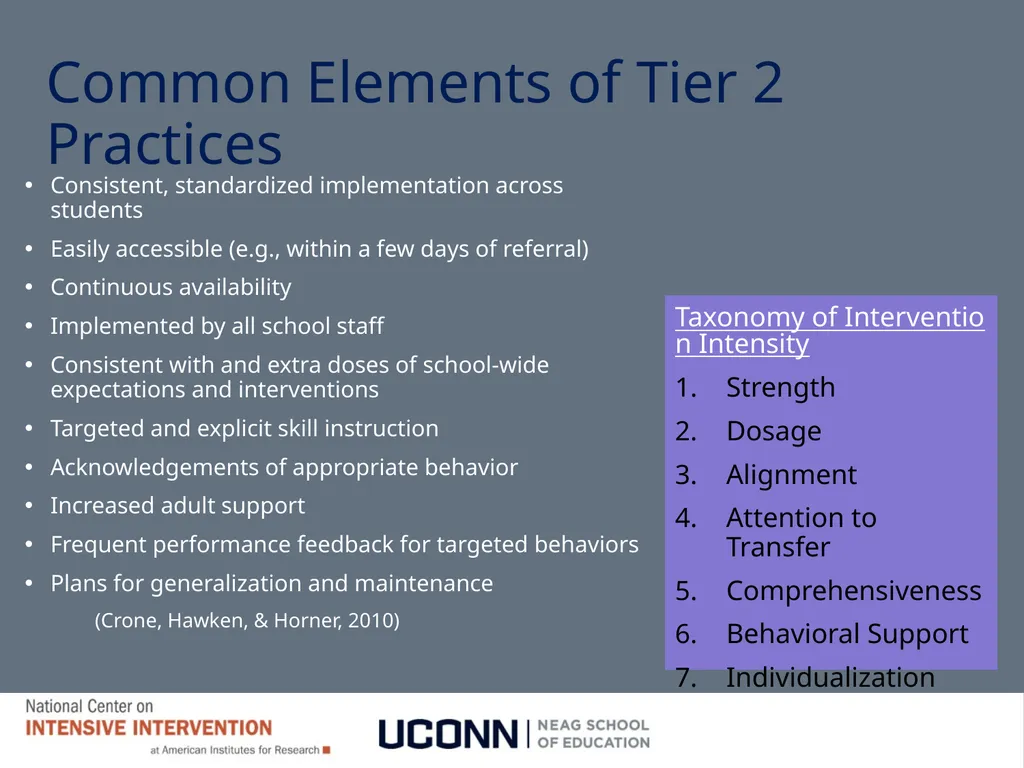
Common Elements of Tier 2 Practices Consistent, standardized implementation across students
Easily accessible (e.g., within a few days of referral)
Continuous availability
Implemented by all school staff
Consistent with and extra doses of school-wide expectations and interventions
Targeted and explicit skill instruction
Acknowledgements of appropriate behavior
Increased adult support
Frequent performance feedback for targeted behaviors
Plans for generalization and maintenance
(Crone, Hawken, & Horner, 2010) Taxonomy of Intervention Intensity
Strength
Dosage
Alignment
Attention to Transfer
Comprehensiveness
Behavioral Support
Individualization<br>
Easily accessible (e.g., within a few days of referral)
Continuous availability
Implemented by all school staff
Consistent with and extra doses of school-wide expectations and interventions
Targeted and explicit skill instruction
Acknowledgements of appropriate behavior
Increased adult support
Frequent performance feedback for targeted behaviors
Plans for generalization and maintenance
(Crone, Hawken, & Horner, 2010) Taxonomy of Intervention Intensity
Strength
Dosage
Alignment
Attention to Transfer
Comprehensiveness
Behavioral Support
Individualization<br>
13
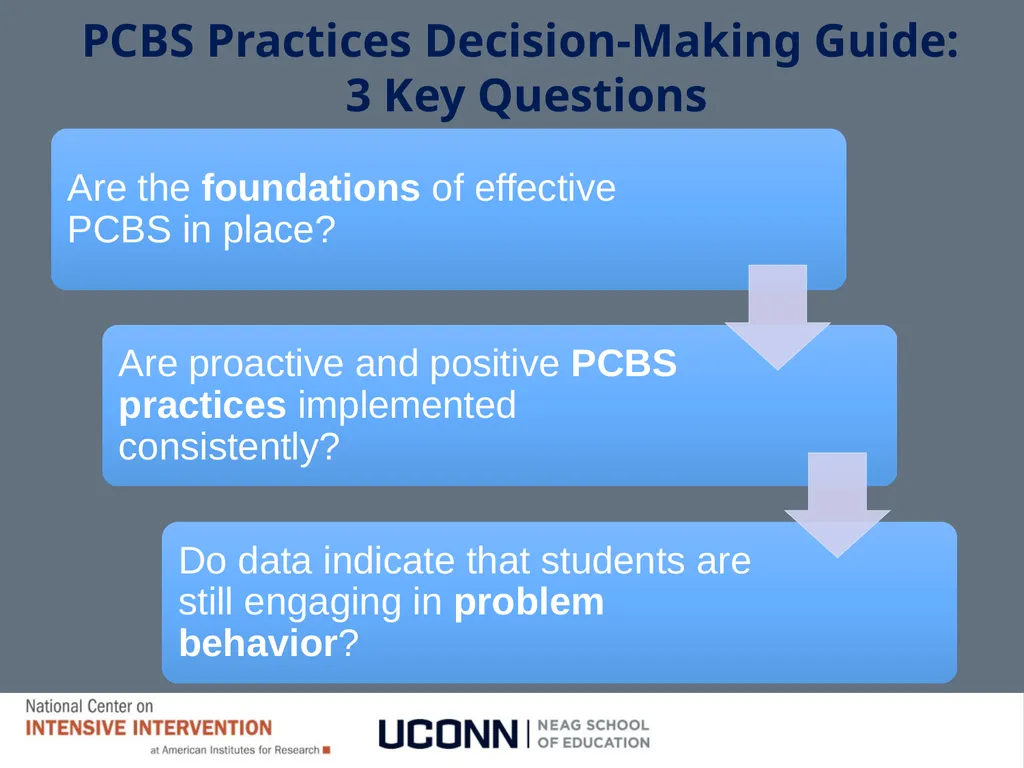
PCBS Practices Decision-Making Guide:
3 Key Questions<br>
3 Key Questions<br>
14
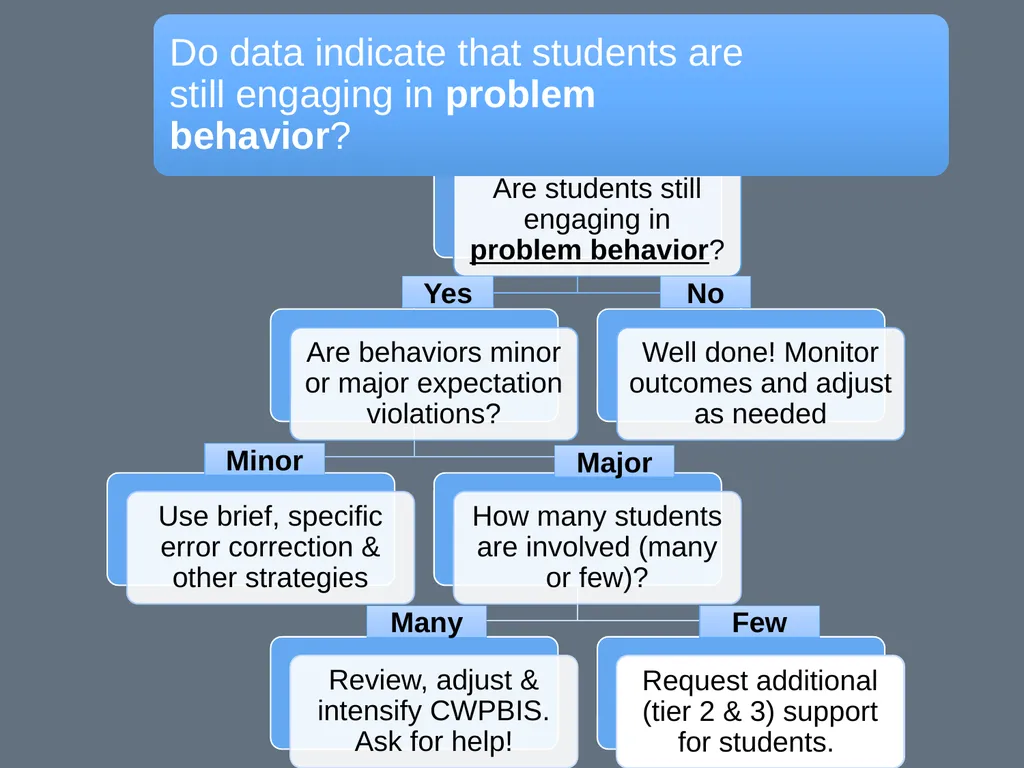
Yes No Minor Major Many Few<br>
15
Yes Yes<br>
16
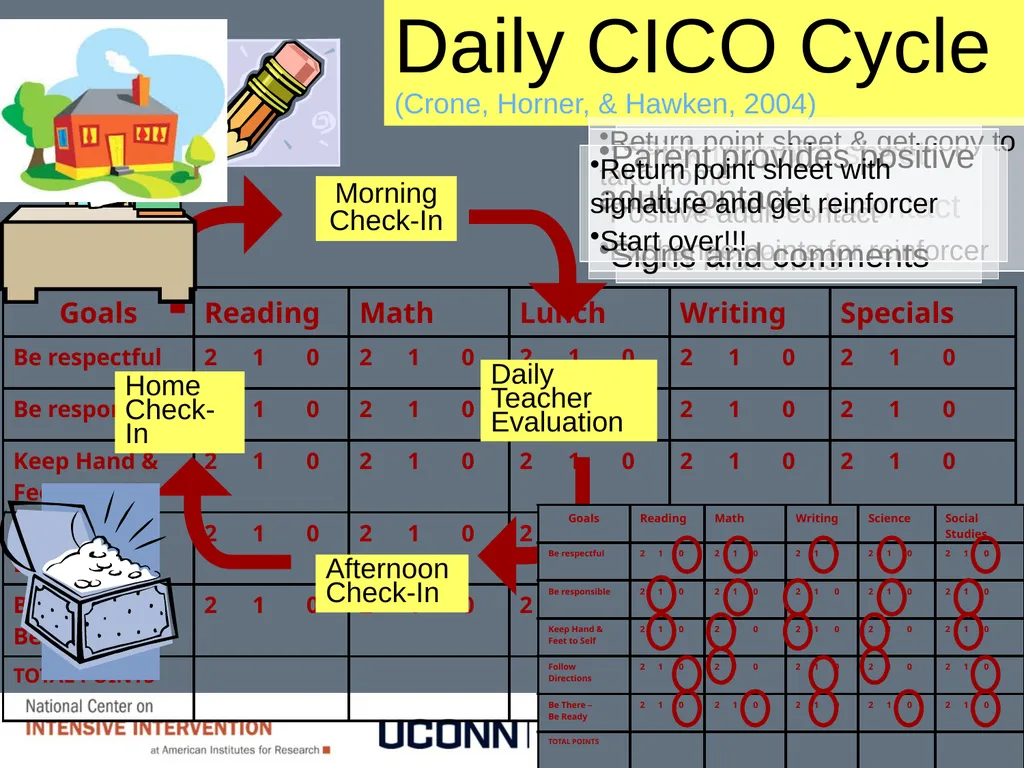
Daily CICO Cycle
(Crone, Horner, & Hawken, 2004) Morning Check-In Home Check-In Daily Teacher Evaluation Afternoon Check-In Pick up point sheet
Positive adult contact
Get materials Return point sheet & get copy to take home
Positive adult contact
Exchange points for reinforcer Parent provides positive adult contact
Signs and comments Return point sheet with signature and get reinforcer
Start over!!!<br>
Positive adult contact
Get materials Return point sheet & get copy to take home
Positive adult contact
Exchange points for reinforcer Parent provides positive adult contact
Signs and comments Return point sheet with signature and get reinforcer
Start over!!!<br>
17
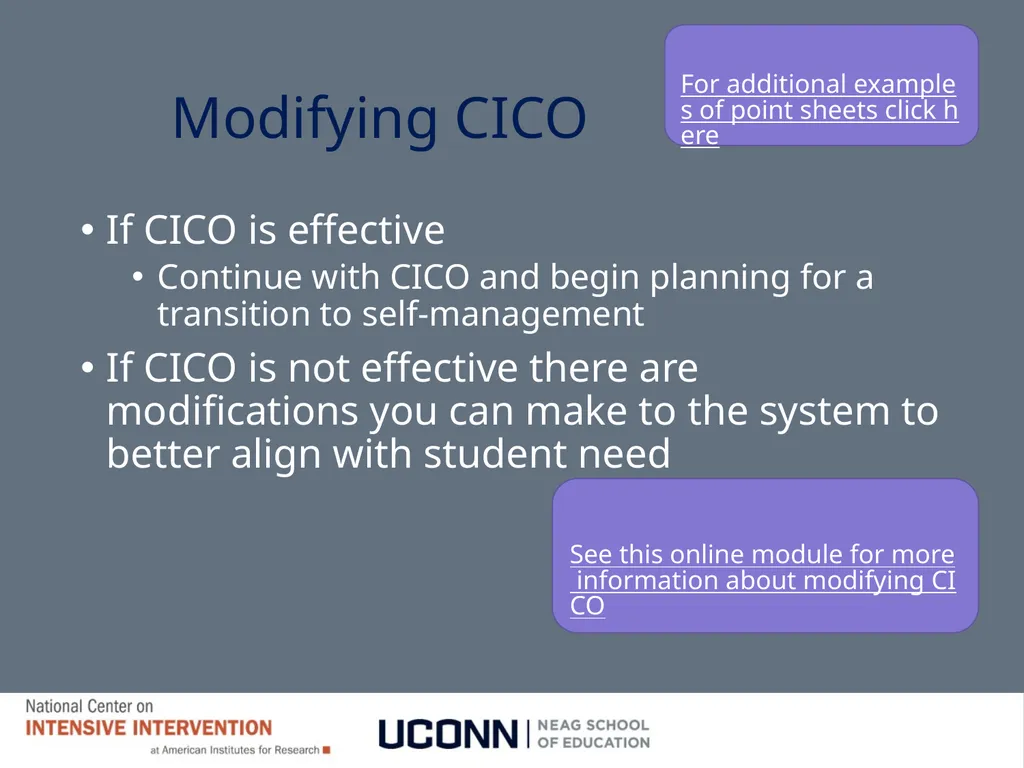
Modifying CICO If CICO is effective
Continue with CICO and begin planning for a transition to self-management
If CICO is not effective there are modifications you can make to the system to better align with student need See this online module for more information about modifying CICO For additional examples of point sheets click here<br>
Continue with CICO and begin planning for a transition to self-management
If CICO is not effective there are modifications you can make to the system to better align with student need See this online module for more information about modifying CICO For additional examples of point sheets click here<br>
18
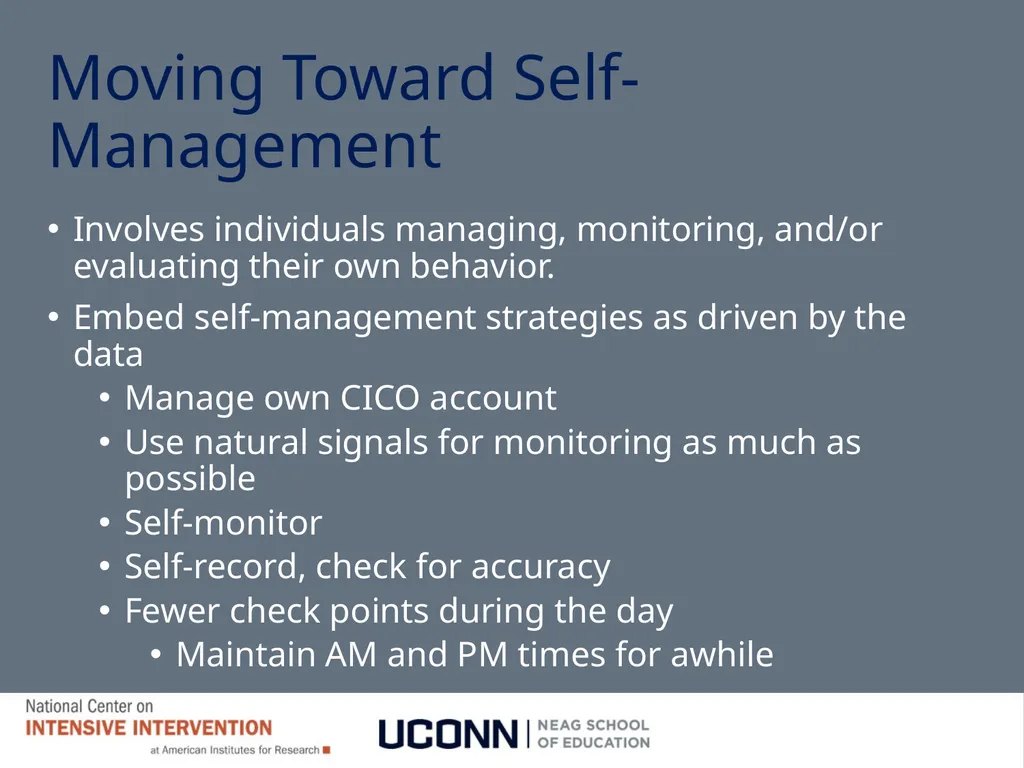
Involves individuals managing, monitoring, and/or evaluating their own behavior.
Embed self-management strategies as driven by the data
Manage own CICO account
Use natural signals for monitoring as much as possible
Self-monitor
Self-record, check for accuracy
Fewer check points during the day
Maintain AM and PM times for awhile Moving Toward Self-Management<br>
Embed self-management strategies as driven by the data
Manage own CICO account
Use natural signals for monitoring as much as possible
Self-monitor
Self-record, check for accuracy
Fewer check points during the day
Maintain AM and PM times for awhile Moving Toward Self-Management<br>
19
Yes Yes<br>
20
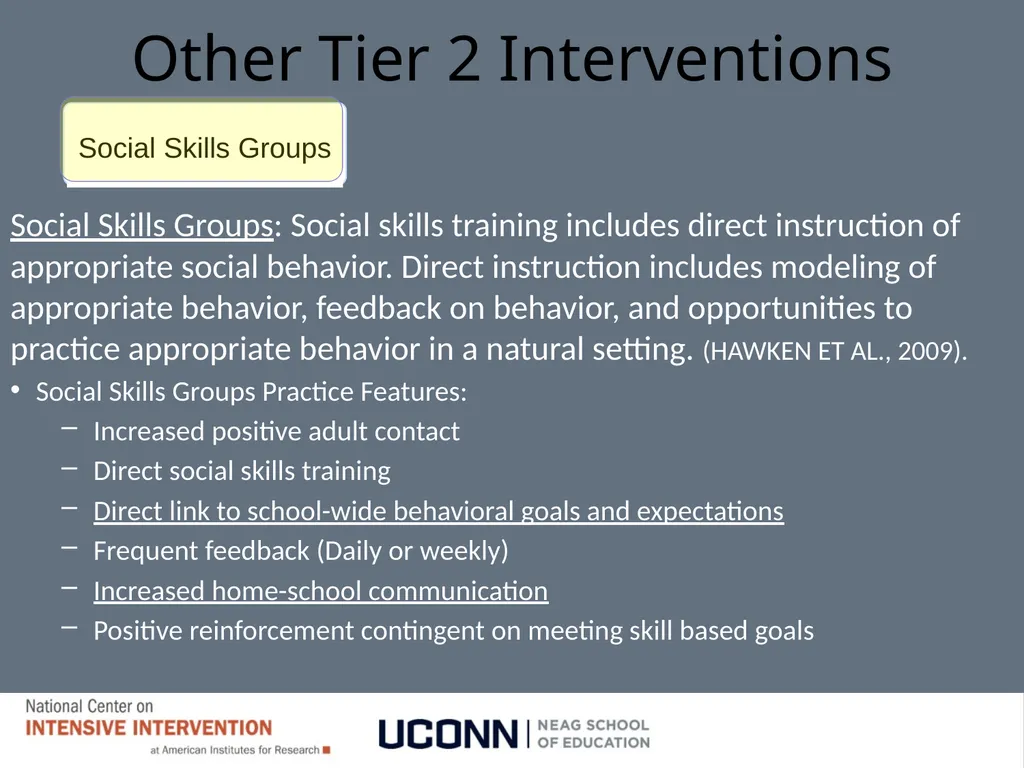
Social Skills Groups: Social skills training includes direct instruction of appropriate social behavior. Direct instruction includes modeling of appropriate behavior, feedback on behavior, and opportunities to practice appropriate behavior in a natural setting. (hawken et al., 2009).
Social Skills Groups Practice Features:
Increased positive adult contact
Direct social skills training
Direct link to school-wide behavioral goals and expectations
Frequent feedback (Daily or weekly)
Increased home-school communication
Positive reinforcement contingent on meeting skill based goals Other Tier 2 Interventions<br>
Social Skills Groups Practice Features:
Increased positive adult contact
Direct social skills training
Direct link to school-wide behavioral goals and expectations
Frequent feedback (Daily or weekly)
Increased home-school communication
Positive reinforcement contingent on meeting skill based goals Other Tier 2 Interventions<br>
21
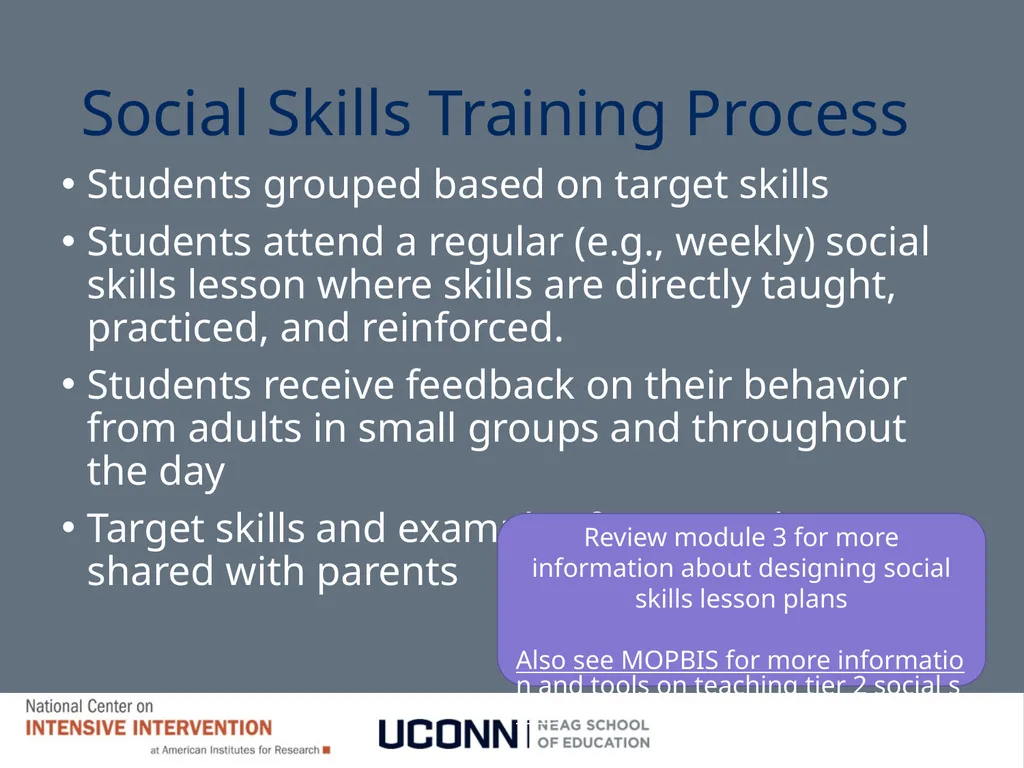
Social Skills Training Process Students grouped based on target skills
Students attend a regular (e.g., weekly) social skills lesson where skills are directly taught, practiced, and reinforced.
Students receive feedback on their behavior from adults in small groups and throughout the day
Target skills and examples for use at home are shared with parents Review module 3 for more information about designing social skills lesson plans
Also see MOPBIS for more information and tools on teaching tier 2 social skills<br>
Students attend a regular (e.g., weekly) social skills lesson where skills are directly taught, practiced, and reinforced.
Students receive feedback on their behavior from adults in small groups and throughout the day
Target skills and examples for use at home are shared with parents Review module 3 for more information about designing social skills lesson plans
Also see MOPBIS for more information and tools on teaching tier 2 social skills<br>
22
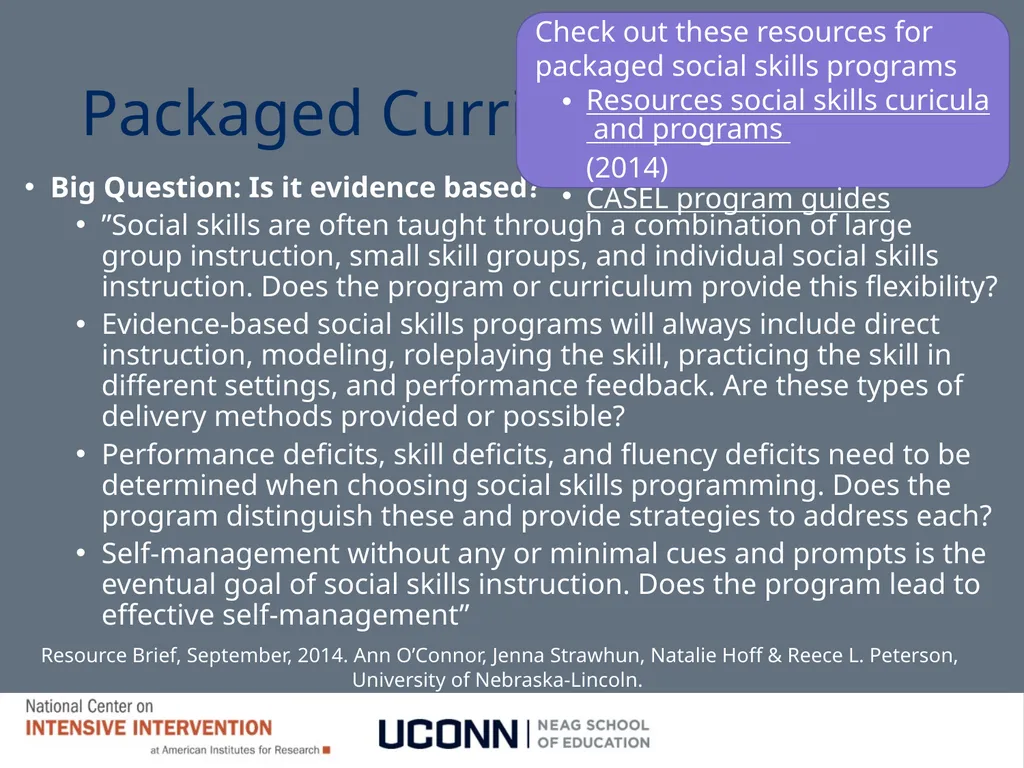
Packaged Curricula Big Question: Is it evidence based?
”Social skills are often taught through a combination of large group instruction, small skill groups, and individual social skills instruction. Does the program or curriculum provide this flexibility?
Evidence-based social skills programs will always include direct instruction, modeling, roleplaying the skill, practicing the skill in different settings, and performance feedback. Are these types of delivery methods provided or possible?
Performance deficits, skill deficits, and fluency deficits need to be determined when choosing social skills programming. Does the program distinguish these and provide strategies to address each?
Self-management without any or minimal cues and prompts is the eventual goal of social skills instruction. Does the program lead to effective self-management” Resource Brief, September, 2014. Ann O’Connor, Jenna Strawhun, Natalie Hoff & Reece L. Peterson, University of Nebraska-Lincoln. Check out these resources for packaged social skills programs
Resources social skills curicula and programs (2014)
CASEL program guides<br>
”Social skills are often taught through a combination of large group instruction, small skill groups, and individual social skills instruction. Does the program or curriculum provide this flexibility?
Evidence-based social skills programs will always include direct instruction, modeling, roleplaying the skill, practicing the skill in different settings, and performance feedback. Are these types of delivery methods provided or possible?
Performance deficits, skill deficits, and fluency deficits need to be determined when choosing social skills programming. Does the program distinguish these and provide strategies to address each?
Self-management without any or minimal cues and prompts is the eventual goal of social skills instruction. Does the program lead to effective self-management” Resource Brief, September, 2014. Ann O’Connor, Jenna Strawhun, Natalie Hoff & Reece L. Peterson, University of Nebraska-Lincoln. Check out these resources for packaged social skills programs
Resources social skills curicula and programs (2014)
CASEL program guides<br>
23
Yes Yes<br>
24
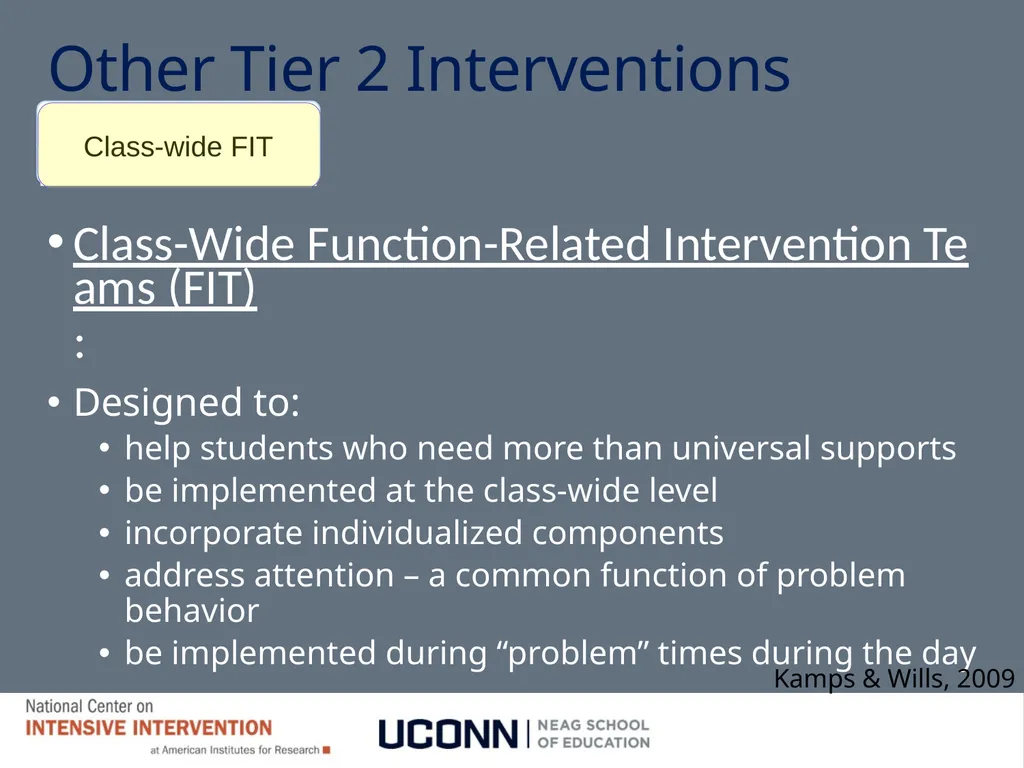
Class-Wide Function-Related Intervention Teams (FIT):
Designed to:
help students who need more than universal supports
be implemented at the class-wide level
incorporate individualized components
address attention – a common function of problem behavior
be implemented during “problem” times during the day Other Tier 2 Interventions Kamps & Wills, 2009<br>
Designed to:
help students who need more than universal supports
be implemented at the class-wide level
incorporate individualized components
address attention – a common function of problem behavior
be implemented during “problem” times during the day Other Tier 2 Interventions Kamps & Wills, 2009<br>
25
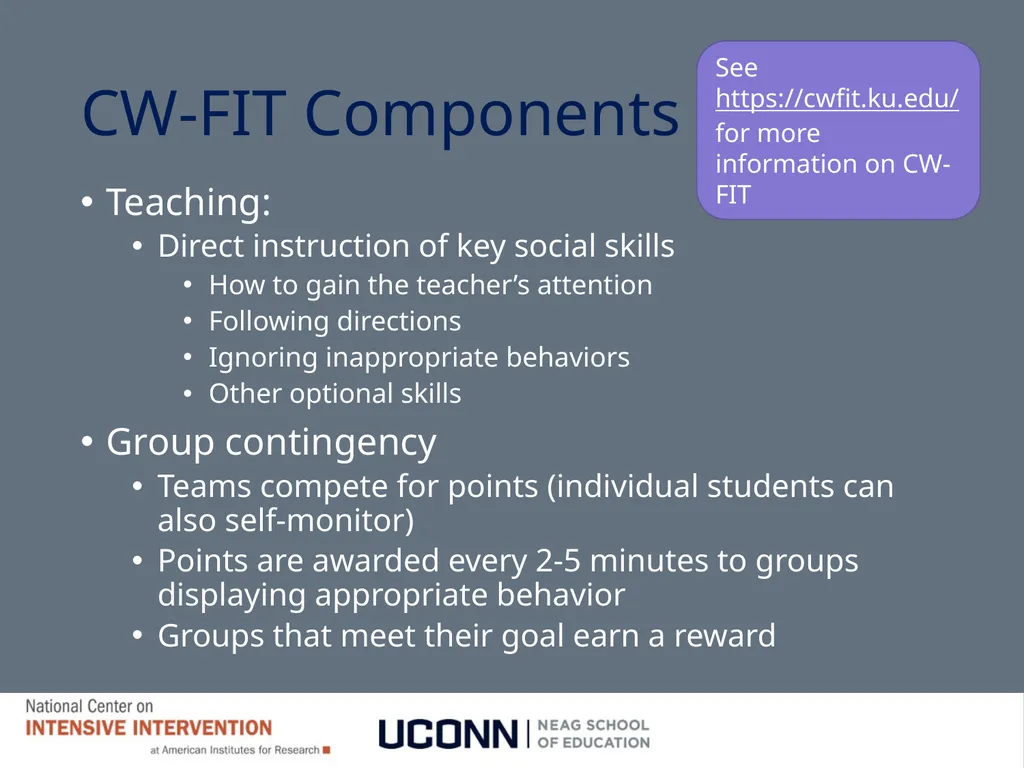
CW-FIT Components Teaching:
Direct instruction of key social skills
How to gain the teacher’s attention
Following directions
Ignoring inappropriate behaviors
Other optional skills
Group contingency
Teams compete for points (individual students can also self-monitor)
Points are awarded every 2-5 minutes to groups displaying appropriate behavior
Groups that meet their goal earn a reward See https://cwfit.ku.edu/ for more information on CW-FIT<br>
Direct instruction of key social skills
How to gain the teacher’s attention
Following directions
Ignoring inappropriate behaviors
Other optional skills
Group contingency
Teams compete for points (individual students can also self-monitor)
Points are awarded every 2-5 minutes to groups displaying appropriate behavior
Groups that meet their goal earn a reward See https://cwfit.ku.edu/ for more information on CW-FIT<br>
26
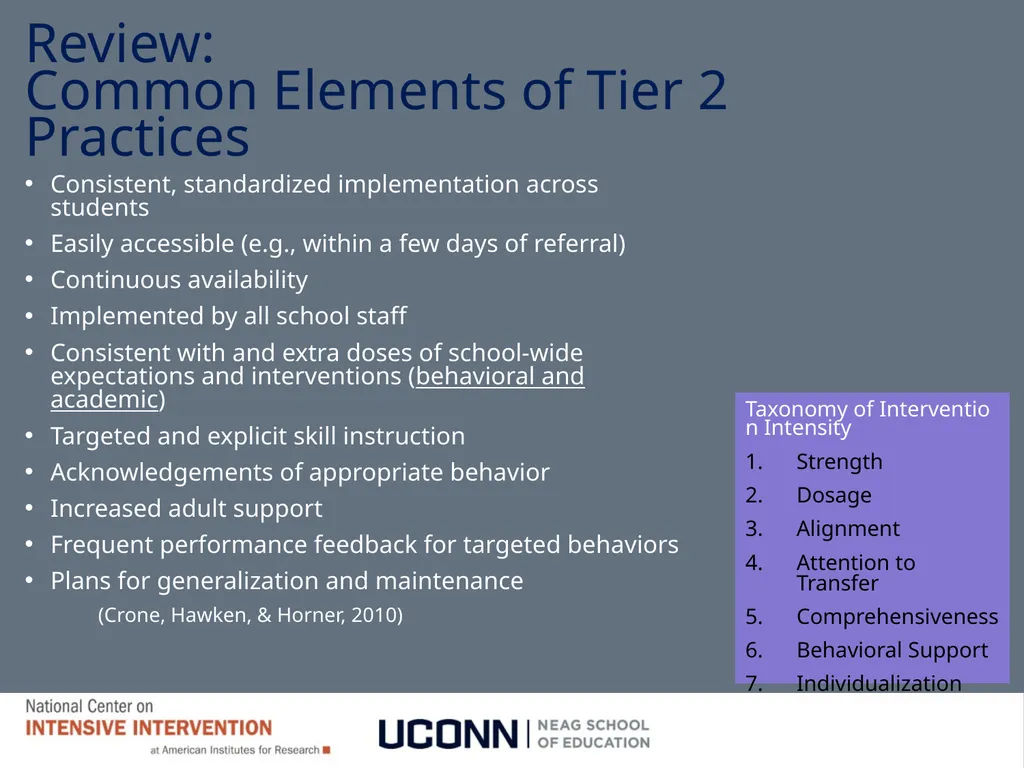
Review:
Common Elements of Tier 2 Practices Consistent, standardized implementation across students
Easily accessible (e.g., within a few days of referral)
Continuous availability
Implemented by all school staff
Consistent with and extra doses of school-wide expectations and interventions (behavioral and academic)
Targeted and explicit skill instruction
Acknowledgements of appropriate behavior
Increased adult support
Frequent performance feedback for targeted behaviors
Plans for generalization and maintenance
(Crone, Hawken, & Horner, 2010) Taxonomy of Intervention Intensity
Strength
Dosage
Alignment
Attention to Transfer
Comprehensiveness
Behavioral Support
Individualization<br>
Easily accessible (e.g., within a few days of referral)
Continuous availability
Implemented by all school staff
Consistent with and extra doses of school-wide expectations and interventions (behavioral and academic)
Targeted and explicit skill instruction
Acknowledgements of appropriate behavior
Increased adult support
Frequent performance feedback for targeted behaviors
Plans for generalization and maintenance
(Crone, Hawken, & Horner, 2010) Taxonomy of Intervention Intensity
Strength
Dosage
Alignment
Attention to Transfer
Comprehensiveness
Behavioral Support
Individualization<br>
27
Intensifying Behavioral Support Part 2
How do we intensify supports for individual students?<br>
How do we intensify supports for individual students?<br>
28
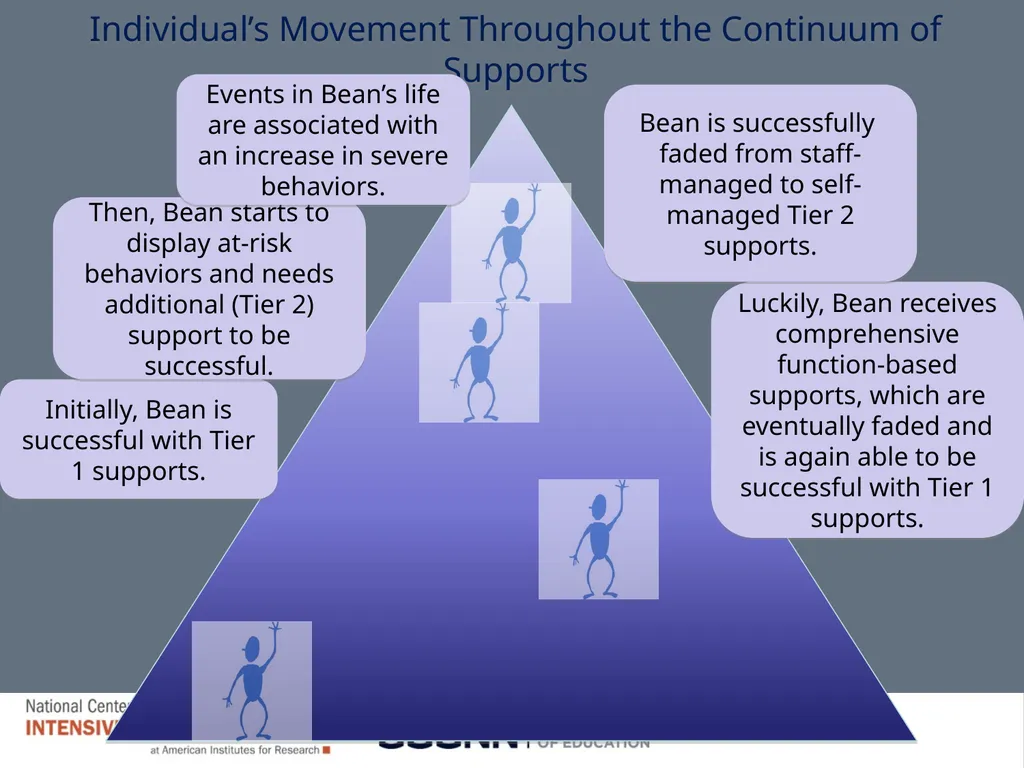
Individual’s Movement Throughout the Continuum of Supports Initially, Bean is successful with Tier 1 supports. Then, Bean starts to display at-risk behaviors and needs additional (Tier 2) support to be successful. Events in Bean’s life are associated with an increase in severe behaviors. Luckily, Bean receives comprehensive function-based supports, which are eventually faded and is again able to be successful with Tier 1 supports. Bean is successfully faded from staff-managed to self-managed Tier 2 supports.<br>
29
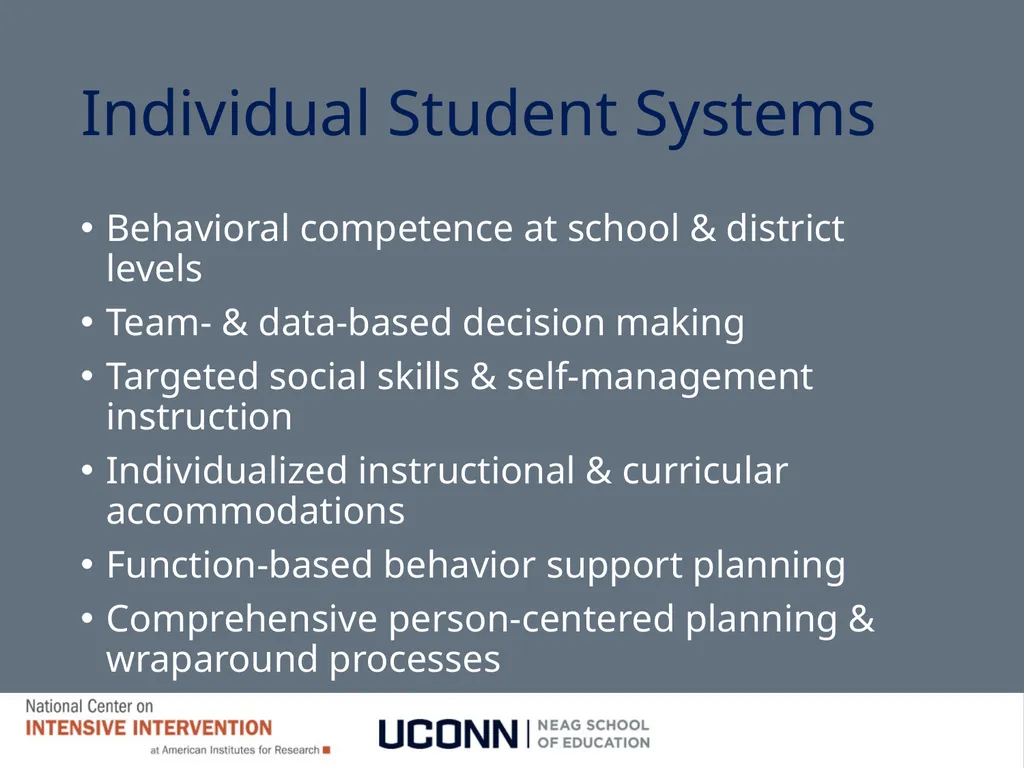
Individual Student Systems Behavioral competence at school & district levels
Team- & data-based decision making
Targeted social skills & self-management instruction
Individualized instructional & curricular accommodations
Function-based behavior support planning
Comprehensive person-centered planning & wraparound processes<br>
Team- & data-based decision making
Targeted social skills & self-management instruction
Individualized instructional & curricular accommodations
Function-based behavior support planning
Comprehensive person-centered planning & wraparound processes<br>
30
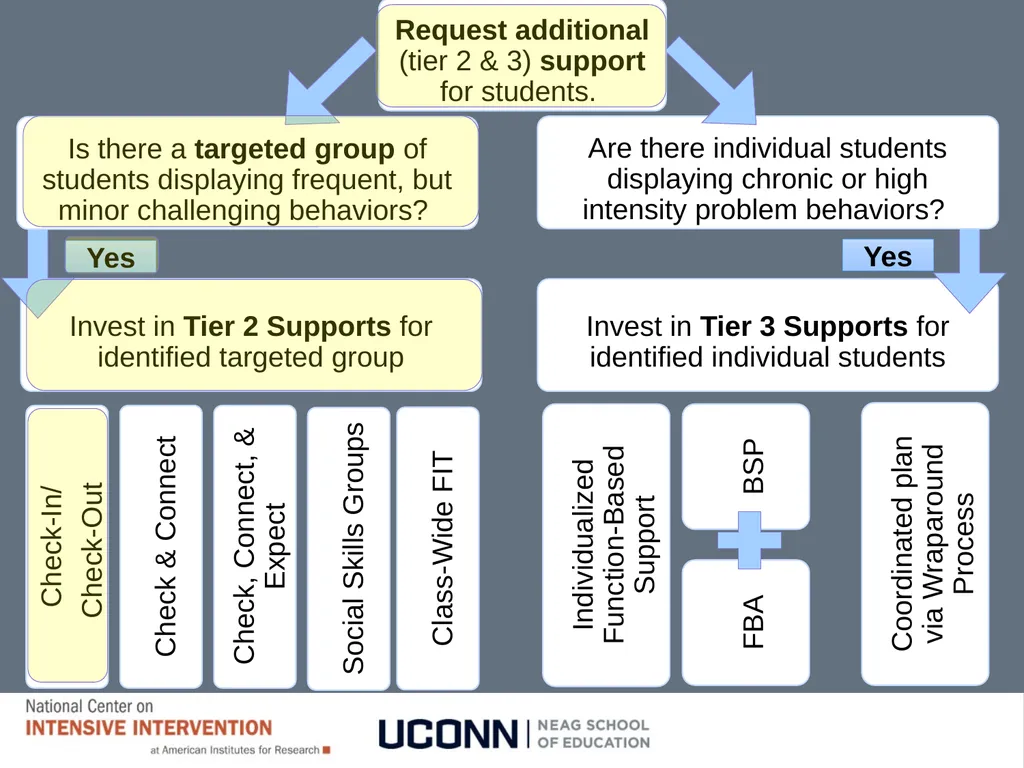
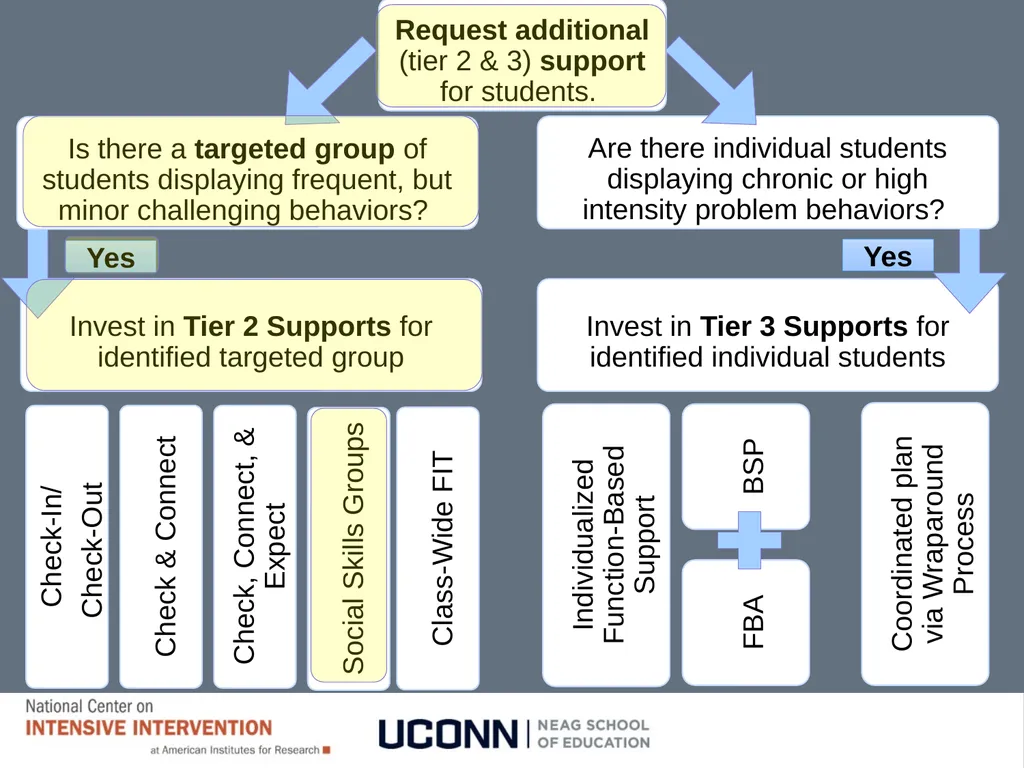
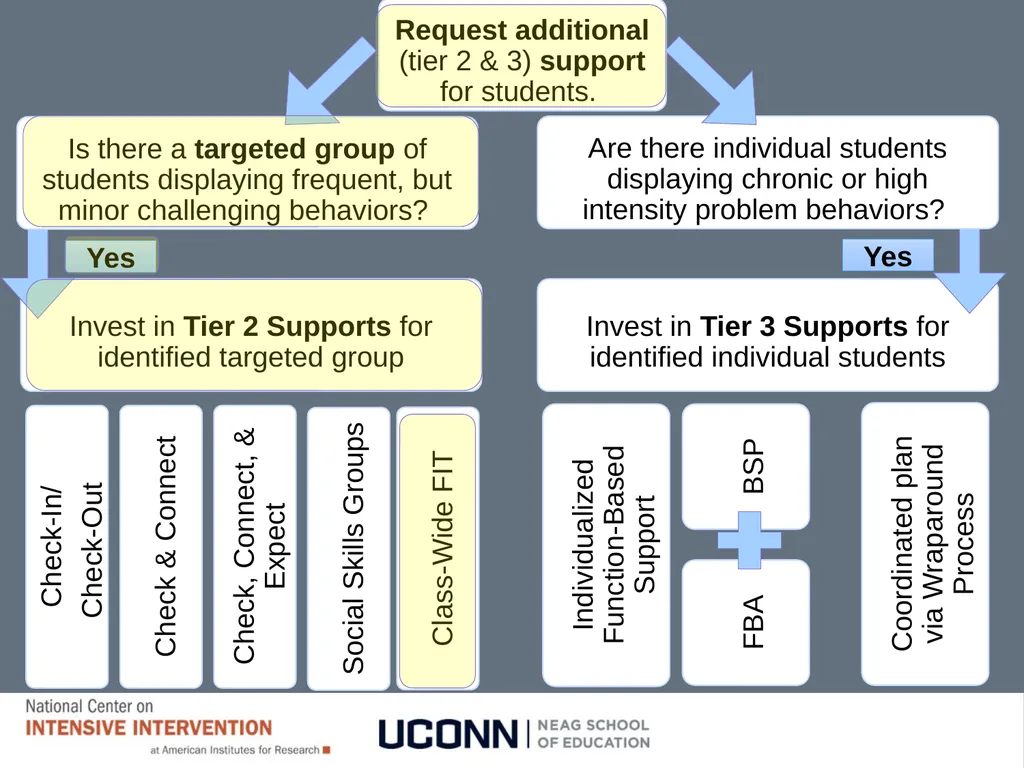
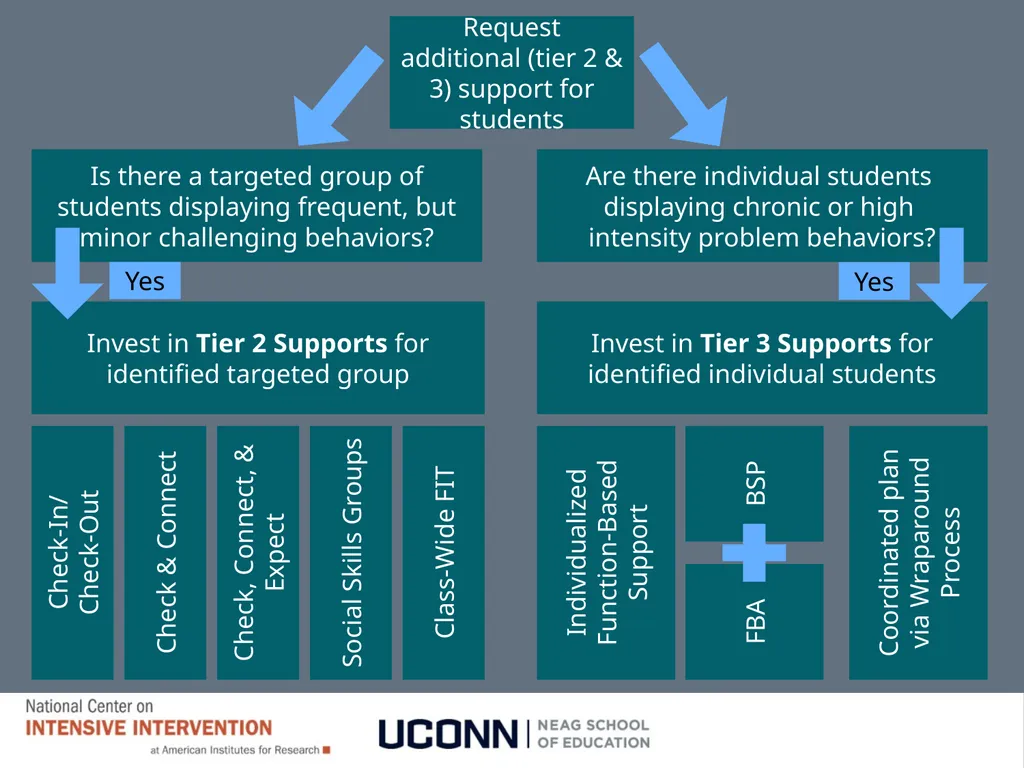
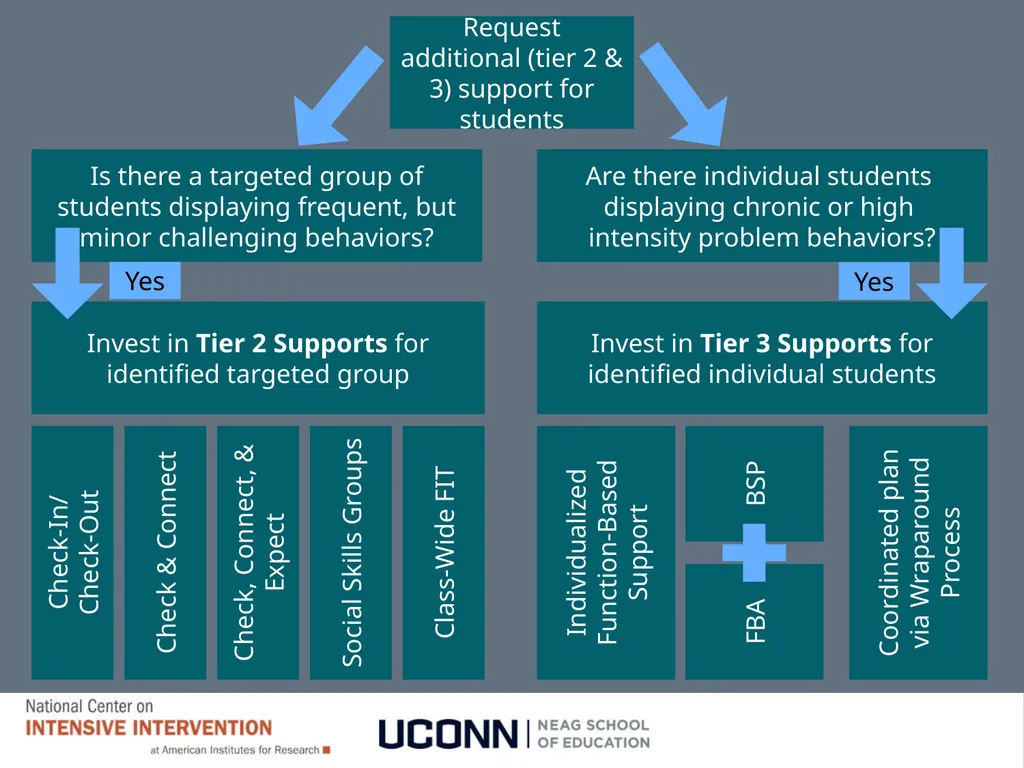
Is there a targeted group of students displaying frequent, but minor challenging behaviors? Request additional (tier 2 & 3) support for students Are there individual students
displaying chronic or high
intensity problem behaviors? Invest in Tier 2 Supports for identified targeted group Invest in Tier 3 Supports for identified individual students Check-In/
Check-Out Check & Connect Check, Connect, & Expect Social Skills Groups Class-Wide FIT Individualized Function-Based Support FBA BSP Coordinated plan via Wraparound Process Yes Yes<br>
displaying chronic or high
intensity problem behaviors? Invest in Tier 2 Supports for identified targeted group Invest in Tier 3 Supports for identified individual students Check-In/
Check-Out Check & Connect Check, Connect, & Expect Social Skills Groups Class-Wide FIT Individualized Function-Based Support FBA BSP Coordinated plan via Wraparound Process Yes Yes<br>
31
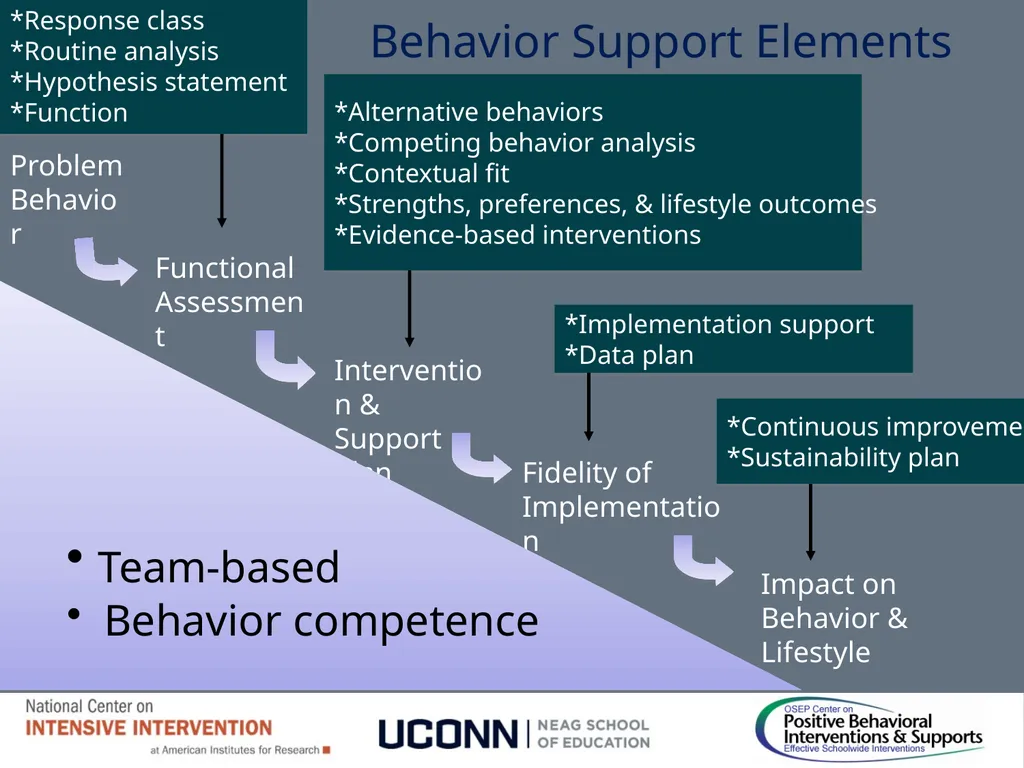
Behavior Support Elements Problem Behavior Functional Assessment Intervention & Support Plan Fidelity of Implementation Impact on Behavior & Lifestyle *Response class
*Routine analysis
*Hypothesis statement
*Function *Alternative behaviors
*Competing behavior analysis
*Contextual fit
*Strengths, preferences, & lifestyle outcomes
*Evidence-based interventions *Implementation support
*Data plan *Continuous improvement
*Sustainability plan Team-based
Behavior competence<br>
*Routine analysis
*Hypothesis statement
*Function *Alternative behaviors
*Competing behavior analysis
*Contextual fit
*Strengths, preferences, & lifestyle outcomes
*Evidence-based interventions *Implementation support
*Data plan *Continuous improvement
*Sustainability plan Team-based
Behavior competence<br>
32
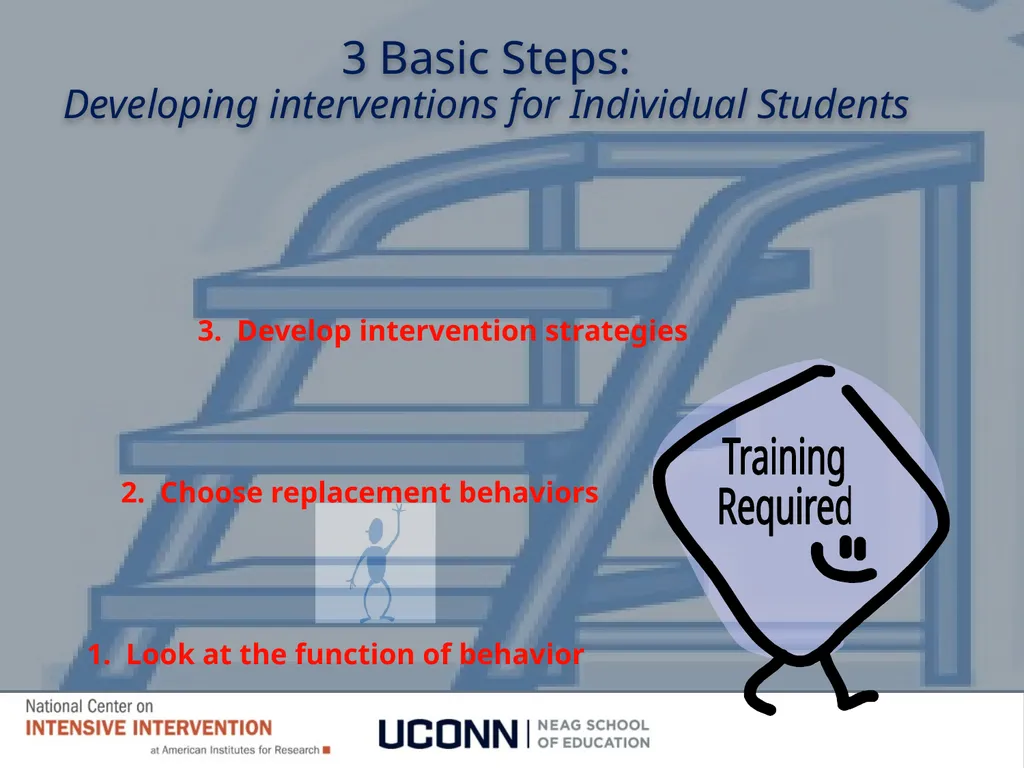
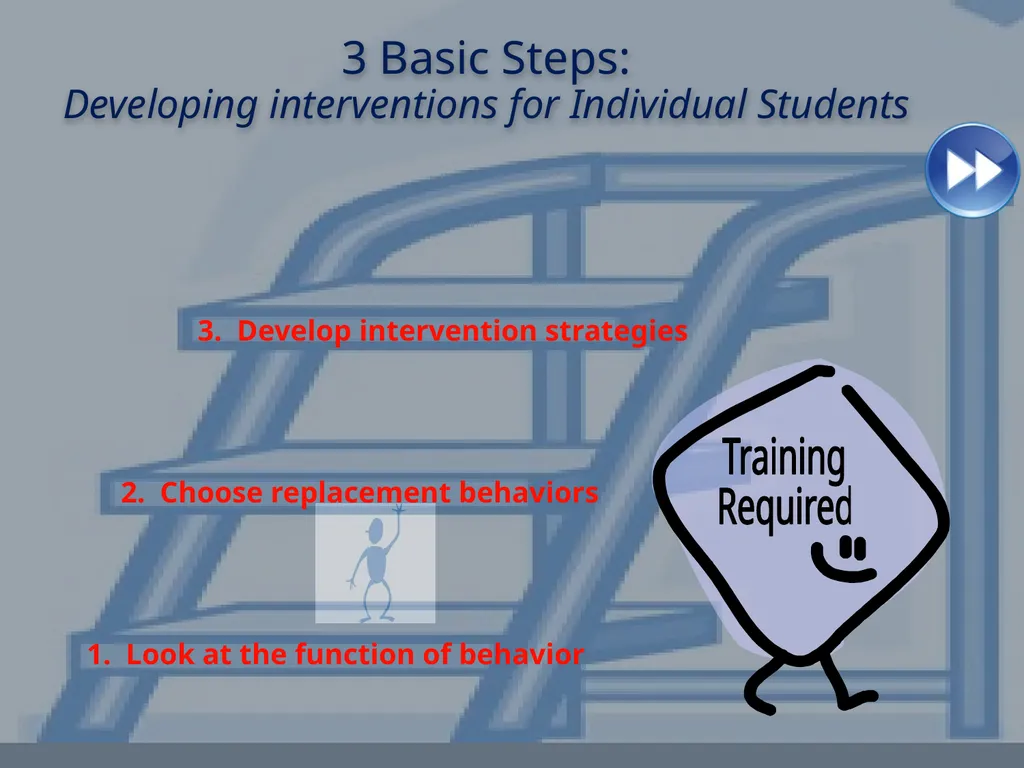
3 Basic Steps:
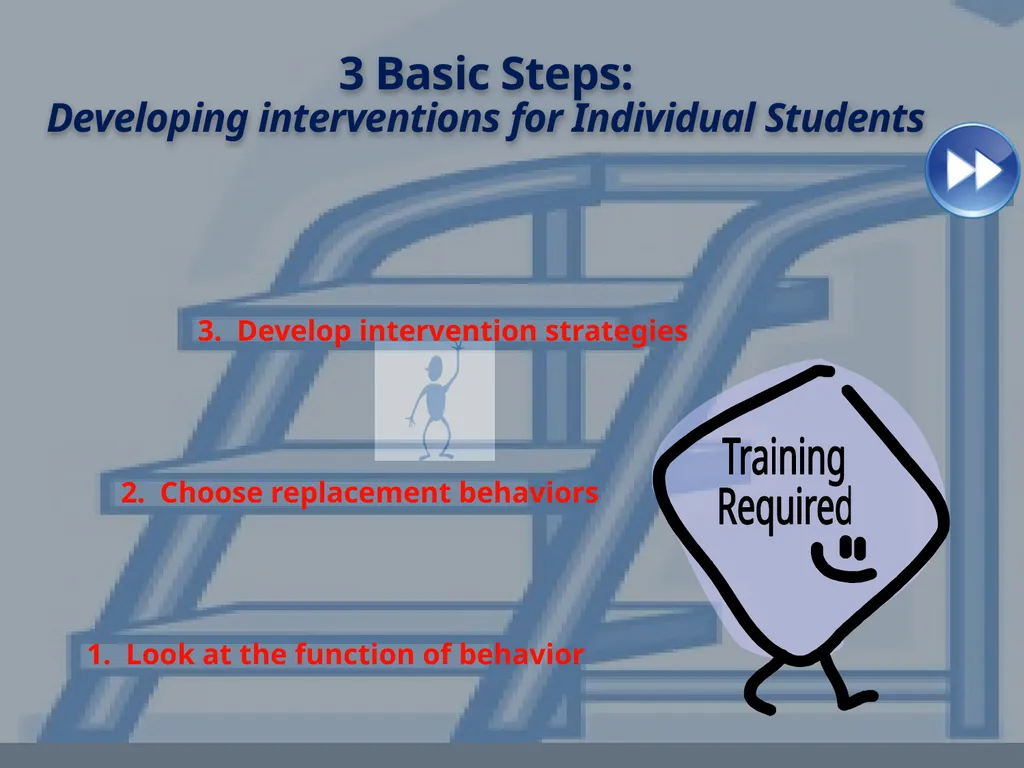
Developing interventions for Individual Students 1. Look at the function of behavior 2. Choose replacement behaviors 3. Develop intervention strategies<br>
33
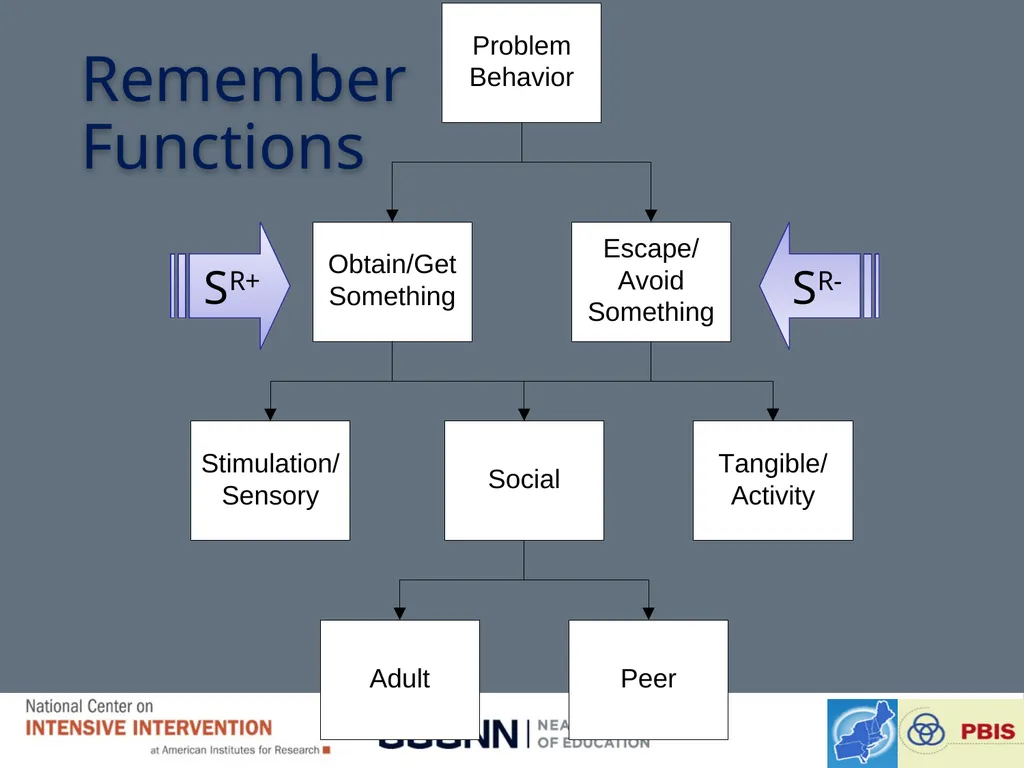
Remember Functions SR+ SR-<br>
34
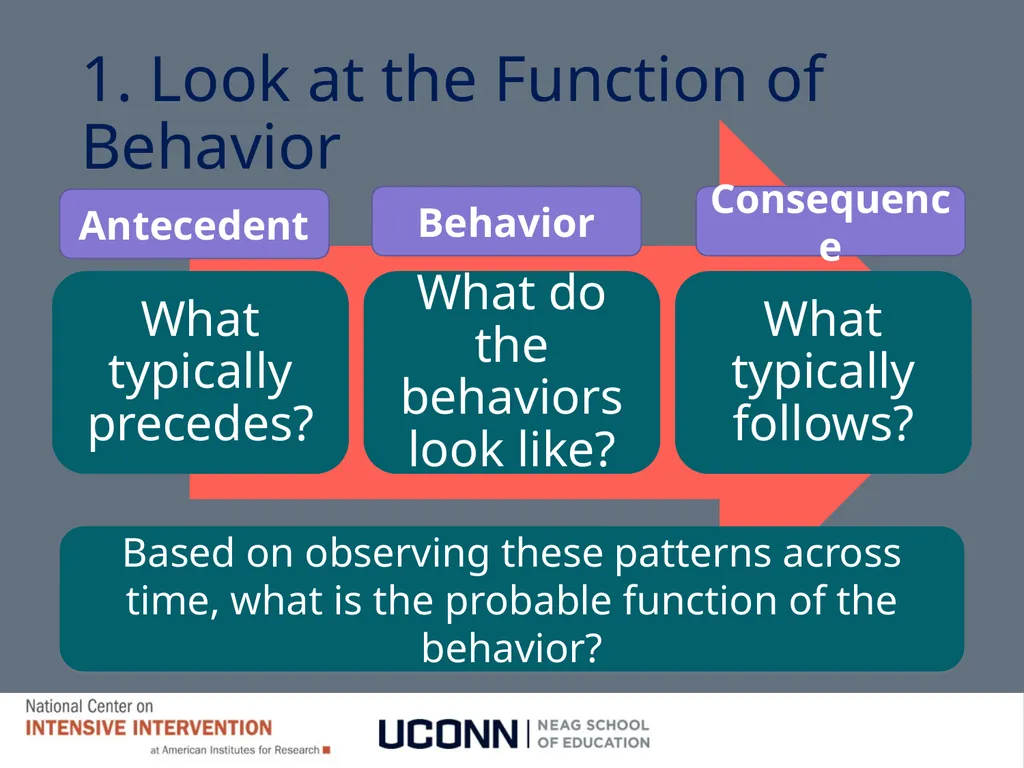
1. Look at the Function of Behavior Based on observing these patterns across time, what is the probable function of the behavior? Antecedent Behavior Consequence<br>
35
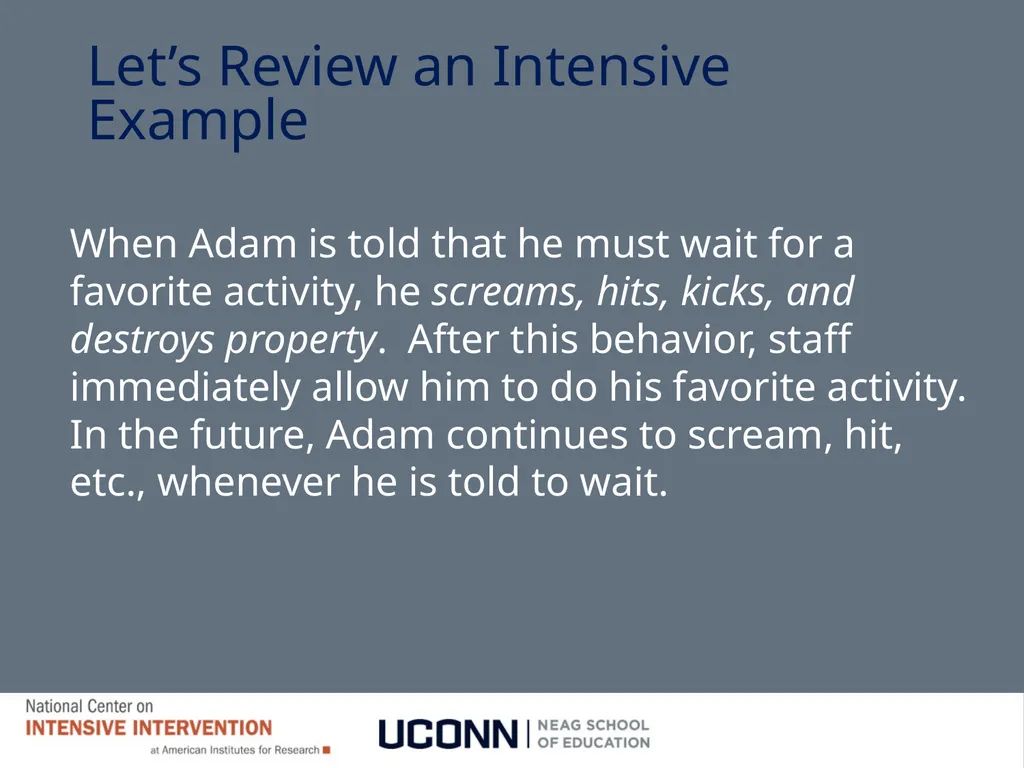
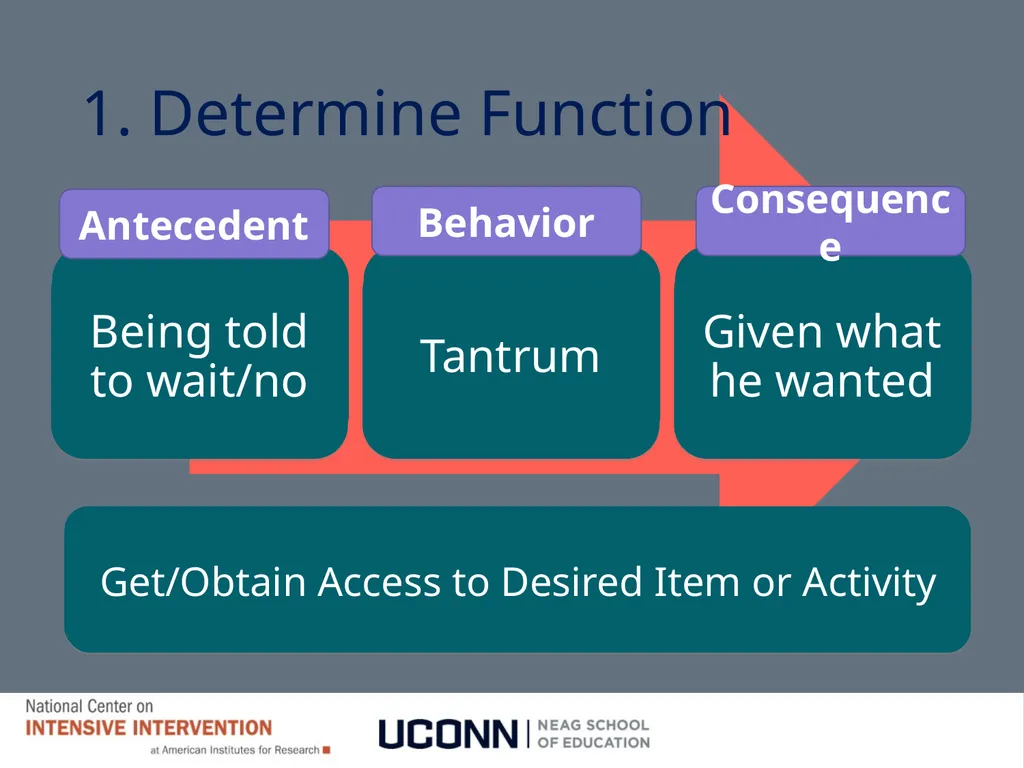
Let’s Review an Intensive Example When Adam is told that he must wait for a favorite activity, he screams, hits, kicks, and destroys property. After this behavior, staff immediately allow him to do his favorite activity. In the future, Adam continues to scream, hit, etc., whenever he is told to wait.<br>
36
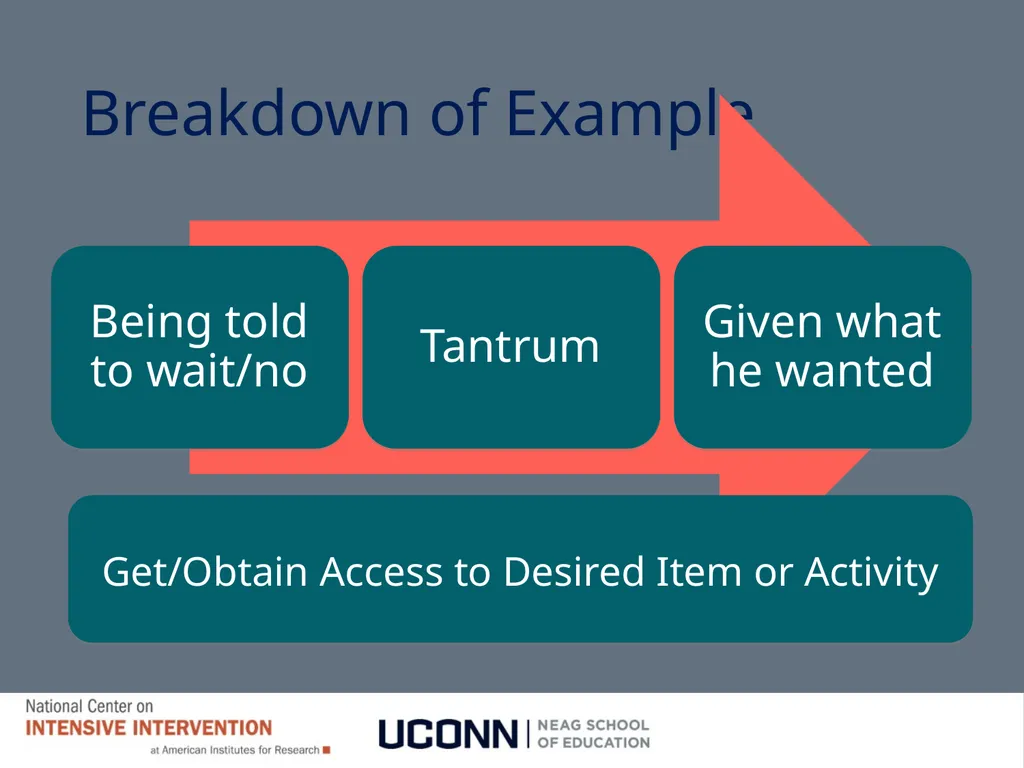
Breakdown of Example Based on observing these patterns across time, what is the probable function of the behavior? Get/Obtain Access to Desired Item or Activity<br>
37
In your workbook, jot down several sources of information you would use to collect information to help determine function of behavior for a student in your classroom. Activity 8.1: Stop and Jot
Determining Function<br>
38
Remember to consider existing data that will help you understand the full context of the behavior problem. Let’s look at some additional data sources that should be included in an FBA.
This resource from NCII provides some examples of ABC data collection forms. Activity 8.1: Review Determining Function<br>
This resource from NCII provides some examples of ABC data collection forms. Activity 8.1: Review Determining Function<br>
39
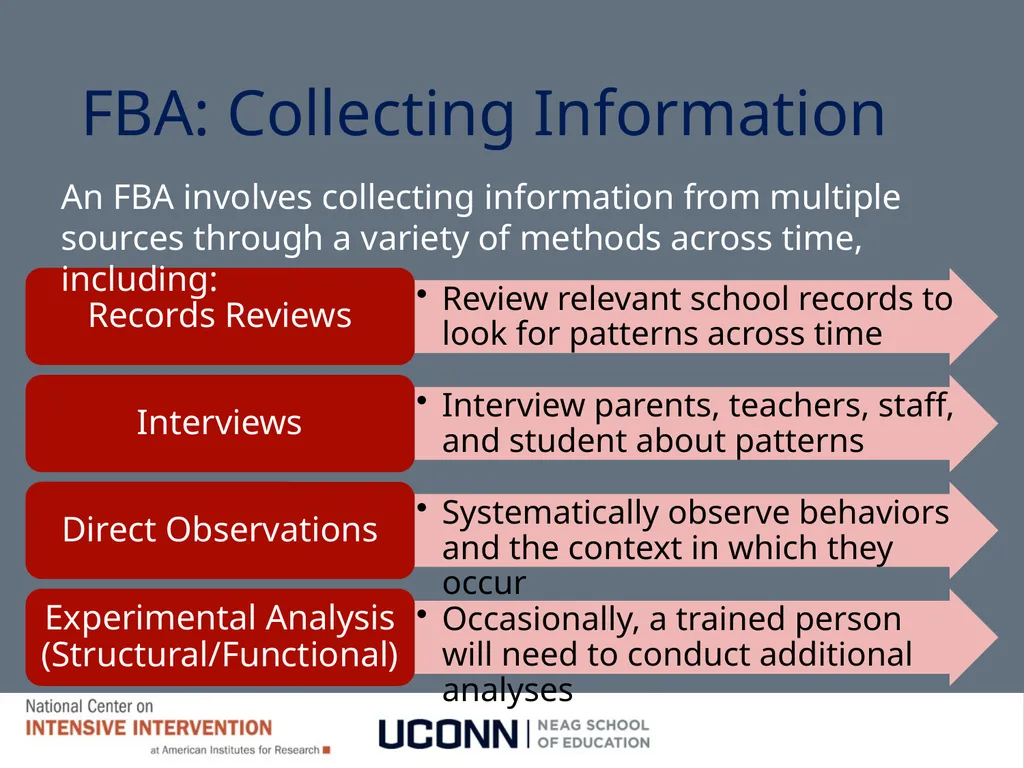
FBA: Collecting Information An FBA involves collecting information from multiple sources through a variety of methods across time, including:<br>
40
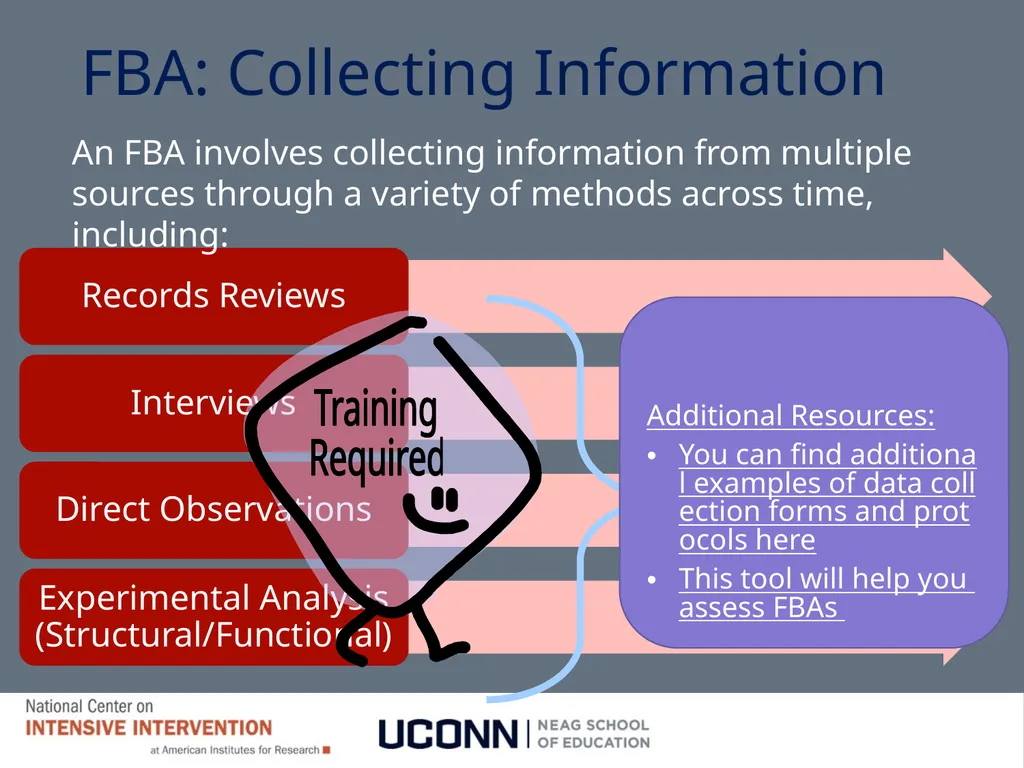
FBA: Collecting Information An FBA involves collecting information from multiple sources through a variety of methods across time, including: Additional Resources:
You can find additional examples of data collection forms and protocols here
This tool will help you assess FBAs<br>
You can find additional examples of data collection forms and protocols here
This tool will help you assess FBAs<br>
41
Given the case study in your workbook, Identify:
the target (or problem) behavior,
the antecedents that typically precede the behavior, and
the function of the behavior.
Use this information to write a hypothesis statement. Activity 8.2: Analyze an Example Determining Function<br>
the target (or problem) behavior,
the antecedents that typically precede the behavior, and
the function of the behavior.
Use this information to write a hypothesis statement. Activity 8.2: Analyze an Example Determining Function<br>
42
Activity 8.2: Review
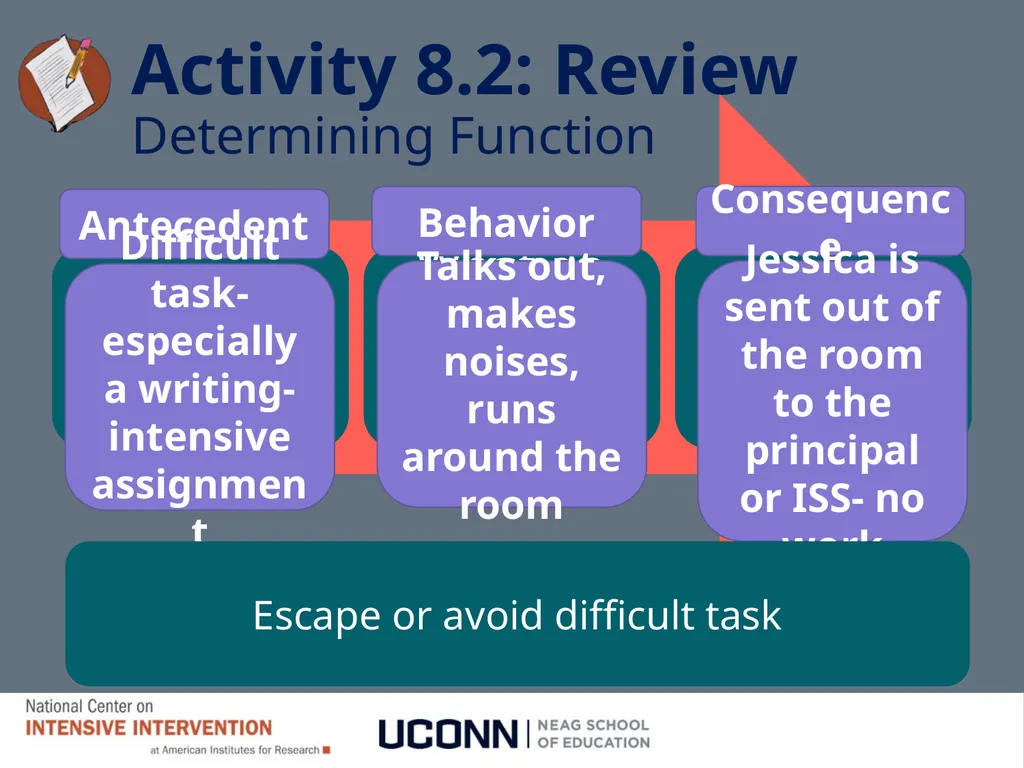
Determining Function Antecedent Behavior Consequence Difficult task- especially a writing-intensive assignment Talks out, makes noises, runs around the room Jessica is sent out of the room to the principal or ISS- no work Escape or avoid difficult task<br>
43
1. Look at the function of behavior 2. Choose replacement behaviors 3. Develop intervention strategies 3 Basic Steps:
Developing interventions for Individual Students<br>
44
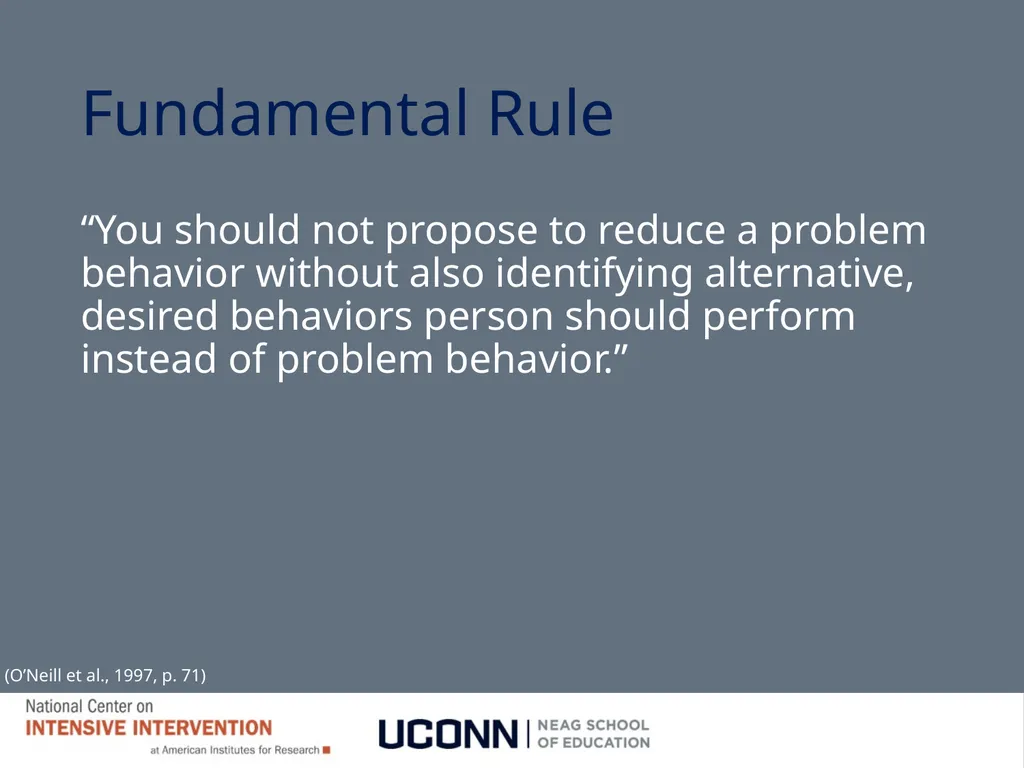
Fundamental Rule “You should not propose to reduce a problem behavior without also identifying alternative, desired behaviors person should perform instead of problem behavior.” (O’Neill et al., 1997, p. 71)<br>
45
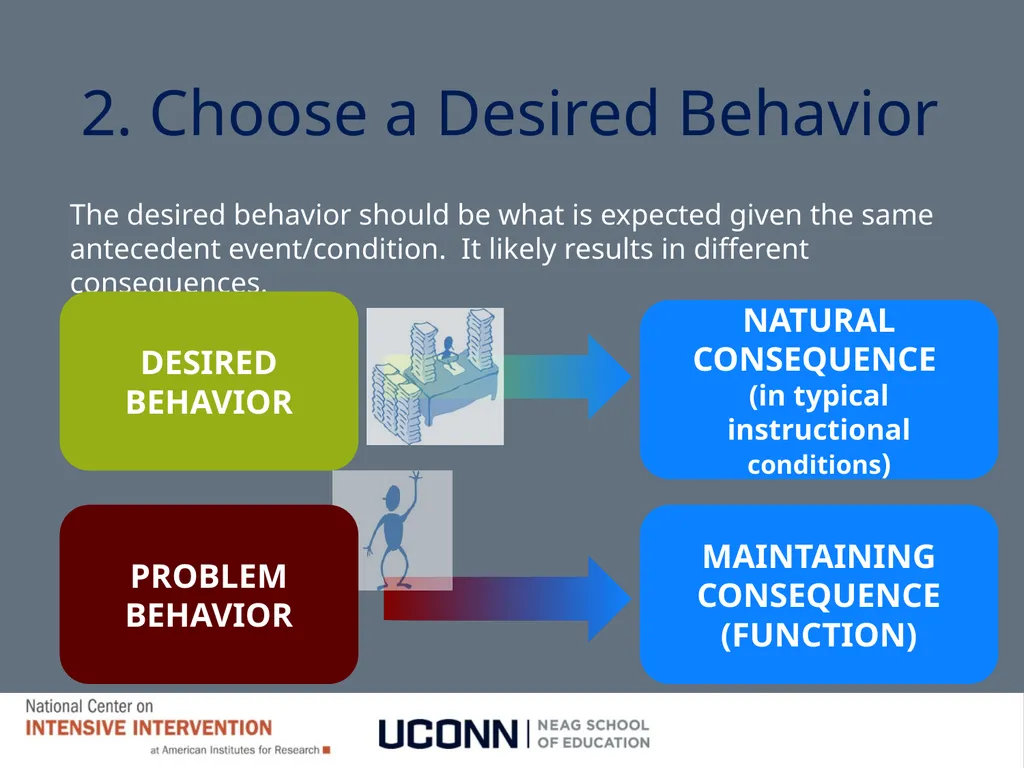
2. Choose a Desired Behavior MAINTAINING CONSEQUENCE (FUNCTION) The desired behavior should be what is expected given the same antecedent event/condition. It likely results in different consequences. PROBLEM BEHAVIOR DESIRED BEHAVIOR NATURAL CONSEQUENCE
(in typical instructional conditions)<br>
(in typical instructional conditions)<br>
46
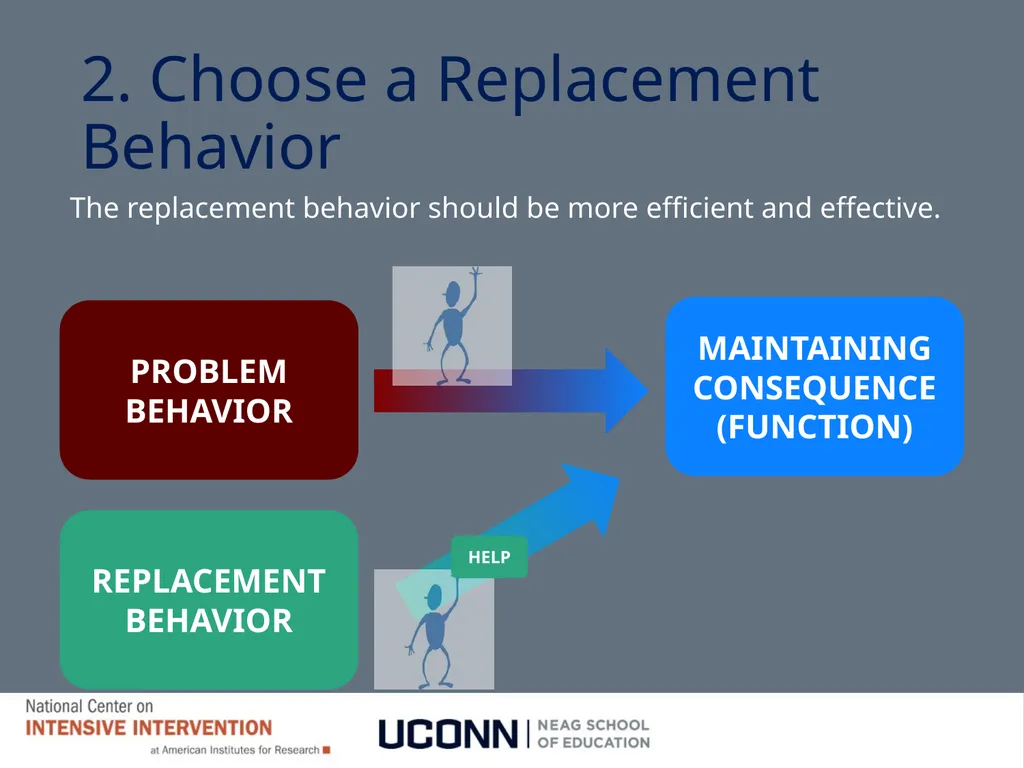
2. Choose a Replacement Behavior PROBLEM BEHAVIOR REPLACEMENT BEHAVIOR MAINTAINING CONSEQUENCE (FUNCTION) The replacement behavior should be more efficient and effective.<br>
47
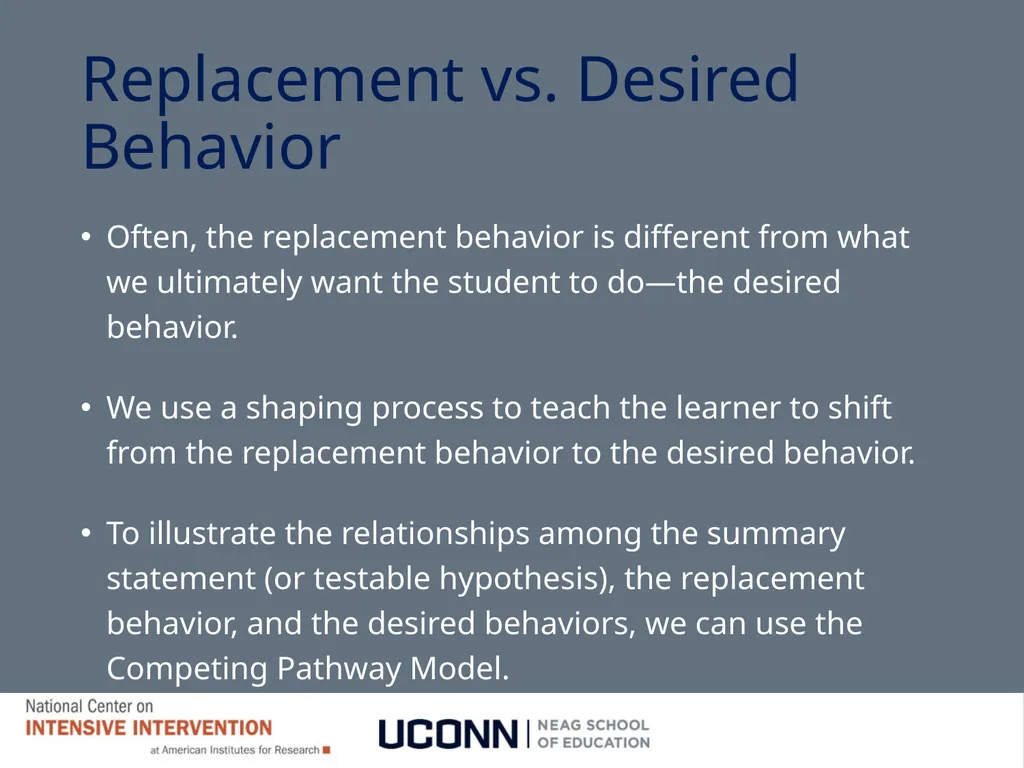
Replacement vs. Desired Behavior Often, the replacement behavior is different from what we ultimately want the student to do—the desired behavior.
We use a shaping process to teach the learner to shift from the replacement behavior to the desired behavior.
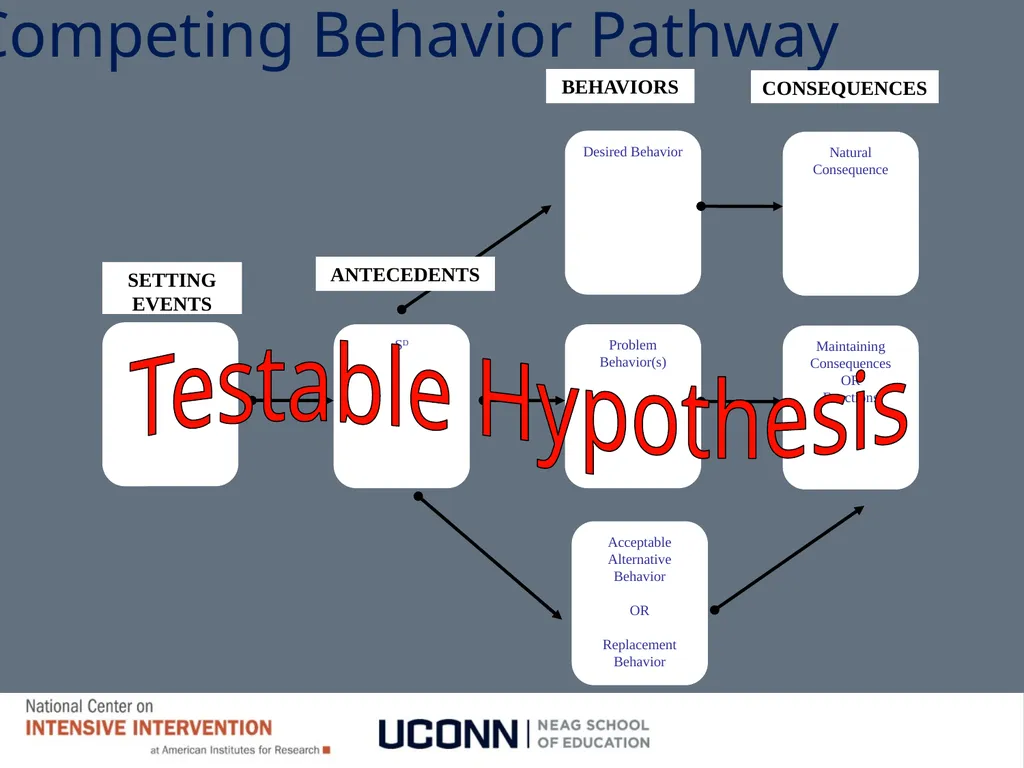
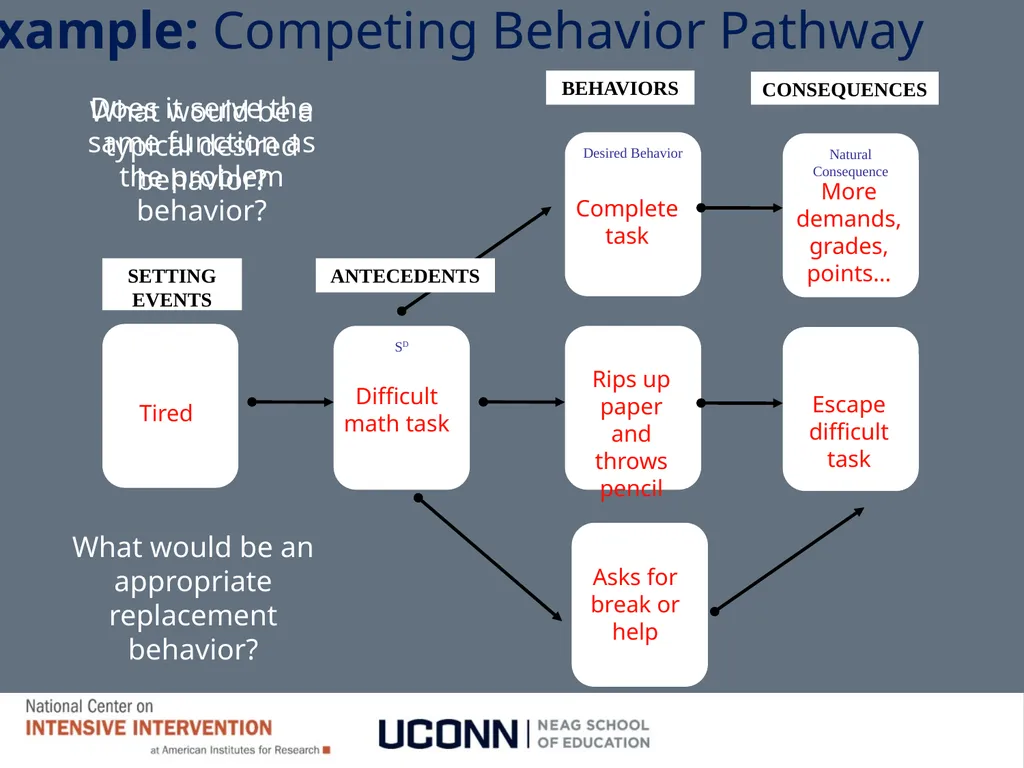
To illustrate the relationships among the summary statement (or testable hypothesis), the replacement behavior, and the desired behaviors, we can use the Competing Pathway Model.<br>
We use a shaping process to teach the learner to shift from the replacement behavior to the desired behavior.
To illustrate the relationships among the summary statement (or testable hypothesis), the replacement behavior, and the desired behaviors, we can use the Competing Pathway Model.<br>
48
Competing Behavior Pathway Acceptable
Alternative Behavior
OR
Replacement
Behavior Problem Behavior(s) SD Maintaining Consequences
OR
Functions Desired Behavior Natural Consequence SETTING EVENTS ANTECEDENTS BEHAVIORS CONSEQUENCES Testable Hypothesis<br>
Alternative Behavior
OR
Replacement
Behavior Problem Behavior(s) SD Maintaining Consequences
OR
Functions Desired Behavior Natural Consequence SETTING EVENTS ANTECEDENTS BEHAVIORS CONSEQUENCES Testable Hypothesis<br>
49
Example: Competing Behavior Pathway SD Desired Behavior Natural Consequence SETTING EVENTS ANTECEDENTS BEHAVIORS CONSEQUENCES Rips up paper and throws pencil Difficult math task Escape difficult task Tired Asks for break or help Complete task More demands, grades, points… What would be an appropriate replacement behavior? What would be a typical desired behavior? Does it serve the same function as the problem behavior?<br>
50
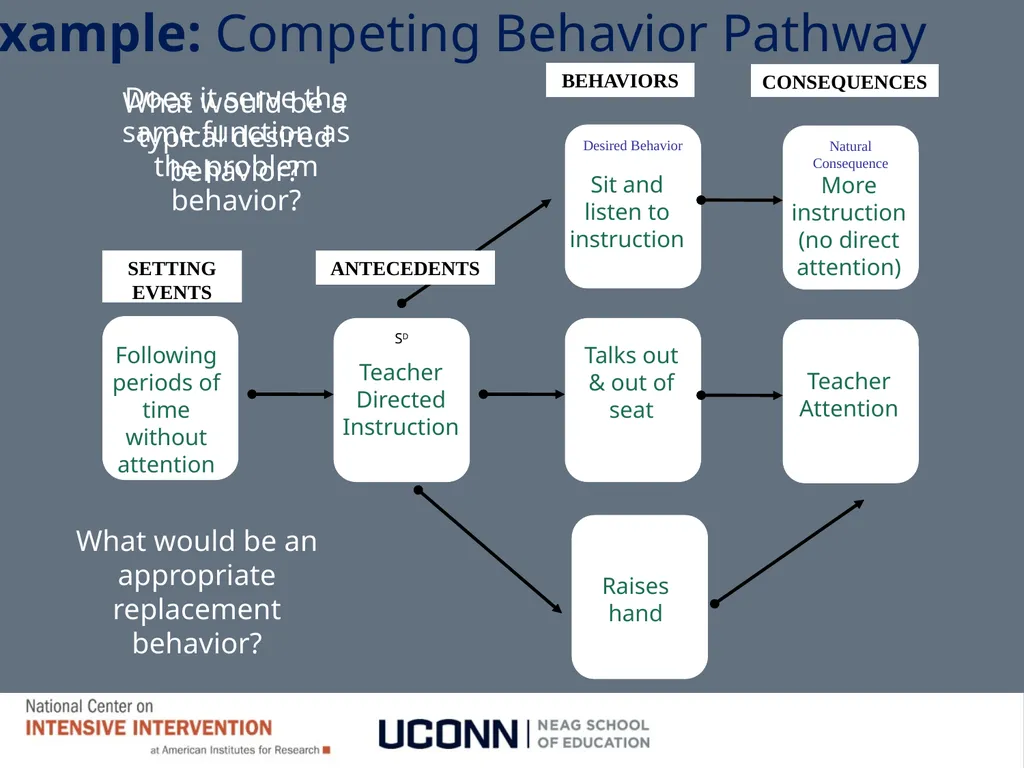
Example: Competing Behavior Pathway SD Desired Behavior Natural Consequence SETTING EVENTS ANTECEDENTS BEHAVIORS CONSEQUENCES Talks out & out of seat Teacher Directed Instruction Teacher Attention Following periods of time without attention What would be an appropriate replacement behavior? Raises hand What would be a typical desired behavior? Sit and listen to instruction More instruction (no direct attention) Does it serve the same function as the problem behavior?<br>
51
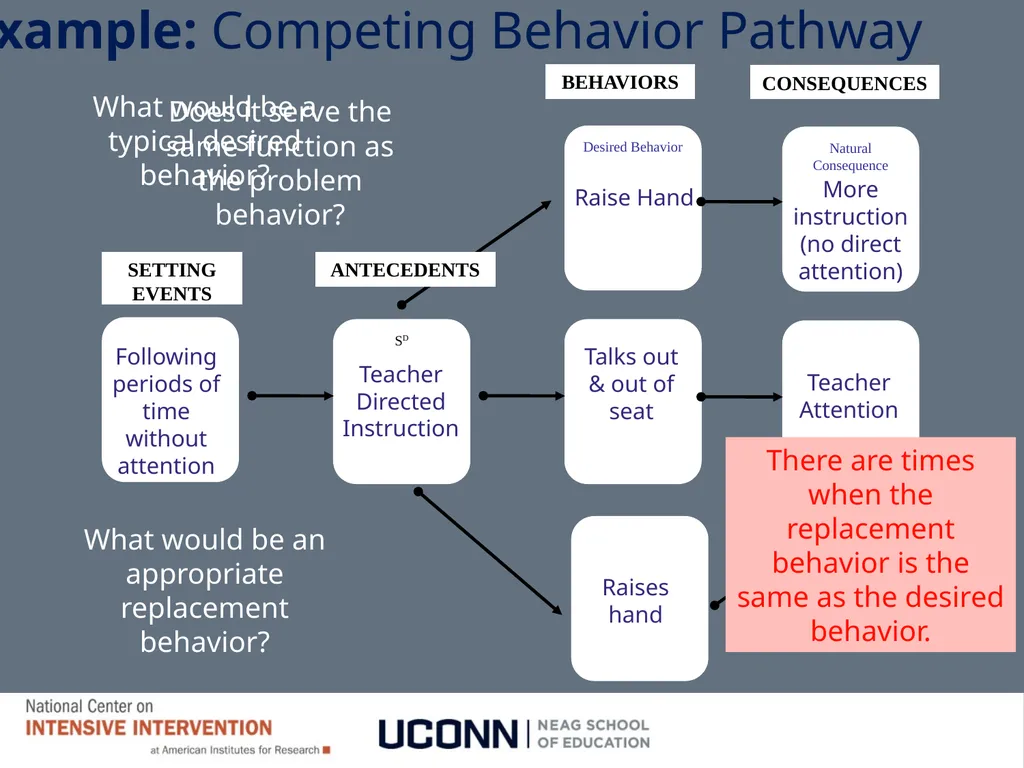
Example: Competing Behavior Pathway SD Desired Behavior Natural Consequence SETTING EVENTS ANTECEDENTS BEHAVIORS CONSEQUENCES Talks out & out of seat Teacher Directed Instruction Teacher Attention Following periods of time without attention What would be an appropriate replacement behavior? Raises hand What would be a typical desired behavior? Raise Hand More instruction (no direct attention) Does it serve the same function as the problem behavior? There are times when the replacement behavior is the same as the desired behavior.<br>
52
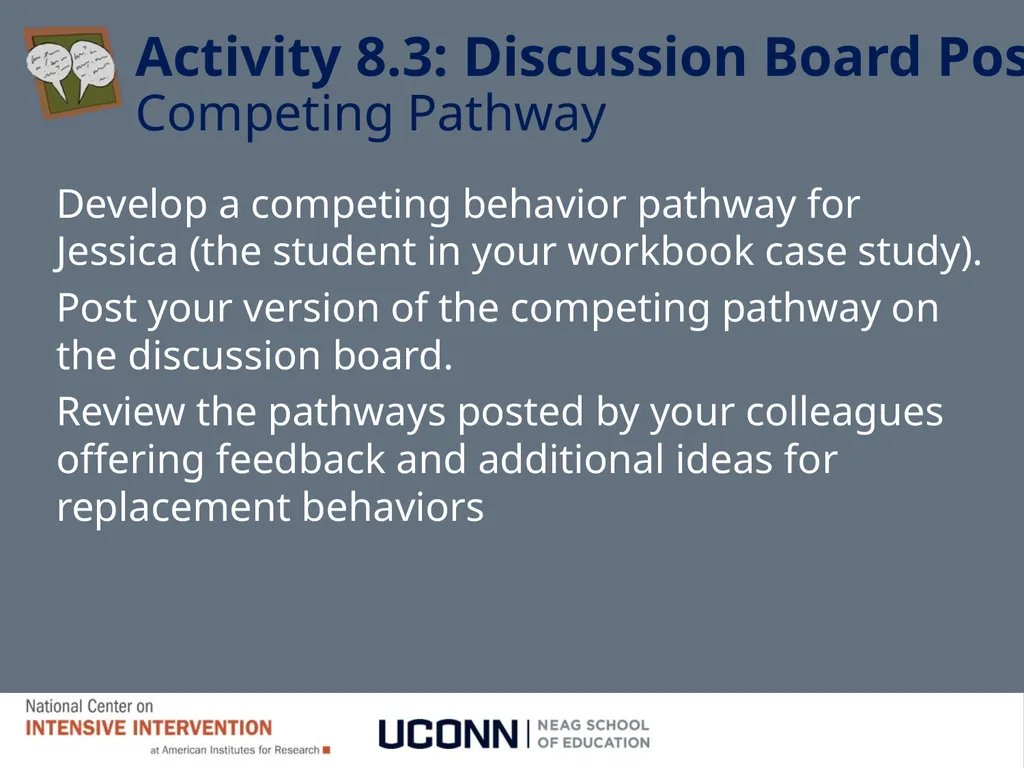
Develop a competing behavior pathway for Jessica (the student in your workbook case study).
Post your version of the competing pathway on the discussion board.
Review the pathways posted by your colleagues offering feedback and additional ideas for replacement behaviors Activity 8.3: Discussion Board Post Competing Pathway<br>
Post your version of the competing pathway on the discussion board.
Review the pathways posted by your colleagues offering feedback and additional ideas for replacement behaviors Activity 8.3: Discussion Board Post Competing Pathway<br>
53
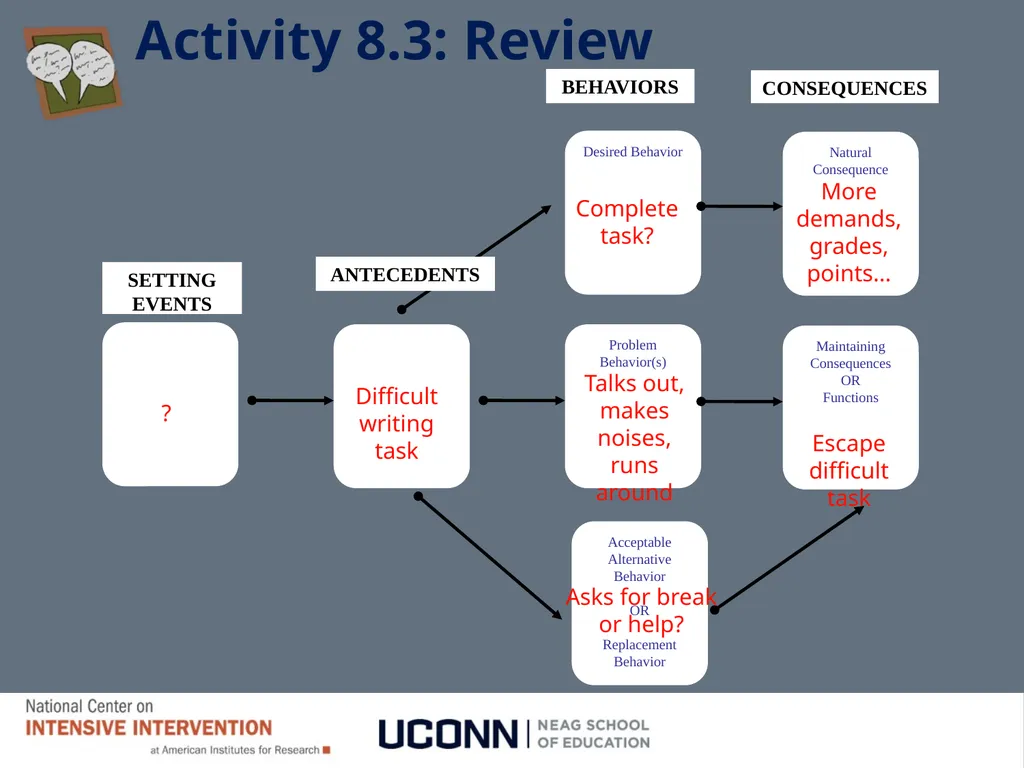
Activity 8.3: Review Acceptable
Alternative Behavior
OR
Replacement
Behavior Problem Behavior(s) Maintaining Consequences
OR
Functions Desired Behavior Natural Consequence SETTING EVENTS ANTECEDENTS BEHAVIORS CONSEQUENCES Talks out, makes noises, runs around Difficult writing task Escape difficult task ? Asks for break or help? Complete task? More demands, grades, points…<br>
Alternative Behavior
OR
Replacement
Behavior Problem Behavior(s) Maintaining Consequences
OR
Functions Desired Behavior Natural Consequence SETTING EVENTS ANTECEDENTS BEHAVIORS CONSEQUENCES Talks out, makes noises, runs around Difficult writing task Escape difficult task ? Asks for break or help? Complete task? More demands, grades, points…<br>
54
1. Look at the function of behavior 2. Choose replacement behaviors 3. Develop intervention strategies 3 Basic Steps:
Developing interventions for Individual Students<br>
55
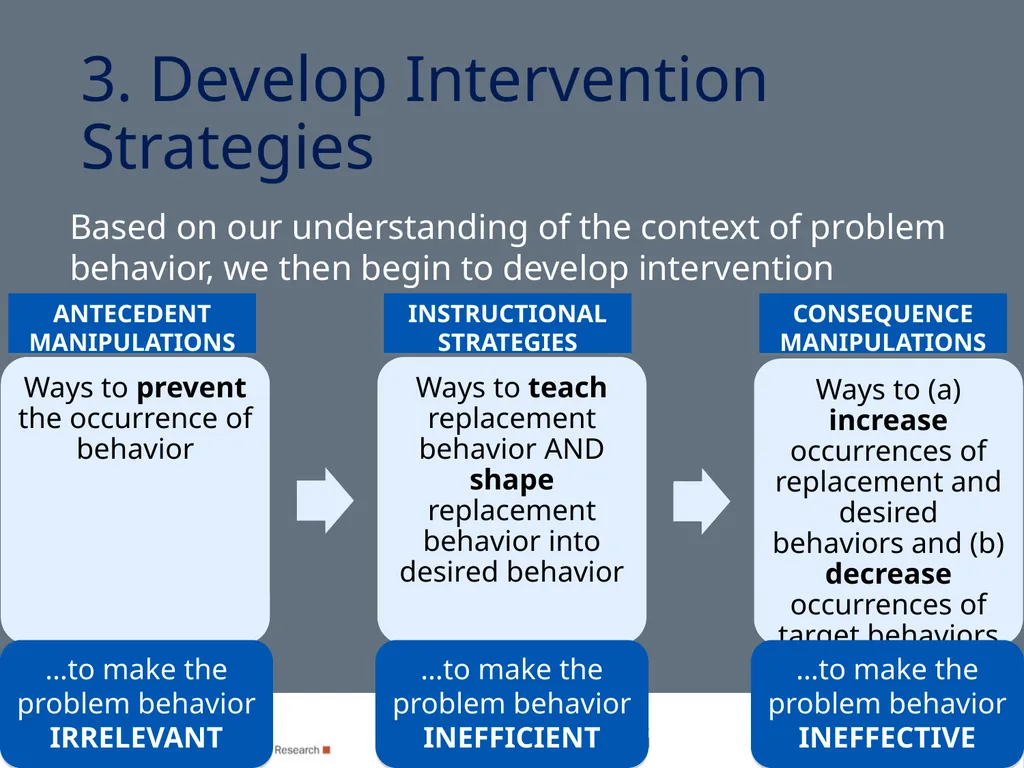
3. Develop Intervention Strategies Based on our understanding of the context of problem behavior, we then begin to develop intervention strategies. ANTECEDENT
MANIPULATIONS instructional STRATEGIES CONSEQUENCE
MANIPULATIONS …to make the problem behavior
IRRELEVANT …to make the problem behavior
INEFFICIENT …to make the problem behavior
INEFFECTIVE<br>
MANIPULATIONS instructional STRATEGIES CONSEQUENCE
MANIPULATIONS …to make the problem behavior
IRRELEVANT …to make the problem behavior
INEFFICIENT …to make the problem behavior
INEFFECTIVE<br>
56
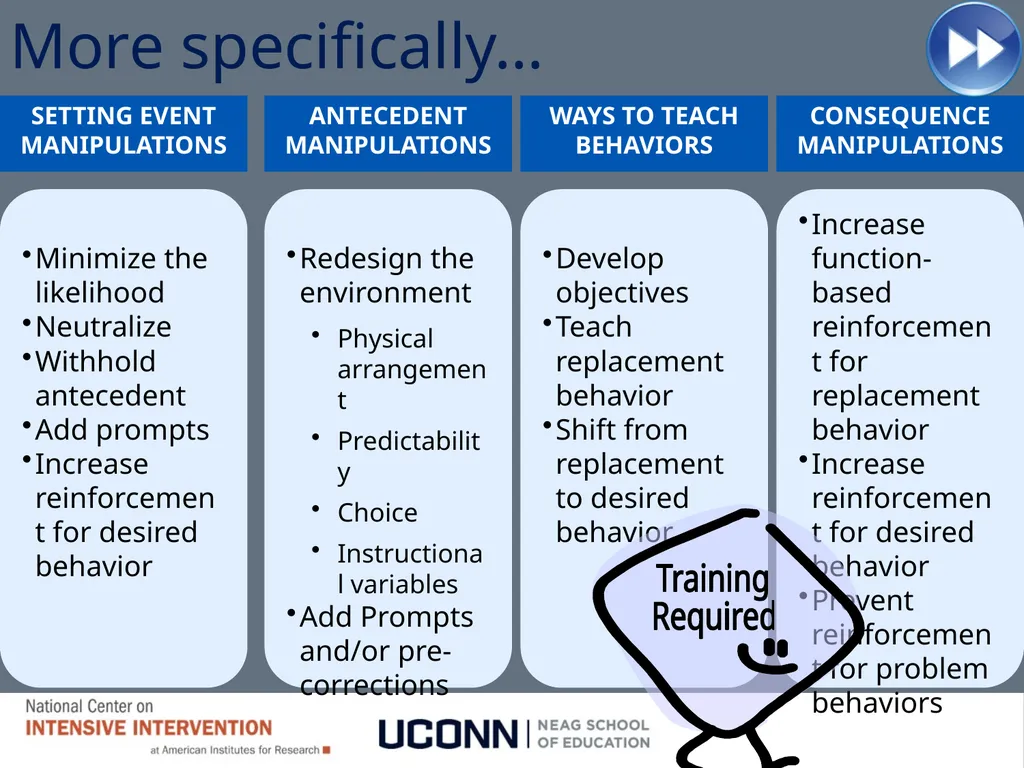
More specifically… Minimize the likelihood
Neutralize
Withhold antecedent
Add prompts
Increase reinforcement for desired behavior SETTING EVENT
MANIPULATIONS Redesign the environment
Physical arrangement
Predictability
Choice
Instructional variables
Add Prompts and/or pre-corrections ANTECEDENT
MANIPULATIONS Develop objectives
Teach replacement behavior
Shift from replacement to desired behavior WAYS TO TEACH
BEHAVIORS Increase function-based reinforcement for replacement behavior
Increase reinforcement for desired behavior
Prevent reinforcement for problem behaviors CONSEQUENCE
MANIPULATIONS<br>
Neutralize
Withhold antecedent
Add prompts
Increase reinforcement for desired behavior SETTING EVENT
MANIPULATIONS Redesign the environment
Physical arrangement
Predictability
Choice
Instructional variables
Add Prompts and/or pre-corrections ANTECEDENT
MANIPULATIONS Develop objectives
Teach replacement behavior
Shift from replacement to desired behavior WAYS TO TEACH
BEHAVIORS Increase function-based reinforcement for replacement behavior
Increase reinforcement for desired behavior
Prevent reinforcement for problem behaviors CONSEQUENCE
MANIPULATIONS<br>
57
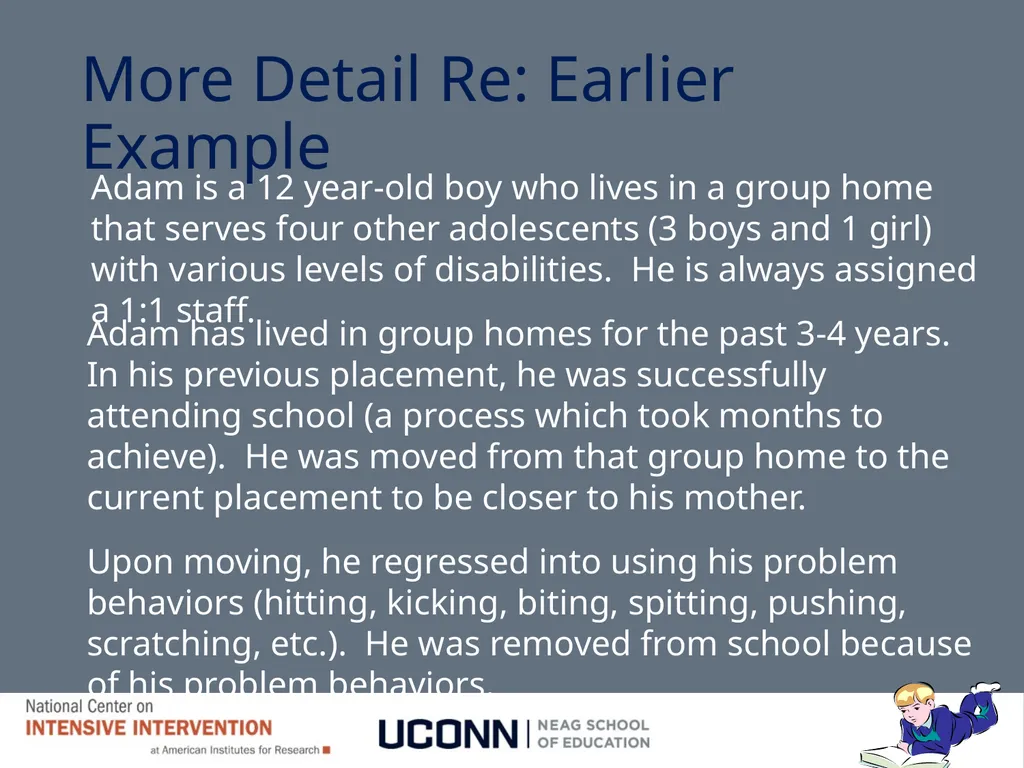
More Detail Re: Earlier Example Adam is a 12 year-old boy who lives in a group home that serves four other adolescents (3 boys and 1 girl) with various levels of disabilities. He is always assigned a 1:1 staff. Adam has lived in group homes for the past 3-4 years. In his previous placement, he was successfully attending school (a process which took months to achieve). He was moved from that group home to the current placement to be closer to his mother. Upon moving, he regressed into using his problem behaviors (hitting, kicking, biting, spitting, pushing, scratching, etc.). He was removed from school because of his problem behaviors.<br>
58
Based on observing these patterns across time, what is the probable function of the behavior? Get/Obtain Access to Desired Item or Activity 1. Determine Function Antecedent Behavior Consequence<br>
59
Given that the probable function of Adam’s behavior is to get or obtain access to desired items, activities, or attention from preferred people, what would you select as a replacement behavior? Jot a couple of ideas in your workbook.
Remember, must be the behavior that should be more efficient and effective at achieving the function than the problem behavior. Activity 8.4: Stop and Jot 2. Choose a Replacement Behavior<br>
Remember, must be the behavior that should be more efficient and effective at achieving the function than the problem behavior. Activity 8.4: Stop and Jot 2. Choose a Replacement Behavior<br>
60
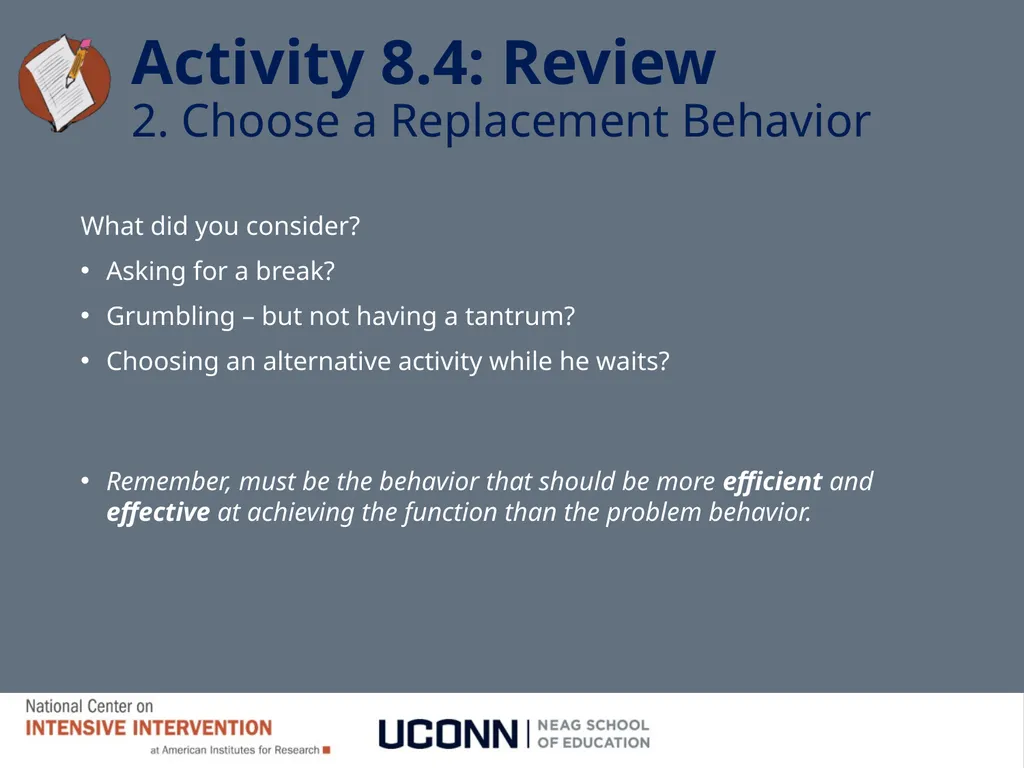
What did you consider?
Asking for a break?
Grumbling – but not having a tantrum?
Choosing an alternative activity while he waits?
Remember, must be the behavior that should be more efficient and effective at achieving the function than the problem behavior. Activity 8.4: Review 2. Choose a Replacement Behavior<br>
Asking for a break?
Grumbling – but not having a tantrum?
Choosing an alternative activity while he waits?
Remember, must be the behavior that should be more efficient and effective at achieving the function than the problem behavior. Activity 8.4: Review 2. Choose a Replacement Behavior<br>
61
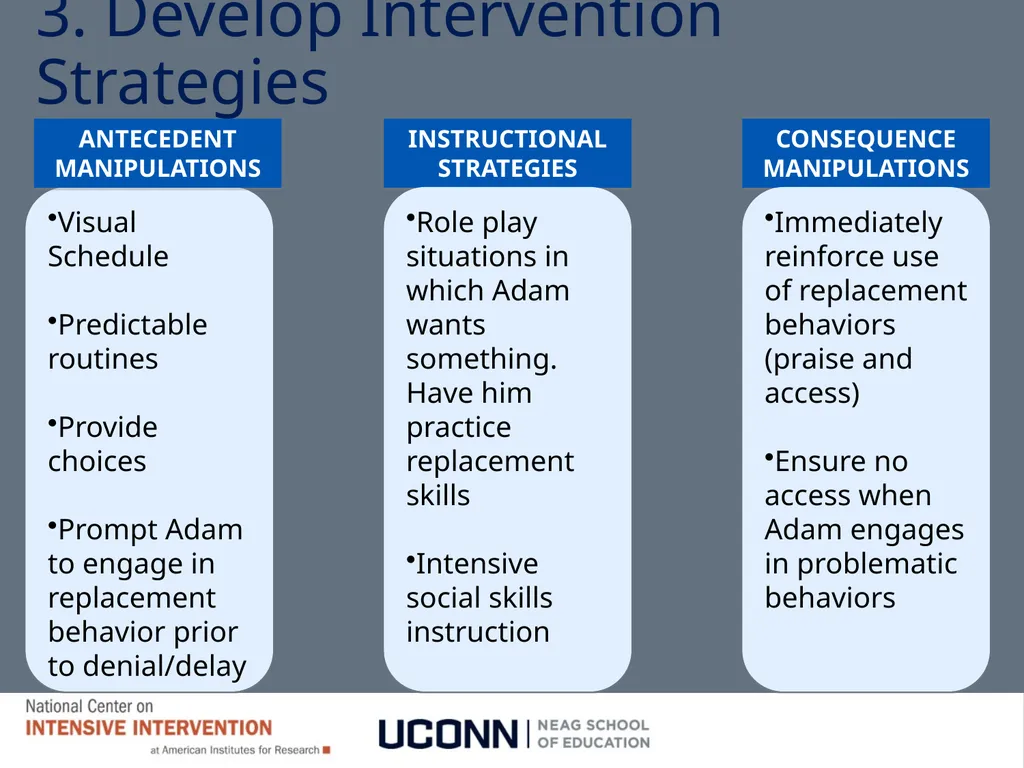
3. Develop Intervention Strategies Visual Schedule
Predictable routines
Provide choices
Prompt Adam to engage in replacement behavior prior to denial/delay ANTECEDENT
MANIPULATIONS INSTRUCTIONAL STRATEGIES CONSEQUENCE
MANIPULATIONS Role play situations in which Adam wants something. Have him practice replacement skills
Intensive social skills instruction Immediately reinforce use of replacement behaviors (praise and access)
Ensure no access when Adam engages in problematic behaviors<br>
Predictable routines
Provide choices
Prompt Adam to engage in replacement behavior prior to denial/delay ANTECEDENT
MANIPULATIONS INSTRUCTIONAL STRATEGIES CONSEQUENCE
MANIPULATIONS Role play situations in which Adam wants something. Have him practice replacement skills
Intensive social skills instruction Immediately reinforce use of replacement behaviors (praise and access)
Ensure no access when Adam engages in problematic behaviors<br>
62
Start with the competing pathway you developed for Jessica.
Develop intervention strategies to prevent, teach, and reinforce the replacement and desired behavior you identified Activity 8.5: Analyze an Example Developing Interventions<br>
Develop intervention strategies to prevent, teach, and reinforce the replacement and desired behavior you identified Activity 8.5: Analyze an Example Developing Interventions<br>
63
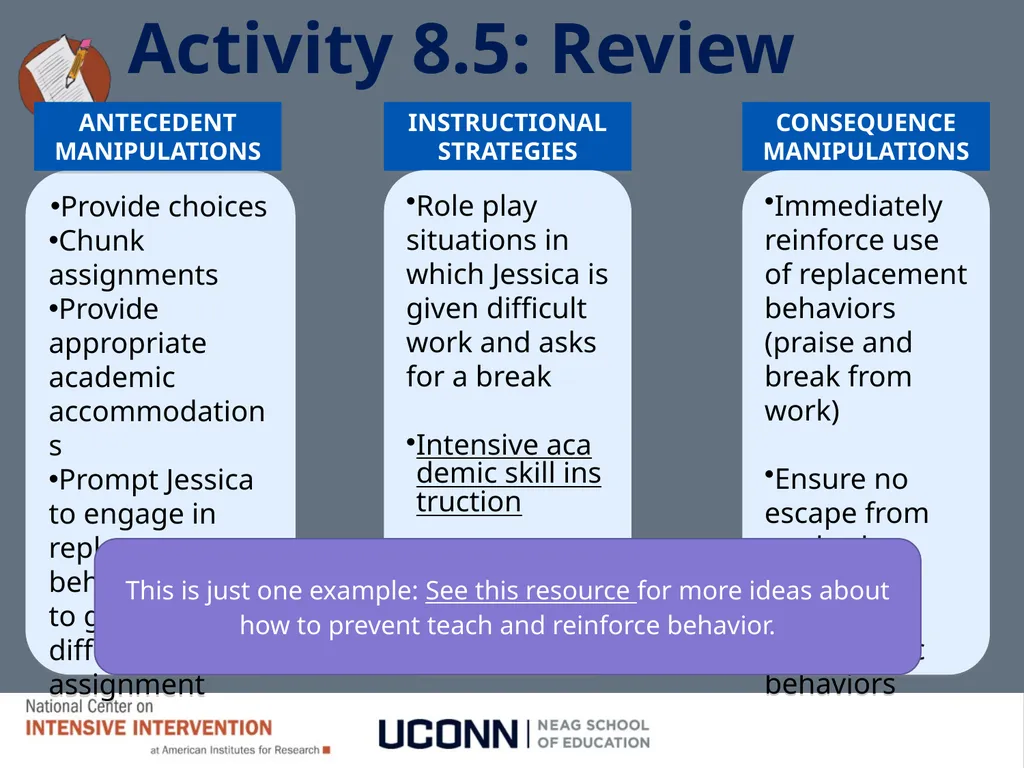
Activity 8.5: Review Provide choices
Chunk assignments
Provide appropriate academic accommodations
Prompt Jessica to engage in replacement behavior prior to giving a difficult assignment ANTECEDENT
MANIPULATIONS INSTRUCTIONAL STRATEGIES CONSEQUENCE
MANIPULATIONS Role play situations in which Jessica is given difficult work and asks for a break
Intensive academic skill instruction. Immediately reinforce use of replacement behaviors (praise and break from work)
Ensure no escape from work when Jessica engages in problematic behaviors This is just one example: See this resource for more ideas about how to prevent teach and reinforce behavior.<br>
Chunk assignments
Provide appropriate academic accommodations
Prompt Jessica to engage in replacement behavior prior to giving a difficult assignment ANTECEDENT
MANIPULATIONS INSTRUCTIONAL STRATEGIES CONSEQUENCE
MANIPULATIONS Role play situations in which Jessica is given difficult work and asks for a break
Intensive academic skill instruction. Immediately reinforce use of replacement behaviors (praise and break from work)
Ensure no escape from work when Jessica engages in problematic behaviors This is just one example: See this resource for more ideas about how to prevent teach and reinforce behavior.<br>
64
Implementing a Plan Train staff to run the plan.
Set up system to monitor the effects of the intervention on the rate of client’s problematic behaviors and acquisition of replacement behaviors (collect data).
Make changes to the plan based on data.
Was your hypothesis wrong?
Are staff consistently implementing the plan?
Do you need to re-train staff? See modules 6+7 for data collection strategies Also see additional resources for tier 3 intensive behavior support at PBIS.org and intensiveintervention.org<br>
Set up system to monitor the effects of the intervention on the rate of client’s problematic behaviors and acquisition of replacement behaviors (collect data).
Make changes to the plan based on data.
Was your hypothesis wrong?
Are staff consistently implementing the plan?
Do you need to re-train staff? See modules 6+7 for data collection strategies Also see additional resources for tier 3 intensive behavior support at PBIS.org and intensiveintervention.org<br>
65
Is there a targeted group of students displaying frequent, but minor challenging behaviors? Request additional (tier 2 & 3) support for students Are there individual students
displaying chronic or high
intensity problem behaviors? Invest in Tier 2 Supports for identified targeted group Invest in Tier 3 Supports for identified individual students Check-In/
Check-Out Check & Connect Check, Connect, & Expect Social Skills Groups Class-Wide FIT Individualized Function-Based Support FBA BSP Coordinated plan via Wraparound Process Yes Yes<br>
displaying chronic or high
intensity problem behaviors? Invest in Tier 2 Supports for identified targeted group Invest in Tier 3 Supports for identified individual students Check-In/
Check-Out Check & Connect Check, Connect, & Expect Social Skills Groups Class-Wide FIT Individualized Function-Based Support FBA BSP Coordinated plan via Wraparound Process Yes Yes<br>
66
Next Steps Module 8 Quiz
Classroom Application Activity<br>
Classroom Application Activity<br>