
Modules: Workers’ rights and responsibilities
SB
Published · 33 slides · 0 views
1 / 1
Description
Modules: Workers rights and responsibilities Infection Prevention Musculoskeletal Safety This material was produced under grant number SH-29637-SH6 from the Occupational Safety and Health Administration, U.S. Department of Labor. It does
Related Topics
Share
Embed code
Download this presentation From Below
"Modules: Workers’ rights and responsibilities" is the property of its rightful owner. Permission is granted to download and print the materials on this website for personal, non-commercial use only, and to display it on your personal computer provided you do not modify the materials and that you retain all copyright notices contained in the materials. By downloading content from our website, you accept the terms of this agreement.
Presentation Transcript
01
Modules:
Workers’ rights and responsibilities
Infection Prevention
Musculoskeletal Safety This material was produced under grant number SH-29637-SH6 from the Occupational Safety and Health Administration, U.S. Department of Labor. It does not necessarily reflect the views or policies of the U.S. Department of Labor, nor does mention of trade names, commercial products, or organizations imply endorsement by the U.S. Government.<br>
02
Introduce Yourself! ● What is your name?
● How long have you been a caregiver?
●What is one thing you love about your job?<br>
● How long have you been a caregiver?
●What is one thing you love about your job?<br>
03
Learning Objectives By the end of this training module, participants will be able to:
● Demonstrate proper hand-washing techniques and the use of personal protective equipment (PPE)
● Describe how to prevent the transmission of bloodborne pathogens
● Demonstrate proper body mechanics for job-related tasks, including lifting
● Demonstrate the use of assistive devices, including transfer boards, slide sheets, hydraulic lifts and gait belts
● Identify and request the need for assistance in physical tasks
● Identify key workers’ rights and employer responsibilities
● Raise health and safety concerns with supervisors and file complaints without fear of retaliation<br>
● Demonstrate proper hand-washing techniques and the use of personal protective equipment (PPE)
● Describe how to prevent the transmission of bloodborne pathogens
● Demonstrate proper body mechanics for job-related tasks, including lifting
● Demonstrate the use of assistive devices, including transfer boards, slide sheets, hydraulic lifts and gait belts
● Identify and request the need for assistance in physical tasks
● Identify key workers’ rights and employer responsibilities
● Raise health and safety concerns with supervisors and file complaints without fear of retaliation<br>
04
Agenda ● Welcome, Introductions & Pre-Test
● Connect and Reflect: Health and Safety
● Infection Prevention
● Prevention of Musculoskeletal Injuries
● Workers’ Rights and Responsibilities
● Review Game
● Reflection and Action
● Conclusion & Post-Test<br>
● Connect and Reflect: Health and Safety
● Infection Prevention
● Prevention of Musculoskeletal Injuries
● Workers’ Rights and Responsibilities
● Review Game
● Reflection and Action
● Conclusion & Post-Test<br>
05
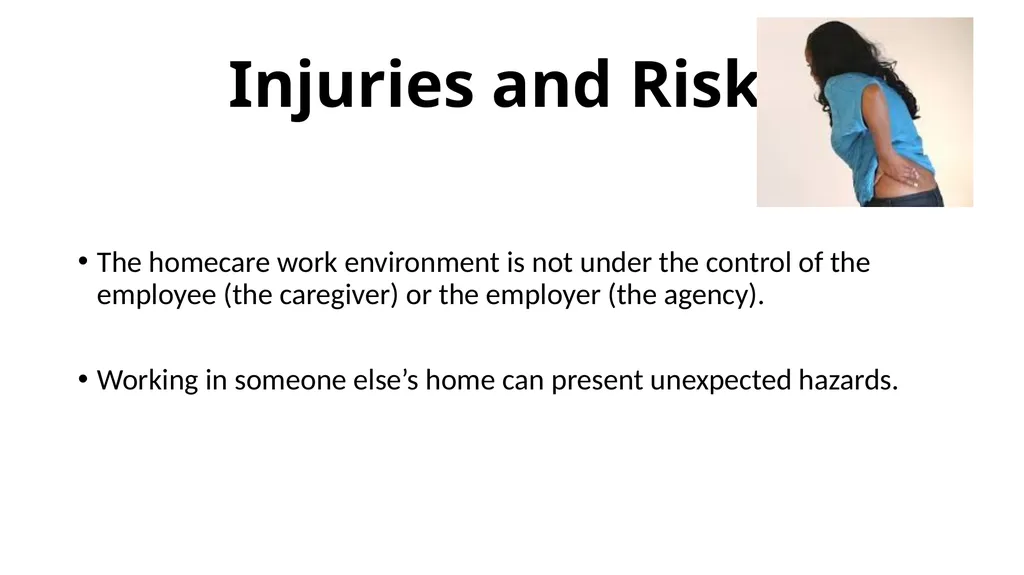
Injuries and Risks The homecare work environment is not under the control of the employee (the caregiver) or the employer (the agency).
Working in someone else’s home can present unexpected hazards.<br>
Working in someone else’s home can present unexpected hazards.<br>
06
Injuries and Risks, cont. Unexpected hazards in home caregiving include:
Animals
Loaded weapons in the home
Violence
Other people
Falls due to snow and ice
Traffic accidents while driving from home to home
Unclean living conditions
Source: National Institute for Occupational Safety and Health. (2010).<br>
Animals
Loaded weapons in the home
Violence
Other people
Falls due to snow and ice
Traffic accidents while driving from home to home
Unclean living conditions
Source: National Institute for Occupational Safety and Health. (2010).<br>
07
Injuries and Risks, cont. Due to these hazards, injuries to caregivers are common. They include:
Sprains and strains
Musculoskeletal disorders (from moving consumers)
Falls
Bloodborne diseases and other infections
Occupational stress
Violence in the home
Latex allergy
Source: National Institute for Occupational Safety and Health. (2010).<br>
Sprains and strains
Musculoskeletal disorders (from moving consumers)
Falls
Bloodborne diseases and other infections
Occupational stress
Violence in the home
Latex allergy
Source: National Institute for Occupational Safety and Health. (2010).<br>
08
Injuries and Risks, cont. This training has to do with two categories of on-the-job- injury and risk:
Infection Prevention
Musculoskeletal Safety
The goal of this training is to minimize or eliminate these injuries and risks to your health and safety.<br>
Infection Prevention
Musculoskeletal Safety
The goal of this training is to minimize or eliminate these injuries and risks to your health and safety.<br>
09
Infection Prevention<br>
10
Caregivers and Infection Caregivers are exposed to many infections:
Colds and influenza
Respiratory infections
Diarrhea (such as from the parasite Giardia)
Staph infections (like MRSA)
Pneumonia
HIV/AIDS
Hepatitis B (HBV) and C (HBC)
Tuberculosis
Some of these infections can be deadly.<br>
Colds and influenza
Respiratory infections
Diarrhea (such as from the parasite Giardia)
Staph infections (like MRSA)
Pneumonia
HIV/AIDS
Hepatitis B (HBV) and C (HBC)
Tuberculosis
Some of these infections can be deadly.<br>
11
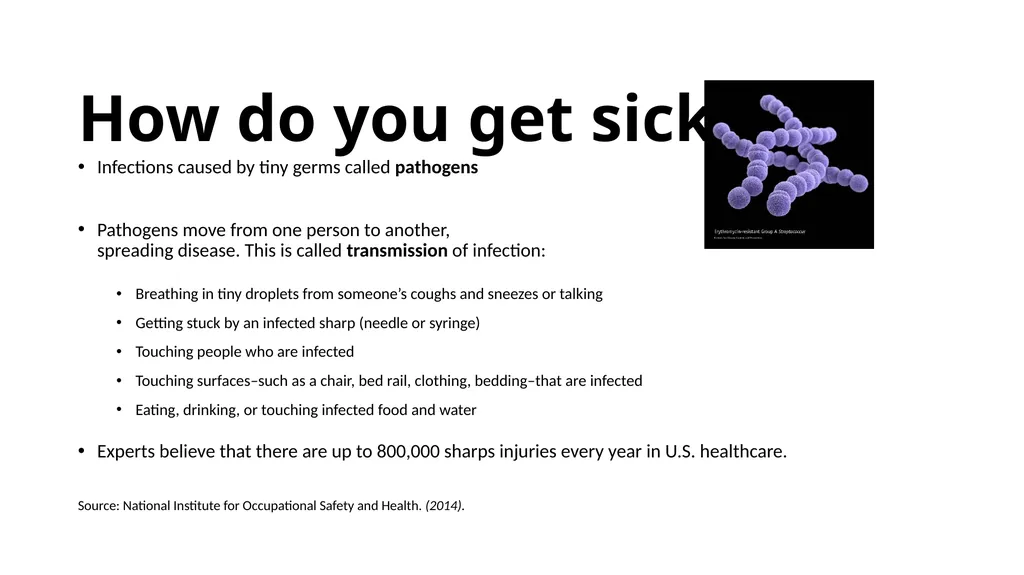
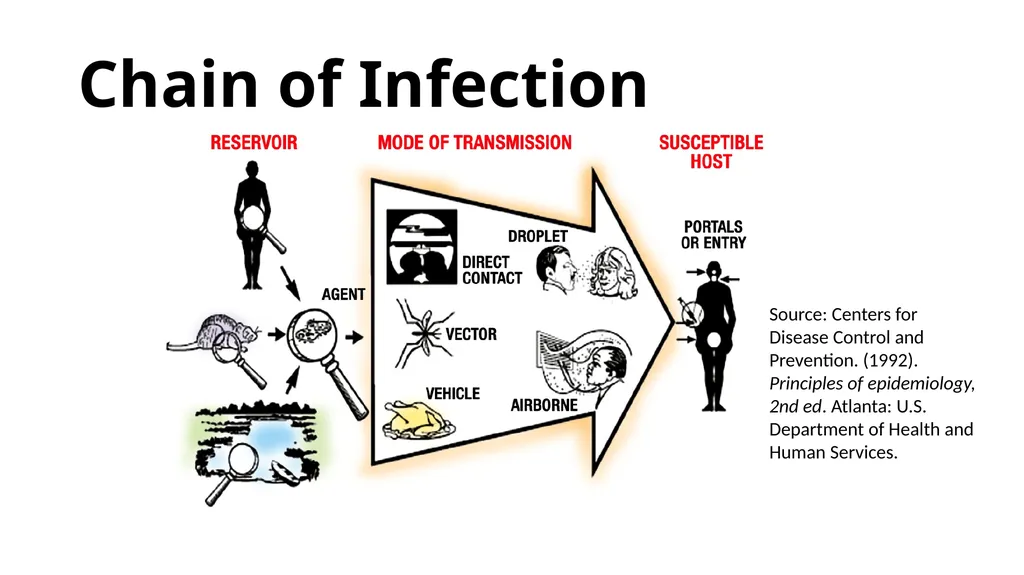
How do you get sick? Infections caused by tiny germs called pathogens
Pathogens move from one person to another, spreading disease. This is called transmission of infection:
Breathing in tiny droplets from someone’s coughs and sneezes or talking
Getting stuck by an infected sharp (needle or syringe)
Touching people who are infected
Touching surfaces–such as a chair, bed rail, clothing, bedding–that are infected
Eating, drinking, or touching infected food and water
Experts believe that there are up to 800,000 sharps injuries every year in U.S. healthcare.
Source: National Institute for Occupational Safety and Health. (2014).<br>
Pathogens move from one person to another, spreading disease. This is called transmission of infection:
Breathing in tiny droplets from someone’s coughs and sneezes or talking
Getting stuck by an infected sharp (needle or syringe)
Touching people who are infected
Touching surfaces–such as a chair, bed rail, clothing, bedding–that are infected
Eating, drinking, or touching infected food and water
Experts believe that there are up to 800,000 sharps injuries every year in U.S. healthcare.
Source: National Institute for Occupational Safety and Health. (2014).<br>
12
Chain of Infection Source: Centers for Disease Control and Prevention. (1992). Principles of epidemiology, 2nd ed. Atlanta: U.S. Department of Health and Human Services.<br>
13
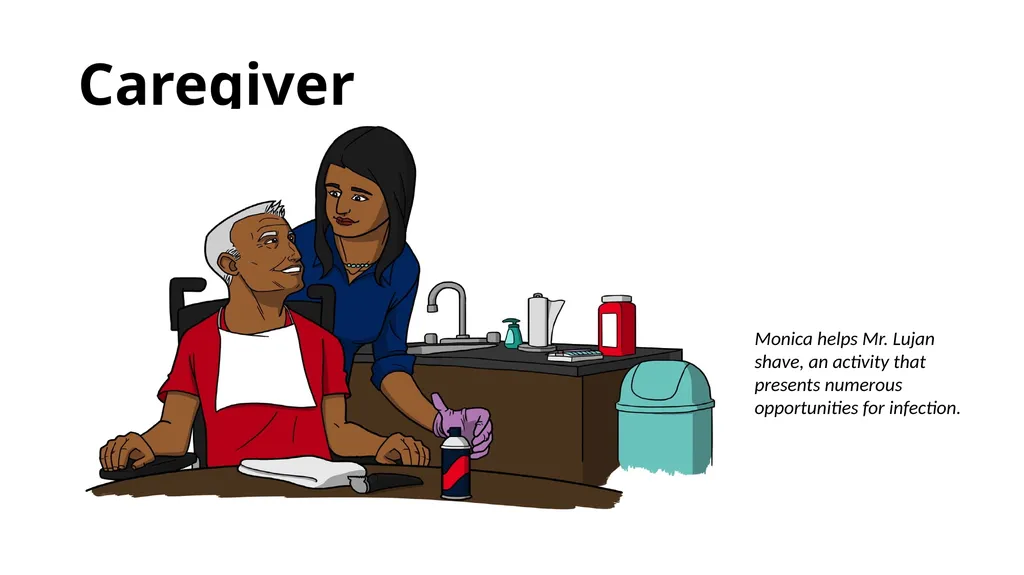
Caregiver Monica helps Mr. Lujan shave, an activity that presents numerous opportunities for infection.<br>
14
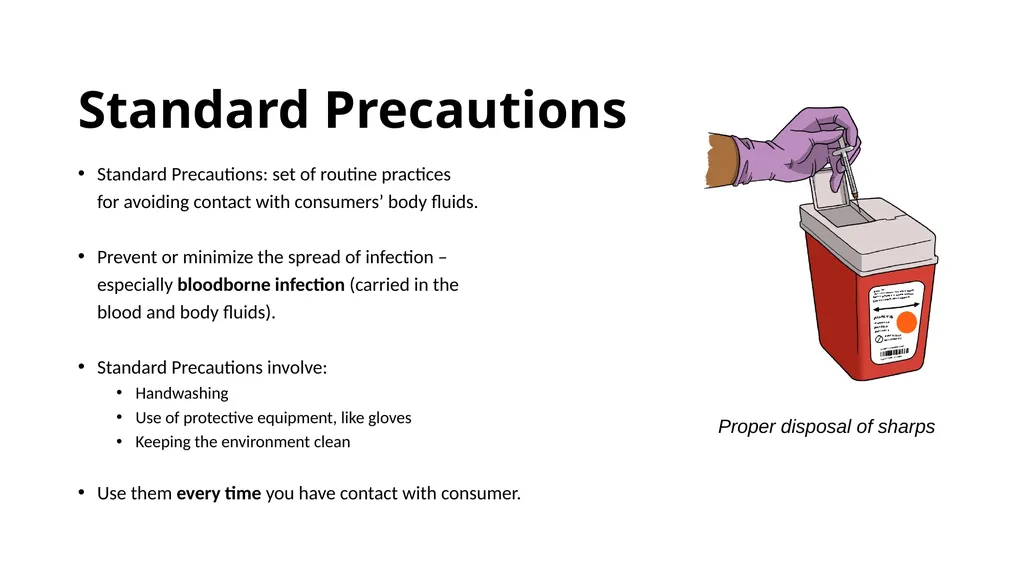
Standard Precautions Standard Precautions: set of routine practices
for avoiding contact with consumers’ body fluids.
Prevent or minimize the spread of infection – especially bloodborne infection (carried in the blood and body fluids).
Standard Precautions involve:
Handwashing
Use of protective equipment, like gloves
Keeping the environment clean
Use them every time you have contact with consumer. Proper disposal of sharps<br>
Prevent or minimize the spread of infection – especially bloodborne infection (carried in the blood and body fluids).
Standard Precautions involve:
Handwashing
Use of protective equipment, like gloves
Keeping the environment clean
Use them every time you have contact with consumer. Proper disposal of sharps<br>
15
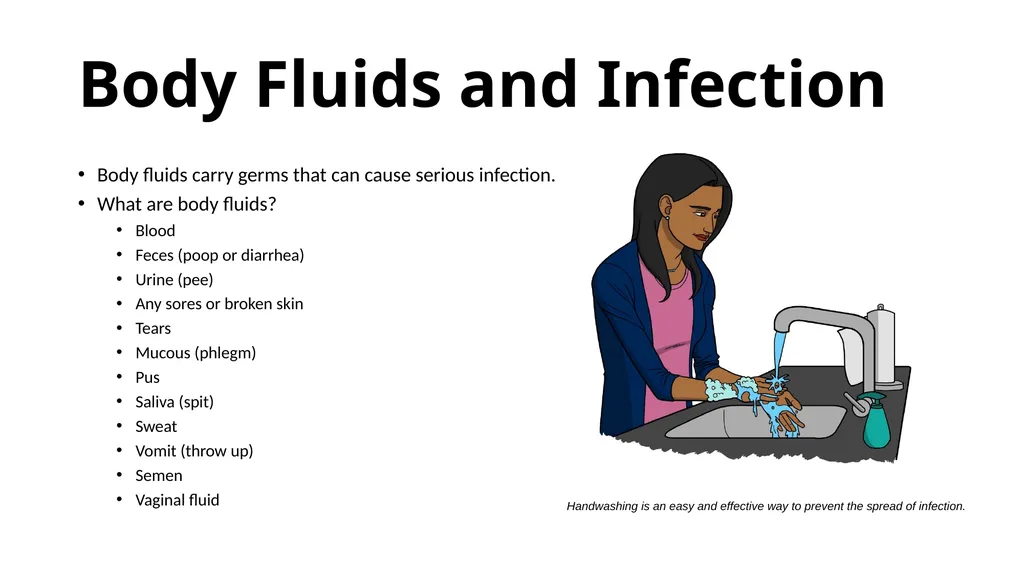
Body Fluids and Infection Body fluids carry germs that can cause serious infection.
What are body fluids?
Blood
Feces (poop or diarrhea)
Urine (pee)
Any sores or broken skin
Tears
Mucous (phlegm)
Pus
Saliva (spit)
Sweat
Vomit (throw up)
Semen
Vaginal fluid Handwashing is an easy and effective way to prevent the spread of infection.<br>
What are body fluids?
Blood
Feces (poop or diarrhea)
Urine (pee)
Any sores or broken skin
Tears
Mucous (phlegm)
Pus
Saliva (spit)
Sweat
Vomit (throw up)
Semen
Vaginal fluid Handwashing is an easy and effective way to prevent the spread of infection.<br>
16
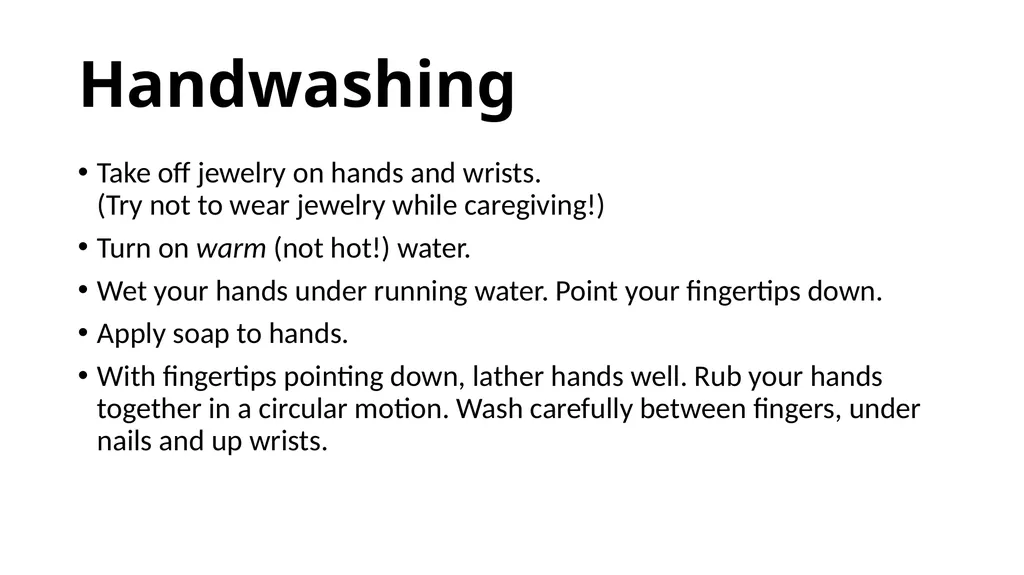
Handwashing Take off jewelry on hands and wrists.
(Try not to wear jewelry while caregiving!)
Turn on warm (not hot!) water.
Wet your hands under running water. Point your fingertips down.
Apply soap to hands.
With fingertips pointing down, lather hands well. Rub your hands together in a circular motion. Wash carefully between fingers, under nails and up wrists.<br>
Turn on warm (not hot!) water.
Wet your hands under running water. Point your fingertips down.
Apply soap to hands.
With fingertips pointing down, lather hands well. Rub your hands together in a circular motion. Wash carefully between fingers, under nails and up wrists.<br>
17
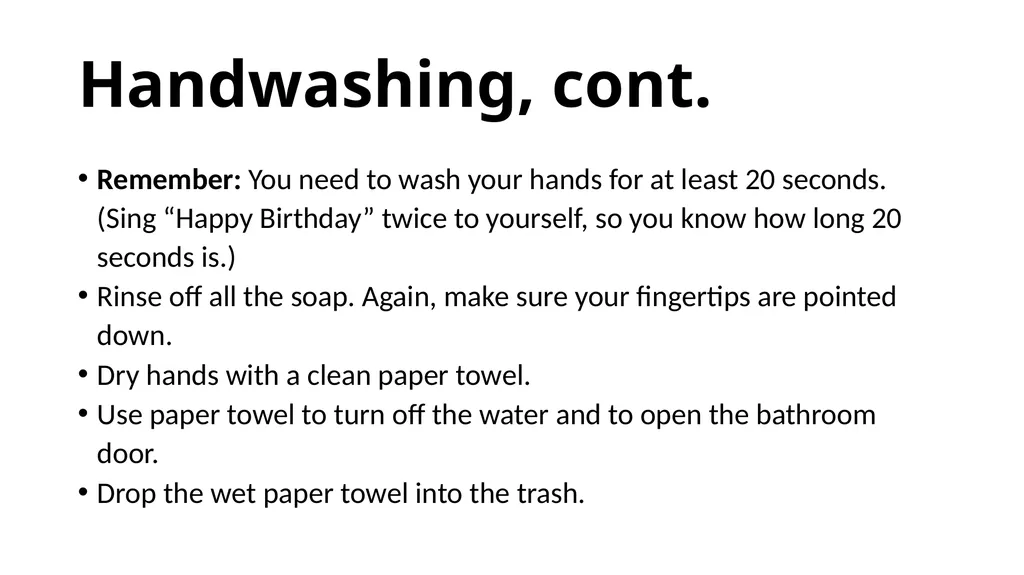
Handwashing, cont. Remember: You need to wash your hands for at least 20 seconds. (Sing “Happy Birthday” twice to yourself, so you know how long 20 seconds is.)
Rinse off all the soap. Again, make sure your fingertips are pointed down.
Dry hands with a clean paper towel.
Use paper towel to turn off the water and to open the bathroom door.
Drop the wet paper towel into the trash.<br>
Rinse off all the soap. Again, make sure your fingertips are pointed down.
Dry hands with a clean paper towel.
Use paper towel to turn off the water and to open the bathroom door.
Drop the wet paper towel into the trash.<br>
18
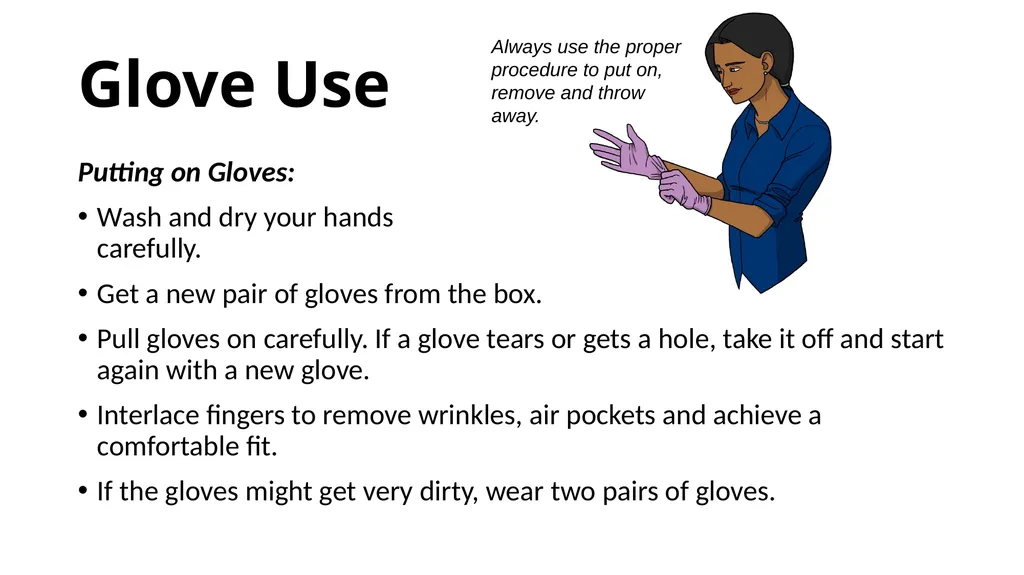
Glove Use Putting on Gloves:
Wash and dry your hands carefully.
Get a new pair of gloves from the box.
Pull gloves on carefully. If a glove tears or gets a hole, take it off and start again with a new glove.
Interlace fingers to remove wrinkles, air pockets and achieve a comfortable fit.
If the gloves might get very dirty, wear two pairs of gloves. Always use the proper procedure to put on, remove and throw away.<br>
Wash and dry your hands carefully.
Get a new pair of gloves from the box.
Pull gloves on carefully. If a glove tears or gets a hole, take it off and start again with a new glove.
Interlace fingers to remove wrinkles, air pockets and achieve a comfortable fit.
If the gloves might get very dirty, wear two pairs of gloves. Always use the proper procedure to put on, remove and throw away.<br>
19
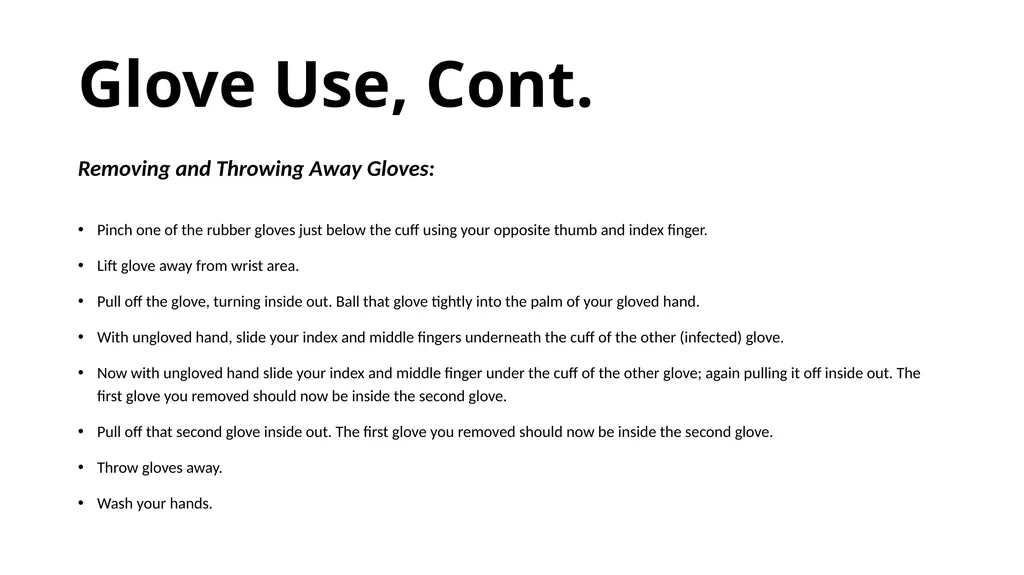
Glove Use, Cont. Removing and Throwing Away Gloves:
Pinch one of the rubber gloves just below the cuff using your opposite thumb and index finger.
Lift glove away from wrist area.
Pull off the glove, turning inside out. Ball that glove tightly into the palm of your gloved hand.
With ungloved hand, slide your index and middle fingers underneath the cuff of the other (infected) glove.
Now with ungloved hand slide your index and middle finger under the cuff of the other glove; again pulling it off inside out. The first glove you removed should now be inside the second glove.
Pull off that second glove inside out. The first glove you removed should now be inside the second glove.
Throw gloves away.
Wash your hands.<br>
Pinch one of the rubber gloves just below the cuff using your opposite thumb and index finger.
Lift glove away from wrist area.
Pull off the glove, turning inside out. Ball that glove tightly into the palm of your gloved hand.
With ungloved hand, slide your index and middle fingers underneath the cuff of the other (infected) glove.
Now with ungloved hand slide your index and middle finger under the cuff of the other glove; again pulling it off inside out. The first glove you removed should now be inside the second glove.
Pull off that second glove inside out. The first glove you removed should now be inside the second glove.
Throw gloves away.
Wash your hands.<br>
20
Musculoskeletal Safety<br>
21
Why Do Direct Caregivers get Musculoskeletal Injuries? Direct caregivers often have to:
Lift and move consumers without help
Twist and pivot the body while carrying a load
Stand for long periods of time
Reach for things, getting off balance
Work in places that may be cluttered or otherwise hazardous
For these reasons, direct caregivers have more job-related injuries than many other types of healthcare workers.<br>
Lift and move consumers without help
Twist and pivot the body while carrying a load
Stand for long periods of time
Reach for things, getting off balance
Work in places that may be cluttered or otherwise hazardous
For these reasons, direct caregivers have more job-related injuries than many other types of healthcare workers.<br>
22
Why Do Direct Caregivers get Musculoskeletal Injuries, cont. Due to these hazards, direct
caregivers have high injury
rates related to:
The back, shoulder, and neck
Slips, trips and falls
Overexertion (working too hard or too long)
Forceful or frequent lifting, pushing, pulling, holding, carrying and throwing
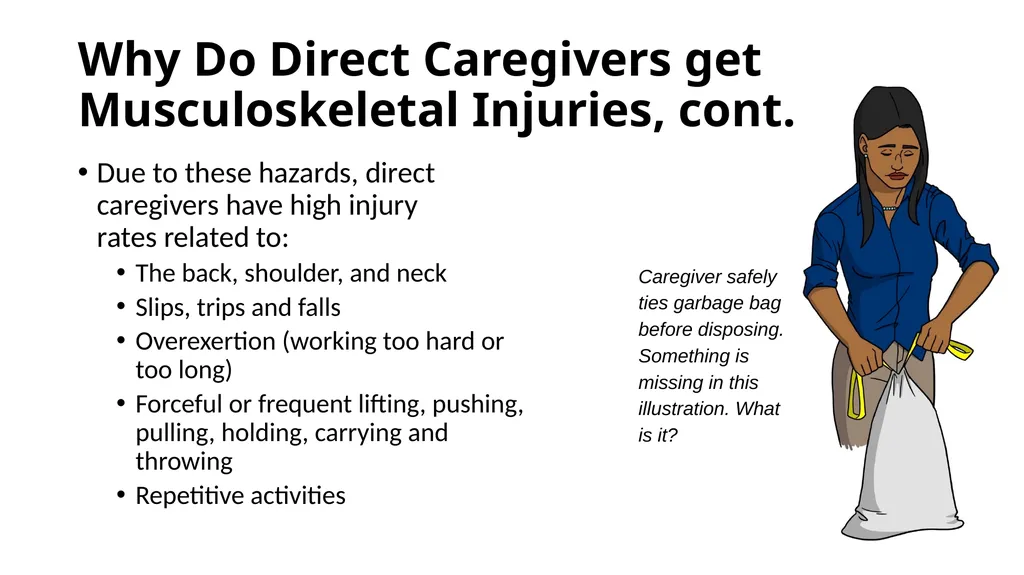
Repetitive activities Caregiver safely ties garbage bag before disposing. Something is missing in this illustration. What is it?<br>
The back, shoulder, and neck
Slips, trips and falls
Overexertion (working too hard or too long)
Forceful or frequent lifting, pushing, pulling, holding, carrying and throwing
Repetitive activities Caregiver safely ties garbage bag before disposing. Something is missing in this illustration. What is it?<br>
23
Symptoms and Consequences
of Musculoskeletal Injury Symptoms of musculoskeletal disorders include:
Pain
Stiffness
Tingling
Numbness
Swelling
Other consequences include:
Lost work time and pay
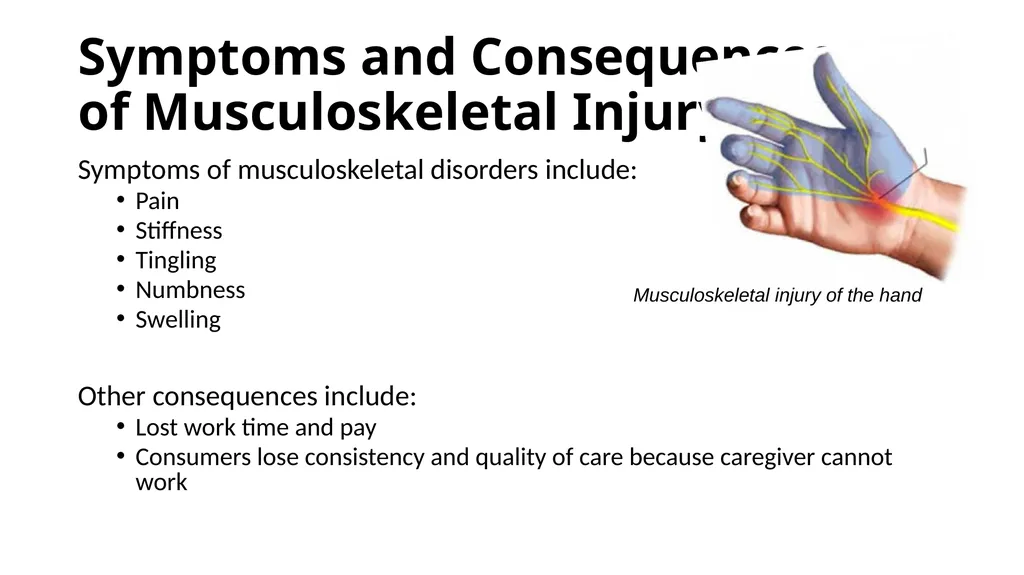
Consumers lose consistency and quality of care because caregiver cannot work Musculoskeletal injury of the hand<br>
Pain
Stiffness
Tingling
Numbness
Swelling
Other consequences include:
Lost work time and pay
Consumers lose consistency and quality of care because caregiver cannot work Musculoskeletal injury of the hand<br>
24
Consequences of
Musculoskeletal Injury The health and safety of the direct caregiver has been directly linked to that of the consumer.
Safer, healthier caregiver = Safer, healthier consumer
Your agency saves money when there are fewer worker injuries.
In a safe work environment, everyone wins!<br>
Safer, healthier caregiver = Safer, healthier consumer
Your agency saves money when there are fewer worker injuries.
In a safe work environment, everyone wins!<br>
25
Advice for a New Caregiver Scenario:
In your agency, many caregivers have been absent from work because of musculoskeletal injuries. You don’t have any injuries, though!
Your boss asks you to give advice to Ben, a new hire, about how he can avoid musculoskeletal injury.
What advice would you give Ben? What strategies would you recommend?<br>
In your agency, many caregivers have been absent from work because of musculoskeletal injuries. You don’t have any injuries, though!
Your boss asks you to give advice to Ben, a new hire, about how he can avoid musculoskeletal injury.
What advice would you give Ben? What strategies would you recommend?<br>
26
Strategies to Avoid Job-Related Injury Use assistive devices to move or transfer consumers.
Encourage consumer to have assistive devices installed (shower chairs, raised toilet seats, grab bars).
Keep floors clean and dry.
Remove clutter and obstacles in the home (with the consumer’s permission).<br>
Encourage consumer to have assistive devices installed (shower chairs, raised toilet seats, grab bars).
Keep floors clean and dry.
Remove clutter and obstacles in the home (with the consumer’s permission).<br>
27
Strategies to Avoid Job-Related Injury, cont. Wear slip-resistant shoes
Make sure there is adequate lighting inside and outside the home, if possible.
Secure loose cords in the house – they are a tripping hazard!<br>
Make sure there is adequate lighting inside and outside the home, if possible.
Secure loose cords in the house – they are a tripping hazard!<br>
28
Strategies to Avoid Job-Related Injury, cont. Be sure ice and snow are
removed from walkways.
Raise your awareness of
fall hazards.
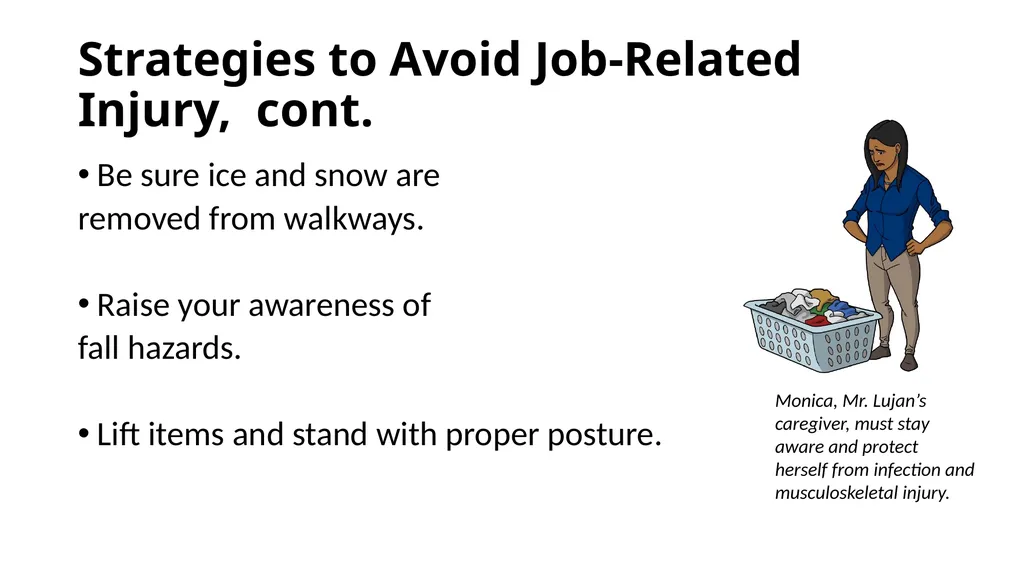
Lift items and stand with proper posture. Monica, Mr. Lujan’s caregiver, must stay aware and protect herself from infection and musculoskeletal injury.<br>
removed from walkways.
Raise your awareness of
fall hazards.
Lift items and stand with proper posture. Monica, Mr. Lujan’s caregiver, must stay aware and protect herself from infection and musculoskeletal injury.<br>
29
Safe Transfer Many consumers need assistance with transfers.
Transferring safely is important for the safety of the caregiver as well as the safety of the consumer.
We will demonstrate 5 tasks:
Safer lifting of heavy objects
Assisting the consumer to move to the side of the bed and sit up
Using a gait belt to transfer the consumer from bed to wheelchair
Using a gait belt to help a consumer ambulate (walk)
How to handle the consumer’s fall<br>
Transferring safely is important for the safety of the caregiver as well as the safety of the consumer.
We will demonstrate 5 tasks:
Safer lifting of heavy objects
Assisting the consumer to move to the side of the bed and sit up
Using a gait belt to transfer the consumer from bed to wheelchair
Using a gait belt to help a consumer ambulate (walk)
How to handle the consumer’s fall<br>
30
Workers’ Rights and Responsibilities<br>
31
Filing a Complaint with OSHA If you believe your workplace is
unsafe or unhealthy, tell your
employer.
You have the right to file a complaint with OSHA.
File a complaint by mail, by telephone or online
If there is an emergency, use the telephone to file your complaint.
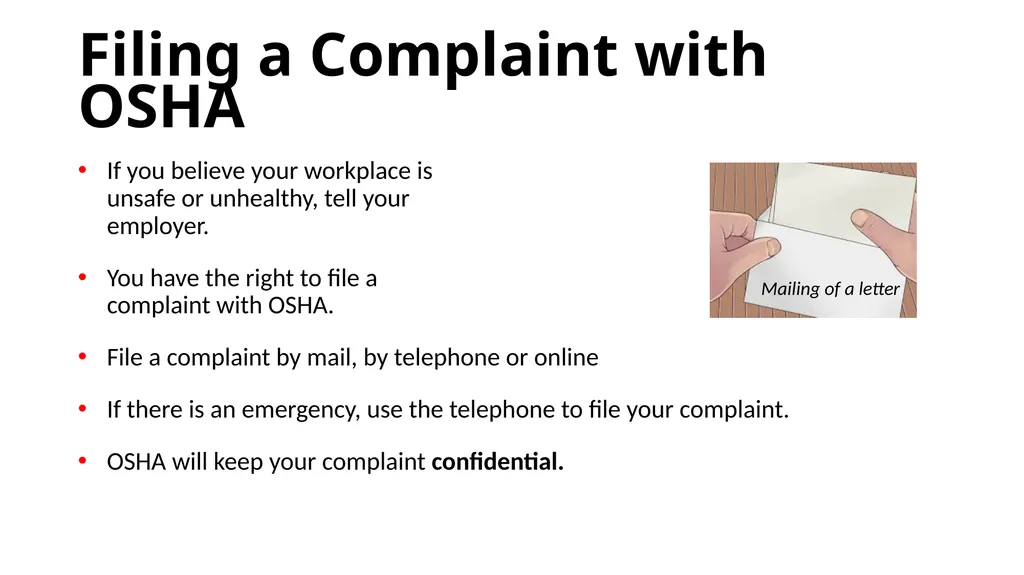
OSHA will keep your complaint confidential. Mailing of a letter<br>
You have the right to file a complaint with OSHA.
File a complaint by mail, by telephone or online
If there is an emergency, use the telephone to file your complaint.
OSHA will keep your complaint confidential. Mailing of a letter<br>
32
Filing a Complaint with OSHA, cont. You have the right to file a complaint without fear of retaliation.
If you believe your employer has retaliated against you for complaining, you can file a Whistleblower Complaint.
See Handout 10 in your Participant Handbook for information on how to file. You can also visit: www.osha.gov<br>
If you believe your employer has retaliated against you for complaining, you can file a Whistleblower Complaint.
See Handout 10 in your Participant Handbook for information on how to file. You can also visit: www.osha.gov<br>
33
References Arizona Direct Care Curriculum Project. (2011). Principles of caregiving: Caregiving fundamentals. Author. Retrieved from link to http://www.azdirectcare.org/uploads/2011_All_Fund_POC.pdf
Centers for Disease Control and Prevention. (1992). Principles of epidemiology, 2nd ed. Atlanta: U.S. Department of Health and Human Services.
Centers for Disease Control and Prevention. (2009). Safe patient handling training for schools of nursing. Retrieved from link to https://www.cdc.gov/niosh/docs/2009-127/pdfs/2009-127.pdf
Collins, J. W., Bell, J. L., and Grönqvist, R. (2010). Developing evidence-based interventions to address the leading causes of workers’ compensation among healthcare workers. Rehabilitation Nursing, 35(6), 226-261.
Hittle, B., Agbonifo, N., Suarez, R., Davis, K. G. & Ballard ,T. (2016) Complexity of occupational exposures for home health-care workers: Nurses vs. home health aides. Journal of Nursing Management, 24, 1071–1079.
Kim, I. H., Geiger-Brown, J., Triankoff, A., & Bonet, C. M. (2010). Physically demanding workloads and the risks of musculoskeletal disorders in homecare workers in the USA. Health & Social Care in the Community, 18(5), 445-455. doi: 10.1111/j.1365-2524.2010.00916.x
National Institute for Occupational Safety and Health. (2014). Caring for yourself while caring for others. Retrieved from link to https://www.cdc.gov/niosh/docs/2015-102/default.html
National Institute for Occupational Safety and Health. (2010). Occupational hazards in home healthcare. Retrieved from link to https://www.cdc.gov/niosh/docs/2010-125/pdfs/2010-125.pdf
Occupational Safety and Health Administration. (n.d.). Infectious diseases. Retrieved from link to https://www.osha.gov/SLTC/healthcarefacilities/infectious_diseases.html
Occupational Safety and Health Administration. (2016). About OSHA. Retrieved from link to https://www.osha.gov/about.html<br>
Centers for Disease Control and Prevention. (1992). Principles of epidemiology, 2nd ed. Atlanta: U.S. Department of Health and Human Services.
Centers for Disease Control and Prevention. (2009). Safe patient handling training for schools of nursing. Retrieved from link to https://www.cdc.gov/niosh/docs/2009-127/pdfs/2009-127.pdf
Collins, J. W., Bell, J. L., and Grönqvist, R. (2010). Developing evidence-based interventions to address the leading causes of workers’ compensation among healthcare workers. Rehabilitation Nursing, 35(6), 226-261.
Hittle, B., Agbonifo, N., Suarez, R., Davis, K. G. & Ballard ,T. (2016) Complexity of occupational exposures for home health-care workers: Nurses vs. home health aides. Journal of Nursing Management, 24, 1071–1079.
Kim, I. H., Geiger-Brown, J., Triankoff, A., & Bonet, C. M. (2010). Physically demanding workloads and the risks of musculoskeletal disorders in homecare workers in the USA. Health & Social Care in the Community, 18(5), 445-455. doi: 10.1111/j.1365-2524.2010.00916.x
National Institute for Occupational Safety and Health. (2014). Caring for yourself while caring for others. Retrieved from link to https://www.cdc.gov/niosh/docs/2015-102/default.html
National Institute for Occupational Safety and Health. (2010). Occupational hazards in home healthcare. Retrieved from link to https://www.cdc.gov/niosh/docs/2010-125/pdfs/2010-125.pdf
Occupational Safety and Health Administration. (n.d.). Infectious diseases. Retrieved from link to https://www.osha.gov/SLTC/healthcarefacilities/infectious_diseases.html
Occupational Safety and Health Administration. (2016). About OSHA. Retrieved from link to https://www.osha.gov/about.html<br>