Molecular Biology Biomedical Third Year Students Dr. Trefa Salih Mohamad Ph.D in Molecular Biology and Microbiology trefa.mohamadsu.edu.krd Molecular Biology Identification of molecular biology : Molecular biology is the branch of biology
"Molecular Biology Biomedical Third Year Students" is the property of its rightful owner. Permission is granted to
download and print the materials on this website for personal, non-commercial use only, and to display it
on your personal computer provided you do not modify the materials and that you retain all copyright
notices contained in the materials. By downloading content from our website, you accept the terms of this
agreement.
Presentation Transcript
01
Molecular Biology Biomedical Third Year Students Dr. Trefa Salih Mohamad
Ph.D in Molecular Biology and Microbiology
trefa.mohamad@su.edu.krd<br>
02
Molecular Biology
Identification of molecular biology :
Molecular biology is the branch of biology that deals with the formation, structure and function of macromolecules
essential to life.
Biologically important macro are DNA , RNA, lipids, carbohydrates and Proteins.
The field of molecular biology involves many other areas of biology such as biochemistry and genetics.
It deals with the manipulation of DNA so that it can be sequenced or mutated.<br>
03
Gregor Mendel, had discovered the basic principles of heredity through experiments in his garden where his observations became the foundation of modern genetics and the study of heredity; scientists started to inquire about the “material” which was responsible about the transmission of the traits from one generation to the next generations, until the year 1866 where the German biologist, naturalist, philosopher and physician Ernst Haeckel had proposed that, the nucleus contains the factors responsible for the transmission of hereditary traits.<br>
04
Freidrich Miescher (1869) : was a Swiss physician and biologist. He was the first researcher who isolate and identify nucleic acid. It was a phosphate-rich chemicals, which he called nuclein (now nucleic acids), from the nuclei of white blood cells without knowing it responsibility about inheritance.
So he knew much of the nucleic acid chemistry but their function remained unknown till a century later . However, his discovery played an important part in the identification of nucleic acids as the carriers of inheritance.<br>
05
Another inquiry dashed into the prospect questioning about the carrier of this “nuclein”.
The answer to this question started to approach with the research of Walther Flemming, founder of cytogenetic in 1882.
With the use of aniline dyes, he was able to find a structure which strongly absorbed basophilic dyes, which he named chromatin. He identified that chromatin was correlated to threadlike structures in the cell nucleus – that he suggested to be the carrier of the nuclein.<br>
06
However, Flemming was unaware of the work of Gregor Mendel on heredity because Mendel’s work wasn’t published until 1900, so he did not make the connection between his observations and genetic inheritance.
Two decades would pass before the significance of Flemming's work was truly realized with the rediscovery of Mendel's rules.<br>
07
The composition of the nuclein was recognized by Phoebus Levene, the American biochemist in 1929 where
he identified the building blocks of DNA, including the four bases adenine (A), cytosine (C), guanine (G), and thymine (T).<br>
08
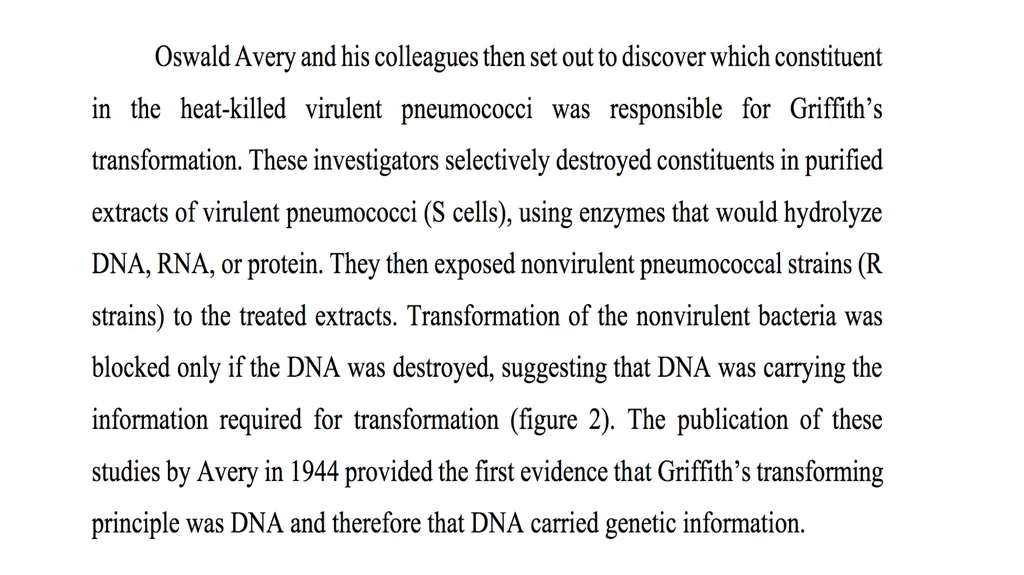
In 1944, the Canadian-born American physician and medical researcher Oswald Theodor Avery, Colin Munro MacLeod and Maclyn McCarty -American geneticists, had suggested that the “Deoxyribonucleic acid – DNA” may function as the genetic material which is responsible of heredity.<br>
09
Many people believe that American biologist James Watson and English physicist Francis Crick discovered DNA in the 1950s. In reality, this is not the case. Rather, DNA was first identified in the late 1860s by Swiss chemist Friedrich Miescher. Then, in the decades following Miescher's discovery, other scientists--notably, Phoebus Levene and Erwin Chargaff--carried out a series of research efforts that revealed additional details about the DNA molecule, including its primary chemical components and the ways in which they joined with one another. Without the scientific foundation provided by these pioneers, Watson and Crick may never have reached their groundbreaking conclusion of 1953: that the DNA molecule exists in the form of a three-dimensional double helix.<br>
10
Though, Matthew Meselson and Franklin Stahl had described in 1958 how DNA replicates, many years later, geneticists had characterized the genetic material in a number of features that included:<br>
11
The genetic material must be capable of storing large amounts of information and instructions for all the traits and functions of an organism.
This information must have the capacity to vary, because different species and even individual members of a species differ in their genetic makeup.
At the same time, the genetic material must be stable, because most alterations to the genetic instructions (mutations) are likely to be detrimental.<br>
12
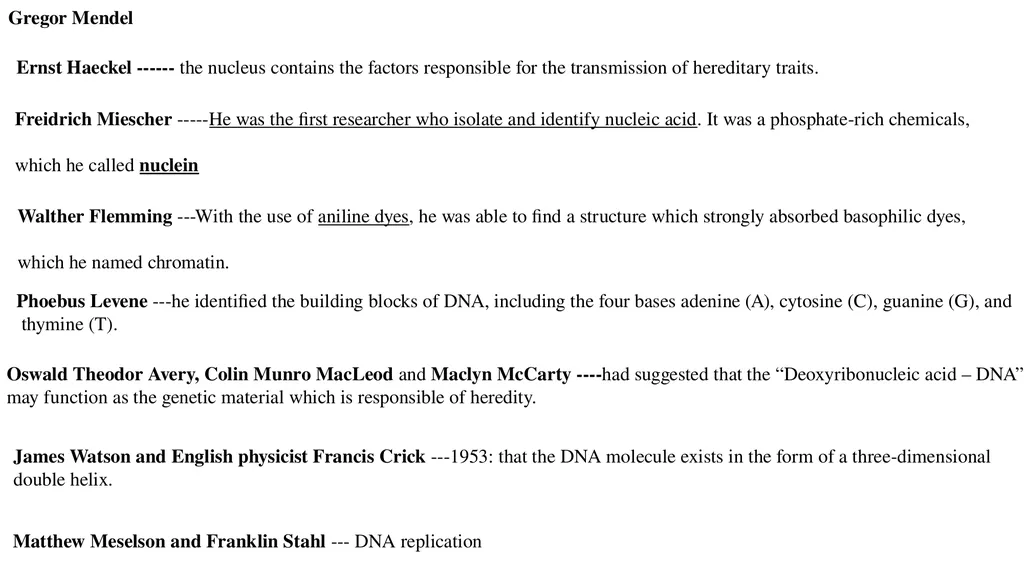
Gregor Mendel Ernst Haeckel ------ the nucleus contains the factors responsible for the transmission of hereditary traits. Freidrich Miescher -----He was the first researcher who isolate and identify nucleic acid. It was a phosphate-rich chemicals,
which he called nuclein Walther Flemming ---With the use of aniline dyes, he was able to find a structure which strongly absorbed basophilic dyes,
which he named chromatin. Phoebus Levene ---he identified the building blocks of DNA, including the four bases adenine (A), cytosine (C), guanine (G), and
thymine (T). Oswald Theodor Avery, Colin Munro MacLeod and Maclyn McCarty ----had suggested that the “Deoxyribonucleic acid – DNA”
may function as the genetic material which is responsible of heredity. James Watson and English physicist Francis Crick ---1953: that the DNA molecule exists in the form of a three-dimensional
double helix. Matthew Meselson and Franklin Stahl --- DNA replication<br>
13
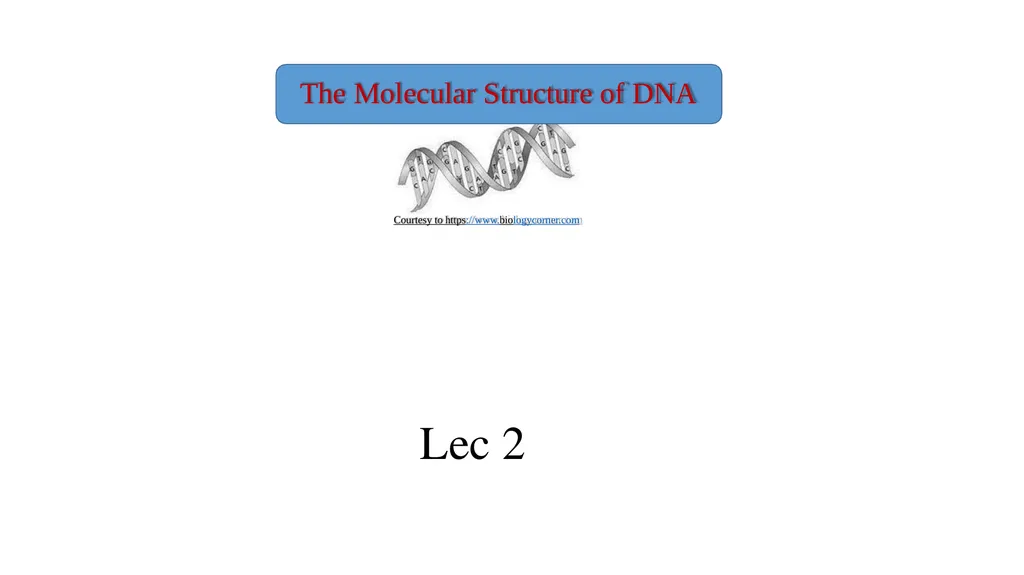
Lec 2<br>
14
Chemical Components of Life 1.
2.
3.
4.<br>
15
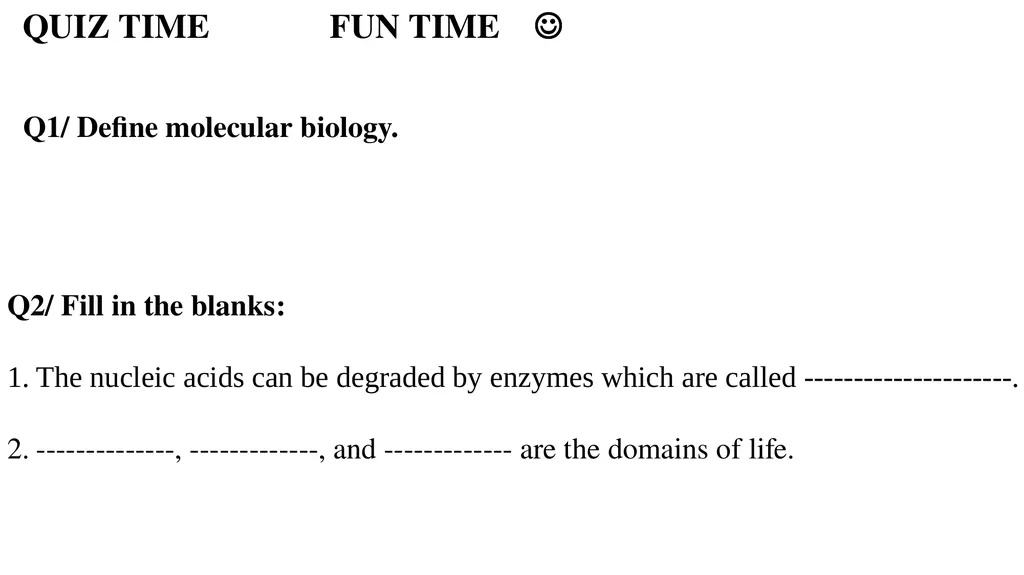
QUIZ TIME FUN TIME Q2/ Fill in the blanks:
The nucleic acids can be degraded by enzymes which are called ---------------------.
--------------, -------------, and ------------- are the domains of life. Q1/ Define molecular biology.<br>