Moral Relativism: Overview Discussion PHIL 102, Spring 2018 Moral relativism is different than saying people disagree A descriptive claim about morality: Different groups have different views of what is morally right and wrong and the
"Moral Relativism: Overview & Discussion PHIL 102," is the property of its rightful owner. Permission is granted to
download and print the materials on this website for personal, non-commercial use only, and to display it
on your personal computer provided you do not modify the materials and that you retain all copyright
notices contained in the materials. By downloading content from our website, you accept the terms of this
agreement.
Presentation Transcript
01
Moral Relativism: Overview & Discussion PHIL 102, Spring 2018<br>
02
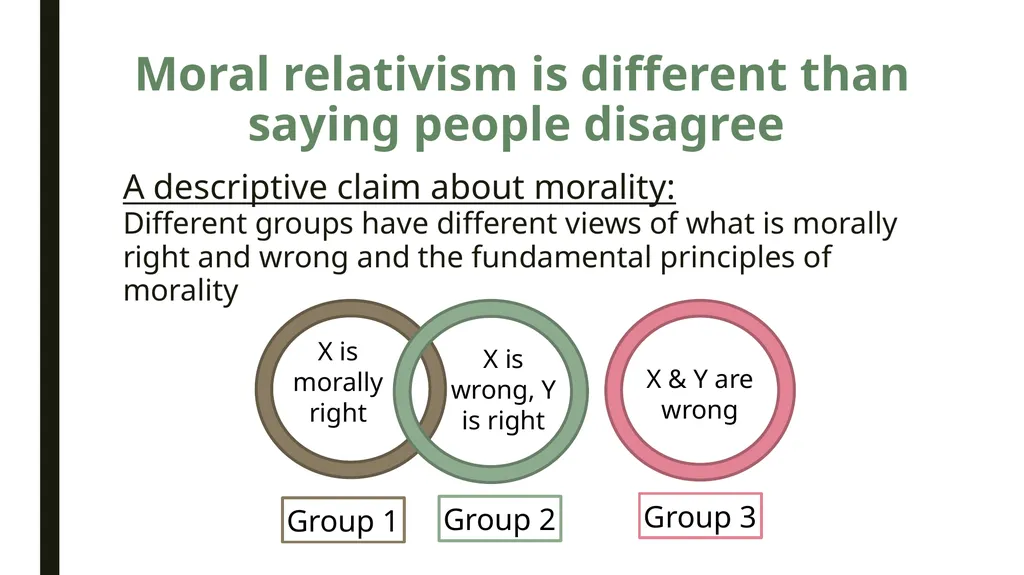
Moral relativism is different than saying people disagree A descriptive claim about morality: Different groups have different views of what is morally right and wrong and the fundamental principles of morality Group 1 Group 2 Group 3<br>
03
Moral Relativism “The truth or falsity of moral judgments … is not absolute or universal, but is relative to the traditions, convictions, or practices of a group of persons.”
Stanford Encyclopedia of Philosophy on Moral Relativism
No “single moral code has universal validity”; “moral truth and justifiability…are in some way relative to factors that are culturally and historically contingent” (Wong 442).
David Wong, “Relativism.” A Companion to Ethics, Ed. Peter Singer. Cambridge, Mass: Basil Blackwell, 1991.<br>
04
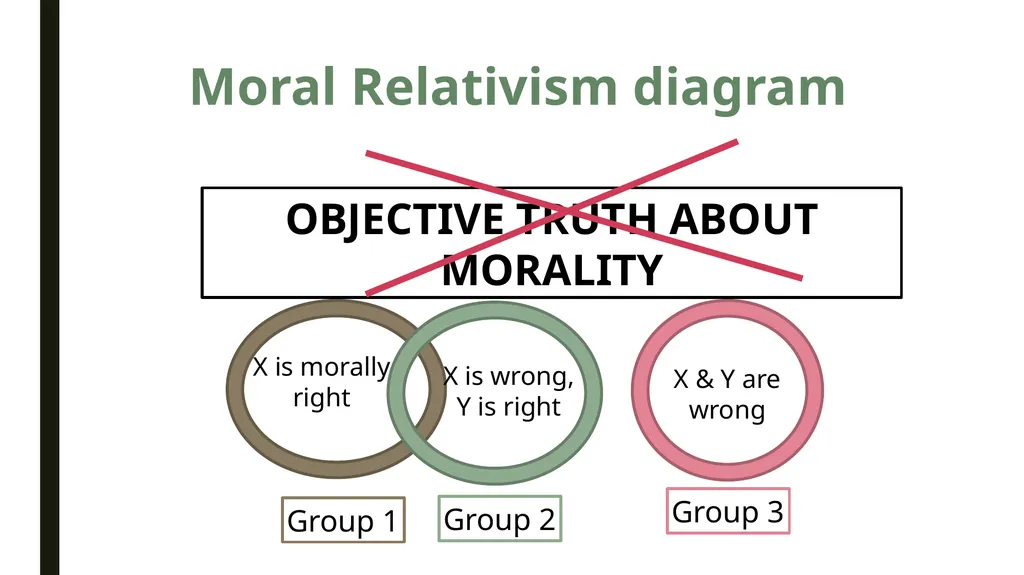
Moral Relativism diagram Group 1 Group 2 Group 3 OBJECTIVE TRUTH ABOUT MORALITY<br>
05
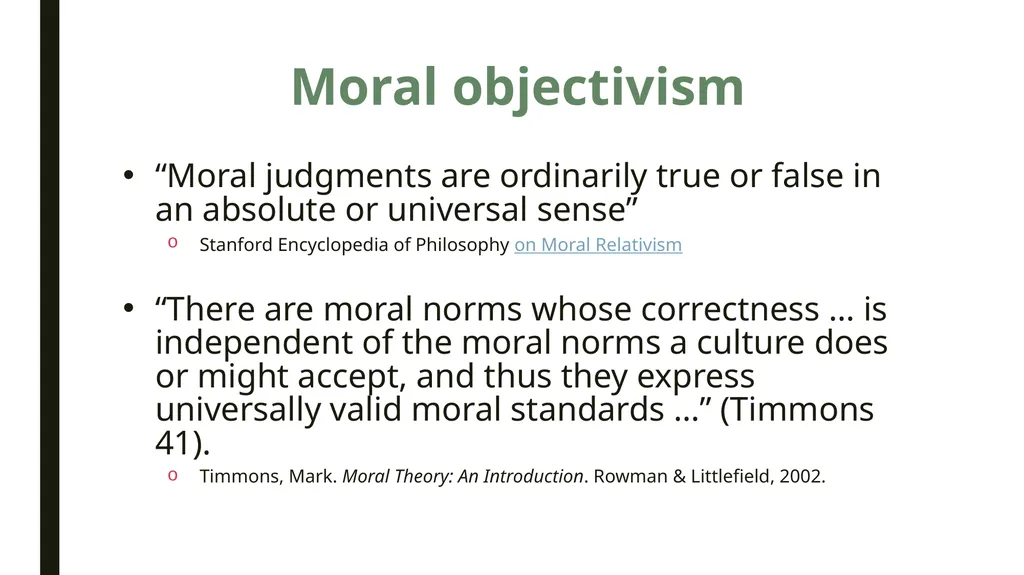
Moral objectivism “Moral judgments are ordinarily true or false in an absolute or universal sense”
Stanford Encyclopedia of Philosophy on Moral Relativism
“There are moral norms whose correctness … is independent of the moral norms a culture does or might accept, and thus they express universally valid moral standards …” (Timmons 41).
Timmons, Mark. Moral Theory: An Introduction. Rowman & Littlefield, 2002.<br>
06
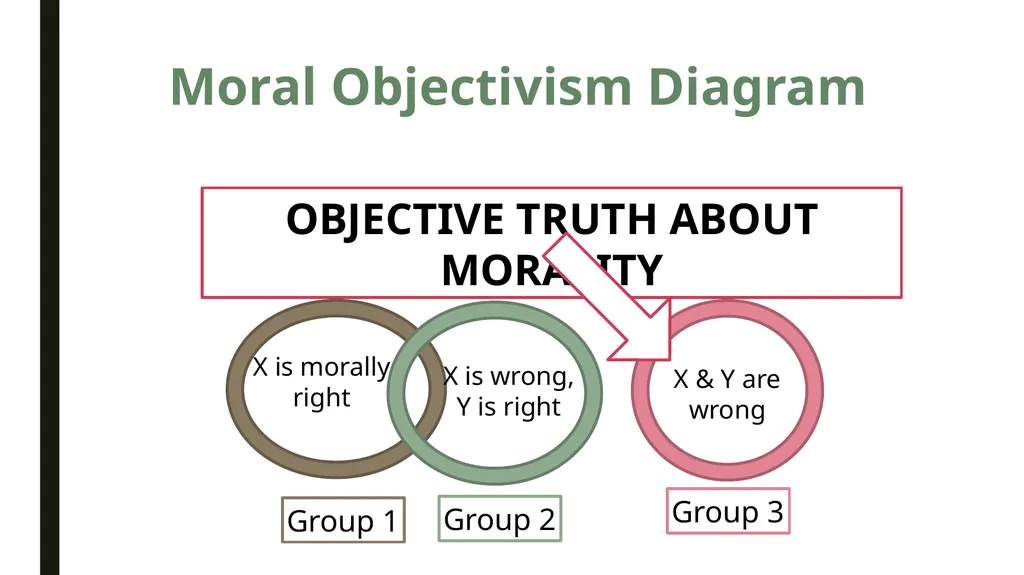
Moral Objectivism Diagram Group 1 Group 2 Group 3 OBJECTIVE TRUTH ABOUT MORALITY<br>
07
Commonly discussed issues with moral relativism<br>
08
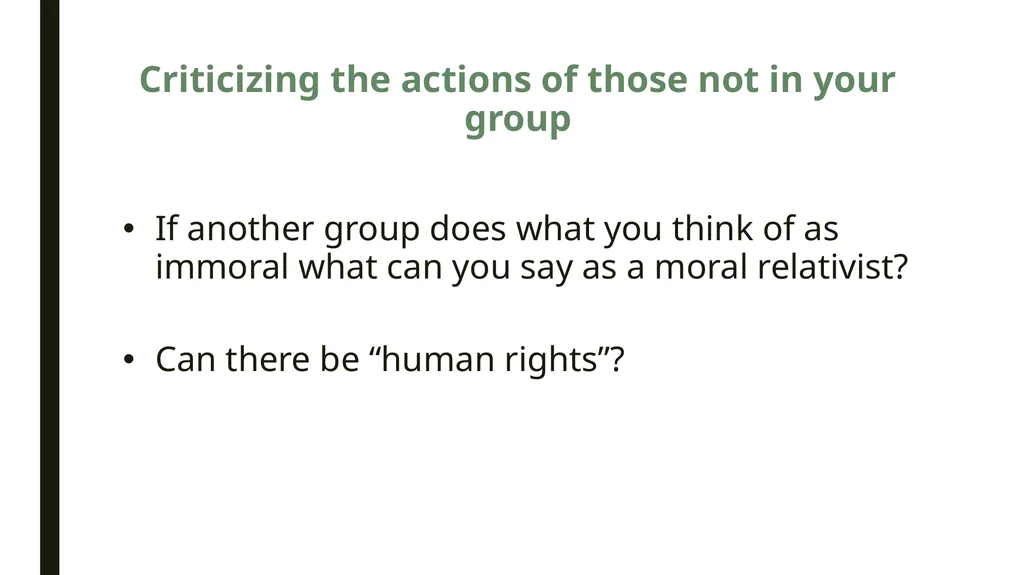
Criticizing the actions of those not in your group If another group does what you think of as immoral what can you say as a moral relativist?
Can there be “human rights”?<br>
09
Criticizing your own group’s views Can you criticize the moral views of your own group?
What about claims to moral progress?
Sort of like Plato’s Euthyphro:
are things morally right because our group they are, or should our group think of morality according to what is morally right?<br>
10
Point of moral discussion seems lost Why have conversations with others inside or outside our group about what’s morally right?
Inside: what’s right is just what our group says
Outside: what’s right is just what their group says<br>