
More on Quantum measurement Next time: Concluding
PM
Published · 13 slides · 0 views
1 / 1

Description
More on Quantum measurement Next time: Concluding remarks on QM And perhaps, start on irreversibility of time Ideas to deal with the measurement problem (folk version of Copenhagen) y collapses, dont ask how (formal Copenhagen) y wasnt
Related Topics
Share
Embed code
Download this presentation From Below
"More on Quantum measurement Next time: Concluding" is the property of its rightful owner. Permission is granted to download and print the materials on this website for personal, non-commercial use only, and to display it on your personal computer provided you do not modify the materials and that you retain all copyright notices contained in the materials. By downloading content from our website, you accept the terms of this agreement.
Presentation Transcript
01
More on Quantum measurement Next time:
Concluding remarks on QM
And perhaps, start on irreversibility of time<br>
Concluding remarks on QM
And perhaps, start on irreversibility of time<br>
02
Ideas to deal with the measurement problem (folk version of Copenhagen) y collapses, don't ask how
(formal Copenhagen) y wasn't ever real, so don't worry about how it collapses. It was just a calculating tool
"macro-realism": y does too collapse, but that involves deviations from the linear wave equation. (Pearle, …)
mentalism: y does too collapse, due to "consciousness", which lies outside the realm of physics. (Wigner, …)
"hidden variables" were always around to determine the outcome of the experiments, so y doesn't have to collapse. (Einstein, DeBroglie, Bohm …)
(Many Worlds). There's nothing but the linear wave equation, you just have to understand what it implies. y doesn't collapse, all those different branches occur but have no reason (until you understand the wave equation) to be aware of each others existence. (Everitt, …)
(Many Thoughts) There are non-linear criteria for what constitutes a thought. Under special circumstances that may lead to | y |2 probabilities. (Hanson, Mallah, mbw)
(Many Many Worlds). As above, but the linear equation predicts incorrect probabilities, so you need non-linear terms to give the right probabilities. (only mbw*)
(quantum logic). Classical Boolean logic is empirically disproved (as a description of our world) by QM, just as Euclidean geometry was shown by G.R. not to describe our world. (Putnam*, …)
*(no longer holds that view)<br>
(formal Copenhagen) y wasn't ever real, so don't worry about how it collapses. It was just a calculating tool
"macro-realism": y does too collapse, but that involves deviations from the linear wave equation. (Pearle, …)
mentalism: y does too collapse, due to "consciousness", which lies outside the realm of physics. (Wigner, …)
"hidden variables" were always around to determine the outcome of the experiments, so y doesn't have to collapse. (Einstein, DeBroglie, Bohm …)
(Many Worlds). There's nothing but the linear wave equation, you just have to understand what it implies. y doesn't collapse, all those different branches occur but have no reason (until you understand the wave equation) to be aware of each others existence. (Everitt, …)
(Many Thoughts) There are non-linear criteria for what constitutes a thought. Under special circumstances that may lead to | y |2 probabilities. (Hanson, Mallah, mbw)
(Many Many Worlds). As above, but the linear equation predicts incorrect probabilities, so you need non-linear terms to give the right probabilities. (only mbw*)
(quantum logic). Classical Boolean logic is empirically disproved (as a description of our world) by QM, just as Euclidean geometry was shown by G.R. not to describe our world. (Putnam*, …)
*(no longer holds that view)<br>
03
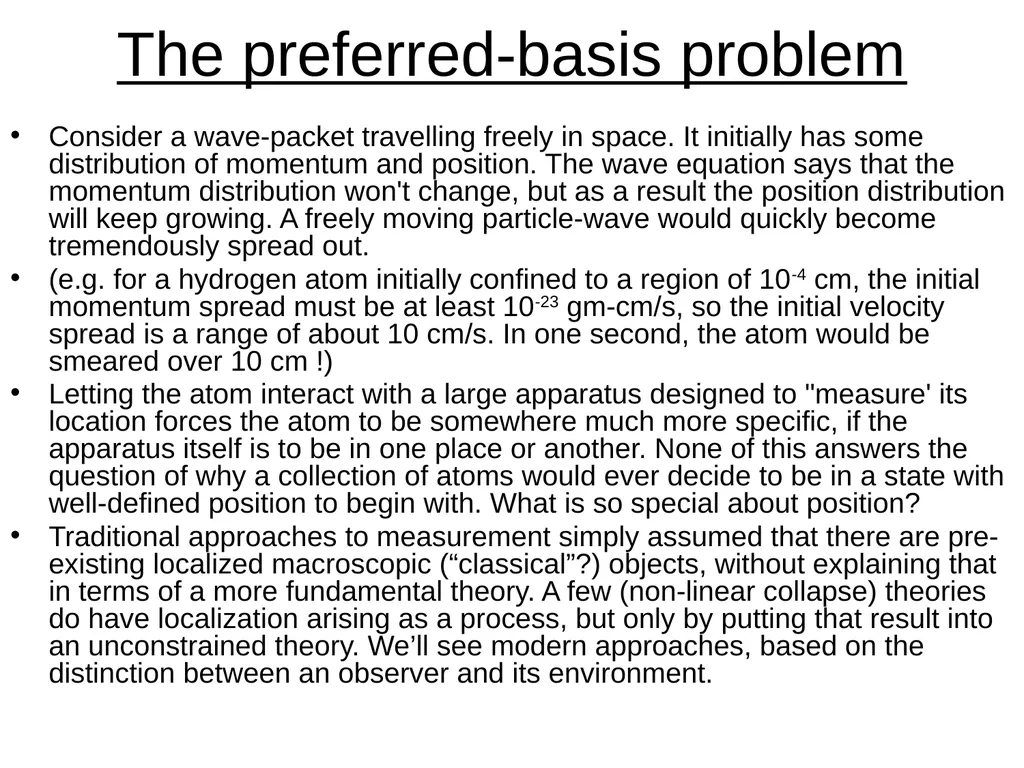
The preferred-basis problem Consider a wave-packet travelling freely in space. It initially has some distribution of momentum and position. The wave equation says that the momentum distribution won't change, but as a result the position distribution will keep growing. A freely moving particle-wave would quickly become tremendously spread out.
(e.g. for a hydrogen atom initially confined to a region of 10-4 cm, the initial momentum spread must be at least 10-23 gm-cm/s, so the initial velocity spread is a range of about 10 cm/s. In one second, the atom would be smeared over 10 cm !)
Letting the atom interact with a large apparatus designed to "measure' its location forces the atom to be somewhere much more specific, if the apparatus itself is to be in one place or another. None of this answers the question of why a collection of atoms would ever decide to be in a state with well-defined position to begin with. What is so special about position?
Traditional approaches to measurement simply assumed that there are pre-existing localized macroscopic (“classical”?) objects, without explaining that in terms of a more fundamental theory. A few (non-linear collapse) theories do have localization arising as a process, but only by putting that result into an unconstrained theory. We’ll see modern approaches, based on the distinction between an observer and its environment.<br>
(e.g. for a hydrogen atom initially confined to a region of 10-4 cm, the initial momentum spread must be at least 10-23 gm-cm/s, so the initial velocity spread is a range of about 10 cm/s. In one second, the atom would be smeared over 10 cm !)
Letting the atom interact with a large apparatus designed to "measure' its location forces the atom to be somewhere much more specific, if the apparatus itself is to be in one place or another. None of this answers the question of why a collection of atoms would ever decide to be in a state with well-defined position to begin with. What is so special about position?
Traditional approaches to measurement simply assumed that there are pre-existing localized macroscopic (“classical”?) objects, without explaining that in terms of a more fundamental theory. A few (non-linear collapse) theories do have localization arising as a process, but only by putting that result into an unconstrained theory. We’ll see modern approaches, based on the distinction between an observer and its environment.<br>
04
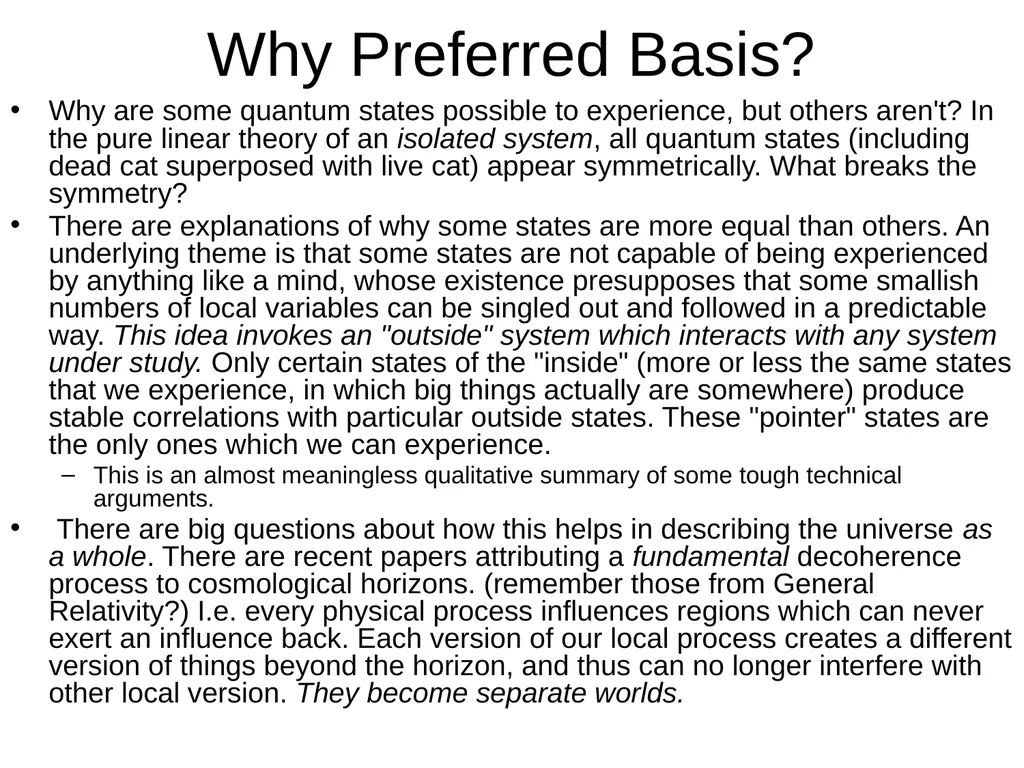
Why Preferred Basis? Why are some quantum states possible to experience, but others aren't? In the pure linear theory of an isolated system, all quantum states (including dead cat superposed with live cat) appear symmetrically. What breaks the symmetry?
There are explanations of why some states are more equal than others. An underlying theme is that some states are not capable of being experienced by anything like a mind, whose existence presupposes that some smallish numbers of local variables can be singled out and followed in a predictable way. This idea invokes an "outside" system which interacts with any system under study. Only certain states of the "inside" (more or less the same states that we experience, in which big things actually are somewhere) produce stable correlations with particular outside states. These "pointer" states are the only ones which we can experience.
This is an almost meaningless qualitative summary of some tough technical arguments.
There are big questions about how this helps in describing the universe as a whole. There are recent papers attributing a fundamental decoherence process to cosmological horizons. (remember those from General Relativity?) I.e. every physical process influences regions which can never exert an influence back. Each version of our local process creates a different version of things beyond the horizon, and thus can no longer interfere with other local version. They become separate worlds.<br>
There are explanations of why some states are more equal than others. An underlying theme is that some states are not capable of being experienced by anything like a mind, whose existence presupposes that some smallish numbers of local variables can be singled out and followed in a predictable way. This idea invokes an "outside" system which interacts with any system under study. Only certain states of the "inside" (more or less the same states that we experience, in which big things actually are somewhere) produce stable correlations with particular outside states. These "pointer" states are the only ones which we can experience.
This is an almost meaningless qualitative summary of some tough technical arguments.
There are big questions about how this helps in describing the universe as a whole. There are recent papers attributing a fundamental decoherence process to cosmological horizons. (remember those from General Relativity?) I.e. every physical process influences regions which can never exert an influence back. Each version of our local process creates a different version of things beyond the horizon, and thus can no longer interfere with other local version. They become separate worlds.<br>
05
Many Worlds and Bare Quantum The MW idea at least clarifies what the bare linear equations predict- a topic that had been oddly avoided by the CI. The MW approach also clarified certain things that were not originally apparent:
It might be possible to make a mathematically coherent theory which still
predicts probabilistic experience
is consistent with the linear part of quantum mechanics
at the expense only of the gut feeling that there must not be any aspects of the universe completely inaccessible to one experience
This was the key lesson from the Many Worlds interpretation: dynamical equations like those of QM can lead to multiple branches, each with consistent correlations among all its own variables but with quite different results than other branches. The theory may say that there's a "you" that sees the live cat and a "you" that sees the dead cat, but it also says that these have no influence on each other, and that weird things like encountering someone who saw the opposite result will not occur.
The macroscopic definiteness of experience is NOT proof of unique outcomes of quantum processes
Unless you make the auxiliary assumption, on the basis of no evidence, that "you" , the experiencer, remain unique.
Is there a path toward obtaining the right probabilities from MW?<br>
It might be possible to make a mathematically coherent theory which still
predicts probabilistic experience
is consistent with the linear part of quantum mechanics
at the expense only of the gut feeling that there must not be any aspects of the universe completely inaccessible to one experience
This was the key lesson from the Many Worlds interpretation: dynamical equations like those of QM can lead to multiple branches, each with consistent correlations among all its own variables but with quite different results than other branches. The theory may say that there's a "you" that sees the live cat and a "you" that sees the dead cat, but it also says that these have no influence on each other, and that weird things like encountering someone who saw the opposite result will not occur.
The macroscopic definiteness of experience is NOT proof of unique outcomes of quantum processes
Unless you make the auxiliary assumption, on the basis of no evidence, that "you" , the experiencer, remain unique.
Is there a path toward obtaining the right probabilities from MW?<br>
06
Many,Many Worlds?
a highly idiosyncratic (read crackpot?) old suggestion of your instructor Remember that when philosophers try to fix MW to give the right probabilities, they in effect hypothesize that for each of the many possible outcomes of an experiment, there are many worlds (or minds) which share that outcome. Then by adjusting the numbers of such worlds for the different outcomes, one could obtain the correct probabilities for the different outcomes simply by counting how many outcomes there were of each type.
The problem is that the standard linear theory predicts no dependence of the numbers of any outcomes on how much of the wave heads for that outcome, i.e. on the measure of that component, but experience shows that the probabilities do depend on the measure of the wave components.
Let's accept that the linear time-dependence equation works very well at a small scale, but that experience (always inherently at a large scale) is not described by it alone. We then follow the non-linear collapse idea by saying that the obvious solution is to find non-linear corrections to the wave equation which become important at some intermediate scale. A choice still remains since such terms could either:
give collapse, following the correct probabilities
give an additional decoherence process, to fix the many-worlds probabilities. (i.e. many, many worlds) The stronger branches of y would have to show more splitting along some unobserved axis, e.g. involving quantum gravity variables, so that there would be more distinct "worlds" with those results.
If some evidence is found that interference is lost when the linear equation says it should be retained, then EITHER non-linear collapse OR non-linear MMW might turn out to work, since both predict this effect.<br>
The problem is that the standard linear theory predicts no dependence of the numbers of any outcomes on how much of the wave heads for that outcome, i.e. on the measure of that component, but experience shows that the probabilities do depend on the measure of the wave components.
Let's accept that the linear time-dependence equation works very well at a small scale, but that experience (always inherently at a large scale) is not described by it alone. We then follow the non-linear collapse idea by saying that the obvious solution is to find non-linear corrections to the wave equation which become important at some intermediate scale. A choice still remains since such terms could either:
give collapse, following the correct probabilities
give an additional decoherence process, to fix the many-worlds probabilities. (i.e. many, many worlds) The stronger branches of y would have to show more splitting along some unobserved axis, e.g. involving quantum gravity variables, so that there would be more distinct "worlds" with those results.
If some evidence is found that interference is lost when the linear equation says it should be retained, then EITHER non-linear collapse OR non-linear MMW might turn out to work, since both predict this effect.<br>
07
how a non-linear many-worlds theory might work Let there be some pointer states, macroscopically consistent, which can develop correlations with some particular states of an outside system
associated with quantum gravity?
So far this is not news. But now let the process by which those correlations develop be non-linear, e.g. it happens only when the measure of the state along some pointer reaches a threshold value. Then the pointer state branches off the original state, becoming correlated with some new outside variable. If that's all there is to it, the state will branch into little pieces, which will not branch any more. So you need for the threshold level to keep shrinking.
Take an experiment which could have produced two distinct outcomes, A and B, with 2/3 of the measure of the state on outcome A.
(see sketches on board)
Following the algorithm, we generate large numbers of A and B branches. The ratio of A branches to B branches approaches two- the correct quantum probability!<br>
associated with quantum gravity?
So far this is not news. But now let the process by which those correlations develop be non-linear, e.g. it happens only when the measure of the state along some pointer reaches a threshold value. Then the pointer state branches off the original state, becoming correlated with some new outside variable. If that's all there is to it, the state will branch into little pieces, which will not branch any more. So you need for the threshold level to keep shrinking.
Take an experiment which could have produced two distinct outcomes, A and B, with 2/3 of the measure of the state on outcome A.
(see sketches on board)
Following the algorithm, we generate large numbers of A and B branches. The ratio of A branches to B branches approaches two- the correct quantum probability!<br>
08
Which non-linear approach is worse?
many, many worlds vs. explicit collapse Both approaches (probabilistic collapse or pure decoherence) introduce non-linear effects.
"Many worlds" remains profligate with worlds.
But non-linear collapse introduces ingredients that are both random and classical, in order to produce unique outcomes.
Many-many worlds has another big problem:
Why is it now?
There are enormously more future you’s than now you’s!<br>
"Many worlds" remains profligate with worlds.
But non-linear collapse introduces ingredients that are both random and classical, in order to produce unique outcomes.
Many-many worlds has another big problem:
Why is it now?
There are enormously more future you’s than now you’s!<br>
09
What Should We Count? Real MW situations are not like the toy model with a batch of discrete worlds emerging. The splitting (“decoherence”) is continuous. Simple world counting might give wrong results but there aren’t any simple worlds to count in real situations.
Jaques Mallah’s new idea: J. Mallah, arXiv:0709.0544v1 [quant-ph] (2007)
What should we count to get probabilities?
Let’s count distinct thoughts.
What’s a thought?
A robust computation of a quantum device (e.g. you.)
What makes a computation robust?
The “signal” must exceed the “noise”.
What noise? Let’s try to figure out from the observed probabilities.
Postulate: There’s a background of quantum noise, unrelated to the coherent world we’re experiencing. In standard representations (e.g. as a function of spatial position) this background looks like rapidly varying complex numbers.
To make a computation robust the coherent part of y averaged over some coordinate region must exceed the noise, just as in ordinary image-processing problems. Random noise averages out, with the average going ->0 as 1/(volume)1/2.
Therefore to get a robust measure of y one must average over a volume proportional to 1/|y|2.<br>
Jaques Mallah’s new idea: J. Mallah, arXiv:0709.0544v1 [quant-ph] (2007)
What should we count to get probabilities?
Let’s count distinct thoughts.
What’s a thought?
A robust computation of a quantum device (e.g. you.)
What makes a computation robust?
The “signal” must exceed the “noise”.
What noise? Let’s try to figure out from the observed probabilities.
Postulate: There’s a background of quantum noise, unrelated to the coherent world we’re experiencing. In standard representations (e.g. as a function of spatial position) this background looks like rapidly varying complex numbers.
To make a computation robust the coherent part of y averaged over some coordinate region must exceed the noise, just as in ordinary image-processing problems. Random noise averages out, with the average going ->0 as 1/(volume)1/2.
Therefore to get a robust measure of y one must average over a volume proportional to 1/|y|2.<br>
10
Why the right background state? Therefore the number of distinct robust computations would be proportional to measure, |y|2!
But why would there be the right background noise in the quantum state to give this?
We switch to another idiosyncratic idea of your instructor
Remember the arguments that any probability other than measure gives weird, unstable results? Could any sort of rational mind function in such a universe?
If Many Worlds is correct, all sorts of universes with all sorts of combinations of states would exist.
Only universes with the right sorts of states would be observable from within.
And none are observable from without!
So the states with the right noise to give the correct probabilities would be post-selected from all the possible states by the requirement that rational beings be arguing about them.
Our first glimpse of “anthropic” explanations.<br>
But why would there be the right background noise in the quantum state to give this?
We switch to another idiosyncratic idea of your instructor
Remember the arguments that any probability other than measure gives weird, unstable results? Could any sort of rational mind function in such a universe?
If Many Worlds is correct, all sorts of universes with all sorts of combinations of states would exist.
Only universes with the right sorts of states would be observable from within.
And none are observable from without!
So the states with the right noise to give the correct probabilities would be post-selected from all the possible states by the requirement that rational beings be arguing about them.
Our first glimpse of “anthropic” explanations.<br>
11
Perspectives on measurement The central problem of the Folk approach is that it does not specify at what point the linear wave eq ceases to apply, and thus is incomplete in the sense that it does not fully describe whether interference effects will be found in hypothetical experiments with large-scale quantum coherence.
The formal Copenhagen approach avoids that problem by saying that the wave function is a non-existent entity to which the linear wave function applies exactly, in between experiences, which are real. (A friend in junior-high used to refer to the unicorn as "a mythical beast found only in Africa.") The problem here is that "experience" is elevated to a central position in the physical working of the universe- it delimits the applicability of the wave equation. However, "experience' is an extremely fuzzy concept, and appears to play an ephemeral role in a universe whose physical behavior seems to be consistent over broad expanses of time and space.
The Bohm approach invokes a dualist picture: a well-defined global position (of all particle coordinates) guided by a wave. It is unclear whether it would allow some experimental test of the existence of the well-defined position variable, i.e. the line between the microworld (with an equilibrated probability density) and the macro world (which is known with certainty) remains somewhat arbitrary. It is not fundamentally Lorentz-invariant. It is equally compatible with single-world or many-world interpretations. (Many Interacting Worlds makes a less dualist version)
The "macro-realist" approaches predict that the wave function really does collapse (following a non-linear equation), under circumstances which depend on physical parameters. The theories are not yet full developed, and invoke non-QM random fields, and severe non-locality, including tachyons in current versions.<br>
The formal Copenhagen approach avoids that problem by saying that the wave function is a non-existent entity to which the linear wave function applies exactly, in between experiences, which are real. (A friend in junior-high used to refer to the unicorn as "a mythical beast found only in Africa.") The problem here is that "experience" is elevated to a central position in the physical working of the universe- it delimits the applicability of the wave equation. However, "experience' is an extremely fuzzy concept, and appears to play an ephemeral role in a universe whose physical behavior seems to be consistent over broad expanses of time and space.
The Bohm approach invokes a dualist picture: a well-defined global position (of all particle coordinates) guided by a wave. It is unclear whether it would allow some experimental test of the existence of the well-defined position variable, i.e. the line between the microworld (with an equilibrated probability density) and the macro world (which is known with certainty) remains somewhat arbitrary. It is not fundamentally Lorentz-invariant. It is equally compatible with single-world or many-world interpretations. (Many Interacting Worlds makes a less dualist version)
The "macro-realist" approaches predict that the wave function really does collapse (following a non-linear equation), under circumstances which depend on physical parameters. The theories are not yet full developed, and invoke non-QM random fields, and severe non-locality, including tachyons in current versions.<br>
12
Perspectives on measurement The standard Many Worlds picture contains only the wave function obeying the linear wave equation. It doesn't yet explain why the universe is found in a condition in which "measurement" occurs (but see L. Susskind for ideas involving cosmological horizons) , but it is consistent with that description. It gives the wrong probabilities for experimental outcomes in simple cases. Do the actual probabilities only emerge because of background noise?
Non-linear Many Words pictures might give correct probabilities, but the additional wave-splitting processes proposed would occur under conditions closely resembling the collapse processes in macro-realist theories, and thus natural-looking Lorentz-invariant descriptions are unlikely to be easily found. There is no well-developed version of such a theory.
Mallah’s Many-Computations Interpretation might give the right probabilities, but requires a special quantum state. Chosen via anthropic post-selection?
Notice that the Many-Worlds pictures approach the experience/reality question in a way opposite to the Copenhagen. For Copenhagen, experience is the central theme, even at the cost of making the theory anthropocentric. People sound central to the process. For Many Worlds, the math is taken to be central, with the requirement that experience be correctly predicted. People are so radically peripheral to the process that most aspects of reality remain completely hidden from any individual experience.<br>
Non-linear Many Words pictures might give correct probabilities, but the additional wave-splitting processes proposed would occur under conditions closely resembling the collapse processes in macro-realist theories, and thus natural-looking Lorentz-invariant descriptions are unlikely to be easily found. There is no well-developed version of such a theory.
Mallah’s Many-Computations Interpretation might give the right probabilities, but requires a special quantum state. Chosen via anthropic post-selection?
Notice that the Many-Worlds pictures approach the experience/reality question in a way opposite to the Copenhagen. For Copenhagen, experience is the central theme, even at the cost of making the theory anthropocentric. People sound central to the process. For Many Worlds, the math is taken to be central, with the requirement that experience be correctly predicted. People are so radically peripheral to the process that most aspects of reality remain completely hidden from any individual experience.<br>
13
Perspectives on measurement
Conclusion The world has not been kind to local realism. The observed violations of local realism are just what QM predicts. However, special relativity and all the key limitations on time-travel have survived intact, no matter how beat-up our intuitions may be.
It is evident that the current state of the interpretation of QM (centered around the measurement problem) is unsatisfactory. We have been driven to a variety ideas, some weasel-worded, some out of touch with the rest of science, some incomplete, some utterly fantastical.
We do not know if a proper theory exists (in some Platonic sphere), or if it exists whether the following analogy holds:
Special relativity is to dog as the proper quantum theory is to man.<br>
It is evident that the current state of the interpretation of QM (centered around the measurement problem) is unsatisfactory. We have been driven to a variety ideas, some weasel-worded, some out of touch with the rest of science, some incomplete, some utterly fantastical.
We do not know if a proper theory exists (in some Platonic sphere), or if it exists whether the following analogy holds:
Special relativity is to dog as the proper quantum theory is to man.<br>