MORPHOLOGY OF PERMANENT CANINES INTRODUCTION Four in number Numbering system Palmer notation: 3 3 3 3 FDI system 13,23,33,43 Eruption time- Max Canine: 11-12years Mand Canine: 9-10years Longest teeth in the mouth and most stable of all
"MORPHOLOGY OF PERMANENT CANINES INTRODUCTION Four" is the property of its rightful owner. Permission is granted to
download and print the materials on this website for personal, non-commercial use only, and to display it
on your personal computer provided you do not modify the materials and that you retain all copyright
notices contained in the materials. By downloading content from our website, you accept the terms of this
agreement.
Presentation Transcript
01
MORPHOLOGY OF PERMANENT CANINES<br>
02
INTRODUCTION Four in number
Numbering system
Palmer notation: 3 3
3 3
FDI system 13,23,33,43
Eruption time- Max Canine: 11-12years
Mand Canine: 9-10years
Longest teeth in the mouth and most stable of all teeth
Last teeth to exfoliate<br>
03
Cornerstone of the dentition
Middle labial lobe is highly developed into strong well formed cusps. Hence canine is also known as ‘cuspid teeth’.
Maxillary canine is the most common teeth to be impacted in the maxillary arch Introduction<br>
04
FUNCTIONS Support to the lip and facial muscles
To cut, pierce or shear food particles
Important guide post in occlusion
Serve as a good anchor teeth for a fixed dental bridge or RPD when adjacent teeth are lost
Very important teeth in maintaining natural facial expression<br>
05
CLASS TRAITS OF CANINES Longest teeth in the mouth
Labio-lingual dimension > mesio-distal dimension
FACIAL VIEW
Crowns are pentagon shaped
Mesial cuspal slopes shorter than distal slopes
Crown outlines are more convex on mesial and flatter on the distal
Roots are wider labio-lingually than mesiodistally<br>
06
Proximal view
Wedge shaped
Facial and lingual crest of curvature are in the cervical 3rd
Cervical lines are convex towards the apex Class traits<br>
07
PERMANENT MAXILLARY CANINE Cervico-incisal length: 10mm
Root length: 17mm
Root is thick labiolingually with mesial and distal development depressions that help to furnish the secure anchorage to the bone<br>
08
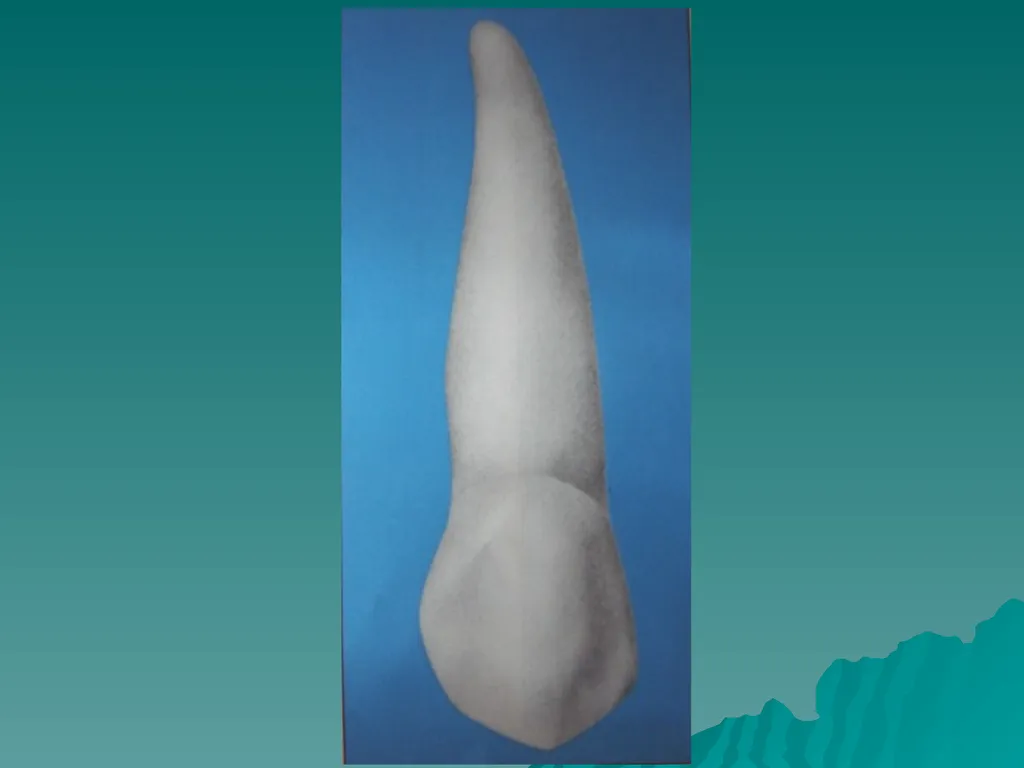
LABIAL ASPECT Labial surface-smooth with no developmental depressions
Middle labial lobe shows much greater development and produces a ridge on labial surface- LABIAL RIDGE
Mesial outline: convex from cervix to the centre of mesial contact area; crown may exhibit slight concavity above the contact area
Mesial contact area: junction of incisal and middle 3rd<br>
09
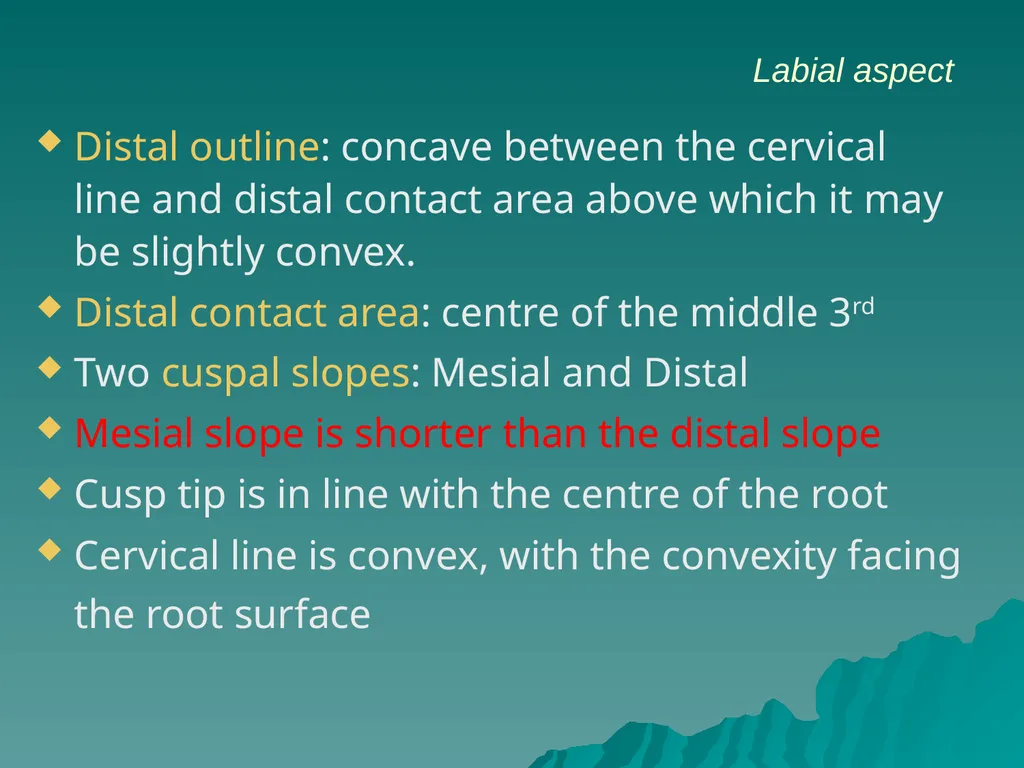
Distal outline: concave between the cervical line and distal contact area above which it may be slightly convex.
Distal contact area: centre of the middle 3rd
Two cuspal slopes: Mesial and Distal
Mesial slope is shorter than the distal slope
Cusp tip is in line with the centre of the root
Cervical line is convex, with the convexity facing the root surface Labial aspect<br>
10
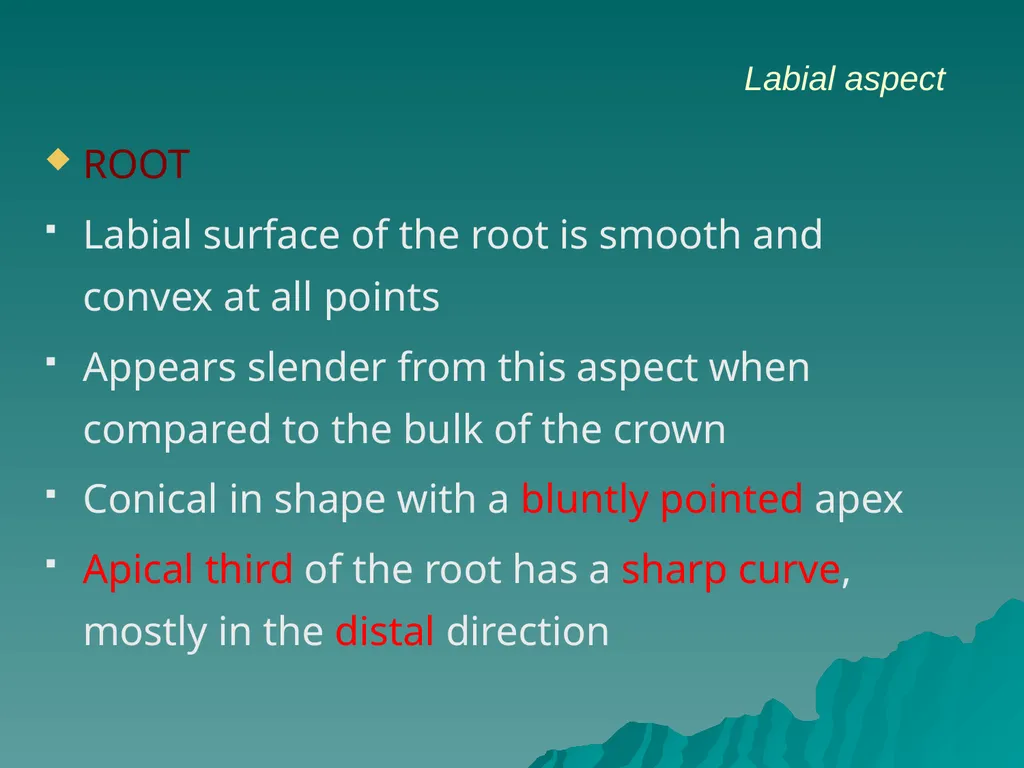
ROOT
Labial surface of the root is smooth and convex at all points
Appears slender from this aspect when compared to the bulk of the crown
Conical in shape with a bluntly pointed apex
Apical third of the root has a sharp curve, mostly in the distal direction Labial aspect<br>
11
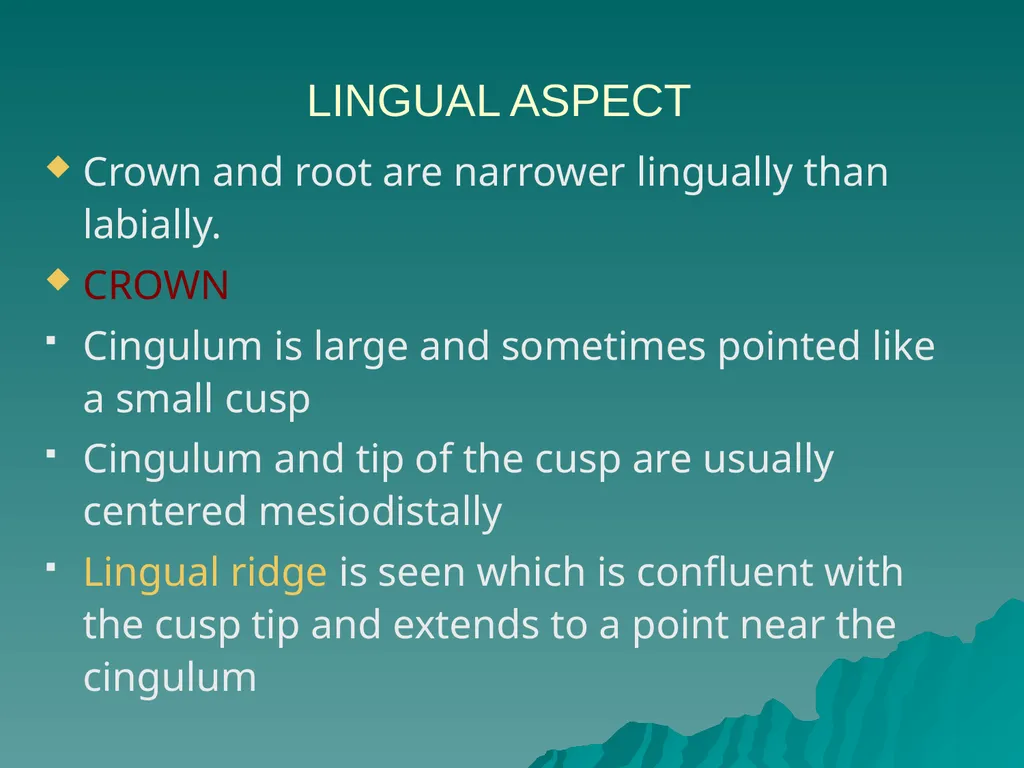
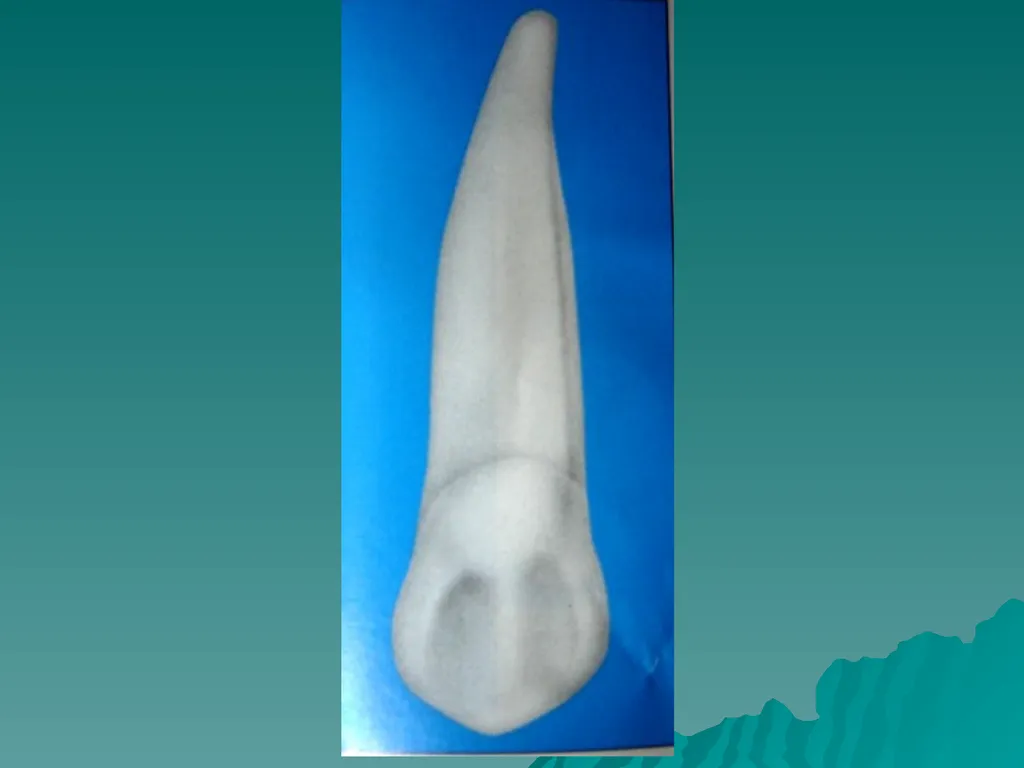
LINGUAL ASPECT Crown and root are narrower lingually than labially.
CROWN
Cingulum is large and sometimes pointed like a small cusp
Cingulum and tip of the cusp are usually centered mesiodistally
Lingual ridge is seen which is confluent with the cusp tip and extends to a point near the cingulum<br>
12
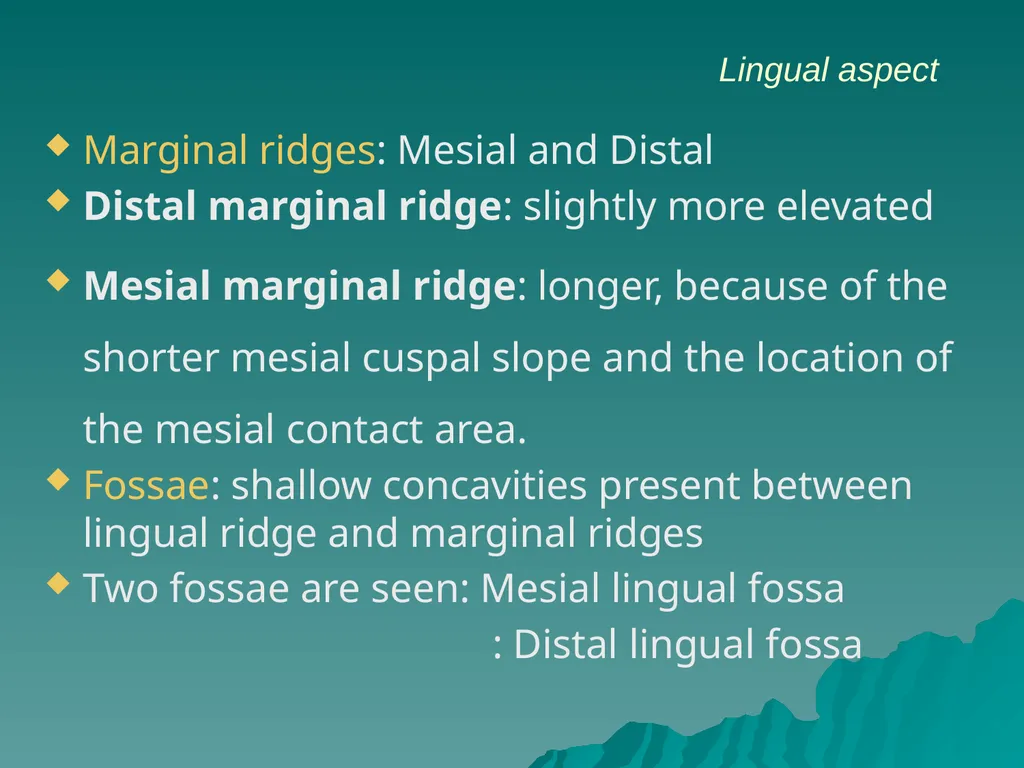
Marginal ridges: Mesial and Distal
Distal marginal ridge: slightly more elevated
Mesial marginal ridge: longer, because of the shorter mesial cuspal slope and the location of the mesial contact area.
Fossae: shallow concavities present between lingual ridge and marginal ridges
Two fossae are seen: Mesial lingual fossa
: Distal lingual fossa Lingual aspect<br>
13
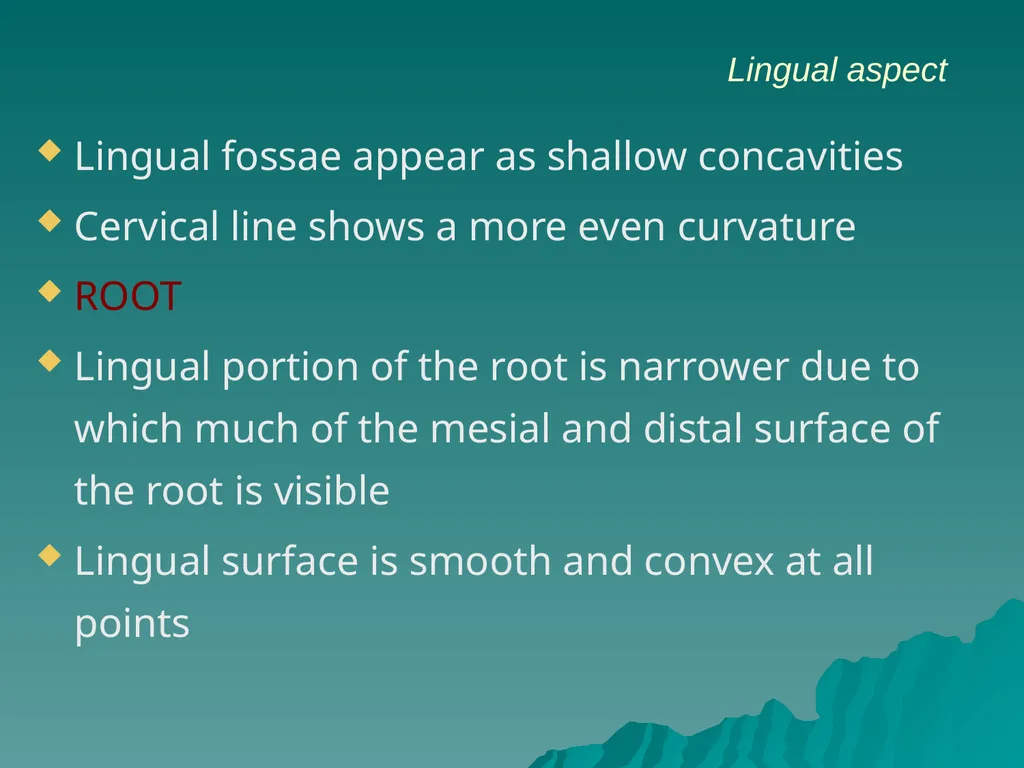
Lingual fossae appear as shallow concavities
Cervical line shows a more even curvature
ROOT
Lingual portion of the root is narrower due to which much of the mesial and distal surface of the root is visible
Lingual surface is smooth and convex at all points Lingual aspect<br>
14
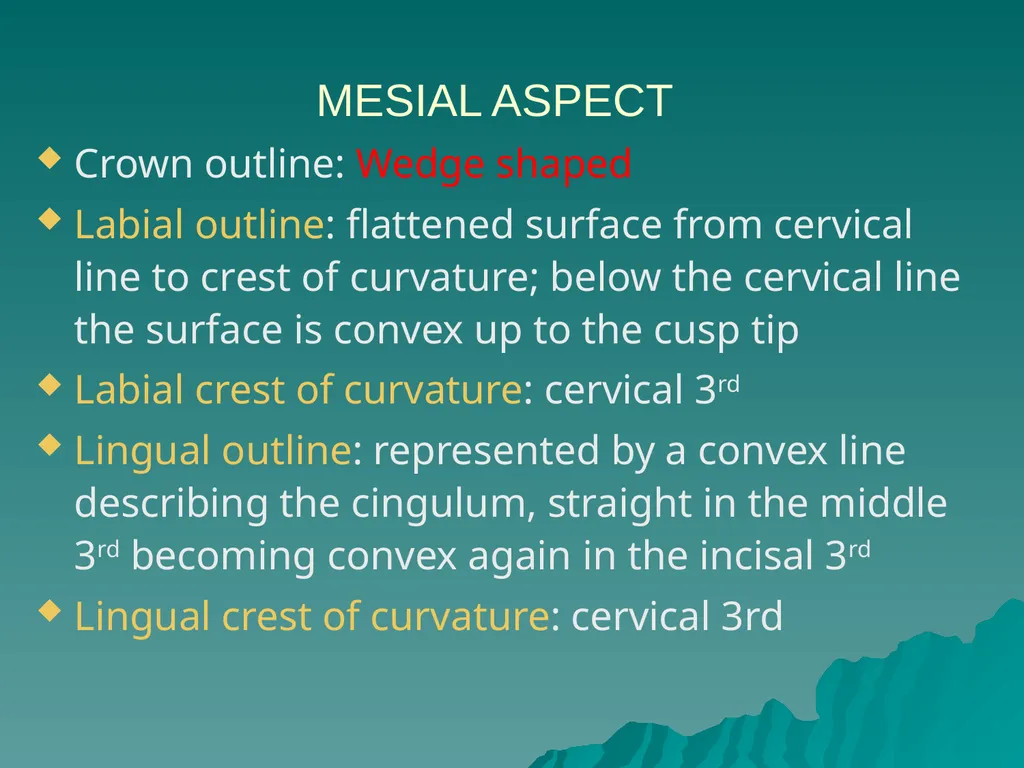
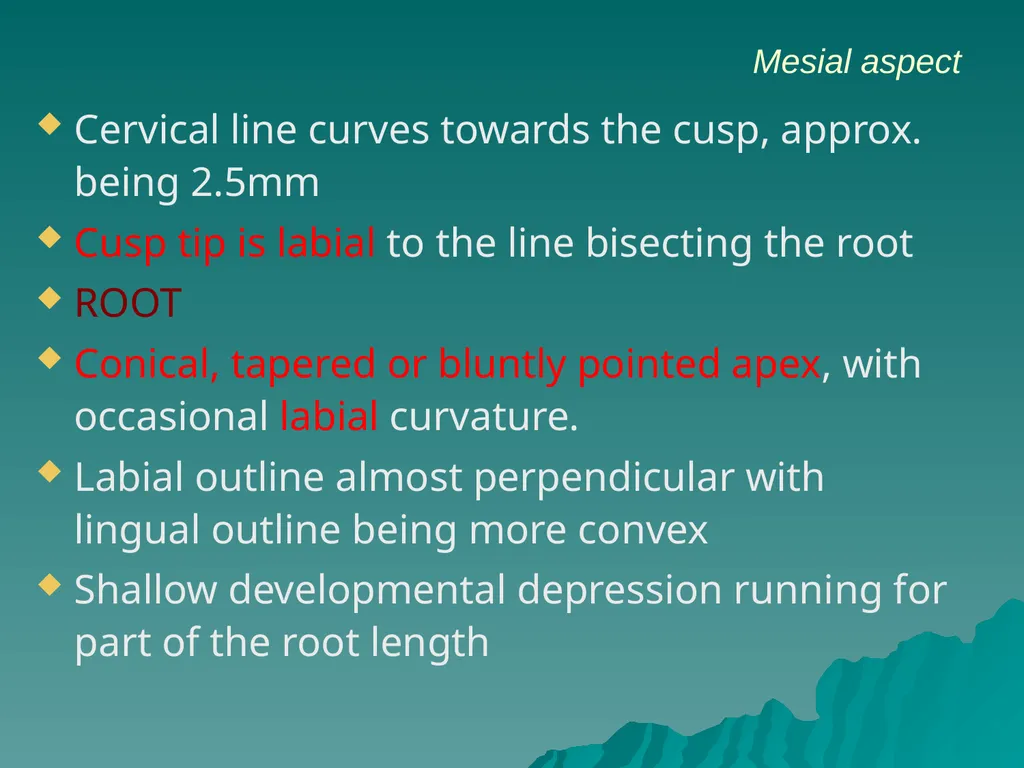
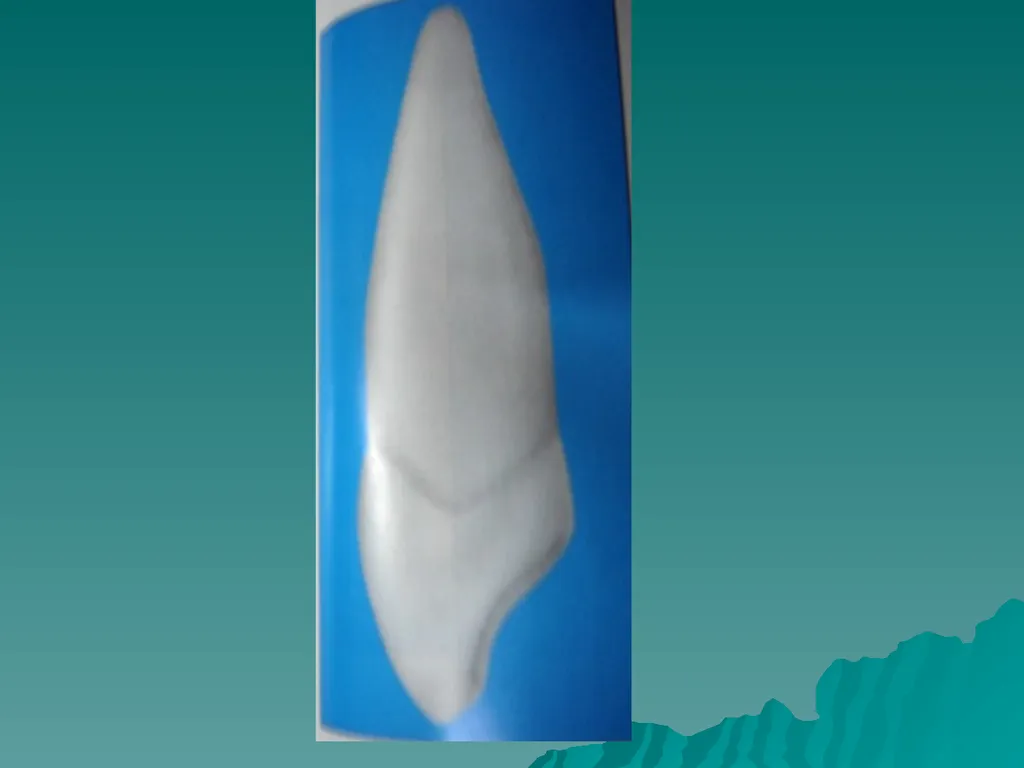
MESIAL ASPECT Crown outline: Wedge shaped
Labial outline: flattened surface from cervical line to crest of curvature; below the cervical line the surface is convex up to the cusp tip
Labial crest of curvature: cervical 3rd
Lingual outline: represented by a convex line describing the cingulum, straight in the middle 3rd becoming convex again in the incisal 3rd
Lingual crest of curvature: cervical 3rd<br>
15
Cervical line curves towards the cusp, approx. being 2.5mm
Cusp tip is labial to the line bisecting the root
ROOT
Conical, tapered or bluntly pointed apex, with occasional labial curvature.
Labial outline almost perpendicular with lingual outline being more convex
Shallow developmental depression running for part of the root length Mesial aspect<br>
16
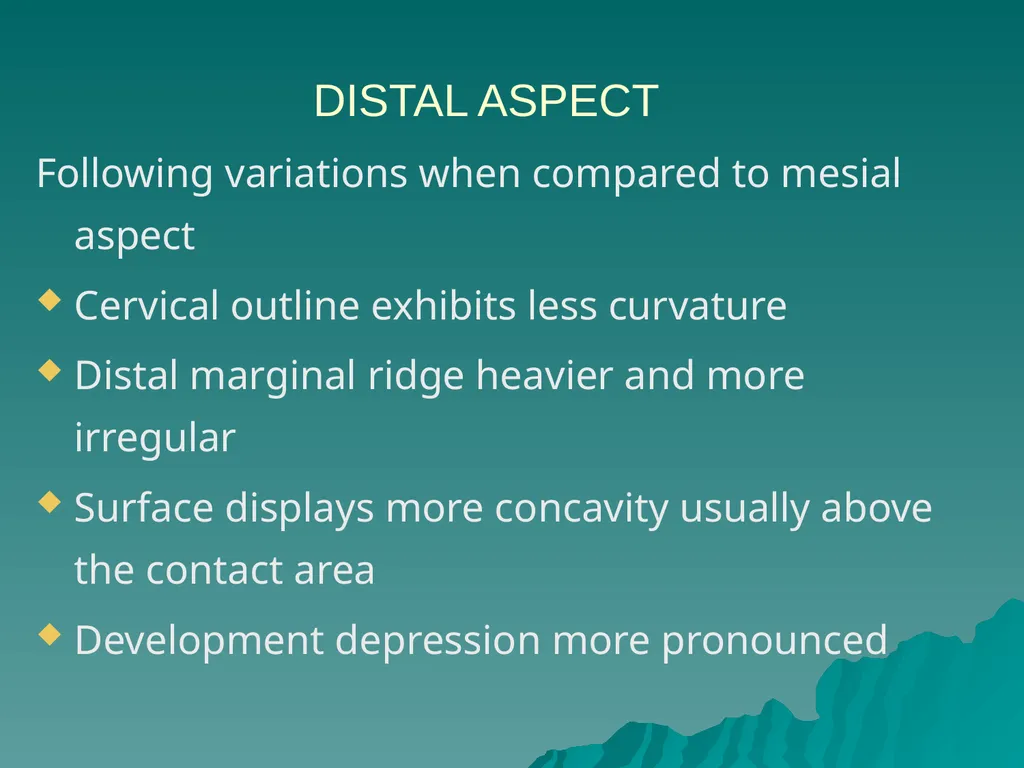
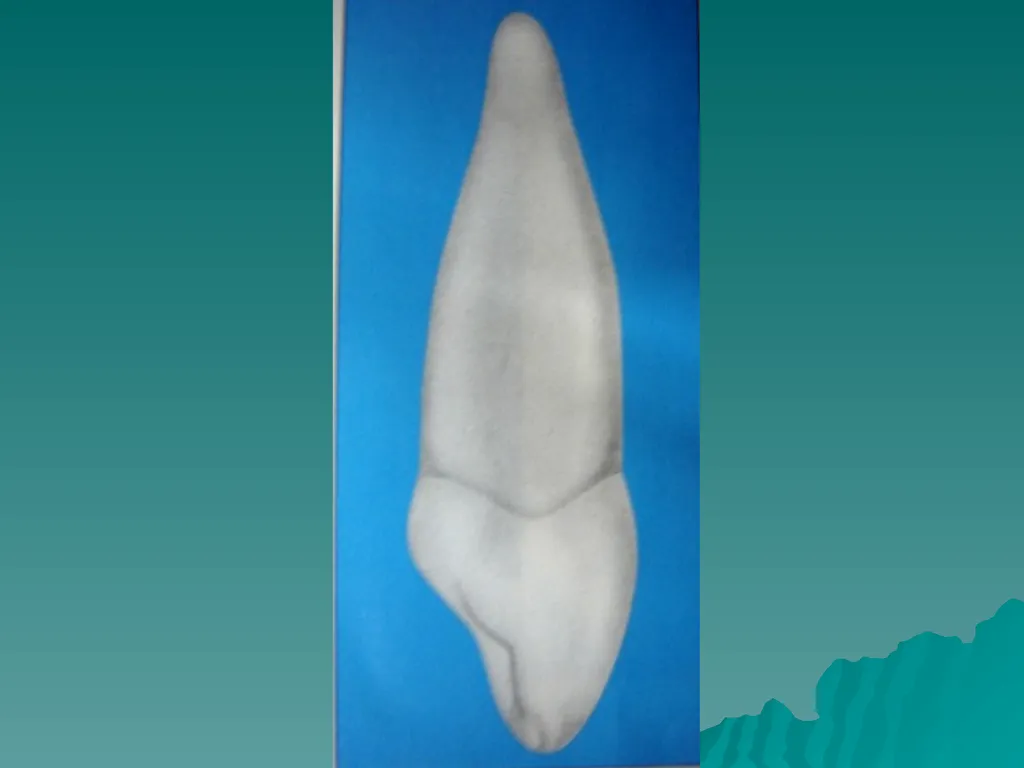
DISTAL ASPECT Following variations when compared to mesial aspect
Cervical outline exhibits less curvature
Distal marginal ridge heavier and more irregular
Surface displays more concavity usually above the contact area
Development depression more pronounced<br>
17
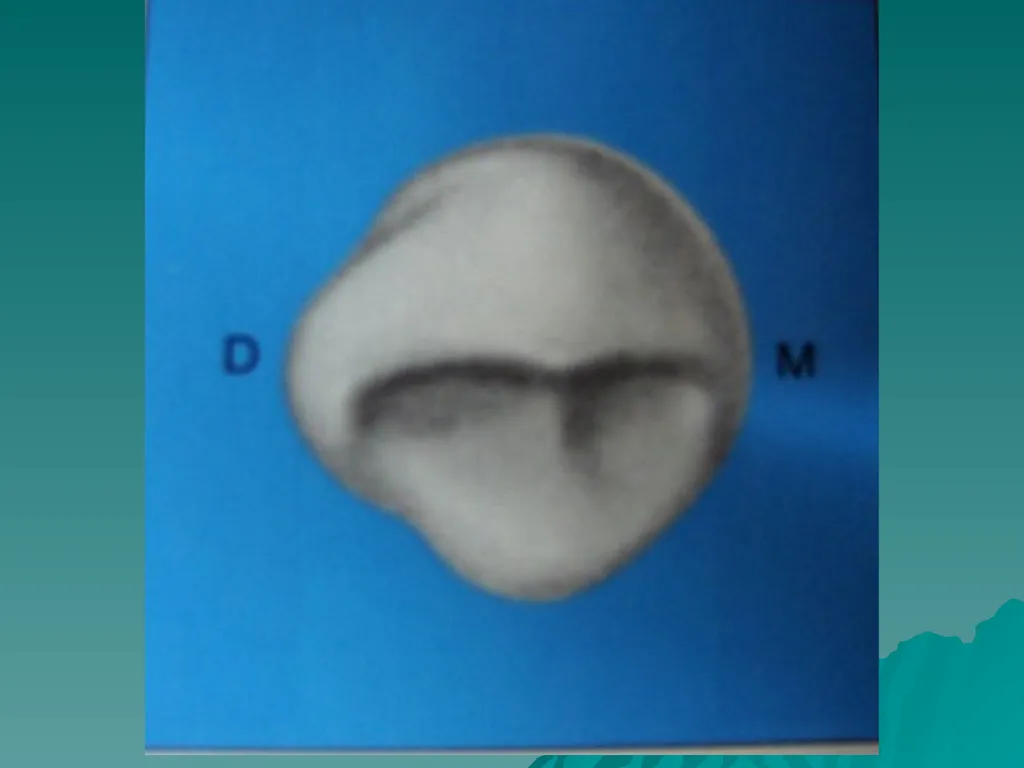
INCISAL ASPECT Labio-lingual dimension> Mesio-distal dimension
Cusp tip is labial to centre of the crown labio-lingually & mesial to the centre mesio-distally
Labial contour: convex labial surface
Labial ridge is very noticeable, greatest convexity at cervical 3rd, becoming broader and flatter at middle and incisal 3rd
Lingual contour: cingulum makes up cervical 3rd, large and located centrally<br>