
Multidisciplinary Tumor Boards (MTB) Thierry M.
AS
Published · 21 slides · 0 views
1 / 1


Description
Multidisciplinary Tumor Boards (MTB) Thierry M. Muanza, BA, MSc, MD, FRCPC Associate ProfessorProfesseur Agrégé Gerald Bronfman department Oncology McGill University, Montreal, QC, Canada Le CGEA fer de lance de la lutte contre le cancer
Related Topics
Share
Embed code
Download this presentation From Below
"Multidisciplinary Tumor Boards (MTB) Thierry M." is the property of its rightful owner. Permission is granted to download and print the materials on this website for personal, non-commercial use only, and to display it on your personal computer provided you do not modify the materials and that you retain all copyright notices contained in the materials. By downloading content from our website, you accept the terms of this agreement.
Presentation Transcript
01
Multidisciplinary Tumor Boards (MTB) Thierry M. Muanza, BA, MSc, MD, FRCPC
Associate Professor/Professeur Agrégé
Gerald Bronfman department Oncology
McGill University, Montreal, QC, Canada "Le CGEA fer de lance de la lutte contre le cancer en RDC ?"<br>
Associate Professor/Professeur Agrégé
Gerald Bronfman department Oncology
McGill University, Montreal, QC, Canada "Le CGEA fer de lance de la lutte contre le cancer en RDC ?"<br>
02
Comprehensive Cancer Center What is comprehensive cancer care?
It signifies a multidisciplinary approach to cancer care. We serve as a central hub for all our patients' needs, offering a full spectrum of cancer services, including screening and prevention, research, diagnosis, treatment, rehabilitation, social/emotional support, and survivorship programs. What's the Difference Between an NCI Cancer Center and an NCI Comprehensive Cancer Center? An NCI-designated cancer center means that a center has met NCI standards for cancer prevention, clinical services, or research.
A Comprehensive Cancer Center meets NCI standards in all three categories.<br>
It signifies a multidisciplinary approach to cancer care. We serve as a central hub for all our patients' needs, offering a full spectrum of cancer services, including screening and prevention, research, diagnosis, treatment, rehabilitation, social/emotional support, and survivorship programs. What's the Difference Between an NCI Cancer Center and an NCI Comprehensive Cancer Center? An NCI-designated cancer center means that a center has met NCI standards for cancer prevention, clinical services, or research.
A Comprehensive Cancer Center meets NCI standards in all three categories.<br>
03
Outline Definition
History
Rational
Participants
Functioning Benefits
Limitations
Summary<br>
History
Rational
Participants
Functioning Benefits
Limitations
Summary<br>
04
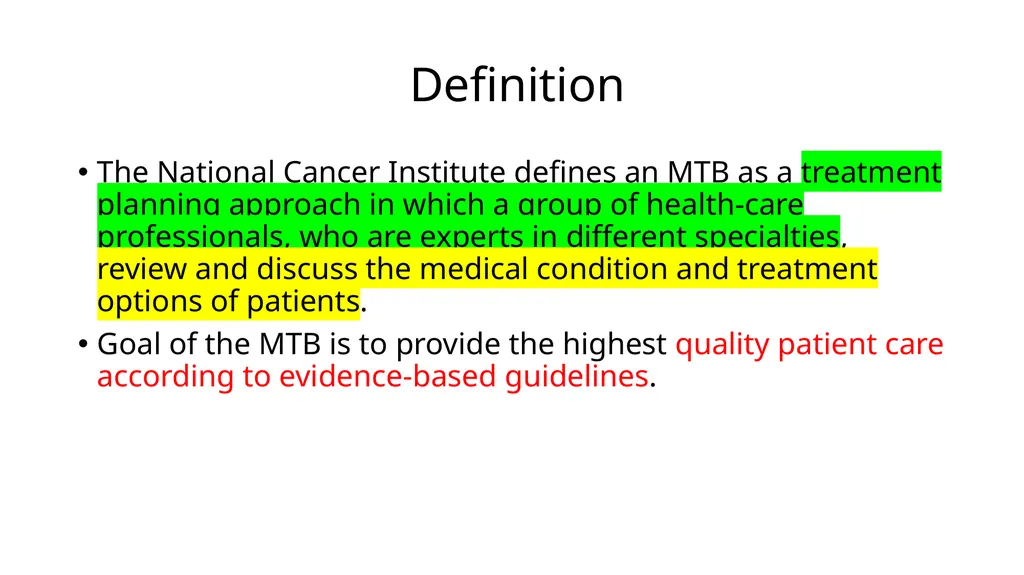
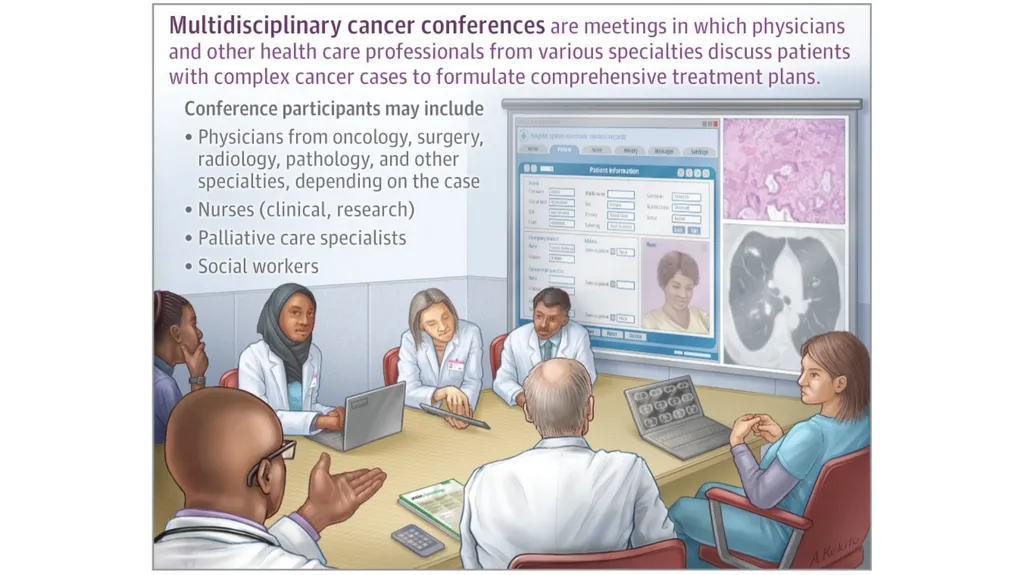
Definition The National Cancer Institute defines an MTB as a treatment planning approach in which a group of health-care professionals, who are experts in different specialties, review and discuss the medical condition and treatment options of patients.
Goal of the MTB is to provide the highest quality patient care according to evidence-based guidelines.<br>
Goal of the MTB is to provide the highest quality patient care according to evidence-based guidelines.<br>
05
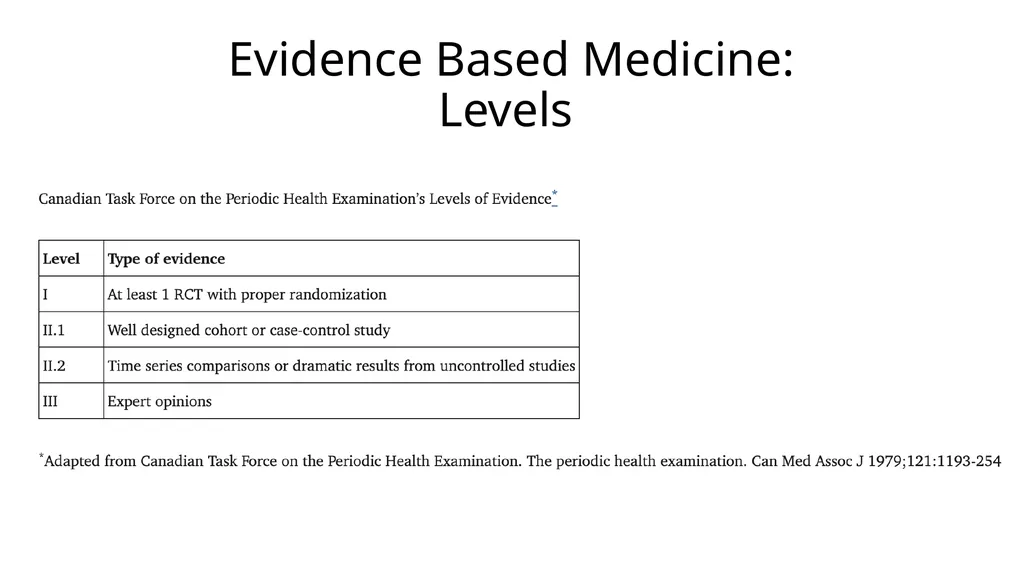
Evidence Based Medicine:
Levels<br>
06
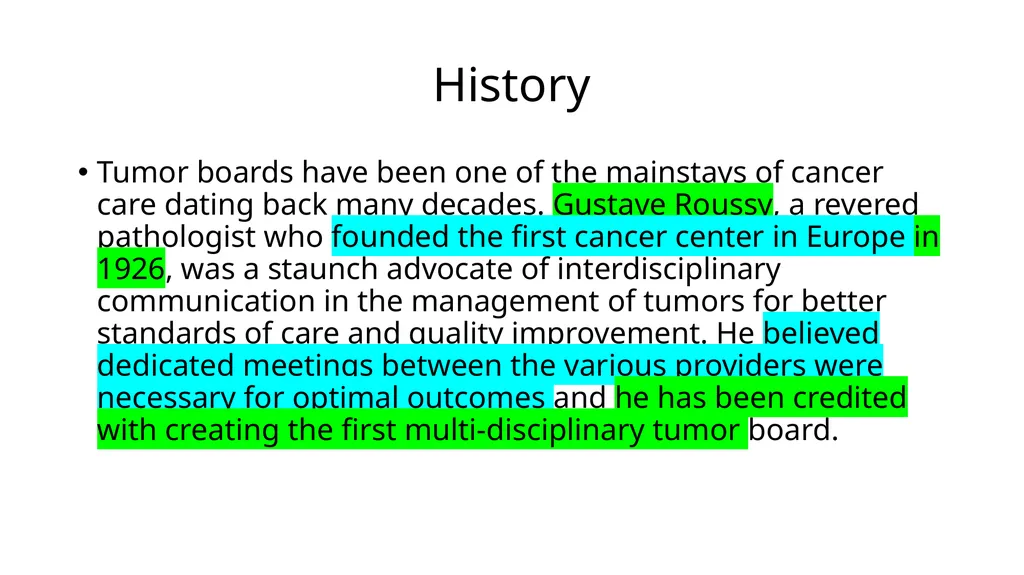
History Tumor boards have been one of the mainstays of cancer care dating back many decades. Gustave Roussy, a revered pathologist who founded the first cancer center in Europe in 1926, was a staunch advocate of interdisciplinary communication in the management of tumors for better standards of care and quality improvement. He believed dedicated meetings between the various providers were necessary for optimal outcomes and he has been credited with creating the first multi-disciplinary tumor board.<br>
07
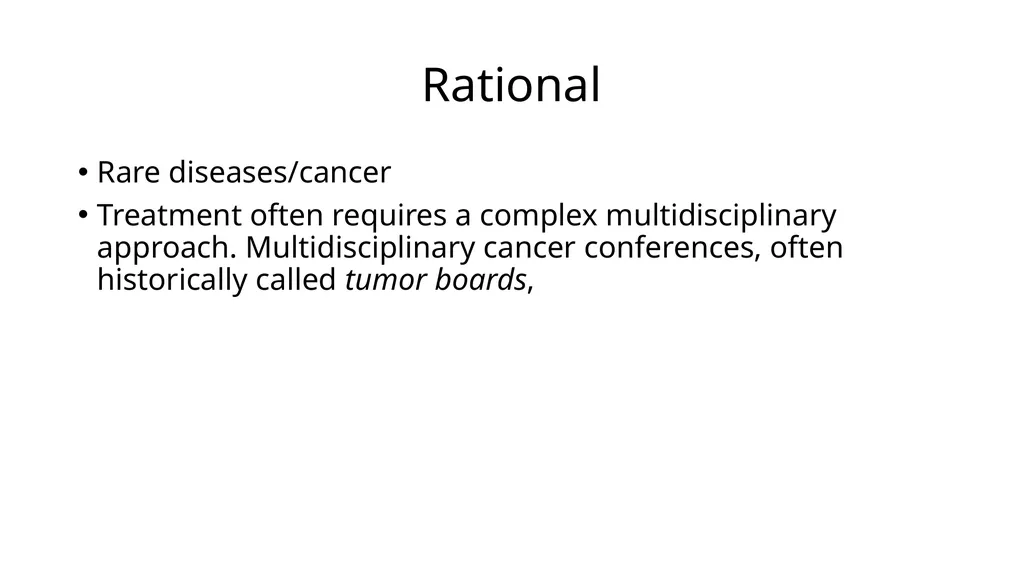
Rational Rare diseases/cancer
Treatment often requires a complex multidisciplinary approach. Multidisciplinary cancer conferences, often historically called tumor boards,<br>
Treatment often requires a complex multidisciplinary approach. Multidisciplinary cancer conferences, often historically called tumor boards,<br>
08
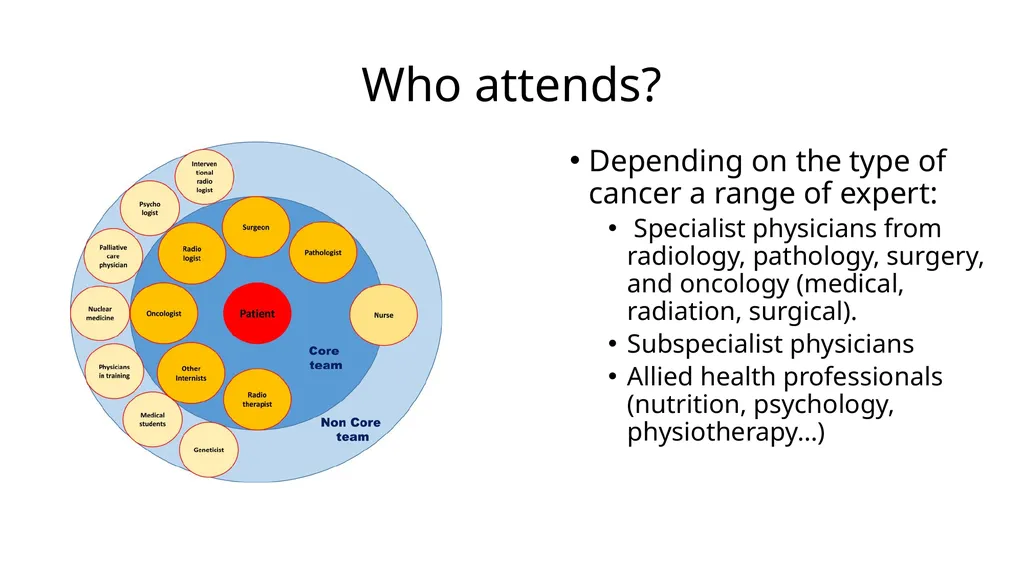
Who attends? Depending on the type of cancer a range of expert:
Specialist physicians from radiology, pathology, surgery, and oncology (medical, radiation, surgical).
Subspecialist physicians
Allied health professionals (nutrition, psychology, physiotherapy…)<br>
Specialist physicians from radiology, pathology, surgery, and oncology (medical, radiation, surgical).
Subspecialist physicians
Allied health professionals (nutrition, psychology, physiotherapy…)<br>
09
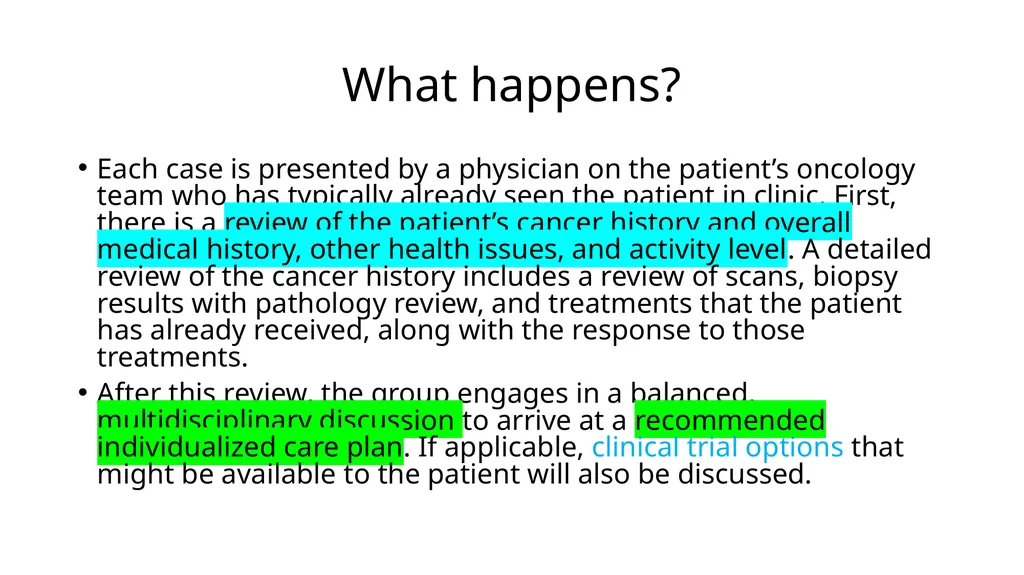
What happens? Each case is presented by a physician on the patient’s oncology team who has typically already seen the patient in clinic. First, there is a review of the patient’s cancer history and overall medical history, other health issues, and activity level. A detailed review of the cancer history includes a review of scans, biopsy results with pathology review, and treatments that the patient has already received, along with the response to those treatments.
After this review, the group engages in a balanced, multidisciplinary discussion to arrive at a recommended individualized care plan. If applicable, clinical trial options that might be available to the patient will also be discussed.<br>
After this review, the group engages in a balanced, multidisciplinary discussion to arrive at a recommended individualized care plan. If applicable, clinical trial options that might be available to the patient will also be discussed.<br>
10
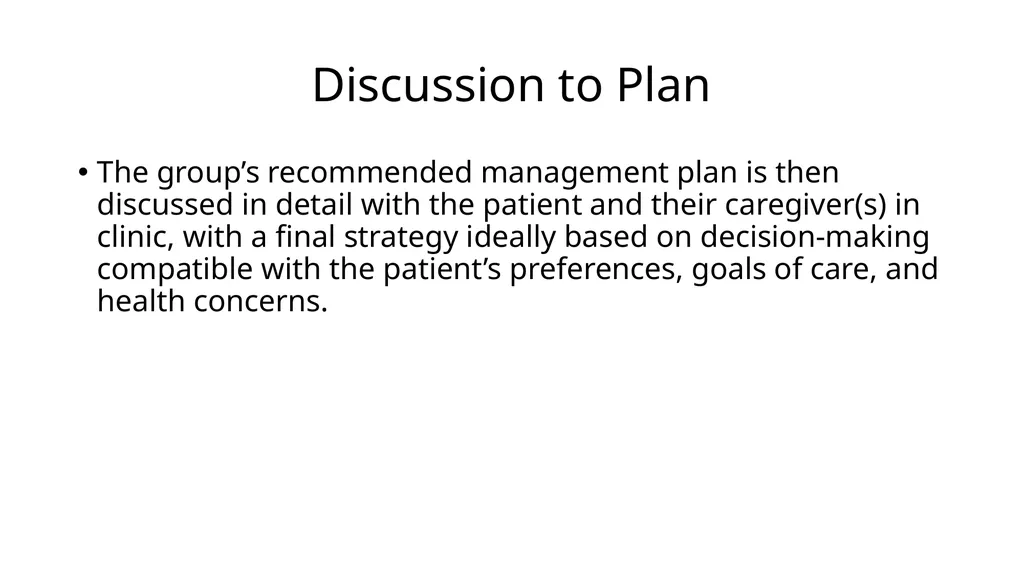
Discussion to Plan The group’s recommended management plan is then discussed in detail with the patient and their caregiver(s) in clinic, with a final strategy ideally based on decision-making compatible with the patient’s preferences, goals of care, and health concerns.<br>
11
Benefits of MTB What Are the Benefits of This Conference?
In-depth discussion of complex cases
Individualized treatment plans for the patient
Opportunity for multiple second opinions all in 1 setting
Other health care professionals, such as social workers and nurse navigators, can discuss barriers and how to overcome them
Consideration of clinical trial options that might be available
Review of resources and support needed for physical, psychological, dietary, and other patient needs
Coordination of care between subspecialties, shortening the time to start of treatment
Optimization of patient outcomes
greater likelihood of implementation of evidence-based medicine, or expert opinions when
evidence is not available from clinical trials.
Integration of oncology and palliative care<br>
In-depth discussion of complex cases
Individualized treatment plans for the patient
Opportunity for multiple second opinions all in 1 setting
Other health care professionals, such as social workers and nurse navigators, can discuss barriers and how to overcome them
Consideration of clinical trial options that might be available
Review of resources and support needed for physical, psychological, dietary, and other patient needs
Coordination of care between subspecialties, shortening the time to start of treatment
Optimization of patient outcomes
greater likelihood of implementation of evidence-based medicine, or expert opinions when
evidence is not available from clinical trials.
Integration of oncology and palliative care<br>
12
Benefits of MTB Greater likelihood of implementation of evidence-based medicine, or expert opinions when evidence is not available from clinical trials.
Multidisciplinary tumor boards reduce emotional burden & burnout in physicians
Effective multidisciplinary tumor boards require effective leadership
Integration of oncology and palliative care<br>
Multidisciplinary tumor boards reduce emotional burden & burnout in physicians
Effective multidisciplinary tumor boards require effective leadership
Integration of oncology and palliative care<br>
13
Limitations of MTB large time commitment
the economic cost
contrasting opinions
legal issues with confidentiality
treatment delays.
lack of significant impact on outcomes/controversial<br>
the economic cost
contrasting opinions
legal issues with confidentiality
treatment delays.
lack of significant impact on outcomes/controversial<br>
14
Relationship between multidisciplinary tumor boards, quality & outcomes in cancer care Research examining the impact of MTBs on cancer outcomes has been inconsistent.
Many studies have demonstrated positive outcomes but were not prospectively designed clinical trials, raising concerns about the quality and generalizability of their findings
In a review of 27 studies, only 13 studies had a control group (non-MTB), and in only 3 studies were the data prospectively collected .
MTBs changed diagnosis reports in 4–45% of the cases, and patients were more properly staged and more likely to receive a (neo)adjuvant treatment.
Only a few studies have revealed clear improvements in patient outcomes, such as a study of 9646 patients with sarcomas.<br>
Many studies have demonstrated positive outcomes but were not prospectively designed clinical trials, raising concerns about the quality and generalizability of their findings
In a review of 27 studies, only 13 studies had a control group (non-MTB), and in only 3 studies were the data prospectively collected .
MTBs changed diagnosis reports in 4–45% of the cases, and patients were more properly staged and more likely to receive a (neo)adjuvant treatment.
Only a few studies have revealed clear improvements in patient outcomes, such as a study of 9646 patients with sarcomas.<br>
15
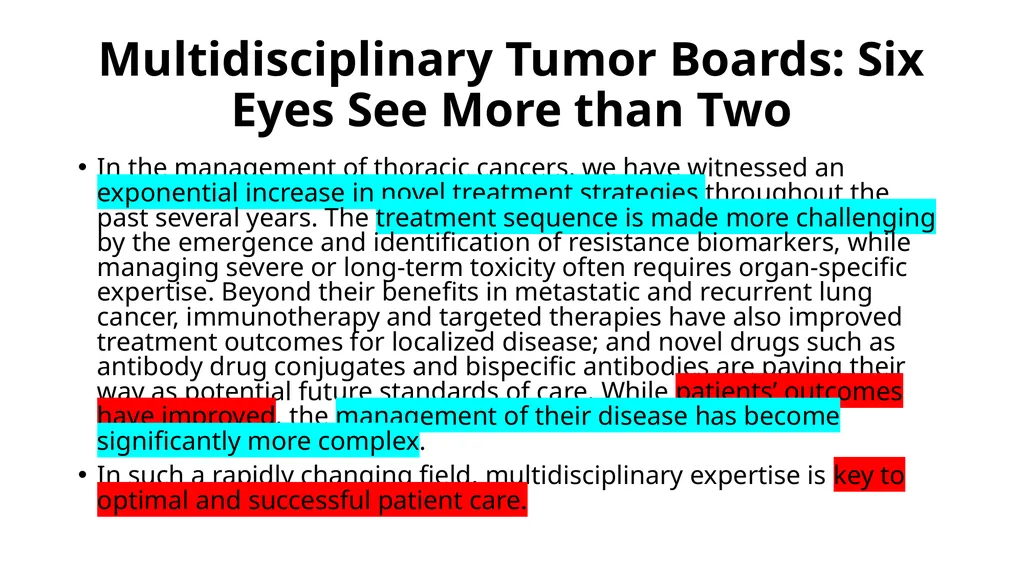
Multidisciplinary Tumor Boards: Six Eyes See More than Two In the management of thoracic cancers, we have witnessed an exponential increase in novel treatment strategies throughout the past several years. The treatment sequence is made more challenging by the emergence and identification of resistance biomarkers, while managing severe or long-term toxicity often requires organ-specific expertise. Beyond their benefits in metastatic and recurrent lung cancer, immunotherapy and targeted therapies have also improved treatment outcomes for localized disease; and novel drugs such as antibody drug conjugates and bispecific antibodies are paving their way as potential future standards of care. While patients’ outcomes have improved, the management of their disease has become significantly more complex.
In such a rapidly changing field, multidisciplinary expertise is key to optimal and successful patient care.<br>
In such a rapidly changing field, multidisciplinary expertise is key to optimal and successful patient care.<br>
16
Global Practice and Efficiency of
Multidisciplinary Tumor Boards: Results
of an American Society of Clinical
Oncology International Survey Methods
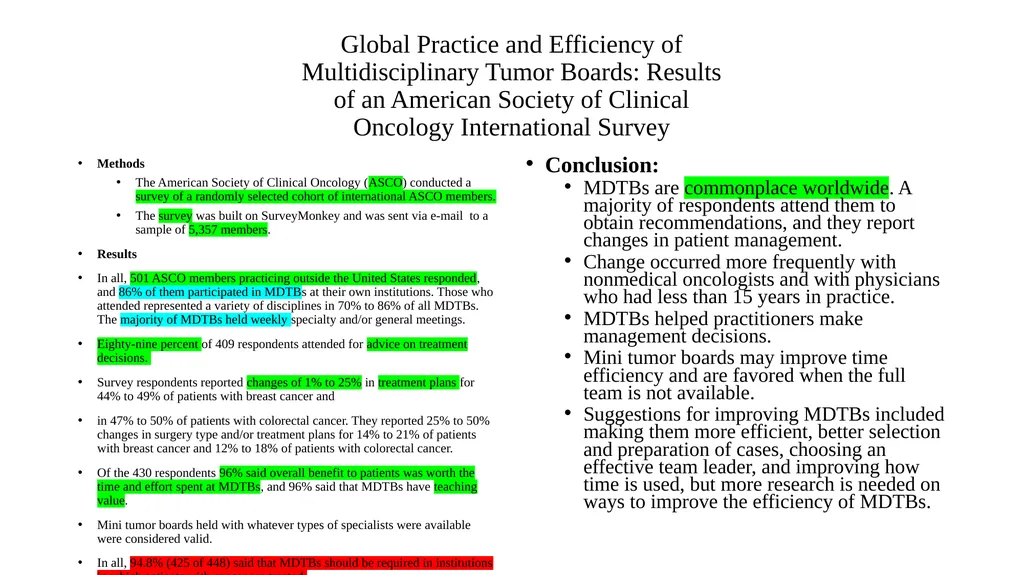
The American Society of Clinical Oncology (ASCO) conducted a survey of a randomly selected cohort of international ASCO members.
The survey was built on SurveyMonkey and was sent via e-mail to a sample of 5,357 members.
Results
In all, 501 ASCO members practicing outside the United States responded, and 86% of them participated in MDTBs at their own institutions. Those who attended represented a variety of disciplines in 70% to 86% of all MDTBs. The majority of MDTBs held weekly specialty and/or general meetings.
Eighty-nine percent of 409 respondents attended for advice on treatment decisions.
Survey respondents reported changes of 1% to 25% in treatment plans for 44% to 49% of patients with breast cancer and
in 47% to 50% of patients with colorectal cancer. They reported 25% to 50% changes in surgery type and/or treatment plans for 14% to 21% of patients with breast cancer and 12% to 18% of patients with colorectal cancer.
Of the 430 respondents 96% said overall benefit to patients was worth the time and effort spent at MDTBs, and 96% said that MDTBs have teaching value.
Mini tumor boards held with whatever types of specialists were available were considered valid.
In all, 94.8% (425 of 448) said that MDTBs should be required in institutions in which patients with cancer are treated. Conclusion:
MDTBs are commonplace worldwide. A majority of respondents attend them to obtain recommendations, and they report changes in patient management.
Change occurred more frequently with nonmedical oncologists and with physicians who had less than 15 years in practice.
MDTBs helped practitioners make management decisions.
Mini tumor boards may improve time efficiency and are favored when the full team is not available.
Suggestions for improving MDTBs included making them more efficient, better selection and preparation of cases, choosing an effective team leader, and improving how time is used, but more research is needed on ways to improve the efficiency of MDTBs.<br>
The American Society of Clinical Oncology (ASCO) conducted a survey of a randomly selected cohort of international ASCO members.
The survey was built on SurveyMonkey and was sent via e-mail to a sample of 5,357 members.
Results
In all, 501 ASCO members practicing outside the United States responded, and 86% of them participated in MDTBs at their own institutions. Those who attended represented a variety of disciplines in 70% to 86% of all MDTBs. The majority of MDTBs held weekly specialty and/or general meetings.
Eighty-nine percent of 409 respondents attended for advice on treatment decisions.
Survey respondents reported changes of 1% to 25% in treatment plans for 44% to 49% of patients with breast cancer and
in 47% to 50% of patients with colorectal cancer. They reported 25% to 50% changes in surgery type and/or treatment plans for 14% to 21% of patients with breast cancer and 12% to 18% of patients with colorectal cancer.
Of the 430 respondents 96% said overall benefit to patients was worth the time and effort spent at MDTBs, and 96% said that MDTBs have teaching value.
Mini tumor boards held with whatever types of specialists were available were considered valid.
In all, 94.8% (425 of 448) said that MDTBs should be required in institutions in which patients with cancer are treated. Conclusion:
MDTBs are commonplace worldwide. A majority of respondents attend them to obtain recommendations, and they report changes in patient management.
Change occurred more frequently with nonmedical oncologists and with physicians who had less than 15 years in practice.
MDTBs helped practitioners make management decisions.
Mini tumor boards may improve time efficiency and are favored when the full team is not available.
Suggestions for improving MDTBs included making them more efficient, better selection and preparation of cases, choosing an effective team leader, and improving how time is used, but more research is needed on ways to improve the efficiency of MDTBs.<br>
17
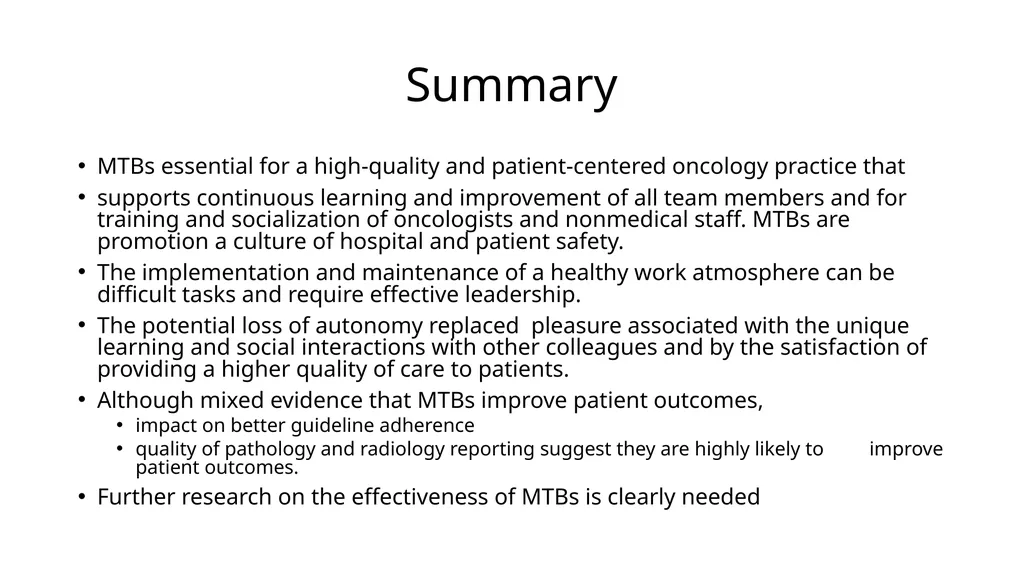
Summary MTBs essential for a high-quality and patient-centered oncology practice that
supports continuous learning and improvement of all team members and for training and socialization of oncologists and nonmedical staff. MTBs are promotion a culture of hospital and patient safety.
The implementation and maintenance of a healthy work atmosphere can be difficult tasks and require effective leadership.
The potential loss of autonomy replaced pleasure associated with the unique learning and social interactions with other colleagues and by the satisfaction of providing a higher quality of care to patients.
Although mixed evidence that MTBs improve patient outcomes,
impact on better guideline adherence
quality of pathology and radiology reporting suggest they are highly likely to improve patient outcomes.
Further research on the effectiveness of MTBs is clearly needed<br>
supports continuous learning and improvement of all team members and for training and socialization of oncologists and nonmedical staff. MTBs are promotion a culture of hospital and patient safety.
The implementation and maintenance of a healthy work atmosphere can be difficult tasks and require effective leadership.
The potential loss of autonomy replaced pleasure associated with the unique learning and social interactions with other colleagues and by the satisfaction of providing a higher quality of care to patients.
Although mixed evidence that MTBs improve patient outcomes,
impact on better guideline adherence
quality of pathology and radiology reporting suggest they are highly likely to improve patient outcomes.
Further research on the effectiveness of MTBs is clearly needed<br>
18
MERCI ?<br>
19
References The Multidisciplinary Cancer Conference Eric K. Singhi, MD1; Jill Feldman2; Howard (Jack) West, MD3 Article Information. JAMA Oncol. 2023;9(2):288. doi:10.1001/jamaoncol.2022.4924
Global Practice and Efficiency of Multidisciplinary Tumor Boards: Results of an American Society of Clinical Oncology International Survey. Global Practice and Efficiency of Multidisciplinary Tumor Boards: Results of an American Society of Clinical Oncology International Survey. Nagi S. El Saghir. J Glob Oncol 1:57-64. © 2015 by American Society of Clinical Oncology
Blay JY , SoibinetP, PenelNet al. Improved survival using specialized multidisciplinary board in sarcoma patients. Ann. Oncol.28(11), 2852–2859 (2017).
Multidisciplinary Tumor Boards: Six Eyes See More than Two. By: Mihaela Aldea, MD, PhD, Cecile Le Pechoux, MD, Sacha Mussot, MD, David Planchard, MD, PhD, and Benjamin Besse, MD, PhD. https://www.ilcn.org/multidisciplinary-tumor-boards-six-eyes-see-more-than-two/
The evolution of the multidisciplinary tumor board in orthopedic oncology: from its historical roots to its future potential. Review Open access Published: 09 July 2024 Volume 3, article number 36, (2024)
Integration of oncology and palliative care: a Lancet Oncology Commission. Kaasa S. Lancet Oncol. 2018 Nov;19(11):e588-e653. doi: 10.1016/S1470-2045(18)30415-7. Epub 2018 Oct 18. PMID: 30344075<br>
Global Practice and Efficiency of Multidisciplinary Tumor Boards: Results of an American Society of Clinical Oncology International Survey. Global Practice and Efficiency of Multidisciplinary Tumor Boards: Results of an American Society of Clinical Oncology International Survey. Nagi S. El Saghir. J Glob Oncol 1:57-64. © 2015 by American Society of Clinical Oncology
Blay JY , SoibinetP, PenelNet al. Improved survival using specialized multidisciplinary board in sarcoma patients. Ann. Oncol.28(11), 2852–2859 (2017).
Multidisciplinary Tumor Boards: Six Eyes See More than Two. By: Mihaela Aldea, MD, PhD, Cecile Le Pechoux, MD, Sacha Mussot, MD, David Planchard, MD, PhD, and Benjamin Besse, MD, PhD. https://www.ilcn.org/multidisciplinary-tumor-boards-six-eyes-see-more-than-two/
The evolution of the multidisciplinary tumor board in orthopedic oncology: from its historical roots to its future potential. Review Open access Published: 09 July 2024 Volume 3, article number 36, (2024)
Integration of oncology and palliative care: a Lancet Oncology Commission. Kaasa S. Lancet Oncol. 2018 Nov;19(11):e588-e653. doi: 10.1016/S1470-2045(18)30415-7. Epub 2018 Oct 18. PMID: 30344075<br>