04
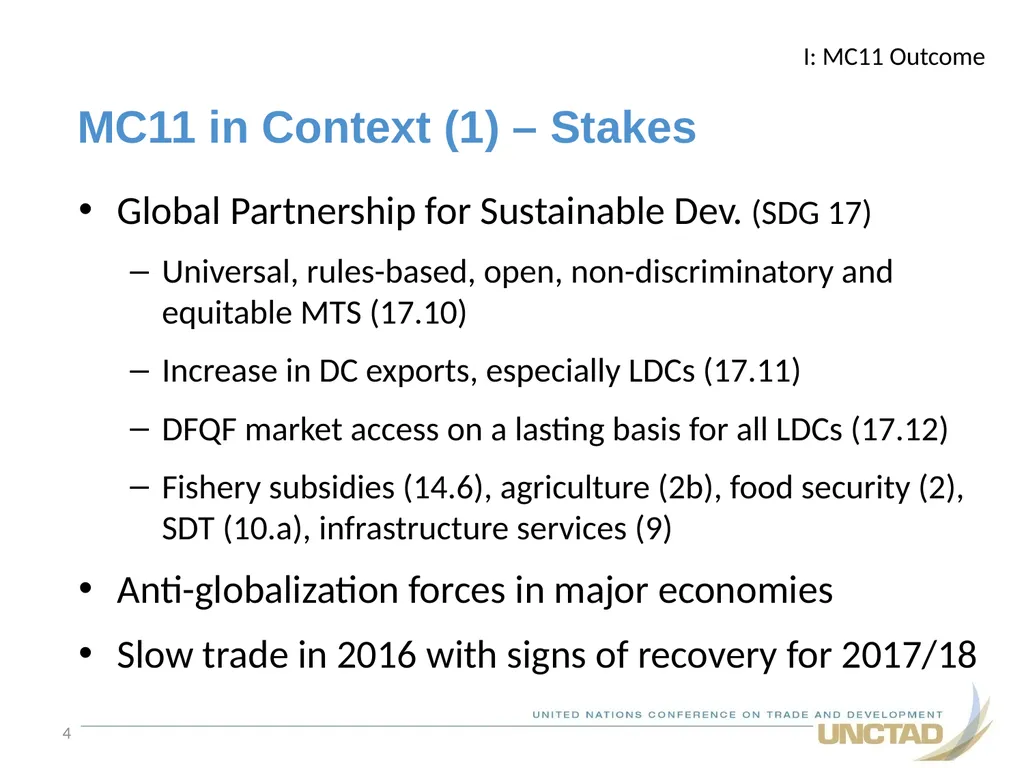
Global Partnership for Sustainable Dev. (SDG 17)
Universal, rules-based, open, non-discriminatory and equitable MTS (17.10)
Increase in DC exports, especially LDCs (17.11)
DFQF market access on a lasting basis for all LDCs (17.12)
Fishery subsidies (14.6), agriculture (2b), food security (2), SDT (10.a), infrastructure services (9)
Anti-globalization forces in major economies
Slow trade in 2016 with signs of recovery for 2017/18 I: MC11 Outcome MC11 in Context (1) – Stakes 4<br>
05
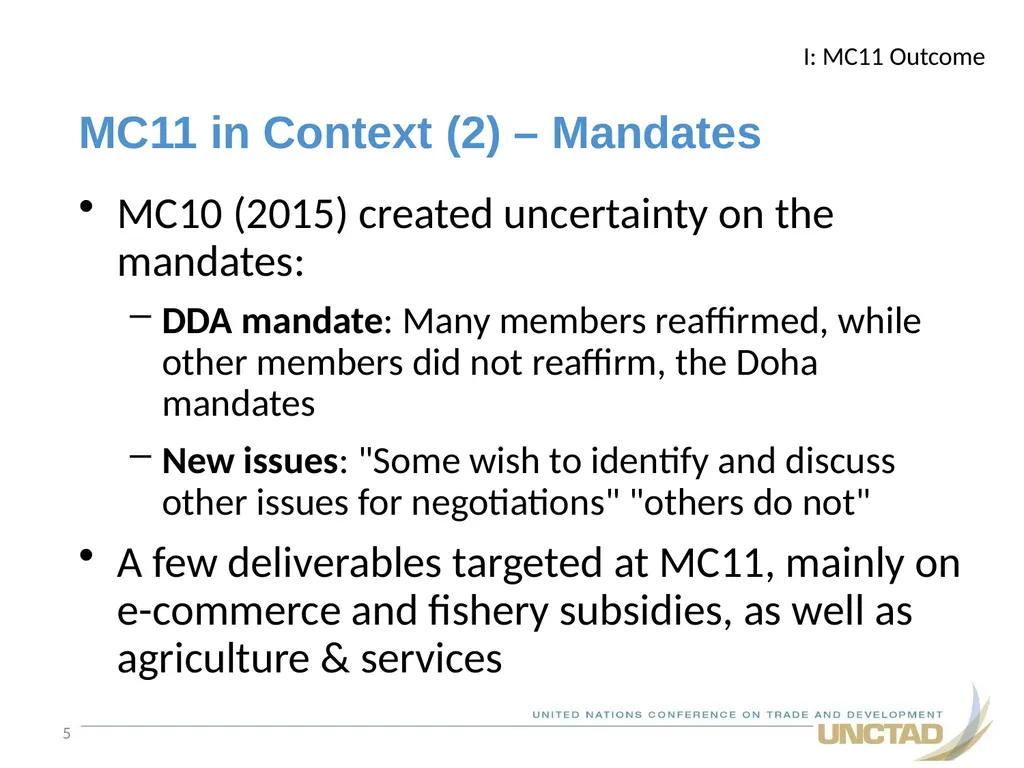
MC10 (2015) created uncertainty on the mandates:
DDA mandate: Many members reaffirmed, while other members did not reaffirm, the Doha mandates
New issues: "Some wish to identify and discuss other issues for negotiations" "others do not"
A few deliverables targeted at MC11, mainly on e-commerce and fishery subsidies, as well as agriculture & services MC11 in Context (2) – Mandates 5 I: MC11 Outcome<br>
06
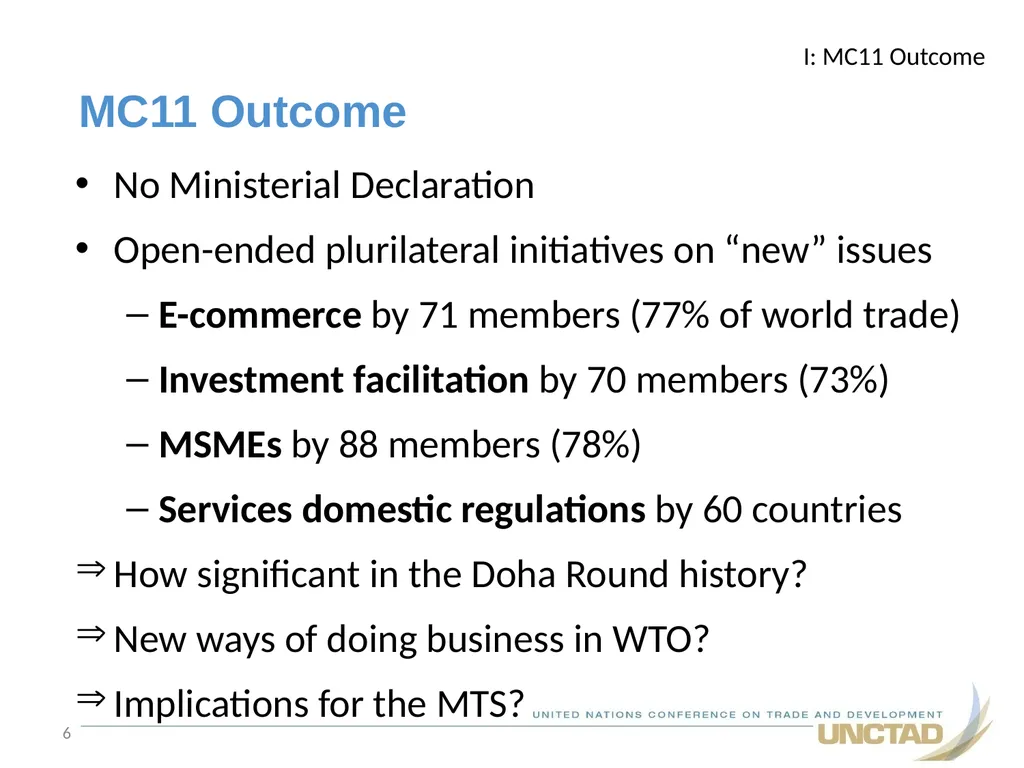
No Ministerial Declaration
Open-ended plurilateral initiatives on “new” issues
E-commerce by 71 members (77% of world trade)
Investment facilitation by 70 members (73%)
MSMEs by 88 members (78%)
Services domestic regulations by 60 countries
How significant in the Doha Round history?
New ways of doing business in WTO?
Implications for the MTS? MC11 Outcome 6 I: MC11 Outcome<br>
07
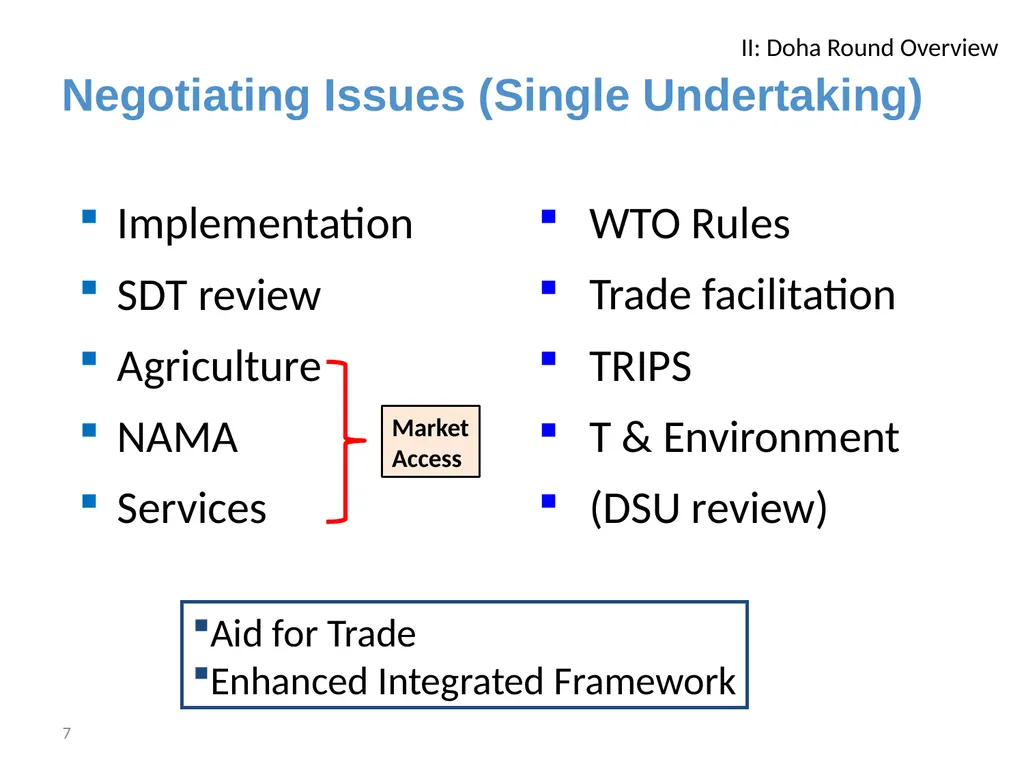
Negotiating Issues (Single Undertaking) Implementation
SDT review
Agriculture
NAMA
Services WTO Rules
Trade facilitation
TRIPS
T & Environment
(DSU review) Aid for Trade
Enhanced Integrated Framework 7 II: Doha Round Overview Market Access<br>
08
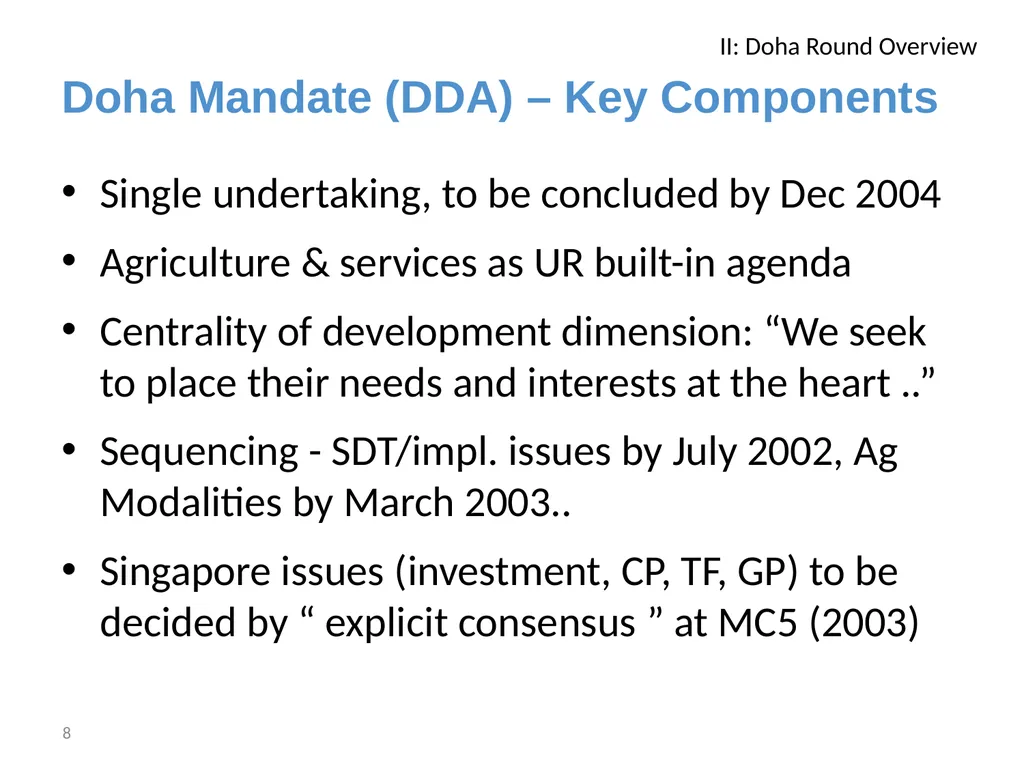
Doha Mandate (DDA) – Key Components Single undertaking, to be concluded by Dec 2004
Agriculture & services as UR built-in agenda
Centrality of development dimension: “We seek to place their needs and interests at the heart ..”
Sequencing - SDT/impl. issues by July 2002, Ag Modalities by March 2003..
Singapore issues (investment, CP, TF, GP) to be decided by “ explicit consensus ” at MC5 (2003) 8 II: Doha Round Overview<br>
09
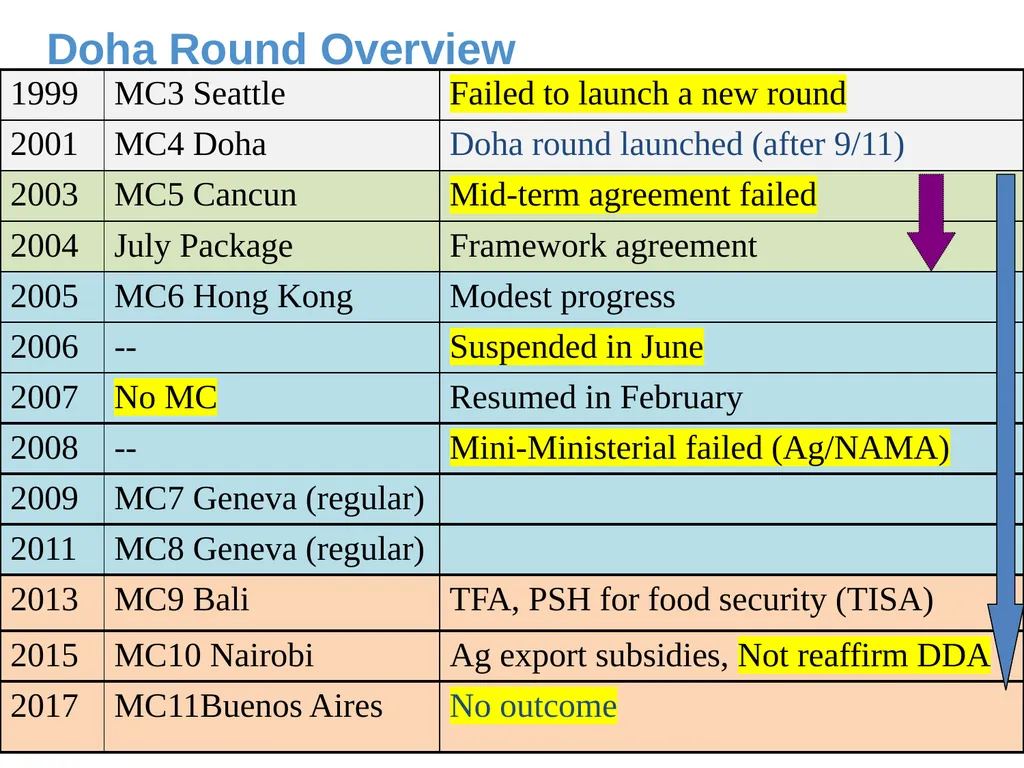
9 Doha Round Overview<br>
10
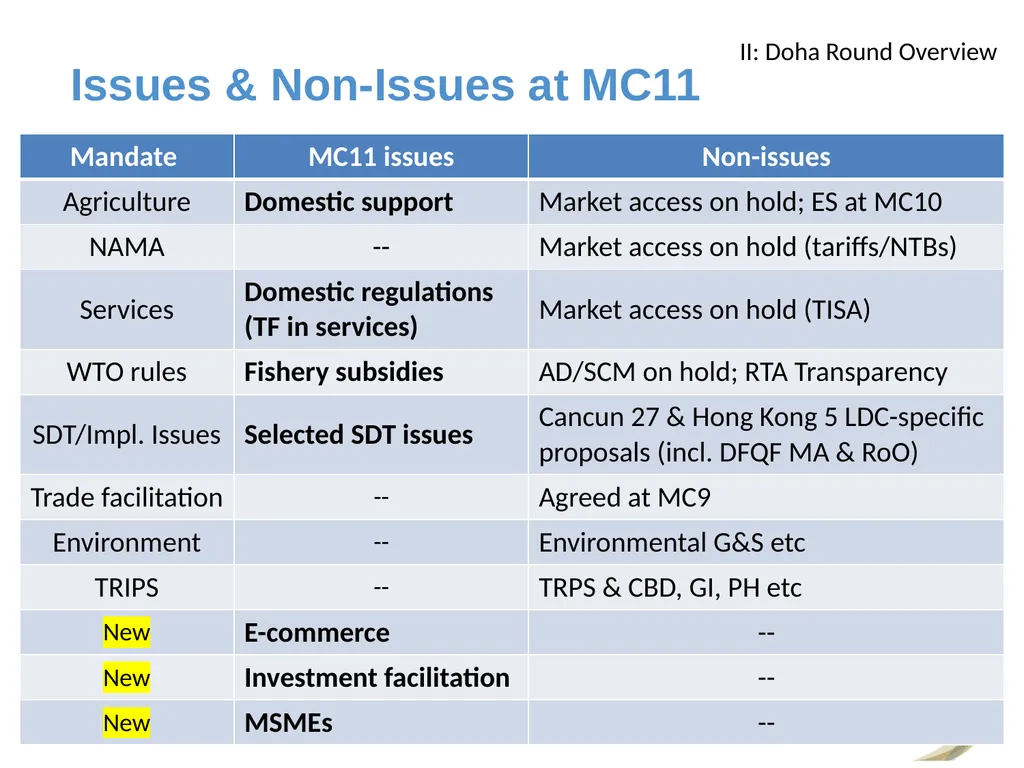
Issues & Non-Issues at MC11 II: Doha Round Overview<br>
11
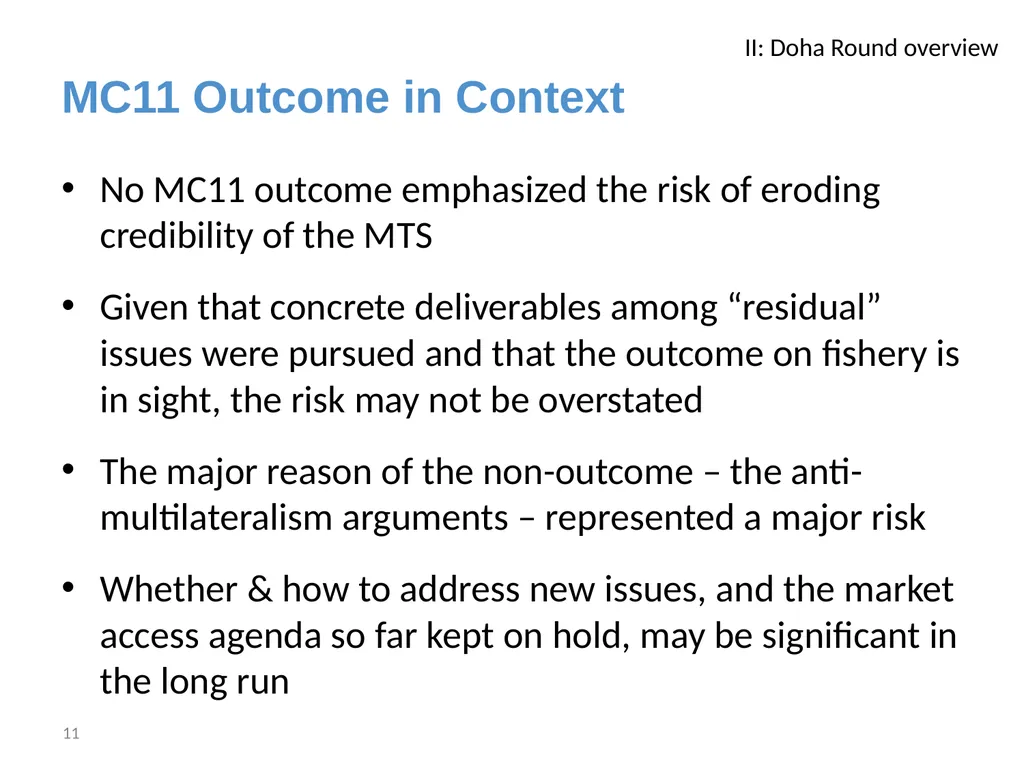
MC11 Outcome in Context No MC11 outcome emphasized the risk of eroding credibility of the MTS
Given that concrete deliverables among “residual” issues were pursued and that the outcome on fishery is in sight, the risk may not be overstated
The major reason of the non-outcome – the anti-multilateralism arguments – represented a major risk
Whether & how to address new issues, and the market access agenda so far kept on hold, may be significant in the long run 11 II: Doha Round overview<br>
12
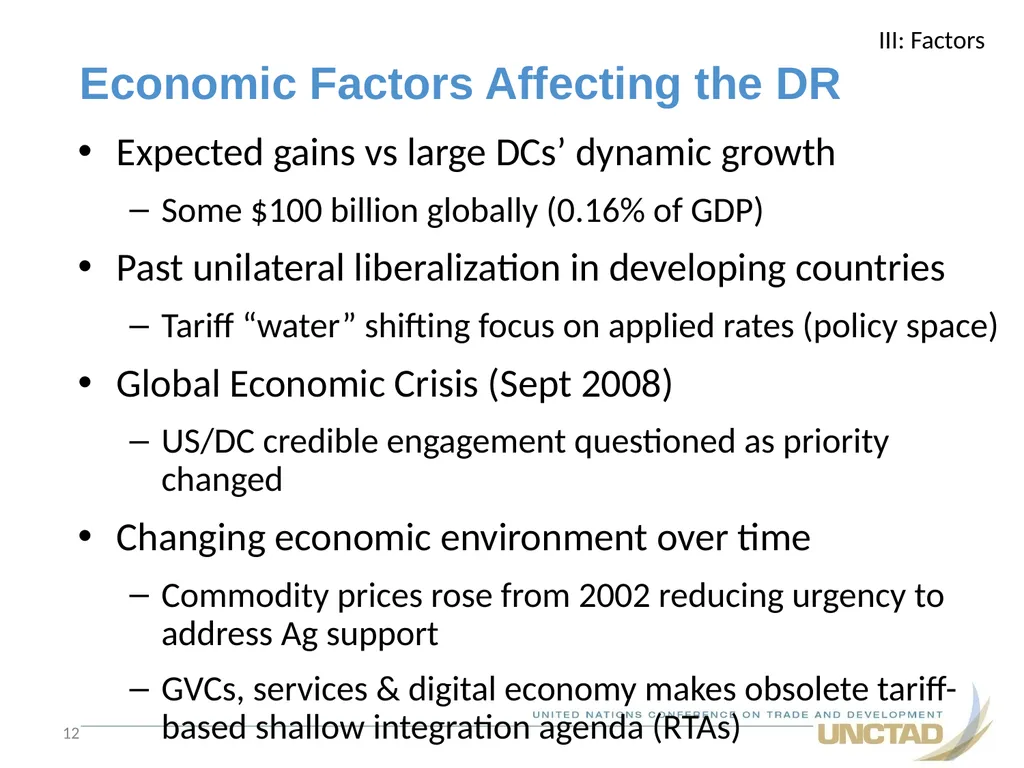
Expected gains vs large DCs’ dynamic growth
Some $100 billion globally (0.16% of GDP)
Past unilateral liberalization in developing countries
Tariff “water” shifting focus on applied rates (policy space)
Global Economic Crisis (Sept 2008)
US/DC credible engagement questioned as priority changed
Changing economic environment over time
Commodity prices rose from 2002 reducing urgency to address Ag support
GVCs, services & digital economy makes obsolete tariff-based shallow integration agenda (RTAs) Economic Factors Affecting the DR 12 III: Factors<br>
13
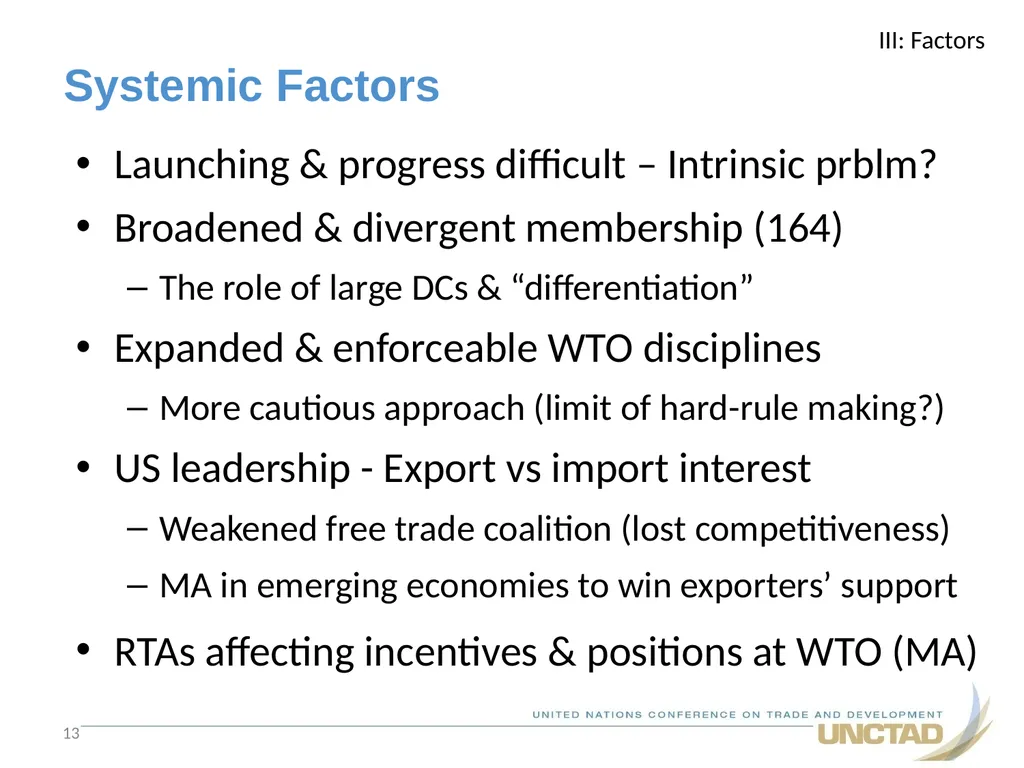
Launching & progress difficult – Intrinsic prblm?
Broadened & divergent membership (164)
The role of large DCs & “differentiation”
Expanded & enforceable WTO disciplines
More cautious approach (limit of hard-rule making?)
US leadership - Export vs import interest
Weakened free trade coalition (lost competitiveness)
MA in emerging economies to win exporters’ support
RTAs affecting incentives & positions at WTO (MA) Systemic Factors 13 III: Factors<br>
14
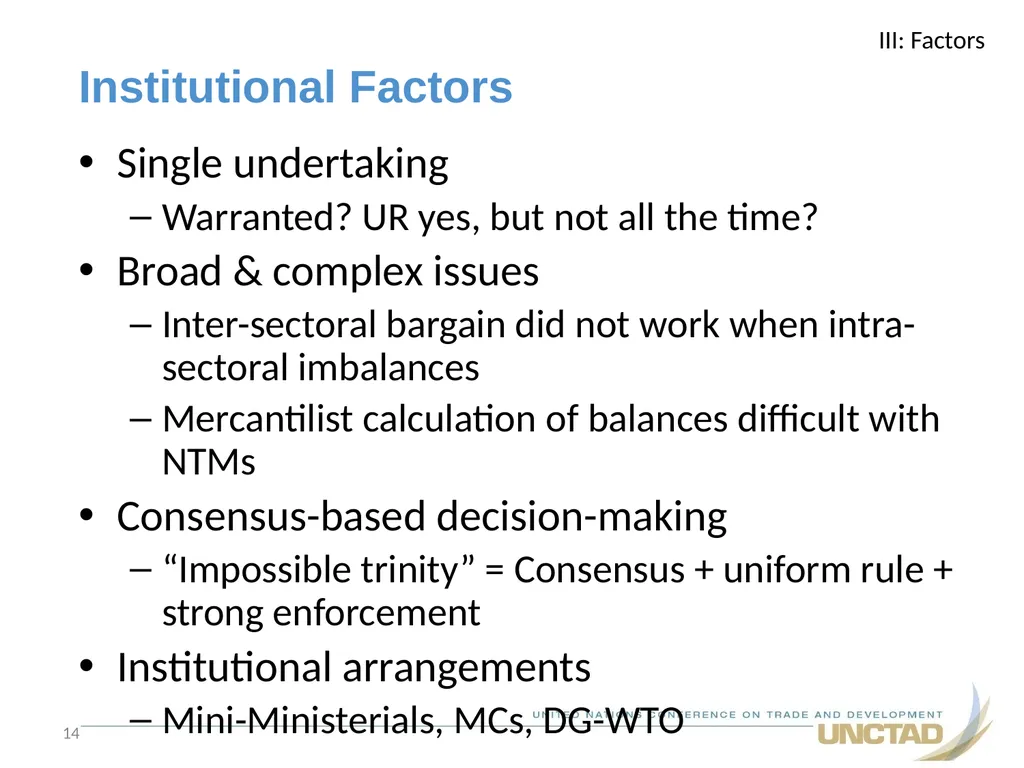
Single undertaking
Warranted? UR yes, but not all the time?
Broad & complex issues
Inter-sectoral bargain did not work when intra-sectoral imbalances
Mercantilist calculation of balances difficult with NTMs
Consensus-based decision-making
“Impossible trinity” = Consensus + uniform rule + strong enforcement
Institutional arrangements
Mini-Ministerials, MCs, DG-WTO Institutional Factors 14 III: Factors<br>
15
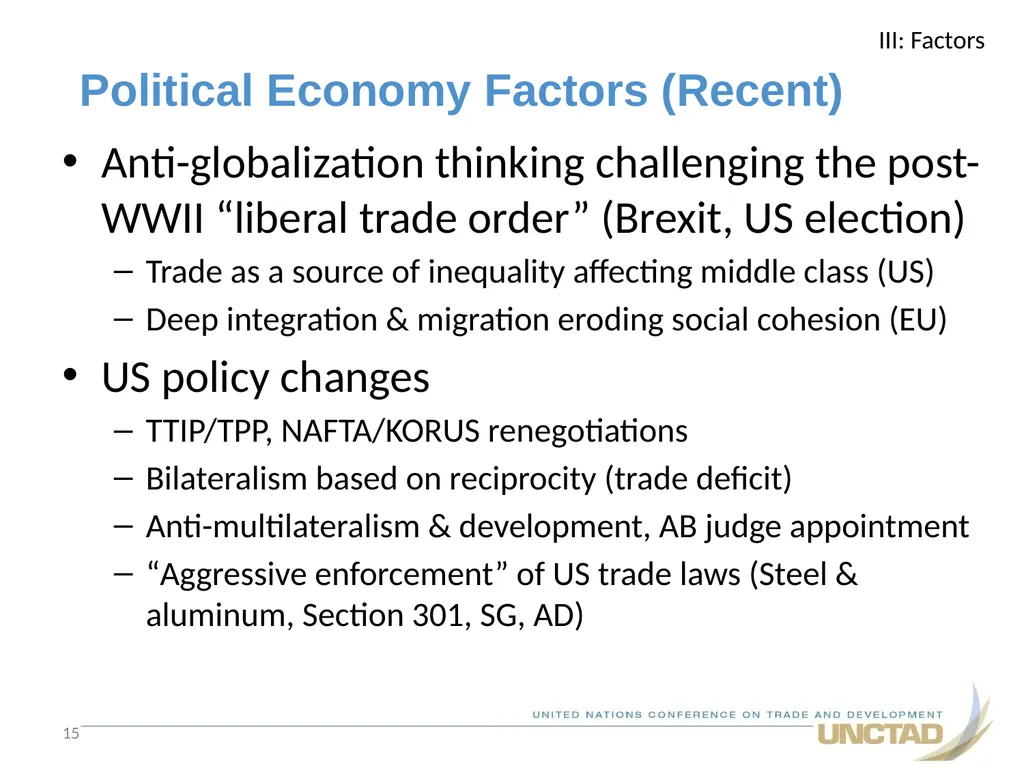
Anti-globalization thinking challenging the post-WWII “liberal trade order” (Brexit, US election)
Trade as a source of inequality affecting middle class (US)
Deep integration & migration eroding social cohesion (EU)
US policy changes
TTIP/TPP, NAFTA/KORUS renegotiations
Bilateralism based on reciprocity (trade deficit)
Anti-multilateralism & development, AB judge appointment
“Aggressive enforcement” of US trade laws (Steel & aluminum, Section 301, SG, AD) Political Economy Factors (Recent) 15 III: Factors<br>
16
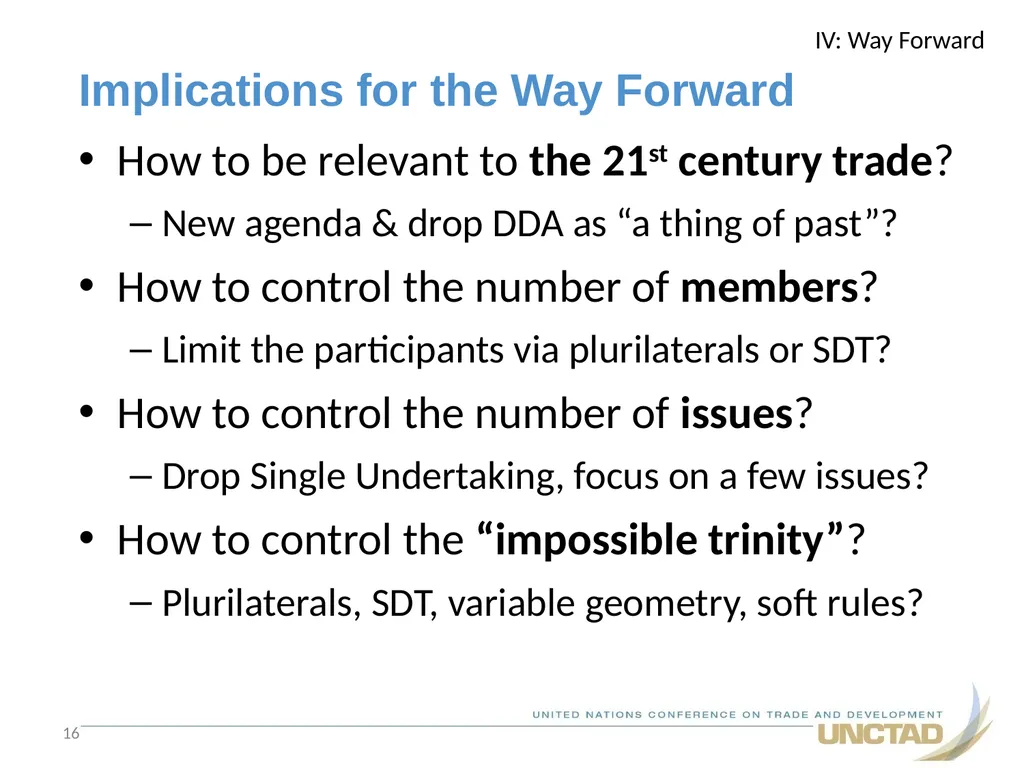
How to be relevant to the 21st century trade?
New agenda & drop DDA as “a thing of past”?
How to control the number of members?
Limit the participants via plurilaterals or SDT?
How to control the number of issues?
Drop Single Undertaking, focus on a few issues?
How to control the “impossible trinity”?
Plurilaterals, SDT, variable geometry, soft rules? Implications for the Way Forward 16 IV: Way Forward<br>
17
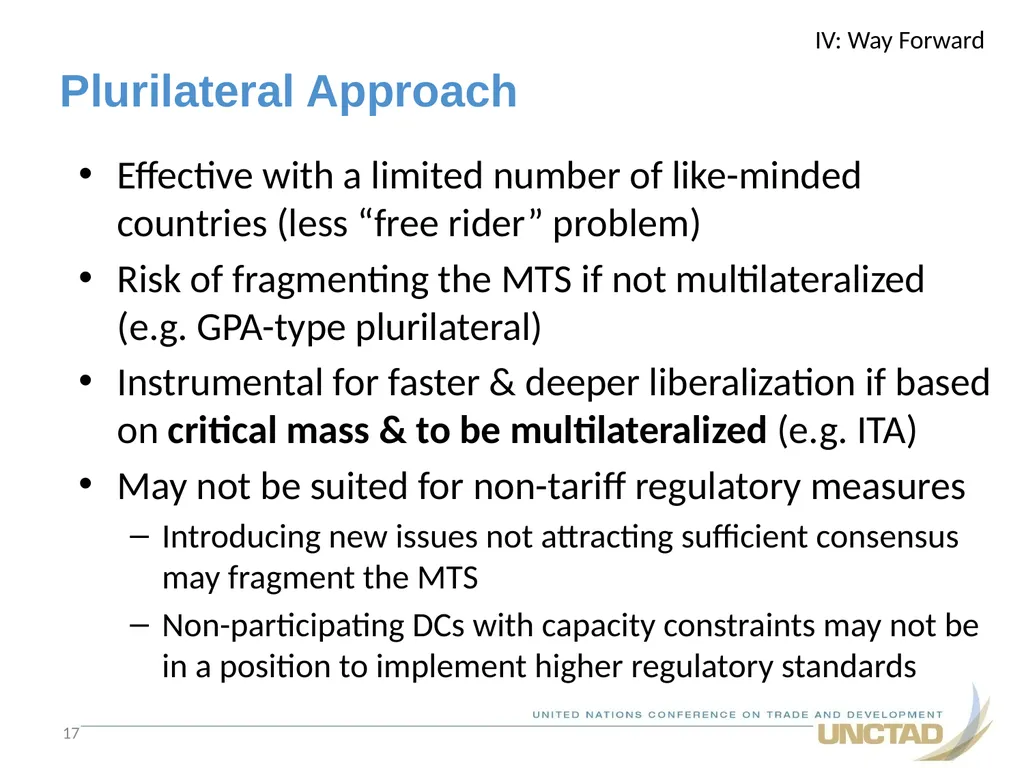
Effective with a limited number of like-minded countries (less “free rider” problem)
Risk of fragmenting the MTS if not multilateralized (e.g. GPA-type plurilateral)
Instrumental for faster & deeper liberalization if based on critical mass & to be multilateralized (e.g. ITA)
May not be suited for non-tariff regulatory measures
Introducing new issues not attracting sufficient consensus may fragment the MTS
Non-participating DCs with capacity constraints may not be in a position to implement higher regulatory standards Plurilateral Approach 17 IV: Way Forward<br>
18
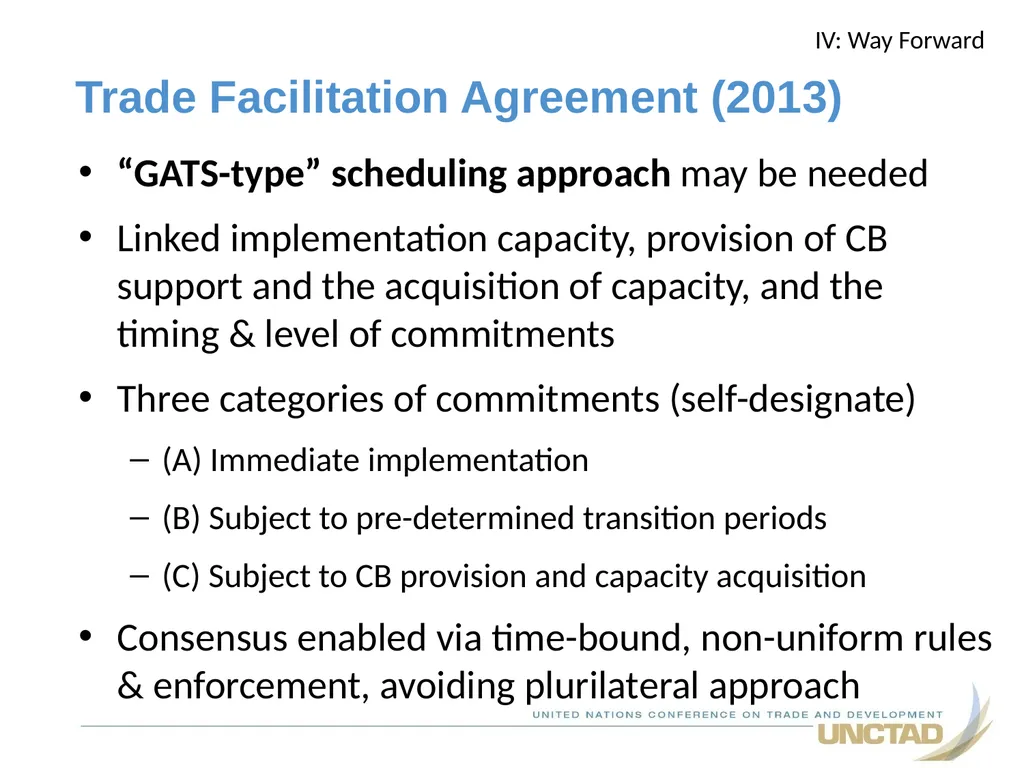
“GATS-type” scheduling approach may be needed
Linked implementation capacity, provision of CB support and the acquisition of capacity, and the timing & level of commitments
Three categories of commitments (self-designate)
(A) Immediate implementation
(B) Subject to pre-determined transition periods
(C) Subject to CB provision and capacity acquisition
Consensus enabled via time-bound, non-uniform rules & enforcement, avoiding plurilateral approach Trade Facilitation Agreement (2013) IV: Way Forward<br>
19
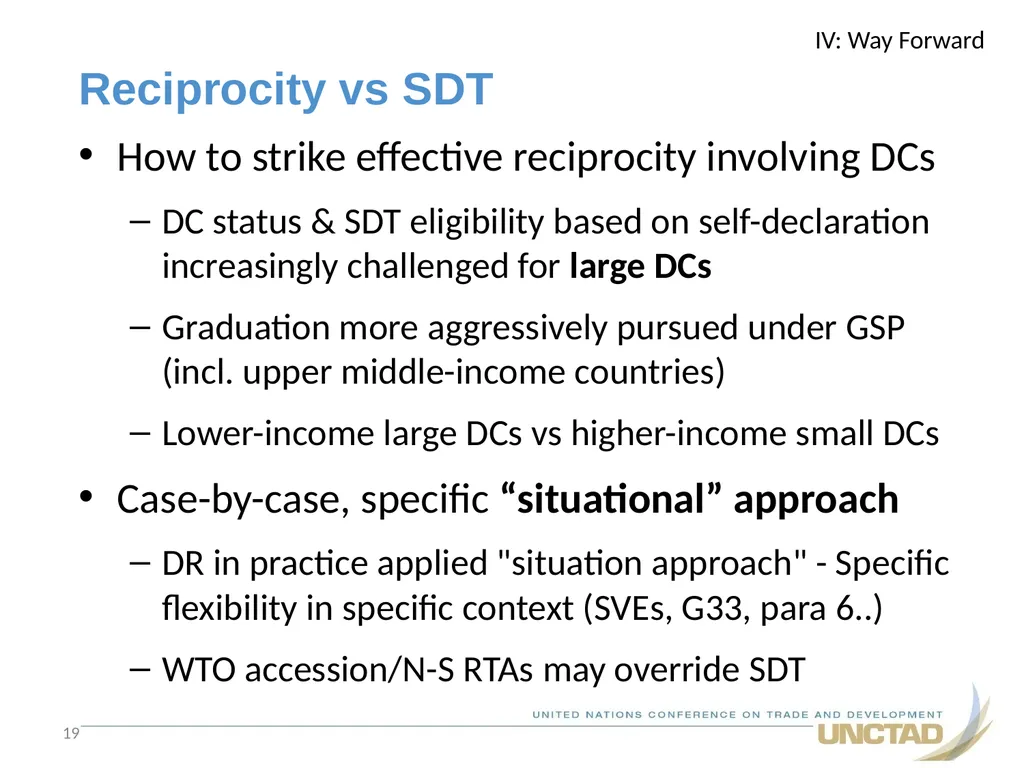
How to strike effective reciprocity involving DCs
DC status & SDT eligibility based on self-declaration increasingly challenged for large DCs
Graduation more aggressively pursued under GSP (incl. upper middle-income countries)
Lower-income large DCs vs higher-income small DCs
Case-by-case, specific “situational” approach
DR in practice applied "situation approach" - Specific flexibility in specific context (SVEs, G33, para 6..)
WTO accession/N-S RTAs may override SDT Reciprocity vs SDT 19 IV: Way Forward<br>
20
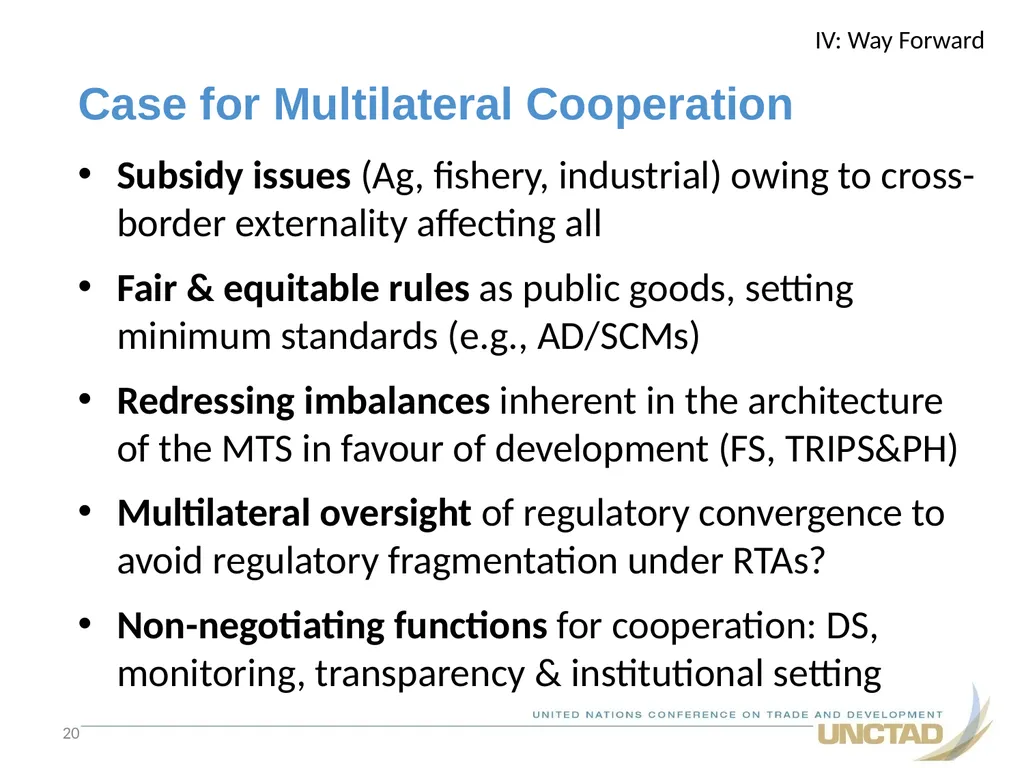
Subsidy issues (Ag, fishery, industrial) owing to cross-border externality affecting all
Fair & equitable rules as public goods, setting minimum standards (e.g., AD/SCMs)
Redressing imbalances inherent in the architecture of the MTS in favour of development (FS, TRIPS&PH)
Multilateral oversight of regulatory convergence to avoid regulatory fragmentation under RTAs?
Non-negotiating functions for cooperation: DS, monitoring, transparency & institutional setting Case for Multilateral Cooperation 20 IV: Way Forward<br>
21
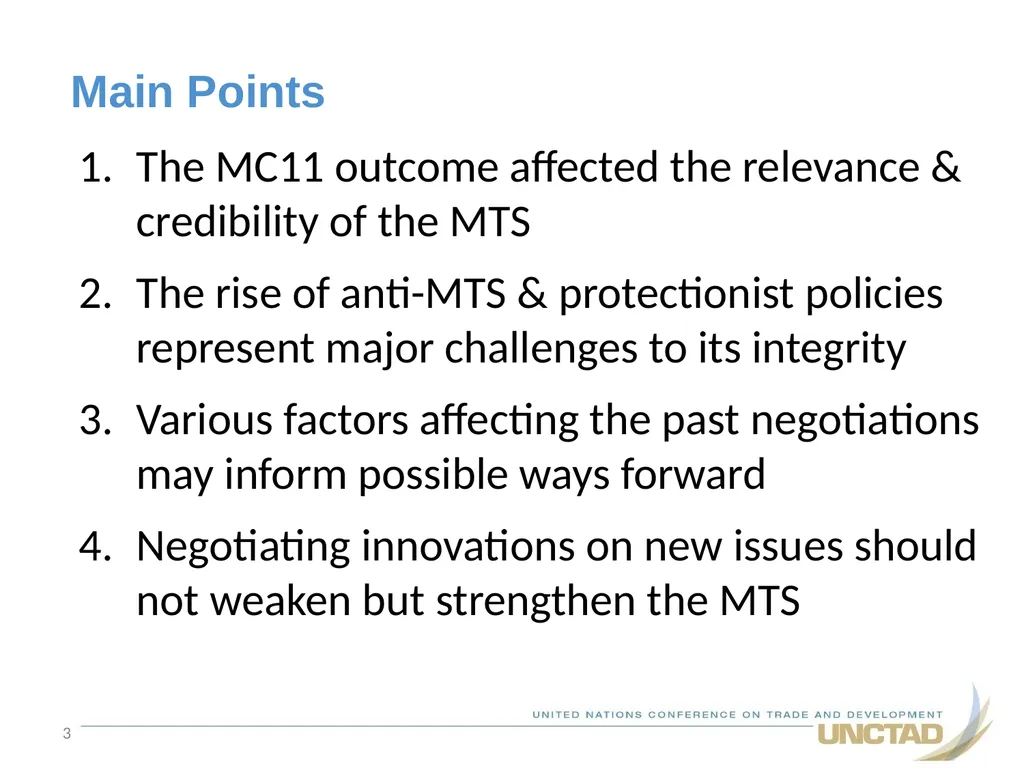
The MC11 outcome affected the relevance & credibility of the MTS
The rise of anti-MTS & protectionist policies represent major challenges to its integrity
Various factors affecting the past negotiations may inform possible ways forward
Negotiating innovations on new issues should not weaken but strengthen the MTS Summary 21<br>
22
Contacts�Taisuke Ito�E-mail: taisuke.ito@unctad.org�Tel: +41 22 917 4893 Thank you. 22<br>