
MULTIPLE DISABILITY P . KAMARAJ, Faculty , NIEPMD,
LO
Published · 35 slides · 0 views
1 / 1
Description
MULTIPLE DISABILITY P . KAMARAJ, Faculty , NIEPMD, ECR ,Muttukadu , Chennai Kamarajnimhyahoo.com 9840380628 TNTEU , B.Ed SPECIAL EDUCATION PROGRAM Course 5 : Assessment and Identification of Needs of Persons with Multiple Disabilities
Related Topics
Share
Embed code
Download this presentation From Below
"MULTIPLE DISABILITY P . KAMARAJ, Faculty , NIEPMD," is the property of its rightful owner. Permission is granted to download and print the materials on this website for personal, non-commercial use only, and to display it on your personal computer provided you do not modify the materials and that you retain all copyright notices contained in the materials. By downloading content from our website, you accept the terms of this agreement.
Presentation Transcript
01
MULTIPLE DISABILITY P . KAMARAJ, Faculty , NIEPMD, ECR ,Muttukadu , Chennai
Kamaraj_nimh@yahoo.com
9840380628<br>
Kamaraj_nimh@yahoo.com
9840380628<br>
02
TNTEU , B.Ed –SPECIAL EDUCATION PROGRAM Course 5 : Assessment and Identification of Needs of Persons with Multiple Disabilities
Unit –III : Multiple Disabilities and other disability conditions
Sub Unit 3.1 : Multiple Disabilities Meaning , Definitions and classifications
Sub Unit 3.2 : Various combinations of Multiple Disabilities and Associated conditions such as epilepsy motor and sensory condition
Sub Unit 3.3 : Implication of Functional limitations for Education of children with multiple disabilities<br>
Unit –III : Multiple Disabilities and other disability conditions
Sub Unit 3.1 : Multiple Disabilities Meaning , Definitions and classifications
Sub Unit 3.2 : Various combinations of Multiple Disabilities and Associated conditions such as epilepsy motor and sensory condition
Sub Unit 3.3 : Implication of Functional limitations for Education of children with multiple disabilities<br>
03
MULTIPLE DISABILITIES children with multiple disabilities are often called
Severe handicapped
Severely and profoundly handicap
Dual sensory impaired
Additional disabilities
Multiple disabilities<br>
Severe handicapped
Severely and profoundly handicap
Dual sensory impaired
Additional disabilities
Multiple disabilities<br>
04
DEFINITION “Multiple disabilities” means concomitant impairments (such as mental retardation-blindness, mental retardation orthopedic impairment), the combination of which causes such severe educational problems that the students cannot be accommodated in Special Education program solely for one of the impairment. The term does not include students with deaf-blindness - USOSE (2004)<br>
05
DEFINITION Multiple Disability” mean a combination of two or more disabilities as defined in clause (i) of section (2) of the Persons with Disabilities (Equal Opportunities, Protection of Rights and Full Participation) Act 1995<br>
06
DEFINITION Those children excluded from school on the basis of extensive mental, physical, and or behavioral impairments that are permanent in nature<br>
07
CLASSIFICATIONS The classification of children with Multiple Disabilities are based on the combinations and severity
Moderate , Severe & Profound condition of any one of the disability in the combination makes the person become multiple disabilities.
In the diagnostic assessment and evaluation process it is addressed that the impairment or the disability condition is more than 60 % among the bench mark disabilities become multiple disabilities in turn they are also called as the children having high support needs.<br>
Moderate , Severe & Profound condition of any one of the disability in the combination makes the person become multiple disabilities.
In the diagnostic assessment and evaluation process it is addressed that the impairment or the disability condition is more than 60 % among the bench mark disabilities become multiple disabilities in turn they are also called as the children having high support needs.<br>
08
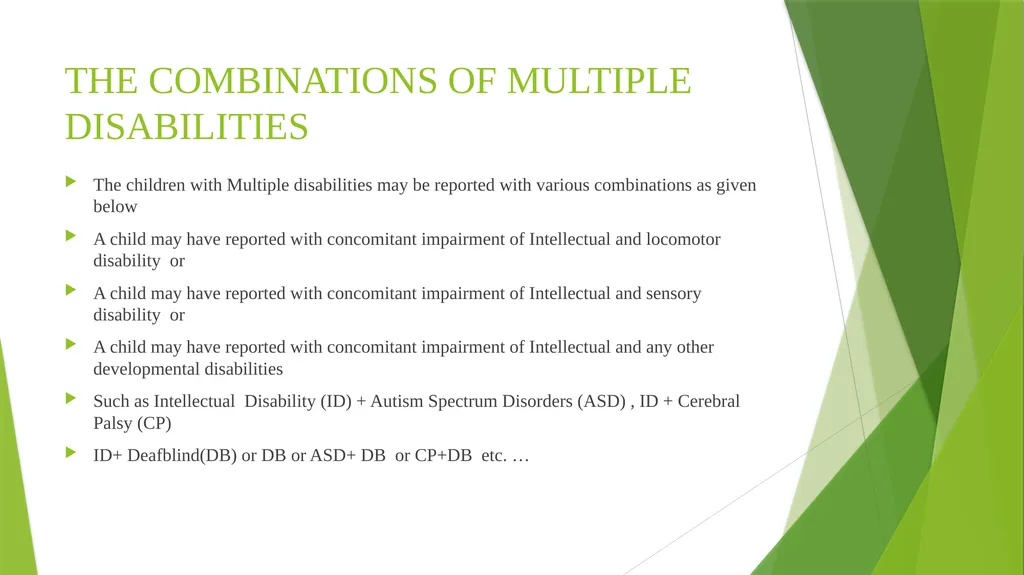
THE COMBINATIONS OF MULTIPLE DISABILITIES The children with Multiple disabilities may be reported with various combinations as given below
A child may have reported with concomitant impairment of Intellectual and locomotor disability or
A child may have reported with concomitant impairment of Intellectual and sensory disability or
A child may have reported with concomitant impairment of Intellectual and any other developmental disabilities
Such as Intellectual Disability (ID) + Autism Spectrum Disorders (ASD) , ID + Cerebral Palsy (CP)
ID+ Deafblind(DB) or DB or ASD+ DB or CP+DB etc. …<br>
A child may have reported with concomitant impairment of Intellectual and locomotor disability or
A child may have reported with concomitant impairment of Intellectual and sensory disability or
A child may have reported with concomitant impairment of Intellectual and any other developmental disabilities
Such as Intellectual Disability (ID) + Autism Spectrum Disorders (ASD) , ID + Cerebral Palsy (CP)
ID+ Deafblind(DB) or DB or ASD+ DB or CP+DB etc. …<br>
09
CHARACTERISTIC FEATURE General appearance
Self help activities
Motor function
Language & Communication
Sensory
Learning
Social and Emotional
Physical/Health condition<br>
Self help activities
Motor function
Language & Communication
Sensory
Learning
Social and Emotional
Physical/Health condition<br>
10
GENERAL APPEARANCE Under build / Thin built
Unsteady of body control
Clumsiness of appearance
Micro cephalic or hydro cephalic head
Squint
Pigeon chest
Drools
Asymmetrical body features
Flexed or Drooped body condition
Retarder physical growth<br>
Unsteady of body control
Clumsiness of appearance
Micro cephalic or hydro cephalic head
Squint
Pigeon chest
Drools
Asymmetrical body features
Flexed or Drooped body condition
Retarder physical growth<br>
11
MOTOR FUNCTIONS Presence of abnormal reflexes
Unstable body condition
No active movements of body and limbs
Developing abnormal pattern of posture and movements
Flexion and hyper tonicity of joins and muscles
Extended or Hypo tonicity of joins and muscles
Sits or stands with supports
Lying on the floor or bed for long time
Drags the body for movements
Depend on others for his mobility
Carries by others manually or using a wheel chair
Hesitate to move around and experiences of fall or hurt while moving around<br>
Unstable body condition
No active movements of body and limbs
Developing abnormal pattern of posture and movements
Flexion and hyper tonicity of joins and muscles
Extended or Hypo tonicity of joins and muscles
Sits or stands with supports
Lying on the floor or bed for long time
Drags the body for movements
Depend on others for his mobility
Carries by others manually or using a wheel chair
Hesitate to move around and experiences of fall or hurt while moving around<br>
12
SELF HELP ACTIVITIES Poor oral hygiene
Decay of the tooth
Show feeble movement of feeding
Shows difficulties in sucking , swallowing , biting and chewing
Poor intake
Chokes while feeding
Poor toilet skill , no toilet indication, cries after defecation and urination
Cooperates for brushing , bathing and dressing.
Custodial of other for his self help activities
Vulnerable to gets infected due to poor maintenance of his clothes, body and places<br>
Decay of the tooth
Show feeble movement of feeding
Shows difficulties in sucking , swallowing , biting and chewing
Poor intake
Chokes while feeding
Poor toilet skill , no toilet indication, cries after defecation and urination
Cooperates for brushing , bathing and dressing.
Custodial of other for his self help activities
Vulnerable to gets infected due to poor maintenance of his clothes, body and places<br>
13
LANGUAGE AND COMMUNICATION Severe to profound delay in language and communication development
Very poor in using the body or limbs for communication
Cries or coos or vocalises for communication
Uses minimal facial expression for communication
Uses eye gazing for communication
Shows agitate movement or moves his limbs for communication
Depend on AAC<br>
Very poor in using the body or limbs for communication
Cries or coos or vocalises for communication
Uses minimal facial expression for communication
Uses eye gazing for communication
Shows agitate movement or moves his limbs for communication
Depend on AAC<br>
14
SENSORY Presence of sensory impairment
Uses residual senses for the functional activities
Shows hyper or hyposensitivity in one or more of the seven senses
Does not use effectively the sensory modalities for learning
Poor abstraction
Does not involve effectively the metacognitive process for learning
Doesn't get much opportunity for learning.
Poor anticipation and reactions
Hesitates to explore with environment /surroundings<br>
Uses residual senses for the functional activities
Shows hyper or hyposensitivity in one or more of the seven senses
Does not use effectively the sensory modalities for learning
Poor abstraction
Does not involve effectively the metacognitive process for learning
Doesn't get much opportunity for learning.
Poor anticipation and reactions
Hesitates to explore with environment /surroundings<br>
15
SOCIAL AND EMOTIONAL Looks Fearful
Gets frustrated , angry and upset that can be observed in the face.
Have difficulty forming interpersonal relationship
No or hardly any friends
Doesn’t react immediately any emotional situations
Does not able participate effectively in the games and play
No or minimal exposed to the visitors and other community functions
Poor maintenance of his body , clothes and surroundings
Not able to defend or indicate on certain circumstances and Victim of ant bites , mosquitoes bites or any other insect bites.<br>
Gets frustrated , angry and upset that can be observed in the face.
Have difficulty forming interpersonal relationship
No or hardly any friends
Doesn’t react immediately any emotional situations
Does not able participate effectively in the games and play
No or minimal exposed to the visitors and other community functions
Poor maintenance of his body , clothes and surroundings
Not able to defend or indicate on certain circumstances and Victim of ant bites , mosquitoes bites or any other insect bites.<br>
16
LEARNING Has poor gross fine motor movements
Uses his/her residual senses for learning
Shows very poor or lethargic response to stimuli
Shows poor visual, auditory ,tactile and kinesthetic processing skills
Forgets skills through disuse
Has limited abstract thinking
Difficulty in locating the directions of sound
Difficulties in visual tracking and visual discrimination
Exposed to limited environment for learning
Experience of being isolated at home or at other places<br>
Uses his/her residual senses for learning
Shows very poor or lethargic response to stimuli
Shows poor visual, auditory ,tactile and kinesthetic processing skills
Forgets skills through disuse
Has limited abstract thinking
Difficulty in locating the directions of sound
Difficulties in visual tracking and visual discrimination
Exposed to limited environment for learning
Experience of being isolated at home or at other places<br>
17
HEALTH Febrile convulsion or Seizures / Epileptic conditions may be having Simple , Partial to Complex seizures
Metabolic disorders liken MPS I&II ,PKU etc.
Undernourished /Malnourished
Constipation sometimes bleedings
Sensory loss –loss of hearing threshold and visual acuity and poor reflexarc
Hydrocephalus and scoliosis
Physically clumsy and awkward
No reactions to various sensory insults like hot or cold contacts , spicy or any other tastes , bad smells.<br>
Metabolic disorders liken MPS I&II ,PKU etc.
Undernourished /Malnourished
Constipation sometimes bleedings
Sensory loss –loss of hearing threshold and visual acuity and poor reflexarc
Hydrocephalus and scoliosis
Physically clumsy and awkward
No reactions to various sensory insults like hot or cold contacts , spicy or any other tastes , bad smells.<br>
18
ASSESSMENT TO UNDERSTAND THE BIO-BEHAVIOURL STATE BIO BEHAVIOURAL STATE It has 3 parts
A-Behavior state
B-Learning environment
C- Format for recording the data<br>
A-Behavior state
B-Learning environment
C- Format for recording the data<br>
19
ASSESSMENT BEHAVIOR STATE:
Sleep states
Intermediate state
Preferred awake stage
Other awake stage<br>
Sleep states
Intermediate state
Preferred awake stage
Other awake stage<br>
20
ASSESSMENT LEARNING ENVIRONMENT VARIABLES:
Materials
Modality
Activity
Social contact
Position
Environmental/Setting<br>
Materials
Modality
Activity
Social contact
Position
Environmental/Setting<br>
21
ASSESSMENT FORMAT FOR RECORDING:
30 observation records to be made in each data sheets<br>
30 observation records to be made in each data sheets<br>
22
THE SIGNIFICANCE OF BBS ASSESSMENT The BBS assessment will help special educators and the therapist to understand to find the right time ( Active Alert Time) for providing the intervention and to avoid certain times for the child to take rest.
It also provide the information on engaging the child for intervention with the right persons , the materials preferred by the child to learn in the appropriate place and context.<br>
It also provide the information on engaging the child for intervention with the right persons , the materials preferred by the child to learn in the appropriate place and context.<br>
23
IMPLICATION OF LEARNING Children with multiple disabilities are experiencing various difficulties in performing their activity of daily living , using their motor skills effectively , learning the content like any other children , communicating with others effectively. The also have the difficulties in using the space and establishing the social relationship with others.
The BBS gives the directions to understand the feasibilities of using the active time, place , persons and the materials for planning the intervention program
The program checklist which is developed by NIEPID (formerly called NIMH) for children with Profound Intellectual Disability is found to be useful for developing the functional activities to enable them to live as closely as possible with their family and community.
The support Intensity program developed by American Association of Intellectual and Developmental Disability (AAIDD) provides a meaningful direction to the special education teachers , therapist and the parents to develop appropriate supports to perform the skills.<br>
The BBS gives the directions to understand the feasibilities of using the active time, place , persons and the materials for planning the intervention program
The program checklist which is developed by NIEPID (formerly called NIMH) for children with Profound Intellectual Disability is found to be useful for developing the functional activities to enable them to live as closely as possible with their family and community.
The support Intensity program developed by American Association of Intellectual and Developmental Disability (AAIDD) provides a meaningful direction to the special education teachers , therapist and the parents to develop appropriate supports to perform the skills.<br>
24
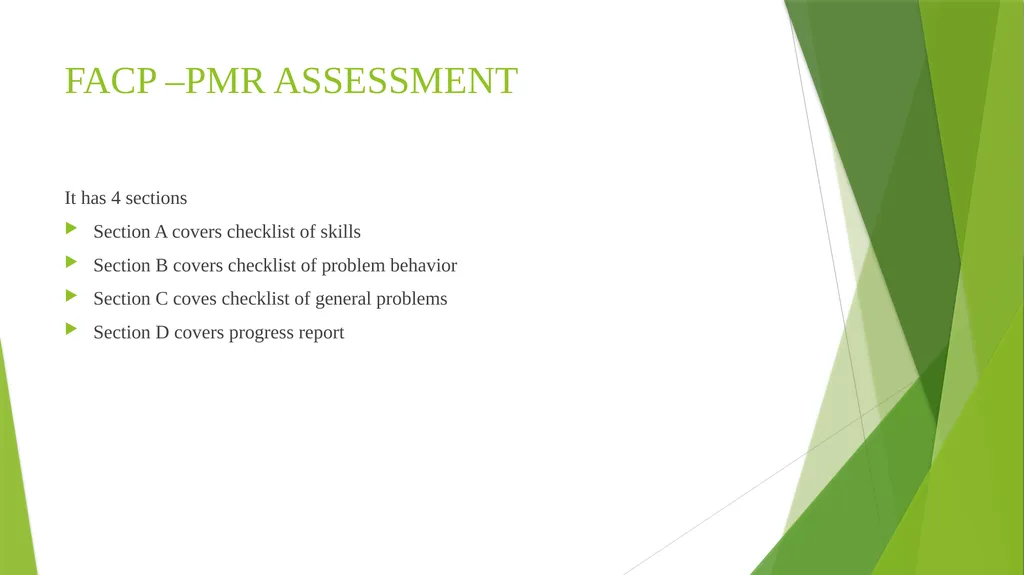
FACP –PMR ASSESSMENT It has 4 sections
Section A covers checklist of skills
Section B covers checklist of problem behavior
Section C coves checklist of general problems
Section D covers progress report<br>
Section A covers checklist of skills
Section B covers checklist of problem behavior
Section C coves checklist of general problems
Section D covers progress report<br>
25
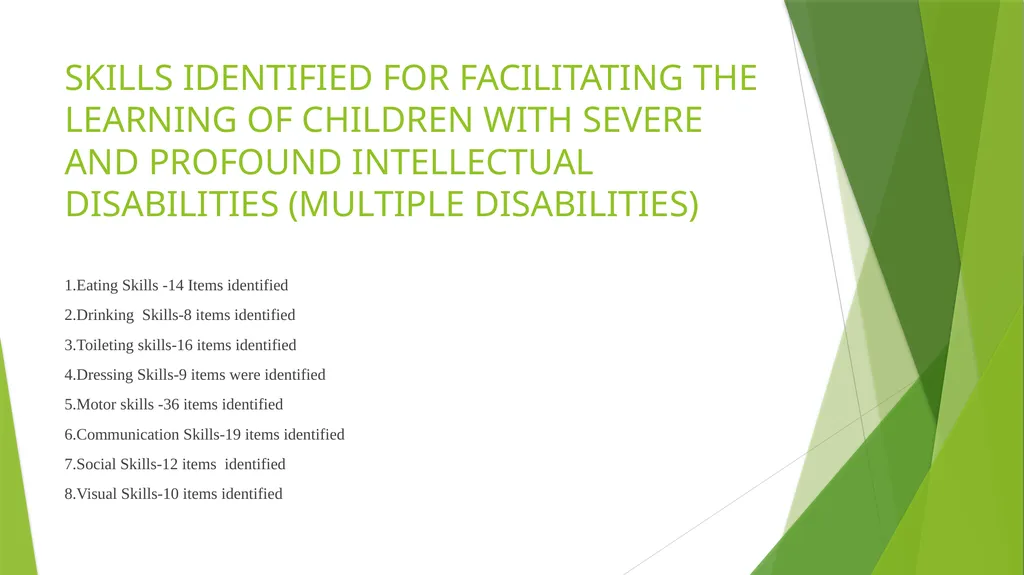
SKILLS IDENTIFIED FOR FACILITATING THE LEARNING OF CHILDREN WITH SEVERE AND PROFOUND INTELLECTUAL DISABILITIES (MULTIPLE DISABILITIES) 1.Eating Skills -14 Items identified
2.Drinking Skills-8 items identified
3.Toileting skills-16 items identified
4.Dressing Skills-9 items were identified
5.Motor skills -36 items identified
6.Communication Skills-19 items identified
7.Social Skills-12 items identified
8.Visual Skills-10 items identified<br>
2.Drinking Skills-8 items identified
3.Toileting skills-16 items identified
4.Dressing Skills-9 items were identified
5.Motor skills -36 items identified
6.Communication Skills-19 items identified
7.Social Skills-12 items identified
8.Visual Skills-10 items identified<br>
26
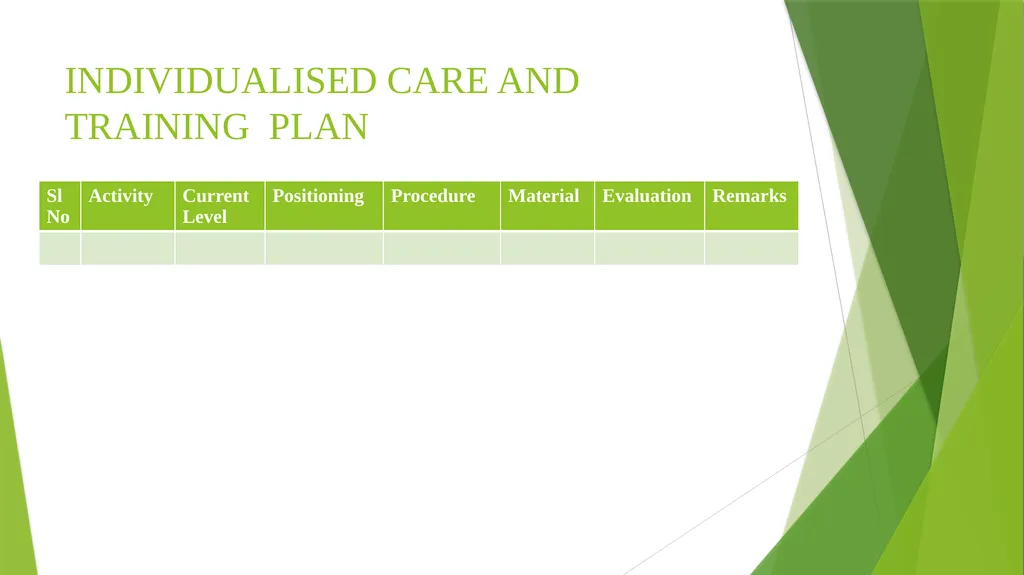
INDIVIDUALISED CARE AND TRAINING PLAN<br>
27
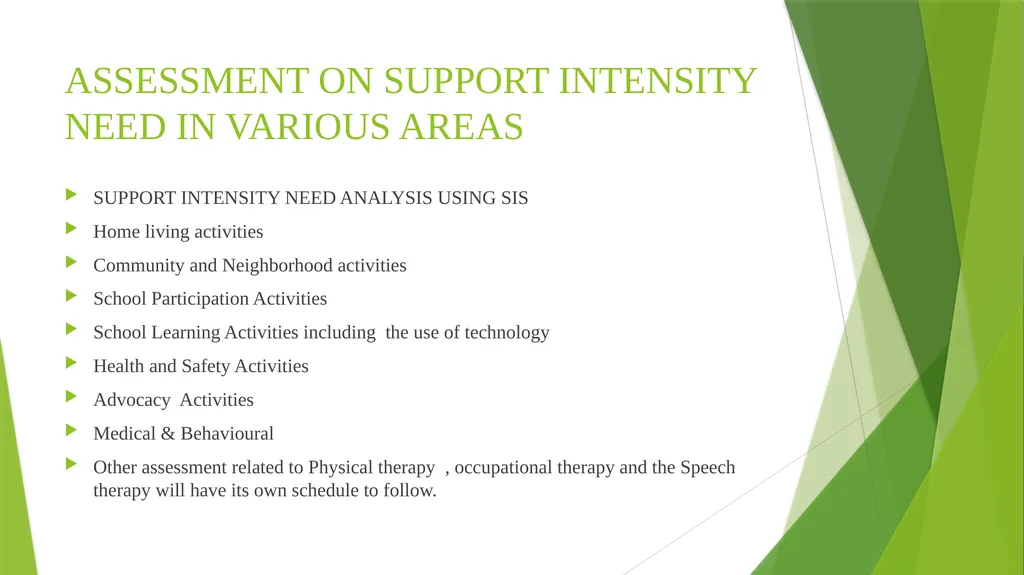
ASSESSMENT ON SUPPORT INTENSITY NEED IN VARIOUS AREAS SUPPORT INTENSITY NEED ANALYSIS USING SIS
Home living activities
Community and Neighborhood activities
School Participation Activities
School Learning Activities including the use of technology
Health and Safety Activities
Advocacy Activities
Medical & Behavioural
Other assessment related to Physical therapy , occupational therapy and the Speech therapy will have its own schedule to follow.<br>
Home living activities
Community and Neighborhood activities
School Participation Activities
School Learning Activities including the use of technology
Health and Safety Activities
Advocacy Activities
Medical & Behavioural
Other assessment related to Physical therapy , occupational therapy and the Speech therapy will have its own schedule to follow.<br>
28
ASSESSMENT ON SCHOOL PARTICIPATION ACTIVITIES School participation activities: Examples
Being included in general education class room including the library and technology rooms
Participating in activities in common school areas (e.g . play ground hall ways ,cafeteria)
Participating in co-curricular
Getting to school (includes accessible transportations)
Moving around with in the school and transitioning between activities
Facilities for Participating in large scale test taking activities required by state education system.
Following class room and school rules
Keeping track of personnel belongings at school & Keeping track of schedule at school
Barrier free Space for the children with multiple disability to participate in activates<br>
Being included in general education class room including the library and technology rooms
Participating in activities in common school areas (e.g . play ground hall ways ,cafeteria)
Participating in co-curricular
Getting to school (includes accessible transportations)
Moving around with in the school and transitioning between activities
Facilities for Participating in large scale test taking activities required by state education system.
Following class room and school rules
Keeping track of personnel belongings at school & Keeping track of schedule at school
Barrier free Space for the children with multiple disability to participate in activates<br>
29
ASSESSMENT ON SCHOOL LEARNING ACTIVITIES School learning activities: Example
Appropriate seating arrangements for learning
Accessing grade level curriculum content and curriculum access
Learning academic skills using assistive technologies
Learning and using metacognitive skills
Completing academic tasks using assistive technology
Learning how to use and using problem solving and self regulation strategies in the class room
Participating in class room level evaluation such as tests in flexible way
Accessing health and physical education curricula
Completing homework assignment<br>
Appropriate seating arrangements for learning
Accessing grade level curriculum content and curriculum access
Learning academic skills using assistive technologies
Learning and using metacognitive skills
Completing academic tasks using assistive technology
Learning how to use and using problem solving and self regulation strategies in the class room
Participating in class room level evaluation such as tests in flexible way
Accessing health and physical education curricula
Completing homework assignment<br>
30
SCORE ON MEDICAL AND BEHAVIOURAL ACTIVITIES Medical and Behavioural activities:
0= No support needed
1 = some support needed (i.e., providing monitoring and /occasional assistance)
2 = Extensive support needed (i.e., providing regular assistance to manage the medical condition or behavior)<br>
0= No support needed
1 = some support needed (i.e., providing monitoring and /occasional assistance)
2 = Extensive support needed (i.e., providing regular assistance to manage the medical condition or behavior)<br>
31
TYPES OF SUPPORT REQUIRES 0=None
1=Monitoring
2=Verbal/gestural prompting
3=Partial Physical assistance
4=Full Physical Assistance<br>
1=Monitoring
2=Verbal/gestural prompting
3=Partial Physical assistance
4=Full Physical Assistance<br>
32
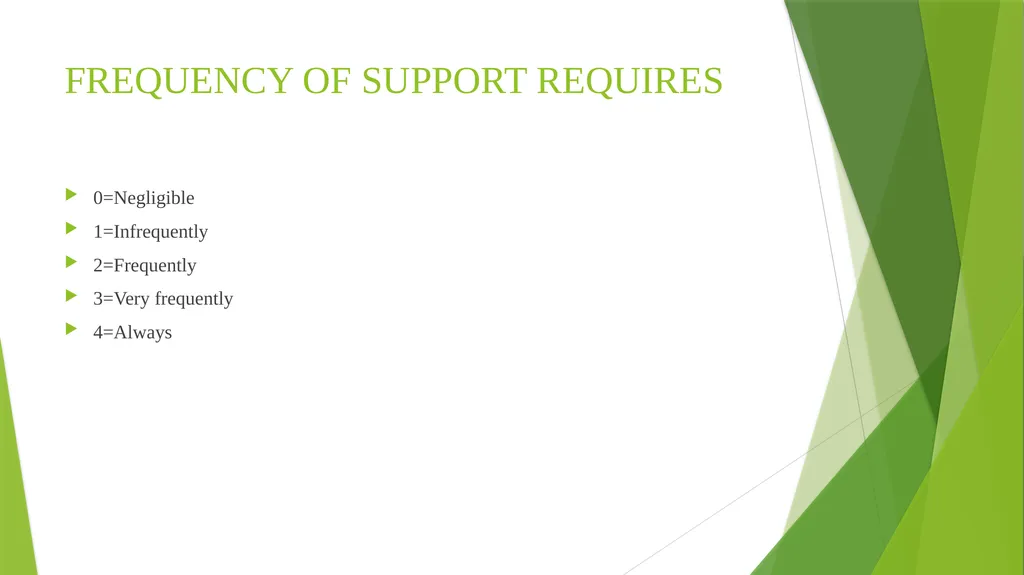
FREQUENCY OF SUPPORT REQUIRES 0=Negligible
1=Infrequently
2=Frequently
3=Very frequently
4=Always<br>
1=Infrequently
2=Frequently
3=Very frequently
4=Always<br>
33
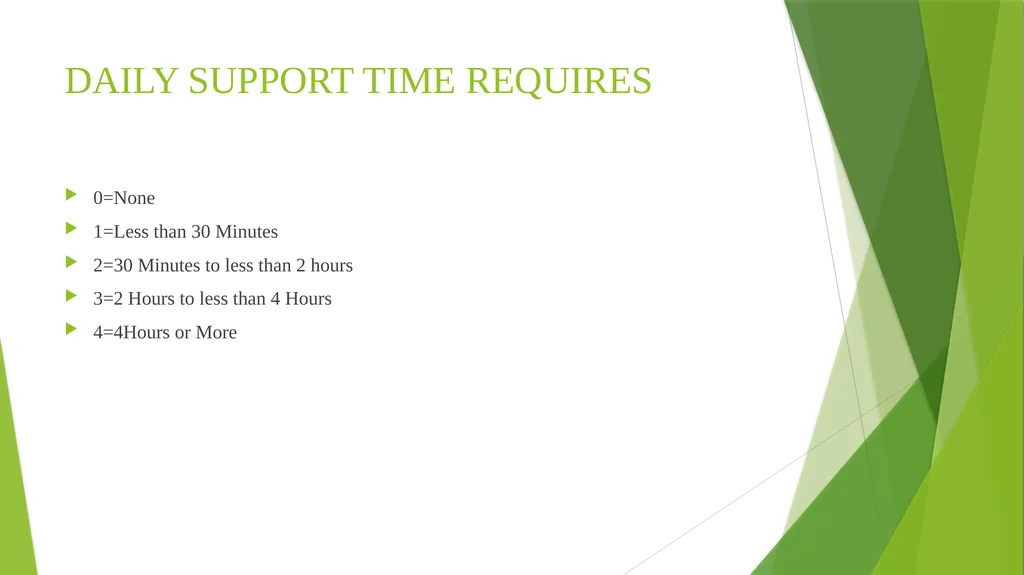
DAILY SUPPORT TIME REQUIRES 0=None
1=Less than 30 Minutes
2=30 Minutes to less than 2 hours
3=2 Hours to less than 4 Hours
4=4Hours or More<br>
1=Less than 30 Minutes
2=30 Minutes to less than 2 hours
3=2 Hours to less than 4 Hours
4=4Hours or More<br>
34
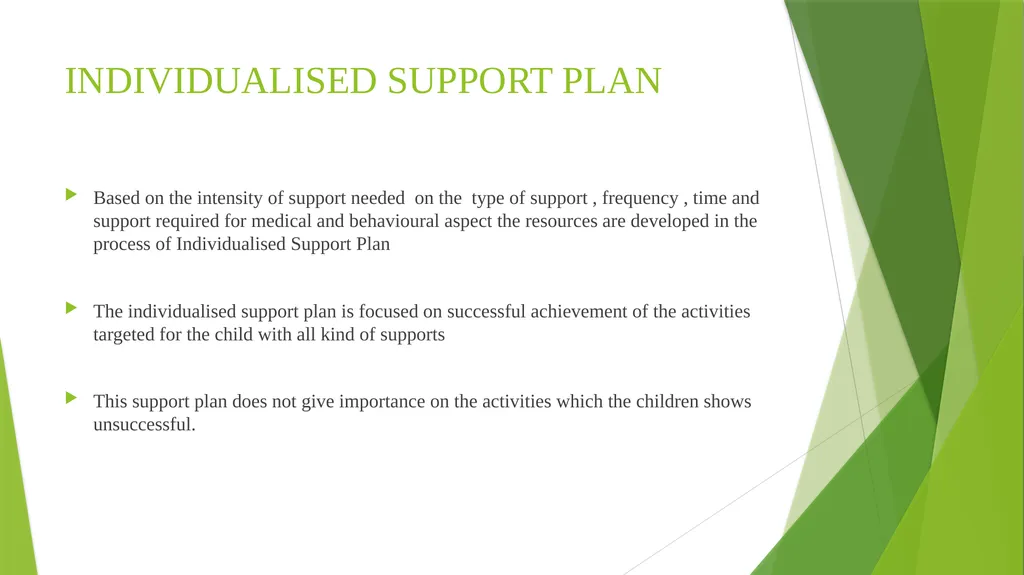
INDIVIDUALISED SUPPORT PLAN Based on the intensity of support needed on the type of support , frequency , time and support required for medical and behavioural aspect the resources are developed in the process of Individualised Support Plan
The individualised support plan is focused on successful achievement of the activities targeted for the child with all kind of supports
This support plan does not give importance on the activities which the children shows unsuccessful.<br>
The individualised support plan is focused on successful achievement of the activities targeted for the child with all kind of supports
This support plan does not give importance on the activities which the children shows unsuccessful.<br>
35
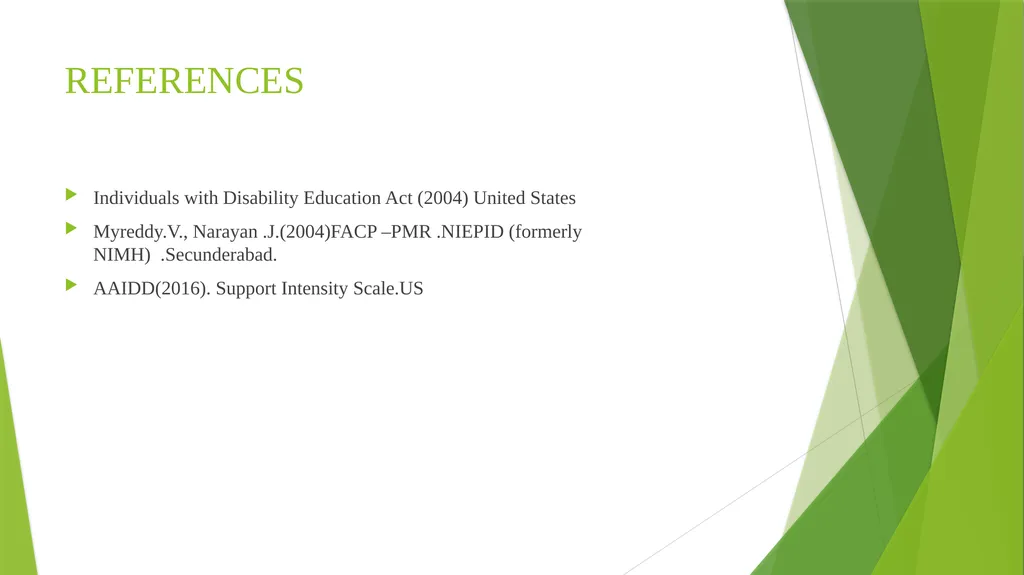
REFERENCES Individuals with Disability Education Act (2004) United States
Myreddy.V., Narayan .J.(2004)FACP –PMR .NIEPID (formerly NIMH) .Secunderabad.
AAIDD(2016). Support Intensity Scale.US<br>
Myreddy.V., Narayan .J.(2004)FACP –PMR .NIEPID (formerly NIMH) .Secunderabad.
AAIDD(2016). Support Intensity Scale.US<br>