Multiply imputing informatively censored time-to-event data Ian R White, Patrick Royston MRC Clinical Trials Unit at UCL, London, UK 7-8092023 UK Stata Conference Plan 2 Motivation: missing data and censored data Model method for
"Multiply imputing informatively censored" is the property of its rightful owner. Permission is granted to
download and print the materials on this website for personal, non-commercial use only, and to display it
on your personal computer provided you do not modify the materials and that you retain all copyright
notices contained in the materials. By downloading content from our website, you accept the terms of this
agreement.
Presentation Transcript
01
Multiply imputing informatively censored time-to-event data Ian R White, Patrick Royston
MRC Clinical Trials Unit at UCL, London, UK 7-8/09/2023 | UK Stata Conference<br>
02
Plan 2 Motivation: missing data and censored data
Model & method for informatively censored data
Stata implementation by extending stsurvimpute
Example<br>
03
Missing outcomes Handle missing values by a missing at random assumption: missing outcomes are like observed outcomes (given similar covariates) 3<br>
04
Censored outcomes Handle censored values by a non-informative censoring assumption: censored outcomes are like observed outcomes (given similar covariates) 4<br>
05
These assumptions are questionable 5 Aim: easy-to-use methods for sensitivity analysis<br>
06
Aim 1 6 Optionally impute events after end of follow-up<br>
07
Aim 2 7 The abstract of the RT01 trial (Lancet 2014, described later) said
“Biochemical progression or progressive disease occurred in 391 patients (221 [57%] in the control group and 170 [43%] in the escalated-dose group). At 10 years, biochemical progression-free survival was 43% (95% CI 38–48) in the control group and 55% (50–61) in the escalated-dose group (HR 0·69, 95% CI 0·56–0·84; p=0·0003).”
The analysis methods implicitly assumed non-informative censoring
as do analyses of very many other data sets How robust is this finding to possible informative censoring?<br>
08
Model & method 8<br>
09
Simulating survival data after censoring 9<br>
10
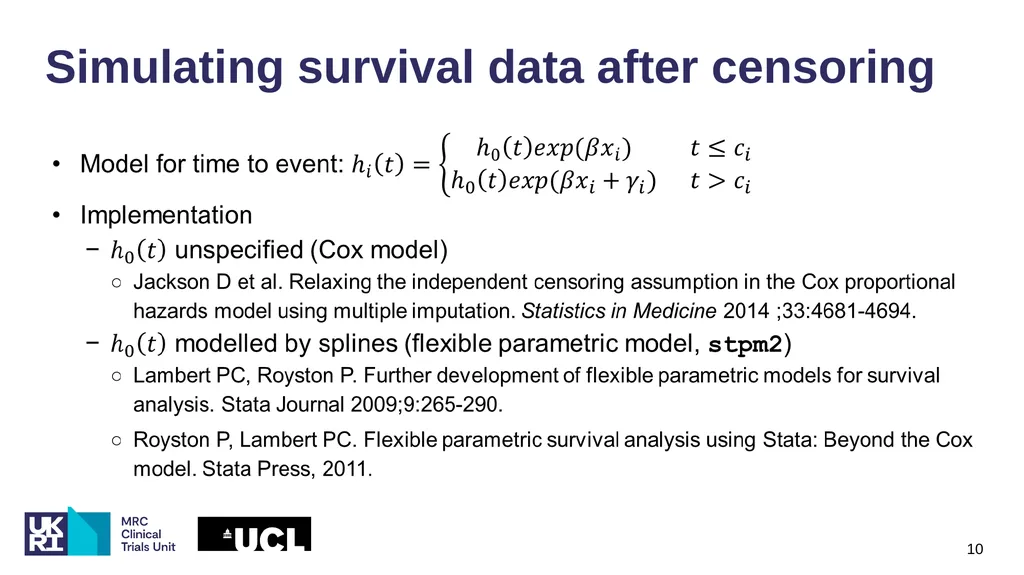
Simulating survival data after censoring 10<br>
11
Stata implementation 11<br>
12
stsurvimpute 12 Original version (SSC, 2011)
Imputes data after censoring, using a flexible parametric model (stpm2)
Assumes non-informative censoring
Creates a new variable to hold a single imputation
New version (in preparation)
Simple modification for informative censoring
Modification to produce multiple imputations and store them in ice/mim format
Why not mi format? See next…<br>
13
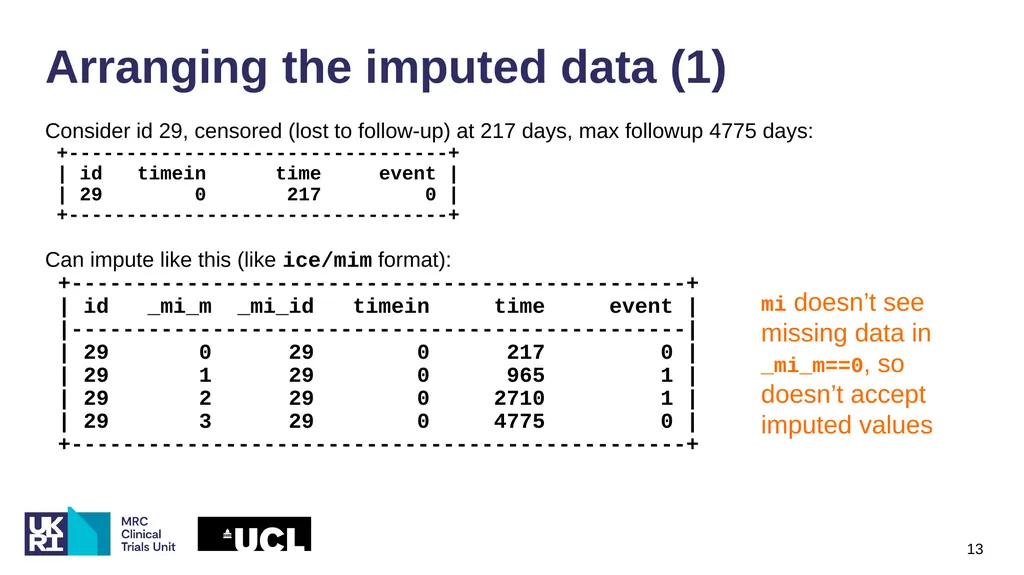
Arranging the imputed data (1) 13 Consider id 29, censored (lost to follow-up) at 217 days, max followup 4775 days:
+---------------------------------+
| id timein time event |
| 29 0 217 0 |
+---------------------------------+
Can impute like this (like ice/mim format):
+------------------------------------------------+
| id _mi_m _mi_id timein time event |
|------------------------------------------------|
| 29 0 29 0 217 0 |
| 29 1 29 0 965 1 |
| 29 2 29 0 2710 1 |
| 29 3 29 0 4775 0 |
+------------------------------------------------+ mi doesn’t see missing data in _mi_m==0, so doesn’t accept imputed values<br>
14
Arranging the imputed data (2) 14 Or can impute in an “stsplit” way, expressing censoring as missing data:
+-------------------------------------------------+
| id _mi_m _mi_id timein time event |
|-------------------------------------------------|
| 29 0 29 0 217 0 |
| 29 0 30 217 . . |
|-------------------------------------------------|
| 29 1 29 0 217 0 |
| 29 1 30 217 965 1 |
|-------------------------------------------------|
| 29 2 29 0 217 0 |
| 29 2 30 217 2710 1 |
|-------------------------------------------------|
| 29 3 29 0 217 0 |
| 29 3 30 217 4775 0 |
+-------------------------------------------------+ mi stset: “Imputed and passive variables may not be used as the basis for mi stset.” Hence we use ice/mim format instead (one record per person per imputed data set)<br>
15
Example 15<br>
16
RT01 trial 16 Phase 3 clinical trial run by MRC CTU
Patients: men with localised prostate cancer
Intervention: escalated dose of radiotherapy (“Esc 74Gy”)
Control: standard dose of radiotherapy (“Std 64 Gy”)
Outcomes: overall survival; biochemical progression-free survival (PFS)
843 men randomised 7jan1998-20dec2001 and followed to 2aug2011
Dearnaley DP, Jovic G, Syndikus I, et al. Escalated-dose versus control-dose conformal radiotherapy for prostate cancer: Long-term results from the MRC RT01 randomised controlled trial. Lancet Oncol. 2014;15(4):464-473.<br>
17
Kaplan-Meier for PFS 17 Censoring by loss to follow up Censoring by end of follow up<br>
stsurvimpute trt rgrp, df(3) tvc(trt) dftvc(trt:3) scale(hazard) ///
m(20) gamma(0) seed(47618906) dots ///
recens(ti_eof)
mim: stcox trt rgrp stpm2 options: fit flexible parametric model with different baseline hazard in each trial arm (trt) Recensor at 7jul2011 baseline covariate<br>
21
21 .5 .6 .7 .8 .9 1 gamma in arm... Treatment effect (HR) Results are robust to plausible and implausible informative censoring mechanisms!<br>
22
Future work 22 Proper imputation to allow for uncertainty in the stpm2 parameters
Imputation by trial arm
Handle multiple-record st data
How to check imputations<br>
23
Acknowledgements 23 The RT01 trial team and participants
Vicki Yorke-Edwards for supplying the data<br>
24
Discussion 24 gamma is the log informative censoring hazard ratio (ICHR)
intuitive sensitivity parameter that can be elicited with clinical experts
choosing a plausible range for gamma is key
can allow gamma to vary e.g. by arm, by reason for censoring
Setting gamma=0 is not the same as analysing the observed data
Other summary measures are estimable e.g. RMST instead of HR
Is imputation beyond planned end of follow-up ever justified?
Can stsurvimpute be made compatible with mi?<br>
25
Extras 25<br>
26
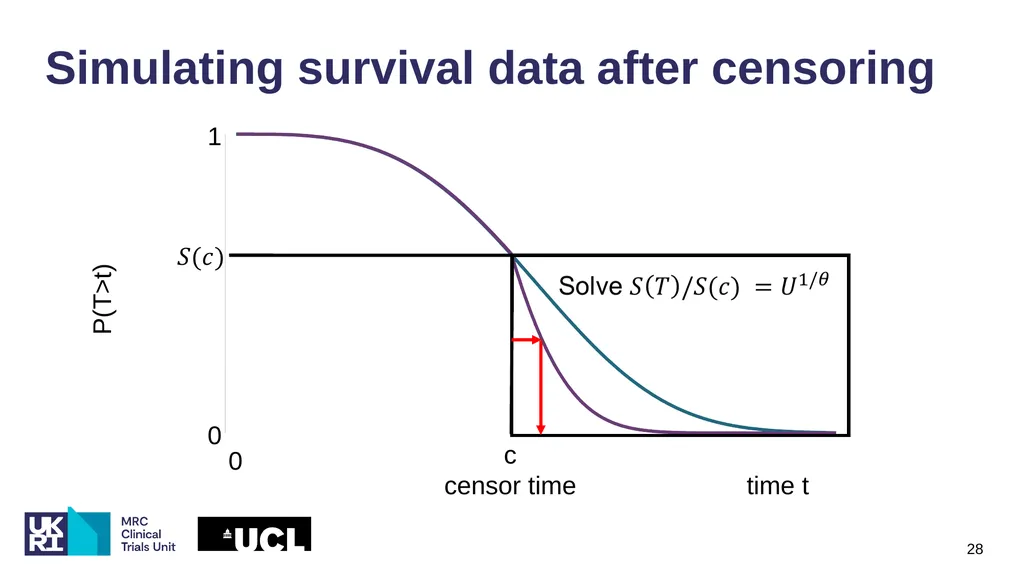
Simulating survival data 26<br>
27
Simulating survival data 27 P(T>t)<br>
28
Simulating survival data after censoring 28 c censor time<br>
29
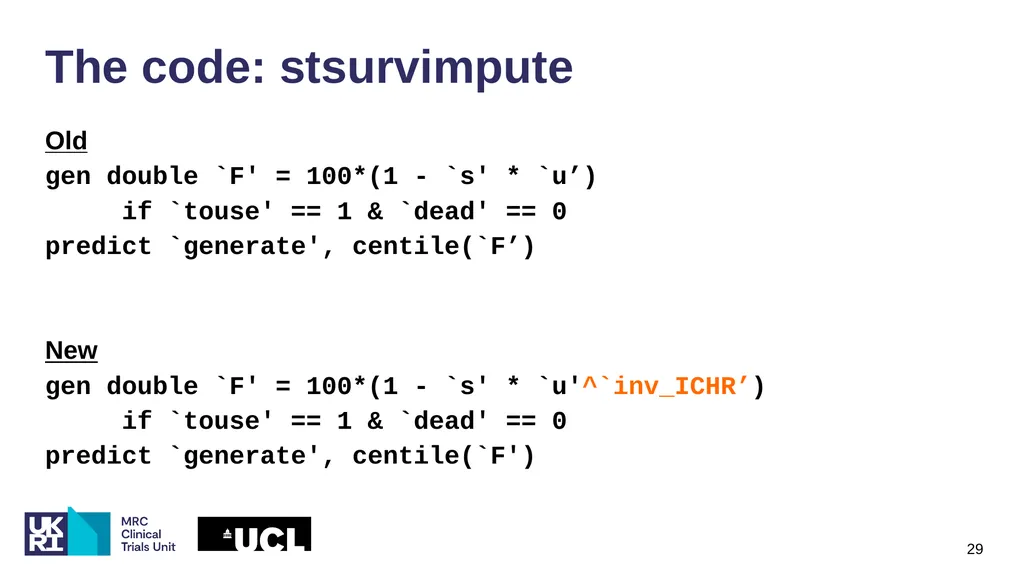
The code: stsurvimpute 29 Old
gen double `F' = 100*(1 - `s' * `u’)
if `touse' == 1 & `dead' == 0
predict `generate', centile(`F’)
New
gen double `F' = 100*(1 - `s' * `u'^`inv_ICHR’)
if `touse' == 1 & `dead' == 0
predict `generate', centile(`F')<br>
30
Kaplan-Meier for censoring 30 Mostly loss to follow up Mostly end of follow up “Reverse KM”: censoring=1, event=0<br>