MUS Online Courses and Programs The problem of definition: unreliable data Recent Progress: MUS fully online programs Standardization of language for data gathering purposes Universal access: MSU Experience MSUs Autumn 2009 Surprise Over
Related Topics
Share
Embed code
Download this presentation From Below
"MUS Online Courses and Programs The problem of" is the property of its rightful owner. Permission is granted to
download and print the materials on this website for personal, non-commercial use only, and to display it
on your personal computer provided you do not modify the materials and that you retain all copyright
notices contained in the materials. By downloading content from our website, you accept the terms of this
agreement.
Presentation Transcript
01
MUS Online Courses and Programs The problem of definition: unreliable data
Recent Progress: MUS fully online programs
Standardization of language for data gathering purposes
Universal access: MSU Experience<br>
02
MSU’s Autumn 2009 Surprise Over 600 separate sections activated
Over 450 instructors using D2L
9500 students, nearly 75% of the student body, enrolled in courses where there is a D2L component
This could double next semester.<br>
03
Possibilities Three-Day Week?
Five-Day Week Minus One? No More Bricks?
The Oxford Model?
Pseudo – Sabbaticals?
Joint Programs – MSU and UM?
Giant Lecture Halls On-Line? Synchronous
The list goes on……………….<br>
04
Features of MSMME Thirty credit-hour graduate program for practicing high school teachers
Serves a broad audience
Employs multi-modal delivery
Emphasizes both mathematics content and pedagogy<br>
05
MSMME: Broad Audience 30–40 enrolled in program at a given time
10-12 graduates per year
1/3 Montana, 1/3 Western, 1/3 Nationwide+
The diverse perspectives and experiences of this audience contribute to teacher growth:
Contrasting state assessment practices
Finding common ground in diversity (shared concerns about urban vs. rural vs. NA students)<br>
06
MSMME is a Quality Program The Master's of Science degree in Mathematics provides teachers across the nation with collaborative, practitioner-based learning.
Courses meet research-based criteria for effective professional development for math teachers (Garet, et al., 2001; Schwan Smith, 2001), including:
a focus on content
collaboration among teachers
use of active learning techniques
meaningful connections to teachers' experiences
sustained contact over time<br>
07
Teachers Need Quality Programs Teachers seek graduate coursework and advanced degrees to strengthen their knowledge of mathematics content and pedagogy as well as their professional status.
Time and cost constraints increasingly restrict teachers from taking advantage of site-based courses and workshops offered by universities.
UM Masters for Middle Grade Teachers??<br>
08
MSMME: Multi-Modal Delivery Online courses – two offered each semester, including summer
Text-based and asynchronous
Summer session - three-week intensive study on campus, required at least once
Learning community
Capstone experience - individualized action research projects that teachers conduct in their schools<br>
09
MSMME: Content and Pedagogy Content courses support teaching grades 9-14 mathematics (e.g., geometry, linear algebra, number theory)
Courses in assessment, learning theory, and other topics delve into mathematics pedagogy
Example: In spring of alternate years, Geometry for Teachers and Mathematical Modeling for Teachers are on-line courses. Last summer, Analysis for Teachers and Technology and the Teaching of Mathematics were offered face-to-face; Language of Mathematics and Statistics for Teachers were offered on-line.<br>
10
Mathematics Content Online How do we approach content courses?
Problem-based - no formal lectures or notes; texts are often supplementary
Technology-supported
Sketchpad, GeoGebra
Online stat packages, Maple
Applets and Web-based resources
Flexible submissions - scans, attachments, GSP, MathText, MSWord – “symbolic text”<br>
11
Example of Mathematics Content The Problem of Dido (based on story from Aeneid)
Princess Dido (Phoenicia) negotiated for as much land as could be “encircled with a bull’s hide.” She cleverly cut the hide into strips and connected them to outline a large area.
Task for teachers: Among all closed plane curves of a given length, find the one that encloses the largest area.
MATH 533: Historical Strategies and the Teaching of Mathematics<br>
12
The Problem of Dido Teachers discussed the problem and were nudged to the strategy of solving a simpler problem, i.e. proving that a maximal n-gon must be regular. (Zenodorus) They were placed in groups and provided a “space” to work together.
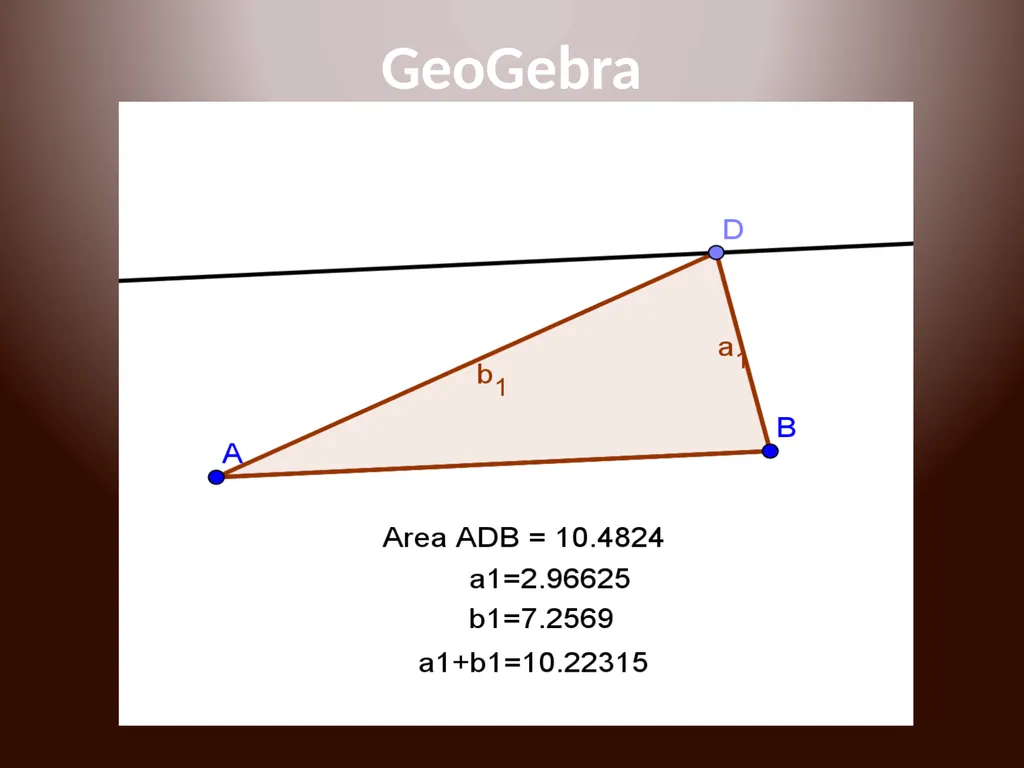
Teachers shared their arguments using documents created in GeoGebra, a free, online software package for geometric construction and documentation.
.<br>
13
GeoGebra<br>
14
Specific Lessons Learned Teachers never dreamt there was so much to learn about isosceles triangles.
They came to appreciate better the mathematical importance of –b/2a.
They discovered the need for and value of Heron’s reflection principle which led to a very interesting historical digression.
They chose to review their calculus and developed a new appreciation for this tool as well as the genius of ancient mathematicians.<br>
15
General Lesson Learned Historical problems were given names because they were challenging and important. They are most valuable in the classroom for the mathematical wondering that they inspire, the myriad of smaller problems they generate, and the sense of purpose they give to the little things we teach in our curriculum. “It is amazing what you can learn by trying the impossible.”<br>
16
MSMME: Other Online Tasks Online learning presents opportunities for a variety of learning tasks in both content and pedagogy:
Read and discuss articles and research (individual reflection and reaction)
Implement course ideas in teachers’ own classrooms (“living laboratory”)
Develop a class wiki (interaction and analysis)
Engage in research “Poster Sessions” or paper conferences (formalized professional interaction)<br>
17
MSMME: Action Research (AR) AR is the ultimate “living laboratory”
Teachers conduct an intervention/experiment, assess and act on findings, and communicate results . (C.A. Mertler, G. Mills)
The MSMME AR process spans a full year and represents 7 of 30 program credits:
Introduction to action research
Literature review and proposal writing
Site-based research
Public presentation and defense<br>
18
Discussion: Issues with Mathematics Special symbols and diagrams
The combination of speech, symbol and diagram are hard to replace when trying to communicate mathematical reasoning in even the simplest situations.
Non-standardization in mathematics editors, mathematics software, and mathematics courseware.
So, here is a question to think about: If online was the only method offered to you, how would you teach your course?<br>