
Mustansiriyah University Class: Third Year Faculty
MT
Published · 9 slides · 0 views
1 / 1
Description
Mustansiriyah University Class: Third Year Faculty of Engineering Cryptographic Hash Functions Course name: Data Security Computer Engineering Dep. Lecturer: Fatimah Al-Ubaidy A Hash function (H) accepts a variable-length block of data M as
Related Topics
Share
Embed code
Download this presentation From Below
"Mustansiriyah University Class: Third Year Faculty" is the property of its rightful owner. Permission is granted to download and print the materials on this website for personal, non-commercial use only, and to display it on your personal computer provided you do not modify the materials and that you retain all copyright notices contained in the materials. By downloading content from our website, you accept the terms of this agreement.
Presentation Transcript
01
Mustansiriyah University Class: Third Year
Faculty of Engineering Cryptographic Hash Functions Course name: Data Security
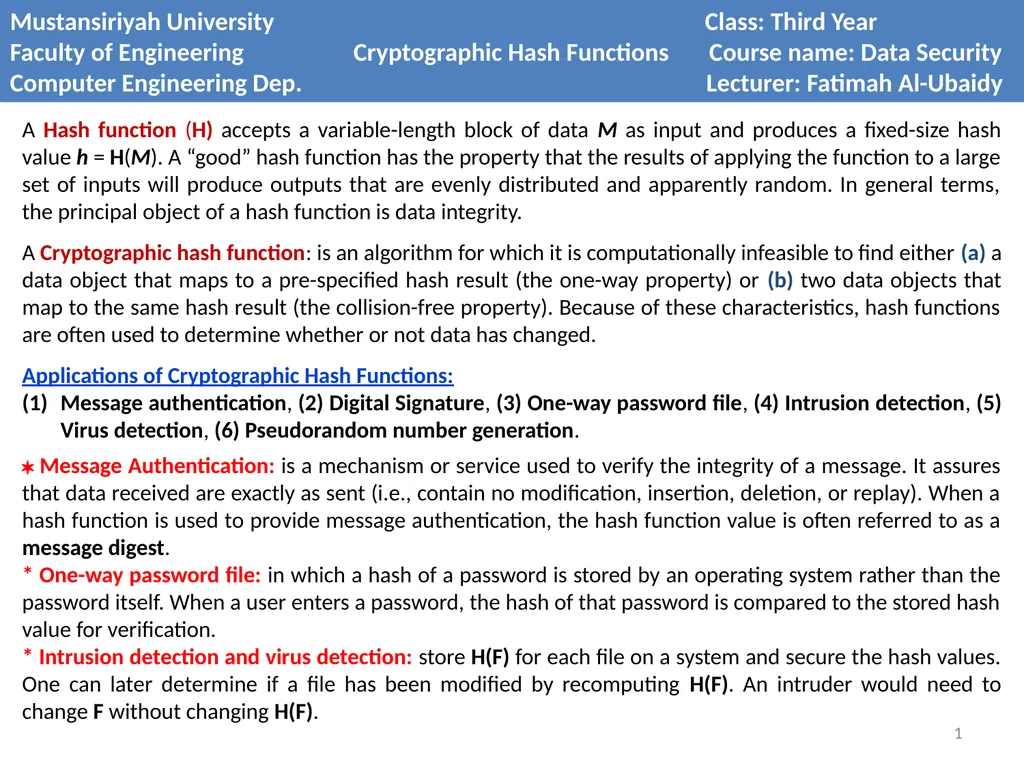
Computer Engineering Dep. Lecturer: Fatimah Al-Ubaidy A Hash function (H) accepts a variable-length block of data M as input and produces a fixed-size hash value h = H(M). A “good” hash function has the property that the results of applying the function to a large set of inputs will produce outputs that are evenly distributed and apparently random. In general terms, the principal object of a hash function is data integrity.
A Cryptographic hash function: is an algorithm for which it is computationally infeasible to find either (a) a data object that maps to a pre-specified hash result (the one-way property) or (b) two data objects that map to the same hash result (the collision-free property). Because of these characteristics, hash functions are often used to determine whether or not data has changed.
Applications of Cryptographic Hash Functions:
Message authentication, (2) Digital Signature, (3) One-way password file, (4) Intrusion detection, (5) Virus detection, (6) Pseudorandom number generation.
Message Authentication: is a mechanism or service used to verify the integrity of a message. It assures that data received are exactly as sent (i.e., contain no modification, insertion, deletion, or replay). When a hash function is used to provide message authentication, the hash function value is often referred to as a message digest.
* One-way password file: in which a hash of a password is stored by an operating system rather than the password itself. When a user enters a password, the hash of that password is compared to the stored hash value for verification.
* Intrusion detection and virus detection: store H(F) for each file on a system and secure the hash values. One can later determine if a file has been modified by recomputing H(F). An intruder would need to change F without changing H(F). 1<br>
Faculty of Engineering Cryptographic Hash Functions Course name: Data Security
Computer Engineering Dep. Lecturer: Fatimah Al-Ubaidy A Hash function (H) accepts a variable-length block of data M as input and produces a fixed-size hash value h = H(M). A “good” hash function has the property that the results of applying the function to a large set of inputs will produce outputs that are evenly distributed and apparently random. In general terms, the principal object of a hash function is data integrity.
A Cryptographic hash function: is an algorithm for which it is computationally infeasible to find either (a) a data object that maps to a pre-specified hash result (the one-way property) or (b) two data objects that map to the same hash result (the collision-free property). Because of these characteristics, hash functions are often used to determine whether or not data has changed.
Applications of Cryptographic Hash Functions:
Message authentication, (2) Digital Signature, (3) One-way password file, (4) Intrusion detection, (5) Virus detection, (6) Pseudorandom number generation.
Message Authentication: is a mechanism or service used to verify the integrity of a message. It assures that data received are exactly as sent (i.e., contain no modification, insertion, deletion, or replay). When a hash function is used to provide message authentication, the hash function value is often referred to as a message digest.
* One-way password file: in which a hash of a password is stored by an operating system rather than the password itself. When a user enters a password, the hash of that password is compared to the stored hash value for verification.
* Intrusion detection and virus detection: store H(F) for each file on a system and secure the hash values. One can later determine if a file has been modified by recomputing H(F). An intruder would need to change F without changing H(F). 1<br>
02
Mustansiriyah University Class: Third Year
Faculty of Engineering Cryptographic Hash Functions Course name: Data Security
Computer Engineering Dep. Lecturer: Fatimah Al-Ubaidy Security Requirements of the Hash Functions:
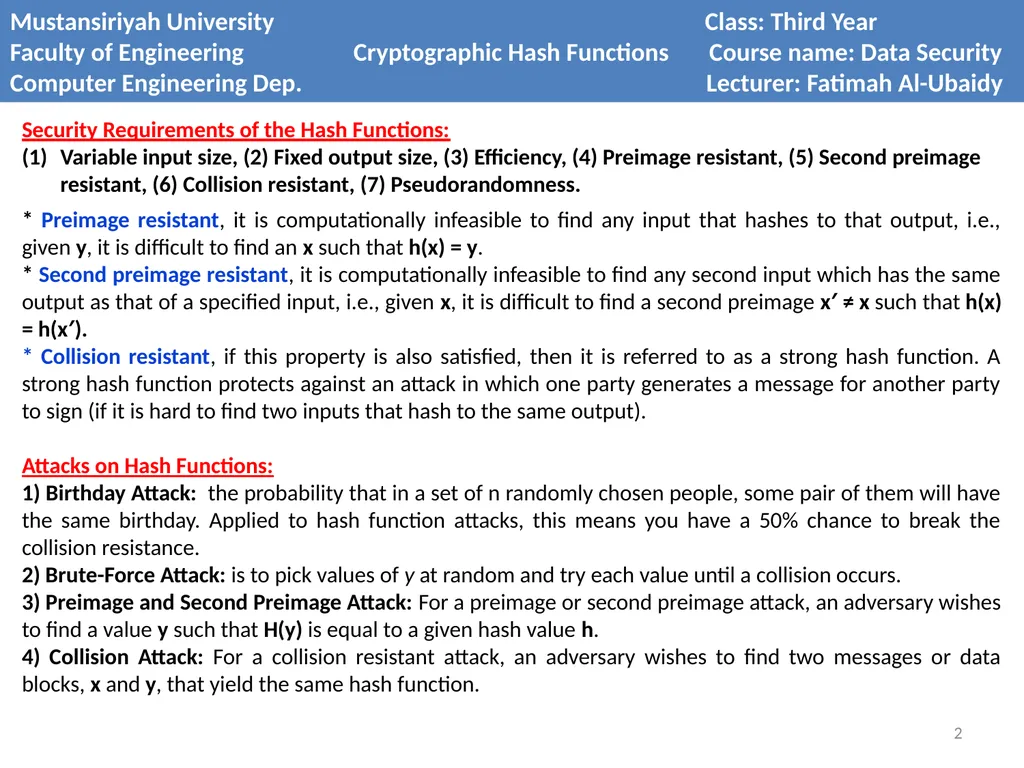
Variable input size, (2) Fixed output size, (3) Efficiency, (4) Preimage resistant, (5) Second preimage resistant, (6) Collision resistant, (7) Pseudorandomness.
* Preimage resistant, it is computationally infeasible to find any input that hashes to that output, i.e., given y, it is difficult to find an x such that h(x) = y.
* Second preimage resistant, it is computationally infeasible to find any second input which has the same output as that of a specified input, i.e., given x, it is difficult to find a second preimage x′ ≠ x such that h(x) = h(x′).
* Collision resistant, if this property is also satisfied, then it is referred to as a strong hash function. A strong hash function protects against an attack in which one party generates a message for another party to sign (if it is hard to find two inputs that hash to the same output).
Attacks on Hash Functions:
1) Birthday Attack: the probability that in a set of n randomly chosen people, some pair of them will have the same birthday. Applied to hash function attacks, this means you have a 50% chance to break the collision resistance.
2) Brute-Force Attack: is to pick values of y at random and try each value until a collision occurs.
3) Preimage and Second Preimage Attack: For a preimage or second preimage attack, an adversary wishes to find a value y such that H(y) is equal to a given hash value h.
4) Collision Attack: For a collision resistant attack, an adversary wishes to find two messages or data blocks, x and y, that yield the same hash function. 2<br>
Faculty of Engineering Cryptographic Hash Functions Course name: Data Security
Computer Engineering Dep. Lecturer: Fatimah Al-Ubaidy Security Requirements of the Hash Functions:
Variable input size, (2) Fixed output size, (3) Efficiency, (4) Preimage resistant, (5) Second preimage resistant, (6) Collision resistant, (7) Pseudorandomness.
* Preimage resistant, it is computationally infeasible to find any input that hashes to that output, i.e., given y, it is difficult to find an x such that h(x) = y.
* Second preimage resistant, it is computationally infeasible to find any second input which has the same output as that of a specified input, i.e., given x, it is difficult to find a second preimage x′ ≠ x such that h(x) = h(x′).
* Collision resistant, if this property is also satisfied, then it is referred to as a strong hash function. A strong hash function protects against an attack in which one party generates a message for another party to sign (if it is hard to find two inputs that hash to the same output).
Attacks on Hash Functions:
1) Birthday Attack: the probability that in a set of n randomly chosen people, some pair of them will have the same birthday. Applied to hash function attacks, this means you have a 50% chance to break the collision resistance.
2) Brute-Force Attack: is to pick values of y at random and try each value until a collision occurs.
3) Preimage and Second Preimage Attack: For a preimage or second preimage attack, an adversary wishes to find a value y such that H(y) is equal to a given hash value h.
4) Collision Attack: For a collision resistant attack, an adversary wishes to find two messages or data blocks, x and y, that yield the same hash function. 2<br>
03
Mustansiriyah University Class: Third Year
Faculty of Engineering Cryptographic Hash Functions Course name: Data Security
Computer Engineering Dep. Lecturer: Fatimah Al-Ubaidy Popular Hash Functions:
1) Message Digest (MD): MD5 was most popular and widely used hash function for quite some years. The MD family comprises of hash functions MD2, MD4, MD5 and MD6. It is a 128-bit hash function. In 2004, collisions were found in MD5 and hence it is no longer recommended for use.
2) Secure Hash Algorithm (SHA):
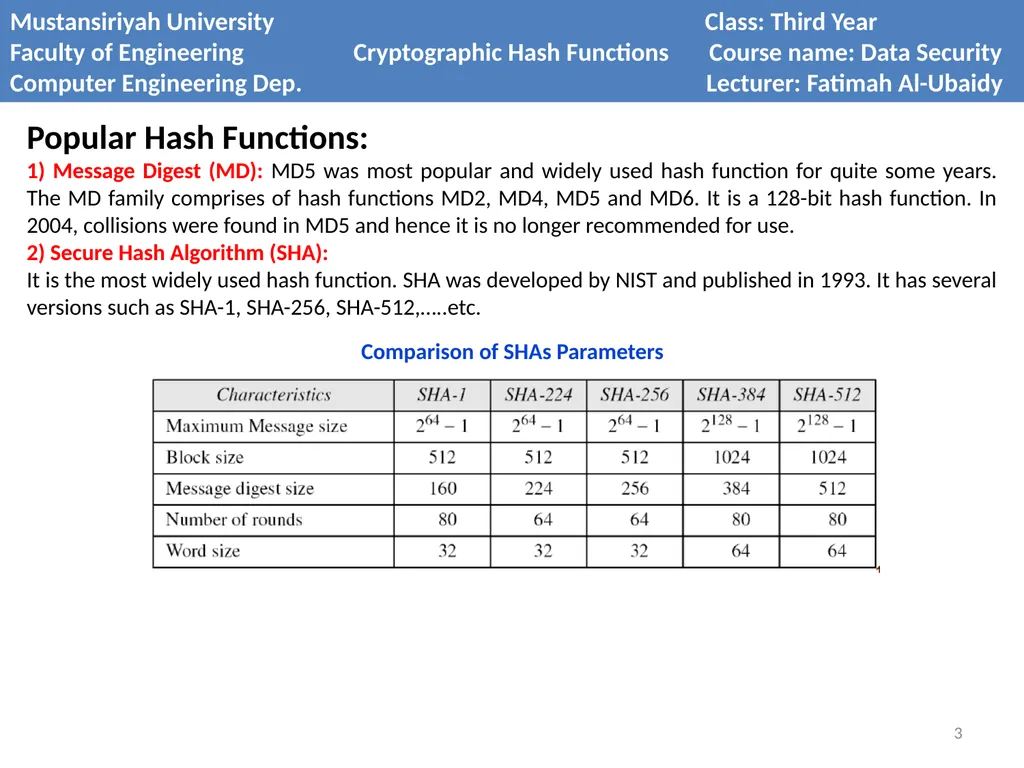
It is the most widely used hash function. SHA was developed by NIST and published in 1993. It has several versions such as SHA-1, SHA-256, SHA-512,…..etc.
Comparison of SHAs Parameters 3<br>
Faculty of Engineering Cryptographic Hash Functions Course name: Data Security
Computer Engineering Dep. Lecturer: Fatimah Al-Ubaidy Popular Hash Functions:
1) Message Digest (MD): MD5 was most popular and widely used hash function for quite some years. The MD family comprises of hash functions MD2, MD4, MD5 and MD6. It is a 128-bit hash function. In 2004, collisions were found in MD5 and hence it is no longer recommended for use.
2) Secure Hash Algorithm (SHA):
It is the most widely used hash function. SHA was developed by NIST and published in 1993. It has several versions such as SHA-1, SHA-256, SHA-512,…..etc.
Comparison of SHAs Parameters 3<br>
04
Mustansiriyah University Class: Third Year
Faculty of Engineering Cryptographic Hash Functions Course name: Data Security
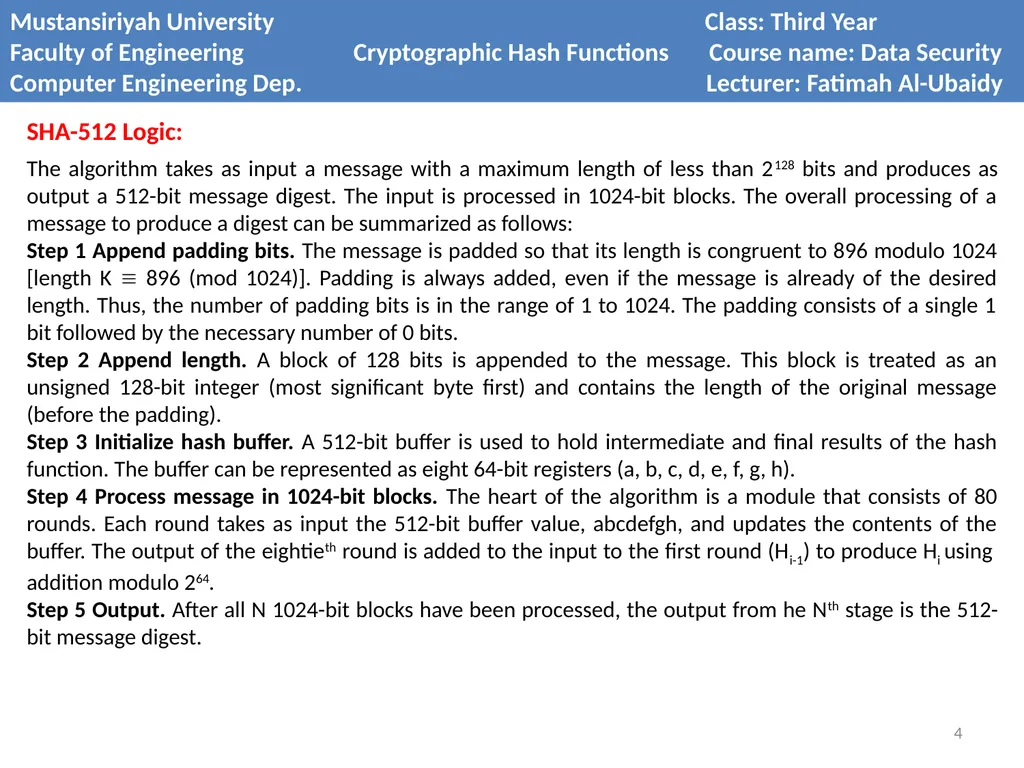
Computer Engineering Dep. Lecturer: Fatimah Al-Ubaidy SHA-512 Logic:
The algorithm takes as input a message with a maximum length of less than 2128 bits and produces as output a 512-bit message digest. The input is processed in 1024-bit blocks. The overall processing of a message to produce a digest can be summarized as follows:
Step 1 Append padding bits. The message is padded so that its length is congruent to 896 modulo 1024 [length K 896 (mod 1024)]. Padding is always added, even if the message is already of the desired length. Thus, the number of padding bits is in the range of 1 to 1024. The padding consists of a single 1 bit followed by the necessary number of 0 bits.
Step 2 Append length. A block of 128 bits is appended to the message. This block is treated as an unsigned 128-bit integer (most significant byte first) and contains the length of the original message (before the padding).
Step 3 Initialize hash buffer. A 512-bit buffer is used to hold intermediate and final results of the hash function. The buffer can be represented as eight 64-bit registers (a, b, c, d, e, f, g, h).
Step 4 Process message in 1024-bit blocks. The heart of the algorithm is a module that consists of 80 rounds. Each round takes as input the 512-bit buffer value, abcdefgh, and updates the contents of the buffer. The output of the eightieth round is added to the input to the first round (Hi-1) to produce Hi using addition modulo 264.
Step 5 Output. After all N 1024-bit blocks have been processed, the output from he Nth stage is the 512-bit message digest. 4<br>
Faculty of Engineering Cryptographic Hash Functions Course name: Data Security
Computer Engineering Dep. Lecturer: Fatimah Al-Ubaidy SHA-512 Logic:
The algorithm takes as input a message with a maximum length of less than 2128 bits and produces as output a 512-bit message digest. The input is processed in 1024-bit blocks. The overall processing of a message to produce a digest can be summarized as follows:
Step 1 Append padding bits. The message is padded so that its length is congruent to 896 modulo 1024 [length K 896 (mod 1024)]. Padding is always added, even if the message is already of the desired length. Thus, the number of padding bits is in the range of 1 to 1024. The padding consists of a single 1 bit followed by the necessary number of 0 bits.
Step 2 Append length. A block of 128 bits is appended to the message. This block is treated as an unsigned 128-bit integer (most significant byte first) and contains the length of the original message (before the padding).
Step 3 Initialize hash buffer. A 512-bit buffer is used to hold intermediate and final results of the hash function. The buffer can be represented as eight 64-bit registers (a, b, c, d, e, f, g, h).
Step 4 Process message in 1024-bit blocks. The heart of the algorithm is a module that consists of 80 rounds. Each round takes as input the 512-bit buffer value, abcdefgh, and updates the contents of the buffer. The output of the eightieth round is added to the input to the first round (Hi-1) to produce Hi using addition modulo 264.
Step 5 Output. After all N 1024-bit blocks have been processed, the output from he Nth stage is the 512-bit message digest. 4<br>
05
Mustansiriyah University Class: Third Year
Faculty of Engineering Cryptographic Hash Functions Course name: Data Security
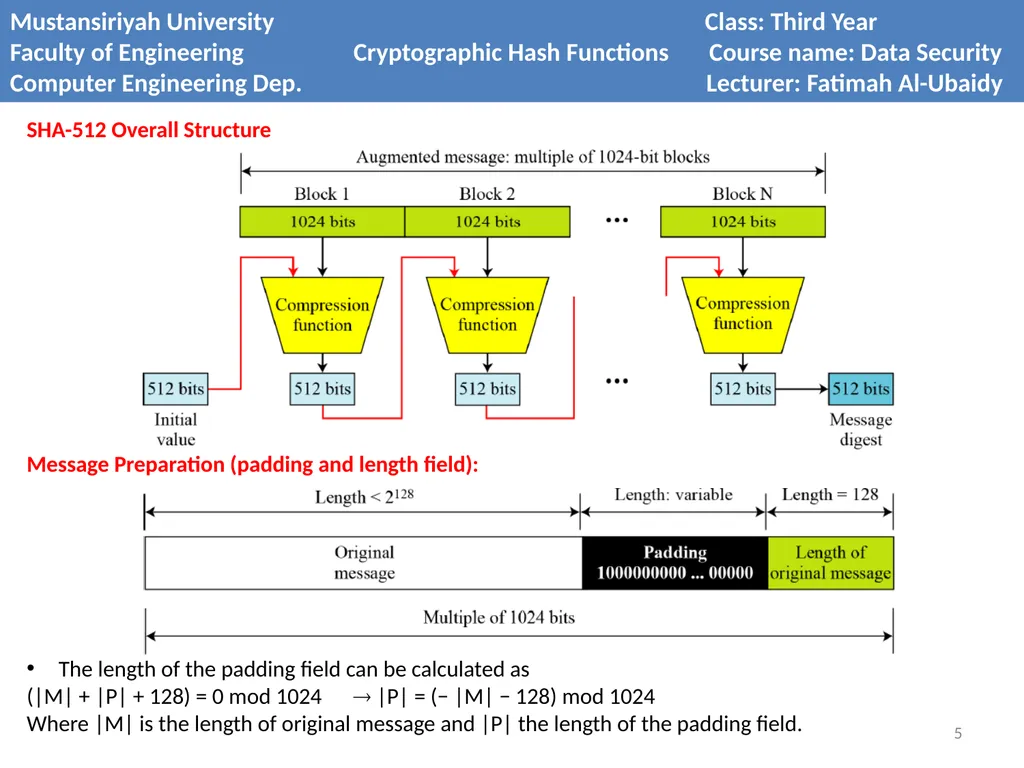
Computer Engineering Dep. Lecturer: Fatimah Al-Ubaidy SHA-512 Overall Structure
Message Preparation (padding and length field):
The length of the padding field can be calculated as
(|M| + |P| + 128) = 0 mod 1024 |P| = (− |M| − 128) mod 1024
Where |M| is the length of original message and |P| the length of the padding field. 5<br>
Faculty of Engineering Cryptographic Hash Functions Course name: Data Security
Computer Engineering Dep. Lecturer: Fatimah Al-Ubaidy SHA-512 Overall Structure
Message Preparation (padding and length field):
The length of the padding field can be calculated as
(|M| + |P| + 128) = 0 mod 1024 |P| = (− |M| − 128) mod 1024
Where |M| is the length of original message and |P| the length of the padding field. 5<br>
06
Mustansiriyah University Class: Third Year
Faculty of Engineering Cryptographic Hash Functions Course name: Data Security
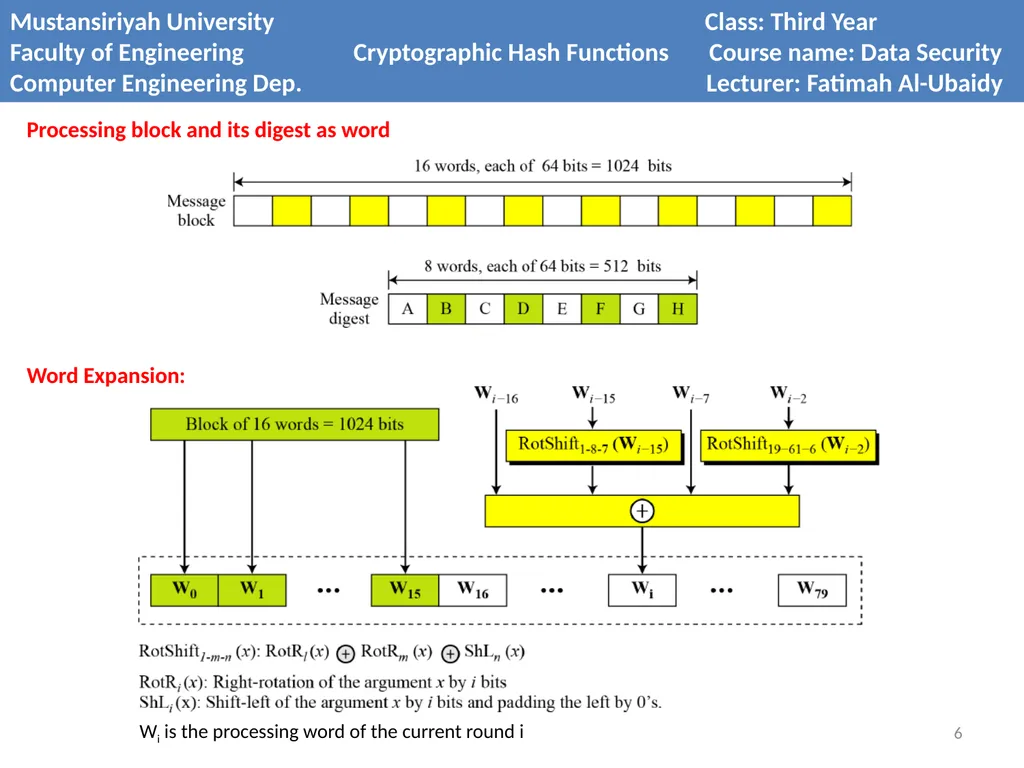
Computer Engineering Dep. Lecturer: Fatimah Al-Ubaidy Processing block and its digest as word
Word Expansion:
Wi is the processing word of the current round i 6<br>
Faculty of Engineering Cryptographic Hash Functions Course name: Data Security
Computer Engineering Dep. Lecturer: Fatimah Al-Ubaidy Processing block and its digest as word
Word Expansion:
Wi is the processing word of the current round i 6<br>
07
Mustansiriyah University Class: Third Year
Faculty of Engineering Cryptographic Hash Functions Course name: Data Security
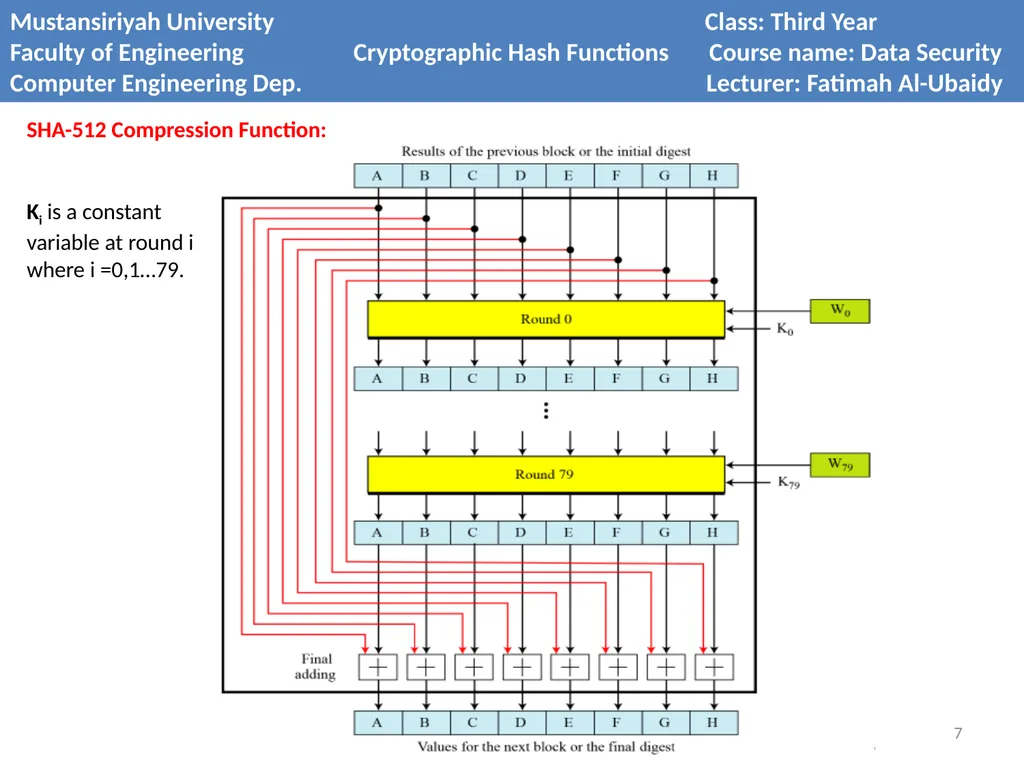
Computer Engineering Dep. Lecturer: Fatimah Al-Ubaidy SHA-512 Compression Function:
Ki is a constant
variable at round i
where i =0,1…79. 7<br>
Faculty of Engineering Cryptographic Hash Functions Course name: Data Security
Computer Engineering Dep. Lecturer: Fatimah Al-Ubaidy SHA-512 Compression Function:
Ki is a constant
variable at round i
where i =0,1…79. 7<br>
08
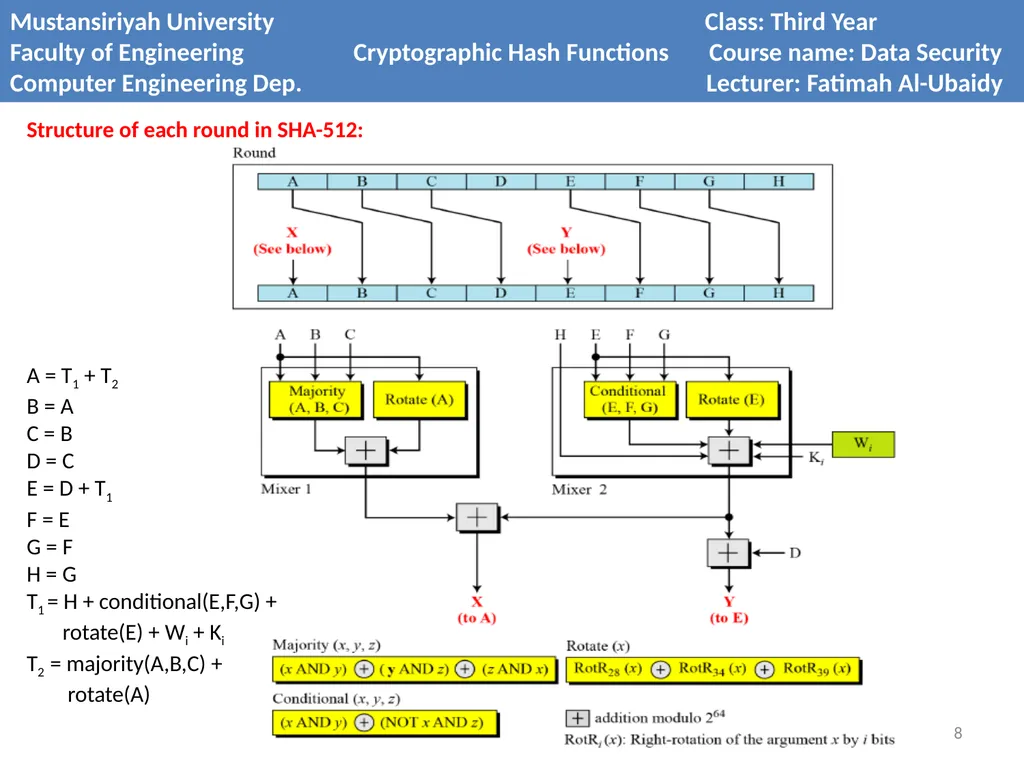
Structure of each round in SHA-512:
A = T1 + T2
B = A
C = B
D = C
E = D + T1
F = E
G = F
H = G
T1 = H + conditional(E,F,G) +
rotate(E) + Wi + Ki
T2 = majority(A,B,C) +
rotate(A) Mustansiriyah University Class: Third Year
Faculty of Engineering Cryptographic Hash Functions Course name: Data Security
Computer Engineering Dep. Lecturer: Fatimah Al-Ubaidy 8<br>
A = T1 + T2
B = A
C = B
D = C
E = D + T1
F = E
G = F
H = G
T1 = H + conditional(E,F,G) +
rotate(E) + Wi + Ki
T2 = majority(A,B,C) +
rotate(A) Mustansiriyah University Class: Third Year
Faculty of Engineering Cryptographic Hash Functions Course name: Data Security
Computer Engineering Dep. Lecturer: Fatimah Al-Ubaidy 8<br>
09
Mustansiriyah University Class: Third Year
Faculty of Engineering Cryptographic Hash Functions Course name: Data Security
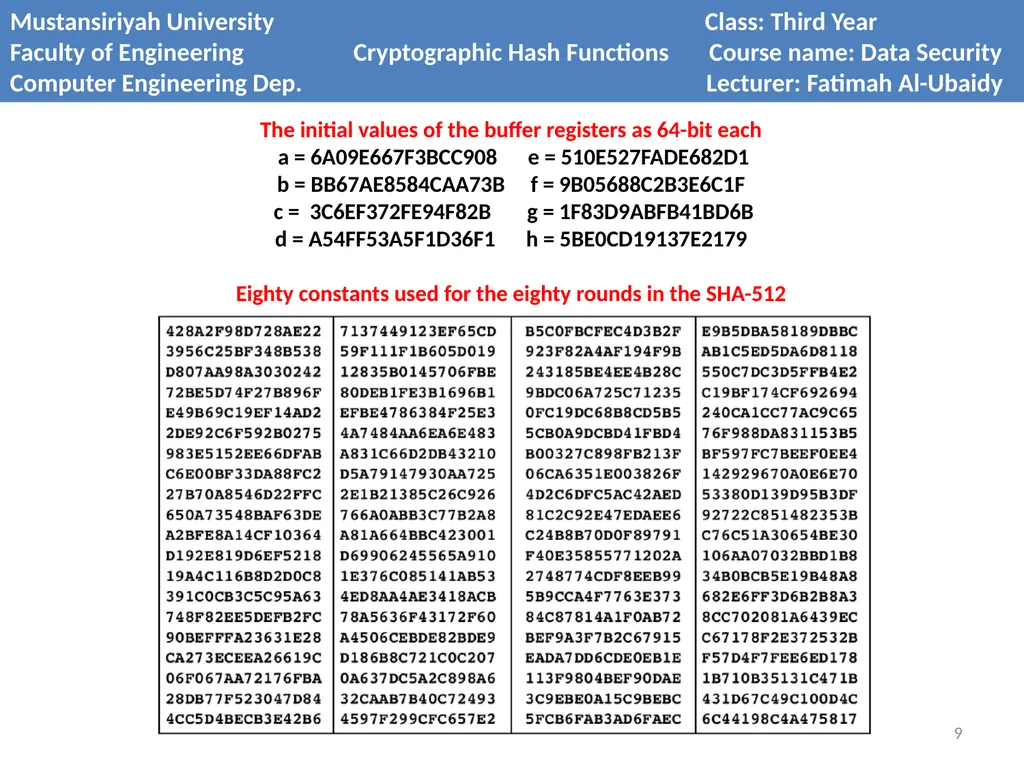
Computer Engineering Dep. Lecturer: Fatimah Al-Ubaidy 9 The initial values of the buffer registers as 64-bit each
a = 6A09E667F3BCC908 e = 510E527FADE682D1
b = BB67AE8584CAA73B f = 9B05688C2B3E6C1F
c = 3C6EF372FE94F82B g = 1F83D9ABFB41BD6B
d = A54FF53A5F1D36F1 h = 5BE0CD19137E2179
Eighty constants used for the eighty rounds in the SHA-512<br>
Faculty of Engineering Cryptographic Hash Functions Course name: Data Security
Computer Engineering Dep. Lecturer: Fatimah Al-Ubaidy 9 The initial values of the buffer registers as 64-bit each
a = 6A09E667F3BCC908 e = 510E527FADE682D1
b = BB67AE8584CAA73B f = 9B05688C2B3E6C1F
c = 3C6EF372FE94F82B g = 1F83D9ABFB41BD6B
d = A54FF53A5F1D36F1 h = 5BE0CD19137E2179
Eighty constants used for the eighty rounds in the SHA-512<br>