
MZANSI NATIONAL PHILHARMONIC ORCHESTRA
SN
Published · 20 slides · 0 views

1 / 1
Description
MZANSI NATIONAL PHILHARMONIC ORCHESTRA PRESENTATION TO THE PORTFOLIO COMMITTEE ON SPORT, ARTS CULTURE 28 FEBRUARY 2023 INTRODUCTION The purpose of this document is to provide the Portfolio Committee on Sport, Arts and Culture with a
Related Topics
Share
Embed code
Download this presentation From Below
"MZANSI NATIONAL PHILHARMONIC ORCHESTRA" is the property of its rightful owner. Permission is granted to download and print the materials on this website for personal, non-commercial use only, and to display it on your personal computer provided you do not modify the materials and that you retain all copyright notices contained in the materials. By downloading content from our website, you accept the terms of this agreement.
Presentation Transcript
01
MZANSI NATIONAL PHILHARMONIC ORCHESTRA
PRESENTATION TO THE PORTFOLIO COMMITTEE ON
SPORT, ARTS & CULTURE
28 FEBRUARY 2023<br>
PRESENTATION TO THE PORTFOLIO COMMITTEE ON
SPORT, ARTS & CULTURE
28 FEBRUARY 2023<br>
02
INTRODUCTION The purpose of this document is to provide the Portfolio Committee on Sport, Arts and Culture with a comprehensive presentation regarding the establishment and status regarding the Mzansi National Philharmonic Orchestra<br>
03
PRESENTATION OUTLINE The presentation will cover:
historical background,
historical funding of orchestras in SA,
the criticism to the ring-fenced allocation to few orchestras; the rationale for the establishment of the National Orchestra, process that was followed,
the aims and objectives of the national orchestra, the budget allocated to the Mzansi National Philharmonic Orchestra (MNPO), and lastly
the current audit undertaken by AGSA on matters relating to the MNPO.
Progress with implementation of Programs by the MNPO<br>
historical background,
historical funding of orchestras in SA,
the criticism to the ring-fenced allocation to few orchestras; the rationale for the establishment of the National Orchestra, process that was followed,
the aims and objectives of the national orchestra, the budget allocated to the Mzansi National Philharmonic Orchestra (MNPO), and lastly
the current audit undertaken by AGSA on matters relating to the MNPO.
Progress with implementation of Programs by the MNPO<br>
04
Historically, South African orchestras are dominated by white musicians, and African practitioners have been largely marginalised.
Even after the end of apartheid in 1994, the representation of African communities in orchestras remained limited,
Funding for the orchestras was mainly directed to benefit orchestras in three major cities, the KZN Philharmonic Orchestra, Cape Town Philharmonic Orchestra and Johannesburg Philharmonic Orchestra. This limited the growth of this particular sector to certain provinces. BACKGROUND<br>
Even after the end of apartheid in 1994, the representation of African communities in orchestras remained limited,
Funding for the orchestras was mainly directed to benefit orchestras in three major cities, the KZN Philharmonic Orchestra, Cape Town Philharmonic Orchestra and Johannesburg Philharmonic Orchestra. This limited the growth of this particular sector to certain provinces. BACKGROUND<br>
05
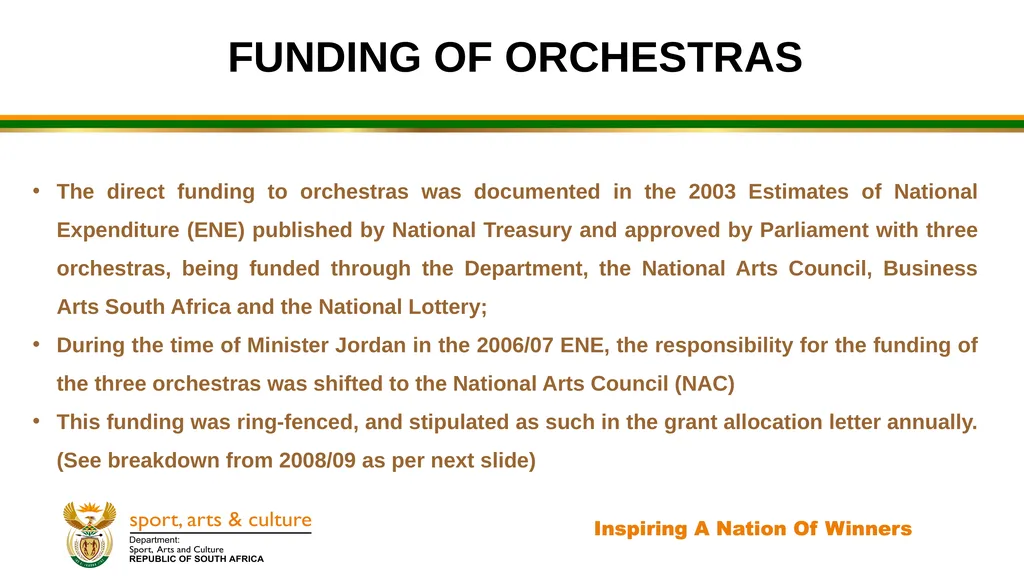
FUNDING OF ORCHESTRAS The direct funding to orchestras was documented in the 2003 Estimates of National Expenditure (ENE) published by National Treasury and approved by Parliament with three orchestras, being funded through the Department, the National Arts Council, Business Arts South Africa and the National Lottery;
During the time of Minister Jordan in the 2006/07 ENE, the responsibility for the funding of the three orchestras was shifted to the National Arts Council (NAC)
This funding was ring-fenced, and stipulated as such in the grant allocation letter annually. (See breakdown from 2008/09 as per next slide)<br>
During the time of Minister Jordan in the 2006/07 ENE, the responsibility for the funding of the three orchestras was shifted to the National Arts Council (NAC)
This funding was ring-fenced, and stipulated as such in the grant allocation letter annually. (See breakdown from 2008/09 as per next slide)<br>
06
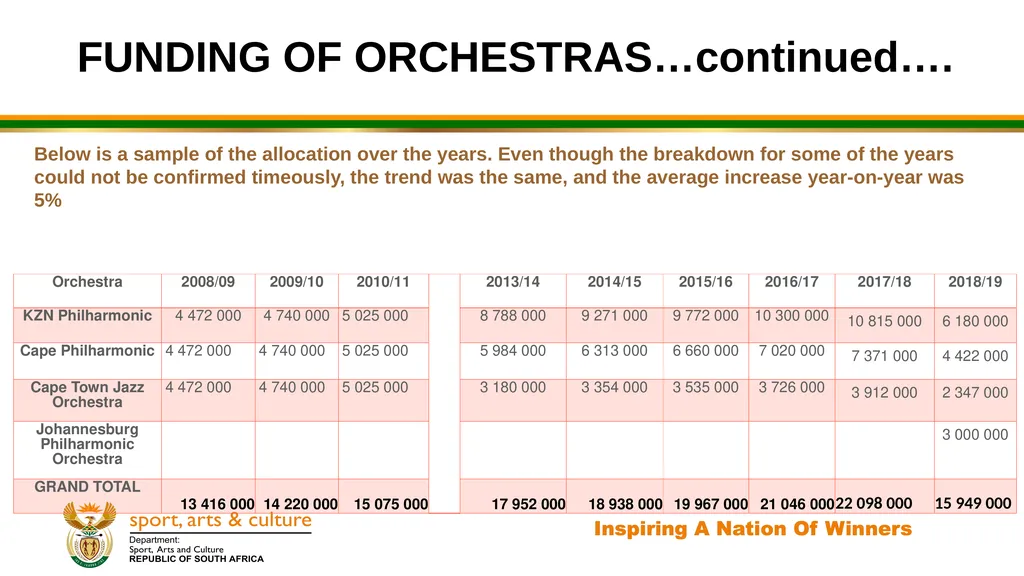
FUNDING OF ORCHESTRAS…continued…. Below is a sample of the allocation over the years. Even though the breakdown for some of the years could not be confirmed timeously, the trend was the same, and the average increase year-on-year was 5%<br>
07
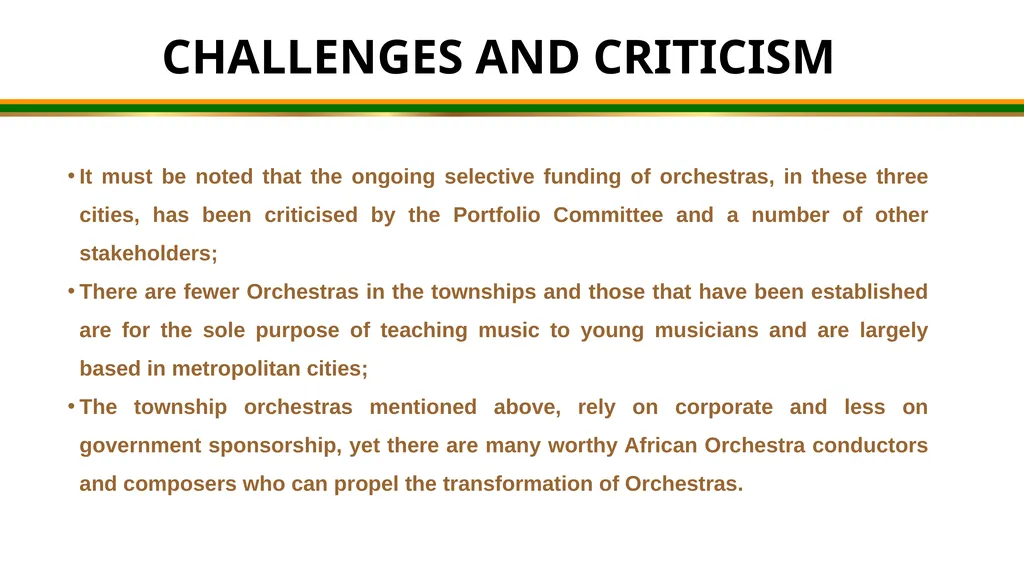
CHALLENGES AND CRITICISM It must be noted that the ongoing selective funding of orchestras, in these three cities, has been criticised by the Portfolio Committee and a number of other stakeholders;
There are fewer Orchestras in the townships and those that have been established are for the sole purpose of teaching music to young musicians and are largely based in metropolitan cities;
The township orchestras mentioned above, rely on corporate and less on government sponsorship, yet there are many worthy African Orchestra conductors and composers who can propel the transformation of Orchestras.<br>
There are fewer Orchestras in the townships and those that have been established are for the sole purpose of teaching music to young musicians and are largely based in metropolitan cities;
The township orchestras mentioned above, rely on corporate and less on government sponsorship, yet there are many worthy African Orchestra conductors and composers who can propel the transformation of Orchestras.<br>
08
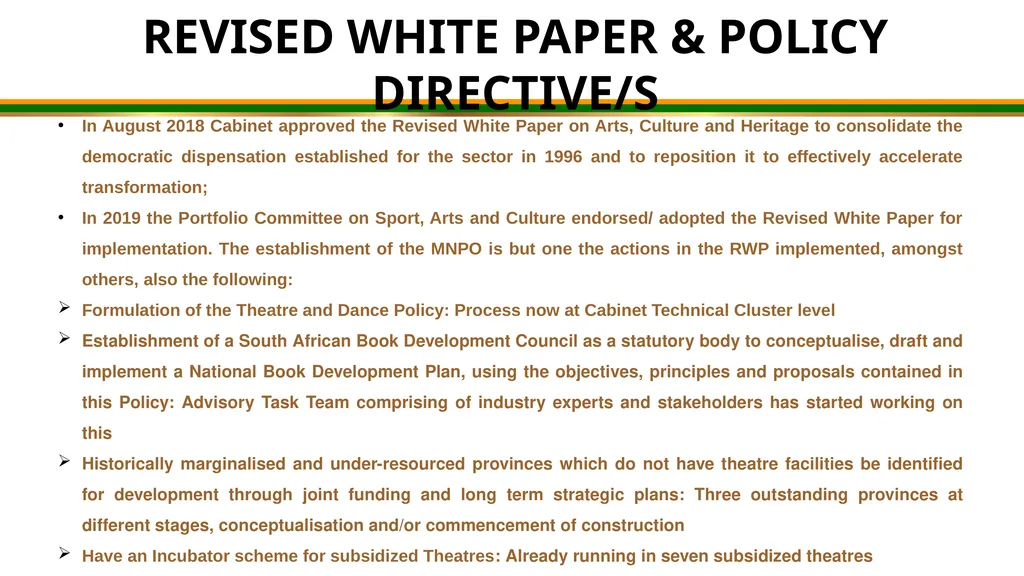
REVISED WHITE PAPER & POLICY DIRECTIVE/S In August 2018 Cabinet approved the Revised White Paper on Arts, Culture and Heritage to consolidate the democratic dispensation established for the sector in 1996 and to reposition it to effectively accelerate transformation;
In 2019 the Portfolio Committee on Sport, Arts and Culture endorsed/ adopted the Revised White Paper for implementation. The establishment of the MNPO is but one the actions in the RWP implemented, amongst others, also the following:
Formulation of the Theatre and Dance Policy: Process now at Cabinet Technical Cluster level
Establishment of a South African Book Development Council as a statutory body to conceptualise, draft and implement a National Book Development Plan, using the objectives, principles and proposals contained in this Policy: Advisory Task Team comprising of industry experts and stakeholders has started working on this
Historically marginalised and under-resourced provinces which do not have theatre facilities be identified for development through joint funding and long term strategic plans: Three outstanding provinces at different stages, conceptualisation and/or commencement of construction
Have an Incubator scheme for subsidized Theatres: Already running in seven subsidized theatres<br>
In 2019 the Portfolio Committee on Sport, Arts and Culture endorsed/ adopted the Revised White Paper for implementation. The establishment of the MNPO is but one the actions in the RWP implemented, amongst others, also the following:
Formulation of the Theatre and Dance Policy: Process now at Cabinet Technical Cluster level
Establishment of a South African Book Development Council as a statutory body to conceptualise, draft and implement a National Book Development Plan, using the objectives, principles and proposals contained in this Policy: Advisory Task Team comprising of industry experts and stakeholders has started working on this
Historically marginalised and under-resourced provinces which do not have theatre facilities be identified for development through joint funding and long term strategic plans: Three outstanding provinces at different stages, conceptualisation and/or commencement of construction
Have an Incubator scheme for subsidized Theatres: Already running in seven subsidized theatres<br>
09
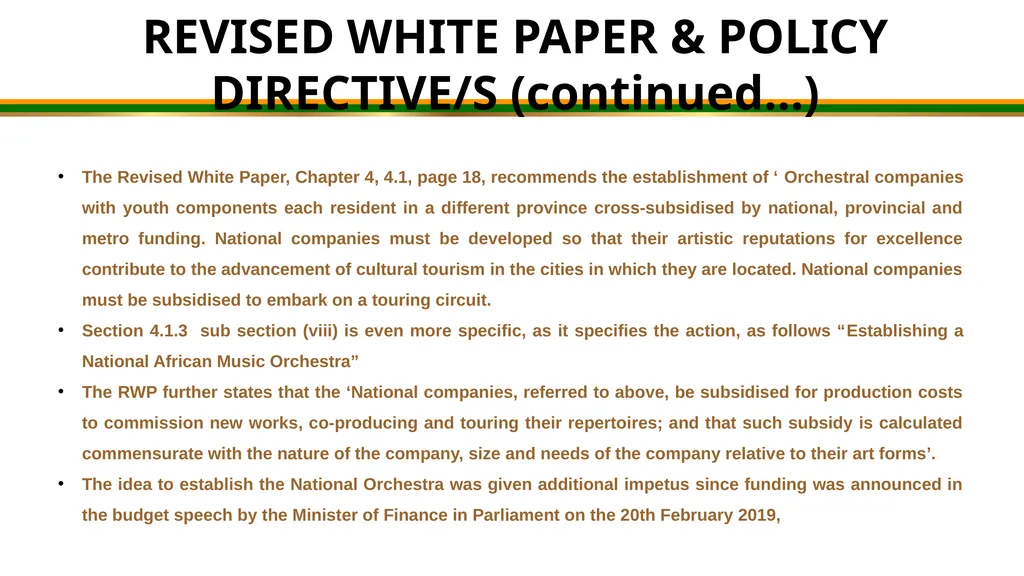
REVISED WHITE PAPER & POLICY DIRECTIVE/S (continued…) The Revised White Paper, Chapter 4, 4.1, page 18, recommends the establishment of ‘ Orchestral companies with youth components each resident in a different province cross-subsidised by national, provincial and metro funding. National companies must be developed so that their artistic reputations for excellence contribute to the advancement of cultural tourism in the cities in which they are located. National companies must be subsidised to embark on a touring circuit.
Section 4.1.3 sub section (viii) is even more specific, as it specifies the action, as follows “Establishing a National African Music Orchestra”
The RWP further states that the ‘National companies, referred to above, be subsidised for production costs to commission new works, co-producing and touring their repertoires; and that such subsidy is calculated commensurate with the nature of the company, size and needs of the company relative to their art forms’.
The idea to establish the National Orchestra was given additional impetus since funding was announced in the budget speech by the Minister of Finance in Parliament on the 20th February 2019,<br>
Section 4.1.3 sub section (viii) is even more specific, as it specifies the action, as follows “Establishing a National African Music Orchestra”
The RWP further states that the ‘National companies, referred to above, be subsidised for production costs to commission new works, co-producing and touring their repertoires; and that such subsidy is calculated commensurate with the nature of the company, size and needs of the company relative to their art forms’.
The idea to establish the National Orchestra was given additional impetus since funding was announced in the budget speech by the Minister of Finance in Parliament on the 20th February 2019,<br>
10
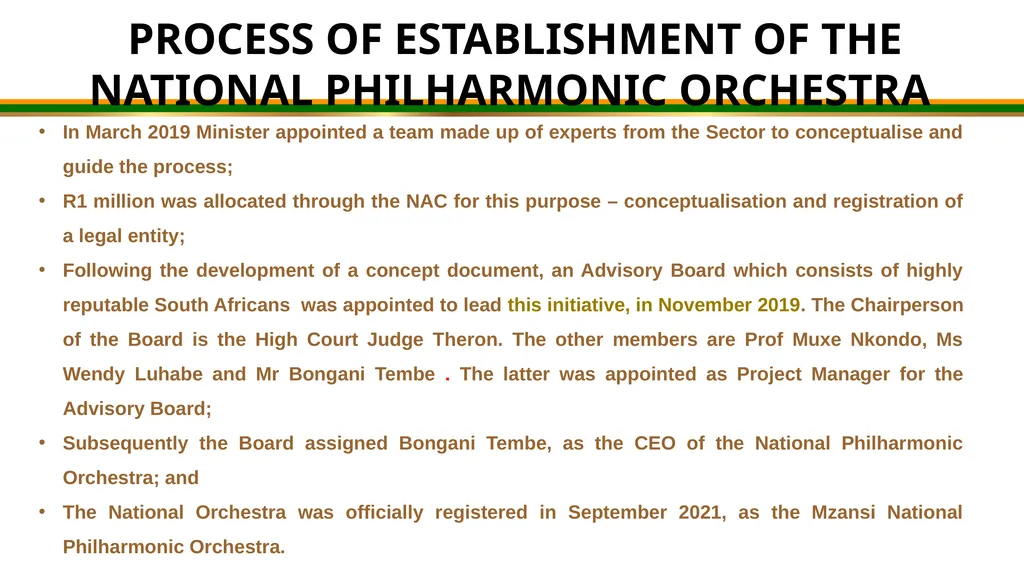
PROCESS OF ESTABLISHMENT OF THE NATIONAL PHILHARMONIC ORCHESTRA In March 2019 Minister appointed a team made up of experts from the Sector to conceptualise and guide the process;
R1 million was allocated through the NAC for this purpose – conceptualisation and registration of a legal entity;
Following the development of a concept document, an Advisory Board which consists of highly reputable South Africans was appointed to lead this initiative, in November 2019. The Chairperson of the Board is the High Court Judge Theron. The other members are Prof Muxe Nkondo, Ms Wendy Luhabe and Mr Bongani Tembe . The latter was appointed as Project Manager for the Advisory Board;
Subsequently the Board assigned Bongani Tembe, as the CEO of the National Philharmonic Orchestra; and
The National Orchestra was officially registered in September 2021, as the Mzansi National Philharmonic Orchestra.<br>
R1 million was allocated through the NAC for this purpose – conceptualisation and registration of a legal entity;
Following the development of a concept document, an Advisory Board which consists of highly reputable South Africans was appointed to lead this initiative, in November 2019. The Chairperson of the Board is the High Court Judge Theron. The other members are Prof Muxe Nkondo, Ms Wendy Luhabe and Mr Bongani Tembe . The latter was appointed as Project Manager for the Advisory Board;
Subsequently the Board assigned Bongani Tembe, as the CEO of the National Philharmonic Orchestra; and
The National Orchestra was officially registered in September 2021, as the Mzansi National Philharmonic Orchestra.<br>
11
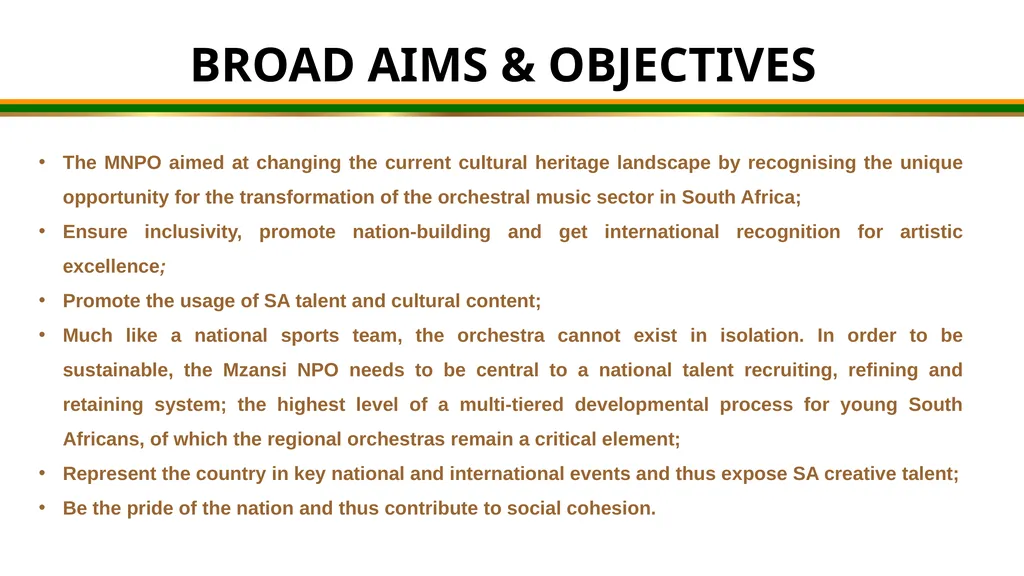
BROAD AIMS & OBJECTIVES The MNPO aimed at changing the current cultural heritage landscape by recognising the unique opportunity for the transformation of the orchestral music sector in South Africa;
Ensure inclusivity, promote nation-building and get international recognition for artistic excellence;
Promote the usage of SA talent and cultural content;
Much like a national sports team, the orchestra cannot exist in isolation. In order to be sustainable, the Mzansi NPO needs to be central to a national talent recruiting, refining and retaining system; the highest level of a multi-tiered developmental process for young South Africans, of which the regional orchestras remain a critical element;
Represent the country in key national and international events and thus expose SA creative talent;
Be the pride of the nation and thus contribute to social cohesion.<br>
Ensure inclusivity, promote nation-building and get international recognition for artistic excellence;
Promote the usage of SA talent and cultural content;
Much like a national sports team, the orchestra cannot exist in isolation. In order to be sustainable, the Mzansi NPO needs to be central to a national talent recruiting, refining and retaining system; the highest level of a multi-tiered developmental process for young South Africans, of which the regional orchestras remain a critical element;
Represent the country in key national and international events and thus expose SA creative talent;
Be the pride of the nation and thus contribute to social cohesion.<br>
12
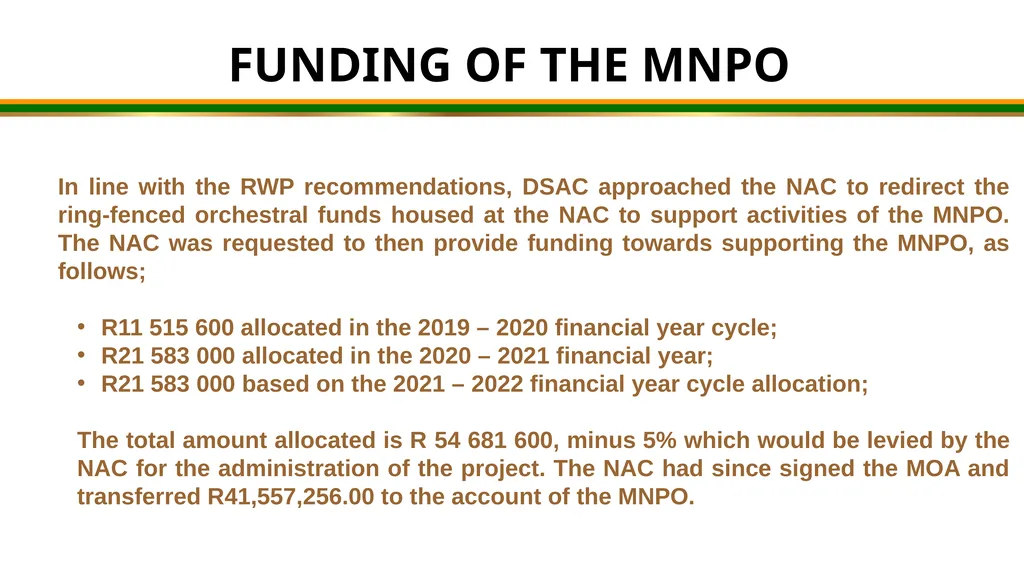
FUNDING OF THE MNPO In line with the RWP recommendations, DSAC approached the NAC to redirect the ring-fenced orchestral funds housed at the NAC to support activities of the MNPO. The NAC was requested to then provide funding towards supporting the MNPO, as follows;
R11 515 600 allocated in the 2019 – 2020 financial year cycle;
R21 583 000 allocated in the 2020 – 2021 financial year;
R21 583 000 based on the 2021 – 2022 financial year cycle allocation;
The total amount allocated is R 54 681 600, minus 5% which would be levied by the NAC for the administration of the project. The NAC had since signed the MOA and transferred R41,557,256.00 to the account of the MNPO.<br>
R11 515 600 allocated in the 2019 – 2020 financial year cycle;
R21 583 000 allocated in the 2020 – 2021 financial year;
R21 583 000 based on the 2021 – 2022 financial year cycle allocation;
The total amount allocated is R 54 681 600, minus 5% which would be levied by the NAC for the administration of the project. The NAC had since signed the MOA and transferred R41,557,256.00 to the account of the MNPO.<br>
13
PERSPECTIVE OF THE NAC REGARDING THE AUDIT OF ON THE MNPO From the perspective of the NAC in respect of the MNPO audit, all due diligence was followed to ensure that a Memorandum of Understanding between NAC and DSAC was in place. Council also approved the processes of engaging DSAC through a Memorandum of Understanding as well as setting of a Memorandum of Agreement with the Mzansi National Philharmonic Orchestra. The transfer to the MNPO was made after ascertaining that all their compliance documents were in place.
According to the AG, they could not conclude on the matter because of the NAC management not providing key outstanding information. NAC confirms that all documentation relating to the MNPO audit was submitted to the AG as part of the audit process. Various meetings were held with AG explaining the gestation of orchestra funding and all relevant supporting documentation requested was submitted. There was no list of outstanding information pending at the conclusion of the audit process.
On 31 July 2022, AG presented on this matter to the NAC’s Audit and Risk Committee. In this meeting, there was no communication or indication that that there was any information outstanding from management. Please also note that there was no limitation of scope declared by AG in relation to any information not provided by management
NAC’s understanding is that AG was still to undertake further investigation into the MNPO funding as they could not reach a conclusion in respect of the MNPO audit. As part of their further enquiry into the matter, AG was going to approach the AG team auditing the Department and also have a meeting with the Department’s CFO<br>
According to the AG, they could not conclude on the matter because of the NAC management not providing key outstanding information. NAC confirms that all documentation relating to the MNPO audit was submitted to the AG as part of the audit process. Various meetings were held with AG explaining the gestation of orchestra funding and all relevant supporting documentation requested was submitted. There was no list of outstanding information pending at the conclusion of the audit process.
On 31 July 2022, AG presented on this matter to the NAC’s Audit and Risk Committee. In this meeting, there was no communication or indication that that there was any information outstanding from management. Please also note that there was no limitation of scope declared by AG in relation to any information not provided by management
NAC’s understanding is that AG was still to undertake further investigation into the MNPO funding as they could not reach a conclusion in respect of the MNPO audit. As part of their further enquiry into the matter, AG was going to approach the AG team auditing the Department and also have a meeting with the Department’s CFO<br>
14
INFORMATION REQUESTED BY AGSA FOR THE PURPOSE OF CONCLUDING THE AUDIT AGSA requested the Department and NAC to furnish the following information:
Documents relating to the establishment/appointment process and all approvals;
Budget and approvals;
Expenditure transferred;
Proof of how expenditure was utilised;
Any other relevant documentation.
DSAC submitted the following to the AGSA ;
Memorandum of Understanding Between DSAC and NAC
Memorandum of Agreement between NAC and MNPO
Internal memo requesting the Minister to appoint the Board;
Letters – Appointment of the Board of the MNPO
Status Report by the MNPO
Online linkage to Cabinet meeting of 22 August 2018 in which the RWP was approved.
NAC submitted the following to the AGSA
Certificate of registration of the MNPO
MNPO Annual Report Jan – December 2022 with Financial Overview and Grant Funding Breakdown
NAC Act<br>
Documents relating to the establishment/appointment process and all approvals;
Budget and approvals;
Expenditure transferred;
Proof of how expenditure was utilised;
Any other relevant documentation.
DSAC submitted the following to the AGSA ;
Memorandum of Understanding Between DSAC and NAC
Memorandum of Agreement between NAC and MNPO
Internal memo requesting the Minister to appoint the Board;
Letters – Appointment of the Board of the MNPO
Status Report by the MNPO
Online linkage to Cabinet meeting of 22 August 2018 in which the RWP was approved.
NAC submitted the following to the AGSA
Certificate of registration of the MNPO
MNPO Annual Report Jan – December 2022 with Financial Overview and Grant Funding Breakdown
NAC Act<br>
15
SPECIFIC OBJECTIVES FOR THE ESTABLISHMENT OF THE NATIONAL ORCHESTRA Providing enrichment and community engagement programmes
Promoting the development of orchestral music and other genres of music, particularly indigenous music
Finding, mentoring, training and supporting young and talented musicians
Promoting the teaching, knowledge and appreciation of music
Encouraging composers of music and promoting music which reflects South Africa’s heritage
Supporting the national brand around the world by presenting events which increase the global profile of South Africa and its talent
Contributing to tourism and the growth of the creative economy<br>
Promoting the development of orchestral music and other genres of music, particularly indigenous music
Finding, mentoring, training and supporting young and talented musicians
Promoting the teaching, knowledge and appreciation of music
Encouraging composers of music and promoting music which reflects South Africa’s heritage
Supporting the national brand around the world by presenting events which increase the global profile of South Africa and its talent
Contributing to tourism and the growth of the creative economy<br>
16
PROGRAMS DRIVEN SINCE ESTABLISHMENT Inaugural National Tour – Durban, Johannesburg and Cape Town
Community Engagement Program – Taking Orchestra to communities
National Cadet-ship Program – to address limited representation of black musicians in the pool of present and future professional musicians, in the process also contributing to job creation
Fellowship Program – supports SA musicians who have earned scholarship/ placements at International Schools. The programme plays an active role harnessing the talent of South African musicians; Contributes to music excellence in South Africa and creates career paths for young musicians
Grant Funding Program – managed by the Artistic Planning Committee and approved by the Board in December 2022
NB: This is amongst others, and detail can be found in the January – December 2022 Report<br>
Community Engagement Program – Taking Orchestra to communities
National Cadet-ship Program – to address limited representation of black musicians in the pool of present and future professional musicians, in the process also contributing to job creation
Fellowship Program – supports SA musicians who have earned scholarship/ placements at International Schools. The programme plays an active role harnessing the talent of South African musicians; Contributes to music excellence in South Africa and creates career paths for young musicians
Grant Funding Program – managed by the Artistic Planning Committee and approved by the Board in December 2022
NB: This is amongst others, and detail can be found in the January – December 2022 Report<br>
17
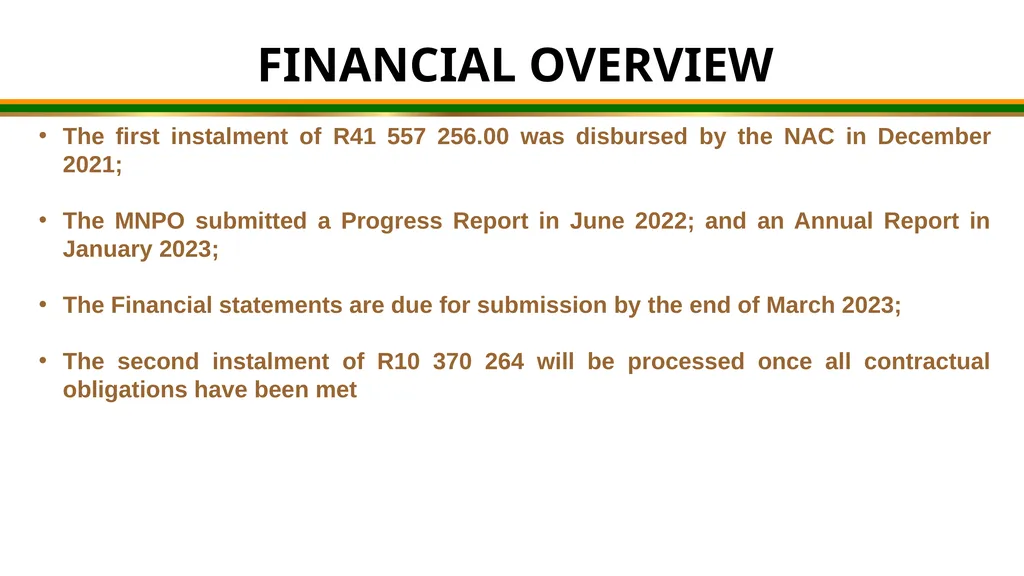
FINANCIAL OVERVIEW The first instalment of R41 557 256.00 was disbursed by the NAC in December 2021;
The MNPO submitted a Progress Report in June 2022; and an Annual Report in January 2023;
The Financial statements are due for submission by the end of March 2023;
The second instalment of R10 370 264 will be processed once all contractual obligations have been met<br>
The MNPO submitted a Progress Report in June 2022; and an Annual Report in January 2023;
The Financial statements are due for submission by the end of March 2023;
The second instalment of R10 370 264 will be processed once all contractual obligations have been met<br>
18
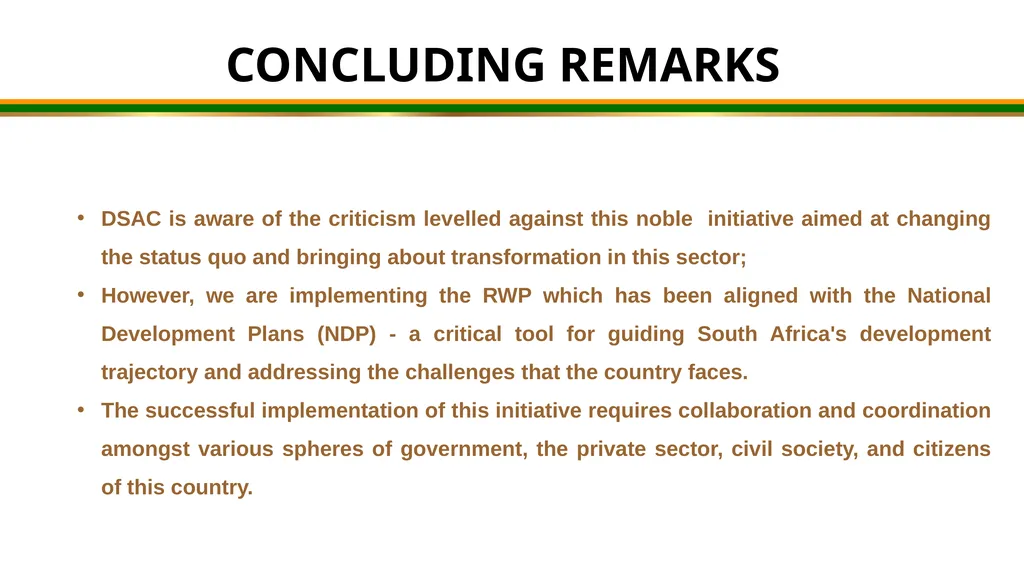
CONCLUDING REMARKS DSAC is aware of the criticism levelled against this noble initiative aimed at changing the status quo and bringing about transformation in this sector;
However, we are implementing the RWP which has been aligned with the National Development Plans (NDP) - a critical tool for guiding South Africa's development trajectory and addressing the challenges that the country faces.
The successful implementation of this initiative requires collaboration and coordination amongst various spheres of government, the private sector, civil society, and citizens of this country.<br>
However, we are implementing the RWP which has been aligned with the National Development Plans (NDP) - a critical tool for guiding South Africa's development trajectory and addressing the challenges that the country faces.
The successful implementation of this initiative requires collaboration and coordination amongst various spheres of government, the private sector, civil society, and citizens of this country.<br>
19
THANK YOU<br>