
Name : DR. R. MUTHULAKSHMI Designation : Guest
DP
Published · 28 slides · 0 views

1 / 1






Description
Name : DR. R. MUTHULAKSHMI Designation : Guest Lecturer Institution : Lady Willingdon Institute of Advanced Study in Education Address : Kamarajar Salai, Triplicane, Chennai 5 Course code : M.Ed - SMTC Unit Topic : V - Action Research
Related Topics
Share
Embed code
Download this presentation From Below
"Name : DR. R. MUTHULAKSHMI Designation : Guest" is the property of its rightful owner. Permission is granted to download and print the materials on this website for personal, non-commercial use only, and to display it on your personal computer provided you do not modify the materials and that you retain all copyright notices contained in the materials. By downloading content from our website, you accept the terms of this agreement.
Presentation Transcript
01
Name : DR. R. MUTHULAKSHMI
Designation : Guest Lecturer
Institution : Lady Willingdon Institute of Advanced Study in Education
Address : Kamarajar Salai, Triplicane, Chennai – 5
Course & code : M.Ed - SMTC
Unit /Topic : V - Action Research Design Creating e-learning portal in TAMIL NADU TEACHERS EDUCATION UNIVERSITY<br>
Designation : Guest Lecturer
Institution : Lady Willingdon Institute of Advanced Study in Education
Address : Kamarajar Salai, Triplicane, Chennai – 5
Course & code : M.Ed - SMTC
Unit /Topic : V - Action Research Design Creating e-learning portal in TAMIL NADU TEACHERS EDUCATION UNIVERSITY<br>
02
Action Research Contents
Meaning
Purpose
Types
Key Characteristics
Steps<br>
Meaning
Purpose
Types
Key Characteristics
Steps<br>
03
Introduction to Action research The term action research was first coined by Kurt Lewin in 1944. Action research is very popular in the field of education to meet the requirement and further progress for effective teaching and learning.
The approach of action research emphasizes encouragement to the practitioners namely teachers, administrators and academicians to do research in order to improve their own fields.<br>
The approach of action research emphasizes encouragement to the practitioners namely teachers, administrators and academicians to do research in order to improve their own fields.<br>
04
Meaning of Action Research
Action research is a scientific research used generally to solve problems in day-to-day classroom activities practically through systematic actions.
Definition of Action Research
On the spot research aimed at the solution of an immediate problem is generally known in education as action research .
- Mouly<br>
Action research is a scientific research used generally to solve problems in day-to-day classroom activities practically through systematic actions.
Definition of Action Research
On the spot research aimed at the solution of an immediate problem is generally known in education as action research .
- Mouly<br>
05
Action Research is the application of scientific thinking to real life problems and represents a great improvement over teacher’s subjective judgement and their limited personal experiences.
- Kurt Lewin
Action Research is a research used by teachers, supervisors and administrators to improve the quality of their decisions and actions.
- Good<br>
- Kurt Lewin
Action Research is a research used by teachers, supervisors and administrators to improve the quality of their decisions and actions.
- Good<br>
06
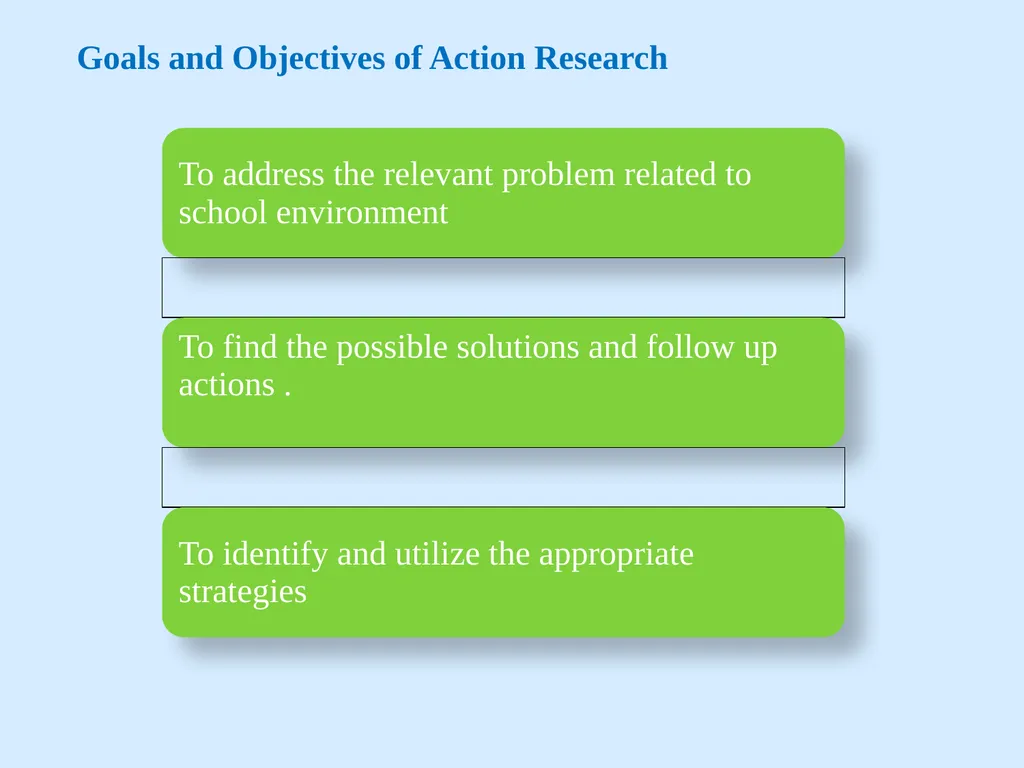
Goals and Objectives of Action Research<br>
07
Purpose of Action Research
To improve the practices going on in the schools
To remove the notion that educational research is the job of specialists only .
To make teachers and the educational administrators research- minded.
To make the school or educational personnel more cooperative and democratic in their work.
To make the environment of the school more conducive for effective teaching and learning.
To provide guidelines to solve immediate problems.
To establish feedback and follow up mechanism<br>
To improve the practices going on in the schools
To remove the notion that educational research is the job of specialists only .
To make teachers and the educational administrators research- minded.
To make the school or educational personnel more cooperative and democratic in their work.
To make the environment of the school more conducive for effective teaching and learning.
To provide guidelines to solve immediate problems.
To establish feedback and follow up mechanism<br>
08
Need and Significance of Action Research
Action research provides systematic study of the problem.
It dispels the fear and confirms that action research is doing for the people who needs remedies.
It helps to find objective way of teaching and learning
It creates awareness among the teachers and administrators about school related problems.
It helps to improve the quality in teaching and learning process.
It helps to address the day-to-day issues related to classroom environment.
It is a sort of cooperative endeavors which involve teaching and non-teaching teams.<br>
Action research provides systematic study of the problem.
It dispels the fear and confirms that action research is doing for the people who needs remedies.
It helps to find objective way of teaching and learning
It creates awareness among the teachers and administrators about school related problems.
It helps to improve the quality in teaching and learning process.
It helps to address the day-to-day issues related to classroom environment.
It is a sort of cooperative endeavors which involve teaching and non-teaching teams.<br>
09
Types of Action Research Designs
There are different types of action research according to the relevance of the problem. The common types of action research are as follows,
Individual action research design
Collaborative action research design
School-wide action research design
District-wide action research design<br>
There are different types of action research according to the relevance of the problem. The common types of action research are as follows,
Individual action research design
Collaborative action research design
School-wide action research design
District-wide action research design<br>
10
Individual action research design
Individual action research is a research conducted by one person from the particular domain. This type of research is conducted to analyze and find solution to a specific task or problem.
Example (classroom)
Problem: A study to find the effectiveness of using peer group learning in English Classroom
Action: *. One teacher performs by implementing strategies such as equalizing peer groups, identifying strength and weakness, allotting time, giving instruction followed by activities.
*. After the action, the teacher analyses the results and find whether the peer group involvement improves learning or not in English classroom.<br>
Individual action research is a research conducted by one person from the particular domain. This type of research is conducted to analyze and find solution to a specific task or problem.
Example (classroom)
Problem: A study to find the effectiveness of using peer group learning in English Classroom
Action: *. One teacher performs by implementing strategies such as equalizing peer groups, identifying strength and weakness, allotting time, giving instruction followed by activities.
*. After the action, the teacher analyses the results and find whether the peer group involvement improves learning or not in English classroom.<br>
11
Collaborative action research design
Collaborative action research is a research that involves group work more than one people engaged to analyze the new task which is given to a group of students.
Example
Problem: A study to find the impact in conducting the online objective test on sixth standard students
Action: *. Head Master, administrators and teachers who are handling sixth standard involves in implementing the online objective test by using online platform that has to be proper usage of technology and identifying the level of interest of the students
*. After implementing the program the results are analyzed by them and find whether online platform possible to conduct objective test for sixth standard students.<br>
Collaborative action research is a research that involves group work more than one people engaged to analyze the new task which is given to a group of students.
Example
Problem: A study to find the impact in conducting the online objective test on sixth standard students
Action: *. Head Master, administrators and teachers who are handling sixth standard involves in implementing the online objective test by using online platform that has to be proper usage of technology and identifying the level of interest of the students
*. After implementing the program the results are analyzed by them and find whether online platform possible to conduct objective test for sixth standard students.<br>
12
School -wide action research design
Generally the scope of action research is vital in school environment to find a problem associated with an entire school. School-wide action research is a research conducted by staffs together to study the problem.
Example
Problem: A study to find the cooperation between parents and teachers.
Action: *. The staff, parents and higher authority of Parent-teacher association works together by analyzing the problem includes adequate meeting, funds, students performance.
*. After the action they decides how to correct the problem using proper discussion.<br>
Generally the scope of action research is vital in school environment to find a problem associated with an entire school. School-wide action research is a research conducted by staffs together to study the problem.
Example
Problem: A study to find the cooperation between parents and teachers.
Action: *. The staff, parents and higher authority of Parent-teacher association works together by analyzing the problem includes adequate meeting, funds, students performance.
*. After the action they decides how to correct the problem using proper discussion.<br>
13
District-wide action research design
District-wide action research is a research conducted for an entire school district to address the organizational problems within the district and it comes in community based research.
Example
Problem: A study to address the issues related to district level sports competition.
Action : *. Relevant staff from each school involves in finding the issues related to how to select the students, funds, getting permission from district collector and transport
*. After addressing the issues they works together in finding the ways to improve the positive climate among their organizations.<br>
District-wide action research is a research conducted for an entire school district to address the organizational problems within the district and it comes in community based research.
Example
Problem: A study to address the issues related to district level sports competition.
Action : *. Relevant staff from each school involves in finding the issues related to how to select the students, funds, getting permission from district collector and transport
*. After addressing the issues they works together in finding the ways to improve the positive climate among their organizations.<br>
14
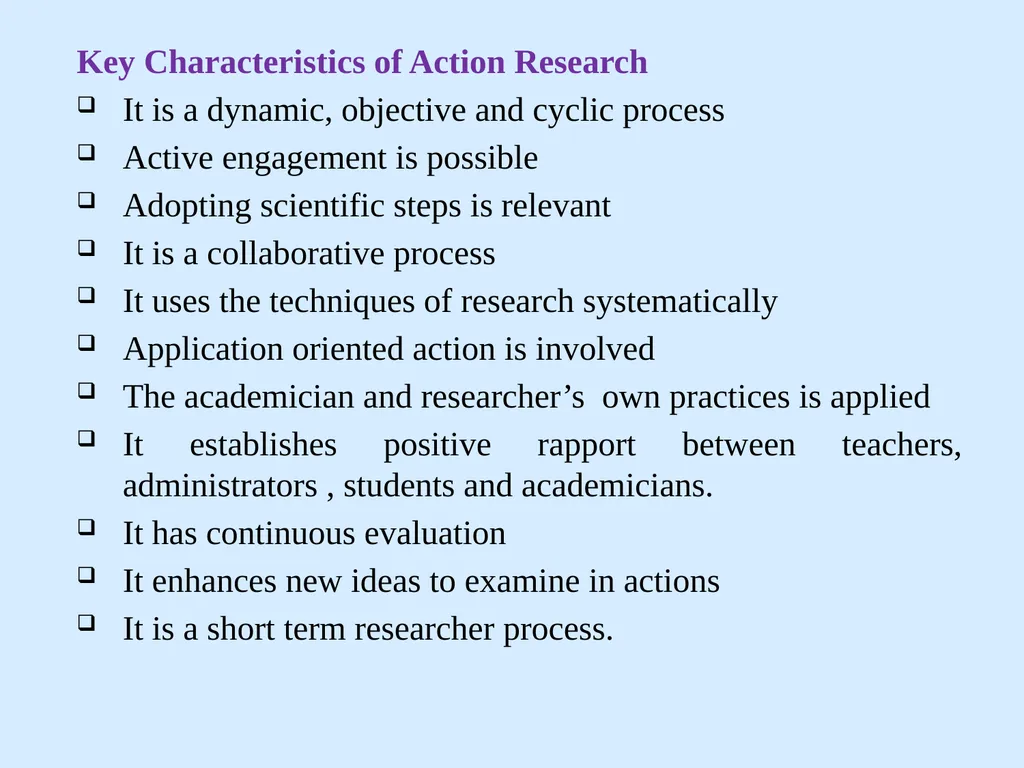
Key Characteristics of Action Research
It is a dynamic, objective and cyclic process
Active engagement is possible
Adopting scientific steps is relevant
It is a collaborative process
It uses the techniques of research systematically
Application oriented action is involved
The academician and researcher’s own practices is applied
It establishes positive rapport between teachers, administrators , students and academicians.
It has continuous evaluation
It enhances new ideas to examine in actions
It is a short term researcher process.<br>
It is a dynamic, objective and cyclic process
Active engagement is possible
Adopting scientific steps is relevant
It is a collaborative process
It uses the techniques of research systematically
Application oriented action is involved
The academician and researcher’s own practices is applied
It establishes positive rapport between teachers, administrators , students and academicians.
It has continuous evaluation
It enhances new ideas to examine in actions
It is a short term researcher process.<br>
15
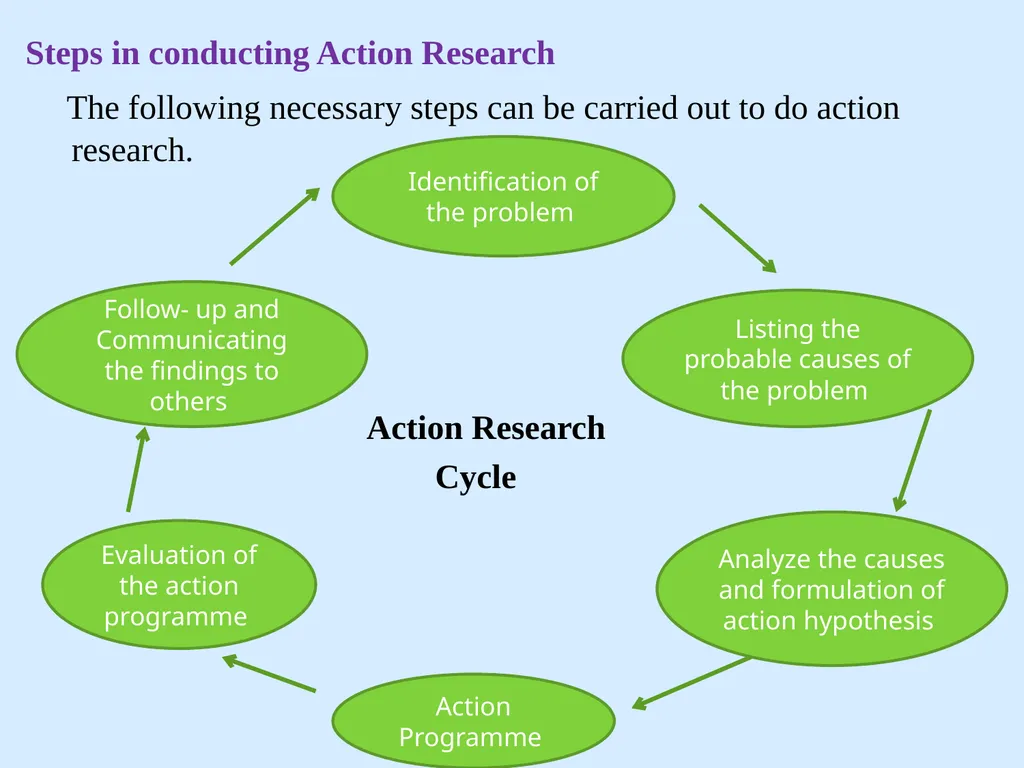
Steps in conducting Action Research
The following necessary steps can be carried out to do action research.
Action Research
Cycle Listing the probable causes of the problem Action Programme Follow- up and Communicating the findings to others Identification of the problem Analyze the causes and formulation of action hypothesis Evaluation of the action programme<br>
The following necessary steps can be carried out to do action research.
Action Research
Cycle Listing the probable causes of the problem Action Programme Follow- up and Communicating the findings to others Identification of the problem Analyze the causes and formulation of action hypothesis Evaluation of the action programme<br>
16
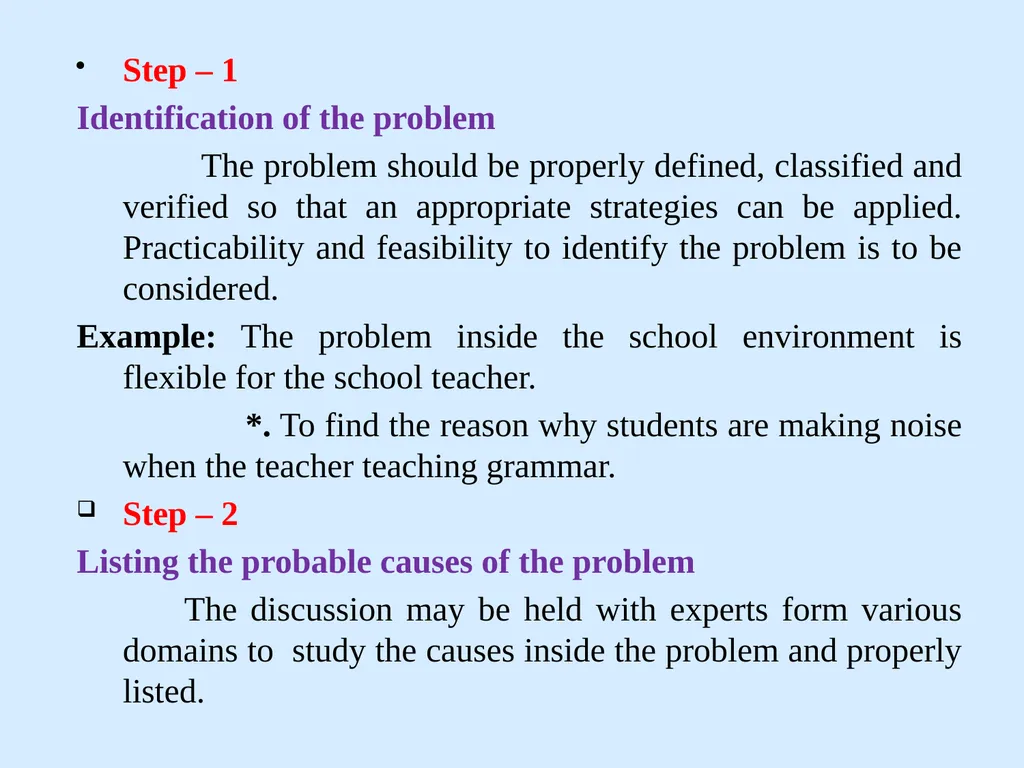
Step – 1
Identification of the problem
The problem should be properly defined, classified and verified so that an appropriate strategies can be applied. Practicability and feasibility to identify the problem is to be considered.
Example: The problem inside the school environment is flexible for the school teacher.
*. To find the reason why students are making noise when the teacher teaching grammar.
Step – 2
Listing the probable causes of the problem
The discussion may be held with experts form various domains to study the causes inside the problem and properly listed.<br>
Identification of the problem
The problem should be properly defined, classified and verified so that an appropriate strategies can be applied. Practicability and feasibility to identify the problem is to be considered.
Example: The problem inside the school environment is flexible for the school teacher.
*. To find the reason why students are making noise when the teacher teaching grammar.
Step – 2
Listing the probable causes of the problem
The discussion may be held with experts form various domains to study the causes inside the problem and properly listed.<br>
17
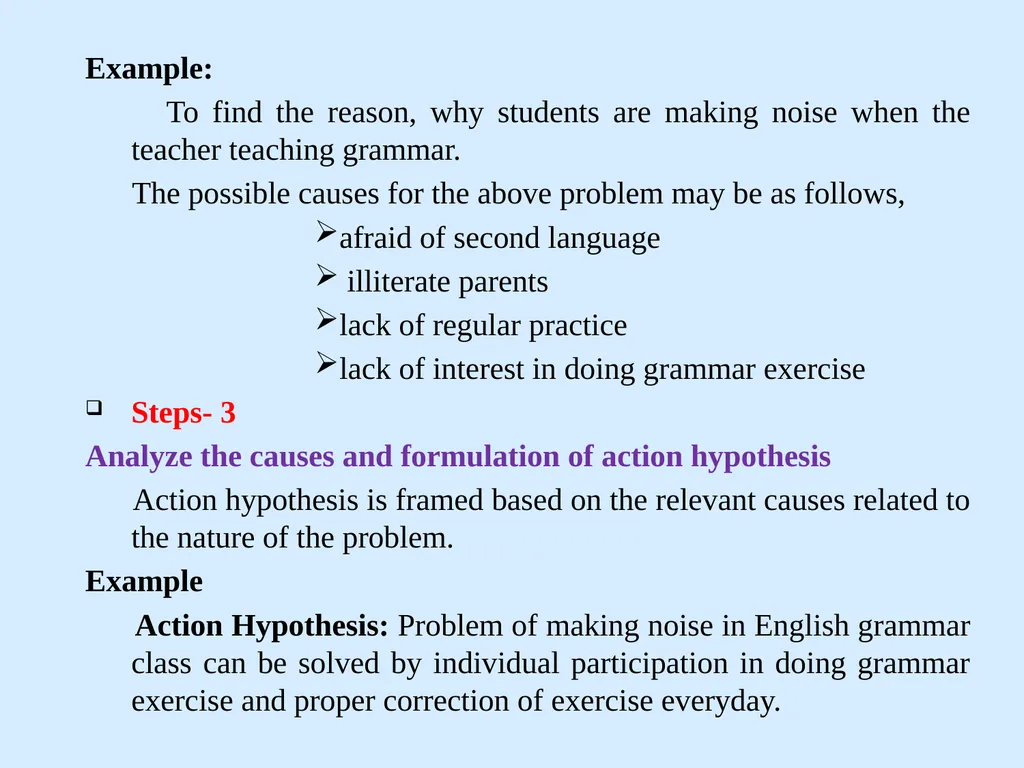
Example:
To find the reason, why students are making noise when the teacher teaching grammar.
The possible causes for the above problem may be as follows,
afraid of second language
illiterate parents
lack of regular practice
lack of interest in doing grammar exercise
Steps- 3
Analyze the causes and formulation of action hypothesis
Action hypothesis is framed based on the relevant causes related to the nature of the problem.
Example
Action Hypothesis: Problem of making noise in English grammar class can be solved by individual participation in doing grammar exercise and proper correction of exercise everyday.<br>
To find the reason, why students are making noise when the teacher teaching grammar.
The possible causes for the above problem may be as follows,
afraid of second language
illiterate parents
lack of regular practice
lack of interest in doing grammar exercise
Steps- 3
Analyze the causes and formulation of action hypothesis
Action hypothesis is framed based on the relevant causes related to the nature of the problem.
Example
Action Hypothesis: Problem of making noise in English grammar class can be solved by individual participation in doing grammar exercise and proper correction of exercise everyday.<br>
18
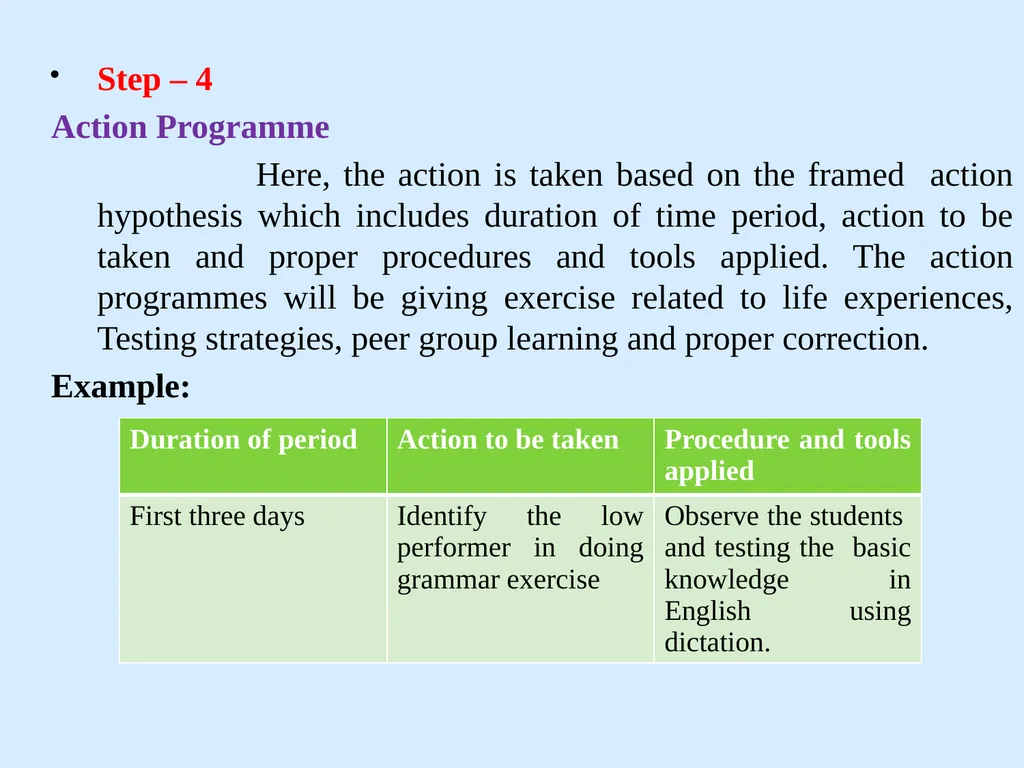
Step – 4
Action Programme
Here, the action is taken based on the framed action hypothesis which includes duration of time period, action to be taken and proper procedures and tools applied. The action programmes will be giving exercise related to life experiences, Testing strategies, peer group learning and proper correction.
Example:<br>
Action Programme
Here, the action is taken based on the framed action hypothesis which includes duration of time period, action to be taken and proper procedures and tools applied. The action programmes will be giving exercise related to life experiences, Testing strategies, peer group learning and proper correction.
Example:<br>
19
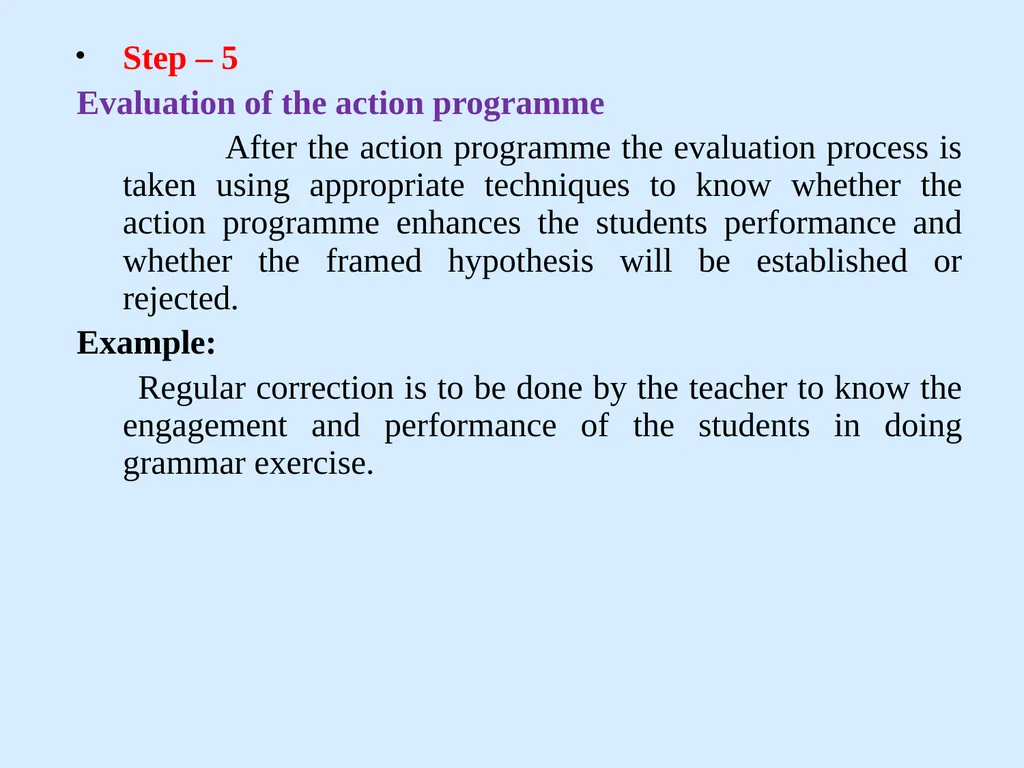
Step – 5
Evaluation of the action programme
After the action programme the evaluation process is taken using appropriate techniques to know whether the action programme enhances the students performance and whether the framed hypothesis will be established or rejected.
Example:
Regular correction is to be done by the teacher to know the engagement and performance of the students in doing grammar exercise.<br>
Evaluation of the action programme
After the action programme the evaluation process is taken using appropriate techniques to know whether the action programme enhances the students performance and whether the framed hypothesis will be established or rejected.
Example:
Regular correction is to be done by the teacher to know the engagement and performance of the students in doing grammar exercise.<br>
20
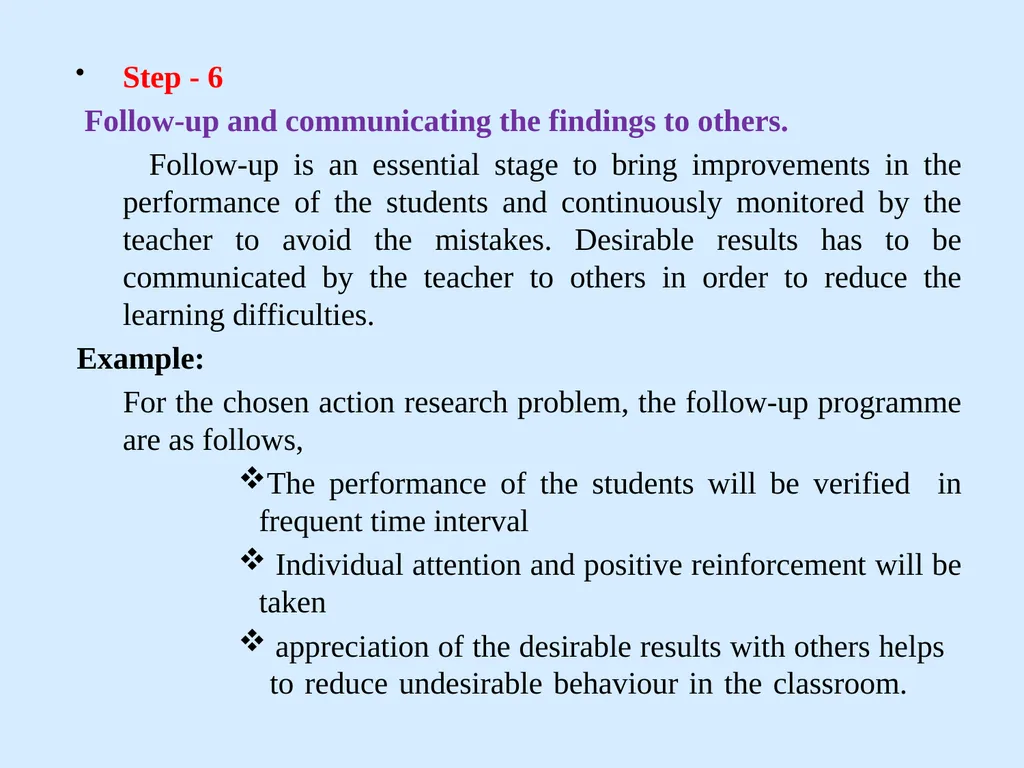
Step - 6
Follow-up and communicating the findings to others.
Follow-up is an essential stage to bring improvements in the performance of the students and continuously monitored by the teacher to avoid the mistakes. Desirable results has to be communicated by the teacher to others in order to reduce the learning difficulties.
Example:
For the chosen action research problem, the follow-up programme are as follows,
The performance of the students will be verified in frequent time interval
Individual attention and positive reinforcement will be taken
appreciation of the desirable results with others helps to reduce undesirable behaviour in the classroom.<br>
Follow-up and communicating the findings to others.
Follow-up is an essential stage to bring improvements in the performance of the students and continuously monitored by the teacher to avoid the mistakes. Desirable results has to be communicated by the teacher to others in order to reduce the learning difficulties.
Example:
For the chosen action research problem, the follow-up programme are as follows,
The performance of the students will be verified in frequent time interval
Individual attention and positive reinforcement will be taken
appreciation of the desirable results with others helps to reduce undesirable behaviour in the classroom.<br>
21
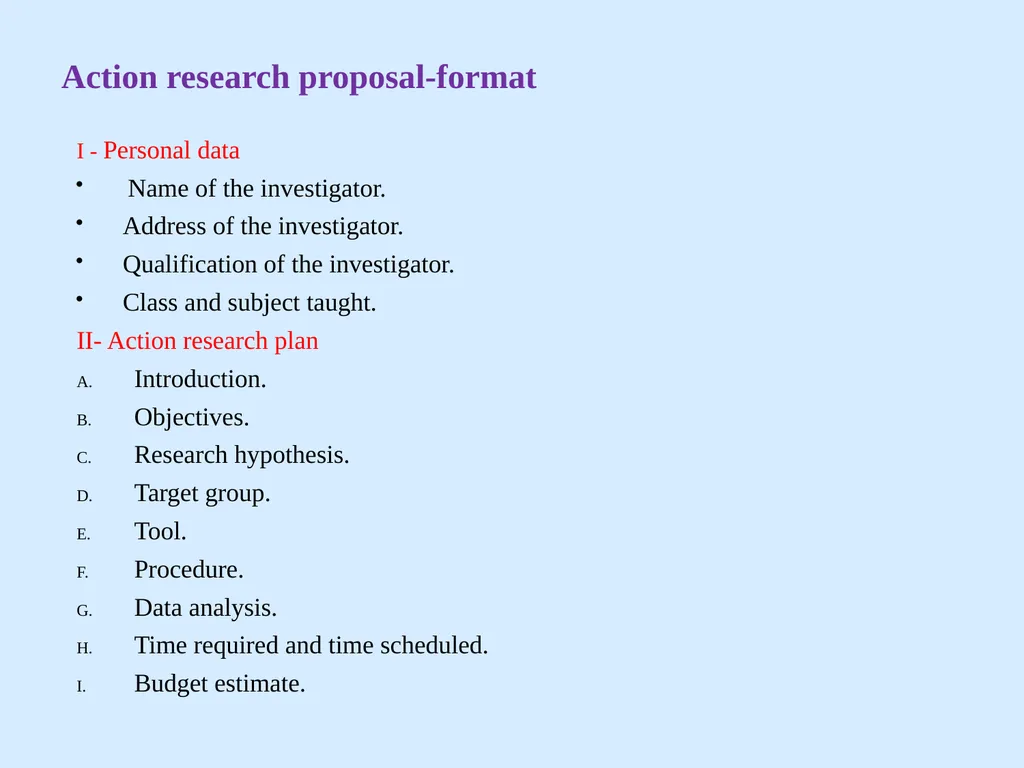
Action research proposal-format I - Personal data
Name of the investigator.
Address of the investigator.
Qualification of the investigator.
Class and subject taught.
II- Action research plan
Introduction.
Objectives.
Research hypothesis.
Target group.
Tool.
Procedure.
Data analysis.
Time required and time scheduled.
Budget estimate.<br>
Name of the investigator.
Address of the investigator.
Qualification of the investigator.
Class and subject taught.
II- Action research plan
Introduction.
Objectives.
Research hypothesis.
Target group.
Tool.
Procedure.
Data analysis.
Time required and time scheduled.
Budget estimate.<br>
22
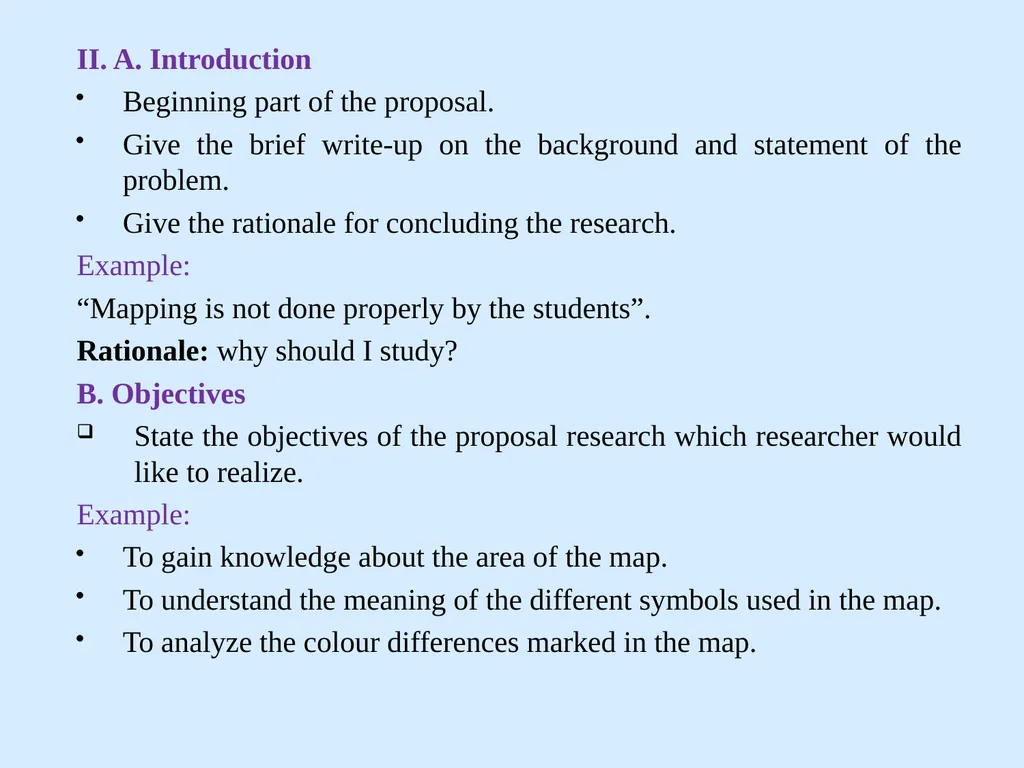
II. A. Introduction
Beginning part of the proposal.
Give the brief write-up on the background and statement of the problem.
Give the rationale for concluding the research.
Example:
“Mapping is not done properly by the students”.
Rationale: why should I study?
B. Objectives
State the objectives of the proposal research which researcher would like to realize.
Example:
To gain knowledge about the area of the map.
To understand the meaning of the different symbols used in the map.
To analyze the colour differences marked in the map.<br>
Beginning part of the proposal.
Give the brief write-up on the background and statement of the problem.
Give the rationale for concluding the research.
Example:
“Mapping is not done properly by the students”.
Rationale: why should I study?
B. Objectives
State the objectives of the proposal research which researcher would like to realize.
Example:
To gain knowledge about the area of the map.
To understand the meaning of the different symbols used in the map.
To analyze the colour differences marked in the map.<br>
23
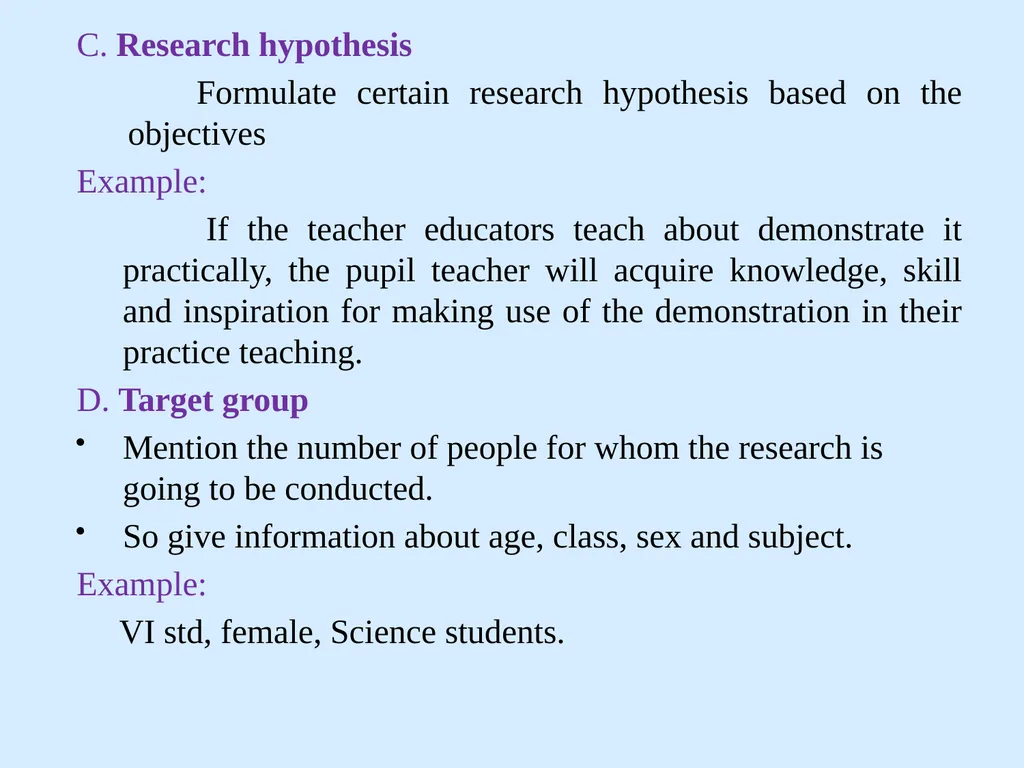
C. Research hypothesis
Formulate certain research hypothesis based on the objectives
Example:
If the teacher educators teach about demonstrate it practically, the pupil teacher will acquire knowledge, skill and inspiration for making use of the demonstration in their practice teaching.
D. Target group
Mention the number of people for whom the research is going to be conducted.
So give information about age, class, sex and subject.
Example:
VI std, female, Science students.<br>
Formulate certain research hypothesis based on the objectives
Example:
If the teacher educators teach about demonstrate it practically, the pupil teacher will acquire knowledge, skill and inspiration for making use of the demonstration in their practice teaching.
D. Target group
Mention the number of people for whom the research is going to be conducted.
So give information about age, class, sex and subject.
Example:
VI std, female, Science students.<br>
24
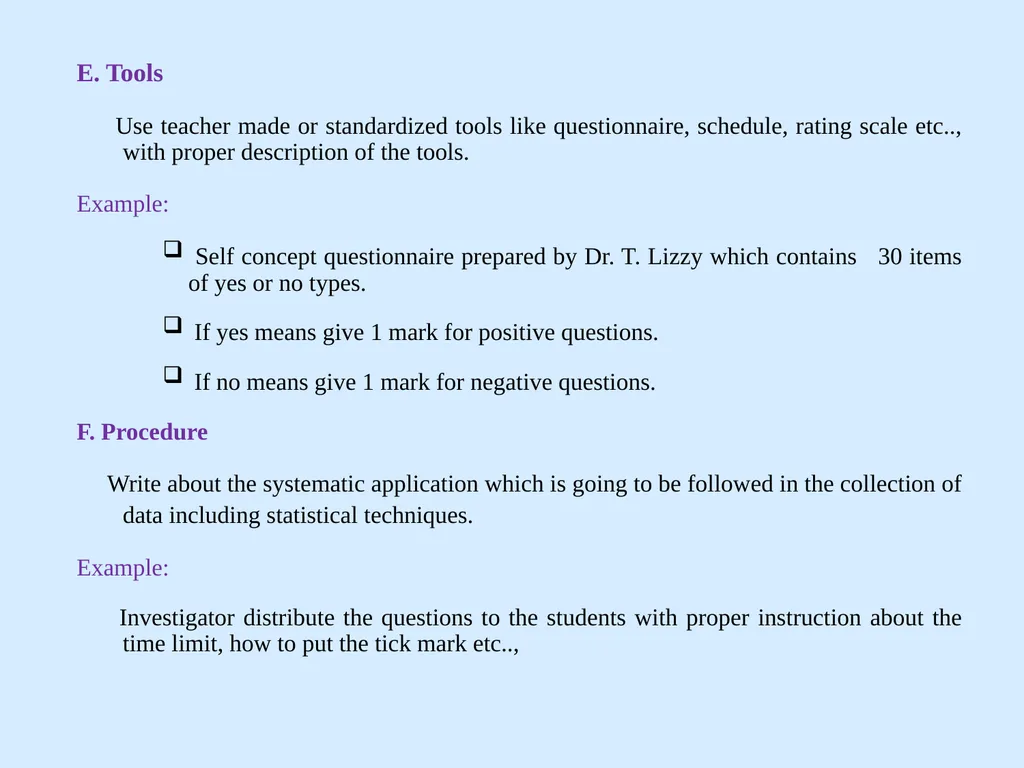
E. Tools
Use teacher made or standardized tools like questionnaire, schedule, rating scale etc.., with proper description of the tools.
Example:
Self concept questionnaire prepared by Dr. T. Lizzy which contains 30 items of yes or no types.
If yes means give 1 mark for positive questions.
If no means give 1 mark for negative questions.
F. Procedure
Write about the systematic application which is going to be followed in the collection of data including statistical techniques.
Example:
Investigator distribute the questions to the students with proper instruction about the time limit, how to put the tick mark etc..,<br>
Use teacher made or standardized tools like questionnaire, schedule, rating scale etc.., with proper description of the tools.
Example:
Self concept questionnaire prepared by Dr. T. Lizzy which contains 30 items of yes or no types.
If yes means give 1 mark for positive questions.
If no means give 1 mark for negative questions.
F. Procedure
Write about the systematic application which is going to be followed in the collection of data including statistical techniques.
Example:
Investigator distribute the questions to the students with proper instruction about the time limit, how to put the tick mark etc..,<br>
25
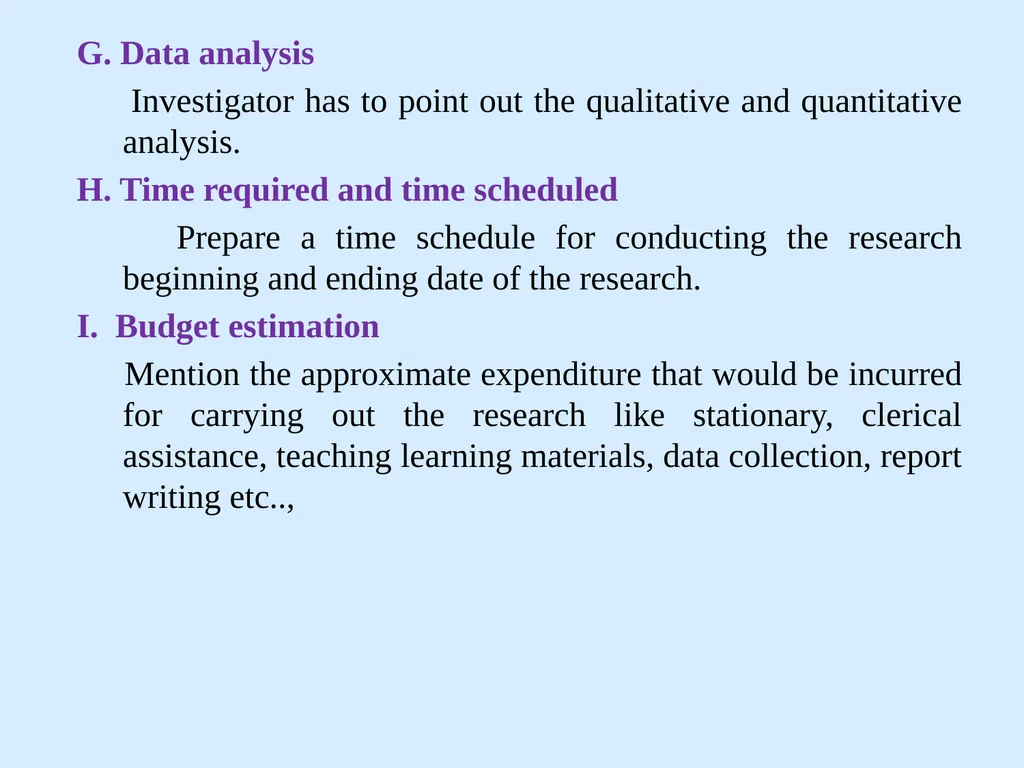
G. Data analysis
Investigator has to point out the qualitative and quantitative analysis.
H. Time required and time scheduled
Prepare a time schedule for conducting the research beginning and ending date of the research.
I. Budget estimation
Mention the approximate expenditure that would be incurred for carrying out the research like stationary, clerical assistance, teaching learning materials, data collection, report writing etc..,<br>
Investigator has to point out the qualitative and quantitative analysis.
H. Time required and time scheduled
Prepare a time schedule for conducting the research beginning and ending date of the research.
I. Budget estimation
Mention the approximate expenditure that would be incurred for carrying out the research like stationary, clerical assistance, teaching learning materials, data collection, report writing etc..,<br>
26
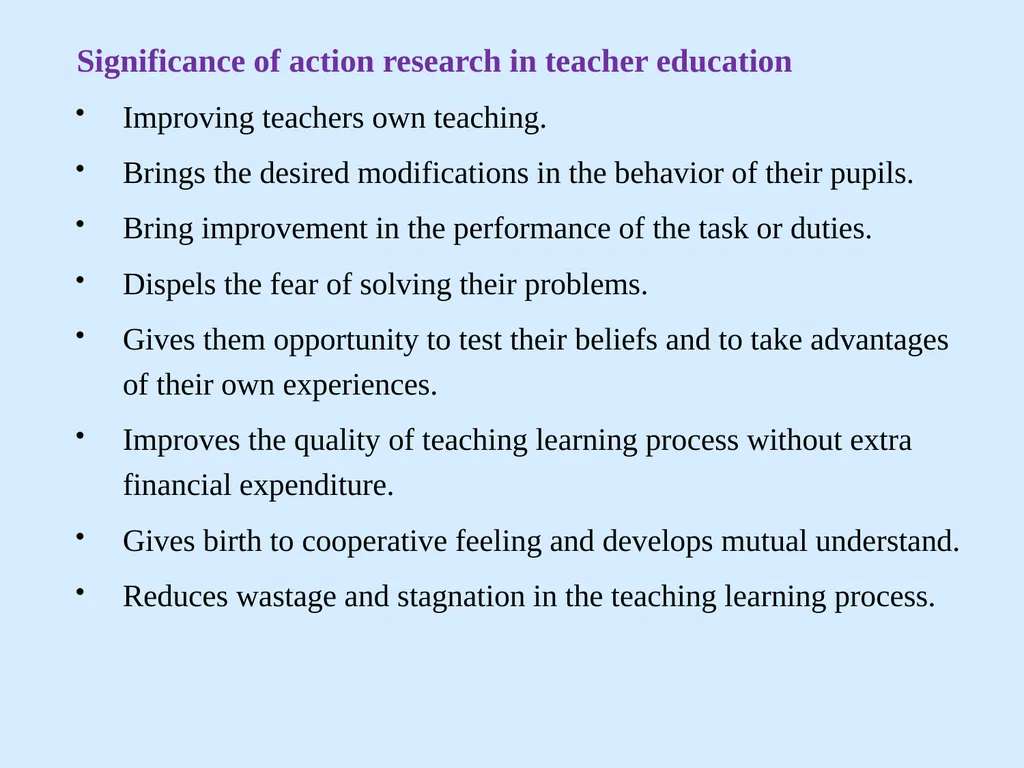
Significance of action research in teacher education
Improving teachers own teaching.
Brings the desired modifications in the behavior of their pupils.
Bring improvement in the performance of the task or duties.
Dispels the fear of solving their problems.
Gives them opportunity to test their beliefs and to take advantages of their own experiences.
Improves the quality of teaching learning process without extra financial expenditure.
Gives birth to cooperative feeling and develops mutual understand.
Reduces wastage and stagnation in the teaching learning process.<br>
Improving teachers own teaching.
Brings the desired modifications in the behavior of their pupils.
Bring improvement in the performance of the task or duties.
Dispels the fear of solving their problems.
Gives them opportunity to test their beliefs and to take advantages of their own experiences.
Improves the quality of teaching learning process without extra financial expenditure.
Gives birth to cooperative feeling and develops mutual understand.
Reduces wastage and stagnation in the teaching learning process.<br>
27
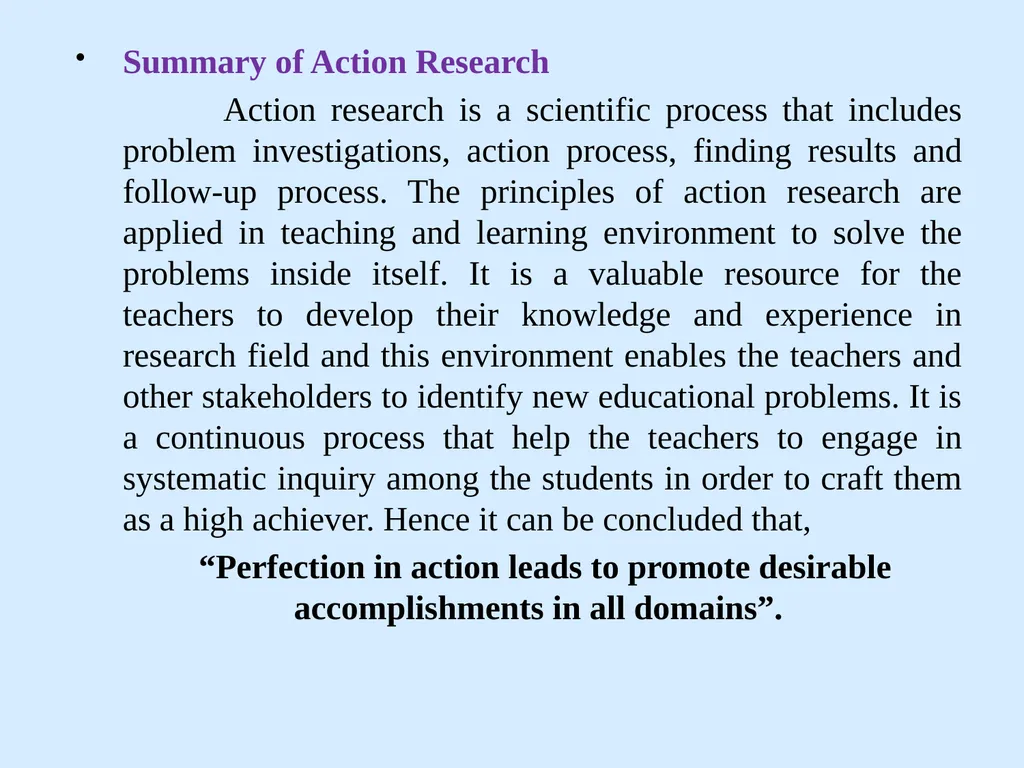
Summary of Action Research
Action research is a scientific process that includes problem investigations, action process, finding results and follow-up process. The principles of action research are applied in teaching and learning environment to solve the problems inside itself. It is a valuable resource for the teachers to develop their knowledge and experience in research field and this environment enables the teachers and other stakeholders to identify new educational problems. It is a continuous process that help the teachers to engage in systematic inquiry among the students in order to craft them as a high achiever. Hence it can be concluded that,
“Perfection in action leads to promote desirable accomplishments in all domains”.<br>
Action research is a scientific process that includes problem investigations, action process, finding results and follow-up process. The principles of action research are applied in teaching and learning environment to solve the problems inside itself. It is a valuable resource for the teachers to develop their knowledge and experience in research field and this environment enables the teachers and other stakeholders to identify new educational problems. It is a continuous process that help the teachers to engage in systematic inquiry among the students in order to craft them as a high achiever. Hence it can be concluded that,
“Perfection in action leads to promote desirable accomplishments in all domains”.<br>
28
References
Best, W. John., and Kahn, V. James. (1996). Research in Education (Seventh Edition). Prentice-Hall of India.
Gupta, S. K., and Rangi, P. (2014). Research Methodology: Methods, Tools and Technique. Kalyani publishers.
Kothari, C.P. (2014). Research Methodology Methods and Techniques (Third Edition). New Age International Publishers.
Leedy and Ormrod. (2005). Action Research for Educational Change. Milton Keynes: Open University Press.
Mangal, S.K. (1995). Educational Psychology. Prakash Publishers.
Mohan Radha. (2011). Research Methods in Education. Neelkamal Publications.
Nagarajan, K., and Srinivasan, R. (1994). Research Methodology in Education. Ram Publication.
Singh, A.K. (1997). Tests, Measurements and Research Methods in Behavioural Sciences. Bharati Bhawan.<br>
Best, W. John., and Kahn, V. James. (1996). Research in Education (Seventh Edition). Prentice-Hall of India.
Gupta, S. K., and Rangi, P. (2014). Research Methodology: Methods, Tools and Technique. Kalyani publishers.
Kothari, C.P. (2014). Research Methodology Methods and Techniques (Third Edition). New Age International Publishers.
Leedy and Ormrod. (2005). Action Research for Educational Change. Milton Keynes: Open University Press.
Mangal, S.K. (1995). Educational Psychology. Prakash Publishers.
Mohan Radha. (2011). Research Methods in Education. Neelkamal Publications.
Nagarajan, K., and Srinivasan, R. (1994). Research Methodology in Education. Ram Publication.
Singh, A.K. (1997). Tests, Measurements and Research Methods in Behavioural Sciences. Bharati Bhawan.<br>