National Core Arts Standards A Group Sharing and Discussion A Common Attitude and Perception Standards!....... We dont need no stinkin standards! Or.. Do we? Why do we have andor need standards? For better or worse, they are part of
"National Core Arts Standards A Group Sharing and" is the property of its rightful owner. Permission is granted to
download and print the materials on this website for personal, non-commercial use only, and to display it
on your personal computer provided you do not modify the materials and that you retain all copyright
notices contained in the materials. By downloading content from our website, you accept the terms of this
agreement.
Presentation Transcript
01
National Core Arts Standards A Group Sharing and Discussion<br>
02
A Common Attitude and Perception Standards!.......
“We don’t need no stinkin’ standards!”
Or….. Do we?<br>
03
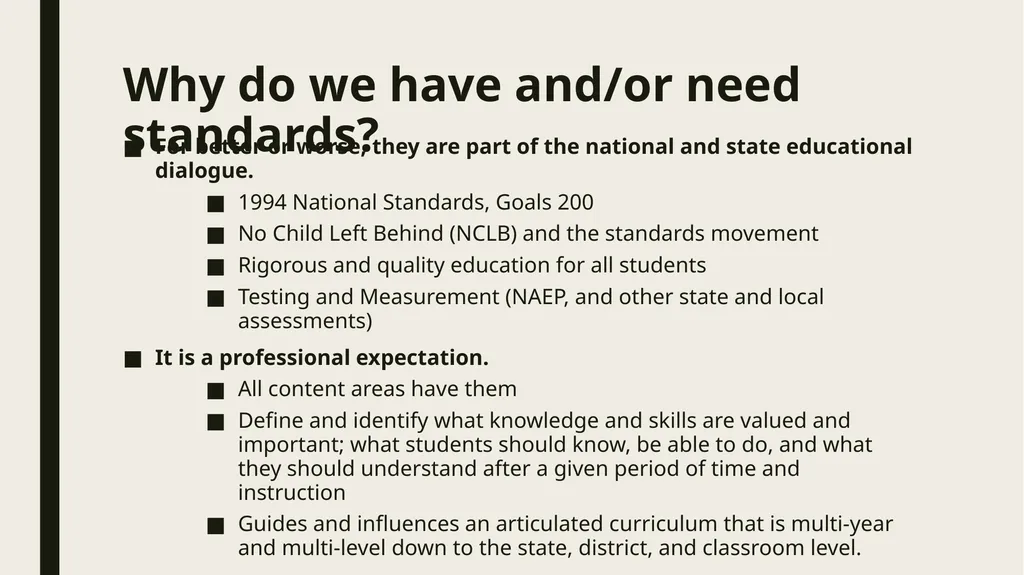
Why do we have and/or need standards? For better or worse, they are part of the national and state educational dialogue.
1994 National Standards, Goals 200
No Child Left Behind (NCLB) and the standards movement
Rigorous and quality education for all students
Testing and Measurement (NAEP, and other state and local assessments)
It is a professional expectation.
All content areas have them
Define and identify what knowledge and skills are valued and important; what students should know, be able to do, and what they should understand after a given period of time and instruction
Guides and influences an articulated curriculum that is multi-year and multi-level down to the state, district, and classroom level.<br>
04
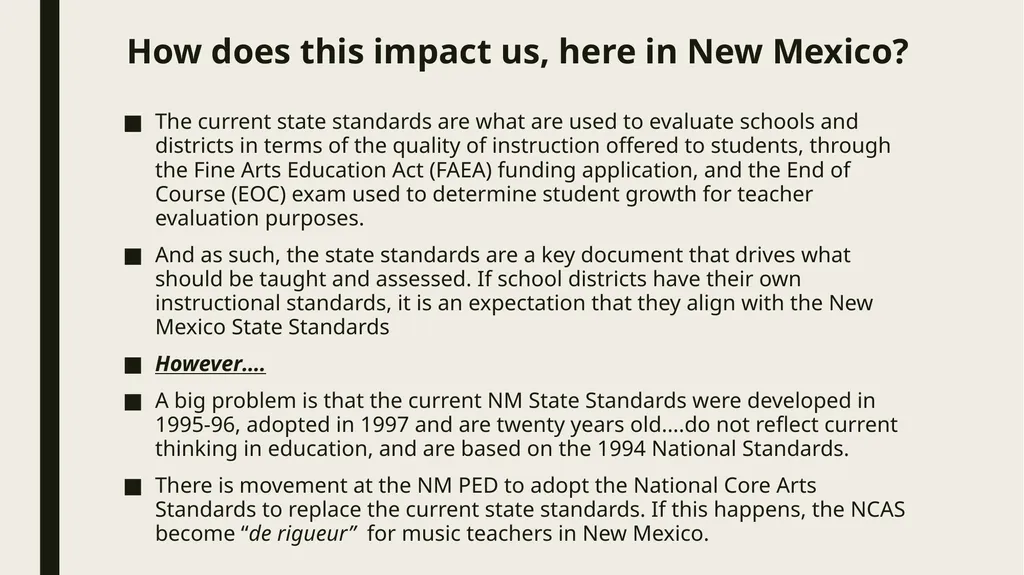
How does this impact us, here in New Mexico? The current state standards are what are used to evaluate schools and districts in terms of the quality of instruction offered to students, through the Fine Arts Education Act (FAEA) funding application, and the End of Course (EOC) exam used to determine student growth for teacher evaluation purposes.
And as such, the state standards are a key document that drives what should be taught and assessed. If school districts have their own instructional standards, it is an expectation that they align with the New Mexico State Standards
However….
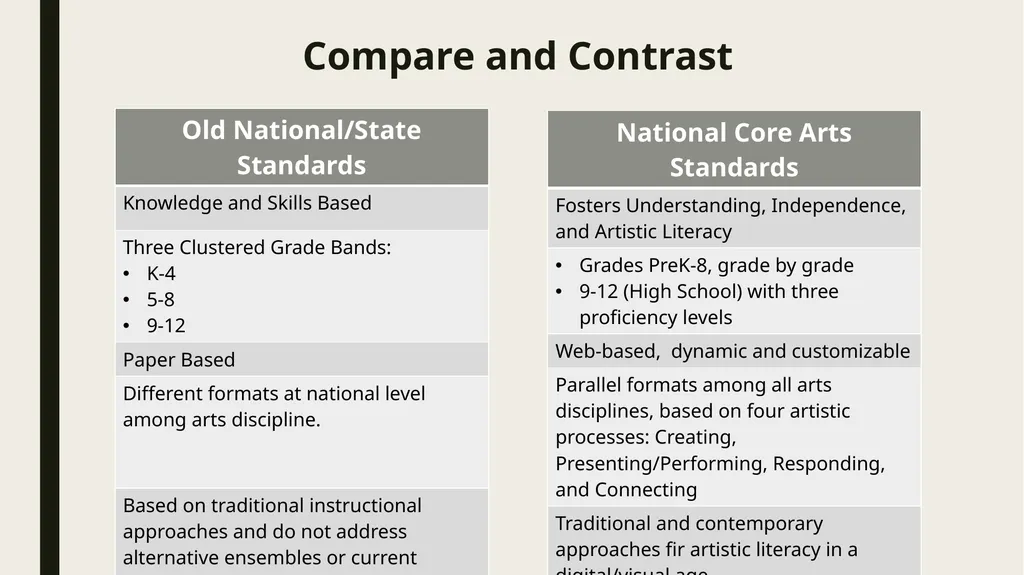
A big problem is that the current NM State Standards were developed in 1995-96, adopted in 1997 and are twenty years old....do not reflect current thinking in education, and are based on the 1994 National Standards.
There is movement at the NM PED to adopt the National Core Arts Standards to replace the current state standards. If this happens, the NCAS become “de rigueur” for music teachers in New Mexico.<br>
05
Compare and Contrast<br>
06
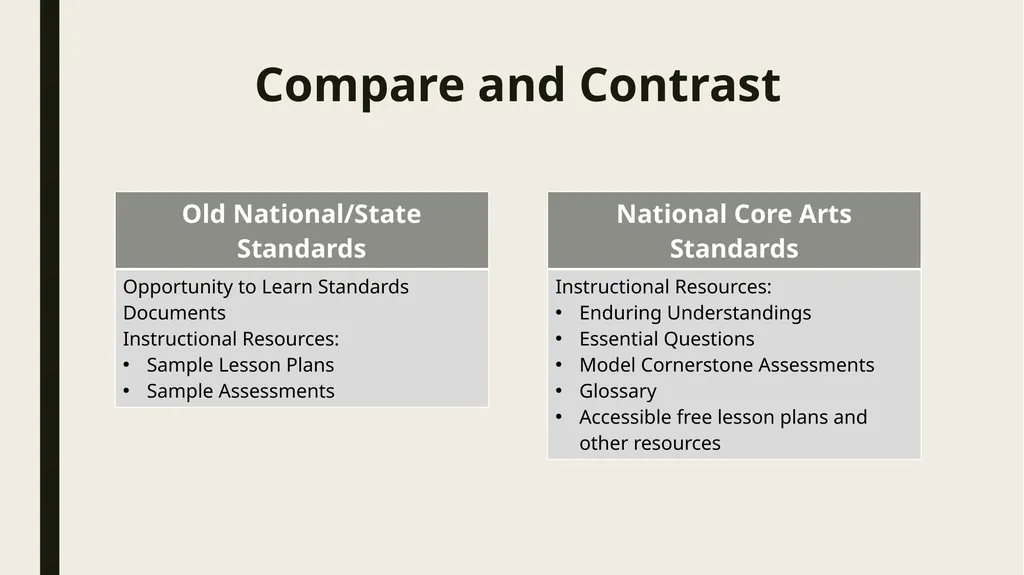
Compare and Contrast<br>
07
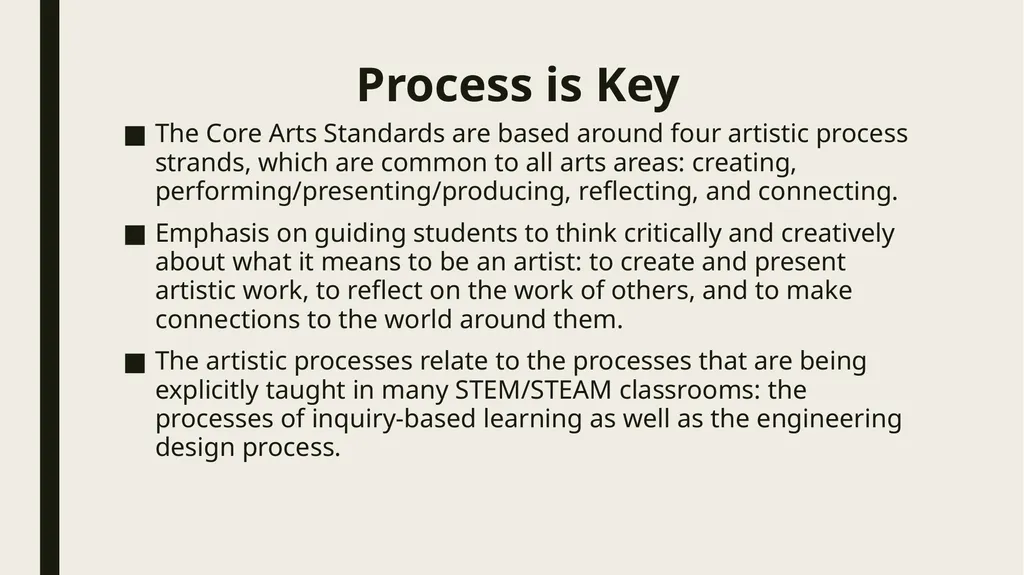
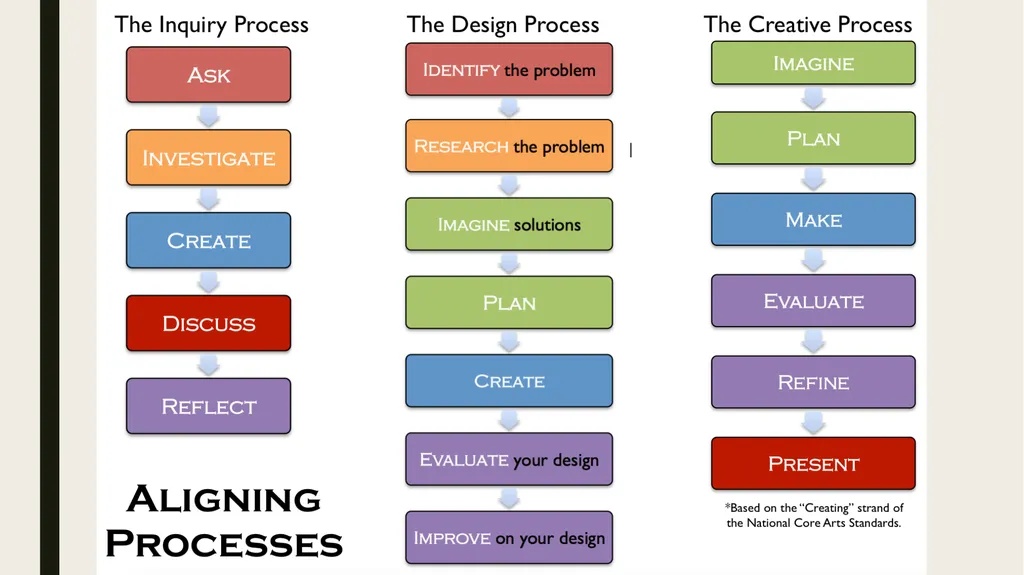
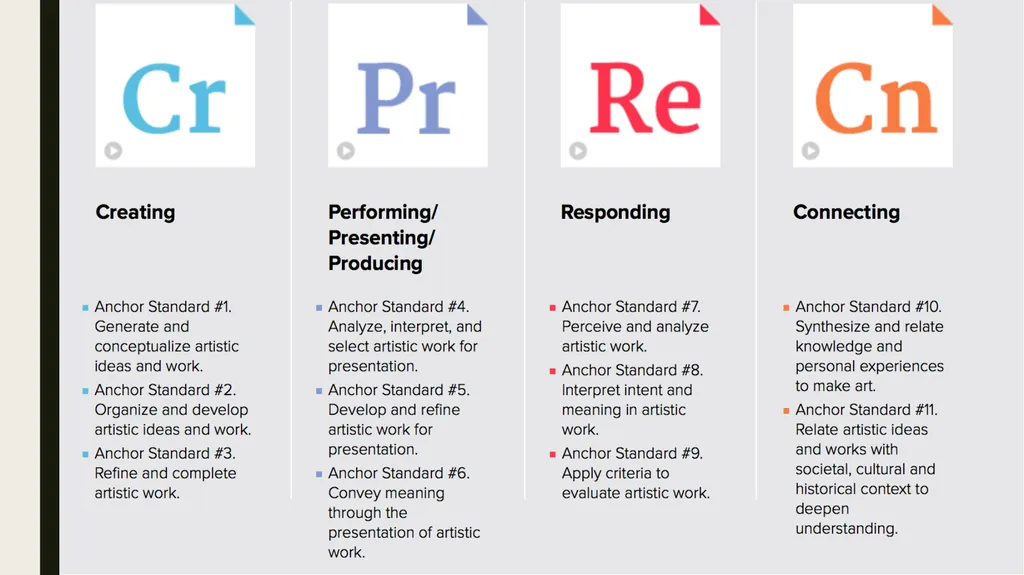
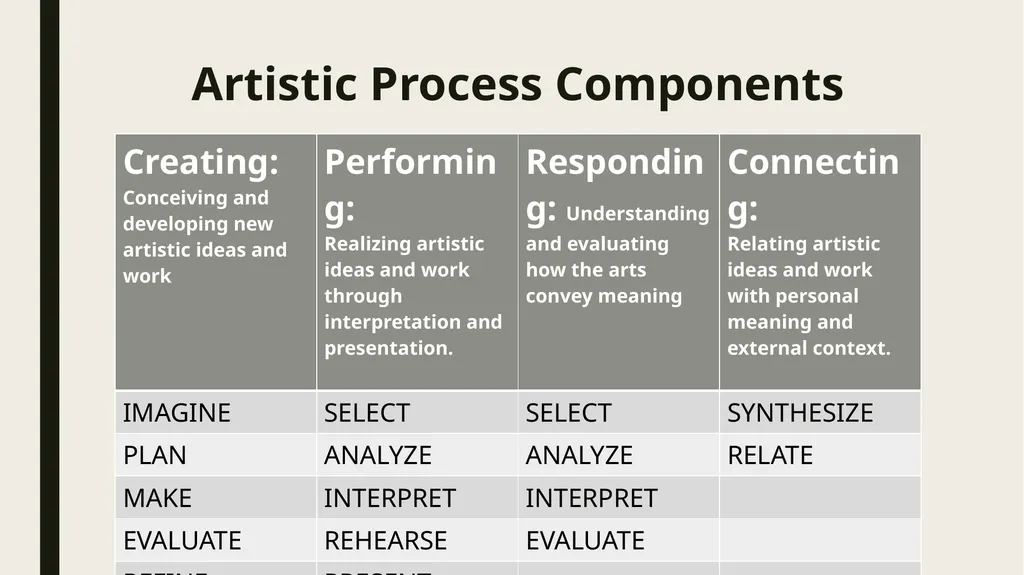
Process is Key The Core Arts Standards are based around four artistic process strands, which are common to all arts areas: creating, performing/presenting/producing, reflecting, and connecting.
Emphasis on guiding students to think critically and creatively about what it means to be an artist: to create and present artistic work, to reflect on the work of others, and to make connections to the world around them.
The artistic processes relate to the processes that are being explicitly taught in many STEM/STEAM classrooms: the processes of inquiry-based learning as well as the engineering design process.<br>
08
Artistic Process Components<br>
09
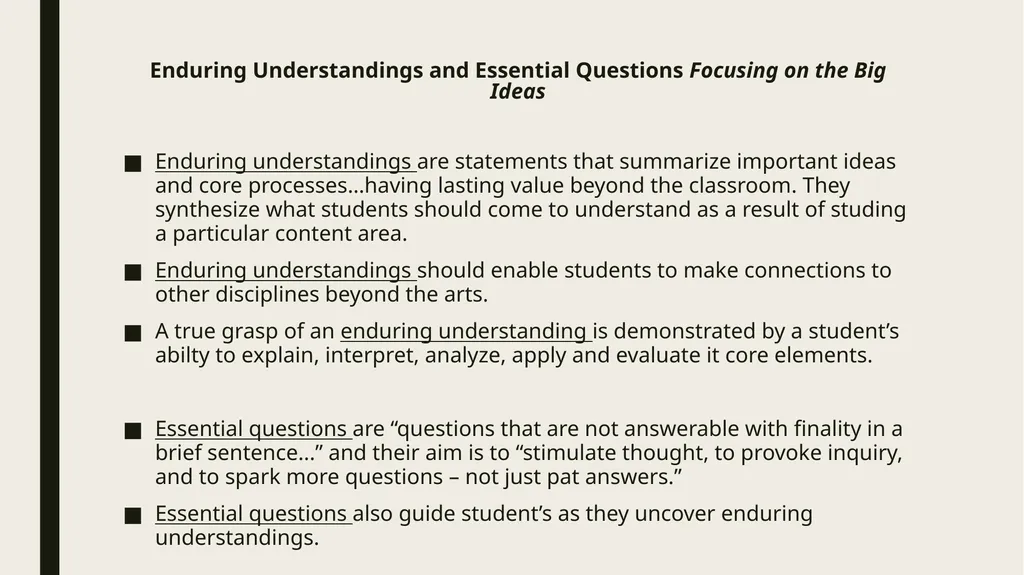
Enduring Understandings and Essential Questions Focusing on the Big Ideas Enduring understandings are statements that summarize important ideas and core processes…having lasting value beyond the classroom. They synthesize what students should come to understand as a result of studing a particular content area.
Enduring understandings should enable students to make connections to other disciplines beyond the arts.
A true grasp of an enduring understanding is demonstrated by a student’s abilty to explain, interpret, analyze, apply and evaluate it core elements.
Essential questions are “questions that are not answerable with finality in a brief sentence...” and their aim is to “stimulate thought, to provoke inquiry, and to spark more questions – not just pat answers.”
Essential questions also guide student’s as they uncover enduring understandings.<br>
10
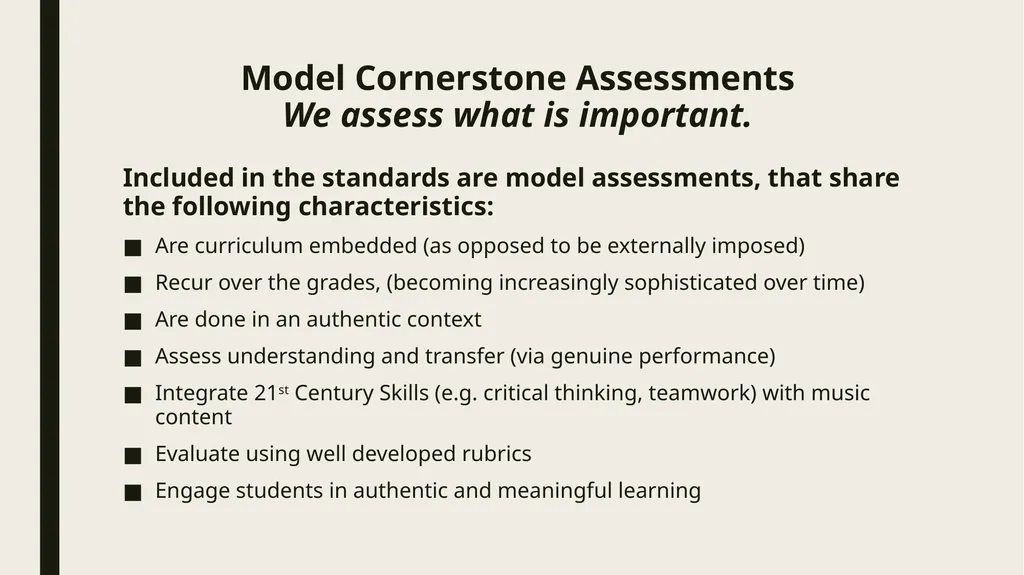
Model Cornerstone Assessments We assess what is important. Included in the standards are model assessments, that share the following characteristics:
Are curriculum embedded (as opposed to be externally imposed)
Recur over the grades, (becoming increasingly sophisticated over time)
Are done in an authentic context
Assess understanding and transfer (via genuine performance)
Integrate 21st Century Skills (e.g. critical thinking, teamwork) with music content
Evaluate using well developed rubrics
Engage students in authentic and meaningful learning<br>
11
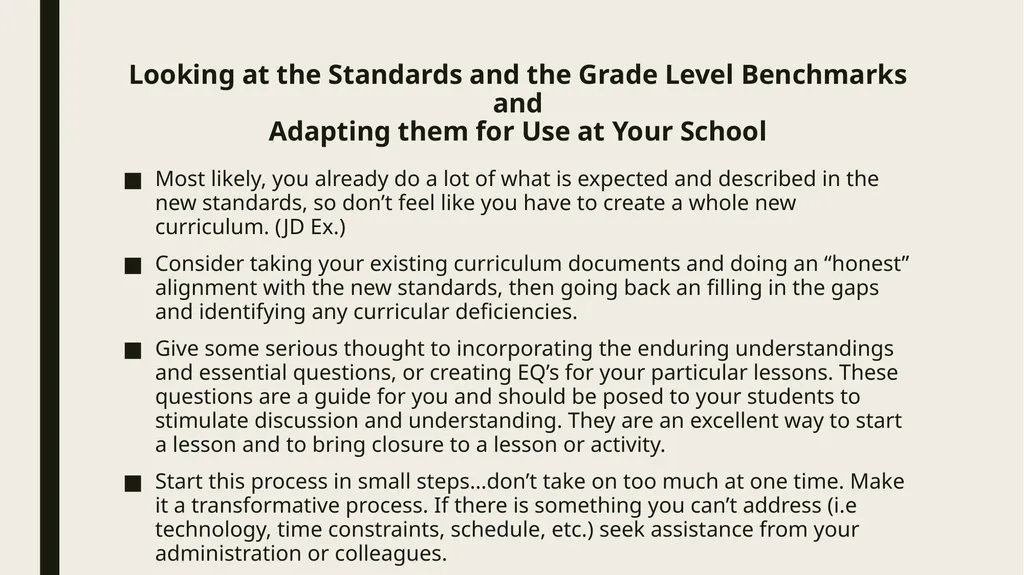
Looking at the Standards and the Grade Level Benchmarks and Adapting them for Use at Your School Most likely, you already do a lot of what is expected and described in the new standards, so don’t feel like you have to create a whole new curriculum. (JD Ex.)
Consider taking your existing curriculum documents and doing an “honest” alignment with the new standards, then going back an filling in the gaps and identifying any curricular deficiencies.
Give some serious thought to incorporating the enduring understandings and essential questions, or creating EQ’s for your particular lessons. These questions are a guide for you and should be posed to your students to stimulate discussion and understanding. They are an excellent way to start a lesson and to bring closure to a lesson or activity.
Start this process in small steps…don’t take on too much at one time. Make it a transformative process. If there is something you can’t address (i.e technology, time constraints, schedule, etc.) seek assistance from your administration or colleagues.<br>
12
Final Questions and Issues Thank you for staying late to attend this presentation and for your active participation<br>