
National Public Education Directorate Instructor



















Description: National Public Education Directorate Instructor Workshop 2026 1 Excellence Through Innovation and Engagement Workshop Delivery Options Option 1: Self-Study Review materials independently at your own pace on the Auxiliary Classroom (Moodle)
Related Topics
Download Presentation
"National Public Education Directorate Instructor" is the property of its rightful owner. Permission is granted to download and print the materials on this website for personal, non-commercial use only, and to display it on your personal computer provided you do not modify the materials and that you retain all copyright notices contained in the materials. By downloading content from our website, you accept the terms of this agreement.
Presentation Transcript
slide1. National Public Education Directorate
Instructor Workshop 2026 1 Excellence Through Innovation and Engagement<br>
slide2. Workshop Delivery Options Option 1: Self-Study
Review materials independently at your own pace on the Auxiliary Classroom (Moodle)
Option 2: Facilitated Workshop (Recommended)
Led by a qualified instructor
Interactive learning environment
Enhanced understanding through group discussion
Real-time clarification of concepts 2<br>
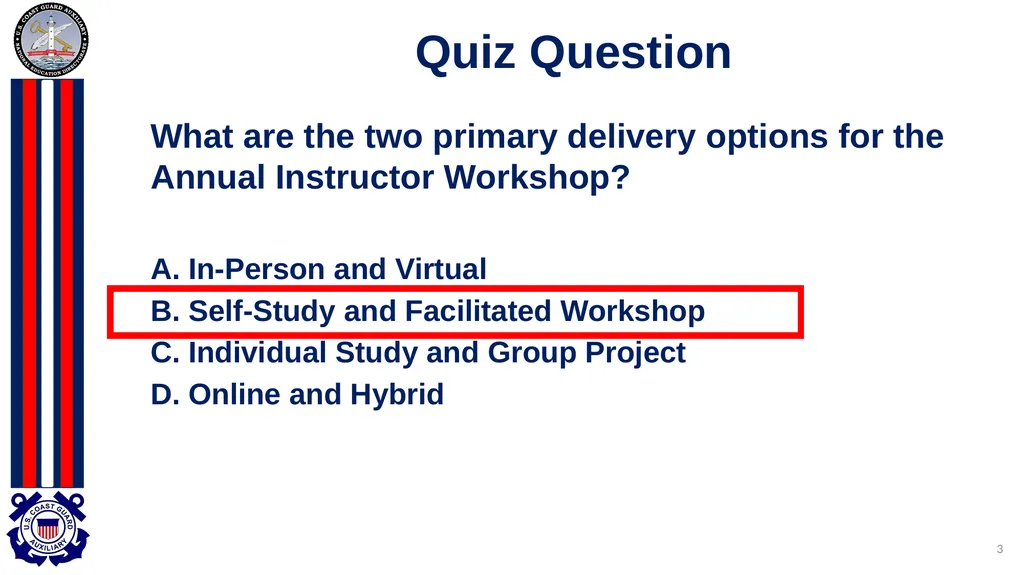
slide3. Quiz Question What are the two primary delivery options for the Annual Instructor Workshop?
A. In-Person and Virtual
B. Self-Study and Facilitated Workshop
C. Individual Study and Group Project
D. Online and Hybrid 3<br>
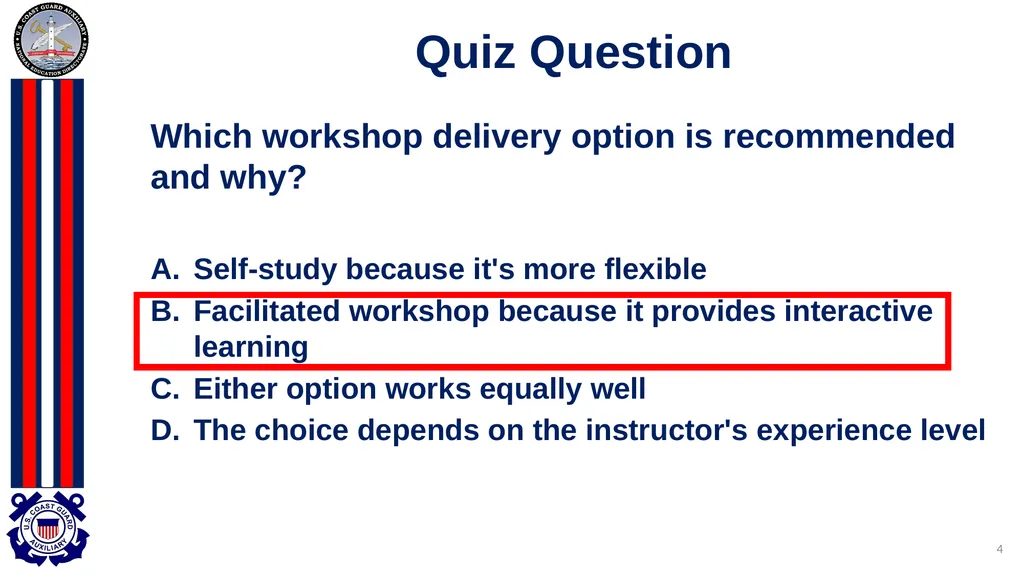
slide4. Quiz Question Which workshop delivery option is recommended and why?
Self-study because it's more flexible
Facilitated workshop because it provides interactive learning
Either option works equally well
The choice depends on the instructor's experience level 4<br>
slide5. Who Should Take This Workshop? • Members involved in public education
• Members involved in member training
• Members mentoring new members
• Members interested in improving their teaching skills
• Anyone who communicates Auxiliary missions to the public
Flotilla leaders and recruiters 5<br>
slide6. The Power of Education • Public education classes are our gateway to the community
• First impressions shape public perception of our entire organization
• Quality instruction drives new member recruitment
• Member training directly impacts satisfaction and retention
• Well-trained members are more confident and active 6<br>
slide7. Why Instructor Excellence Matters • Professional instruction leads to stronger member recruitment
• Quality training improves member retention
• Excellence enhances program credibility in the community
• Teaching is a skill requiring continuous practice
• Instructors represent the Auxiliary as safety experts
• Our reputation depends on instructional quality 7<br>
slide8. Quiz Question Who should take the 2026 Instructor Workshop?
Only certified public education instructors
Only member training instructors
All members, regardless of role
Only new instructors seeking certification 8<br>
slide9. Quiz Question Why is instructional excellence important?
It reduces paperwork
It improves recruitment and retention
It allows instructors to skip lesson planning
It’s only required for virtual classes 9<br>
slide10. Quiz Question How do public education classes serve as a "gateway to the community"?
They generate revenue for the flotilla
They are the Auxiliary's first impression and shape public perception
They are required by federal law
They provide free entertainment for the public 10<br>
slide11. Quiz Question Why is continuous practice important for instructors?
It's required by the Auxiliary Manual
It helps instructors earn more awards
It's only necessary for new instructors
Teaching is a skill that requires regular practice and staying current 11<br>
slide12. Workshop Goals • Enhance instructor quality and capabilities
• Expand our instructor pool
• Boost teaching effectiveness
• Inspire more members to become instructors
• Share best practices and proven techniques
• Address common instructional challenges 12<br>
slide13. Effective Teaching Practices • Engage students through meaningful dialogue and observation
• Actively listen to ensure student comprehension
• Create interactive, two-way learning experiences 13<br>
slide14. Effective Teaching Practices (cont’d) • Watch for visual cues of understanding or confusion
• Ask open-ended questions to gauge comprehension
• Build on student responses to deepen understanding 14<br>
slide15. Dos and Don’ts for Instructors • DON'T: Simply read from slides or textbooks
• DON'T: Deliver one-way information without interaction
• DON'T: Passively present course materials
• DO: Provide context and deeper insight beyond slides
• DO: Facilitate active learning and discovery
• DO: Create opportunities for peer-to-peer learning 15<br>
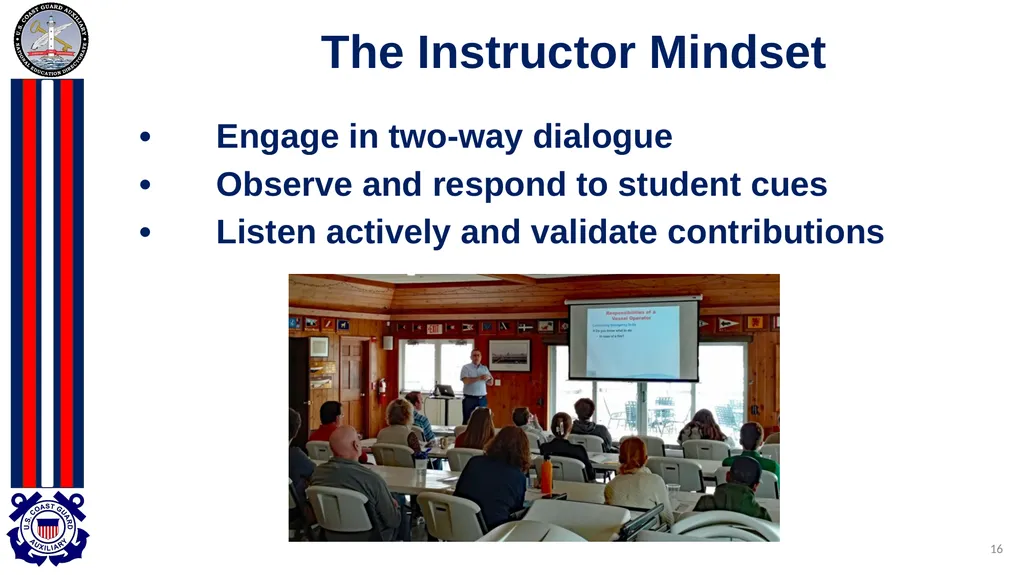
slide16. The Instructor Mindset • Engage in two-way dialogue
• Observe and respond to student cues
• Listen actively and validate contributions 16<br>
slide17. Continuous Improvement • Ongoing progress is better than waiting for perfection
• Incremental improvements are preferable to pursuing absolute perfection
• Focus on making consistent strides forward
• Learn from experience and adapt over time
• Perfection may be elusive and time-consuming
• Continuous improvement allows adaptability and learning from mistakes 17<br>
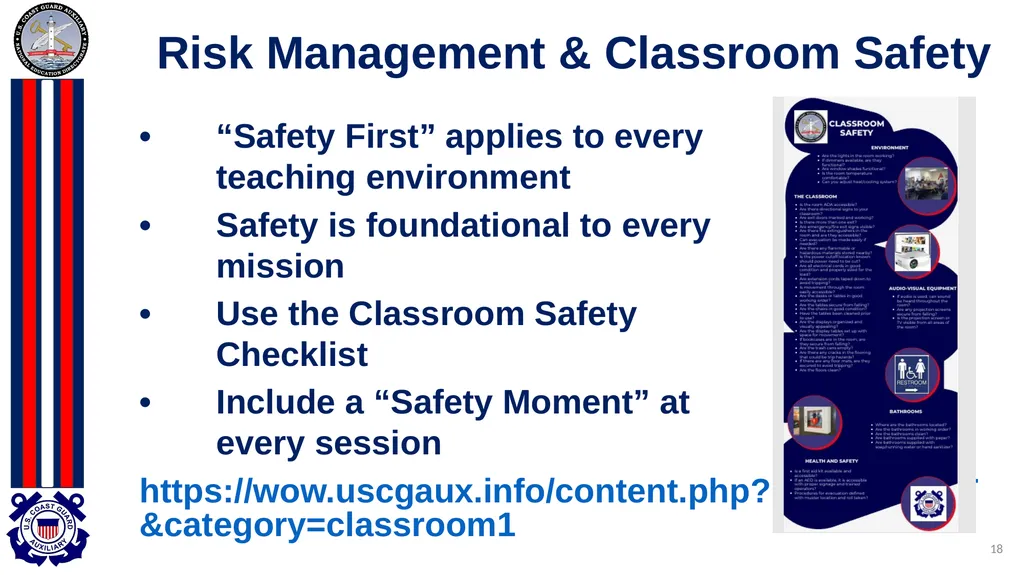
slide18. Risk Management & Classroom Safety • “Safety First” applies to every teaching environment
• Safety is foundational to every mission
• Use the Classroom Safety Checklist
• Include a “Safety Moment” at every session
https://wow.uscgaux.info/content.php?unit=E-DEPT&category=classroom1 18<br>
slide19. Culture of Safety in Instruction • Safety is integrated into all instructional activities
• Instructor qualifications emphasize safety commitment
• Focus on practical skills and hands-on exercises
• Interactive learning enhances safety education
• Continuous professional development is encouraged 19<br>
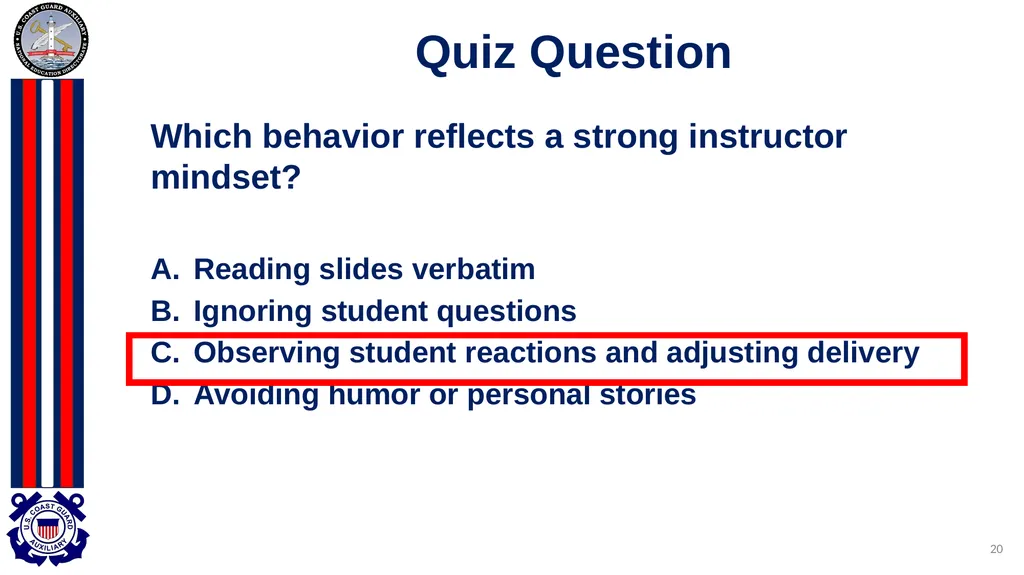
slide20. Quiz Question Which behavior reflects a strong instructor mindset?
Reading slides verbatim
Ignoring student questions
Observing student reactions and adjusting delivery
Avoiding humor or personal stories 20<br>
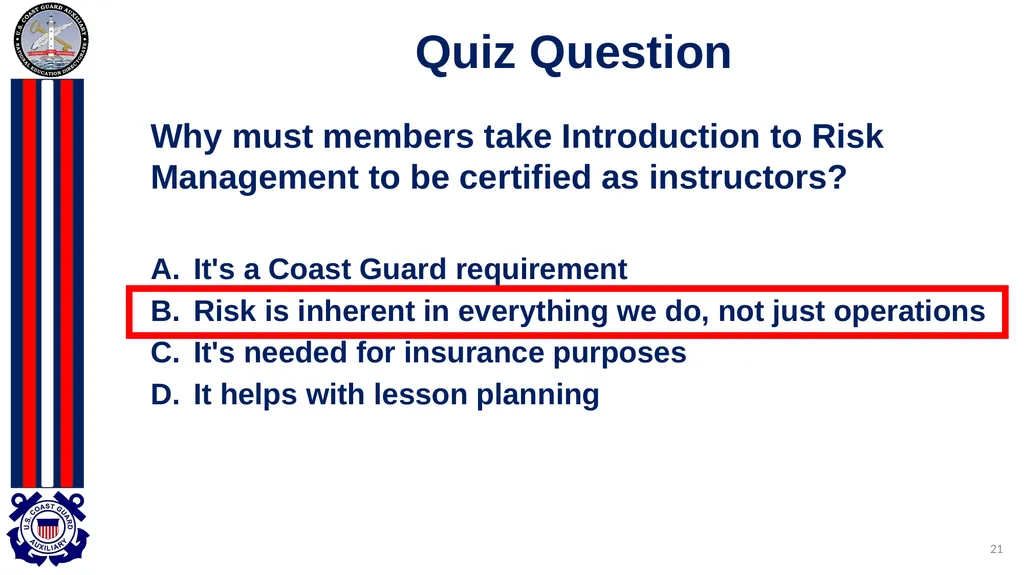
slide21. Quiz Question Why must members take Introduction to Risk Management to be certified as instructors?
It's a Coast Guard requirement
Risk is inherent in everything we do, not just operations
It's needed for insurance purposes
It helps with lesson planning 21<br>
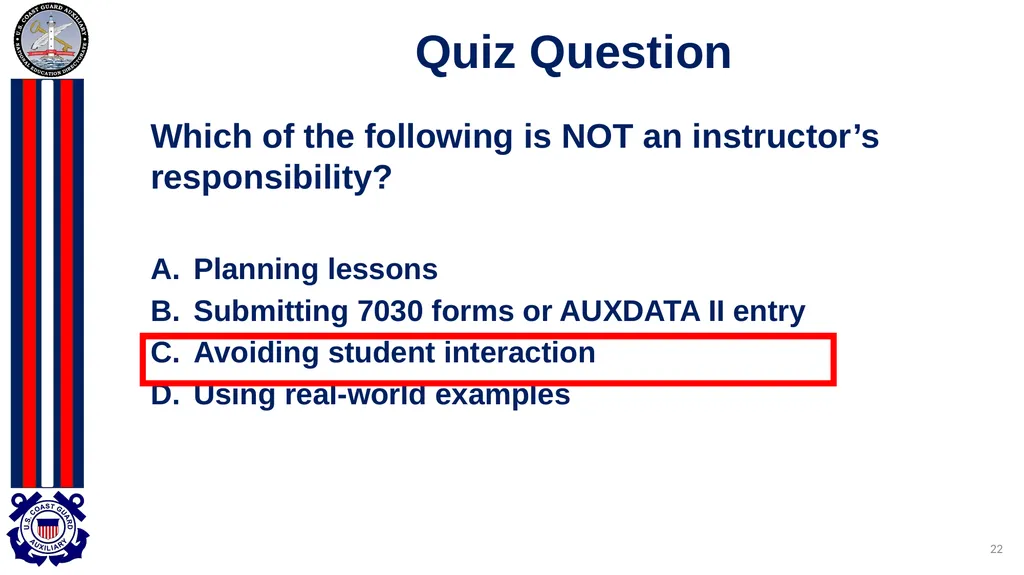
slide22. Quiz Question Which of the following is NOT an instructor’s responsibility?
Planning lessons
Submitting 7030 forms or AUXDATA II entry
Avoiding student interaction
Using real-world examples 22<br>
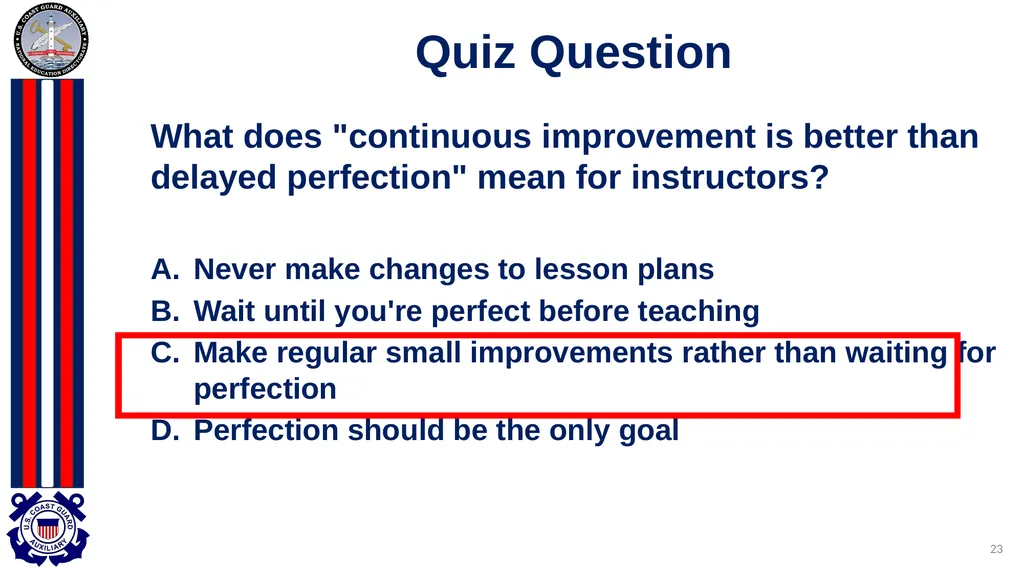
slide23. Quiz Question What does "continuous improvement is better than delayed perfection" mean for instructors?
Never make changes to lesson plans
Wait until you're perfect before teaching
Make regular small improvements rather than waiting for perfection
Perfection should be the only goal 23<br>
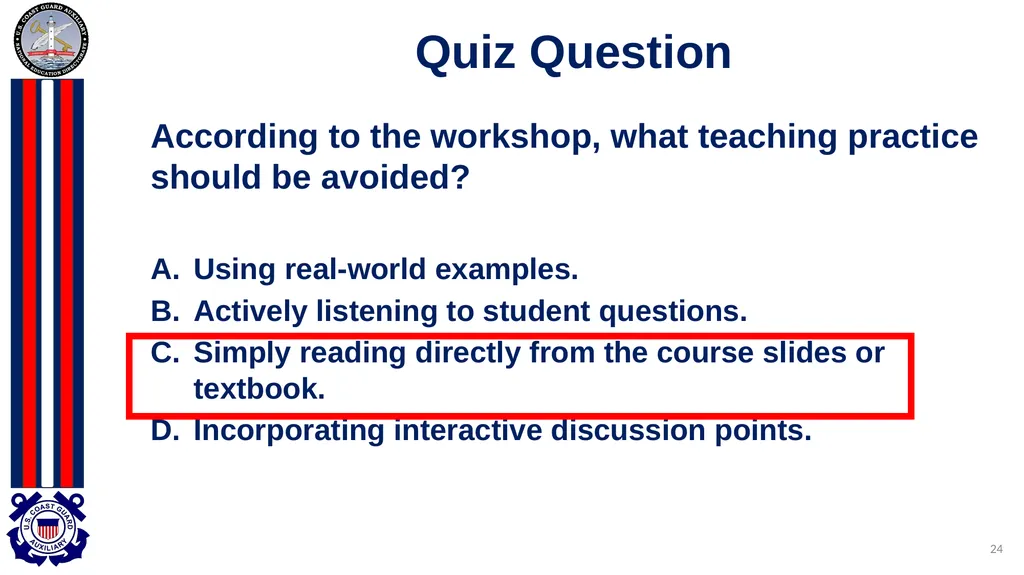
slide24. Quiz Question According to the workshop, what teaching practice should be avoided?
Using real-world examples.
Actively listening to student questions.
Simply reading directly from the course slides or textbook.
Incorporating interactive discussion points. 24<br>
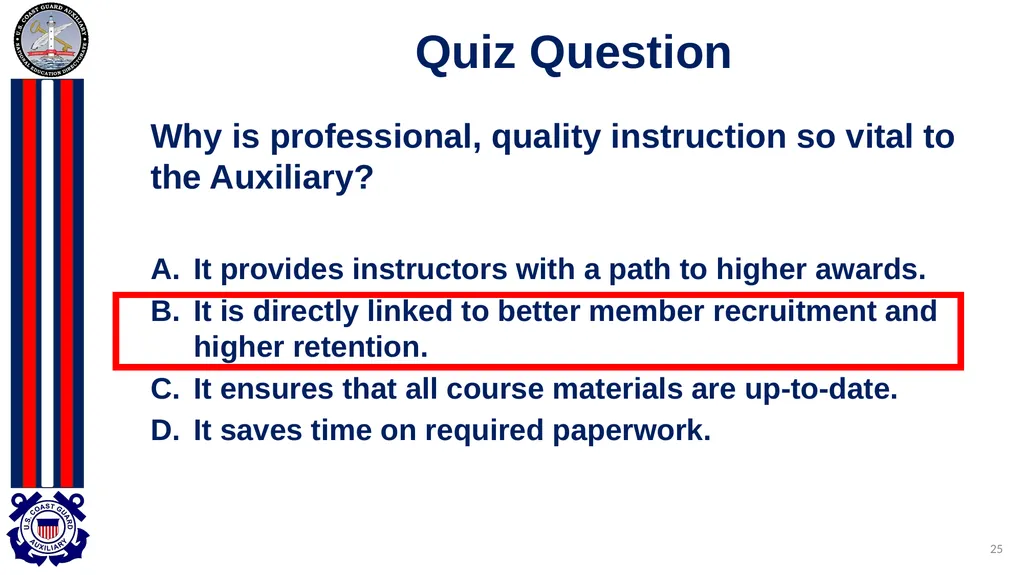
slide25. Quiz Question Why is professional, quality instruction so vital to the Auxiliary?
It provides instructors with a path to higher awards.
It is directly linked to better member recruitment and higher retention.
It ensures that all course materials are up-to-date.
It saves time on required paperwork. 25<br>
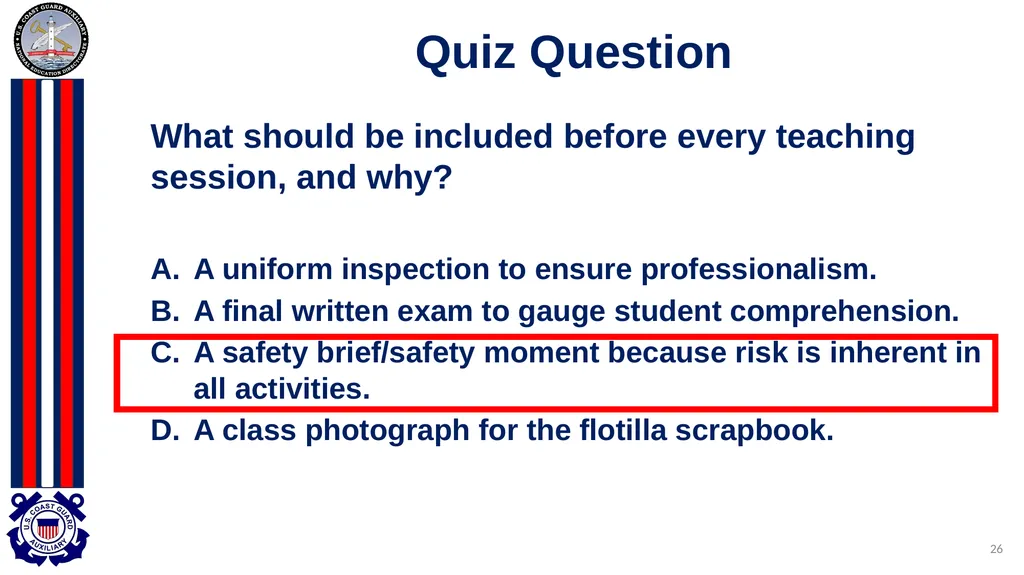
slide26. Quiz Question What should be included before every teaching session, and why?
A uniform inspection to ensure professionalism.
A final written exam to gauge student comprehension.
A safety brief/safety moment because risk is inherent in all activities.
A class photograph for the flotilla scrapbook. 26<br>
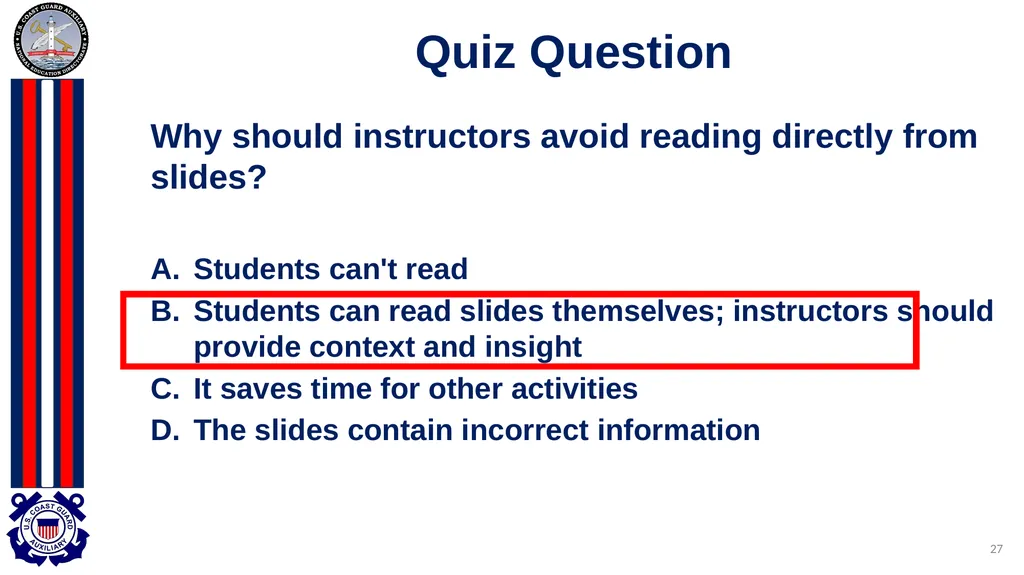
slide27. Quiz Question Why should instructors avoid reading directly from slides?
Students can't read
Students can read slides themselves; instructors should provide context and insight
It saves time for other activities
The slides contain incorrect information 27<br>
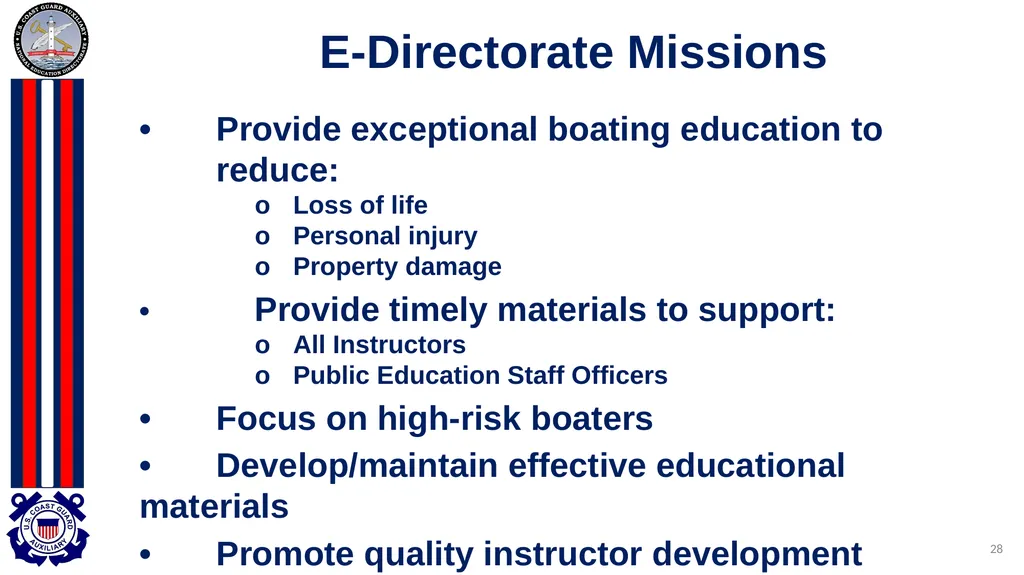
slide28. E-Directorate Missions • Provide exceptional boating education to reduce:
o Loss of life
o Personal injury
o Property damage
• Provide timely materials to support:
o All Instructors
o Public Education Staff Officers
• Focus on high-risk boaters
• Develop/maintain effective educational materials
• Promote quality instructor development 28<br>
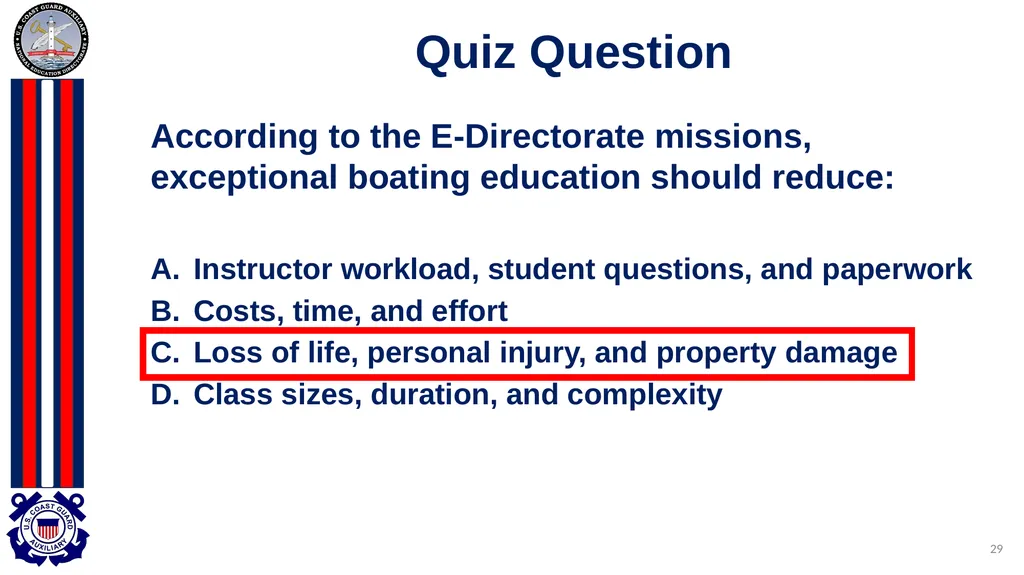
slide29. Quiz Question According to the E-Directorate missions, exceptional boating education should reduce:
Instructor workload, student questions, and paperwork
Costs, time, and effort
Loss of life, personal injury, and property damage
Class sizes, duration, and complexity 29<br>
slide30. Instructor Responsibilities • Plan lessons and room setup
• Self-preparation and ongoing study
• Use hands-on exercises and real-world examples
• Student engagement and inclusion
• Incorporate guest speakers and humor appropriately
• Submit 7030 forms or enter data in AUXDATA II 30<br>
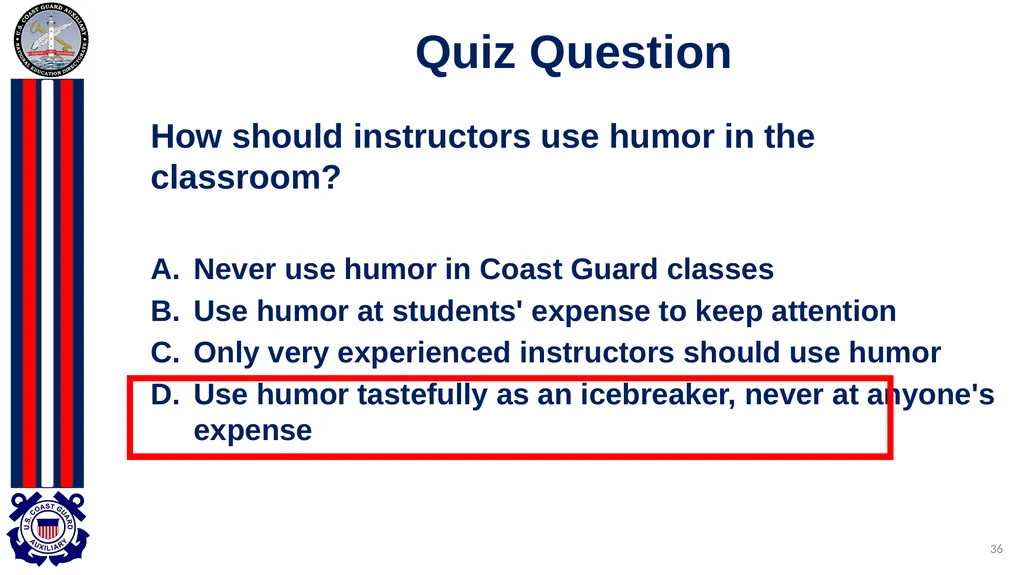
slide31. Using Humor in the Classroom • Humor can be an effective icebreaker
• Use humor tastefully and appropriately
• Never use humor at anyone's expense
• Humor should enhance learning, not distract from it
• Consider your audience and their sensitivities
• Only experienced instructors should use humor extensively
• When in doubt, err on the side of professionalism 31<br>
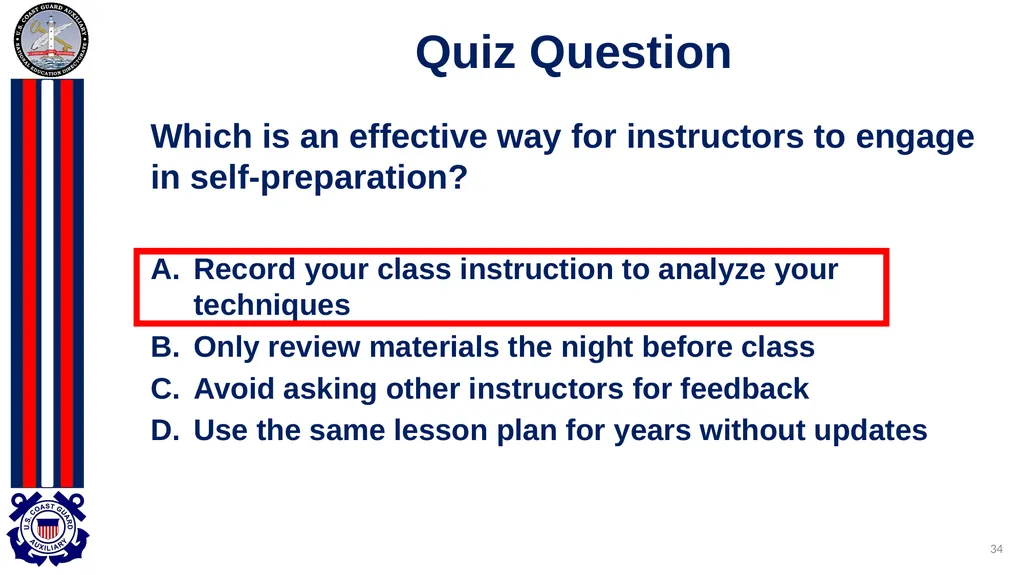
slide32. Instructor Responsibility: Self-Preparation • Constantly reassess teaching techniques and lesson plans
• Record your class instruction to analyze your techniques
• Ask other flotilla instructors for critiques
• Take advantage of training opportunities
• Continue educating yourself in areas of interest
• Update lesson plans with lessons learned
• Review and master course materials thoroughly 32<br>
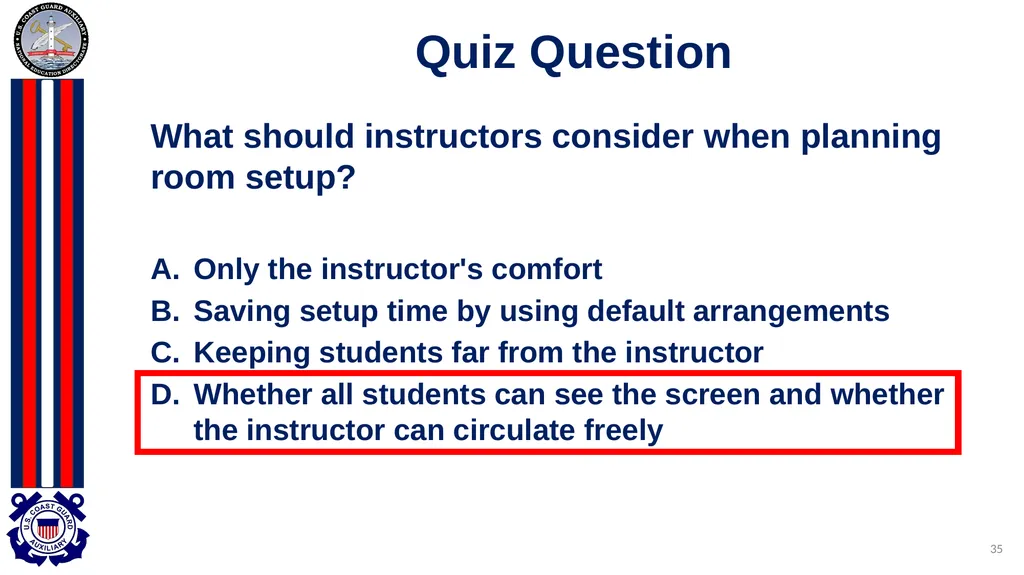
slide33. Instructor Responsibility: Planning • Plan room setup carefully—can everyone see the screen/whiteboard?
• Consider table arrangements that facilitate discussion
• Circulate freely around the room during class
• Incorporate hands-on exercises to engage students
• Use discussions to tap into the group’s collective experience 33<br>
slide34. Quiz Question Which is an effective way for instructors to engage in self-preparation?
Record your class instruction to analyze your techniques
Only review materials the night before class
Avoid asking other instructors for feedback
Use the same lesson plan for years without updates 34<br>
slide35. Quiz Question What should instructors consider when planning room setup?
Only the instructor's comfort
Saving setup time by using default arrangements
Keeping students far from the instructor
Whether all students can see the screen and whether the instructor can circulate freely 35<br>
slide36. Quiz Question How should instructors use humor in the classroom?
Never use humor in Coast Guard classes
Use humor at students' expense to keep attention
Only very experienced instructors should use humor
Use humor tastefully as an icebreaker, never at anyone's expense 36<br>
slide37. Instructor Development 2025 (ID2025) • Updated from ID2020 based on five years of lessons learned
• Emphasizes practical aspects of Auxiliary instruction
• Includes concrete examples and sample questions
• Enhanced information on virtual classrooms (Zoom, Webex, Teams) 37<br>
slide38. Instructor Development 2025 (ID2025) Cont’d • Updated supporting materials: instructor notes and slide deck
• Focuses on facilitating effective learning environments
• Required for initial instructor qualification
• Recommended as a refresher for experienced instructors 38<br>
slide39. Virtual and Hybrid Instruction • Virtual classes expand reach and accessibility
• Carefully select your platforms (Zoom, Webex, Teams)
• Check state approval for virtual delivery
• Resources available on E-Directorate site 39<br>
slide40. Instructor Awards: Maxim Award • Commodore Daniel Maxim Award for Excellence in Education
• Motivates instructors to achieve excellence
• Recognizes development of innovative methods and training aids
• Acknowledges increased mentorship of newer instructors 40<br>
slide41. Instructor Awards: Maxim Award Cont’d • National Prize Winner receives Auxiliary Commendation Medal
• Area Prize Winners receive Auxiliary Achievement Medal
• Flotilla nominations due February 28th
• District selected packages due April 30th 41<br>
slide42. Instructor Awards: Golden Key and Lighthouse • Golden Key Award: 50-99 lead instruction hours in a year
• Lighthouse Award: 100+ lead instruction hours in a year
• Recognizes instructors who go above and beyond
• Combines Public Education and Member Training hours
• Highlights our superstar instructors 42<br>
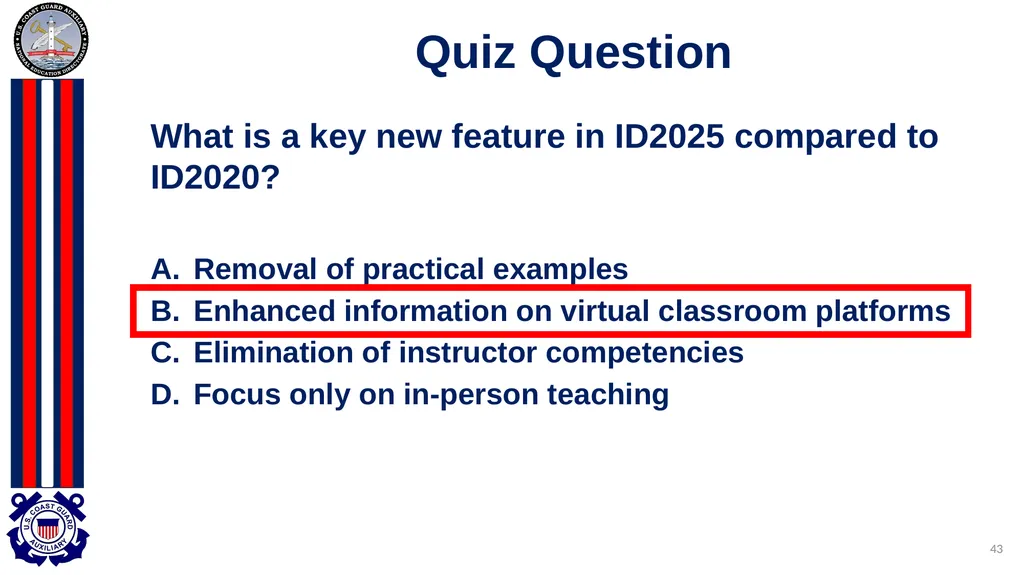
slide43. Quiz Question What is a key new feature in ID2025 compared to ID2020?
Removal of practical examples
Enhanced information on virtual classroom platforms
Elimination of instructor competencies
Focus only on in-person teaching 43<br>
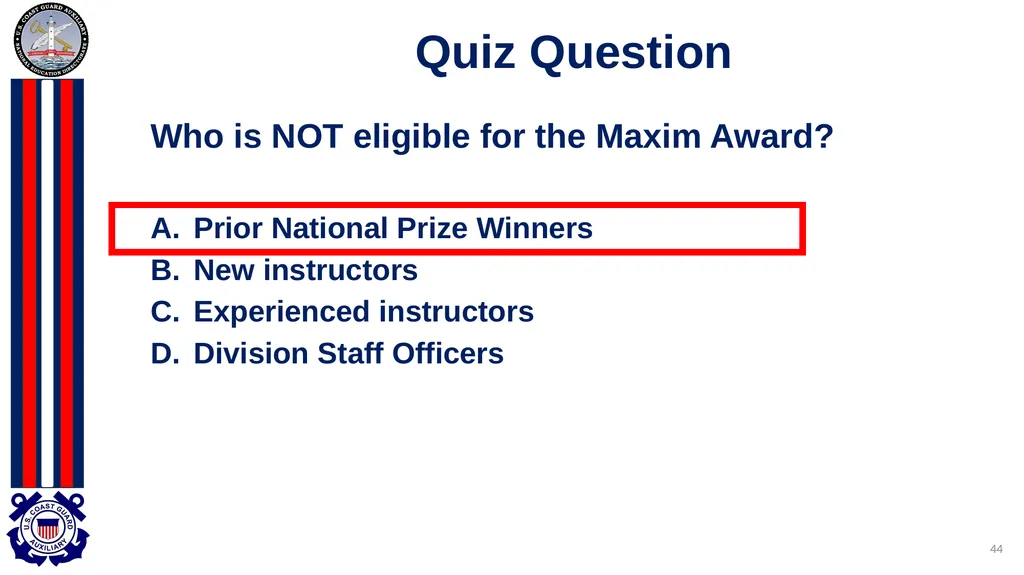
slide44. Quiz Question Who is NOT eligible for the Maxim Award?
Prior National Prize Winners
New instructors
Experienced instructors
Division Staff Officers 44<br>
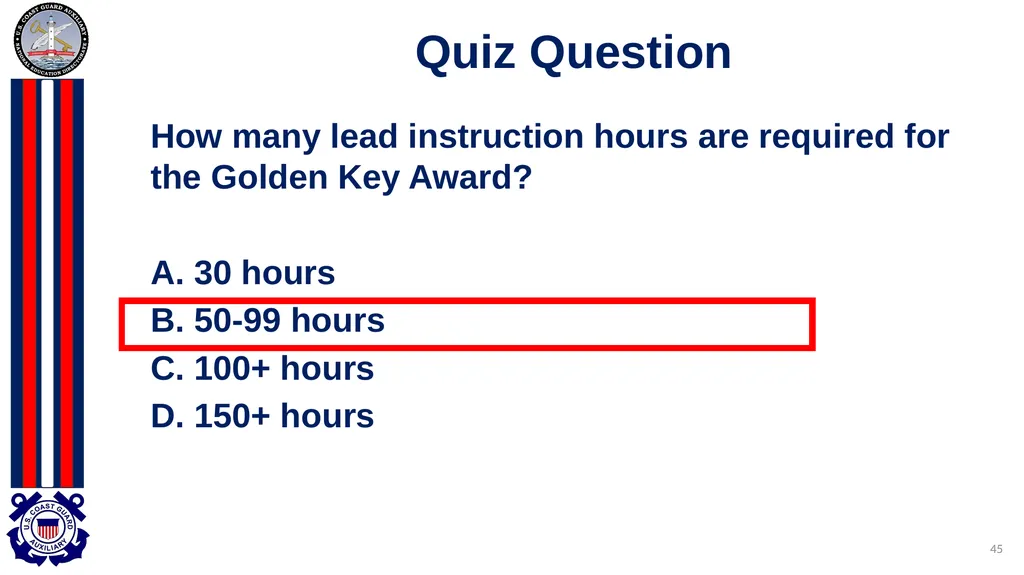
slide45. Quiz Question How many lead instruction hours are required for the Golden Key Award?
A. 30 hours
B. 50-99 hours
C. 100+ hours
D. 150+ hours 45<br>
slide46. Marketing Public Education Classes • Promote classes during Vessel Safety Checks and RBS Program Visits
• Conduct coordinated media campaigns
• Leverage websites and social media platforms
• Word-of-mouth referrals are highly effective
• Sign up students at boat shows and community events
• Marketing posters and tri-fold brochure on E- Directorate Website (Resources) 46<br>
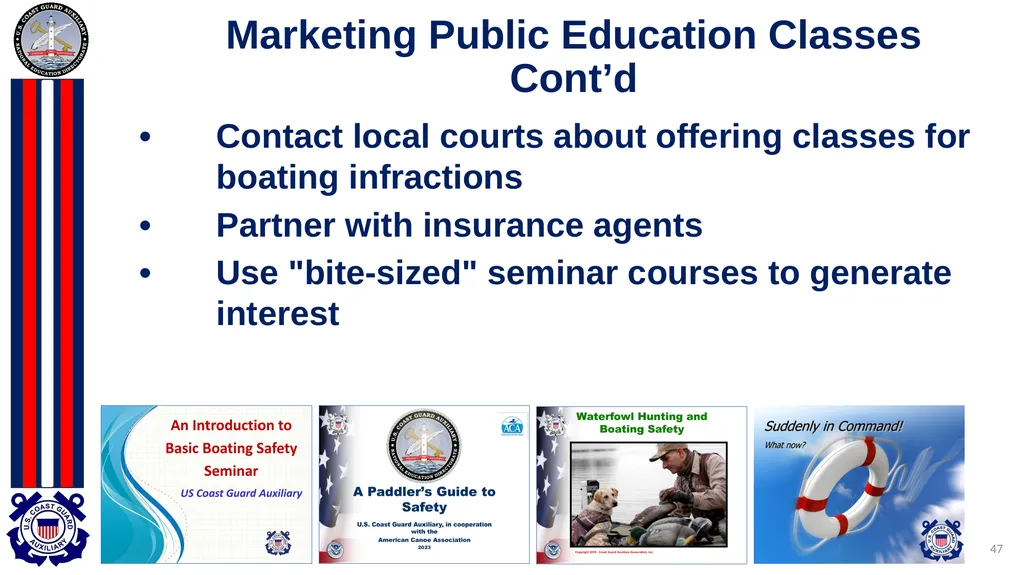
slide47. Marketing Public Education Classes Cont’d • Contact local courts about offering classes for boating infractions
• Partner with insurance agents
• Use "bite-sized" seminar courses to generate interest 47<br>
slide48. Boat America Course • NASBLA-approved certificate course
• Accepted in all states requiring boating education
• Order materials from AUXCEN (Shop Auxiliary)
• Slides and instructor notes available on E-Directorate website
• State supplement slides available for each state
• May add material; cannot delete required content
• Works well with in-person and virtual delivery 48<br>
slide49. Boating Skills and Seamanship Course • No longer offered as a NASBLA-approved certificate course
• Suggestion: Teach Boat America plus additional BS&S chapters
• Use the Boat America exam for state certification 49<br>
slide50. Boating Skills and Seamanship Course Cont’d • E-Directorate exploring updates to the supplemental chapters
• Still valuable for expanding course content
• Materials available on the E-Directorate website 50<br>
slide51. Spanish Language Courses • Spanish-speaking boaters represent a fast-growing market
• Emerging market of first-time boat buyers
• Previously underserved population
• All slides, instructor notes, and exams available in Spanish
• Most textbooks remain in English
• Addresses critical safety gap in Hispanic/Latino communities 51<br>
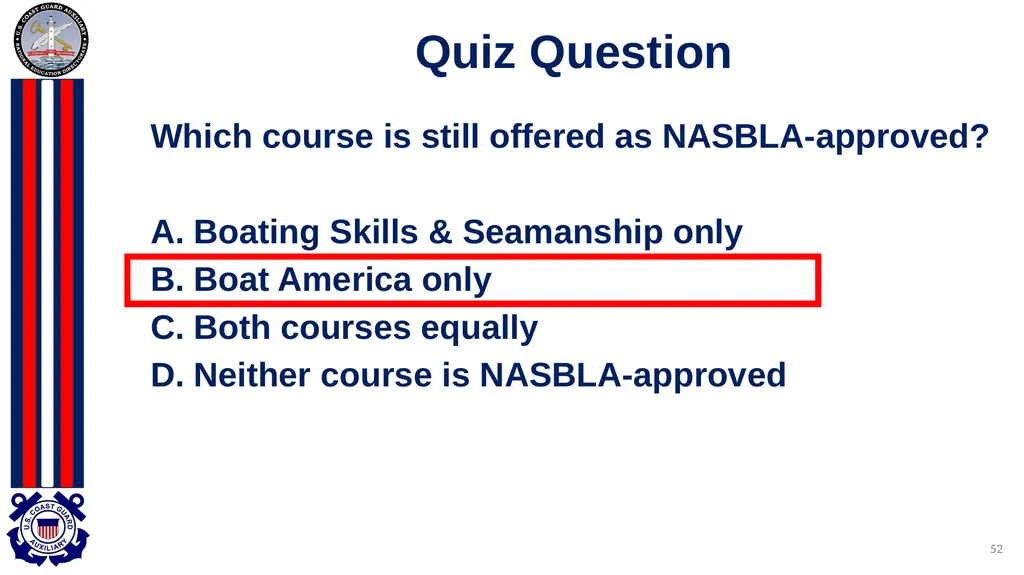
slide52. Quiz Question Which course is still offered as NASBLA-approved?
Boating Skills & Seamanship only
Boat America only
Both courses equally
Neither course is NASBLA-approved 52<br>
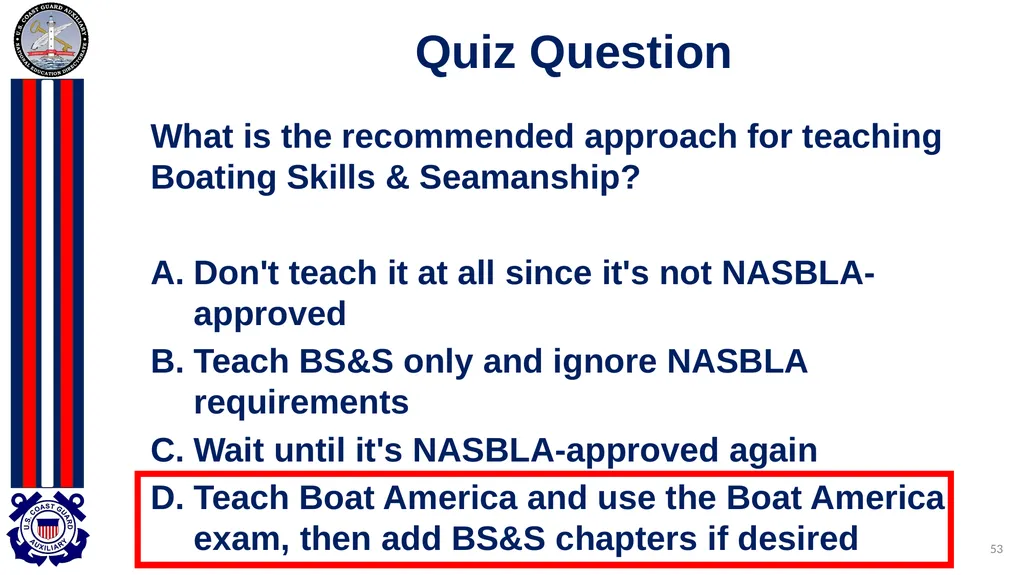
slide53. Quiz Question What is the recommended approach for teaching Boating Skills & Seamanship?
Don't teach it at all since it's not NASBLA-approved
Teach BS&S only and ignore NASBLA requirements
Wait until it's NASBLA-approved again
Teach Boat America and use the Boat America exam, then add BS&S chapters if desired 53<br>
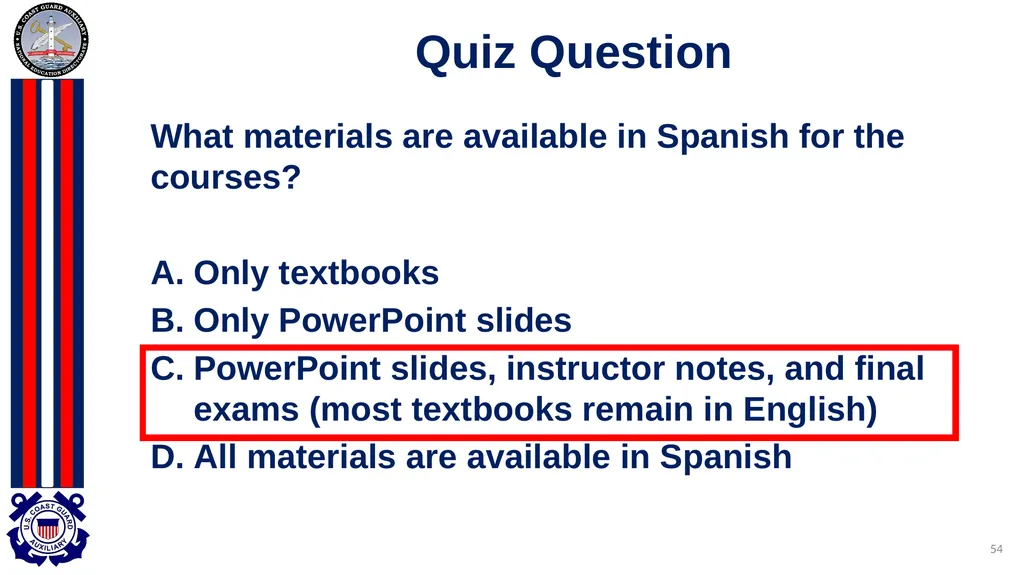
slide54. Quiz Question What materials are available in Spanish for the courses?
Only textbooks
Only PowerPoint slides
PowerPoint slides, instructor notes, and final exams (most textbooks remain in English)
All materials are available in Spanish 54<br>
slide55. Resources for FSO-PEs • "I'm the Flotilla Staff Officer-Public Education, Now What?" course
• Available on E-Directorate website
• Designed for new and returning FSO-PEs
• Covers all aspects of the FSO-PE position
• Includes supervision and scheduling responsibilities
• Addresses coordination with other staff officers
• Provides best practices and practical guidance
• Pathway to higher staff officer positions 55<br>
slide56. Instructor Currency Maintenance for 2026 • Two hours as lead instructor OR
• Four hours as non-lead instructor OR
• A combination of both
• Completion of 2026 instructor workshop (recommended) 56<br>
slide57. Instructor Currency Maintenance for 2026 cont’d • If REYR from 2025, must make up deficit hours as trainee
• Must also complete the 2026 workshop
• Flotilla Commander notifies DIRAUX for re-certification
• Core Training must remain current 57<br>
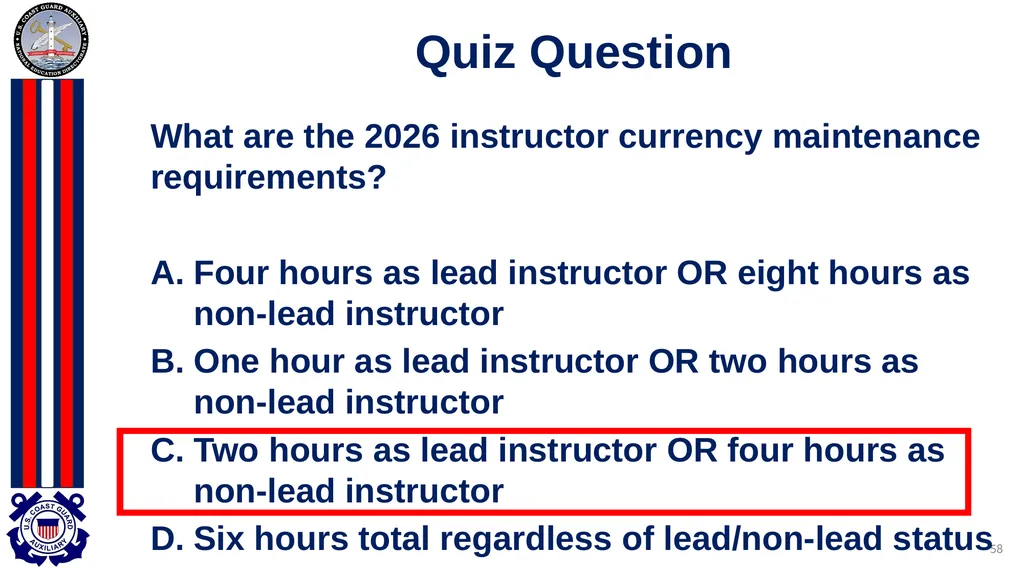
slide58. Quiz Question What are the 2026 instructor currency maintenance requirements?
Four hours as lead instructor OR eight hours as non-lead instructor
One hour as lead instructor OR two hours as non-lead instructor
Two hours as lead instructor OR four hours as non-lead instructor
Six hours total regardless of lead/non-lead status 58<br>
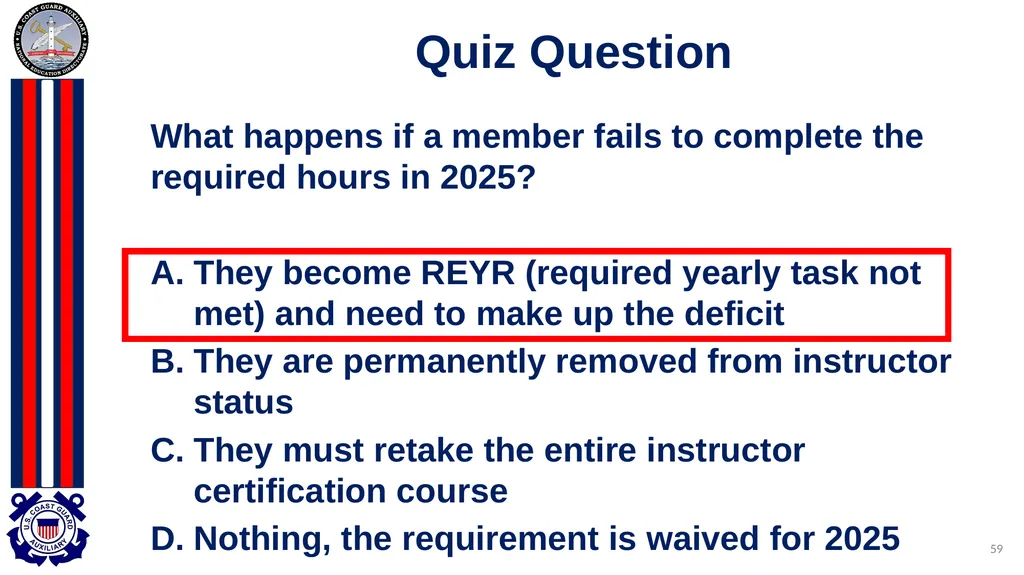
slide59. Quiz Question What happens if a member fails to complete the required hours in 2025?
They become REYR (required yearly task not met) and need to make up the deficit
They are permanently removed from instructor status
They must retake the entire instructor certification course
Nothing, the requirement is waived for 2025 59<br>
slide60. Recruiting Through Public Education • Distribute plenty of handouts showcasing Auxiliary missions
• Show common interests and build rapport with students
• Actively mention flotilla needs beyond just boats
• Avoid instructor cliques that exclude students
• Use plain English, not acronyms and insider terminology 60<br>
slide61. Recruiting Through Public Education cont’d • Be approachable—talk to students, not just other instructors
• Work local pictures and anecdotes into presentations
• Include the Auxiliary message in every session
• Make recruiting part of your lesson plan 61<br>
slide62. Member Retention Through Quality Training • Quality training creates strong, committed membership
• Well-trained members are more confident and stay active longer
• Training builds competence, which builds confidence
• Shared training experiences foster team unity and camaraderie 62<br>
slide63. Member Retention Through Quality Training cont’d • Continuous learning keeps members engaged
• Professional training reflects organizational values
• Recognition of training achievements motivates members
• Training quality directly affects a member’s satisfaction 63<br>
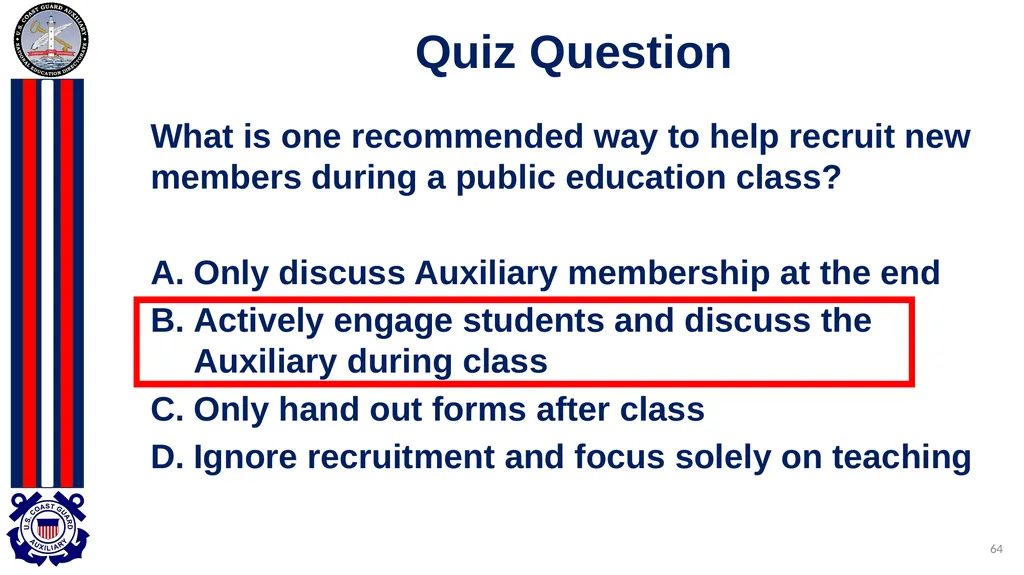
slide64. Quiz Question What is one recommended way to help recruit new members during a public education class?
Only discuss Auxiliary membership at the end
Actively engage students and discuss the Auxiliary during class
Only hand out forms after class
Ignore recruitment and focus solely on teaching 64<br>
slide65. Quiz Question What is the relationship between quality training and member retention?
There is no relationship between the two
Training quality only matters for new members
Retention depends solely on social activities
Well-trained members stay active longer 65<br>
slide66. What's New and On the Horizon • Updated Suddenly in Command course
• Workshop and ID2025 on the Auxiliary Classroom platform
• Marketing campaign to recruit instructors from within
• Targeted outreach to professional educators
• Master Instructor program development
• Regular updates on E-Directorate website
• Check "What's New" section frequently 66<br>
slide67. Chain of Leadership and Management • Solve issues at the lowest possible level
• Elevate through proper chain as needed
• FSO-PE → SO-PE → ADSO-PE → DSO-PE → National E-Directorate
• Do NOT contact the Chief Director's office directly
• Do NOT contact outside organizations (NASBLA, BLA) directly 67<br>
slide68. Chain of Leadership and Management cont’d • Email E-Directorate at pe.feedback@cgauxnet.us for unresolved issues
• Following the chain maintains organizational discipline and credibility
The E-Directorate staff is here to support you 68<br>
slide69. Professionalism in Instruction • Instructors represent the Auxiliary in the community
• First impressions are lasting impressions
• Professional appearance and conduct are essential
• Be prepared, punctual, and polished
• Maintain appropriate boundaries with students
• Model the behavior and attitude we promote
• Remember: you're always representing the Coast Guard Auxiliary 69<br>
slide70. Instructor Self-Care and Burnout Prevention • Teaching requires significant energy and emotional investment
• Recognize signs of instructor burnout
• Balance teaching load with other activities
• Share the workload—recruit and develop new instructors
• Celebrate successes, not just challenges
• Connect with other instructors for support
• Take breaks when needed 70<br>
slide71. Looking Ahead: The Future of Public Education • Technology continues to evolve—we must adapt
• Virtual and hybrid delivery are here to stay
• Younger generations have different learning preferences
• Electric and alternative-fuel vessels are emerging
• Our core mission remains constant: reducing loss of life, injury, and property damage
• Innovation balanced with proven principles 71<br>
slide72. Conclusion: Characteristics of Effective Instructors • Professional in appearance, conduct, and preparation
• Enthusiastic about subject matter and teaching
• Constantly practicing their craft and seeking improvement
• Student-centered in approach
• Knowledgeable yet humble enough to say "I don't know"
• Committed to the mission of saving lives through education 72<br>
slide73. Quiz Question Why is instructor professionalism important?
It's required by federal law
Instructors represent the Auxiliary and create first impressions
It's only important for new instructors
Professionalism doesn't affect student learning 73<br>
slide74. Quiz Question What are the three characteristics of effective Auxiliary instructors mentioned in the conclusion?
Professional, enthusiastic, and constantly practicing their craft
Knowledgeable, friendly, and punctual
Organized, prepared, and strict
Experienced, certified, and always available 74<br>
slide75. Final Reminders Check the E-Directorate website regularly for updates
Follow the chain of leadership and management for issues
Email pe.feedback@cgauxnet.us for unresolved questions
Stay current with Core Training
Remember: every class is an opportunity to save lives and build our organization
Thank you for your service and dedication! 75<br>
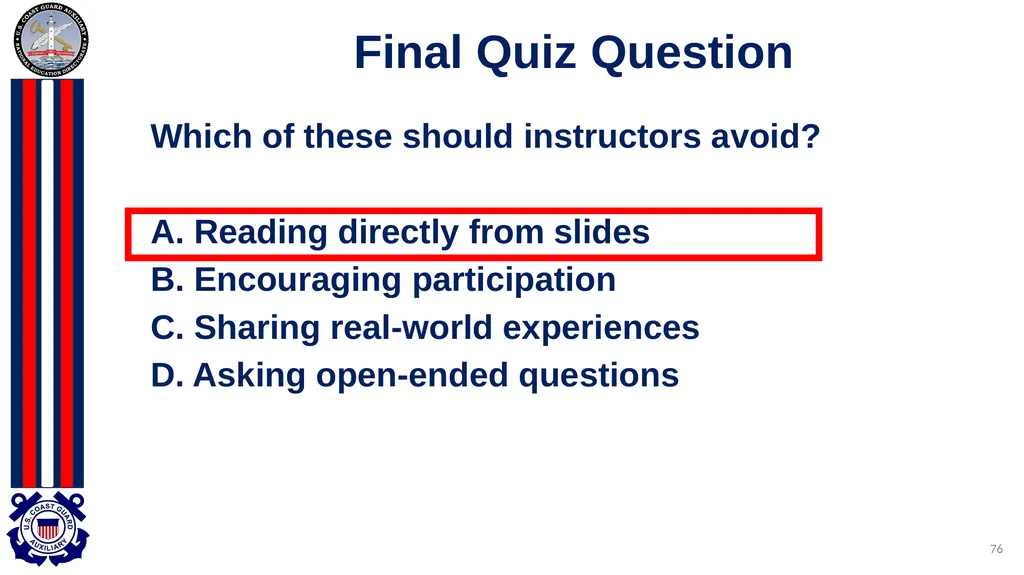
slide76. Final Quiz Question Which of these should instructors avoid?
A. Reading directly from slides
B. Encouraging participation
C. Sharing real-world experiences
D. Asking open-ended questions 76<br>
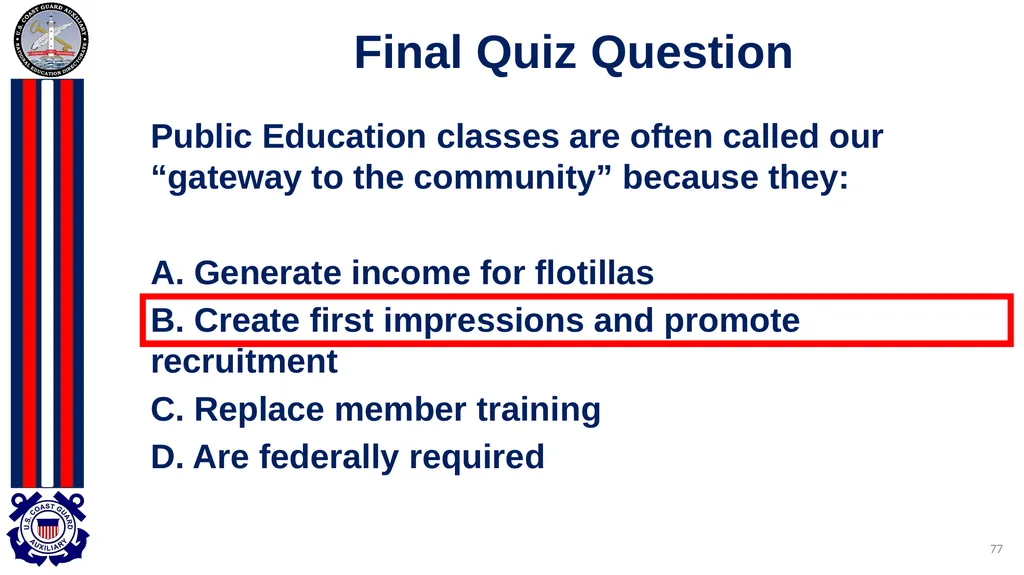
slide77. Final Quiz Question Public Education classes are often called our “gateway to the community” because they:
A. Generate income for flotillas
B. Create first impressions and promote recruitment
C. Replace member training
D. Are federally required 77<br>
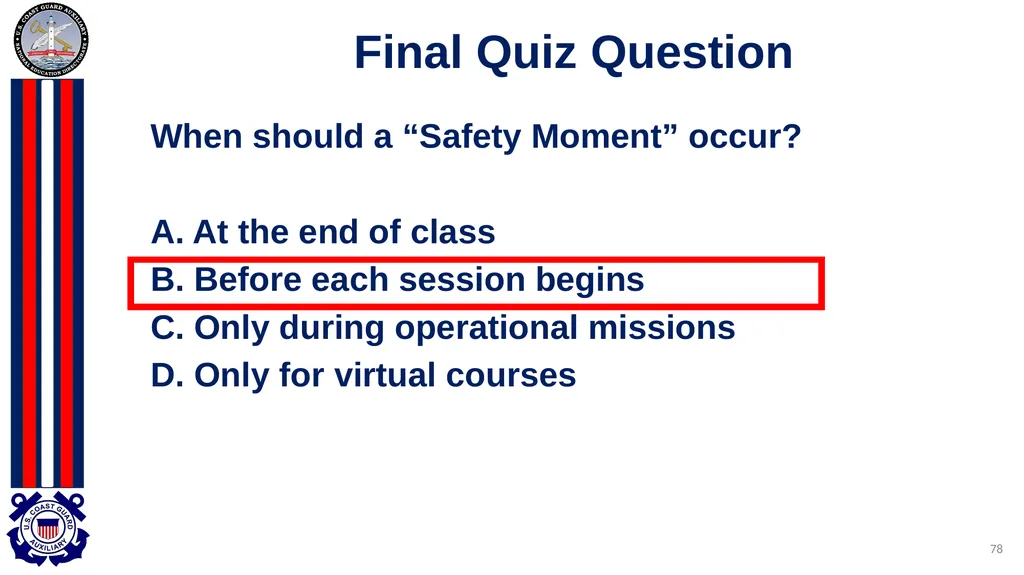
slide78. Final Quiz Question When should a “Safety Moment” occur?
A. At the end of class
B. Before each session begins
C. Only during operational missions
D. Only for virtual courses 78<br>
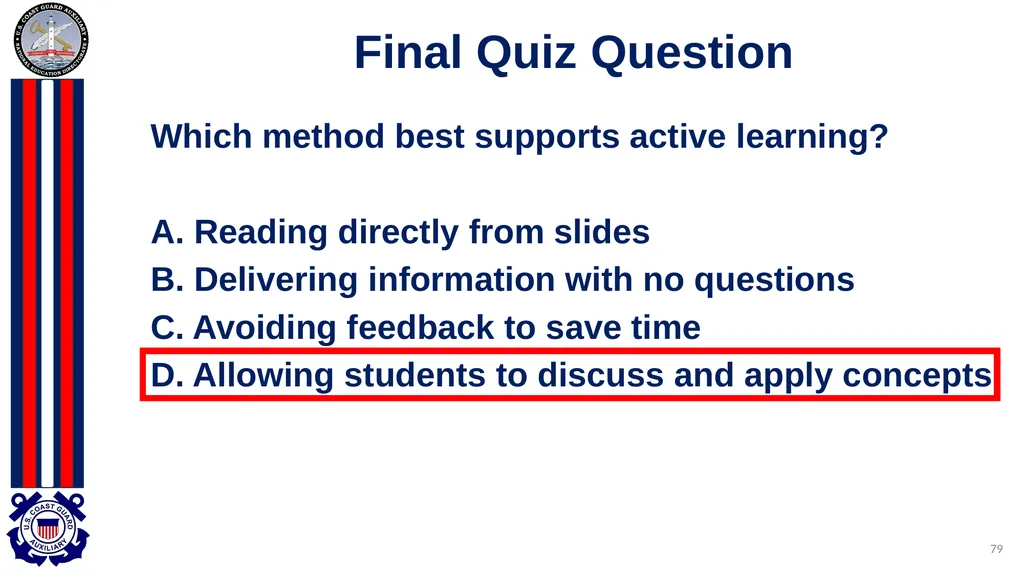
slide79. Final Quiz Question Which method best supports active learning?
A. Reading directly from slides
B. Delivering information with no questions
C. Avoiding feedback to save time
D. Allowing students to discuss and apply concepts 79<br>
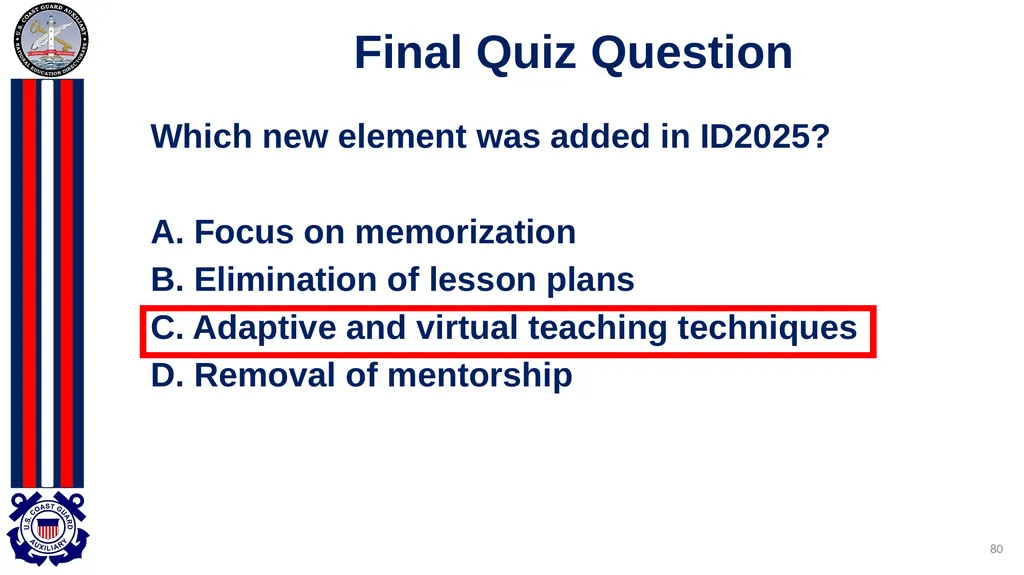
slide80. Final Quiz Question Which new element was added in ID2025?
A. Focus on memorization
B. Elimination of lesson plans
C. Adaptive and virtual teaching techniques
D. Removal of mentorship 80<br>
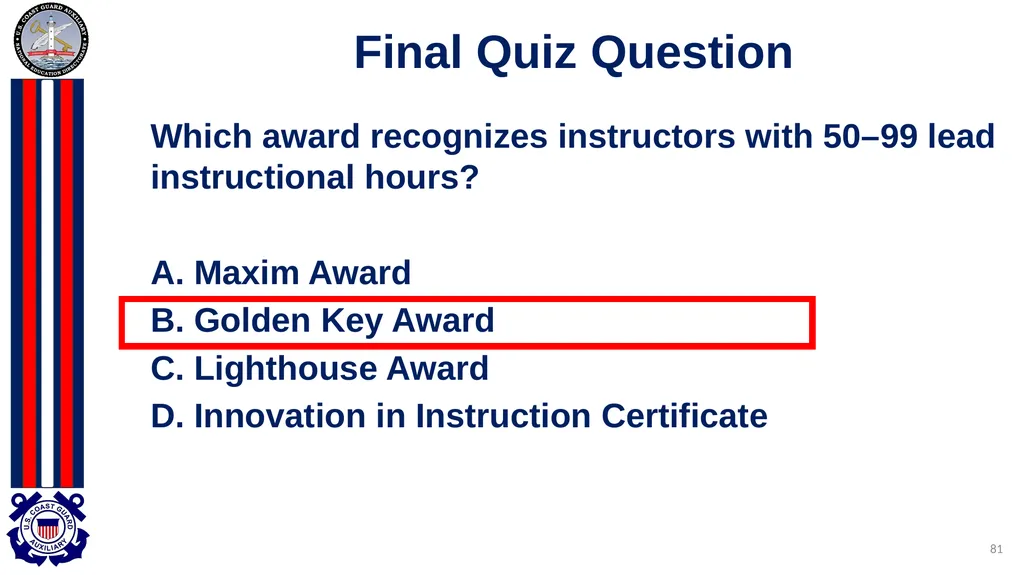
slide81. Final Quiz Question Which award recognizes instructors with 50–99 lead instructional hours?
A. Maxim Award
B. Golden Key Award
C. Lighthouse Award
D. Innovation in Instruction Certificate 81<br>
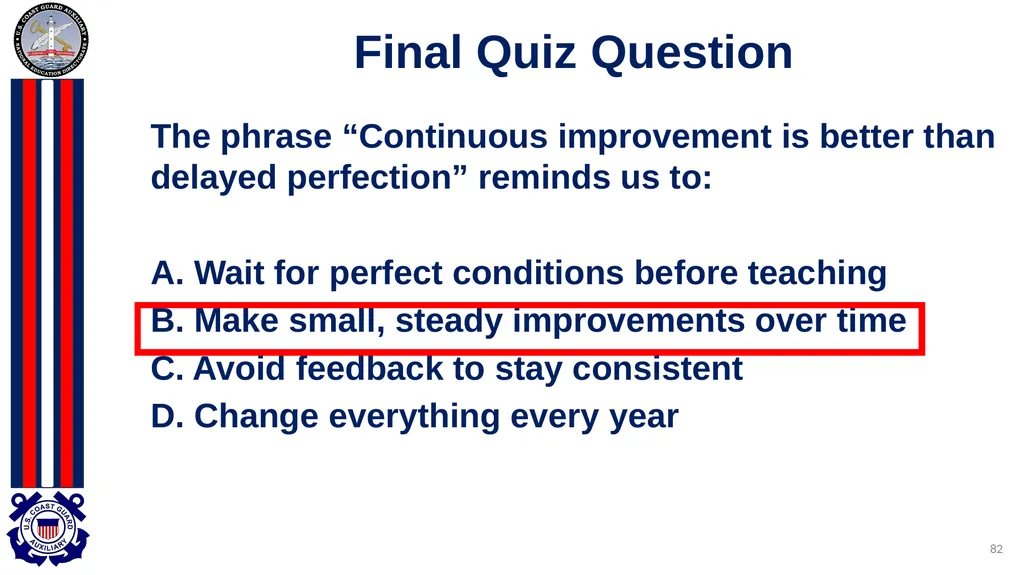
slide82. Final Quiz Question The phrase “Continuous improvement is better than delayed perfection” reminds us to:
A. Wait for perfect conditions before teaching
B. Make small, steady improvements over time
C. Avoid feedback to stay consistent
D. Change everything every year 82<br>
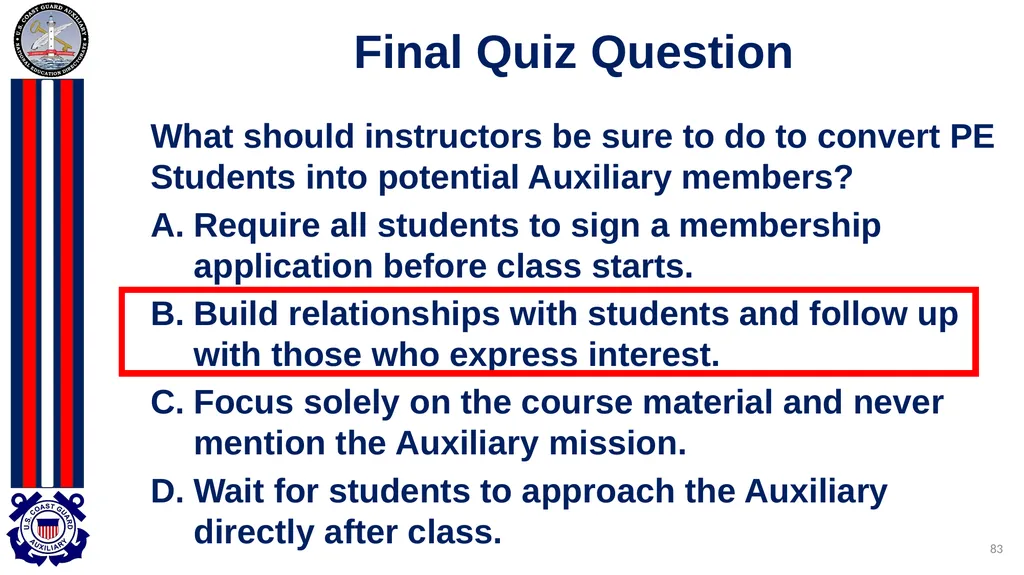
slide83. Final Quiz Question What should instructors be sure to do to convert PE Students into potential Auxiliary members?
Require all students to sign a membership application before class starts.
Build relationships with students and follow up with those who express interest.
Focus solely on the course material and never mention the Auxiliary mission.
Wait for students to approach the Auxiliary directly after class. 83<br>
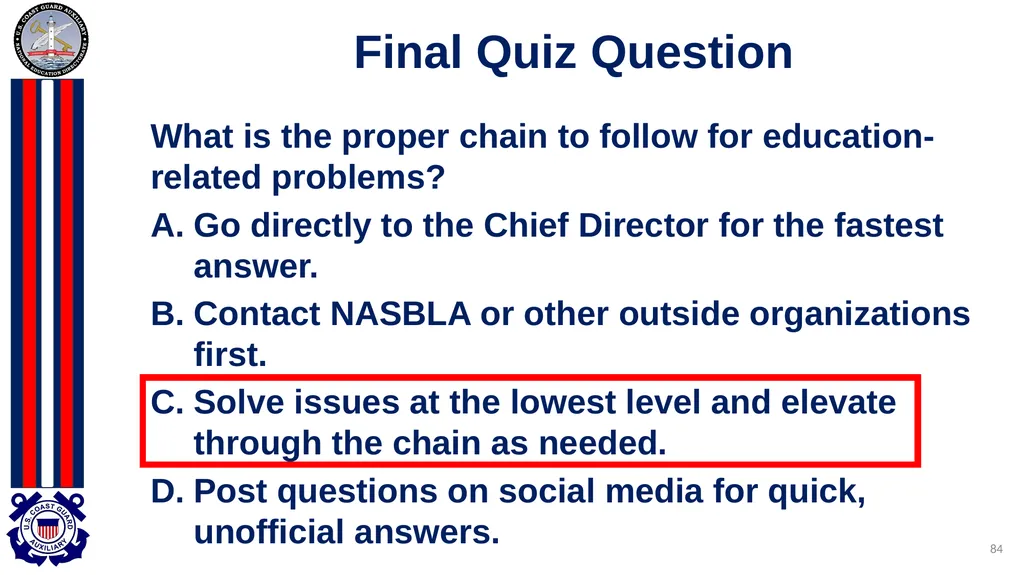
slide84. Final Quiz Question What is the proper chain to follow for education-related problems?
Go directly to the Chief Director for the fastest answer.
Contact NASBLA or other outside organizations first.
Solve issues at the lowest level and elevate through the chain as needed.
Post questions on social media for quick, unofficial answers. 84<br>
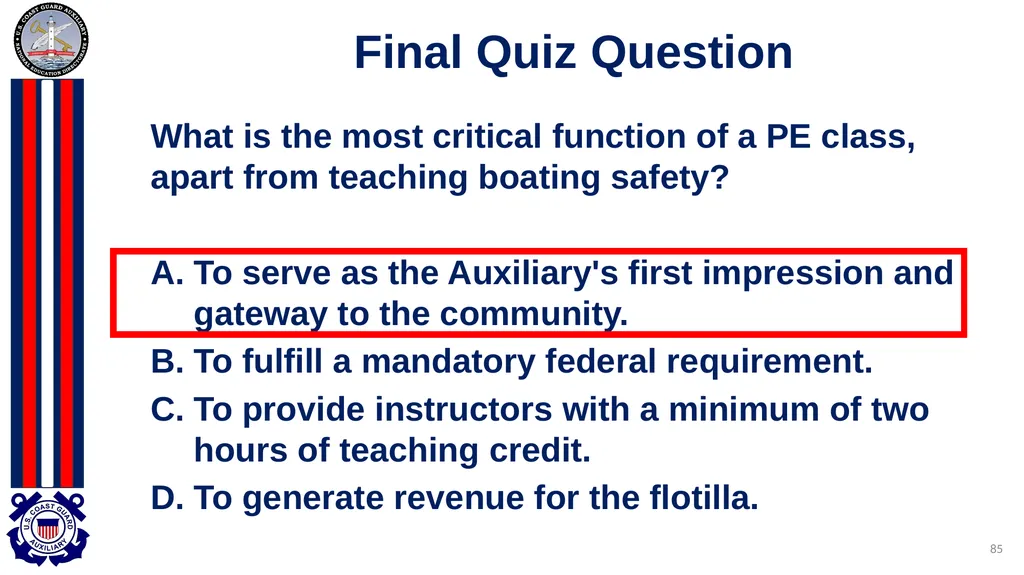
slide85. Final Quiz Question What is the most critical function of a PE class, apart from teaching boating safety?
To serve as the Auxiliary's first impression and gateway to the community.
To fulfill a mandatory federal requirement.
To provide instructors with a minimum of two hours of teaching credit.
To generate revenue for the flotilla. 85<br>
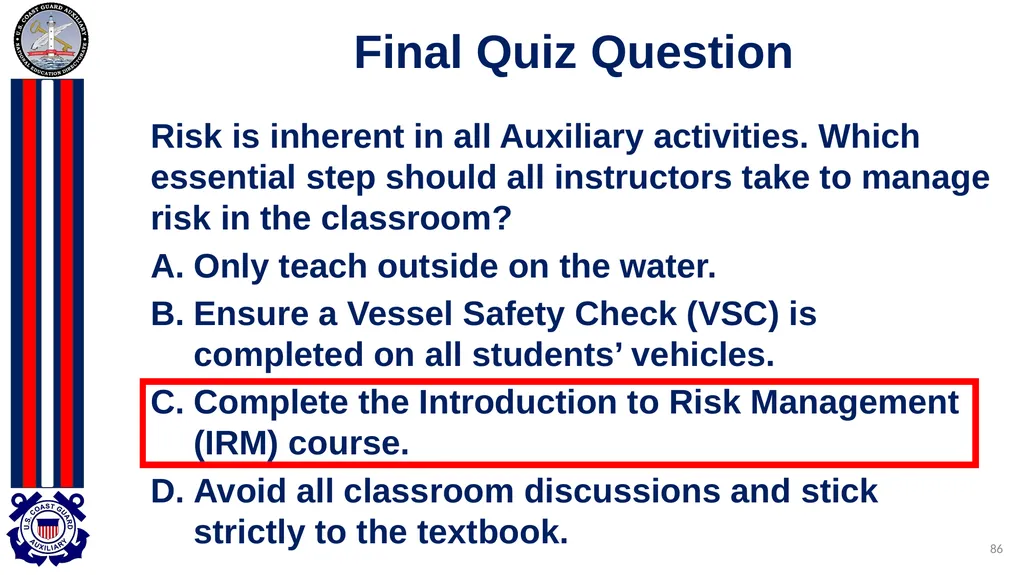
slide86. Final Quiz Question Risk is inherent in all Auxiliary activities. Which essential step should all instructors take to manage risk in the classroom?
Only teach outside on the water.
Ensure a Vessel Safety Check (VSC) is completed on all students’ vehicles.
Complete the Introduction to Risk Management (IRM) course.
Avoid all classroom discussions and stick strictly to the textbook. 86<br>
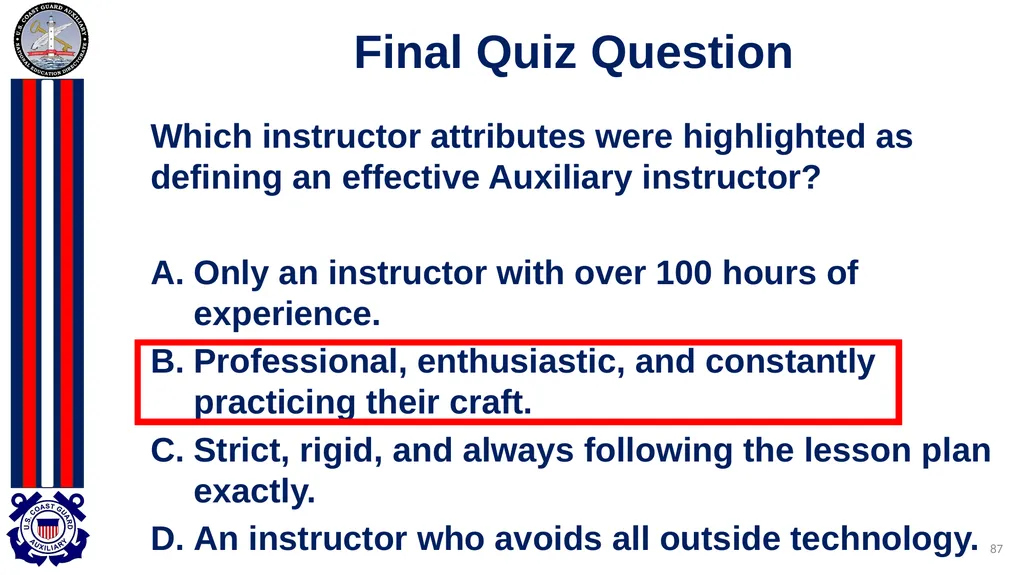
slide87. Final Quiz Question Which instructor attributes were highlighted as defining an effective Auxiliary instructor?
Only an instructor with over 100 hours of experience.
Professional, enthusiastic, and constantly practicing their craft.
Strict, rigid, and always following the lesson plan exactly.
An instructor who avoids all outside technology. 87<br>
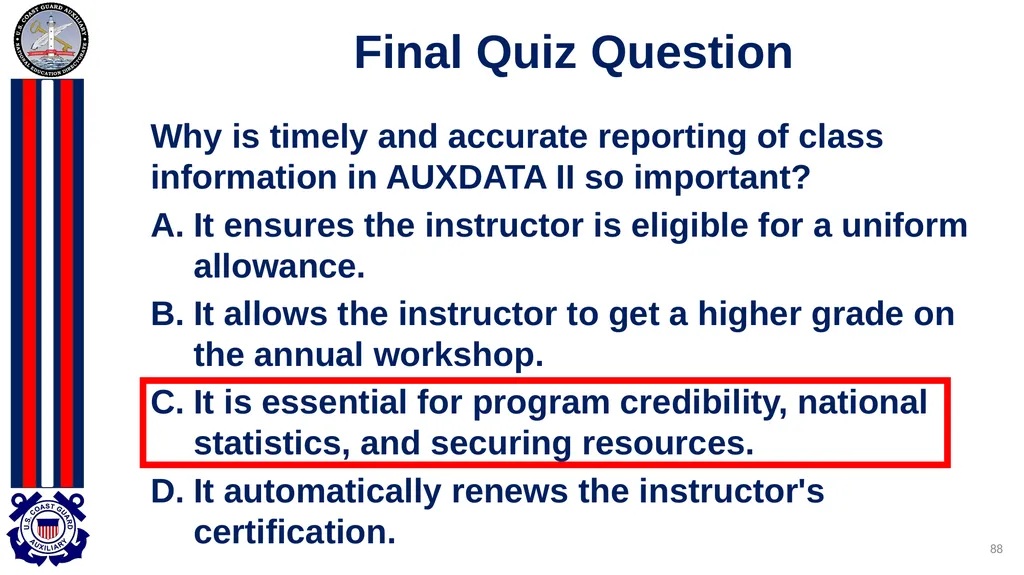
slide88. Final Quiz Question Why is timely and accurate reporting of class information in AUXDATA II so important?
It ensures the instructor is eligible for a uniform allowance.
It allows the instructor to get a higher grade on the annual workshop.
It is essential for program credibility, national statistics, and securing resources.
It automatically renews the instructor's certification. 88<br>
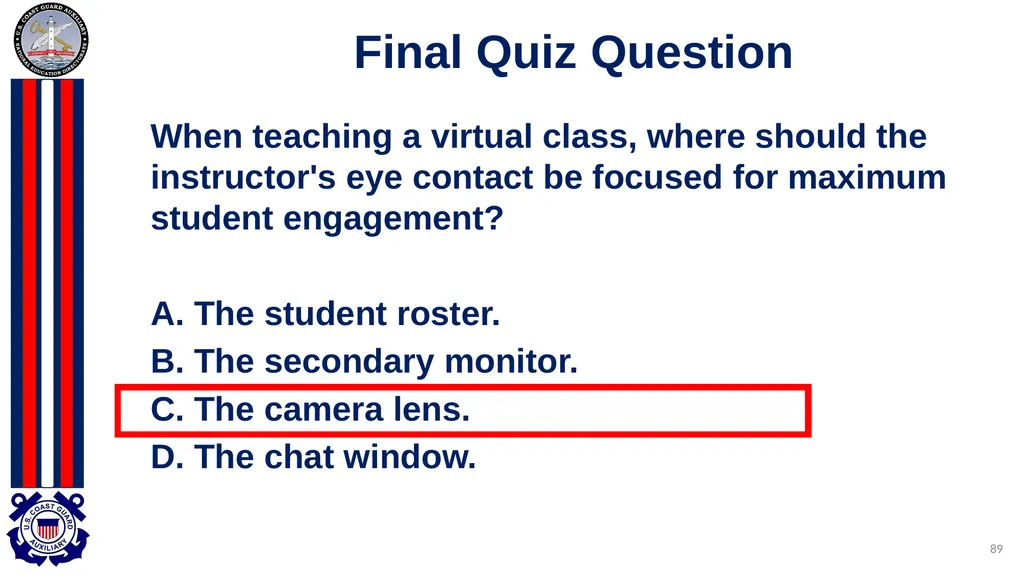
slide89. Final Quiz Question When teaching a virtual class, where should the instructor's eye contact be focused for maximum student engagement?
A. The student roster.
B. The secondary monitor.
C. The camera lens.
D. The chat window. 89<br>
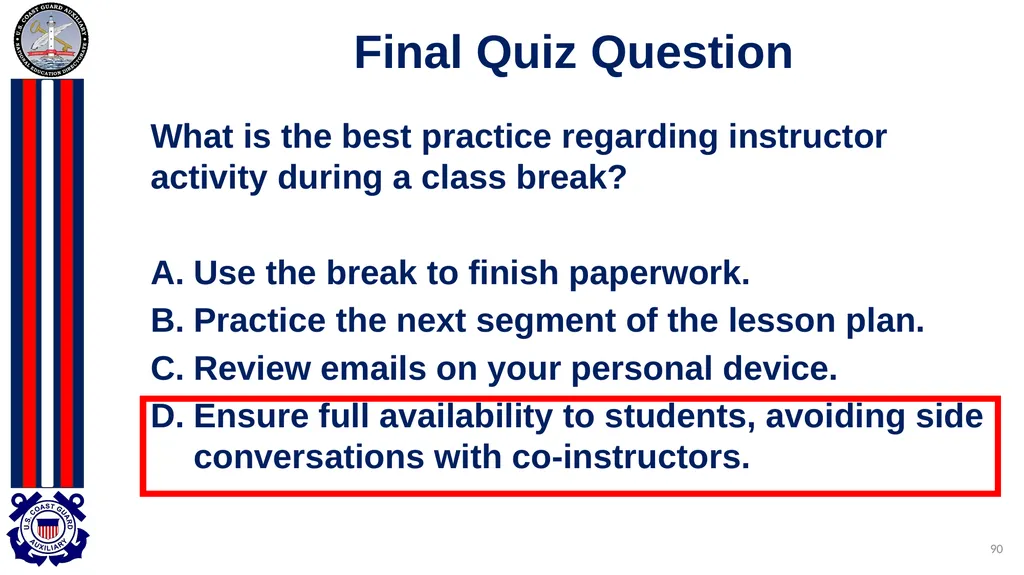
slide90. Final Quiz Question What is the best practice regarding instructor activity during a class break?
Use the break to finish paperwork.
Practice the next segment of the lesson plan.
Review emails on your personal device.
Ensure full availability to students, avoiding side conversations with co-instructors. 90<br>
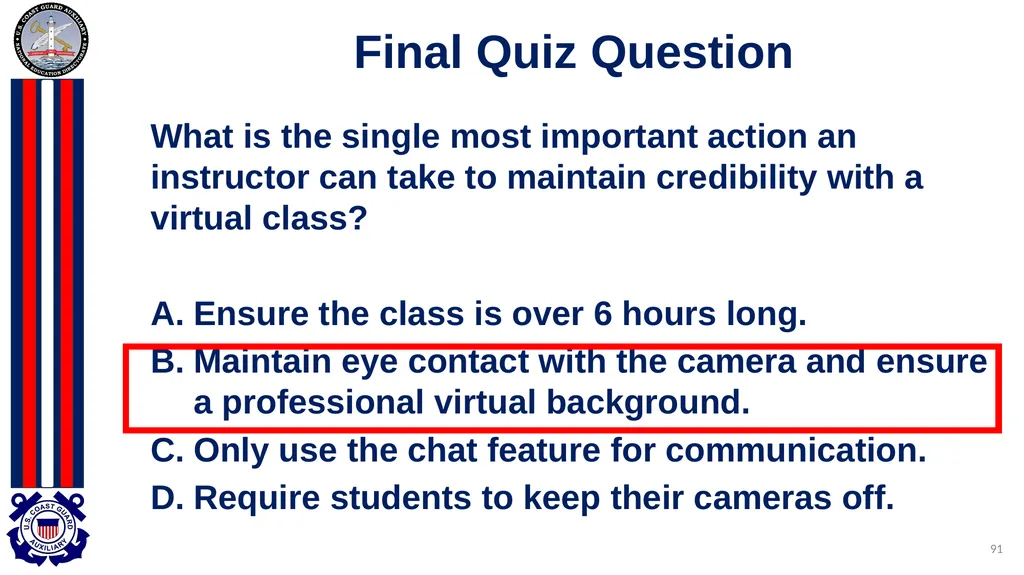
slide91. Final Quiz Question What is the single most important action an instructor can take to maintain credibility with a virtual class?
Ensure the class is over 6 hours long.
Maintain eye contact with the camera and ensure a professional virtual background.
Only use the chat feature for communication.
Require students to keep their cameras off. 91<br>
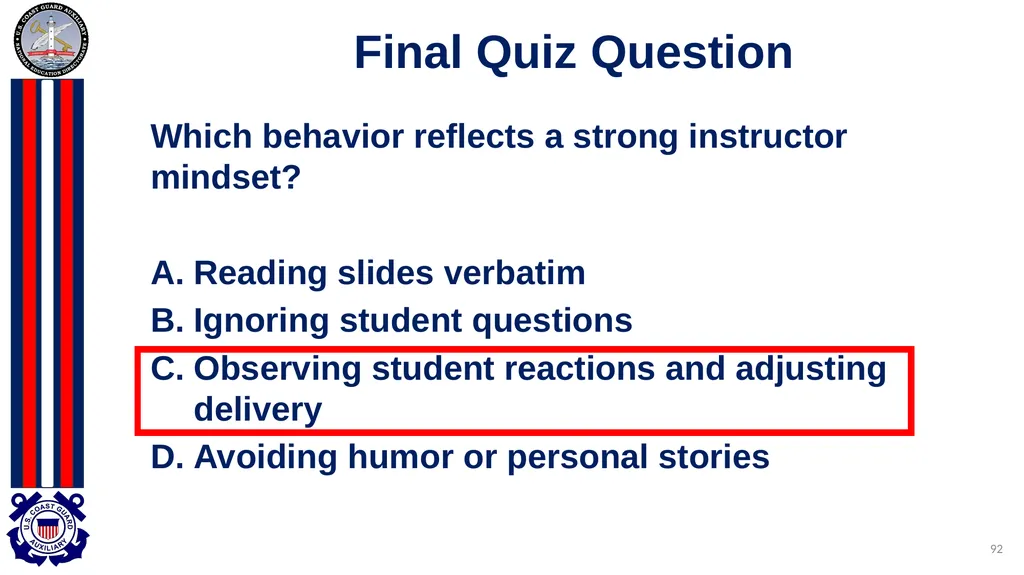
slide92. Final Quiz Question Which behavior reflects a strong instructor mindset?
Reading slides verbatim
Ignoring student questions
Observing student reactions and adjusting delivery
Avoiding humor or personal stories 92<br>
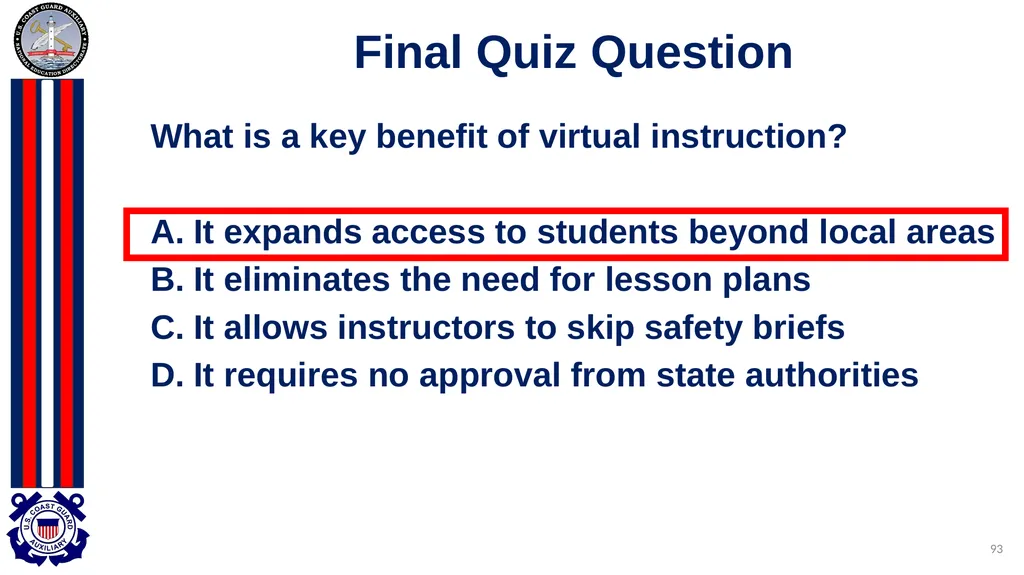
slide93. Final Quiz Question What is a key benefit of virtual instruction?
It expands access to students beyond local areas
It eliminates the need for lesson plans
It allows instructors to skip safety briefs
It requires no approval from state authorities 93<br>
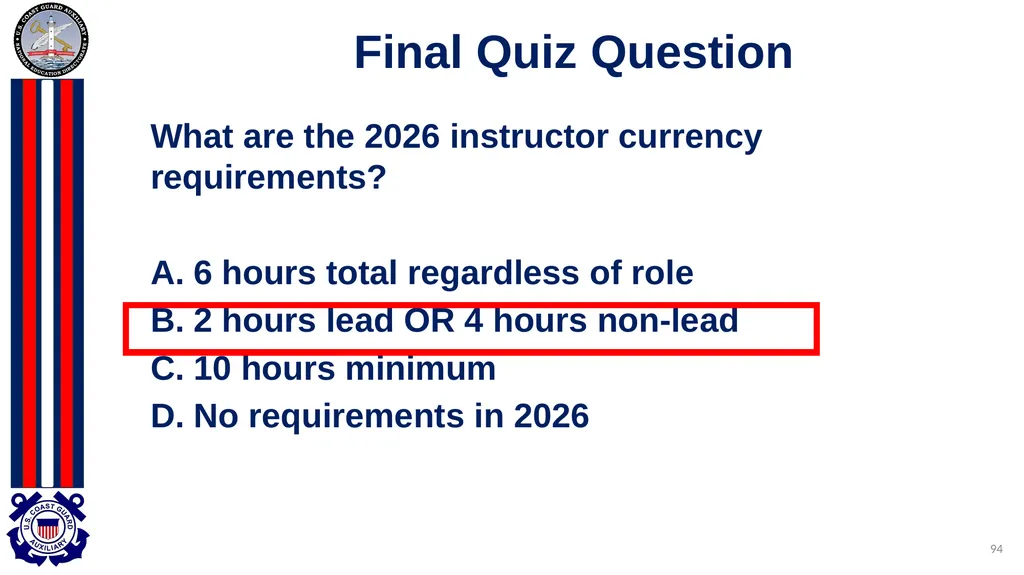
slide94. Final Quiz Question What are the 2026 instructor currency requirements?
6 hours total regardless of role
2 hours lead OR 4 hours non-lead
10 hours minimum
No requirements in 2026 94<br>
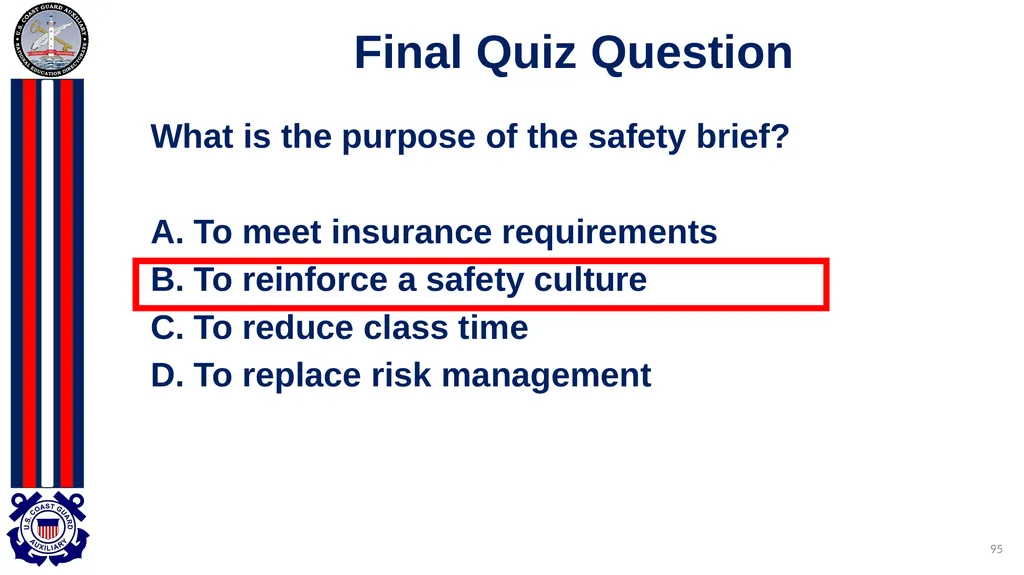
slide95. Final Quiz Question What is the purpose of the safety brief?
To meet insurance requirements
To reinforce a safety culture
To reduce class time
To replace risk management 95<br>
slide96. National Public Education Directorate Instructor Workshop 2026 96 Thank you for Attending<br>
slide2. Workshop Delivery Options Option 1: Self-Study
Review materials independently at your own pace on the Auxiliary Classroom (Moodle)
Option 2: Facilitated Workshop (Recommended)
Led by a qualified instructor
Interactive learning environment
Enhanced understanding through group discussion
Real-time clarification of concepts 2<br>
slide3. Quiz Question What are the two primary delivery options for the Annual Instructor Workshop?
A. In-Person and Virtual
B. Self-Study and Facilitated Workshop
C. Individual Study and Group Project
D. Online and Hybrid 3<br>
slide4. Quiz Question Which workshop delivery option is recommended and why?
Self-study because it's more flexible
Facilitated workshop because it provides interactive learning
Either option works equally well
The choice depends on the instructor's experience level 4<br>
slide5. Who Should Take This Workshop? • Members involved in public education
• Members involved in member training
• Members mentoring new members
• Members interested in improving their teaching skills
• Anyone who communicates Auxiliary missions to the public
Flotilla leaders and recruiters 5<br>
slide6. The Power of Education • Public education classes are our gateway to the community
• First impressions shape public perception of our entire organization
• Quality instruction drives new member recruitment
• Member training directly impacts satisfaction and retention
• Well-trained members are more confident and active 6<br>
slide7. Why Instructor Excellence Matters • Professional instruction leads to stronger member recruitment
• Quality training improves member retention
• Excellence enhances program credibility in the community
• Teaching is a skill requiring continuous practice
• Instructors represent the Auxiliary as safety experts
• Our reputation depends on instructional quality 7<br>
slide8. Quiz Question Who should take the 2026 Instructor Workshop?
Only certified public education instructors
Only member training instructors
All members, regardless of role
Only new instructors seeking certification 8<br>
slide9. Quiz Question Why is instructional excellence important?
It reduces paperwork
It improves recruitment and retention
It allows instructors to skip lesson planning
It’s only required for virtual classes 9<br>
slide10. Quiz Question How do public education classes serve as a "gateway to the community"?
They generate revenue for the flotilla
They are the Auxiliary's first impression and shape public perception
They are required by federal law
They provide free entertainment for the public 10<br>
slide11. Quiz Question Why is continuous practice important for instructors?
It's required by the Auxiliary Manual
It helps instructors earn more awards
It's only necessary for new instructors
Teaching is a skill that requires regular practice and staying current 11<br>
slide12. Workshop Goals • Enhance instructor quality and capabilities
• Expand our instructor pool
• Boost teaching effectiveness
• Inspire more members to become instructors
• Share best practices and proven techniques
• Address common instructional challenges 12<br>
slide13. Effective Teaching Practices • Engage students through meaningful dialogue and observation
• Actively listen to ensure student comprehension
• Create interactive, two-way learning experiences 13<br>
slide14. Effective Teaching Practices (cont’d) • Watch for visual cues of understanding or confusion
• Ask open-ended questions to gauge comprehension
• Build on student responses to deepen understanding 14<br>
slide15. Dos and Don’ts for Instructors • DON'T: Simply read from slides or textbooks
• DON'T: Deliver one-way information without interaction
• DON'T: Passively present course materials
• DO: Provide context and deeper insight beyond slides
• DO: Facilitate active learning and discovery
• DO: Create opportunities for peer-to-peer learning 15<br>
slide16. The Instructor Mindset • Engage in two-way dialogue
• Observe and respond to student cues
• Listen actively and validate contributions 16<br>
slide17. Continuous Improvement • Ongoing progress is better than waiting for perfection
• Incremental improvements are preferable to pursuing absolute perfection
• Focus on making consistent strides forward
• Learn from experience and adapt over time
• Perfection may be elusive and time-consuming
• Continuous improvement allows adaptability and learning from mistakes 17<br>
slide18. Risk Management & Classroom Safety • “Safety First” applies to every teaching environment
• Safety is foundational to every mission
• Use the Classroom Safety Checklist
• Include a “Safety Moment” at every session
https://wow.uscgaux.info/content.php?unit=E-DEPT&category=classroom1 18<br>
slide19. Culture of Safety in Instruction • Safety is integrated into all instructional activities
• Instructor qualifications emphasize safety commitment
• Focus on practical skills and hands-on exercises
• Interactive learning enhances safety education
• Continuous professional development is encouraged 19<br>
slide20. Quiz Question Which behavior reflects a strong instructor mindset?
Reading slides verbatim
Ignoring student questions
Observing student reactions and adjusting delivery
Avoiding humor or personal stories 20<br>
slide21. Quiz Question Why must members take Introduction to Risk Management to be certified as instructors?
It's a Coast Guard requirement
Risk is inherent in everything we do, not just operations
It's needed for insurance purposes
It helps with lesson planning 21<br>
slide22. Quiz Question Which of the following is NOT an instructor’s responsibility?
Planning lessons
Submitting 7030 forms or AUXDATA II entry
Avoiding student interaction
Using real-world examples 22<br>
slide23. Quiz Question What does "continuous improvement is better than delayed perfection" mean for instructors?
Never make changes to lesson plans
Wait until you're perfect before teaching
Make regular small improvements rather than waiting for perfection
Perfection should be the only goal 23<br>
slide24. Quiz Question According to the workshop, what teaching practice should be avoided?
Using real-world examples.
Actively listening to student questions.
Simply reading directly from the course slides or textbook.
Incorporating interactive discussion points. 24<br>
slide25. Quiz Question Why is professional, quality instruction so vital to the Auxiliary?
It provides instructors with a path to higher awards.
It is directly linked to better member recruitment and higher retention.
It ensures that all course materials are up-to-date.
It saves time on required paperwork. 25<br>
slide26. Quiz Question What should be included before every teaching session, and why?
A uniform inspection to ensure professionalism.
A final written exam to gauge student comprehension.
A safety brief/safety moment because risk is inherent in all activities.
A class photograph for the flotilla scrapbook. 26<br>
slide27. Quiz Question Why should instructors avoid reading directly from slides?
Students can't read
Students can read slides themselves; instructors should provide context and insight
It saves time for other activities
The slides contain incorrect information 27<br>
slide28. E-Directorate Missions • Provide exceptional boating education to reduce:
o Loss of life
o Personal injury
o Property damage
• Provide timely materials to support:
o All Instructors
o Public Education Staff Officers
• Focus on high-risk boaters
• Develop/maintain effective educational materials
• Promote quality instructor development 28<br>
slide29. Quiz Question According to the E-Directorate missions, exceptional boating education should reduce:
Instructor workload, student questions, and paperwork
Costs, time, and effort
Loss of life, personal injury, and property damage
Class sizes, duration, and complexity 29<br>
slide30. Instructor Responsibilities • Plan lessons and room setup
• Self-preparation and ongoing study
• Use hands-on exercises and real-world examples
• Student engagement and inclusion
• Incorporate guest speakers and humor appropriately
• Submit 7030 forms or enter data in AUXDATA II 30<br>
slide31. Using Humor in the Classroom • Humor can be an effective icebreaker
• Use humor tastefully and appropriately
• Never use humor at anyone's expense
• Humor should enhance learning, not distract from it
• Consider your audience and their sensitivities
• Only experienced instructors should use humor extensively
• When in doubt, err on the side of professionalism 31<br>
slide32. Instructor Responsibility: Self-Preparation • Constantly reassess teaching techniques and lesson plans
• Record your class instruction to analyze your techniques
• Ask other flotilla instructors for critiques
• Take advantage of training opportunities
• Continue educating yourself in areas of interest
• Update lesson plans with lessons learned
• Review and master course materials thoroughly 32<br>
slide33. Instructor Responsibility: Planning • Plan room setup carefully—can everyone see the screen/whiteboard?
• Consider table arrangements that facilitate discussion
• Circulate freely around the room during class
• Incorporate hands-on exercises to engage students
• Use discussions to tap into the group’s collective experience 33<br>
slide34. Quiz Question Which is an effective way for instructors to engage in self-preparation?
Record your class instruction to analyze your techniques
Only review materials the night before class
Avoid asking other instructors for feedback
Use the same lesson plan for years without updates 34<br>
slide35. Quiz Question What should instructors consider when planning room setup?
Only the instructor's comfort
Saving setup time by using default arrangements
Keeping students far from the instructor
Whether all students can see the screen and whether the instructor can circulate freely 35<br>
slide36. Quiz Question How should instructors use humor in the classroom?
Never use humor in Coast Guard classes
Use humor at students' expense to keep attention
Only very experienced instructors should use humor
Use humor tastefully as an icebreaker, never at anyone's expense 36<br>
slide37. Instructor Development 2025 (ID2025) • Updated from ID2020 based on five years of lessons learned
• Emphasizes practical aspects of Auxiliary instruction
• Includes concrete examples and sample questions
• Enhanced information on virtual classrooms (Zoom, Webex, Teams) 37<br>
slide38. Instructor Development 2025 (ID2025) Cont’d • Updated supporting materials: instructor notes and slide deck
• Focuses on facilitating effective learning environments
• Required for initial instructor qualification
• Recommended as a refresher for experienced instructors 38<br>
slide39. Virtual and Hybrid Instruction • Virtual classes expand reach and accessibility
• Carefully select your platforms (Zoom, Webex, Teams)
• Check state approval for virtual delivery
• Resources available on E-Directorate site 39<br>
slide40. Instructor Awards: Maxim Award • Commodore Daniel Maxim Award for Excellence in Education
• Motivates instructors to achieve excellence
• Recognizes development of innovative methods and training aids
• Acknowledges increased mentorship of newer instructors 40<br>
slide41. Instructor Awards: Maxim Award Cont’d • National Prize Winner receives Auxiliary Commendation Medal
• Area Prize Winners receive Auxiliary Achievement Medal
• Flotilla nominations due February 28th
• District selected packages due April 30th 41<br>
slide42. Instructor Awards: Golden Key and Lighthouse • Golden Key Award: 50-99 lead instruction hours in a year
• Lighthouse Award: 100+ lead instruction hours in a year
• Recognizes instructors who go above and beyond
• Combines Public Education and Member Training hours
• Highlights our superstar instructors 42<br>
slide43. Quiz Question What is a key new feature in ID2025 compared to ID2020?
Removal of practical examples
Enhanced information on virtual classroom platforms
Elimination of instructor competencies
Focus only on in-person teaching 43<br>
slide44. Quiz Question Who is NOT eligible for the Maxim Award?
Prior National Prize Winners
New instructors
Experienced instructors
Division Staff Officers 44<br>
slide45. Quiz Question How many lead instruction hours are required for the Golden Key Award?
A. 30 hours
B. 50-99 hours
C. 100+ hours
D. 150+ hours 45<br>
slide46. Marketing Public Education Classes • Promote classes during Vessel Safety Checks and RBS Program Visits
• Conduct coordinated media campaigns
• Leverage websites and social media platforms
• Word-of-mouth referrals are highly effective
• Sign up students at boat shows and community events
• Marketing posters and tri-fold brochure on E- Directorate Website (Resources) 46<br>
slide47. Marketing Public Education Classes Cont’d • Contact local courts about offering classes for boating infractions
• Partner with insurance agents
• Use "bite-sized" seminar courses to generate interest 47<br>
slide48. Boat America Course • NASBLA-approved certificate course
• Accepted in all states requiring boating education
• Order materials from AUXCEN (Shop Auxiliary)
• Slides and instructor notes available on E-Directorate website
• State supplement slides available for each state
• May add material; cannot delete required content
• Works well with in-person and virtual delivery 48<br>
slide49. Boating Skills and Seamanship Course • No longer offered as a NASBLA-approved certificate course
• Suggestion: Teach Boat America plus additional BS&S chapters
• Use the Boat America exam for state certification 49<br>
slide50. Boating Skills and Seamanship Course Cont’d • E-Directorate exploring updates to the supplemental chapters
• Still valuable for expanding course content
• Materials available on the E-Directorate website 50<br>
slide51. Spanish Language Courses • Spanish-speaking boaters represent a fast-growing market
• Emerging market of first-time boat buyers
• Previously underserved population
• All slides, instructor notes, and exams available in Spanish
• Most textbooks remain in English
• Addresses critical safety gap in Hispanic/Latino communities 51<br>
slide52. Quiz Question Which course is still offered as NASBLA-approved?
Boating Skills & Seamanship only
Boat America only
Both courses equally
Neither course is NASBLA-approved 52<br>
slide53. Quiz Question What is the recommended approach for teaching Boating Skills & Seamanship?
Don't teach it at all since it's not NASBLA-approved
Teach BS&S only and ignore NASBLA requirements
Wait until it's NASBLA-approved again
Teach Boat America and use the Boat America exam, then add BS&S chapters if desired 53<br>
slide54. Quiz Question What materials are available in Spanish for the courses?
Only textbooks
Only PowerPoint slides
PowerPoint slides, instructor notes, and final exams (most textbooks remain in English)
All materials are available in Spanish 54<br>
slide55. Resources for FSO-PEs • "I'm the Flotilla Staff Officer-Public Education, Now What?" course
• Available on E-Directorate website
• Designed for new and returning FSO-PEs
• Covers all aspects of the FSO-PE position
• Includes supervision and scheduling responsibilities
• Addresses coordination with other staff officers
• Provides best practices and practical guidance
• Pathway to higher staff officer positions 55<br>
slide56. Instructor Currency Maintenance for 2026 • Two hours as lead instructor OR
• Four hours as non-lead instructor OR
• A combination of both
• Completion of 2026 instructor workshop (recommended) 56<br>
slide57. Instructor Currency Maintenance for 2026 cont’d • If REYR from 2025, must make up deficit hours as trainee
• Must also complete the 2026 workshop
• Flotilla Commander notifies DIRAUX for re-certification
• Core Training must remain current 57<br>
slide58. Quiz Question What are the 2026 instructor currency maintenance requirements?
Four hours as lead instructor OR eight hours as non-lead instructor
One hour as lead instructor OR two hours as non-lead instructor
Two hours as lead instructor OR four hours as non-lead instructor
Six hours total regardless of lead/non-lead status 58<br>
slide59. Quiz Question What happens if a member fails to complete the required hours in 2025?
They become REYR (required yearly task not met) and need to make up the deficit
They are permanently removed from instructor status
They must retake the entire instructor certification course
Nothing, the requirement is waived for 2025 59<br>
slide60. Recruiting Through Public Education • Distribute plenty of handouts showcasing Auxiliary missions
• Show common interests and build rapport with students
• Actively mention flotilla needs beyond just boats
• Avoid instructor cliques that exclude students
• Use plain English, not acronyms and insider terminology 60<br>
slide61. Recruiting Through Public Education cont’d • Be approachable—talk to students, not just other instructors
• Work local pictures and anecdotes into presentations
• Include the Auxiliary message in every session
• Make recruiting part of your lesson plan 61<br>
slide62. Member Retention Through Quality Training • Quality training creates strong, committed membership
• Well-trained members are more confident and stay active longer
• Training builds competence, which builds confidence
• Shared training experiences foster team unity and camaraderie 62<br>
slide63. Member Retention Through Quality Training cont’d • Continuous learning keeps members engaged
• Professional training reflects organizational values
• Recognition of training achievements motivates members
• Training quality directly affects a member’s satisfaction 63<br>
slide64. Quiz Question What is one recommended way to help recruit new members during a public education class?
Only discuss Auxiliary membership at the end
Actively engage students and discuss the Auxiliary during class
Only hand out forms after class
Ignore recruitment and focus solely on teaching 64<br>
slide65. Quiz Question What is the relationship between quality training and member retention?
There is no relationship between the two
Training quality only matters for new members
Retention depends solely on social activities
Well-trained members stay active longer 65<br>
slide66. What's New and On the Horizon • Updated Suddenly in Command course
• Workshop and ID2025 on the Auxiliary Classroom platform
• Marketing campaign to recruit instructors from within
• Targeted outreach to professional educators
• Master Instructor program development
• Regular updates on E-Directorate website
• Check "What's New" section frequently 66<br>
slide67. Chain of Leadership and Management • Solve issues at the lowest possible level
• Elevate through proper chain as needed
• FSO-PE → SO-PE → ADSO-PE → DSO-PE → National E-Directorate
• Do NOT contact the Chief Director's office directly
• Do NOT contact outside organizations (NASBLA, BLA) directly 67<br>
slide68. Chain of Leadership and Management cont’d • Email E-Directorate at pe.feedback@cgauxnet.us for unresolved issues
• Following the chain maintains organizational discipline and credibility
The E-Directorate staff is here to support you 68<br>
slide69. Professionalism in Instruction • Instructors represent the Auxiliary in the community
• First impressions are lasting impressions
• Professional appearance and conduct are essential
• Be prepared, punctual, and polished
• Maintain appropriate boundaries with students
• Model the behavior and attitude we promote
• Remember: you're always representing the Coast Guard Auxiliary 69<br>
slide70. Instructor Self-Care and Burnout Prevention • Teaching requires significant energy and emotional investment
• Recognize signs of instructor burnout
• Balance teaching load with other activities
• Share the workload—recruit and develop new instructors
• Celebrate successes, not just challenges
• Connect with other instructors for support
• Take breaks when needed 70<br>
slide71. Looking Ahead: The Future of Public Education • Technology continues to evolve—we must adapt
• Virtual and hybrid delivery are here to stay
• Younger generations have different learning preferences
• Electric and alternative-fuel vessels are emerging
• Our core mission remains constant: reducing loss of life, injury, and property damage
• Innovation balanced with proven principles 71<br>
slide72. Conclusion: Characteristics of Effective Instructors • Professional in appearance, conduct, and preparation
• Enthusiastic about subject matter and teaching
• Constantly practicing their craft and seeking improvement
• Student-centered in approach
• Knowledgeable yet humble enough to say "I don't know"
• Committed to the mission of saving lives through education 72<br>
slide73. Quiz Question Why is instructor professionalism important?
It's required by federal law
Instructors represent the Auxiliary and create first impressions
It's only important for new instructors
Professionalism doesn't affect student learning 73<br>
slide74. Quiz Question What are the three characteristics of effective Auxiliary instructors mentioned in the conclusion?
Professional, enthusiastic, and constantly practicing their craft
Knowledgeable, friendly, and punctual
Organized, prepared, and strict
Experienced, certified, and always available 74<br>
slide75. Final Reminders Check the E-Directorate website regularly for updates
Follow the chain of leadership and management for issues
Email pe.feedback@cgauxnet.us for unresolved questions
Stay current with Core Training
Remember: every class is an opportunity to save lives and build our organization
Thank you for your service and dedication! 75<br>
slide76. Final Quiz Question Which of these should instructors avoid?
A. Reading directly from slides
B. Encouraging participation
C. Sharing real-world experiences
D. Asking open-ended questions 76<br>
slide77. Final Quiz Question Public Education classes are often called our “gateway to the community” because they:
A. Generate income for flotillas
B. Create first impressions and promote recruitment
C. Replace member training
D. Are federally required 77<br>
slide78. Final Quiz Question When should a “Safety Moment” occur?
A. At the end of class
B. Before each session begins
C. Only during operational missions
D. Only for virtual courses 78<br>
slide79. Final Quiz Question Which method best supports active learning?
A. Reading directly from slides
B. Delivering information with no questions
C. Avoiding feedback to save time
D. Allowing students to discuss and apply concepts 79<br>
slide80. Final Quiz Question Which new element was added in ID2025?
A. Focus on memorization
B. Elimination of lesson plans
C. Adaptive and virtual teaching techniques
D. Removal of mentorship 80<br>
slide81. Final Quiz Question Which award recognizes instructors with 50–99 lead instructional hours?
A. Maxim Award
B. Golden Key Award
C. Lighthouse Award
D. Innovation in Instruction Certificate 81<br>
slide82. Final Quiz Question The phrase “Continuous improvement is better than delayed perfection” reminds us to:
A. Wait for perfect conditions before teaching
B. Make small, steady improvements over time
C. Avoid feedback to stay consistent
D. Change everything every year 82<br>
slide83. Final Quiz Question What should instructors be sure to do to convert PE Students into potential Auxiliary members?
Require all students to sign a membership application before class starts.
Build relationships with students and follow up with those who express interest.
Focus solely on the course material and never mention the Auxiliary mission.
Wait for students to approach the Auxiliary directly after class. 83<br>
slide84. Final Quiz Question What is the proper chain to follow for education-related problems?
Go directly to the Chief Director for the fastest answer.
Contact NASBLA or other outside organizations first.
Solve issues at the lowest level and elevate through the chain as needed.
Post questions on social media for quick, unofficial answers. 84<br>
slide85. Final Quiz Question What is the most critical function of a PE class, apart from teaching boating safety?
To serve as the Auxiliary's first impression and gateway to the community.
To fulfill a mandatory federal requirement.
To provide instructors with a minimum of two hours of teaching credit.
To generate revenue for the flotilla. 85<br>
slide86. Final Quiz Question Risk is inherent in all Auxiliary activities. Which essential step should all instructors take to manage risk in the classroom?
Only teach outside on the water.
Ensure a Vessel Safety Check (VSC) is completed on all students’ vehicles.
Complete the Introduction to Risk Management (IRM) course.
Avoid all classroom discussions and stick strictly to the textbook. 86<br>
slide87. Final Quiz Question Which instructor attributes were highlighted as defining an effective Auxiliary instructor?
Only an instructor with over 100 hours of experience.
Professional, enthusiastic, and constantly practicing their craft.
Strict, rigid, and always following the lesson plan exactly.
An instructor who avoids all outside technology. 87<br>
slide88. Final Quiz Question Why is timely and accurate reporting of class information in AUXDATA II so important?
It ensures the instructor is eligible for a uniform allowance.
It allows the instructor to get a higher grade on the annual workshop.
It is essential for program credibility, national statistics, and securing resources.
It automatically renews the instructor's certification. 88<br>
slide89. Final Quiz Question When teaching a virtual class, where should the instructor's eye contact be focused for maximum student engagement?
A. The student roster.
B. The secondary monitor.
C. The camera lens.
D. The chat window. 89<br>
slide90. Final Quiz Question What is the best practice regarding instructor activity during a class break?
Use the break to finish paperwork.
Practice the next segment of the lesson plan.
Review emails on your personal device.
Ensure full availability to students, avoiding side conversations with co-instructors. 90<br>
slide91. Final Quiz Question What is the single most important action an instructor can take to maintain credibility with a virtual class?
Ensure the class is over 6 hours long.
Maintain eye contact with the camera and ensure a professional virtual background.
Only use the chat feature for communication.
Require students to keep their cameras off. 91<br>
slide92. Final Quiz Question Which behavior reflects a strong instructor mindset?
Reading slides verbatim
Ignoring student questions
Observing student reactions and adjusting delivery
Avoiding humor or personal stories 92<br>
slide93. Final Quiz Question What is a key benefit of virtual instruction?
It expands access to students beyond local areas
It eliminates the need for lesson plans
It allows instructors to skip safety briefs
It requires no approval from state authorities 93<br>
slide94. Final Quiz Question What are the 2026 instructor currency requirements?
6 hours total regardless of role
2 hours lead OR 4 hours non-lead
10 hours minimum
No requirements in 2026 94<br>
slide95. Final Quiz Question What is the purpose of the safety brief?
To meet insurance requirements
To reinforce a safety culture
To reduce class time
To replace risk management 95<br>
slide96. National Public Education Directorate Instructor Workshop 2026 96 Thank you for Attending<br>