Nationalism and the Middle Class Understanding the terms historically HISTORICIZING NATIONS and NATIONALISM Often used very loosely for a feeling of collective identity This course seeks to HISTORICIZE nationalism See it as a specific kind
"Nationalism and the Middle Class Understanding the" is the property of its rightful owner. Permission is granted to
download and print the materials on this website for personal, non-commercial use only, and to display it
on your personal computer provided you do not modify the materials and that you retain all copyright
notices contained in the materials. By downloading content from our website, you accept the terms of this
agreement.
Presentation Transcript
01
Nationalism and the Middle Class Understanding the terms historically<br>
02
HISTORICIZING NATIONS and NATIONALISM Often used very loosely for a feeling of collective identity
This course seeks to HISTORICIZE nationalism
See it as a specific kind of ideology that is a product of a certain kind of History
Nationalism = forms of organization / feelings / loyalty to, a territorially bounded entity = NATION
“Nation” is abstract, un-definable, yet has borders
Nation also a fairly recent form of political organization in the form of the “nation-state”<br>
03
De-Naturalizing the Nation Nationalism seeks to NATURALIZE itself: as an ideology, a feeling, that is ALWAYS present, something in human DNA almost!
Its success means, living in 21st C, easy to believe the NATURALNESS of the nation; that the nation-state only way of organizing POLITIES
Not all forms of ANTI-FOREIGN or even ANTI-COLONIAL movements are “Nationalist”
1857 Revolt in India was not a “Nationalist” revolt because aim was not to create a NATION, but to RESTORE Mughals or Marathas or other IMPERIAL forms
“Nationalism” not exist NATURALLY<br>
04
Nation: An Imagined Community Benedict Anderson calls the nation an “Imagined Community;” and how that imagination, aka “nationalism,” was created at specific times and places
Nation replaces earlier “imagined communities” (religious or imperial)
New forms of communications, such as printing presses and PRINT CAPITALISM in the 18th C, help people think similarly, as ONE, about the same issues, rather than localized concerns<br>
05
The Novelty of Nationalism Nationalism emerges around 18thC, in the New world. Countries in North and South America first to organize their states as NATIONS
They are the first imagine a deep sense of camaraderie between all people inhabiting a spatially bounded territory
AND to insist that this loyalty SUPERCEDED others
AND to use it to give LEGITIMACY to their new states
Contrast with loyalty to monarchs (not abnormal for those we today call “German” to be Kings of England/Britain)
Although nationalists WANTED this ideology to supersede other loyalties, did not always do so
BECAUSE, despite what it claimed, nationalism did not ACTUALLY eliminate differences or inequalities, e.g. of class, race, gender
This was as true for the New World, the Old World, and in the even older world of Asia<br>
06
Modernity and the Nation NATION, therefore, is a MODERN concept, and form of political organization
Equally important is to recognize that “nationalism” was the result of a PROCESS where people had to be persuaded to put nation above all other loyalties
Eugen Weber argued that it took till the early 20th century to turn “Peasants into Frenchmen”
The process of HOW this happens in India, how local, imperial, and other loyalties are converted to “nationalism” is what we will study<br>
07
Modernity, Ambiguity, and Indian Nationalism There was ambiguity towards modernization in India because of its connections with colonialism
As nationalism overtakes India, middle class nationalists seek to RESOLVE ambiguities towards modernization through the adoption of different varieties of nationalism
Hence we encounter a VARIETY of nationalisms. This is VERY important, and please keep in mind
Even though some variants of nationalism may seem unfamiliar, hardly “modern,” we will try to understand why they are all modern phenomena<br>
08
The “Middle Class” Leading role of the “middle class” in promoting nationalism in India
They are mostly western-educated MEN from comfortable often professional background
The products of British rule, of its Anglicist colleges, and professions that came with colonialism, like LAW or JOURNALISM
Often, derogatorily referred to as “Macaulay’s sons”
An elite, top 10%, but not the richest. Adopt the category of “middle class” for themselves
Bought into the idea that the middle class always played a progressive role in history, a vanguard of new social, political and cultural values<br>
09
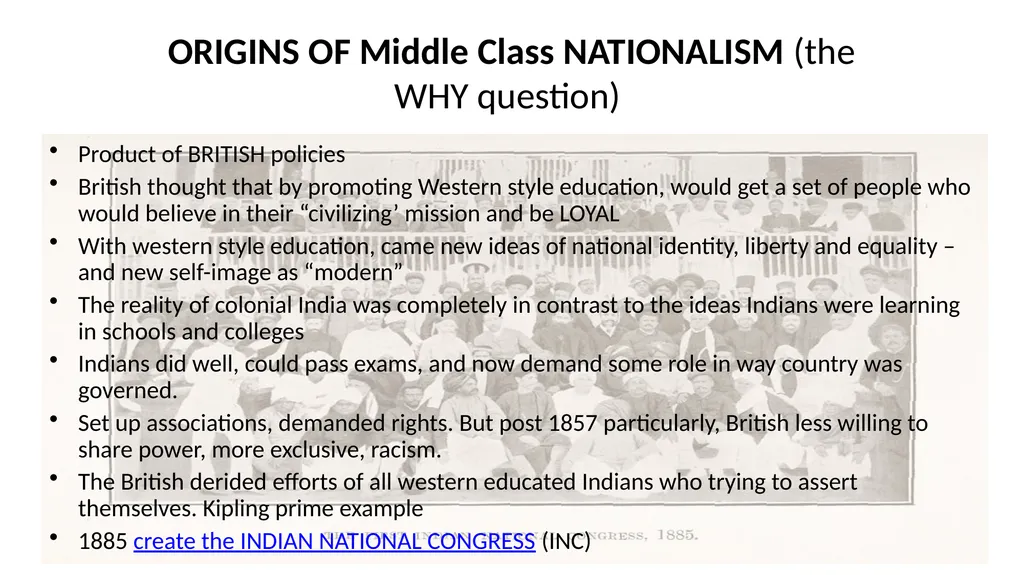
ORIGINS OF Middle Class NATIONALISM (the WHY question) Product of BRITISH policies
British thought that by promoting Western style education, would get a set of people who would believe in their “civilizing’ mission and be LOYAL
With western style education, came new ideas of national identity, liberty and equality – and new self-image as “modern”
The reality of colonial India was completely in contrast to the ideas Indians were learning in schools and colleges
Indians did well, could pass exams, and now demand some role in way country was governed.
Set up associations, demanded rights. But post 1857 particularly, British less willing to share power, more exclusive, racism.
The British derided efforts of all western educated Indians who trying to assert themselves. Kipling prime example
1885 create the INDIAN NATIONAL CONGRESS (INC)<br>
10
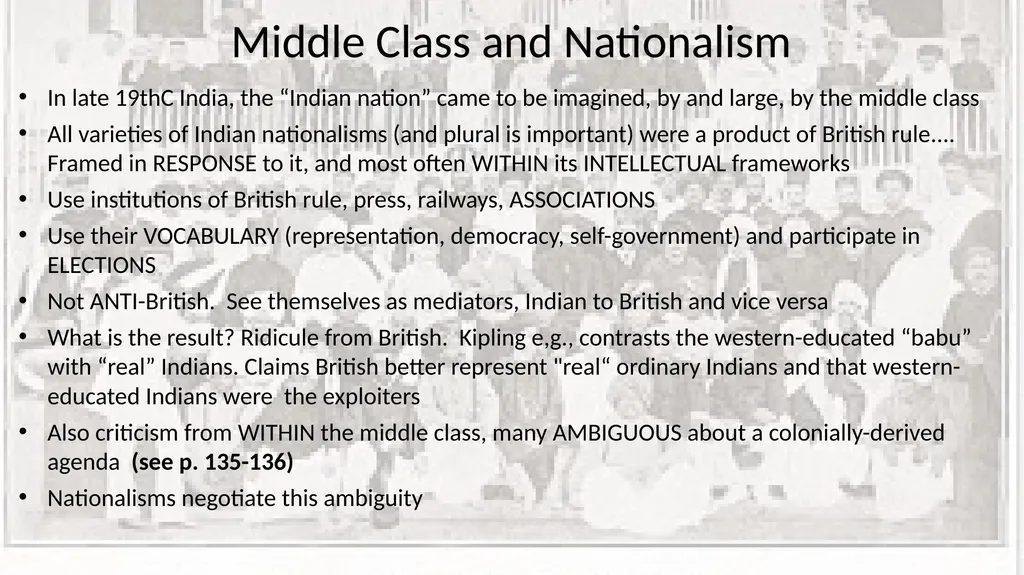
Middle Class and Nationalism In late 19thC India, the “Indian nation” came to be imagined, by and large, by the middle class
All varieties of Indian nationalisms (and plural is important) were a product of British rule.... Framed in RESPONSE to it, and most often WITHIN its INTELLECTUAL frameworks
Use institutions of British rule, press, railways, ASSOCIATIONS
Use their VOCABULARY (representation, democracy, self-government) and participate in ELECTIONS
Not ANTI-British. See themselves as mediators, Indian to British and vice versa
What is the result? Ridicule from British. Kipling e,g., contrasts the western-educated “babu” with “real” Indians. Claims British better represent "real“ ordinary Indians and that western-educated Indians were the exploiters
Also criticism from WITHIN the middle class, many AMBIGUOUS about a colonially-derived agenda (see p. 135-136)
Nationalisms negotiate this ambiguity<br>