
NCLEX Strategies Application of knowledge Types of
YM
Published · 22 slides · 0 views

1 / 1

Description
NCLEX Strategies Application of knowledge Types of Questions In a standard four-answer NCLEX Answer in multiple-choice question, if you can systematically eliminate false answers, you can reduce the four-answer question to a two-answer one
Related Topics
Share
Embed code
Download this presentation From Below
"NCLEX Strategies Application of knowledge Types of" is the property of its rightful owner. Permission is granted to download and print the materials on this website for personal, non-commercial use only, and to display it on your personal computer provided you do not modify the materials and that you retain all copyright notices contained in the materials. By downloading content from our website, you accept the terms of this agreement.
Presentation Transcript
01
NCLEX Strategies Application of knowledge<br>
02
Types of Questions In a standard four-answer NCLEX Answer in multiple-choice question, if you can systematically eliminate false answers, you can reduce the four-answer question to a two-answer one and thereby make your chances as good as those in the true-false type of question; that is, the odds will favor your guessing half of the answers correctly.
Other questions will ask you to “select all that apply” from five to seven options by clicking in the correct boxes to select the answers (multiple response questions). In the alternate items, you may see charts and tables, or you may find pictures and graphs requiring identification of a correct location (“hot spot”) by either point-and-click or fill-in-the-blank.<br>
Other questions will ask you to “select all that apply” from five to seven options by clicking in the correct boxes to select the answers (multiple response questions). In the alternate items, you may see charts and tables, or you may find pictures and graphs requiring identification of a correct location (“hot spot”) by either point-and-click or fill-in-the-blank.<br>
03
Types of Questions In the items requiring a calculation, determine which numbers are needed to figure out the correct numerical answer and use the drop-down calculator to fill in the blank. Another alternate item is the “drag and drop–ordered” response, in which you are asked to arrange all the correct responses in priority order: identify action or factor that you think should be first, then identify which should be last.<br>
04
NCLEX Strategies will assist you to narrow down your choices systematically and intelligently: Always, all, everyone, never, none, only, every, must.
Answers that include global words such as these should be viewed with caution because they imply that there are no exceptions. There are very few instances in which a correct answer is that absolute. Example: Nurses should exercise caution in interviewing clients who have an alcohol use/dependency problem because:
1. These clients always exaggerate.
2. These clients are never consistent.
A good NCLEX Strategy is that any such suggested answer should be looked at with care because any exception will make that a false response. A more reasonable answer to the preceding might be “Clients who have an alcohol use/ dependency problem may not be reliable historians.”<br>
Answers that include global words such as these should be viewed with caution because they imply that there are no exceptions. There are very few instances in which a correct answer is that absolute. Example: Nurses should exercise caution in interviewing clients who have an alcohol use/dependency problem because:
1. These clients always exaggerate.
2. These clients are never consistent.
A good NCLEX Strategy is that any such suggested answer should be looked at with care because any exception will make that a false response. A more reasonable answer to the preceding might be “Clients who have an alcohol use/ dependency problem may not be reliable historians.”<br>
05
NCLEX Strategies will assist you to narrow down your choices systematically and intelligently: 2.Broadest, most comprehensive answers.
Choose the answer that includes all the others, which is referred to here as the “umbrella effect.” Example: A main nursing function in group therapy is to:
1. Help clients give and receive feedback in the group
2. Encourage clients to bring up their concerns.
3. Facilitate group interaction among the members.
4. Remind clients to address their comments to the group.
Number 3 is the best choice because all the other choices fall under it.<br>
Choose the answer that includes all the others, which is referred to here as the “umbrella effect.” Example: A main nursing function in group therapy is to:
1. Help clients give and receive feedback in the group
2. Encourage clients to bring up their concerns.
3. Facilitate group interaction among the members.
4. Remind clients to address their comments to the group.
Number 3 is the best choice because all the other choices fall under it.<br>
06
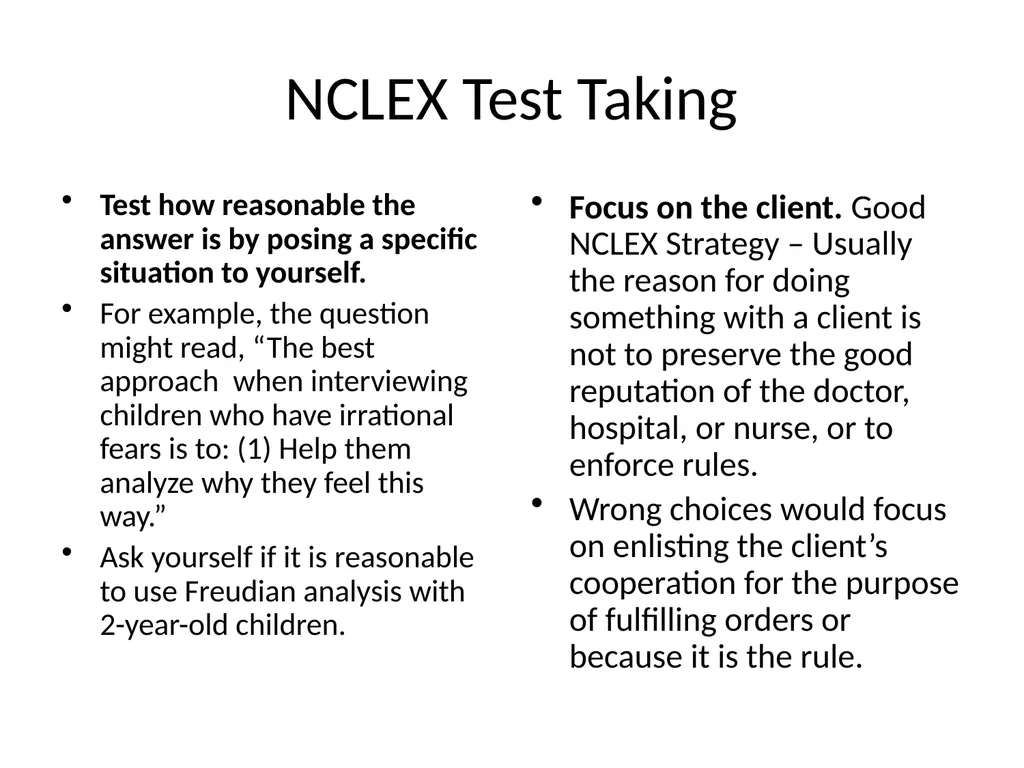
NCLEX Test Taking Test how reasonable the answer is by posing a specific situation to yourself.
For example, the question might read, “The best approach when interviewing children who have irrational fears is to: (1) Help them analyze why they feel this way.”
Ask yourself if it is reasonable to use Freudian analysis with 2-year-old children. Focus on the client. Good NCLEX Strategy – Usually the reason for doing something with a client is not to preserve the good reputation of the doctor, hospital, or nurse, or to enforce rules.
Wrong choices would focus on enlisting the client’s cooperation for the purpose of fulfilling orders or because it is the rule.<br>
For example, the question might read, “The best approach when interviewing children who have irrational fears is to: (1) Help them analyze why they feel this way.”
Ask yourself if it is reasonable to use Freudian analysis with 2-year-old children. Focus on the client. Good NCLEX Strategy – Usually the reason for doing something with a client is not to preserve the good reputation of the doctor, hospital, or nurse, or to enforce rules.
Wrong choices would focus on enlisting the client’s cooperation for the purpose of fulfilling orders or because it is the rule.<br>
07
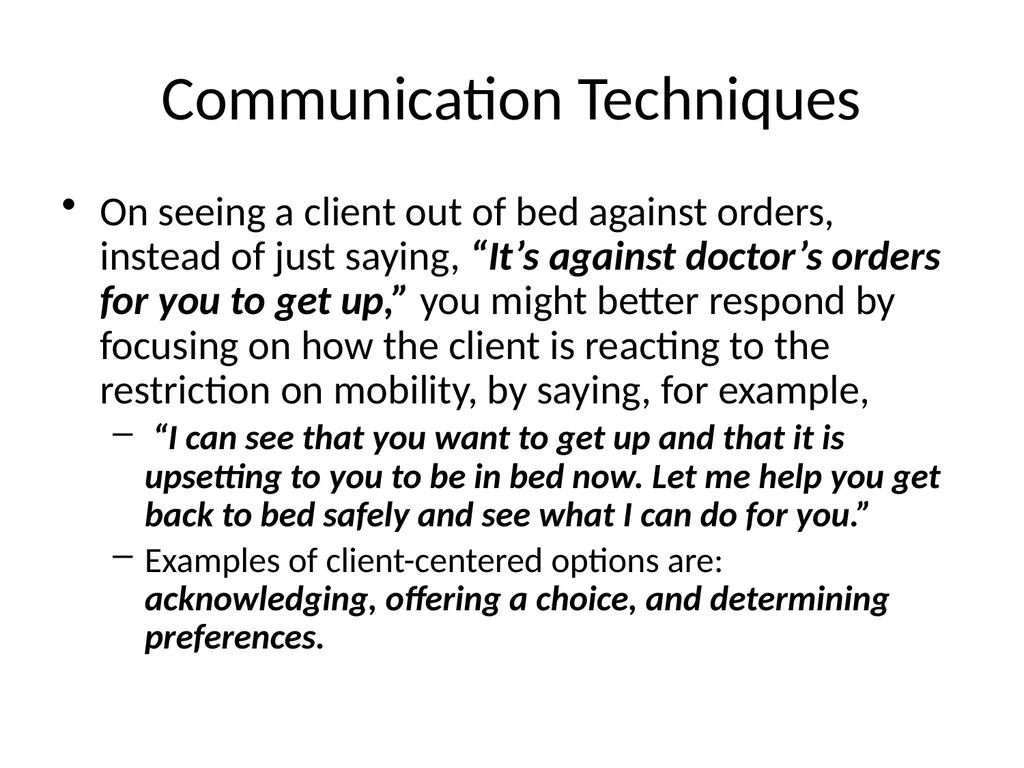
Communication Techniques On seeing a client out of bed against orders, instead of just saying, “It’s against doctor’s orders for you to get up,” you might better respond by focusing on how the client is reacting to the restriction on mobility, by saying, for example,
“I can see that you want to get up and that it is upsetting to you to be in bed now. Let me help you get back to bed safely and see what I can do for you.”
Examples of client-centered options are: acknowledging, offering a choice, and determining preferences.<br>
“I can see that you want to get up and that it is upsetting to you to be in bed now. Let me help you get back to bed safely and see what I can do for you.”
Examples of client-centered options are: acknowledging, offering a choice, and determining preferences.<br>
08
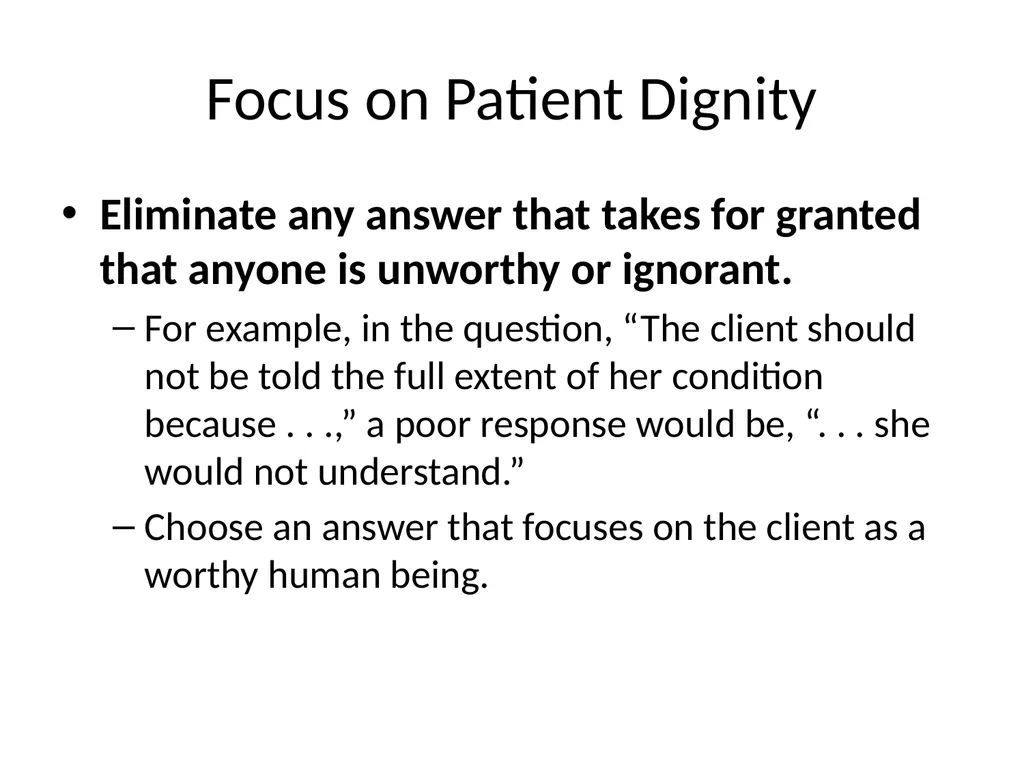
Focus on Patient Dignity Eliminate any answer that takes for granted that anyone is unworthy or ignorant.
For example, in the question, “The client should not be told the full extent of her condition because . . .,” a poor response would be, “. . . she would not understand.”
Choose an answer that focuses on the client as a worthy human being.<br>
For example, in the question, “The client should not be told the full extent of her condition because . . .,” a poor response would be, “. . . she would not understand.”
Choose an answer that focuses on the client as a worthy human being.<br>
09
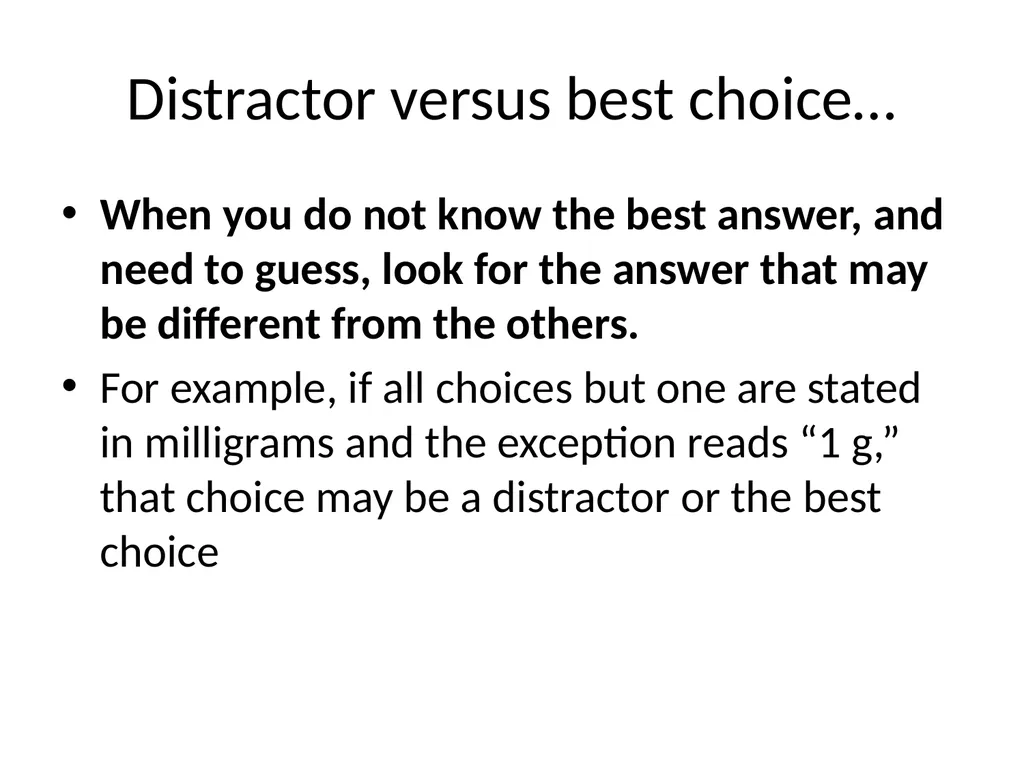
Distractor versus best choice… When you do not know the best answer, and need to guess, look for the answer that may be different from the others.
For example, if all choices but one are stated in milligrams and the exception reads “1 g,” that choice may be a distractor or the best choice<br>
For example, if all choices but one are stated in milligrams and the exception reads “1 g,” that choice may be a distractor or the best choice<br>
10
Read Carefully Read the question carefully to see if a negative modifier is used.
If the question asks, “Which of the following is least helpful,” be sure to gear your thinking accordingly. Emphasize a key word such as least, contraindicated, or avoid as you read the questions. In this type of question, a correct answer may reflect something that is false.
Do NOT look for a pattern in the correct answers.
If you have already selected option 3 for several questions in a row, do not be reluctant to choose option 3 again, if you think that it is the correct response.<br>
If the question asks, “Which of the following is least helpful,” be sure to gear your thinking accordingly. Emphasize a key word such as least, contraindicated, or avoid as you read the questions. In this type of question, a correct answer may reflect something that is false.
Do NOT look for a pattern in the correct answers.
If you have already selected option 3 for several questions in a row, do not be reluctant to choose option 3 again, if you think that it is the correct response.<br>
11
Look for choices Look for the choices that you know either are correct or may be incorrect.
Good NCLEX Strategy – You can save time and narrow your selection by using this strategy. This strategy is also useful when the question requires you to select all options that apply. Read each option and determine if it is correct or not; if correct, click on the box to the left of the option. There is no partial credit if you select some but not all that apply.
In eliminating potentially wrong psychosocial answers, remember to look for examples of what has been included in the nontherapeutic responses (e.g., denying feelings, false reassurance, changing the subject).
Wrong choices tend to be either very brief or very long and involved.<br>
Good NCLEX Strategy – You can save time and narrow your selection by using this strategy. This strategy is also useful when the question requires you to select all options that apply. Read each option and determine if it is correct or not; if correct, click on the box to the left of the option. There is no partial credit if you select some but not all that apply.
In eliminating potentially wrong psychosocial answers, remember to look for examples of what has been included in the nontherapeutic responses (e.g., denying feelings, false reassurance, changing the subject).
Wrong choices tend to be either very brief or very long and involved.<br>
12
Choosing Correct Responses Better psychosocial nursing responses to select are those responses that
(a) focus on feelings (unless safety is at stake!): “How did that make you feel?”
(b) reflect the client’s comments: “You say that made you angry”;
(c) communicate acceptance of the client by the nurse rather than criticism or a value judgment;
(d) acknowledge the client: “I see that you are wincing”; and
(e) stay in the here and- now: “What will help now?”
Look for the average, acceptable, safe, common, typical, “garden variety” responses, not the “exception to the rule,” esoteric, or controversial responses.<br>
(a) focus on feelings (unless safety is at stake!): “How did that make you feel?”
(b) reflect the client’s comments: “You say that made you angry”;
(c) communicate acceptance of the client by the nurse rather than criticism or a value judgment;
(d) acknowledge the client: “I see that you are wincing”; and
(e) stay in the here and- now: “What will help now?”
Look for the average, acceptable, safe, common, typical, “garden variety” responses, not the “exception to the rule,” esoteric, or controversial responses.<br>
13
Choosing Correct Responses Be sure to note whether the question asks for what is the first or initial response to be made or action to be taken by the nurse.
The choices listed may all be correct, but in this situation selecting the response with the highest priority is important. If the question asks for an immediate action, probably all answers are correct and you need to choose the priority answer. Identify words that set a priority: best, main, primary, greatest, most.
When you do not know the specific facts called for in a question, use your skills of reasoning;
One of the best NCLEX Strategy here! – for example, when an answer involves amounts or time (mainly numbers) and you do not know the answer and cannot find any basis for reasoning (all else being equal), avoid the extreme responses (the highest or lowest numerical values).<br>
The choices listed may all be correct, but in this situation selecting the response with the highest priority is important. If the question asks for an immediate action, probably all answers are correct and you need to choose the priority answer. Identify words that set a priority: best, main, primary, greatest, most.
When you do not know the specific facts called for in a question, use your skills of reasoning;
One of the best NCLEX Strategy here! – for example, when an answer involves amounts or time (mainly numbers) and you do not know the answer and cannot find any basis for reasoning (all else being equal), avoid the extreme responses (the highest or lowest numerical values).<br>
14
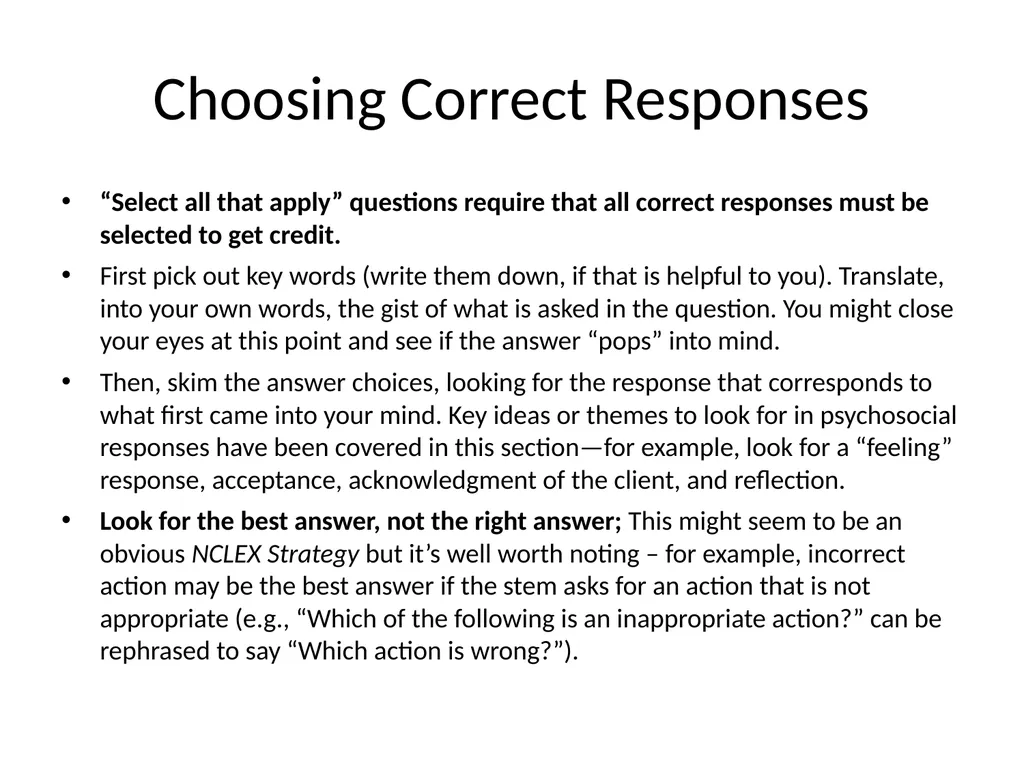
Choosing Correct Responses “Select all that apply” questions require that all correct responses must be selected to get credit.
First pick out key words (write them down, if that is helpful to you). Translate, into your own words, the gist of what is asked in the question. You might close your eyes at this point and see if the answer “pops” into mind.
Then, skim the answer choices, looking for the response that corresponds to what first came into your mind. Key ideas or themes to look for in psychosocial responses have been covered in this section—for example, look for a “feeling” response, acceptance, acknowledgment of the client, and reflection.
Look for the best answer, not the right answer; This might seem to be an obvious NCLEX Strategy but it’s well worth noting – for example, incorrect action may be the best answer if the stem asks for an action that is not appropriate (e.g., “Which of the following is an inappropriate action?” can be rephrased to say “Which action is wrong?”).<br>
First pick out key words (write them down, if that is helpful to you). Translate, into your own words, the gist of what is asked in the question. You might close your eyes at this point and see if the answer “pops” into mind.
Then, skim the answer choices, looking for the response that corresponds to what first came into your mind. Key ideas or themes to look for in psychosocial responses have been covered in this section—for example, look for a “feeling” response, acceptance, acknowledgment of the client, and reflection.
Look for the best answer, not the right answer; This might seem to be an obvious NCLEX Strategy but it’s well worth noting – for example, incorrect action may be the best answer if the stem asks for an action that is not appropriate (e.g., “Which of the following is an inappropriate action?” can be rephrased to say “Which action is wrong?”).<br>
15
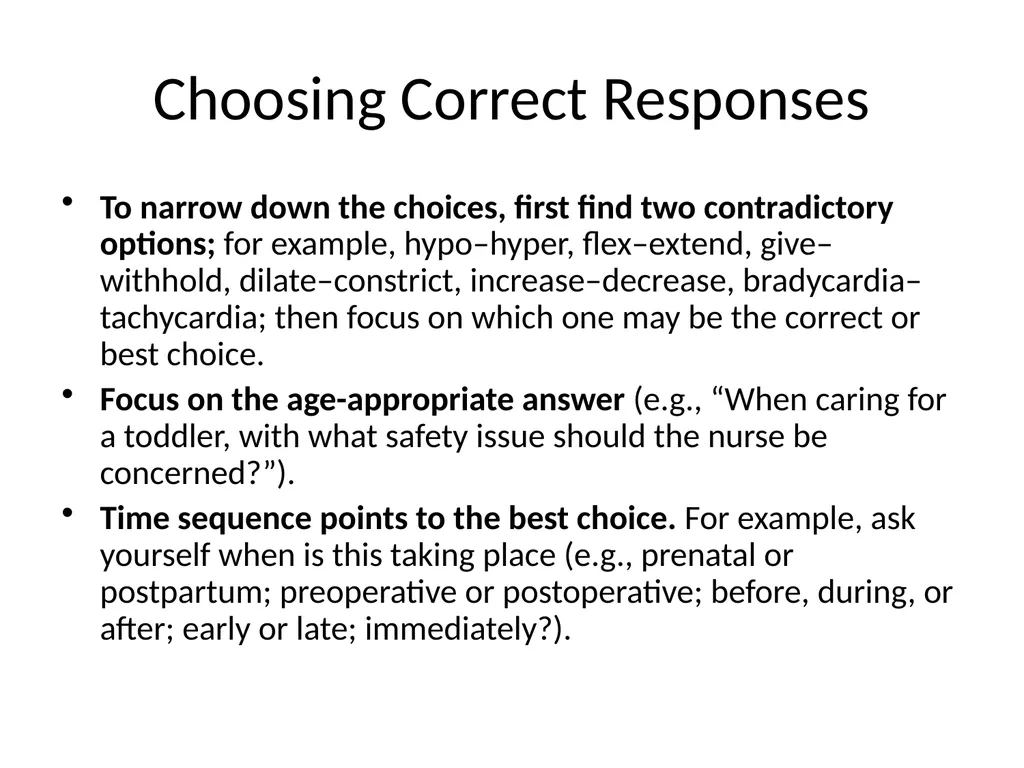
Choosing Correct Responses To narrow down the choices, first find two contradictory options; for example, hypo–hyper, flex–extend, give–withhold, dilate–constrict, increase–decrease, bradycardia–tachycardia; then focus on which one may be the correct or best choice.
Focus on the age-appropriate answer (e.g., “When caring for a toddler, with what safety issue should the nurse be concerned?”).
Time sequence points to the best choice. For example, ask yourself when is this taking place (e.g., prenatal or postpartum; preoperative or postoperative; before, during, or after; early or late; immediately?).<br>
Focus on the age-appropriate answer (e.g., “When caring for a toddler, with what safety issue should the nurse be concerned?”).
Time sequence points to the best choice. For example, ask yourself when is this taking place (e.g., prenatal or postpartum; preoperative or postoperative; before, during, or after; early or late; immediately?).<br>
16
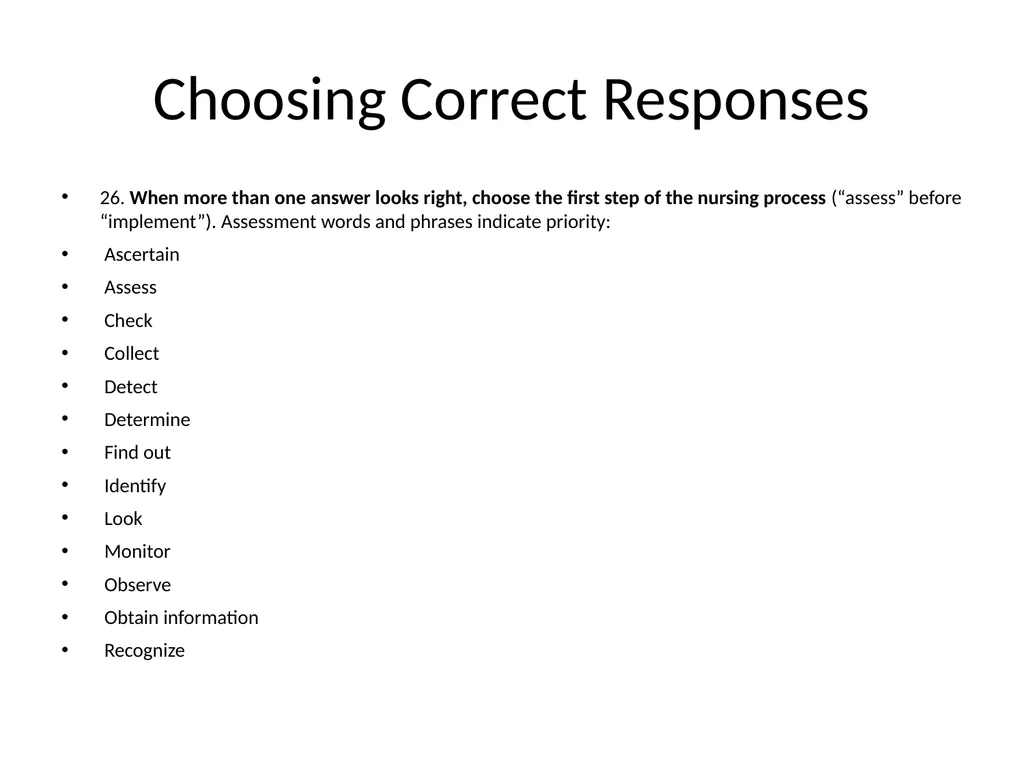
Choosing Correct Responses 26. When more than one answer looks right, choose the first step of the nursing process (“assess” before “implement”). Assessment words and phrases indicate priority:
Ascertain
Assess
Check
Collect
Detect
Determine
Find out
Identify
Look
Monitor
Observe
Obtain information
Recognize<br>
Ascertain
Assess
Check
Collect
Detect
Determine
Find out
Identify
Look
Monitor
Observe
Obtain information
Recognize<br>
17
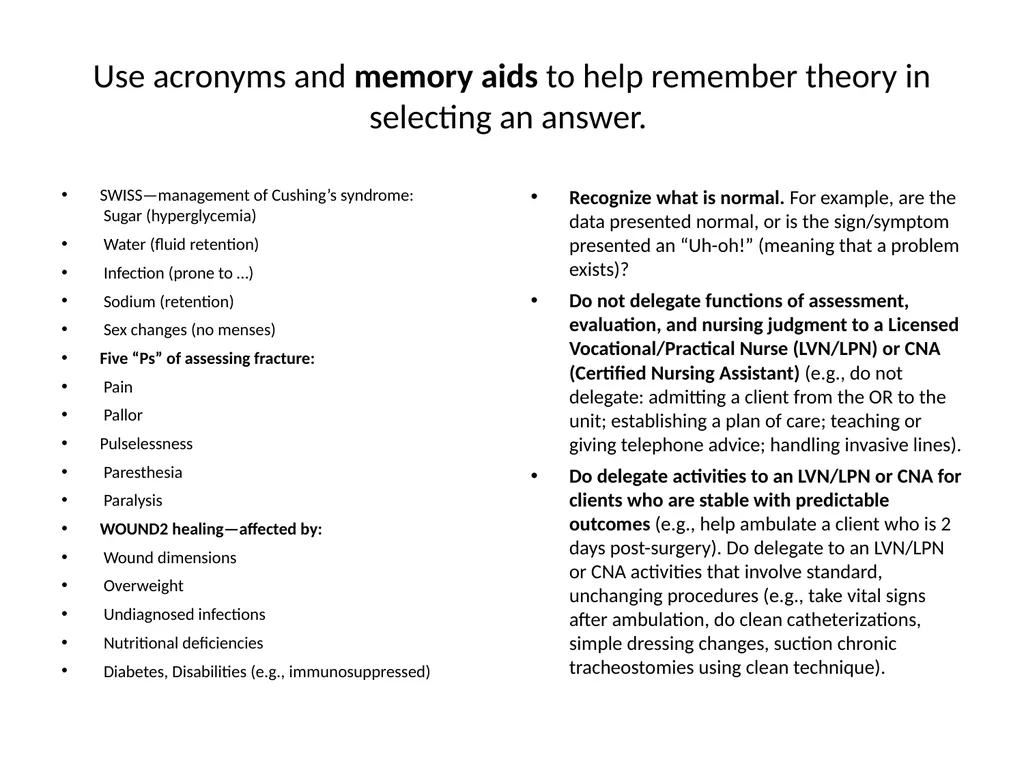
Use acronyms and memory aids to help remember theory in selecting an answer. SWISS—management of Cushing’s syndrome:
Sugar (hyperglycemia)
Water (fluid retention)
Infection (prone to …)
Sodium (retention)
Sex changes (no menses)
Five “Ps” of assessing fracture:
Pain
Pallor
Pulselessness
Paresthesia
Paralysis
WOUND2 healing—affected by:
Wound dimensions
Overweight
Undiagnosed infections
Nutritional deficiencies
Diabetes, Disabilities (e.g., immunosuppressed) Recognize what is normal. For example, are the data presented normal, or is the sign/symptom presented an “Uh-oh!” (meaning that a problem exists)?
Do not delegate functions of assessment, evaluation, and nursing judgment to a Licensed Vocational/Practical Nurse (LVN/LPN) or CNA (Certified Nursing Assistant) (e.g., do not delegate: admitting a client from the OR to the unit; establishing a plan of care; teaching or giving telephone advice; handling invasive lines).
Do delegate activities to an LVN/LPN or CNA for clients who are stable with predictable outcomes (e.g., help ambulate a client who is 2 days post-surgery). Do delegate to an LVN/LPN or CNA activities that involve standard, unchanging procedures (e.g., take vital signs after ambulation, do clean catheterizations, simple dressing changes, suction chronic tracheostomies using clean technique).<br>
Water (fluid retention)
Infection (prone to …)
Sodium (retention)
Sex changes (no menses)
Five “Ps” of assessing fracture:
Pain
Pallor
Pulselessness
Paresthesia
Paralysis
WOUND2 healing—affected by:
Wound dimensions
Overweight
Undiagnosed infections
Nutritional deficiencies
Diabetes, Disabilities (e.g., immunosuppressed) Recognize what is normal. For example, are the data presented normal, or is the sign/symptom presented an “Uh-oh!” (meaning that a problem exists)?
Do not delegate functions of assessment, evaluation, and nursing judgment to a Licensed Vocational/Practical Nurse (LVN/LPN) or CNA (Certified Nursing Assistant) (e.g., do not delegate: admitting a client from the OR to the unit; establishing a plan of care; teaching or giving telephone advice; handling invasive lines).
Do delegate activities to an LVN/LPN or CNA for clients who are stable with predictable outcomes (e.g., help ambulate a client who is 2 days post-surgery). Do delegate to an LVN/LPN or CNA activities that involve standard, unchanging procedures (e.g., take vital signs after ambulation, do clean catheterizations, simple dressing changes, suction chronic tracheostomies using clean technique).<br>
18
1. Don’t let stress take over! Some stress is good – it can keep you motivated and focused. But too much stress can negatively affect you.
Sometimes people try to deal with stress by doing things that make it worse – like using alcohol, tobacco and other drugs.<br>
Sometimes people try to deal with stress by doing things that make it worse – like using alcohol, tobacco and other drugs.<br>
19
2. Identify your stressors Some stressors might include:
Being busy
Not getting enough sleep
Pressure from school or work
Family problems
Trouble with friends or a boyfriend/girlfriend
Struggles with personal identity
Financial struggles<br>
Being busy
Not getting enough sleep
Pressure from school or work
Family problems
Trouble with friends or a boyfriend/girlfriend
Struggles with personal identity
Financial struggles<br>
20
3. Recognize the signs of stress. Some signs of too much stress include:
Feeling anxious, nervous or tired
Difficulty concentrating
Forgetfulness
Getting sick more than usual
Feeling depressed or overwhelmed<br>
Feeling anxious, nervous or tired
Difficulty concentrating
Forgetfulness
Getting sick more than usual
Feeling depressed or overwhelmed<br>
21
4. Identify what you can control – and what you can’t. Some things that cause stress are easy to change
Ask yourself: Is this important to me?
If it’s not important – forget about it!
Ask yourself: Can I control this?
If you can’t control it, why worry?
Can you change the situation somehow so that you can control it?<br>
Ask yourself: Is this important to me?
If it’s not important – forget about it!
Ask yourself: Can I control this?
If you can’t control it, why worry?
Can you change the situation somehow so that you can control it?<br>
22
5. Slow down and take time for yourself! Having too much to do is a huge cause of stress.
Consider cutting things out of your schedule
Eliminate “time zappers” like Facebook/Twitter
Be okay with saying “no”
Do things that you enjoy and help you relax
Spend some time by yourself<br>
Consider cutting things out of your schedule
Eliminate “time zappers” like Facebook/Twitter
Be okay with saying “no”
Do things that you enjoy and help you relax
Spend some time by yourself<br>