
Negotiating Career Counseling and Support Services



Description: Negotiating Career Counseling and Support Services The Ohio State University 1640 Neil Avenue, Second Floor Younkin Success Center 614-688-3898 www.ccss.osu.edu Career Counseling and Support Services Individual Career Counseling
Related Topics
Download Presentation
"Negotiating Career Counseling and Support Services" is the property of its rightful owner. Permission is granted to download and print the materials on this website for personal, non-commercial use only, and to display it on your personal computer provided you do not modify the materials and that you retain all copyright notices contained in the materials. By downloading content from our website, you accept the terms of this agreement.
Presentation Transcript
slide1. Negotiating
Career Counseling and Support Services
The Ohio State University
1640 Neil Avenue, Second Floor
Younkin Success Center
614-688-3898 * www.ccss.osu.edu<br>
slide2. Career Counseling and Support Services Individual Career Counseling
Appointments and Walk-ins
Job Search Campaign
Resumes, Cover Letters & Interviewing Skills
Applying to Graduate School
Career Exploration
Career Assessments
Career Planning & Decision-Making
Career Counseling<br>
slide3. Salary Negotiation Steps
Know your budget and what you realistically need/want
Know the market and what you can realistically expect to get
Prepare to negotiate
Salary
Additional options<br>
slide4. Know your budget and what you realistically need/want-Bottom line
Budget today
Mint, Wally, Personal Capital, YNAB, Spreadsheet
Know how much you need for tomorrow
Budget Calculators
You can deal with it, mapping your future
OSU Wellness Office
https://swc.osu.edu/services/financial-education/financial-coaching/<br>
slide5. Know your budget and what you realistically need/want
Cost of Living Calculators
Payscale.com Cost of Living Calculator http://www.payscale.com/cost-of-living-calculator
CNNMoney Cost of Living Calculator http://money.cnn.com/calculator/pf/cost-of-living/
Sperling best places to live
www.bestplaces.net<br>
slide6. Know the market and what you can realistically expect to get
BLS.gov and Onet
Salary Estimating Tools:
Educate to Career https://www.jobsearchintelligence.com/etc/jobseekers/salary-calculator.php
Salary.com - Provides salaries by job title and location. www.salary.com
Payscale.com – Accurate, real-time salary reports based on your job title, location, education, skills and experience. www.payscale.com
Higheredjobs.com - https://www.higheredjobs.com/salary/salaryDisplay.cfm?SurveyID=37
American Association of University Professors’ faculty salary survey https://www.aaup.org/our-work/research/annual-report-economic-status-profession<br>
slide7. Know the market and what you can realistically expect to get
Ask your friends and networking contacts
Use job listings, which indicate salaries for related positions*
Check online databases for specific state schools
Don't worry about what your friends are making, the employer certainly isn‘t<br>
slide8. What do you need to know in order to negotiate? Negotiating must be done with a careful eye to:
Size
Type
Rank of institution
Size and rank of department
Overall comparative wealth and endowment of the institution
Its local culture (i.e unionized)
Historical conditions of salary compression (offer cannot be higher than tenured colleagues who have been working for years with minimal or no raise)<br>
slide9. Are salaries really negotiable? Yes, and no.
Department chair may have little discretion in some of these areas:
salary, benefits, and housing
Department chair has some flexibility in the use of department funds to cover for:
summer research
conference funds
extra TA(s) or RA(s)
secretarial help
lightened teaching loads
Department chair has some control over:
computer access and office space
lab facilities
parking<br>
slide10. If offer is non-negotiable Some universities have a “one price” hiring process
Best possible deal is calculated within current budget constraints
Most will discuss with you (if finalist) the package in depth, so that you know expectations before an offer is made
It is transparent for candidates and candidates can withdraw<br>
slide11. When to Negotiate? You are not in a position to negotiate until the employer makes an offer. Offer is an advantage.
Delay any discussion of Salary as long as possible
Don't be the first to mention salary during the interview<br>
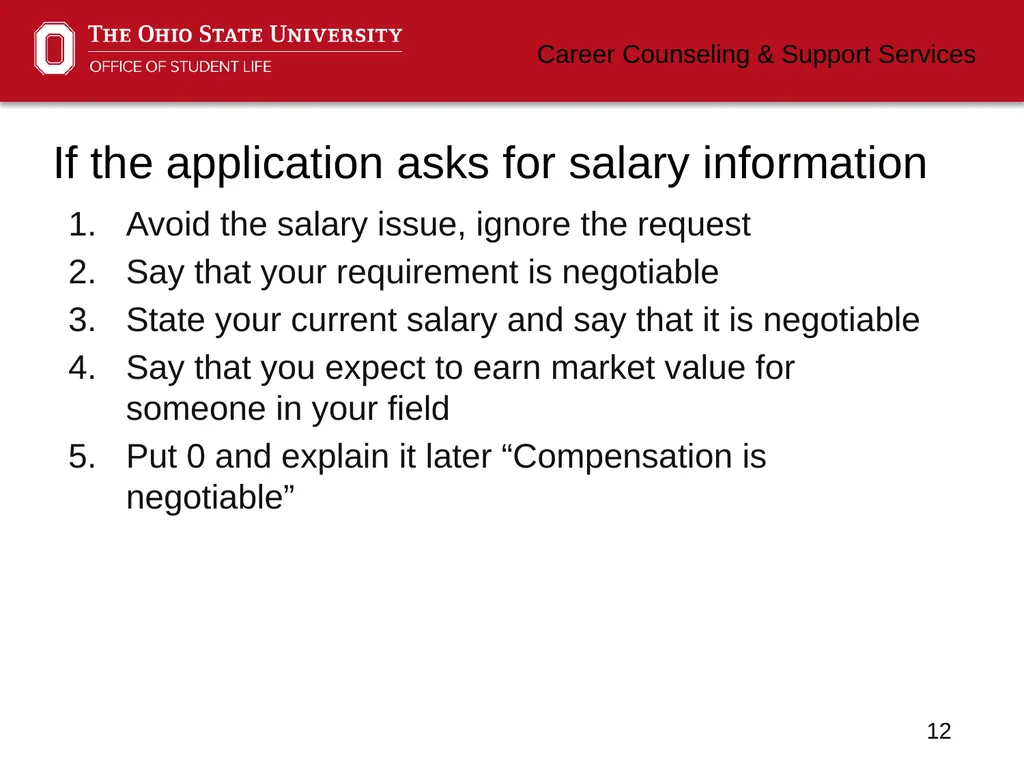
slide12. If the application asks for salary information Avoid the salary issue, ignore the request
Say that your requirement is negotiable
State your current salary and say that it is negotiable
Say that you expect to earn market value for someone in your field
Put 0 and explain it later “Compensation is negotiable”<br>
slide13. If Salary+ comes up early What are your options?<br>
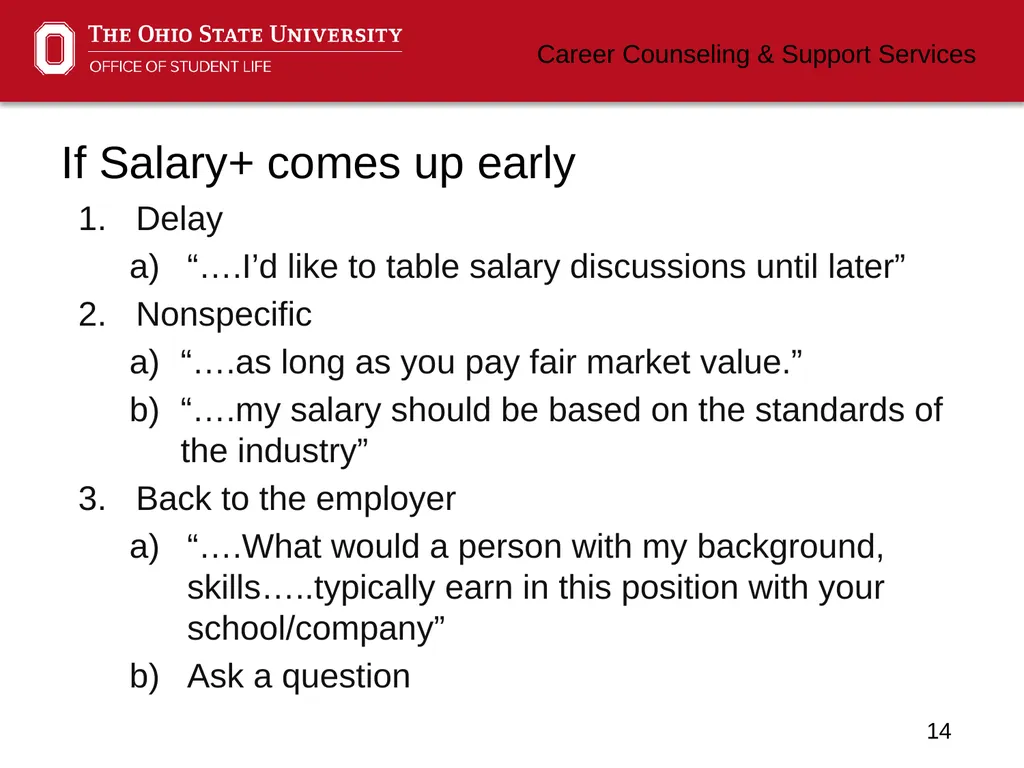
slide14. If Salary+ comes up early Delay
“….I’d like to table salary discussions until later”
Nonspecific
“….as long as you pay fair market value.”
“….my salary should be based on the standards of the industry”
Back to the employer
“….What would a person with my background, skills…..typically earn in this position with your school/company”
Ask a question<br>
slide15. Appropriate questions to ask if salary is brought during an interview Is the salary negotiable?
What is the salary range for this position?
Does the institution ever pay higher than the starting salary? If so in what circumstances?
What is the average salary increase for the position?
How often are increases given?<br>
slide16. The Process After on-campus interviews, job candidates have been ranked and have gone to the dean and HR for background check
Department chair calls you with an offer
Job offer is usually made by phone, but sometimes e-mail
Ok to say this isn’t a good time to talk
Make sure you can take notes
Institution makes an offer and goes into detail
Clarify any aspects of the offer as necessary
“You can’t always get what you want” ~ Cheryl Ball (insidehighered.com)<br>
slide17. How to respond You have power! Remember they are choosing you, not your price. They think you will help them be successful
Don’t accept the job as-is because you are excited. Your tendency may be to be so glad you have an offer you accept whatever is offered
Show enthusiasm and appreciation. Be polite, grateful and upbeat
Sign of what kind of colleague you will be (30 years)
Don’t let it go to your head and ask for the moon and stars
Not a doormat but also not difficult to deal with
Ask them to e-mail you the details after they’ve gone through it all
They will send an informal e-mail or HR will e-mail you a contract. This may take days. The written contract is negotiable
You have two weeks, usually, to hash out details and give the college an answer<br>
slide18. How to respond Counter offer on phone or e-mail
Your requests need to be reasonable and in line with the job ad and tenure expectations, type of university, and your credentials
Ask don’t demand
Make requests in an informational way
Can they rescind the offer?
Norm is to negotiate
Asking won’t hurt….how you ask might
If you ask for wrong things might be indicating a lack of fit<br>
slide19. 4 possibilities when salary is discussed Salary range is acceptable
Only the top of the range is acceptable
The entire range is unacceptable
The interviewer doesn’t give you a range<br>
slide20. Salary range is acceptable 2 options
Respond to the offer and accept
Express your pleasure at receiving the offer and enthusiasm for the position
Clarify any aspects of the offer as necessary*
Ask for a little more
The higher your starting salary, the higher future increases will be—and your bonuses and retirement benefits too!<br>
slide21. Only the top of the range is acceptable Tell the interviewer that it does come near what you were expecting, and then offer a range which places the top of the employer's range into the bottom of your range (i.e., I was thinking in terms of $XXXX to $XXXX). Remember: be sure that the range you were thinking about is consistent with what you learned about that position in the institution.
Can discuss other options if they are unable to budge.<br>
slide22. The entire range is unacceptable Thank you for this offer. I want to work with your school, however other schools I am currently speaking with (or the information I have researched) are considering me at a higher salary range. Is this negotiable? OR
I am very interesting in working for your institution; however, at this
point I am not able to accept the offer because ___ (state specifically what is missing: is it the amount? Teaching load? Equipment? Travel requirements?) I will be happy to accept this position if _____.
If you want the job can ask:
What can I do to become more valuable?<br>
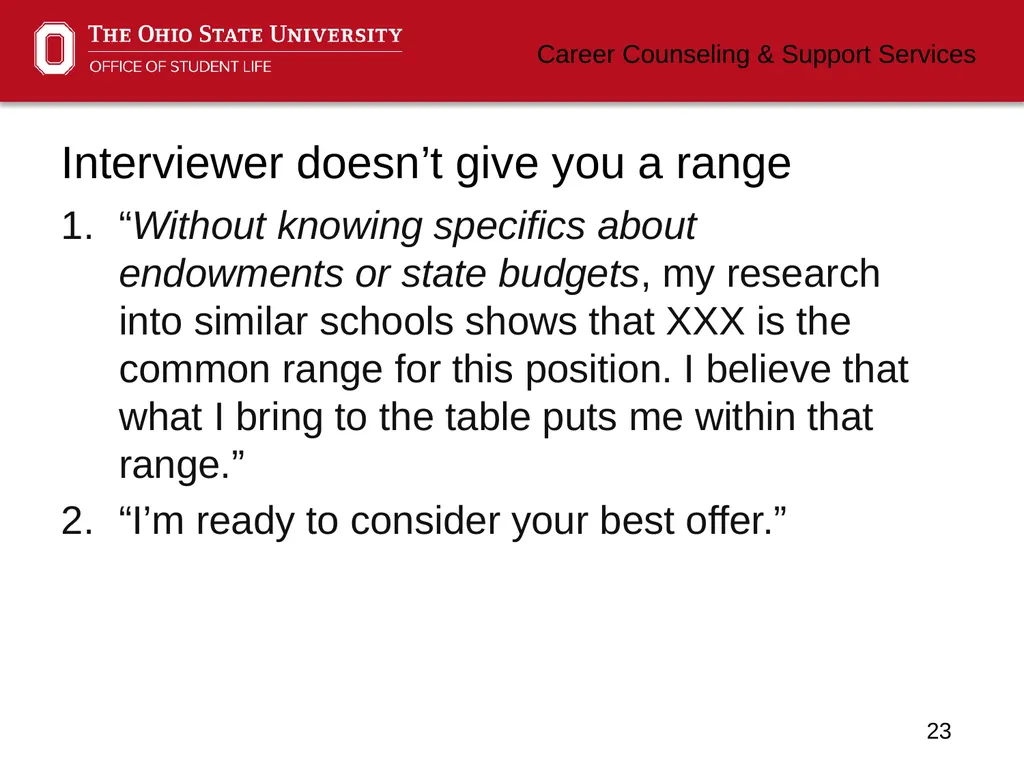
slide23. Interviewer doesn’t give you a range “Without knowing specifics about endowments or state budgets, my research into similar schools shows that XXX is the common range for this position. I believe that what I bring to the table puts me within that range.”
“I’m ready to consider your best offer.”<br>
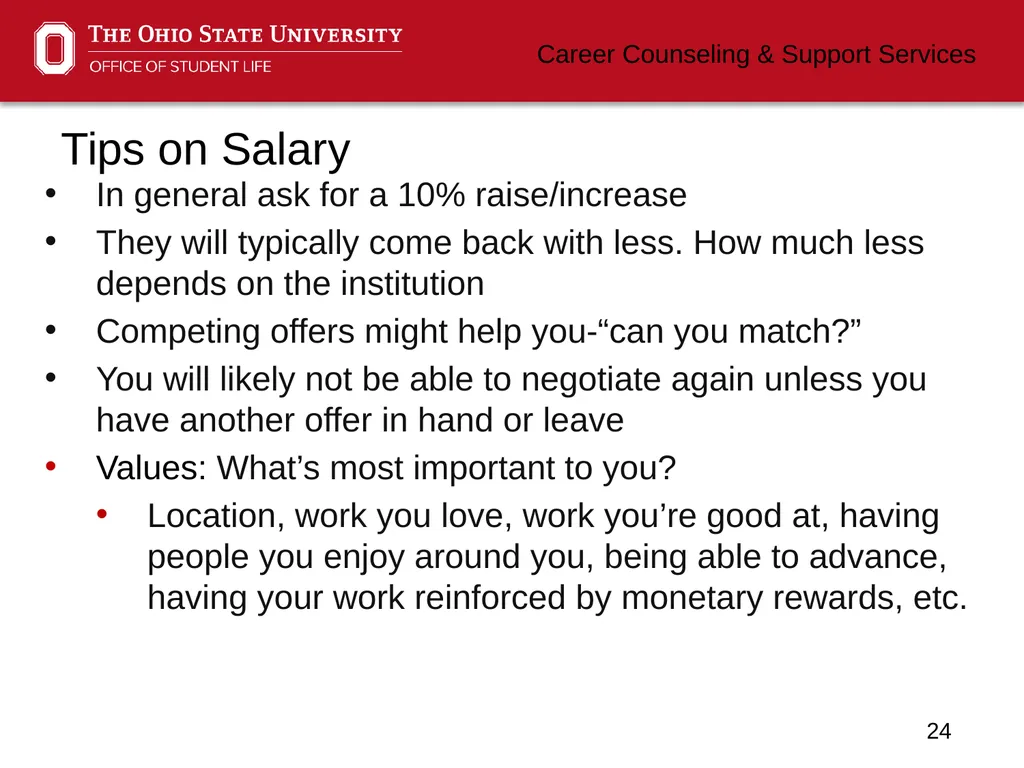
slide24. Tips on Salary In general ask for a 10% raise/increase
They will typically come back with less. How much less depends on the institution
Competing offers might help you-“can you match?”
You will likely not be able to negotiate again unless you have another offer in hand or leave
Values: What’s most important to you?
Location, work you love, work you’re good at, having people you enjoy around you, being able to advance, having your work reinforced by monetary rewards, etc.<br>
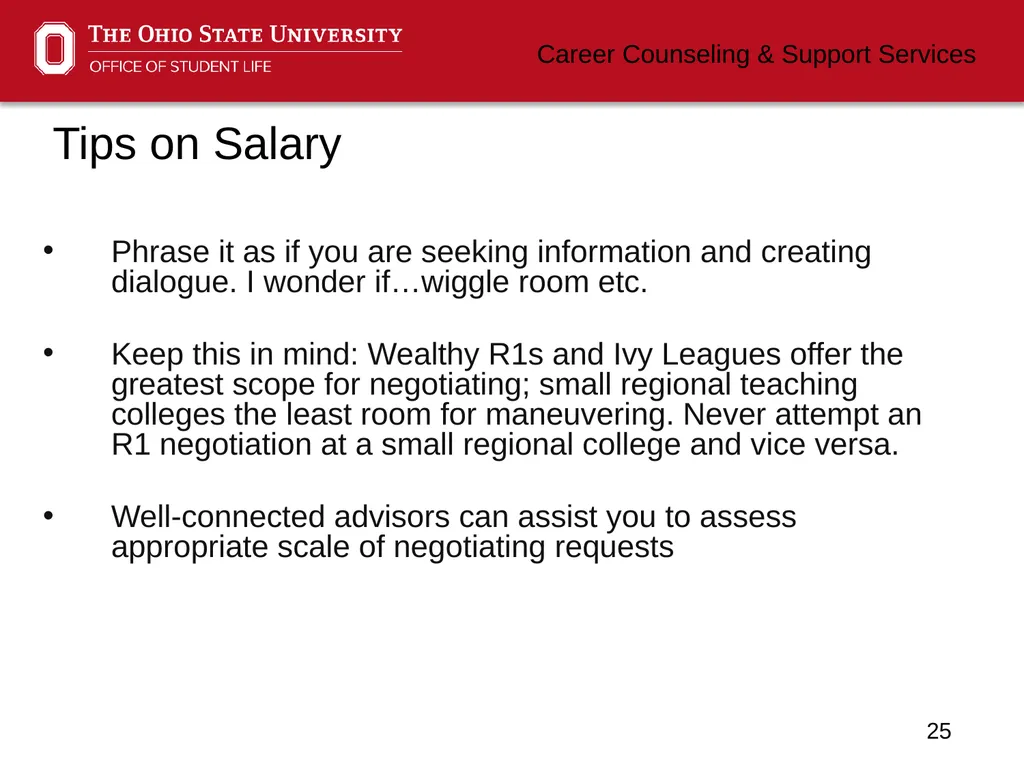
slide25. Tips on Salary Phrase it as if you are seeking information and creating dialogue. I wonder if…wiggle room etc.
Keep this in mind: Wealthy R1s and Ivy Leagues offer the greatest scope for negotiating; small regional teaching colleges the least room for maneuvering. Never attempt an R1 negotiation at a small regional college and vice versa.
Well-connected advisors can assist you to assess appropriate scale of negotiating requests<br>
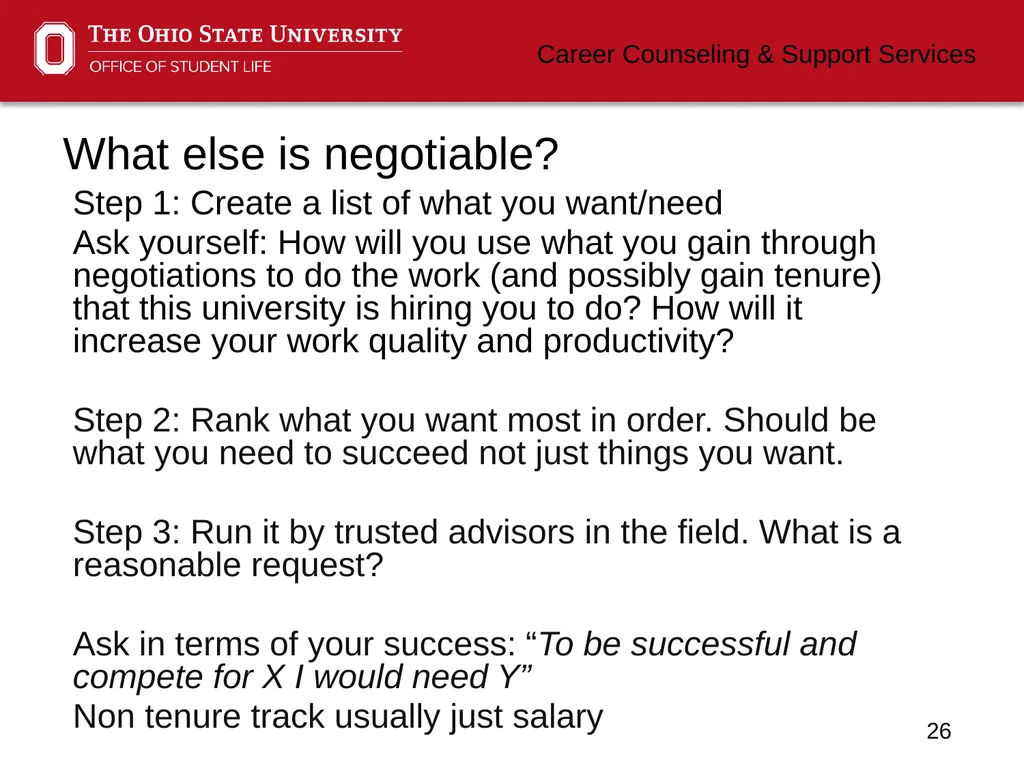
slide26. What else is negotiable? Step 1: Create a list of what you want/need
Ask yourself: How will you use what you gain through negotiations to do the work (and possibly gain tenure) that this university is hiring you to do? How will it increase your work quality and productivity?
Step 2: Rank what you want most in order. Should be what you need to succeed not just things you want.
Step 3: Run it by trusted advisors in the field. What is a reasonable request?
Ask in terms of your success: “To be successful and compete for X I would need Y”
Non tenure track usually just salary<br>
slide27. Potential Areas of Negotiation General
The amount of time you’ll have to decide on this offer
Your starting date (including deferment in order to take a postdoc)
Early (or extended) sabbatical or leave (including parental, if relevant)
Tenure expectations
Office space/location
Parking
Moving Expenses<br>
slide28. Areas of Negotiation General
Assistance in finding and sometimes financing housing
Assistance in finding spouse employment, child care
Extra secretarial assistance
Benefit package: health, life, disability, tuition, and retirement (available for spouse and dependents), on-site day-care, spouse employment assistance, pharmaceutical plan
Advising<br>
slide29. Areas of Negotiation Teaching/Research
Reduced teaching load (common for first year)
Types of Courses (New, Grad Level)
Lab facilities and equipment, supplies*
Can be most challenging because of limited space
Need to know what you need to be successful
What will it take to get your research off the ground
Computer or specific technology
Summer research support
Summer courses
Extra T.A (s) or R.A (s)
Travel funds for conferences, libraries and research centers
Money for new library resources<br>
slide30. Example Look for mutual gain, common interests
Ex. Chair is sympathetic to your need to publish, but has no money for course reductions this year. How about:
More T.A.(s)?
Less demanding courses?
More summer research money?
Reduction of administrative or departmental duties?
Suppose you know you will not have time to prepare courses for fall (e.g. you’ll be too busy finishing dissertation, or perhaps you are expecting a baby). Can you work out a semester’s maternity leave? Find a substitute? Schedule all your courses or better– a reduced load in the 2nd semester?<br>
slide31. Overall Do not press on matters beyond their control, though you can ask for some commitment to intervene with the responsible agency (i.e child care center, housing, spouse benefit)
You can use any leverage you actually have: “I really want to come here, but _____ has offered me x, y, and z. Is there anything you can do to assist me in making a commitment to you?”
Silence can be an effective tool, especially in real time negotiations<br>
slide32. Last thoughts… Get offer in writing
If you are not going to accept, explain why tactfully and honestly
Reiterate your positive impressions and your regret that the job didn’t work out
These will be your colleagues, work with them as if they already are
RELAX! It's natural to feel uncomfortable discussing salary
Competing offers, speed up process<br>
slide33. Questions? Wilhelm.118@osu.edu
Career Counseling and Support Services
Younkin Success Center, 2nd Floor
614-688-3898
www.ccss.osu.edu<br>
slide34. What’s your BATNA? (Best Alternative to a Negotiated Agreement)
What’s your Reservation Value? (RV; Bottom line or cutoff point)
What’s then the Contract Zone? (The difference between your bottom line and their highest number)
What’s your Target Value? (What would you like to get?)
Your Target value should be:
Better than your BATNA
Ambitious (pushing the limits of what’s possible)
Realistic – something the other side might agree to Synthesize this information<br>
Career Counseling and Support Services
The Ohio State University
1640 Neil Avenue, Second Floor
Younkin Success Center
614-688-3898 * www.ccss.osu.edu<br>
slide2. Career Counseling and Support Services Individual Career Counseling
Appointments and Walk-ins
Job Search Campaign
Resumes, Cover Letters & Interviewing Skills
Applying to Graduate School
Career Exploration
Career Assessments
Career Planning & Decision-Making
Career Counseling<br>
slide3. Salary Negotiation Steps
Know your budget and what you realistically need/want
Know the market and what you can realistically expect to get
Prepare to negotiate
Salary
Additional options<br>
slide4. Know your budget and what you realistically need/want-Bottom line
Budget today
Mint, Wally, Personal Capital, YNAB, Spreadsheet
Know how much you need for tomorrow
Budget Calculators
You can deal with it, mapping your future
OSU Wellness Office
https://swc.osu.edu/services/financial-education/financial-coaching/<br>
slide5. Know your budget and what you realistically need/want
Cost of Living Calculators
Payscale.com Cost of Living Calculator http://www.payscale.com/cost-of-living-calculator
CNNMoney Cost of Living Calculator http://money.cnn.com/calculator/pf/cost-of-living/
Sperling best places to live
www.bestplaces.net<br>
slide6. Know the market and what you can realistically expect to get
BLS.gov and Onet
Salary Estimating Tools:
Educate to Career https://www.jobsearchintelligence.com/etc/jobseekers/salary-calculator.php
Salary.com - Provides salaries by job title and location. www.salary.com
Payscale.com – Accurate, real-time salary reports based on your job title, location, education, skills and experience. www.payscale.com
Higheredjobs.com - https://www.higheredjobs.com/salary/salaryDisplay.cfm?SurveyID=37
American Association of University Professors’ faculty salary survey https://www.aaup.org/our-work/research/annual-report-economic-status-profession<br>
slide7. Know the market and what you can realistically expect to get
Ask your friends and networking contacts
Use job listings, which indicate salaries for related positions*
Check online databases for specific state schools
Don't worry about what your friends are making, the employer certainly isn‘t<br>
slide8. What do you need to know in order to negotiate? Negotiating must be done with a careful eye to:
Size
Type
Rank of institution
Size and rank of department
Overall comparative wealth and endowment of the institution
Its local culture (i.e unionized)
Historical conditions of salary compression (offer cannot be higher than tenured colleagues who have been working for years with minimal or no raise)<br>
slide9. Are salaries really negotiable? Yes, and no.
Department chair may have little discretion in some of these areas:
salary, benefits, and housing
Department chair has some flexibility in the use of department funds to cover for:
summer research
conference funds
extra TA(s) or RA(s)
secretarial help
lightened teaching loads
Department chair has some control over:
computer access and office space
lab facilities
parking<br>
slide10. If offer is non-negotiable Some universities have a “one price” hiring process
Best possible deal is calculated within current budget constraints
Most will discuss with you (if finalist) the package in depth, so that you know expectations before an offer is made
It is transparent for candidates and candidates can withdraw<br>
slide11. When to Negotiate? You are not in a position to negotiate until the employer makes an offer. Offer is an advantage.
Delay any discussion of Salary as long as possible
Don't be the first to mention salary during the interview<br>
slide12. If the application asks for salary information Avoid the salary issue, ignore the request
Say that your requirement is negotiable
State your current salary and say that it is negotiable
Say that you expect to earn market value for someone in your field
Put 0 and explain it later “Compensation is negotiable”<br>
slide13. If Salary+ comes up early What are your options?<br>
slide14. If Salary+ comes up early Delay
“….I’d like to table salary discussions until later”
Nonspecific
“….as long as you pay fair market value.”
“….my salary should be based on the standards of the industry”
Back to the employer
“….What would a person with my background, skills…..typically earn in this position with your school/company”
Ask a question<br>
slide15. Appropriate questions to ask if salary is brought during an interview Is the salary negotiable?
What is the salary range for this position?
Does the institution ever pay higher than the starting salary? If so in what circumstances?
What is the average salary increase for the position?
How often are increases given?<br>
slide16. The Process After on-campus interviews, job candidates have been ranked and have gone to the dean and HR for background check
Department chair calls you with an offer
Job offer is usually made by phone, but sometimes e-mail
Ok to say this isn’t a good time to talk
Make sure you can take notes
Institution makes an offer and goes into detail
Clarify any aspects of the offer as necessary
“You can’t always get what you want” ~ Cheryl Ball (insidehighered.com)<br>
slide17. How to respond You have power! Remember they are choosing you, not your price. They think you will help them be successful
Don’t accept the job as-is because you are excited. Your tendency may be to be so glad you have an offer you accept whatever is offered
Show enthusiasm and appreciation. Be polite, grateful and upbeat
Sign of what kind of colleague you will be (30 years)
Don’t let it go to your head and ask for the moon and stars
Not a doormat but also not difficult to deal with
Ask them to e-mail you the details after they’ve gone through it all
They will send an informal e-mail or HR will e-mail you a contract. This may take days. The written contract is negotiable
You have two weeks, usually, to hash out details and give the college an answer<br>
slide18. How to respond Counter offer on phone or e-mail
Your requests need to be reasonable and in line with the job ad and tenure expectations, type of university, and your credentials
Ask don’t demand
Make requests in an informational way
Can they rescind the offer?
Norm is to negotiate
Asking won’t hurt….how you ask might
If you ask for wrong things might be indicating a lack of fit<br>
slide19. 4 possibilities when salary is discussed Salary range is acceptable
Only the top of the range is acceptable
The entire range is unacceptable
The interviewer doesn’t give you a range<br>
slide20. Salary range is acceptable 2 options
Respond to the offer and accept
Express your pleasure at receiving the offer and enthusiasm for the position
Clarify any aspects of the offer as necessary*
Ask for a little more
The higher your starting salary, the higher future increases will be—and your bonuses and retirement benefits too!<br>
slide21. Only the top of the range is acceptable Tell the interviewer that it does come near what you were expecting, and then offer a range which places the top of the employer's range into the bottom of your range (i.e., I was thinking in terms of $XXXX to $XXXX). Remember: be sure that the range you were thinking about is consistent with what you learned about that position in the institution.
Can discuss other options if they are unable to budge.<br>
slide22. The entire range is unacceptable Thank you for this offer. I want to work with your school, however other schools I am currently speaking with (or the information I have researched) are considering me at a higher salary range. Is this negotiable? OR
I am very interesting in working for your institution; however, at this
point I am not able to accept the offer because ___ (state specifically what is missing: is it the amount? Teaching load? Equipment? Travel requirements?) I will be happy to accept this position if _____.
If you want the job can ask:
What can I do to become more valuable?<br>
slide23. Interviewer doesn’t give you a range “Without knowing specifics about endowments or state budgets, my research into similar schools shows that XXX is the common range for this position. I believe that what I bring to the table puts me within that range.”
“I’m ready to consider your best offer.”<br>
slide24. Tips on Salary In general ask for a 10% raise/increase
They will typically come back with less. How much less depends on the institution
Competing offers might help you-“can you match?”
You will likely not be able to negotiate again unless you have another offer in hand or leave
Values: What’s most important to you?
Location, work you love, work you’re good at, having people you enjoy around you, being able to advance, having your work reinforced by monetary rewards, etc.<br>
slide25. Tips on Salary Phrase it as if you are seeking information and creating dialogue. I wonder if…wiggle room etc.
Keep this in mind: Wealthy R1s and Ivy Leagues offer the greatest scope for negotiating; small regional teaching colleges the least room for maneuvering. Never attempt an R1 negotiation at a small regional college and vice versa.
Well-connected advisors can assist you to assess appropriate scale of negotiating requests<br>
slide26. What else is negotiable? Step 1: Create a list of what you want/need
Ask yourself: How will you use what you gain through negotiations to do the work (and possibly gain tenure) that this university is hiring you to do? How will it increase your work quality and productivity?
Step 2: Rank what you want most in order. Should be what you need to succeed not just things you want.
Step 3: Run it by trusted advisors in the field. What is a reasonable request?
Ask in terms of your success: “To be successful and compete for X I would need Y”
Non tenure track usually just salary<br>
slide27. Potential Areas of Negotiation General
The amount of time you’ll have to decide on this offer
Your starting date (including deferment in order to take a postdoc)
Early (or extended) sabbatical or leave (including parental, if relevant)
Tenure expectations
Office space/location
Parking
Moving Expenses<br>
slide28. Areas of Negotiation General
Assistance in finding and sometimes financing housing
Assistance in finding spouse employment, child care
Extra secretarial assistance
Benefit package: health, life, disability, tuition, and retirement (available for spouse and dependents), on-site day-care, spouse employment assistance, pharmaceutical plan
Advising<br>
slide29. Areas of Negotiation Teaching/Research
Reduced teaching load (common for first year)
Types of Courses (New, Grad Level)
Lab facilities and equipment, supplies*
Can be most challenging because of limited space
Need to know what you need to be successful
What will it take to get your research off the ground
Computer or specific technology
Summer research support
Summer courses
Extra T.A (s) or R.A (s)
Travel funds for conferences, libraries and research centers
Money for new library resources<br>
slide30. Example Look for mutual gain, common interests
Ex. Chair is sympathetic to your need to publish, but has no money for course reductions this year. How about:
More T.A.(s)?
Less demanding courses?
More summer research money?
Reduction of administrative or departmental duties?
Suppose you know you will not have time to prepare courses for fall (e.g. you’ll be too busy finishing dissertation, or perhaps you are expecting a baby). Can you work out a semester’s maternity leave? Find a substitute? Schedule all your courses or better– a reduced load in the 2nd semester?<br>
slide31. Overall Do not press on matters beyond their control, though you can ask for some commitment to intervene with the responsible agency (i.e child care center, housing, spouse benefit)
You can use any leverage you actually have: “I really want to come here, but _____ has offered me x, y, and z. Is there anything you can do to assist me in making a commitment to you?”
Silence can be an effective tool, especially in real time negotiations<br>
slide32. Last thoughts… Get offer in writing
If you are not going to accept, explain why tactfully and honestly
Reiterate your positive impressions and your regret that the job didn’t work out
These will be your colleagues, work with them as if they already are
RELAX! It's natural to feel uncomfortable discussing salary
Competing offers, speed up process<br>
slide33. Questions? Wilhelm.118@osu.edu
Career Counseling and Support Services
Younkin Success Center, 2nd Floor
614-688-3898
www.ccss.osu.edu<br>
slide34. What’s your BATNA? (Best Alternative to a Negotiated Agreement)
What’s your Reservation Value? (RV; Bottom line or cutoff point)
What’s then the Contract Zone? (The difference between your bottom line and their highest number)
What’s your Target Value? (What would you like to get?)
Your Target value should be:
Better than your BATNA
Ambitious (pushing the limits of what’s possible)
Realistic – something the other side might agree to Synthesize this information<br>