
Negotiation Section 01: Negotiation Fundamentals
A
Published · 27 slides · 0 views
1 / 1
Description
Negotiation Section 01: Negotiation Fundamentals Chapter 03: Strategy and Tactics of Integrative Negotiation 2019 McGraw-Hill Education. All rights reserved. Authorized only for instructor use in the classroom. No reproduction or further
Related Topics
Share
Embed code
Download this presentation From Below
"Negotiation Section 01: Negotiation Fundamentals" is the property of its rightful owner. Permission is granted to download and print the materials on this website for personal, non-commercial use only, and to display it on your personal computer provided you do not modify the materials and that you retain all copyright notices contained in the materials. By downloading content from our website, you accept the terms of this agreement.
Presentation Transcript
01
Negotiation Section 01:
Negotiation Fundamentals Chapter 03:
Strategy and Tactics of Integrative Negotiation © 2019 McGraw-Hill Education. All rights reserved. Authorized only for instructor use in the classroom. No reproduction or further distribution permitted without the prior written consent of McGraw-Hill Education.<br>
Negotiation Fundamentals Chapter 03:
Strategy and Tactics of Integrative Negotiation © 2019 McGraw-Hill Education. All rights reserved. Authorized only for instructor use in the classroom. No reproduction or further distribution permitted without the prior written consent of McGraw-Hill Education.<br>
02
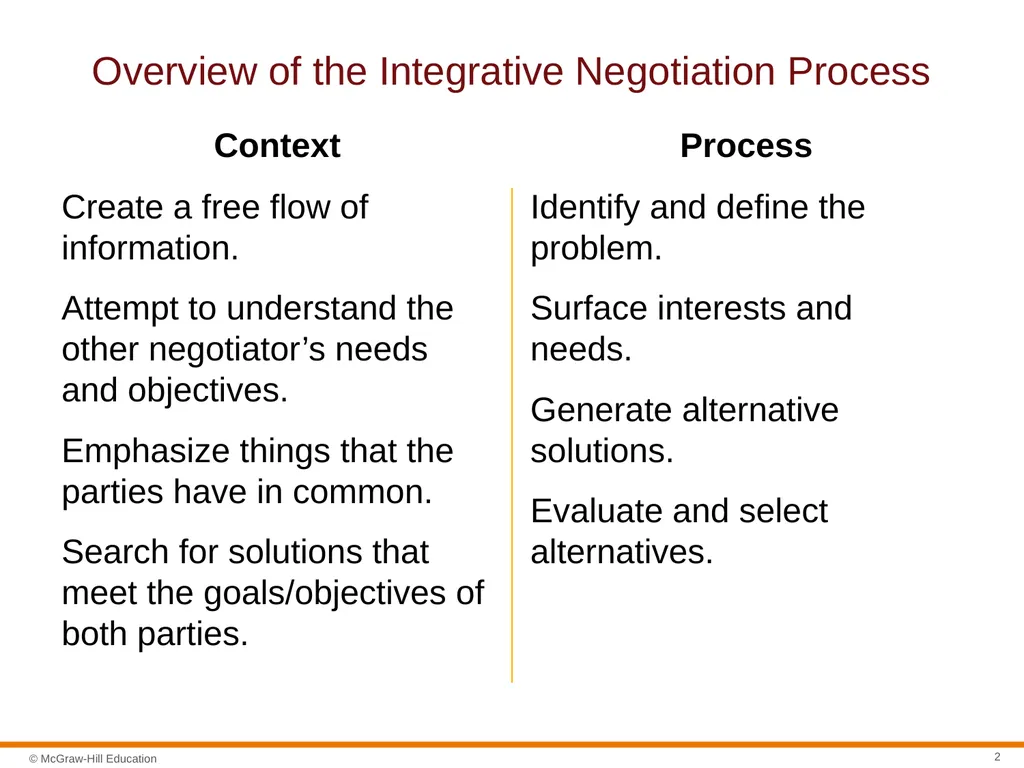
Overview of the Integrative Negotiation Process 2 Context Create a free flow of information.
Attempt to understand the other negotiator’s needs and objectives.
Emphasize things that the parties have in common.
Search for solutions that meet the goals/objectives of both parties. Process Identify and define the problem.
Surface interests and needs.
Generate alternative solutions.
Evaluate and select alternatives.<br>
Attempt to understand the other negotiator’s needs and objectives.
Emphasize things that the parties have in common.
Search for solutions that meet the goals/objectives of both parties. Process Identify and define the problem.
Surface interests and needs.
Generate alternative solutions.
Evaluate and select alternatives.<br>
03
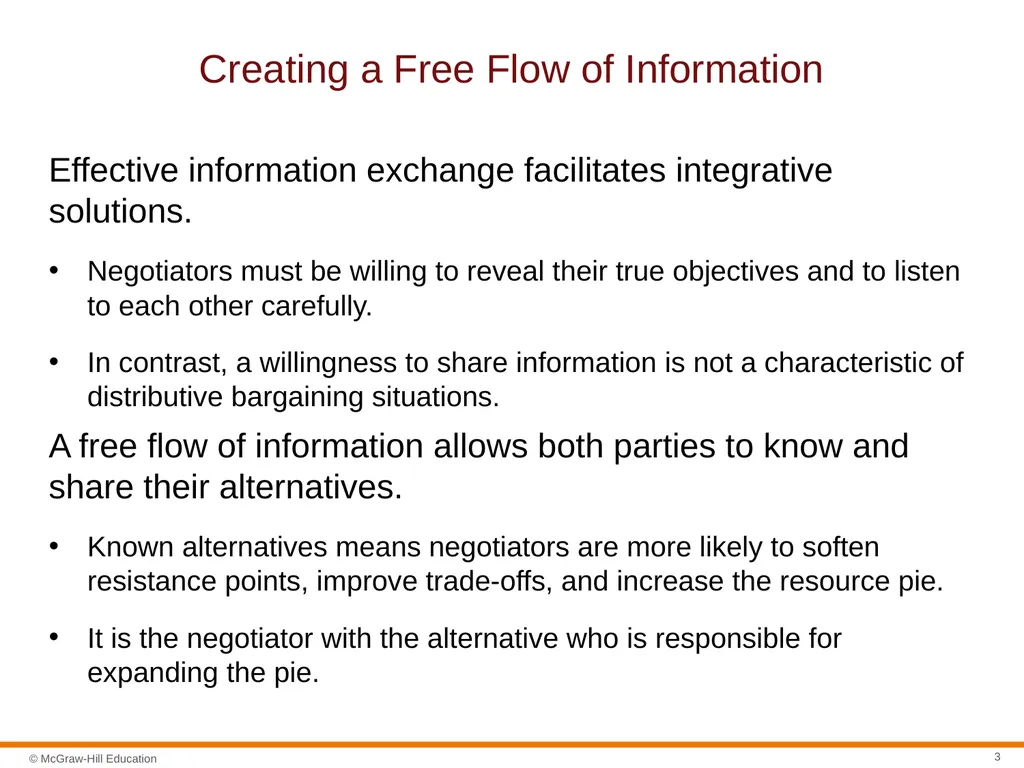
Creating a Free Flow of Information Effective information exchange facilitates integrative solutions.
Negotiators must be willing to reveal their true objectives and to listen to each other carefully.
In contrast, a willingness to share information is not a characteristic of distributive bargaining situations.
A free flow of information allows both parties to know and share their alternatives.
Known alternatives means negotiators are more likely to soften resistance points, improve trade-offs, and increase the resource pie.
It is the negotiator with the alternative who is responsible for expanding the pie. 3<br>
Negotiators must be willing to reveal their true objectives and to listen to each other carefully.
In contrast, a willingness to share information is not a characteristic of distributive bargaining situations.
A free flow of information allows both parties to know and share their alternatives.
Known alternatives means negotiators are more likely to soften resistance points, improve trade-offs, and increase the resource pie.
It is the negotiator with the alternative who is responsible for expanding the pie. 3<br>
04
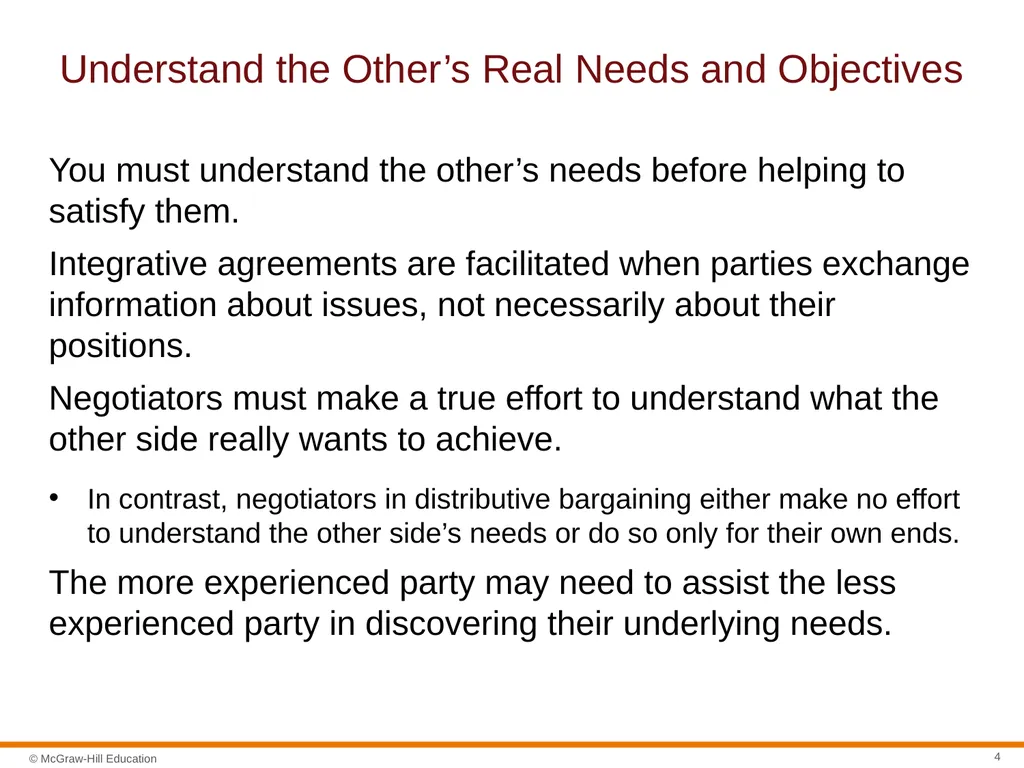
Understand the Other’s Real Needs and Objectives You must understand the other’s needs before helping to satisfy them.
Integrative agreements are facilitated when parties exchange information about issues, not necessarily about their positions.
Negotiators must make a true effort to understand what the other side really wants to achieve.
In contrast, negotiators in distributive bargaining either make no effort to understand the other side’s needs or do so only for their own ends.
The more experienced party may need to assist the less experienced party in discovering their underlying needs. 4<br>
Integrative agreements are facilitated when parties exchange information about issues, not necessarily about their positions.
Negotiators must make a true effort to understand what the other side really wants to achieve.
In contrast, negotiators in distributive bargaining either make no effort to understand the other side’s needs or do so only for their own ends.
The more experienced party may need to assist the less experienced party in discovering their underlying needs. 4<br>
05
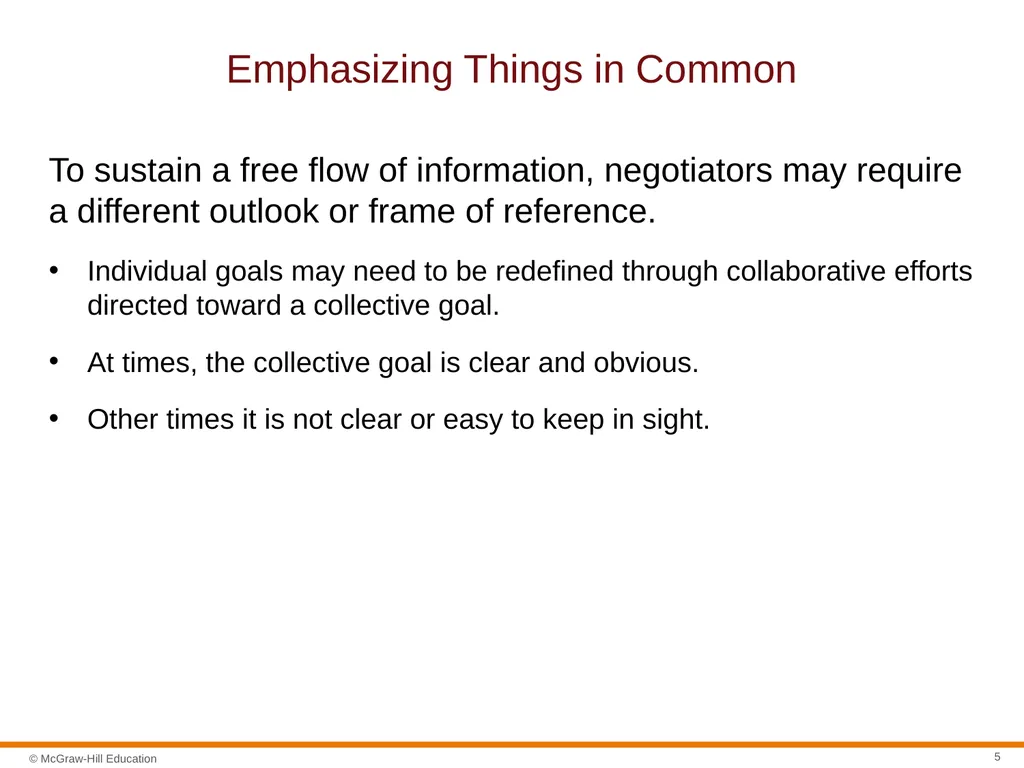
Emphasizing Things in Common To sustain a free flow of information, negotiators may require a different outlook or frame of reference.
Individual goals may need to be redefined through collaborative efforts directed toward a collective goal.
At times, the collective goal is clear and obvious.
Other times it is not clear or easy to keep in sight. 5<br>
Individual goals may need to be redefined through collaborative efforts directed toward a collective goal.
At times, the collective goal is clear and obvious.
Other times it is not clear or easy to keep in sight. 5<br>
06
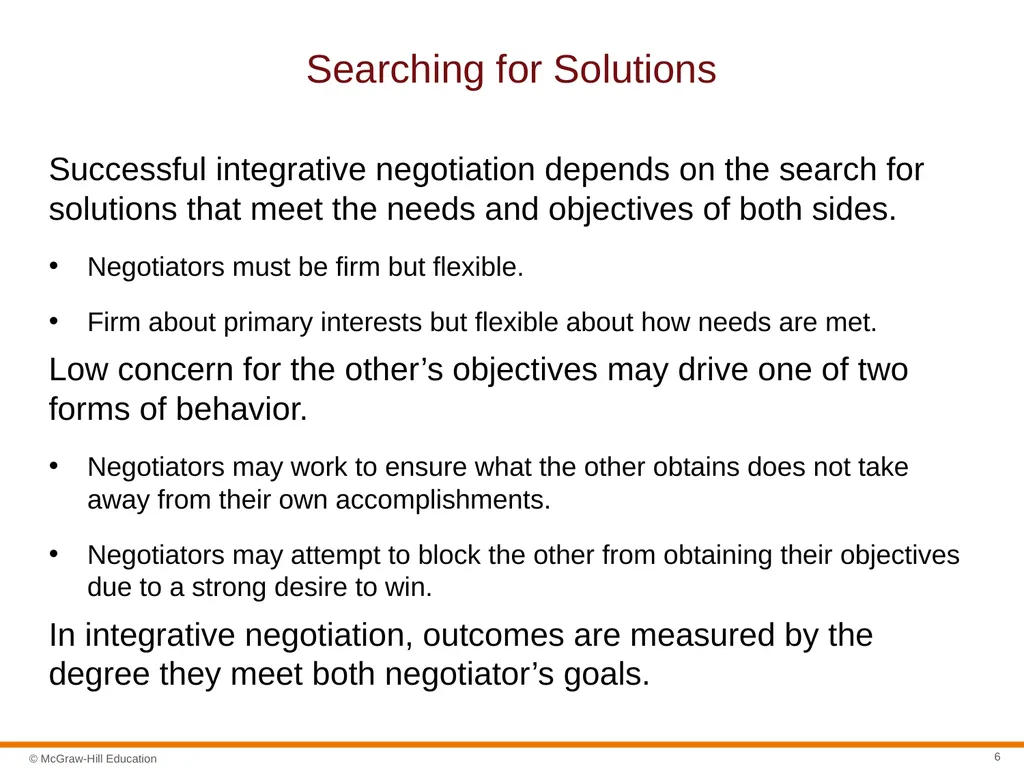
Searching for Solutions Successful integrative negotiation depends on the search for solutions that meet the needs and objectives of both sides.
Negotiators must be firm but flexible.
Firm about primary interests but flexible about how needs are met.
Low concern for the other’s objectives may drive one of two forms of behavior.
Negotiators may work to ensure what the other obtains does not take away from their own accomplishments.
Negotiators may attempt to block the other from obtaining their objectives due to a strong desire to win.
In integrative negotiation, outcomes are measured by the degree they meet both negotiator’s goals. 6<br>
Negotiators must be firm but flexible.
Firm about primary interests but flexible about how needs are met.
Low concern for the other’s objectives may drive one of two forms of behavior.
Negotiators may work to ensure what the other obtains does not take away from their own accomplishments.
Negotiators may attempt to block the other from obtaining their objectives due to a strong desire to win.
In integrative negotiation, outcomes are measured by the degree they meet both negotiator’s goals. 6<br>
07
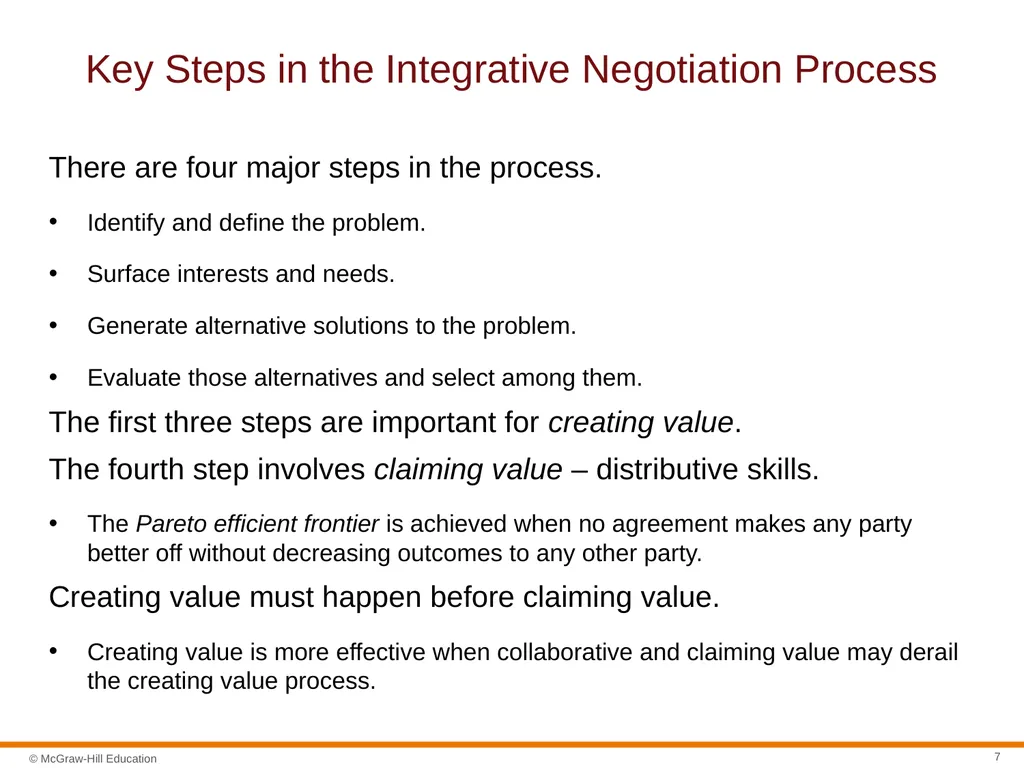
Key Steps in the Integrative Negotiation Process There are four major steps in the process.
Identify and define the problem.
Surface interests and needs.
Generate alternative solutions to the problem.
Evaluate those alternatives and select among them.
The first three steps are important for creating value.
The fourth step involves claiming value – distributive skills.
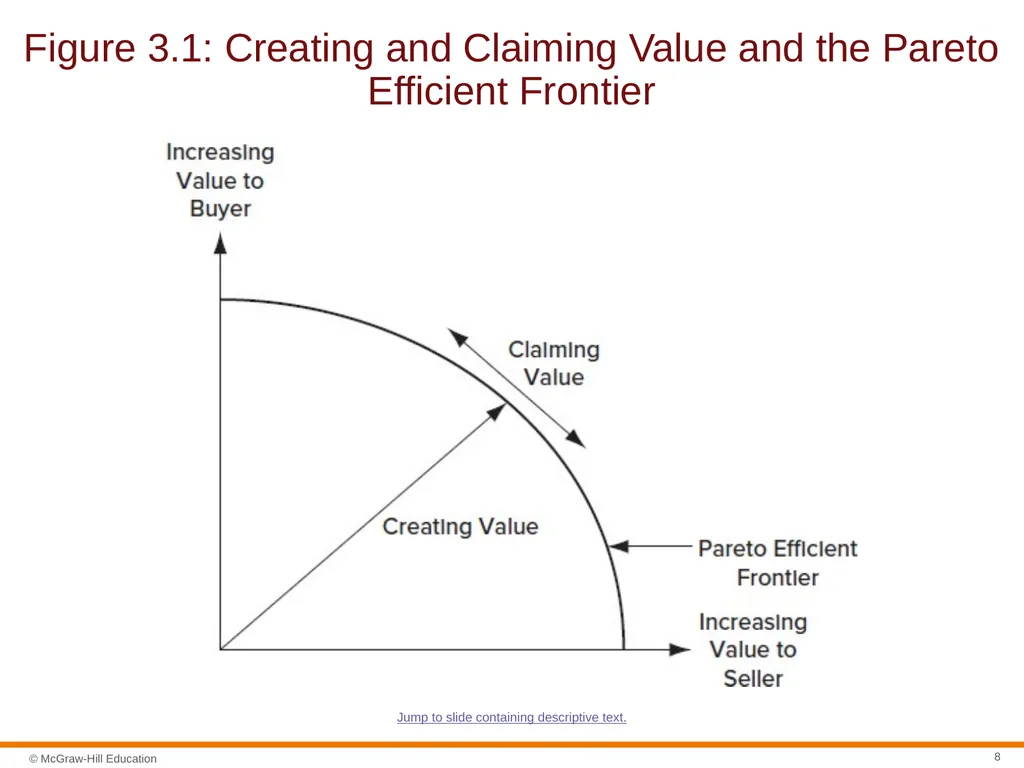
The Pareto efficient frontier is achieved when no agreement makes any party better off without decreasing outcomes to any other party.
Creating value must happen before claiming value.
Creating value is more effective when collaborative and claiming value may derail the creating value process. 7<br>
Identify and define the problem.
Surface interests and needs.
Generate alternative solutions to the problem.
Evaluate those alternatives and select among them.
The first three steps are important for creating value.
The fourth step involves claiming value – distributive skills.
The Pareto efficient frontier is achieved when no agreement makes any party better off without decreasing outcomes to any other party.
Creating value must happen before claiming value.
Creating value is more effective when collaborative and claiming value may derail the creating value process. 7<br>
08
Figure 3.1: Creating and Claiming Value and the Pareto Efficient Frontier Jump to slide containing descriptive text. 8<br>
09
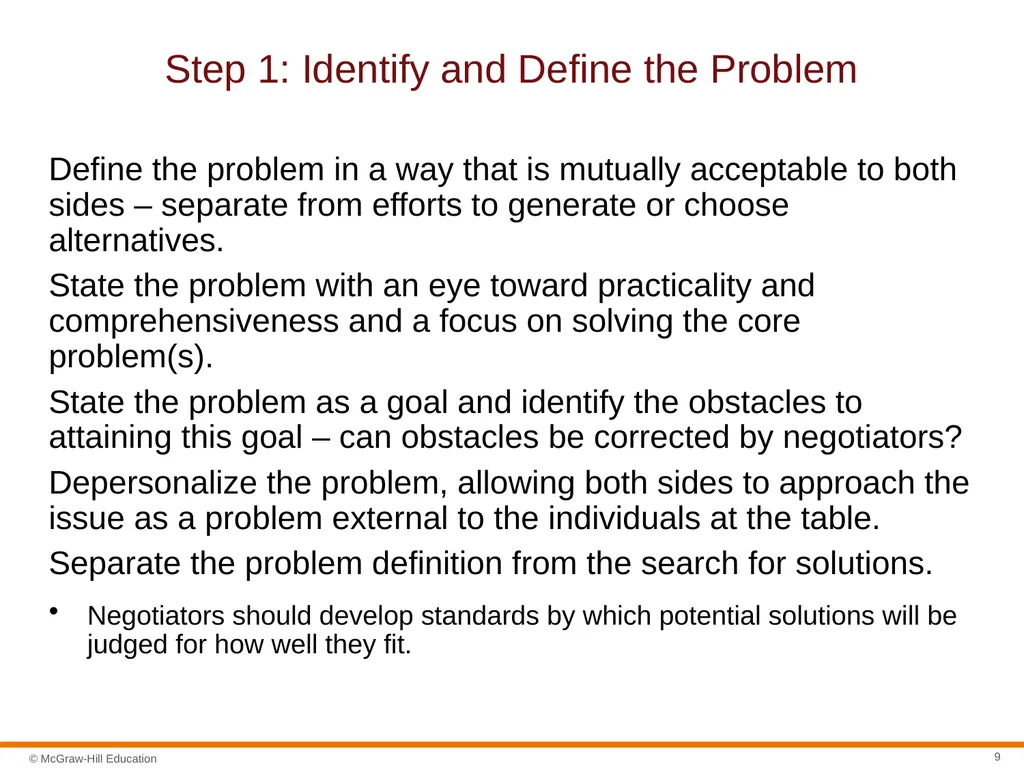
Step 1: Identify and Define the Problem Define the problem in a way that is mutually acceptable to both sides – separate from efforts to generate or choose alternatives.
State the problem with an eye toward practicality and comprehensiveness and a focus on solving the core problem(s).
State the problem as a goal and identify the obstacles to attaining this goal – can obstacles be corrected by negotiators?
Depersonalize the problem, allowing both sides to approach the issue as a problem external to the individuals at the table.
Separate the problem definition from the search for solutions.
Negotiators should develop standards by which potential solutions will be judged for how well they fit. 9<br>
State the problem with an eye toward practicality and comprehensiveness and a focus on solving the core problem(s).
State the problem as a goal and identify the obstacles to attaining this goal – can obstacles be corrected by negotiators?
Depersonalize the problem, allowing both sides to approach the issue as a problem external to the individuals at the table.
Separate the problem definition from the search for solutions.
Negotiators should develop standards by which potential solutions will be judged for how well they fit. 9<br>
10
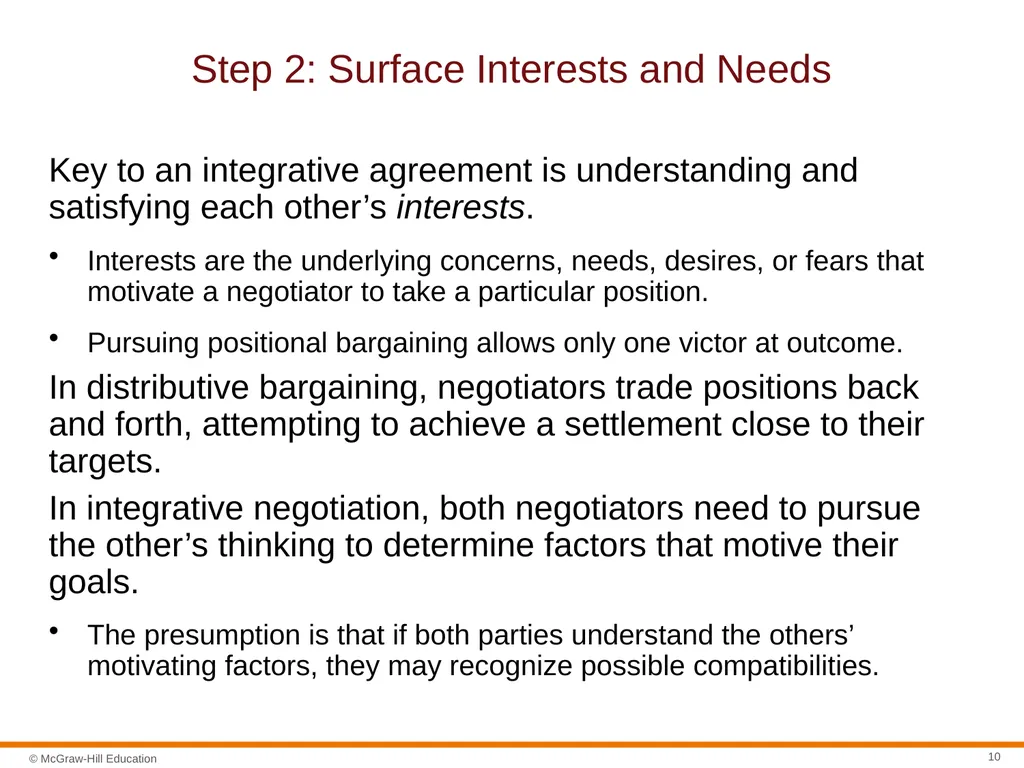
Step 2: Surface Interests and Needs Key to an integrative agreement is understanding and satisfying each other’s interests.
Interests are the underlying concerns, needs, desires, or fears that motivate a negotiator to take a particular position.
Pursuing positional bargaining allows only one victor at outcome.
In distributive bargaining, negotiators trade positions back and forth, attempting to achieve a settlement close to their targets.
In integrative negotiation, both negotiators need to pursue the other’s thinking to determine factors that motive their goals.
The presumption is that if both parties understand the others’ motivating factors, they may recognize possible compatibilities. 10<br>
Interests are the underlying concerns, needs, desires, or fears that motivate a negotiator to take a particular position.
Pursuing positional bargaining allows only one victor at outcome.
In distributive bargaining, negotiators trade positions back and forth, attempting to achieve a settlement close to their targets.
In integrative negotiation, both negotiators need to pursue the other’s thinking to determine factors that motive their goals.
The presumption is that if both parties understand the others’ motivating factors, they may recognize possible compatibilities. 10<br>
11
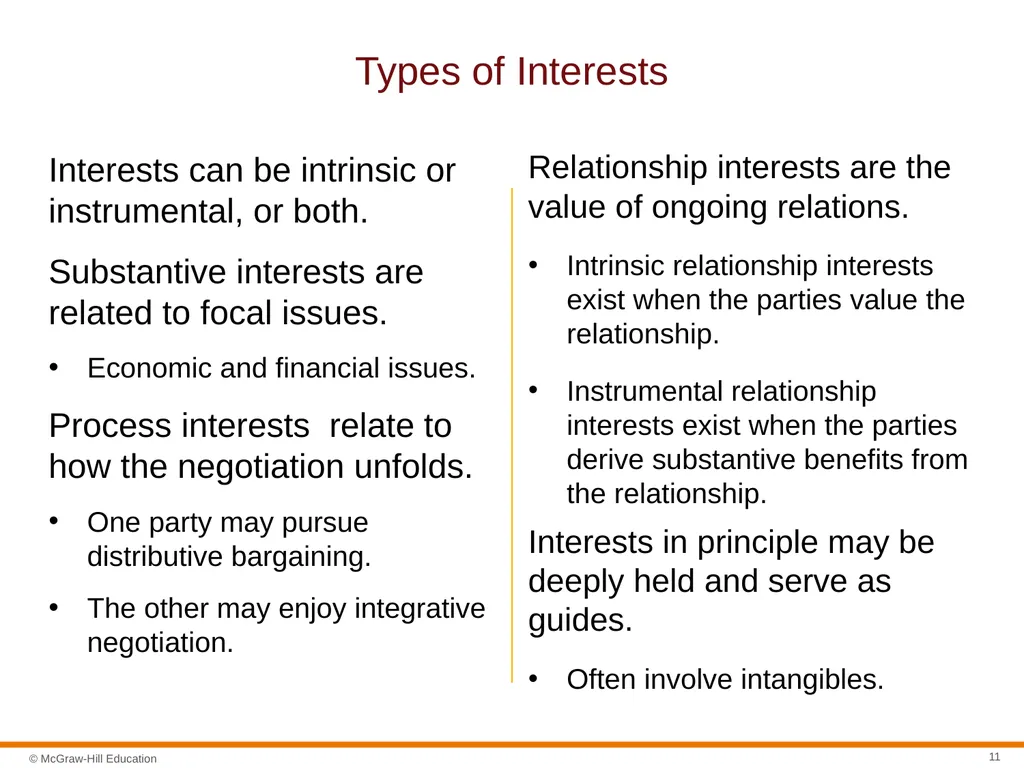
Types of Interests Interests can be intrinsic or instrumental, or both.
Substantive interests are related to focal issues.
Economic and financial issues.
Process interests relate to how the negotiation unfolds.
One party may pursue distributive bargaining.
The other may enjoy integrative negotiation. Relationship interests are the value of ongoing relations.
Intrinsic relationship interests exist when the parties value the relationship.
Instrumental relationship interests exist when the parties derive substantive benefits from the relationship.
Interests in principle may be deeply held and serve as guides.
Often involve intangibles. 11<br>
Substantive interests are related to focal issues.
Economic and financial issues.
Process interests relate to how the negotiation unfolds.
One party may pursue distributive bargaining.
The other may enjoy integrative negotiation. Relationship interests are the value of ongoing relations.
Intrinsic relationship interests exist when the parties value the relationship.
Instrumental relationship interests exist when the parties derive substantive benefits from the relationship.
Interests in principle may be deeply held and serve as guides.
Often involve intangibles. 11<br>
12
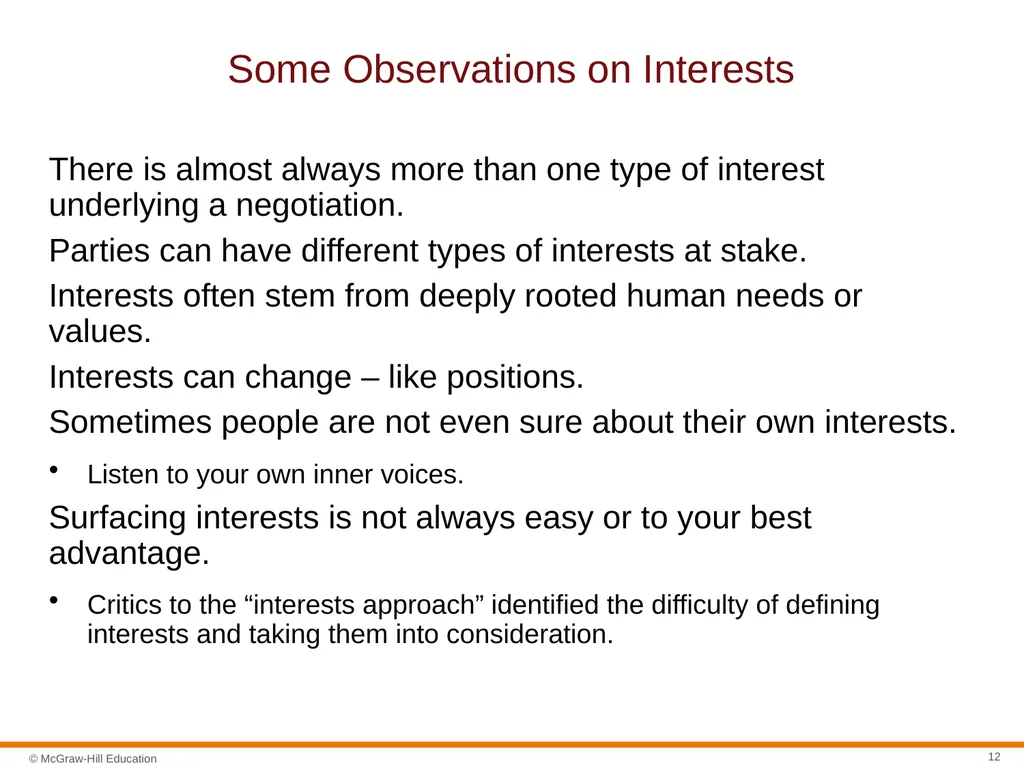
Some Observations on Interests There is almost always more than one type of interest underlying a negotiation.
Parties can have different types of interests at stake.
Interests often stem from deeply rooted human needs or values.
Interests can change – like positions.
Sometimes people are not even sure about their own interests.
Listen to your own inner voices.
Surfacing interests is not always easy or to your best advantage.
Critics to the “interests approach” identified the difficulty of defining interests and taking them into consideration. 12<br>
Parties can have different types of interests at stake.
Interests often stem from deeply rooted human needs or values.
Interests can change – like positions.
Sometimes people are not even sure about their own interests.
Listen to your own inner voices.
Surfacing interests is not always easy or to your best advantage.
Critics to the “interests approach” identified the difficulty of defining interests and taking them into consideration. 12<br>
13
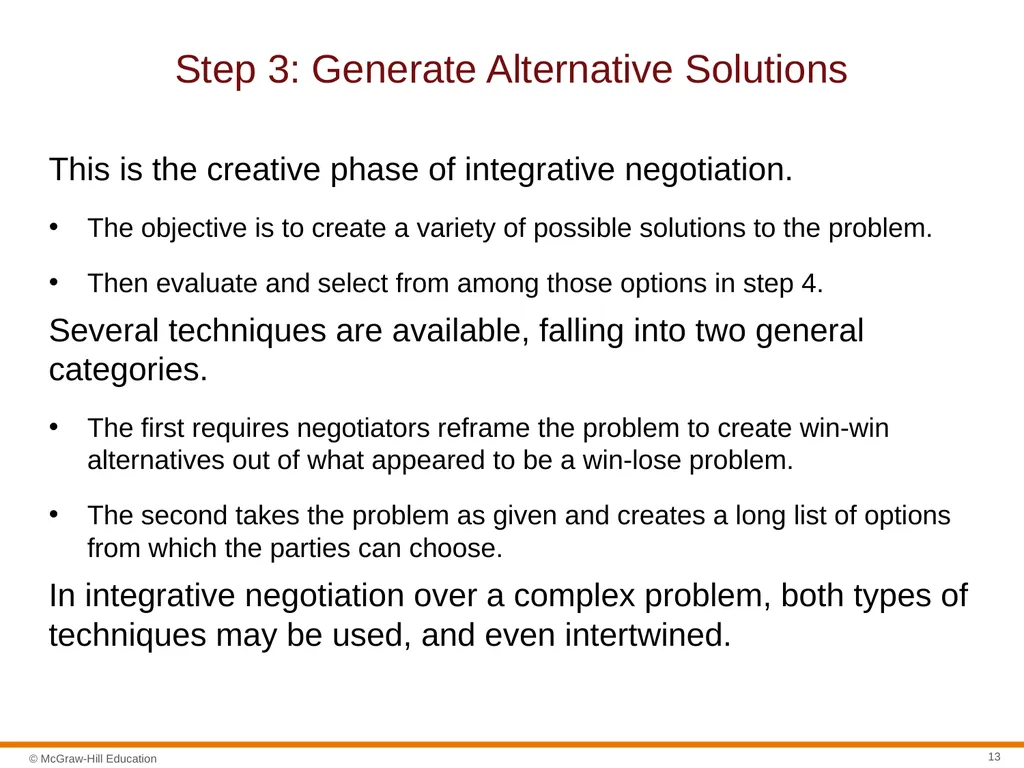
Step 3: Generate Alternative Solutions This is the creative phase of integrative negotiation.
The objective is to create a variety of possible solutions to the problem.
Then evaluate and select from among those options in step 4.
Several techniques are available, falling into two general categories.
The first requires negotiators reframe the problem to create win-win alternatives out of what appeared to be a win-lose problem.
The second takes the problem as given and creates a long list of options from which the parties can choose.
In integrative negotiation over a complex problem, both types of techniques may be used, and even intertwined. 13<br>
The objective is to create a variety of possible solutions to the problem.
Then evaluate and select from among those options in step 4.
Several techniques are available, falling into two general categories.
The first requires negotiators reframe the problem to create win-win alternatives out of what appeared to be a win-lose problem.
The second takes the problem as given and creates a long list of options from which the parties can choose.
In integrative negotiation over a complex problem, both types of techniques may be used, and even intertwined. 13<br>
14
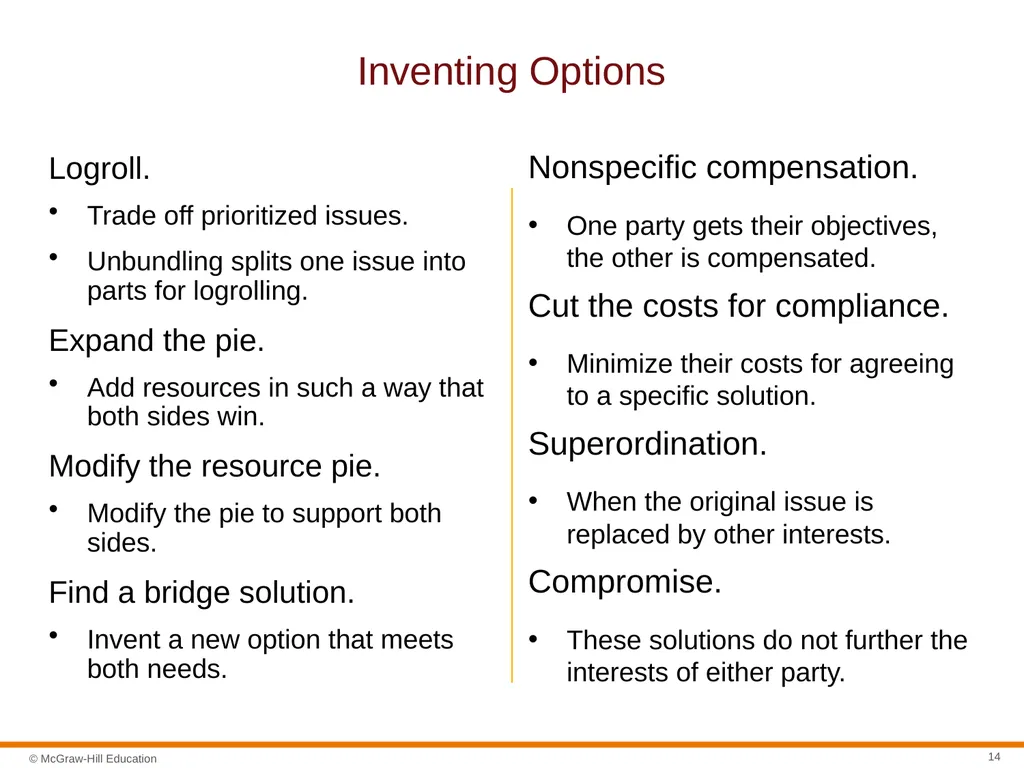
Inventing Options Logroll.
Trade off prioritized issues.
Unbundling splits one issue into parts for logrolling.
Expand the pie.
Add resources in such a way that both sides win.
Modify the resource pie.
Modify the pie to support both sides.
Find a bridge solution.
Invent a new option that meets both needs. Nonspecific compensation.
One party gets their objectives, the other is compensated.
Cut the costs for compliance.
Minimize their costs for agreeing to a specific solution.
Superordination.
When the original issue is replaced by other interests.
Compromise.
These solutions do not further the interests of either party. 14<br>
Trade off prioritized issues.
Unbundling splits one issue into parts for logrolling.
Expand the pie.
Add resources in such a way that both sides win.
Modify the resource pie.
Modify the pie to support both sides.
Find a bridge solution.
Invent a new option that meets both needs. Nonspecific compensation.
One party gets their objectives, the other is compensated.
Cut the costs for compliance.
Minimize their costs for agreeing to a specific solution.
Superordination.
When the original issue is replaced by other interests.
Compromise.
These solutions do not further the interests of either party. 14<br>
15
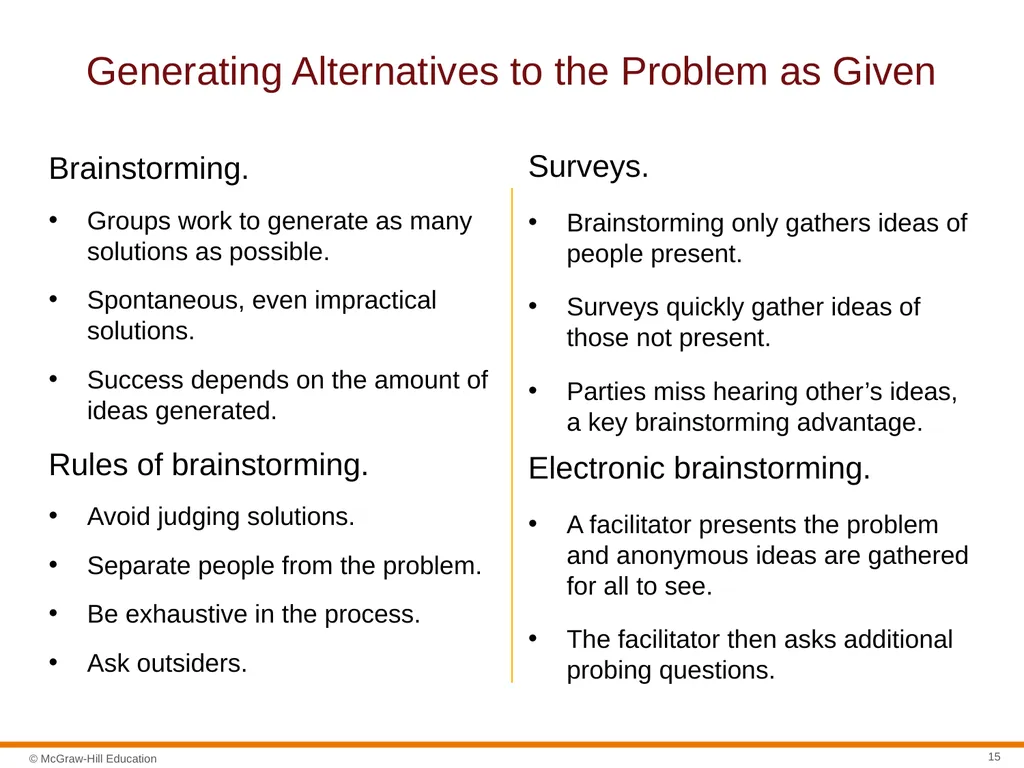
Generating Alternatives to the Problem as Given Brainstorming.
Groups work to generate as many solutions as possible.
Spontaneous, even impractical solutions.
Success depends on the amount of ideas generated.
Rules of brainstorming.
Avoid judging solutions.
Separate people from the problem.
Be exhaustive in the process.
Ask outsiders. Surveys.
Brainstorming only gathers ideas of people present.
Surveys quickly gather ideas of those not present.
Parties miss hearing other’s ideas, a key brainstorming advantage.
Electronic brainstorming.
A facilitator presents the problem and anonymous ideas are gathered for all to see.
The facilitator then asks additional probing questions. 15<br>
Groups work to generate as many solutions as possible.
Spontaneous, even impractical solutions.
Success depends on the amount of ideas generated.
Rules of brainstorming.
Avoid judging solutions.
Separate people from the problem.
Be exhaustive in the process.
Ask outsiders. Surveys.
Brainstorming only gathers ideas of people present.
Surveys quickly gather ideas of those not present.
Parties miss hearing other’s ideas, a key brainstorming advantage.
Electronic brainstorming.
A facilitator presents the problem and anonymous ideas are gathered for all to see.
The facilitator then asks additional probing questions. 15<br>
16
Step 4: Evaluate and Select Alternatives When the issue is simple, this may be a single step.
Otherwise, the steps are: definitions and standards, alternatives, evaluation, and selection.
Negotiators will need to weigh or rank-order each option against clear criteria.
May need to return to definitions or return to standards for revisions.
Finally, the parties engage in a decision-making process and come to an agreement on the best options.
The selection of alternatives is the claiming-value stage.
Use the following guidelines to evaluate options and reach a consensus. 16<br>
Otherwise, the steps are: definitions and standards, alternatives, evaluation, and selection.
Negotiators will need to weigh or rank-order each option against clear criteria.
May need to return to definitions or return to standards for revisions.
Finally, the parties engage in a decision-making process and come to an agreement on the best options.
The selection of alternatives is the claiming-value stage.
Use the following guidelines to evaluate options and reach a consensus. 16<br>
17
Guidelines to Evaluate and Select Alternatives Narrow the range of solution options.
Evaluate solutions on the basis of quality, standards, and acceptability.
Agree to the criteria in advance of evaluating options.
Be willing to justify personal preferences.
Be alert to the influence of intangibles in selecting options.
Take time out to cool off. Use subgroups to evaluate complex options.
Explore different ways to logroll by exploring differences in risk preference, expectations, and time preferences.
Keep decisions tentative and conditional until all aspects of the final proposal are complete.
Minimize formality and recordkeeping until final agreements are closed. 17<br>
Evaluate solutions on the basis of quality, standards, and acceptability.
Agree to the criteria in advance of evaluating options.
Be willing to justify personal preferences.
Be alert to the influence of intangibles in selecting options.
Take time out to cool off. Use subgroups to evaluate complex options.
Explore different ways to logroll by exploring differences in risk preference, expectations, and time preferences.
Keep decisions tentative and conditional until all aspects of the final proposal are complete.
Minimize formality and recordkeeping until final agreements are closed. 17<br>
18
Assessing the Quality of the Agreement Assessed along the same two dimensions as distributive agreements.
Objective outcomes.
Subjective value.
Assess objective outcomes against the extent to which both parties’ interests and needs were met by the agreement.
The subjective value is more important in integrative negotiations due to the long-term relationship of the parties. 18<br>
Objective outcomes.
Subjective value.
Assess objective outcomes against the extent to which both parties’ interests and needs were met by the agreement.
The subjective value is more important in integrative negotiations due to the long-term relationship of the parties. 18<br>
19
Factors Facilitating Successful Integrative Negotiation Successful integrative negotiation occurs when the parties are predisposed to finding a mutually acceptable joint solution.
This next section reviews seven factors that facilitate successful integrative negotiation.
The presence of a common goal.
Faith in your own problem-solving ability.
A belief in the validity of the other party’s position.
The motivation and commitment to work together.
Trust.
Clear and accurate communication.
An understanding of the dynamics of integrative negotiation. 19<br>
This next section reviews seven factors that facilitate successful integrative negotiation.
The presence of a common goal.
Faith in your own problem-solving ability.
A belief in the validity of the other party’s position.
The motivation and commitment to work together.
Trust.
Clear and accurate communication.
An understanding of the dynamics of integrative negotiation. 19<br>
20
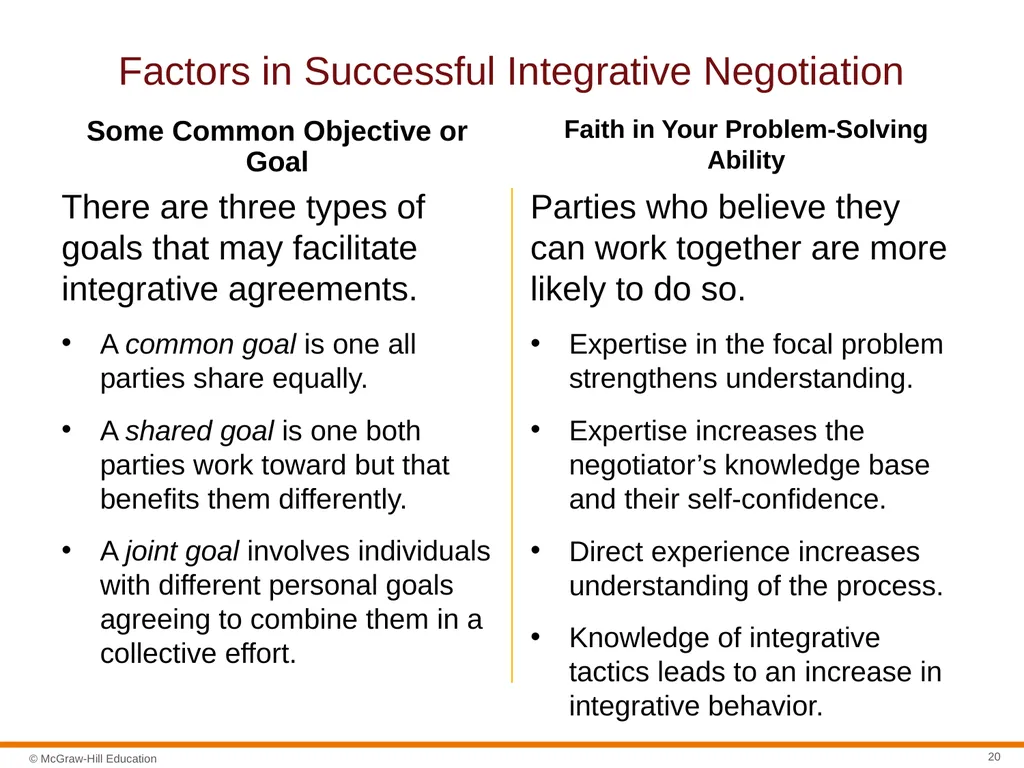
Factors in Successful Integrative Negotiation 20 Some Common Objective or Goal There are three types of goals that may facilitate integrative agreements.
A common goal is one all parties share equally.
A shared goal is one both parties work toward but that benefits them differently.
A joint goal involves individuals with different personal goals agreeing to combine them in a collective effort. Faith in Your Problem-Solving Ability Parties who believe they can work together are more likely to do so.
Expertise in the focal problem strengthens understanding.
Expertise increases the negotiator’s knowledge base and their self-confidence.
Direct experience increases understanding of the process.
Knowledge of integrative tactics leads to an increase in integrative behavior.<br>
A common goal is one all parties share equally.
A shared goal is one both parties work toward but that benefits them differently.
A joint goal involves individuals with different personal goals agreeing to combine them in a collective effort. Faith in Your Problem-Solving Ability Parties who believe they can work together are more likely to do so.
Expertise in the focal problem strengthens understanding.
Expertise increases the negotiator’s knowledge base and their self-confidence.
Direct experience increases understanding of the process.
Knowledge of integrative tactics leads to an increase in integrative behavior.<br>
21
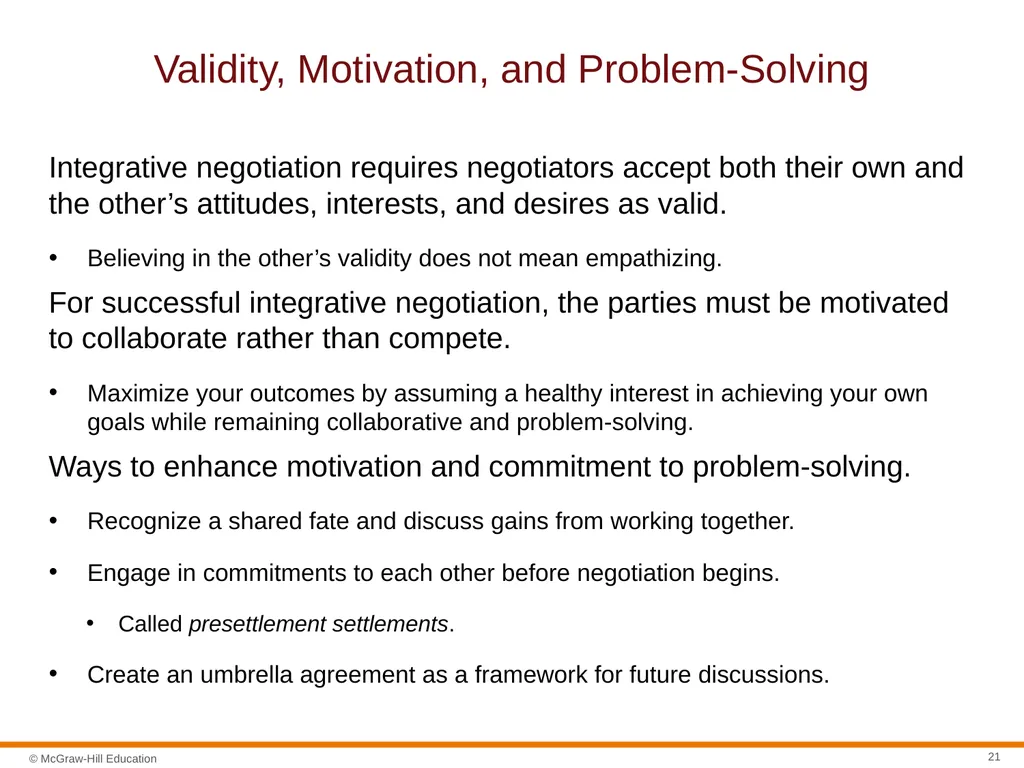
Validity, Motivation, and Problem-Solving Integrative negotiation requires negotiators accept both their own and the other’s attitudes, interests, and desires as valid.
Believing in the other’s validity does not mean empathizing.
For successful integrative negotiation, the parties must be motivated to collaborate rather than compete.
Maximize your outcomes by assuming a healthy interest in achieving your own goals while remaining collaborative and problem-solving.
Ways to enhance motivation and commitment to problem-solving.
Recognize a shared fate and discuss gains from working together.
Engage in commitments to each other before negotiation begins.
Called presettlement settlements.
Create an umbrella agreement as a framework for future discussions. 21<br>
Believing in the other’s validity does not mean empathizing.
For successful integrative negotiation, the parties must be motivated to collaborate rather than compete.
Maximize your outcomes by assuming a healthy interest in achieving your own goals while remaining collaborative and problem-solving.
Ways to enhance motivation and commitment to problem-solving.
Recognize a shared fate and discuss gains from working together.
Engage in commitments to each other before negotiation begins.
Called presettlement settlements.
Create an umbrella agreement as a framework for future discussions. 21<br>
22
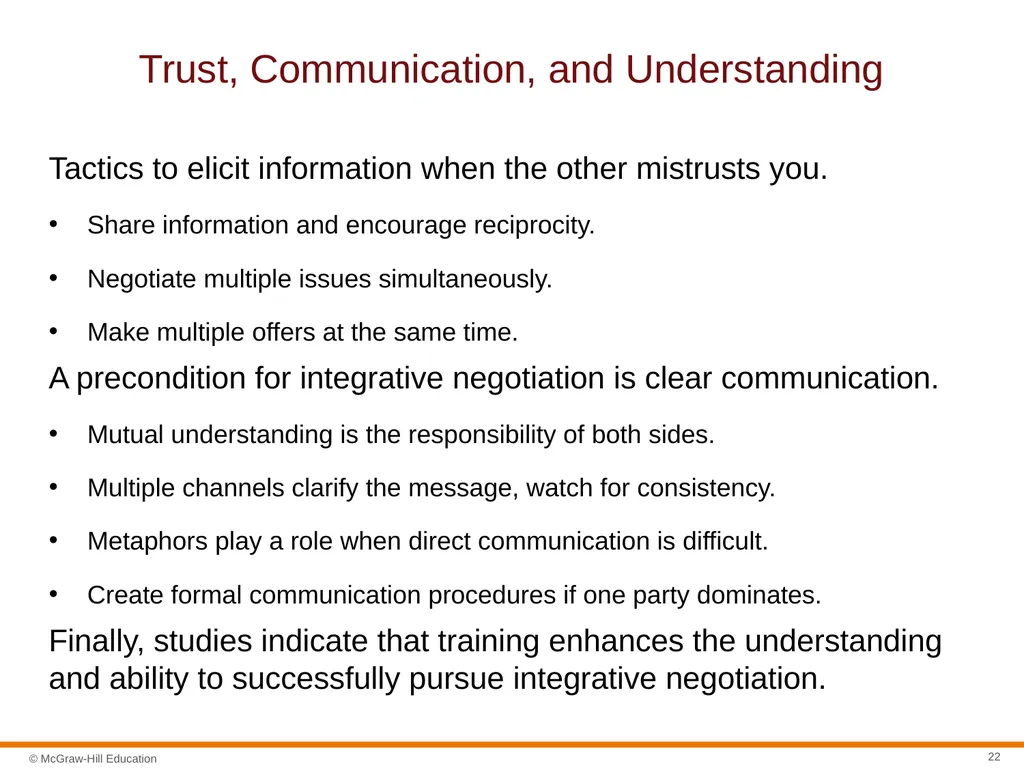
Trust, Communication, and Understanding Tactics to elicit information when the other mistrusts you.
Share information and encourage reciprocity.
Negotiate multiple issues simultaneously.
Make multiple offers at the same time.
A precondition for integrative negotiation is clear communication.
Mutual understanding is the responsibility of both sides.
Multiple channels clarify the message, watch for consistency.
Metaphors play a role when direct communication is difficult.
Create formal communication procedures if one party dominates.
Finally, studies indicate that training enhances the understanding and ability to successfully pursue integrative negotiation. 22<br>
Share information and encourage reciprocity.
Negotiate multiple issues simultaneously.
Make multiple offers at the same time.
A precondition for integrative negotiation is clear communication.
Mutual understanding is the responsibility of both sides.
Multiple channels clarify the message, watch for consistency.
Metaphors play a role when direct communication is difficult.
Create formal communication procedures if one party dominates.
Finally, studies indicate that training enhances the understanding and ability to successfully pursue integrative negotiation. 22<br>
23
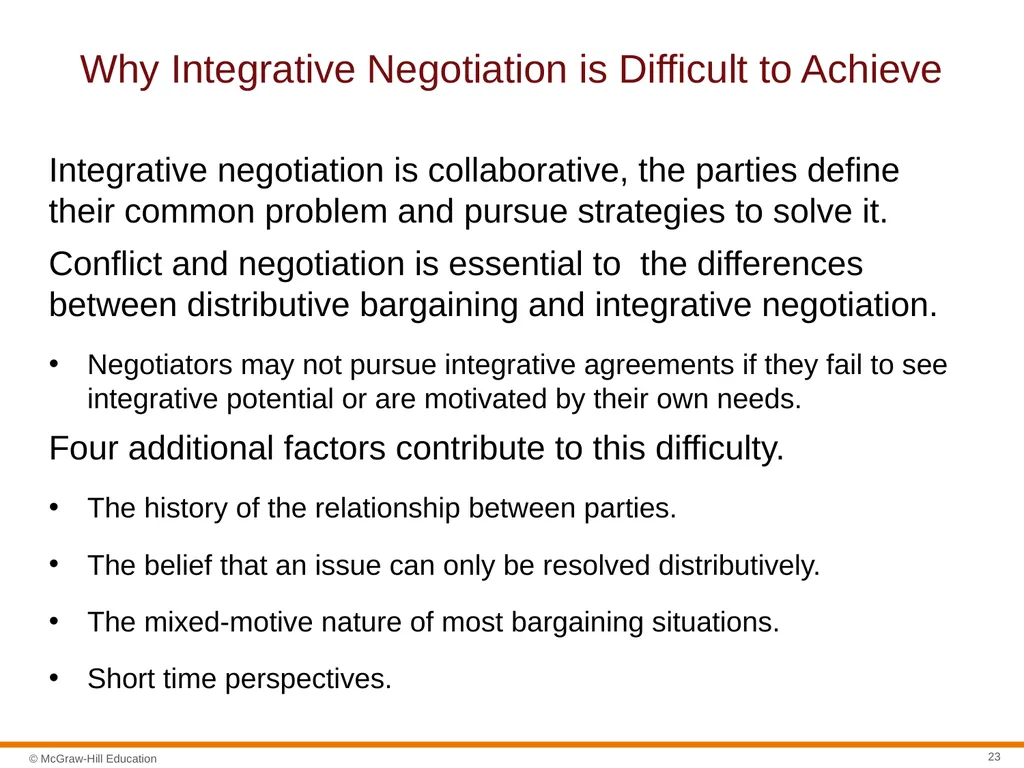
Why Integrative Negotiation is Difficult to Achieve Integrative negotiation is collaborative, the parties define their common problem and pursue strategies to solve it.
Conflict and negotiation is essential to the differences between distributive bargaining and integrative negotiation.
Negotiators may not pursue integrative agreements if they fail to see integrative potential or are motivated by their own needs.
Four additional factors contribute to this difficulty.
The history of the relationship between parties.
The belief that an issue can only be resolved distributively.
The mixed-motive nature of most bargaining situations.
Short time perspectives. 23<br>
Conflict and negotiation is essential to the differences between distributive bargaining and integrative negotiation.
Negotiators may not pursue integrative agreements if they fail to see integrative potential or are motivated by their own needs.
Four additional factors contribute to this difficulty.
The history of the relationship between parties.
The belief that an issue can only be resolved distributively.
The mixed-motive nature of most bargaining situations.
Short time perspectives. 23<br>
24
History and Beliefs The more competitive and conflict-laden their past relationship, the more likely parties will be defensive with a win-lose attitude.
Even with no history, expectations create defensiveness.
Negotiators can proceed past a negative history, but it takes effort.
Conflict dynamics lead negotiators to polarize issues and see them only in win-lose terms.
In addition, negotiators may be prone to several cognitive biases that may preclude them from engaging in behaviors necessary for integrative negotiation. 24<br>
Even with no history, expectations create defensiveness.
Negotiators can proceed past a negative history, but it takes effort.
Conflict dynamics lead negotiators to polarize issues and see them only in win-lose terms.
In addition, negotiators may be prone to several cognitive biases that may preclude them from engaging in behaviors necessary for integrative negotiation. 24<br>
25
Nature of Situations and Short Time Perspective Most situations contain some elements requiring distributive bargaining processes, others requiring integrative processes.
Conflict and competitiveness drive out cooperation and trust.
A fundamental challenge is that parties fail to recognize or search for the integrative potential in a negotiation.
Primarily to satisfy their own concerns.
Effective integrative negotiation requires sufficient time.
To process information.
To reach true understanding of your own and the other party’s needs.
To manage the transition from creating value to claiming value. 25<br>
Conflict and competitiveness drive out cooperation and trust.
A fundamental challenge is that parties fail to recognize or search for the integrative potential in a negotiation.
Primarily to satisfy their own concerns.
Effective integrative negotiation requires sufficient time.
To process information.
To reach true understanding of your own and the other party’s needs.
To manage the transition from creating value to claiming value. 25<br>
26
Distributive Bargaining versus Integrative Negotiation Many would argue for integrative negotiations, holding that distributive bargaining is outdated.
A strong understanding of both is important for two reasons.
Some negotiators use a purely distributive approach and evidence shows integrative negotiating is effective against such bargainers.
Integrative situations involve a claiming-value portion and this may involve the use of distributive tactics.
A sound understanding of distributive bargaining makes it more likely you will be able to identify insincere opponents. 26<br>
A strong understanding of both is important for two reasons.
Some negotiators use a purely distributive approach and evidence shows integrative negotiating is effective against such bargainers.
Integrative situations involve a claiming-value portion and this may involve the use of distributive tactics.
A sound understanding of distributive bargaining makes it more likely you will be able to identify insincere opponents. 26<br>
27
End of Chapter 03. © 2019 McGraw-Hill Education. All rights reserved. Authorized only for instructor use in the classroom. No reproduction or further distribution permitted without the prior written consent of McGraw-Hill Education.<br>
28
Accessibility Content: Text Alternative for Image 28<br>
29
Appendix: Figure 3.1 Return to parent-slide containing image. This graph shows four types of strategies depending on what is important to the negotiator. If relational outcome is important and substantive outcome is also important, collaboration is called for.
If relational outcome is important but substantive outcome is not important, then accommodation is called for.
If relational outcome is not important but substantive outcome is important, then competition is called for.
If neither relational outcome nor substantive outcome is important, then avoidance may be a strategy. Return to parent-slide containing image. 29<br>
If relational outcome is important but substantive outcome is not important, then accommodation is called for.
If relational outcome is not important but substantive outcome is important, then competition is called for.
If neither relational outcome nor substantive outcome is important, then avoidance may be a strategy. Return to parent-slide containing image. 29<br>