Network Layer: Control Plane introduction routing algorithms link state distance vector intra-ISP routing: OSPF routing among ISPs: BGP SDN control plane Internet Control Message Protocol Network management, configuration our routing study
"Network Layer: Control Plane introduction routing" is the property of its rightful owner. Permission is granted to
download and print the materials on this website for personal, non-commercial use only, and to display it
on your personal computer provided you do not modify the materials and that you retain all copyright
notices contained in the materials. By downloading content from our website, you accept the terms of this
agreement.
Share
Embed code
Presentation Transcript
01
Network Layer: Control Plane introduction
routing algorithms
link state
distance vector
intra-ISP routing: OSPF
routing among ISPs: BGP
SDN control plane
Internet Control Message Protocol
Network management, configuration<br>
02
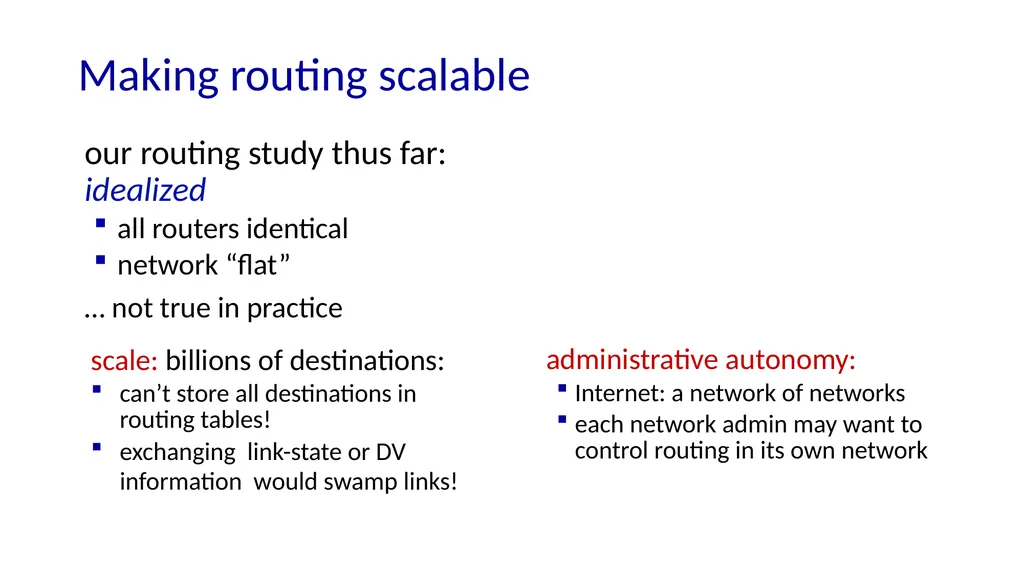
our routing study thus far:
idealized
all routers identical
network “flat”
… not true in practice Making routing scalable scale: billions of destinations:
can’t store all destinations in routing tables!
exchanging link-state or DV information would swamp links! administrative autonomy:
Internet: a network of networks
each network admin may want to control routing in its own network<br>
03
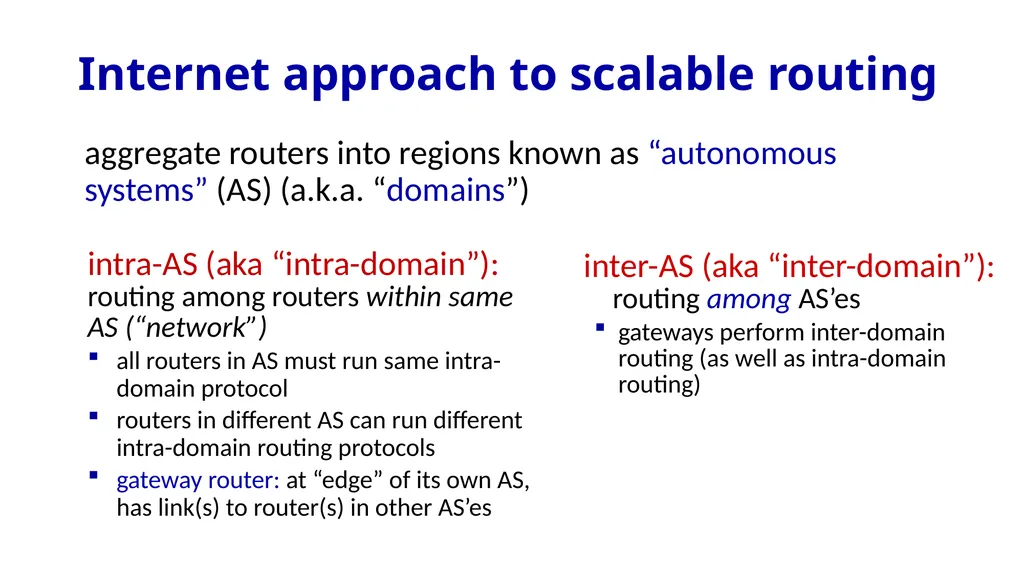
aggregate routers into regions known as “autonomous systems” (AS) (a.k.a. “domains”) Internet approach to scalable routing intra-AS (aka “intra-domain”): routing among routers within same AS (“network”)
all routers in AS must run same intra-domain protocol
routers in different AS can run different intra-domain routing protocols
gateway router: at “edge” of its own AS, has link(s) to router(s) in other AS’es inter-AS (aka “inter-domain”): routing among AS’es
gateways perform inter-domain routing (as well as intra-domain routing)<br>
04
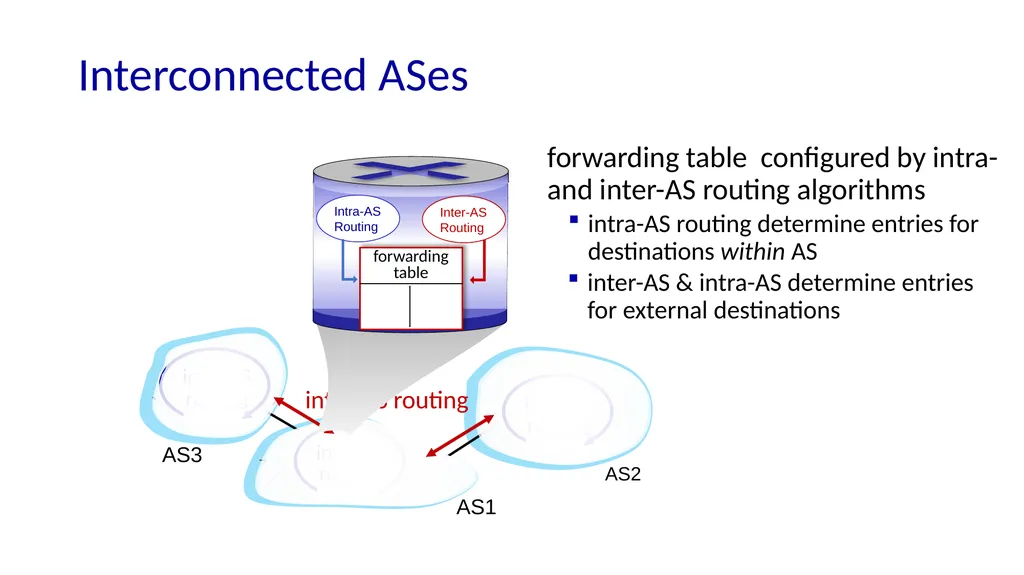
Interconnected ASes 3b 3a 2a AS3 AS1 AS2 1a forwarding table configured by intra- and inter-AS routing algorithms intra-AS routing determine entries for destinations within AS inter-AS & intra-AS determine entries for external destinations<br>
05
Inter-AS routing: routing within an AS most common intra-AS routing protocols:
RIP: Routing Information Protocol [RFC 1723]
classic DV: DVs exchanged every 30 secs
no longer widely used
OSPF: Open Shortest Path First [RFC 2328]
classic link-state routing
IS-IS protocol (ISO standard, not RFC standard) essentially same as OSPF
EIGRP: Enhanced Interior Gateway Routing Protocol
DV based
formerly Cisco-proprietary for decades
became open in 2013 [RFC 7868])<br>
06
OSPF (Open Shortest Path First) routing “open”: publicly available
classic link-state
each router floods OSPF link-state advertisements (directly over IP rather than using TCP/UDP) to all other routers in entire AS
multiple link costs metrics possible: bandwidth, delay
each router has full topology, uses Dijkstra’s algorithm to compute forwarding table
security: all OSPF messages authenticated (to prevent malicious intrusion)<br>
07
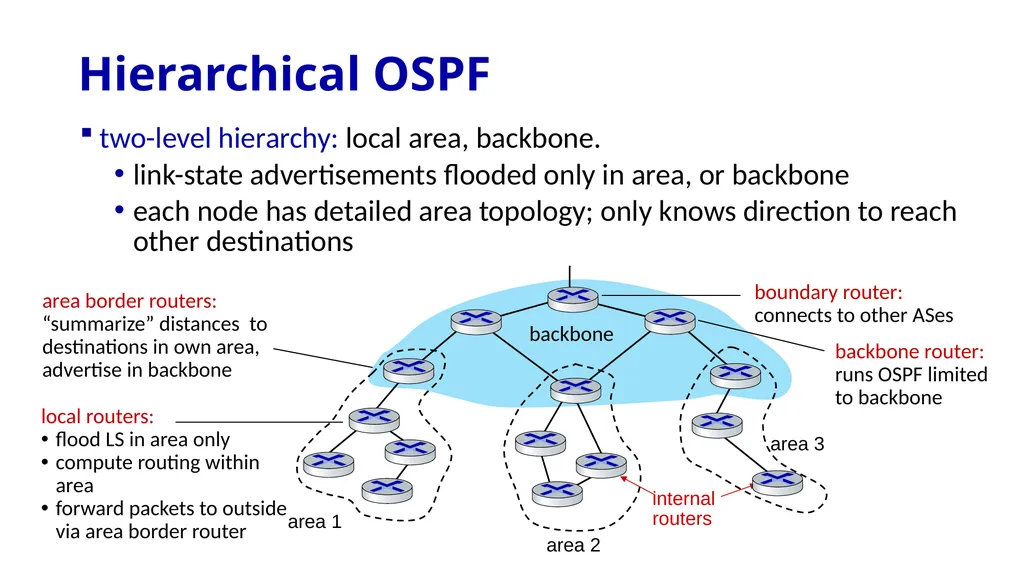
Hierarchical OSPF two-level hierarchy: local area, backbone.
link-state advertisements flooded only in area, or backbone
each node has detailed area topology; only knows direction to reach other destinations area 1 area 2 area 3 backbone internal
routers<br>
08
Network Layer: Data Plane introduction
routing algorithms
link state
distance vector
intra-ISP routing: OSPF
routing among ISPs: BGP
SDN control plane
Internet Control Message Protocol
Network management, configuration<br>