
Network Security Essentials: Applications and
Description: Network Security Essentials: Applications and Standards Sixth Edition Chapter 2 Symmetric Encryption and Message Confidentiality Copyright 2017 Pearson Education, Inc. All Rights Reserved Cryptography Cryptography is the science or
Related Topics
Download Presentation
"Network Security Essentials: Applications and" is the property of its rightful owner. Permission is granted to download and print the materials on this website for personal, non-commercial use only, and to display it on your personal computer provided you do not modify the materials and that you retain all copyright notices contained in the materials. By downloading content from our website, you accept the terms of this agreement.
Presentation Transcript
slide1. Network Security Essentials: Applications and Standards Sixth Edition Chapter 2 Symmetric Encryption and
Message Confidentiality Copyright © 2017 Pearson Education, Inc. All Rights Reserved<br>
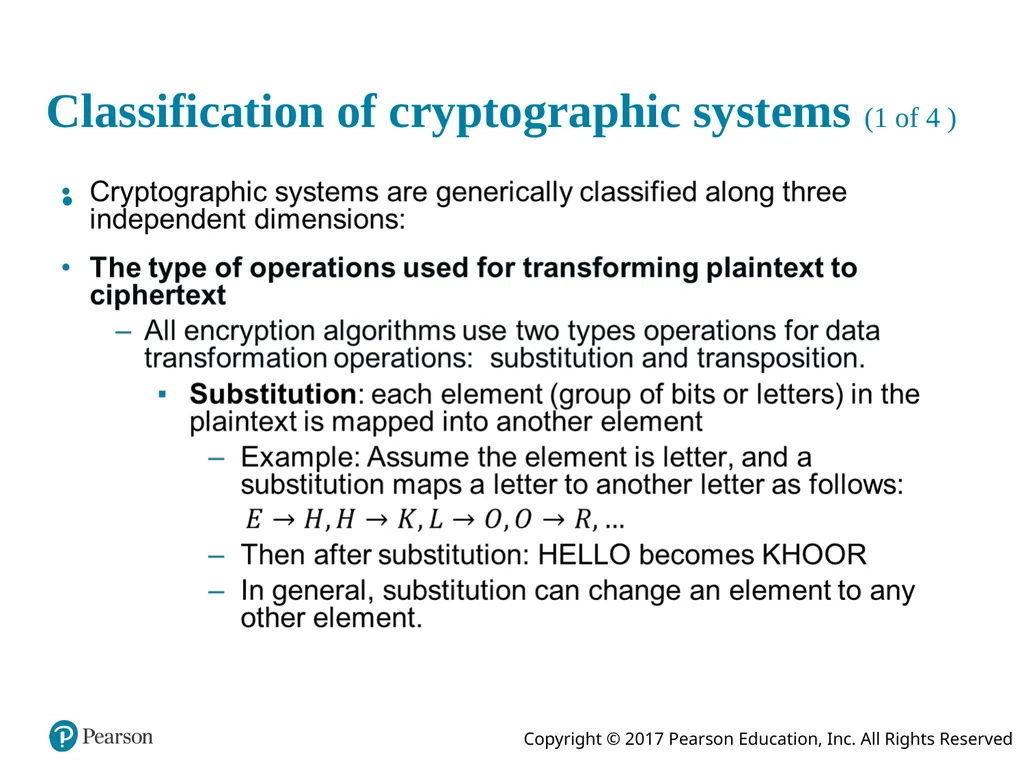
slide2. Cryptography Cryptography is the science or practice of securing information by transforming it into a form that only authorized parties can understand.
Cryptography protects data confidentiality, integrity, authenticity, and non-repudiation using mathematical techniques.
A cryptographic system is the framework to perform cryptography.<br>
slide3. Common Terminology in Cryptography Plaintext: The original readable message or data.
Ciphertext: The encrypted (scrambled) form of the plaintext.
Encryption: The process of converting plaintext into ciphertext using a key.
Decryption: The process of converting ciphertext back into plaintext using a key.
Key: A secret value used by the encryption and decryption algorithms.<br>
slide4. Classification of cryptographic systems (1 of 4 )<br>
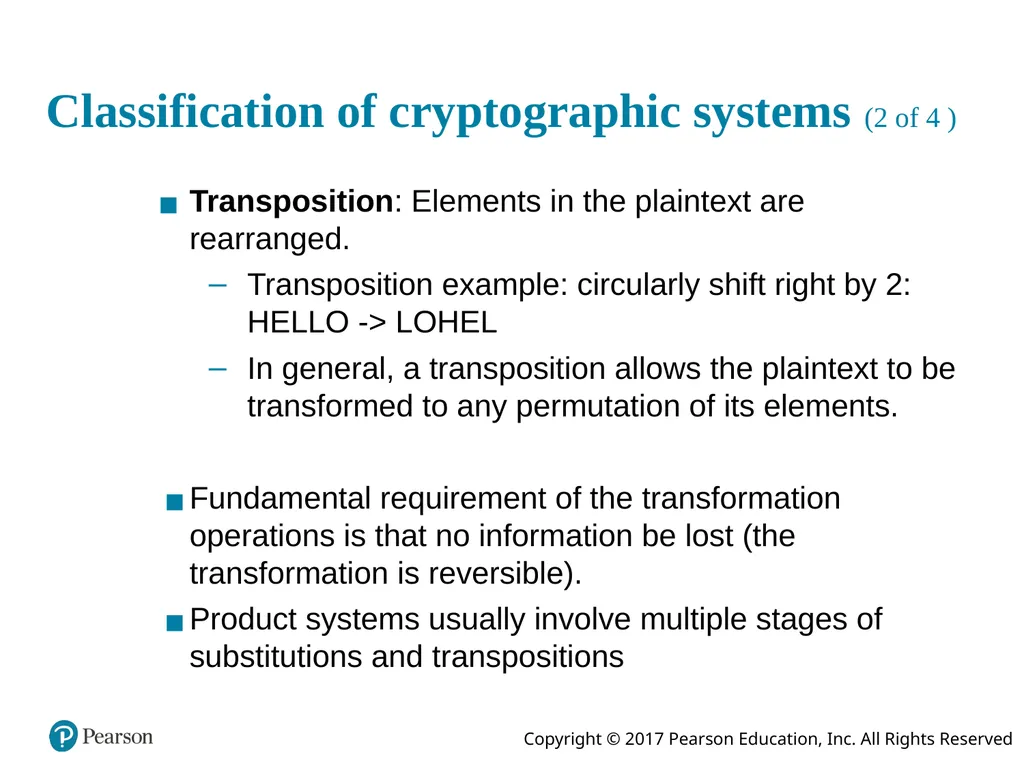
slide5. Classification of cryptographic systems (2 of 4 ) Transposition: Elements in the plaintext are rearranged.
Transposition example: circularly shift right by 2: HELLO -> LOHEL
In general, a transposition allows the plaintext to be transformed to any permutation of its elements.
Fundamental requirement of the transformation operations is that no information be lost (the transformation is reversible).
Product systems usually involve multiple stages of substitutions and transpositions<br>
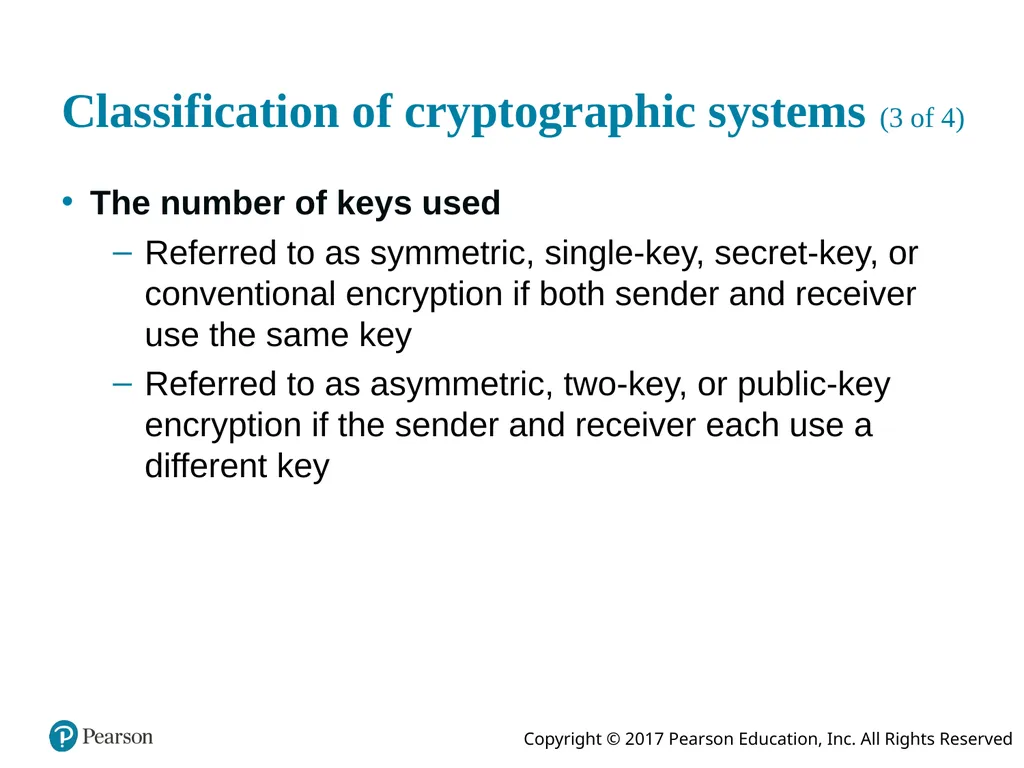
slide6. Classification of cryptographic systems (3 of 4) The number of keys used
Referred to as symmetric, single-key, secret-key, or conventional encryption if both sender and receiver use the same key
Referred to as asymmetric, two-key, or public-key encryption if the sender and receiver each use a different key<br>
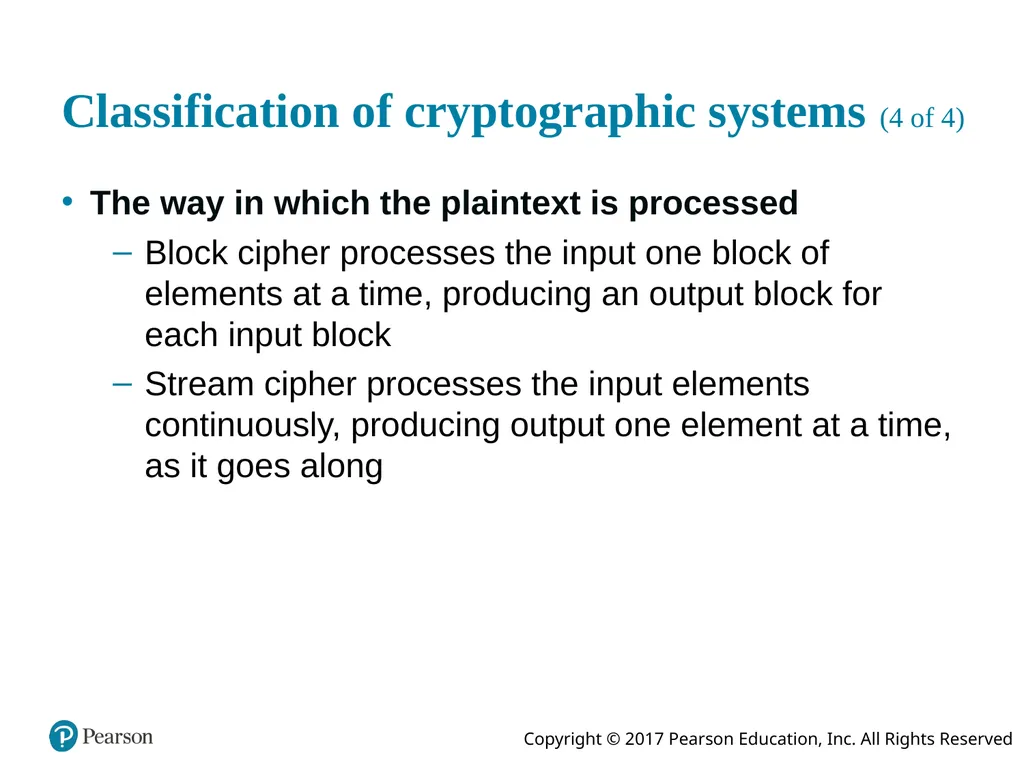
slide7. Classification of cryptographic systems (4 of 4) The way in which the plaintext is processed
Block cipher processes the input one block of elements at a time, producing an output block for each input block
Stream cipher processes the input elements continuously, producing output one element at a time, as it goes along<br>
slide8. Symmetric encryption Also known as conventional encryption, single-key encryption, and secret-key encryption.
Most widely used encryption scheme.<br>
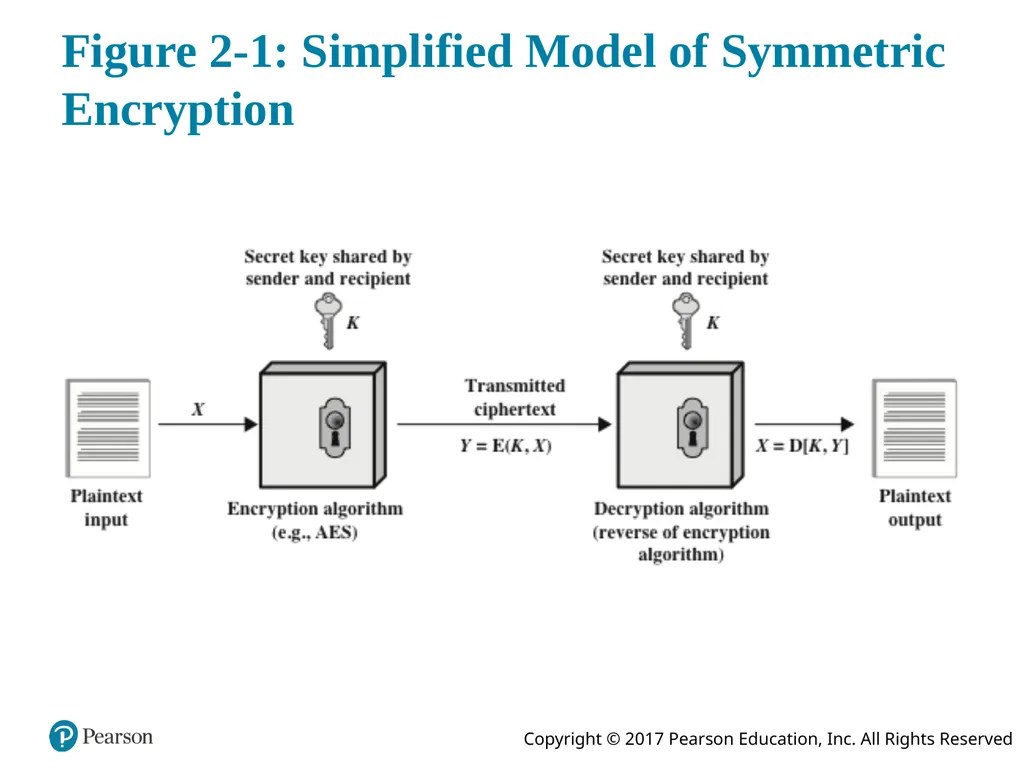
slide9. Figure 2-1: Simplified Model of Symmetric Encryption<br>
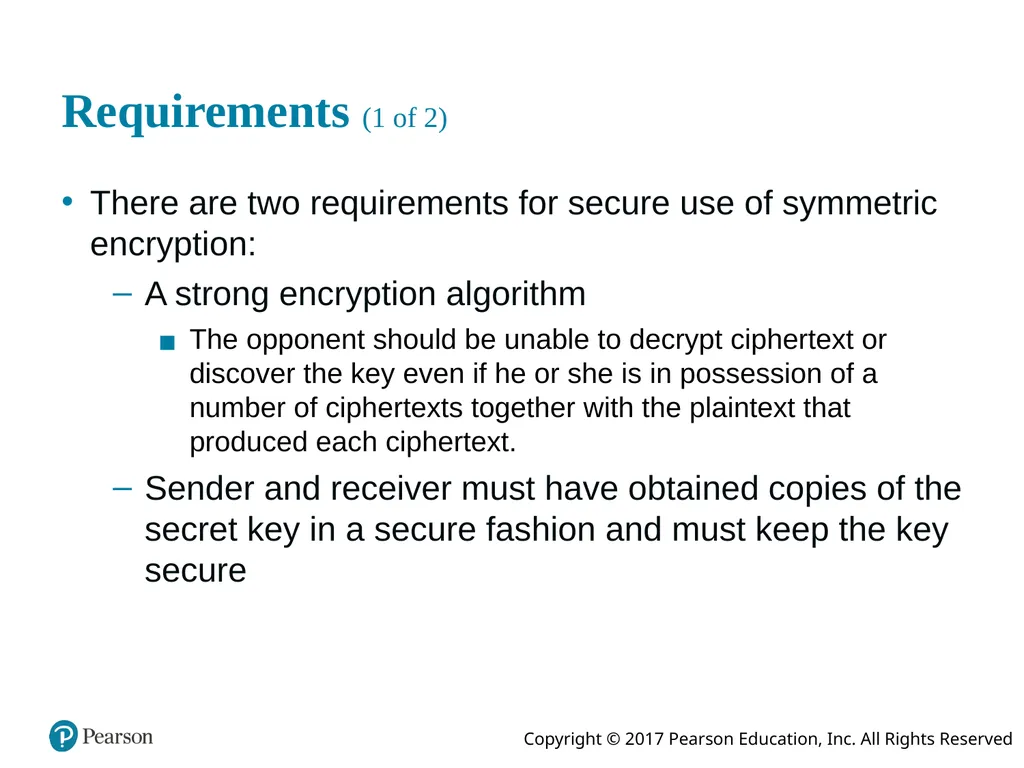
slide10. Requirements (1 of 2) There are two requirements for secure use of symmetric encryption:
A strong encryption algorithm
The opponent should be unable to decrypt ciphertext or discover the key even if he or she is in possession of a number of ciphertexts together with the plaintext that produced each ciphertext.
Sender and receiver must have obtained copies of the secret key in a secure fashion and must keep the key secure<br>
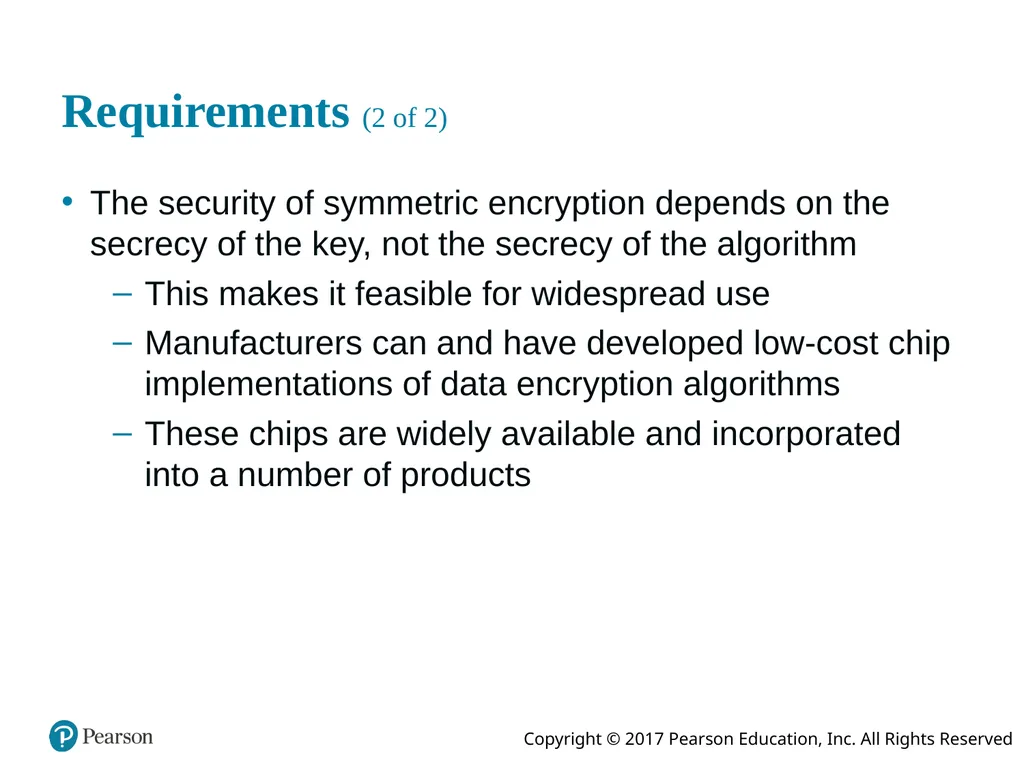
slide11. Requirements (2 of 2) The security of symmetric encryption depends on the secrecy of the key, not the secrecy of the algorithm
This makes it feasible for widespread use
Manufacturers can and have developed low-cost chip implementations of data encryption algorithms
These chips are widely available and incorporated into a number of products<br>
slide12. Cryptanalysis The process of attempting to discover the plaintext or key is known as cryptanalysis.
The strategy used by the cryptanalyst depends on the nature of the encryption scheme.<br>
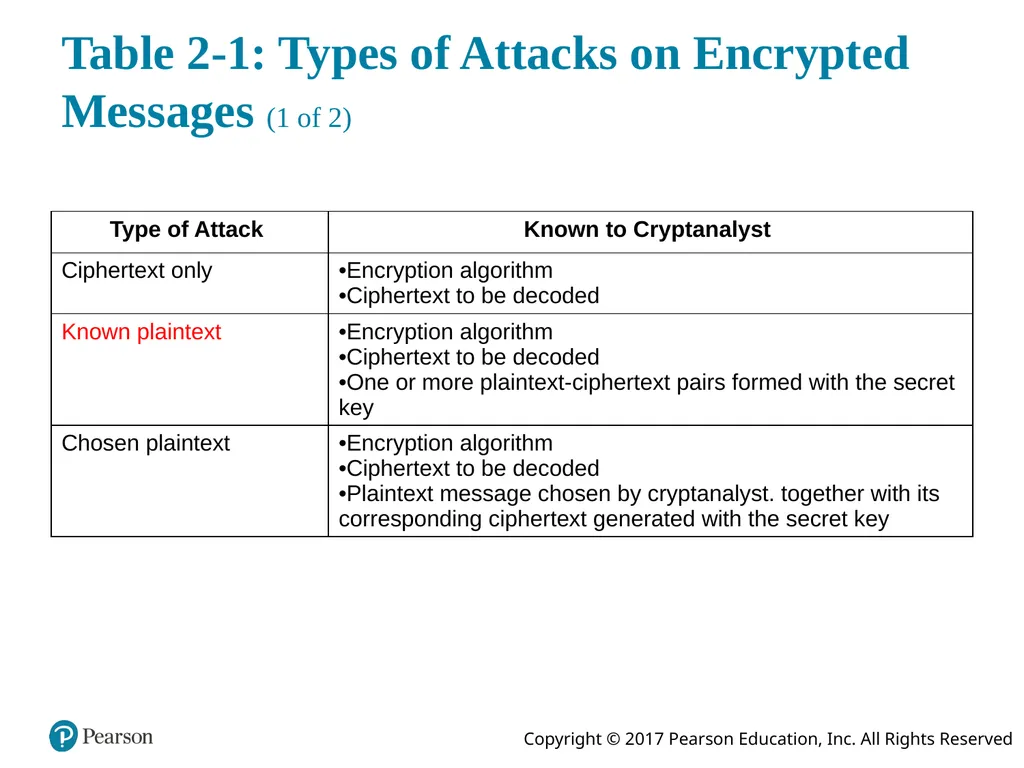
slide13. Table 2-1: Types of Attacks on Encrypted Messages (1 of 2)<br>
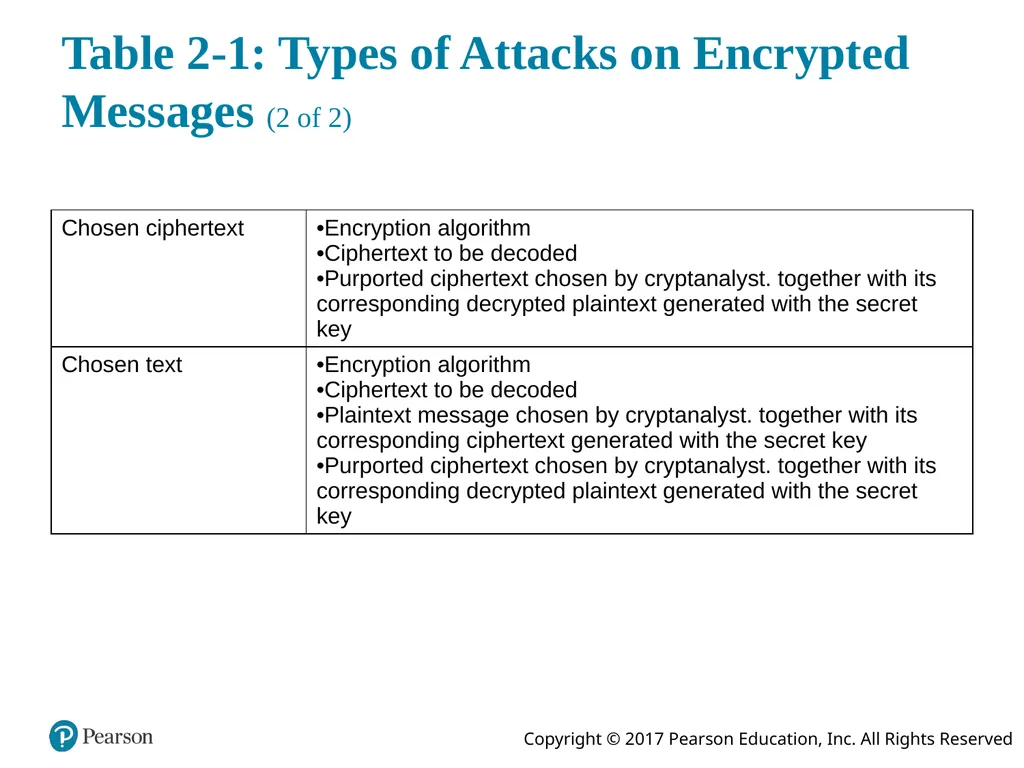
slide14. Table 2-1: Types of Attacks on Encrypted Messages (2 of 2)<br>
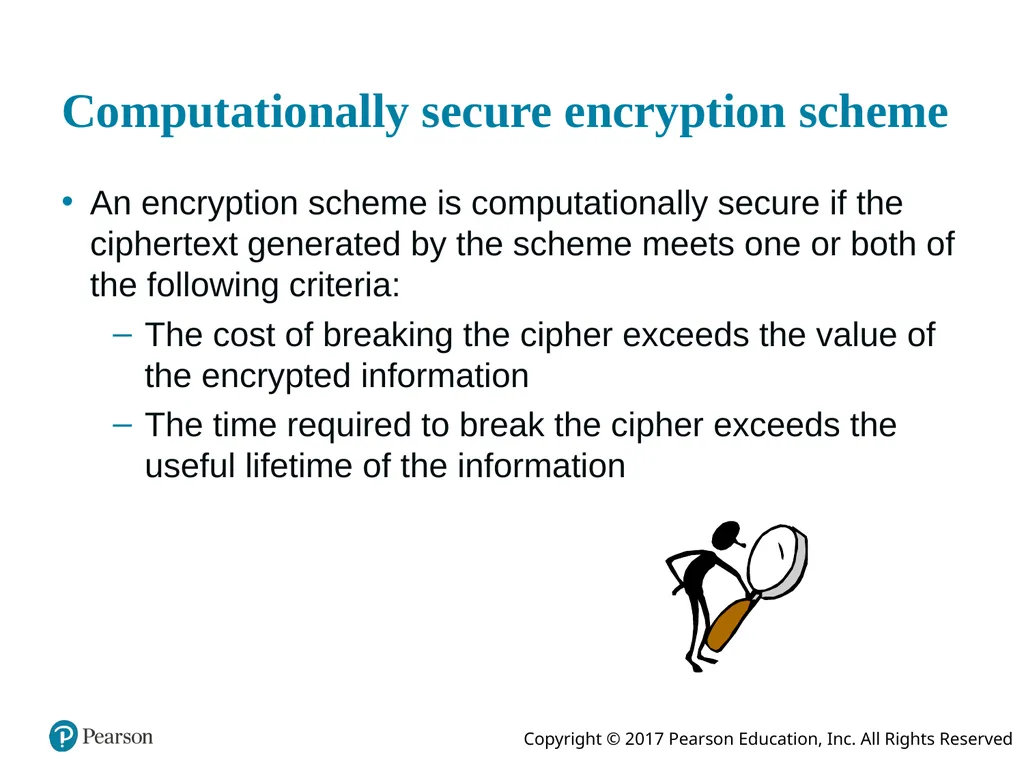
slide15. Computationally secure encryption scheme An encryption scheme is computationally secure if the ciphertext generated by the scheme meets one or both of the following criteria:
The cost of breaking the cipher exceeds the value of the encrypted information
The time required to break the cipher exceeds the useful lifetime of the information<br>
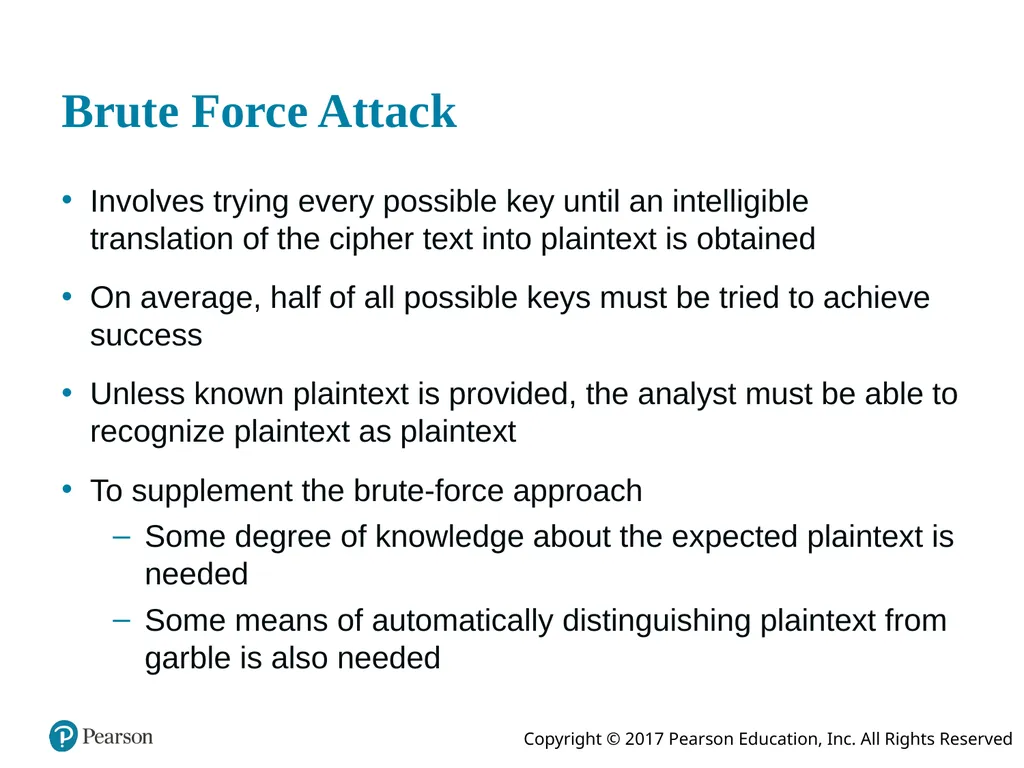
slide16. Brute Force Attack Involves trying every possible key until an intelligible translation of the cipher text into plaintext is obtained
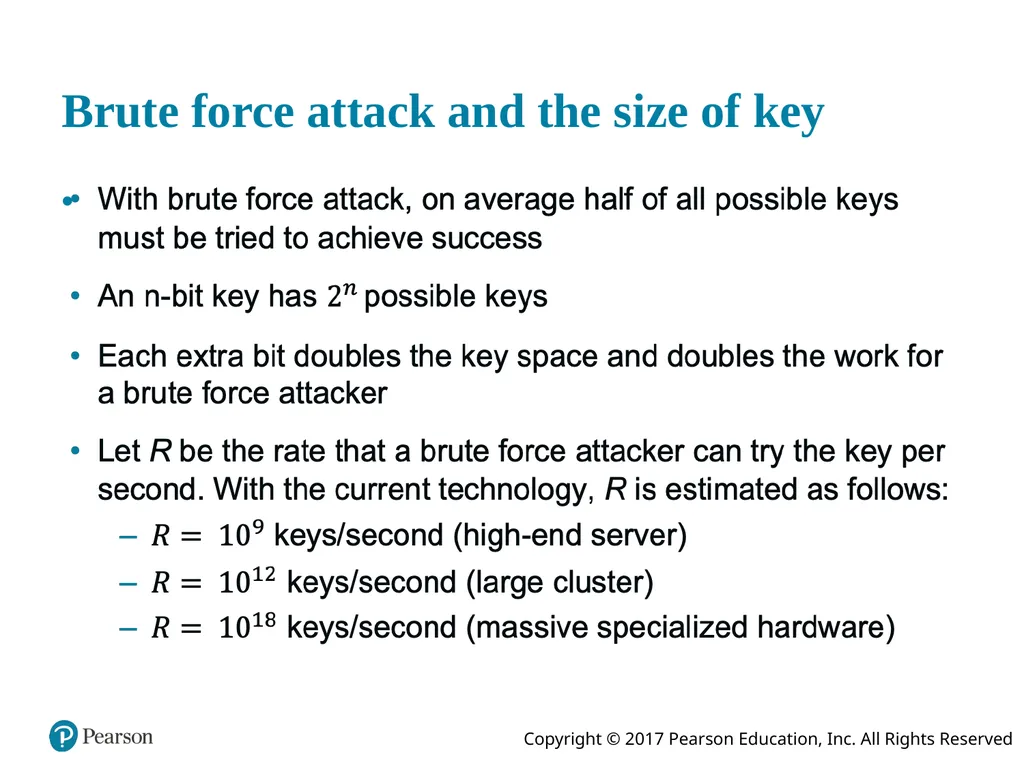
On average, half of all possible keys must be tried to achieve success
Unless known plaintext is provided, the analyst must be able to recognize plaintext as plaintext
To supplement the brute-force approach
Some degree of knowledge about the expected plaintext is needed
Some means of automatically distinguishing plaintext from garble is also needed<br>
slide17. Brute force attack and the size of key<br>
slide18. Brute force attack and the size of key<br>
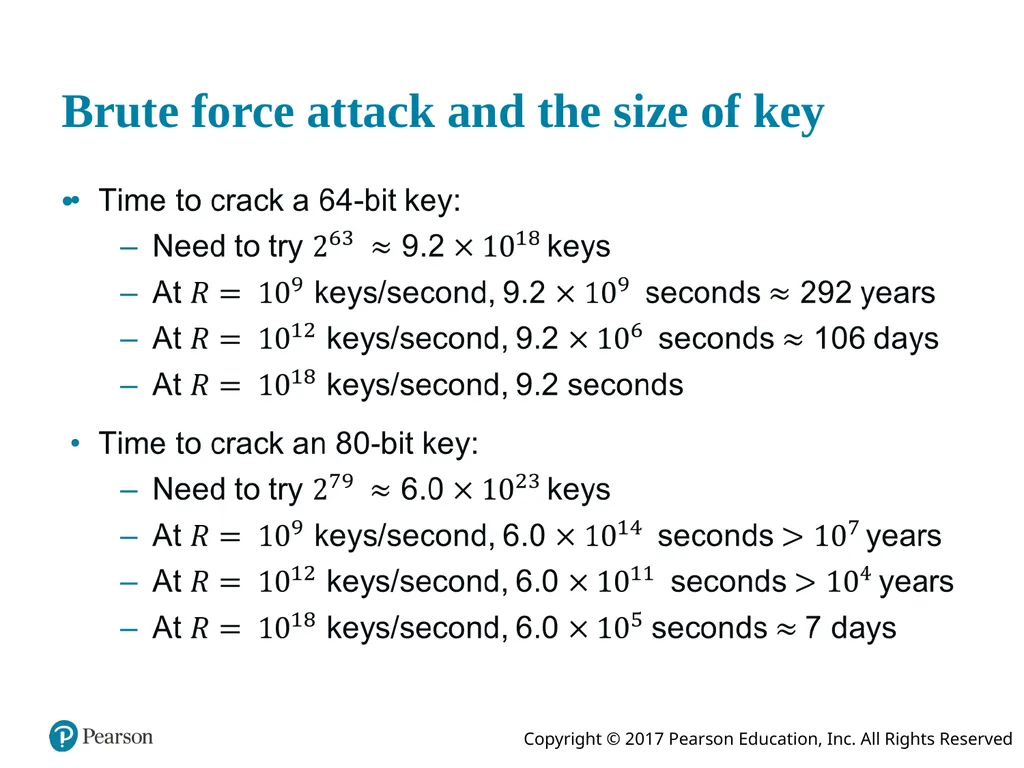
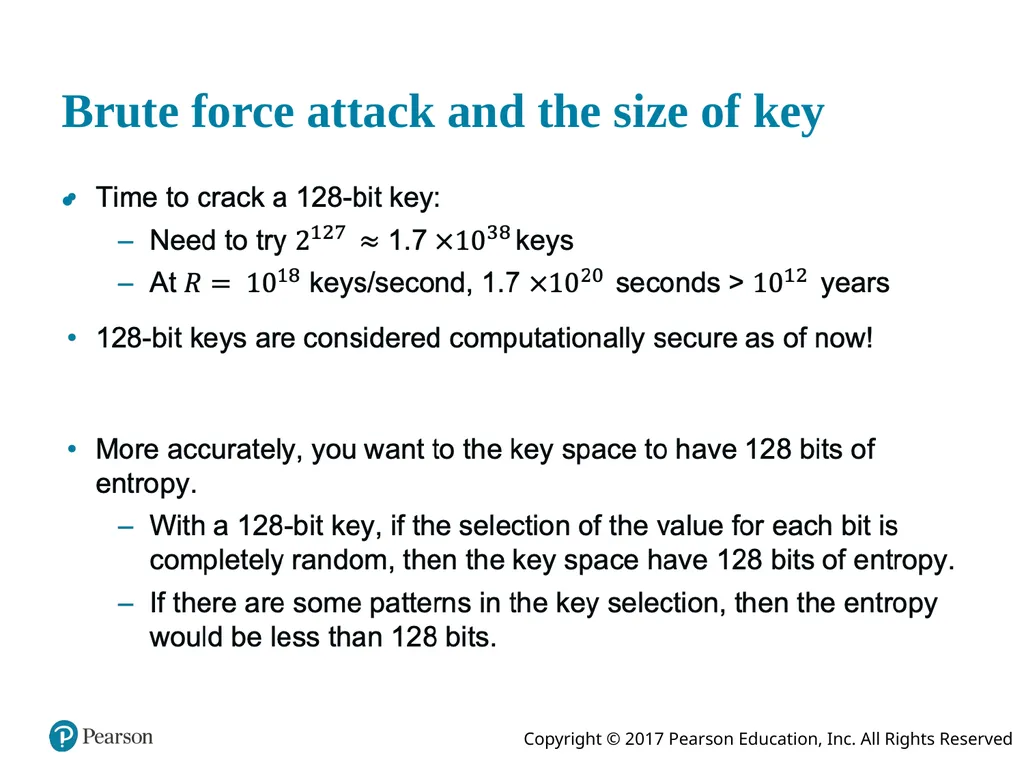
slide19. Brute force attack and the size of key<br>
slide20. Feistel Encryption and Decryption Many symmetric block encryption algorithms, including DES, have a structure similar to one first described by Horst Feistel of IBM in 1973
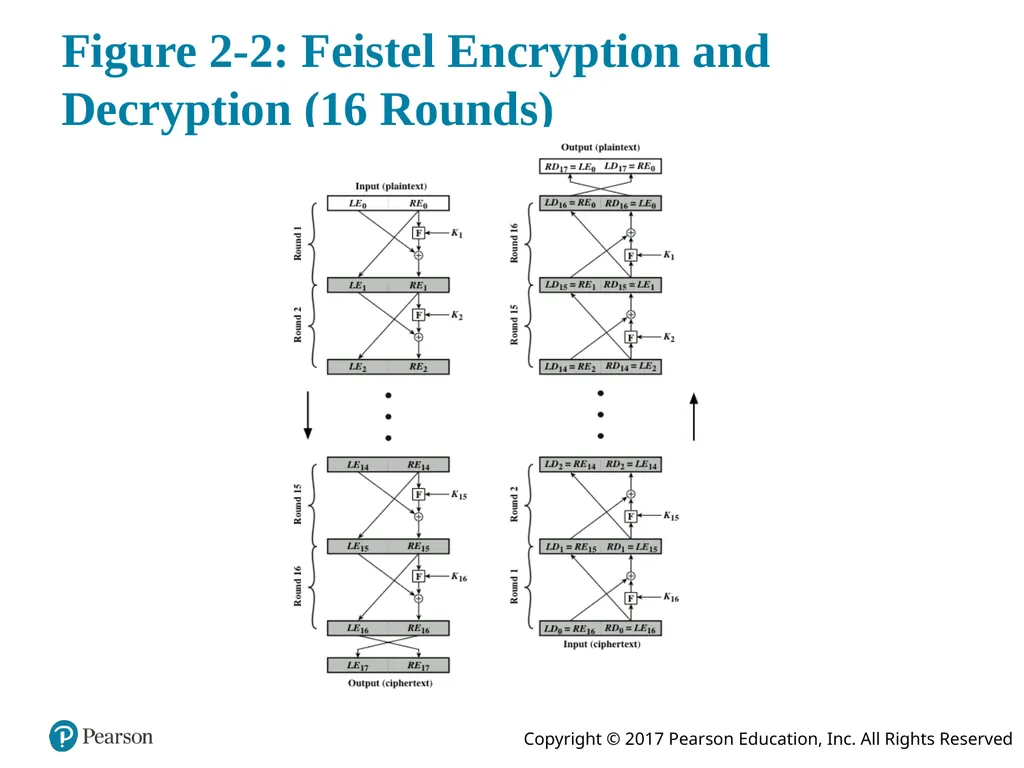
The plaintext block is divided into two halves. The two halves of the data pass through n rounds of processing and then combine to produce the ciphertext block.
The structure is shown in the next slide.<br>
slide21. Figure 2-2: Feistel Encryption and Decryption (16 Rounds)<br>
slide22. Feistel Cipher Design Elements (1 of 3) Block size
Larger block sizes mean greater security but reduced encryption/decryption speed
Key size
Larger key size means greater security but may decrease encryption/decryption speed
Number of rounds
The essence of a symmetric block cipher is that a single round offers inadequate security but that multiple rounds offer increasing security<br>
slide23. Feistel Cipher Design Elements (2 of 3) Sub key generation algorithm
Greater complexity in this algorithm should lead to greater difficulty of cryptanalysis
Round function
Greater complexity generally means greater resistance to cryptanalysis<br>
slide24. Feistel Cipher Design Elements (3 of 3) Fast software encryption/decryption
In many cases, encryption is embedded in applications or utility functions in such a way as to preclude a hardware implementation; accordingly, the speed of execution of the algorithm becomes a concern
Ease of analysis
If the algorithm can be concisely and clearly explained, it is easier to analyze that algorithm for cryptanalytic vulnerabilities and therefore develop a higher level of assurance as to its strength<br>
slide25. Symmetric Block Encryption Algorithms Block cipher
The most commonly used symmetric encryption algorithms
Processes the plaintext input in fixed-sized blocks and produces a block of ciphertext of equal size for each plaintext block
The three most important symmetric block ciphers
Data Encryption Standard (D E S)
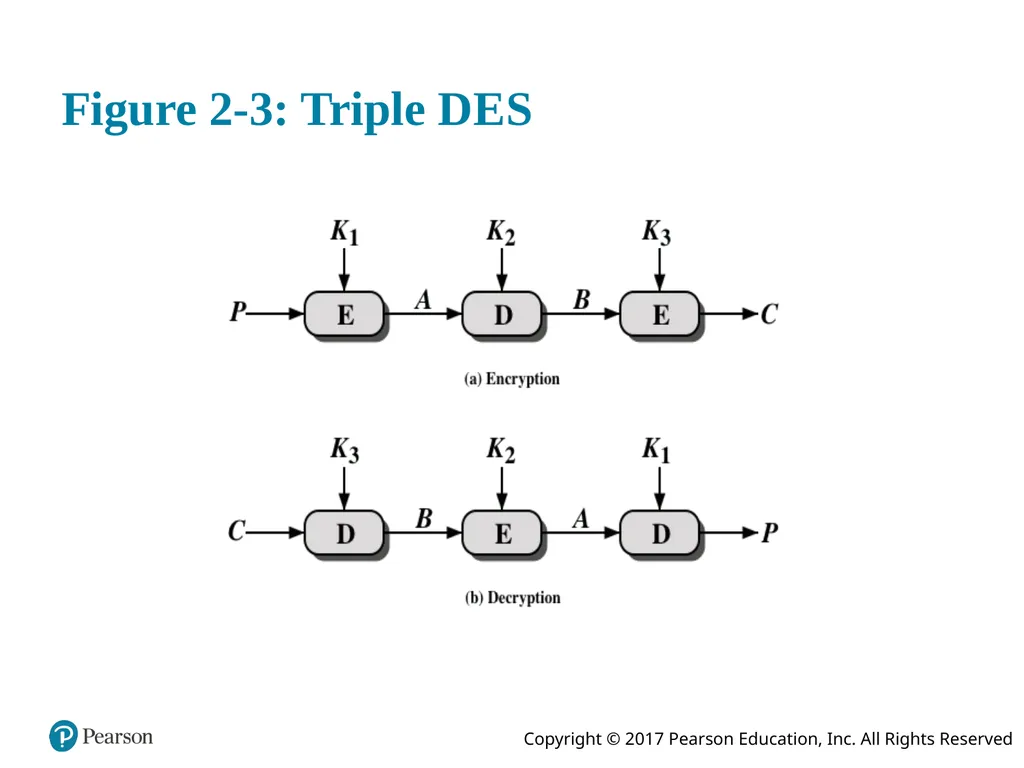
Triple DES (3 D E S)
Advanced Encryption Standard (A E S)<br>
slide26. Data Encryption Standard (D E S) Once most widely used encryption scheme
Issued in 1977 as Federal Information Processing Standard 46 (F I P S 46) by the National Institute of Standards and Technology (N I S T)
The algorithm itself is referred to as the Data Encryption Algorithm (D E A)<br>
slide27. D E S Algorithm (1 of 2) Description of the algorithm:
Plaintext is 64 bits in length
Key is 56 bits in length
Structure is a minor variation of the Feistel network
There are 16 rounds of processing
Process of decryption is essentially the same as the encryption process<br>
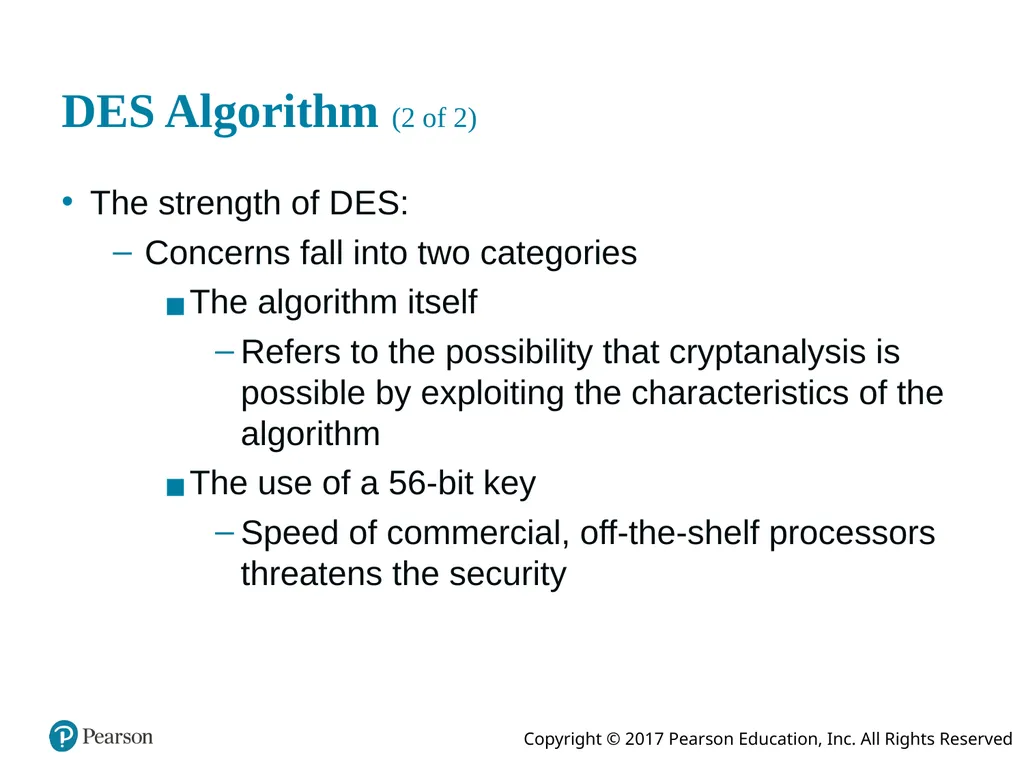
slide28. D E S Algorithm (2 of 2) The strength of D E S:
Concerns fall into two categories
The algorithm itself
Refers to the possibility that cryptanalysis is possible by exploiting the characteristics of the algorithm
The use of a 56-bit key
Speed of commercial, off-the-shelf processors threatens the security<br>
slide29. Figure 2-3: Triple D E S<br>
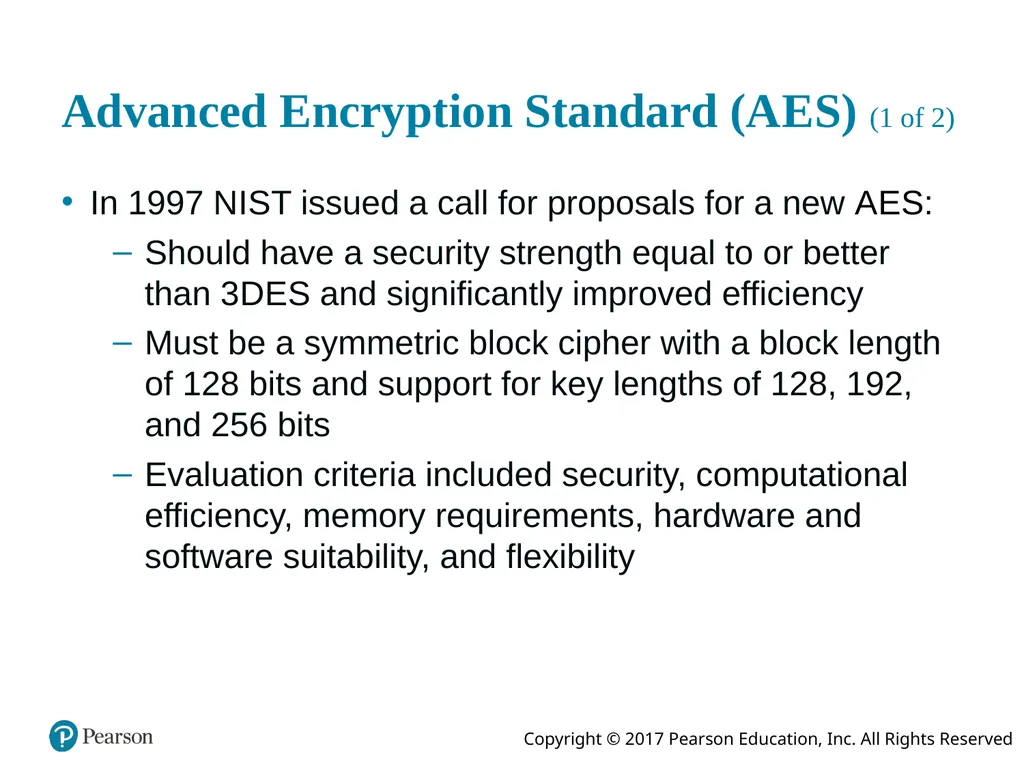
slide30. Advanced Encryption Standard (A E S) (1 of 2) In 1997 N I S T issued a call for proposals for a new A E S:
Should have a security strength equal to or better than 3 D E S and significantly improved efficiency
Must be a symmetric block cipher with a block length of 128 bits and support for key lengths of 128, 192, and 256 bits
Evaluation criteria included security, computational efficiency, memory requirements, hardware and software suitability, and flexibility<br>
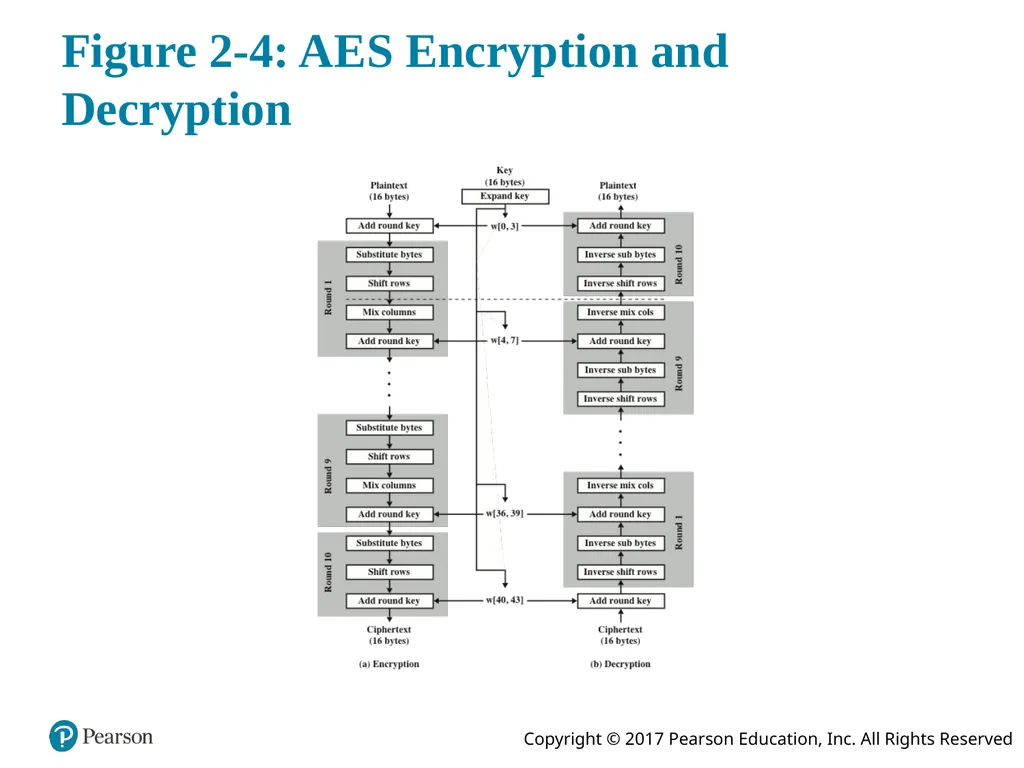
slide31. Advanced Encryption Standard (A E S) (2 of 2) N I S T selected Rijndael as the proposed A E S algorithm
F I P S P U B 197
Developers were two cryptographers from Belgium: Dr. Joan Daemen and Dr. Vincent Rijmen<br>
slide32. Figure 2-4: A E S Encryption and Decryption<br>
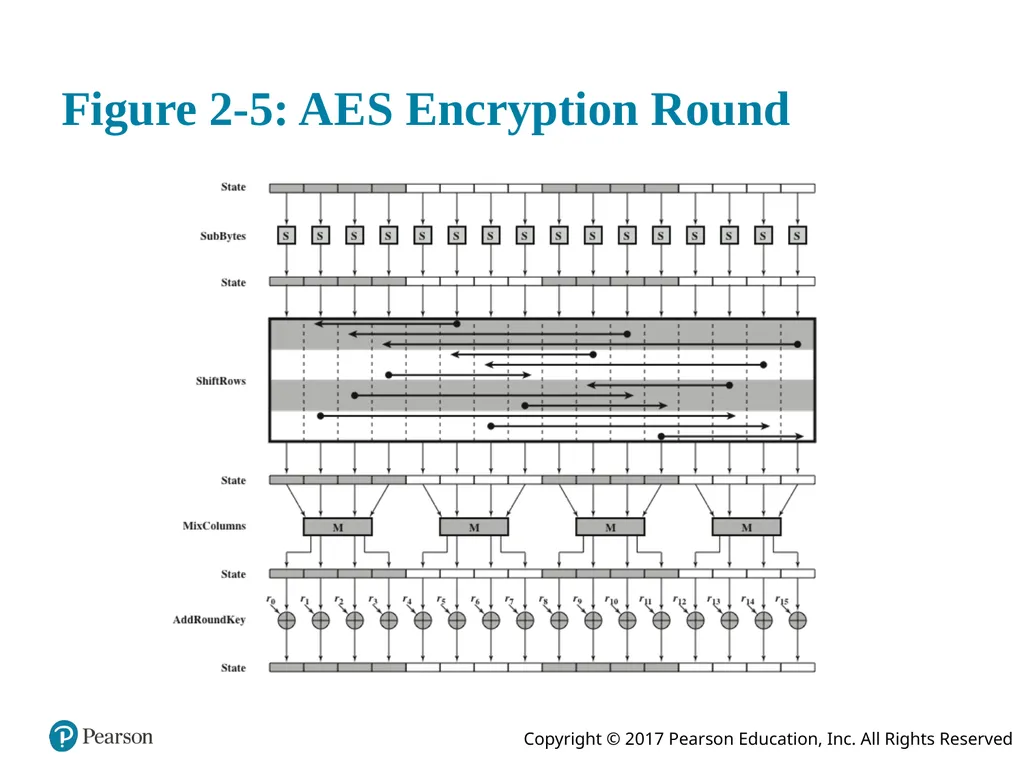
slide33. Figure 2-5: A E S Encryption Round<br>
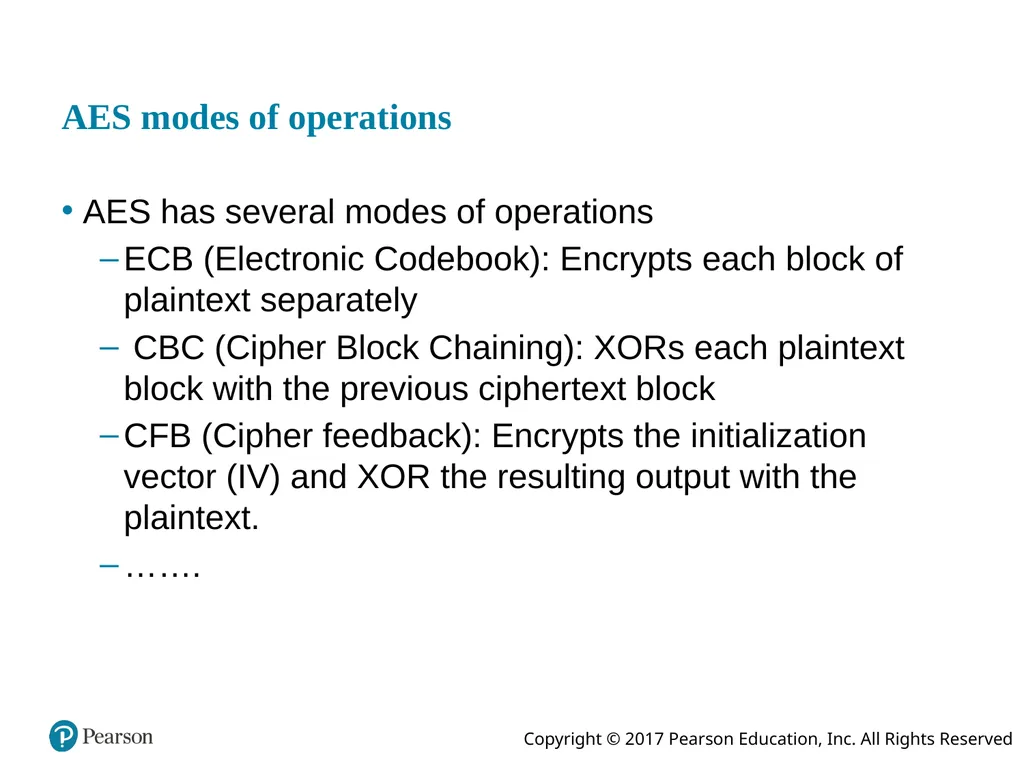
slide34. AES modes of operations AES has several modes of operations
ECB (Electronic Codebook): Encrypts each block of plaintext separately
CBC (Cipher Block Chaining): XORs each plaintext block with the previous ciphertext block
CFB (Cipher feedback): Encrypts the initialization vector (IV) and XOR the resulting output with the plaintext.
…….<br>
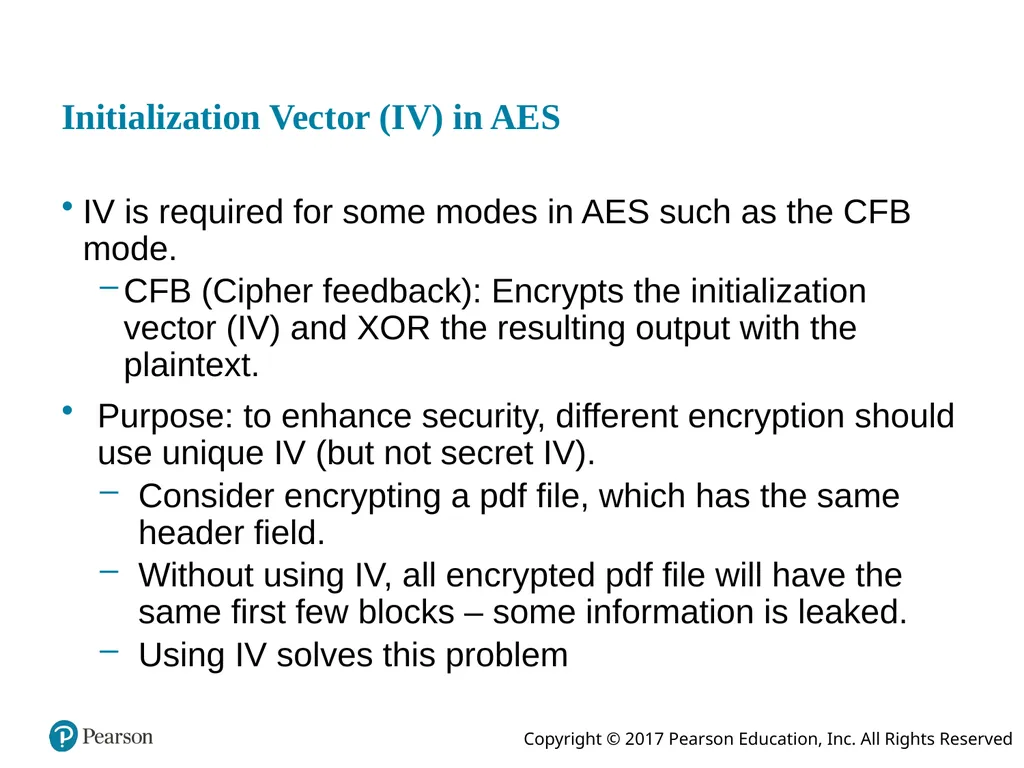
slide35. Initialization Vector (IV) in AES IV is required for some modes in AES such as the CFB mode.
CFB (Cipher feedback): Encrypts the initialization vector (IV) and XOR the resulting output with the plaintext.
Purpose: to enhance security, different encryption should use unique IV (but not secret IV).
Consider encrypting a pdf file, which has the same header field.
Without using IV, all encrypted pdf file will have the same first few blocks – some information is leaked.
Using IV solves this problem<br>
slide36. Symmetric Encryption in Python There are several cryptography libraries in Python
On linprog, pycryptodomex has been installed.
See lect15/encryption.py for an example AES encryption/decryption class.<br>
slide37. Copyright<br>
Message Confidentiality Copyright © 2017 Pearson Education, Inc. All Rights Reserved<br>
slide2. Cryptography Cryptography is the science or practice of securing information by transforming it into a form that only authorized parties can understand.
Cryptography protects data confidentiality, integrity, authenticity, and non-repudiation using mathematical techniques.
A cryptographic system is the framework to perform cryptography.<br>
slide3. Common Terminology in Cryptography Plaintext: The original readable message or data.
Ciphertext: The encrypted (scrambled) form of the plaintext.
Encryption: The process of converting plaintext into ciphertext using a key.
Decryption: The process of converting ciphertext back into plaintext using a key.
Key: A secret value used by the encryption and decryption algorithms.<br>
slide4. Classification of cryptographic systems (1 of 4 )<br>
slide5. Classification of cryptographic systems (2 of 4 ) Transposition: Elements in the plaintext are rearranged.
Transposition example: circularly shift right by 2: HELLO -> LOHEL
In general, a transposition allows the plaintext to be transformed to any permutation of its elements.
Fundamental requirement of the transformation operations is that no information be lost (the transformation is reversible).
Product systems usually involve multiple stages of substitutions and transpositions<br>
slide6. Classification of cryptographic systems (3 of 4) The number of keys used
Referred to as symmetric, single-key, secret-key, or conventional encryption if both sender and receiver use the same key
Referred to as asymmetric, two-key, or public-key encryption if the sender and receiver each use a different key<br>
slide7. Classification of cryptographic systems (4 of 4) The way in which the plaintext is processed
Block cipher processes the input one block of elements at a time, producing an output block for each input block
Stream cipher processes the input elements continuously, producing output one element at a time, as it goes along<br>
slide8. Symmetric encryption Also known as conventional encryption, single-key encryption, and secret-key encryption.
Most widely used encryption scheme.<br>
slide9. Figure 2-1: Simplified Model of Symmetric Encryption<br>
slide10. Requirements (1 of 2) There are two requirements for secure use of symmetric encryption:
A strong encryption algorithm
The opponent should be unable to decrypt ciphertext or discover the key even if he or she is in possession of a number of ciphertexts together with the plaintext that produced each ciphertext.
Sender and receiver must have obtained copies of the secret key in a secure fashion and must keep the key secure<br>
slide11. Requirements (2 of 2) The security of symmetric encryption depends on the secrecy of the key, not the secrecy of the algorithm
This makes it feasible for widespread use
Manufacturers can and have developed low-cost chip implementations of data encryption algorithms
These chips are widely available and incorporated into a number of products<br>
slide12. Cryptanalysis The process of attempting to discover the plaintext or key is known as cryptanalysis.
The strategy used by the cryptanalyst depends on the nature of the encryption scheme.<br>
slide13. Table 2-1: Types of Attacks on Encrypted Messages (1 of 2)<br>
slide14. Table 2-1: Types of Attacks on Encrypted Messages (2 of 2)<br>
slide15. Computationally secure encryption scheme An encryption scheme is computationally secure if the ciphertext generated by the scheme meets one or both of the following criteria:
The cost of breaking the cipher exceeds the value of the encrypted information
The time required to break the cipher exceeds the useful lifetime of the information<br>
slide16. Brute Force Attack Involves trying every possible key until an intelligible translation of the cipher text into plaintext is obtained
On average, half of all possible keys must be tried to achieve success
Unless known plaintext is provided, the analyst must be able to recognize plaintext as plaintext
To supplement the brute-force approach
Some degree of knowledge about the expected plaintext is needed
Some means of automatically distinguishing plaintext from garble is also needed<br>
slide17. Brute force attack and the size of key<br>
slide18. Brute force attack and the size of key<br>
slide19. Brute force attack and the size of key<br>
slide20. Feistel Encryption and Decryption Many symmetric block encryption algorithms, including DES, have a structure similar to one first described by Horst Feistel of IBM in 1973
The plaintext block is divided into two halves. The two halves of the data pass through n rounds of processing and then combine to produce the ciphertext block.
The structure is shown in the next slide.<br>
slide21. Figure 2-2: Feistel Encryption and Decryption (16 Rounds)<br>
slide22. Feistel Cipher Design Elements (1 of 3) Block size
Larger block sizes mean greater security but reduced encryption/decryption speed
Key size
Larger key size means greater security but may decrease encryption/decryption speed
Number of rounds
The essence of a symmetric block cipher is that a single round offers inadequate security but that multiple rounds offer increasing security<br>
slide23. Feistel Cipher Design Elements (2 of 3) Sub key generation algorithm
Greater complexity in this algorithm should lead to greater difficulty of cryptanalysis
Round function
Greater complexity generally means greater resistance to cryptanalysis<br>
slide24. Feistel Cipher Design Elements (3 of 3) Fast software encryption/decryption
In many cases, encryption is embedded in applications or utility functions in such a way as to preclude a hardware implementation; accordingly, the speed of execution of the algorithm becomes a concern
Ease of analysis
If the algorithm can be concisely and clearly explained, it is easier to analyze that algorithm for cryptanalytic vulnerabilities and therefore develop a higher level of assurance as to its strength<br>
slide25. Symmetric Block Encryption Algorithms Block cipher
The most commonly used symmetric encryption algorithms
Processes the plaintext input in fixed-sized blocks and produces a block of ciphertext of equal size for each plaintext block
The three most important symmetric block ciphers
Data Encryption Standard (D E S)
Triple DES (3 D E S)
Advanced Encryption Standard (A E S)<br>
slide26. Data Encryption Standard (D E S) Once most widely used encryption scheme
Issued in 1977 as Federal Information Processing Standard 46 (F I P S 46) by the National Institute of Standards and Technology (N I S T)
The algorithm itself is referred to as the Data Encryption Algorithm (D E A)<br>
slide27. D E S Algorithm (1 of 2) Description of the algorithm:
Plaintext is 64 bits in length
Key is 56 bits in length
Structure is a minor variation of the Feistel network
There are 16 rounds of processing
Process of decryption is essentially the same as the encryption process<br>
slide28. D E S Algorithm (2 of 2) The strength of D E S:
Concerns fall into two categories
The algorithm itself
Refers to the possibility that cryptanalysis is possible by exploiting the characteristics of the algorithm
The use of a 56-bit key
Speed of commercial, off-the-shelf processors threatens the security<br>
slide29. Figure 2-3: Triple D E S<br>
slide30. Advanced Encryption Standard (A E S) (1 of 2) In 1997 N I S T issued a call for proposals for a new A E S:
Should have a security strength equal to or better than 3 D E S and significantly improved efficiency
Must be a symmetric block cipher with a block length of 128 bits and support for key lengths of 128, 192, and 256 bits
Evaluation criteria included security, computational efficiency, memory requirements, hardware and software suitability, and flexibility<br>
slide31. Advanced Encryption Standard (A E S) (2 of 2) N I S T selected Rijndael as the proposed A E S algorithm
F I P S P U B 197
Developers were two cryptographers from Belgium: Dr. Joan Daemen and Dr. Vincent Rijmen<br>
slide32. Figure 2-4: A E S Encryption and Decryption<br>
slide33. Figure 2-5: A E S Encryption Round<br>
slide34. AES modes of operations AES has several modes of operations
ECB (Electronic Codebook): Encrypts each block of plaintext separately
CBC (Cipher Block Chaining): XORs each plaintext block with the previous ciphertext block
CFB (Cipher feedback): Encrypts the initialization vector (IV) and XOR the resulting output with the plaintext.
…….<br>
slide35. Initialization Vector (IV) in AES IV is required for some modes in AES such as the CFB mode.
CFB (Cipher feedback): Encrypts the initialization vector (IV) and XOR the resulting output with the plaintext.
Purpose: to enhance security, different encryption should use unique IV (but not secret IV).
Consider encrypting a pdf file, which has the same header field.
Without using IV, all encrypted pdf file will have the same first few blocks – some information is leaked.
Using IV solves this problem<br>
slide36. Symmetric Encryption in Python There are several cryptography libraries in Python
On linprog, pycryptodomex has been installed.
See lect15/encryption.py for an example AES encryption/decryption class.<br>
slide37. Copyright<br>