
Networking and partnership formation for AECD
DJ
Published · 120 slides · 0 views

1 / 1






Description
Networking and partnership formation for AECD University of Gondar College of Education Department of Adult Education and Community Development By Samuel Getnet MA, in Adult Education and Community Development Alone we can do so little;
Related Topics
Share
Embed code
Download this presentation From Below
"Networking and partnership formation for AECD" is the property of its rightful owner. Permission is granted to download and print the materials on this website for personal, non-commercial use only, and to display it on your personal computer provided you do not modify the materials and that you retain all copyright notices contained in the materials. By downloading content from our website, you accept the terms of this agreement.
Presentation Transcript
01
Networking and partnership
formation for AECD
University of Gondar
College of Education
Department of Adult Education and Community Development
By
Samuel Getnet
MA, in Adult Education and Community Development "Alone we can do so little; together we can do so much" 1<br>
02
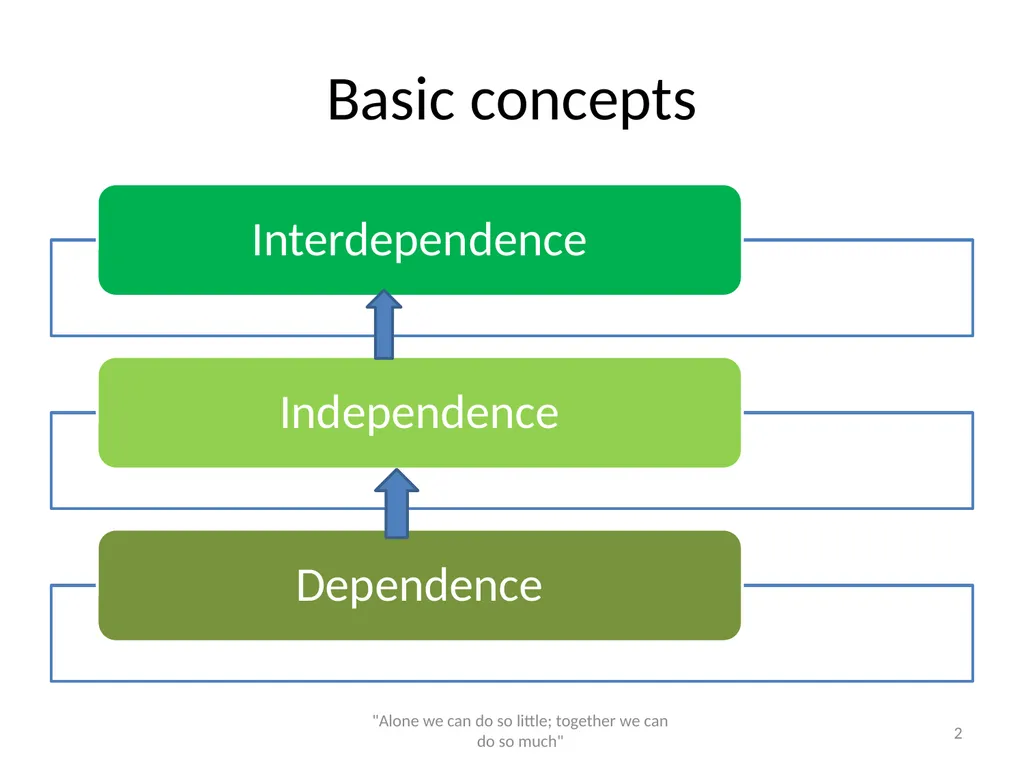
Basic concepts "Alone we can do so little; together we can do so much" 2<br>
03
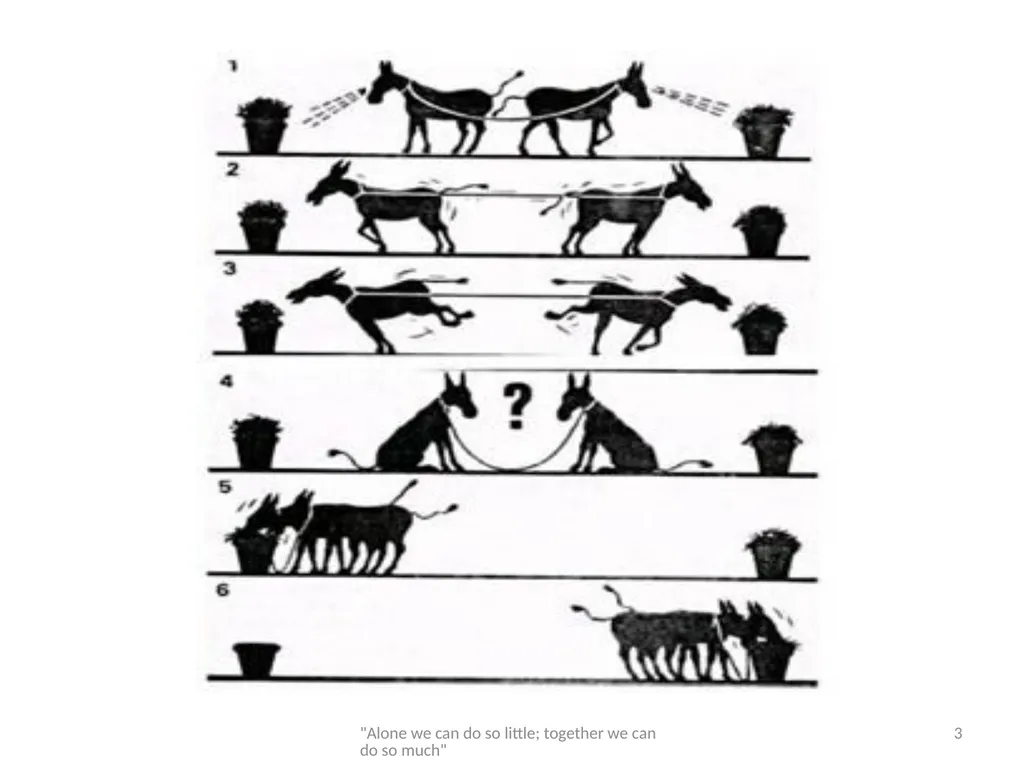
"Alone we can do so little; together we can do so much" 3<br>
04
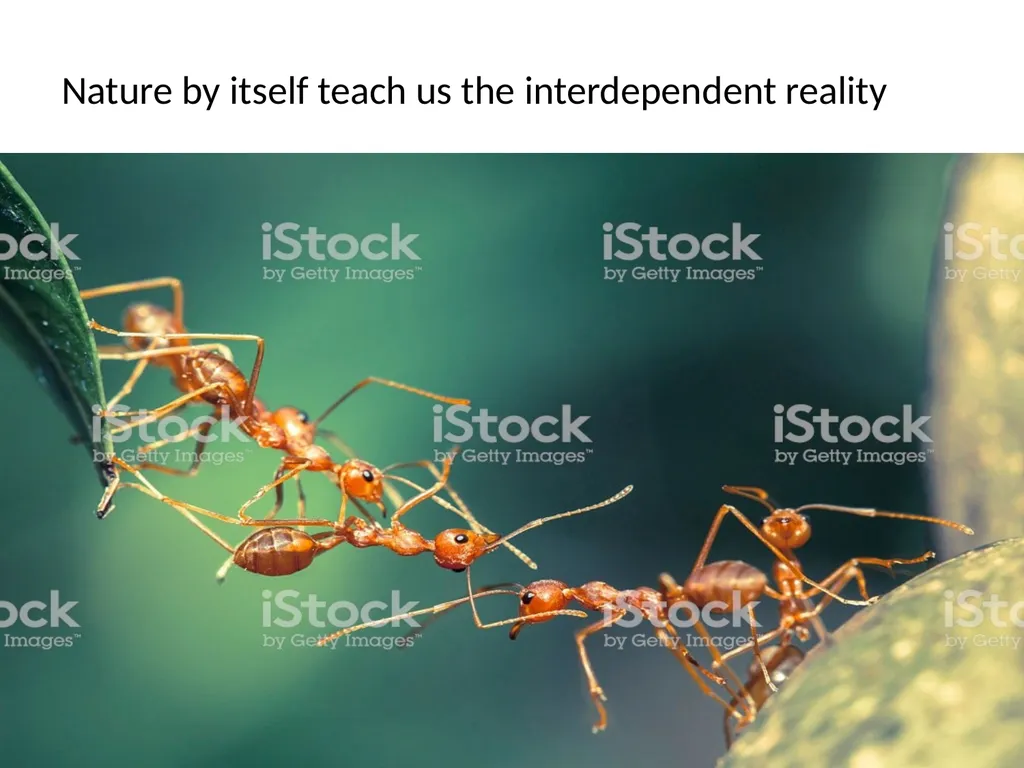
Nature by itself teach us the interdependent reality "Alone we can do so little; together we can do so much" 4<br>
05
Networking Networking is the exchange of information and ideas among people with a common profession or special interest
information, contacts or experience. "Alone we can do so little; together we can do so much" 5<br>
information, contacts or experience. "Alone we can do so little; together we can do so much" 5<br>
06
Principles of Networking 1. Give more than you get
Networking is a two-way street.
There is nothing wrong with wanting to get something positive for yourself out of your networking efforts, but it’s important to take an approach that will also benefit others in your network.
When you want to strengthen a relationship with someone in your network, and connect for the first time with someone, think about ways that you could help them "Alone we can do so little; together we can do so much" 6<br>
Networking is a two-way street.
There is nothing wrong with wanting to get something positive for yourself out of your networking efforts, but it’s important to take an approach that will also benefit others in your network.
When you want to strengthen a relationship with someone in your network, and connect for the first time with someone, think about ways that you could help them "Alone we can do so little; together we can do so much" 6<br>
07
2. Be genuine
It’s important to be genuine in your networking efforts, and really make an effort to get to know the people that you want to connect with. "Alone we can do so little; together we can do so much" 7<br>
It’s important to be genuine in your networking efforts, and really make an effort to get to know the people that you want to connect with. "Alone we can do so little; together we can do so much" 7<br>
08
3. Be proactive
4. Take a long-term approach
Building a strong network, takes time.
The real value of those efforts will be seen in time. "Alone we can do so little; together we can do so much" 8<br>
4. Take a long-term approach
Building a strong network, takes time.
The real value of those efforts will be seen in time. "Alone we can do so little; together we can do so much" 8<br>
09
5. Prioritize quality over quantity
It’s not important that you have thousands of people in your network.
What is much more important is the quality of those connections. "Alone we can do so little; together we can do so much" 9<br>
It’s not important that you have thousands of people in your network.
What is much more important is the quality of those connections. "Alone we can do so little; together we can do so much" 9<br>
10
6. Be approachable
make sure that whether others are able to easily reach out to you. "Alone we can do so little; together we can do so much" 10<br>
make sure that whether others are able to easily reach out to you. "Alone we can do so little; together we can do so much" 10<br>
11
7. Set aside time for networking
it should be a part of your daily, or at least weekly, schedule. "Alone we can do so little; together we can do so much" 11<br>
it should be a part of your daily, or at least weekly, schedule. "Alone we can do so little; together we can do so much" 11<br>
12
Inter-sectoral arrangements Partnership vs. collaboration
Different concepts, often perceived similarly
Both implies relationships
But level of relationship between or among parties is different "Alone we can do so little; together we can do so much" 12<br>
Different concepts, often perceived similarly
Both implies relationships
But level of relationship between or among parties is different "Alone we can do so little; together we can do so much" 12<br>
13
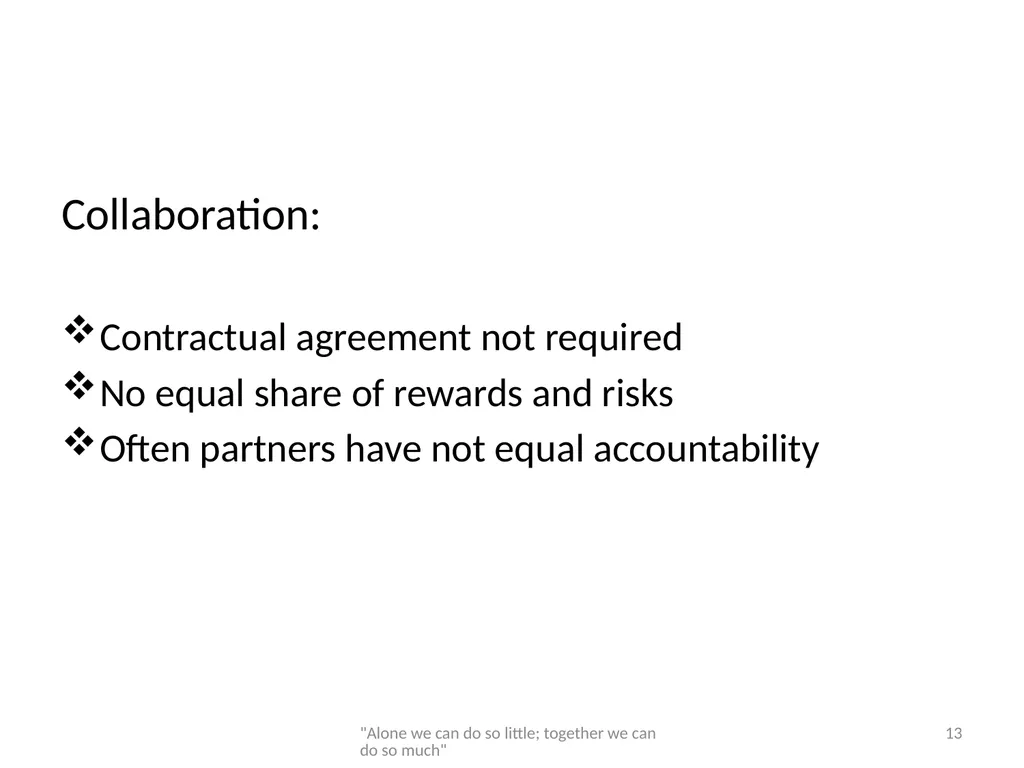
Collaboration:
Contractual agreement not required
No equal share of rewards and risks
Often partners have not equal accountability "Alone we can do so little; together we can do so much" 13<br>
Contractual agreement not required
No equal share of rewards and risks
Often partners have not equal accountability "Alone we can do so little; together we can do so much" 13<br>
14
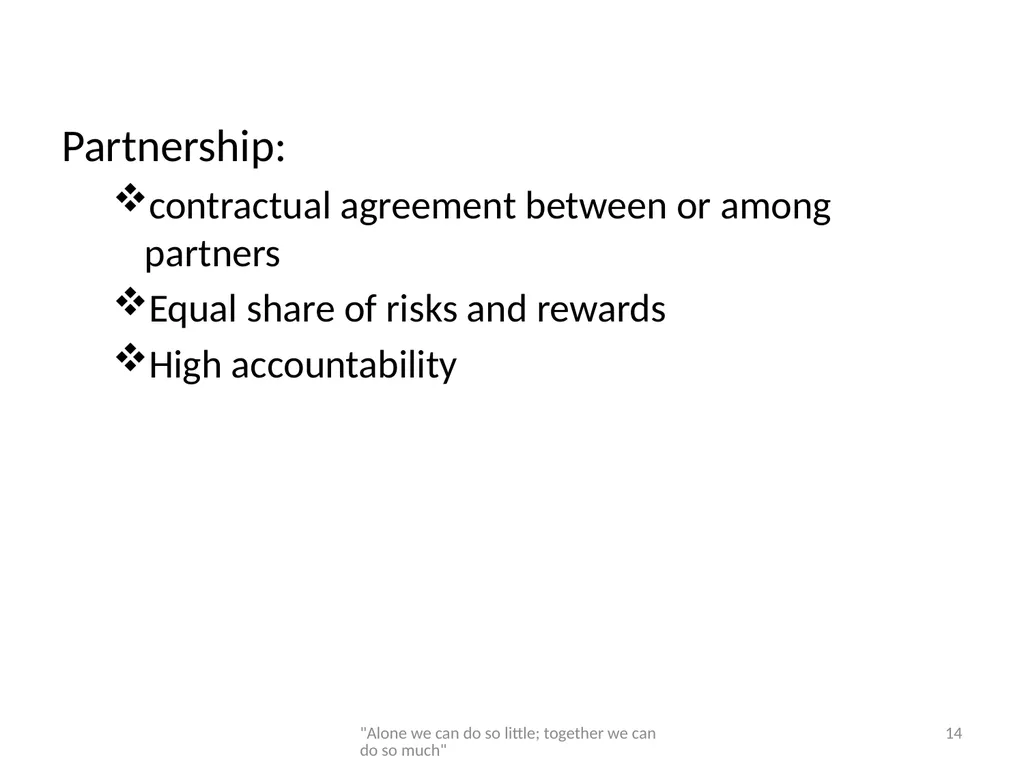
Partnership:
contractual agreement between or among partners
Equal share of risks and rewards
High accountability "Alone we can do so little; together we can do so much" 14<br>
contractual agreement between or among partners
Equal share of risks and rewards
High accountability "Alone we can do so little; together we can do so much" 14<br>
15
What is partnership? "Alone we can do so little; together we can do so much" 15<br>
16
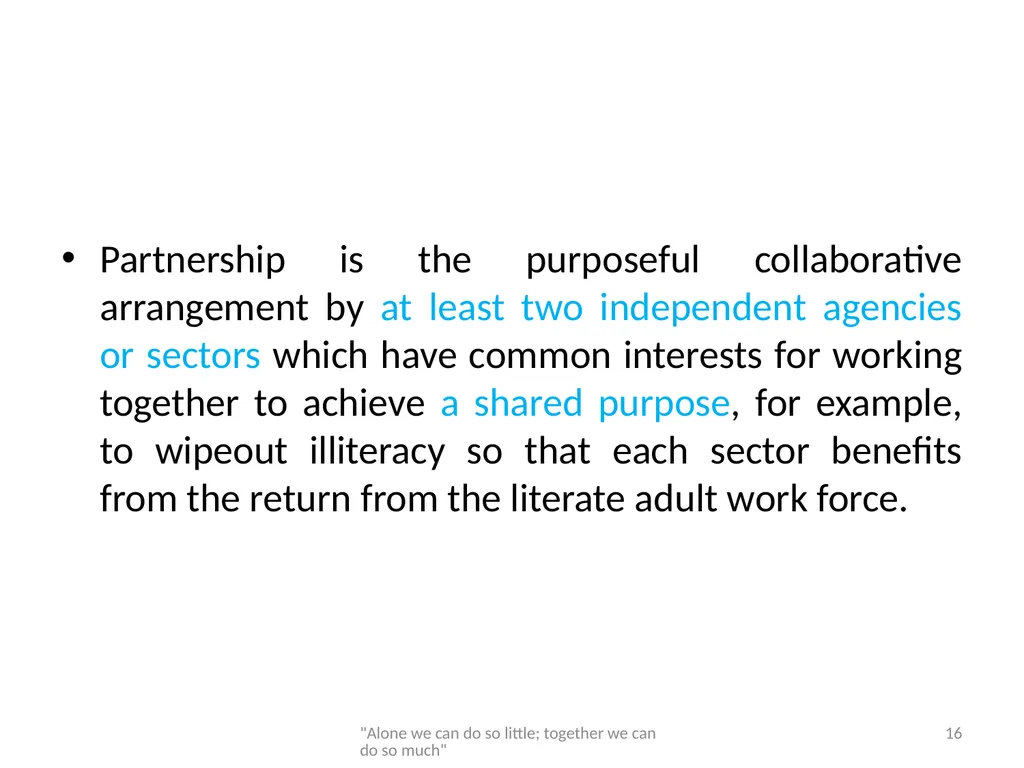
Partnership is the purposeful collaborative arrangement by at least two independent agencies or sectors which have common interests for working together to achieve a shared purpose, for example, to wipeout illiteracy so that each sector benefits from the return from the literate adult work force. "Alone we can do so little; together we can do so much" 16<br>
17
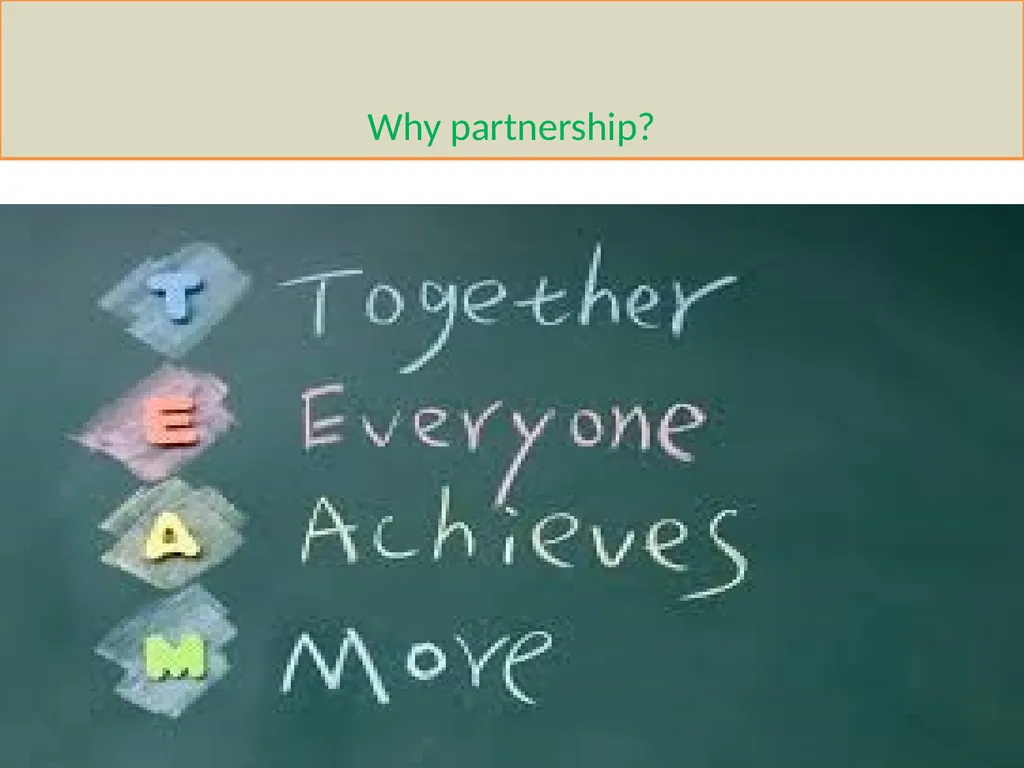
Why partnership? "Alone we can do so little; together we can do so much" 17<br>
18
It enables to make services more accessible and effective by avoiding duplication of efforts and reduction of individual expenses (Mattessich & Monsey, 1992).
Specifically, It resulted in;
improved decision-making,
improved problem-solving,
broader information/perspective on system issues, "Alone we can do so little; together we can do so much" 18<br>
Specifically, It resulted in;
improved decision-making,
improved problem-solving,
broader information/perspective on system issues, "Alone we can do so little; together we can do so much" 18<br>
19
decreased individual risk and increased risk sharing among partners,
increased ability to handle uncertainty and
increased ability to adapt to changing environment
increased opportunities for effectiveness, efficiency, and equity "Alone we can do so little; together we can do so much" 19<br>
increased ability to handle uncertainty and
increased ability to adapt to changing environment
increased opportunities for effectiveness, efficiency, and equity "Alone we can do so little; together we can do so much" 19<br>
20
Effectiveness, efficiency, and equity Effectiveness:
Degree to which objectives are achieved and the extent to which targeted problems are resolved.
effectiveness is determined without reference to costs
effectiveness means "doing the right thing."
Efficiency:
ability to produce a desired effect, product, etc. with a minimum of effort, expense, or waste;
quality or fact of being efficient
the ratio of the effective or useful output to the total input in any system.
"doing the thing right,"
Note: effectiveness does not imply efficiency "Alone we can do so little; together we can do so much" 20<br>
Degree to which objectives are achieved and the extent to which targeted problems are resolved.
effectiveness is determined without reference to costs
effectiveness means "doing the right thing."
Efficiency:
ability to produce a desired effect, product, etc. with a minimum of effort, expense, or waste;
quality or fact of being efficient
the ratio of the effective or useful output to the total input in any system.
"doing the thing right,"
Note: effectiveness does not imply efficiency "Alone we can do so little; together we can do so much" 20<br>
21
Equity:
Equity is about ensuring the extent that goods and services are fairly divided among recipients. "Alone we can do so little; together we can do so much" 21<br>
Equity is about ensuring the extent that goods and services are fairly divided among recipients. "Alone we can do so little; together we can do so much" 21<br>
22
Components of partnership 1. Leadership
Partnerships imply a shared leadership among respected individuals who are recognized and empowered by their own organizations and trusted by partners to build consensus and resolve conflicts. "Alone we can do so little; together we can do so much" 22<br>
Partnerships imply a shared leadership among respected individuals who are recognized and empowered by their own organizations and trusted by partners to build consensus and resolve conflicts. "Alone we can do so little; together we can do so much" 22<br>
23
2. Common Understanding
There must be a common understanding of the framework, culture, values, and approach of partner organizations.
A clear understanding of individual members’ roles and responsibilities regarding the division of labor. "Alone we can do so little; together we can do so much" 23<br>
There must be a common understanding of the framework, culture, values, and approach of partner organizations.
A clear understanding of individual members’ roles and responsibilities regarding the division of labor. "Alone we can do so little; together we can do so much" 23<br>
24
3. Purpose
A shared common vision and purpose that builds trust and openness and recognizes the value and contribution of all members needs to exist. "Alone we can do so little; together we can do so much" 24<br>
A shared common vision and purpose that builds trust and openness and recognizes the value and contribution of all members needs to exist. "Alone we can do so little; together we can do so much" 24<br>
25
4. Culture and Values
Shared values, understanding, and an acceptance of differences (e.g., values, ways of working) are important.
Having respect for the contributions of all partners, combined with an absence of status barriers, will lead to the active involvement of members who are identified as being effective, representative, and capable of playing a valued role in the partnership. "Alone we can do so little; together we can do so much" 25<br>
Shared values, understanding, and an acceptance of differences (e.g., values, ways of working) are important.
Having respect for the contributions of all partners, combined with an absence of status barriers, will lead to the active involvement of members who are identified as being effective, representative, and capable of playing a valued role in the partnership. "Alone we can do so little; together we can do so much" 25<br>
26
5. Learning and Development
A healthy partnership promotes an atmosphere of learning.
It needs members’ well performance. Investing in partner skills, knowledge, and competence needs to be highly valued within the partnership.
This open mindset and spirit of facilitation creates opportunities to shape each other’s work and learn together. "Alone we can do so little; together we can do so much" 26<br>
A healthy partnership promotes an atmosphere of learning.
It needs members’ well performance. Investing in partner skills, knowledge, and competence needs to be highly valued within the partnership.
This open mindset and spirit of facilitation creates opportunities to shape each other’s work and learn together. "Alone we can do so little; together we can do so much" 26<br>
27
6. Communication
If a partnership is going to succeed in the area of communication, strong feedback loops are required.
Effective communication at all levels within the partnership and within partner organizations, sharing and accessing all knowledge and information, needs to exist. "Alone we can do so little; together we can do so much" 27<br>
If a partnership is going to succeed in the area of communication, strong feedback loops are required.
Effective communication at all levels within the partnership and within partner organizations, sharing and accessing all knowledge and information, needs to exist. "Alone we can do so little; together we can do so much" 27<br>
28
7. Performance Management
Management practices and resources are required to achieve the partnership goals and complement the intended purpose of the partnership.
Specifically, members must demonstrate accountability for the actions they take and ownership of delivery of the objectives and targets for which they are responsible. "Alone we can do so little; together we can do so much" 28<br>
Management practices and resources are required to achieve the partnership goals and complement the intended purpose of the partnership.
Specifically, members must demonstrate accountability for the actions they take and ownership of delivery of the objectives and targets for which they are responsible. "Alone we can do so little; together we can do so much" 28<br>
29
Forms of partnership
1. Cross sector partnerships 1. Public-public partnership
Formed by different public organizations/sectors
Why?
In Government structure sectors are mandated to a certain task or services. However, some issue may remained untreated due to the division of powers across departments and levels of government.
wicked issues (activities or services cut across or fall between boundaries in sectors) "Alone we can do so little; together we can do so much" 29<br>
Formed by different public organizations/sectors
Why?
In Government structure sectors are mandated to a certain task or services. However, some issue may remained untreated due to the division of powers across departments and levels of government.
wicked issues (activities or services cut across or fall between boundaries in sectors) "Alone we can do so little; together we can do so much" 29<br>
30
It is about ‘‘Joining up’’: it aims to coordinate activities across organizational boundaries without removing the boundaries themselves.
E.g. the collaboration of different public sectors in IFAE program in Ethiopia "Alone we can do so little; together we can do so much" 30<br>
E.g. the collaboration of different public sectors in IFAE program in Ethiopia "Alone we can do so little; together we can do so much" 30<br>
31
2. Public-Private partnership
Formed by public organizations/sectors and private/business sectors.
To gain managerial, technical, or professional expertise; develop more flexible service provision
‘‘contractual partnership arrangements’’ or ‘‘joint venture partnerships’’ "Alone we can do so little; together we can do so much" 31<br>
Formed by public organizations/sectors and private/business sectors.
To gain managerial, technical, or professional expertise; develop more flexible service provision
‘‘contractual partnership arrangements’’ or ‘‘joint venture partnerships’’ "Alone we can do so little; together we can do so much" 31<br>
32
3. Public-Nonprofit Partnership
formed by public organizations/sectors and nonprofit sectors.
The not-for-profit, third, or voluntary sector is often possessing a number of distinctive virtues/ third sector activities/. "Alone we can do so little; together we can do so much" 32<br>
formed by public organizations/sectors and nonprofit sectors.
The not-for-profit, third, or voluntary sector is often possessing a number of distinctive virtues/ third sector activities/. "Alone we can do so little; together we can do so much" 32<br>
33
It enable to understand and voice the needs of disadvantaged, excluded, and underrepresented groups.
For public organizations seeking to enhance the fairness of service delivery decisions, partnership with third sector organizations is, therefore, essential. "Alone we can do so little; together we can do so much" 33<br>
For public organizations seeking to enhance the fairness of service delivery decisions, partnership with third sector organizations is, therefore, essential. "Alone we can do so little; together we can do so much" 33<br>
34
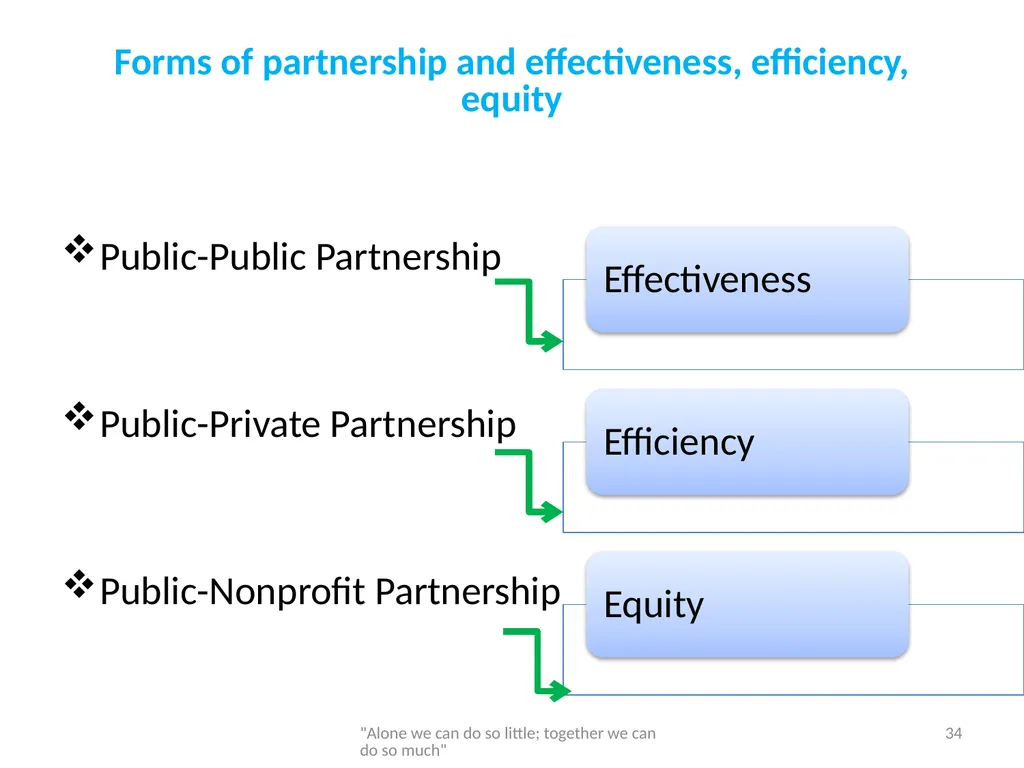
Forms of partnership and effectiveness, efficiency, equity Public-Public Partnership
Public-Private Partnership
Public-Nonprofit Partnership "Alone we can do so little; together we can do so much" 34<br>
Public-Private Partnership
Public-Nonprofit Partnership "Alone we can do so little; together we can do so much" 34<br>
35
2. Partnerships among Community-based Nonprofit Service Organizations From a community development perspective, the test to determine if these partnerships are effective is whether they actually contribute to what will empower people for social and economic change.
Important components for the effectiveness of these kind of partnerships:
close, mutual cooperation;
common goals;
shared involvement in decision making;
sharing risks and benefits;
common interests;
responsibilities; and
power. "Alone we can do so little; together we can do so much" 35<br>
Important components for the effectiveness of these kind of partnerships:
close, mutual cooperation;
common goals;
shared involvement in decision making;
sharing risks and benefits;
common interests;
responsibilities; and
power. "Alone we can do so little; together we can do so much" 35<br>
36
There are a number of properties to assess when considering how the “community” and the “partnership” establish and sustain a relationship.
Leadership: who is providing the leadership in the partnership.
Primary funding: An institutional partner can bring resources to the table
Goals: develop them through consensus decision- making
Process: inclusive decision making process
it is about how actively, and deeply, engage the community "Alone we can do so little; together we can do so much" 36<br>
Leadership: who is providing the leadership in the partnership.
Primary funding: An institutional partner can bring resources to the table
Goals: develop them through consensus decision- making
Process: inclusive decision making process
it is about how actively, and deeply, engage the community "Alone we can do so little; together we can do so much" 36<br>
37
3. Partnerships between Donors and Recipients Partnerships between donors and recipients can often create confusion. Is a partnership just receiving money? "Alone we can do so little; together we can do so much" 37<br>
38
A partnership is not a gift.
a partnership seeks joint “ownership” of the relationship
A partnership is not a relationship based on “if…then” terms
donors cannot impose conditions to coerce FBCOs to do things that they don’t want to do in order to obtain resources they need "Alone we can do so little; together we can do so much" 38<br>
a partnership seeks joint “ownership” of the relationship
A partnership is not a relationship based on “if…then” terms
donors cannot impose conditions to coerce FBCOs to do things that they don’t want to do in order to obtain resources they need "Alone we can do so little; together we can do so much" 38<br>
39
A partnership is not a principal-agent relationship between a donor and a recipient:
the donor cannot prescribe the terms of the relationship in the way that an employer can specify terms of employment when hiring a worker
A partnership is not simply a “team” activity
members of a partnership certainly have strong interests in common, they are likely to have some divergent interests too.
E.g. In sports team, everyone has exactly the same interest in winning, and the team members win or lose together. "Alone we can do so little; together we can do so much" 39<br>
the donor cannot prescribe the terms of the relationship in the way that an employer can specify terms of employment when hiring a worker
A partnership is not simply a “team” activity
members of a partnership certainly have strong interests in common, they are likely to have some divergent interests too.
E.g. In sports team, everyone has exactly the same interest in winning, and the team members win or lose together. "Alone we can do so little; together we can do so much" 39<br>
40
Forming partnership Beginning the process of partnership development is a big concern.
It has three essential steps:
Step 1: Defining the needs for partnership
Step 2: Starting the process
Step 3: Setting up and maintaining partnership "Alone we can do so little; together we can do so much" 40<br>
It has three essential steps:
Step 1: Defining the needs for partnership
Step 2: Starting the process
Step 3: Setting up and maintaining partnership "Alone we can do so little; together we can do so much" 40<br>
41
Step 1: Defining the needs for partnership Partnership should be formed if a goal requires the engagement of diverse stakeholders operating within a complex civic system.
Examples include the education system (made up of school districts, colleges, universities, tutoring programs, and dozens of other stakeholders) "Alone we can do so little; together we can do so much" 41<br>
Examples include the education system (made up of school districts, colleges, universities, tutoring programs, and dozens of other stakeholders) "Alone we can do so little; together we can do so much" 41<br>
42
Step 2: Starting the process The process for building and developing relationships within the partnership is not just the responsibility of the person(s) who lead the group, but of everyone in that group.
The stages of developing a partnership could be passed these four stages:
forming,
storming,
norming
performing. "Alone we can do so little; together we can do so much" 42<br>
The stages of developing a partnership could be passed these four stages:
forming,
storming,
norming
performing. "Alone we can do so little; together we can do so much" 42<br>
43
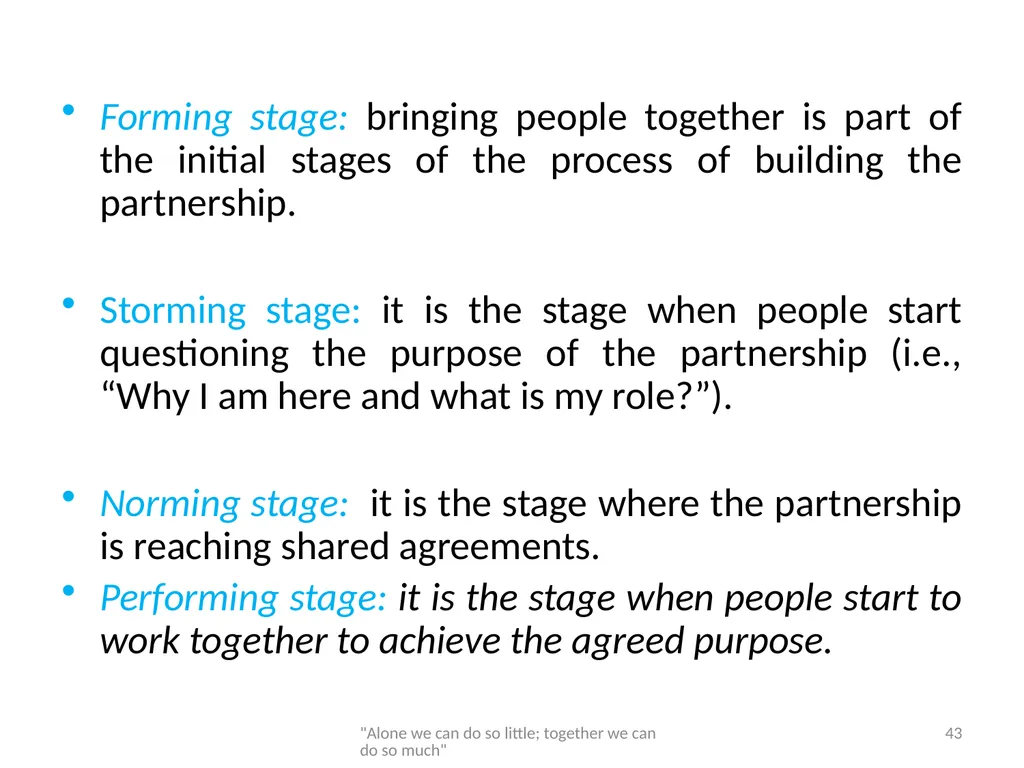
Forming stage: bringing people together is part of the initial stages of the process of building the partnership.
Storming stage: it is the stage when people start questioning the purpose of the partnership (i.e., “Why I am here and what is my role?”).
Norming stage: it is the stage where the partnership is reaching shared agreements.
Performing stage: it is the stage when people start to work together to achieve the agreed purpose. "Alone we can do so little; together we can do so much" 43<br>
Storming stage: it is the stage when people start questioning the purpose of the partnership (i.e., “Why I am here and what is my role?”).
Norming stage: it is the stage where the partnership is reaching shared agreements.
Performing stage: it is the stage when people start to work together to achieve the agreed purpose. "Alone we can do so little; together we can do so much" 43<br>
44
It is important during the initial stages to agree on a set of ground rules for the partnership.
This may seem obvious, but very few groups perform this fundamental requirement necessary for valuing and respecting the individual partners. "Alone we can do so little; together we can do so much" 44<br>
This may seem obvious, but very few groups perform this fundamental requirement necessary for valuing and respecting the individual partners. "Alone we can do so little; together we can do so much" 44<br>
45
Step 3: Setting up and maintaining partnership Healthy and strong partnerships provide the foundation of many community interventions and initiatives.
In order to achieve long-term goals, it is essential to continually maintain and improve the partnership. "Alone we can do so little; together we can do so much" 45<br>
In order to achieve long-term goals, it is essential to continually maintain and improve the partnership. "Alone we can do so little; together we can do so much" 45<br>
46
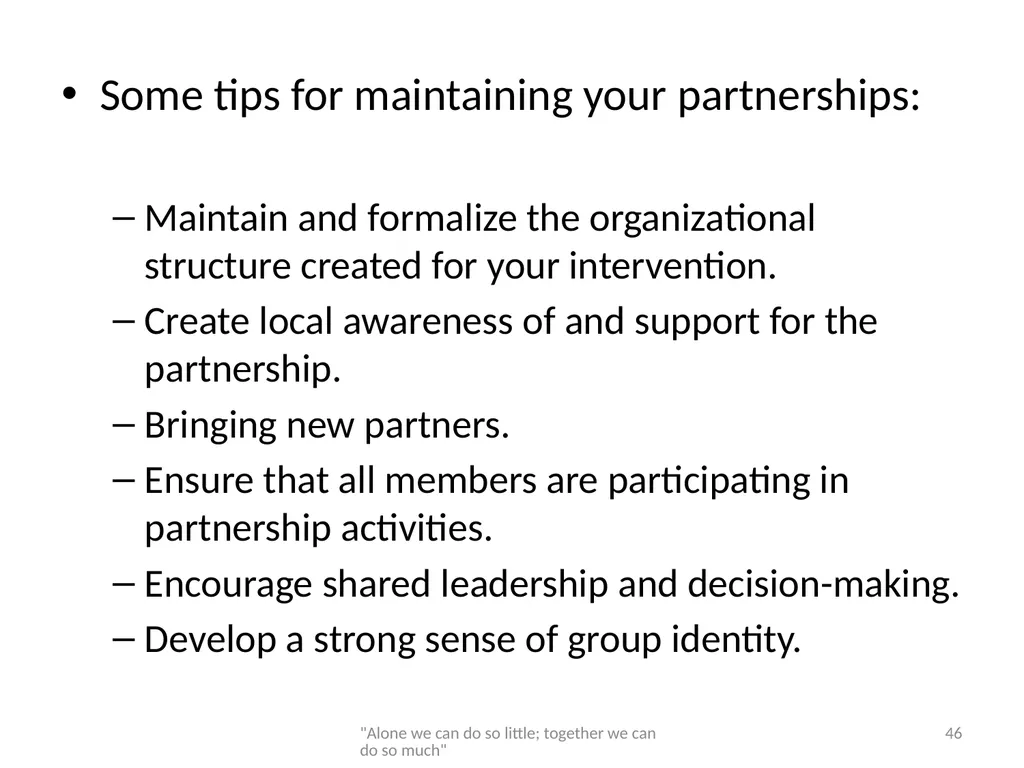
Some tips for maintaining your partnerships:
Maintain and formalize the organizational structure created for your intervention.
Create local awareness of and support for the partnership.
Bringing new partners.
Ensure that all members are participating in partnership activities.
Encourage shared leadership and decision-making.
Develop a strong sense of group identity. "Alone we can do so little; together we can do so much" 46<br>
Maintain and formalize the organizational structure created for your intervention.
Create local awareness of and support for the partnership.
Bringing new partners.
Ensure that all members are participating in partnership activities.
Encourage shared leadership and decision-making.
Develop a strong sense of group identity. "Alone we can do so little; together we can do so much" 46<br>
47
Managing partnerships Partnership management is the process of following up on and maintaining effective, productive, and harmonious relationships with partners.
The work of actively managing partnerships can be supported by partnership norms, collaborative work plans, and solid communication structures and practices. "Alone we can do so little; together we can do so much" 47<br>
The work of actively managing partnerships can be supported by partnership norms, collaborative work plans, and solid communication structures and practices. "Alone we can do so little; together we can do so much" 47<br>
48
Creating partnership norms
Partnership norms are a set of shared values that act as informal guidelines on how partnership members will behave and interact with one another.
they can foster healthy work relationships.
Successful partnerships are managed by people who recognize the importance of cultivating healthy working relationships. "Alone we can do so little; together we can do so much" 48<br>
Partnership norms are a set of shared values that act as informal guidelines on how partnership members will behave and interact with one another.
they can foster healthy work relationships.
Successful partnerships are managed by people who recognize the importance of cultivating healthy working relationships. "Alone we can do so little; together we can do so much" 48<br>
49
Creating partnership norms requires time to consider each person’s past experience, work style, cultural values, expectations, and self-interest.
Because, all these factors will surface and impact the ability of the group to effectively work together. "Alone we can do so little; together we can do so much" 49<br>
Because, all these factors will surface and impact the ability of the group to effectively work together. "Alone we can do so little; together we can do so much" 49<br>
50
MOU vs. partnership norms
MOUs are formal agreements between organizations, and do not establish the “how” of the relationship whereas partnership norms are informal standards for how individuals will work together. "Alone we can do so little; together we can do so much" 50<br>
MOUs are formal agreements between organizations, and do not establish the “how” of the relationship whereas partnership norms are informal standards for how individuals will work together. "Alone we can do so little; together we can do so much" 50<br>
51
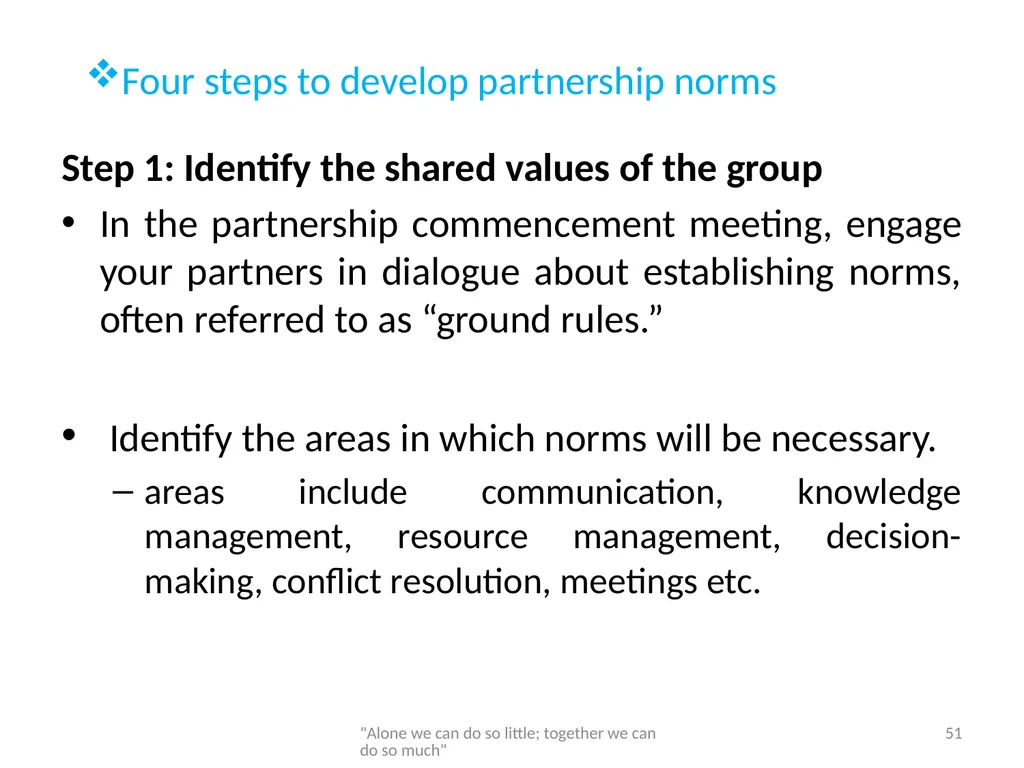
Four steps to develop partnership norms Step 1: Identify the shared values of the group
In the partnership commencement meeting, engage your partners in dialogue about establishing norms, often referred to as “ground rules.”
Identify the areas in which norms will be necessary.
areas include communication, knowledge management, resource management, decision-making, conflict resolution, meetings etc. "Alone we can do so little; together we can do so much" 51<br>
In the partnership commencement meeting, engage your partners in dialogue about establishing norms, often referred to as “ground rules.”
Identify the areas in which norms will be necessary.
areas include communication, knowledge management, resource management, decision-making, conflict resolution, meetings etc. "Alone we can do so little; together we can do so much" 51<br>
52
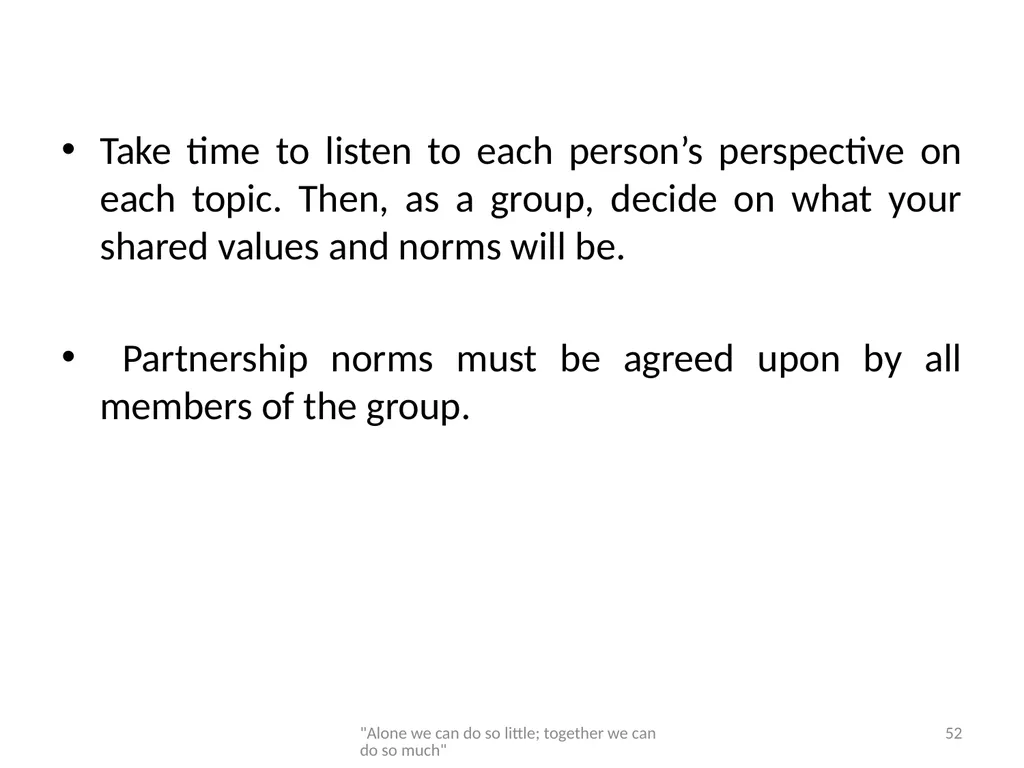
Take time to listen to each person’s perspective on each topic. Then, as a group, decide on what your shared values and norms will be.
Partnership norms must be agreed upon by all members of the group. "Alone we can do so little; together we can do so much" 52<br>
Partnership norms must be agreed upon by all members of the group. "Alone we can do so little; together we can do so much" 52<br>
53
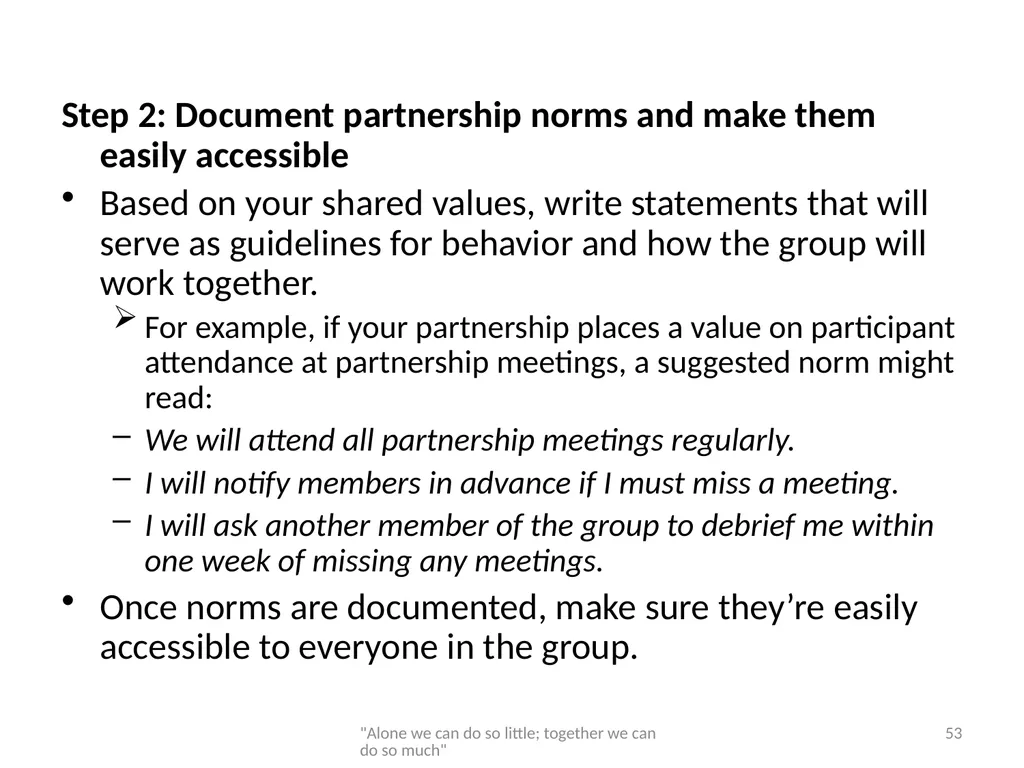
Step 2: Document partnership norms and make them easily accessible
Based on your shared values, write statements that will serve as guidelines for behavior and how the group will work together.
For example, if your partnership places a value on participant attendance at partnership meetings, a suggested norm might read:
We will attend all partnership meetings regularly.
I will notify members in advance if I must miss a meeting.
I will ask another member of the group to debrief me within one week of missing any meetings.
Once norms are documented, make sure they’re easily accessible to everyone in the group. "Alone we can do so little; together we can do so much" 53<br>
Based on your shared values, write statements that will serve as guidelines for behavior and how the group will work together.
For example, if your partnership places a value on participant attendance at partnership meetings, a suggested norm might read:
We will attend all partnership meetings regularly.
I will notify members in advance if I must miss a meeting.
I will ask another member of the group to debrief me within one week of missing any meetings.
Once norms are documented, make sure they’re easily accessible to everyone in the group. "Alone we can do so little; together we can do so much" 53<br>
54
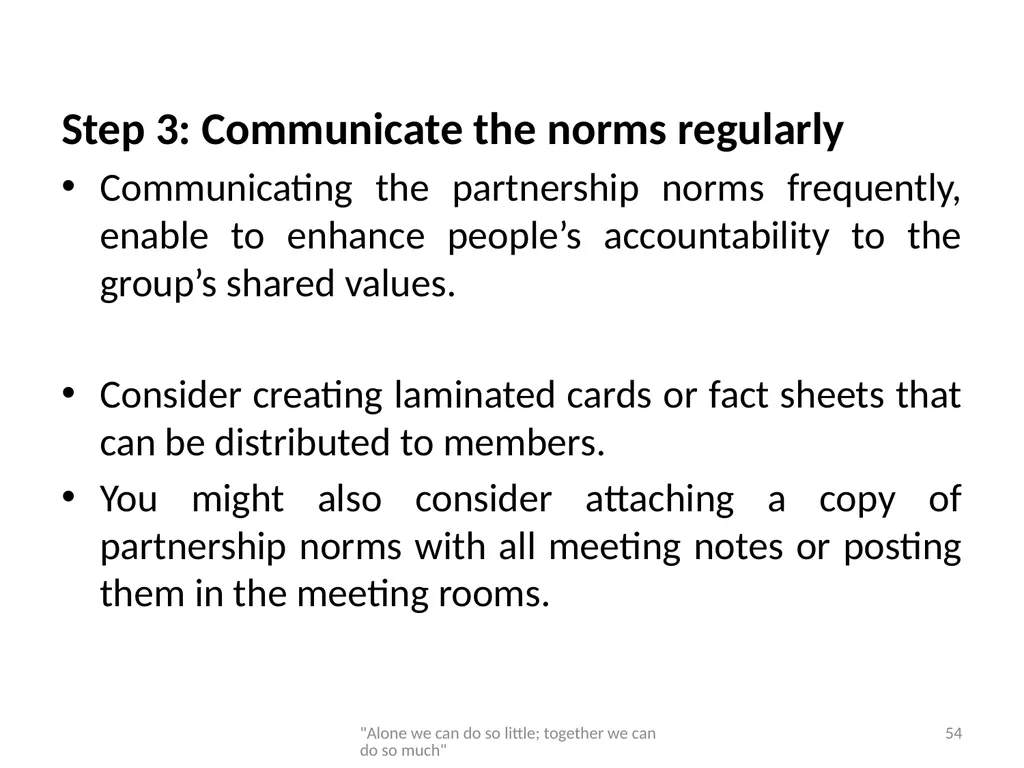
Step 3: Communicate the norms regularly
Communicating the partnership norms frequently, enable to enhance people’s accountability to the group’s shared values.
Consider creating laminated cards or fact sheets that can be distributed to members.
You might also consider attaching a copy of partnership norms with all meeting notes or posting them in the meeting rooms. "Alone we can do so little; together we can do so much" 54<br>
Communicating the partnership norms frequently, enable to enhance people’s accountability to the group’s shared values.
Consider creating laminated cards or fact sheets that can be distributed to members.
You might also consider attaching a copy of partnership norms with all meeting notes or posting them in the meeting rooms. "Alone we can do so little; together we can do so much" 54<br>
55
Step 4: Update the norms as needed
As partnership adds or loses members, it’s important to revisit your partnership norms.
But even if you maintain the same members throughout the relationship, it’s necessary to review and assess your norms based on the current stage of your partnership. "Alone we can do so little; together we can do so much" 55<br>
As partnership adds or loses members, it’s important to revisit your partnership norms.
But even if you maintain the same members throughout the relationship, it’s necessary to review and assess your norms based on the current stage of your partnership. "Alone we can do so little; together we can do so much" 55<br>
56
2. Use communication structures to facilitate open discussion Open, honest communication is a cornerstone of good partnerships.
It can be built by creating communication norms and using structures for facilitated discussion.
Successful partnerships use consistent communication norms in every interaction and meeting.
They engage in open dialogue within established parameters and allow for healthy conflict. "Alone we can do so little; together we can do so much" 56<br>
It can be built by creating communication norms and using structures for facilitated discussion.
Successful partnerships use consistent communication norms in every interaction and meeting.
They engage in open dialogue within established parameters and allow for healthy conflict. "Alone we can do so little; together we can do so much" 56<br>
57
3. Crafting Collaborative Work Plans A collaborative work plan is a document that outlines the structure of work for the partnership or a specific initiative within the partnership.
If the partnership is considering developing a collaborative work plan or is tracking progress on a work plan, keep in mind the following: "Alone we can do so little; together we can do so much" 57<br>
If the partnership is considering developing a collaborative work plan or is tracking progress on a work plan, keep in mind the following: "Alone we can do so little; together we can do so much" 57<br>
58
Establishing buy-in
Collaborative work plans document the work breakdown for the specific tasks.
Increase your success rate by first establishing buy-in from the members of your work group. "Alone we can do so little; together we can do so much" 58<br>
Collaborative work plans document the work breakdown for the specific tasks.
Increase your success rate by first establishing buy-in from the members of your work group. "Alone we can do so little; together we can do so much" 58<br>
59
Being realistic
It is important to be realistic when developing a collaborative work plan.
People want to see progress
Stay within the scope of your project "Alone we can do so little; together we can do so much" 59<br>
It is important to be realistic when developing a collaborative work plan.
People want to see progress
Stay within the scope of your project "Alone we can do so little; together we can do so much" 59<br>
60
Having measurable results
Consider developing short-term, intermediate, and long-term outcomes for your collaborative work plan.
Identify how you will determine the success of your activities and efforts.
What indicators will you measure? "Alone we can do so little; together we can do so much" 60<br>
Consider developing short-term, intermediate, and long-term outcomes for your collaborative work plan.
Identify how you will determine the success of your activities and efforts.
What indicators will you measure? "Alone we can do so little; together we can do so much" 60<br>
61
Being accountable
Communicate group accountability and interdependence of activities.
Showing people how their specific tasks impact the completion of the overall task is a good way of communicating the expectation of accountability. "Alone we can do so little; together we can do so much" 61<br>
Communicate group accountability and interdependence of activities.
Showing people how their specific tasks impact the completion of the overall task is a good way of communicating the expectation of accountability. "Alone we can do so little; together we can do so much" 61<br>
62
Implementing Evaluation and Monitoring All partnerships need to ensure that they have an ongoing program of monitoring and revising aims and objectives.
This relates to the performing stage in team development.
It provide the opportunity to learn what has been successful and what has not, building these lessons into revised plans. "Alone we can do so little; together we can do so much" 62<br>
This relates to the performing stage in team development.
It provide the opportunity to learn what has been successful and what has not, building these lessons into revised plans. "Alone we can do so little; together we can do so much" 62<br>
63
The plan should set periodic reviews to check whether its aims and objectives have changed and what is required to make the change.
As the term of a partnership increases, the original vision and goals may become blurred. "Alone we can do so little; together we can do so much" 63<br>
As the term of a partnership increases, the original vision and goals may become blurred. "Alone we can do so little; together we can do so much" 63<br>
64
Individual assignment What is partnership agreement?
What are the core elements of partnership agreement? "Alone we can do so little; together we can do so much" 64<br>
What are the core elements of partnership agreement? "Alone we can do so little; together we can do so much" 64<br>
65
Chapter Three
Roles, contributions and challenges of NGOs in Ethiopia "Alone we can do so little; together we can do so much" 65<br>
Roles, contributions and challenges of NGOs in Ethiopia "Alone we can do so little; together we can do so much" 65<br>
66
Civil society Civil society embraces different sections of social community.
Such as NGOs, professional associations, cooperatives, trade unions, religious institutions, independent media organizations, which operate at different levels; global, regional national and local . "Alone we can do so little; together we can do so much" 66<br>
Such as NGOs, professional associations, cooperatives, trade unions, religious institutions, independent media organizations, which operate at different levels; global, regional national and local . "Alone we can do so little; together we can do so much" 66<br>
67
Any group or entity regarded as civil society is required to fulfill one or more of the following conditions.
Representations: aggregate citizens’ voice.
Advocacy and technical inputs: provides information and advice, and lobby on particular issues. "Alone we can do so little; together we can do so much" 67<br>
Representations: aggregate citizens’ voice.
Advocacy and technical inputs: provides information and advice, and lobby on particular issues. "Alone we can do so little; together we can do so much" 67<br>
68
Capacity building: provide support to other civil society organizations, including funding.
Service delivery: implement development projects or provide services.
Social functions: foster collective recreational activities.
Legal status: If any associational entity is considered as a civil society organization, then it is required to have legal status/registration "Alone we can do so little; together we can do so much" 68<br>
Service delivery: implement development projects or provide services.
Social functions: foster collective recreational activities.
Legal status: If any associational entity is considered as a civil society organization, then it is required to have legal status/registration "Alone we can do so little; together we can do so much" 68<br>
69
Non-Governmental Organizations (NGOs) NGOs are “associations formed within civil society bringing together individuals who share common purpose” (Turner and Hulme, 1997).
NGO refers to both indigenous and international non-governmental organizations (GTZ, 2001). "Alone we can do so little; together we can do so much" 69<br>
NGO refers to both indigenous and international non-governmental organizations (GTZ, 2001). "Alone we can do so little; together we can do so much" 69<br>
70
In the Ethiopian context, as defined by German technical Cooperation (GTZ) (2001), the term is broadly used to denote an organization that meets the following requirements:
NGOs are voluntary in their genesis
NGOs engage in relief, service delivery, advocacy or development activities "Alone we can do so little; together we can do so much" 70<br>
NGOs are voluntary in their genesis
NGOs engage in relief, service delivery, advocacy or development activities "Alone we can do so little; together we can do so much" 70<br>
71
NGOs are non-profit or self serving organizations working to serve the disadvantaged groups of the society
NGOs are non-political
NGOs have no permanent program interest or geographical context
Legal status: any organization to be considered as NGO, it requires a legal status/registration. "Alone we can do so little; together we can do so much" 71<br>
NGOs are non-political
NGOs have no permanent program interest or geographical context
Legal status: any organization to be considered as NGO, it requires a legal status/registration. "Alone we can do so little; together we can do so much" 71<br>
72
Historical development of NGOs in Ethiopia Ethiopia was hit with two devastating famines in almost in a decade.
The first famine occurred in 1973/74 and
The second more devastating occurred in 1984/85 causing involuntary mass migration and huge loss of lives and properties.
These two famines resulted in dramatic increase in the number of NGOs operating in the country. "Alone we can do so little; together we can do so much" 72<br>
The first famine occurred in 1973/74 and
The second more devastating occurred in 1984/85 causing involuntary mass migration and huge loss of lives and properties.
These two famines resulted in dramatic increase in the number of NGOs operating in the country. "Alone we can do so little; together we can do so much" 72<br>
73
During the first famine 1973/74 various groups engaged in relief operations formed a network that became known as Christian Relief and Development Association (CRDA) (World Bank, 2000).
The significance contribution of NGOs has increased since these devastating famines.
The role of NGOs during these famines was very essential in saving the lives of famine victims when the government’s capacities were completely eroded. "Alone we can do so little; together we can do so much" 73<br>
The significance contribution of NGOs has increased since these devastating famines.
The role of NGOs during these famines was very essential in saving the lives of famine victims when the government’s capacities were completely eroded. "Alone we can do so little; together we can do so much" 73<br>
74
These famines compelled the then governments to allow a large entry of western NGOs into the country.
During the first famine, the total number of NGOs mostly operating on relief in the country was not more than twenty-five; of which the vast majority were church based and very few of local origin. "Alone we can do so little; together we can do so much" 74<br>
During the first famine, the total number of NGOs mostly operating on relief in the country was not more than twenty-five; of which the vast majority were church based and very few of local origin. "Alone we can do so little; together we can do so much" 74<br>
75
Compared to other African Countries, civil society in Ethiopia remained the weakest by all measurements due to the governance history, which was based on, centralized states ruled by autocratic governments, which gave no or little space for associational structure (World Bank, 2000). "Alone we can do so little; together we can do so much" 75<br>
76
Roles of NGOs in Ethiopia Due to the restrictive nature of the government that limited the space for NGOs, the roles and contributions made by NGOs are limited in Ethiopia.
However, after the occurrences of the two devastating famines in the country, the roles and contributions of NGOs significantly increased in different sectors. "Alone we can do so little; together we can do so much" 76<br>
However, after the occurrences of the two devastating famines in the country, the roles and contributions of NGOs significantly increased in different sectors. "Alone we can do so little; together we can do so much" 76<br>
77
The following are some of the contributions made by NGOs since their establishment in Ethiopia.
Food Security: saving the life of famine victims in food insecure parts of the country through emergency relief support of NGOs.
Health and Education: improving the health and education of the society through constructing health centers and schools. "Alone we can do so little; together we can do so much" 77<br>
Food Security: saving the life of famine victims in food insecure parts of the country through emergency relief support of NGOs.
Health and Education: improving the health and education of the society through constructing health centers and schools. "Alone we can do so little; together we can do so much" 77<br>
78
Capacity Building: uplifting the capacity and skill of the rural people through constructing training centers and intensive trainings on skill acquisition capacity building.
Infrastructure Development: improved infrastructures developed by NGOs enabled millions of people to have access to health, education and market services. "Alone we can do so little; together we can do so much" 78<br>
Infrastructure Development: improved infrastructures developed by NGOs enabled millions of people to have access to health, education and market services. "Alone we can do so little; together we can do so much" 78<br>
79
Microfinance: increasing the income of the rural poor through creating local credit and saving institutions.
Democratization: contribution of NGOs in the democratic process is also remarkable although it is less significant compared to other contributions made by NGOs. "Alone we can do so little; together we can do so much" 79<br>
Democratization: contribution of NGOs in the democratic process is also remarkable although it is less significant compared to other contributions made by NGOs. "Alone we can do so little; together we can do so much" 79<br>
80
Challenges for NGOs Sector The Ethiopian civil society, especially the NGOs sector has been engulfed with various problems.
The challenges may be categorized into two broad parts; external and internal. "Alone we can do so little; together we can do so much" 80<br>
The challenges may be categorized into two broad parts; external and internal. "Alone we can do so little; together we can do so much" 80<br>
81
External Challenges Government attitude
Strong, vibrant and independent institutions have been considered by the government as a threat and categorized as part of opposition and working to undermine its power bases.
Bureaucracy
Lengthy and bureaucratic requirements for registration,
demanding reporting requirements,
lack of transparency on the part of government executive bodies exacerbate the ever-volatile Government-NGO relations (GTZ, 2001). "Alone we can do so little; together we can do so much" 81<br>
Strong, vibrant and independent institutions have been considered by the government as a threat and categorized as part of opposition and working to undermine its power bases.
Bureaucracy
Lengthy and bureaucratic requirements for registration,
demanding reporting requirements,
lack of transparency on the part of government executive bodies exacerbate the ever-volatile Government-NGO relations (GTZ, 2001). "Alone we can do so little; together we can do so much" 81<br>
82
Pro-government NGOs
The state is deliberately promoting its own party controlled parallel civil society groups, such as local indigenous NGOs, women organizations, youth associations and trade unions.
This highly reinforces the doubt that is held in the voluntary sector that the state does not have confidence in independent civil society groups and may be planning to replace them at some time in the future (Zewdie & Pausewang, 2002). "Alone we can do so little; together we can do so much" 82<br>
The state is deliberately promoting its own party controlled parallel civil society groups, such as local indigenous NGOs, women organizations, youth associations and trade unions.
This highly reinforces the doubt that is held in the voluntary sector that the state does not have confidence in independent civil society groups and may be planning to replace them at some time in the future (Zewdie & Pausewang, 2002). "Alone we can do so little; together we can do so much" 82<br>
83
Participation
Major decisions that concern the civil society themselves are passed at regional and federal levels without the participation of civil society representatives (GTZ, 2001).
E.G, officials in the ministry of justice responsible for drafting new laws that govern NGOs operations have been unwilling to involve the NGOs sector in the preparatory efforts.
Rules and regulations
The state of the rules, regulations that govern civil society engagements
If rules are vague, ambitious, and subject to arbitrary interpretation by the regulating organizations. "Alone we can do so little; together we can do so much" 83<br>
Major decisions that concern the civil society themselves are passed at regional and federal levels without the participation of civil society representatives (GTZ, 2001).
E.G, officials in the ministry of justice responsible for drafting new laws that govern NGOs operations have been unwilling to involve the NGOs sector in the preparatory efforts.
Rules and regulations
The state of the rules, regulations that govern civil society engagements
If rules are vague, ambitious, and subject to arbitrary interpretation by the regulating organizations. "Alone we can do so little; together we can do so much" 83<br>
84
Internal Challenges Internal challenges refer to limitation in the resource and managerial capacity within the NGOs themselves.
Capacity limitation
There is significant capacity limitation among indigenous NGOs.
Limitation in human resource and budget constraints are the prominent features of local NGOs.
Weak private sector
In Ethiopia the private sector is so weak to fund sources for NGOs.
The private sector is so weak due to unfriendly policy environment and government control of major economic sectors (Zewdie & Pausewang, 2002). "Alone we can do so little; together we can do so much" 84<br>
Capacity limitation
There is significant capacity limitation among indigenous NGOs.
Limitation in human resource and budget constraints are the prominent features of local NGOs.
Weak private sector
In Ethiopia the private sector is so weak to fund sources for NGOs.
The private sector is so weak due to unfriendly policy environment and government control of major economic sectors (Zewdie & Pausewang, 2002). "Alone we can do so little; together we can do so much" 84<br>
85
Dependence on external funding
Majority of both international and local NGOs depend on external funding sources to run their programs.
Government and donors play major roles in supporting NGOs programs which usually has compromised the independence and effectiveness of NGOs (Hellinger, 1987). "Alone we can do so little; together we can do so much" 85<br>
Majority of both international and local NGOs depend on external funding sources to run their programs.
Government and donors play major roles in supporting NGOs programs which usually has compromised the independence and effectiveness of NGOs (Hellinger, 1987). "Alone we can do so little; together we can do so much" 85<br>
86
The NGOs who based their funding source on governments end up with negative bearing against the poor by failing to distance themselves and compromising their impendence with the government (Weston, 1994). "Alone we can do so little; together we can do so much" 86<br>
87
Personal interest
Many of the NGOs are not home-grown, they are distant from many of the social and cultural aspects of the society, and many NGOs have tendencies to preserve institutional and personal interests rather than the wider beneficiary (Zewdie & Pausewang, 2002).
Lack of democratic culture and values
Many of the NGOs, especially indigenous ones have not internalized democratic cultures.
They lack the culture of tolerance and constructive debate
They have no media to inform the general public about their activities (Gebre egzibiaher & Sisay, 2002). "Alone we can do so little; together we can do so much" 87<br>
Many of the NGOs are not home-grown, they are distant from many of the social and cultural aspects of the society, and many NGOs have tendencies to preserve institutional and personal interests rather than the wider beneficiary (Zewdie & Pausewang, 2002).
Lack of democratic culture and values
Many of the NGOs, especially indigenous ones have not internalized democratic cultures.
They lack the culture of tolerance and constructive debate
They have no media to inform the general public about their activities (Gebre egzibiaher & Sisay, 2002). "Alone we can do so little; together we can do so much" 87<br>
88
Chapter Four
Public-Private Partnership in adult education "Alone we can do so little; together we can do so much" 88<br>
Public-Private Partnership in adult education "Alone we can do so little; together we can do so much" 88<br>
89
Basic terms Public sector:
it is also called the state sector
is the part of the economy composed of both public services and public enterprises.
The public sector is that portion of an economic system that is controlled by national, state or provincial, and local governments. "Alone we can do so little; together we can do so much" 89<br>
it is also called the state sector
is the part of the economy composed of both public services and public enterprises.
The public sector is that portion of an economic system that is controlled by national, state or provincial, and local governments. "Alone we can do so little; together we can do so much" 89<br>
90
Private sector:
It is composed of the economic sectors that are intended to earn a profit for the owners of the enterprise.
It is the part of a country's economic system that is run by individuals and companies, rather than the government. "Alone we can do so little; together we can do so much" 90<br>
It is composed of the economic sectors that are intended to earn a profit for the owners of the enterprise.
It is the part of a country's economic system that is run by individuals and companies, rather than the government. "Alone we can do so little; together we can do so much" 90<br>
91
What is Public-Private Partnership (PPP) PPP refers to arrangements between the public and private sectors whereby some of the services that fall under the responsibilities of the public sector are provided by the private sector, with clear agreement on shared objectives for delivery of public infrastructure and/ or public services. "Alone we can do so little; together we can do so much" 91<br>
92
In the context of Ethiopia, PPP can be defined as an engagement and a relationship between the public (including development partners) and private sectors as well as civil society (including community beneficiaries, the poor and vulnerable groups). "Alone we can do so little; together we can do so much" 92<br>
93
Why PPP: Rational for PPP Easing the budget constraint:
Fund could not be bear by the government alone in a stipulated period of time.
Involving the private sector in the endeavor the financial resources could be augmented. "Alone we can do so little; together we can do so much" 93<br>
Fund could not be bear by the government alone in a stipulated period of time.
Involving the private sector in the endeavor the financial resources could be augmented. "Alone we can do so little; together we can do so much" 93<br>
94
Efficiency gains:
because of specialization in certain areas, the private sector has greater efficiency.
Private organizations often have the resources for training and recruitment of new talent, and they are not constrained by civil service rules and regulations.
They enjoy as a result, more managerial flexibility than their public sector counterparts, which, in turn, can give them a comparative advantage in terms of organizational change and responsiveness. "Alone we can do so little; together we can do so much" 94<br>
because of specialization in certain areas, the private sector has greater efficiency.
Private organizations often have the resources for training and recruitment of new talent, and they are not constrained by civil service rules and regulations.
They enjoy as a result, more managerial flexibility than their public sector counterparts, which, in turn, can give them a comparative advantage in terms of organizational change and responsiveness. "Alone we can do so little; together we can do so much" 94<br>
95
Appropriate risk sharing:
The various risks of PPP project may be allocated between the public and private sector optimally so that the overall risk gets reduced significantly.
Speed of implementation:
In a public sector project, many players are involved and coordination becomes difficult due to restrict rules and regulations.
Since the private partner would be interested in getting payment as soon as the services start being made available, the speed of implementation would be much quicker. "Alone we can do so little; together we can do so much" 95<br>
The various risks of PPP project may be allocated between the public and private sector optimally so that the overall risk gets reduced significantly.
Speed of implementation:
In a public sector project, many players are involved and coordination becomes difficult due to restrict rules and regulations.
Since the private partner would be interested in getting payment as soon as the services start being made available, the speed of implementation would be much quicker. "Alone we can do so little; together we can do so much" 95<br>
96
Reduction of costs:
The cost of operation is expected to be much lower than in government set up.
This is due to the greater managerial efficiency in the private sector.
Accountability for performance:
private partners have experience to develop feeling accountable for performance.
Greater flexibility:
Under PPP, there will be greater autonomy and flexibility whereas the government systems have rigidity. "Alone we can do so little; together we can do so much" 96<br>
The cost of operation is expected to be much lower than in government set up.
This is due to the greater managerial efficiency in the private sector.
Accountability for performance:
private partners have experience to develop feeling accountable for performance.
Greater flexibility:
Under PPP, there will be greater autonomy and flexibility whereas the government systems have rigidity. "Alone we can do so little; together we can do so much" 96<br>
97
Models of PPPs Service contracts (few months to two years)
It is also called outsourcing
Between government and a private partner to perform specific, usually non-core tasks within infrastructure systems. "Alone we can do so little; together we can do so much" 97<br>
It is also called outsourcing
Between government and a private partner to perform specific, usually non-core tasks within infrastructure systems. "Alone we can do so little; together we can do so much" 97<br>
98
Service contracting can be an attractive form of PPP where:
there is strong political or community opposition to wider involvement of the private sector,
opposition to price increases,
where the government is seeking to shed responsibility for non-core functions. "Alone we can do so little; together we can do so much" 98<br>
there is strong political or community opposition to wider involvement of the private sector,
opposition to price increases,
where the government is seeking to shed responsibility for non-core functions. "Alone we can do so little; together we can do so much" 98<br>
99
Operation and management contracts (3 to 5 years) Transfer responsibility for the operation and maintenance of government-owned entities to the private sector.
Ownership of the entity and responsibility for service provision
The bulk of the commercial risk and all the capital and investment risks remain with government.
Management control and authority is transferred to a private partner, which applies its expertise to improve management systems and practices. "Alone we can do so little; together we can do so much" 99<br>
Ownership of the entity and responsibility for service provision
The bulk of the commercial risk and all the capital and investment risks remain with government.
Management control and authority is transferred to a private partner, which applies its expertise to improve management systems and practices. "Alone we can do so little; together we can do so much" 99<br>
100
Operation and management contracts are most beneficial where:
the main objective is to rapidly enhance a public enterprise’s efficiency, or to prepare for a deeper level of PPP "Alone we can do so little; together we can do so much" 100<br>
the main objective is to rapidly enhance a public enterprise’s efficiency, or to prepare for a deeper level of PPP "Alone we can do so little; together we can do so much" 100<br>
101
Leases (10 and 15 years) Under a lease, a private firm (Lessee) leases the assets of an enterprise from a properly empowered government authority (Lessor) and assumes full responsibility for operations and partial responsibility for investments for a period usually between ten and fifteen years. "Alone we can do so little; together we can do so much" 101<br>
102
Lease are most appropriate where there is scope for large gains in operating efficiency but only limited need or scope for new investments. "Alone we can do so little; together we can do so much" 102<br>
103
Concessions (20 to 30 years) The private partner (Concessionaire) bears overall responsibility for the services, including operation, maintenance, and management, as well as capital investments for rehabilitation and renewal of assets, and the expansion of services.
The Concessionaire is paid for its services directly by the consumer, based on the contractually set fee or tariff, which is adjustable over the life of the contract. "Alone we can do so little; together we can do so much" 103<br>
The Concessionaire is paid for its services directly by the consumer, based on the contractually set fee or tariff, which is adjustable over the life of the contract. "Alone we can do so little; together we can do so much" 103<br>
104
Advantage: it passes full responsibility for operations, maintenance, rehabilitation, renewal and service expansion to the private partner and so creates incentives for efficiency in all the utility’s activities.
Concessions are an attractive option where large investments are required. "Alone we can do so little; together we can do so much" 104<br>
Concessions are an attractive option where large investments are required. "Alone we can do so little; together we can do so much" 104<br>
105
Build-Operate-Transfer (BOT) contracts (15 and 30 years) BOT designate the way of contracting the building of large infrastructure facilities with the involvement of the private sector.
The organizers of the building, normally called sponsors, take over the financing, the organization and the responsibility of the construction of such a facility and then, after it has been built, the responsibility for its use, maintenance and management. "Alone we can do so little; together we can do so much" 105<br>
The organizers of the building, normally called sponsors, take over the financing, the organization and the responsibility of the construction of such a facility and then, after it has been built, the responsibility for its use, maintenance and management. "Alone we can do so little; together we can do so much" 105<br>
106
After the expiry of such a period, the sponsors return the facility to the government for future usage.
BOT contracts and variants are the most complex form of the public-private partnership. "Alone we can do so little; together we can do so much" 106<br>
BOT contracts and variants are the most complex form of the public-private partnership. "Alone we can do so little; together we can do so much" 106<br>
107
Principles of PPPs According to Asubonteng (2011), PPPs works based on the following principles.
Transparency: sharing information and acting in an open manner
Competition: remove abuse of dominance
Accountability: it involves holding the partners (public and private) responsible for results
Legality: a solid legal basis to create a safe environment "Alone we can do so little; together we can do so much" 107<br>
Transparency: sharing information and acting in an open manner
Competition: remove abuse of dominance
Accountability: it involves holding the partners (public and private) responsible for results
Legality: a solid legal basis to create a safe environment "Alone we can do so little; together we can do so much" 107<br>
108
Clarity and predictability: The partnership framework and the contract agreed upon must be as clear as possible to create a stable context for delivery of services
Specificity: address specific problems and circumstances
Flexibility: need for flexibility due to the changing nature of contexts
Economic and financial sustainability: PPP is feasible to public and private sector partners if it is economically and financially sustainable. "Alone we can do so little; together we can do so much" 108<br>
Specificity: address specific problems and circumstances
Flexibility: need for flexibility due to the changing nature of contexts
Economic and financial sustainability: PPP is feasible to public and private sector partners if it is economically and financially sustainable. "Alone we can do so little; together we can do so much" 108<br>
109
Continuous learning: : it means making continuous efforts and commitments to turn daily incidents and activities into “learning moments”
Equity: consider poor communities
Inclusiveness: the removal of institutional constraints to enhance participation by beneficiaries (including poor and marginalized groups) in service delivery decision-making, policy shaping and enjoyment of benefits.
Empowerment: creating the necessary conditions to strengthen and develop emerging entrepreneurs "Alone we can do so little; together we can do so much" 109<br>
Equity: consider poor communities
Inclusiveness: the removal of institutional constraints to enhance participation by beneficiaries (including poor and marginalized groups) in service delivery decision-making, policy shaping and enjoyment of benefits.
Empowerment: creating the necessary conditions to strengthen and develop emerging entrepreneurs "Alone we can do so little; together we can do so much" 109<br>
110
Factors for effective partnership Environment Related Factors
Environment related factors are those factors, which are beyond the ability of any partnership to control.
The social and political climate; political leaders’ opinion or the general public supports, effective past collaborative efforts
Collaborative efforts can be strengthen when the commitment of the government is good.
formalizing the partnership in a declaration, memorandum of understanding or other framework documents. "Alone we can do so little; together we can do so much" 110<br>
Environment related factors are those factors, which are beyond the ability of any partnership to control.
The social and political climate; political leaders’ opinion or the general public supports, effective past collaborative efforts
Collaborative efforts can be strengthen when the commitment of the government is good.
formalizing the partnership in a declaration, memorandum of understanding or other framework documents. "Alone we can do so little; together we can do so much" 110<br>
111
Membership Characteristics Related Factors
Membership characteristics related factors are generally related to the characteristics of partners involved in the collaboration.
Effective ISC requires strong relationships among partners
effective mix/appropriate cross section of partners,
self-interest to collaborate,
mutual respect, understanding,
ability to compromise
trust, "Alone we can do so little; together we can do so much" 111<br>
Membership characteristics related factors are generally related to the characteristics of partners involved in the collaboration.
Effective ISC requires strong relationships among partners
effective mix/appropriate cross section of partners,
self-interest to collaborate,
mutual respect, understanding,
ability to compromise
trust, "Alone we can do so little; together we can do so much" 111<br>
112
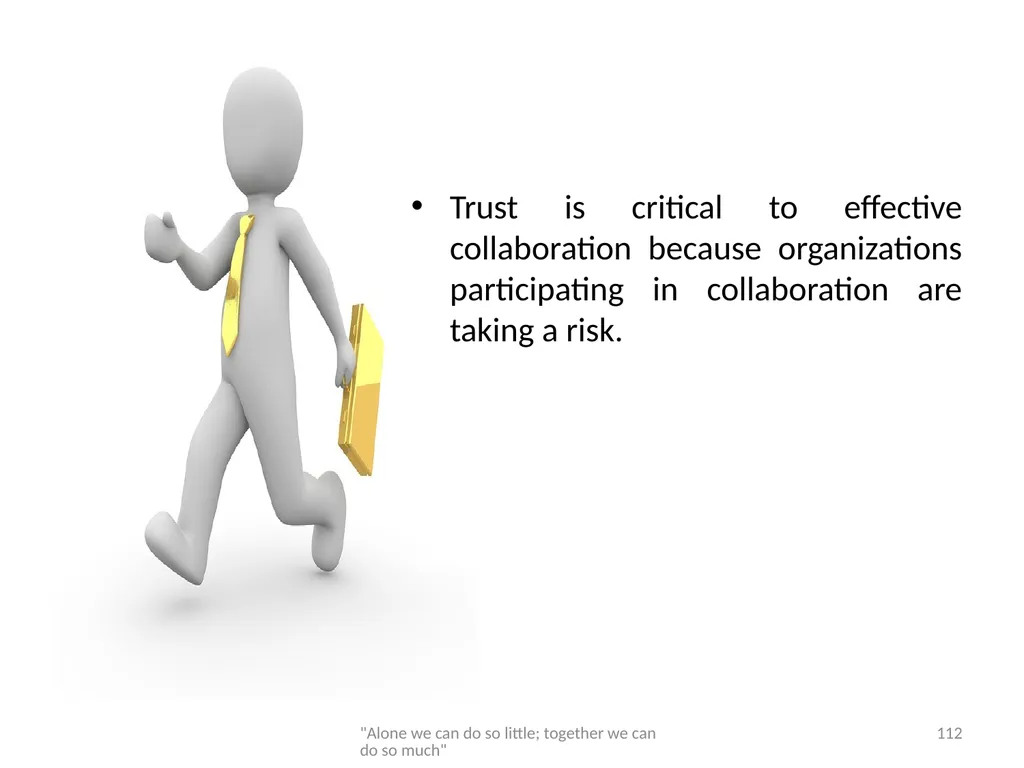
Trust is critical to effective collaboration because organizations participating in collaboration are taking a risk. "Alone we can do so little; together we can do so much" 112<br>
113
Process/Structure Related Factors Structures and processes in collaborative efforts are very important factors for collaboration.
Structures refer to the institutions, legislation, policies, and mechanisms that determine how work is carried out.
Well-designed structures can facilitate integration of services and strengthen communication among partners
Structures in collaboration require flexibility. "Alone we can do so little; together we can do so much" 113<br>
Structures refer to the institutions, legislation, policies, and mechanisms that determine how work is carried out.
Well-designed structures can facilitate integration of services and strengthen communication among partners
Structures in collaboration require flexibility. "Alone we can do so little; together we can do so much" 113<br>
114
Throughout the process of the collaboration, there ought to be clear and documented expectations, commitments, and roles to allow joint commitment and accountability.
Effective processes in collaboration are characterized by two strategies;
Integration: Good integration enables partners to coordinate service delivery and facilitate change without duplicating services.
community engagement: Collaborations may more likely to be successful if they engaged citizens at local level to ensure their concerns are being heard. "Alone we can do so little; together we can do so much" 114<br>
Effective processes in collaboration are characterized by two strategies;
Integration: Good integration enables partners to coordinate service delivery and facilitate change without duplicating services.
community engagement: Collaborations may more likely to be successful if they engaged citizens at local level to ensure their concerns are being heard. "Alone we can do so little; together we can do so much" 114<br>
115
Communication Related Factors The more open and repeated interaction made the more potential for collaboration between and among the partners.
If the different partners are communicating with each other, they can increase their knowledge of each other and develop a mutual understanding and respect, which may facilitate collaboration "Alone we can do so little; together we can do so much" 115<br>
If the different partners are communicating with each other, they can increase their knowledge of each other and develop a mutual understanding and respect, which may facilitate collaboration "Alone we can do so little; together we can do so much" 115<br>
116
Purpose Related Factors Collaborative working can attain change when all partners who involved acknowledged the shared issue and committed to do so.
In doing so, the vision, goal, and objectives of the shared issue, need to be clear and concrete be easily described and understood. "Alone we can do so little; together we can do so much" 116<br>
In doing so, the vision, goal, and objectives of the shared issue, need to be clear and concrete be easily described and understood. "Alone we can do so little; together we can do so much" 116<br>
117
Resource Related Factors Resources (financial, material and personnel) are all the basic building blocks in the course of collaborative workings.
Successful collaborations require people who have skill, credibility, and the authority to make decisions. if good leader with skills and expertise to engage partners, support the collaboration process, and coordinate the multiple components of their interventions.
Collaboration must be ultimately supported by a visionary, focused, humble, and results oriented strong collaborative leader to unite diverse players within a system by persistently and consistently articulating the compelling cause or the shared issue. "Alone we can do so little; together we can do so much" 117<br>
Successful collaborations require people who have skill, credibility, and the authority to make decisions. if good leader with skills and expertise to engage partners, support the collaboration process, and coordinate the multiple components of their interventions.
Collaboration must be ultimately supported by a visionary, focused, humble, and results oriented strong collaborative leader to unite diverse players within a system by persistently and consistently articulating the compelling cause or the shared issue. "Alone we can do so little; together we can do so much" 117<br>
118
Barriers to successful partnerships Limited vision/failure to inspire
One partner manipulates or dominates, or partners compete for the lead
Lack of clear purpose and inconsistent level of understanding purpose
Lack of understanding roles/responsibilities
Lack of support from partner organizations with ultimate decision-making power
Differences of philosophies and manners of working "Alone we can do so little; together we can do so much" 118<br>
One partner manipulates or dominates, or partners compete for the lead
Lack of clear purpose and inconsistent level of understanding purpose
Lack of understanding roles/responsibilities
Lack of support from partner organizations with ultimate decision-making power
Differences of philosophies and manners of working "Alone we can do so little; together we can do so much" 118<br>
119
Lack of commitment; unwilling participants
Unequal and/or unacceptable balance of power and control
Key interests and/or people missing from the partnership
Hidden agendas
Failure to communicate
Lack of evaluation or monitoring systems
Failure to learn
Financial and time commitments outweigh potential benefits
Too little time for effective consultation "Alone we can do so little; together we can do so much" 119<br>
Unequal and/or unacceptable balance of power and control
Key interests and/or people missing from the partnership
Hidden agendas
Failure to communicate
Lack of evaluation or monitoring systems
Failure to learn
Financial and time commitments outweigh potential benefits
Too little time for effective consultation "Alone we can do so little; together we can do so much" 119<br>
120
The end !!! "Alone we can do so little; together we can do so much" 120<br>