
Neuro-Exploration: Why MI works in resolving
MS
Published · 47 slides · 0 views

1 / 1


Description
Neuro-Exploration: Why MI works in resolving ambivalence Richard Rutschman Center for College Access Success Northeastern Illinois University Exploration because we really know very little with regard to neurobiology and its relation to
Related Topics
Share
Embed code
Download this presentation From Below
"Neuro-Exploration: Why MI works in resolving" is the property of its rightful owner. Permission is granted to download and print the materials on this website for personal, non-commercial use only, and to display it on your personal computer provided you do not modify the materials and that you retain all copyright notices contained in the materials. By downloading content from our website, you accept the terms of this agreement.
Presentation Transcript
01
Neuro-Exploration: Why MI works in resolving ambivalence Richard Rutschman
Center for College Access & Success
Northeastern Illinois University<br>
Center for College Access & Success
Northeastern Illinois University<br>
02
“Exploration” because we really know very little with regard to neurobiology and its relation to the workings of our mind.
Yet what we are beginning to discover provides some clues that may help explain why MI works.<br>
03
Workshop Format Choice—You choose your level of participation involving participating in experiential activities (from active to observer)
Experience before label—Experiences (activities) are intended to enhance understanding of the concepts presented.
Multimodal—Combining activities with slides is intended to help visualize the concepts in explaining basic brain physiology and neurobiological processes.
Meaning making—Discussion and sharing is encouraged including if this neuroscience understanding might be valuable to including in MI workshops.<br>
Experience before label—Experiences (activities) are intended to enhance understanding of the concepts presented.
Multimodal—Combining activities with slides is intended to help visualize the concepts in explaining basic brain physiology and neurobiological processes.
Meaning making—Discussion and sharing is encouraged including if this neuroscience understanding might be valuable to including in MI workshops.<br>
04
A Proposition that MI:
Leads to balanced neurotransmitters that promote positive, forward-thinking decision-making.
Helps resolve ambivalence because of the brain’s lateralized structure of specialized dominance creating an alternative path to connect and resolve ambivalence;
Encourages neural integration with the self-narratives in the evoking process leading to decisions
Helps change the reflexive processes into purposeful reflective process.
Supports intrinsic motivation that involves a different part of the brain as extrinsic.<br>
Leads to balanced neurotransmitters that promote positive, forward-thinking decision-making.
Helps resolve ambivalence because of the brain’s lateralized structure of specialized dominance creating an alternative path to connect and resolve ambivalence;
Encourages neural integration with the self-narratives in the evoking process leading to decisions
Helps change the reflexive processes into purposeful reflective process.
Supports intrinsic motivation that involves a different part of the brain as extrinsic.<br>
05
Introductory Activities Engaging our social brain
Chiji intro<br>
Chiji intro<br>
06
Index Finger Duel In pairs clasp hands (like a handshake) but each place your index finger out toward the other person.
Your goal is to poke with your index fingers as many times as possible the person on their torso (appropriate touch).
Debrief: How is being playful making you feel? How is this activity similar to working with them to solve a problem (resolve ambivalence)?<br>
Your goal is to poke with your index fingers as many times as possible the person on their torso (appropriate touch).
Debrief: How is being playful making you feel? How is this activity similar to working with them to solve a problem (resolve ambivalence)?<br>
07
The Brain Human brain consists of 86 billion neurons
One Thousand seconds =
One Million Seconds =
One Billion Seconds =
There are an estimated 125 trillion connections between neurons just in the cortex, with 15,000 connections or more from single neurons.
The brain uses 20% of the energy we consume yet is only 3% of the body weight.<br>
One Thousand seconds =
One Million Seconds =
One Billion Seconds =
There are an estimated 125 trillion connections between neurons just in the cortex, with 15,000 connections or more from single neurons.
The brain uses 20% of the energy we consume yet is only 3% of the body weight.<br>
08
Brain Simulation Activity
… 50+ Neurotransmitters in the brain
Social environment helps determine which neurotransmitters are released
Physical threats and emotional threats similar response
Meeting psychological needs helps balance neurotransmitters and can help prepare the mind for thinking about change…<br>
Social environment helps determine which neurotransmitters are released
Physical threats and emotional threats similar response
Meeting psychological needs helps balance neurotransmitters and can help prepare the mind for thinking about change…<br>
09
Neurotransmitters are released in response to the social, physical environment, our physical response Playful cooperative activities
Muscles (frown vs. smile)
Laughter
Mirror neurons How are neurotransmitters of the person effected by the providers way of being (Spirit of MI)? Positive outlook?<br>
Muscles (frown vs. smile)
Laughter
Mirror neurons How are neurotransmitters of the person effected by the providers way of being (Spirit of MI)? Positive outlook?<br>
10
Neurotransmitters: The Spirit & Skills of MI help promote the balance of neurotransmitters that can promote positive, forward-thinking decision-making.<br>
11
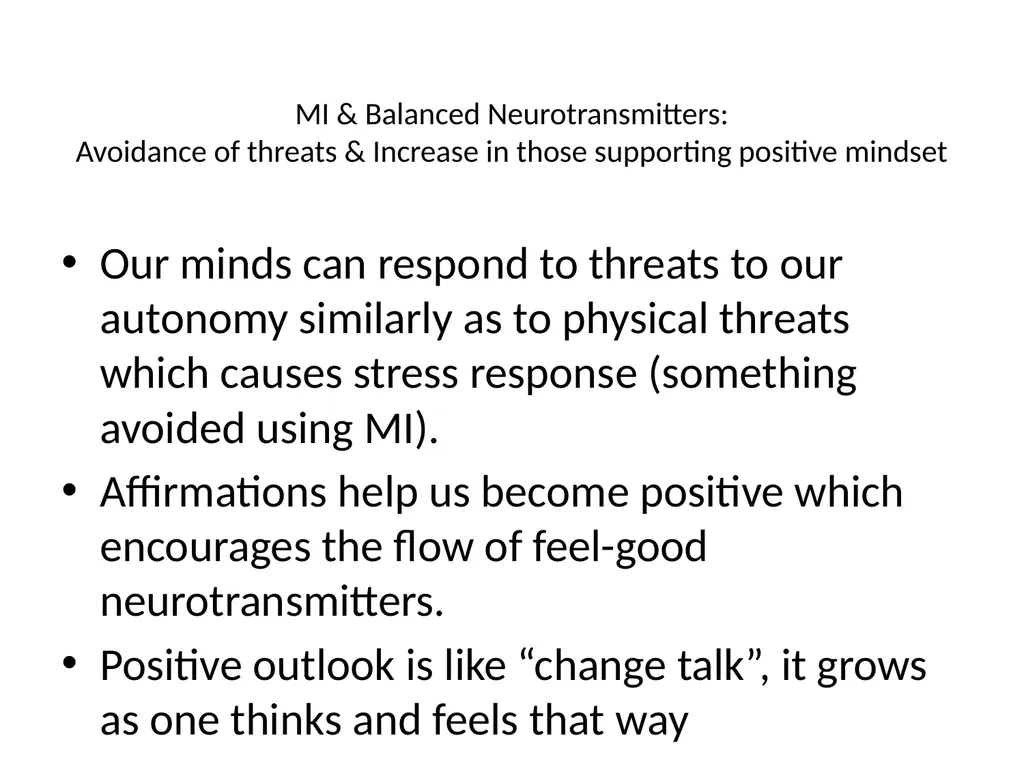
MI & Balanced Neurotransmitters:
Avoidance of threats & Increase in those supporting positive mindset Our minds can respond to threats to our autonomy similarly as to physical threats which causes stress response (something avoided using MI).
Affirmations help us become positive which encourages the flow of feel-good neurotransmitters.
Positive outlook is like “change talk”, it grows as one thinks and feels that way<br>
Affirmations help us become positive which encourages the flow of feel-good neurotransmitters.
Positive outlook is like “change talk”, it grows as one thinks and feels that way<br>
12
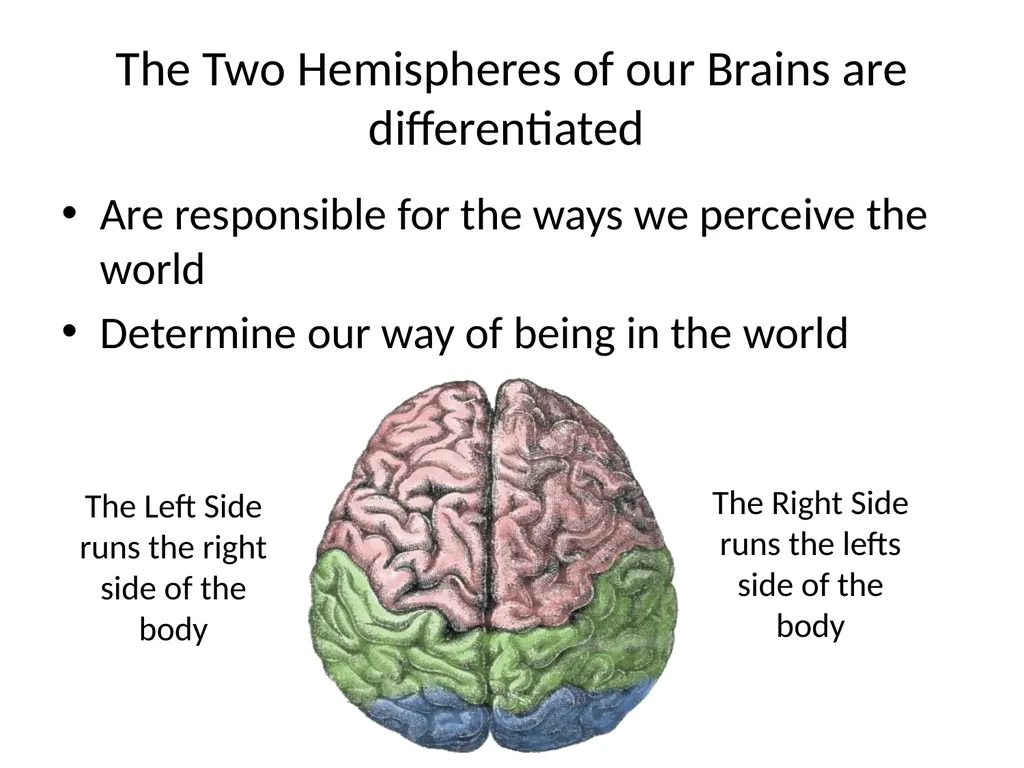
The Two Hemispheres of our Brains are differentiated Are responsible for the ways we perceive the world
Determine our way of being in the world The Right Side runs the lefts side of the body The Left Side runs the right side of the body<br>
Determine our way of being in the world The Right Side runs the lefts side of the body The Left Side runs the right side of the body<br>
13
Left/Right Hemispheres & Neural Connections (Integration) Research suggests people have a dominant hemisphere which affects personality, abilities, and preferred perceptions.
During learning and problem-solving, both hemispheres are engaged by processing the input/skill according to their specialization and exchanging results through the Corpus Callosum (neural cable). Sousa, David (2006). How the Brain Learns; Corwin Press: Thousand Oaks, California.<br>
During learning and problem-solving, both hemispheres are engaged by processing the input/skill according to their specialization and exchanging results through the Corpus Callosum (neural cable). Sousa, David (2006). How the Brain Learns; Corwin Press: Thousand Oaks, California.<br>
14
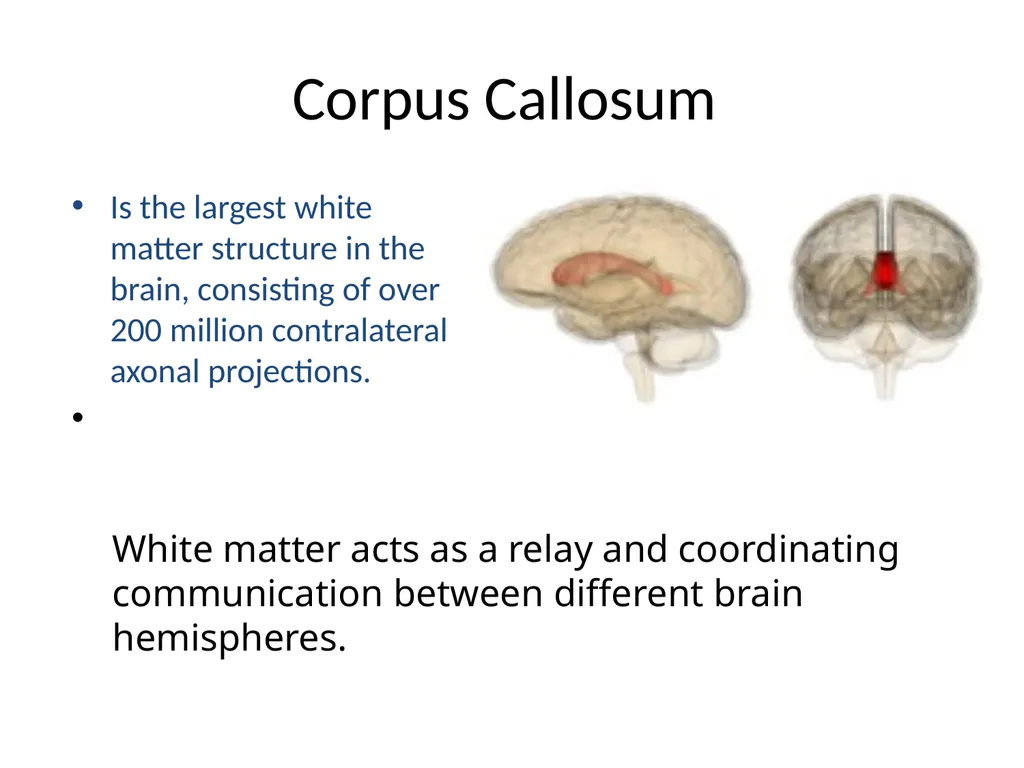
Corpus Callosum Is the largest white matter structure in the brain, consisting of over 200 million contralateral axonal projections. White matter acts as a relay and coordinating communication between different brain hemispheres.<br>
15
Lateralized Structure & Ambivalence
Ambivalence may be partly the result of the brain’s lateralized structure with specialized dominance (i.e. emotions and logical decisions on opposite sides) that when in conflict have trouble connecting and how MI providers reflecting serve as an alternative pathway allowing for decisions for change.<br>
16
Connections in the Brain TOP/DOWN
RIGHT/LEFT
IS CALLED NEURAL INTEGRATION
AFFECTS MEMORY, ATTACHMENT, EMOTIONS AND CONSCIOUS AWARENESS POSITIVELY<br>
RIGHT/LEFT
IS CALLED NEURAL INTEGRATION
AFFECTS MEMORY, ATTACHMENT, EMOTIONS AND CONSCIOUS AWARENESS POSITIVELY<br>
17
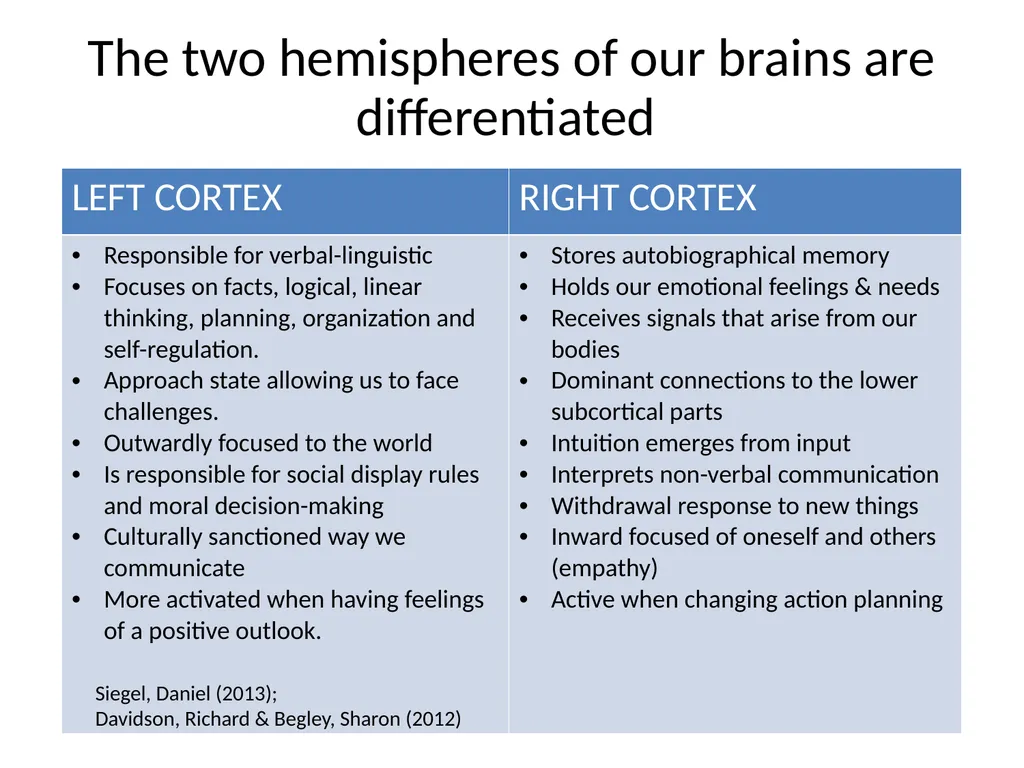
The two hemispheres of our brains are differentiated Siegel, Daniel (2013);
Davidson, Richard & Begley, Sharon (2012)<br>
Davidson, Richard & Begley, Sharon (2012)<br>
18
Think-Pair-Share
What do you think about these ideas?<br>
19
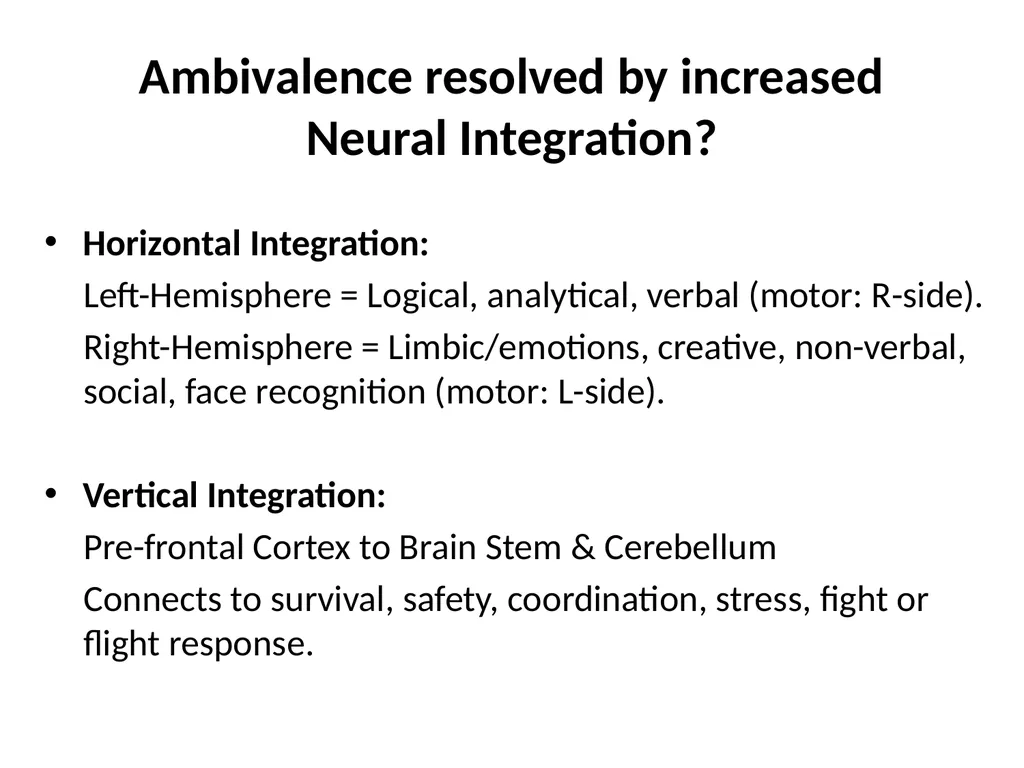
Ambivalence resolved by increased Neural Integration? Horizontal Integration:
Left-Hemisphere = Logical, analytical, verbal (motor: R-side).
Right-Hemisphere = Limbic/emotions, creative, non-verbal, social, face recognition (motor: L-side).
Vertical Integration:
Pre-frontal Cortex to Brain Stem & Cerebellum
Connects to survival, safety, coordination, stress, fight or flight response.<br>
Left-Hemisphere = Logical, analytical, verbal (motor: R-side).
Right-Hemisphere = Limbic/emotions, creative, non-verbal, social, face recognition (motor: L-side).
Vertical Integration:
Pre-frontal Cortex to Brain Stem & Cerebellum
Connects to survival, safety, coordination, stress, fight or flight response.<br>
20
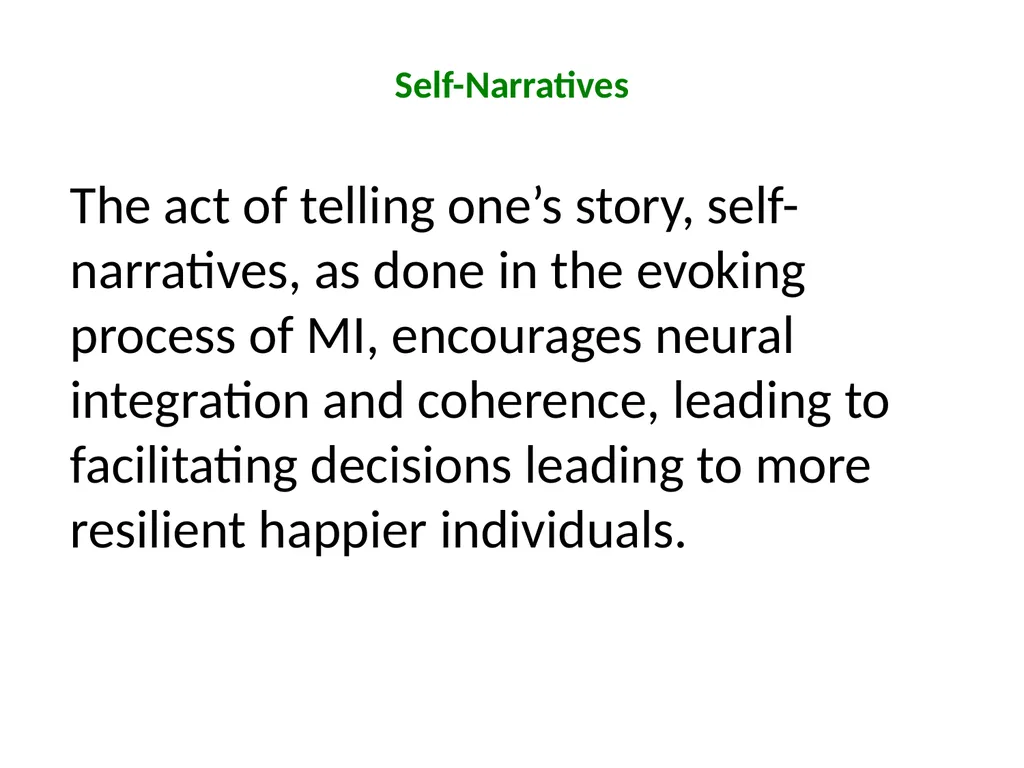
Self-Narratives The act of telling one’s story, self-narratives, as done in the evoking process of MI, encourages neural integration and coherence, leading to facilitating decisions leading to more resilient happier individuals.<br>
21
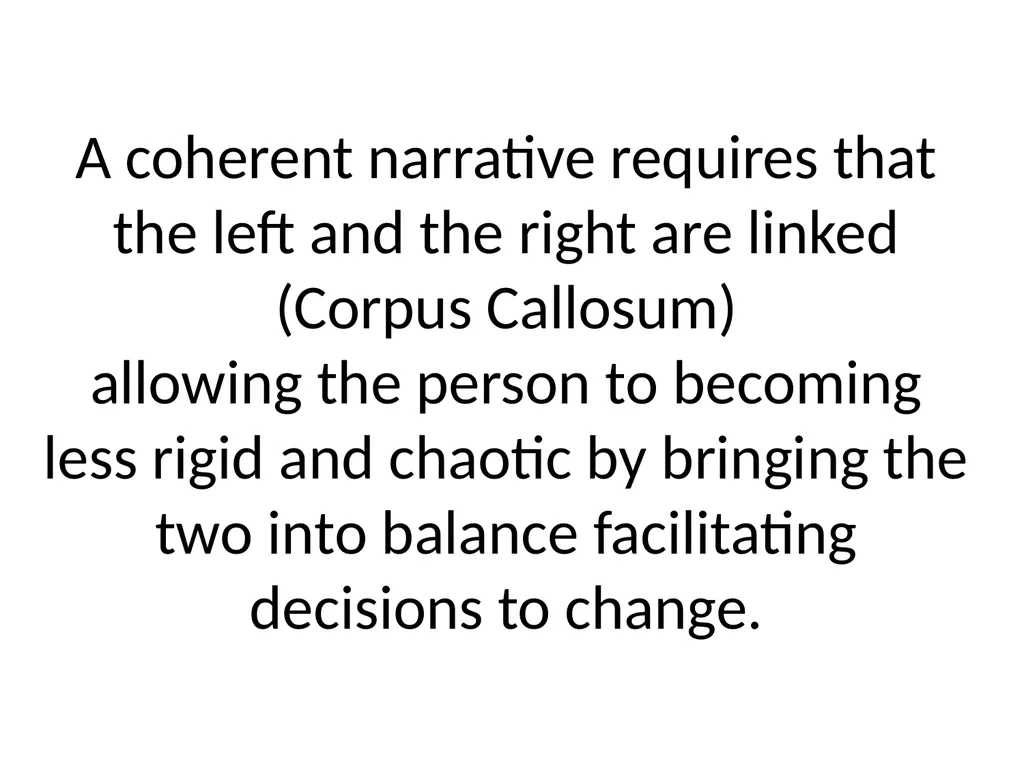
A coherent narrative requires that the left and the right are linked (Corpus Callosum)
allowing the person to becoming less rigid and chaotic by bringing the two into balance facilitating decisions to change.<br>
22
Reflective Listening Helping the person to reflect their reality (thoughts and feelings) can bring coherence. It can help transform raw emotions/memories from the right and link them to explicit memories of facts in the left. Creating connection so they do not become intrusive emotions and instead a coherent narrative of who they are and who they want to be.<br>
23
“Telling a story is the linear telling of a sequence of events involving the left hemisphere’s linguistic, logical, linear diver to explain the cause-effect relationship of things in life. The ability to understand our mental lives are predominately right-sided affairs, suggesting that to tell a coherent story of our lives we need collaboration between these two differentiated, lateralize ways of seeing and being in the world.” Creating the connections necessary for a coherent narrative of who we are and want to be. Seigel, Daniel (2009). The Developing Mind, p. 383. MI is a process of helping the person tell their stories in relation to change…<br>
24
“The mind is defined a process that regulates the flow of energy and information.”
“The view that the mind is just the activity of the brain is only part of the story… the mind uses the brain to create itself. In fact, the mind…cannot only use its own activity to create itself it can actually change the structure of the brain.” Daniel Siegel<br>
“The view that the mind is just the activity of the brain is only part of the story… the mind uses the brain to create itself. In fact, the mind…cannot only use its own activity to create itself it can actually change the structure of the brain.” Daniel Siegel<br>
25
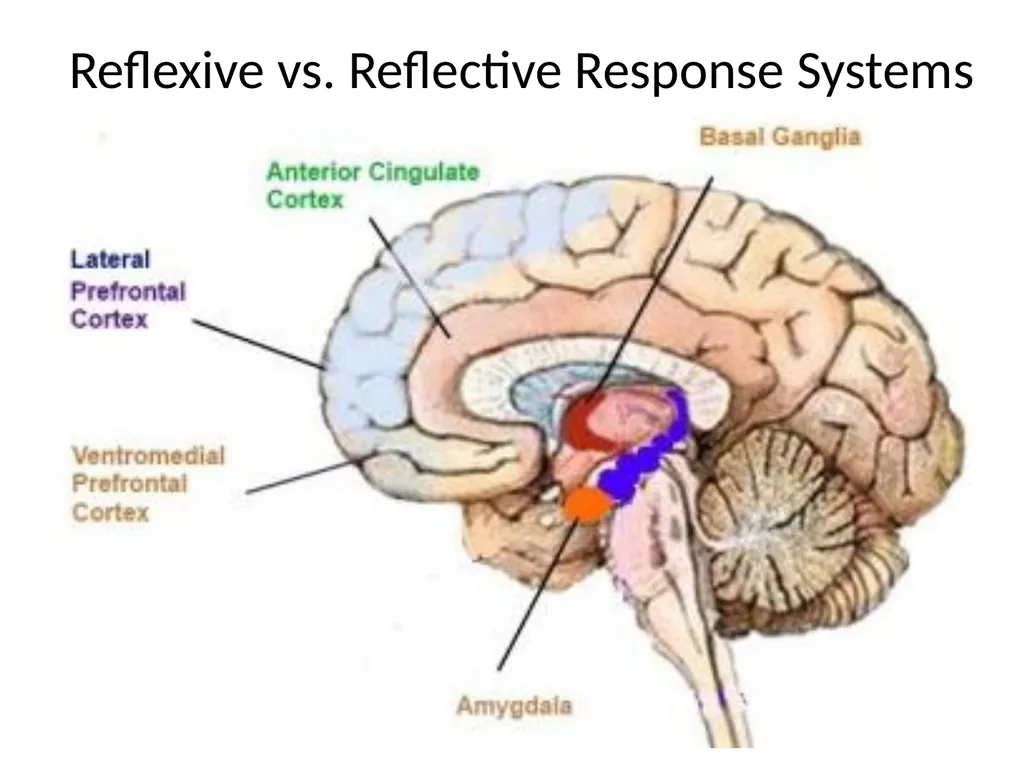
Reflective vs. Reflexive Brain Processes MI conversations help change the energy saving reflexive processes of the brain (i.e. like habits involving the reward circuitry) into the reflective process involving executive functioning.<br>
26
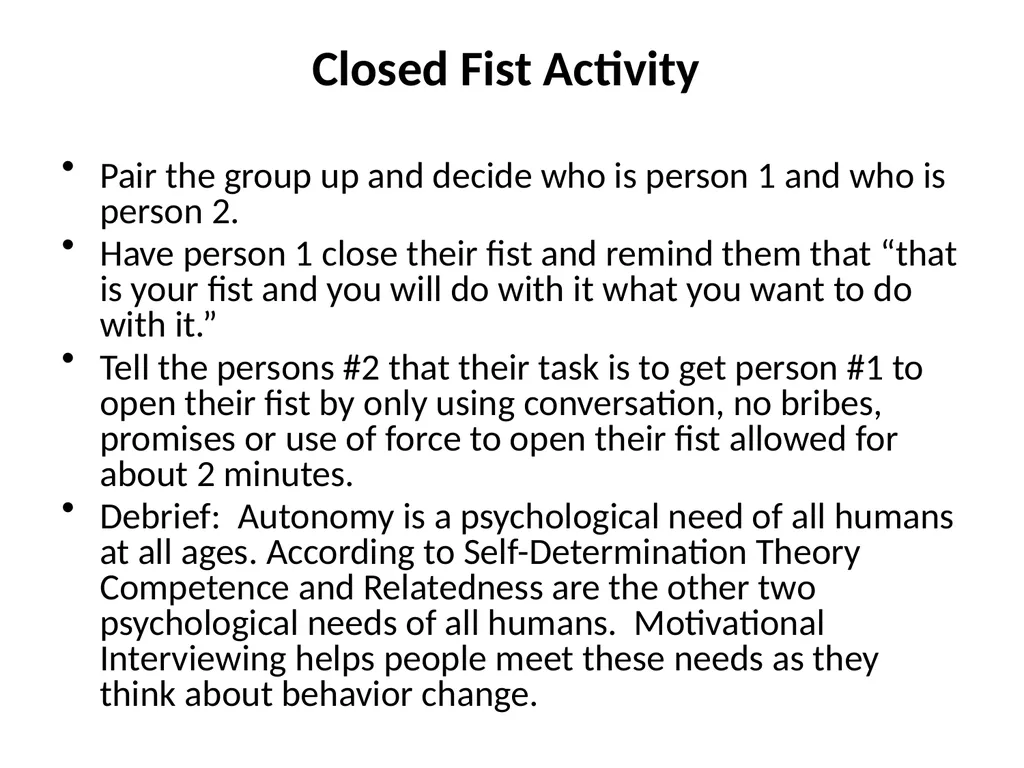
Closed Fist Activity Pair the group up and decide who is person 1 and who is person 2.
Have person 1 close their fist and remind them that “that is your fist and you will do with it what you want to do with it.”
Tell the persons #2 that their task is to get person #1 to open their fist by only using conversation, no bribes, promises or use of force to open their fist allowed for about 2 minutes.
Debrief: Autonomy is a psychological need of all humans at all ages. According to Self-Determination Theory Competence and Relatedness are the other two psychological needs of all humans. Motivational Interviewing helps people meet these needs as they think about behavior change.<br>
Have person 1 close their fist and remind them that “that is your fist and you will do with it what you want to do with it.”
Tell the persons #2 that their task is to get person #1 to open their fist by only using conversation, no bribes, promises or use of force to open their fist allowed for about 2 minutes.
Debrief: Autonomy is a psychological need of all humans at all ages. According to Self-Determination Theory Competence and Relatedness are the other two psychological needs of all humans. Motivational Interviewing helps people meet these needs as they think about behavior change.<br>
27
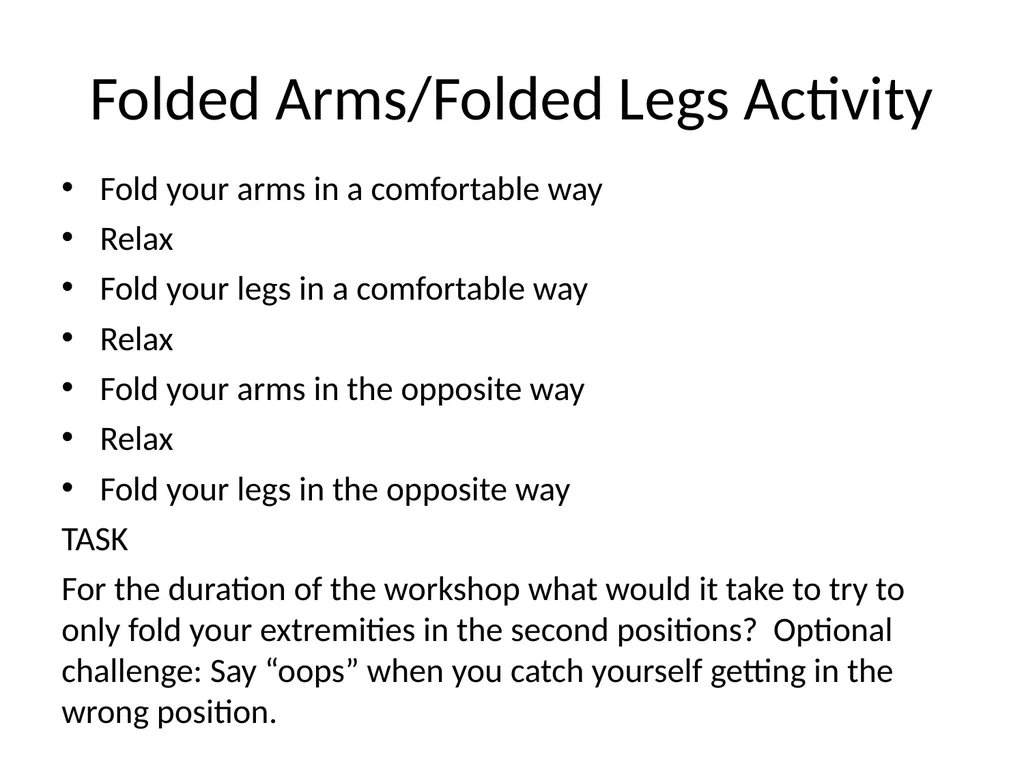
Folded Arms/Folded Legs Activity Fold your arms in a comfortable way
Relax
Fold your legs in a comfortable way
Relax
Fold your arms in the opposite way
Relax
Fold your legs in the opposite way
TASK
For the duration of the workshop what would it take to try to only fold your extremities in the second positions? Optional challenge: Say “oops” when you catch yourself getting in the wrong position.<br>
Relax
Fold your legs in a comfortable way
Relax
Fold your arms in the opposite way
Relax
Fold your legs in the opposite way
TASK
For the duration of the workshop what would it take to try to only fold your extremities in the second positions? Optional challenge: Say “oops” when you catch yourself getting in the wrong position.<br>
28
Reflexive vs. Reflective Response Systems<br>
29
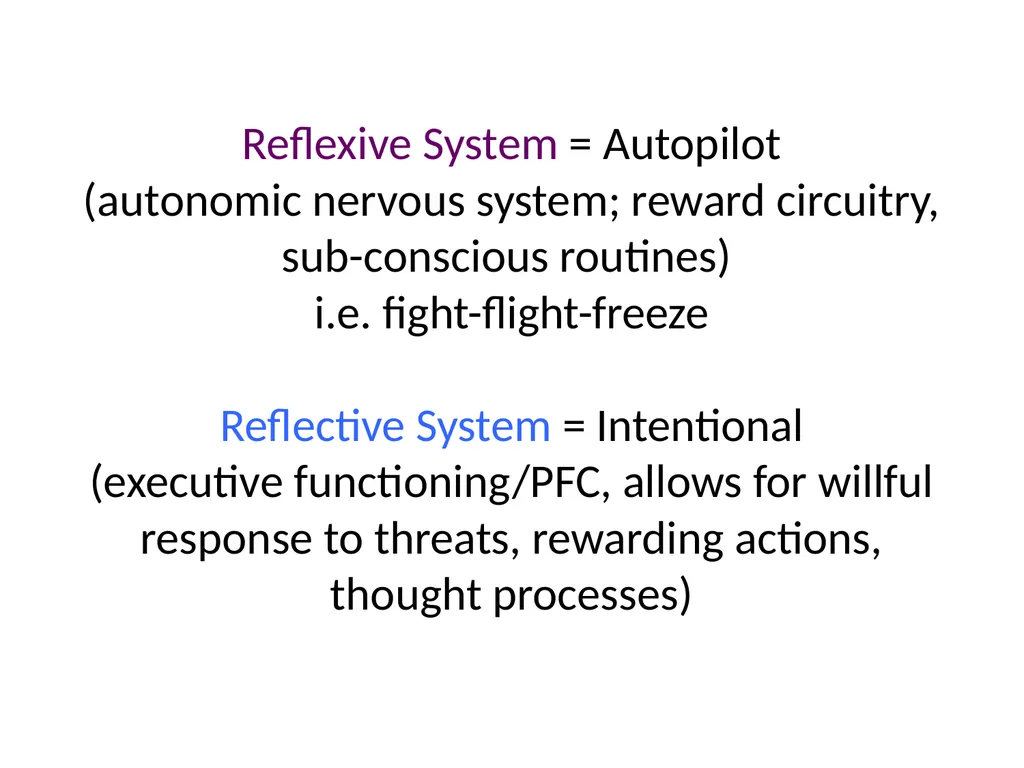
Reflexive System = Autopilot
(autonomic nervous system; reward circuitry, sub-conscious routines)
i.e. fight-flight-freeze
Reflective System = Intentional
(executive functioning/PFC, allows for willful response to threats, rewarding actions, thought processes)<br>
30
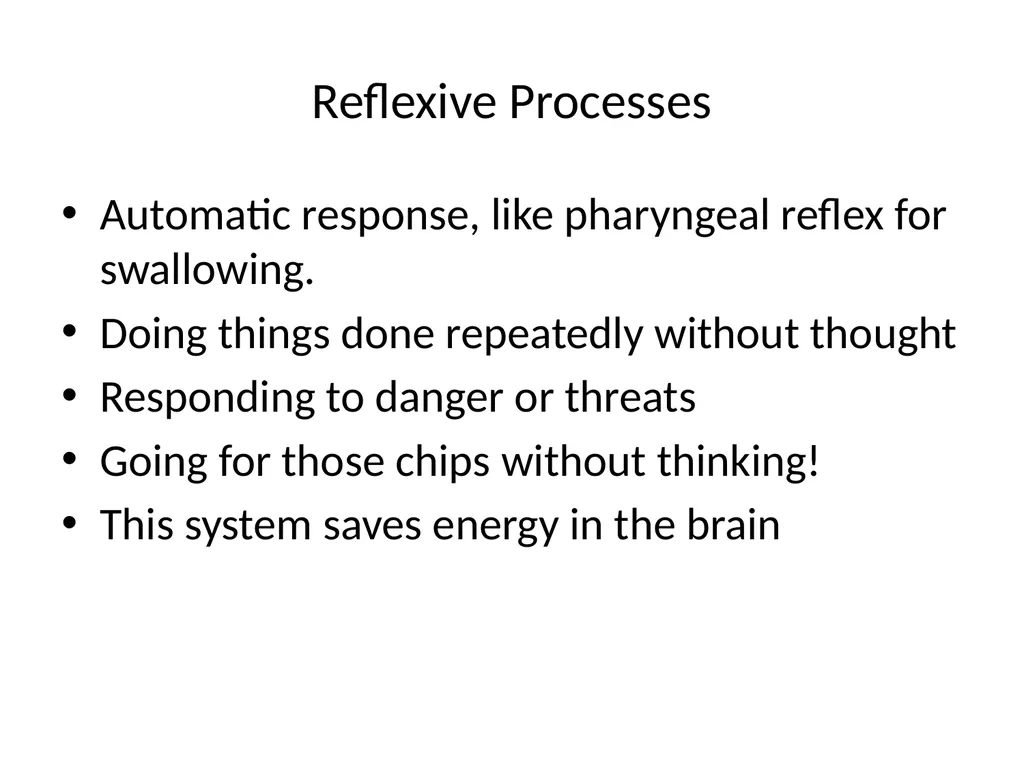
Automatic response, like pharyngeal reflex for swallowing.
Doing things done repeatedly without thought
Responding to danger or threats
Going for those chips without thinking!
This system saves energy in the brain Reflexive Processes<br>
Doing things done repeatedly without thought
Responding to danger or threats
Going for those chips without thinking!
This system saves energy in the brain Reflexive Processes<br>
31
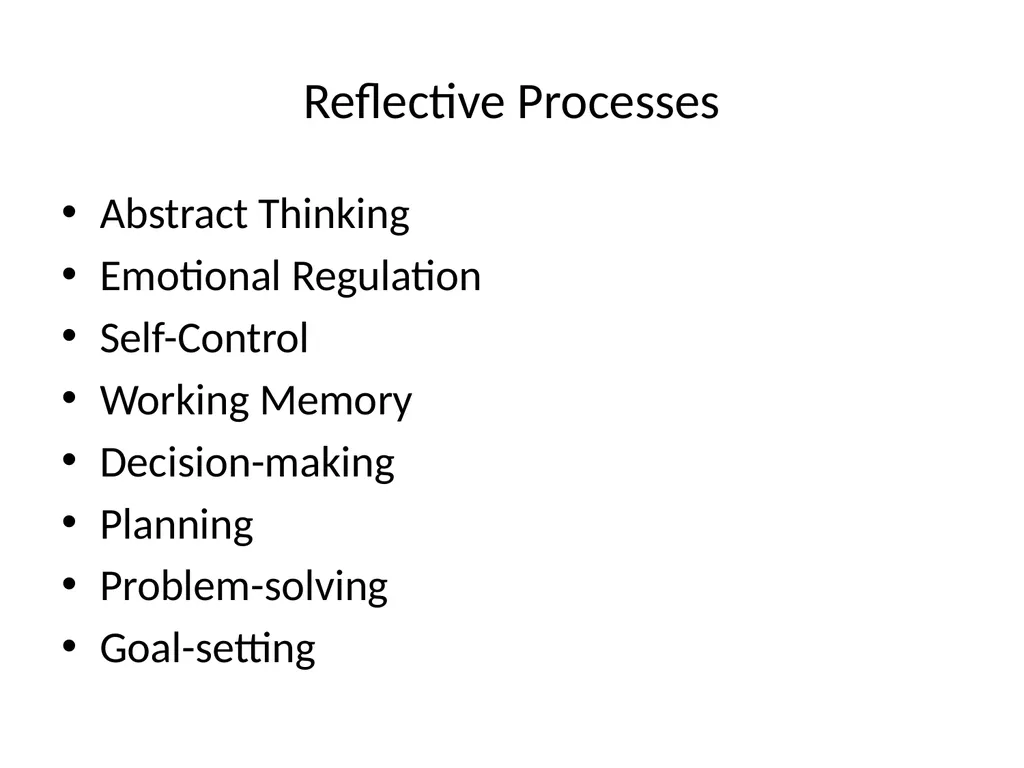
Abstract Thinking
Emotional Regulation
Self-Control
Working Memory
Decision-making
Planning
Problem-solving
Goal-setting Reflective Processes<br>
Emotional Regulation
Self-Control
Working Memory
Decision-making
Planning
Problem-solving
Goal-setting Reflective Processes<br>
32
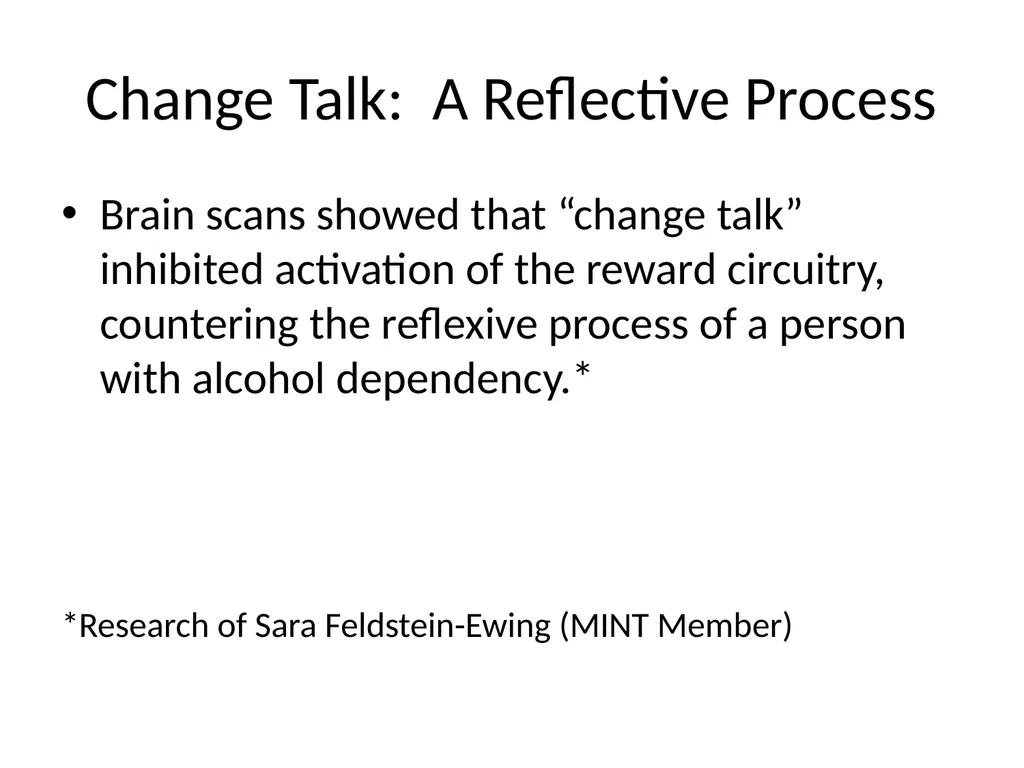
Change Talk: A Reflective Process Brain scans showed that “change talk” inhibited activation of the reward circuitry, countering the reflexive process of a person with alcohol dependency.*
*Research of Sara Feldstein-Ewing (MINT Member)<br>
*Research of Sara Feldstein-Ewing (MINT Member)<br>
33
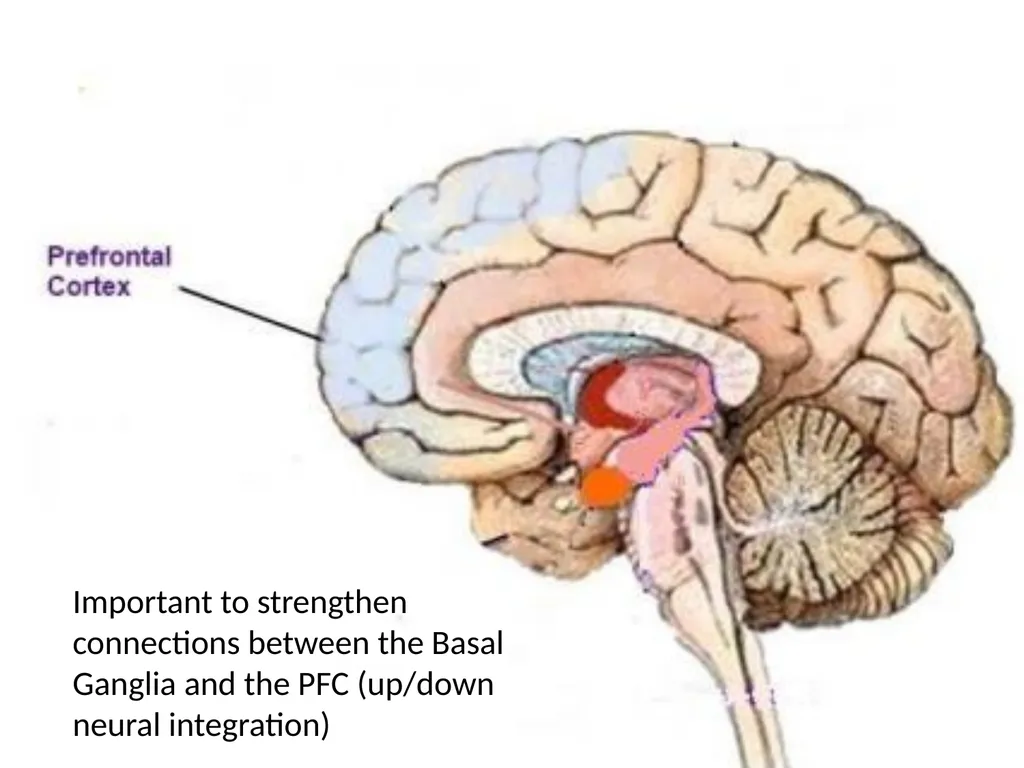
Important to strengthen connections between the Basal Ganglia and the PFC (up/down neural integration)<br>
34
MI Engages the Pre-Frontal Cortex (Executive Function) MI conversations engage the executive function and utilizes neural pathways throughout the brain to evaluate our emotions, enable imagination, and make judgments to determine our actions. When we are ambivalent, stuck or seemingly unmotivated, help integrating our rational, emotional and senses is essential. By reflecting on past experiences and discussing goals, it encourages neural integration and resolution of ambivalence.<br>
35
Extrinsic Motivation vs. Intrinsic Motivation (self-directed) Which is which?
How would you categorize these:
Grades in school/college
Punishment
Shaming
Rewards/Prizes
Curiosity
Making Meaning/thinking
Play<br>
How would you categorize these:
Grades in school/college
Punishment
Shaming
Rewards/Prizes
Curiosity
Making Meaning/thinking
Play<br>
36
Intrinsic vs. Extrinsic Motivation What is referred to as motivation can come from different parts of the brain, depending on if it is extrinsic or intrinsic.<br>
37
Different Parts of the Brain Activated for
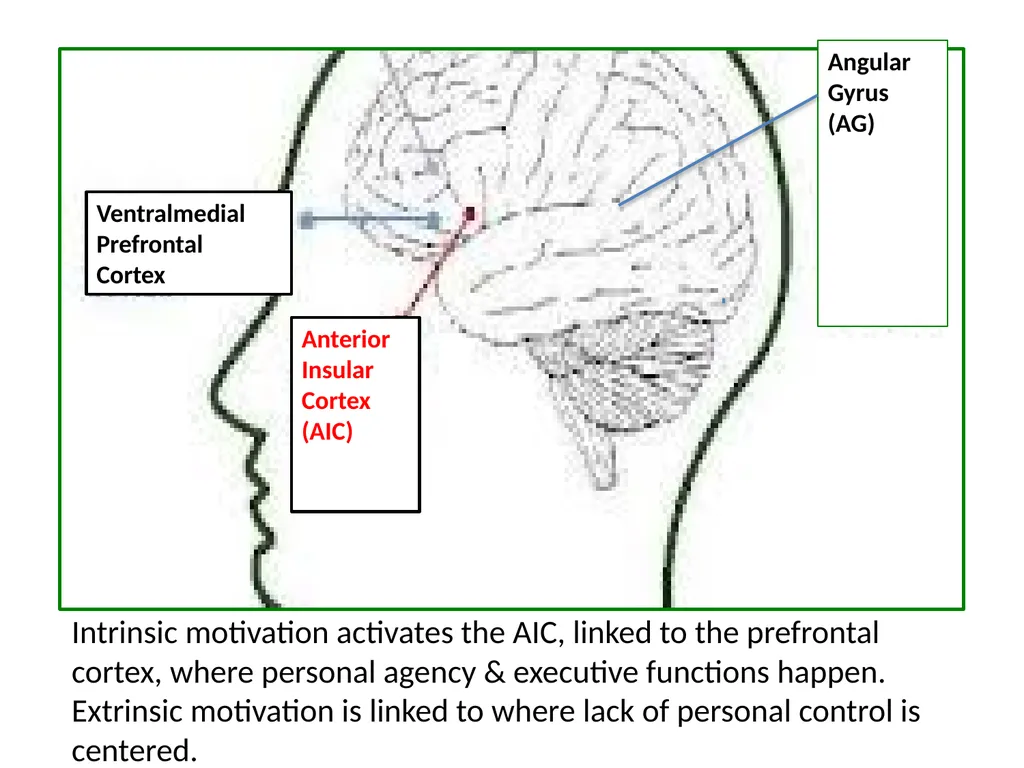
Intrinsic Motivation vs. Extrinsic Motivation Subjects imagined self-determined/intrinsically motivated reason or a non-self-determined/extrinsically motivated reason for taking a particular action (writing). Results showed:
The anterior insular cortex (AIC), known to be related to the sense of agency, was more activated during self-determined behavior
The angular gyrus, known to be related to the sense of loss of agency, was more activated during non-self-determined behavior. Woogul Lee and Johnmarshall Reeve, Self-determined, but not non-self-determined, motivation predicts activations in the anterior insular cortex: an fMRI study of personal agency, Social Cognitive and Affective Neuroscience Advance Access published April 17, 2012.<br>
The anterior insular cortex (AIC), known to be related to the sense of agency, was more activated during self-determined behavior
The angular gyrus, known to be related to the sense of loss of agency, was more activated during non-self-determined behavior. Woogul Lee and Johnmarshall Reeve, Self-determined, but not non-self-determined, motivation predicts activations in the anterior insular cortex: an fMRI study of personal agency, Social Cognitive and Affective Neuroscience Advance Access published April 17, 2012.<br>
38
Angular Gyrus (AG) Anterior Insular Cortex
(AIC) Ventralmedial Prefrontal
Cortex Intrinsic motivation activates the AIC, linked to the prefrontal cortex, where personal agency & executive functions happen. Extrinsic motivation is linked to where lack of personal control is centered.<br>
(AIC) Ventralmedial Prefrontal
Cortex Intrinsic motivation activates the AIC, linked to the prefrontal cortex, where personal agency & executive functions happen. Extrinsic motivation is linked to where lack of personal control is centered.<br>
39
Meeting Needs Engages Minds Meeting a person’s psychological needs (as per Self Determination Theory) increases intrinsic motivation and leads to positive thoughts that maximize neural integration leading to optimal learning and increased resilience. This helps explain why the guided conversations of motivational interviewing can be transformative.<br>
40
Self-Determination Theory:
All cultures and ages have 3 basic psychological needs for healthy growth & development Autonomy (perceived source of own behavior, acting from interest and integrated values).
Competence (confidence in capacities, interactions that expresses and enhances one’s capabilities).
Relatedness (belonging, caring and being cared for, accepted and integrated).<br>
Competence (confidence in capacities, interactions that expresses and enhances one’s capabilities).
Relatedness (belonging, caring and being cared for, accepted and integrated).<br>
41
Intrinsic Motivation Offering people extrinsic rewards for behavior that is intrinsically motivated undermines their intrinsic motivation because it is perceived as undermining their autonomy.
Increasing a participant’s options and choices increases their intrinsic motivation.
Feelings of competence of activities facilitates internalization of interest in those actions.
People internalizing extrinsic regulations (schools, society, workplace, institutions) when they feel secure and cared for by others (parents, teachers, employers, coworkers, etc.)<br>
Increasing a participant’s options and choices increases their intrinsic motivation.
Feelings of competence of activities facilitates internalization of interest in those actions.
People internalizing extrinsic regulations (schools, society, workplace, institutions) when they feel secure and cared for by others (parents, teachers, employers, coworkers, etc.)<br>
42
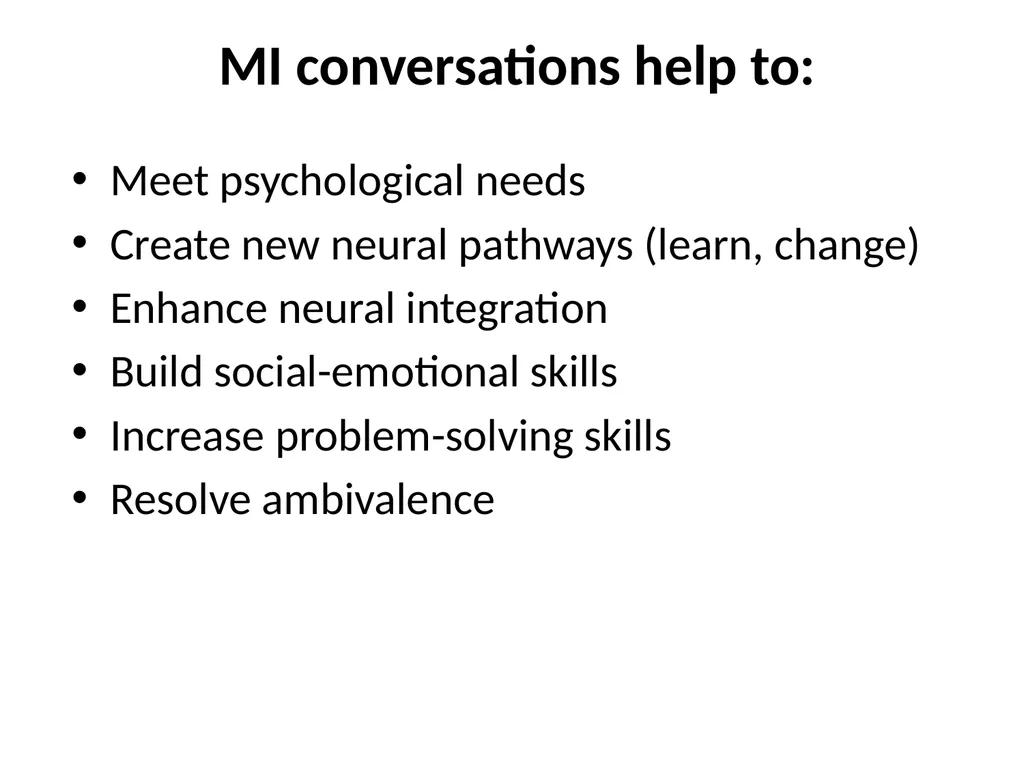
MI conversations help to: Meet psychological needs
Create new neural pathways (learn, change)
Enhance neural integration
Build social-emotional skills
Increase problem-solving skills
Resolve ambivalence<br>
Create new neural pathways (learn, change)
Enhance neural integration
Build social-emotional skills
Increase problem-solving skills
Resolve ambivalence<br>
43
Making Connections Closing Our brain is connected in a similar way as our social connections…
How?<br>
How?<br>
44
Bibliography/References: Amen, Daniel (1998). Change Your Brain Change Your Life; Three Rivers Press: NY.
Boleyn-Fitzgerald, Miriam (2010). Pictures of the Mind: What the new Neuroscience Tells Us About Who We Are; Pearson Education: NJ.
Caine, Geoggrey and Renate N. Caine (2001). The Brain, Education, and the Competitive Edge; Scarecrow Press: Lanham, Maryland.
Caine, Renate N. and G. Caine, C. McClintic and K. Klimek (2009). 12 Brain/Mind Learning Principles in Action: Developing Executive Functions of the Human Brain; Corwin Press: Thousand Oaks, CA.
Cozolino, Louis (2010). The Neuroscience of Psychotherapy: Healing the Social Brain; Norton: NY.
Cozolino, L. (2013). The Social Neuroscience of Education: Optimizing Attachment and Learning in the Classroom WW Norton & Company.
Davidson, Richard & Begley, Sharon (2012). The Emotional Life of Your Brain; Plume: London, England
Handson, Rick (2009). Buddha’s Brain: The Practical Neuroscience of happiness, love and Wisdom; New Harbinger Publications: Oakland, CA.<br>
Boleyn-Fitzgerald, Miriam (2010). Pictures of the Mind: What the new Neuroscience Tells Us About Who We Are; Pearson Education: NJ.
Caine, Geoggrey and Renate N. Caine (2001). The Brain, Education, and the Competitive Edge; Scarecrow Press: Lanham, Maryland.
Caine, Renate N. and G. Caine, C. McClintic and K. Klimek (2009). 12 Brain/Mind Learning Principles in Action: Developing Executive Functions of the Human Brain; Corwin Press: Thousand Oaks, CA.
Cozolino, Louis (2010). The Neuroscience of Psychotherapy: Healing the Social Brain; Norton: NY.
Cozolino, L. (2013). The Social Neuroscience of Education: Optimizing Attachment and Learning in the Classroom WW Norton & Company.
Davidson, Richard & Begley, Sharon (2012). The Emotional Life of Your Brain; Plume: London, England
Handson, Rick (2009). Buddha’s Brain: The Practical Neuroscience of happiness, love and Wisdom; New Harbinger Publications: Oakland, CA.<br>
45
2. Bibliography (Continued) Horstman, Judith (2009). The Scientific American Day in the Life of Your Brain: A 24 Hour Journal of What’s Happening in Your Brain; Jossey-Bass: San Francisco.
Jensen, Eric (2001). Teaching with the Brain in Mind, ASCD: Alexandria, VA.
McNamara, Eddie (1999). Positive Pupil Management and Motivation: A Secondary Teacher’s Guide; Fulton Publishes: London.
McNamara, Eddie (2009). Motivational Interviewing: Theory, Practice and Applications with Children and Young People; Positive Behavior Management: Ainsdale, Merseyside.
Miller, William and Stephen Rollnick (2013). Motivational Interviewing: Preparing People for Change (3rd Ed); Guilford Press: NY.
Naar-King, Sylvie and Mariann Suarez (2011). Motivational Interviewing with Adolescents and Young Adults; Guilford Press: NY.
Pink, Daniel (2006). A Whole New Mind; Riverhead Books: NY.<br>
Jensen, Eric (2001). Teaching with the Brain in Mind, ASCD: Alexandria, VA.
McNamara, Eddie (1999). Positive Pupil Management and Motivation: A Secondary Teacher’s Guide; Fulton Publishes: London.
McNamara, Eddie (2009). Motivational Interviewing: Theory, Practice and Applications with Children and Young People; Positive Behavior Management: Ainsdale, Merseyside.
Miller, William and Stephen Rollnick (2013). Motivational Interviewing: Preparing People for Change (3rd Ed); Guilford Press: NY.
Naar-King, Sylvie and Mariann Suarez (2011). Motivational Interviewing with Adolescents and Young Adults; Guilford Press: NY.
Pink, Daniel (2006). A Whole New Mind; Riverhead Books: NY.<br>
46
3. Bibliography (Continued) Restak, Richard (2006). The Naked Brain: How the Emerging Neuroscience is Changing How We Live, Work and Love; Three Rivers Press: NY.
Schwartz, Jeffery and Sharon Begley (2003). The Mind & The Brain: Neoplasticity and the Power of Mental Force; HarperCollins: NY.
Siegel, Daniel (2013). Brainstorm: The Power & Purpose of the Teenage Brain; Penguin: NY.
Siegel, Daniel (2012). The Developing Mind: How Relationships and the Brain Interact to Shape Who We Are (2nd Ed); Guilford Press: NY.
Siegel, Daniel (2011). Mindsight: The New Science of Personal Transformation; Bantom Books: NY.
Strauch, Barbara (2003). The Primal Teen: What the New Discoveries About the Teenage Brain Tell Us about Our Kids; Anchor Books: NY.
Steinberg, Lawrence (2011). The New Science of the Teenage Brain, National Geographic, 10/2011.<br>
Schwartz, Jeffery and Sharon Begley (2003). The Mind & The Brain: Neoplasticity and the Power of Mental Force; HarperCollins: NY.
Siegel, Daniel (2013). Brainstorm: The Power & Purpose of the Teenage Brain; Penguin: NY.
Siegel, Daniel (2012). The Developing Mind: How Relationships and the Brain Interact to Shape Who We Are (2nd Ed); Guilford Press: NY.
Siegel, Daniel (2011). Mindsight: The New Science of Personal Transformation; Bantom Books: NY.
Strauch, Barbara (2003). The Primal Teen: What the New Discoveries About the Teenage Brain Tell Us about Our Kids; Anchor Books: NY.
Steinberg, Lawrence (2011). The New Science of the Teenage Brain, National Geographic, 10/2011.<br>