
NEW PRODUCT DEVELOPMENT The development of
NS
Published · 25 slides · 0 views
1 / 1
Description
NEW PRODUCT DEVELOPMENT The development of competitive new products is a prerequisite for every business organisation to be successful. Samsung has outperformed Nokia in the global mobile-phone market and become the global leader. Samsung
Related Topics
Share
Embed code
Download this presentation From Below
"NEW PRODUCT DEVELOPMENT The development of" is the property of its rightful owner. Permission is granted to download and print the materials on this website for personal, non-commercial use only, and to display it on your personal computer provided you do not modify the materials and that you retain all copyright notices contained in the materials. By downloading content from our website, you accept the terms of this agreement.
Presentation Transcript
01
NEW PRODUCT DEVELOPMENT<br>
02
The development of competitive new products is a prerequisite for every business organisation to be successful. Samsung has outperformed Nokia in the global mobile-phone market and become the global leader. Samsung updates its existing mobile phones and brings new mobile phones more frequently at competitive low price with advance features, appealing designs, better quality and reliability. Nokia failed to satisfy changing customer needs, wants, and expectations, and lost its market position.<br>
03
Definition of Product Development
In general, the Product Development can be defined as "creating, innovating, or developing entirely a new product , or presenting an existing product with enhanced utility, improved features, more appealing design, better quality and reliability to satisfy the requirements of its end-users."
Meaning of Product Development
Product means a good, service, idea or object created as a result of a process and offered to serve a need or satisfy a want. Development means the act or process of growing, progressing, or developing.<br>
04
Product Development is a process of improving the existing product or to introduce a new product in the market. It is also referred as New Product Development.
The functions of product development are as follows :- Creation of an entirely new product or upgrading an existing product,
Innovation of a new or an existing product to deliver better and enhanced services,
Enhancing the utility and improving the features of an existing product,
Continuous improvement of a product to satisfy rapidly changing customer needs and wants.<br>
The functions of product development are as follows :- Creation of an entirely new product or upgrading an existing product,
Innovation of a new or an existing product to deliver better and enhanced services,
Enhancing the utility and improving the features of an existing product,
Continuous improvement of a product to satisfy rapidly changing customer needs and wants.<br>
05
Product Development Process
Product development process is a crucial process for the success and survival of any business. Today, businesses are operating in a highly dynamic and competitive environment. Business organizations have to continuously update their products to conform to current trends.
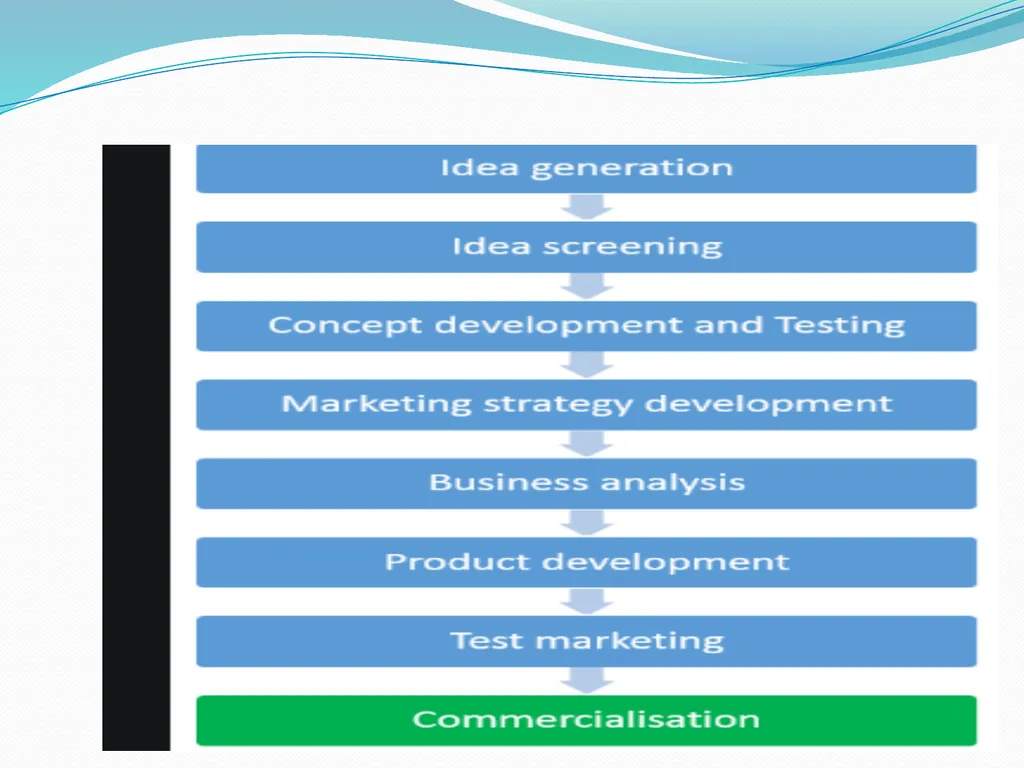
The product development process starts from idea generation and ends with product development and commercialization.
Following are the steps in the process of product development.<br>
Product development process is a crucial process for the success and survival of any business. Today, businesses are operating in a highly dynamic and competitive environment. Business organizations have to continuously update their products to conform to current trends.
The product development process starts from idea generation and ends with product development and commercialization.
Following are the steps in the process of product development.<br>
06
Idea Generation -
The first step of product development is Idea Generation that is identification of new products required to be developed considering consumer needs and demands. Idea generation is done through research of market sources like consumer liking, disliking, and competitor policies. Various methods are available for idea generation like - Brain Storming, Delphi Method, or Focus Group.<br>
The first step of product development is Idea Generation that is identification of new products required to be developed considering consumer needs and demands. Idea generation is done through research of market sources like consumer liking, disliking, and competitor policies. Various methods are available for idea generation like - Brain Storming, Delphi Method, or Focus Group.<br>
07
Idea Screening -
The second step in the process of product development is Idea Screening that is selecting the best idea among the ideas generated at the first step. As the resources are limited, so all the ideas are not converted to products. Most promising idea is kept for the next stage.<br>
The second step in the process of product development is Idea Screening that is selecting the best idea among the ideas generated at the first step. As the resources are limited, so all the ideas are not converted to products. Most promising idea is kept for the next stage.<br>
08
Concept Development - At this step the selected idea is moved into development process. For the selected idea different product concepts are developed. Out of several product concepts the most suitable concept is selected and introduced to a focus group of customers to understand their reaction.
For example - in auto expos different concept cars are presented, these models are not the actual product, they are just to describe the concept say electric, hybrid, sport, fuel efficient, environment friendly, etc<br>
For example - in auto expos different concept cars are presented, these models are not the actual product, they are just to describe the concept say electric, hybrid, sport, fuel efficient, environment friendly, etc<br>
09
Concept development
Imagine a car manufacturer that has developed an all-electric car. The idea has passed the idea screening and must now be developed into a concept. The marketer’s task is to develop this new product into alternative product concepts. Then, the company can find out how attractive each concept is to customers and choose the best one. Possible product concepts for this electric car could be<br>
Imagine a car manufacturer that has developed an all-electric car. The idea has passed the idea screening and must now be developed into a concept. The marketer’s task is to develop this new product into alternative product concepts. Then, the company can find out how attractive each concept is to customers and choose the best one. Possible product concepts for this electric car could be<br>
10
Market Strategy Development -
At this step the market strategies are developed to evaluate market size, product demand, growth potential, and profit estimation for initial years. Further it includes launch of product, selection of distribution channel, budgetary requirements, etc.<br>
At this step the market strategies are developed to evaluate market size, product demand, growth potential, and profit estimation for initial years. Further it includes launch of product, selection of distribution channel, budgetary requirements, etc.<br>
11
Business Analysis - At this step business analysis for the new product is done. Business analysis includes - estimation of sales, frequency of purchases, nature of business, production and distribution related costs and expenses, and estimation of profit.<br>
12
Once decided upon a product concept and marketing strategy, management can evaluate the business attractiveness of the proposed new product. The fifth step in the new product development process involves a review of the sales, costs and profit projections for the new product to find out whether these factors satisfy the company’s objectives. If they do, the product can be moved on to the product development stage.
In order to estimate sales, the company could look at the sales history of similar products and conduct market surveys. Then, it should be able to estimate minimum and maximum sales to assess the range of risk. When the sales forecast is prepared, the firm can estimate the expected costs and profits for a product, including marketing, R&D, operations etc. All the sales and costs figures together can eventually be used to analyse the new product’s financial attractiveness<br>
In order to estimate sales, the company could look at the sales history of similar products and conduct market surveys. Then, it should be able to estimate minimum and maximum sales to assess the range of risk. When the sales forecast is prepared, the firm can estimate the expected costs and profits for a product, including marketing, R&D, operations etc. All the sales and costs figures together can eventually be used to analyse the new product’s financial attractiveness<br>
13
Product Development - At this step the concept moves to production of finalised product. Decisions are taken from operational point of view whether the product is technically and commercially feasible to produce. Here the research and development department develop a physical product<br>
14
Test Marketing - Now the product is ready to be launched in market with brand name, packaging, and pricing. Initially the product is launched in a test market. Before full scale launching the product is exposed to a carefully chosen sample of the population, called test market. If the product is found acceptable in test market the product is ready to be launched in target market.<br>
15
Commercialization - Here the product is launched across target market with a proper market strategy and plan. This is called commercialization phase of product development.<br>
16
Test marketing has given management the information needed to make the final decision: launch or do not launch the new product. The final stage in the new product development process is commercialisation.
Commercialisation means nothing else than introducing a new product into the market. At this point, the highest costs are incurred: the company may need to build or rent a manufacturing facility. Large amounts may be spent on advertising, sales promotion and other marketing efforts in the first year.
Some factors should be considered before the product is commercialized:
Introduction timing. For instance, if the economy is down, it might be wise to wait until the following year to launch the product. However, if competitors are ready to introduce their own products, the company should push to introduce the new product sooner.<br>
Commercialisation means nothing else than introducing a new product into the market. At this point, the highest costs are incurred: the company may need to build or rent a manufacturing facility. Large amounts may be spent on advertising, sales promotion and other marketing efforts in the first year.
Some factors should be considered before the product is commercialized:
Introduction timing. For instance, if the economy is down, it might be wise to wait until the following year to launch the product. However, if competitors are ready to introduce their own products, the company should push to introduce the new product sooner.<br>
17
Introduction place. Where to launch the new product? Should it be launched in a single location, a region, the national market, or the international market? Normally, companies don’t have the confidence, capital and capacity to launch new products into full national or international distribution from the start. Instead, they usually develop a planned market rollout over time.
In all of these steps of the new product development process, the most important focus is on creating superior customer value. Only then, the product can become a success in the market. Only very few products actually get the chance to become a success. The risks and costs are simply too high to allow every product to pass every stage of the new product development process.<br>
In all of these steps of the new product development process, the most important focus is on creating superior customer value. Only then, the product can become a success in the market. Only very few products actually get the chance to become a success. The risks and costs are simply too high to allow every product to pass every stage of the new product development process.<br>
18
Some of the major roles played by marketers in new product development process are as follows:<br>
19
The Importance of Product Development<br>
20
Product development, is the life-blood of companies and societies. The product could be a physical product such as an automobile, smart phone, or coffee maker. It could also be services such as new IT solution, new manufacturing process, or a new real estate marketing concept.
All successful product development actions provide the following:
New value for customers
Improved society
Continued existence of the company<br>
All successful product development actions provide the following:
New value for customers
Improved society
Continued existence of the company<br>
21
New Value for Customers
The first and most important reason for any new development is to provide new value to the customer. Without this, there is no reason for them to trade their money for the new device. However, if the product or service offers overwhelming value, then customers will flock to it.
This new and increasing value is what keeps companies growing. If there is no new value to offer customers, the firm wilts and eventually dies. If the value offered is not increasing, then the company is losing ground in the market as its competitors increase their value in the market.
Improved Society
Many new products are simply an incremental improvement over the previous version with only some new features or slight faster performance. These products may sustain the company by offering enough new value to generate additional revenue, but they are hardly a boon to society.
There are certain instances where new products will improve society beyond just the immediate gratification of the consumer.<br>
The first and most important reason for any new development is to provide new value to the customer. Without this, there is no reason for them to trade their money for the new device. However, if the product or service offers overwhelming value, then customers will flock to it.
This new and increasing value is what keeps companies growing. If there is no new value to offer customers, the firm wilts and eventually dies. If the value offered is not increasing, then the company is losing ground in the market as its competitors increase their value in the market.
Improved Society
Many new products are simply an incremental improvement over the previous version with only some new features or slight faster performance. These products may sustain the company by offering enough new value to generate additional revenue, but they are hardly a boon to society.
There are certain instances where new products will improve society beyond just the immediate gratification of the consumer.<br>
22
Continued Existence and Growth of the Company
New products and services are the lifeblood of any company. Without them, the firm withers on the vine and either dies or is absorbed by another firm. Society is well-served by the continuance of these companies from the employment of the individuals who work there (who are also consumers), and the support for society at-large in the form of taxation and charitable giving.
Companies (and civilizations) have little choice but grow and improve if they want to move from survival to thriving. The new products and services created and provided by companies of all sizes provide the mechanism for this growth and improvement. What are you and your firm doing to improve?<br>
New products and services are the lifeblood of any company. Without them, the firm withers on the vine and either dies or is absorbed by another firm. Society is well-served by the continuance of these companies from the employment of the individuals who work there (who are also consumers), and the support for society at-large in the form of taxation and charitable giving.
Companies (and civilizations) have little choice but grow and improve if they want to move from survival to thriving. The new products and services created and provided by companies of all sizes provide the mechanism for this growth and improvement. What are you and your firm doing to improve?<br>
23
Key factors or reasons for developing new products:
Change in Market
Today’s market is more dynamic as compared to the past; it keeps on changing due to the wide variety of customer needs. Due to increased literacy rate, globalized market, heavy competition, and availability of a number of substitute products have given tremendous challenges in today’s market. Market fashion and Trends, preference and needs, behaviour and habits are constantly changing and marketer’s finds no other options rather than accepting market changes, by providing positive response in terms of innovation. Thus, consumer behaviour drives the innovation and become the dominant reason.
Change in Technology Due to continuous technological growth and development, new manufacturing methods are invented. Old technologies and manufacturing methods are replaced by newer ones. A firm spends a huge amount of money for technological research. To cope up with the technological changes, new products are being developed.
Increasing Competition Increased competition is one of major reasons leading to go for new products development. Every firm struggles to fulfil and retain consumers by offering exceptional products. To offer more competitive advantage over the other and to satisfy consumer needs more effectively and efficiently, the product innovation seems to be needed.
Diversification of Risk In most of the cases, existing products may not be sufficient to manage with market needs and wants so firms develops new products just to diversify risk. By providing more varieties, a firm can reduce the degree of failure. Thus results in the need for continuous innovation, because older products are thrown out of existing market.
Reputation and Goodwill To build image and reputation as a dynamic innovation and creative firm, the new products development is adopted. Company desires to convince the market that it works hard to meet consumer’s expectations. In fact, a company developing new products frequently has more reputation and can easily attract customers.
Utilization of Excess Capacity To optimally utilize the existing resources is in the form of production capacity and human skills and capabilities; a company may go for creating a new products.
Seasonal Fluctuations Now and then, new products are created just to reduce seasonal fluctuations in demand. By manufacturing new products, a firm can meet seasonal requirements of customers in the market. Customers are satisfied due to matching products in each of the seasons, and company can get reasonable business.<br>
Change in Technology Due to continuous technological growth and development, new manufacturing methods are invented. Old technologies and manufacturing methods are replaced by newer ones. A firm spends a huge amount of money for technological research. To cope up with the technological changes, new products are being developed.
Increasing Competition Increased competition is one of major reasons leading to go for new products development. Every firm struggles to fulfil and retain consumers by offering exceptional products. To offer more competitive advantage over the other and to satisfy consumer needs more effectively and efficiently, the product innovation seems to be needed.
Diversification of Risk In most of the cases, existing products may not be sufficient to manage with market needs and wants so firms develops new products just to diversify risk. By providing more varieties, a firm can reduce the degree of failure. Thus results in the need for continuous innovation, because older products are thrown out of existing market.
Reputation and Goodwill To build image and reputation as a dynamic innovation and creative firm, the new products development is adopted. Company desires to convince the market that it works hard to meet consumer’s expectations. In fact, a company developing new products frequently has more reputation and can easily attract customers.
Utilization of Excess Capacity To optimally utilize the existing resources is in the form of production capacity and human skills and capabilities; a company may go for creating a new products.
Seasonal Fluctuations Now and then, new products are created just to reduce seasonal fluctuations in demand. By manufacturing new products, a firm can meet seasonal requirements of customers in the market. Customers are satisfied due to matching products in each of the seasons, and company can get reasonable business.<br>
24
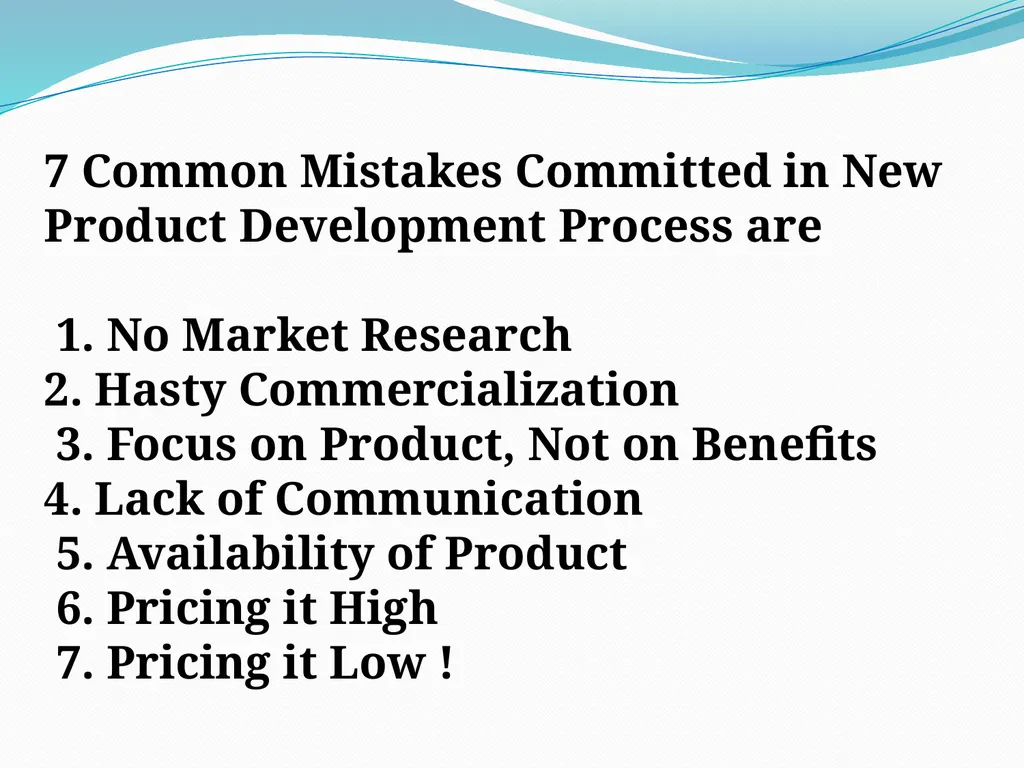
7 Common Mistakes Committed in New Product Development Process are
1. No Market Research
2. Hasty Commercialization
3. Focus on Product, Not on Benefits
4. Lack of Communication
5. Availability of Product
6. Pricing it High
7. Pricing it Low !<br>
1. No Market Research
2. Hasty Commercialization
3. Focus on Product, Not on Benefits
4. Lack of Communication
5. Availability of Product
6. Pricing it High
7. Pricing it Low !<br>