
New Testament Backgrounds OT Foundations “Look,



Description: New Testament Backgrounds OT Foundations Look, the lamb of God which takes away the sin of the world John 1:29 Climax of Institutions of Israel: Prophet: Deut 18, Mal. 4:5f King: greater son of David; temple builder Priest: Aaronic
Related Topics
Download Presentation
"New Testament Backgrounds OT Foundations “Look," is the property of its rightful owner. Permission is granted to download and print the materials on this website for personal, non-commercial use only, and to display it on your personal computer provided you do not modify the materials and that you retain all copyright notices contained in the materials. By downloading content from our website, you accept the terms of this agreement.
Presentation Transcript
slide1. New Testament Backgrounds<br>
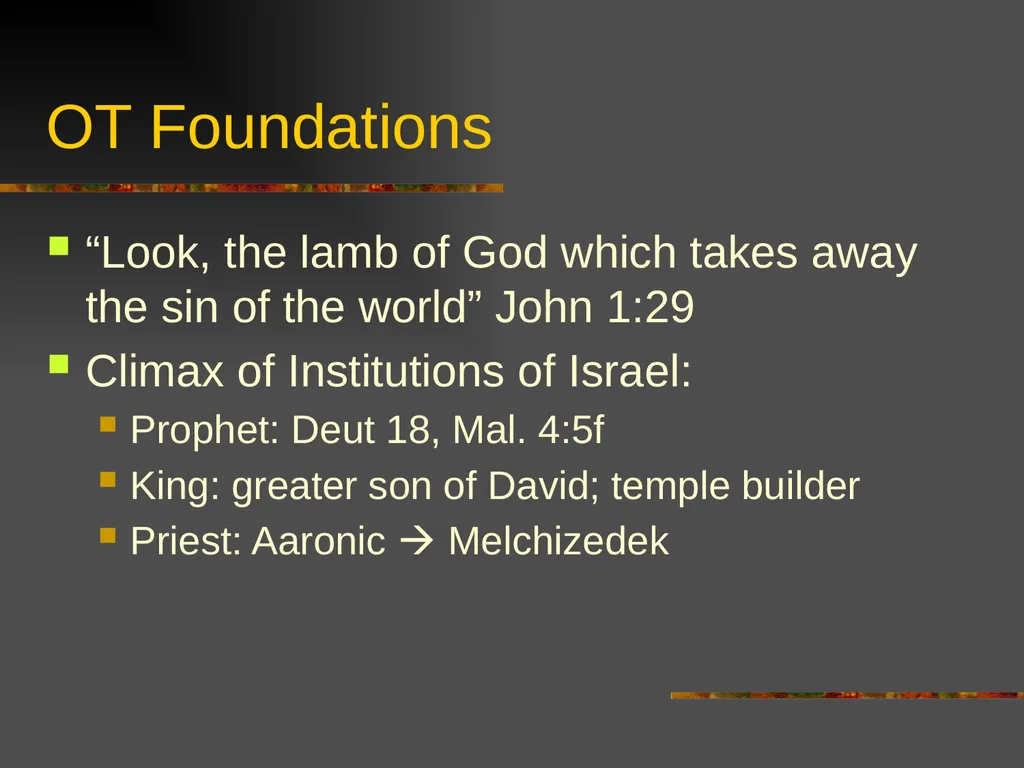
slide2. OT Foundations “Look, the lamb of God which takes away the sin of the world” John 1:29
Climax of Institutions of Israel:
Prophet: Deut 18, Mal. 4:5f
King: greater son of David; temple builder
Priest: Aaronic Melchizedek<br>
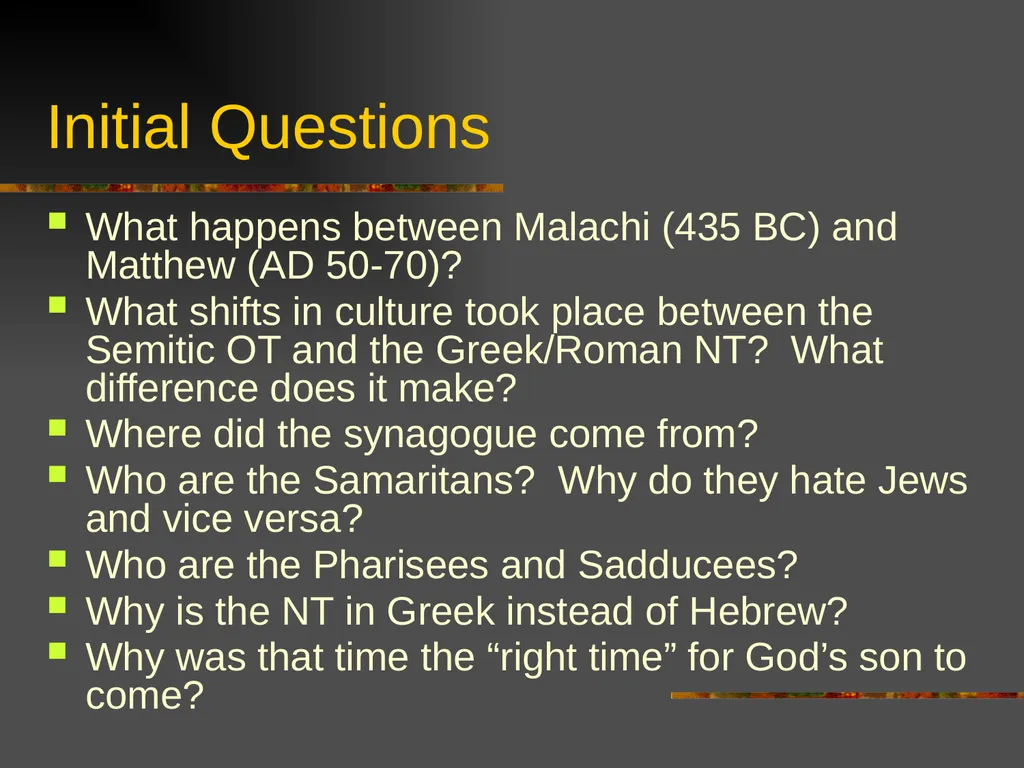
slide3. Initial Questions What happens between Malachi (435 BC) and Matthew (AD 50-70)?
What shifts in culture took place between the Semitic OT and the Greek/Roman NT? What difference does it make?
Where did the synagogue come from?
Who are the Samaritans? Why do they hate Jews and vice versa?
Who are the Pharisees and Sadducees?
Why is the NT in Greek instead of Hebrew?
Why was that time the “right time” for God’s son to come?<br>
slide4. Galatians 4:4 But when the set time had fully come, God sent his Son, born of a woman, born under the law.<br>
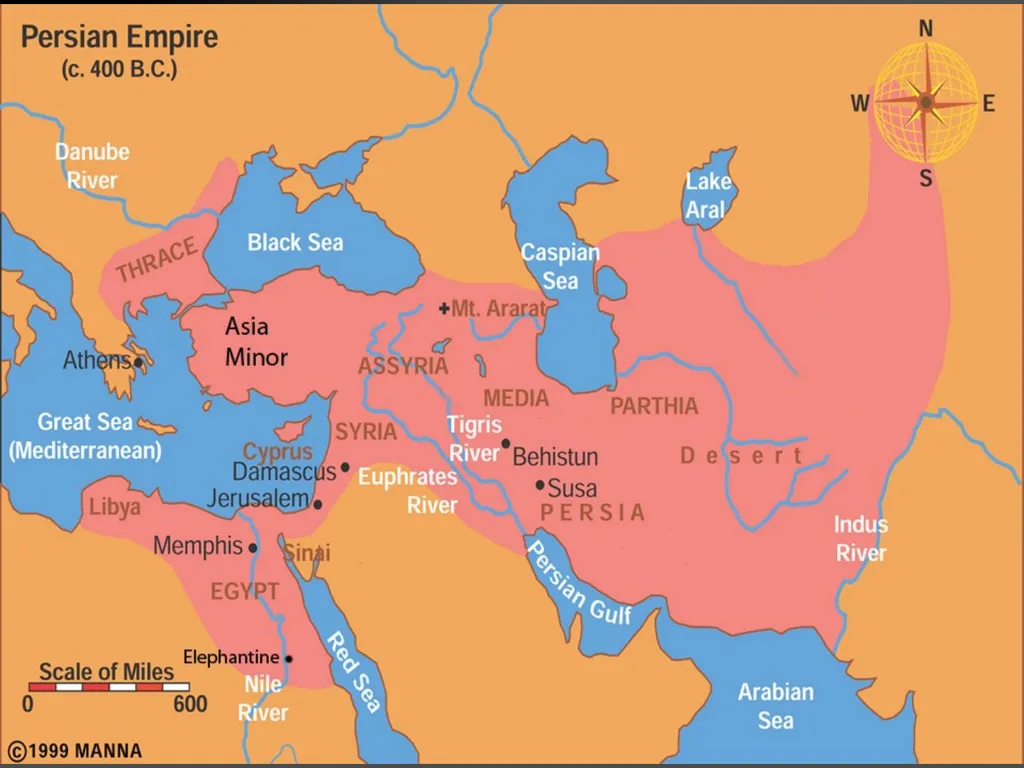
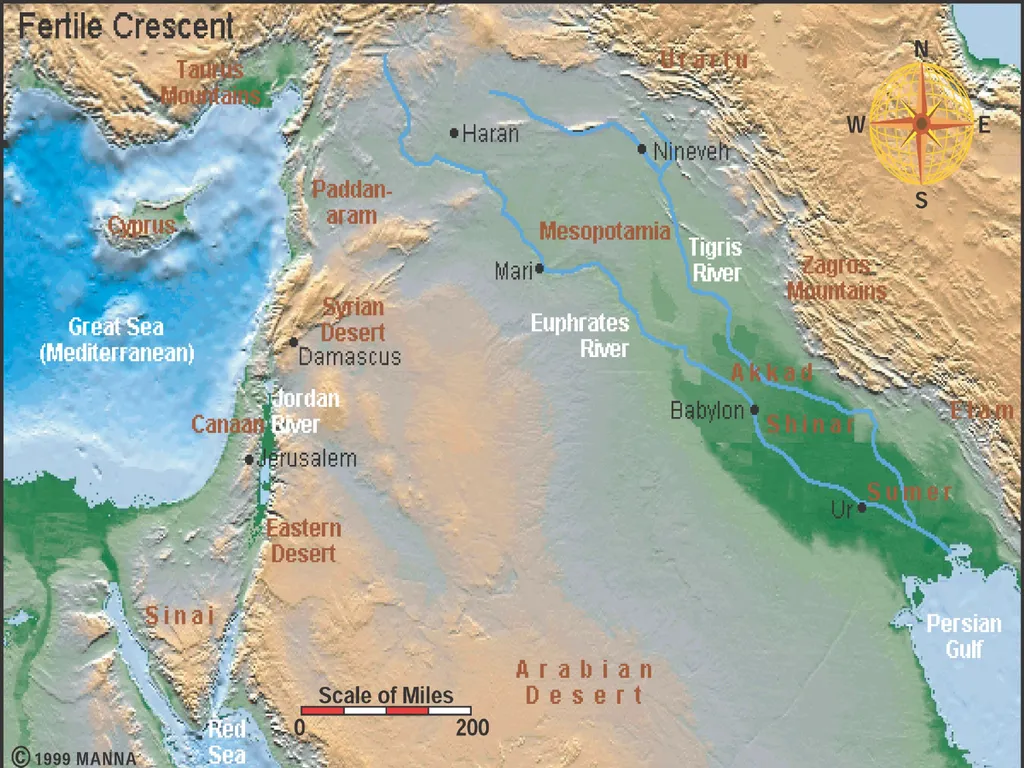
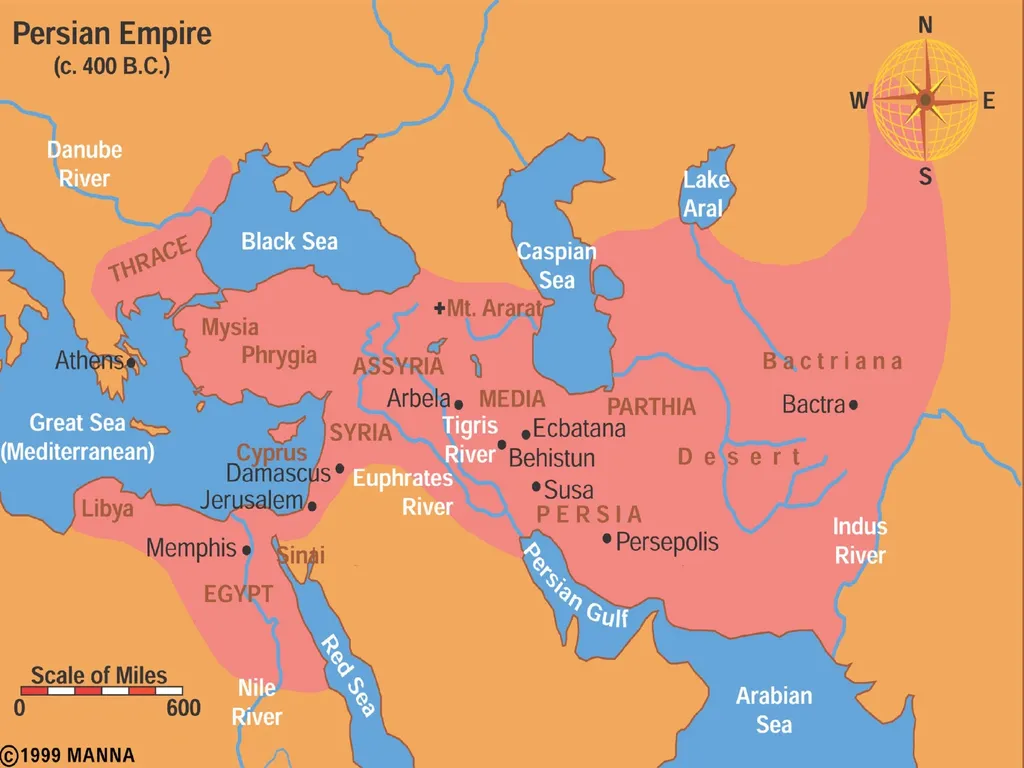
slide5. Persian Empire<br>
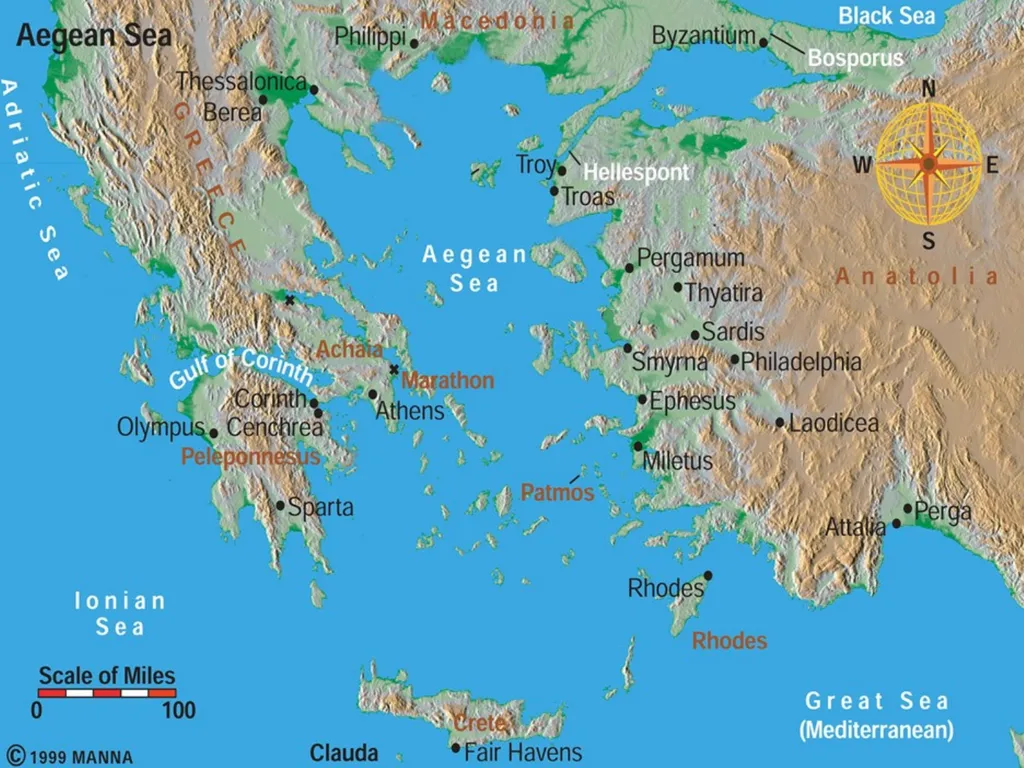
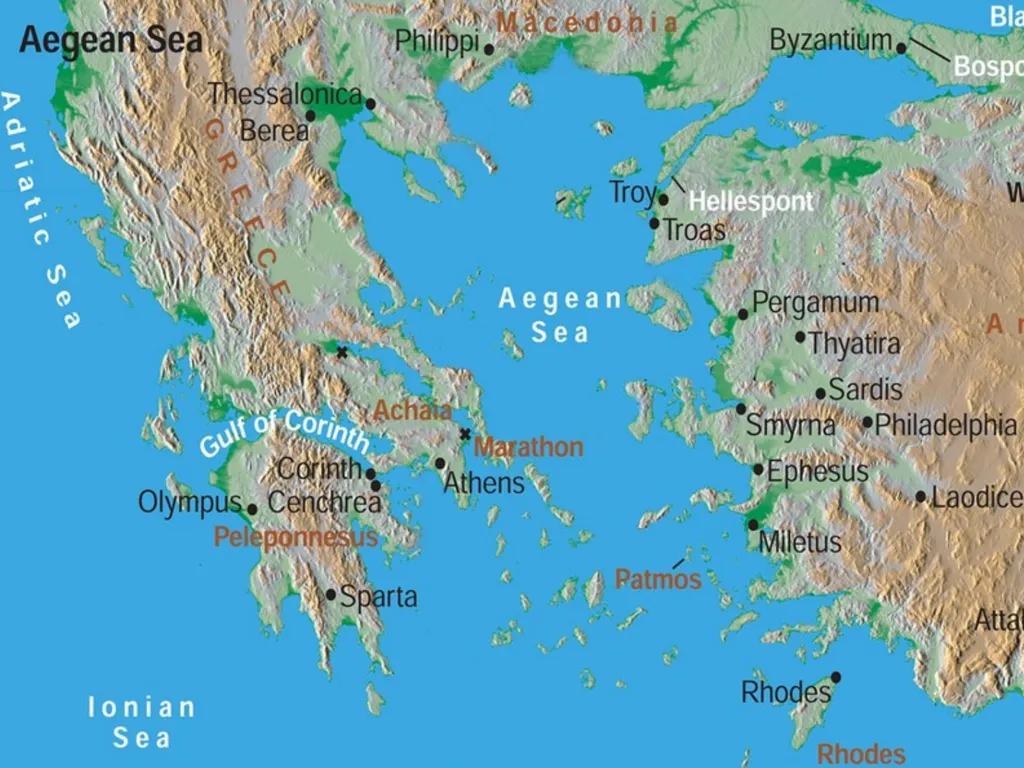
slide7. Aegean Sea<br>
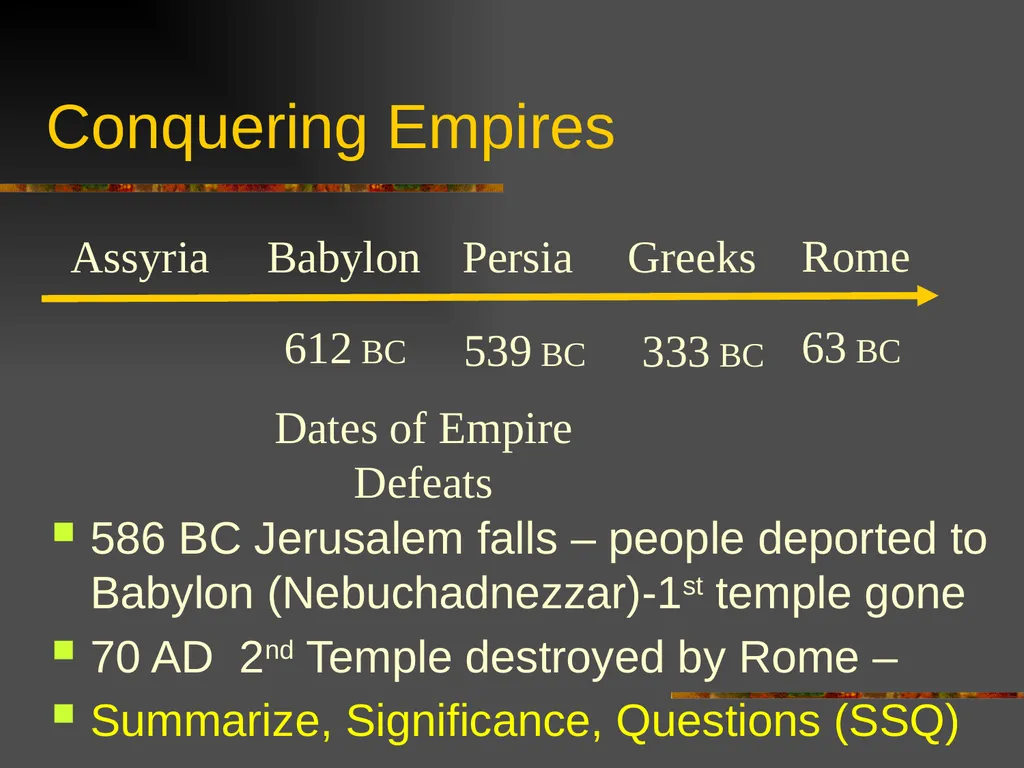
slide8. Conquering Empires 586 BC Jerusalem falls – people deported to Babylon (Nebuchadnezzar)-1st temple gone
70 AD 2nd Temple destroyed by Rome –
Summarize, Significance, Questions (SSQ)<br>
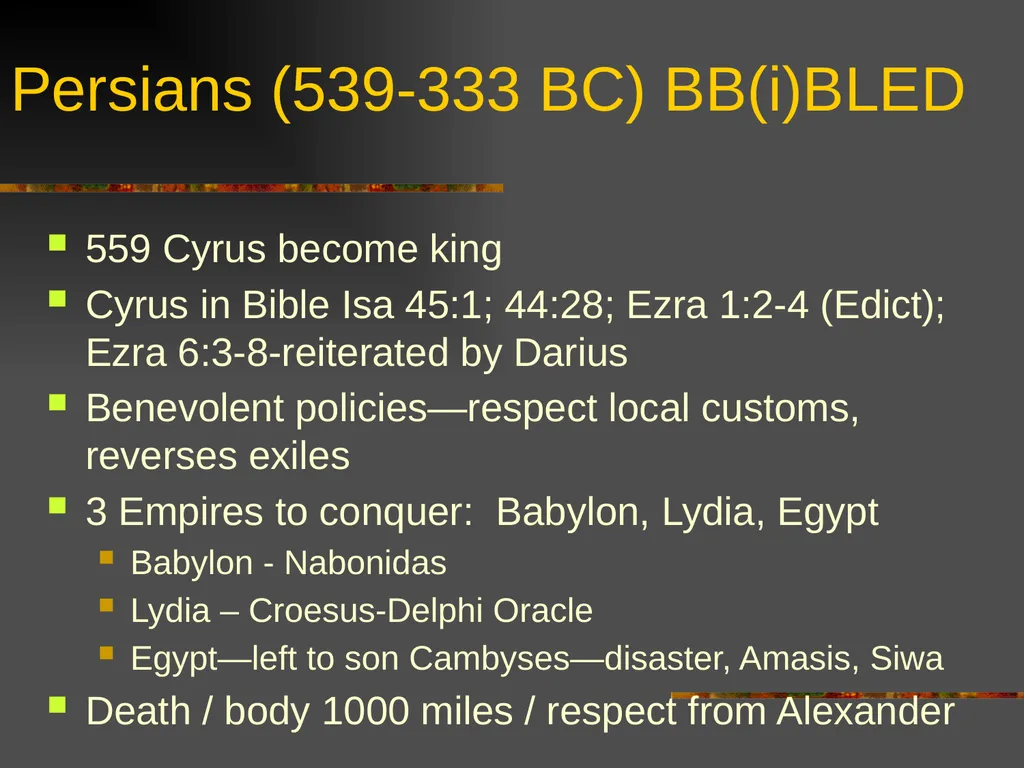
slide9. Persians (539-333 BC) BB(i)BLED 559 Cyrus become king
Cyrus in Bible Isa 45:1; 44:28; Ezra 1:2-4 (Edict); Ezra 6:3-8-reiterated by Darius
Benevolent policies—respect local customs, reverses exiles
3 Empires to conquer: Babylon, Lydia, Egypt
Babylon - Nabonidas
Lydia – Croesus-Delphi Oracle
Egypt—left to son Cambyses—disaster, Amasis, Siwa
Death / body 1000 miles / respect from Alexander<br>
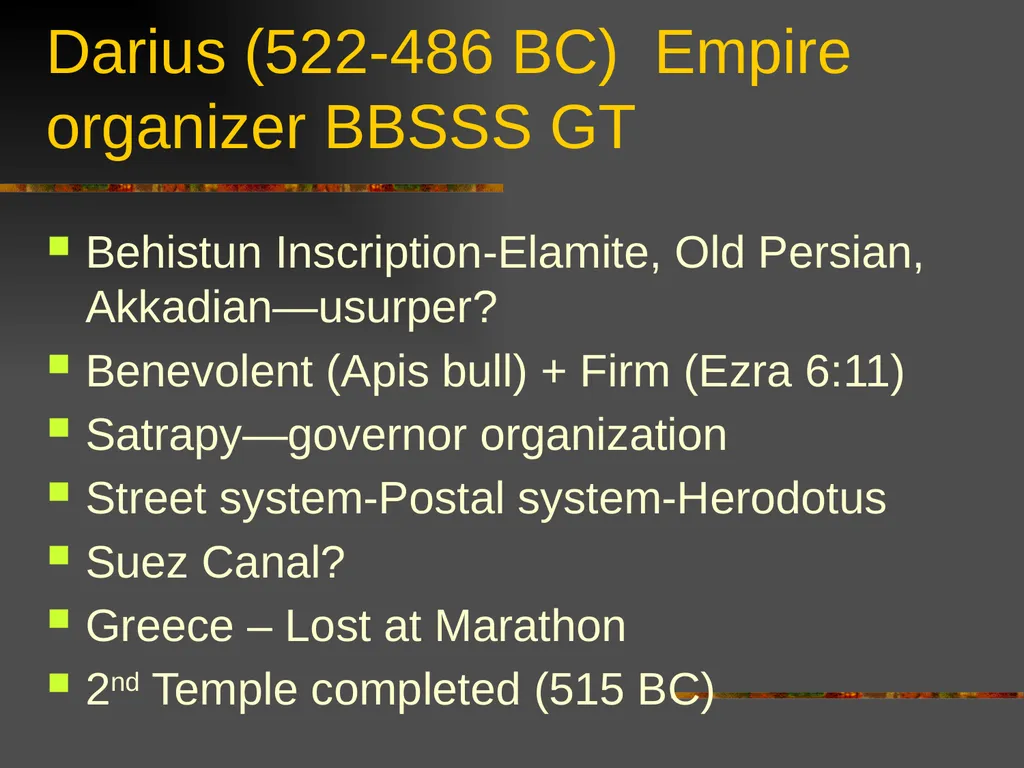
slide10. Darius (522-486 BC) Empire organizer BBSSS GT Behistun Inscription-Elamite, Old Persian, Akkadian—usurper?
Benevolent (Apis bull) + Firm (Ezra 6:11)
Satrapy—governor organization
Street system-Postal system-Herodotus
Suez Canal?
Greece – Lost at Marathon
2nd Temple completed (515 BC)<br>
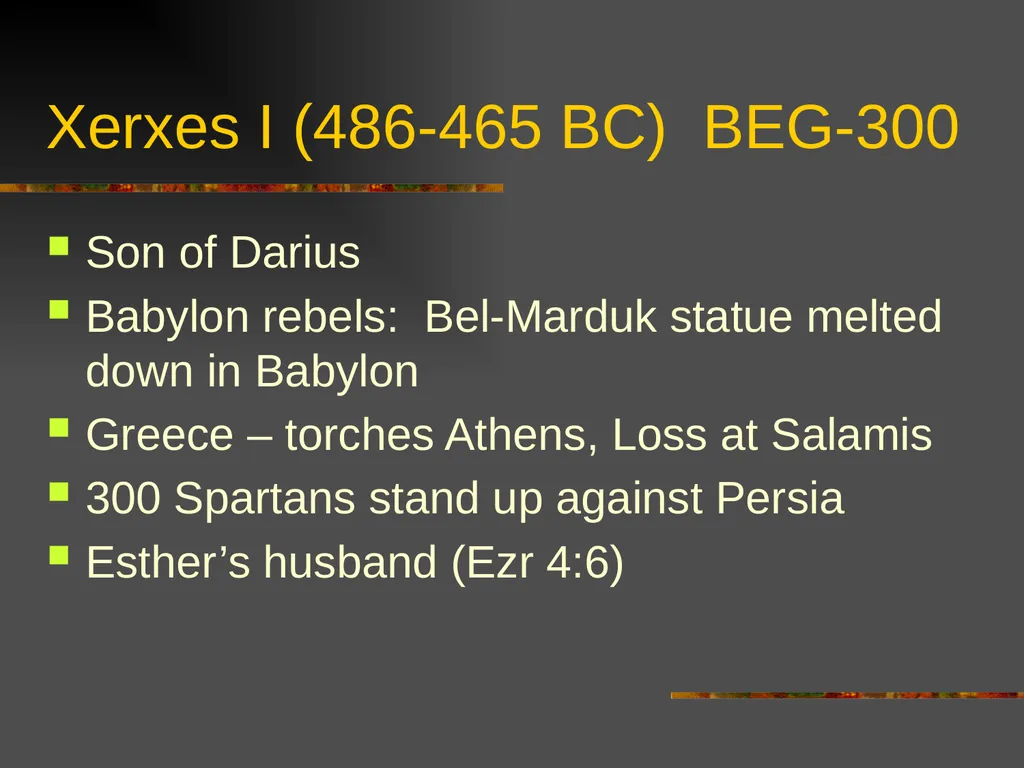
slide11. Xerxes I (486-465 BC) BEG-300 Son of Darius
Babylon rebels: Bel-Marduk statue melted down in Babylon
Greece – torches Athens, Loss at Salamis
300 Spartans stand up against Persia
Esther’s husband (Ezr 4:6)<br>
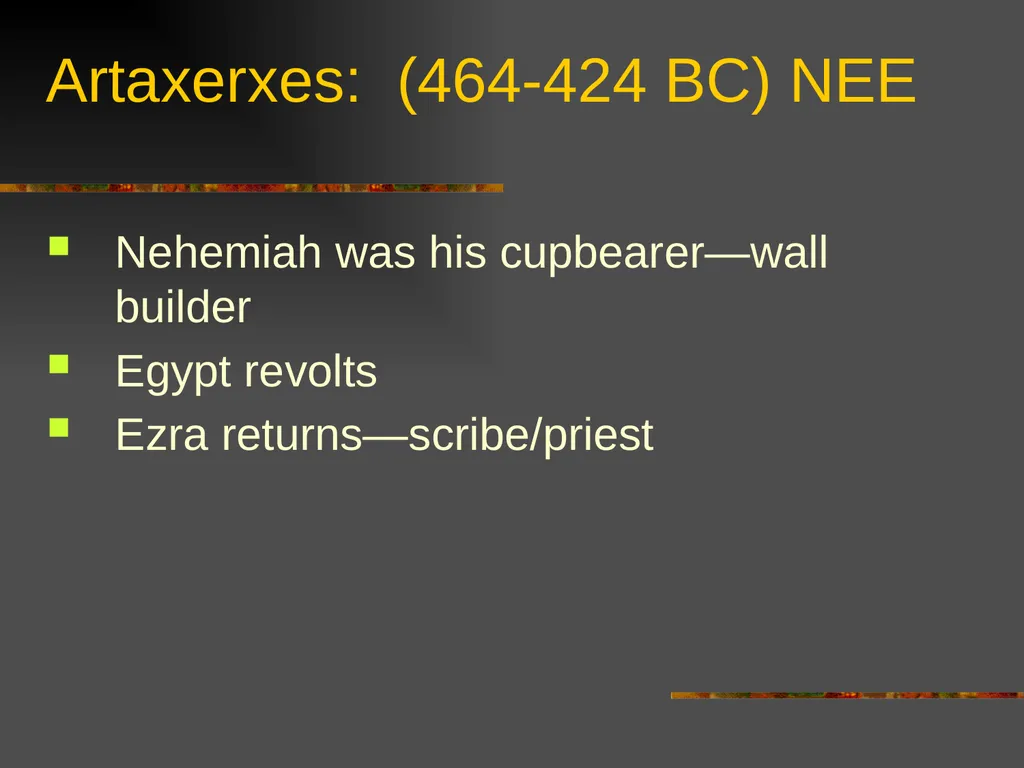
slide12. Artaxerxes: (464-424 BC) NEE Nehemiah was his cupbearer—wall builder
Egypt revolts
Ezra returns—scribe/priest<br>
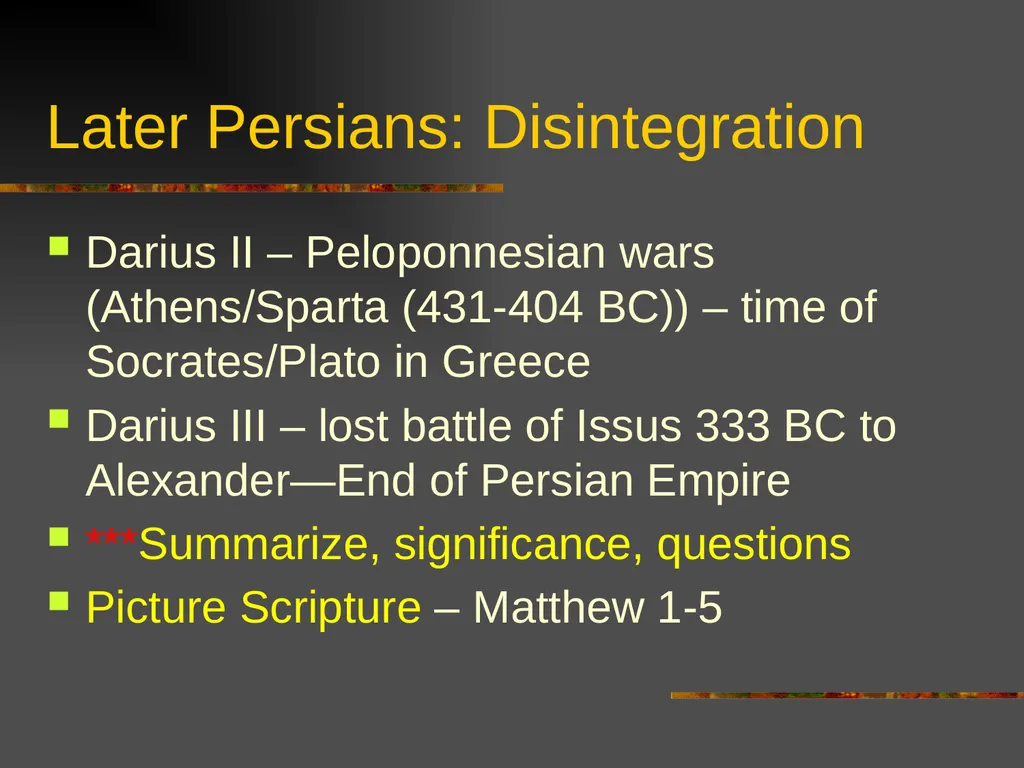
slide13. Later Persians: Disintegration Darius II – Peloponnesian wars (Athens/Sparta (431-404 BC)) – time of Socrates/Plato in Greece
Darius III – lost battle of Issus 333 BC to Alexander—End of Persian Empire
***Summarize, significance, questions
Picture Scripture – Matthew 1-5<br>
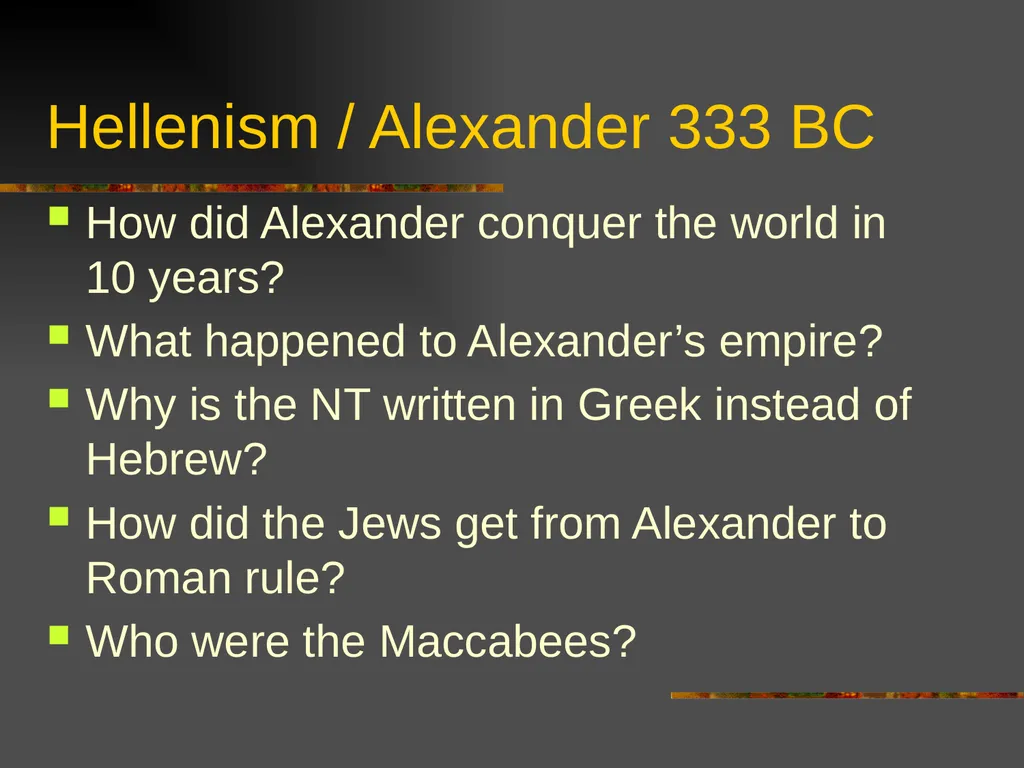
slide14. Hellenism / Alexander 333 BC How did Alexander conquer the world in 10 years?
What happened to Alexander’s empire?
Why is the NT written in Greek instead of Hebrew?
How did the Jews get from Alexander to Roman rule?
Who were the Maccabees?<br>
slide15. Persian Empire<br>
slide16. Aegean Sea<br>
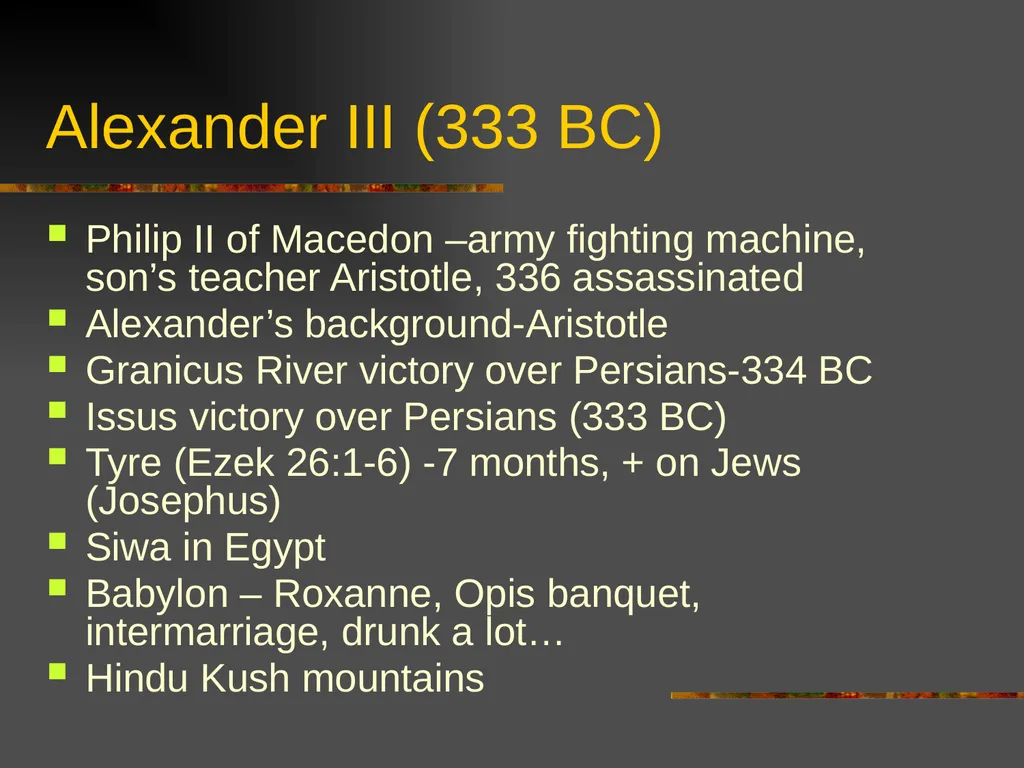
slide17. Alexander III (333 BC) Philip II of Macedon –army fighting machine, son’s teacher Aristotle, 336 assassinated
Alexander’s background-Aristotle
Granicus River victory over Persians-334 BC
Issus victory over Persians (333 BC)
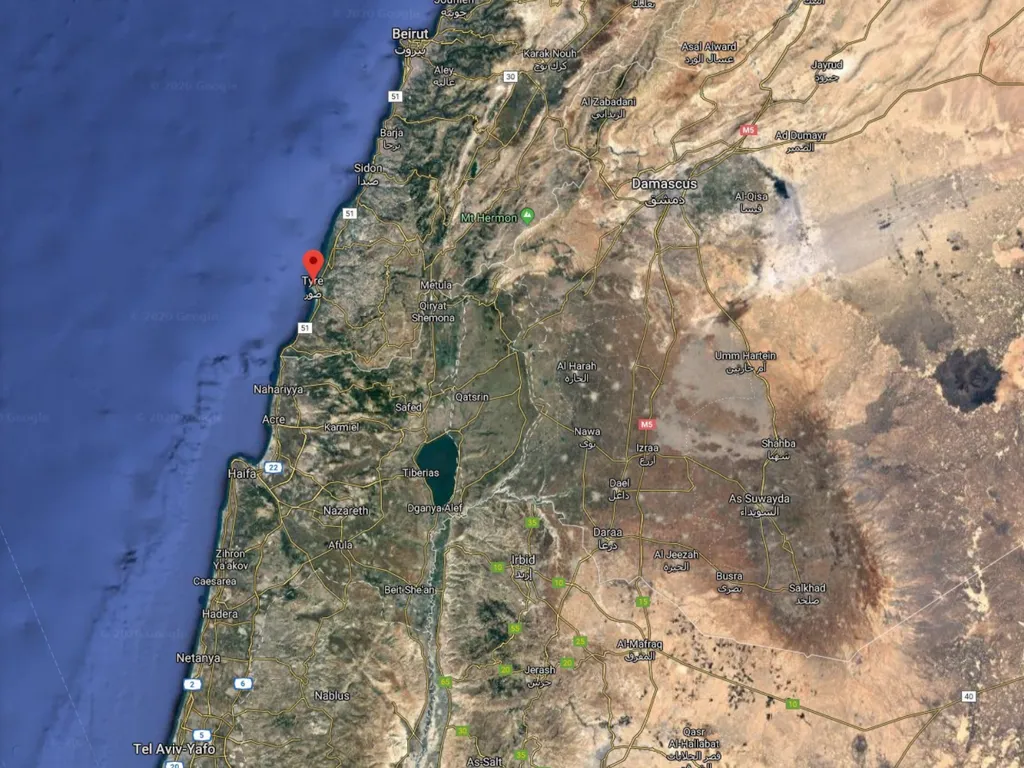
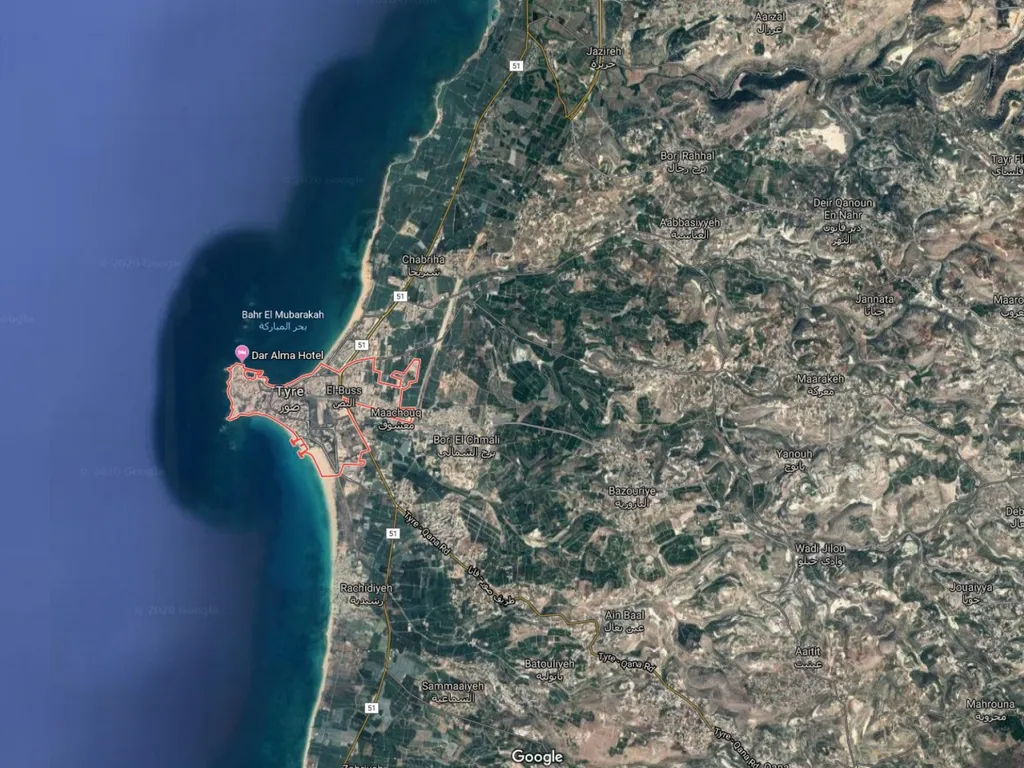
Tyre (Ezek 26:1-6) -7 months, + on Jews (Josephus)
Siwa in Egypt
Babylon – Roxanne, Opis banquet, intermarriage, drunk a lot…
Hindu Kush mountains<br>
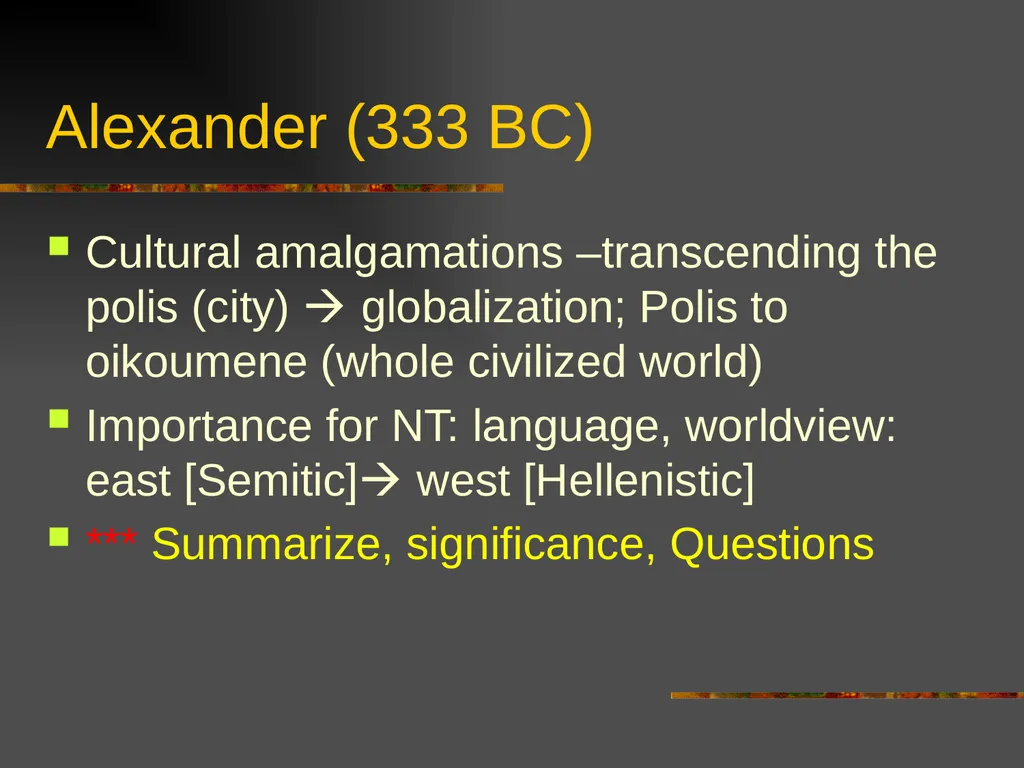
slide20. Alexander (333 BC) Cultural amalgamations –transcending the polis (city) globalization; Polis to oikoumene (whole civilized world)
Importance for NT: language, worldview: east [Semitic] west [Hellenistic]
*** Summarize, significance, Questions<br>
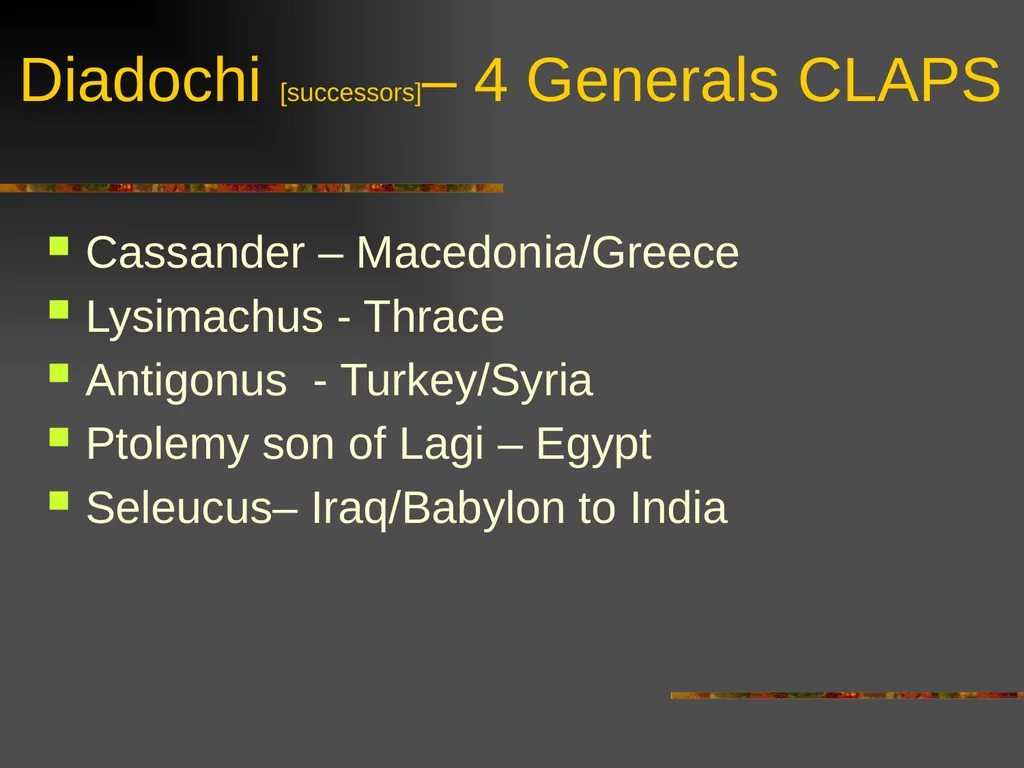
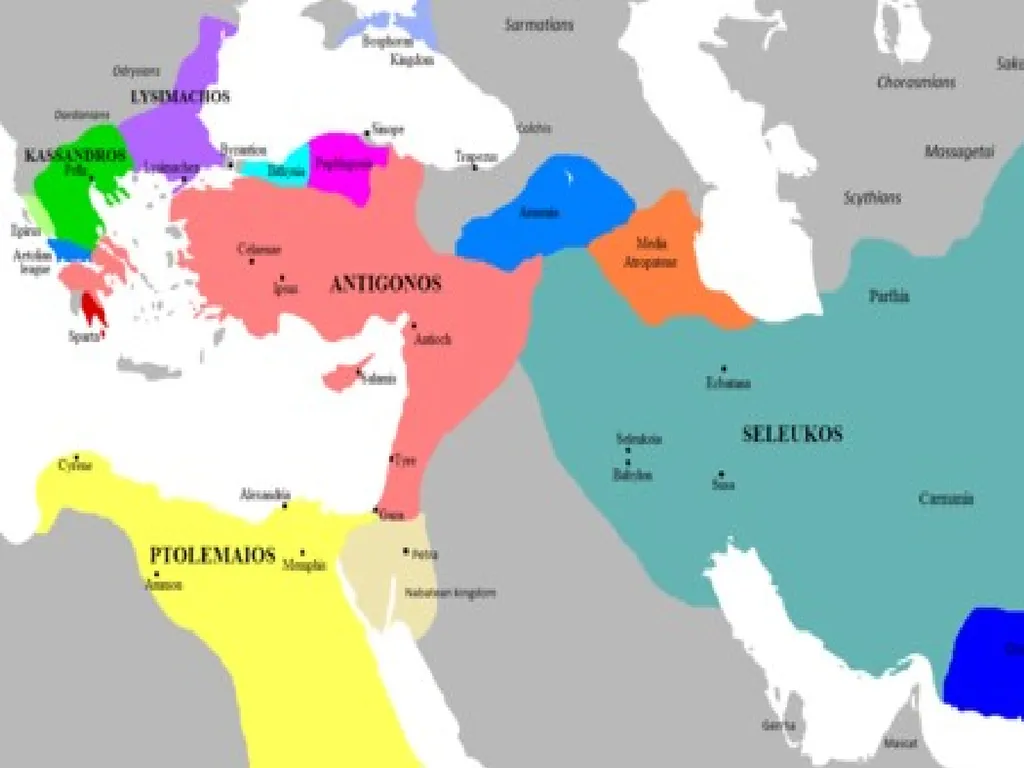
slide21. Diadochi [successors]– 4 Generals CLAPS Cassander – Macedonia/Greece
Lysimachus - Thrace
Antigonus - Turkey/Syria
Ptolemy son of Lagi – Egypt
Seleucus– Iraq/Babylon to India<br>
slide22. Persian Empire<br>
slide23. Tolerant Ptolemies (323-198 BC) Over Egypt, rule Palestine (300-200 BC)
Ptolemy takes title of King (304 BC)
Alexandria built by 200 BC--Library<br>
slide24. Ptolemaic Hellenism Alexandrian allegorism—hermeneutics, anthropomorphisms of gods offensive Zeus=logos/word
Unified language—Koine Greek
Septuagint (HebrewLXX – 250-150 BC) Greek translation of OT<br>
slide25. Hellenism—Factions in Israel Areas of cultural interface: REAP Religion: Jewish // Greek // priests Economic: taxes, merchants Army: generals & army Political: king, governors & courts
Responses to Hellenism: TAWA; diaspora:
Tradition (Pharisees, separation ideology),
Assimilate (Sadducees),
Withdraw (Essenes, apocalyptic),
Attack (zealots) *** SSQ<br>
slide26. Seleucids (198-167 BC) Antiochus III (the Great) – victory Panion 198 BC gets Palestine away from Ptolemy
Romans begin taxing
Antiochus IV (175-163 BC) Epiphanes
Hellenize the Jews: Grk. Deities, no circumcision, eat pigs, Scriptures burned
Three high priests: OJM
Onias—money-bought High priesthood
Jason — gym, Hellenism
Menelaus—Benjamin (not Levite), temple treasure
Abomination of Desolation<br>
slide27. The Big Maccabees Mattathias (167 BC)-- Father
Judas Maccabee (166-160 BC)—hammerer, Hanukkah
Poor Eleazar—Elephant man
Jonathan the diplomat, made high priest
Simon the dynasty builder (Hasmoneans) (142-135 BC)<br>
slide28. Hasmoneans - Questions Who are the Hasmoneans?
Where did the Pharisees and Sadducees come from?
What was Herod the Great like? Why did everybody hate him?
How does Rome get into the picture?
Was Jesus an Essene from Qumran?<br>
slide29. Hasmoneans John Hyrcanus (135-104 BC) PECC
Religious Parties – Pharisees [Hasidim] /Sadducees [Hellenists]
Expansion of territory
Circumcision Idumeans (Edomites)
Children trained Greek
Aristobulus (103 BC)<br>
slide30. Alexander Jannaeus (102-76 BC) F CAPE Feast of Tabernacles
Crucifies Pharisees
Assimilation of all groups
Pharisees ask for Syrian help
Expansion of territory<br>
slide31. Salome Alexandra (75-67 BC) HA MEPS Hyrcanus = high priesthood; Aristobulus = army
Married: Aristobolus Alexander Jannaeus
Education
Pharisee link
Sadducees abused<br>
slide32. Hyrcanus II (66-63 BC) Takes High priesthood
Aristobulus and Sadducees march on Jerusalem<br>
slide33. Aristobulus (66-63 BC) Hyrcanus goes to Aretas (Nabatean) for help
Enter Rome to break up the fight (63 BC)<br>
slide34. Rome takes over (63 BC) Pompey
Antipater’s boys (Idumean)
Roman Government structure
Senatorial provinces
Imperial provinces—legions, answerable to the emperor;
Client state under Rome<br>
slide35. Herod the Great (37-4 BC) JK MCBS Julius Caesar –First Triumvirate end 46 BC with Julius Caesar as supreme leader (assassinated 44 BC, Brutus).
Herod as “King of the Jews”
Mariamne (Hasmonean)
Cleopatra—Marc Antony, Second Triumvirate and Augustus (31 BC-14AD) as savior and good news (Luke)
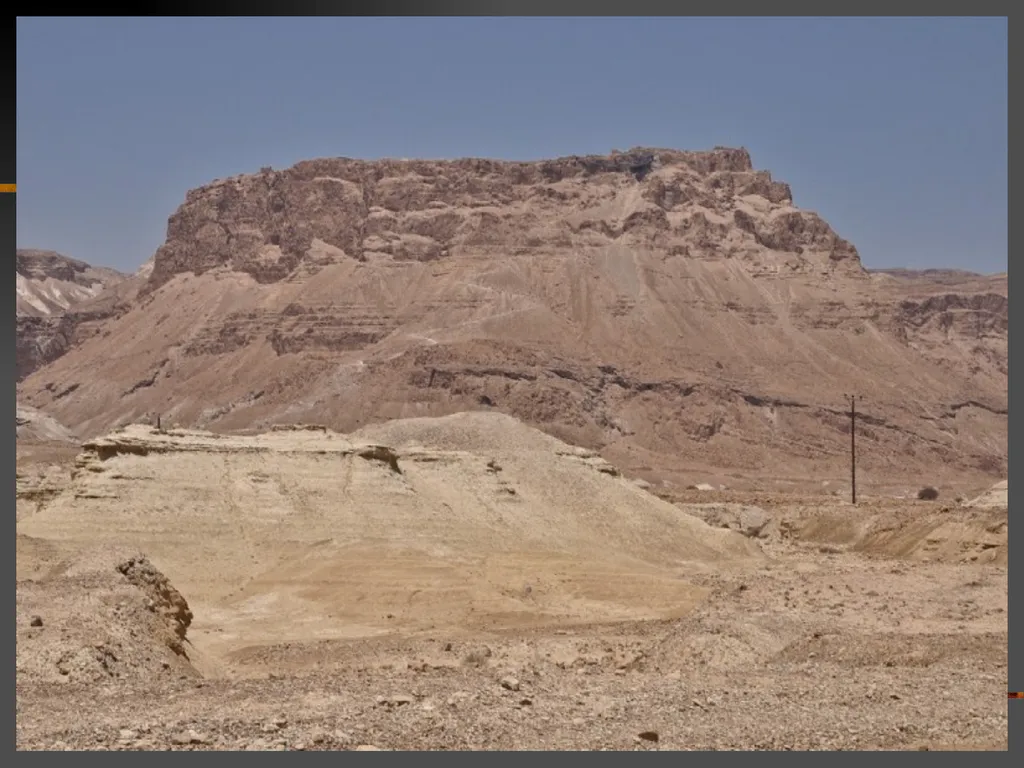
Herod the Builder: Caesarea, Masada, Temple
Sons & Wife<br>
slide37. Tetrarchs after Herod Archelaus: gets Judea, Idumea & Samaria [huge], kills 3,000 pilgrims to Jerusalem—exiled to Gaul (6 AD)
Herod Antipas: gets Galilee & Perea: Kills John Bapt. At trial of Jesus, exiled France
Herod Philip: Golan Heights, wife goes to Antipas
Supposed to be 4 but only 3 listed; Archelaus may have 2 sections<br>
slide38. Jewish Sects -- Pharisees Pharisees
History
Sources—oral tradition big
Two types: Expository // Logical deductions
Expository
Midrash (ca. 200 AD) expository on Scripture
Halakhah: legal—ca 200 AD
Haggadah: stories—Rabbis
Targums: Hebrew Aramaic translations<br>
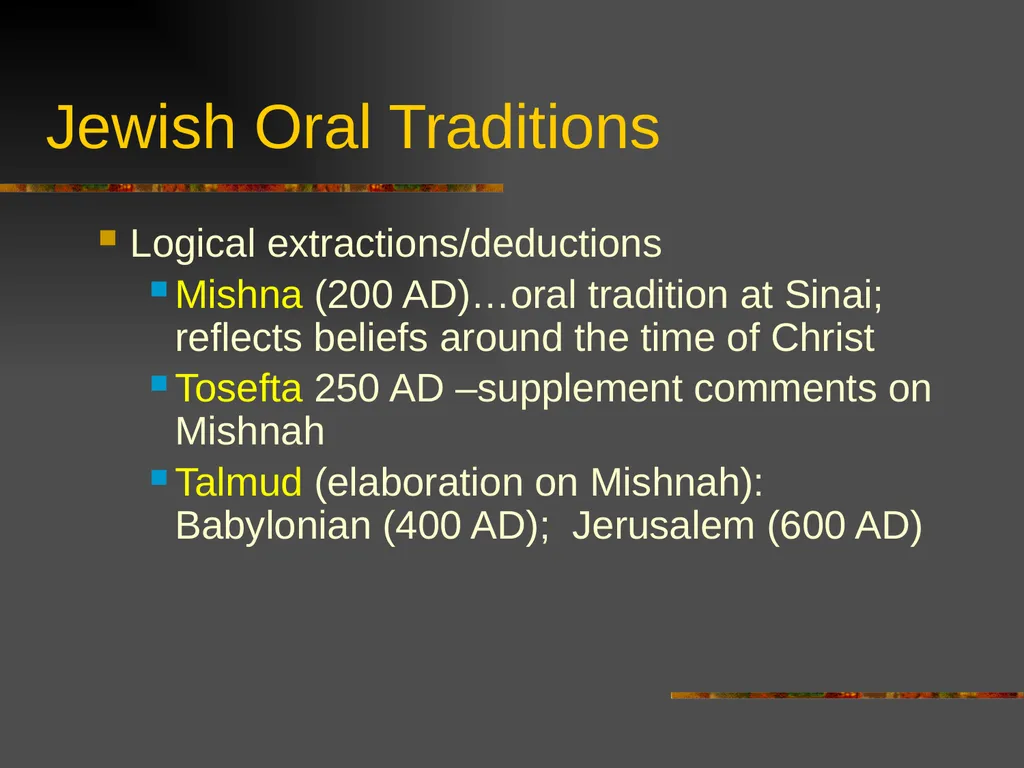
slide39. Jewish Oral Traditions Logical extractions/deductions
Mishna (200 AD)…oral tradition at Sinai; reflects beliefs around the time of Christ
Tosefta 250 AD –supplement comments on Mishnah
Talmud (elaboration on Mishnah): Babylonian (400 AD); Jerusalem (600 AD)<br>
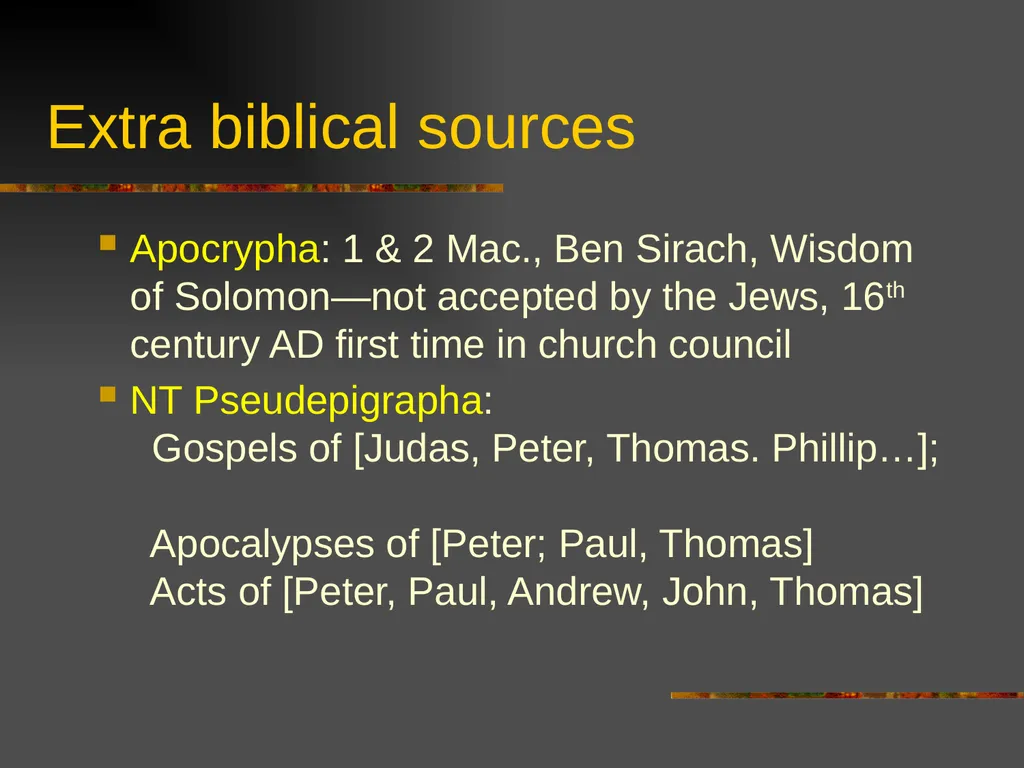
slide40. Extra biblical sources Apocrypha: 1 & 2 Mac., Ben Sirach, Wisdom of Solomon—not accepted by the Jews, 16th century AD first time in church council
NT Pseudepigrapha: Gospels of [Judas, Peter, Thomas. Phillip…]; Apocalypses of [Peter; Paul, Thomas] Acts of [Peter, Paul, Andrew, John, Thomas]<br>
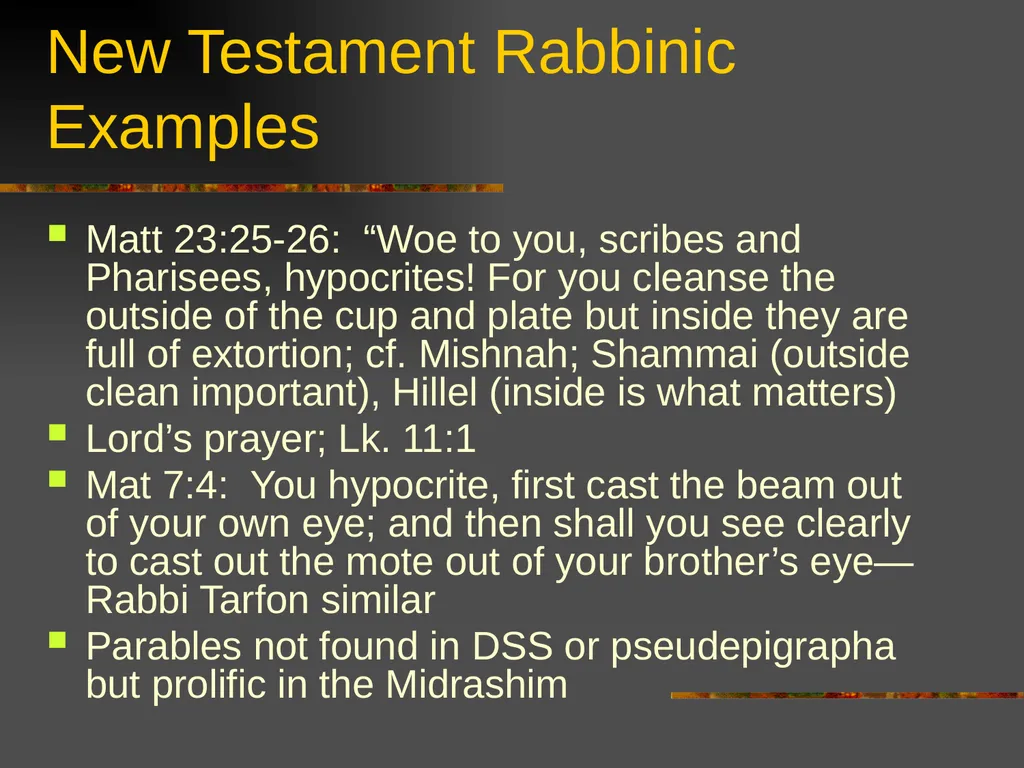
slide41. New Testament Rabbinic Examples Matt 23:25-26: “Woe to you, scribes and Pharisees, hypocrites! For you cleanse the outside of the cup and plate but inside they are full of extortion; cf. Mishnah; Shammai (outside clean important), Hillel (inside is what matters)
Lord’s prayer; Lk. 11:1
Mat 7:4: You hypocrite, first cast the beam out of your own eye; and then shall you see clearly to cast out the mote out of your brother’s eye—Rabbi Tarfon similar
Parables not found in DSS or pseudepigrapha but prolific in the Midrashim<br>
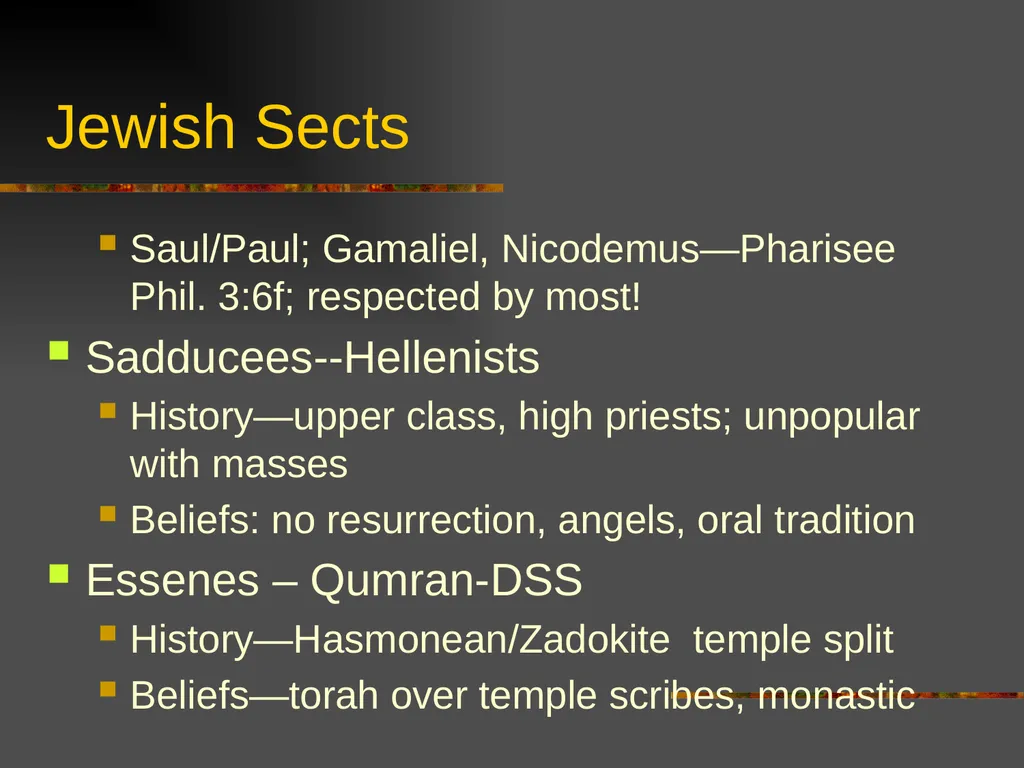
slide42. Jewish Sects Saul/Paul; Gamaliel, Nicodemus—Pharisee Phil. 3:6f; respected by most!
Sadducees--Hellenists
History—upper class, high priests; unpopular with masses
Beliefs: no resurrection, angels, oral tradition
Essenes – Qumran-DSS
History—Hasmonean/Zadokite temple split
Beliefs—torah over temple scribes, monastic<br>
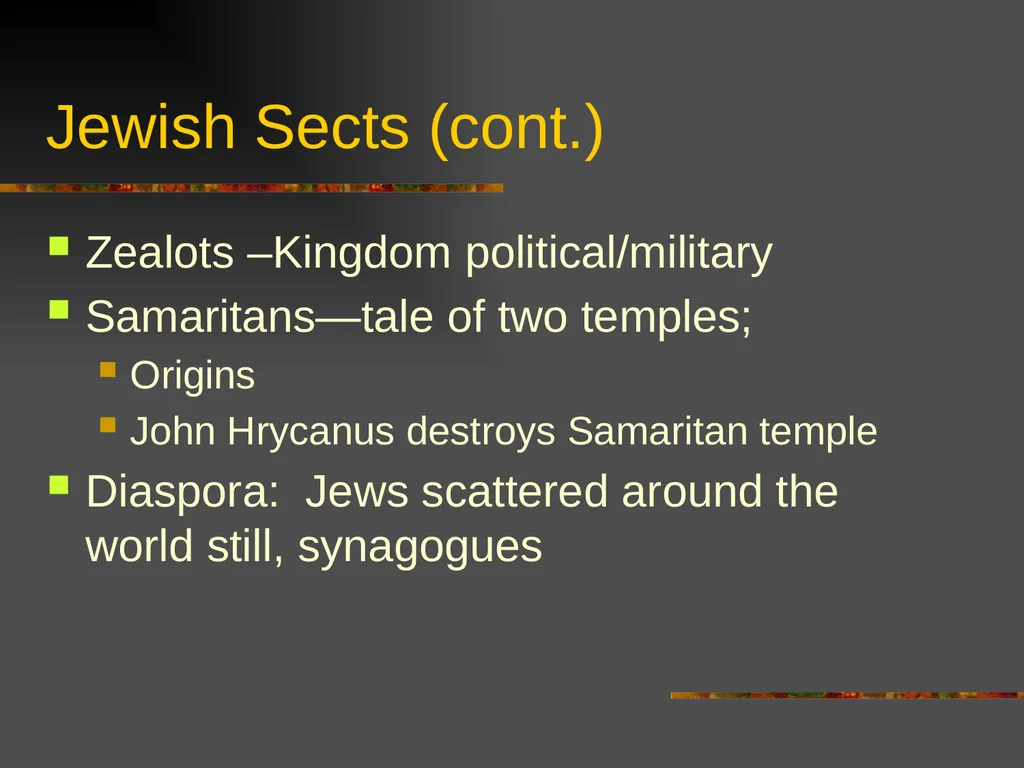
slide43. Jewish Sects (cont.) Zealots –Kingdom political/military
Samaritans—tale of two temples;
Origins
John Hrycanus destroys Samaritan temple
Diaspora: Jews scattered around the world still, synagogues<br>
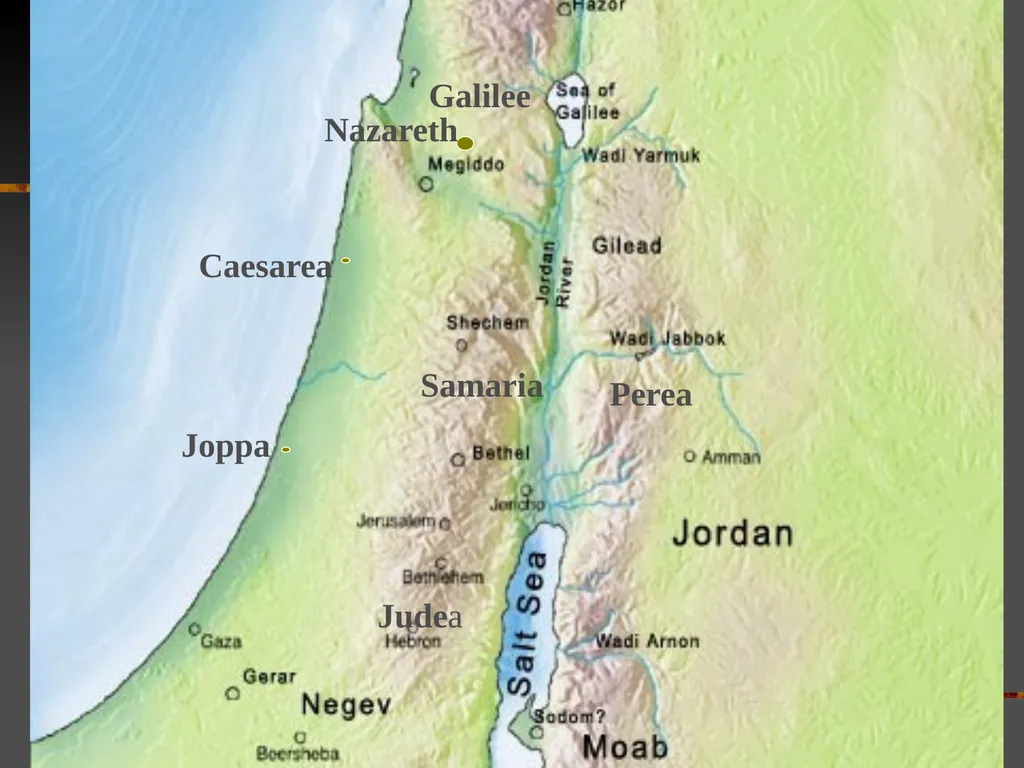
slide44. Galilee Samaria Judea Caesarea Joppa Nazareth Perea<br>
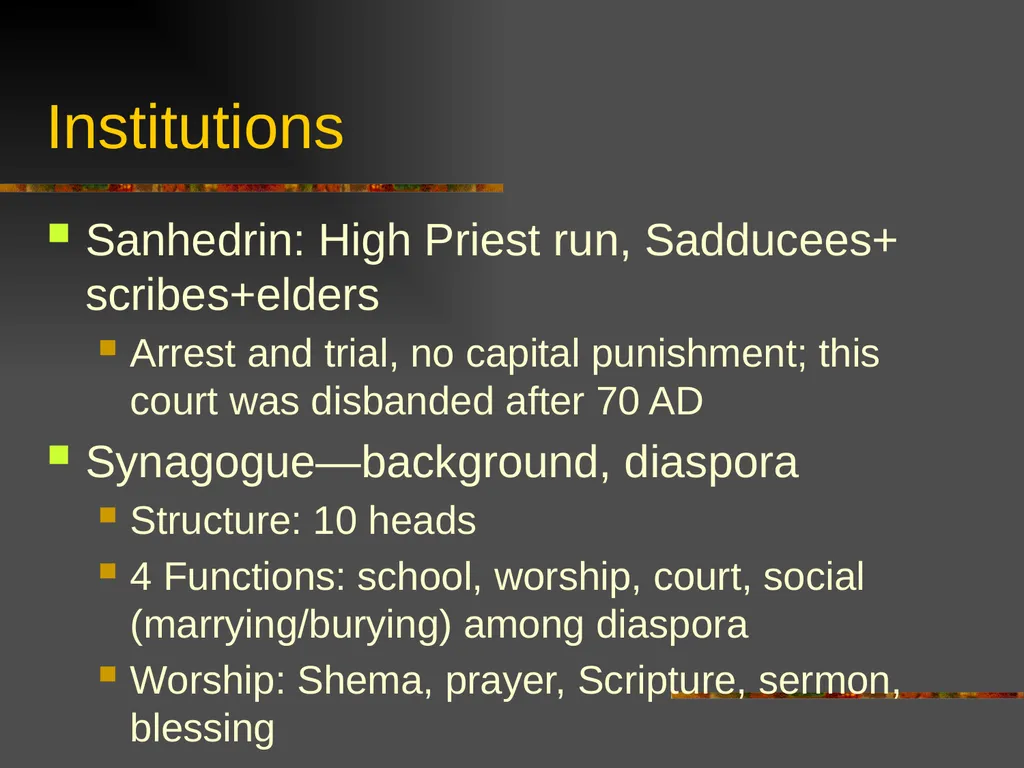
slide45. Institutions Sanhedrin: High Priest run, Sadducees+ scribes+elders
Arrest and trial, no capital punishment; this court was disbanded after 70 AD
Synagogue—background, diaspora
Structure: 10 heads
4 Functions: school, worship, court, social (marrying/burying) among diaspora
Worship: Shema, prayer, Scripture, sermon, blessing<br>
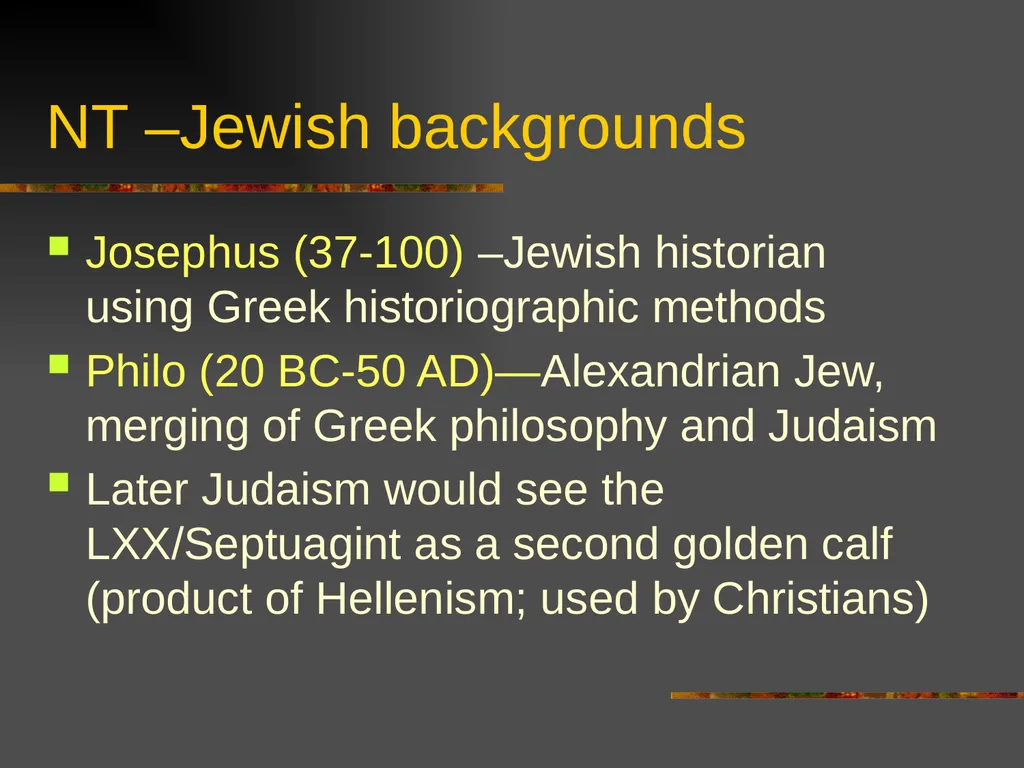
slide46. NT –Jewish backgrounds Josephus (37-100) –Jewish historian using Greek historiographic methods
Philo (20 BC-50 AD)—Alexandrian Jew, merging of Greek philosophy and Judaism
Later Judaism would see the LXX/Septuagint as a second golden calf (product of Hellenism; used by Christians)<br>
slide2. OT Foundations “Look, the lamb of God which takes away the sin of the world” John 1:29
Climax of Institutions of Israel:
Prophet: Deut 18, Mal. 4:5f
King: greater son of David; temple builder
Priest: Aaronic Melchizedek<br>
slide3. Initial Questions What happens between Malachi (435 BC) and Matthew (AD 50-70)?
What shifts in culture took place between the Semitic OT and the Greek/Roman NT? What difference does it make?
Where did the synagogue come from?
Who are the Samaritans? Why do they hate Jews and vice versa?
Who are the Pharisees and Sadducees?
Why is the NT in Greek instead of Hebrew?
Why was that time the “right time” for God’s son to come?<br>
slide4. Galatians 4:4 But when the set time had fully come, God sent his Son, born of a woman, born under the law.<br>
slide5. Persian Empire<br>
slide7. Aegean Sea<br>
slide8. Conquering Empires 586 BC Jerusalem falls – people deported to Babylon (Nebuchadnezzar)-1st temple gone
70 AD 2nd Temple destroyed by Rome –
Summarize, Significance, Questions (SSQ)<br>
slide9. Persians (539-333 BC) BB(i)BLED 559 Cyrus become king
Cyrus in Bible Isa 45:1; 44:28; Ezra 1:2-4 (Edict); Ezra 6:3-8-reiterated by Darius
Benevolent policies—respect local customs, reverses exiles
3 Empires to conquer: Babylon, Lydia, Egypt
Babylon - Nabonidas
Lydia – Croesus-Delphi Oracle
Egypt—left to son Cambyses—disaster, Amasis, Siwa
Death / body 1000 miles / respect from Alexander<br>
slide10. Darius (522-486 BC) Empire organizer BBSSS GT Behistun Inscription-Elamite, Old Persian, Akkadian—usurper?
Benevolent (Apis bull) + Firm (Ezra 6:11)
Satrapy—governor organization
Street system-Postal system-Herodotus
Suez Canal?
Greece – Lost at Marathon
2nd Temple completed (515 BC)<br>
slide11. Xerxes I (486-465 BC) BEG-300 Son of Darius
Babylon rebels: Bel-Marduk statue melted down in Babylon
Greece – torches Athens, Loss at Salamis
300 Spartans stand up against Persia
Esther’s husband (Ezr 4:6)<br>
slide12. Artaxerxes: (464-424 BC) NEE Nehemiah was his cupbearer—wall builder
Egypt revolts
Ezra returns—scribe/priest<br>
slide13. Later Persians: Disintegration Darius II – Peloponnesian wars (Athens/Sparta (431-404 BC)) – time of Socrates/Plato in Greece
Darius III – lost battle of Issus 333 BC to Alexander—End of Persian Empire
***Summarize, significance, questions
Picture Scripture – Matthew 1-5<br>
slide14. Hellenism / Alexander 333 BC How did Alexander conquer the world in 10 years?
What happened to Alexander’s empire?
Why is the NT written in Greek instead of Hebrew?
How did the Jews get from Alexander to Roman rule?
Who were the Maccabees?<br>
slide15. Persian Empire<br>
slide16. Aegean Sea<br>
slide17. Alexander III (333 BC) Philip II of Macedon –army fighting machine, son’s teacher Aristotle, 336 assassinated
Alexander’s background-Aristotle
Granicus River victory over Persians-334 BC
Issus victory over Persians (333 BC)
Tyre (Ezek 26:1-6) -7 months, + on Jews (Josephus)
Siwa in Egypt
Babylon – Roxanne, Opis banquet, intermarriage, drunk a lot…
Hindu Kush mountains<br>
slide20. Alexander (333 BC) Cultural amalgamations –transcending the polis (city) globalization; Polis to oikoumene (whole civilized world)
Importance for NT: language, worldview: east [Semitic] west [Hellenistic]
*** Summarize, significance, Questions<br>
slide21. Diadochi [successors]– 4 Generals CLAPS Cassander – Macedonia/Greece
Lysimachus - Thrace
Antigonus - Turkey/Syria
Ptolemy son of Lagi – Egypt
Seleucus– Iraq/Babylon to India<br>
slide22. Persian Empire<br>
slide23. Tolerant Ptolemies (323-198 BC) Over Egypt, rule Palestine (300-200 BC)
Ptolemy takes title of King (304 BC)
Alexandria built by 200 BC--Library<br>
slide24. Ptolemaic Hellenism Alexandrian allegorism—hermeneutics, anthropomorphisms of gods offensive Zeus=logos/word
Unified language—Koine Greek
Septuagint (HebrewLXX – 250-150 BC) Greek translation of OT<br>
slide25. Hellenism—Factions in Israel Areas of cultural interface: REAP Religion: Jewish // Greek // priests Economic: taxes, merchants Army: generals & army Political: king, governors & courts
Responses to Hellenism: TAWA; diaspora:
Tradition (Pharisees, separation ideology),
Assimilate (Sadducees),
Withdraw (Essenes, apocalyptic),
Attack (zealots) *** SSQ<br>
slide26. Seleucids (198-167 BC) Antiochus III (the Great) – victory Panion 198 BC gets Palestine away from Ptolemy
Romans begin taxing
Antiochus IV (175-163 BC) Epiphanes
Hellenize the Jews: Grk. Deities, no circumcision, eat pigs, Scriptures burned
Three high priests: OJM
Onias—money-bought High priesthood
Jason — gym, Hellenism
Menelaus—Benjamin (not Levite), temple treasure
Abomination of Desolation<br>
slide27. The Big Maccabees Mattathias (167 BC)-- Father
Judas Maccabee (166-160 BC)—hammerer, Hanukkah
Poor Eleazar—Elephant man
Jonathan the diplomat, made high priest
Simon the dynasty builder (Hasmoneans) (142-135 BC)<br>
slide28. Hasmoneans - Questions Who are the Hasmoneans?
Where did the Pharisees and Sadducees come from?
What was Herod the Great like? Why did everybody hate him?
How does Rome get into the picture?
Was Jesus an Essene from Qumran?<br>
slide29. Hasmoneans John Hyrcanus (135-104 BC) PECC
Religious Parties – Pharisees [Hasidim] /Sadducees [Hellenists]
Expansion of territory
Circumcision Idumeans (Edomites)
Children trained Greek
Aristobulus (103 BC)<br>
slide30. Alexander Jannaeus (102-76 BC) F CAPE Feast of Tabernacles
Crucifies Pharisees
Assimilation of all groups
Pharisees ask for Syrian help
Expansion of territory<br>
slide31. Salome Alexandra (75-67 BC) HA MEPS Hyrcanus = high priesthood; Aristobulus = army
Married: Aristobolus Alexander Jannaeus
Education
Pharisee link
Sadducees abused<br>
slide32. Hyrcanus II (66-63 BC) Takes High priesthood
Aristobulus and Sadducees march on Jerusalem<br>
slide33. Aristobulus (66-63 BC) Hyrcanus goes to Aretas (Nabatean) for help
Enter Rome to break up the fight (63 BC)<br>
slide34. Rome takes over (63 BC) Pompey
Antipater’s boys (Idumean)
Roman Government structure
Senatorial provinces
Imperial provinces—legions, answerable to the emperor;
Client state under Rome<br>
slide35. Herod the Great (37-4 BC) JK MCBS Julius Caesar –First Triumvirate end 46 BC with Julius Caesar as supreme leader (assassinated 44 BC, Brutus).
Herod as “King of the Jews”
Mariamne (Hasmonean)
Cleopatra—Marc Antony, Second Triumvirate and Augustus (31 BC-14AD) as savior and good news (Luke)
Herod the Builder: Caesarea, Masada, Temple
Sons & Wife<br>
slide37. Tetrarchs after Herod Archelaus: gets Judea, Idumea & Samaria [huge], kills 3,000 pilgrims to Jerusalem—exiled to Gaul (6 AD)
Herod Antipas: gets Galilee & Perea: Kills John Bapt. At trial of Jesus, exiled France
Herod Philip: Golan Heights, wife goes to Antipas
Supposed to be 4 but only 3 listed; Archelaus may have 2 sections<br>
slide38. Jewish Sects -- Pharisees Pharisees
History
Sources—oral tradition big
Two types: Expository // Logical deductions
Expository
Midrash (ca. 200 AD) expository on Scripture
Halakhah: legal—ca 200 AD
Haggadah: stories—Rabbis
Targums: Hebrew Aramaic translations<br>
slide39. Jewish Oral Traditions Logical extractions/deductions
Mishna (200 AD)…oral tradition at Sinai; reflects beliefs around the time of Christ
Tosefta 250 AD –supplement comments on Mishnah
Talmud (elaboration on Mishnah): Babylonian (400 AD); Jerusalem (600 AD)<br>
slide40. Extra biblical sources Apocrypha: 1 & 2 Mac., Ben Sirach, Wisdom of Solomon—not accepted by the Jews, 16th century AD first time in church council
NT Pseudepigrapha: Gospels of [Judas, Peter, Thomas. Phillip…]; Apocalypses of [Peter; Paul, Thomas] Acts of [Peter, Paul, Andrew, John, Thomas]<br>
slide41. New Testament Rabbinic Examples Matt 23:25-26: “Woe to you, scribes and Pharisees, hypocrites! For you cleanse the outside of the cup and plate but inside they are full of extortion; cf. Mishnah; Shammai (outside clean important), Hillel (inside is what matters)
Lord’s prayer; Lk. 11:1
Mat 7:4: You hypocrite, first cast the beam out of your own eye; and then shall you see clearly to cast out the mote out of your brother’s eye—Rabbi Tarfon similar
Parables not found in DSS or pseudepigrapha but prolific in the Midrashim<br>
slide42. Jewish Sects Saul/Paul; Gamaliel, Nicodemus—Pharisee Phil. 3:6f; respected by most!
Sadducees--Hellenists
History—upper class, high priests; unpopular with masses
Beliefs: no resurrection, angels, oral tradition
Essenes – Qumran-DSS
History—Hasmonean/Zadokite temple split
Beliefs—torah over temple scribes, monastic<br>
slide43. Jewish Sects (cont.) Zealots –Kingdom political/military
Samaritans—tale of two temples;
Origins
John Hrycanus destroys Samaritan temple
Diaspora: Jews scattered around the world still, synagogues<br>
slide44. Galilee Samaria Judea Caesarea Joppa Nazareth Perea<br>
slide45. Institutions Sanhedrin: High Priest run, Sadducees+ scribes+elders
Arrest and trial, no capital punishment; this court was disbanded after 70 AD
Synagogue—background, diaspora
Structure: 10 heads
4 Functions: school, worship, court, social (marrying/burying) among diaspora
Worship: Shema, prayer, Scripture, sermon, blessing<br>
slide46. NT –Jewish backgrounds Josephus (37-100) –Jewish historian using Greek historiographic methods
Philo (20 BC-50 AD)—Alexandrian Jew, merging of Greek philosophy and Judaism
Later Judaism would see the LXX/Septuagint as a second golden calf (product of Hellenism; used by Christians)<br>