05
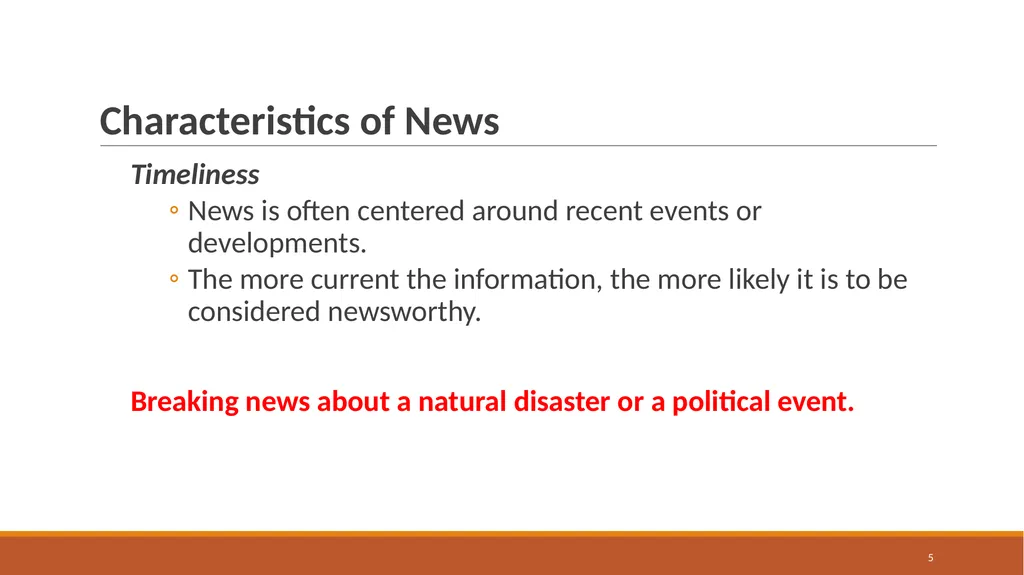
Characteristics of News 5 Timeliness
News is often centered around recent events or developments.
The more current the information, the more likely it is to be considered newsworthy.
Breaking news about a natural disaster or a political event.<br>
06
Characteristics of News 6 Relevance
News must be relevant to the audience it is intended for.
What is newsworthy in one community or country may not be in another.
Local elections may be newsworthy in a small town but less so on a national level unless they have broader implications.<br>
07
Characteristics of News 7 Proximity
Geographical or cultural proximity often determines the newsworthiness of a story.
Events that happen closer to the audience are usually given more coverage.
�A significant local event might be more important to local readers than international news.<br>
08
Characteristics of News 8 Impact
The potential impact or significance of an event can make it newsworthy.
Stories that affect a large number of people or have a profound influence on the community tend to be prioritized.
A major government policy change or a public health crisis.<br>
09
Characteristics of News 9 Prominence
The involvement of prominent figures (celebrities, politicians, business leaders) can increase the newsworthiness of a story.
A statement made by the President or a celebrity.<br>
10
Characteristics of News 10 Conflict
News often highlights conflicts, controversies, or disagreements, as they tend to attract more attention.
Political debates, legal battles, or social protests.<br>
11
Characteristics of News 11 Novelty
Unusual, rare, or surprising events tend to be more newsworthy because they stand out from the ordinary.
An unusual weather event or a scientific breakthrough.<br>
12
Human Interest
Stories that evoke emotions, whether they are heartwarming, tragic, or inspiring, are often considered newsworthy.
An individual overcoming significant odds or a community coming together to help someone in need. 12<br>
13
What is News Literacy? 13 The ability to carefully examine news and information.
It involves:
Understanding how news is created.
Finding reliable sources.
Spotting bias/perspectives in news.
Knowing the difference between facts and opinions.
Being aware of false information and misinformation.<br>
14
Importance of news literacy News literacy is increasingly important in the digital age, where information is abundant, and misinformation can spread rapidly.
It is crucial to discern fact from fiction, identify biases, and understand the impact of news on society. 14<br>
15
Distinguishing Between News and Opinion Recognizing when a piece is a news report and when it is an editorial or opinion piece, and understanding how this affects the content.
Op-ed sections in newspapers like The Hindu or Times of India often feature opinion pieces that reflect the author’s viewpoint rather than objective reporting. 15<br>
16
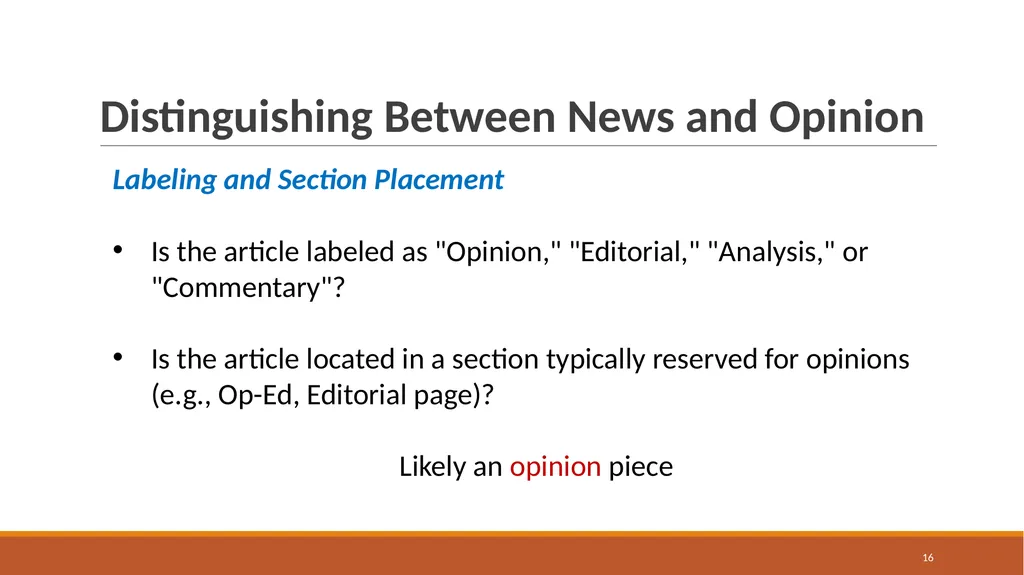
16 Labeling and Section Placement
Is the article labeled as "Opinion," "Editorial," "Analysis," or "Commentary"?
Is the article located in a section typically reserved for opinions (e.g., Op-Ed, Editorial page)?
Likely an opinion piece Distinguishing Between News and Opinion<br>
17
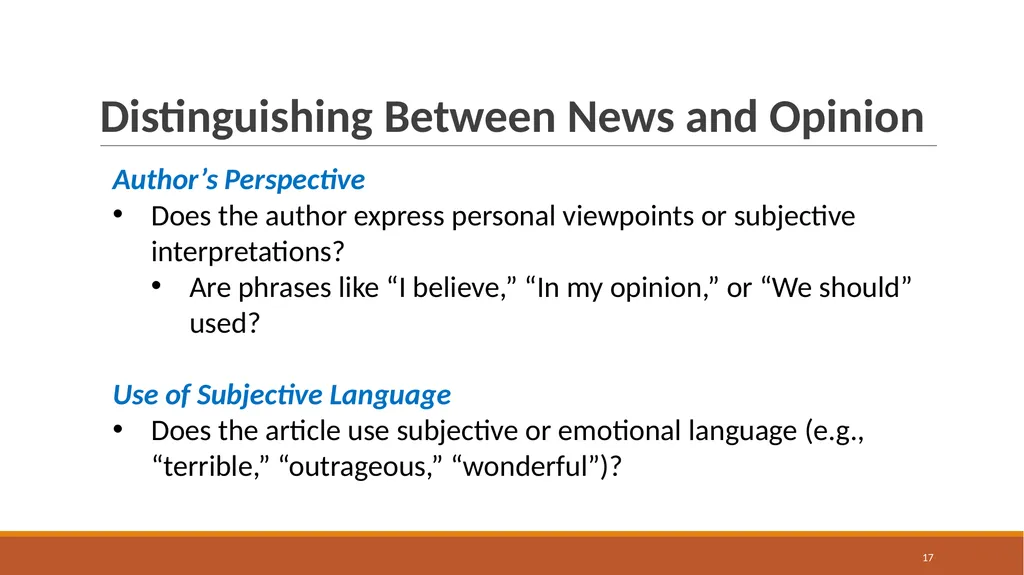
17 Author’s Perspective
Does the author express personal viewpoints or subjective interpretations?
Are phrases like “I believe,” “In my opinion,” or “We should” used?
Use of Subjective Language
Does the article use subjective or emotional language (e.g., “terrible,” “outrageous,” “wonderful”)? Distinguishing Between News and Opinion<br>
18
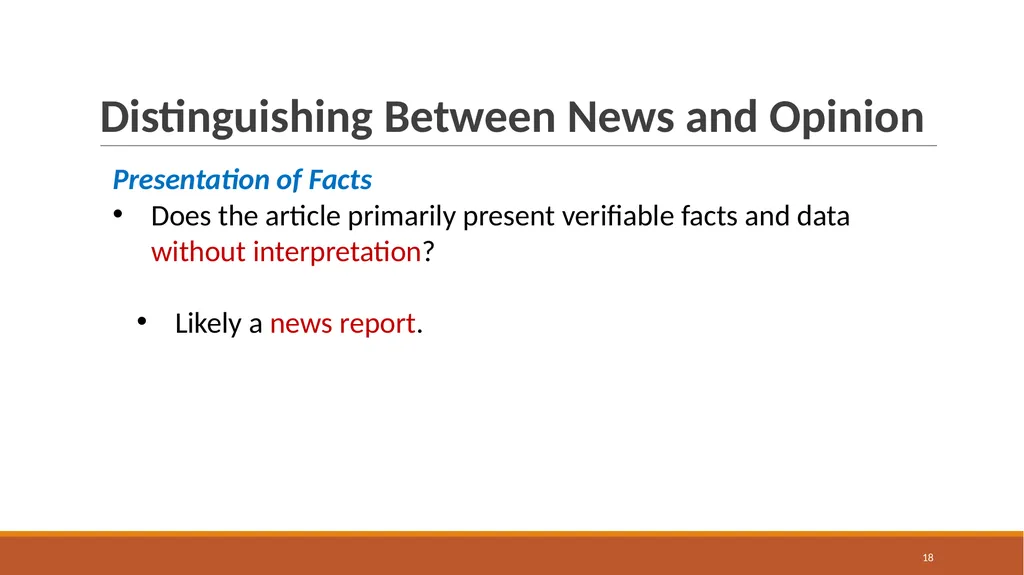
18 Presentation of Facts
Does the article primarily present verifiable facts and data without interpretation?
Likely a news report. Distinguishing Between News and Opinion<br>
19
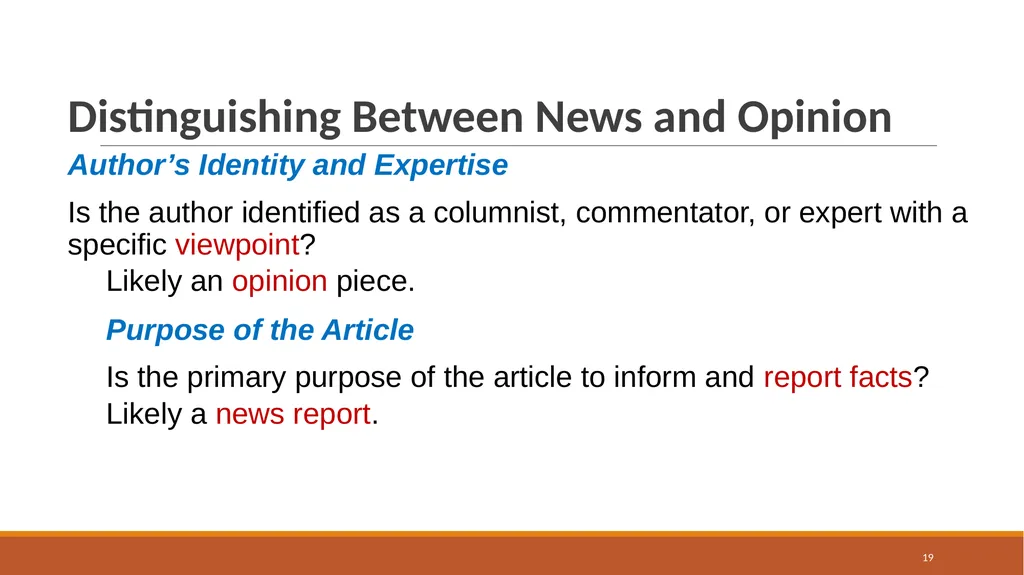
19 Author’s Identity and Expertise
Is the author identified as a columnist, commentator, or expert with a specific viewpoint?
Likely an opinion piece.
Purpose of the Article
Is the primary purpose of the article to inform and report facts?
Likely a news report. Distinguishing Between News and Opinion<br>
20
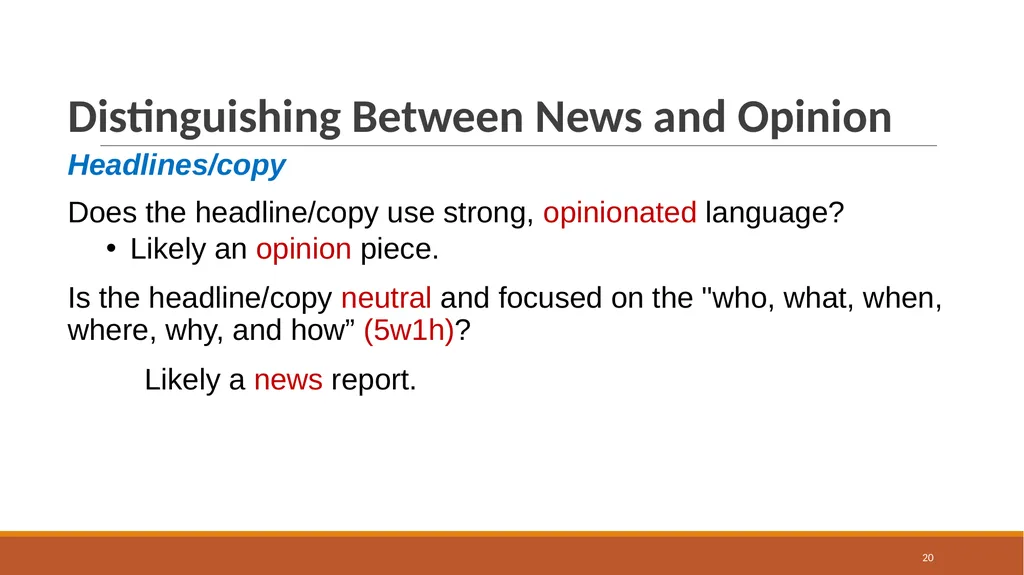
20 Headlines/copy
Does the headline/copy use strong, opinionated language?
Likely an opinion piece.
Is the headline/copy neutral and focused on the "who, what, when, where, why, and how” (5w1h)?
Likely a news report. Distinguishing Between News and Opinion<br>
21
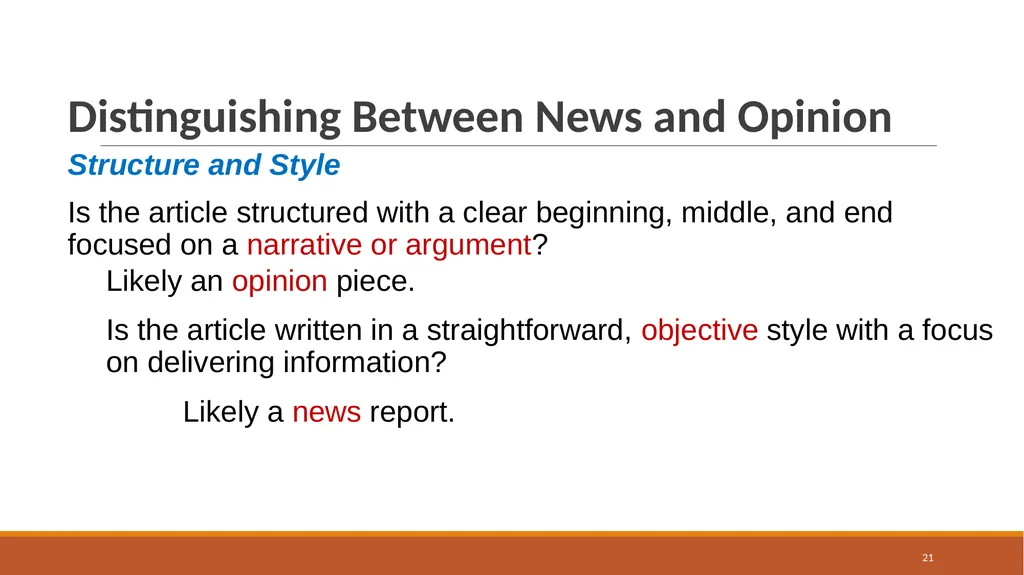
21 Structure and Style
Is the article structured with a clear beginning, middle, and end focused on a narrative or argument?
Likely an opinion piece.
Is the article written in a straightforward, objective style with a focus on delivering information?
Likely a news report. Distinguishing Between News and Opinion<br>
22
Evaluating Credibility of a News Story 22 Take a recent news story and evaluate the credibility of the source by researching the publication’s history, balance and the evidence cited in the story.<br>
23
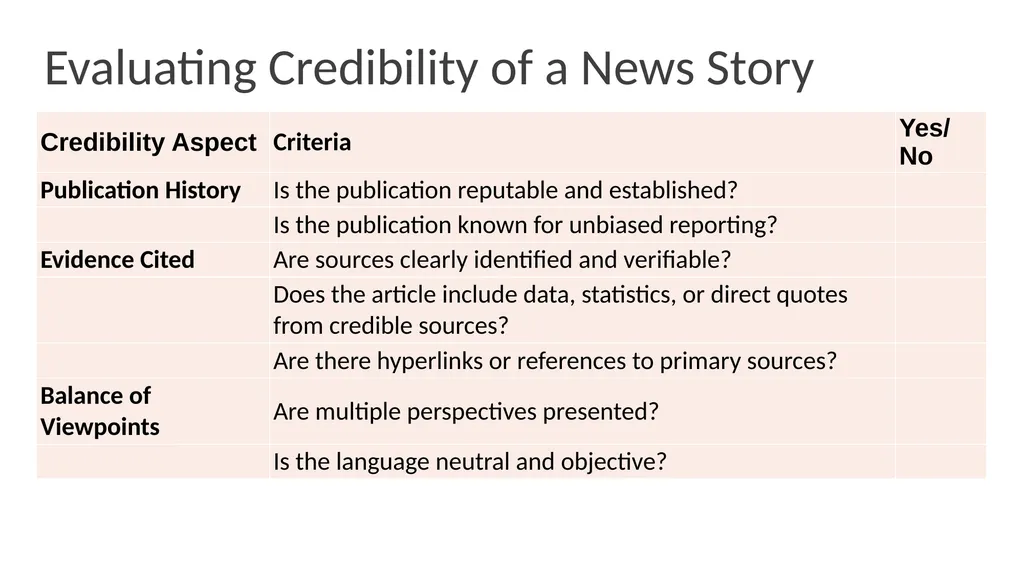
23 Evaluating Credibility of a News Story<br>
24
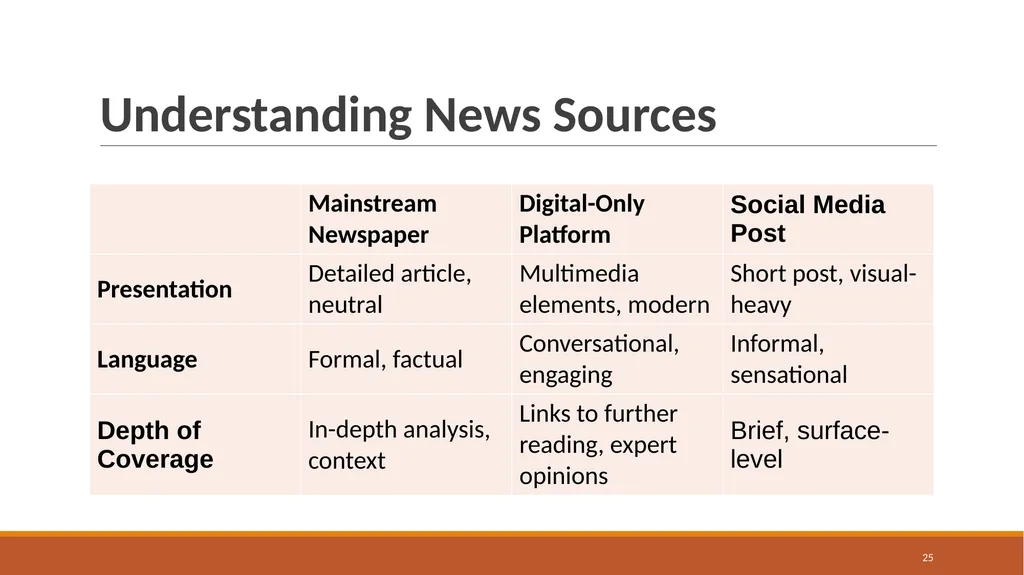
Understanding News Sources Choose a news story and find how it's covered by at least three different types of sources: a mainstream newspaper, a digital-only news platform, and a social media post.
Compare how each source presents the story 24<br>
25
Understanding News Sources 25<br>
26
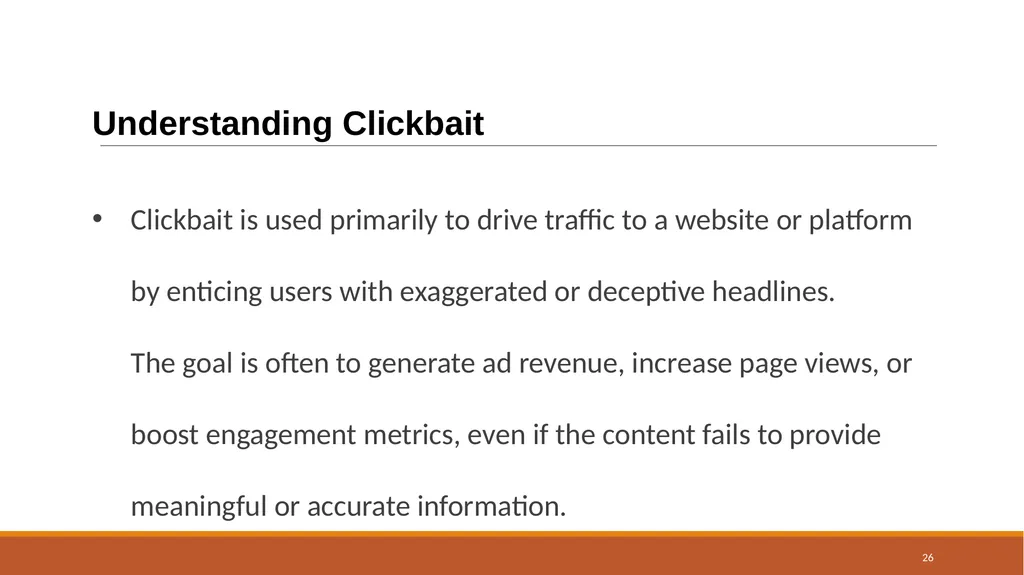
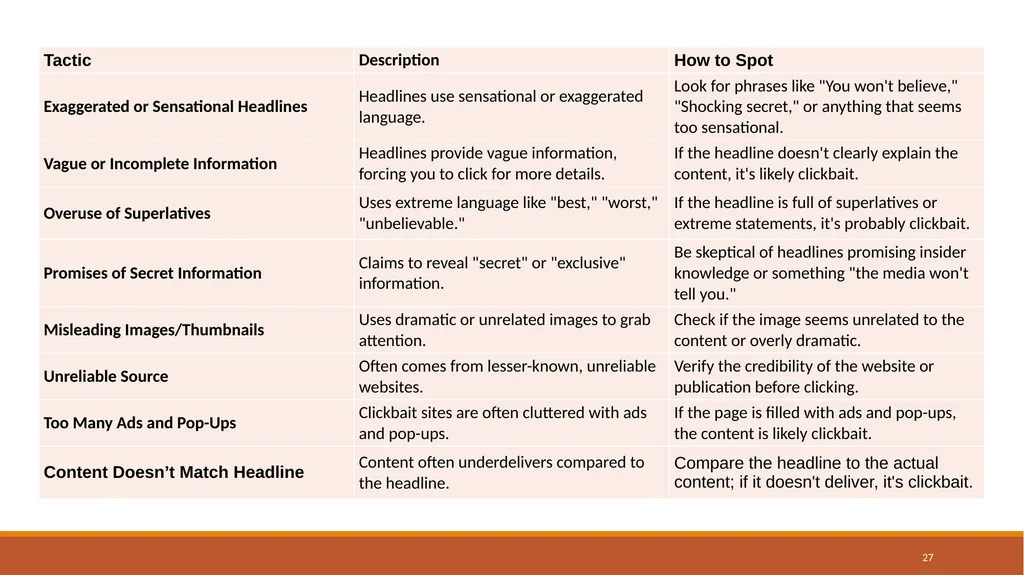
26 Clickbait is used primarily to drive traffic to a website or platform by enticing users with exaggerated or deceptive headlines. �The goal is often to generate ad revenue, increase page views, or boost engagement metrics, even if the content fails to provide meaningful or accurate information. Understanding Clickbait<br>
28
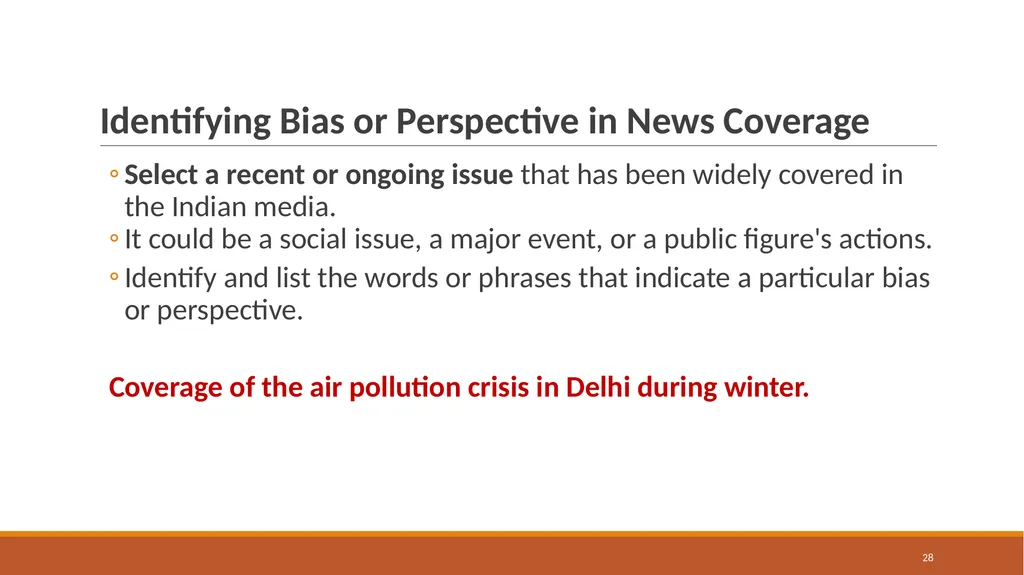
Identifying Bias or Perspective in News Coverage Select a recent or ongoing issue that has been widely covered in the Indian media.
It could be a social issue, a major event, or a public figure's actions.
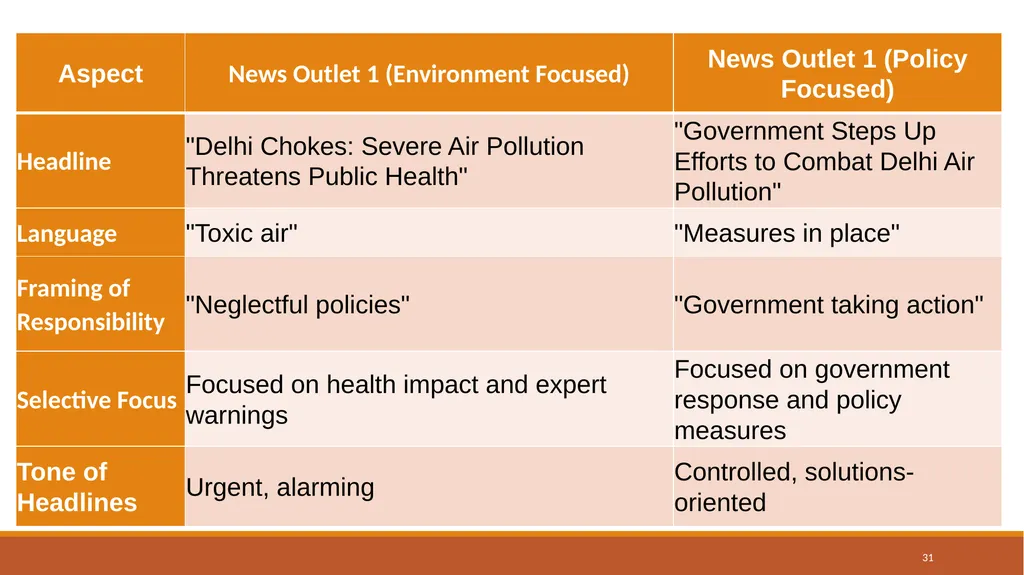
Identify and list the words or phrases that indicate a particular bias or perspective.
Coverage of the air pollution crisis in Delhi during winter. 28<br>
29
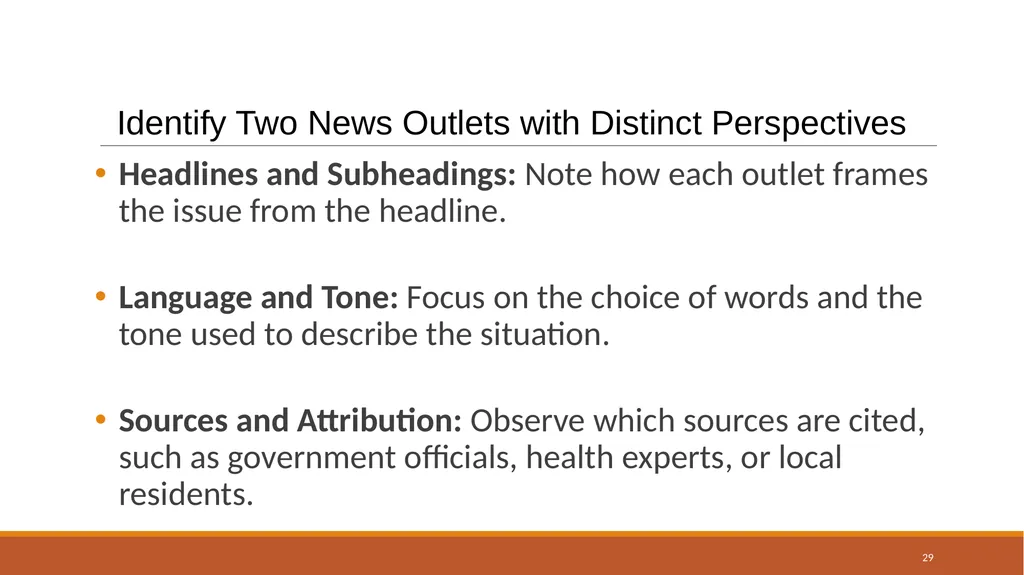
Headlines and Subheadings: Note how each outlet frames the issue from the headline.
Language and Tone: Focus on the choice of words and the tone used to describe the situation.
Sources and Attribution: Observe which sources are cited, such as government officials, health experts, or local residents. 29 Identify Two News Outlets with Distinct Perspectives<br>
30
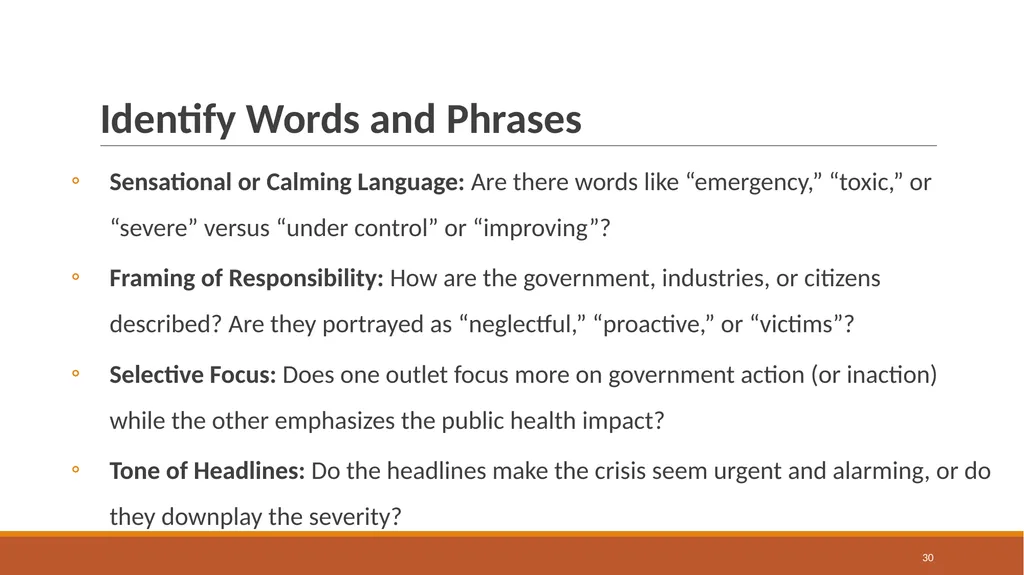
Identify Words and Phrases Sensational or Calming Language: Are there words like “emergency,” “toxic,” or “severe” versus “under control” or “improving”?
Framing of Responsibility: How are the government, industries, or citizens described? Are they portrayed as “neglectful,” “proactive,” or “victims”?
Selective Focus: Does one outlet focus more on government action (or inaction) while the other emphasizes the public health impact?
Tone of Headlines: Do the headlines make the crisis seem urgent and alarming, or do they downplay the severity? 30<br>
32
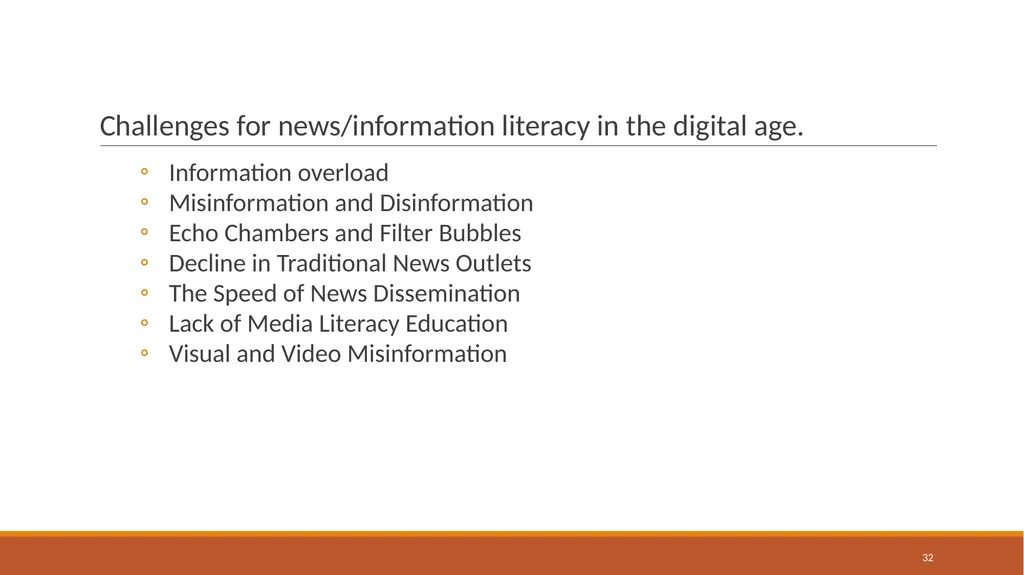
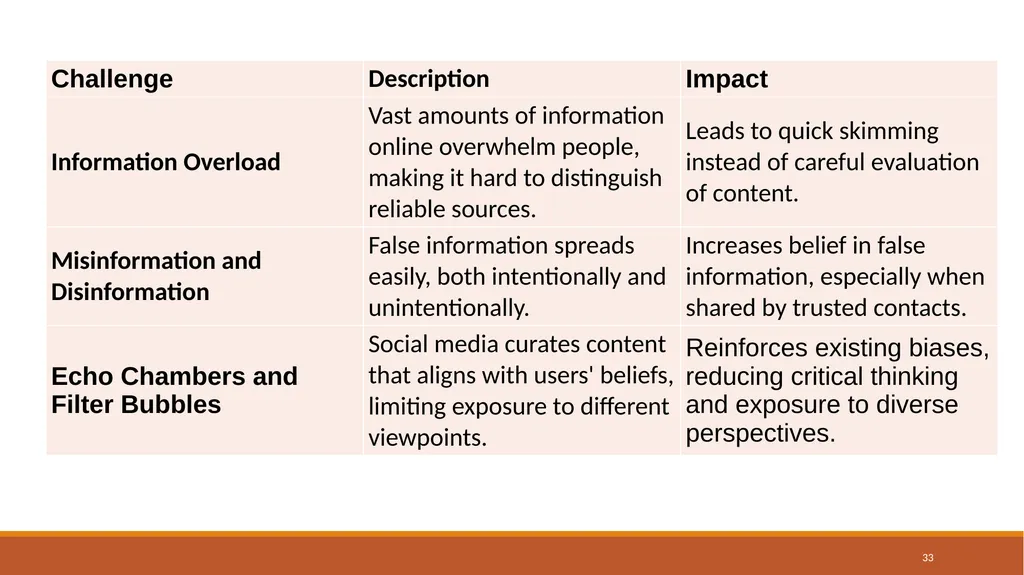
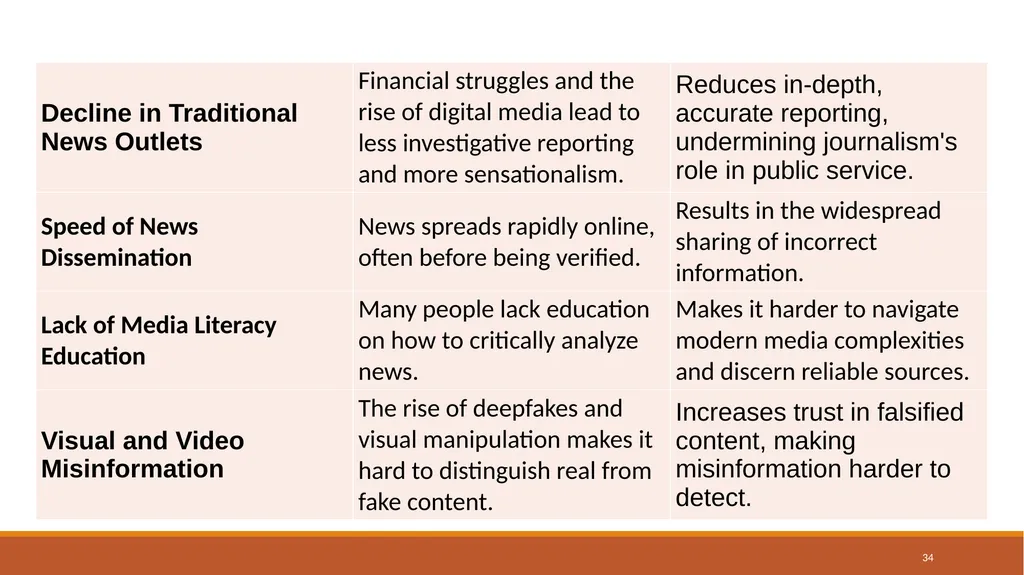
Challenges for news/information literacy in the digital age. Information overload
Misinformation and Disinformation
Echo Chambers and Filter Bubbles
Decline in Traditional News Outlets
The Speed of News Dissemination
Lack of Media Literacy Education
Visual and Video Misinformation 32<br>