NiftyNet: A Deep learning platform for medical
Description: NiftyNet: A Deep learning platform for medical Imaging Syed Sharjeelullah Introduction Medical image analysis increasingly being addresses by deep-learning methods The existing deep-learning platforms do not provide domain specific
Related Topics
Download Presentation
"NiftyNet: A Deep learning platform for medical" is the property of its rightful owner. Permission is granted to download and print the materials on this website for personal, non-commercial use only, and to display it on your personal computer provided you do not modify the materials and that you retain all copyright notices contained in the materials. By downloading content from our website, you accept the terms of this agreement.
Presentation Transcript
slide1. NiftyNet: A Deep learning platform for medical Imaging Syed Sharjeelullah<br>
slide2. Introduction Medical image analysis increasingly being addresses by deep-learning methods
The existing deep-learning platforms do not provide domain specific functionality for medical image analysis
A lot of research done in this area, with a lot of duplication of work
Incompatible infrastructures built across different problems
Reuse of these structures and platforms very difficult
The barriers to distribution of these models are also significant<br>
slide3. Introduction Deep-learning pipelines for medical image analysis comprise interconnected components.
Many components are similar to all regular deep-learning pipelines
Separation of data into training, testing and validation sets
Randomized sampling during training
Image data loading and sampling
Data augmentation
Deep learning model or network
Optimization of model
Evaluation of model performance<br>
slide4. Introduction Medical image analysis has domain specific features
Such as a specific kind of medical image is stored in a specific and unique file format only designed for that kind of image
Current deep learning work, converts images from these formats to some other form
2d image slices, or 1d dimensional array, or maybe 3d volumetric partitions
Medical image analysis can be complex and a very small detail in an image can have catastrophic implications
Such as a small tumor or a small cancerous pulp in the image<br>
slide5. Background Software infrastructure for medical image analysis is not new
Since late ninetees medical imaging formats were released
ACR-NEMA
Analyze
DICOM
Toolsets were also developed to solve common problems such as registration, segmentation and modelling.
Niftyreg, ANTs and elastix<br>
slide6. Background (software infrastructure- Deep Learning Pipelines) Software infrastructure for general purpose deep learning is relatively new.
High computational demands for training models and complexity of efficiently utilizing modern CPU’s and GPU’s has resulted in many libraries and toolkits
Such as TensorFlow, Theano, Caffe, Torch, etc
These libraries assists in building, deployment and distribution of deep learning models for medical imaging<br>
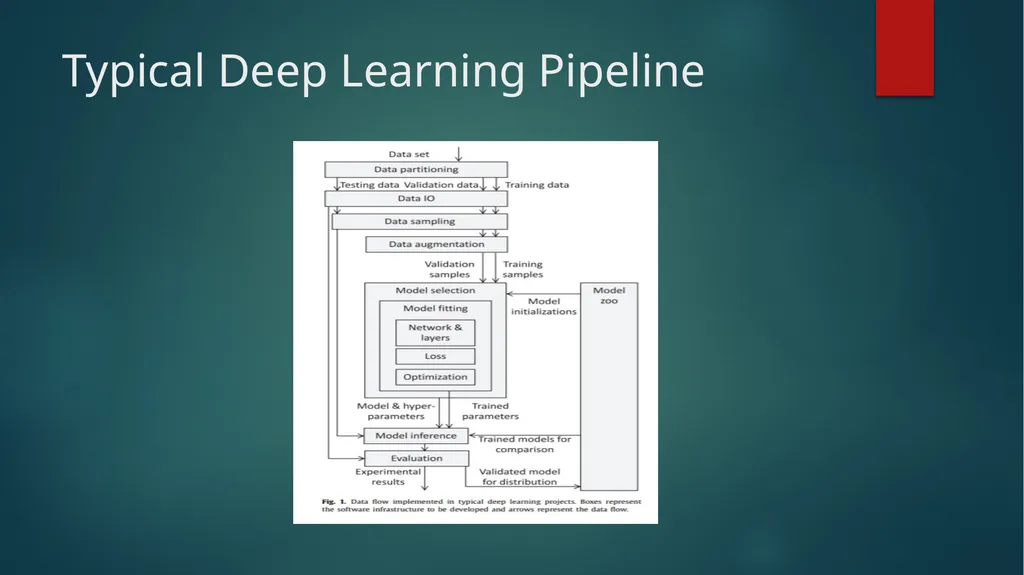
slide7. Typical Deep Learning Pipeline<br>
slide8. Design considerations for Deep learning in medical imaging Data Availability
Acquiring, annotating and distributing a big challenge
Data Dimensionality and Size
2D to 5D, High resolution images
Small or large batch size
Data Formatting
Different formats such as DICOM,NifTI, Analyze
Data Properties
Spatial locations, high resolution,<br>
slide9. NiftyNet: a platform for Deep learning in medical Imaging NiftyNet aims to augment the current deep learning infrastructure for medical imaging
Lowers the barriers of adopting this technology in medical imaging
Makes it easier to build, test and reuse machine learning models for medical image analysis
Built using TensorFlow library
Provides tools for defining computational pipelines and executing them on hardware resources
No functionality for medical image analysis such as pre processing and data cleansing<br>
slide10. NiftyNet: a platform for Deep learning in medical Imaging Provides a high level deep learning pipeline with components optimized for medical imaging applications
Provides specific interfaces for medical image segmentation, classification, regression and image generation.
Has a Model Zoo<br>
slide11. NiftyNet: Design Goals Supports a wide variety of applications in medical image analysis
Enables research in one aspect of deep learning pipeline with no modifications needed for recreation of other parts.
Simple to use for common cases
Supports built in TensorFlow features, such as visualization
Supports best practices
Supports model distribution and adaption<br>
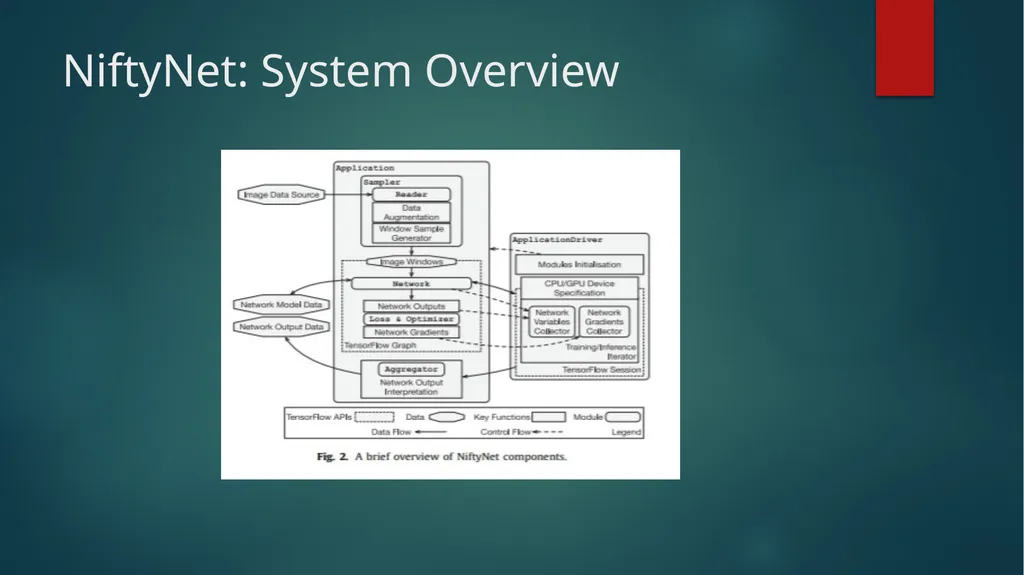
slide12. NiftyNet: System Overview<br>
slide13. Component Details: TensorFlow framework Defines interface for and executes the high performance computations used in deep learning.
Provides a Python application programming interface
TensorFlow was chosen because of:
Cross-platform support
Visualization tools
Installation without compilation
Multi- GPU support
Big support and users in the industry<br>
slide14. Component Details: ApplicationDriver Class Defines common structure for all NiftyNet pipelines
Instantiates Data and Application objects
Acts like a driver of the deep learning pipeline and all the components
Central controller<br>
slide15. Component Details: Application Class Medical Image Analysis requires a wide variety of domain specific tasks for different applications
However, there is common structure and functionality among these applications
NiftyNet supports these common tasks:
Image segmentation
Image regression
Image model representation
Image generation<br>
slide16. Component Details: Network and Layers Complex compositions of simple functions comprise a deep learning architecture simplified in typical networks by repeated reuse of conceptual blocks.
These conceptual blocks are represented by Layer classes.
Composite layers of even entire networks can be instantiated with Niftynet layers and TensorFlow operations.<br>
slide17. Component Details: Data Loading Reader class is responsible for loading medical images in their domain specific formats.
To deal with these formats NiftyNet utilizes Python’s nibabel library, and also SimpleITK.
If file format is not supported by NiftyNet then image wide preprocessing functions are ran before actual samples are taken.<br>
slide18. Component Details: Samplers and Output Handlers Samplers are responsible for mapping a wide variety of input data sets into packets or partitions of data
This layer does the sampling on a wide range of medical applications.
These partitions of data are then processed to become processed data or images
Output Handlers transforms processed data or images into useful output formats.
Output handlers and Samplers are linked, and are regulated by Application class.<br>
slide19. Component Details: Data Normalization and Augmentation Used for small training data sets
Data is too sparse to represent variability in distribution of images.
Data normalization reduces variability in data such as having fixed invariant properties such as mean and variance.
Data augmentation, adds variability in data by adding synthetic samples using adversarial oversampling.<br>
slide20. Component Details: Data Evaluation Performance of image analysis pipelines rely on some standardized metrics
Because of variability of models and applications, different metrics are used in combination to evaluate performance
Niftynet supports descriptive and error metrics for segmentation.
Spacial metrics (eg, volume, surface/volume ratio, compactness)
Intensity metrics (eg, mean, quartiles, skewness of intensity)
Error Metrics (eg, Dice and Jacard scores, specificity and accuracy)<br>
slide21. Model Zoo for Network Reusability Database of trained and untrained networks in standardized formats
Trained networks can be used directly in applications
Untrained networks can be used within new network building.<br>
slide22. Platform Processes and Distribution Ease NiftyNet utilized good software development processes to support:
Ease of use
Robustness
Longevity of the platform
Distribution of code and models
Vibrant community
Simple Commands like pip install niftynet will install NiftyNet<br>
slide23. Results: Abdominal Organ Segmentation A Dense V-network trained using NiftyNet
The object is to segment organs and display them in different colors
90 abdominal CT scans, manually segmented<br>
slide24. Results: Abdominal Organ Segmentation<br>
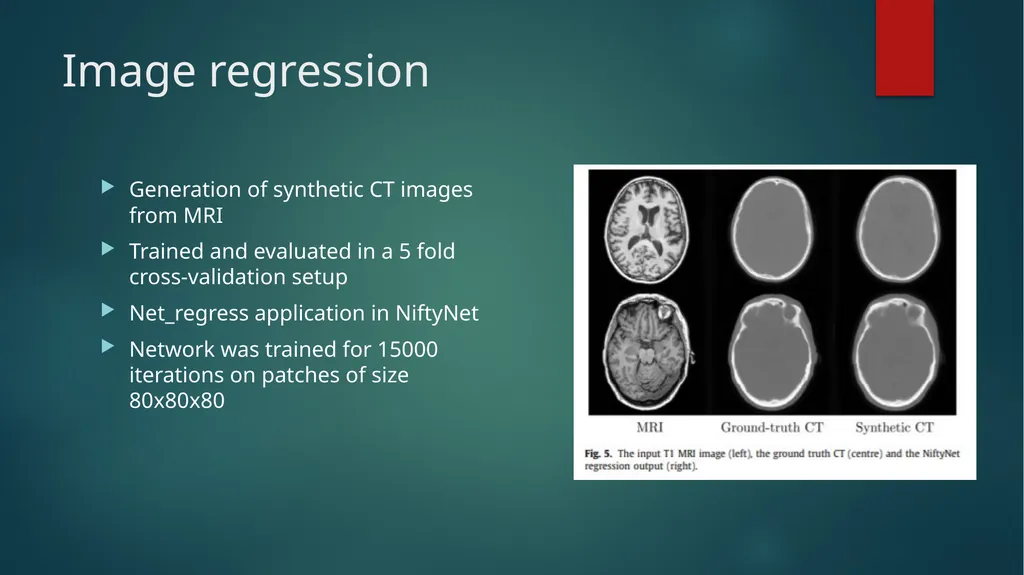
slide25. Image regression Generation of synthetic CT images from MRI
Trained and evaluated in a 5 fold cross-validation setup
Net_regress application in NiftyNet
Network was trained for 15000 iterations on patches of size 80x80x80<br>
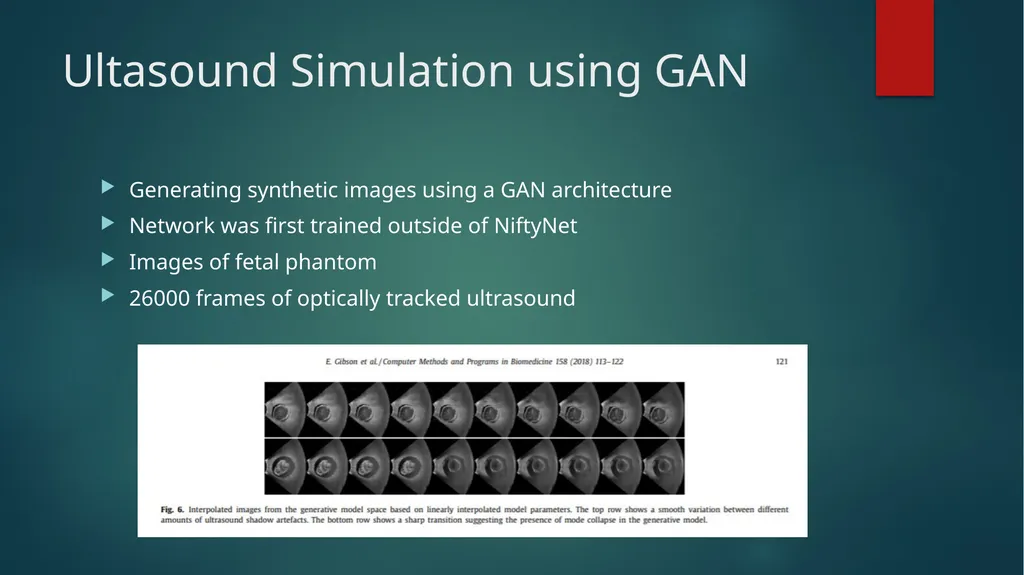
slide26. Ultasound Simulation using GAN Generating synthetic images using a GAN architecture
Network was first trained outside of NiftyNet
Images of fetal phantom
26000 frames of optically tracked ultrasound<br>
slide27. Future Work NiftyNet roadmap is focused on new application types, a larger model zoo and advanced experimental design
Future applications include:
Image classification
Registration
Enhancement (eg super resolution)
Pathology detection<br>

slide2. Introduction Medical image analysis increasingly being addresses by deep-learning methods
The existing deep-learning platforms do not provide domain specific functionality for medical image analysis
A lot of research done in this area, with a lot of duplication of work
Incompatible infrastructures built across different problems
Reuse of these structures and platforms very difficult
The barriers to distribution of these models are also significant<br>
slide3. Introduction Deep-learning pipelines for medical image analysis comprise interconnected components.
Many components are similar to all regular deep-learning pipelines
Separation of data into training, testing and validation sets
Randomized sampling during training
Image data loading and sampling
Data augmentation
Deep learning model or network
Optimization of model
Evaluation of model performance<br>
slide4. Introduction Medical image analysis has domain specific features
Such as a specific kind of medical image is stored in a specific and unique file format only designed for that kind of image
Current deep learning work, converts images from these formats to some other form
2d image slices, or 1d dimensional array, or maybe 3d volumetric partitions
Medical image analysis can be complex and a very small detail in an image can have catastrophic implications
Such as a small tumor or a small cancerous pulp in the image<br>
slide5. Background Software infrastructure for medical image analysis is not new
Since late ninetees medical imaging formats were released
ACR-NEMA
Analyze
DICOM
Toolsets were also developed to solve common problems such as registration, segmentation and modelling.
Niftyreg, ANTs and elastix<br>
slide6. Background (software infrastructure- Deep Learning Pipelines) Software infrastructure for general purpose deep learning is relatively new.
High computational demands for training models and complexity of efficiently utilizing modern CPU’s and GPU’s has resulted in many libraries and toolkits
Such as TensorFlow, Theano, Caffe, Torch, etc
These libraries assists in building, deployment and distribution of deep learning models for medical imaging<br>
slide7. Typical Deep Learning Pipeline<br>
slide8. Design considerations for Deep learning in medical imaging Data Availability
Acquiring, annotating and distributing a big challenge
Data Dimensionality and Size
2D to 5D, High resolution images
Small or large batch size
Data Formatting
Different formats such as DICOM,NifTI, Analyze
Data Properties
Spatial locations, high resolution,<br>
slide9. NiftyNet: a platform for Deep learning in medical Imaging NiftyNet aims to augment the current deep learning infrastructure for medical imaging
Lowers the barriers of adopting this technology in medical imaging
Makes it easier to build, test and reuse machine learning models for medical image analysis
Built using TensorFlow library
Provides tools for defining computational pipelines and executing them on hardware resources
No functionality for medical image analysis such as pre processing and data cleansing<br>
slide10. NiftyNet: a platform for Deep learning in medical Imaging Provides a high level deep learning pipeline with components optimized for medical imaging applications
Provides specific interfaces for medical image segmentation, classification, regression and image generation.
Has a Model Zoo<br>
slide11. NiftyNet: Design Goals Supports a wide variety of applications in medical image analysis
Enables research in one aspect of deep learning pipeline with no modifications needed for recreation of other parts.
Simple to use for common cases
Supports built in TensorFlow features, such as visualization
Supports best practices
Supports model distribution and adaption<br>
slide12. NiftyNet: System Overview<br>
slide13. Component Details: TensorFlow framework Defines interface for and executes the high performance computations used in deep learning.
Provides a Python application programming interface
TensorFlow was chosen because of:
Cross-platform support
Visualization tools
Installation without compilation
Multi- GPU support
Big support and users in the industry<br>
slide14. Component Details: ApplicationDriver Class Defines common structure for all NiftyNet pipelines
Instantiates Data and Application objects
Acts like a driver of the deep learning pipeline and all the components
Central controller<br>
slide15. Component Details: Application Class Medical Image Analysis requires a wide variety of domain specific tasks for different applications
However, there is common structure and functionality among these applications
NiftyNet supports these common tasks:
Image segmentation
Image regression
Image model representation
Image generation<br>
slide16. Component Details: Network and Layers Complex compositions of simple functions comprise a deep learning architecture simplified in typical networks by repeated reuse of conceptual blocks.
These conceptual blocks are represented by Layer classes.
Composite layers of even entire networks can be instantiated with Niftynet layers and TensorFlow operations.<br>
slide17. Component Details: Data Loading Reader class is responsible for loading medical images in their domain specific formats.
To deal with these formats NiftyNet utilizes Python’s nibabel library, and also SimpleITK.
If file format is not supported by NiftyNet then image wide preprocessing functions are ran before actual samples are taken.<br>
slide18. Component Details: Samplers and Output Handlers Samplers are responsible for mapping a wide variety of input data sets into packets or partitions of data
This layer does the sampling on a wide range of medical applications.
These partitions of data are then processed to become processed data or images
Output Handlers transforms processed data or images into useful output formats.
Output handlers and Samplers are linked, and are regulated by Application class.<br>
slide19. Component Details: Data Normalization and Augmentation Used for small training data sets
Data is too sparse to represent variability in distribution of images.
Data normalization reduces variability in data such as having fixed invariant properties such as mean and variance.
Data augmentation, adds variability in data by adding synthetic samples using adversarial oversampling.<br>
slide20. Component Details: Data Evaluation Performance of image analysis pipelines rely on some standardized metrics
Because of variability of models and applications, different metrics are used in combination to evaluate performance
Niftynet supports descriptive and error metrics for segmentation.
Spacial metrics (eg, volume, surface/volume ratio, compactness)
Intensity metrics (eg, mean, quartiles, skewness of intensity)
Error Metrics (eg, Dice and Jacard scores, specificity and accuracy)<br>
slide21. Model Zoo for Network Reusability Database of trained and untrained networks in standardized formats
Trained networks can be used directly in applications
Untrained networks can be used within new network building.<br>
slide22. Platform Processes and Distribution Ease NiftyNet utilized good software development processes to support:
Ease of use
Robustness
Longevity of the platform
Distribution of code and models
Vibrant community
Simple Commands like pip install niftynet will install NiftyNet<br>
slide23. Results: Abdominal Organ Segmentation A Dense V-network trained using NiftyNet
The object is to segment organs and display them in different colors
90 abdominal CT scans, manually segmented<br>
slide24. Results: Abdominal Organ Segmentation<br>
slide25. Image regression Generation of synthetic CT images from MRI
Trained and evaluated in a 5 fold cross-validation setup
Net_regress application in NiftyNet
Network was trained for 15000 iterations on patches of size 80x80x80<br>
slide26. Ultasound Simulation using GAN Generating synthetic images using a GAN architecture
Network was first trained outside of NiftyNet
Images of fetal phantom
26000 frames of optically tracked ultrasound<br>
slide27. Future Work NiftyNet roadmap is focused on new application types, a larger model zoo and advanced experimental design
Future applications include:
Image classification
Registration
Enhancement (eg super resolution)
Pathology detection<br>