
Night Surface Operations GUIDE National Response
MY
Published · 26 slides · 0 views
1 / 1
Description
Night Surface Operations GUIDE National Response Directorate Disclaimer This guide is not a substitute for applicable policy. The best practices presented in this guide should augment and support the safe completion of our surface
Related Topics
Share
Embed code
Download this presentation From Below
"Night Surface Operations GUIDE National Response" is the property of its rightful owner. Permission is granted to download and print the materials on this website for personal, non-commercial use only, and to display it on your personal computer provided you do not modify the materials and that you retain all copyright notices contained in the materials. By downloading content from our website, you accept the terms of this agreement.
Presentation Transcript
01
Night Surface Operations
GUIDE
National Response Directorate<br>
02
Disclaimer This guide is not a substitute for applicable policy. The best practices presented in this guide should augment and support the safe completion of our surface operations responsibilities. Applicable instructions and/or local regulations from your OIA and chain of leadership must always be followed. Night Surface Operations Guide<br>
03
Night Surface Operations Guide Welcome Why do we need night ops training?
“I’ve driven boats all my life”
“I operate at night all the time”
“I’ve never had an accident”
No one has had an accident…
…..until they do.<br>
“I’ve driven boats all my life”
“I operate at night all the time”
“I’ve never had an accident”
No one has had an accident…
…..until they do.<br>
04
Night Surface Operations Guide Night Operations “Night Operations”, for the purposes of this presentation, is defined as any surface mission aboard an AUXFAC that occurs between dusk and dawn, or in conditions of limited visibility requiring the use of navigation lights (fog, rain, less than ¼ mile visibility and/or other factors).
See Inland and International Rule # 19 (Navigation Rules) for details.<br>
See Inland and International Rule # 19 (Navigation Rules) for details.<br>
05
Night Surface Operations Guide Fatal Accident December 20, 2009, 1744 hours (Dark)
San Diego Holiday Boat Parade
CG 33118 moving at 42 kts (NTSB report)
They were responding to a non-distress sailboat aground
CG 33118 struck a 24 foot Sea Ray
An 8 year old boy was killed<br>
San Diego Holiday Boat Parade
CG 33118 moving at 42 kts (NTSB report)
They were responding to a non-distress sailboat aground
CG 33118 struck a 24 foot Sea Ray
An 8 year old boy was killed<br>
06
Night Surface Operations Guide Night Operations ½ of the world is always in darkness
While we train in the light, the SAR call may come at night
Some ATON patrols must be done at night
BCM-08-02-AUX requires a night underway navigation and piloting exercise
NOTE: May be waived by the Director in accordance with Section 1.B.4. If waived, candidate must discuss night navigation and piloting. Same for COX-09-04-AUX<br>
While we train in the light, the SAR call may come at night
Some ATON patrols must be done at night
BCM-08-02-AUX requires a night underway navigation and piloting exercise
NOTE: May be waived by the Director in accordance with Section 1.B.4. If waived, candidate must discuss night navigation and piloting. Same for COX-09-04-AUX<br>
07
NIGHT OPERATIONS Holiday boat parades are conducted after dark
Hard to distinguish Navigation Lights from holiday lights
Fireworks Safety Patrols are very dangerous
Everyone is looking up, not out
Things (some hot things) are falling from the sky Night Surface Operations Guide<br>
Hard to distinguish Navigation Lights from holiday lights
Fireworks Safety Patrols are very dangerous
Everyone is looking up, not out
Things (some hot things) are falling from the sky Night Surface Operations Guide<br>
08
Night Surface Operations Guide General Rules Conduct a thorough mission briefing –:
Discuss specific mission goals
Discuss how reduced visibility will affect navigation & avoiding hazards that may be encountered.
Adapt to night vision and conserve it
No white lights
Extra caution moving on weather decks
Keep one eye closed if white light must be used
Change interior lights to red or blue
Use caution reading charts in red or blue light – colors on the chart look very different<br>
Discuss specific mission goals
Discuss how reduced visibility will affect navigation & avoiding hazards that may be encountered.
Adapt to night vision and conserve it
No white lights
Extra caution moving on weather decks
Keep one eye closed if white light must be used
Change interior lights to red or blue
Use caution reading charts in red or blue light – colors on the chart look very different<br>
09
General Rules Slow down, remember NAV RULE 6
“Every vessel shall at all times proceed at a safe speed so that she can take proper and effective action to avoid a collision and be stopped within a distance appropriate to the prevailing circumstances and conditions”.
To determine that safe speed, the Nav Rules list these factors:
Visibility, traffic density, maneuverability of the vessel (stop, turn distances), background light & “scatter” that may impact vision, draft & water depth, sea state & weather. Night Surface Operations Guide<br>
“Every vessel shall at all times proceed at a safe speed so that she can take proper and effective action to avoid a collision and be stopped within a distance appropriate to the prevailing circumstances and conditions”.
To determine that safe speed, the Nav Rules list these factors:
Visibility, traffic density, maneuverability of the vessel (stop, turn distances), background light & “scatter” that may impact vision, draft & water depth, sea state & weather. Night Surface Operations Guide<br>
10
Night Surface Operations Guide Night Operations If ever in doubt of the vessels’ position
STOP!<br>
STOP!<br>
11
Night Surface Operations Guide Night Operations Regain your situational awareness by:
Bringing the vessel to a full stop.
Deploying the anchor if necessary.
Do not continue patrol until your exact position and circumstances have been determined.<br>
Bringing the vessel to a full stop.
Deploying the anchor if necessary.
Do not continue patrol until your exact position and circumstances have been determined.<br>
12
Night Operations How current are your electronic charts?
How current are your paper charts?
Currently corrected paper charts are always the best, the “Gold Standard”.
Electronic charts are known to have errors.
Trust…but verify. Night Surface Operations Guide<br>
How current are your paper charts?
Currently corrected paper charts are always the best, the “Gold Standard”.
Electronic charts are known to have errors.
Trust…but verify. Night Surface Operations Guide<br>
13
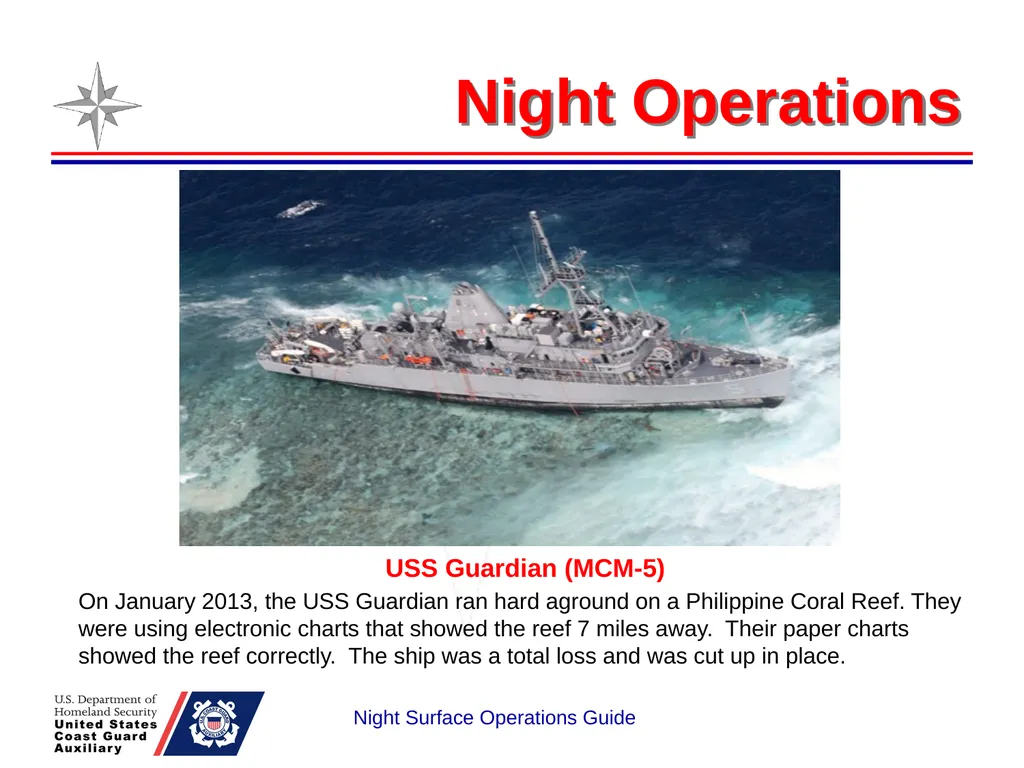
Night Surface Operations Guide Night Operations USS Guardian (MCM-5)
On January 2013, the USS Guardian ran hard aground on a Philippine Coral Reef. They were using electronic charts that showed the reef 7 miles away. Their paper charts showed the reef correctly. The ship was a total loss and was cut up in place.<br>
On January 2013, the USS Guardian ran hard aground on a Philippine Coral Reef. They were using electronic charts that showed the reef 7 miles away. Their paper charts showed the reef correctly. The ship was a total loss and was cut up in place.<br>
14
Night Surface Operations Guide Night Operations Use your hearing
Sound carries very well over the water
Maintain a proper watch and extra lookouts.
Consider attaching Chem-Lights to tow lines so you can actually see the line and stand a proper tow watch.<br>
Sound carries very well over the water
Maintain a proper watch and extra lookouts.
Consider attaching Chem-Lights to tow lines so you can actually see the line and stand a proper tow watch.<br>
15
Night Surface Operations Guide Night Operations Alertness levels may drop off at night.
More frequent helm and lookout changes may be required to maintain an alert crew.
The most difficult period to maintain alertness and awareness is between 2100-0700 hours.<br>
More frequent helm and lookout changes may be required to maintain an alert crew.
The most difficult period to maintain alertness and awareness is between 2100-0700 hours.<br>
16
Night Surface Operations Guide Night Vision You should have 20/20 (or corrected to 20/20) to see obstacles, navigation lights and aids to navigation.
It takes healthy people up to 60 minutes in darkness to adapt to night vision.<br>
It takes healthy people up to 60 minutes in darkness to adapt to night vision.<br>
17
Night Surface Operations Guide Night Vision Individuals who smoke and/or drink have decreased visual acuity.
Alcohol has the following effects
Blurred or double vision
Slow pupil reaction
Decreased peripheral vision
Altered contrast sensitivity<br>
Alcohol has the following effects
Blurred or double vision
Slow pupil reaction
Decreased peripheral vision
Altered contrast sensitivity<br>
18
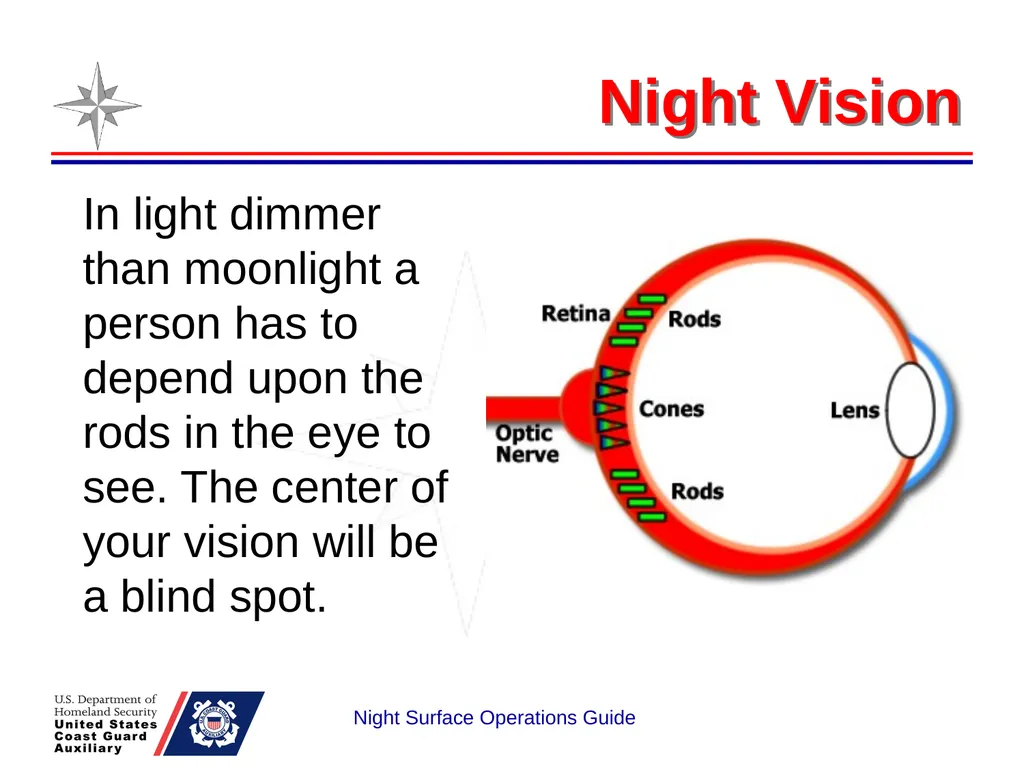
Night Surface Operations Guide Night Vision In light dimmer than moonlight a person has to depend upon the rods in the eye to see. The center of your vision will be a blind spot.<br>
19
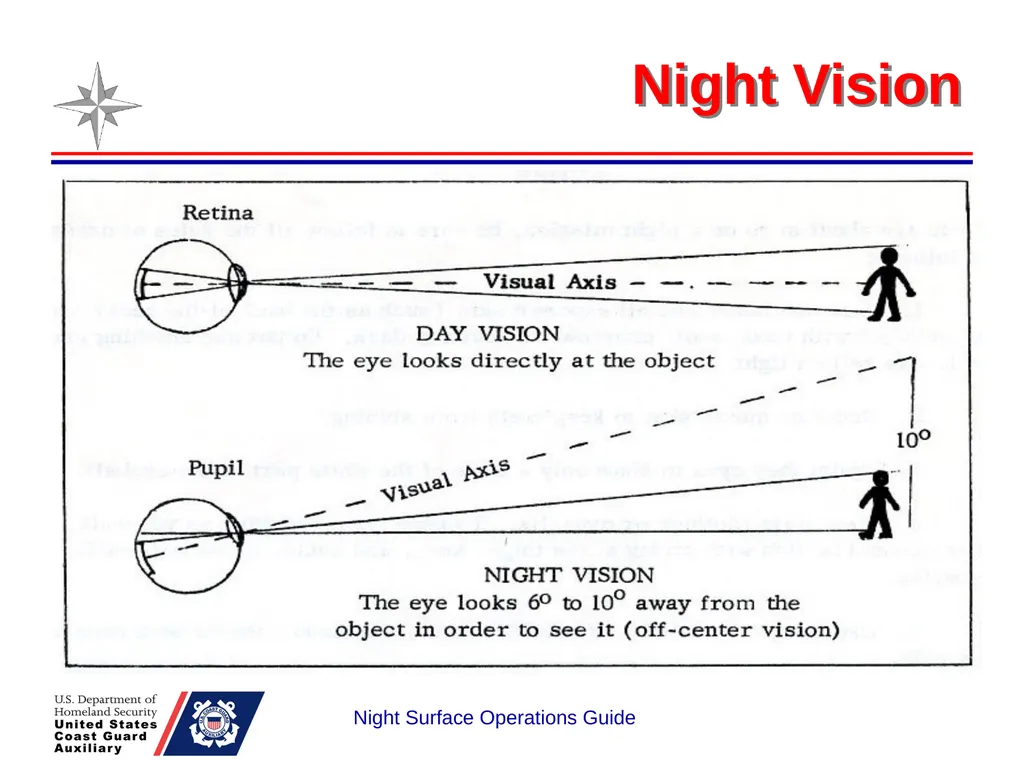
Night Surface Operations Guide Night Vision<br>
20
Night Surface Operations Guide Night Operations Equipment The OIA will decide what limitations will be placed on night & limited visibility operations & what equip is necessary.
GPS-RADAR
As a general rule, any facility that might operate at night or in conditions of limited visibility should be equipped with GPS and RADAR, and the operator must be able to competently use that equipment safely.<br>
GPS-RADAR
As a general rule, any facility that might operate at night or in conditions of limited visibility should be equipped with GPS and RADAR, and the operator must be able to competently use that equipment safely.<br>
21
Night Operations Equipment NAVRULE 7 states;
“Proper use shall be made of radar equipment if fitted and operational”.
If you have it you must use it (all hours, not just at night) and be competent in it’s use.
Make sure your watch standers know how to read the screen. Night Surface Operations Guide<br>
“Proper use shall be made of radar equipment if fitted and operational”.
If you have it you must use it (all hours, not just at night) and be competent in it’s use.
Make sure your watch standers know how to read the screen. Night Surface Operations Guide<br>
22
Night Operations Equipment Night Surface Operations Guide Where from any sufficient cause it is impracticable for a vessel not normally
engaged in towing operations to display the lights prescribed in paragraph
(a) or (c) of this Rule, such vessel shall not be required to exhibit those
lights when engaged in towing another vessel in distress or otherwise in
need of assistance. All possible measures shall be taken to indicate the
nature of the relationship between the towing vessel and the vessel being
towed as authorized by Rule 36, in particular by illuminating the towline. Tow Lights
The tow light configuration described in Rule 24 of
the Navigation Rules regarding night towing operations
is a good idea but is not required for AUXFACS.<br>
engaged in towing operations to display the lights prescribed in paragraph
(a) or (c) of this Rule, such vessel shall not be required to exhibit those
lights when engaged in towing another vessel in distress or otherwise in
need of assistance. All possible measures shall be taken to indicate the
nature of the relationship between the towing vessel and the vessel being
towed as authorized by Rule 36, in particular by illuminating the towline. Tow Lights
The tow light configuration described in Rule 24 of
the Navigation Rules regarding night towing operations
is a good idea but is not required for AUXFACS.<br>
23
Night Operations The Coxswain should assign one crew member to constantly monitor the Radar screen in addition to the helmsman.
This crew person must be competent with Radar, keep a watchful eye on the screen and communicate conditions clearly with the Coxswain and helmsman.
Speeds should be limited to no more than 10 knots. Night Surface Operations Guide<br>
This crew person must be competent with Radar, keep a watchful eye on the screen and communicate conditions clearly with the Coxswain and helmsman.
Speeds should be limited to no more than 10 knots. Night Surface Operations Guide<br>
24
Night Surface Operations Guide Summary The 7 elements of TCT are especially important during night operations.
Be guided by and communicate with your OIA and appointed officers when night operations are planned.
Ensure you have a fit crew, with extra members, and a skilled GPS and RADAR operator on board.
Maintain situational awareness and be adaptable to changing conditions.<br>
Be guided by and communicate with your OIA and appointed officers when night operations are planned.
Ensure you have a fit crew, with extra members, and a skilled GPS and RADAR operator on board.
Maintain situational awareness and be adaptable to changing conditions.<br>
25
Night Surface Operations Guide Thank You Please send your comments to:
David Larkin BC-RSP
david.larkin@cgauxnet.us
James McCarty, DVC-RS
james.mccarty@cgauxnet.us<br>
David Larkin BC-RSP
david.larkin@cgauxnet.us
James McCarty, DVC-RS
james.mccarty@cgauxnet.us<br>
26
Night Surface Operations Guide References COMDTPUB 16754.27, 2013. Recreational Boating Statistics.
Code of Federal Regulations. 46 CFR 10.305(a), Vision Requirements, Deck Standard.
Bedinhaus, T. DO, June 3, 2014. USAF Special Report, AL-SR-1992-0002, Night Vision Manual for the Flight Surgeon, written by Robert E. Miller II, Col, USAF, (RET) and Thomas J. Tredici, Col, USAF, (RET).
USCG, November 18, 2014. Navigation Rules and Regulations Handbook.
COMDTINST 16772.2D, July 1, 2013. Navigation Rules: International-Inland (superseded).
National Transportation Safety Board, July 12, 2011. Collision Between U.S. Coast Guard Vessel CG 33118 and Sea Ray Recreational Vessel CF 2607 PZ, San Diego Bay, California, December 20,2009.<br>
Code of Federal Regulations. 46 CFR 10.305(a), Vision Requirements, Deck Standard.
Bedinhaus, T. DO, June 3, 2014. USAF Special Report, AL-SR-1992-0002, Night Vision Manual for the Flight Surgeon, written by Robert E. Miller II, Col, USAF, (RET) and Thomas J. Tredici, Col, USAF, (RET).
USCG, November 18, 2014. Navigation Rules and Regulations Handbook.
COMDTINST 16772.2D, July 1, 2013. Navigation Rules: International-Inland (superseded).
National Transportation Safety Board, July 12, 2011. Collision Between U.S. Coast Guard Vessel CG 33118 and Sea Ray Recreational Vessel CF 2607 PZ, San Diego Bay, California, December 20,2009.<br>