Nitrogen fixation: a structural inorganic mystery? This slide show created by Jodi ODonnell, Siena College (jodonnellsiena.edu) August 1, 2014. This work is licensed under the Creative Commons Attribution Non-commercial Share Alike
"Nitrogen fixation: a structural inorganic mystery?" is the property of its rightful owner. Permission is granted to
download and print the materials on this website for personal, non-commercial use only, and to display it
on your personal computer provided you do not modify the materials and that you retain all copyright
notices contained in the materials. By downloading content from our website, you accept the terms of this
agreement.
Presentation Transcript
01
Nitrogen fixation: a structural inorganic mystery? This slide show created by Jodi O’Donnell, Siena College (jodonnell@siena.edu) August 1, 2014. This work is licensed under the Creative Commons Attribution Non-commercial Share Alike License. To view a copy of this license visit http://creativecommons.org/about/license/.<br>
02
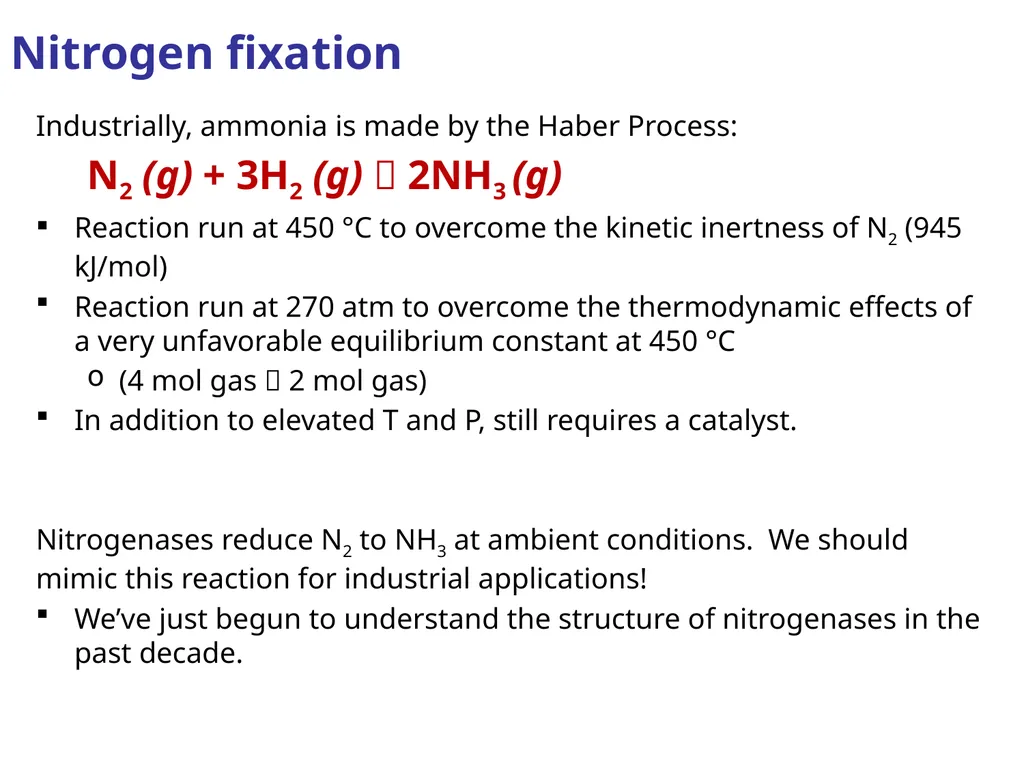
Nitrogen fixation Industrially, ammonia is made by the Haber Process:
N2 (g) + 3H2 (g) 2NH3 (g)
Reaction run at 450 °C to overcome the kinetic inertness of N2 (945 kJ/mol)
Reaction run at 270 atm to overcome the thermodynamic effects of a very unfavorable equilibrium constant at 450 °C
(4 mol gas 2 mol gas)
In addition to elevated T and P, still requires a catalyst.
Nitrogenases reduce N2 to NH3 at ambient conditions. We should mimic this reaction for industrial applications!
We’ve just begun to understand the structure of nitrogenases in the past decade.<br>
03
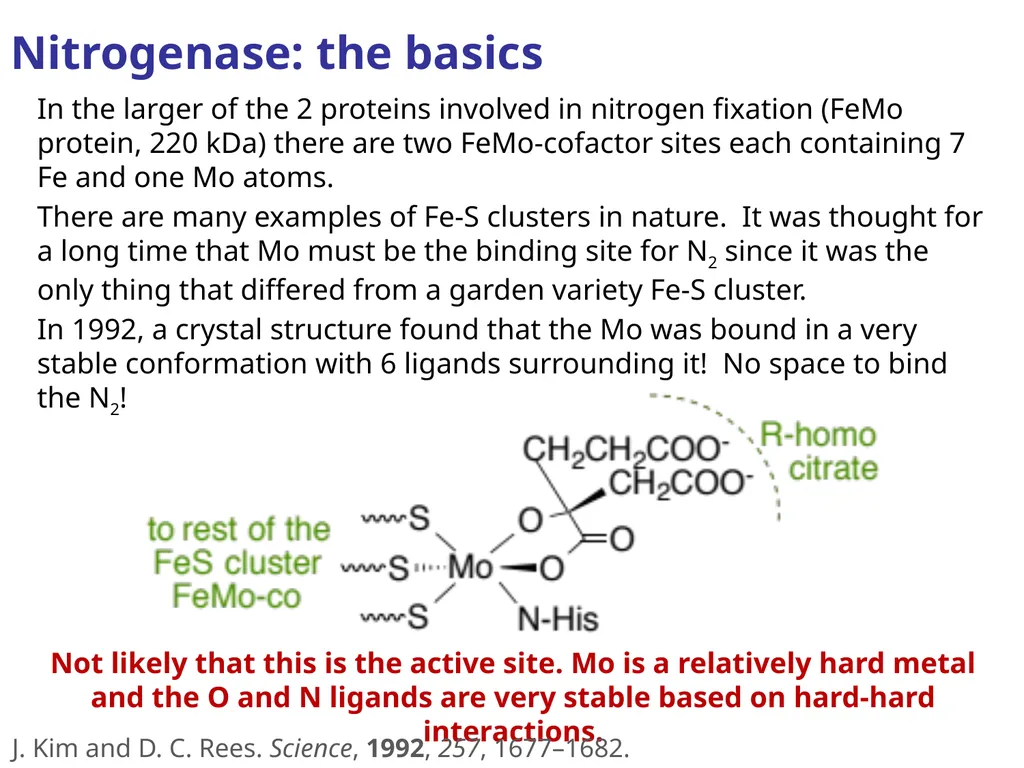
Nitrogenase: the basics In the larger of the 2 proteins involved in nitrogen fixation (FeMo protein, 220 kDa) there are two FeMo-cofactor sites each containing 7 Fe and one Mo atoms.
There are many examples of Fe-S clusters in nature. It was thought for a long time that Mo must be the binding site for N2 since it was the only thing that differed from a garden variety Fe-S cluster.
In 1992, a crystal structure found that the Mo was bound in a very stable conformation with 6 ligands surrounding it! No space to bind the N2! Not likely that this is the active site. Mo is a relatively hard metal and the O and N ligands are very stable based on hard-hard interactions. J. Kim and D. C. Rees. Science, 1992, 257, 1677–1682.<br>
04
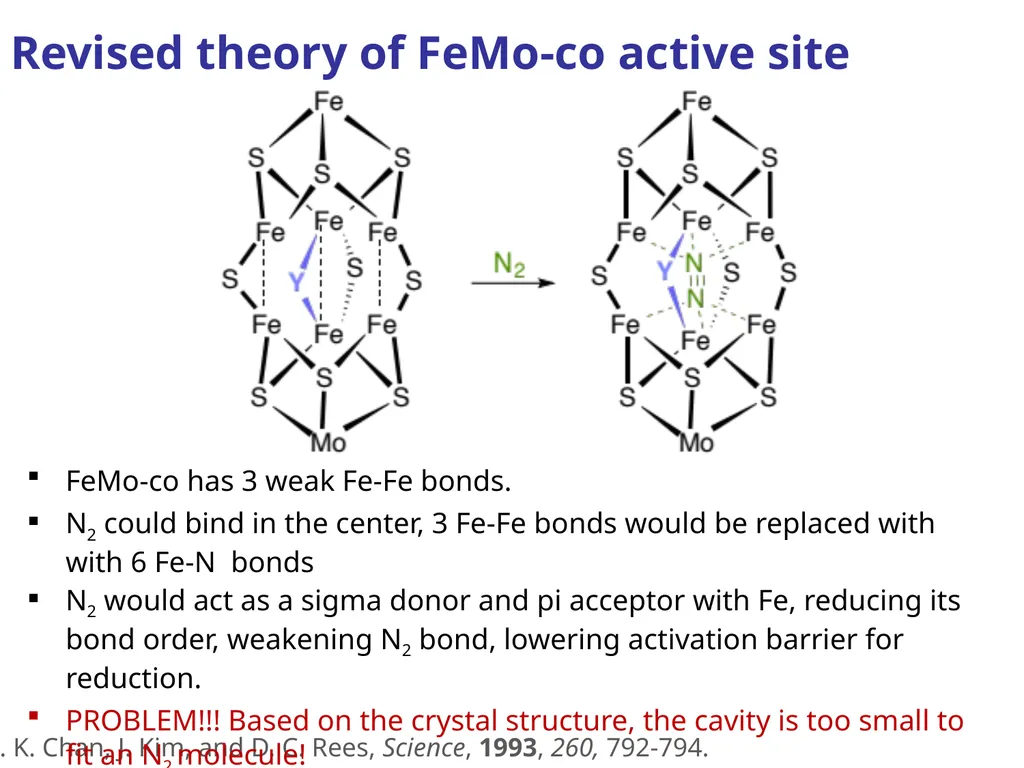
Revised theory of FeMo-co active site FeMo-co has 3 weak Fe-Fe bonds.
N2 could bind in the center, 3 Fe-Fe bonds would be replaced with with 6 Fe-N bonds M. K. Chan, J. Kim, and D. C. Rees, Science, 1993, 260, 792-794. N2 would act as a sigma donor and pi acceptor with Fe, reducing its bond order, weakening N2 bond, lowering activation barrier for reduction.
PROBLEM!!! Based on the crystal structure, the cavity is too small to fit an N2 molecule!<br>
05
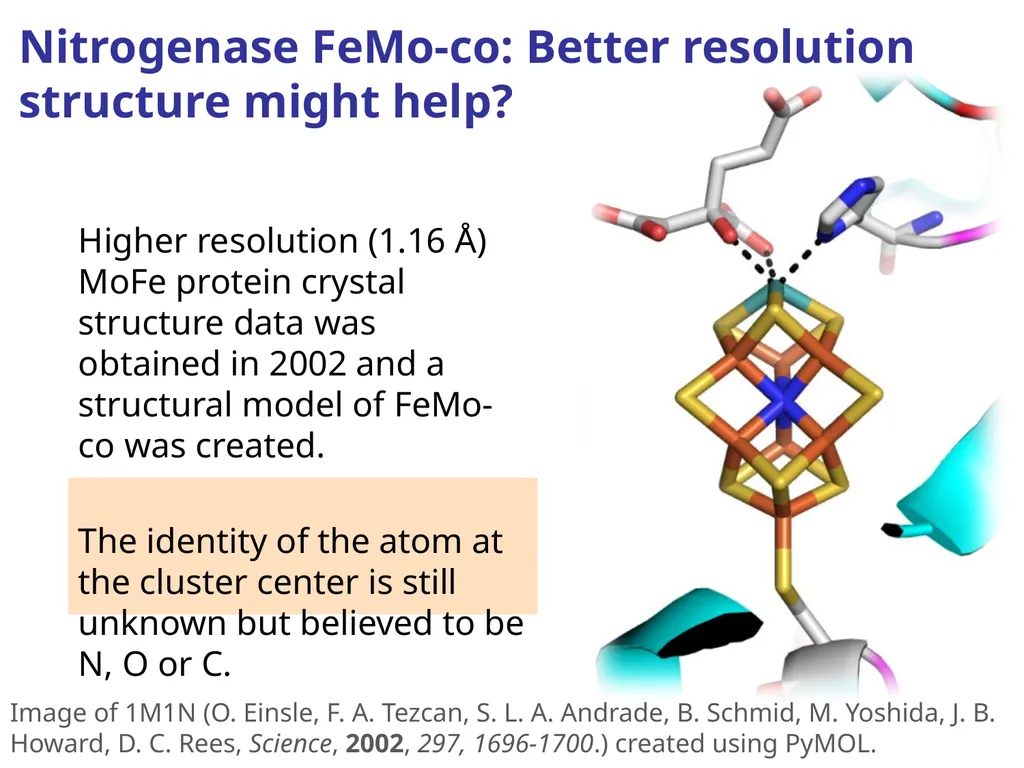
Nitrogenase FeMo-co: Better resolution structure might help? Higher resolution (1.16 Å) MoFe protein crystal structure data was obtained in 2002 and a structural model of FeMo-co was created.
The identity of the atom at the cluster center is still unknown but believed to be N, O or C. Image of 1M1N (O. Einsle, F. A. Tezcan, S. L. A. Andrade, B. Schmid, M. Yoshida, J. B. Howard, D. C. Rees, Science, 2002, 297, 1696-1700.) created using PyMOL.<br>
06
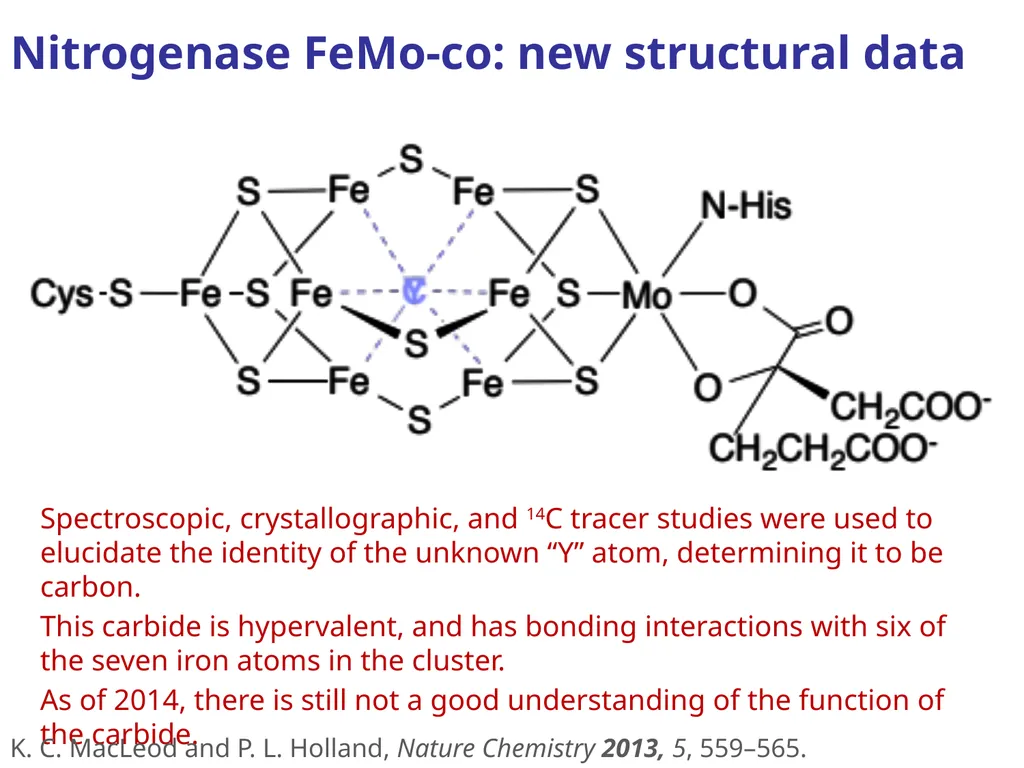
Nitrogenase FeMo-co: new structural data Spectroscopic, crystallographic, and 14C tracer studies were used to elucidate the identity of the unknown “Y” atom, determining it to be carbon.
This carbide is hypervalent, and has bonding interactions with six of the seven iron atoms in the cluster.
As of 2014, there is still not a good understanding of the function of the carbide. K. C. MacLeod and P. L. Holland, Nature Chemistry 2013, 5, 559–565.<br>