
NMR spectroscopy Prepared by Dr. Upali Siriwardane
PM
Published · 50 slides · 0 views

1 / 1


Description
NMR spectroscopy Prepared by Dr. Upali Siriwardane For CHEM 481 Lab Objectives Student should gain better understanding of NMR spectroscopy. Student should gain experience in the acquisition, processing, and displaying NMR data. Student
Related Topics
Share
Embed code
Download this presentation From Below
"NMR spectroscopy Prepared by Dr. Upali Siriwardane" is the property of its rightful owner. Permission is granted to download and print the materials on this website for personal, non-commercial use only, and to display it on your personal computer provided you do not modify the materials and that you retain all copyright notices contained in the materials. By downloading content from our website, you accept the terms of this agreement.
Presentation Transcript
01
NMR spectroscopy Prepared by Dr. Upali Siriwardane
For
CHEM 481 Lab<br>
For
CHEM 481 Lab<br>
02
Objectives Student should gain better understanding of NMR spectroscopy.
Student should gain experience in the acquisition, processing, and displaying NMR data.
Student should gain experience in interpreting NMR data in order to establish structure for unknown organic molecules.
Student should gain understanding in advanced 1Dimensional and 2Dimensional NMR techniques.<br>
Student should gain experience in the acquisition, processing, and displaying NMR data.
Student should gain experience in interpreting NMR data in order to establish structure for unknown organic molecules.
Student should gain understanding in advanced 1Dimensional and 2Dimensional NMR techniques.<br>
03
Information from 1H-nmr spectra:
Number of signals: How many different types of hydrogens in the molecule.
Position of signals (chemical shift): What types of hydrogens.
Relative areas under signals (integration): How many hydrogens of each type.
Splitting pattern: How many neighboring hydrogens.<br>
Number of signals: How many different types of hydrogens in the molecule.
Position of signals (chemical shift): What types of hydrogens.
Relative areas under signals (integration): How many hydrogens of each type.
Splitting pattern: How many neighboring hydrogens.<br>
04
Introduction The Nobel Prize has been awarded twice for work related to NMR. F. Bloch and E.M. Purcell received the Nobel Prize in Physics, in 1952, for the first experimental verifications of the phenomenon, and Prof. R.R. Ernst received the Nobel Prize in Chemistry, in 1991, for the development of the NMR techniques.
Since its discovery 50 years ago, in 1945, it has spread from physics to chemistry, biosciences, material research and medical diagnosis.<br>
Since its discovery 50 years ago, in 1945, it has spread from physics to chemistry, biosciences, material research and medical diagnosis.<br>
05
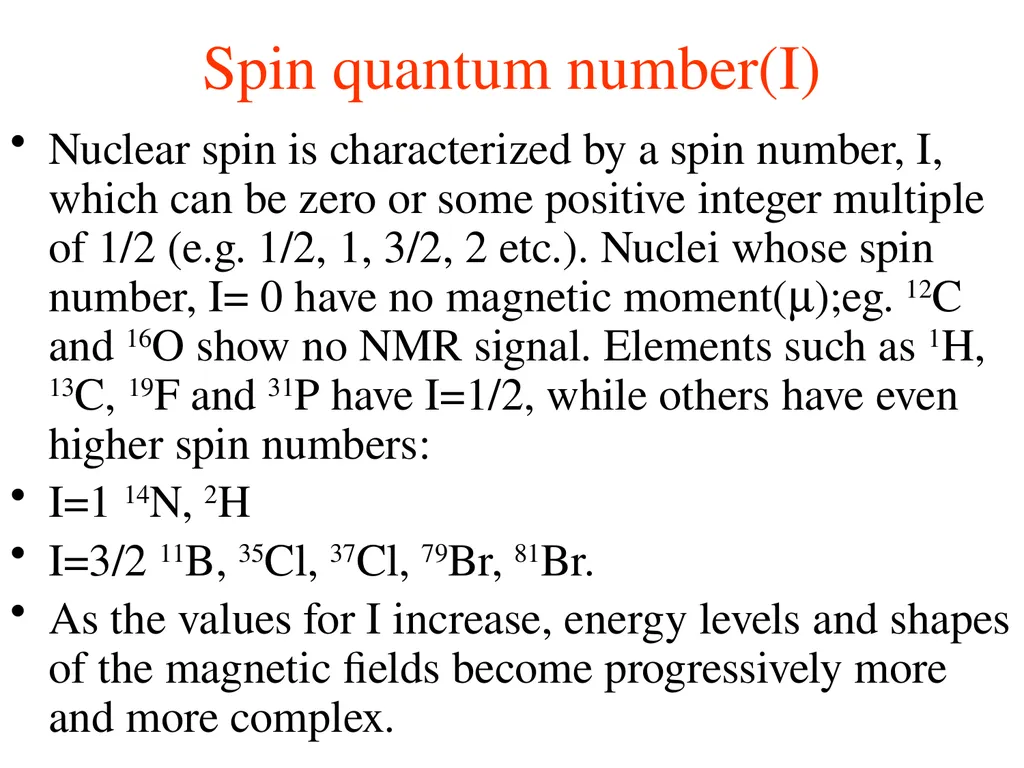
Spin quantum number(I) Nuclear spin is characterized by a spin number, I, which can be zero or some positive integer multiple of 1/2 (e.g. 1/2, 1, 3/2, 2 etc.). Nuclei whose spin number, I= 0 have no magnetic moment(m);eg. 12C and 16O show no NMR signal. Elements such as 1H, 13C, 19F and 31P have I=1/2, while others have even higher spin numbers:
I=1 14N, 2H
I=3/2 11B, 35Cl, 37Cl, 79Br, 81Br.
As the values for I increase, energy levels and shapes of the magnetic fields become progressively more and more complex.<br>
I=1 14N, 2H
I=3/2 11B, 35Cl, 37Cl, 79Br, 81Br.
As the values for I increase, energy levels and shapes of the magnetic fields become progressively more and more complex.<br>
06
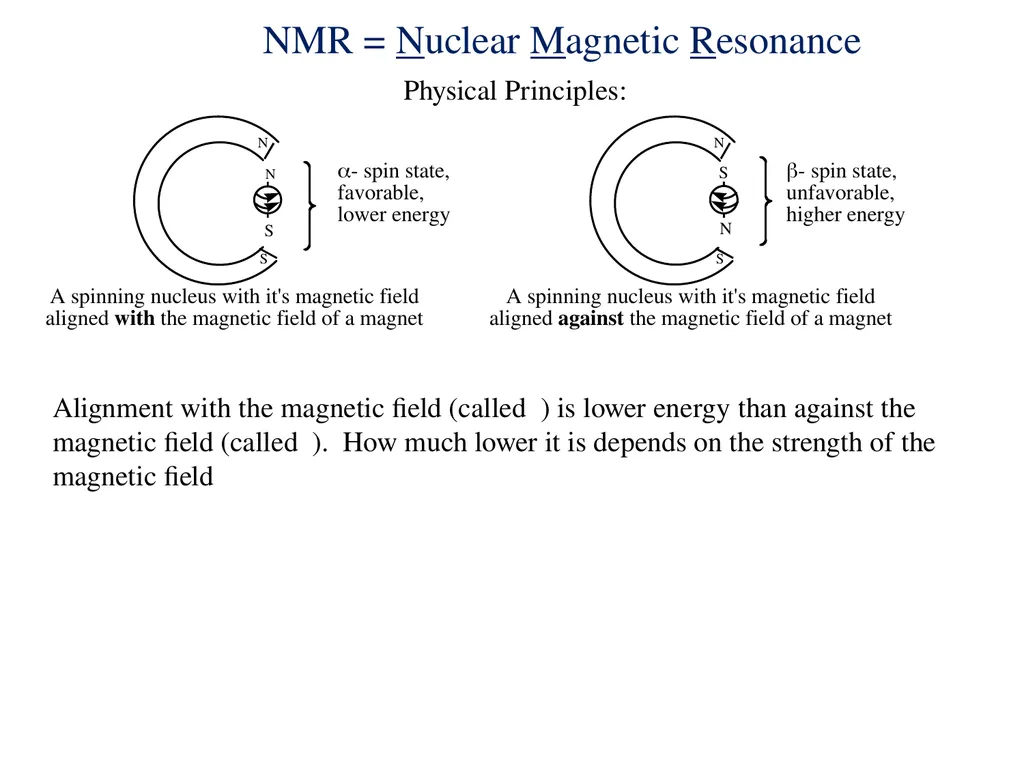
NMR = Nuclear Magnetic Resonance Alignment with the magnetic field (called ) is lower energy than against the magnetic field (called ). How much lower it is depends on the strength of the magnetic field Physical Principles:<br>
07
NMR = Nuclear Magnetic Resonance Physical Principles:<br>
08
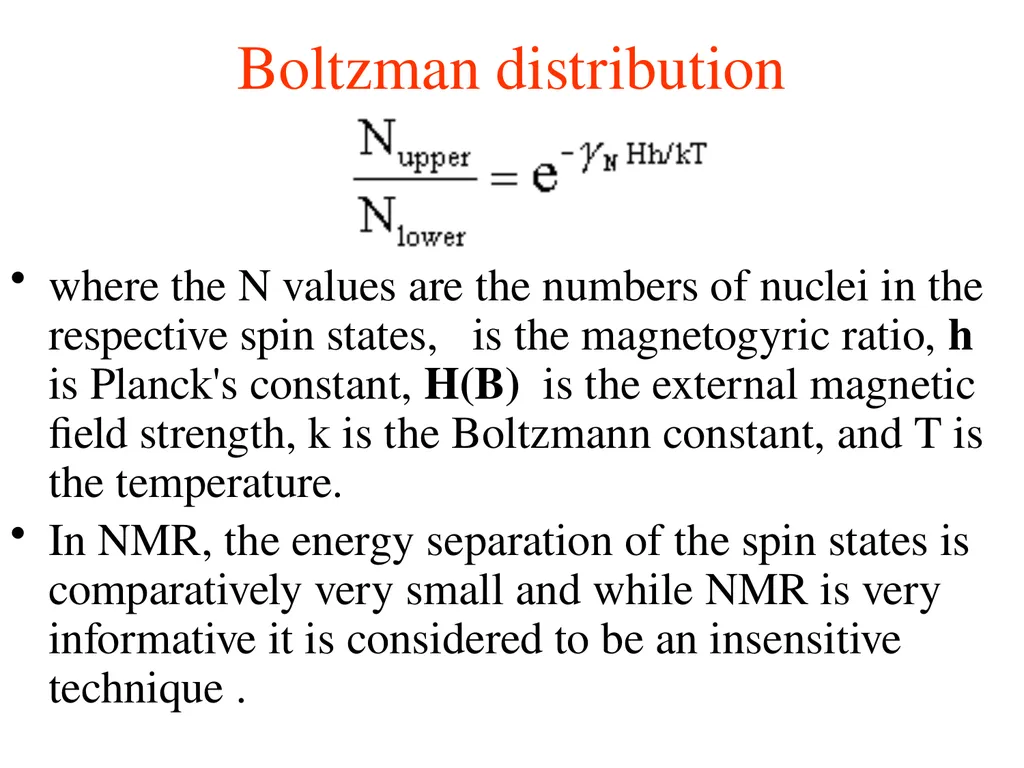
Boltzmann Distribution of Spin States In a given sample of a specific nucleus, the nuclei will be distributed throughout the various spin states available. Because the energy separation between these states is comparatively small, energy from thermal collisions is sufficient to place many nuclei into higher energy spin states. The numbers of nuclei in each spin state are described by the Boltzman distribution<br>
09
Boltzman distribution where the N values are the numbers of nuclei in the respective spin states, is the magnetogyric ratio, h is Planck's constant, H(B) is the external magnetic field strength, k is the Boltzmann constant, and T is the temperature.
In NMR, the energy separation of the spin states is comparatively very small and while NMR is very informative it is considered to be an insensitive technique .<br>
In NMR, the energy separation of the spin states is comparatively very small and while NMR is very informative it is considered to be an insensitive technique .<br>
10
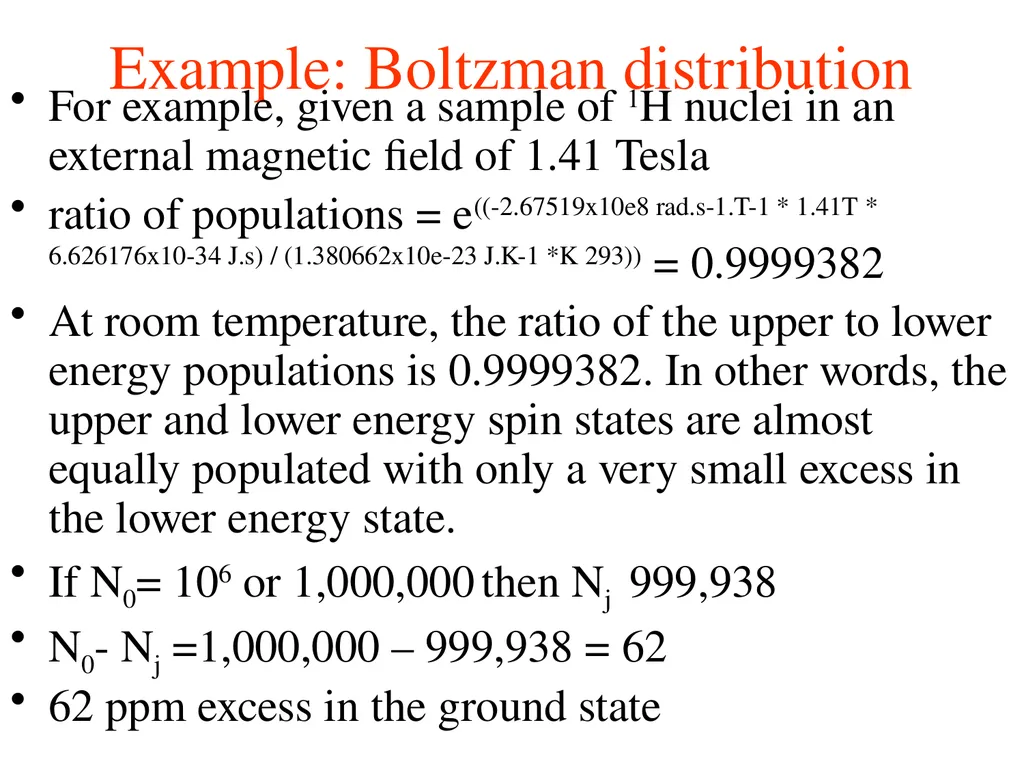
Example: Boltzman distribution For example, given a sample of 1H nuclei in an external magnetic field of 1.41 Tesla
ratio of populations = e((-2.67519x10e8 rad.s-1.T-1 * 1.41T * 6.626176x10-34 J.s) / (1.380662x10e-23 J.K-1 *K 293)) = 0.9999382
At room temperature, the ratio of the upper to lower energy populations is 0.9999382. In other words, the upper and lower energy spin states are almost equally populated with only a very small excess in the lower energy state.
If N0= 106 or 1,000,000 then Nj 999,938
N0- Nj =1,000,000 – 999,938 = 62
62 ppm excess in the ground state<br>
ratio of populations = e((-2.67519x10e8 rad.s-1.T-1 * 1.41T * 6.626176x10-34 J.s) / (1.380662x10e-23 J.K-1 *K 293)) = 0.9999382
At room temperature, the ratio of the upper to lower energy populations is 0.9999382. In other words, the upper and lower energy spin states are almost equally populated with only a very small excess in the lower energy state.
If N0= 106 or 1,000,000 then Nj 999,938
N0- Nj =1,000,000 – 999,938 = 62
62 ppm excess in the ground state<br>
11
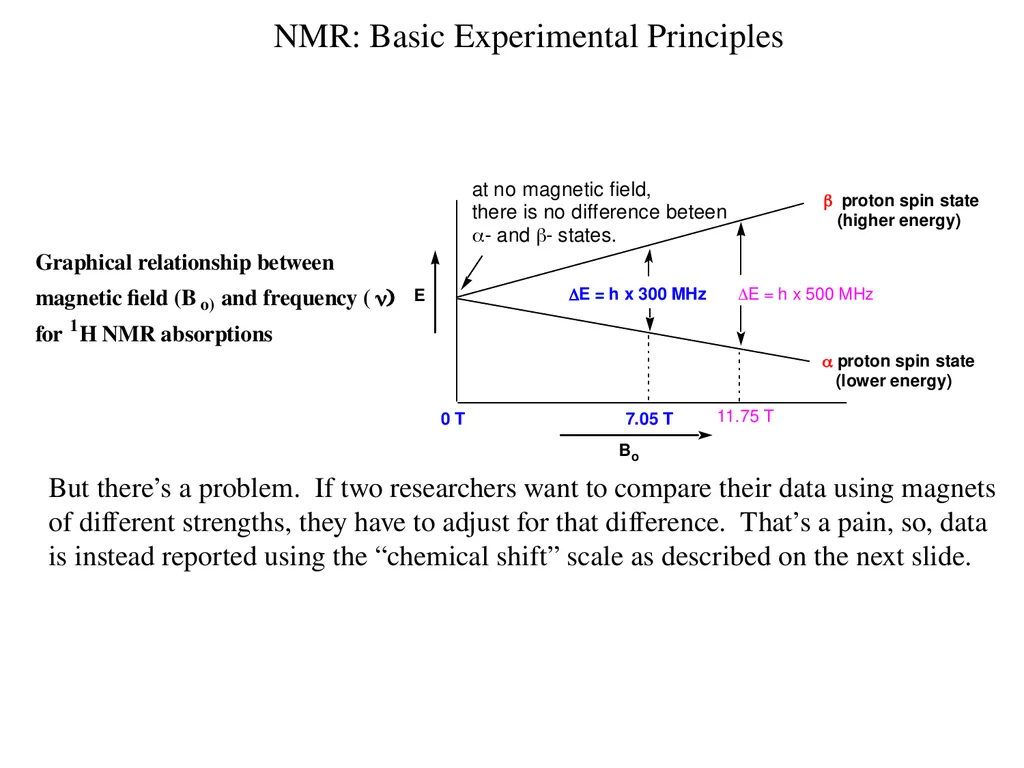
NMR: Basic Experimental Principles But there’s a problem. If two researchers want to compare their data using magnets of different strengths, they have to adjust for that difference. That’s a pain, so, data is instead reported using the “chemical shift” scale as described on the next slide.<br>
12
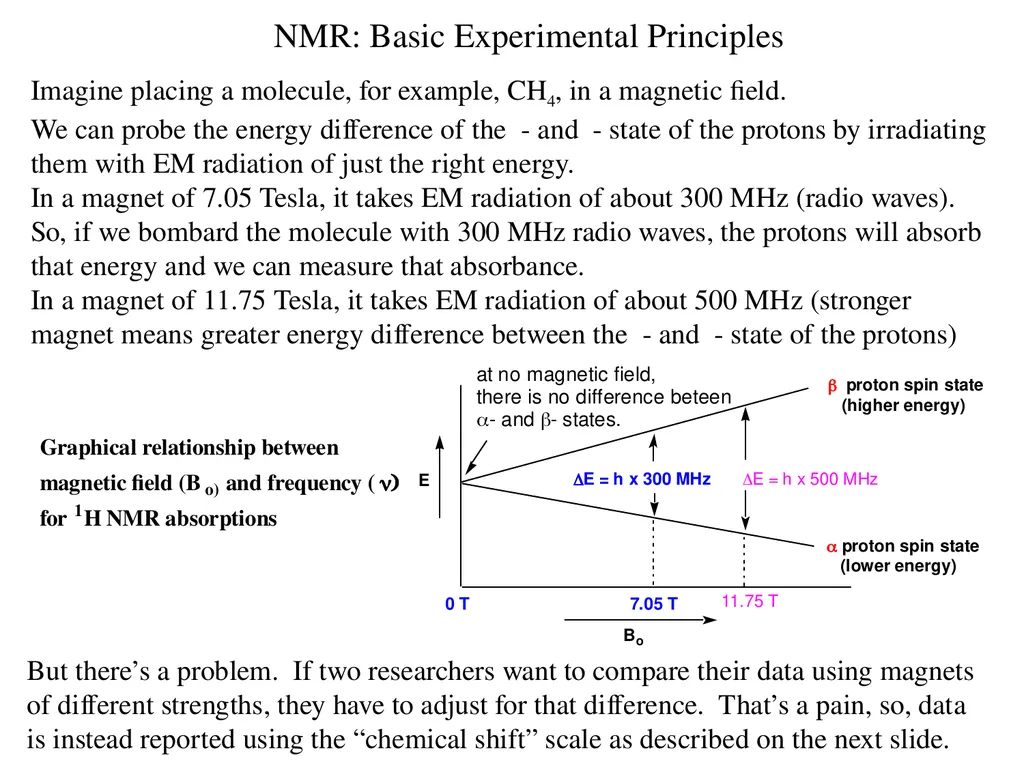
NMR: Basic Experimental Principles Imagine placing a molecule, for example, CH4, in a magnetic field.
We can probe the energy difference of the - and - state of the protons by irradiating them with EM radiation of just the right energy.
In a magnet of 7.05 Tesla, it takes EM radiation of about 300 MHz (radio waves).
So, if we bombard the molecule with 300 MHz radio waves, the protons will absorb that energy and we can measure that absorbance.
In a magnet of 11.75 Tesla, it takes EM radiation of about 500 MHz (stronger magnet means greater energy difference between the - and - state of the protons) But there’s a problem. If two researchers want to compare their data using magnets of different strengths, they have to adjust for that difference. That’s a pain, so, data is instead reported using the “chemical shift” scale as described on the next slide.<br>
We can probe the energy difference of the - and - state of the protons by irradiating them with EM radiation of just the right energy.
In a magnet of 7.05 Tesla, it takes EM radiation of about 300 MHz (radio waves).
So, if we bombard the molecule with 300 MHz radio waves, the protons will absorb that energy and we can measure that absorbance.
In a magnet of 11.75 Tesla, it takes EM radiation of about 500 MHz (stronger magnet means greater energy difference between the - and - state of the protons) But there’s a problem. If two researchers want to compare their data using magnets of different strengths, they have to adjust for that difference. That’s a pain, so, data is instead reported using the “chemical shift” scale as described on the next slide.<br>
13
The Chemical Shift (Also Called ) Scale Here’s how it works. We decide on a sample we’ll use to standardize our instruments. We take an NMR of that standard and measure its absorbance frequency. We then measure the frequency of our sample and subtract its frequency from that of the standard. We then then divide by the frequency of the standard. This gives a number called the “chemical shift,” also called d, which does not depend on the magnetic field strength. Why not? Let’s look at two examples. Of course, we don’t do any of this, it’s all done automatically by the NMR machine.
Even more brilliant. Imagine that we have a magnet where our standard absorbs at 300,000,000 Hz (300 megahertz), and our sample absorbs at 300,000,300 Hz. The difference is 300 Hz, so we take 300/300,000,000 = 1/1,000,000 and call that 1 part per million (or 1 PPM). Now lets examine the same sample in a stronger magnetic field where the reference comes at 500,000,000 Hz, or 500 megahertz. The frequency of our sample will increase proportionally, and will come at 500,000,500 Hz. The difference is now 500 Hz, but we divide by 500,000,000 (500/500,000,000 = 1/1,000,000, = 1 PPM).
It’s brilliant.<br>
Even more brilliant. Imagine that we have a magnet where our standard absorbs at 300,000,000 Hz (300 megahertz), and our sample absorbs at 300,000,300 Hz. The difference is 300 Hz, so we take 300/300,000,000 = 1/1,000,000 and call that 1 part per million (or 1 PPM). Now lets examine the same sample in a stronger magnetic field where the reference comes at 500,000,000 Hz, or 500 megahertz. The frequency of our sample will increase proportionally, and will come at 500,000,500 Hz. The difference is now 500 Hz, but we divide by 500,000,000 (500/500,000,000 = 1/1,000,000, = 1 PPM).
It’s brilliant.<br>
14
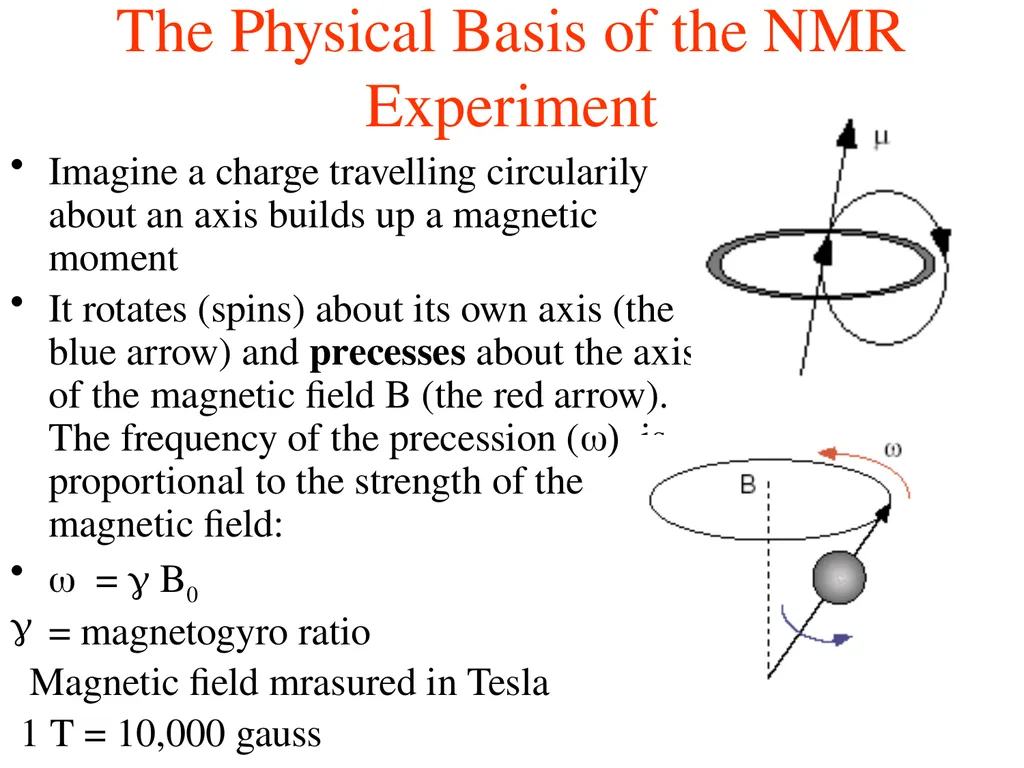
Imagine a charge travelling circularily about an axis builds up a magnetic moment
It rotates (spins) about its own axis (the blue arrow) and precesses about the axis of the magnetic field B (the red arrow). The frequency of the precession () is proportional to the strength of the magnetic field:
= B0
= magnetogyro ratio
Magnetic field mrasured in Tesla
1 T = 10,000 gauss The Physical Basis of the NMR Experiment<br>
It rotates (spins) about its own axis (the blue arrow) and precesses about the axis of the magnetic field B (the red arrow). The frequency of the precession () is proportional to the strength of the magnetic field:
= B0
= magnetogyro ratio
Magnetic field mrasured in Tesla
1 T = 10,000 gauss The Physical Basis of the NMR Experiment<br>
15
Magnetogyric ratio() The larger the value of the magnetogyric ratio, the larger the
Magnetic moment (m) of the nucleus and the easier it is to see by NMR spectroscopy.
Energy difference (DE) between Iz = +1/2 and Iz = -1/2.<br>
Magnetic moment (m) of the nucleus and the easier it is to see by NMR spectroscopy.
Energy difference (DE) between Iz = +1/2 and Iz = -1/2.<br>
16
The Physical Basis of the NMR Experiment: Nuclear magnetic resonance, or NMR as it is abbreviated by scientists, is a phenomenon which occurs when the nuclei of certain atoms are immersed in a static strong magnetic field and exposed to a second oscillating magnetic field in the form of radiofrequency pulses, it is possible to transfer energy into the spin system and change the state of the system. After the pulse, the system relaxes back to its state of equilibrium, sending a weak signal that can be recorded.<br>
17
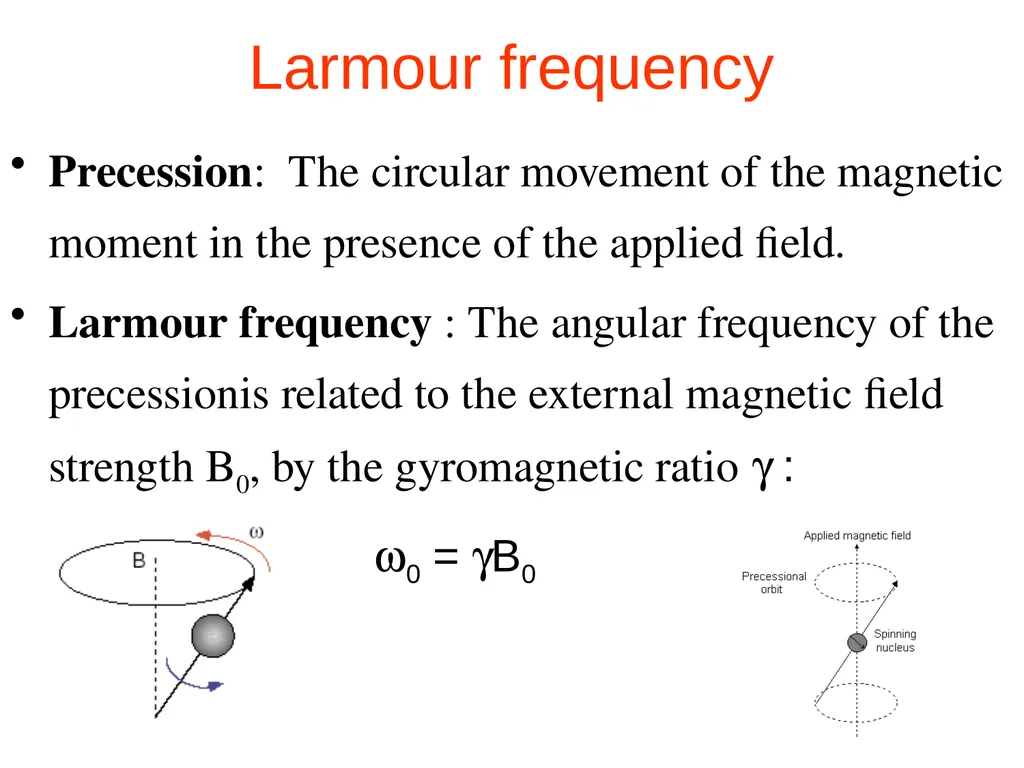
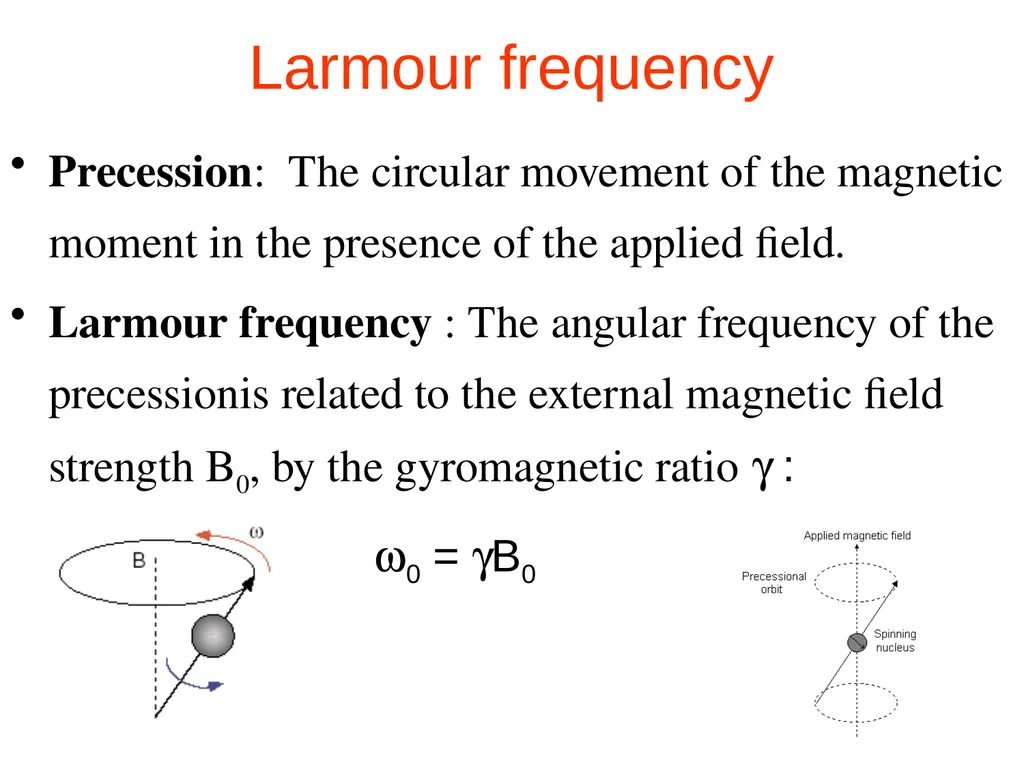
Larmour frequency Precession: The circular movement of the magnetic moment in the presence of the applied field.
Larmour frequency : The angular frequency of the precessionis related to the external magnetic field strength B0, by the gyromagnetic ratio g :
w0 = gB0<br>
Larmour frequency : The angular frequency of the precessionis related to the external magnetic field strength B0, by the gyromagnetic ratio g :
w0 = gB0<br>
18
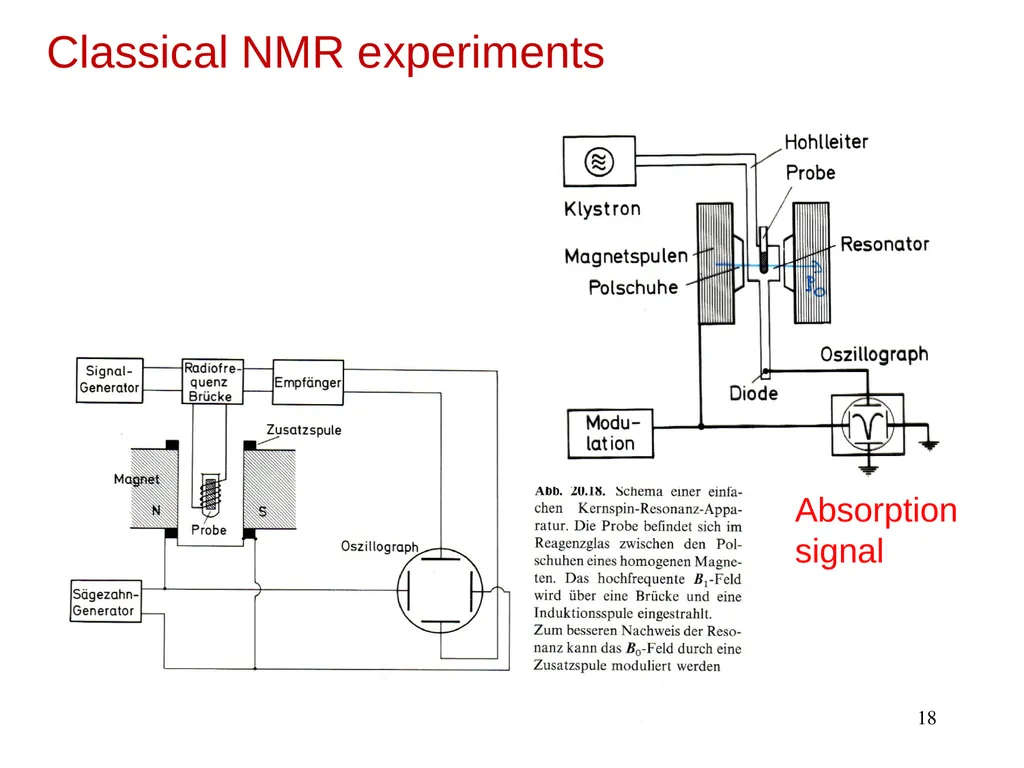
18 Classical NMR experiments Absorption signal<br>
19
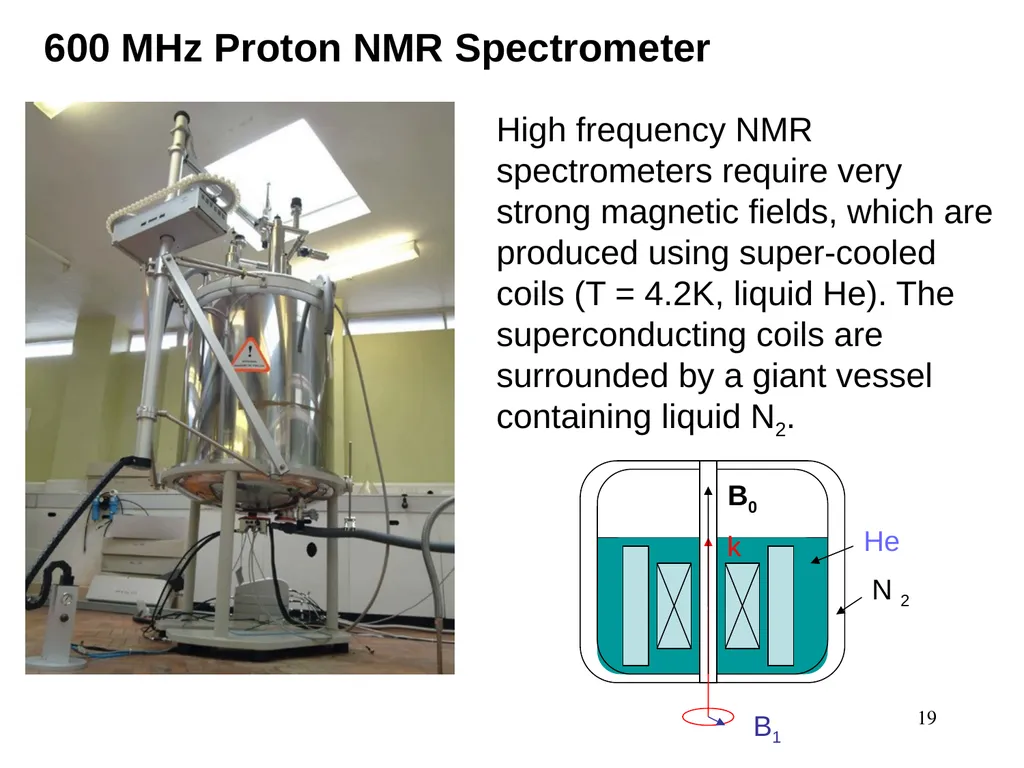
19 High frequency NMR spectrometers require very strong magnetic fields, which are produced using super-cooled coils (T = 4.2K, liquid He). The superconducting coils are surrounded by a giant vessel containing liquid N2. 600 MHz Proton NMR Spectrometer B0 B1 k He N 2<br>
20
Larmour frequency Precession: The circular movement of the magnetic moment in the presence of the applied field.
Larmour frequency : The angular frequency of the precessionis related to the external magnetic field strength B0, by the gyromagnetic ratio g :
w0 = gB0<br>
Larmour frequency : The angular frequency of the precessionis related to the external magnetic field strength B0, by the gyromagnetic ratio g :
w0 = gB0<br>
21
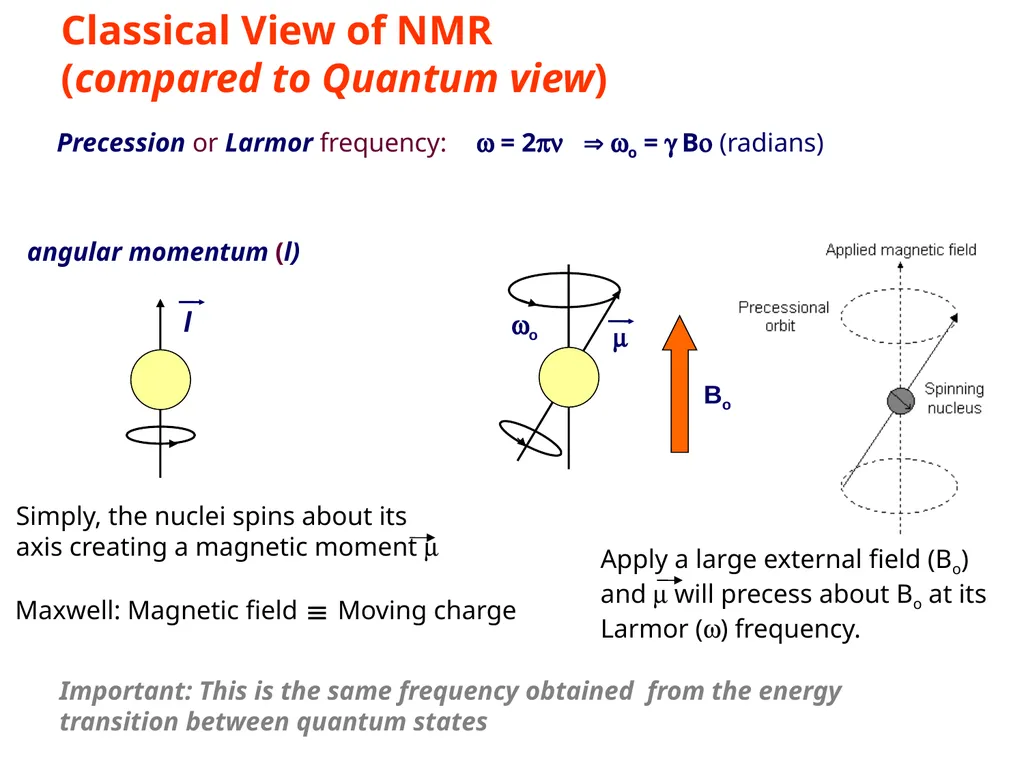
w = 2pn wo = g Bo (radians) Precession or Larmor frequency: l angular momentum (l) Simply, the nuclei spins about its
axis creating a magnetic moment m Classical View of NMR
(compared to Quantum view) Maxwell: Magnetic field Moving charge ≡ Bo wo m Apply a large external field (Bo)
and m will precess about Bo at its
Larmor (w) frequency. Important: This is the same frequency obtained from the energy transition between quantum states<br>
axis creating a magnetic moment m Classical View of NMR
(compared to Quantum view) Maxwell: Magnetic field Moving charge ≡ Bo wo m Apply a large external field (Bo)
and m will precess about Bo at its
Larmor (w) frequency. Important: This is the same frequency obtained from the energy transition between quantum states<br>
22
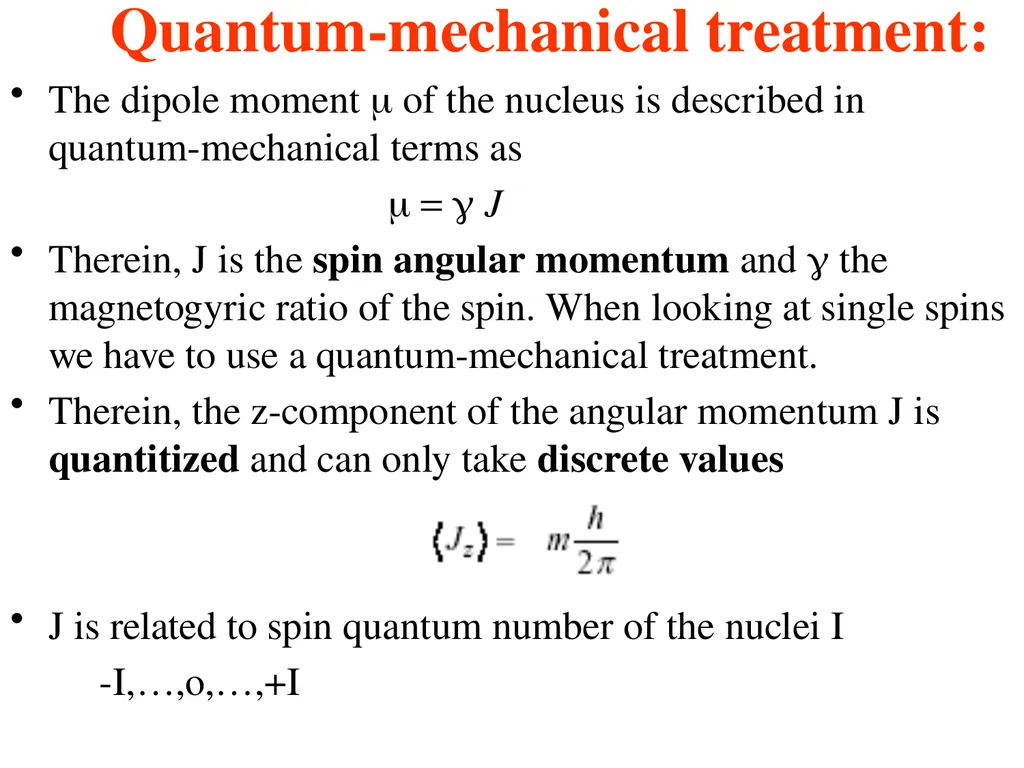
Quantum-mechanical treatment: The dipole moment of the nucleus is described in quantum-mechanical terms as
= J
Therein, J is the spin angular momentum and the magnetogyric ratio of the spin. When looking at single spins we have to use a quantum-mechanical treatment.
Therein, the z-component of the angular momentum J is quantitized and can only take discrete values
J is related to spin quantum number of the nuclei I
-I,…,o,…,+I<br>
= J
Therein, J is the spin angular momentum and the magnetogyric ratio of the spin. When looking at single spins we have to use a quantum-mechanical treatment.
Therein, the z-component of the angular momentum J is quantitized and can only take discrete values
J is related to spin quantum number of the nuclei I
-I,…,o,…,+I<br>
23
Spin quantum number(I) Nuclear spin is characterized by a spin number, I, which can be zero or some positive integer multiple of 1/2 (e.g. 1/2, 1, 3/2, 2 etc.). Nuclei whose spin number, I= 0 have no magnetic moment(m);eg. 12C and 16O show no NMR signal. Elements such as 1H, 13C, 19F and 31P have I=1/2, while others have even higher spin numbers:
I=1 14N, 2H
I=3/2 11B, 35Cl, 37Cl, 79Br, 81Br.
As the values for I increase, energy levels and shapes of the magnetic fields become progressively more and more complex.<br>
I=1 14N, 2H
I=3/2 11B, 35Cl, 37Cl, 79Br, 81Br.
As the values for I increase, energy levels and shapes of the magnetic fields become progressively more and more complex.<br>
24
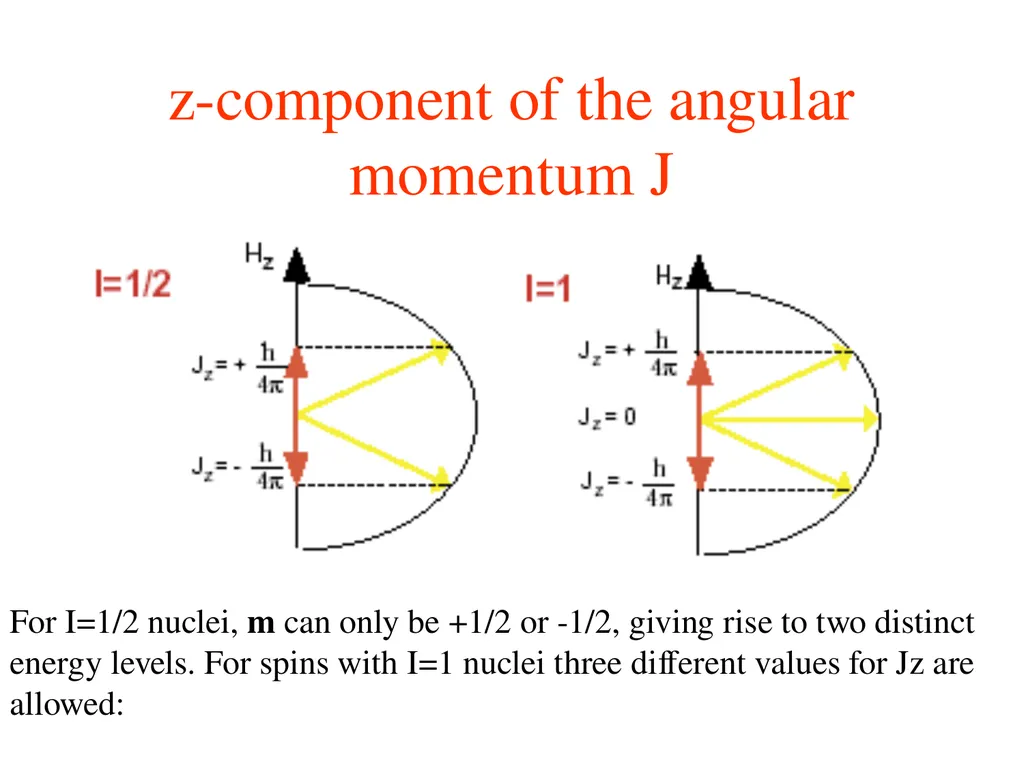
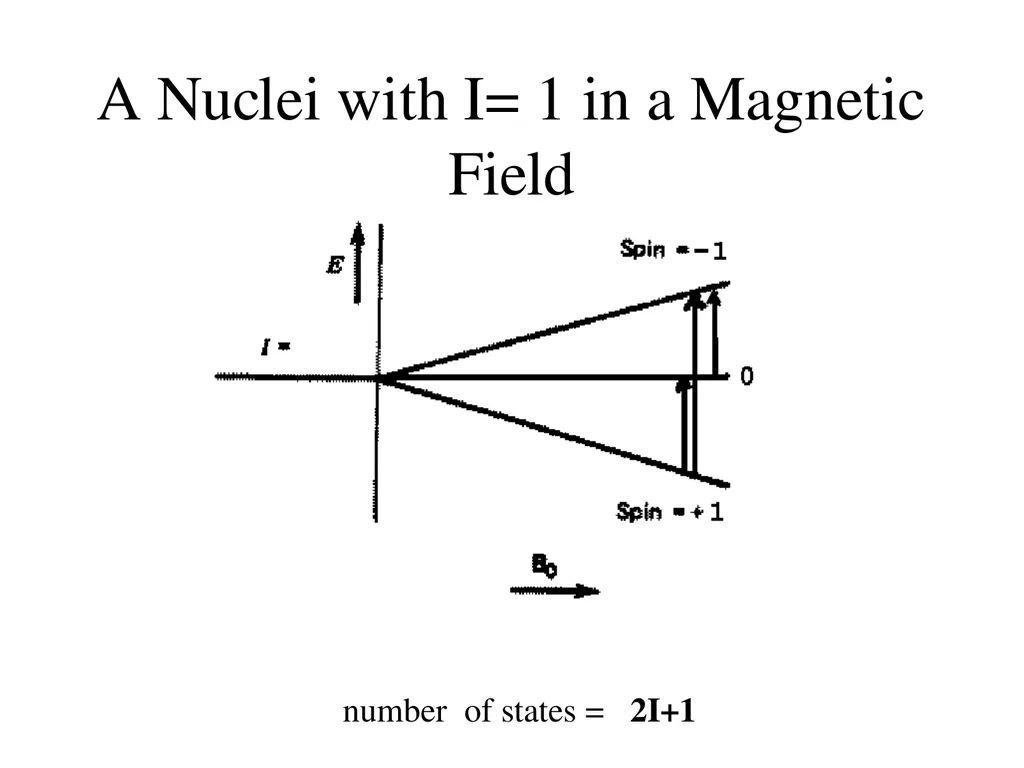
z-component of the angular momentum J For I=1/2 nuclei, m can only be +1/2 or -1/2, giving rise to two distinct energy levels. For spins with I=1 nuclei three different values for Jz are allowed:<br>
25
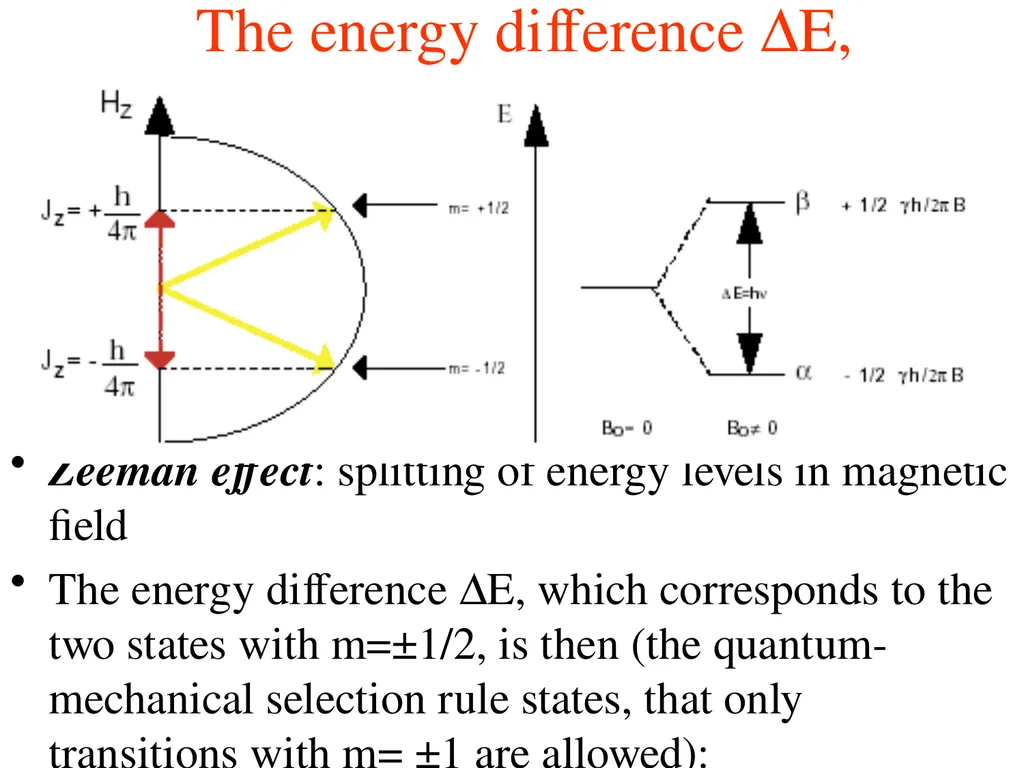
The energy difference DE, Zeeman effect: splitting of energy levels in magnetic field
The energy difference DE, which corresponds to the two states with m=±1/2, is then (the quantum-mechanical selection rule states, that only transitions with m= ±1 are allowed):<br>
The energy difference DE, which corresponds to the two states with m=±1/2, is then (the quantum-mechanical selection rule states, that only transitions with m= ±1 are allowed):<br>
26
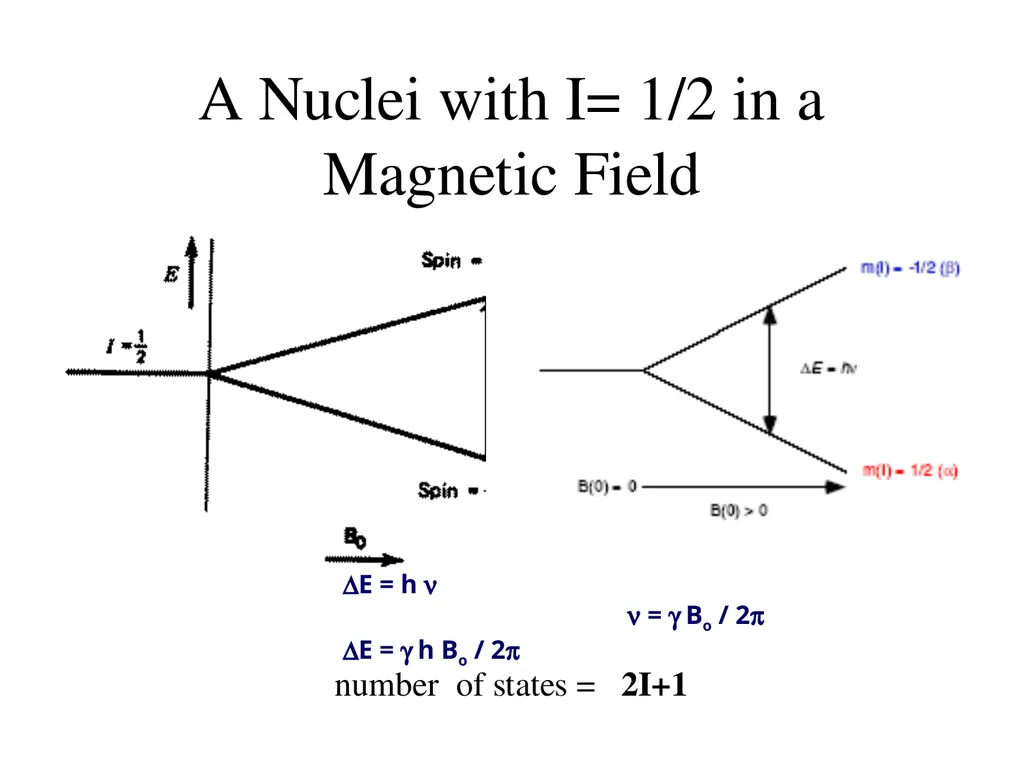
A Nuclei with I= 1/2 in a Magnetic Field number of states = 2I+1 DE = h n
n = g Bo / 2p
DE = g h Bo / 2p<br>
n = g Bo / 2p
DE = g h Bo / 2p<br>
27
A Nuclei with I= 1 in a Magnetic Field number of states = 2I+1<br>
28
Boltzmann Distribution of Spin States In a given sample of a specific nucleus, the nuclei will be distributed throughout the various spin states available. Because the energy separation between these states is comparatively small, energy from thermal collisions is sufficient to place many nuclei into higher energy spin states. The numbers of nuclei in each spin state are described by the Boltzman distribution<br>
29
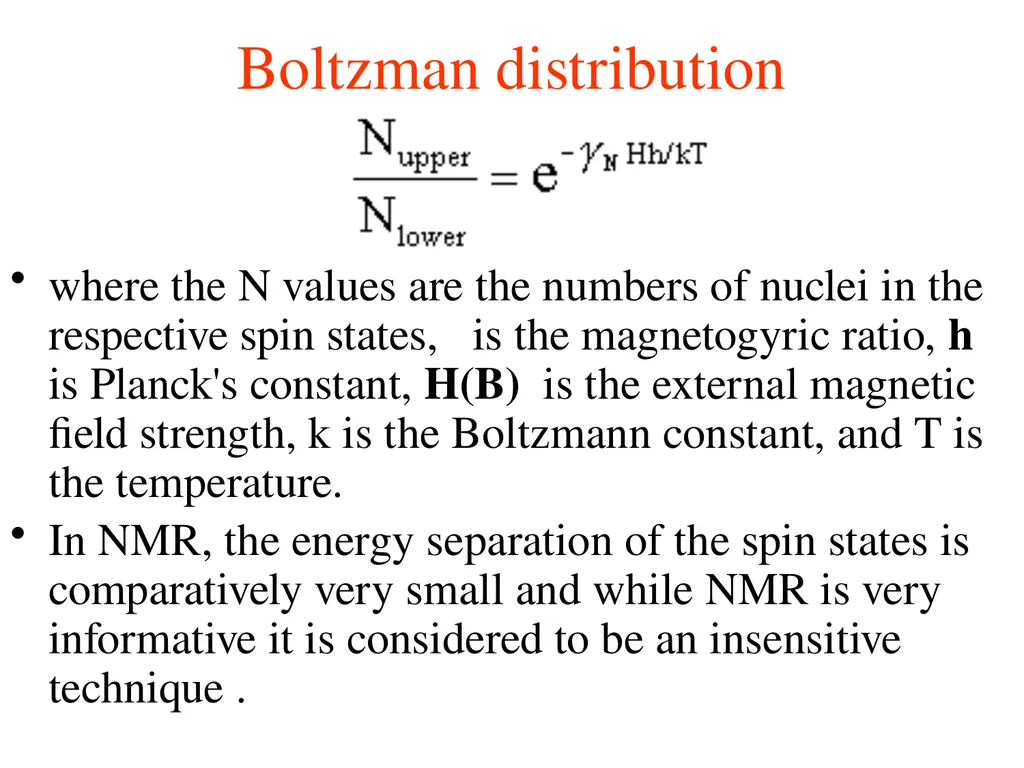
Boltzman distribution where the N values are the numbers of nuclei in the respective spin states, is the magnetogyric ratio, h is Planck's constant, H(B) is the external magnetic field strength, k is the Boltzmann constant, and T is the temperature.
In NMR, the energy separation of the spin states is comparatively very small and while NMR is very informative it is considered to be an insensitive technique .<br>
In NMR, the energy separation of the spin states is comparatively very small and while NMR is very informative it is considered to be an insensitive technique .<br>
30
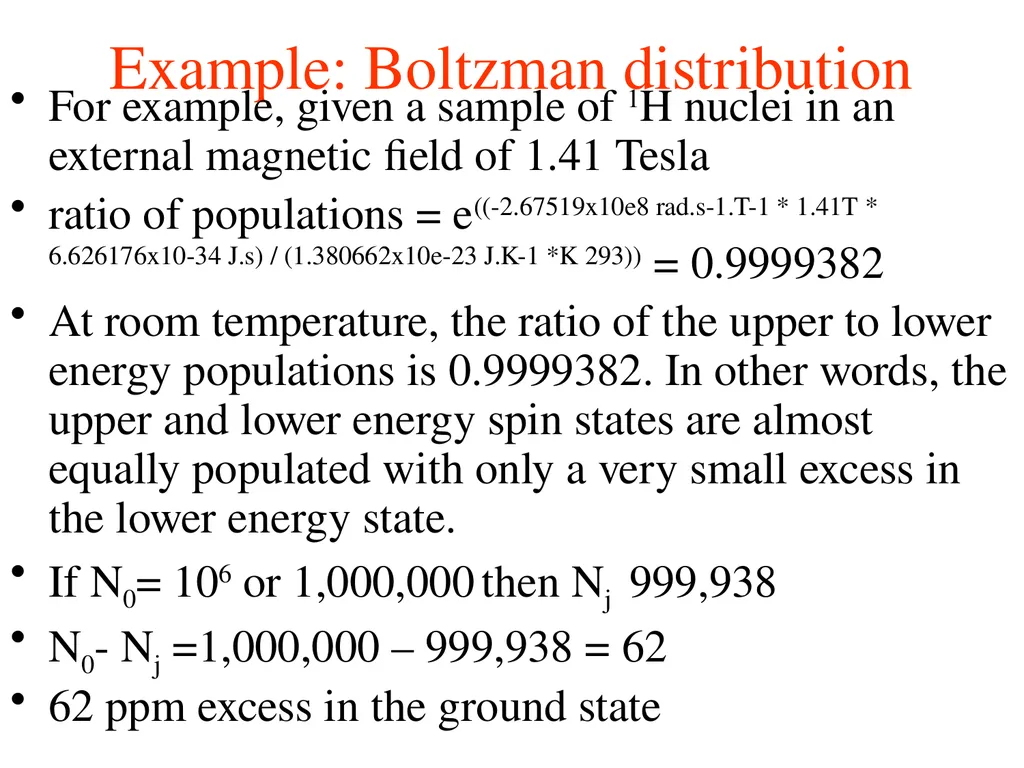
Example: Boltzman distribution For example, given a sample of 1H nuclei in an external magnetic field of 1.41 Tesla
ratio of populations = e((-2.67519x10e8 rad.s-1.T-1 * 1.41T * 6.626176x10-34 J.s) / (1.380662x10e-23 J.K-1 *K 293)) = 0.9999382
At room temperature, the ratio of the upper to lower energy populations is 0.9999382. In other words, the upper and lower energy spin states are almost equally populated with only a very small excess in the lower energy state.
If N0= 106 or 1,000,000 then Nj 999,938
N0- Nj =1,000,000 – 999,938 = 62
62 ppm excess in the ground state<br>
ratio of populations = e((-2.67519x10e8 rad.s-1.T-1 * 1.41T * 6.626176x10-34 J.s) / (1.380662x10e-23 J.K-1 *K 293)) = 0.9999382
At room temperature, the ratio of the upper to lower energy populations is 0.9999382. In other words, the upper and lower energy spin states are almost equally populated with only a very small excess in the lower energy state.
If N0= 106 or 1,000,000 then Nj 999,938
N0- Nj =1,000,000 – 999,938 = 62
62 ppm excess in the ground state<br>
31
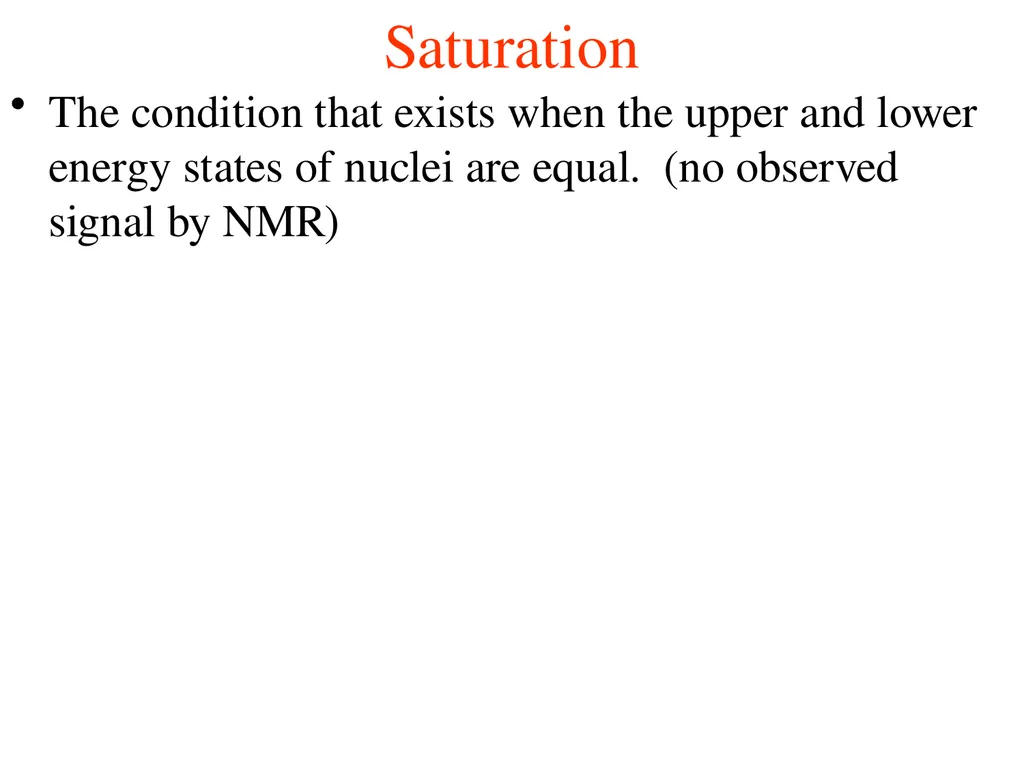
Saturation The condition that exists when the upper and lower energy states of nuclei are equal. (no observed signal by NMR)<br>
32
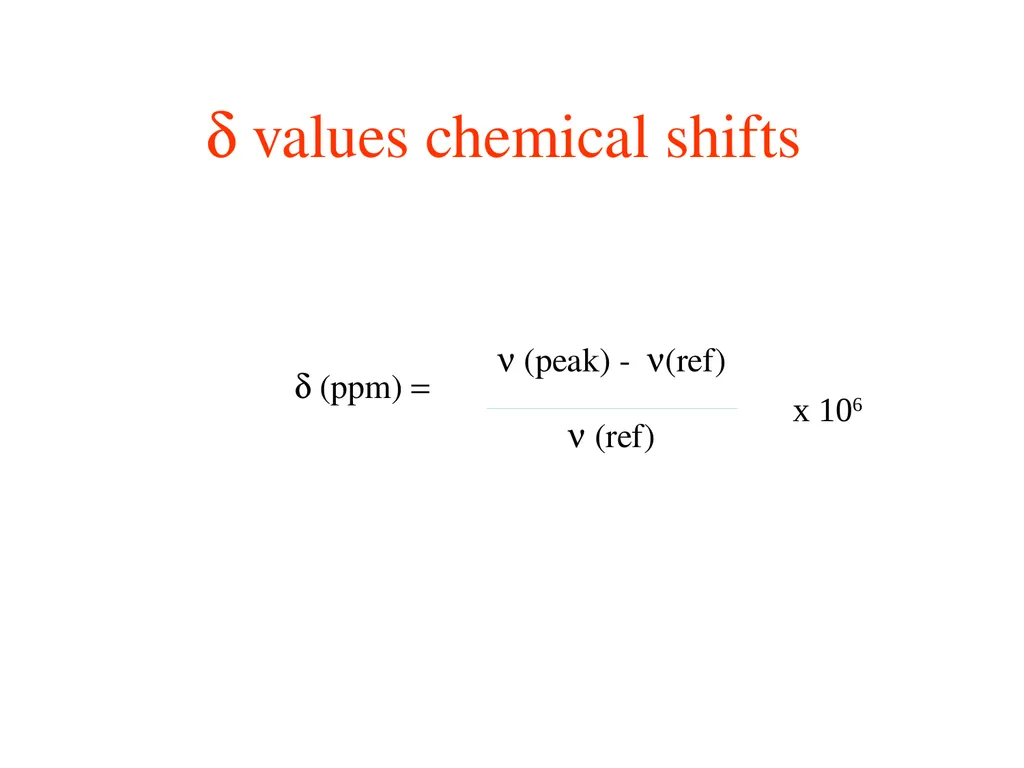
d values chemical shifts d (ppm) = n (peak) - n(ref) n (ref) x 106<br>
33
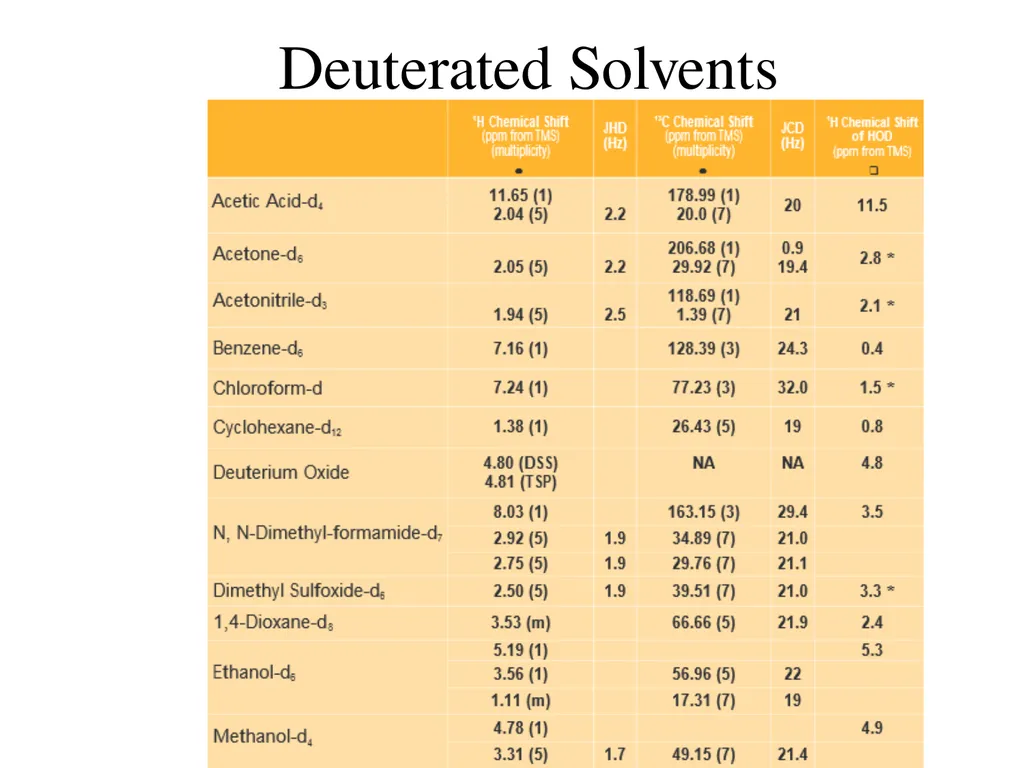
Deuterated Solvents<br>
34
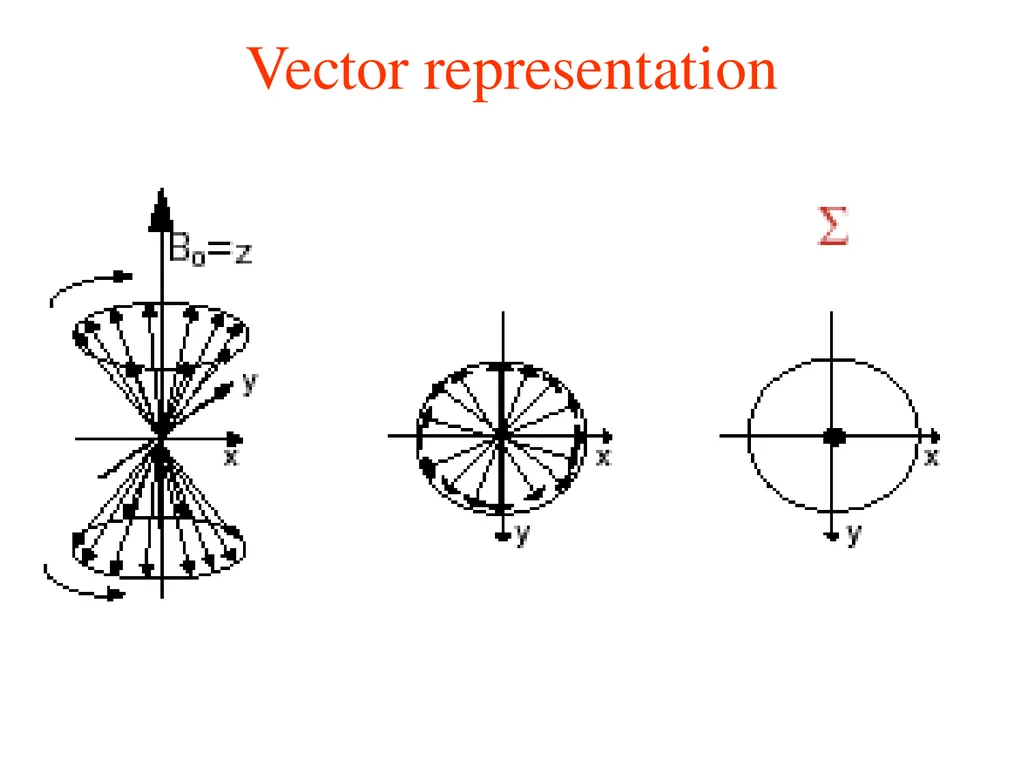
Vector representation<br>
35
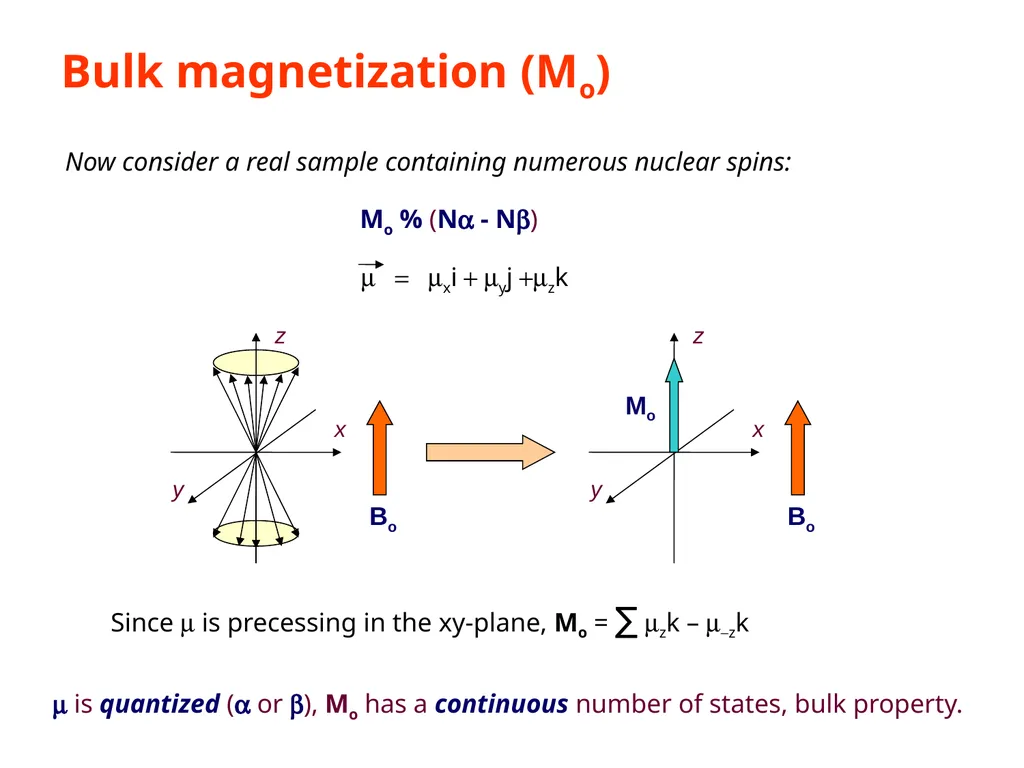
Bulk magnetization (Mo) Mo y x z x y z Bo Bo Now consider a real sample containing numerous nuclear spins: Mo % (Na - Nb) m = mxi + myj +mzk Since m is precessing in the xy-plane, Mo = ∑ mzk – m-zk m is quantized (a or b), Mo has a continuous number of states, bulk property.<br>
36
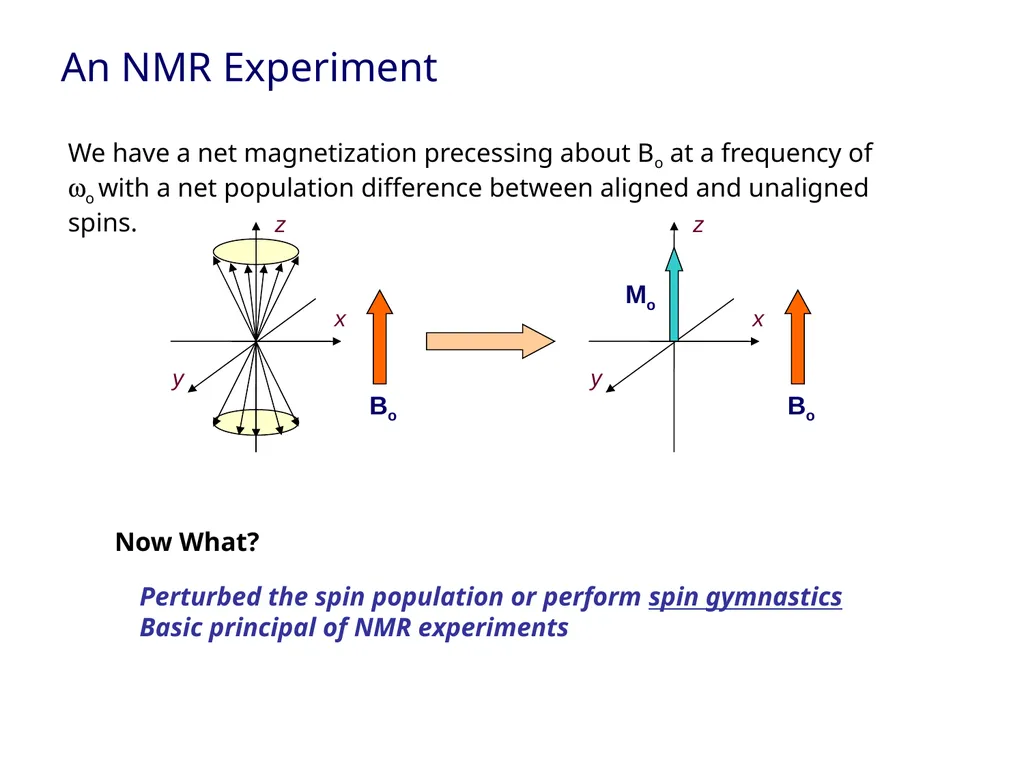
An NMR Experiment Mo y x z x y z Bo Bo We have a net magnetization precessing about Bo at a frequency of wo with a net population difference between aligned and unaligned spins. Now What? Perturbed the spin population or perform spin gymnastics
Basic principal of NMR experiments<br>
Basic principal of NMR experiments<br>
37
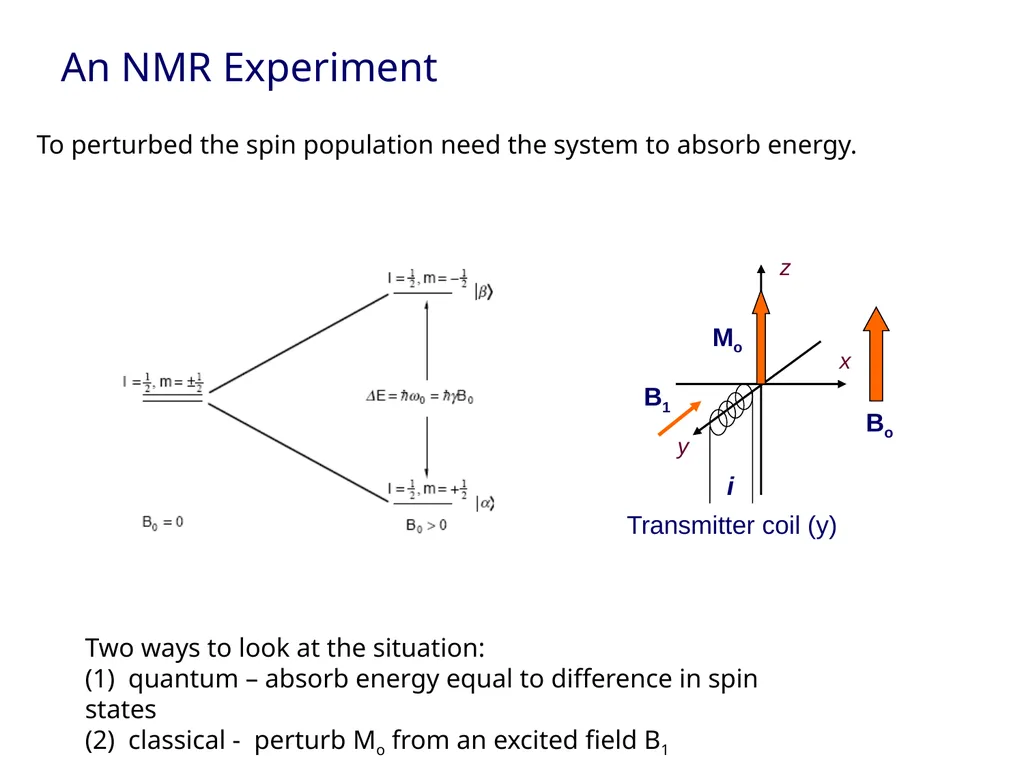
Mo z x i B1 Transmitter coil (y) y Bo An NMR Experiment To perturbed the spin population need the system to absorb energy. Two ways to look at the situation:
(1) quantum – absorb energy equal to difference in spin states
(2) classical - perturb Mo from an excited field B1<br>
(1) quantum – absorb energy equal to difference in spin states
(2) classical - perturb Mo from an excited field B1<br>
38
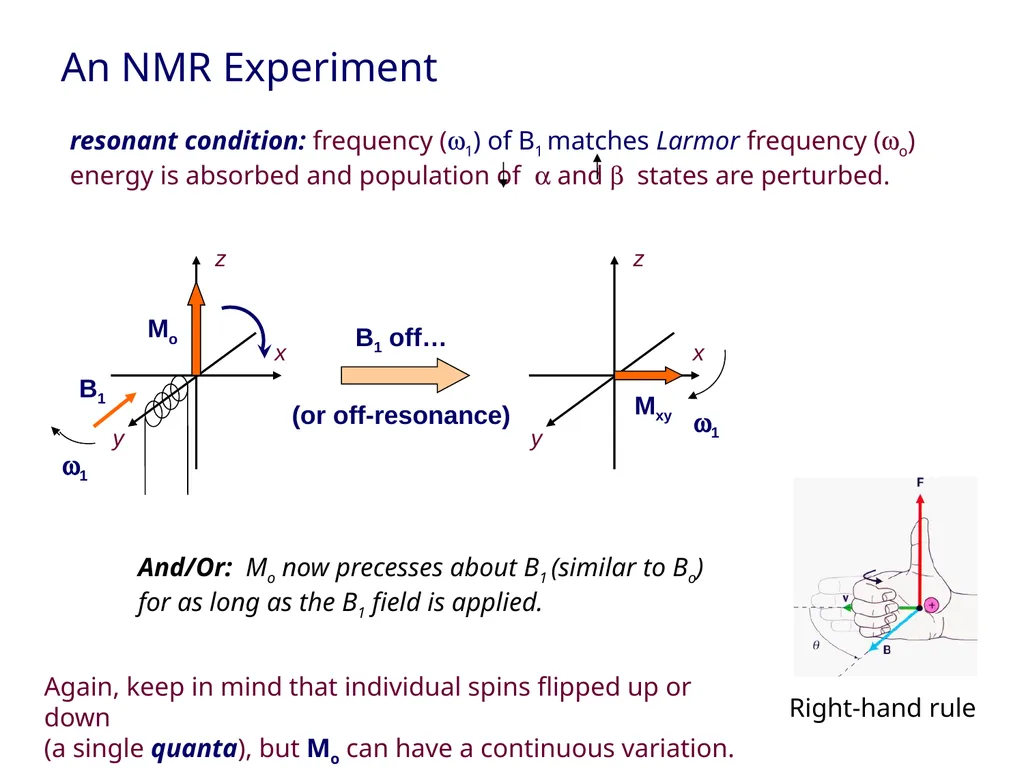
B1 off…
(or off-resonance) Mo z x B1 z x Mxy y y w1 w1 Right-hand rule resonant condition: frequency (w1) of B1 matches Larmor frequency (wo)
energy is absorbed and population of a and b states are perturbed. An NMR Experiment And/Or: Mo now precesses about B1 (similar to Bo) for as long as the B1 field is applied. Again, keep in mind that individual spins flipped up or down
(a single quanta), but Mo can have a continuous variation.<br>
(or off-resonance) Mo z x B1 z x Mxy y y w1 w1 Right-hand rule resonant condition: frequency (w1) of B1 matches Larmor frequency (wo)
energy is absorbed and population of a and b states are perturbed. An NMR Experiment And/Or: Mo now precesses about B1 (similar to Bo) for as long as the B1 field is applied. Again, keep in mind that individual spins flipped up or down
(a single quanta), but Mo can have a continuous variation.<br>
39
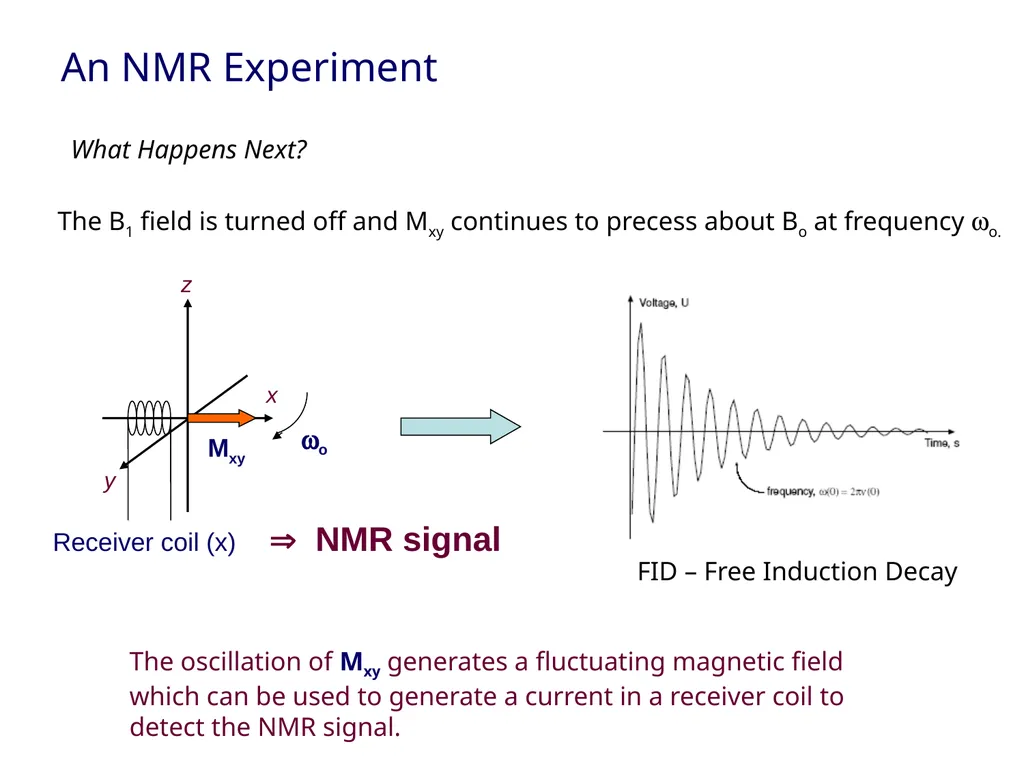
An NMR Experiment What Happens Next? The B1 field is turned off and Mxy continues to precess about Bo at frequency wo. z x Mxy Receiver coil (x) y NMR signal wo The oscillation of Mxy generates a fluctuating magnetic field which can be used to generate a current in a receiver coil to detect the NMR signal. FID – Free Induction Decay<br>
40
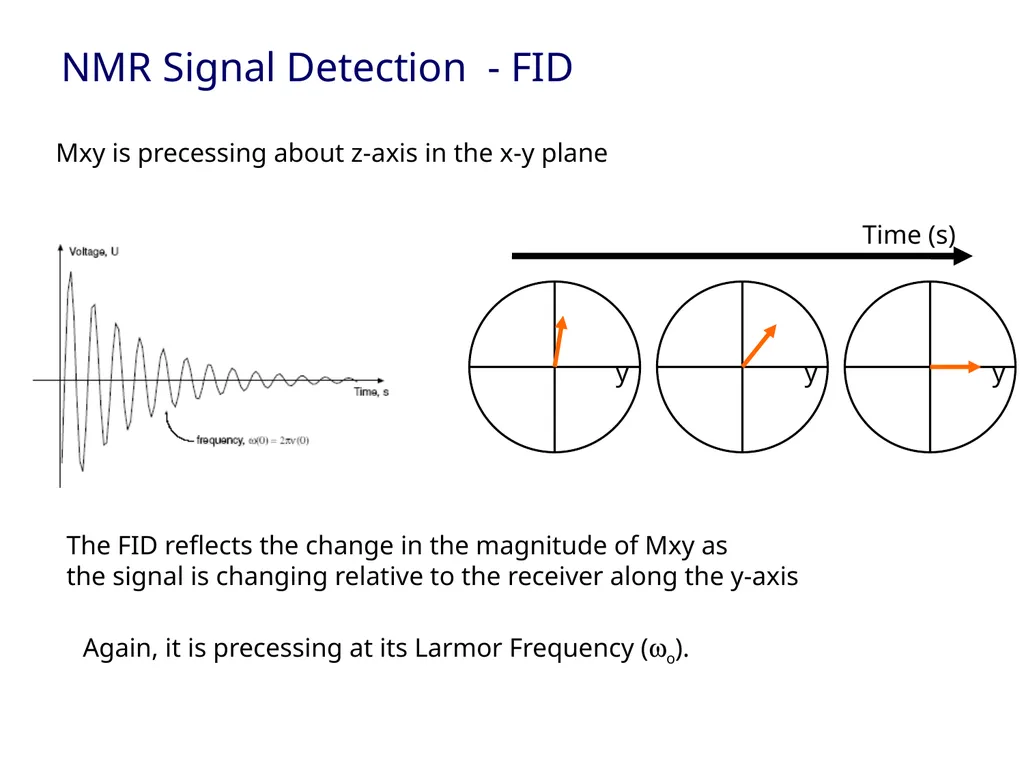
NMR Signal Detection - FID Mxy is precessing about z-axis in the x-y plane Time (s) y y y The FID reflects the change in the magnitude of Mxy as
the signal is changing relative to the receiver along the y-axis Again, it is precessing at its Larmor Frequency (wo).<br>
the signal is changing relative to the receiver along the y-axis Again, it is precessing at its Larmor Frequency (wo).<br>
41
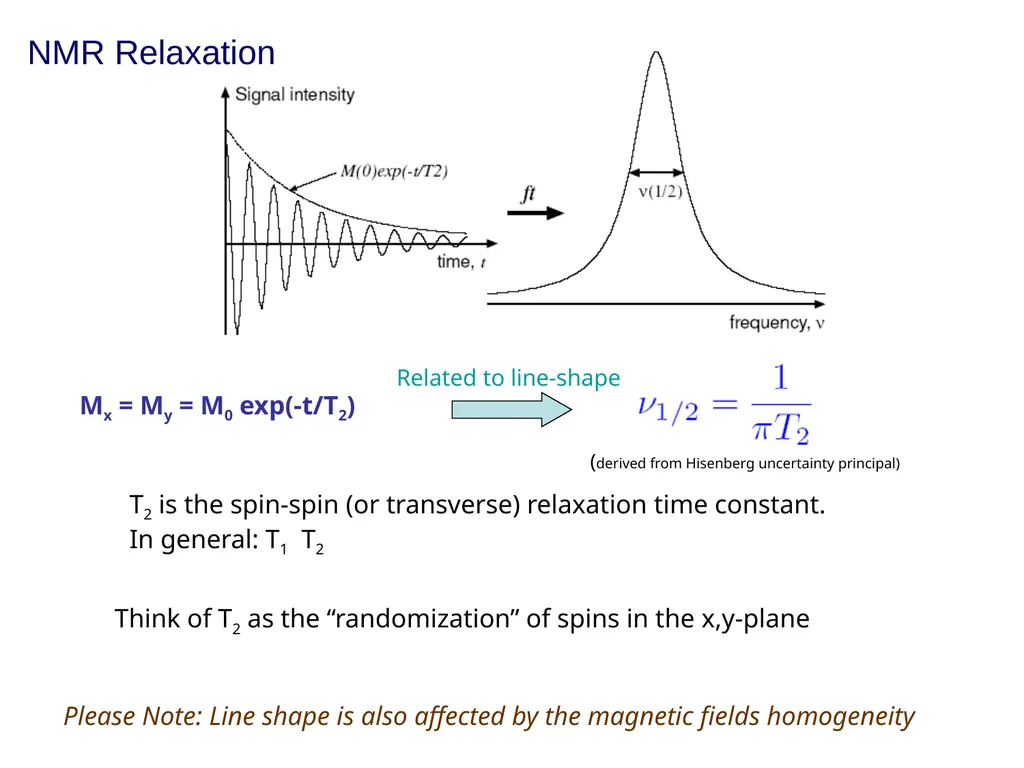
NMR Relaxation Mx = My = M0 exp(-t/T2) T2 is the spin-spin (or transverse) relaxation time constant.
In general: T1 T2 Think of T2 as the “randomization” of spins in the x,y-plane Related to line-shape Please Note: Line shape is also affected by the magnetic fields homogeneity (derived from Hisenberg uncertainty principal)<br>
In general: T1 T2 Think of T2 as the “randomization” of spins in the x,y-plane Related to line-shape Please Note: Line shape is also affected by the magnetic fields homogeneity (derived from Hisenberg uncertainty principal)<br>
42
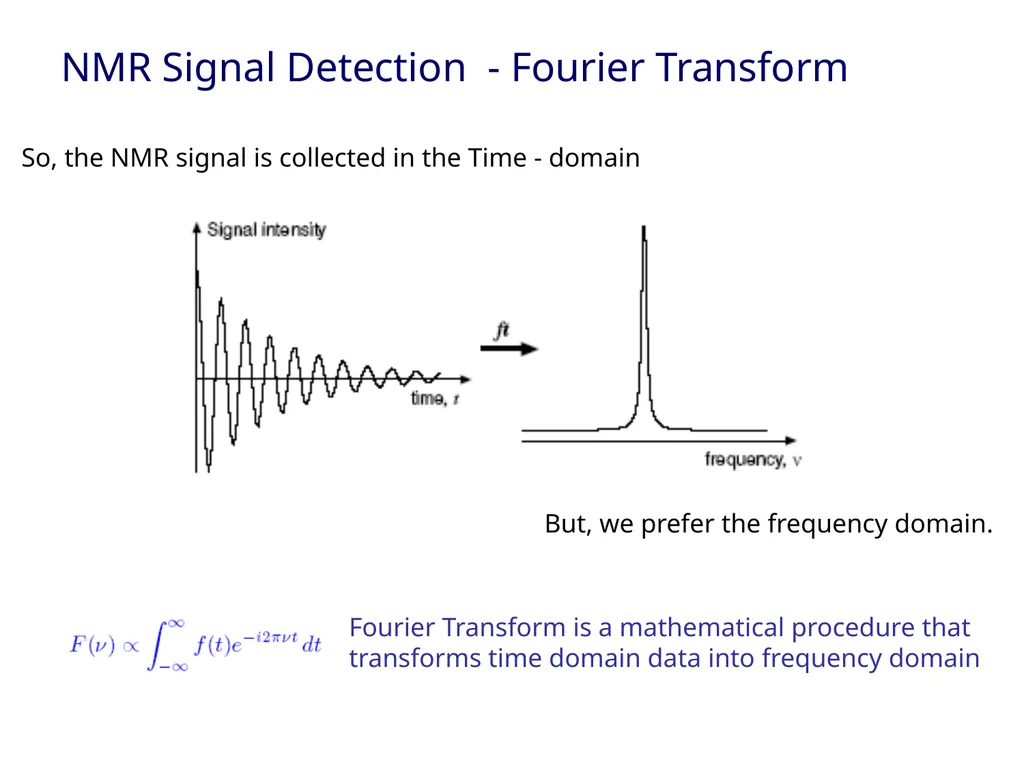
NMR Signal Detection - Fourier Transform So, the NMR signal is collected in the Time - domain But, we prefer the frequency domain. Fourier Transform is a mathematical procedure that
transforms time domain data into frequency domain<br>
transforms time domain data into frequency domain<br>
43
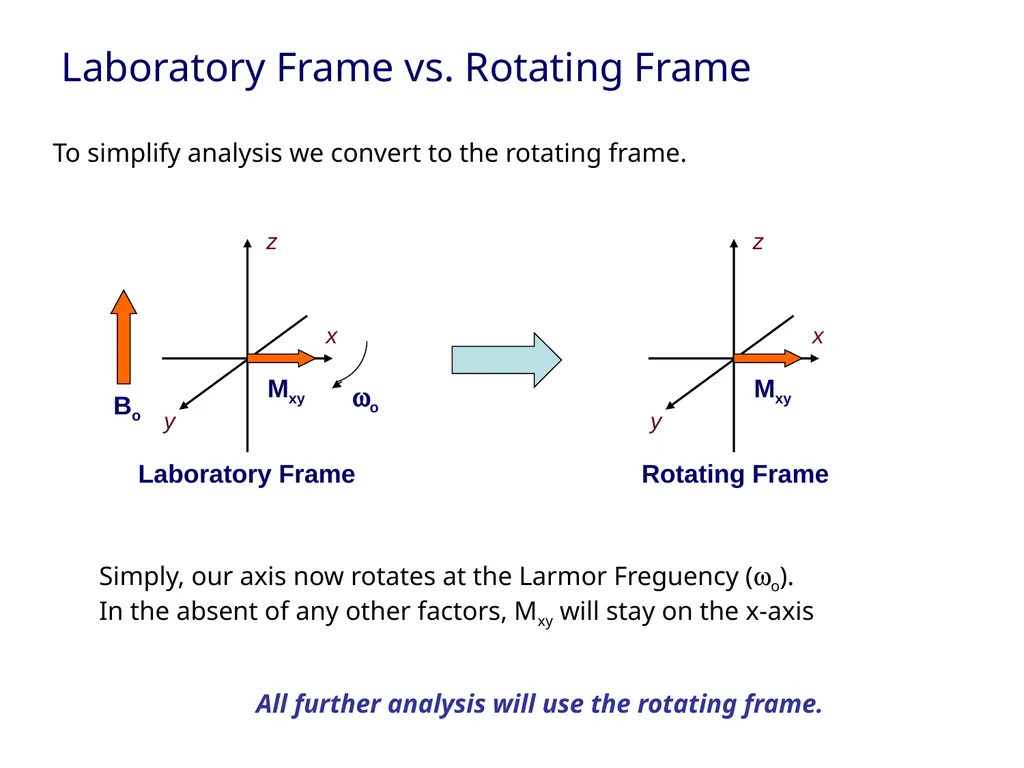
z x Mxy y Bo z x Mxy y wo Laboratory Frame Rotating Frame Laboratory Frame vs. Rotating Frame To simplify analysis we convert to the rotating frame. Simply, our axis now rotates at the Larmor Freguency (wo).
In the absent of any other factors, Mxy will stay on the x-axis All further analysis will use the rotating frame.<br>
In the absent of any other factors, Mxy will stay on the x-axis All further analysis will use the rotating frame.<br>
44
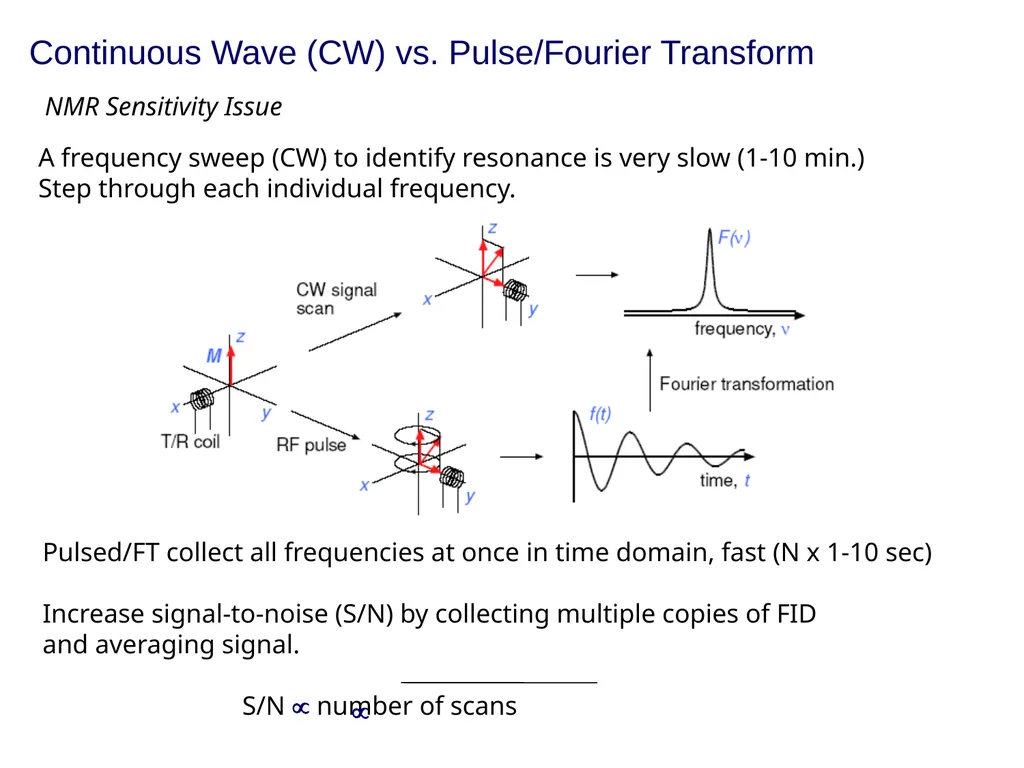
Continuous Wave (CW) vs. Pulse/Fourier Transform NMR Sensitivity Issue A frequency sweep (CW) to identify resonance is very slow (1-10 min.)
Step through each individual frequency. Pulsed/FT collect all frequencies at once in time domain, fast (N x 1-10 sec)
Increase signal-to-noise (S/N) by collecting multiple copies of FID
and averaging signal.
S/N number of scans <br>
Step through each individual frequency. Pulsed/FT collect all frequencies at once in time domain, fast (N x 1-10 sec)
Increase signal-to-noise (S/N) by collecting multiple copies of FID
and averaging signal.
S/N number of scans <br>
45
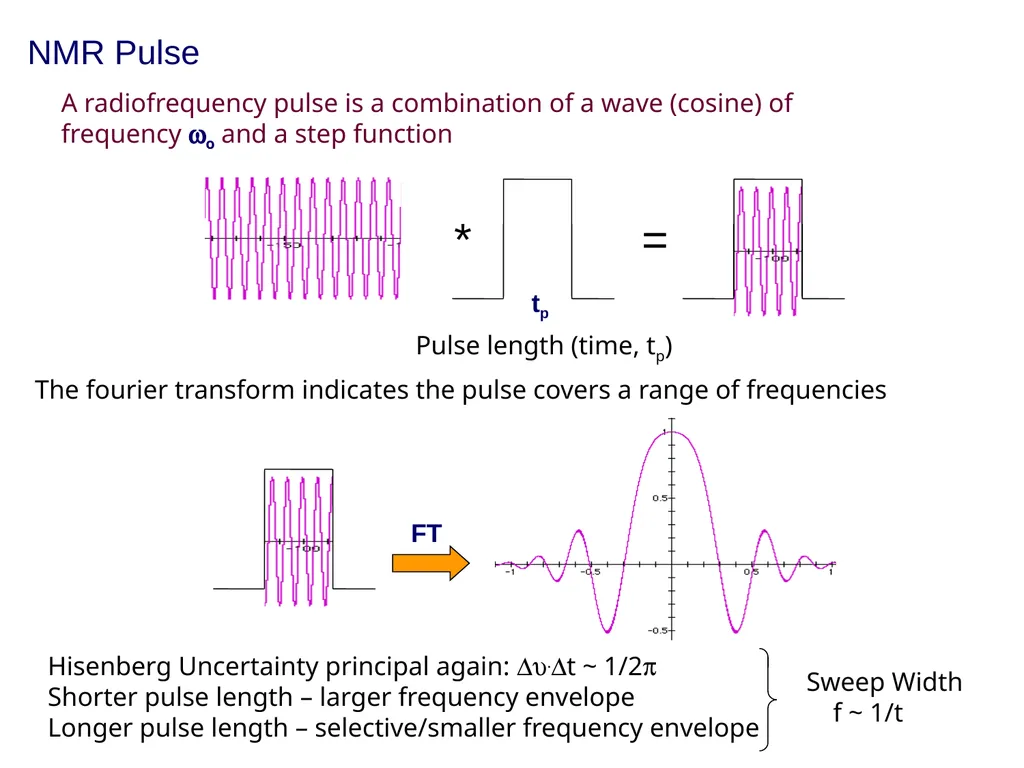
* = tp NMR Pulse FT A radiofrequency pulse is a combination of a wave (cosine) of frequency wo and a step function Pulse length (time, tp) The fourier transform indicates the pulse covers a range of frequencies Hisenberg Uncertainty principal again: Du.Dt ~ 1/2p
Shorter pulse length – larger frequency envelope
Longer pulse length – selective/smaller frequency envelope Sweep Width
f ~ 1/t<br>
Shorter pulse length – larger frequency envelope
Longer pulse length – selective/smaller frequency envelope Sweep Width
f ~ 1/t<br>
46
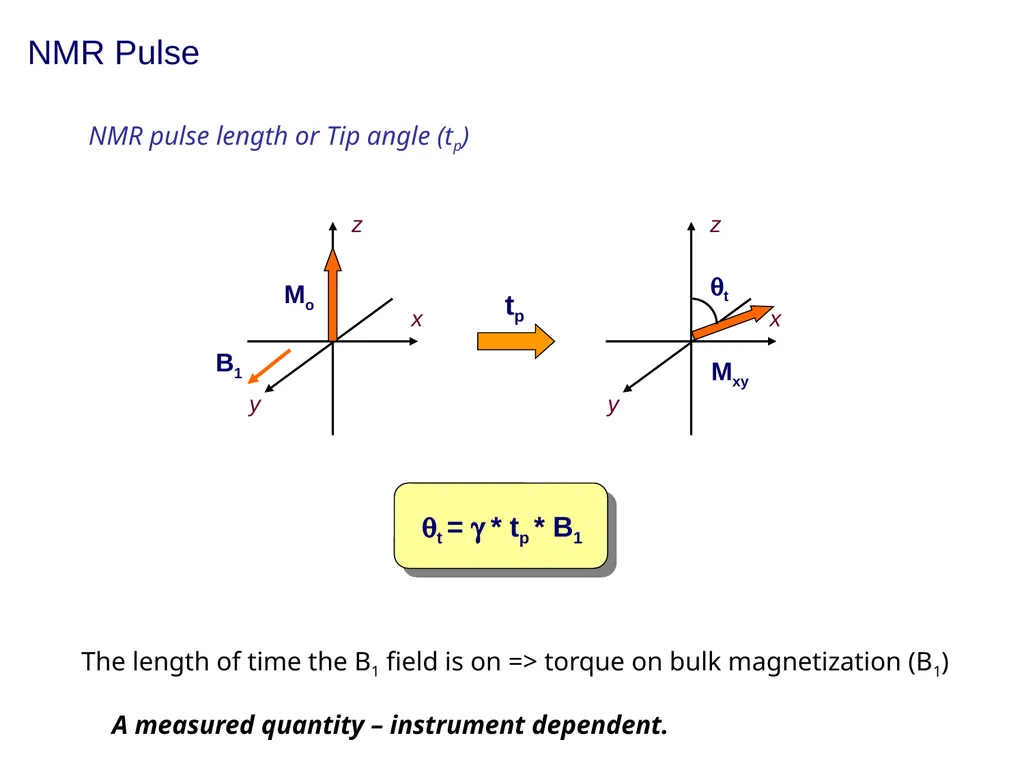
NMR Pulse z x Mxy y z x y Mo B1 qt tp qt = g * tp * B1 NMR pulse length or Tip angle (tp) The length of time the B1 field is on => torque on bulk magnetization (B1) A measured quantity – instrument dependent.<br>
47
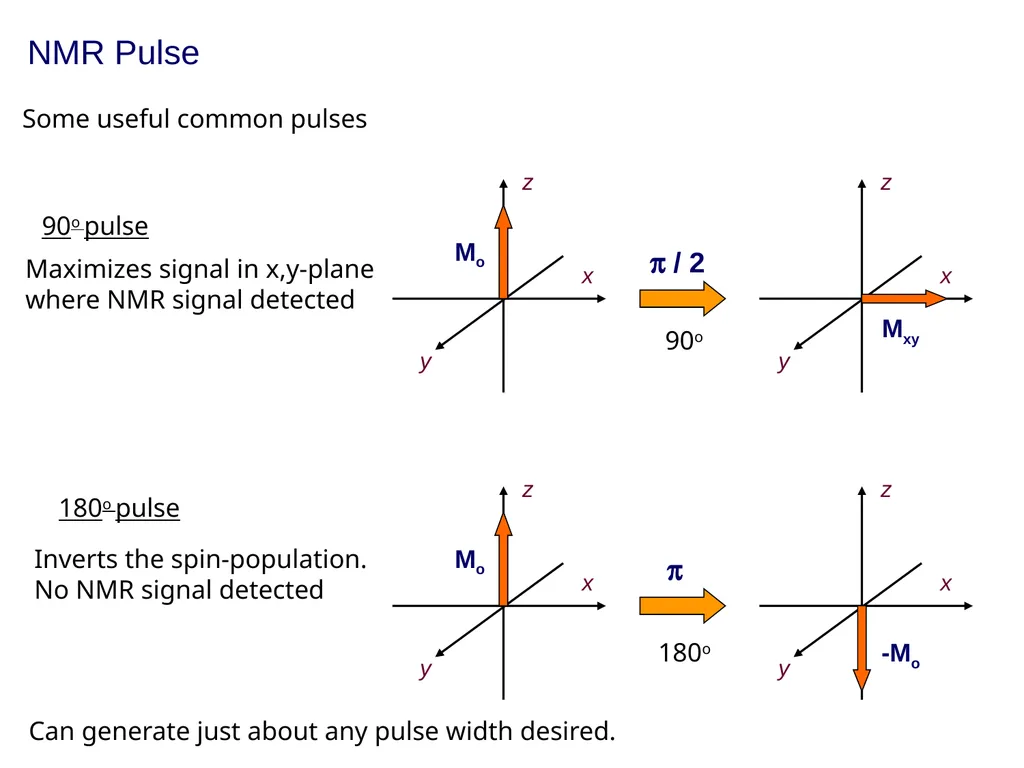
NMR Pulse z x Mxy y z x y Mo p / 2 Some useful common pulses 90o Maximizes signal in x,y-plane
where NMR signal detected z x -Mo y z x y Mo p 180o 90o pulse 180o pulse Inverts the spin-population.
No NMR signal detected Can generate just about any pulse width desired.<br>
where NMR signal detected z x -Mo y z x y Mo p 180o 90o pulse 180o pulse Inverts the spin-population.
No NMR signal detected Can generate just about any pulse width desired.<br>
48
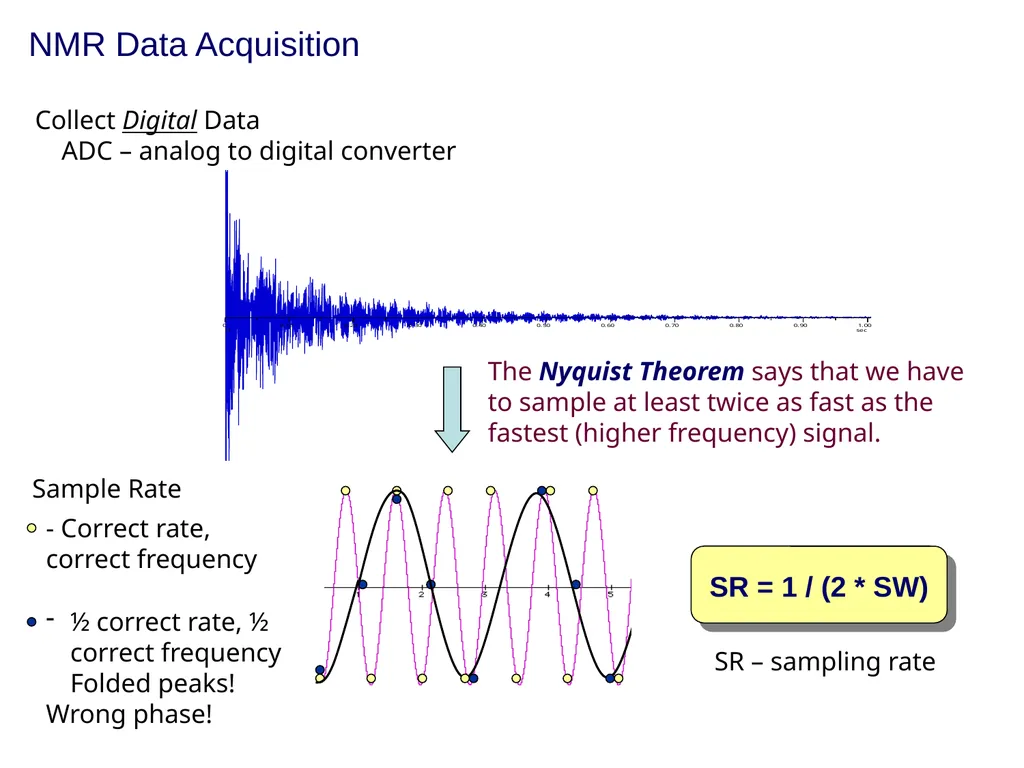
NMR Data Acquisition Collect Digital Data
ADC – analog to digital converter SR = 1 / (2 * SW) The Nyquist Theorem says that we have to sample at least twice as fast as the fastest (higher frequency) signal. Sample Rate - Correct rate, correct frequency ½ correct rate, ½ correct frequency Folded peaks!
Wrong phase! SR – sampling rate<br>
ADC – analog to digital converter SR = 1 / (2 * SW) The Nyquist Theorem says that we have to sample at least twice as fast as the fastest (higher frequency) signal. Sample Rate - Correct rate, correct frequency ½ correct rate, ½ correct frequency Folded peaks!
Wrong phase! SR – sampling rate<br>
49
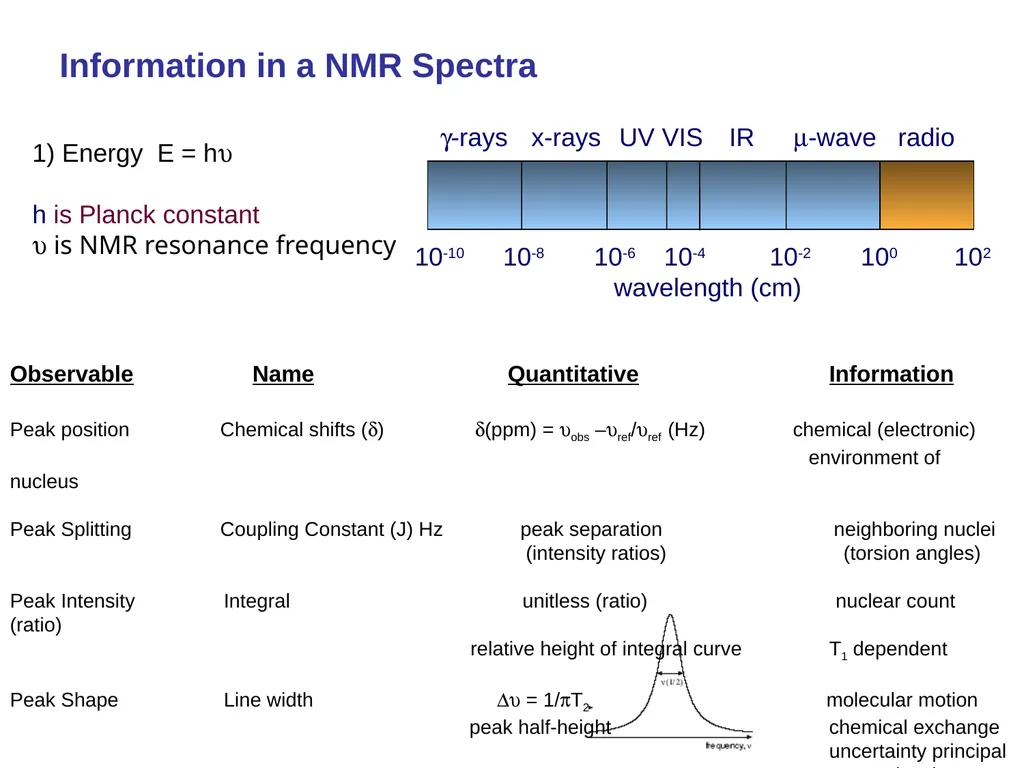
Information in a NMR Spectra 1) Energy E = hu
h is Planck constant
u is NMR resonance frequency Observable Name Quantitative Information
Peak position Chemical shifts (d) d(ppm) = uobs –uref/uref (Hz) chemical (electronic)
environment of nucleus
Peak Splitting Coupling Constant (J) Hz peak separation neighboring nuclei
(intensity ratios) (torsion angles)
Peak Intensity Integral unitless (ratio) nuclear count (ratio)
relative height of integral curve T1 dependent
Peak Shape Line width Du = 1/pT2 molecular motion
peak half-height chemical exchange
uncertainty principal
uncertainty in energy<br>
h is Planck constant
u is NMR resonance frequency Observable Name Quantitative Information
Peak position Chemical shifts (d) d(ppm) = uobs –uref/uref (Hz) chemical (electronic)
environment of nucleus
Peak Splitting Coupling Constant (J) Hz peak separation neighboring nuclei
(intensity ratios) (torsion angles)
Peak Intensity Integral unitless (ratio) nuclear count (ratio)
relative height of integral curve T1 dependent
Peak Shape Line width Du = 1/pT2 molecular motion
peak half-height chemical exchange
uncertainty principal
uncertainty in energy<br>
50
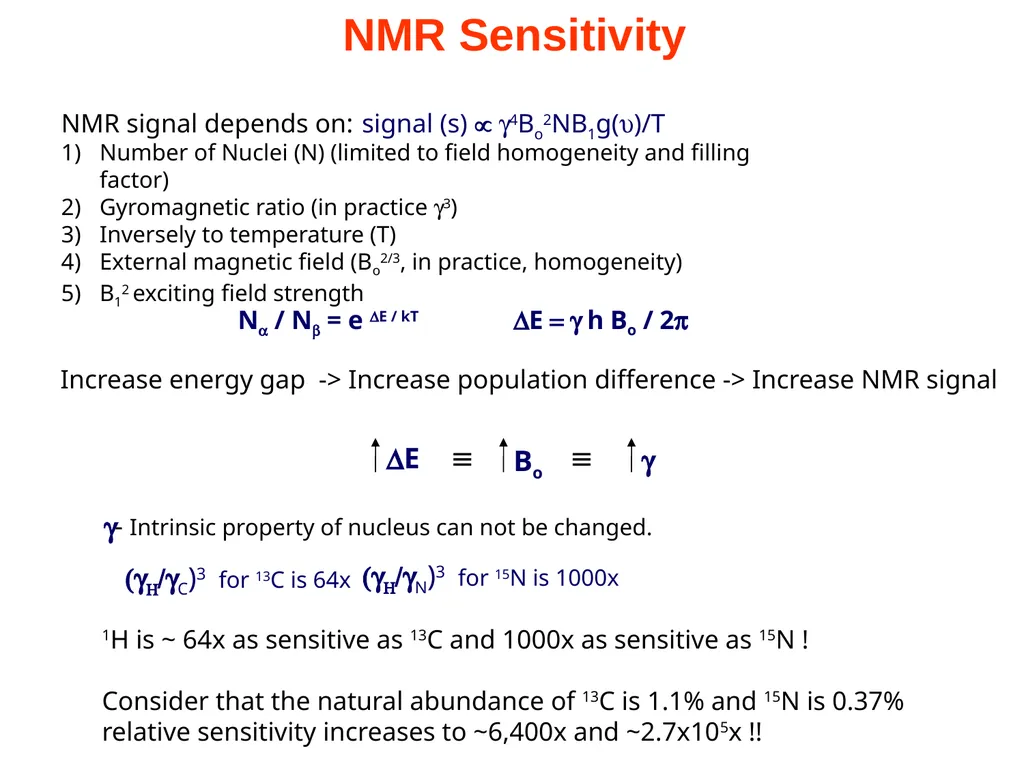
NMR Sensitivity DE = g h Bo / 2p NMR signal depends on:
Number of Nuclei (N) (limited to field homogeneity and filling factor)
Gyromagnetic ratio (in practice g3)
Inversely to temperature (T)
External magnetic field (Bo2/3, in practice, homogeneity)
B12 exciting field strength Na / Nb = e DE / kT Increase energy gap -> Increase population difference -> Increase NMR signal DE ≡ Bo ≡ g g - Intrinsic property of nucleus can not be changed. (gH/gC)3 for 13C is 64x (gH/gN)3 for 15N is 1000x 1H is ~ 64x as sensitive as 13C and 1000x as sensitive as 15N !
Consider that the natural abundance of 13C is 1.1% and 15N is 0.37%
relative sensitivity increases to ~6,400x and ~2.7x10⁵x !! signal (s) g4Bo2NB1g(u)/T<br>
Number of Nuclei (N) (limited to field homogeneity and filling factor)
Gyromagnetic ratio (in practice g3)
Inversely to temperature (T)
External magnetic field (Bo2/3, in practice, homogeneity)
B12 exciting field strength Na / Nb = e DE / kT Increase energy gap -> Increase population difference -> Increase NMR signal DE ≡ Bo ≡ g g - Intrinsic property of nucleus can not be changed. (gH/gC)3 for 13C is 64x (gH/gN)3 for 15N is 1000x 1H is ~ 64x as sensitive as 13C and 1000x as sensitive as 15N !
Consider that the natural abundance of 13C is 1.1% and 15N is 0.37%
relative sensitivity increases to ~6,400x and ~2.7x10⁵x !! signal (s) g4Bo2NB1g(u)/T<br>