
“No Documentation = No Work Done” Audit
PT
Published · 43 slides · 0 views
1 / 1

Description
No Documentation No Work Done Audit Documentation- The Saviour -By Bharat Sonkhiya Day and Date: Thursday 7th December, 2023 ICAI-JAIPUR BRANCH 1 Expectation Gap in Audit Knowledge Gap Performance Gap Evolution Gap Attest Function
Related Topics
Share
Embed code
Download this presentation From Below
"“No Documentation = No Work Done” Audit" is the property of its rightful owner. Permission is granted to download and print the materials on this website for personal, non-commercial use only, and to display it on your personal computer provided you do not modify the materials and that you retain all copyright notices contained in the materials. By downloading content from our website, you accept the terms of this agreement.
Presentation Transcript
01
“No Documentation = No Work Done” Audit Documentation- The Saviour -By Bharat Sonkhiya Day and Date: Thursday 7th December, 2023 ICAI-JAIPUR BRANCH 1<br>
02
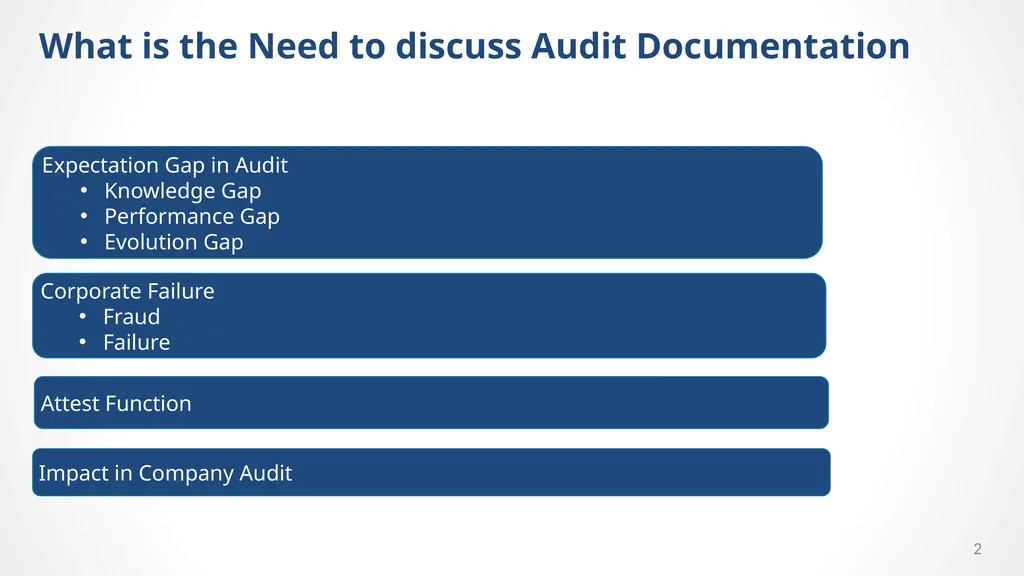
Expectation Gap in Audit
Knowledge Gap
Performance Gap
Evolution Gap Attest Function Corporate Failure
Fraud
Failure Impact in Company Audit What is the Need to discuss Audit Documentation 2<br>
Knowledge Gap
Performance Gap
Evolution Gap Attest Function Corporate Failure
Fraud
Failure Impact in Company Audit What is the Need to discuss Audit Documentation 2<br>
03
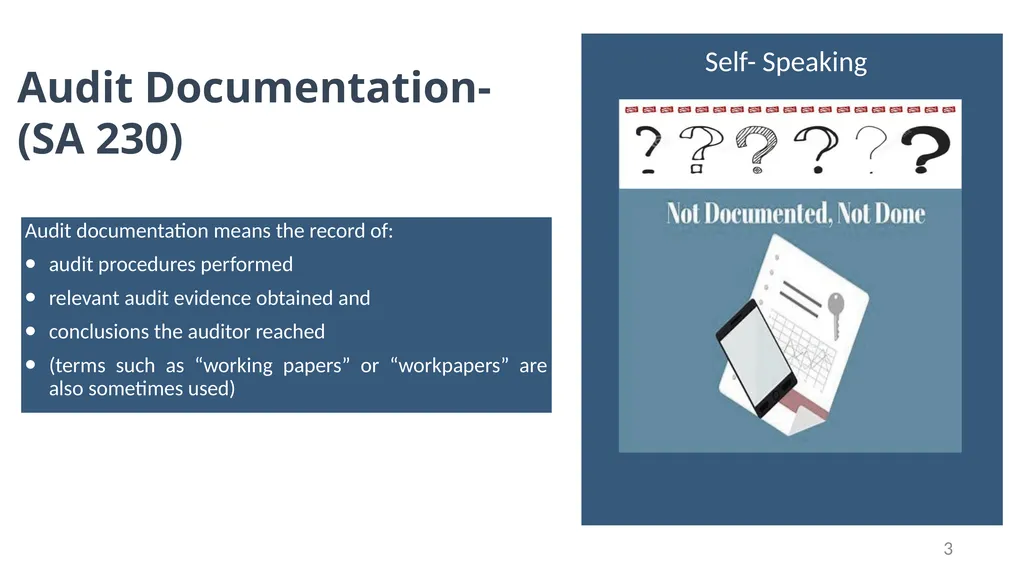
Audit Documentation- (SA 230) Audit documentation means the record of:
audit procedures performed
relevant audit evidence obtained and
conclusions the auditor reached
(terms such as “working papers” or “workpapers” are also sometimes used) Self- Speaking 3<br>
audit procedures performed
relevant audit evidence obtained and
conclusions the auditor reached
(terms such as “working papers” or “workpapers” are also sometimes used) Self- Speaking 3<br>
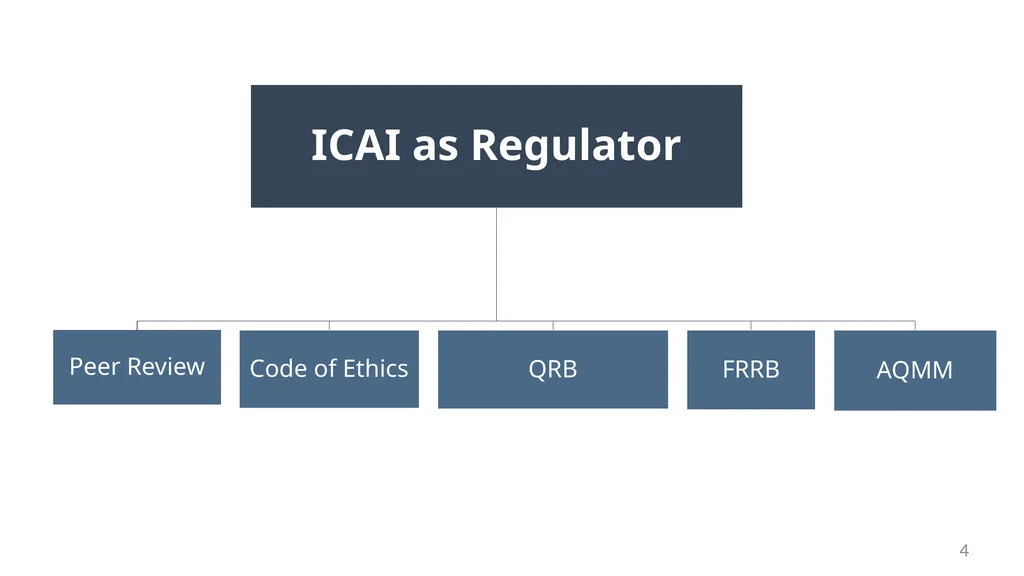
04
4<br>
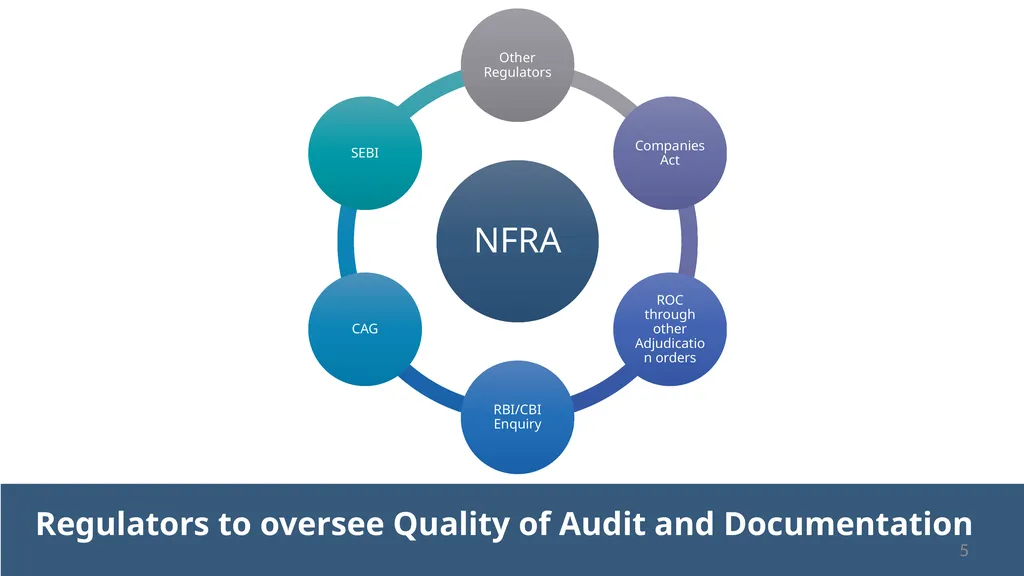
05
Regulators to oversee Quality of Audit and Documentation 5<br>
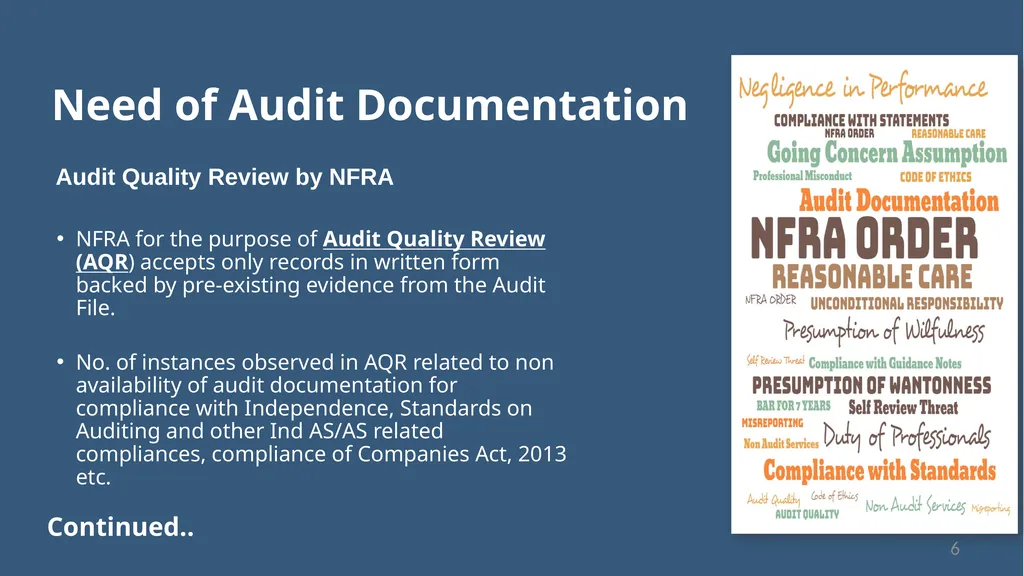
06
Continued.. 6<br>
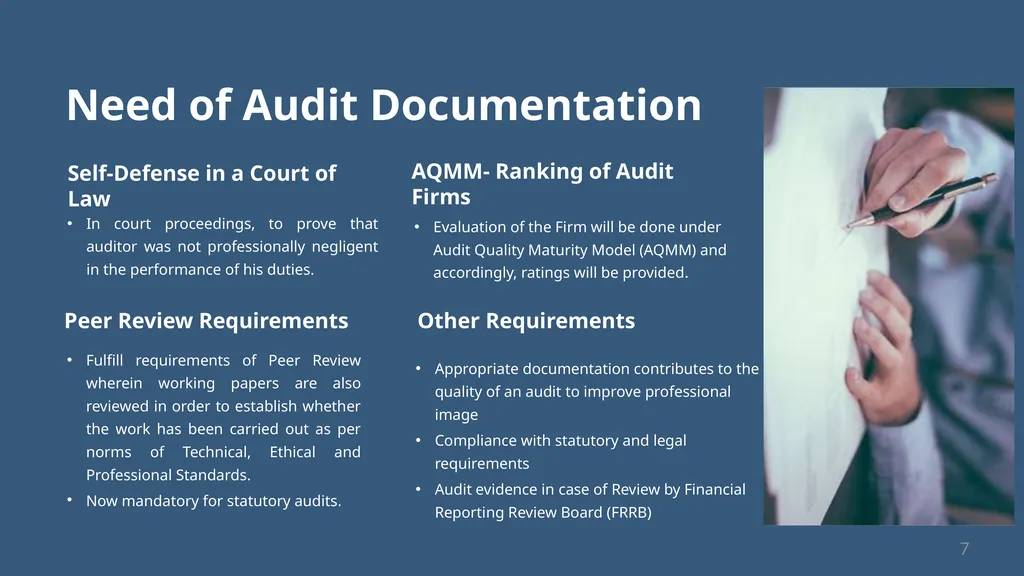
07
7<br>
08
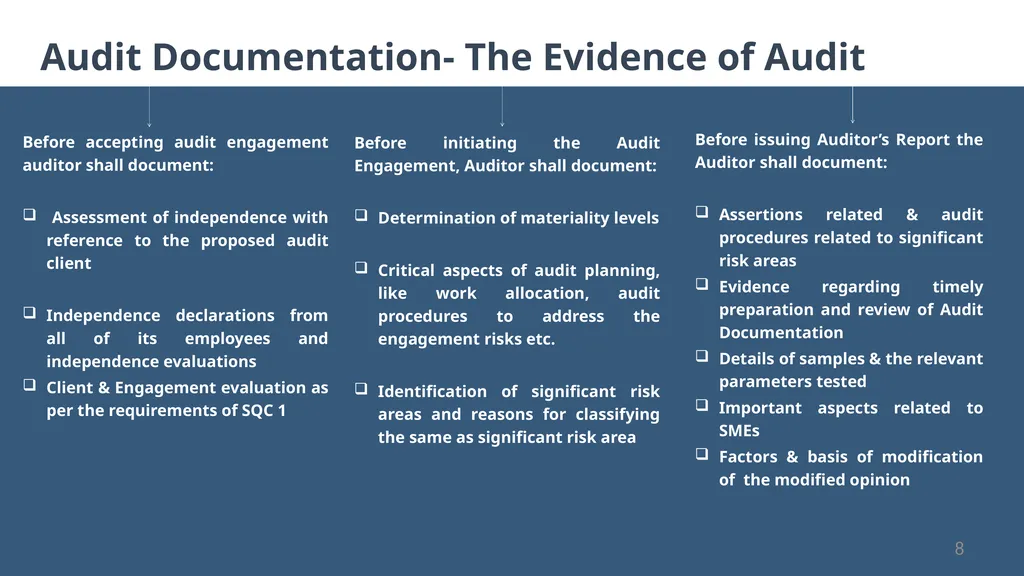
Audit Documentation- The Evidence of Audit Before issuing Auditor’s Report the Auditor shall document:
Assertions related & audit procedures related to significant risk areas
Evidence regarding timely preparation and review of Audit Documentation
Details of samples & the relevant parameters tested
Important aspects related to SMEs
Factors & basis of modification of the modified opinion Before accepting audit engagement auditor shall document:
Assessment of independence with reference to the proposed audit client
Independence declarations from all of its employees and independence evaluations
Client & Engagement evaluation as per the requirements of SQC 1 Before initiating the Audit Engagement, Auditor shall document:
Determination of materiality levels
Critical aspects of audit planning, like work allocation, audit procedures to address the engagement risks etc.
Identification of significant risk areas and reasons for classifying the same as significant risk area 8<br>
Assertions related & audit procedures related to significant risk areas
Evidence regarding timely preparation and review of Audit Documentation
Details of samples & the relevant parameters tested
Important aspects related to SMEs
Factors & basis of modification of the modified opinion Before accepting audit engagement auditor shall document:
Assessment of independence with reference to the proposed audit client
Independence declarations from all of its employees and independence evaluations
Client & Engagement evaluation as per the requirements of SQC 1 Before initiating the Audit Engagement, Auditor shall document:
Determination of materiality levels
Critical aspects of audit planning, like work allocation, audit procedures to address the engagement risks etc.
Identification of significant risk areas and reasons for classifying the same as significant risk area 8<br>
09
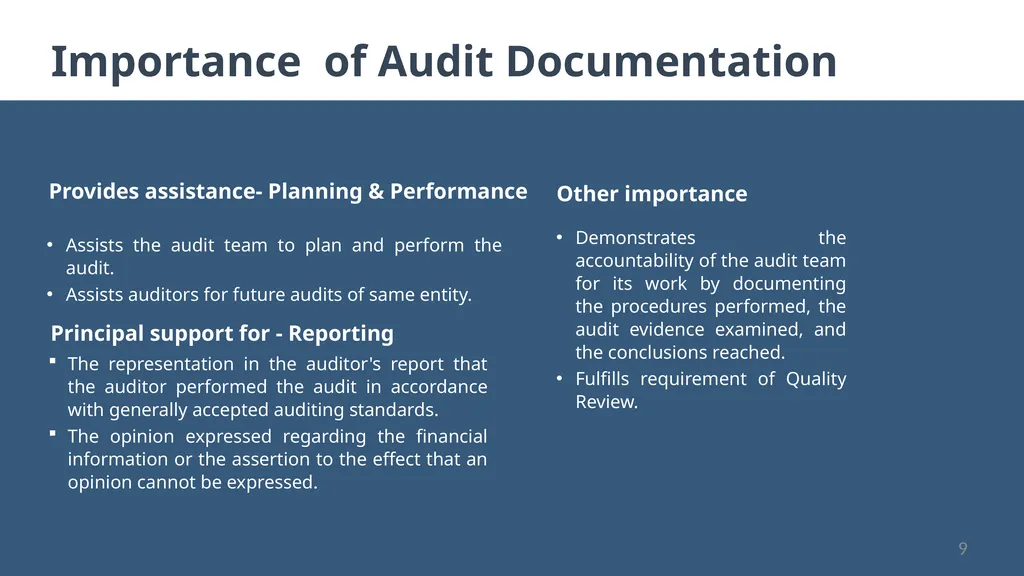
Importance of Audit Documentation 9<br>
10
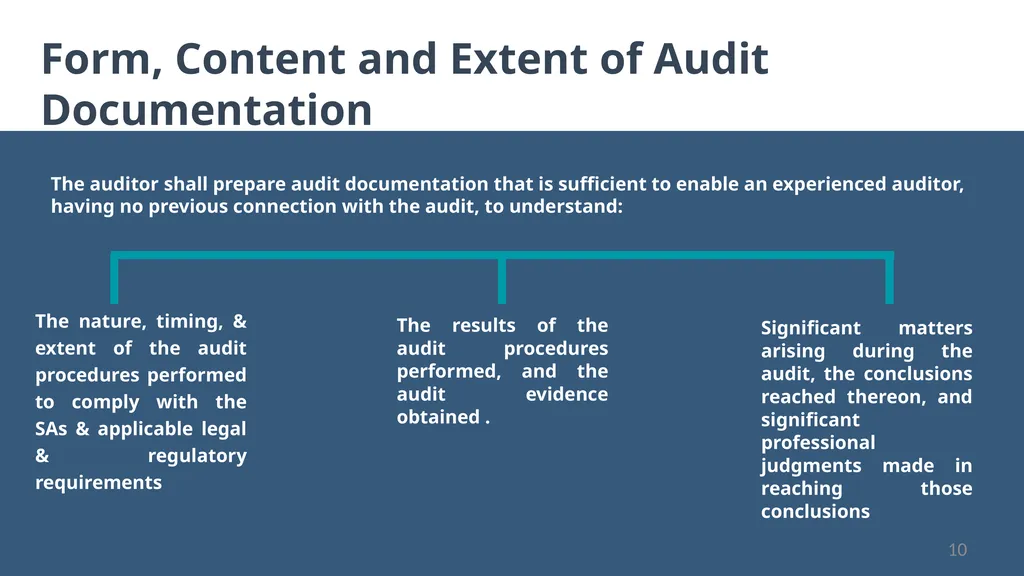
Form, Content and Extent of Audit Documentation The results of the audit procedures performed, and the audit evidence obtained . Significant matters arising during the audit, the conclusions reached thereon, and significant professional judgments made in reaching those conclusions The nature, timing, & extent of the audit procedures performed to comply with the SAs & applicable legal & regulatory requirements The auditor shall prepare audit documentation that is sufficient to enable an experienced auditor, having no previous connection with the audit, to understand: 10<br>
11
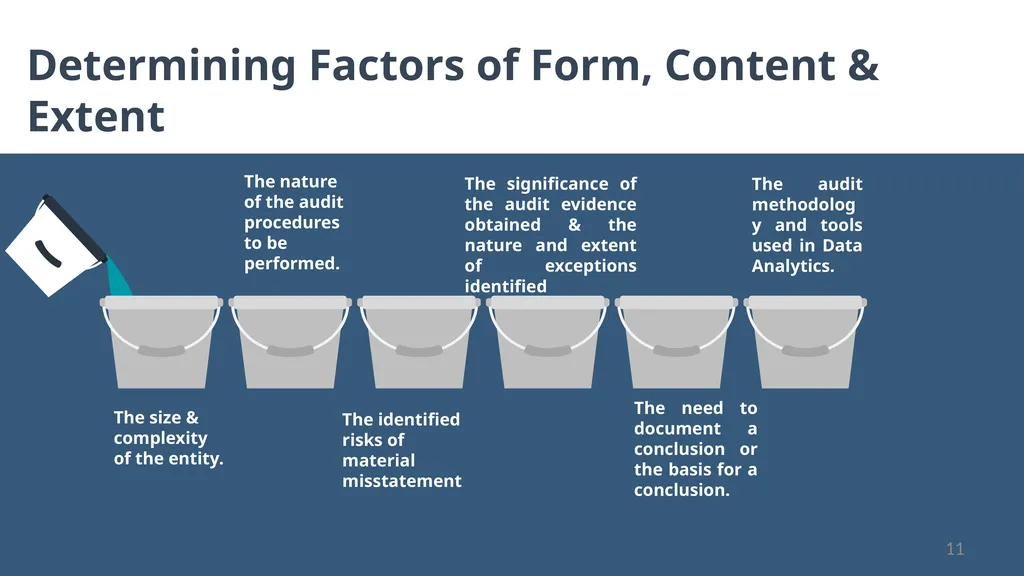
Determining Factors of Form, Content & Extent The size & complexity of the entity. The nature of the audit procedures to be performed. The identified risks of material misstatement The significance of the audit evidence obtained & the nature and extent of exceptions identified The need to document a conclusion or the basis for a conclusion. The audit methodology and tools used in Data Analytics. 11<br>
12
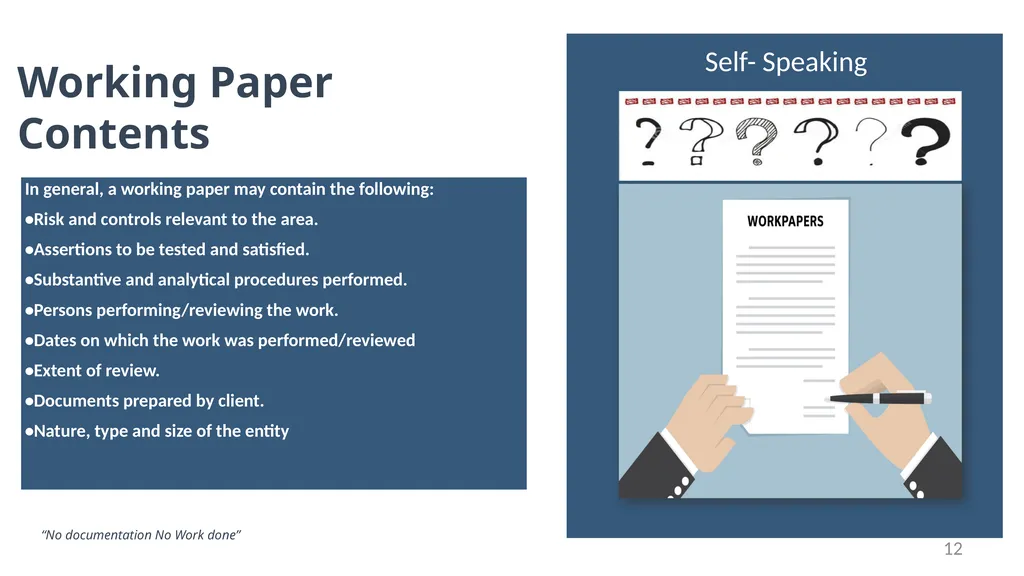
Working Paper Contents In general, a working paper may contain the following:
•Risk and controls relevant to the area.
•Assertions to be tested and satisfied.
•Substantive and analytical procedures performed.
•Persons performing/reviewing the work.
•Dates on which the work was performed/reviewed
•Extent of review.
•Documents prepared by client.
•Nature, type and size of the entity “No documentation No Work done” Self- Speaking 12<br>
•Risk and controls relevant to the area.
•Assertions to be tested and satisfied.
•Substantive and analytical procedures performed.
•Persons performing/reviewing the work.
•Dates on which the work was performed/reviewed
•Extent of review.
•Documents prepared by client.
•Nature, type and size of the entity “No documentation No Work done” Self- Speaking 12<br>
13
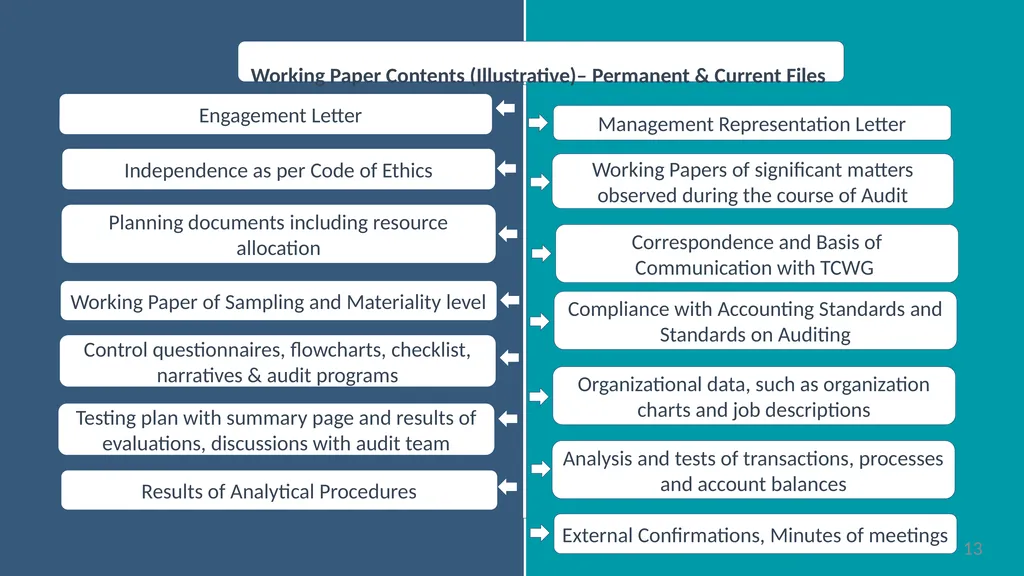
Working Paper Contents (Illustrative)– Permanent & Current Files Engagement Letter Planning documents including resource allocation Working Paper of Sampling and Materiality level Correspondence and Basis of Communication with TCWG Working Papers of significant matters observed during the course of Audit Management Representation Letter Independence as per Code of Ethics Results of Analytical Procedures Compliance with Accounting Standards and Standards on Auditing Control questionnaires, flowcharts, checklist, narratives & audit programs Organizational data, such as organization charts and job descriptions Analysis and tests of transactions, processes and account balances Testing plan with summary page and results of evaluations, discussions with audit team External Confirmations, Minutes of meetings 13<br>
14
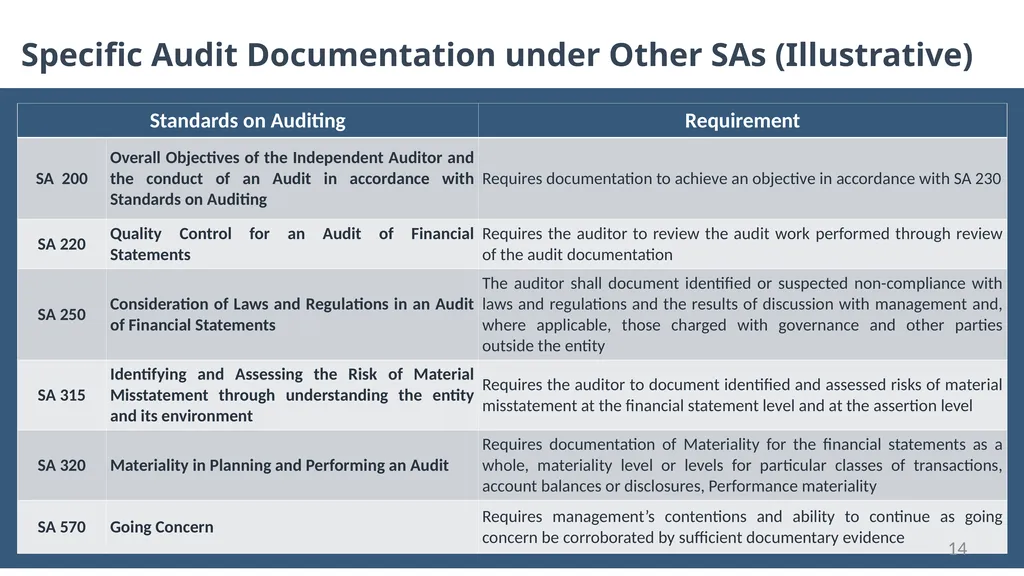
Specific Audit Documentation under Other SAs (Illustrative) 14<br>
15
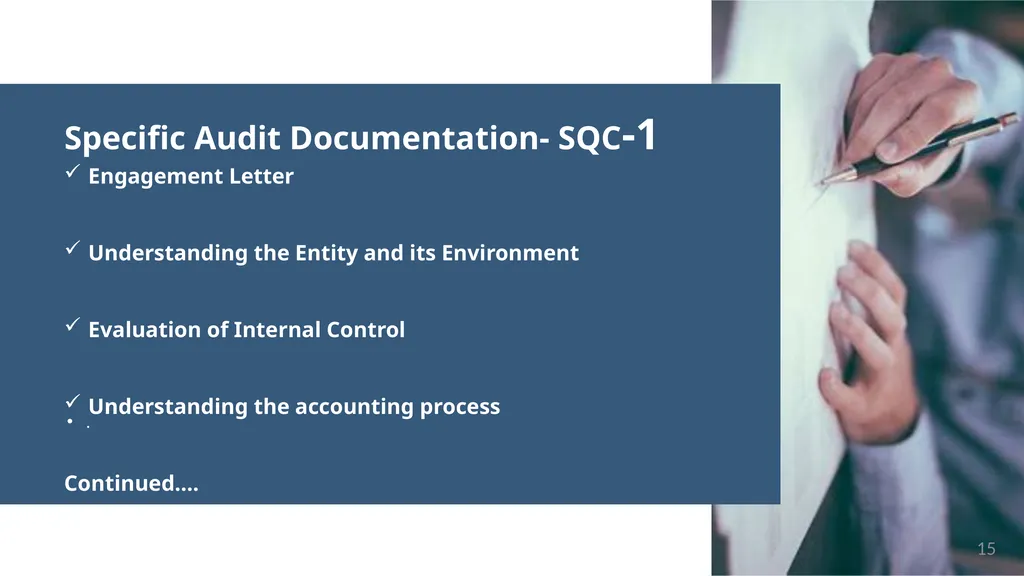
15<br>
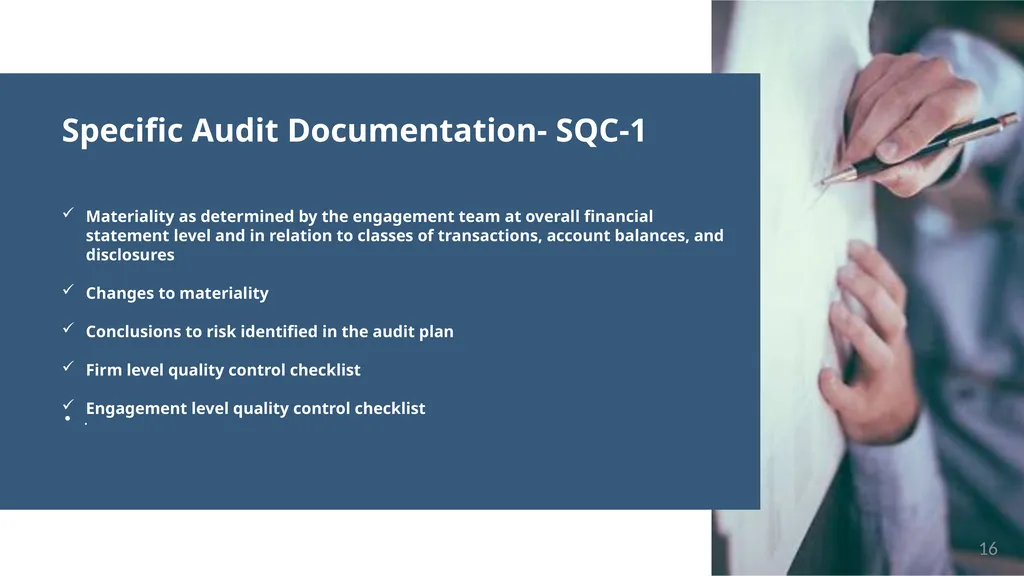
16
16<br>
17
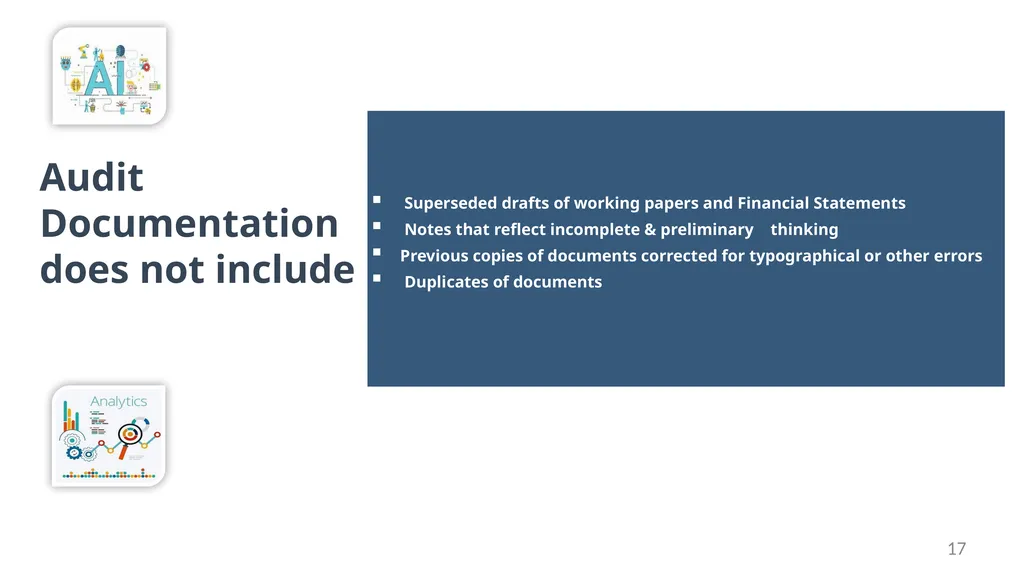
Superseded drafts of working papers and Financial Statements
Notes that reflect incomplete & preliminary thinking
Previous copies of documents corrected for typographical or other errors
Duplicates of documents Audit Documentation does not include 17<br>
Notes that reflect incomplete & preliminary thinking
Previous copies of documents corrected for typographical or other errors
Duplicates of documents Audit Documentation does not include 17<br>
18
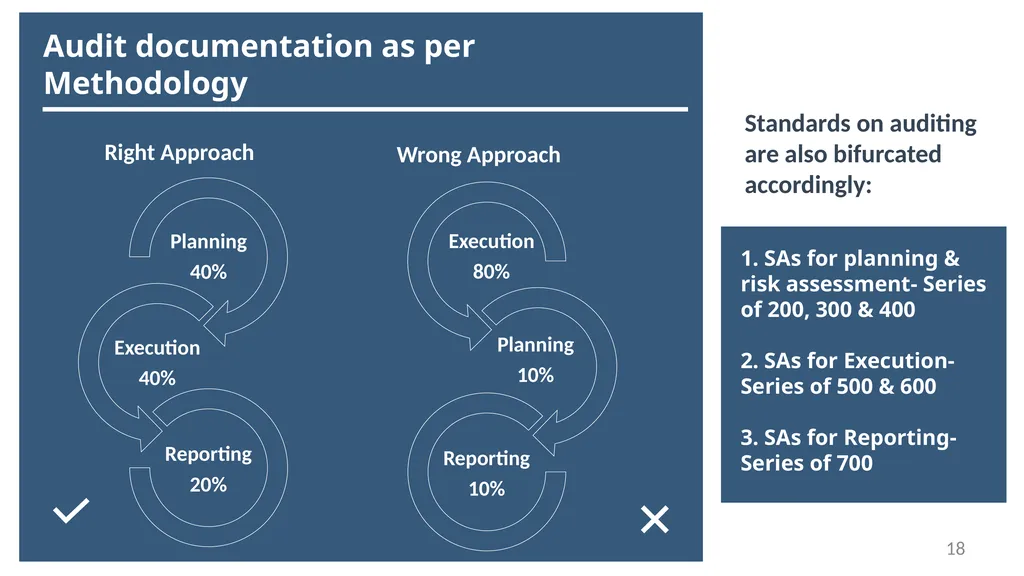
Audit documentation as per Methodology Right Approach Wrong Approach Standards on auditing are also bifurcated accordingly: 1. SAs for planning & risk assessment- Series of 200, 300 & 400
2. SAs for Execution- Series of 500 & 600
3. SAs for Reporting- Series of 700 18<br>
2. SAs for Execution- Series of 500 & 600
3. SAs for Reporting- Series of 700 18<br>
19
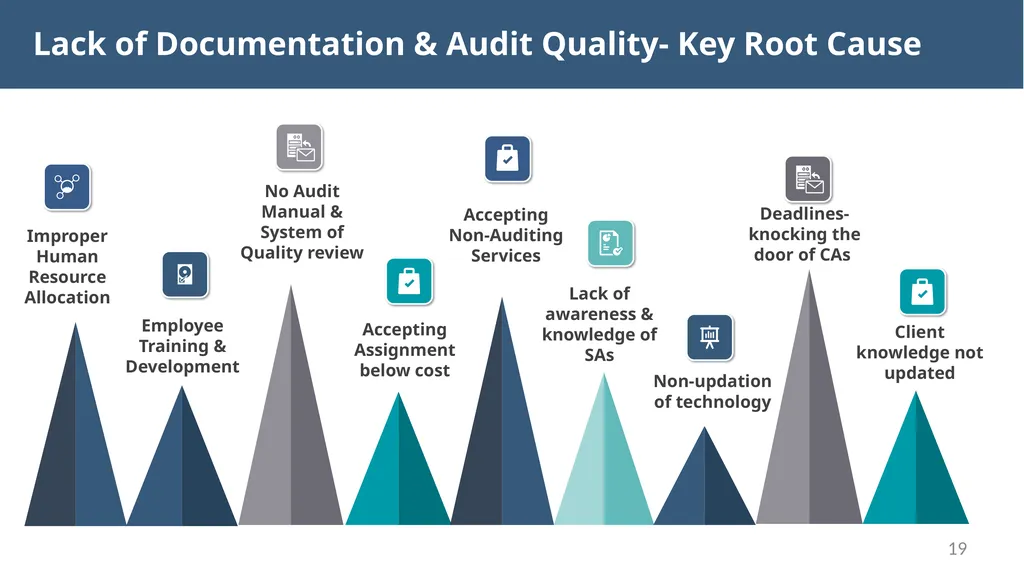
Employee Training & Development No Audit Manual & System of Quality review Accepting Assignment below cost Accepting Non-Auditing Services Lack of awareness & knowledge of SAs Non-updation of technology Lack of Documentation & Audit Quality- Key Root Cause Improper Human Resource Allocation Deadlines- knocking the door of CAs Client knowledge not updated 19<br>
20
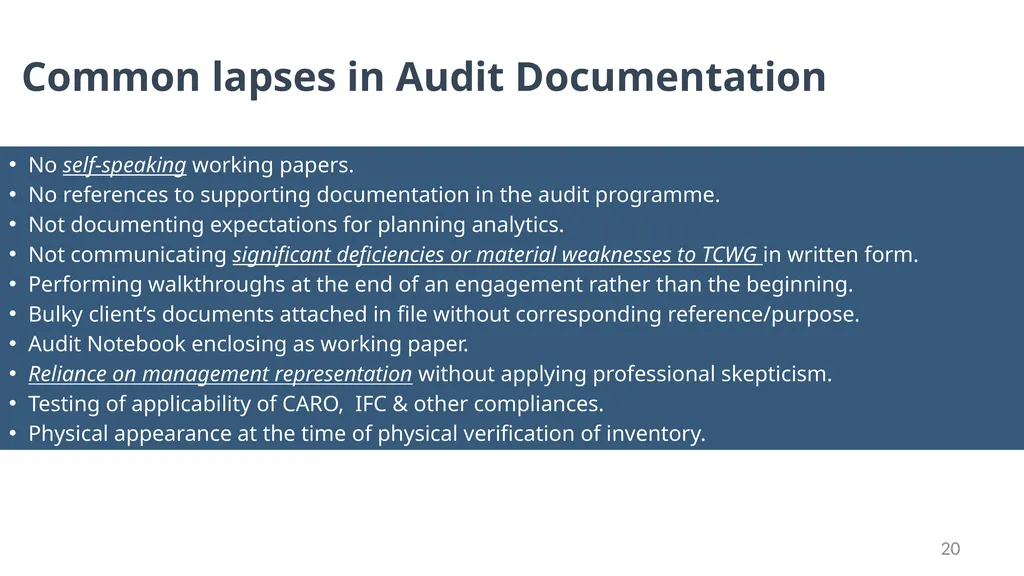
Common lapses in Audit Documentation No self-speaking working papers.
No references to supporting documentation in the audit programme.
Not documenting expectations for planning analytics.
Not communicating significant deficiencies or material weaknesses to TCWG in written form.
Performing walkthroughs at the end of an engagement rather than the beginning.
Bulky client’s documents attached in file without corresponding reference/purpose.
Audit Notebook enclosing as working paper.
Reliance on management representation without applying professional skepticism.
Testing of applicability of CARO, IFC & other compliances.
Physical appearance at the time of physical verification of inventory. Continued.. 20<br>
No references to supporting documentation in the audit programme.
Not documenting expectations for planning analytics.
Not communicating significant deficiencies or material weaknesses to TCWG in written form.
Performing walkthroughs at the end of an engagement rather than the beginning.
Bulky client’s documents attached in file without corresponding reference/purpose.
Audit Notebook enclosing as working paper.
Reliance on management representation without applying professional skepticism.
Testing of applicability of CARO, IFC & other compliances.
Physical appearance at the time of physical verification of inventory. Continued.. 20<br>
21
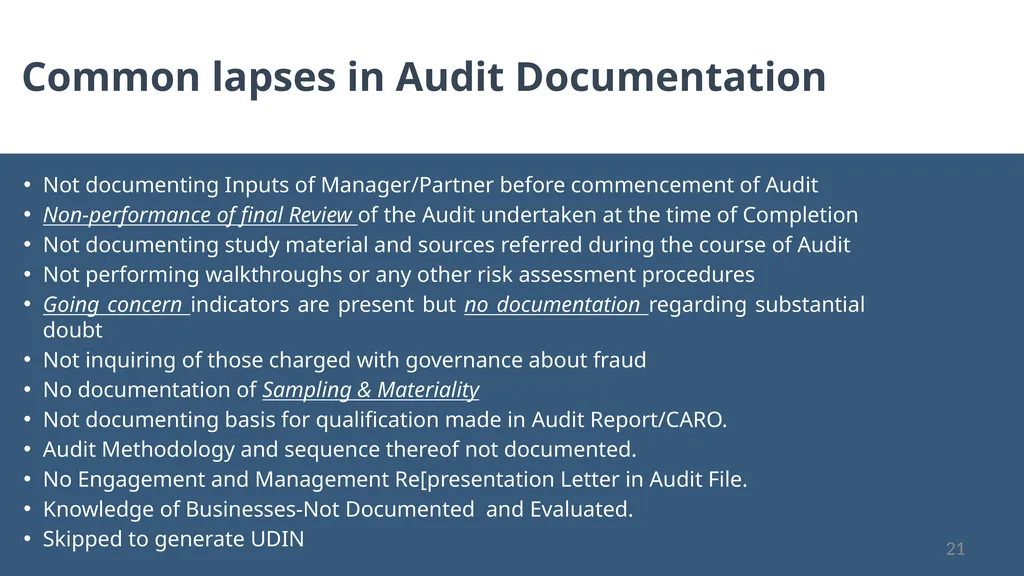
Common lapses in Audit Documentation Not documenting Inputs of Manager/Partner before commencement of Audit
Non-performance of final Review of the Audit undertaken at the time of Completion
Not documenting study material and sources referred during the course of Audit
Not performing walkthroughs or any other risk assessment procedures
Going concern indicators are present but no documentation regarding substantial doubt
Not inquiring of those charged with governance about fraud
No documentation of Sampling & Materiality
Not documenting basis for qualification made in Audit Report/CARO.
Audit Methodology and sequence thereof not documented.
No Engagement and Management Re[presentation Letter in Audit File.
Knowledge of Businesses-Not Documented and Evaluated.
Skipped to generate UDIN 21<br>
Non-performance of final Review of the Audit undertaken at the time of Completion
Not documenting study material and sources referred during the course of Audit
Not performing walkthroughs or any other risk assessment procedures
Going concern indicators are present but no documentation regarding substantial doubt
Not inquiring of those charged with governance about fraud
No documentation of Sampling & Materiality
Not documenting basis for qualification made in Audit Report/CARO.
Audit Methodology and sequence thereof not documented.
No Engagement and Management Re[presentation Letter in Audit File.
Knowledge of Businesses-Not Documented and Evaluated.
Skipped to generate UDIN 21<br>
22
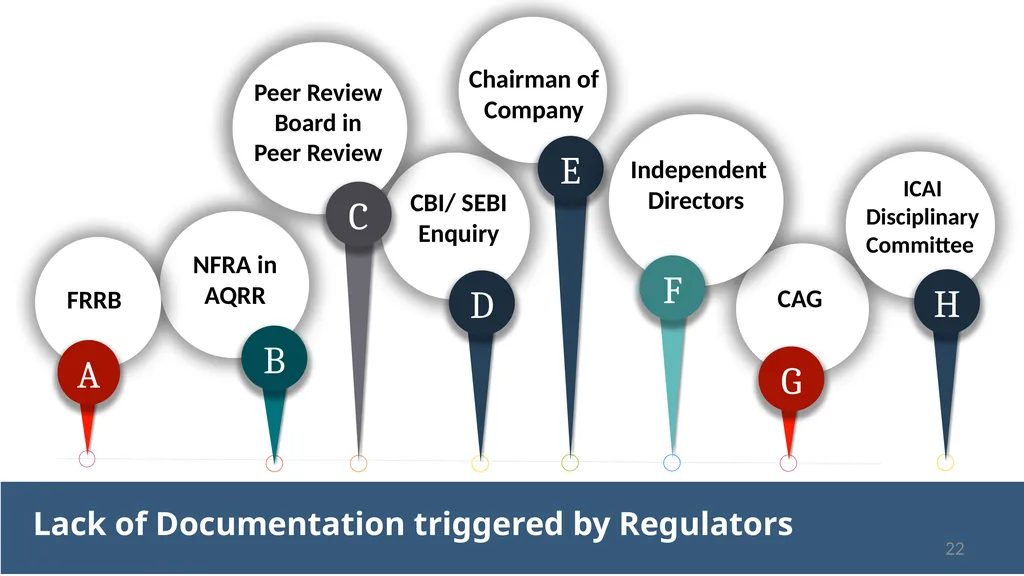
Lack of Documentation triggered by Regulators 22<br>
23
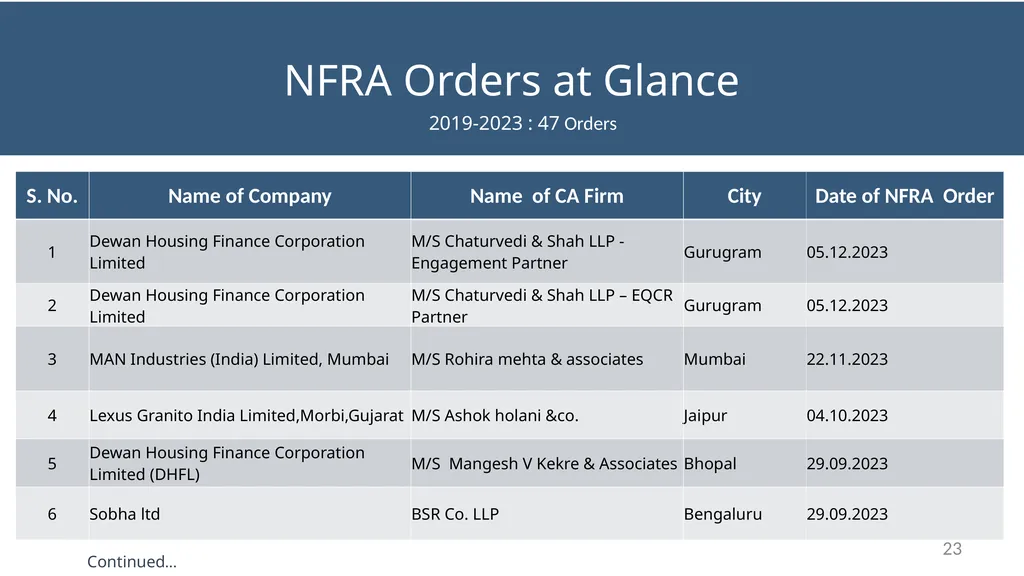
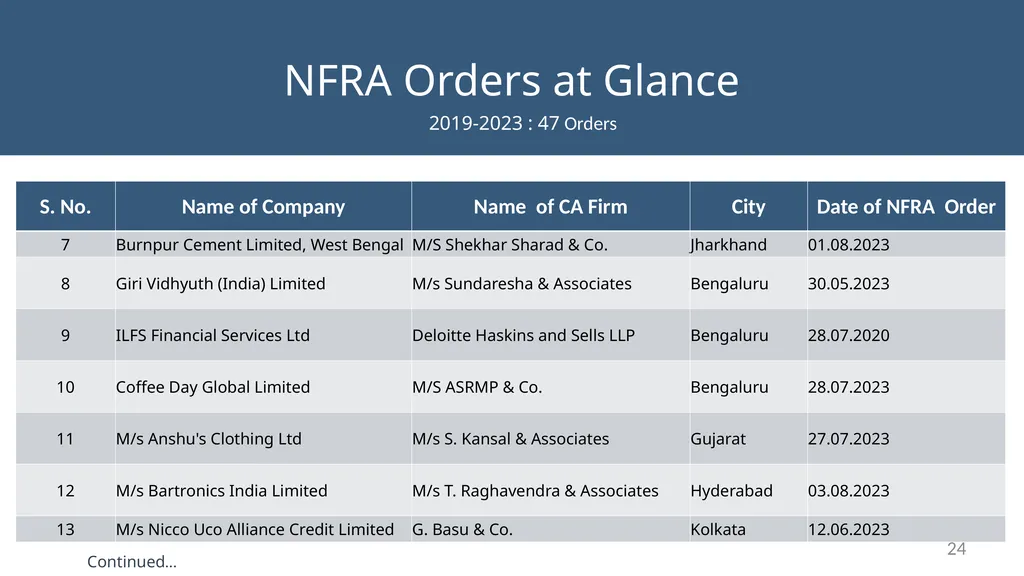
NFRA Orders at Glance 2019-2023 : 47 Orders Continued… 23<br>
24
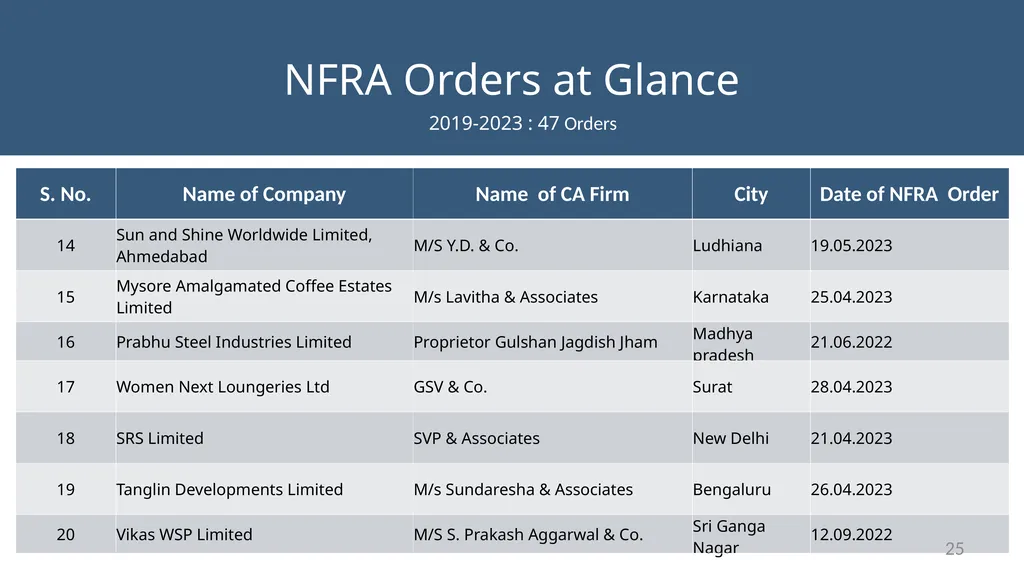
NFRA Orders at Glance 2019-2023:45 Orders NFRA Orders at Glance 2019-2023 : 47 Orders Continued… 24<br>
25
NFRA Orders at Glance 2019-2023:45 Orders NFRA Orders at Glance 2019-2023 : 47 Orders 25<br>
26
NFRA ORDERS -Discrepancies in Audit Documentation SA-220/230: Failed to comply with parameters of SQC-1, SAs, Quality aspects SA-260: No correspondence/communication to TCWG on Key/significant matters SA-500: No sufficient Audit Evidence for Accuracy and Completeness SA-240: Failed to identify and report Fraud Risk SA-501: Requirements such as Attendance at physical verification counting not followed SA-540: Failure to test management’s estimates SA-570: Going Concern Assumption not evaluated and conclusion drawn based on Management Data SA-580: Management Representation considered without applying Professional Skepticism SA-550: Related Party Transactions not checked- based on Arm’s Length Price & Other criteria SA-320: Failed to document determination of Materiality 26<br>
27
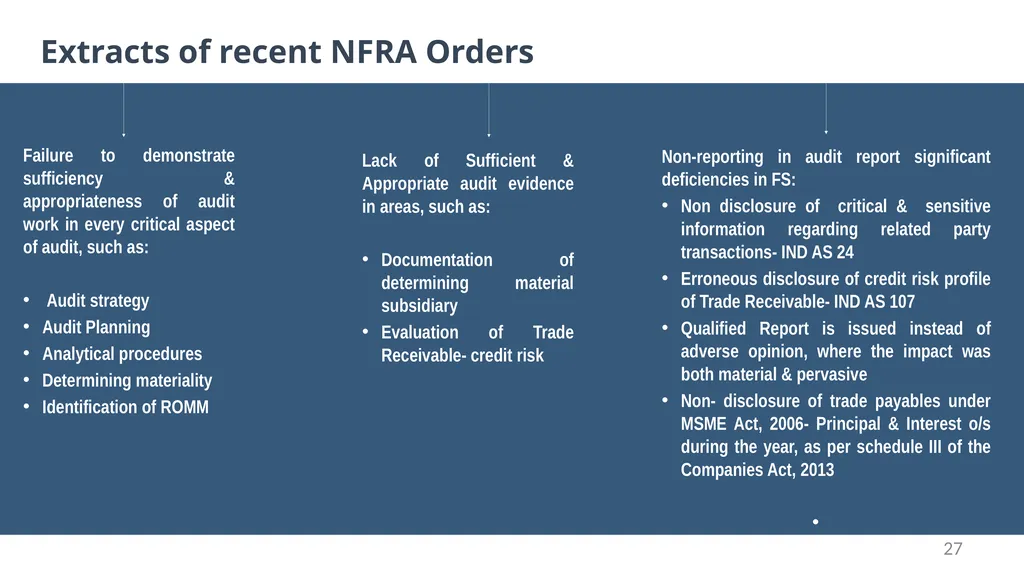
Extracts of recent NFRA Orders Non-reporting in audit report significant deficiencies in FS:
Non disclosure of critical & sensitive information regarding related party transactions- IND AS 24
Erroneous disclosure of credit risk profile of Trade Receivable- IND AS 107
Qualified Report is issued instead of adverse opinion, where the impact was both material & pervasive
Non- disclosure of trade payables under MSME Act, 2006- Principal & Interest o/s during the year, as per schedule III of the Companies Act, 2013 Failure to demonstrate sufficiency & appropriateness of audit work in every critical aspect of audit, such as:
Audit strategy
Audit Planning
Analytical procedures
Determining materiality
Identification of ROMM Lack of Sufficient & Appropriate audit evidence in areas, such as:
Documentation of determining material subsidiary
Evaluation of Trade Receivable- credit risk 27<br>
Non disclosure of critical & sensitive information regarding related party transactions- IND AS 24
Erroneous disclosure of credit risk profile of Trade Receivable- IND AS 107
Qualified Report is issued instead of adverse opinion, where the impact was both material & pervasive
Non- disclosure of trade payables under MSME Act, 2006- Principal & Interest o/s during the year, as per schedule III of the Companies Act, 2013 Failure to demonstrate sufficiency & appropriateness of audit work in every critical aspect of audit, such as:
Audit strategy
Audit Planning
Analytical procedures
Determining materiality
Identification of ROMM Lack of Sufficient & Appropriate audit evidence in areas, such as:
Documentation of determining material subsidiary
Evaluation of Trade Receivable- credit risk 27<br>
28
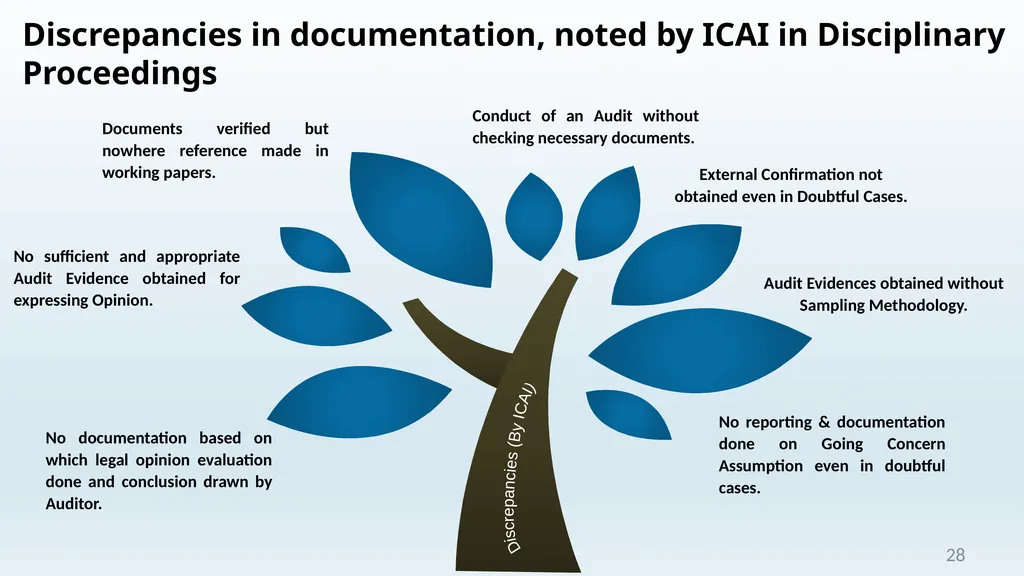
External Confirmation not obtained even in Doubtful Cases. Discrepancies (By ICAI) Discrepancies in documentation, noted by ICAI in Disciplinary Proceedings Audit Evidences obtained without Sampling Methodology. No reporting & documentation done on Going Concern Assumption even in doubtful cases. No documentation based on which legal opinion evaluation done and conclusion drawn by Auditor. No sufficient and appropriate Audit Evidence obtained for expressing Opinion. Documents verified but nowhere reference made in working papers. Conduct of an Audit without checking necessary documents. 28<br>
29
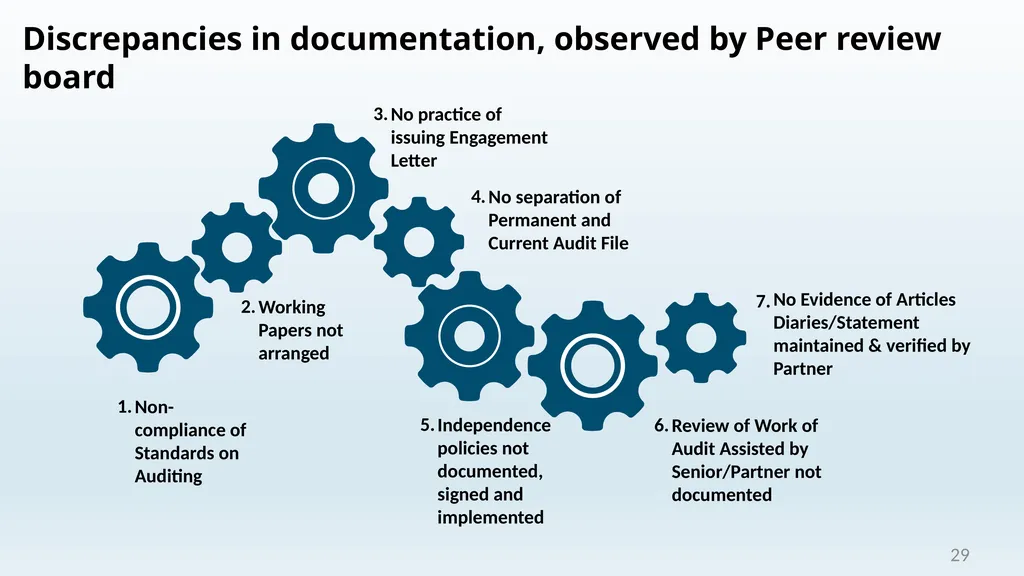
Discrepancies in documentation, observed by Peer review board 29<br>
30
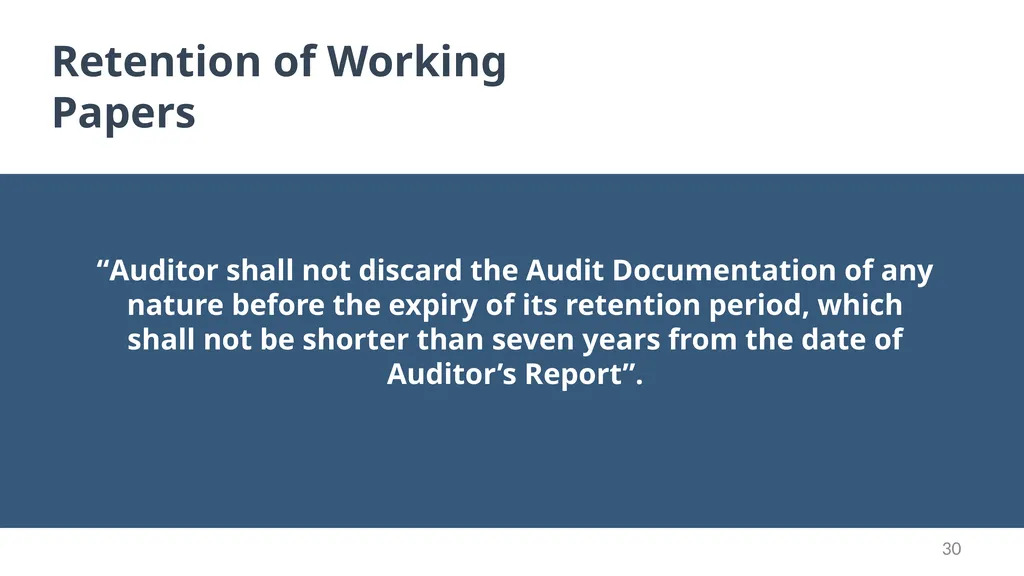
Retention of Working Papers 30<br>
31
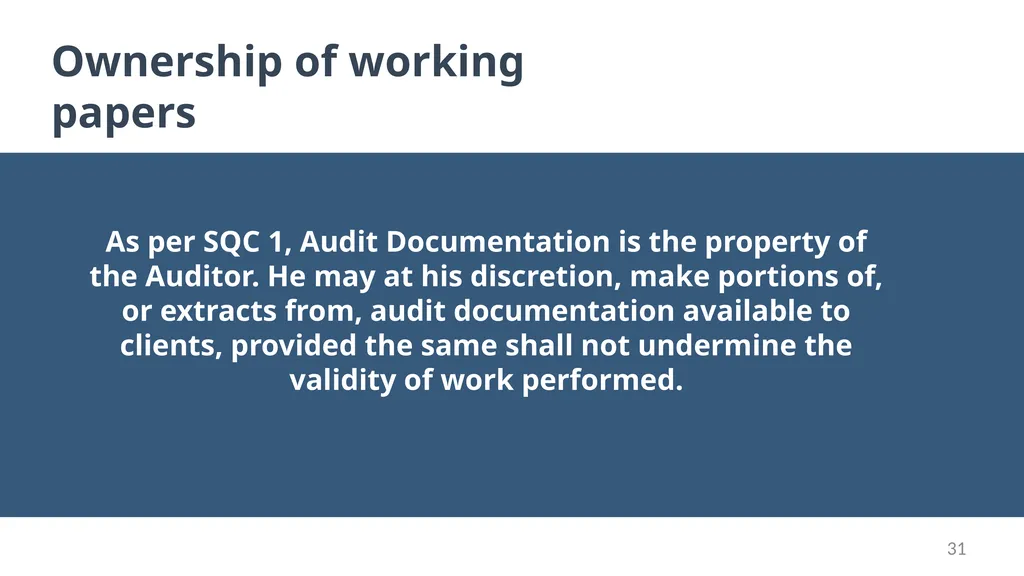
Ownership of working papers 31<br>
32
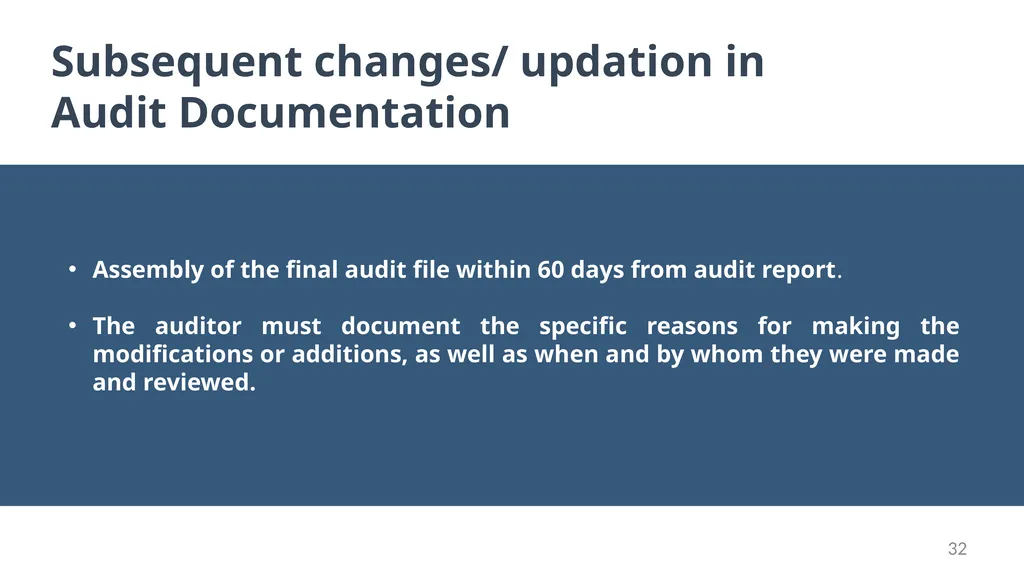
Subsequent changes/ updation in Audit Documentation 32<br>
33
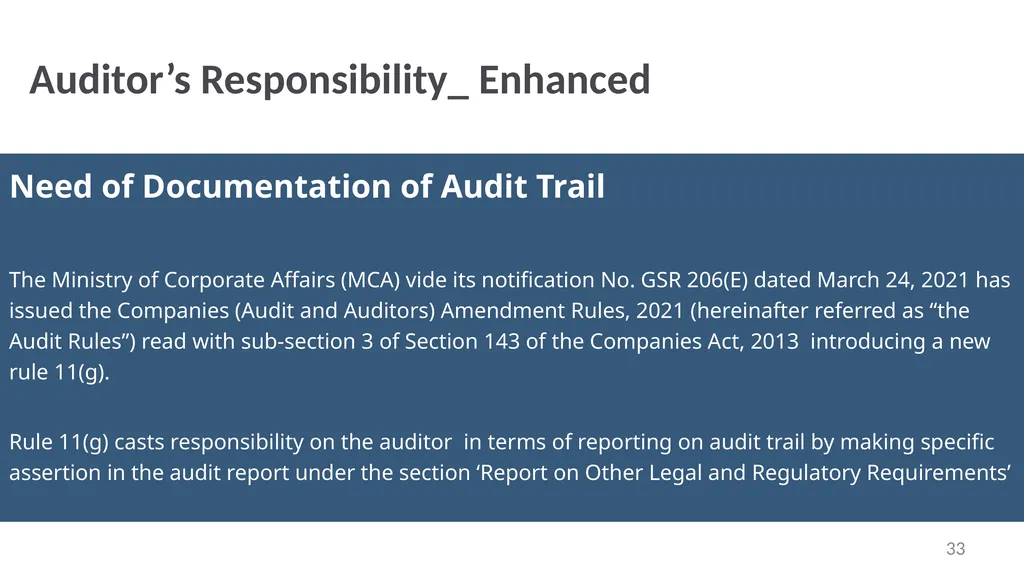
Auditor’s Responsibility_ Enhanced Need of Documentation of Audit Trail
The Ministry of Corporate Affairs (MCA) vide its notification No. GSR 206(E) dated March 24, 2021 has issued the Companies (Audit and Auditors) Amendment Rules, 2021 (hereinafter referred as “the Audit Rules”) read with sub-section 3 of Section 143 of the Companies Act, 2013 introducing a new rule 11(g).
Rule 11(g) casts responsibility on the auditor in terms of reporting on audit trail by making specific assertion in the audit report under the section ‘Report on Other Legal and Regulatory Requirements’ 33<br>
The Ministry of Corporate Affairs (MCA) vide its notification No. GSR 206(E) dated March 24, 2021 has issued the Companies (Audit and Auditors) Amendment Rules, 2021 (hereinafter referred as “the Audit Rules”) read with sub-section 3 of Section 143 of the Companies Act, 2013 introducing a new rule 11(g).
Rule 11(g) casts responsibility on the auditor in terms of reporting on audit trail by making specific assertion in the audit report under the section ‘Report on Other Legal and Regulatory Requirements’ 33<br>
34
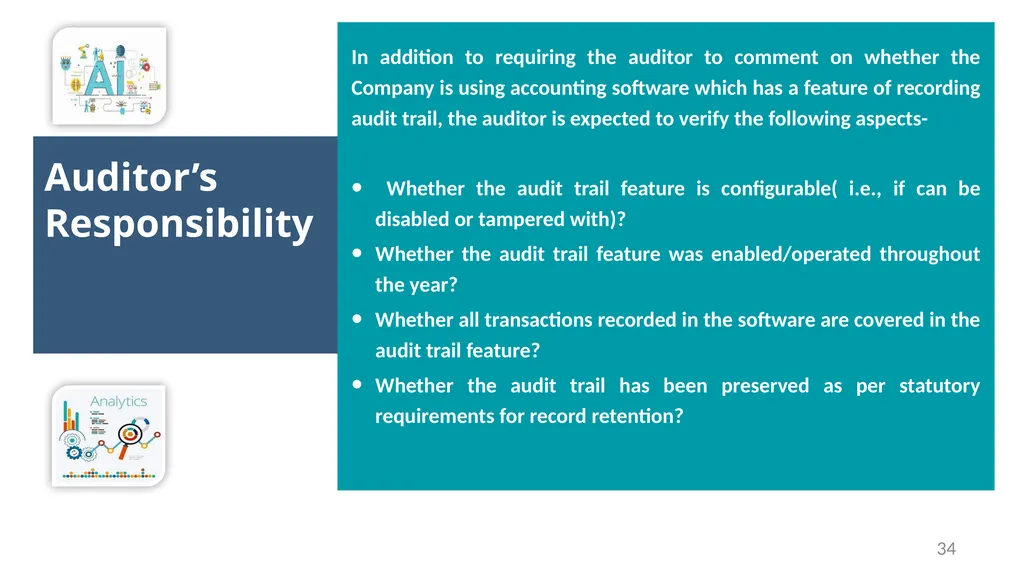
In addition to requiring the auditor to comment on whether the Company is using accounting software which has a feature of recording audit trail, the auditor is expected to verify the following aspects-
Whether the audit trail feature is configurable( i.e., if can be disabled or tampered with)?
Whether the audit trail feature was enabled/operated throughout the year?
Whether all transactions recorded in the software are covered in the audit trail feature?
Whether the audit trail has been preserved as per statutory requirements for record retention? Auditor’s Responsibility 34<br>
Whether the audit trail feature is configurable( i.e., if can be disabled or tampered with)?
Whether the audit trail feature was enabled/operated throughout the year?
Whether all transactions recorded in the software are covered in the audit trail feature?
Whether the audit trail has been preserved as per statutory requirements for record retention? Auditor’s Responsibility 34<br>
35
Since the auditor is required to report on the various aspects of the audit trail, the auditor may document the work performed on audit trail such that it provide:
A sufficient and appropriate record of the basis for the auditor’s reporting under rule 11(g); and
Evidence that the audit was planned and performed in accordance with the implementation guide on Audit Trail, applicable Standards on Auditing and applicable legal and regulatory requirements. Documentation_ Audit Trail 35<br>
A sufficient and appropriate record of the basis for the auditor’s reporting under rule 11(g); and
Evidence that the audit was planned and performed in accordance with the implementation guide on Audit Trail, applicable Standards on Auditing and applicable legal and regulatory requirements. Documentation_ Audit Trail 35<br>
36
Audit Documentation Regarding- Audit Trail Maintained
Audit Trail not Maintained
Discrepancies observed in Edit Log and conclusion thereof 36<br>
Audit Trail not Maintained
Discrepancies observed in Edit Log and conclusion thereof 36<br>
37
Companies use all accounting and related software that has a feature of audit trail which cannot be disabled
Accounting and other software must record an audit trail of every transaction, creating an edit log of each change made in the books of account along with the date when such changes were made and by whom. Audit Trail Maintained 37<br>
Accounting and other software must record an audit trail of every transaction, creating an edit log of each change made in the books of account along with the date when such changes were made and by whom. Audit Trail Maintained 37<br>
38
Audit Trail not Maintained Software having no Edit Log facility
Software having Edit Log Facility but can be disabled by the Company
Audit Trail not implemented on Supporting Software i.e. payroll software or stock software maintained by the entity linked to the books of account
Audit Trail not implemented by the third party(any other service organisation) maintaining the Company’s accounting software.
Multiple users are working on one login id. 38<br>
Software having Edit Log Facility but can be disabled by the Company
Audit Trail not implemented on Supporting Software i.e. payroll software or stock software maintained by the entity linked to the books of account
Audit Trail not implemented by the third party(any other service organisation) maintaining the Company’s accounting software.
Multiple users are working on one login id. 38<br>
39
39<br>
40
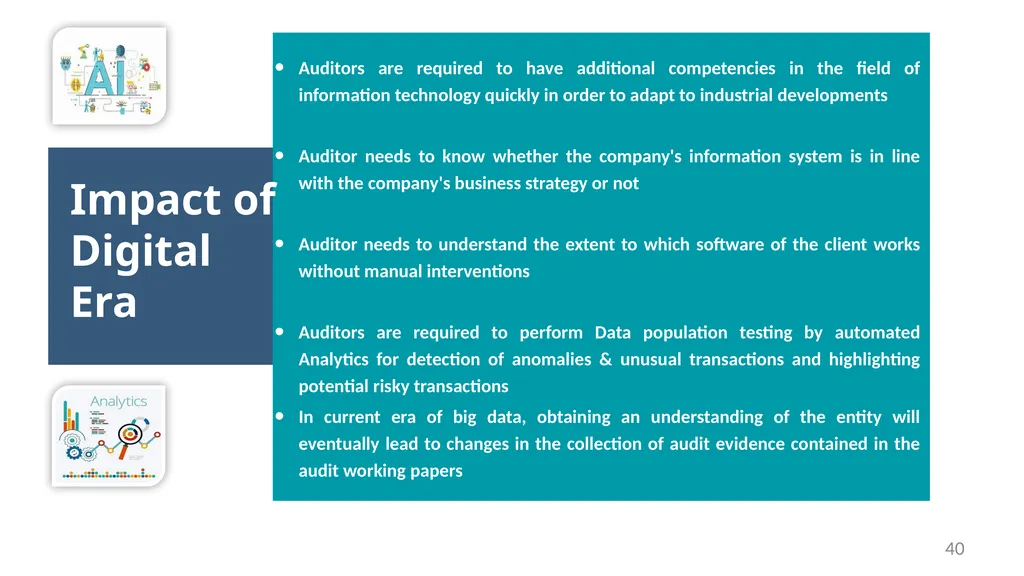
Auditors are required to have additional competencies in the field of information technology quickly in order to adapt to industrial developments
Auditor needs to know whether the company's information system is in line with the company's business strategy or not
Auditor needs to understand the extent to which software of the client works without manual interventions
Auditors are required to perform Data population testing by automated Analytics for detection of anomalies & unusual transactions and highlighting potential risky transactions
In current era of big data, obtaining an understanding of the entity will eventually lead to changes in the collection of audit evidence contained in the audit working papers Impact of Digital Era 40<br>
Auditor needs to know whether the company's information system is in line with the company's business strategy or not
Auditor needs to understand the extent to which software of the client works without manual interventions
Auditors are required to perform Data population testing by automated Analytics for detection of anomalies & unusual transactions and highlighting potential risky transactions
In current era of big data, obtaining an understanding of the entity will eventually lead to changes in the collection of audit evidence contained in the audit working papers Impact of Digital Era 40<br>
41
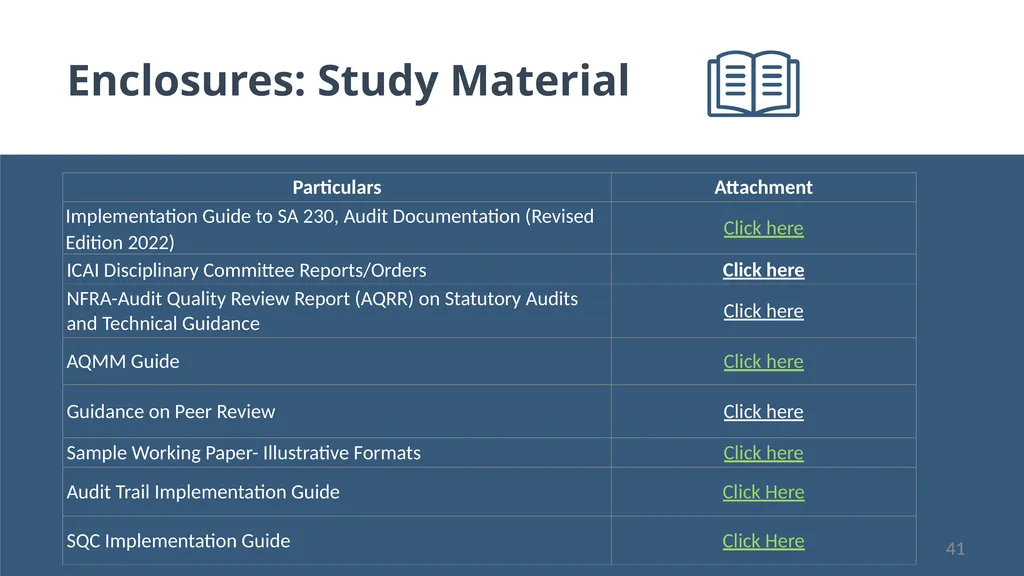
Enclosures: Study Material 41<br>
42
42<br>
43
For any queries please contact:
Bharat Sonkhiya
Mobile No. 91-9828443301
bharat@soganiprofessionals.com 43<br>
Bharat Sonkhiya
Mobile No. 91-9828443301
bharat@soganiprofessionals.com 43<br>