Non-violent Action: A Force for Change Lesson 2: Enquiring into violence and non-violence Starter Activity: Concept SPEC on violence Non-violentViolent Spectrum Read the examples of violent or non-violent actions and decide where to
"Non-violent Action: A Force for Change Lesson 2:" is the property of its rightful owner. Permission is granted to
download and print the materials on this website for personal, non-commercial use only, and to display it
on your personal computer provided you do not modify the materials and that you retain all copyright
notices contained in the materials. By downloading content from our website, you accept the terms of this
agreement.
Presentation Transcript
01
Non-violent Action: A Force for Change Lesson 2: Enquiring into violence and non-violence<br>
02
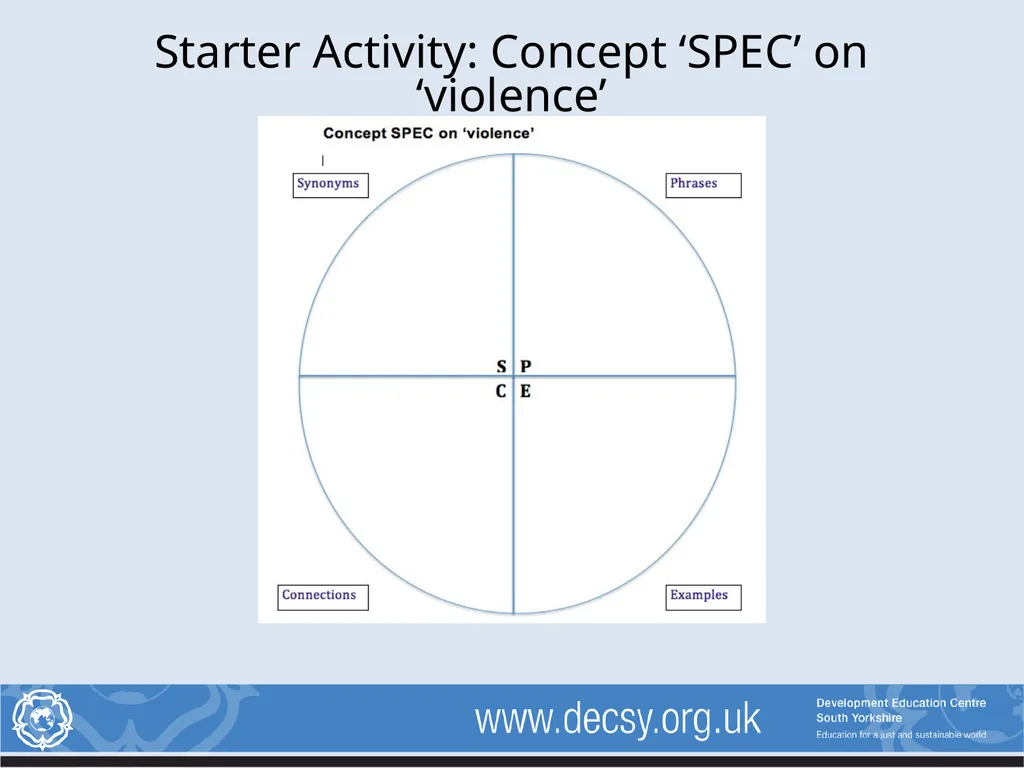
Starter Activity: Concept ‘SPEC’ on ‘violence’<br>
03
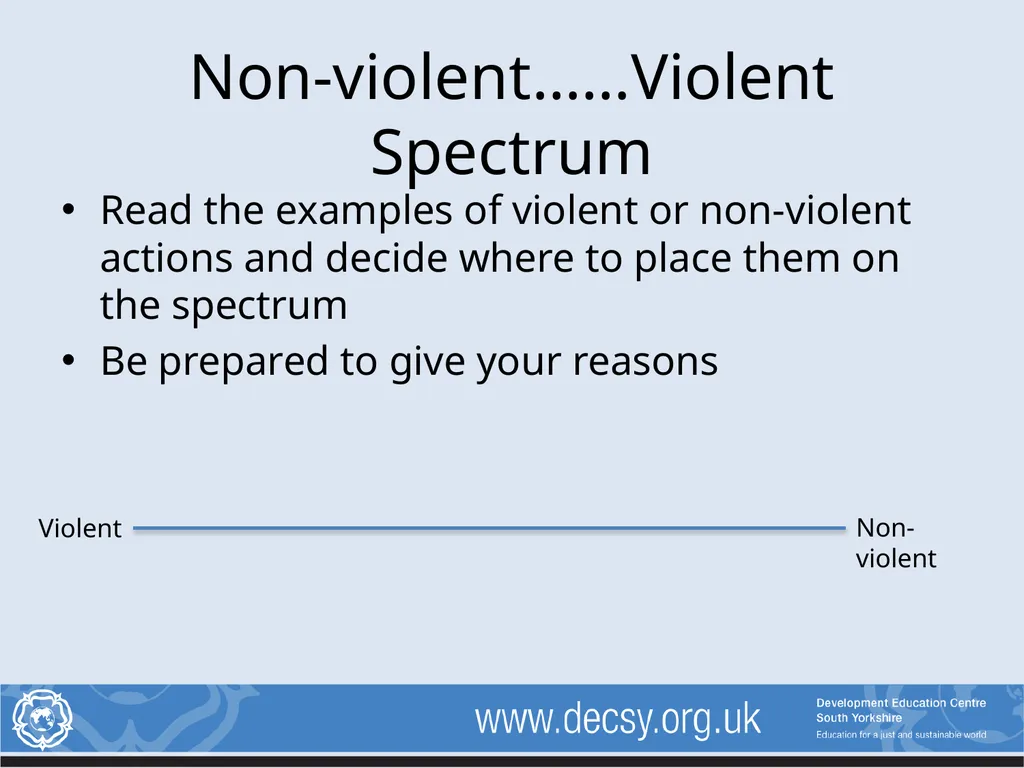
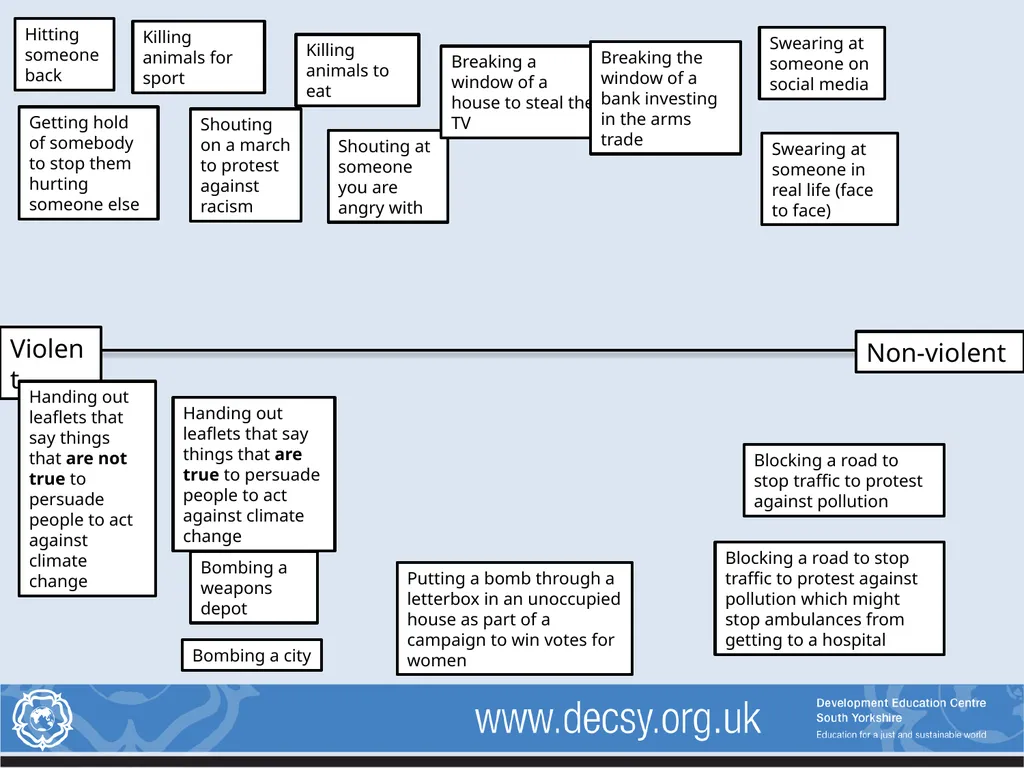
Non-violent……Violent Spectrum Read the examples of violent or non-violent actions and decide where to place them on the spectrum
Be prepared to give your reasons Violent Non-violent<br>
04
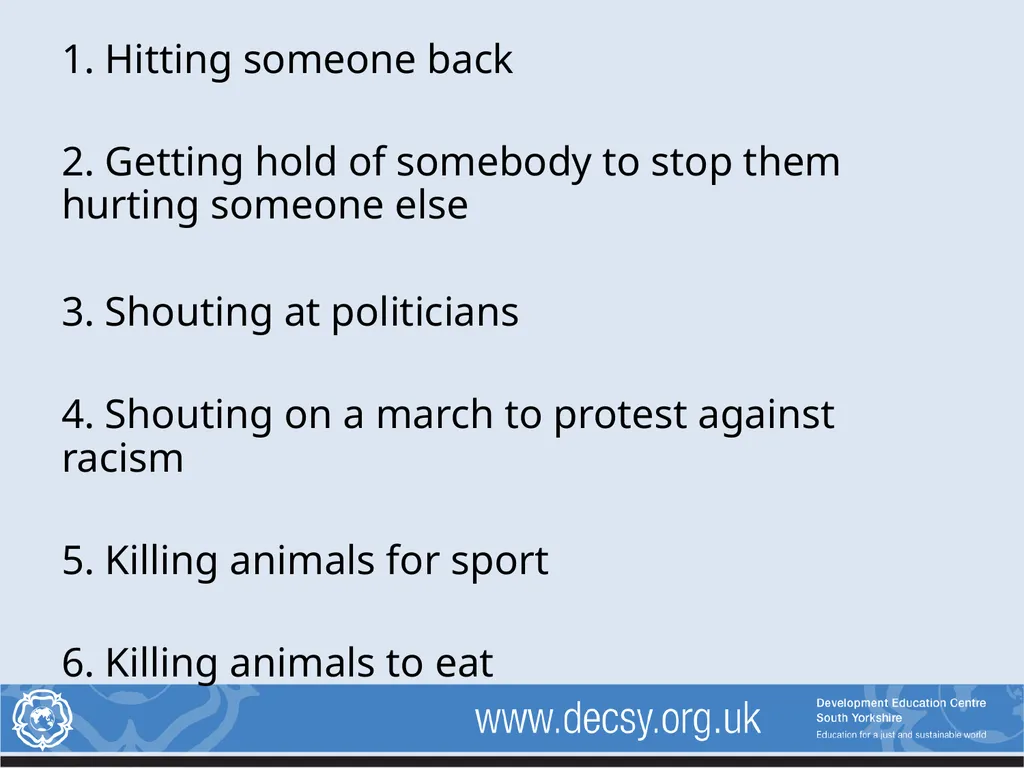
1. Hitting someone back
2. Getting hold of somebody to stop them hurting someone else
3. Shouting at politicians
4. Shouting on a march to protest against racism
5. Killing animals for sport
6. Killing animals to eat<br>
05
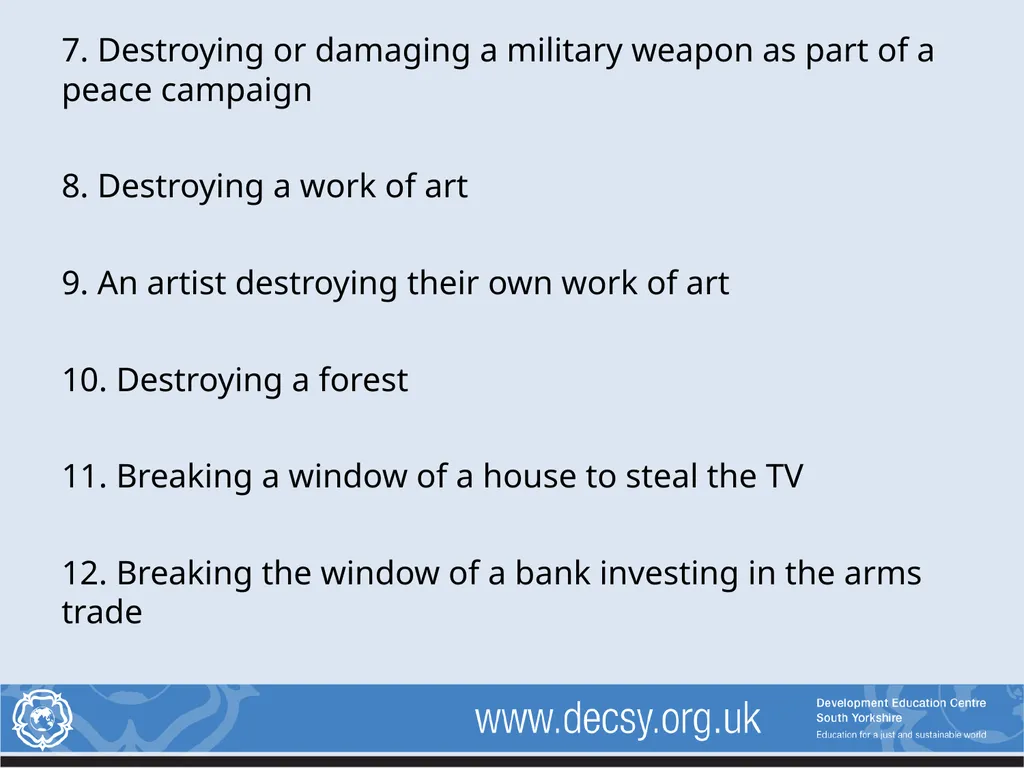
7. Destroying or damaging a military weapon as part of a peace campaign
8. Destroying a work of art
9. An artist destroying their own work of art
10. Destroying a forest
11. Breaking a window of a house to steal the TV
12. Breaking the window of a bank investing in the arms trade<br>
06
13. Bombing a city
14. Bombing a weapons depot
15. Putting a bomb through a letterbox in an unoccupied house as part of a campaign to win votes for women
16. Handing out leaflets that say things that are not true to persuade people to act against climate change
17. Handing out leaflets that say things that are true to persuade people to act against climate change<br>
07
18. Swearing at someone on social media
19. Swearing at someone in real life (face to face)
20. Blocking a road to stop traffic to protest against pollution
21. Blocking a road to stop traffic to protest against pollution which might stop ambulances from getting to a hospital.<br>
08
Violent Non-violent Shouting at someone you are angry with Killing animals for sport Getting hold of somebody to stop them hurting someone else Shouting on a march to protest against racism Killing animals to eat Breaking a window of a house to steal the TV Breaking the window of a bank investing in the arms trade Hitting someone back Bombing a city Bombing a weapons depot Putting a bomb through a letterbox in an unoccupied house as part of a campaign to win votes for women Handing out leaflets that say things that are not true to persuade people to act against climate change Handing out leaflets that say things that are true to persuade people to act against climate change Swearing at someone on social media Blocking a road to stop traffic to protest against pollution Blocking a road to stop traffic to protest against pollution which might stop ambulances from getting to a hospital Swearing at someone in real life (face to face)<br>
09
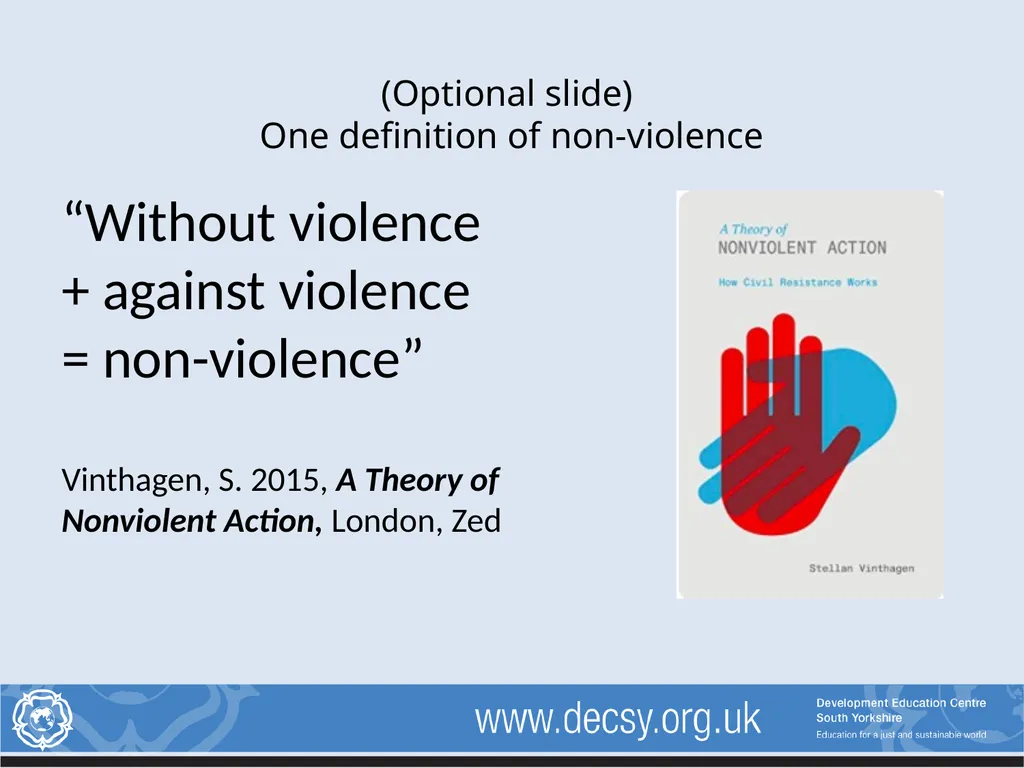
(Optional slide) One definition of non-violence “Without violence
+ against violence
= non-violence”
Vinthagen, S. 2015, A Theory of Nonviolent Action, London, Zed<br>
10
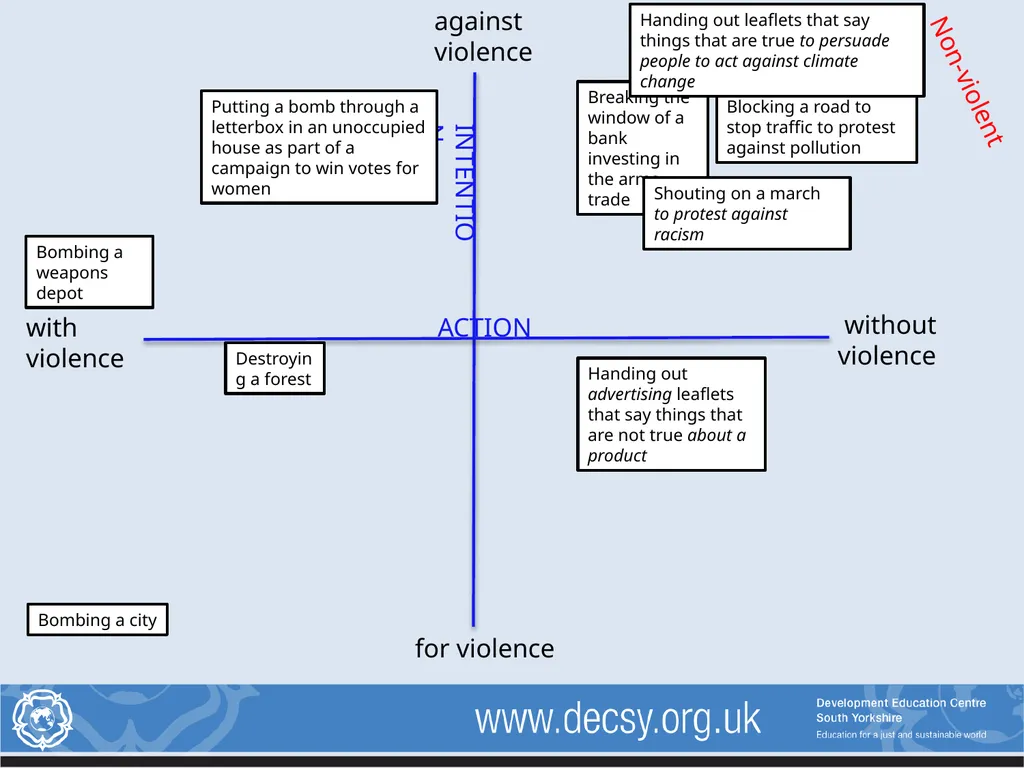
with violence without violence against violence for violence Non-violent ACTION INTENTION Blocking a road to stop traffic to protest against pollution Bombing a city Breaking the window of a bank investing in the arms trade Putting a bomb through a letterbox in an unoccupied house as part of a campaign to win votes for women Destroying a forest Shouting on a march to protest against racism Handing out leaflets that say things that are true to persuade people to act against climate change Bombing a weapons depot Handing out advertising leaflets that say things that are not true about a product<br>
11
Principles of non-violence In groups discuss one quote each about non-violence.
Identify any questions of clarification or words you don’t understand.
Find a way of explaining the quote so that other learners will understand it.<br>
12
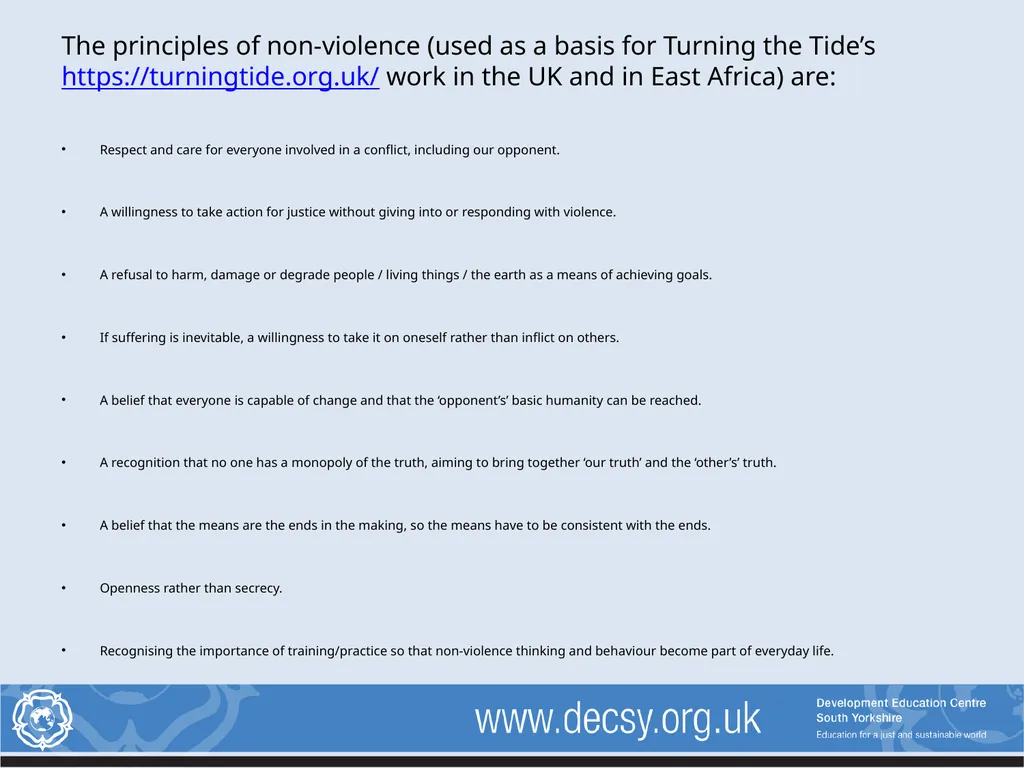
The principles of non-violence (used as a basis for Turning the Tide’s https://turningtide.org.uk/ work in the UK and in East Africa) are: Respect and care for everyone involved in a conflict, including our opponent.
A willingness to take action for justice without giving into or responding with violence.
A refusal to harm, damage or degrade people / living things / the earth as a means of achieving goals.
If suffering is inevitable, a willingness to take it on oneself rather than inflict on others.
A belief that everyone is capable of change and that the ‘opponent’s’ basic humanity can be reached.
A recognition that no one has a monopoly of the truth, aiming to bring together ‘our truth’ and the ‘other’s’ truth.
A belief that the means are the ends in the making, so the means have to be consistent with the ends.
Openness rather than secrecy.
Recognising the importance of training/practice so that non-violence thinking and behaviour become part of everyday life.<br>
13
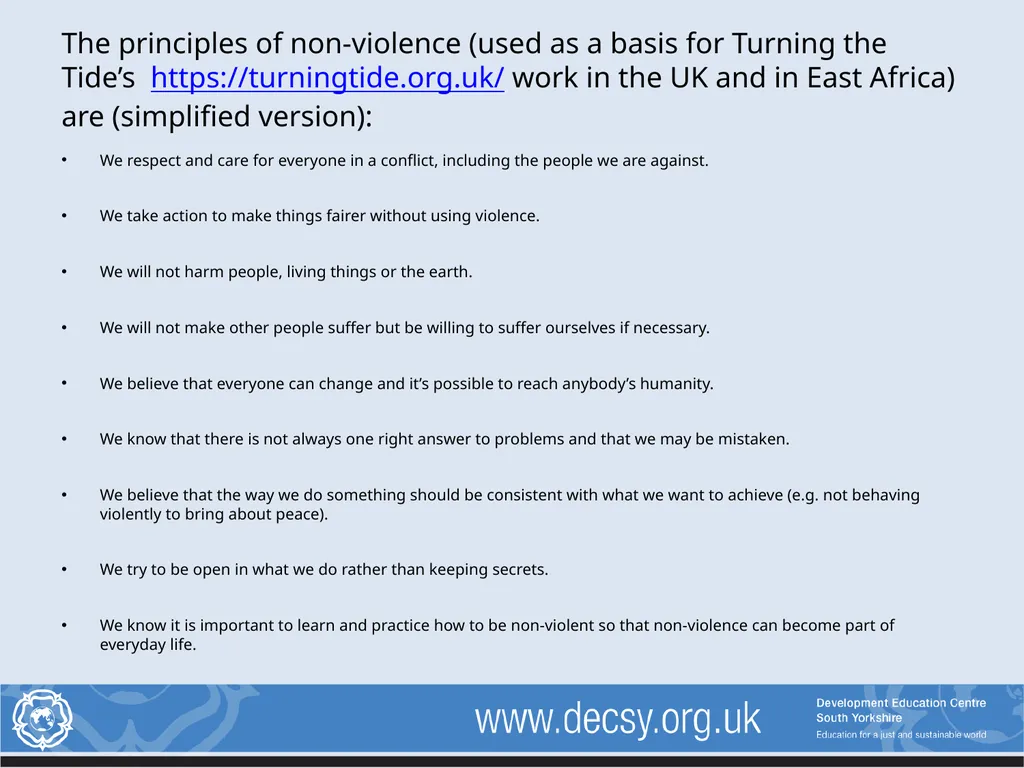
The principles of non-violence (used as a basis for Turning the Tide’s https://turningtide.org.uk/ work in the UK and in East Africa) are (simplified version): We respect and care for everyone in a conflict, including the people we are against.
We take action to make things fairer without using violence.
We will not harm people, living things or the earth.
We will not make other people suffer but be willing to suffer ourselves if necessary.
We believe that everyone can change and it’s possible to reach anybody’s humanity.
We know that there is not always one right answer to problems and that we may be mistaken.
We believe that the way we do something should be consistent with what we want to achieve (e.g. not behaving violently to bring about peace).
We try to be open in what we do rather than keeping secrets.
We know it is important to learn and practice how to be non-violent so that non-violence can become part of everyday life.<br>
14
What would these principles of non-violence mean in practice if they were used in:
School
Our local community
Our national community
Our global community?<br>